Categories
Christianity Today Europe Published Articles

Russia Restricts Churches in Ukraine. Divided Orthodox Critique Both.

Image: Photo courtesy of Mission Eurasia

Religious freedom is under threat in Ukraine. Some question by whom?

A Ukrainian delegation to last week’s International Religious Freedom Summit in Washington, DC, had a clear answer: Russia. Led by Sergey Rakhuba, president of Mission Eurasia, it presented “Faith Under Fire,” a December report detailing the crimes of war in eastern Ukraine and elsewhere.

“Faith communities are under incredible pressure in occupied territories,” he told CT. “The ideology of the Russian world is to completely monopolize religion.”

International lawyer Robert Amsterdam, however, warned that Ukraine was attempting the same control over one half of its divided Orthodox church.

Initial legislation passed by the Ukrainian parliament in October, he said, threatened to “ban” the historic Ukrainian Orthodox Church (UOC), the branch canonically linked to the Russian Orthodox Church (ROC) patriarchate in Moscow. In response, Amsterdam sent a 25-page dossier to the US, UK, and European Union heads of state on the UOC’s behalf.

“There is now a very serious question mark over whether Ukraine can meet its commitments to human rights and the rule of law,” the dossier stated. “This will have dire ramifications for Ukraine’s entry into the European Union and its place in the Western world.”

The authors of both reports share a common enemy.

Mykhailo Brytsyn, the lead author of the Mission Eurasia report, is a Ukrainian pastor who was previously arrested by the Russians during a worship service in Melitopol, occupied by Russia since March 2022. He was later exiled, and the army seized his church and turned it into a military base. Amsterdam, a Canadian lawyer with offices in DC and London, was also previously arrested in Moscow for defending Russian dissidents and subsequently banned from the country.

The United Nations is monitoring both Russia and Ukraine.

At a November meeting of the body’s security council, the UN assistant secretary general for human rights noted the yet-to-be finalized law in Ukraine and chided the country for failing to properly investigate 10 documented cases of violence at houses of worship, instigated by the Orthodox Church of Ukraine (OCU) against the Moscow-linked UOC.

The OCU was granted autocephaly—national independence—by Ecumenical Patriarch Bartholomew I of Constantinople in 2019, supported by the United States under the principle of religious freedom. But the move was rejected by the ROC, which continued in ecclesial jurisdiction over the UOC.

The UN official, Ilze Brands Kehris, continued her testimony to state that Russia is violating international norms by applying its own law in occupied territory, detailing restrictions on minority believers.

Rakhuba noted that there are many such restrictions.

“This war is not just territorial, it is ideological,” he said. “Religious freedom is missing from Russian terminology.”

Citing a concept called Russki Miir—“Russian World”—Rakhuba, a Ukrainian who previously worked with the Union of Evangelical Christian Baptists in the Soviet Union, contended that the ROC works hand-in-hand with the Kremlin to marginalize other Christian denominations. Since the invasion, the Russian military authority in the occupied Donbas region has steadily replicated that formula.

Rakhuba described three phases. In the first, from the January 2022 invasion until April of that year, the Russian army…

This article was originally published at Christianity Today on February 6, 2024. Please click here to read the full text.
Categories
Christianity Today Europe Published Articles

Photos Show Ukraine’s Bible Belt Struck Down But Not Destroyed

Image: Joel Carillet
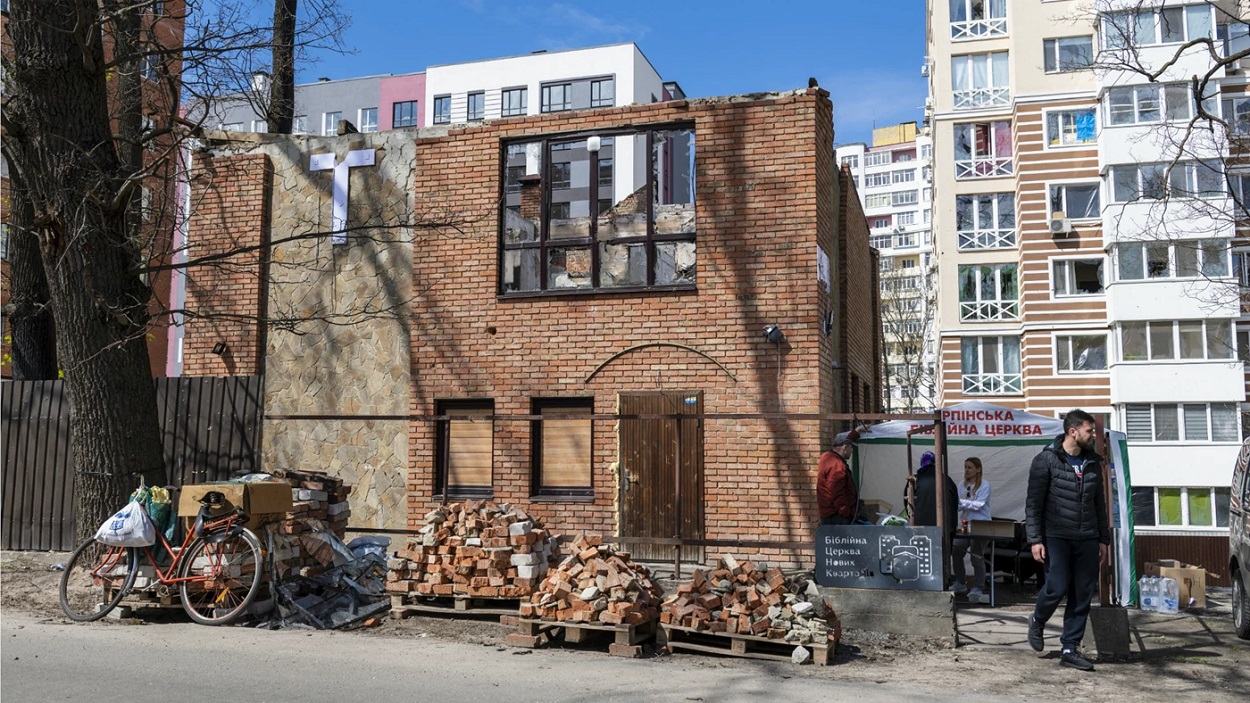
A Baptist church plant in Irpin, Ukraine, damaged during the Russian invasion

Ministry had been going so well in Irpin, Ukraine.

Over the past decade, the population of Kyiv’s northwest suburb swelled to 90,000, and Irpin Bible Church (IBC) grew with it. The Baptist congregation grew to include 700 adults, with an additional 300 children. And in 2019, 12 members launched a church plant in the “New Blocs” neighborhood, where 15,000 Ukrainians lived in multi-story apartment complexes with no church of any kind.

Meeting previously in a basement office, last December the church planters purchased a stand-alone building from a local bank, grateful to have their own location amid a shortage of rental space. With a ground-floor capacity of 200 people, the congregation’s 60 members anticipated additional growth.

Three months later, the Russians invaded.

Hostomel was the first suburb to fall, being home to the regional airport. The assault on Irpin and neighboring Bucha began February 27, attempting to encircle Kyiv.

IBC senior pastor Mykola Romanuk was in the US at the time, while his family relocated to western Ukraine. He returned on March 5, only to leave later that day when tanks first breached the suburb. The next day, a member of his congregation who had returned to Irpin to assist with evacuations was killed alongside a mother and her two young children—a tragedy witnessed and shared worldwide by The New York Times—as Russian forces shelled the humanitarian corridor.

By March 14, Russia occupied half the suburb, including the church plant’s quarter. IBC’s sanctuary remained secure, but 200 of its members fled to 20 nations across Europe, while another 500 scattered across western Ukraine. Romanuk was in Rivne, 200 miles west of Kyiv, with about 70 of his congregants. Services resumed online while the stalwart faithful tried to serve 4,000 mostly elderly residents left behind in Irpin.

Dozens were killed in Russian atrocities.

On March 16, Ukraine announced a counterattack. The army recaptured the suburb on March 28. But fighting continued in Bucha for another two days, during which time Russia increased its seemingly random barrage of missiles into Irpin. One hit the church plant, destroying its roof and the second floor Sunday school classrooms.

There were no military personnel in the area.

“Any building can be rebuilt,” said Romanuk. “Compared to the destruction of the city and the many who died, it is no big deal.”

While some Ukrainian Protestants see church buildings as holy, he added, the majority Orthodox Christians view sanctuaries as a sacred space to connect with God, imbued with divine aura. No food is allowed inside; certainly not a bathroom toilet.

This has impacted relief efforts. Of the eight Orthodox churches in Irpin, only two had service annexes. Though only one was damaged—and its priest killed in an airstrike—it was only the annexes that opened to shelter their neighborhood members, he said. One Orthodox priest tried to help more broadly.

“In our theology, the church is a place for service and worship,” said Romanuk. “Now it has become a home for the homeless, catering to the needs of all.” Leading IBC since 2009, he returned with his wife and daughter on April 3, living in the church basement with…

This article was originally published at Christianity Today on May 13, 2022. Please click here to read the full text.