Categories
Acts 2:11 Americas Published Articles

The Difficulty of ‘Do Unto Others’

Arabic Golden Rule
The Golden Rule, in Arabic

As Christians involve themselves – for good and for bad – in the divisive politics and cultural struggles of our nation, it is assumed they do so to preserve and advance a moral ethic consistent with Scripture.

Unfortunately, it can be easy to forget one of the central marks of this morality: ‘Do unto others, as you would have others do unto you.’

This command, and it is necessary to remember it is an active imperative, concerns many issues of the day. I would submit that current Muslim-Christian relations illustrate this selective memory, and the Middle East provides a useful mirror.

In the Arab world it is Christians who are the great minority. How do they describe their situation? Much like in America, there is considerable nuance.

It must be said at the outset that the comparison will not be exact. The US enshrines religious freedom for the individual and forbids a religious test for public office. While these concepts are not absent from the Arab world, they are mixed in with many constitutions that enshrine Islam as the religion of the state and sharia law as the basis of legislation. At the official level these articles can complicate matters considerably.

But what about the popular level?

To be certain there is a spirit that, while tolerating Christianity, strives to preserve and advance the Islamization of society. Some conservative Muslims argue that Christians should not be greeted on their holidays, lest it imply endorsement of false theology. Others warn their children against playing with Christians at school. And many Christians complain of discrimination that is mixed in with a general culture of nepotism.

But Christians the region over also speak of neighborly relations with normal people who happen to be Muslims. Post-Arab spring, many Arab governments are going out of their way to combat extremism that has crept into society. And as reflected in my recent article in Christianity Today, many Arab Christians are comfortable saying they and their fellow Muslim citizens worship the same God.

Yet the article also described an undercurrent of frustration, that Christians feel internally compelled to seek common theological ground in order to secure common societal acceptance. The more some push the distinctiveness of Christianity, the more they fear either government or popular response.

Within the diversity of these Arab responses there is also advice for America and the West: Limit the presence of Muslims in your midst.

The complaint is not so much against Muslims as a people, but of Islam as a religion. The more devout the practice, they say, the greater the enthusiasm to enact its superiority – not just in the afterlife, but to bring this world into conformity as well. As evidence, they simply point to their own societies.

Whatever is made of the ‘same God’ debate, Islam and Christianity are different religions. But different also is the historical fusion between these religions and their respective societies. It is good to learn from our Arab brothers and sisters in Christ about their experience with Islam where they are the minority. But the point here is not so much to arm with argument but to invite readers to flip the script and see within it a mirror to their own society.

How might American Muslims feel about our current social and political climate? Would they say most neighbors treat them well? Would they complain they have to accommodate their faith to a dominant culture? Would they state a concern over discrimination or a fear of rejection?

Many Arab Christians have responded to their challenges by withdrawing into their own communities. Are American Muslims tempted to do the same?

And what of the warning some Arab Christians issue about Islam? How similar is it to some Muslim warnings about decadent Western society and the Christianity that is powerless to arrest it? Or, others argue, the Christianity that is in league with colonialism or Zionism or consumer capitalism to radically alter the fabric of Muslim society?

Let every charge be answered, and every religious ideology be examined. But let every American Christian return to the imperative of Christ:

“Do unto others as you would have others do unto you.“

Consider the situation in which Middle Eastern Christians live and ask, how would you like this ‘you’ to be treated?

It is not argued that treating American Muslims well will necessarily make any difference to the Egyptian Copt, the Lebanese Maronite, or the Iraqi Assyrian. But any mistreatment of Western Muslims is often reported in the regional press, and gives fuel to those with an axe to grind.

The Golden Rule is not about quid pro quo. It is fulfillment of the law of Christ, who served those who loved him not. Please be mindful, for concerning Muslims it is often we who so rarely love.

This article was first published at Acts211.org.

Categories
Lapido Media Middle East Published Articles

Egypt Exports Interfaith ‘Bridge’

Azadeh Ghotbi
Azadeh Ghotbi

IN IRAQ, ISIS zealots smash centuries-old artifacts and blow up churches. In Yemen, Shia militias plough through cities as Sunni neighbour Saudi Arabia rains down missiles.

Egypt is not without its own religious tension, but a timely interfaith art exhibition in Cairo intersects with perhaps the only potentially good news coming out of the region.

Iran may be rejoining the international community, and Iranian-born Azadeh Ghotbi is coming to London.

Born a Muslim, educated in a Catholic school and married to an atheist beside a Jewish bridesmaid, Ghotbi has lived in five countries across three continents.

Her parents fled the Islamic Revolution when she was a child.

Today,Ghotbi is one of 47 premier and emerging artists featured at the CARAVAN visual arts exhibition. Founded in Cairo in 2009, its yearly offerings travel the world, dedicated to the message of interreligious peace and cultural understanding between East and West.

‘I jumped at the opportunity to participate in this noble mission,’ Ghotbi told Lapido Media. ‘I highlight in my art that strength and beauty come through openness to the “other” and the cross-fertilisation of differences.’

Soar

[Change your viewpoint. Photo: Sixpillars.org]

Her piece is entitled Crossroads, and her message fits perfectly with the theme of the exhibition, The Bridge.

‘I have suffered the consequences of religious obtuseness,’ she wrote in her artist’s statement, ‘but have benefitted immensely among open-minded souls from diverse religious backgrounds.’

Ghotbi’s art has been exhibited in top galleries in Europe, the United Statesand Iran. The last of these has informed several pieces.

In the Name of Freedom interlocks the E’s to symbolize encaged rights and restrained voices. The Trappings of Theocracy is constructed with unpainted, faceless miniature figurines.

They are not Iran-centric, Ghotbi said, as oppression is not limited to one country.

But in Give Peace a Chance to Soar, she directly critiques her country of origin.

Faced straight on, the black letters of peace are hard to read behind the iron bars of a cage. But the inset of the letters is radiant turquoise, a colour she associates with the beauty of Iran, and only visible if you changeyour viewpoint.

‘As for the small fragile turquoise bird that represents hope, peace and freedom for us all,’ she explains,‘I left the cage door ajar for it!’

Ghotbi crafted Peace in 2013, eager for change.

Savvy

Two years later, Ghotbi is enthusiastic about the framework agreement signed by Iran and Western nations. As Tehran reduces its nuclear capabilities and allows comprehensive inspections, international sanctions will be gradually eliminated.

Sanctions have disproportionately hurt the poor and middle class, she said, while strengthening the political hand of the hardliners. The US Congressional Research Service reported a five percent contraction of the Iranian economy in 2013 along with a 56 percent currency devaluation and a 45 percent rise in the rate of inflation.

‘What Iran needs eventually is political change from within,’ said Ghotbi. ‘It’s youthful and highly educated population is quite savvy, but desperate for more freedom and better economic opportunities.’

CARAVAN founder Paul-Gordon Chandler echoes Ghotbi’s optimism.

‘I am very pleased about the deal going ahead,’ he told Lapido Media. ‘We have to work toward peoples coming together.

‘Opening up Iran, which it will do, allows more people to experience the “other”, on both sides.’

Indirect

An American, Chandler grew up as a minority Christian in mostly Muslim Senegal. He was deeply influenced by the local arts scene, but also disturbed by the tensions between the two faiths.

It was not until his ten years as an Episcopal priest in Cairo’s historic St. John’s Church that a vision began to form. Initially, CARAVAN was held only in Egypt, but over the past two years more than 300,000 have viewed the traveling exhibition in London, New York, and Washington, DC.

This year, The Bridge opened at the oldest church in Paris, the Eglise Saint Germain-Des-Pres, during the United Nations week for interfaith harmony. Following its current station in Cairo it will move to St Martin-in-the-Fields, Trafalgar Square from June 1 – July 31.

But CARAVAN is not intended only for the Western elite, as important as it is for them to see this example of cooperation between Arabs, Persians, Muslims, Christians, and Jews. The exhibition will travel also to rural areas in the United States, where misunderstanding of the Middle East is prevalent.

‘Art provides a context to address issues indirectly,’ Chandler told Lapido Media. ‘  It provides an atmosphere of contemplation and discussion that is neutral, when being direct causes tensions to rise.’

And in the Middle East, where spin-off projects are in development in Jordan, Tunisia, and Malta, the indirect approach of art can make all the difference.

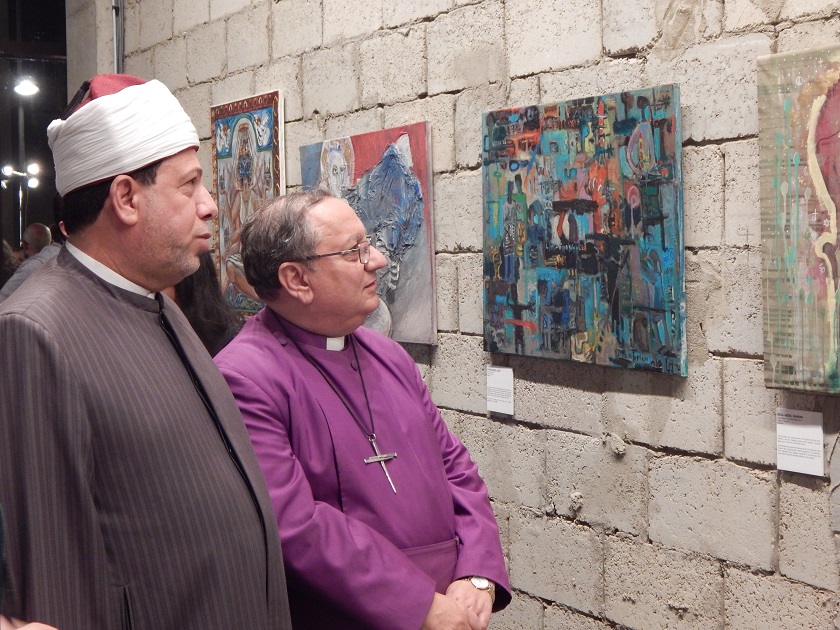
Sheikh Abdel Aziz of the Azhar and Bishop Mouneer of the Anglican Church, observing the CARAVAN artwork.

According to Bishop Mouneer Hanna Anis, archbishop of the Anglican diocese of Egypt, structured efforts at dialogue between religious professionals have not impacted reality.

‘We have to be creative so that dialogue reaches the people,’ he said at the exhibition opening in Cairo. ‘Paul-Gordon has done this through art, to help build harmony between cultures, and to bring people together.’

The Middle East needs CARAVAN, Ghotbi believes, but art is not enough.

Education, jobs, and women’s rights are necessary to ease religious clashes between groups that used to coexist peacefully.

Chandler agrees, noting that transformation through art is a long term process.

‘Art doesn’t stop conflict, but that is not its function,’ he said. ‘It can’t change events but it can change people.’

However much the Middle East needs this message, it can also export the example. 47 artists are living testimony.


This article was first published at Lapido Media.

Categories
Audio

Podcast: On the Middle East, Christians, and ISIS

The Way Home - Dan DarlingThis week I had the opportunity to appear on ‘The Way Home‘ podcast, hosted by Dan Darling. Darling is the Vice President for Communications at the Ethics and Religious Liberty Commission of the Southern Baptist Convention, and he invited me to share about current events in the Middle East and in particular how they are impacting Christians. Here is his introduction:

All of us have reacted with horror at the atrocities committed by the terrorist group ISIS upon Christians in the Middle East. How can Christians pray? How should we think about ISIS?

Today on The Way Home I talk with Jayson Casper, a Christianity Today journalist who has been covering this story. He called me from Cairo to discuss how Christians in places like Egypt, Jordan, and other countries are reacting to the atrocities of their brothers and sisters in Syria and Iraq and Libya. He also gives a thorough analysis of ISIS and Islamic extremism.

Our conversation lasted about half an hour, touching on various questions. Is ISIS Islamic? How are Christians responding? How should Western Christians pray?

Please click here to open a new window and listen to the podcast.

Categories
Excerpts

The Case against Qatar

Qatar

A recent Foreign Policy investigative report details Qatari foreign policy. It describes a strategy of intervention-by-proxy, which keeps its hands clean officially while funneling money to groups it deems ideologically similar, that is, those they can trust.

Primarily, this has been the Muslim Brotherhood and various activist Salafi factions.

The article is long but worthy, and one interesting section describes how Qatar has helped the US disengage from the region. This was evident in Libya, when Qatar not only provided crucial Arab support for the operation, but also took the lead in sponsoring militia groups against Gaddafi.

But now that the US is reengaging the region, this time against the Islamic State (ISIS), officials are examining anew the sponsorship by Qatari individuals and charities which have gone to the al-Qaeda affiliated al-Nusra Front. Following three years or more of looking the other way, the dispute has become public:

In Syria, meanwhile, it wasn’t until the Islamic State gained prominence that Washington sat up and took notice. In March, David S. Cohen, the Treasury Department’s undersecretary for terrorism and financial intelligence, took the unprecedented step of calling out the Qataris in public for a “permissive terrorist financing environment.” Such stark criticism, counterterrorism experts say, is usually left for closed-door conversations. A public airing likely indicated Doha wasn’t responsive to Washington’s private requests.

But if initial requests were private, that means the US – for a long while, at least – tolerated and possibly approved of the general strokes of Qatari foreign policy. Two key aspects of Qatar’s leverage over the United States include its hosting of the US Central Command air base, as well as the usefulness of its network to liaison with otherwise disreputable characters. Discussions with the Taliban in particular have often flowed through Qatar. Without them, back-door channels would not be possible; hostages released might still be held.

Has the US, therefore, been a partner in the wanton destruction of Syria? President Obama has forcefully spoken against Assad, but has never decisively moved against him. The article deems the chaos there less to be a result of coordinated conspiracy, than uncoordinated incompetence:

In other words, there was no one winner. Qatar and other international powers haphazardly backed dozens of different brigades and let them fight it out for who could secure a greater share of the funding. They had few incentives to cooperate on operations, let alone strategy. Nor did their various backers have any incentive to push them together, since this might erode their own influence over the rebels.

Says one analyst:

“One of the things about Qatar’s foreign policy is the extent to which it has been a complete and total failure, almost an uninterrupted series of disasters,” says Hussein Ibish, a senior fellow at the American Task Force on Palestine. “Except it’s all by proxy, so nothing bad ever happens to Qatar.”

Except its reputation in much of the Arab world. Egyptians in particular have been furious at Qatar over its support for the Muslim Brotherhood. Saudi Arabia and the United Arab Emirates have signaled displeasure in manners unusual among Gulf monarchies.

Long ago Qatar made a bet on the Islamist factions becoming the prominent power players in the region. For a while they seemed vindicated; now they appear in retreat. Qatar has been publicly acquiescing to the criticism, sending away top Brotherhood figures it has long hosted, for example, but it is unclear if its long term strategies have changed.

Were Qatar and its allies-by-proxy simply outmaneuvered? How much of the Arab Spring was manipulated by the regional and international power struggles? What role did America have is a key question. Most Arabs view Washington as the chief puppet master, allowing its public allies – the Saudis, Turks, UAE, Qatar, and Israel, of course – to mess around with local sovereignty.

Or, did the US just pull back, and allow others to run the show? Either way, the result is a disaster, however many parties share in the blame.

One other controversial point converges with this article. Many Egyptians see the Muslim Brotherhood as one aspect of an Islamist agenda that includes and coordinates with groups like ISIS, on the far end of the spectrum. The point is not necessarily that the MB keeps its hands clean while sending out clandestine orders to others to ferment chaos – though this is certainly believed locally.

But if the Brotherhood is one part, and a key part, of Qatar’s proxy network, a linkage does seem to exist. This article does not make the accusation, and I do not wish to lend it weight in the mentioning. But it bears consideration.

Of course, Brotherhood sympathizers simply turn the equation on its head. They see Qatar as the good guy, standing with the people and the forces of democracy, against fearful Gulf monarchies, their own proxies, and the US.

God bless this part of the world. Maybe one day the oil will run out and they can all be left alone again.

Categories
Excerpts

They Really Do Hate Us … at Least on Twitter

From AhramOnline, on research analyzing Twitter:

In the case of Egypt, the researchers analyzed more than 2.2 million Arabic tweets that mentioned the United States and found just three percent could be termed pro-American, with 23 percent neutral and the majority critical of the United States.

Ok, so they hate our foreign policy – no big news there. But the following is more disturbing:

By contrast, about 30 percent of those tweeting in Arabic about Hurricane Sandy expressed concern about Americans or defended Americans.

Only 30 percent? Ugh. I hope there is some confusion in reporting or answering, between ‘concern’ and ‘defended’. But this doesn’t reflect well, I’m afraid.

So how to interpret the general conclusion:

“Reactions to cases where the US is influencing Middle Eastern affairs are 95 percent to 99 percent negative,” Keohane said.

Is our foreign policy just really bad? Or are we inept at PR, at least in comparison to local outfits? The research showed these numbers hold no matter what side of the domestic divide these tweets support.

I generally think that ‘winning hearts and minds’ is an overblown concept. But in as much as it is a policy goal, the US is failing miserably … at least on Twitter.

Categories
Christianity Today Middle East Published Articles

175 Leaders Urge US Support in Christianity’s Historical Heartland; Egyptian Churches Not So Sure

From the Ethics and Religious Liberty Commission

From my latest article in Christianity Today, published May 9, 2014:

More than 175 Christian leaders crossed denominational and political divides this week to urge the United States government to do more to help the rapidly diminishing, historic Christian populations of Syria, Iraq, and Egypt.

The solidarity pledge—signed by National Association of Evangelicals (NAE) president Leith Anderson, Focus on the Family founder James Dobson, Southern Baptist Theological Seminary president Al Mohler, and Samaritan’s Purse president Franklin Graham, among other prominent names—presented on Capitol Hill asks for the appointment of a special envoy on Middle East Religious Minorities, a review of foreign aid, and refugee and reconstruction assistance.

“These defenseless religious communities are facing an existential crisis, which threatens their very survival in the lands they have inhabited for centuries,” said Rep. Frank Wolf (R-VA), a longtime religious freedom advocate who helped create the U.S. Commission on International Religious Freedom (USCIRF) in 1998. “The faith leaders … recognize that unless the American church begins to champion this cause, the foreign policy establishment will hardly lead the way. They are committing to be their ‘brother’s keeper,’ whether in Nineveh, Cairo or Homs.”

But Egyptian Christians have a longstanding reticence about outside help:

“We value so much the prayers and concerns of our Christian brethren around the world, and in the U.S. especially,” said Fawzi Khalil, pastor at Kasr el-Dobara Church in Cairo, the largest evangelical congregation in the Middle East. “But we don’t believe outside pressure would be best for our daily life with our Muslim friends. The government of Egypt with local Christian leaders are best suited to fix our problems.”

Please click here to read the full article at Christianity Today, including testimony from other Egyptian Christians and one US Copt who is a signatory.

Categories
Excerpts

Egypt for Expats… Ugh?

Expat Map

We like it here, but many people don’t, it seems. From the Washington Post, reporting on a survey by HSBC bank:

The worst of these 34 countries to be an expat is Egypt, which has seen xenophobia rise considerably since this summer’s military coup and wave of populist nationalism.

East Asian nations rank highest, and among the lowest are Western European. The Middle East doesn’t fare well in general:

Middle Eastern countries tend be worse places for expats, owing to legislation that makes it tougher for foreigners to own property and to formal and informal social restrictions that can cut back on quality of life. The exceptions are Bahrain and Qatar, two very wealthy and very small Gulf states whose governments work to attract the wealthy expats they see as crucial to building businesses there. It should go without saying that HSBC’s study does not consider “guest workers” in its measurements. Gulf states, particularly Qatar, have notorious reputations for mistreating migrant laborers from South and Southeast Asia, who work in difficult conditions and with few protections.

Egyptians often ask us: We all want to leave, why did you come here? Let’s just say we’re suckers for xenophobia and populist nationalism, and leave it at that.

Why does anyone live anywhere? God ‘determined the times set for them and the exact places where they should live.’ What is more important is how to live wherever you are. For our thoughts on that matter, please read the opening post to our blog, also titled ‘A Sense of Belonging‘, and this post also considering our expat status, ‘The Sole of Belonging‘.

What does HSBC know anyway? Egypt is great.

Categories
Personal

Orient and Occident Magazine

Orient and Occident Magazine is a publication of the Anglican Diocese of Egypt, North Africa, and the Horn of Africa. I have been working with the church on the project for a little under a year, and am proud to announce the first issue is now complete and online.

O&O is scheduled to be an online, quarterly, bilingual magazine. Its goal is to serve primarily Arab Christians of the region in providing articles that consider the intersection of the values of faith and the issues of society.

Many Christians have a strong sense of spirituality; many others are active in political life or defense of their community. Orient and Occident seeks to bring these worlds together – what practical difference should Christian values make for the good of all?

Love, peace, forgiveness, mercy, grace, justice. By no means are these Christian values alone. Orient and Occident also welcomes Muslim and non-religious writers to contribute – and seeks their readership – so that these values might increasingly find expression in the public lives of the region’s people.

Of course, there will be disagreement over how these values should be expressed. Orient and Occident will strive to welcome all opinions. It aims to take no editorial stand, except to insist on a perspective shaped by the values of faith.

The articles of the summer edition include:

  • It All Began Here (the Anglican Church and the Middle East)
  • Tunisian Christians and the Arab Spring (how they contributed, that they exist)
  • My Story with the Thug (necessary introspection of a societal crisis)
  • Political Choices and the Confusion of Believers (facing a presidential vote)
  • Religious Pluralism in Egypt in the Near Future (on Protestantism and Islamism)
  • The Truth No One Talks About (sectarian tension and its roots)
  • Two Cities (Augustine’s vision and Egyptian reality)
  • Caravan Reflections (contemplating a recent art exhibition)
  • Poisons We Love (on the dangers of sugar)
  • The Killer of Dreams (short story on parental expectations)
  • Two Faced (on political and religious hypocrisy)

In addition to articles, Orient and Occident features Christian bloggers from the Arab world. As these post new material to their site, O&O will automatically feature it in chronological order. Currently there are 17 bloggers featured, but we hope this number will grow as our magazine becomes better known.

Please click here to visit Orient and Occident, the English version. We hope you will enjoy it; please share widely to help this idea become better known.

Categories
Personal

Cultural Insights on Marriage and Children

Today I had a nice long visit with a fairly new Egyptian friend. Her name is Suzi and she is the mom of one of Emma’s classmates at school.  This was our third visit together, once at our house and twice at hers.  The kids all have fun playing together – Emma and her school friend, along with my Hannah and Layla, and the friend’s little brother who is the same age as Hannah.  While they played, we mostly chatted about life.  I thought I’d record some of the things I heard today as they provide an interesting insight into culture here.

Marriage Differences

One of the topics we spoke about was marriage.  It is common here for a man to come to a woman’s house to inquire about marrying her.  He may have known of her for a long time, or perhaps a friend mentioned her or he saw her in some spot and asked others about her.  There are a variety of ways that this meeting can come about, but it is still a norm for marriages to be “arranged” this way.  In most cases, it seems that the woman has full rights to say yes or no, but it is often the way a relationship begins.

That’s not to say there aren’t many, many relationships that start because people work together or go to school together or whatever, but this man coming to ask for a woman’s hand, while basically absent from the American culture, is still very present here.  Suzi was asking if it was harder or easier to get married in America and I said that it was harder because of the absence of the arranged marriage.  She seemed somewhat surprised to know that it doesn’t happen in the states.  I couldn’t just wait at my parent’s house for possible suitors to come calling; I had to meet people and take initiative without being too forward.  I told her it was tricky as it is a bit of a game to let someone know of your interest without being aggressive (as the woman). And meeting potential spouses in general can be challenging.  While I appreciate the American dating system as a whole, I thought it might be a bit easier to find a husband in this culture.

That being said, she asked if the man must have a house or apartment already purchased and furnished before proposing to someone.  He sometimes must have a car and enough money for a good amount of gold jewelry as well, that will be shown off at the engagement ceremony.  In this way, I said, things might be easier in America.  Many couples will start off living in an apartment and work together to afford a house after getting married.  Whatever the particular timetable, it is not expected that a man have all the material goods before he can even look to get married.  This is one reason that Egyptian men are getting married later in life as it is getting harder and harder to earn enough money to buy a flat and furnish it before proposing to a future bride.

Suzi’s story itself was quite interesting to me, and perhaps bizarre from the Western perspective.  She is married to her first cousin.  Her mom and his dad are sister and brother.  We talked about this a bit as I told her it is illegal in the states to marry your cousin.  (I guess I don’t really know if it’s illegal, but I think it is.)  I tried to explain that one reason is the possible genetic problems with the offspring, but she said they just trust God for the health of their children.

I have encountered this frequently in this part of the world—the idea of marrying within the same family.  Suzi said it makes sense as you know where the spouse comes from if they are from your family.  It is a risk to marry an outsider.  Her sister also married a cousin, and they have already, somewhat jokingly, arranged for Suzi’s daughter to marry the sister’s son, which is many years down the road considering they are both five now.

Even though Suzi married her cousin, she had never actually seen him until the wedding day!  His family has lived in Cairo his whole life and she grew up about 8 hours south and at one point when they were very young they saw each other, but not another time until the day of the wedding.  They got engaged over the phone and spent the following year planning things, and getting to know one another over the phone, before Suzi came to Cairo to get married to her cousin whom she had seen once in her life!  They have been married 7 years now and seem to be happy with the arrangement.

Children Sleeping

Another topic we covered was children sleeping.  We’ve talked about this each time we were together as Suzi cannot get over the fact that my girls go to bed at 7pm.  In Arabic there is a word specifically for “staying up late,” and Egyptians, in particular, are known for their love of the late night.  Especially in summer when kids are off school and the weather is so hot during the day, the streets will be busier at night with people enjoying a walk downtown or the view of the Nile.  As such we have to miss out on some of these late-night activities if we want to hold to the regular bedtime.

Today Suzi was trying to figure out how she could get her kids to sleep earlier.  As of now, her six-year old daughter sleeps at 2 or 3am, maybe midnight on an early night.  Apparently, she doesn’t struggle with being tired during the day, and is not too difficult to wake in the morning, but Suzi complained that sometimes she, as the mom, would like to go to bed earlier but can’t since her kids won’t.

How the kids fall asleep is another factor.  Suzi couldn’t get over the fact that I put Layla in her crib awake and she would just fall asleep.  She mentioned that they would rock their kids until they fell asleep and then lay them down.  I assured her that even in America, moms do different things with their kids, but I followed others who had success with this method and I really appreciated being able to not take the extra time to put the kids to sleep.

There are some downfalls to this, however, as my babies have always been used to sleeping in a crib. The few times I have wanted them to fall asleep on me or in another bed often didn’t work.  One nice thing about the sleeping habits of babies around here is that they can sleep anywhere!  Sometimes that could come in handy.

Besides the time factor, they have been working on getting the kids to sleep in their room without the parents.  Emma’s friend is scared to sleep without her mom and so Suzi will begin the night in the kids’ room before moving to her own room.  They have begun rewarding the kids for sleeping on their own.  The parents are ready to sleep and stay in their own room and let the kids be in theirs!  I suggested using a similar reward system to slowly move up the bedtime to a more reasonable hour.  I can’t imagine how the kids function going to bed so late, but besides that, I cherish those hours in the evening when the kids are in bed and I am still awake.  Somehow Suzi is cheerful and full of energy even though it seems she doesn’t get much time to herself.

Potty Training

Once we exhausted the sleeping topic, I thought I would ask about her method of potty training since I have heard very different ideas in the Middle East than I have in the states.  I asked her when she began potty training with her children and her answer was when they were about eight months old!  I guess when she noticed them going to the bathroom, she would quickly strip them and put them on a small child’s potty so they got used to the idea.  At night, of course, they would wear diapers as they had no control over nighttime toilet needs, but during the day, slowly, slowly, they would get used to the idea of using the potty.  It seems it may have been a long process but by the age of 1 ½, the children would be fully potty trained.

I asked why she did it this way, was it because diapers are expensive?  This is one of the reasons I heard in Jordan when I asked a friend who said she begins as soon as the child can walk.  Suzi said this is the way her mom did it except that she would begin as early as five months!  I shared with her that in the states, people may begin the process at 2 for girls, and 3 for boys (as a general figure).  She pointed out that kids will do what they learn and get used to.  This is what I had told her about sleeping: my girls are used to falling asleep on their own and sleeping early.  Her kids got used to using the potty at an earlier age and needed no daytime diapers by age 1 ½.

Two different cultures; two different ways of doing things.  We share so many things in common such as marriage and child rearing, but our methods vary greatly.  Who has it better?  Who does it better?  What can we learn from each other?