Categories
Christianity Today Middle East Published Articles

Grassroots Efforts Bring Together Diverse Sects in Iraq

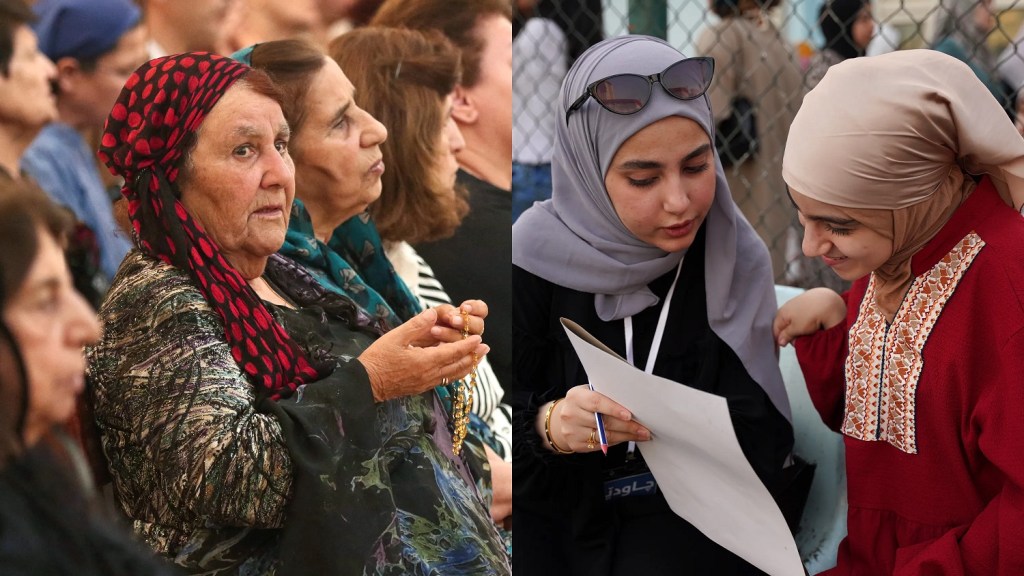
Illustration by Christianity Today / Source Images: Getty

Three years ago in Iraqi Kurdistan, an adherent of the Kakai faith posted on social media that he had been called an infidel by a Sunni Muslim sheikh.

Kakai is a synthesis of Zoroastrianism and Shiite Islam, with between 110,000 and 200,000 followers in Iraq. Persecuted throughout their history, some Kakai consider themselves an independent religion, others a sect of Islam. But most Kurds are Sunni. The offending adherent felt a clear threat; some interpretations of Islam call for the killing of infidels.

Abdo Saad, regional programs director for Adyan Foundation, a Lebanon-based organization promoting interfaith dialogue and equal rights, reached out from his office in Erbil, Iraq, to the local ministry for religious affairs, alerting officials to the danger the Kakai follower may have faced. The authorities intervened and spoke to the sheikh privately. The Kakai man told Saad the issue had been resolved. But the ministry took no further action against the cleric.

Saad was not satisfied. In the honor-shame culture of the Middle East, it is often possible to resolve issues of religious freedom behind the scenes. Many converts to Christianity, for example, can live in relative peace if their Muslim families are not devout. Most authorities are not out to arrest believers.

However, if a conservative cousin publicizes the convert’s new faith, trouble may ensue. Wise officials may calm the situation, perhaps by relocating the convert to a different part of the city. They do not want Muslim extremists to discover the offense and call into question the religious legitimacy of a government that does not enforce the Islamic ban on apostasy.

Yet in the Middle East, only Lebanon allows a convert to officially register his or her new faith. For other nations in the region, religious scruples often trump religious freedom. Governments resolve many social issues along similar patterns, but human rights advocates lament that—as with the Sunni sheikh and Kakai Kurd—officials do not take a public stand.

Lebanon boasts one of the Arab world’s more robust expressions of political and cultural commitment to religious freedom. But Saad said the concept of rights-based citizenship has not sufficiently taken hold in any nation to enable a transition to a free and open democracy. He counsels Christians and Muslims to listen well to each other’s concerns so they can reform their nations together.

“I don’t have the answer for what this should look like,” he said. “I hope our grassroots work will push the leaders, but I don’t know.”

His uncertainty is warranted for Iraq as well. Under the dictatorship of Saddam Hussein, a Sunni, the nation had a nominally secular regime that integrated allied elites from different sects into its authoritarian governing structure. During the transition to democracy under US occupation, Iraqi political parties immediately organized along religious lines, and the majority Shiites captured power.

Sunni insurgencies followed, culminating in the creation of ISIS. Shiite militias backed by Iran joined the international coalition to defeat the jihadist threat but then kept their weapons and eroded national sovereignty. Neighboring Syria may witness a similar transition to conservative Sunni power now that a former al-Qaeda member has overthrown the Alawite-led regime.

Adyan registered in Iraq in 2022. An early project aimed to replicate the Lebanon success of Alwan, a school-based program to foster religious diversity and acceptance. Alwan means “colors” in Arabic. The Iraqi government welcomed the effort but insisted on calling it by the less kid-friendly name “Education on Active and Inclusive Citizenship,” as the original name made them think of the LGBTQ rainbow. Due to local sensitivities, the interfaith group accepted.

Other projects worked on social cohesion, Saad said. In a Chaldean Catholic city in the northern area of Nineveh, a Christian, Muslim, and Yazidi led joint efforts to renovate a public square damaged by ISIS. They restored electricity, installed benches, and held a public dinner. Some played backgammon long into the evening.

Similarly, in the southern city of Basrah, Iraq, with an overwhelmingly Shiite population, Adyan helped a Shiite and a Sunni lead a festival of diversity in the main city square. Artists and singers entertained onlookers, when a member of the minority Mandaean religion took the stage. He told Saad this was the first time he felt comfortable speaking publicly about his faith, in which John the Baptist is the greatest prophet.

Within a sectarian society, good social relations are possible—even common. It is harder to…

This article was originally published at Christianity Today, on October 29, 2025. Please click here to read the full text.

Categories
Christianity Today Middle East Published Articles

What Do Iraq’s Persecuted Yazidis Believe?

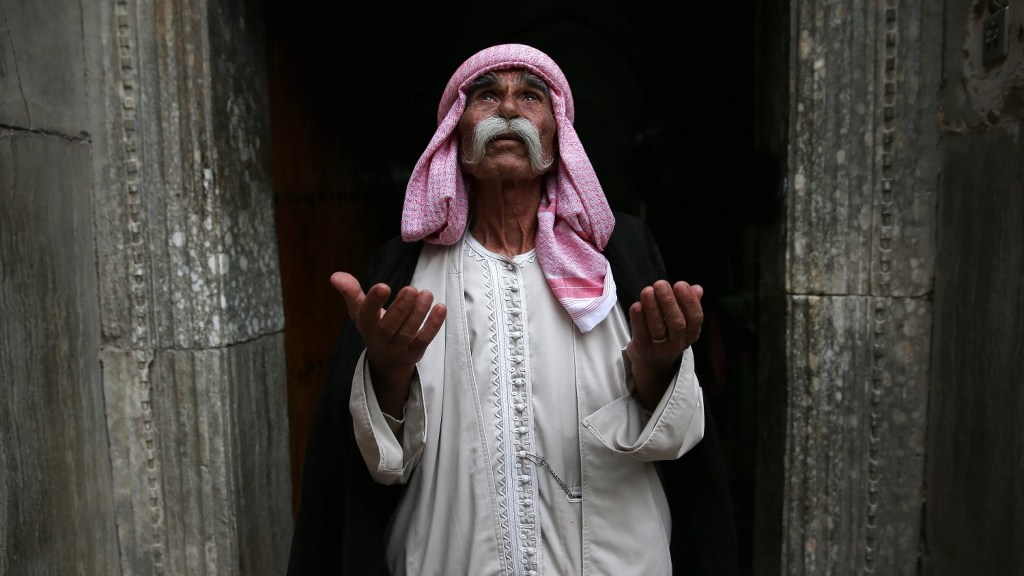
John Moore / Getty

Hadi Maao has faced multiple challenges in his 22 years of life. At age five, his mud-brick house fell on him, a result of nearby car bombings. At age 12, he fled to the mountains when ISIS displaced his people. At age 19, he dodged police while seeking asylum in Europe. Today, he lives and works legally in the Netherlands, while missing and worrying about his family still living in camps in northern Iraq.

Yet he maintains hope.

“God is always by my side,” Maao said. “And when I pray, he assures me of his presence.”

The thought sounds very evangelical. Yet Maao is Yazidi, a member of a minority religious community in Iraq that dates back to ancient Mesopotamia.

CT profiled Maao in part 1 of this series. In part 2, we described the challenges of Christian aid groups who help Yazidis in Kurdistan, the northern Iraqi region hosting many camps for the displaced. USAID cuts, also described in part 1, have drastically reduced humanitarian service.

Alongside his faith, Maao credited the prayers of his foreign Christian friends for his continued well-being. Conversion to another religion is forbidden to his people, Maao said. But he believes there is only a “thread of difference” between Yazidis and Christians.

This is far from the case in theology. Maao said that in ethics and conduct, the communities are close and keep good relations. But he made the comparison as the two minority religious groups have faced persecution from the majority Muslims, many of whom charge Yazidis with devil worship. Christians sometimes speak similarly, claiming Yazidis worship Lucifer.

The Bible does not give many details about the origin of Satan’s evil—only that in pride the angel rebelled against God and God cast him out of heaven. But in Islam, the Quran relates that when Allah created Adam, he commanded the angels to bow before the human creation. Believing himself superior, Satan refused.

Maao said that in the Yazidi story, God rewarded this angel (which they believe was a spirit called Melek Tawûs) for his refusal, as he would only worship God. In another version, however, Melek Tawûs’s disobedience was forgiven with his repentance, evidenced by tears that quenched the fires of hell. Maao stated that Yazidi beliefs are relayed by oral tradition, creating…

This article was originally published at Christianity Today on July 3, 2025. Please click here to read the full text.
Categories
Christianity Today Middle East Published Articles

ISIS Victims Welcome Christian Help, Not Christian Conversion

John Moore / Getty

The previous article in this series highlighted the impact of USAID cuts on the vulnerable Yazidi community in Iraq. ISIS displaced Yazidis from their historic home of Sinjar in northern Iraq in 2014, killing and enslaving thousands. The jihadist group claimed that the Yazidis, whose religion has roots in ancient Mesopotamia, worshiped Satan. (The nature of the Yazidi religion will be discussed in the final article of this series.)

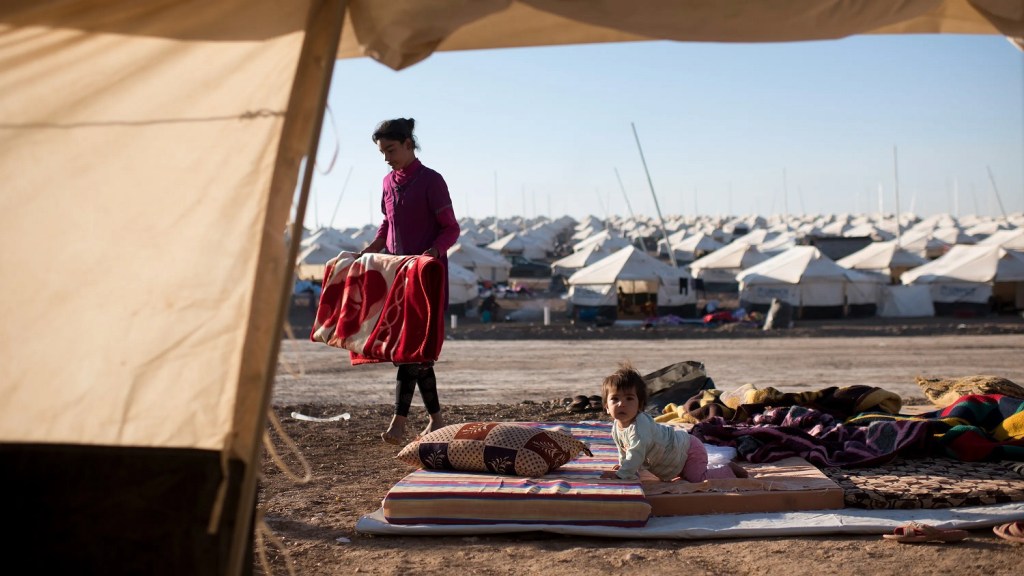
After US coalition forces drove back ISIS, most Yazidis remained in United Nations camps for the internally displaced. USAID was a key aid provider, facilitating access to essential services for more than 30,000 people in Sinjar. The cuts have prevented vulnerable groups like the Yazidis from accessing food and health care they need to survive, wrote Amy Hawthorne, a former Obama-era State Department official.

Top of Form

Yet the legacy of USAID in the Middle East is mixed.

American foreign policy is “deeply unpopular” in the region, Hawthorne continued, while tens of billions of dollars in assistance have failed to create stability, prosperity, or democracy.

If USAID has its critics in the region, so too does faith-based aid.

“Some [Iraqis and secular expats] are very critical of Christians,” said one aid worker serving Yazidis. CT granted him anonymity due to the sensitivity of the issue. “They accuse us of mixing help with the gospel.”

Humanitarian organizations of many varieties rushed to help the Yazidis in 2014 during their displacement. Yet large agencies like World Vision, Medair, and Doctors Without Borders began leaving in 2019 as the situation stabilized and crises multiplied around the world. Among the international groups remaining, the aid worker said, many are small and motivated by a long-term commitment to serve the Yazidi people.

For instance, the Kurdistan-based Zalal Life (highlighted in part 1) provides food distribution, vocational training, and medical services to three Yazidi camps and dozens of villages in the northern Iraqi governorate of Duhok. Other Yazidis are displaced to Iraq’s Nineveh valley, bordering Syria.

Ashty Bahro, who founded the Christian group in 2007, has never received USAID or UN funding. But this would not be a problem in Kurdistan, he explained, because unlike many Arabs in the Middle East, most Kurds love America.  

Christian foundations and church support fund Zalal Life operations, he said, which recently included the repair of 100 tents left leaking in the wake of Trump’s budget cuts. And his two medical clinics are now serving twice as many patients as before, with three times the demand.

Bahro said the aid work is separate from his church ministry. He is also…

This article was originally published at Christianity Today on July 2, 2025. Please click here to read the full text.

Categories
Christianity Today Middle East Published Articles

USAID Cuts Leave Yazidi Tents in Tatters

Lynsey Addario / Contributor / Getty

When Hadi Maao was five years old, his mud-brick home collapsed on him after Muslim extremists detonated car bombs in his northern Iraqi village. Seven years later, in 2014, ISIS jihadists forced his community in the district of Sinjar to flee to the mountains. Now 22, he is an asylum seeker in the Netherlands and sends a quarter of his meager earnings as a grocery shelf stocker to his family still sheltering in a United Nations camp for internally displaced Yazidis.

“Sinjar is not a place to live,” he said. “I’m afraid people are forgetting us.”

US Agency for International Development (USAID) cuts have made things worse, pausing the reconstruction of Yazidi villages and overwhelming medical centers. An evangelical organization is trying to fill the gap, while a new generation of Yazidis living aboard are seeking ways to help. In this three-part series, we will also cover the complications of Christian aid in Sinjar and explain the basics of the Yazidi religion that Maao and his people follow.

Top of Form

Maao is the youngest of four brothers and three sisters. All of his siblings currently live in Sardashti Camp in the Nineveh Valley, 12 miles east of the Syrian border. The money Maao sends home contributes to building a concrete house for his aging mother and father. They currently reside with his cousin’s family in the UN’s standard canvas tent.

At the International Religious Freedom Summit in February, Vice President JD Vance praised the first Trump administration’s action to bring aid to Yazidis and Christians “facing genocidal terror from ISIS.” Yet President Donald Trump’s executive order to freeze foreign funding and the subsequent dismantling of USAID has had a disastrous effect on the camps where Yazidis still live.

The camp is full of tattered tents that allow rain leakage, unhygienic bathroom facilities, and the threat of fire from spark-prone electricity cables, according to on-the-ground sources that CT spoke with. Cuts have halted the building of schools, community centers, and water purification units. An unused transformer, delivered prior to the stop-work order, was placed in storage.

Maao is from the village of Tel Ezer, also known as…

This article was originally published at Christianity Today on July 1, 2025. Please click here to read the full text.

Categories
Asia Christianity Today Europe Middle East Published Articles

Quran Burning in Sweden Singes Muslim-World Christians

Image: Hadi Mizban / AP Images

Following the burning of the Quran in Sweden last month, Christians in the Muslim world have been vocal in their condemnation.

But some expressions of disapproval may have been forced upon them.

“Christian religious figures … [must] state their positions regarding this explicit crime,” stated the Association of Muslim Scholars in Iraq. “Their silence puts them in a position of refraining from criminalizing and condemning it.”

The Sunni-based group had plenty of reasons to be offended. The stunt occurred in front of the Grand Mosque of Stockholm on the first day of Eid al-Adha, one of two primary Muslim holidays. And prior to being lit on fire, the Quran was kicked about and stuffed with bacon—provocation against Islam’s prohibition of pork.

But the greatest Iraqi ire may have been that the culprit was one of their own—and a Christian. Salwan Momika, a 37-year-old father of two, sought refuge in Sweden sometime after 2017. But his checkered history had many Middle East Christians criticizing him as well.

In fact, he is an atheist.

His Instagram post announcing his act declared his lack of faith in anything save secular liberalism. Citing the protest as an act of democracy in defense of freedom of speech, he also asked for financial support. And it is reported that upon arrival in Sweden, he volunteered for a far-right party known for its opposition to Muslim migrants.

But earlier, he worked for Shiites.

Momika professed admiration for Abu Mahdi al-Muhandis, the deputy commander of Iraq’s Popular Mobilization Forces (PMF), who was killed with Iran’s Qasem Soleimani in a US drone strike in 2020. Under the PMF’s command he enrolled with Christian compatriots in “The Spirit of Jesus Brigades” in the common fight against ISIS.

He also tried founding his own political party in Iraq, the Syriac Democratic Union. The established, similarly named Christian party in Syria denied any connection to him.

“He is a showoff who wants the spotlight,” said Habib Ephrem, president of the Lebanon-based Syriac League. “He has no specific ideology and stirred up controversy in the Muslim world—for nothing.”

Some observers speculated that Momika’s aim was to create conditions in which it would be impossible to deny his citizenship request and send him back to Iraq.

At least it has given Christians an opportunity for witness.

“What happened in Sweden was an unwholesome use of the concept of personal freedom,” said Ara Badalian, senior pastor of Baptist Church in Baghdad. “True Christianity is characterized by love, tolerance, and rejection of violence and hatred.”

The patriarch of the Assyrian Church of the East spoke similarly. “We call upon the governments of all countries, particularly the Swedish government, not to allow these actions perpetrated in the name of ‘personal freedom,’” stated Mar Awa Royel, who quoted Ephesians 4:32. “This is what the Bible teaches us…

This article was originally published at Christianity Today, on July 11, 2023. Please click here to read the full text.
Categories
Christianity Today Middle East Published Articles

Good News for Iraq’s Christians: More Autonomy, Less Dhimmitude

Image: Courtesy of Archbishop Bashar Warda
Chaldean Catholic Archbishop Bashar Warda stands in front of the Catholic University of Erbil, located in the Iraqi Kurdistan capital city’s Ankawa district.

This week, the Christian enclave of Ankawa in Erbil, the capital city of Iraqi Kurdistan, was designated by the autonomous region’s prime minister as an official district, giving believers there administrative autonomy starting next week.

They will directly elect their own mayor, and have charge of security.

Prime Minister Masrour Barzani called Ankawa a home for “religious and social coexistence, and a place for peace.”

Archbishop Bashar Warda, the Chaldean Catholic archbishop of Erbil, called it an “important” and “strategic” decision.

“Our confidence in the future of Kurdistan makes us encourage Christians not only to stay,” he said, “but also to invest in this region.”

Ordained a priest in 1993, Warda was consecrated in his current position in 2010. With Iraq’s hemorrhaging of Christians since the 2003 US invasion, Warda’s bishopric in the autonomous Kurdish region soon became a providential band-aid.

Beginning in 2014, ISIS drove Christians from Mosul and their traditional homeland in the Nineveh Plains, and thousands took refuge in Erbil and other cities in the secure northeast. From 1.5 million Christians in 2003, the Chaldean Catholic church now estimates a population of fewer than 275,000 Christians.

Warda has long been investing to turn the tide.

In 2015, he established the Catholic University of Erbil, and has coordinated relief aid from governments and charities alike. The situation stabilized following ISIS’s defeat in 2017.

But freedom does not come from politics alone. Two years ago, Christians endorsed widespread popular uprisings against the political class. Violently suppressed, the movement’s main celebrated achievement was early elections under a new law designed to promote better local and small-party representation.

Polls open on October 10, and a quota gives Christians five of 329 seats in parliament. However, Warda’s Baghdad-based patriarch has called for a Christian boycott, fearing fraud.

Warda wants a Christian revival. Buoyed by the March visit of Pope Francis, he believes that ISIS broke the fundamental religious and cultural underpinnings of Islamic superiority. Christians no longer are seen as second-class citizens.

In an interview on the sidelines of the IRF Summit convened in Washington in July, Warda told CT about his welcome of missionaries, the Catholic way of witnessing to Muslims, and whether a revived Christian influence in Iraq will lead to future church growth.

Since the defeat of ISIS in Iraq, what challenge has been hardest for the church?

With all the displaced people, images of scattered tents immediately come to mind. But the hard part is not to provide them with food, sanitation, or medical supplies. This is not easy, but it is obvious.

The hard part is to restore their dignity. They understand that ISIS is a criminal gang. And they can bear the wounds of the innocent, knowing they had nothing to do with this dispute.

But their question is “Why?” yet also “What now?”

Men are the providers for the family. Sitting around doing nothing, they tell me, “Bishop, we don’t want money; we want a job. I want to deserve my food.”

Suppose there is aid sufficient to rebuild homes, churches, and schools and even to provide jobs. You have said that this is not enough. It does not establish the basis of citizenship and pluralism.

That is true. But without homes, churches, schools, and jobs, the people will leave the country. And then there are no citizens left.

With a rebuilt community, you can go to the government to speak about the constitution, defending the people’s full rights under the law. There is a link. First have the community; then talk about implementing ideals.

Before ISIS, when the community was stable, were you able to seek your rights?

For 1,400 years there was a sort of social contract: Islam is the religion of the nation, and you are the People of the Book. But know that Islam is the honorable religion of God, which means you are second. In the Quran it says…

This article was originally published at Christianity Today, on August 8, 2021. Please click here to read the full text.
Categories
Christianity Today Middle East Published Articles

Died: Ashur Eskrya, Champion of Iraq’s Displaced Christians

Image: Zowaa / ADM

Ashur Sargon Eskrya, president of the Assyrian Aid Society–Iraq (AASI), passed away today from COVID-19 complications.

A champion of the Assyrian Christian minority, he was also a central figure in US efforts to shelter refugees from ISIS and later rebuild the Nineveh Plains.

AASI was honored for its work with a Nobel Peace Prize nomination in 2016.

“Ashur has played a prominent role in being a voice for our people in international forums, speaking on behalf of us all especially on the subject of indigenous rights,” stated the official account of the Assyrian Democratic Movement (ADM), of which Eskrya was a senior member.

“He will always be remembered for his leadership.”

Fellow ADM member Jessi Arabou called him one of the Assyrian nation’s “biggest assets.” Born in 1974, Eskrya was a civil engineer and graduate of Baghdad University. He became a member in AASI in 2003, and assumed the presidency in 2010. Founded in 1991 to respond to the humanitarian crisis following the first Gulf War, the nonprofit…

This article was originally published at Christianity Today, on April 9, 2021. Please click here to read the full text.
Categories
Christianity Today Middle East Published Articles

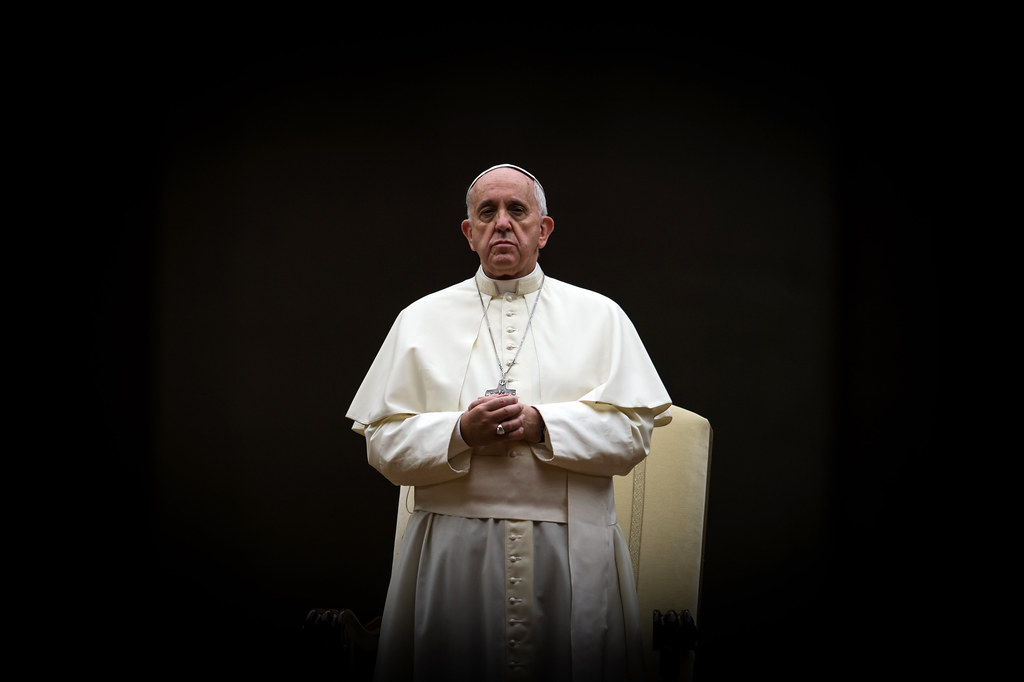
At Mosul Church, Pope Asks Iraq’s Christians to Forgive ISIS and Rebuild

Copyright: MARCIN MAZUR

I contributed additional reporting to this AP article, including its conclusion below:

At Qaraqosh, Francis urged its residents to continue to dream, and forgive.

“Forgiveness is necessary to remain in love, to remain Christian,” he said.

One resident, Doha Sabah Abdallah, told him how her son and two other young people were killed in a mortar strike August 6, 2014, as ISIS neared the town. “The martyrdom of these three angels” alerted the other residents to flee, she said. “The deaths of three saved the entire city.”

She said now it was for the survivors to “try to forgive the aggressor.”

Francis wrapped up the day—and his visit—with a Mass at the stadium in Irbil, in the semi-autonomous northern Kurdish region. An estimated 10,000 people erupted in ululating cheers when he arrived and did a lap around the track in his open-sided popemobile, the first and only time he has used it on this trip due to security concerns.

On the makeshift altar for the Mass was a statue of the Virgin Mary from the Mar Adday Church in the town of Keramlis, which was restored after ISIS militants chopped off its head and hands.

“Religion is love, grace, forgiveness,” said Louis Sako, patriarch of the Chaldean Catholic Church, in advance of the visit. “Religion is a message, and humanity is its core.

“[And] as for us, we are staying until the end.”

But perhaps some Iraq Christians have a vision for even more.

“This is a time of healing for our country,” Farouk Hammo, pastor of Baghdad Presbyterian Church, told CT.

“But we are still praying for a visitation by the Lord Jesus—a revival—and it will happen.”

This article was originally published at Christianity Today on March 11, 2021. Please click here to read the full text.

Categories
Christianity Today Middle East Published Articles

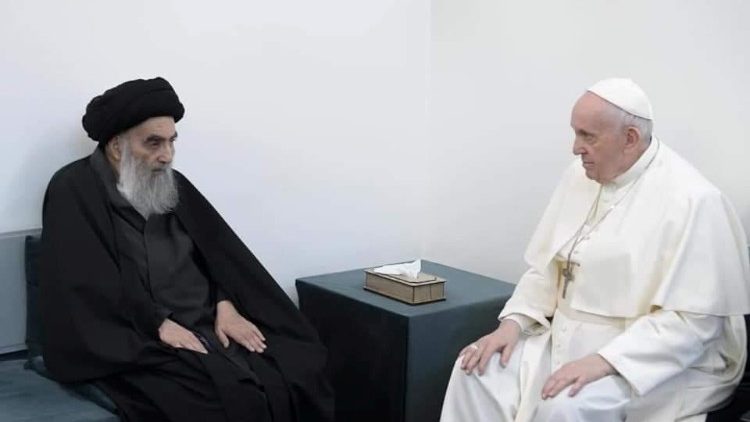
Pope Francis Secures Favorable Fatwa for Iraq’s Christians

Via Vatican News

Pope Francis, a “pilgrim of peace” to Iraq, has made history by becoming the first pontiff to meet a grand ayatollah: Ali al-Sistani, whose hawza (seminary) in Najaf, 100 miles south of Baghdad, is considered the foremost center of learning in Shiite Islam.

Two years ago, the pope met the grand imam of Egypt’s al-Azhar, considered the foremost center of learning in Sunni Islam. With Ahmed al-Tayyeb, Francis signed the “Declaration of Human Fraternity,” calling on both Christians and Muslims to embrace religious diversity with freedom and respect.

This weekend, Francis came to Iraq to support and encourage the nation’s beleaguered Christians, whose numbers have decreased from 1.4 million in 2003 to about 250,000 today.

But he also wished to sign a similar document with the reclusive leading figure in Shiite Islam, which represents 1 in 10 of the world’s Muslims—and 6 in 10 Iraqis.

The result with Sistani was more modest than with Tayyeb, but Francis did secure a very important fatwa (religious ruling).

“[Christians should] live like all Iraqis, in security and peace and with full constitutional rights,” said Sistani in an official statement. “The religious authority plays [a role] in protecting them, and others who have also suffered injustice and harm in the events of past years.”

Francis removed his shoes upon entering Sistani’s modest home. And while the ayatollah usually sits to receive visitors, he stood to welcome the pope.

Will the ruling make a difference? Will it have any impact in Iran, the neighboring theocratic Shiite state? And what really drives the regional conflict: religion or politics? In Muslim history, the answer is…

This article was originally published at Christianity Today, on March 7, 2021. Please click here to read the full text.

Categories
Christianity Today Middle East Published Articles

Iraq’s Evangelicals Use Pope Francis’s Visit to Press for Equality

(Photo by AHMAD AL-RUBAYE/AFP via Getty Images)

Pope Francis traveled to war-torn Iraq today “as a pilgrim of peace, seeking fraternity [and] reconciliation.”

The trip’s official logo, written in three languages, comes from Matthew 23: “You are all brothers.” Iraq’s evangelicals, therefore, have asked for the pope’s help.

“The other churches don’t want us, and accuse us of everything,” said Maher Dawoud, head of the General Society for Iraqi National Evangelical Churches (GSINEC).

“But we are churches present throughout the world. Why shouldn’t the government give us our rights?”

Dawoud sent a letter to the Vatican, asking Francis to intercede—on behalf of evangelical Christians—with the Catholic church in Iraq, and ultimately with the government in Baghdad.

The World Evangelical Alliance (WEA) had gone straight to the United Nations, long before.

One year ago, the WEA filed a report with the UN Human Rights Committee, protesting the denial of legal recognition for Iraqi evangelicals. Fourteen other denominations are currently counted within the Christian, Yazidi, and Sabaean-Mandaean Religions Diwan (Bureau).

Now estimated at less than 250,000 people, Christians are a small minority of Iraq’s 40 million population, 97 percent of which is Muslim. Evangelical numbers are even smaller.

The Chaldean Catholic Church represents 80 percent of the nation’s Christians, with 110 churches throughout the country. Syriacs, both Catholic and Orthodox, constitute another 10 percent, with 82 churches. Assyrians, primarily through the Church of the East, have a 5 percent share, and Armenians, 3 percent. (Other estimates count 67 percent for the Chaldeans, and 20 percent for the Assyrians. Their identity and history are disputed.)

Evangelicals have 7 churches, Dawoud said. Representing the Baptist, Pentecostal, Nazarene, Alliance, Assemblies of God, and Armenian Evangelical denominations, the GSINEC has petitioned Baghdad for recognition since 2003.

While their churches are open and able to conduct services, they lack the authority to perform marriages, conduct funerals, and interact with the government. This prevents them from owning property, opening bank accounts, and producing religious literature.

It also keeps Protestants from invitations to official events—like the visit of a pope.

But not all of them. “I will ask Pope Francis to agree with me in prayer,” said…

This article was originally published at Christianity Today, on March 5, 2021. Please click here to read the full text.

Categories
Christianity Today Middle East Published Articles

Word or Deeds: Shiite Firebrand Pledges to Restore Iraqi Christian Property

Muqtada al-Sadr

If Pope Francis can avoid the complications of COVID-19 travel and get to Iraq in March, he will hear a lot about stolen property. Muqtada al-Sadr, a leading Shiite politician fiercely opposed to the US military presence, has told Christians he will do something about it.

The issue is not new.

As Iraq’s pre-Gulf War Christian population of 1.25 million dwindled to about 250,000 today, opportunistic non-Christians laid claim to their unoccupied homes and lands. The city of Mosul, next to the traditionally Christian Nineveh Plains—where Pope Francis is scheduled to visit— located 220 miles north of Baghdad, provides telling examples of the problem.

In 2010, in the waning days of official US occupation, Ashur Eskrya’s father decided to sell his family home. Years of chaos had depleted the once 60,000-strong Christian population of Iraq’s second-largest city, representing 10 percent of its total. Property values were plummeting. Especially in hindsight, Eskrya felt fortunate to get 25 percent of its market value.

Four years later, his neighbor got nothing.

ISIS invaded Mosul, putting its Christian population to flight. In 2015, the International Organization for Migration (IOM) surveyed 240 individuals displaced by the fighting throughout Iraq. Nearly 9 in 10 (89%) had their homes confiscated.

A 2014 study estimated that ISIS made more money from selling stolen real estate than it did from oil revenue.

After the liberation of Mosul, some Christians returned, including Eskrya’s neighbor. While 42 percent had lost their property documentation altogether, according to IOM, the neighbor was able to enter a lengthy legal process and eventually regain ownership of his home.

But uncomfortable with the security situation, he returned to Erbil, 55 miles east of Mosul in Iraqi Kurdistan, where thousands of displaced Christians still reside.

He lives there today with his children, which is more than a third family can say.

This neighbor benefited from Mosul’s earlier oil boom, and lived in a home valued at $1.2 million in one of the plush city districts. But in 2006, his daughter was kidnapped and killed. In 2012, another daughter tried to emigrate through Syria, and was killed there. The parents eventually moved to Australia—with the deed to their home. But last year, they were stunned to receive news…

This article was originally published at Christianity Today, on January 21, 2021. Please click here to read the full text.

Categories
Christianity Today Middle East Published Articles

Christmas Unites a Divided Iraq

A picture taken on December 30, 2016 shows people walking past Christmas and New Year’s decorations displayed outside a shopping mall street in Arbil, the capital of the autonomous Kurdish region of northern Iraq. / AFP / SAFIN HAMED via Getty Images

Seventeen years since the fall of Saddam Hussein, the fractious Iraqi nation—divided mostly between Sunni, Shiite, and Kurdish Muslims—remains unable to agree on a national day.

But they can agree on Christmas.

Last week, the parliament unanimously passed a law to make Christmas a “national holiday, with annual frequency.”

The latter phrase gave great “joy and satisfaction” to Cardinal Louis Raphael Sako, patriarch of the Chaldean Catholic Church. Last October, he presented an official request to Iraqi President Barham Salih to make Christmas a permanent public holiday.

“Today Christmas is truly a celebration for all Iraqis,” said Basilio Yaldo, bishop of Baghdad and Sako’s close associate. “This is a message of great value and hope.”

In 2008, the government declared Christmas a “one-time holiday.”

In 2018, the parliament amended the law to make Christmas for all citizens.

But after each occasion, it was not renewed.

“The declaration is beautiful, but it is very late,” said Ashur Eskrya, president of the Assyrian Aid Society–Iraq. “But our trouble is not in holidays, it is in…

This article was originally published at Christianity Today, on December 21, 2020. Please click here to read the full text.

Categories
Christianity Today Middle East Published Articles

Why We Opened a Christian University in Iraq Amid ISIS’ Genocide

Catholic University of Erbil
The Catholic University of Erbil (courtesy CUE)

This article was first published at Christianity Today, on May 7, 2020.

For 25 years, Stephen Rasche was a “bare knuckles” international lawyer. But in 2010, he offered his services to the Chaldean Catholic Church of Erbil in Iraqi Kurdistan and has increasingly dedicated his life to the preservation of this ancient community.

Under the leadership of Archbishop Bashar Matti Warda, in 2015 Rasche helped found the Catholic University of Erbil, where he serves as vice chancellor. Also the director of its Institute for Ancient and Threatened Christianity, Rasche lived this title as ISIS ravaged Iraq’s Christian homelands in the Nineveh Plains and many believers fled to Erbil.

After testifying on their behalf before the United Nations and the US Congress, Rasche allows them to represent themselves in his recent book, The Disappearing People: The Tragic Fate of Christians in the Middle East. The book has won a diverse range of endorsements, from leaders such as Matthew Hassan Kukah, bishop of the Catholic Diocese of Sokoto, Nigeria; Yahya Cholil Staquf, general secretary of Nahdlatul Ulama, the largest Muslim organization in the world; and Thomas Farr, president of the Religious Freedom Institute.

The US State Department’s Office of International Religious Freedom reports that less than 250,000 Christians are living in Iraq, most in Kurdistan or on the Nineveh Plains. Two-thirds belong to the Chaldean Catholic Church.

CT interviewed Rasche about the logic of establishing a university during a genocide, how its Catholic identity functions in a Muslim society, and his enduring optimism for Christianity in Iraq.

What led you personally to invest your life in this endeavor?

In 2010, Bishop Warda had just been made archbishop, and I went to pay him a visit of respect, asking if there was anything I could do to help. “Yes, in fact,” he said. “You Americans have made a big mess here, and you could stay and help me. I have 3,000 displaced families here from the south, they need help, and no one is helping us with them. We don’t have jobs for them, and there’s a whole range of things I would like to do.”

I assisted on and off on a pro-bono basis for the next four years, but by 2014 the situation looked really desperate. ISIS was maybe 30 miles away from Erbil. But in a visit just after Christmas, I sat down with the bishop and the priests who told me, “We are going to stay. Will you be with us here, and help us?”

Honestly, I was skeptical. But after some deep thinking, I tried to determine the right thing to do and if there was a calling in this for me.

Tell us more about that calling.

Being an international transactions lawyer involved a fair amount of bare knuckles litigation. And not a lot of it, quite frankly, was fulfilling…

Please click here to read the full article at Christianity Today.

Categories
Christianity Today Middle East Published Articles

Arab Christians Have Lost Easter Before. Here’s What They Learned.

Losing Easter Churches
House of St Ananias, Damascus

This article was first published at Christianity Today, on April 3, 2020.

Christians around the world are about to lose their usual Easter celebration—the highlight of most congregations’ annual life together.

Yes, there will be a livestream. Their pastor will likely call them. They may even chat on Zoom with friends and family.

But it will be different. The community of believers has been sundered by the new coronavirus. And threatened with it is Christ’s body, his bride, his temple for his presence in the world.

If there is any consolation, it is that this is not the first time.

“There are forces of nature—and forces of man—that challenge our ability to experience the presence of Christ,” said Gregory Mansour, the Maronite bishop of Brooklyn.

“[COVID-19] is different from persecution. But it is the same.”

A born-again Catholic led into personal relationship with Christ by the Navigators, Mansour later reconnected with his ancient Lebanon-based church. His clerical colleagues there received thousands of ISIS-fleeing Christians from Syria and Iraq.

“There was a deliberate desire to obliterate churches, hymnals, prayers, and people,” he said. “The only thing we had left was…

Please click here to read the full article at Christianity Today.

Categories
Christianity Today Middle East Published Articles

Soleimani’s Death Doesn’t End Iran’s Influence on Middle East Christians

Soleimani Funeral
(via Fars News Agency)

This article was first published at Christianity Today, on January 28, 2020.

Middle East Christians might shrug their shoulders. They might even fret and worry. But perhaps Qassem Soleimani got what he deserved.

“We regret what happened. We do not want anyone to die, because Christianity wants the good of all,” said Ashty Bahro, former head of the Kurdistan Evangelical Alliance.

“But a person leads himself to his own destiny.”

Soleimani, head of Iran’s special operations Quds Force, was killed by a US rocket strike on January 3. It was a rapid escalation following the Iran-linked death of an American contractor, a retaliatory attack on the responsible Iraqi militia, and the storming of the US embassy in Baghdad.

According to the US State Department, Soleimani, who reported directly to Iranian Supreme Leader Ayatollah Khamenei, was responsible for 17 percent of American deaths in Iraq from 2003 to 2011.

He also enraged Sunni Muslims by engineering the subsequent Iranian defense of Syria’s regime, led by President Bashar al-Assad. With Russia and the Iran-backed military wing of Lebanon’s Hezbollah, the shelling of rebel-held cities resulted in the displacement of thousands during Syria’s civil war.

But Soleimani was also acclaimed for his role in fighting ISIS, personally directing Iraqi militias from the front lines.

Thus, Middle East Christians have mixed feelings about his death—and the immediate aftermath.

Some Syrian believers see no benefit to anyone.

“Iran was working with the US government in certain agreements. Why did you destroy them?” asked Maan Bitar, pastor of the Presbyterian churches in Mhardeh and Hama, noting both the fight against ISIS and the nuclear deal.

“This will prompt a severe reaction that will hurt…”

Please click here to read the full article at Christianity Today.

Categories
Christianity Today Middle East Published Articles

Christmas Celebrations Canceled in Iraq After Deaths of 400 Protesters

Iraq Protests Baptist
Pastor Ara Badalian leads members of National Baptist Church in prayer at Baghdad’s Tahrir Square. Image: Courtesy of National Baptist Church

This article was first published at Christianity Today, on December 9, 2019.

Distributing food to protesters with 40 fellow church members under the Jumariyah bridge near Tahrir Square in Baghdad, Ara Badalian made a poignant observation.

“This movement is a flood, occupying the hearts of the youth and the poor, without any religious discrimination,” the pastor of National Baptist Church recalled to CT. “It has broken down all the walls that divided Iraqis.”

It is at the bridges—about a dozen span the Tigris River, which bifurcates the Iraqi capital—where most violence has taken place. The protest movement, which began in October, has resulted in more than 400 deaths, around a dozen of them security personnel. Over 17,000 people have been injured.

In response, the Chaldean Catholic Church decided last week to refrain from holding public celebrations of Christmas, trading tree decorations and holiday receptions for prayers of intercession.

“Instead of bringing hope and prosperity, the current government structure has brought continued corruption and despair,” Bashar Warda, the Chaldean archbishop of Erbil, told the United Nations Security Council last week.

“[Iraqi youth] have made it clear that they want Iraq … to be a place where all can live together as equal citizens in a country of legitimate pluralism and respect for all.”

Protesters have demanded the dissolution of parliament, widespread government reforms, and amendment of the sectarian-based 2005 constitution.

Ratified following the United States-led 2003 Iraq War, the current constitution gives the Middle East nation’s Shiite majority (55% of the population) the leading position of prime minister, as well as the influential interior and foreign ministries.

The Sunni minority (40%) receive the speaker of parliament and the defense ministry. The Kurds, who comprise only a third of the Sunni population but are concentrated in their own autonomous northern region, receive the presidency and finance ministry.

Islam is established as the religion of the state and the foundational source of legislation. Christians are among three religious minorities guaranteed religious freedom, though the constitution protects the Islamic identity of the majority.

While the protests have been cross-sectarian in Baghdad, they’ve paradoxically been strongest in the nine Shiite provinces in southern Iraq.

“People don’t want foreign interference from anywhere…

Please click here to read the full article at Christianity Today.

Categories
Americas Christianity Today Published Articles

US Catholics Now as Concerned About Persecution as Climate Change

Aid to the Church in Need Iraq
Decapitated statue of Our Lady in the destroyed St Addai’s Church, Karemles, northern Iraq, via ACN-UK.

This article was first published at Christianity Today, on March 22.

American Catholics are growing more concerned about the fate of the world—and with it, Christian persecution.

More than 9 in 10 now identify persecution as either “very” or “somewhat” severe. This is roughly the same percentage as an identical poll last year, both sponsored by the US branch of Catholic charity Aid to the Church in Need (ACN). But over the last 12 months, the share choosing the “very severe” category rose from 40 percent to 46 percent.

And their level of concern went with it, rising 9 percentage points. Last year, 49 percent of Catholics described themselves as “very concerned.” This year, 58 percent.

The poll surveys 1,000 American Catholics across the spectrums of age, politics, and piety, conducted by McLaughlin & Associates.

It showed that intense Catholic concern is growing on several global issues. Those “very concerned” about human trafficking rose from 72 percent to 82 percent. Poverty climbed from 68 percent to 74 percent. The refugee issue jumped from 50 percent to 60 percent. And climate change nudged forward from 55 percent to 57 percent.

So while those unconcerned about Christian persecution fell by half (from 18% to 9%), overall the “church in need” only ranked No. 4 among the list of issues.

But last year, it was…

Please click here to read the full article at Christianity Today.

Categories
Americas Christianity Today Published Articles

Christians Could Return to the Middle East, Thanks to Trump (Deportations)

Iraq Trump Deportation

This article was originally published in the October print edition of Christianity Today, co-authored with Griffin Jackson.

When Haitham Jazrawi started working at Kirkuk Presbyterian Church in Iraq in 1991, there were 72 families. Today, there are still 72 families—but only two of the originals remain. During his 26-year tenure as caretaker and then pastor, Jazrawi has seen a turnover of more than 300 families due to emigration.

Such an outward flow has been the norm in churches across the Middle East. In Iraq and Syria, countries ravaged by years of war and the terror of the Islamic State, roughly two-thirds of Christians have fled.

Among Jazrawi’s congregants, 50 percent are internally displaced from elsewhere in Iraq. “They come as refugees from inside our country,” said the Kirkuk pastor, “from the Nineveh Valley, from Nineveh, from other villages and cities.”

Soon, they may also come from outside of Iraq. With the Trump administration threatening to deport more than 1,400 Iraqis, hundreds of whom are Christians, a rare irony may present itself: the forced movement of Christians into the Middle East.

This summer, hundreds of Iraqis were behind bars in holding centers around the United States, slated for deportation to Iraq. The majority were Christians, and most were rounded up in Detroit in a massive June raid executed by Immigration and Customs Enforcement (ICE).

“Not only would they be breaking up families that have been here for decades,” said Nathan Kalasho, a local advocate for the detainees, “but they would be sending an already targeted minority to a country that no longer welcomes them…”

Please click here to read the full article at Christianity Today.

Categories
Personal

Distributing Aid to Iraqi Christians

Zalal 7

Five days ago Iraqi Christians were displaced from their city – again. As Fox News reported, they had only recently returned to Teleskof following its liberation from ISIS.

Here are pictures from those trying to help.

The recent Kurdish referendum effort led the Iraqi government to reclaim disputed land held by the Peshmerga forces. Christians were caught in the crossfire, and my Christianity Today story has some of the details.

It also features Ashty Bahro, the head of Zalal Life Civil Society Foundation, and former head of the Evangelical Alliance of Kurdistan.

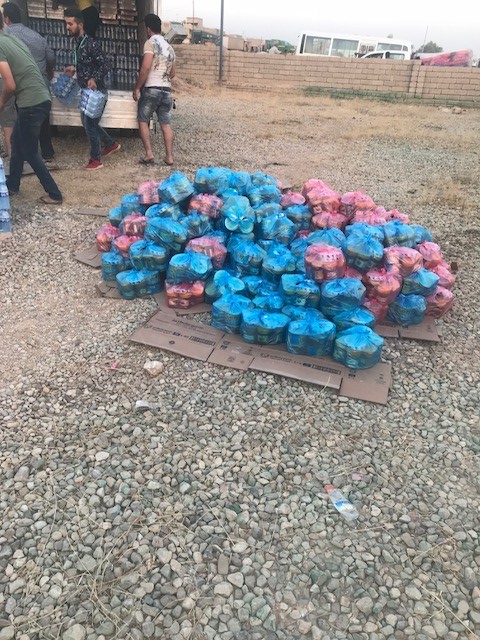
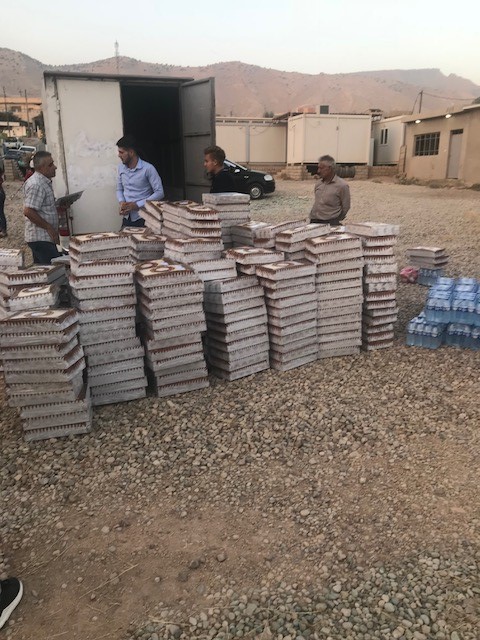
On the day the refugees fled to nearby al-Qosh, his organization was there to distribute 300 parcels of food and water.

The following pictures were supplied by Zalal Life.

Zalal 8
The license plate reads: Dohuk, Iraq. Bahro is a pastor in Dohuk, 25 miles to the northwest of al-Qosh.

Zalal 1
Bahro described the area as mountainous, with the journey taking about 40 minutes.

Zalal 2
Refugees gathered at the local St. Qarbakh church. Al-Qosh is roughly 30 miles north of Mosul and is home to what is believed to be the burial place of the prophet Nahum, who preached against the Assyrian Empire of his day.

Zalal 4
Containing cheese, meat, tuna, beans, and other foot items.

Zalal 5
Boxes filled with bread. Iraqi bread is traditionally flat and round, shaped similarly to a pizza.

Zalal 6

There is always a cost to war. There are always real people on both sides of charity.

Pictures help us visualize what we are too often able to overlook: Faces.

You don’t have to do anything. In most cases you can’t. Some are chosen to suffer, others are able to help.

Just remember the dignity of all.

UPDATE:

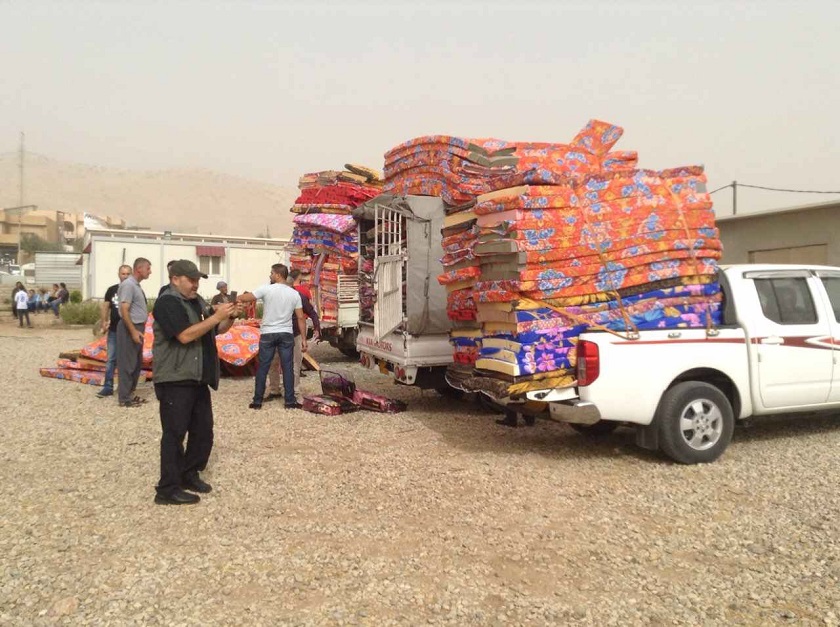
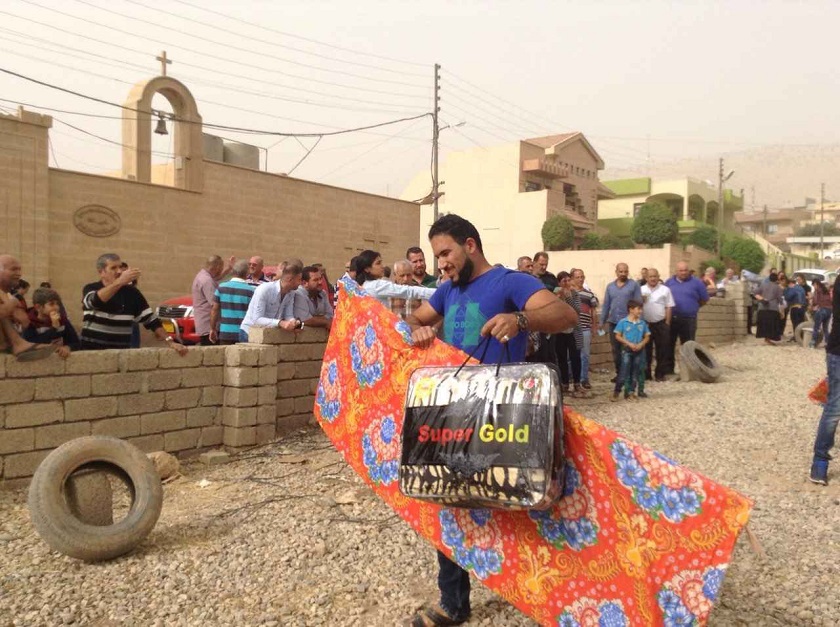
On October 30, Zalal Life was able to return and complement the emergency food supplies with 300 mattresses and blankets. Bahro specifically thanks Steadfast Global and L4L.

Zalal 10
It is not uncommon in the Middle East to see all sorts of vehicles piled high with supplies.

Zalal 11
I liked this picture because it shows a little more of the neighborhood near the church. Looks nice – that doesn’t always come through in refugee situations.

Zalal 13
And this one: Just because kids are so frequently cute.


Categories
Personal

An Iraqi Refugee Leads Us Home

Iraqi Refugees
(via Time, Muhammed Muheisen—AP. Image is of Yazidis.)

Abu Rafi surveyed what once was a familiar scene.

Displaced from Qaraqosh, Iraq by the marauding ISIS forces, his family of ten fled to Kurdistan where he secured a two bedroom apartment.

Now with ISIS in retreat, he traveled back to see the wreckage.

Their home was robbed and burned. They used to host many friends; now the sofa and dining table are gone. They had a garden; it is ruined. Grandkids picked oranges, and ran barefoot on the green grass.

Now they are just memories, though the process of repair and repainting has begun.

From Kurdistan he lamented with Lilian Samaan, the American Bible Society’s strategic ministries advisor for the Middle East and North Africa.

“It’s okay,” he told her. “I have my daughters and son around me, alive and well. That is what matters most.”

Samaan asks us to empathize, but also more. We must recognize first that Arab refugees in America almost universally share this desire to go home.

“Their old home, their garden, their church, their priest, their community,” she said, “all that once was is now lost, all gone.”

We might want to help, she says, but it is not that simple. These were a proud people, violated thoroughly. Their honor has been damaged, and their need of assistance is a further source of shame.

“A gentle approach and a posture of learning, listening and asking the right questions,” she counsels, “will allow access to support in a dignified way.”

It is kind and wise advice, but also personal. Samaan is originally from Jordan – not a refugee but an immigrant who sees herself in many she now comes along side of.

What made the difference for her was respect.

“I was welcomed into homes, cherished like a daughter, and trusted like a friend,” she said. “At work and at church on the North Side of Chicago, my contributions and gifts were acknowledged and appreciated, as an immigrant.”

And if American Christians can go a step further, they might reverse their roles. Samaan urges the church to become disciples of those washing up on their shore.

“I believe the American church is in a privileged position to have such people of history and faith in its midst,” she said. It’s a golden opportunity to come alongside refugees from these areas, hear their story, acknowledge their pain, affirm their honor and resilience, and minister to them with presence and friendship.”

And in the process, learn.

“Can we become disciples of the minority church, the persecuted church?” she asked. “Can we allow ourselves to be vulnerable, to commune with a church that has suffered but survived persecution over many centuries, demonstrating patient resilience?

“It could be that this is a moment for us in the West to step aside, lay down our ideologies and agendas, and allow the Church in the East to propose its own solutions, and with our support, lead us.”

Abu Rafi will soon lead his family home. Can we, in spirit, join him?