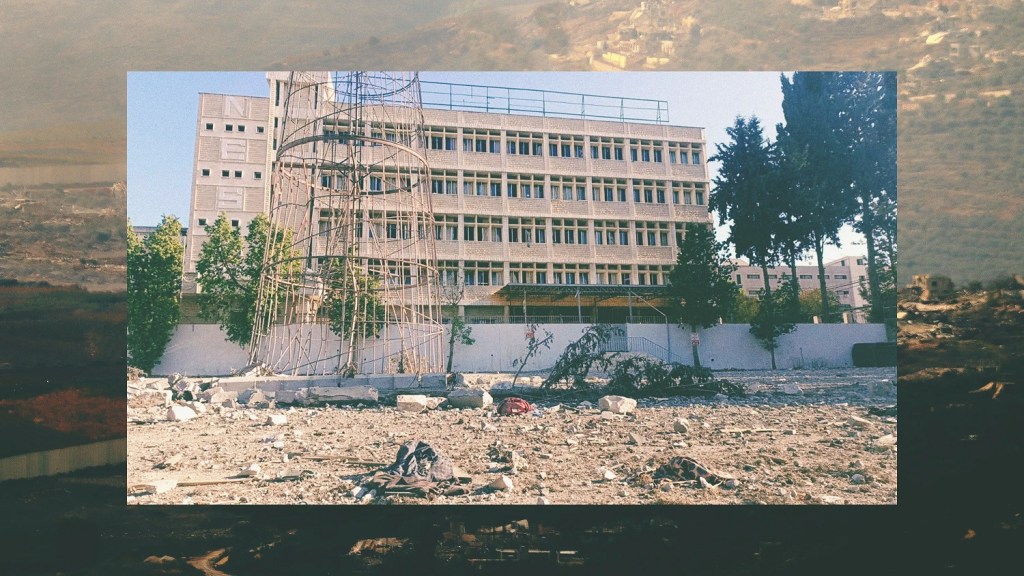
The predominantly Shiite city of Nabatieh in southern Lebanon once boasted the nation’s largest Christmas tree, erected to symbolize good relations between local Muslims and the tiny Christian minority of only 20 families.
The local evangelical school—with a 99 percent Shiite student body—had celebrated the holiday for years, and in 2018 it built a 100-foot wrought-iron conic structure topped with a radiant star. (The use of natural firs or pines is uncommon in Lebanon). Several of the hundreds of students, parents, neighbors, and dignitaries in attendance wore Santa hats. Many had trees in their homes and gifts to open on Christmas day.
Earlier that December, Ahmed Kahil, the Hezbollah-affiliated president of the municipality, continued the annual tradition of erecting a smaller tree in the souk, the traditional marketplace and heart of the city. And at both events—alongside Shadi El-Hajjar, the principal of the National Evangelical School of Nabatieh (NESN), heads of other private schools in the city, and various government and religious officials—Kahil wished Christians a Merry Christmas.
Top of Form
Lebanon’s economic crisis made 2018 the last year NESN could afford to erect its massive Yuletide construction. But over the following years, elementary school classrooms still featured Christmas trees, students exchanged secret Santa gifts, and teachers enjoyed the annual holiday dinner. “If Christmas isn’t found in your hearts,” the school reminded, “you won’t find it under a tree.”
But there was no Christmas celebration in Nabatieh last month, after over a year of war between Israel and Hezbollah. On October 8, 2023, the Shiite militia launched rockets into Israel in support of Hamas following its attack that killed 1,200 Israelis and took around 250 hostages. The subsequent daily missile exchange drove tens of thousands from the border regions of both nations.
A year later, most of Nabatieh’s 80,000 residents fled their homes as Israel intensified its military campaign against Hezbollah. On October 16, an Israeli missile killed Kahil and 10 others at the Nabatieh town hall as they coordinated the daily distribution of food and medicine to the 200 families who remained in the largely evacuated city.
Initially, NESN stayed open for its 1,400 students. Located 35 miles south of Beirut and only 7 miles from Israel, the historic evangelical institution won local respect over the years by offering a nonreligious but values-based educational environment that consistently ranked among the top high schools in Lebanon. The September 2024 pager attack delayed the start of the academic year, and the exodus from the city eventually shifted education online. But within a week NESN opened its doors as a shelter for the locally displaced.
Over the course of the war, its staff stood by the Shiite community, including one who rescued Kahil’s colleague after the October 16 strike.
“When you see your hometown destroyed and the damage at the school,” Hajjar said, “you have to ask: Why is this happening to those who are not involved?”
A safe haven
In the early stages of the war, Nabatieh mostly…
This article was originally published at Christianity Today on January 31, 2025. Please click here to read the full text.
In early October, in a Christian village in southern Lebanon, “Samira” (we’re using pseudonyms due to the political situation) decided to water her lemon trees. The autumn winds were dry this season. Rain was less frequent. The frail, hunched-over grandmother filled her bucket and went outside.
Samira’s husband had died two years earlier. Her children had long ago moved away, seeking better opportunities in Beirut, but her daughter owned the house next door and made frequent trips back, recently refurnishing the interior with modern decor. Samira loved the home’s colorful bedspreads in the rooms where her great-grandchildren often stayed.
But such visits were infrequent these days. A year earlier, Hezbollah had entered the Israel-Hamas war in Gaza by shooting missiles into Israel. Israel had pushed back, and the exchange of fire between the Shiite militia and Israel drove thousands from their homes on both sides of the border. And in late September, Israel increased its bombing campaign against suspected Hezbollah sites throughout the country. Nevertheless, Samira had remained, adamant that her Christian village was not a target.
Samira had just begun watering her lemon trees when everything went black…
This article was originally published at Christianity Today, on January 8, 2025. Please click here to read the full text.
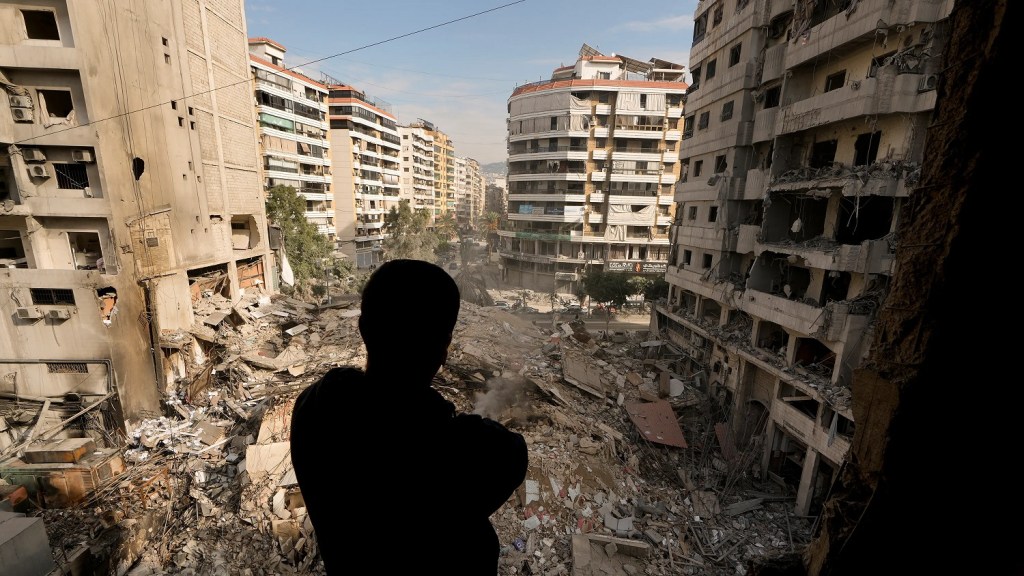
While an explosion reverberated across the valley from Beirut to the foothill village of Mansourieh, two men puffed on their cigarettes in resignation. Israeli jets were striking another apartment building in the Dahiyeh region of Beirut, Lebanon’s capital city, likely killing a Hezbollah militant or targeting an underground weapons depot within the tightly packed urban area.
Neither man cared about politics or the war, brought to their doorstep by last year’s decision of the Shiite Muslim militia to launch rockets into Israel to support Hamas. Tit-for-tat attacks had crossed the southern border for the 11 months that followed, as neither side wanted to engage in a larger conflict. That fighting displaced tens of thousands on both sides while leaving the rest of Lebanon largely unscathed—yet ever worried about an escalation.
It came in September. On the 17th, Israel declared the return of northern citizens to their homes to be an official war goal. Hours later, an Israeli sabotage operation exploded Hezbollah pagers, killing 13 and wounding around 4,000 militia-linked individuals. Then, on September 23, Israeli missiles struck throughout Lebanon, and hundreds of thousands fled their homes. Lubnan Assaf, a 42-year-old Shiite Muslim, and Awad Saab, a 72-year-old Greek Catholic, somehow found their way to the Arab Baptist Theological Seminary (ABTS) guesthouse—and became friends. At its peak, the evangelical institution housed almost 250 displaced individuals, about one-third of whom were fellow Christians.
ABTS offered daily chapels and provided three meals a day—but no televisions. Isolated from the news and away from static entertainment, couples walked in the seminary gardens while children rode scooters down the access road from the library. Assaf and Saab played a Rummy-like card game until 10 p.m., exchanging details about their abandoned neighborhoods.
Assaf gave Saab the daily update that his auto-accessory shop on the edge of Dahiyeh had not been looted. Saab replied that his eight-month pregnant daughter, one of 15 people who remained in their southern village on the frontline of the Israeli ground invasion, was still doing all right. Both whittled away the hours in relative boredom, as each over time expanded his spiritual horizons.
Assaf’s Story
Assaf’s apartment in the working-class Shiite neighborhood of Ouzai, located in Dahiyeh near the Beirut airport, overlooks a local café and the Mediterranean Sea. His shop serviced mostly middle-class Christians who frequented the area, well-known for its inexpensive furniture and manufactured goods.
Over the years, Assaf saved up enough money to build a home in his family village of Younine, 11 miles northeast of Baalbek, an ancient Roman city preserved in the Bekaa Valley, Lebanon’s agricultural heartland. Driving from Beirut means passing by marijuana fields that fuel an unofficial economy run by local Shiite tribes that reportedly collaborate loosely with Hezbollah.
Artful calligraphy from the Quran adorns the walls of Assaf’s home. His wife, Mira, and their 15-year-old daughter wear the hijab. When war came to Dahiyeh, they relocated for safety, while Assaf returned to Beirut to oversee his shop. The next day, an Israeli missile…
This article was originally published at Christianity Today on December 20, 2024. Please click here to read the full text.
Illustration by Christianity Today / Source Images: Getty / Courtesy of Brent Hamoud, Emad Botros, and Daniel Suter
The warning issued by the American embassy on October 14 could not have been clearer: US citizens in Lebanon are strongly encouraged to depart now. But this message, coming as Israel increased its attacks on Hezbollah, was only the latest in several weeks of diplomatic efforts to reduce the American presence.
Back on July 31, already fearing an escalation of violence, the embassy was discouraging would-be tourists with its highest of four alert levels: Do Not Travel. For those inside Lebanon, it urged: The best time to leave a country is before a crisis, if at all possible. Major airlines had already canceled flights to and from Beirut, leaving only the national carrier to facilitate evacuation—and its outbound flights were booked weeks in advance.
Ever since Hezbollah—a Shiite Muslim militia designated by the US as a terrorist entity—launched missiles across the border in support of Hamas’s attack last October, foreigners have lived under a cloud of uncertainty that Israel might eventually bomb the airport, as it did in the month-long war in 2006 that left many expats stranded. Americans would have little hope of leaving through Syria, and Lebanon has no official relationship with Israel to permit crossing the southern border.
And then Hezbollah pagers exploded throughout the country.
With dozens dead and thousands injured, the next day, September 18, the embassy warned of a reduction in routine care at hospitals. On September 21, it told citizens the Lebanese government could not ensure their safety, mentioning the possibility of increased crime, sectarian violence, or targeted kidnapping.
And on September 28, one day after a massive Israeli airstrike killed Hezbollah leader Hassan Nasrallah, the embassy sent its nonessential personnel home and opened registration for US citizens to request assistance in leaving.
Several US citizens paid thousands of dollars to place their families on private yachts to nearby Cyprus. Others frantically called Middle East Airlines (MEA) to secure embassy-reserved seats to anywhere else. And among the missionary community, the chatter was incessant: Are you leaving? What are your contingency plans? Will your organization make you go?
Some decided to stay.
CT interviewed four Christian foreigners to learn how they made the decision to remain in times of war.
Each had already endured the constant hum of Israeli drones hovering over their neighborhoods. They learned to distinguish between the noise of warplanes deliberately breaking the sound barrier and the similarly ear-popping sound of a missile strike bringing down a Beirut apartment complex. And some have wondered if they might become a target of random Shiite anger or if the Islamist kidnappings of foreigners during Lebanon’s civil war decades earlier could be repeated.
The sources represent different categories of Christian workers.
A Swiss family living in the foothills outside Beirut believes that angels closed their ears of their children at night, allowing for consistent sleep even when explosions—slightly muffled by the distance—woke the parents consistently at 3 a.m. An Egyptian with Canadian citizenship said the blasts were so loud he sometimes thought they had happened just across the street—only to look out the window and see smoke plumes rising across the valley two miles away, not far from his church outside Beirut.
An American married to a Lebanese woman said that while the bombings did not threaten him directly, he was deeply troubled as each missile resulted in more deaths and displaced families. And a single American woman raised in urban poverty amid gang warfare stated casually, “I grew up rough, but gunshots and bombs are not the same thing.”
A Shared Resilience
This woman, a Black millennial from Ohio, has…
This article was originally published at Christianity Today on November 1, 2024. Please click here to read the full text.
On September 23, Mustafa put his family of five on a small motorbike and drove seven hours north from Tyre to a village in the Lebanese mountains, weaving slowly through lines of gridlocked vehicles. Some in those cars—like his brother Hussein’s family of six—would not arrive for another two days.
The path normally takes two hours.
Mustafa, and thousands like him, were frantically fleeing Israeli bombs aimed at Hezbollah, the Shiite militia designated by the US government as a terrorist organization. Until that moment, he and his brother had been agricultural workers in a farm outside the city, living in a spartan two-bedroom apartment provided by his employers.
Top of Form
CT agreed to withhold his family name for security reasons. Mustafa is a Christian originally from Afrin, a Kurdish area in northwest Syria. Asked if he shared his brother’s faith, Hussein said, “Not yet.”
Their home nation does not recognize converts from Islam. And while Lebanon is the only Arab nation to grant freedom of conversion, Tyre is a socially conservative Shiite city under the political sway of Hezbollah.
This was Mustafa’s second displacement. In 2013, he and his brother fled the Syrian civil war. But over the past five years, as poverty rates tripled in Lebanon, the nominal Sunni Muslims found support from a local Christian ministry offering aid.
Eighteen months ago, Mustafa professed faith in Christ.
“I follow Jesus,” he said. “He saved me.”
When Israel began its ground invasion of Lebanon, it issued evacuation orders to both Muslim and Christian villages in the south. But the large majority of the displaced come from Shiite areas suspected of housing weapons depots and underground tunnels—where resident Shiites may or may not align with Hezbollah’s Islamist ideology.
According to a survey conducted in early 2024, while 78 percent of Shiites viewed positively the militia’s role in regional affairs, only 39 percent said they felt closest to Hezbollah among Lebanon’s political parties, compared to 37 percent of Shiites who felt closest to none.
Only 6 percent of Christians had “a lot of trust” in the Shiite militia.
Within these realities, Christians are eager—and cautious—to help. Gospel commitments and national solidarity require hospitality. Sectarian guardedness encourages suspicion. And Israel’s bombing campaign creates fear that welcoming the displaced might make them a target.
Many are helping anyway.
Mustafa and Hussein found shelter in living quarters offered by an evangelical church in the mixed Muslim-Christian village where they sought refuge. A plastic rug covered half of the cement floor in their private allotment, with thin mattresses pressed up against the walls. Blankets and pillows strewn about were evidence of their children’s fitful night of sleep.
“This is our message: to show love in action as we lead people to Christ,” the church’s pastor said. (CT is granting him anonymity due to the uncertain political situation in Lebanon.) “As they receive, we teach them to give.”
His congregation currently hosts about 100 people, displaced from their homes in the south and in Lebanon’s Bekaa Valley. More than half are from neighboring Syria; the rest are primarily Lebanese Shiites. The pastor said 60 percent of the total are believers in Jesus. Others, like Hussein, are their relatives or Muslims already closely connected to churches in their original area.
They all pitched in to prepare 500 tuna sandwiches for local distribution.
Not Just Talk
Hezbollah’s current conflict with Israel began last year on October 8, one day after Hamas invaded from Gaza and killed approximately 1,200 Israelis, taking 250 hostages. The Lebanese militia initiated what it called a “support front” for Hamas, launching missiles that caused 80,000 Israelis to flee from villages near the border.
A similar number of Lebanese also fled from Israel’s retaliation, and for 11 months the two sides had kept their missile exchange relatively contained, aiming to avoid a larger and perhaps regional conflict with Iran, which backs both Hamas and Hezbollah as proxy forces.
That status quo held despite…
This article was originally published at Christianity Today on October 17, 2024. Please click here to read the full text.
One Friday evening, a young woman sat her toddler on her lap at Christ the King Evangelical Episcopal Church in Ma’alot-Tarshiha, a mixed Arab-Jewish town in northern Israel five miles from the border with Lebanon. Like mothers everywhere, she clapped her hands and beckoned a response.
What does the cow say? “Moo,” the child replied.
What does the dog say? “Woof” came the answer.
What does the bomb say? “Boom,” and they both laughed.
Only a few hours earlier, with Hezbollah rockets flying overhead, intercepted sometimes by Israel’s Iron Dome defense system, church elders had debated meeting at all. When the siren sounded during the service, members wondered if they should enter the concrete basement shelter.
The playful mimicry belies the seriousness of the less-reported conflict in the Galilee region, but it also reveals its everyday normalcy.
“By now the bombs have faded into the background,” said Talita Jiryis, the 28-year-old volunteer youth leader at Christ the King. “Dark humor is our mechanism to cope with fear and the uncertainty of tomorrow.”
That is, for the northern citizens who remain near the border. But a different uncertainty pains the tens of thousands evacuated from their homes. Arab Israeli Christians offered different assessments to CT, but all pray for peace in the land of their citizenship. The war in Gaza affects them too.
On October 8, one day after Hamas crossed the border into southern Israel and killed 1,200 Israelis, Hezbollah—the Shiite Muslim militia similarly aligned with Iran—launched its “support front” from Lebanon.
Daily exchange of rocket strikes and retaliatory fire has continued since.
But compared to Gaza, the casualties have been far fewer. In Lebanon, more than 450 people have been killed, mostly Hezbollah and other militant fighters but including over 80 civilians. In Israel, at least 16 soldiers and 11 civilians have been killed.
Within weeks, Israel ordered 42 northern communities neighboring Lebanon to evacuate, displacing between 60,000 and 80,000 residents with financial compensation provided. An additional 90,000 Lebanese have also fled the fighting, generally restricted to a stretch of land a few miles on either side of the border.
The violence has steadily escalated and expanded, though both Israel and Hezbollah have appeared reticent to engage in an all-out war. Ma’alot-Tarshiha was not ordered to evacuate; neither was nearby Rameh, where Jiryis was born and raised.
Mentioned in Joshua 19:29 as a border town of the tribe of Asher, Rameh lies a mere eight miles from the border. Yet the historically Christian village, populated also by Muslims and Islam’s heterodox Druze community, sits on a hill facing away from Lebanon. During the last outright conflict between Israel and Hezbollah in 2006, rockets struck only the peak or the valley below.
But it is not the relative safety that keeps Arab residents from evacuating. Jiryis said that many in Rameh are originally from nearby Iqrit, where in the 1948 Israeli war of independence, villagers were forced by Jewish soldiers to vacate. A promise they could return within two weeks was not honored; neither was the 1951 Israeli Supreme Court ruling on their behalf. The following Christmas, the Israeli Defense Forces (IDF) demolished each home.
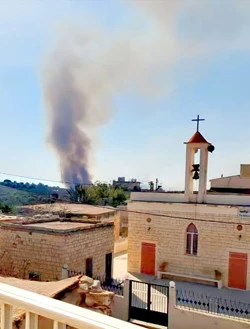
Seventy-three years and one day later, a Hezbollah rocket struck Iqrit’s Greek Catholic church compound, the only building left standing. The rocket injured the 80-year-old caretaker, and nine IDF soldiers were wounded in subsequent fire as they sought to evacuate him.
Aware of the widespread grievance, Israeli authorities have issued only recommendations—not orders—for Arab communities to evacuate, Jiryis said. In the Christian village of Fassuta, women and children left while the men stayed behind, fearful that history might repeat itself.
Christ the King church, however, represents modern cooperation: Its land was donated three years ago by the Israeli government, and its bomb shelter is open to the public. Services are on the Israeli weekend in advance of the Sabbath, as many from the village work in the Jewish sector. Samaritan’s Purse, she added, helped the poor with a $130 food coupon, a first-aid kit, and battery-charged lamps.
“Jesus is the light of the world,” leaders stated during the distribution.
The church’s average attendance is about 80 people, including a dozen youth, mostly teens. Jiryis’s father is the pastor, and she extended his regional Maranatha family conference ministry with an interdenominational youth gathering planned for April. About 70 signed up from northern Brethren and Nazarene congregations, only for all to be thrown into disarray by Iran’s unprecedented missile barrage against Israel a few days prior to the event.
They held the conference anyway.
“We had to fully activate our faith,” she said. “Christians quote, ‘I will fear no evil.’ But this time, we couldn’t afford to pretend.”
Yet many are mentally exhausted, Jiryis said, and bury their fears rather than turn to God. During the week, she lives in the port city of Haifa, 25 miles southwest of her village, where she works as a psychologist in a government hospital. She has applied her skills through arts and crafts for the village children and insisted the adults continue to meet for mutual fellowship. Breathing exercises and emotional awareness are essential, Jiryis tells them.
Yet as she looks at the war, she is angry at injustice from both sides.
Jiryis knows the history at the heart of Jewish fear. Her mother is German; her great-grandfather was forced to fight in World War II. There are no winners in war, only losers was the mantra instilled in his son. This grandfather passed away when she was seven years old, but the sentiment has filtered into her identity today.
Her paternal grandfather was Palestinian, but like many young people of her generation, Jiryis said she struggles with how to define herself. Although she calls herself a Christian Arab citizen, she doesn’t feel fully Israeli because she is not Jewish, nor does she serve in the IDF. With many Arab and Jewish friends, as a rule she avoids politics and says instead, “Call me Switzerland”—a neutral nation where her father did biblical studies. Yet as an evangelical, she is a minority of a minority of a minority.
Her internal conflict is tangible, but she finds a solution.
“I focus on my heavenly identity,” Jiryis said. “But it is difficult here because you have to belong to something.”
She sees the surrender to community narratives even in the body of Christ. Some Messianic Jews admit they will not pray for the “future terrorists”—Palestinian children—who are dying in Gaza. Some Palestinian evangelicals say they cannot pray for a government committing “genocide.” While tension was always under the surface, relationships everywhere are getting worse.
But some, even apart from Jesus, are still praying together.
A Land of Life
Jiryis’s church is an example of believers praying together, having held joint meetings with Messianic Jews. But the identity issues she described are not uncommon in her community.
A 2015 survey of local evangelical leaders conducted by Nazareth Evangelical College (NEC) found that…
This article was originally published at Christianity Today on June 25, 2024. Please click here to read the full text.
Rabih Taleb looked out from the pulpit at the 30 nervous believers gathered at the Evangelical Presbyterian Church of Alma al-Shaab in southern Lebanon, located less than one mile from northwest Israel. One day earlier, Hamas terrorists had killed 1,200 mostly civilian Israelis 125 miles south on the Gaza border.
That Sunday morning, Hezbollah, the Lebanese Shiite militia designated as a terrorist entity by the United States government, fired rockets into the disputed Sheba Farms enclave occupied by Israel but claimed by Lebanon. And as Israel began its massive bombing campaign against Hamas in Gaza, it also shelled Hezbollah positions 35 miles east of Alma al-Shaab.
A few families immediately fled, including the elder who leads worship, forcing the hymns into a cappella. The rest of the congregation pressed Taleb for a shortened service, all eager to return home and prepare for the worst. But the sermon topic—the second in a series on distinctives of Reformed faith—appeared divinely appointed. Little adjustment was needed to discuss original sin, suffering, and pain.
“They ask me: Why are we always facing these difficulties?” Taleb said. “We are believers. Why is there always war, war, war?”
Sources said this was their seventh displacement in the last 50 years.
Alma al-Shaab, one of about a dozen entirely Christian villages near the Israeli border, has a year-round population of about 700 people, Taleb said. Today only about 20 remain, including the Maronite Catholic priest who conducts services—now welcoming all sects—when there are lulls in the fighting.
Taleb and his family left Alma al-Shaab on October 9 when a bomb fell in a field only a three-minute drive from his church, rattling his parsonage home. Most of its 40 Presbyterian families relocated to stay with relatives in Beirut, with others fleeing within Lebanon to the biblical cities of Sidon or Tyre. The local synod, serving seven Presbyterian churches near the border with Israel, opened its retreat center in Zahle in case of further escalation.
So far, only three families have stayed behind.
Taleb has returned to his home village in Minyara, 115 miles north near the border with Syria. But every day he consults with elders about the condition of his scattered flock, and every 7–10 days he returns to visit Alma al-Shaab, violence permitting.
While the war rages in Gaza…
This article was originally published at Christianity Today on November 16, 2023. Please click here to read the full text.
A Protestant mother. A Shiite son. A plea for vengeance on his killers.
But unlike many responses to political martyrdoms in Lebanese history, she yields it to God.
Last month in the Hezbollah-controlled south of Lebanon, unknown gunmen shot Lokman Slim in the head. It was a targeted assassination of a man dedicated to the hope that his small Middle Eastern nation might overcome sectarian divisions.
He was his mother’s son.
“I will not go and kill them, but ask God to avenge him,” said the grieving 80-year-old, Selma Merchak. “This comes from my faith in God as the great authority.”
But her next response reflects the family’s—and Lebanon’s—complex religious identity.
“And as it says in Islam: Warn the killer he will be killed, though it tarries.”
Born in Egypt, Selma’s Protestant lineage traces back to her grandfather in Syria, who found Christ through the preaching of the first wave of Scottish missionaries to the Middle East. As a child, she attended the American School for Girls—now Ramses College—founded in 1908 by American Presbyterians.
The family attended Qasr el-Dobara Church, located in Cairo’s Tahrir Square. And Selma continued in the Protestant educational heritage, graduating with a degree in journalism from the American University in Cairo, which by then had become a secular institution.
The Merchak family mixed freely in an Egyptian upper class that was open to all religions, vacationing often in Lebanon’s mountains. But in the chaos of Gamal Abdel Nasser’s nationalizing of the Suez Canal, in 1957 Newsweek relocated its regional headquarters to Beirut, and Selma went with it.
She reconnected with Muhsin Slim, her childhood friend from the family vacations. The Slims were an influential Shiite family known for its good relations with the Lebanese Christian elite. Muhsin’s father served as a member of parliament in the 1960s, and during the civil war advocated against the use of Lebanon as a staging ground for the Palestinian armed struggle against Israel.
Now a lawyer, Muhsin married Selma shortly after her arrival in Lebanon. Her Egyptian accent was the toast of the town, aiding the political career of her parliamentary husband.
While Muhsin would only “pray in his heart,” Selma said, she worshiped on-and-off at the National Evangelical Church in Beirut, the oldest indigenous Protestant congregation in the Middle East.
Lokman, their second of three children, was born in 1962. Registered as Shiites within Lebanon’s sectarian system, Muhsin and Selma raised them to be moral, but to make up their own minds about religion. Statues of Buddha were part of the décor of their 150-year-old home. On property located in what was once known…
This article was originally published at Christianity Today on March 15, 2021. Please click here to read the full text.
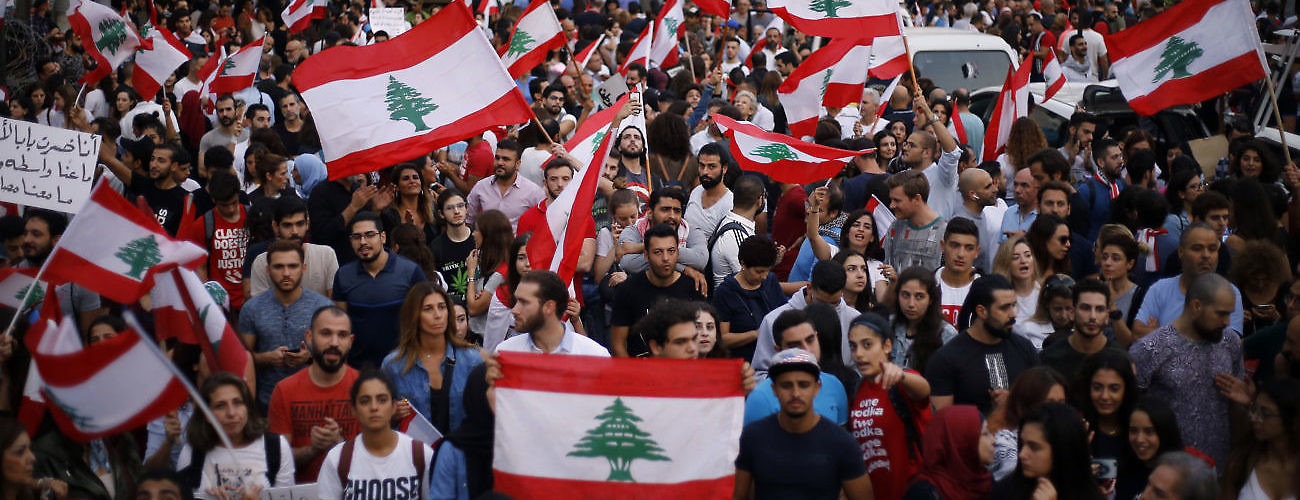
Anti-government protesters chant slogans against the Lebanese government as they hold Lebanese flags during a protest in Beirut, on October 26. (AP Photo/Bilal Hussein)
Does a revolution need a leader?
As the rocks rained down near the tent of Ras Beirut Baptist Church’s effort to discuss the question, suddenly the faith of the Christians gathered there was put to the test.
For the past month, Lebanese evangelicals have debated Scripture, sharing sermons online. One viral effort urges believers to stay away from widespread demonstrations in submission to authority. Another licenses participation in the popular push for justice.
Trying to find a third way, RBBC has visited the protest site weekly at Beirut’s Martyrs Square to discuss issues related to the revolutionary movement.
“We are not supporting a political agenda, but listening to people about why they are coming down to the streets,” Joe Costa, RBBC youth leader, told CT. “You cannot evangelize people if they are hungry or hurt. You have to be with them where they are.”
And this time, the church’s tent was at the front line as dozens of Hezbollah flag-waving partisans approached on their motorcycles.
Since October 17, citizens of Lebanon and its multi-confessional democracy have shed their religious identities in largely peaceful demonstrations against their political leaders. Some politicians have responded by justifying the violence of their followers, without authorizing it. Other politicians have expressed sympathy, asking for trust to make things better.
But long seen as the untouchable defenders of their communities’ interests, over the decades many political leaders have become wealthy.
“Corruption is like decay in our bones,” Hikmat Kashouh, pastor of Resurrection Church of Beirut (RCB), told CT. “No single person doubts it, including those in authority today.”
The current protest movement is leaderless and has no formal demands, but in general seeks…
Please click here to read the full article at Christianity Today.



 Jayson Casper