Categories
Arab West Report Middle East Published Articles

Interview with a Presidential Candidate, Summarized

Dr. Abul Futuh

Dr. Abdel Munim Abul Futuh is a frontrunning candidate in the Egyptian presidential elections. He has been a member of the Muslim Brotherhood’s Guidance Council for twenty-five years, but now finds himself officially outside the organization as a result of his desire to run for the presidency. The Brotherhood has stated it will not field a candidate for this post, and thus expelled him from the group. Nonetheless, his stature as a liberal-leaning Islamist positions him well among current declared candidates, and there is a better-than-fair chance he may be Egypt’s next president.

Arab West Report was able to secure an interview with him; questions were posed by Editor-in-Chief Cornelis Hulsman, and composed under his supervision by Yousef Habib, Jenna Ferrecchia, and myself.  Prior to the full transcript and analysis thereof I will place now a brief preview. The final transcript will be posted with a link to the video of this interview in a few days.

The interview was conducted in Arabic, so the nuances of his answers must wait until the proper and precise translation is finished.

How do you plan to unite Egypt as president, given her current divisions?

Egypt has diversity, not division. In order to unite Egyptians the president must have four characteristics:

  • He must work for Egypt’s independence and national benefit
  • He must be religious to fit with the population
  • He must deepen the reality of citizenship
  • He must render justice according to the law

Are you truly independent from the Muslim Brotherhood?

I take pride in the Muslim Brotherhood and in its moderate Islamist ideology. But my separation now is not a tactic. I do not represent the Brotherhood and am completely independent in terms of organization.

What is your opinion about the caliphate?

This is not an Islamic religious term. It represents simply the idea of international cooperation but is misused by many. In any event it does not concern me. I am interested in building Egypt. Besides, as we are now, who can we unite with?

What is your opinion of the Hassan al-Banna quote: ‘The Qur’an has made Muslims to be the guardians for an incapable humanity, giving them the right of superintendence and sovereignty over the world.’

If Banna or anyone else said this, it is an incorrect idea. No person may claim guardianship over any other person, and Islam does not support this. If someone claims to be on better standing with God than someone else, fine, but let him take this up with God. Between men, anyone who sets himself up as better than another, even religiously, damages the essential dignity of humanity.

Note: al-Banna is the founder of the Muslim Brotherhood. Click here for a summary translation of a compilation of his writings, here for an analysis thereof, and here for the response of a regional leader of the Brotherhood to some of its quotes.

Earlier your said creating the Freedom and Justice Party was ‘a risky gamble’ in the likelihood it would mix proselytizing and politics. What do you think now after their electoral success?

Now as before I do not support the Muslim Brotherhood in creating a political party, as there is an obvious mixture between the two. Every day you get some Muslim Brother – non-affiliated with the Freedom and Justice Party – speaking about politics. It is not good.

How do you see the proper role of Egypt’s president and parliament?

The president should have strong powers but these should be shared with parliament, which maintains both a legislative role and one of oversight on the executive branch.

How do you view the process of reform at the Ministry of Interior?

It is not simply a matter of firing officers, but engineering a change in culture so the police become in service to the people. But this must be done with respect to the preservation of stability.

What are you views about the coming constitutional assembly?

This must be representative of all sectors of society, some of which may come from parliament, but not most. It must produce a national dialogue in order to create consensus, even if this takes time. But out of respect to the March referendum, the writing of the constitution should take place after presidential elections, not before.

What is your view about Article Two of the old constitution, making Islam the religion of the state and the principles of Islamic sharia to be the source of legislation?

It was part of the 1971 constitution and was approved widely by the people. Today, everyone supports it, including Christians.

How many Christians do you think are in Egypt, and should their official number be made public?

I do not have an estimate on their number, but the fact of their number should be part of public information. What is done about this number is another matter, but as a statistic it should be released.

You stated previously there should be no barriers to religious conversion in any direction. What is your view?

Freedom of doctrine is a basic human right and enshrined in the recent Azhar document. But neither the Azhar nor the church should have any role in conversions, as if they must give their approval. It is the state alone which must guarantee this freedom.

What do you think about the unified law for building houses of worship?

This is an invented issue. There is no need for a law but only for administrative permits where there is a need. But really, Egypt does not need more mosques or churches; it needs farms and factories.

How do you view issues of marriage and divorce?

In Islam, marriage is a civil matter, not a religious issue. But if a Christian wishes to have a religious marriage, this is a matter for his community. But in terms of the state marriage and divorce should be civil matters. The problem some Christians have in getting divorces is simply a matter between him and the church; the state is not involved.

What are your ideas on economic policy and Islamic banks?

Time does not permit a full answer, but the gap between the rich and the poor is largely an issue of corruption and poor administration. As for Islamic banks, they exist now everywhere in the world. People should have the freedom to choose the bank they wish to use, with all options available.

Thank you very much for your time, Dr. Abul Futuh.

Update: The interview has now been transcribed. Please click here for the post.

Categories
Christianity Today Middle East Published Articles

Many Copts Anxious as Islamists Win Majority in Parliament

Egypt’s parliamentary elections are over.

While noting irregularities, former US president Jimmy Carter, through his Carter Center for promoting democracy, has judged the elections to be “acceptable.” When the first post-Mubarak parliament opens session today (January 23) its composition will be 72 percent Islamist.

The celebrated chant of Tahrir Square – “Muslims and Christians are one hand” – has given way to sectarian politics in which liberal parties, favored by the great majority of Copts, received a crushing defeat.

The Democratic Alliance, dominated by the Freedom and Justice Party (FJP) of the Muslim Brotherhood, has won 46 percent of the seats. The more conservative Salafi Nour Party has captured 24 percent. A handful of smaller Islamist parties add another 2 percent. Liberal politicians, who were once hopeful, are reeling from their losses. Coptic Christians are left pondering their murky future.

Today, The Wall Street Journal published an op-ed article about risks to freedom that observed, “Especially critical is protection for Copts, the canaries in Egypt’s coal mine. The fate of Egypt’s democracy—and the chances for the emergence of non-Islamist options—will rest on whether this millennia-old community, as well as an array of other groups, feels comfortable in the new Egypt.”

Amin Makram Ebeid, a Coptic intellectual and author, summarizes four primary Coptic responses:

  • A minority, though sizeable, is planning to emigrate.
  • The largest group is looking for spiritual, perhaps even mystical solutions.
  • A smaller party is dedicated to stay and fight for their rights, especially in securing a non-Islamist constitution, which according to the national referendum in March is the provenance of parliament.
  • Finally, there is a group that is looking to cooperate with Islamists, provided Copts do not lose their identity in the process.

Paula Magdy, a 24-year-old volunteer librarian in a Coptic Orthodox Church in Cairo, illustrates the group seeking spiritual solutions. “We pray to God to save us, but I am not afraid. Up until now we have not been sure about anything. Maybe they have won elections, but we will win the war?”

Fawzi Khalil, a pastor at Kasr el-Dobara Church also estimates most Christians fall into the spiritual solution category, with only about 10 percent actively participating in shaping the political outcome for Copts.

Standing their Ground

Emad Gad is one of the 10 percent, representing the group wishing to stay and fight. He is a Coptic leader in the liberal Egyptian Social Democratic Party, winning a parliament seat in the north Cairo district. Naturally, he offers political perspective.

“We don’t fear the result of elections because there were many violations that skewed results. In any case, parliament will not form the government, the president will, and the military council also maintains its influence.”

For him, the constitution is the largest battleground, but liberals are working on an agreement with Islamists for each party to nominate a limited number of members to the committee which will draft it.

Nevertheless, “If Islamists reach toward a Saudi-style government we have many means to resist. Certainly the new generation is able to go once again to the streets. I expect Egypt will remain a civil state.”

Fr. Philopater

Father Philopater will also stay and fight, but his is a religious perspective. A controversial priest in the Coptic Orthodox Church who has repeatedly clashed with the hierarchy, Philopater expects a continuation of the suffering of Copts.

“The one benefit is that persecution will now be obvious, as under Mubarak it was always assigned to hidden hands or deviant people.”

Furthermore, Copts should not cooperate with Islamists. ‘It is true some speak of protecting Copts, but others speak about jizia, call us infidels, or instruct Muslims not to greet us in the street.’

Ebeid agrees with non-cooperation. “Christians should not support them in their quest for power. If we sell ourselves, why should liberal Muslims continue to fight?”

Cooperating with Islamists

Then there is the group which promotes cooperation. Rafik Habib, son of a now-deceased prominent Protestant pastor, represents a tiny Coptic constituency that actually favors Islamist rule. He is among roughly one hundred Copts who are founding members of the Brotherhood’s FJP, and serves as one of its vice-presidents.

He believes Egypt must accept the essential religious basis of society, not deny it.

“Secularism surrounds Christianity and the church and weakens its role in society. Under an Islamic state it can be completely different because the main function of the Islamic state is to protect religion, not to restrict it.”

Youssef Sidhom

More typical are Copts who wish to cooperate with Islamists but due to necessity. Among these is Youssef Sidhom, editor-in-chief of the Coptic newspaper Watani.

“In order to keep any vicious Islamist appetite at bay we must stay at the table with them and remind them they promised not to hijack Egypt.”

Unlike Philopater, Sidhom has a degree of trust in the leaders of the Muslim Brotherhood, who through his interactions with them finds them to be decent people.

“I believe the Brotherhood wants to prove they can create a form of democracy that respects the rights of all Egyptians.”

Similar to Social Democrat Gad, however, Sidhom is prepared.

“Our Plan B if Islamist groups seek an Islamic state is to oppose their constitution in a referendum, but if it is accepted, Copts and liberal Muslims – 40 percent of the population – will take again to the streets.”

All Politics is Local

While these responses are varied, it is “the street” that decides. This is not the street of Tahrir Square, but the poor, crowded neighborhoods in every city of Egypt.

In Warrak, a suburb of Cairo, Shadia Bushra, a 45 year old Coptic widow, cast her vote for the Freedom and Justice Party.

“I don’t know much about politics, but I followed the general view of the neighborhood.”

Essam Sharif

It did not hurt that when her local church failed to intervene to defend her rights in a property dispute, Essam Sharif, her Salafi neighbor and a leader in the Nour Party stood by her side, retained a lawyer, and helped win the judgment against wealthier Christian neighbors.

“I told her I would have done the same if she was opposed by Muslims,” stated Sharif.

Stated Islamist commitment to the rights of all has also won support from Copts in Maghagha, a small city in Upper Egypt. Sheikh Hamdi Abdel Fattah is a candidate for the Nour Party.

“I will consider myself the candidate of Christians ahead of Muslims, even if they do not vote for me. As such, I have to demand their rights. This is both democracy and Shari’ah law.”

Sheikh Hamdi and Fr. Yu’annis

Father Yu’annis is a Coptic Orthodox priest in Maghagha and has campaigned openly for Abdel Fattah.

“I don’t support him as a Salafi or as a Muslim, but as a person. He is from our village and I hope all Salafis will be like him.”

Yet he is pragmatic as well. “If we see more than two-thirds of the people are for an Islamic state we cannot stop them from having it, so as the Egyptian proverb says, ’With him who wins, play with him’. I must do my village duty to stand by him, so he won’t say I caused him to lose, and if he wins, he will be thankful.”

Perplexing Questions

The seismic politic changes in Egypt during the past 12 months are still underway. Copts and others fill this resulting uncertainty with fears and expectations in wildly different directions.

Essam Thabit, a Coptic school teacher in Maghagha, believes all will be well. “Whoever comes to power will make sure they treat Christians better than the old regime, even though they know Christians won’t vote for them. I expect many churches to be built.”

His Coptic colleague Yasser Tekla from the neighboring city of Beni Mazar expects, and oddly welcomes, the worst. “I will vote for the Salafis now so they will come to power and people will see them truly, and then reject them afterwards.”

Many Copts hesitated during the revolution, while others joined wholeheartedly. The initial celebrations of Tahrir – where Muslims and Christians alternated protecting each other at prayer – have been followed by multiple instances of bloody sectarian conflict.

This has prompted Copts to ask themselves hard questions: Should Copts take refuge in the military council against Islamists, or with Islamists against the military-as-old-regime? Should they enter the political arena and trust its processes, or enter their churches and trust in God?

So far, clear answers to these questions seem beyond the reach of Egypt’s Christian minority.

This article was published originally at Christianity Today. Please click here to view it at that site.

Categories
Lapido Media Middle East Published Articles

Christmas with the Brotherhood

MB Delegation Outside a Helwan Church

Following two years of bloody winter holidays, and following also resounding Islamic success in elections, the Muslim Brotherhood coordinated with security forces – and probably Orthodox Church leadership – to stand watch outside church buildings throughout Egypt.

I was able to visit one installation in Helwan, to the south of Cairo. After moving from church to church in the district of Maadi, finding no Brothers present, I happened upon a Christian taxi driver who told me they were at his church, to which he subsequently brought me. It would have been difficult to find on my own.

I wrote about this story for Lapido Media, a British website focusing on telling religious aspects of the news which might be overlooked by other outlets. That the Brotherhood would come and spend Christmas with Copts is a fairly big deal, but many Western news agencies missed it. Not only is the event newsworthy, but so is its undercurrent. Please click here to read the story.

The basic question is this: Is the Brotherhood coming to Christmas celebrations because they love Copts as fellow citizens and Egyptian brothers? If so, this is wonderful.

Or, does their effort to ‘defend’ Christians issue from a place of Islamic superiority which offers protection to religious minorities in exchange for their acceptance of an Islamic system of government? If so, this is concerning.

Read the story for several wonderful quotes which insist upon the former. Yet upon pushing them for their eventual goal – after reestablishing security, economy, and demonstrating the virtues of Islamic government – they deftly skirted the issue. They insisted it was not proper to speak about Christians under dhimmi protection ‘now’.

I don’t necessarily doubt their sincerity. I believe that most Brothers, being Egyptians, have a love of their fellow Copts. It is a laudable feature of Islam that it urges Muslims to defend the rights of (at least Abrahamic) religious minorities.

Every religion has a natural chauvinism with which it imbues believers concerning their own faith. One of the prominent interpretations of Islam insists it has the right to rule – and rule justly – but to accord non-Muslims a special place in subservience to an Islamic order. Even if the Muslim Brotherhood does not have a ‘strategy’ to turn Copts into dhimmis, this aspect of their faith may be bubbling to the surface, no matter their simultaneous sincere expressions of love and equality.

Being a dhimmi may not even be a horrible thing, but neither is it liberal democracy. Currently the Muslim Brotherhood straddles the fence, insisting both on a civil state with equality of citizenship and an Islamic reference to guide legislation. Can they pull it off? Time will tell.

Yet despite the desires of many Muslim Brothers to postpone this question, it is essential it be answered now. Otherwise, the system may take root and produce effects from sources far more deeply rooted than assertions of national unity. These assertions are true, they are even sharia. Yet historically, sharia also often included dhimnitude.

Muslim Brotherhood overtures at Christmas hint in both directions. As one Brother states in the article, he wants Christians to know what is in their heart. This is good, but Copts also deserve to know what is in their vision.


Categories
Aslan Media Middle East Published Articles

Brotherhood Deliberations

Leaders in the Muslim Brotherhood's Freedom and Justice Party

The latest violent crisis in Tahrir finally de-escalated through the courageous act of thousands of women marching to the square demanding an end to clashes. Meanwhile, political leverage is being sought as parties propose an idea to hurry the presidential elections. The military council succumbed to such pressure following the clashes of Mohamed Mahmoud Street off Tahrir, to guarantee these elections before the end of June 2012. Current ideas now call for elections to be as soon as January 25, the one year anniversary of the revolution.

Proponents of this idea argue that the military must be returned to its barracks as soon as possible, having mangled the democratic transition if not actively opposing it. This cry is heard from across the political spectrum, from liberals and Islamists alike.

The issue for Islamists, however, is that they have repeatedly based their decisions on the ‘will of the people’ as expressed in the March referendum. This mandate granted the army the right to oversee the transition, during which the lower house of parliament would be elected, then the upper house, then the constitution drafted, and finally presidential elections held. Should Islamists call for departure now they go against their own rhetoric.

It appears they have, and then shortly after, they haven’t.

The Ikhwanweb Twitter account represents itself as ‘The only official Muslim Brotherhood’s English website. Our Tweets represent the official opinions of the Muslim Brotherhood’. On December 19 the account tweeted:

Democratic Alliance demands #SCAF to handover both legislative and executive power to the elected parliament no later than February 2012.

The Democratic Alliance is the coalition led strongly by the Muslim Brotherhood’s Freedom and Justice Party. While it includes a variety of liberal and Islamist parties, the FJP is widely understood to control the direction of the group.

Here, the coalition demands not simply the early election of the president, but the transfer of executive power to the legislature, which, not coincidentally, is controlled by 40% FJP alongside 25% Salafi party members. By all appearances it is a power grab. It certainly represents a departure from the March referendum and the ‘will of the people’.

Perhaps in recognition of this fact, or in a desire to not confront the military directly, the website of the Muslim Brotherhood released a statement on December 21 to return to the mandate of the referendum. They state:

3 – The FJP believes that to end the violence, which erupts on the scene each time popular will requires full-throttle efforts to complete the legislative elections so the elected People’s Assembly participates in the peaceful transfer of power. Furthermore, the party deems premature all calls for immediate handover of power to the People’s Assembly Speaker-elect, and rejects them, because the idea is not compatible with the current Constitutional Declaration.

  4 – The FJP asserts that demands put forward for holding presidential elections before January 25 will not solve the current crisis, because the issue is now about who is stirring strife, sedition and crises, who is acting with exemplary short-sightedness, and fails to appreciate the requirements approved by all parties in the Constitutional Declaration – which provides for elections of the People’s Assembly, then the Shura Council, drafting the new constitution, and finally the presidential elections.

Analysis elsewhere can determine the wisdom of either statement, the opportunism therein, or the best interests of the democratic transition. What is interesting is to wonder who in the Brotherhood authorized the Ikhwanweb Twitter account to demand transfer of power to the parliament? At what level did this reflect the consensus of the organization, and what transpired to result in this second announcement?

Though the Muslim Brotherhood is a pyramidal organization, its members consist of diverse trends and political pragmatism. These statements perhaps can be viewed through the lens of organizational groupthink, of internal deliberations which spilled out into the public.

Another possible insight is that these statements belie the idea the Brotherhood is the possessor of a grand conspiracy to move events along until power is consolidated in their hands. While this may or may not be an ultimate goal, the contradictory statements indicate the group is trying to figure things out as they go along, much like everyone else. In all likelihood they have a strategy, but they do not pull all the strings.

In the meanwhile, in the current relative calm of Tahrir, all political forces and the military council are regrouping, repositioning to come out on top. Even after Friday and the latest massive demonstration gathering, there is no clear indication who is winning.


Categories
Arab West Report Middle East Published Articles

Gamal Nassar on the Muslim Brotherhood

A primary accusation against the Muslim Brotherhood is that it is two-faced in its politics. Within Arab contexts the organization, it is said, promotes a radical Islamist agenda, yet when addressing Western audiences its discourse becomes more moderate. A comprehensive answer to this charge is not possible within a single interview, and may be impossible altogether. The Muslim Brotherhood is composed of diverse membership, all of which may be categorized as Islamist in the sense of esteeming the role of Islam in government, but which harbor different visions as per means, extent, and implementation. This interview is but one man’s opinion on some of the hard issues Western critique levels at the Brotherhood, but it is hoped that he is, to a degree, representative.

Dr. Gamal Nassar is a journalist, writer, and the director of the Civilizational Center for Future Studies. He has been a member of the Muslim Brotherhood for over thirty years, and served nine years as media advisor to the General Guides Muhammad Mehdi Akef and Muhammad Badie. He is a founding member of the Brotherhood’s Freedom and Justice Party (FJP), and one of the 550 members of the regional party office in Giza. He is a graduate of Cairo University, with MA degrees in Philosophy and International Negotiation.

The following text will convey Dr. Nassar’s perspective on the relationship between the Muslim Brotherhood and the FJP, the Salafis of Egypt, and Hamas of Gaza. It will also seek his perspective on the writings of Hassan al-Banna from the treatise, ‘Who are We, and What do We Want?’ as described in a previous text. Dr. Nassar spoke passionately, authoritatively, and clearly on these topics.

The Freedom and Justice Party

Why does the Muslim Brotherhood have just one party, and why is it kicking out members who seek other political visions? What is the political vision of the FJP? What is the role of Islam? Furthermore, is it truly independent, as required by law, or under the direction of the Brotherhood? Each of these questions betrays distrust that the Muslim Brotherhood is being sinister. Are they after democracy, or an Islamic state?

Dr. Nassar celebrates that after the revolution all segments of society have had the freedom to craft political parties. Though only about 10% of Muslim Brotherhood activity is political in orientation, it is appropriate their politics formalizes into a party. Why only one party? It is pragmatic – otherwise the power of the Muslim Brotherhood would be diffused.

The extent of rebellion, he states, has been greatly exaggerated in the press. Yes, there have been several breakaway parties from the Muslim Brotherhood – the Renaissance Party, the Pioneer Party, and the Egyptian Current Party – but those members, generally acknowledged as youth, represent less than 1% of Brotherhood youth membership.[1] Sixty percent of the Muslim Brotherhood, in fact, are youth (under 40 years old), which is the same percentage as society at large. Dr. Nassar wondered that perhaps the Brotherhood might allow free political participation for members in the future, but that for now those leaving do not represent a new trend – in the 1990s the Wasat Party also emerged from the Brotherhood organization, and is independent today.

As for the independence of the FJP, Dr. Nassar related that party leadership tendered their resignation from their Brotherhood responsibilities in the Guidance Bureau and Shura Council, though they maintained general membership. The FJP is administratively and financially independent, taking its own decisions.

Does their continuing membership, however, imply necessary obedience to the general guide? This is not the way the Muslim Brotherhood functions, Dr. Nassar replied. First of all, the general guide does not issue instructions unless they are thoroughly studied by the group. Second of all, membership in the Muslim Brotherhood is akin to membership in a club. Anyone is welcome to join, but there are rules to abide by. The FJP operates within the framework of these rules.

Dr. Nassar made it clear that the FJP, like the Brotherhood in general, desires a civil state. It rejects the idea of a religious state, for this has never existed in the history of Islam. Yet what then about the ‘Islamic frame of reference’ which the party espouses? What does this entail?

The frame of reference is in one sense recognition of the heritage of Islamic civilization. In another and more telling sense, it is the obligation of the government to not issue laws which violate Islamic sharia. Dr. Nassar stated that sharia protects Muslims and Christians alike, guaranteeing their citizenship. This was seen with Muhammad during his Compact of Medina, in which Muslims, Jews, and pagans lived equitably under Muhammad’s rule. It was also witnessed during the caliphate of Omar ibn al-Khattab, when he entered Jerusalem and guaranteed freedom of worship to Christians now under his rule.

The decision on what violates the sharia, he added, is not to be made by religious scholars. An Islamic frame of reference is not the rule of men of religion. Rather, it places the decision in the hands of the regular judiciary, culminating in the constitutional court. This is the prerogative of a civil system.

Laws permitting adultery and the drinking of alcohol, for example, would be struck down as clearly contradicting sharia. Dr. Nassar believed, however that forced wearing of the hijab would not be enacted, as this was not a clear matter. He did state that the Brotherhood would encourage all women to be appropriately modest in their dress.

The Salafis

Well enough that the FJP wants a civil state, but what about Salafis? Does not the Brotherhood cooperate with them, even as they call openly for an Islamic state? Do they not call democracy a form of unbelief? Will democracy in Egypt be a one-time event?

Dr. Nassar acknowledged that the FJP cooperates with Salafi groups in Egypt, but that it does also with liberal and socialist perspectives. When asked the difference between the Brotherhood and Salafis, though, he stated there was no essential difference, only in non-essential matters. A key distinction was that traditionally Salafis avoided politics, while it has always been a component of the Brotherhood program.

Dr. Nassar went on to clarify, then, that when Salafis call for an Islamic state, he believes they are asking in essence for the same thing he described above. The problem is that the term ‘secular state’ has entered the political discourse, and Salafis take this to be anti-religion. They compensate by calling for an Islamic state, to make sure religion and politics are not separated.

Dr. Nassar realized that some were afraid Salafis, as well as the Muslim Brotherhood, would treat democracy like a ladder to power, and then kick it away once it was obtained. This is not the case, with the FJP at least. He believes in a democratic system that rotates and shares power. The Brotherhood does not seek to dominate the political scene. Rather, it is working for an overall goal of promoting an Islamic renaissance, not just for Egypt, but for all Muslim peoples and the world at large. It is a civilizational project, not to be achieved by force, but by wisdom, preaching, and good communication.

In terms of Egypt, however, Dr. Nassar appeared agitated. We are not from Mars, he declared, we are Egyptians. Everyone has the right to seek to gain authority, as do we. Yet it is the people who are to choose in elections, and we hope they will choose us. Just look at the recent university elections in Ain Shams. We lost; did anything bad happen afterwards? No, our goal is to serve the people, and Egyptians know well enough what they want.

Hamas and Israel

Is Hamas part of the Muslim Brotherhood network? Are their terrorist activities supported by the Brotherhood in Egypt? What does the Brotherhood think of the Camp David Accords? Of Israel as a state? Of Jews in the Middle East?

Dr. Nassar described the Muslim Brotherhood as an ideological organization, spread worldwide in over eighty countries including the United States. Yes, the general guide represents the Brotherhood in the world, but there is no worldwide organizational structure, and each region is free to shape its own policy as long as it does not go against the general principles of the group. This is the situation with Hamas; they know their circumstances best.

To begin with Egypt, however, Dr. Nassar acknowledges the Muslim Brotherhood does not recognize the state of Israel. All the same, they deal with the situation in reality, and are asking for the amendment of the Camp David Accords, given that the treaty works in favor of Israel and to the detriment of Egypt. Yet any international adjustments, such as these, must be ratified by the Egyptian parliament.

Asked, however, if reality permitted, would the Muslim Brotherhood seek the disappearance of the Israeli state, Dr. Nassar said this was not only the wish of the Brotherhood, but of Egyptians and all Arabs. He was clear that Islam called Muslims to support the followers of Judaism and Christianity, but that it was also clear Muslims should fight those who fight them. The state of Israel is akin to a thug who entered your home by force. Is it not right to resist his occupation? Should the homeowner recognize the thug’s right to be there? Should he enter negotiations with the thug in order to get him to leave? Should he accept any situation that grants the thug the living room and kitchen in exchange for the bedroom? Should there be a democracy in which the thug gets to vote? This is all ludicrous, Dr. Nassar explained, and as such the resistance of Hamas is legitimate.

Even the means Hamas utilizes, such as the firing of rockets into Israel, is legitimate. Dr. Nassar noted that Israel also fires rockets into Gaza, which kill indiscriminately. Yet the residents of southern Israel are not strictly civilians – they are settlers and occupiers; they have usurped the land. Even outside of the West Bank and Gaza, the Jews there have come from Europe, Russia, Africa and elsewhere, taking land that was not theirs. Should Palestinians then only ask for up to the 1967 lines? No, the whole land is occupied, and it is moral to fight back against oppression.

In this sense, in the ideal, even a one state solution would not properly satisfy justice. Dr. Nassar stated that while the Jews of Palestine resident for generations had every right to live in the land, the others should go back where they came from. Reality may not permit this, as the Zionist lobby is strong, especially in America. Why else is the United States threatening to veto UN membership for Palestine, when South Sudan has been granted a state? The US is neither for democracy nor justice, simply its own interests. By contrast, the Muslim Brotherhood idea is moderate, believes Islam is incorporated in all aspects of life, and intends to reform humanity.

Commenting on the Writings of al-Banna

Click here for a previous text exploring ‘Who are We, and What do We Want?’

  • The Quran establishes Muslims as guardians over an incapable humanity, giving them the right of superintendence and sovereignty over the world.

God has chosen Muslims to be guardians, or witnesses, to the world because they have received his grace. Humanity is not able to know the truth or what is good, suffering many problems and limitations. Muslims should therefore rise to meet this need, acting as guardians – though not as father to child – to benefit, advise, and direct the people.

In terms of sovereignty, previous prophets like Moses and Jesus were sent only to their own people, but Muhammad was sent to the whole world. In the world there is a struggle between right and wrong which will continue until the resurrection. Muslims enter this struggle to bless the whole world peacefully – not through war – and spread the message of Islam. As this message spreads, it will also take sovereignty over the areas that accept it.

  • We will pursue them and raid in their own lands, until the entire world celebrates the name of the Prophet and the teachings of the Quran.

Even though they are a minority, Muslims are in Europe, for example, and can play a role in spreading Islam there. European civilization is filled with materialism and desires, which Islam can balance with its focus on spirituality. This should be done with wisdom and good communication, and not with force, for there is no compulsion in religion.

Why not use a different word, then? And do not Muslims celebrate the raids of Muhammad?

When al-Banna wrote his message what I explained was understood naturally; ‘raiding’ was not intended. What is meant is that the religion should spread, but it is not my job to force you. I can only advise you, since freedom of religion is very important.

  • The Muslim should then work to restore the international position of the Islamic nation, so that its lands are liberated and its glory revived in the return of the lost caliphate and all desired unity.
  • We desire the flag of God to fly high over the lands which once enjoyed Islam and the call of prayer declaring ‘God is great’, but then returned to unbelief. Andalusia, Sicily, the Balkans, southern Italy, and the islands of the Mediterranean were all Islamic colonies and must return to the bosom of Islam.

‘Caliphate’ is only a word; what is intended is the unity of the Islamic nations, not dissimilarly to the European Union. We want them to cooperate, even to have a single leadership decided by elections.

Yes, this should also include the former Muslim lands – this should be the goal of every Muslim, not just the Muslim Brotherhood. ‘Colony’ in Arabic linguistic terms is positive – it means to develop and build up. What European nations did, however, was to destroy and exploit, seeking to make the colonies European. In terms of those nations mentioned in the text, they were originally Islamic, until the European raids took them away.

  • We desire to announce our call to the whole world, and to cause every tyrant to submit to it, so that there is no sedition and all of religion is for God.
  • The Muslim should work for professorship of the world by spreading the call to Islam in all corners (quoting the Quranic verse): Fight them until there is no sedition, and all of religion is for God.

A tyrant, like Israel today, overturns what God has made natural for people. This is the meaning of sedition; it should be fought against, so that religion – the natural state – is for God. Elsewhere the Quran teaches that you should only fight someone who fights you, and that this should be a last resort.

Yet if it is your job to spread Islam and others deny and fight you, should you be silent? Reason says you should fight back; people must know that God’s will is to be implemented. Yet if it is said that the United States is oppressing Muslims, this does not mean there should be a counterattack in the US. No, the foundation of preaching religion is in wisdom and good communication; fighting is only a last resort.

  • Do not adorn tombs of the deceased or call upon the help of departed saints.

If Sufism in its interpretation of Islam helps people to lift up their souls, it is very good. Yet if they deviate from proper religion, the Muslim has an obligation to make their error clear to them. This also is the role of the state, to raise consciousness as per right religion. Yet we should stop no one from visiting tombs, nor should we tear them down as happened in Saudi Arabia. A large part of the problem is simple ignorance, but yes, the practice should be prevented.


[1] Bassam Qutb, who had his membership frozen for supporting the presidency of Abdel Munim Abul Futouh, running in defiance of a Brotherhood decision not to pursue the presidency, estimated in June that 4000 youth were similarly disciplined. Unofficial estimates put total Muslim Brotherhood membership between 400,000 and 700,000 people, suggesting Dr. Nassar’s figure to be accurate.

Categories
Arab West Report Middle East Published Articles

Disappointment with the Brotherhood

Polling Station Info, Handwritten on an FJP Leaflet

The morning of elections, I marveled at the political acumen of the Muslim Brotherhood. By afternoon, I was disappointed.

At polling stations across Egypt the Brotherhood’s Freedom and Justice Party volunteers manned tables equipped with laptop computers and logged into the voter registration system to assist confused citizens where their vote must be cast. The volunteers wore yellow FJP hats and wrote down the requisite information on a specially designed party leaflet. It was a beautiful stroke – practical service to create last minute impressions. The only problem, I discovered later in the day, was that it was illegal.

Election law proscribed campaign activity during the final two days before the vote. Many parties violated the law by passing out literature to passers-by as well as those waiting captive in long lines to cast their ballot. The Brotherhood’s violation was simply more creative and effectual than all others. Shame on the rest for not thinking of it first.

But shame on the Brotherhood for doing it at all. Many volunteers denied knowing of the regulation, and likely they were innocent. Party leaders, however, either failed in knowing the law or failed more egregiously by ignoring it. Yet this is politics, which is rarely celebrated as an arena of virtue. Why then should disappointment reign?

I am among those not wishing to dismiss Islamist governance out of hand. A nation’s rulers should reflect the makeup of their people, and there is a place for religion (morality, virtue) in crafting legislation. While politics can corrupt religion – and vice versa – I would, in general, desire a God-fearing man or woman to represent me in office. Religion should promote the humility and other-centered-service required of transparent leadership. I would wish to believe the Muslim Brotherhood, being Muslims, might fit this bill.

The laptop affair violated not only the law, to which believers should submit, but also the ideals of religion. I am most familiar with Christianity, where Jesus says,

Be careful not to do your acts of righteousness before me, to be seen by them. If you do, you will have no reward from your Father in heaven … but when you give to the needy, do not let your left hand know what your right hand is doing, so that your giving may be in secret. Then your Father, who sees what is done in secret, will reward you. (Mt. 6:1-4)

Truly the Brotherhood was giving to people in need. Perhaps the reward of electoral victory, having been seen by men, is enough for them.

I must pause before pronouncing anything concerning Islam, but I understand it contains similar sentiments:

If ye disclose (acts of) charity, even so it is well, but if ye conceal them, and make them reach those (really) in need, that is best for you: It will remove from you some of your (stains of) evil. And God is well acquainted with what ye do. (Qur’an, Baqarah, 271)

Seven people will be shaded by Allah under His shade on the day when there will be no shade except His. They are … (#6) A man who gives in charity and hides it, such that his left hand does not know what his right hand gives in charity. (Sahih Al-Bukhari, vol. 2, no. 504)

Islamic morality champions niyyah, or intention, in weighing the value of good works. No man can state what was in the hearts of Brotherhood leaders when they crafted their polling station strategy. Yet they could have worked without their hats, without their leaflets, without ever mentioning their identity, and provided the exact same service.

I wish to believe an Islamist government will root out corruption. I wish to believe it will aim to create a just economic order. I worry about the absolutism of claiming ‘God’s will’ for that interpreted by men, but I wish to believe Islamist leaders are at heart decent, pious Muslims who fear God.

They may be, but early appearances suggest they are also politicians who seek to please men. It is an inauspicious start.

Categories
Arab West Report Aslan Media Middle East Published Articles

Early Election Observations in Egypt

The Pink Pinky of Voting

I took a stroll through our neighborhood this morning to see the early activity surrounding our four public schools hosting parliamentary elections. Polls opened at 8am, and I crossed the street, walked a block, and began to observe.

A few things stuck me immediately. First, a long line. Over 100 people were in cue, side by side. Second, they were all men. I thought this was peculiar. Third, the guard. About four or five soldiers manned the entrance to the school, while two or three policemen monitored traffic and paid general attention to the surroundings.

Fourth, the propaganda. Opposite the school were about twenty volunteers for the Muslim Brotherhood’s Freedom and Justice Party, distinguished by their bright yellow hats with the party logo. Some were distributing leaflets, some seemed around just to establish presence. The main contribution, however, was to set up a table with two laptop computers, helping voters identify their polling station.

Some have complained about the odd distribution of voters through various districts, with family members in one home often in three different places. Still, the government has established a website in which one’s national ID number will provide the exact location for voting. The Muslim Brotherhood effort provides an uninformed voter which neighborhood school to visit. It also provides them with a leaflet for the party, on the back of which their volunteers write down the polling station info, to help with ease of access. Last Friday at church two laptops were set up in the courtyard to provide a similar service, without the leaflets.

Interestingly, the electricity to run the laptops was provided by the private school across the street, where our daughter attends kindergarten. Private schools do not serve as polling stations.

Leaving this location I walked down the street for about three blocks to visit a second school, which cleared up my confusion about gender participation. Actually, two schools here were back to back, both receiving only women voters. Two lines were formed, each having at least 200 people. I saw a few people from church, waiting their turn, optimistic and excited about this their first vote ever.

Returning back home I passed by the first school with the men, with the line just as long as when I left it. I noticed a fourth school around the corner, however, which also serviced male voters. Only about 50 were in line here, however.

Standing on the corner keeping observation there are two other minor events to relate. First, a campaign car for Mohamed Amara of the Salafi Nour (Light) Party drove by, with a prominent sticker of his mug shot on both back windows. This helped identify him as he stepped out, shook the hands of one of the Muslim Brotherhood volunteers, got back in his car, and drove away. To note, Amara is the lead local candidate on the Islamist Alliance for Egypt list, headed by the Nour Party, which is in competition with the Democratic Alliance, headed by the MB’s Freedom and Justice Party. Liberal and other parties are also in competition, of course.

Second, our elderly neighborhood gardener saw me standing around and motioned that I follow him away from the area. The presence of a foreigner, he stated, might concern and worry the people. In addition, there are police around in civilian clothes taking note, which he could see but I would be unaware of. Having seen enough anyway, it is best to follow the advice of a friendly Egyptian, so I left with him, as he was himself off to vote at a station three metro stops to the south. The Freedom and Justice Party helped him find his way.

Three final observations. First, though the Muslim Brotherhood volunteers were out in force, they were not the only ones. Many party representatives were distributing leaflets and information. I received information additionally from the moderate Islamist Wasat (Centrist) Party, the liberal Egyptian Bloc electoral alliance, and a couple independent candidates as well. I am not familiar with all campaign laws, but I have read that each of these propagandists are breaking the law forbidding party promotion at the polling stations 48 hours to the lead up of elections.

Second, given that in Egypt one’s religion can be outwardly identifiable, I can make some very rudimentary and cautious exit poll guesses. In the men’s line, about 20% of the people wore long robes, had heavy beards, or prominent prayer calluses on their foreheads. These are often signs of being a conservative Muslim, particularly of the Salafi trend. A beard and robe can be worn by any Muslim, of course, many of whom do not support political Islam. Many Brotherhood supporters, meanwhile, do not necessarily have distinctive dress, and many ordinary non-Islamist Egyptians may vote for the Freedom and Justice Party, given their longstanding role as an opposition party and the relative newness of other liberal entities.

As for the women, perhaps around 30% of those in line were non-veiled. This indicates in general that there are Coptic, or else Muslims willing to resist the cultural pressures to wear a head covering. This segment of society would be unlikely to vote Islamist, though some may. To note, only about 10% or less of the population is Coptic, and though I have no official estimates, non-veiled Muslim women appear to be a similar minority. On the other hand, wearing a veil is no necessary indicator of political affiliation. I saw only a handful of women wearing the niqab, which covers all but the slit over the eyes. This could be reflective of conservative tendency, but as in all the above deductions, caution is needed above all.

Third, everything concerning the vote seemed orderly and peaceful. Yesterday’s rains made the environment wet and muddy, but turnout was impressive and lines were respected – which is not always true in Egypt. Voters were let into the school a couple at a time, and everyone behind waited their turn. In our neighborhood at least, early signs are promising.

There may yet be surprises of many sorts, let alone in results. From what I understand, results from the individual election competitions will be announced on Wednesday, followed by runoff elections as needed. Results from the list-based competition, however, will wait until all three election stages are completed, geographically arranged across the country. Most pundits expect a plurality of votes for Islamist parties. Meanwhile some predict their victory will be overwhelming, while others think they will receive surprisingly little support. Now has begun the process to tell, for the first time in modern Egypt. May it be the first of many.

Categories
Arab West Report Middle East Published Articles

Who are We, and What do We Want? – The Muslim Brotherhood

This is the very question many people are asking about the Muslim Brotherhood following the Egyptian Revolution of January 25, 2011. While the world was enthralled by a peaceful youth movement to overthrow a corrupt regime, many feared then, and more fear now, that the aftermath will result in national leadership in the hands of Islamists, led by the Muslim Brotherhood. Some believe the Brotherhood will transform Egypt into a theocratic state as in Iran. Others believe the movement is largely moderate, compatible with a modern democratic state. Some Muslim Brothers speak of a return to a caliphate; others speak of human rights and religious freedom. Are some stuck in the past? Do others obscure their ultimate goals? Who are they, and what do they want?

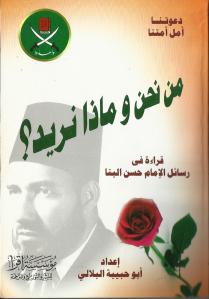
Fortunately, the Muslim Brotherhood issued a booklet answering this very question. It is subtitled: Readings from the Letters of Imam Hasan al-Banna. Hasan al-Banna founded the Muslim Brotherhood in 1928, and lived from 1906 until his assassination in 1949. Al-Banna was eager to put forth clearly his aims and understanding of Islam. He wrote:

For this reason I have wished to speak to you about the definition of Islam and its ideal picture in the souls of the Muslim Brothers, so that the foundations of which we call for, take pride in, and seek the expansion of, may be completely clear.

The booklet newly gathering his thoughts was published in April 2011, thus reflecting an effort, at least on the part of some Muslim Brothers, to make clear once again the principles of the group following the revolution. It was presented to the author of this text while attending ‘Tuesday Conversations’ at the Omar ibn al-‘As Mosque in Old Cairo. A helpful young member of the organization selected it from a wide variety of books made available at the entrance to the mosque. ‘Tuesday Conversations’ was a weekly public lecture conducted by al-Banna until it was forbidden by the government in 1948. General Guide Mohamed Badie re-launched the session under the slogan, “Listen to Us, not about Us.” This is fitting with al-Banna’s original desire to present a clear image of the Brotherhood.

The booklet is divided into two sections. The first is a general introduction to understanding the call of the Muslim Brotherhood, while the second is a more specific treatment of its definition, end, goals, means, etc. This text will provide summaries of each section which represent loose translations of the content. It will also provide direct quotes in italics, especially in areas that appear more provocative and need further explanation. The text will follow the outline provided by the booklet.

One caveat to present the reader before beginning: The Muslim Brotherhood is a flexible and evolutionary organization which has consistently changed with the times. That the information which follows is drawn from its founder and re-presented is a fair indication this vision still drives the organization. Yet it must be emphasized the current leadership may have moved on from certain statements or understandings its founder possessed, which were forged in the period of European colonialism. This can only be assessed through monitoring their statements and direct questioning in interviews, which will hopefully be possible in the days to come.

The Muslim Brotherhood is more than a political organization, though it includes this function as witnessed in the creation of its Freedom and Justice Party. Politicians of all stripes are accused of changing their statements to suit their audience, and Brotherhood politicians should not be excused from this suspicion. Yet as Mina Magdy, political affairs coordinator for the Maspero Youth Union, a largely Coptic Christian human rights organization which rejects cooperation with the Brotherhood, says,

They interact according to what people want to hear, and maybe some of them are sincere in their kind words. But we judge them according to their books, by what is written.

This text is an effort to present one example of what is written and distributed by the Muslim Brotherhood.

Who are We, and What do We Want?

Part One – A General Introduction to Understanding the Call of the Muslim Brotherhood

   1.    Islam … As the Brothers Understand it

Many people misunderstand both Islam and the Muslim Brotherhood. Some think of Islam as rules for worship and the provision of serenity in life. Others view it as a system of virtue and avoiding vice, while others think it is an inherited, backward tradition. As for the Brotherhood, some see it as a preaching organization for prosperity in this life and reminders of the next. Others view it as a Sufi organization promoting self-denial.

a)      We believe Islam incorporates all things to organize life in this world and the next: Doctrine and worship, nation and nationality, religion and state, spirituality and work, and Quran and the sword.

b)      We follow the Quran and the Sunna as practiced by the followers of Muhammad and those who followed them.[1]

c)       Islam organizes all of life for all peoples at all times.

In times past Islam came under the powers of the infidel world, so that it and its empire grew weaker and lost its meaning.

The theoretical part of our call is to show people clearly the pure Islam; the practical part is to ask them to carry it out. To this we will strive, calling people to the task, expending everything for its sake, so that we live nobly either in life or in death.

Our slogan: God is our end, the Apostle[2] is our leader, the Quran is our constitution, jihad[3] is our way, and death is the path of God is our highest hope.

2.       The Muslim’s Duty in Life, as the Muslim Brotherhood Understands it

The Quran is the measure by which we judge our call and our goals in life. It teaches that some people seek food or riches, or even to spread trouble and evil. But the Muslim’s goal is higher: It is to guide people to the good, giving them the light of Islam.

Therefore, the Quran has made Muslims to be the guardians for an incapable humanity, giving them the right of superintendence and sovereignty over the world. This is in service to our noble teachings and is our business, not that of the West; for the civilization of Islam, and not the civilization of materialism.

Muslims should expend themselves in sacrifice for this call, and not profit from it. As they do they create civilization, unlike Western imperialism, which promotes desires and cravings.

It is necessary we make this clear and specify it, and I think we have arrived to a place of clarity and agreed: Our duty is to have sovereignty over the world and to guide humanity to the good ways of Islam and its teachings, which alone can make a man happy.

3.       The Muslim Brotherhood on the Path of its First Call

We call people along the same path Mohamed did, so that they maintain these three strong feelings:

a)      Faith in the greatness of the message

b)      Pride in belonging to it

c)       Hope in the support of God in achieving it

Part Two – Getting to Know the Call of the Muslim Brotherhood

1.       Essence of the Muslim Brotherhood

The essence of the Muslim Brotherhood is to explain carefully the call of the Quran in its entirety, in accordance with the modern age.[4] We seek to win hearts and souls to the principles of the Quran, so that we may renew our heritage and bring all Islamic viewpoints closer together.

We seek to develop and liberate the national wealth, raising standards of living, achieving social justice and security for all citizens, combating ignorance, sickness, poverty, and vice.

We wish to liberate Egypt and all Arab and Islamic lands from foreign control. We will support Arab unity and the Islamic league.

We will establish a state which implements practically the regulations and teachings of Islam, protecting them domestically and publishing them abroad.

We will support global cooperation in protection of rights and freedoms, to promote peace in the balance between faith and the material world.

Muslim Brothers are:

  • Strangers who seek reform among the corrupt
  • A new mind to judge between right and wrong
  • Callers for Islam and the Quran, connecting the earth with heaven
  • Possessors of the noblest call, the greatest aim, the strongest foundation, the securest band, who have light for the way

The Muslim Brotherhood is:

  • A Salafi call to return to the Islam of Quran and Sunna
  • A Sunni way in worship and doctrine
  • A Sufi truth to promote purity of self and love for God
  • A political organization to reform governance both home and abroad
  • A sporting group to build strong bodies in performance of the pillars of Islam
  • A scientific and cultural club to promote learning
  • An economic company to make clean profits
  • A social idea to treat social ills


2.       The Goal of the Muslim Brotherhood

The goal of the Brotherhood is to create a new generation of believers from the teachings of Islam, in order to give the nations a complete Islamic imprint in all aspects of life.

3.       The Message of the Muslim Brotherhood

Ruling the world, guiding all of humanity to the ways and teachings of Islam, which alone can make people happy.

For too long the civilization of materialism has divided the Muslim peoples and retarded their progress. It stands against them and the leadership of the Prophet, denying the light of Islam to the world.

We do not stand for this, but will pursue them and raid in their own lands, until the entire world celebrates the name of the Prophet and the teachings of the Quran. The shade of Islam will cover the earth, and then what the Muslim desires will be achieved: No sedition and all religion will be for God.

4.       Goals of the Muslim Brotherhood

Our program has clear and specific stages and steps, since we know exactly what we want and the means by which to achieve it.

  • First, a Muslim man, clear in his thought, doctrine, morals, sympathies, work, and behavior.
  • Second, a Muslim house, in the areas above but we care also for the women as we do for the men, and for children as we do for youth. This is how we shape the family.
  • Third, a Muslim people, so that our message is heard in every village, district, and city.
  • Fourth, a Muslim government, which will lead the people to prayer and the guidance of Islam, as did the Companions of the Prophet and the caliphs Abu Bakr and Omar. We recognize no system of government that does not emerge from the foundation of Islam. We recognize no political parties or traditional forms which the infidels and enemies of Islam have forced upon us. We will work to revive the Islamic system of rule in all its forms, and we will shape an Islamic government from this system.
  • Fifth, an Islamic nation, desiring every part of the Islamic world to join with us, which was previously divided by Western politics and whose unity was weakened by European colonialism. We do not recognize these political divisions and will not submit to these international agreements which turned the Islamic nation into weak, torn apart, tiny states, easily swallowed by usurpers. We will not be silent as these peoples’ freedom is digested by autocrats. Egypt, Syria, Iraq, the Hijaz,[5] Yemen, Tripoli, Tunisia, Algeria, Marrakesh,[6] and all lands where Muslims say ‘There is no god but God’ – these are one large nation which we aim to liberate, rescue, and save, incorporating its parts one with the other. If the German Reich forced itself as a protector of all who had German blood, then Islamic doctrine obliges every strong Muslim to consider himself a protector of all who imbibe the teachings of the Quran. It is not possible in Islam for the racial factor to be more powerful than the factor of faith. Doctrine is everything in Islam, for what is faith except love and hatred?
  • Sixth, we desire the flag of God to fly high over the lands which once enjoyed Islam and the call of prayer declaring ‘God is great’, but then returned to unbelief. Andalusia,[7] Sicily, the Balkans, southern Italy, and the islands of the Mediterranean were all Islamic colonies and must return to the bosom of Islam. If Mussolini saw as his right to recreate the Roman Empire, whose so-called ancient empire was built on nothing but avarice and pleasure, then it is within our right to restore the glory of the Islamic Empire which was founded on justice, fairness, and spreading light and guidance to the people.
  •  Seventh, we desire to announce our call to the whole world, and to cause every tyrant to submit to it, so that there is no sedition and all of religion is for God.

Those incapable cowards who suppose this is all fantasy or dreams are simply suffering from weakness of faith that God has cast into the hearts of Islam’s enemies. We announce clearly that every Muslim who does not believe in this program and work for its realization will have no fortune in Islam.

5.       The Preparedness of the Muslim Brotherhood

Those who follow this path possess a faith that cannot be shaken, confidence in God that cannot grow weak, and souls which rejoice most in their martyrdom. Furthermore, they possess great psychological power, having a strong will, firm loyalty, great sacrifice, and knowledge of faith. They implement the Quranic verse which states: God will not change a people until they change themselves.

6.       The Means of the Muslim Brotherhood

As stated in the Muslim Brotherhood foundational system law, we pursue our goal through the following means:

  • Preaching – through letters, publications, newspapers, magazines, books, and delegations both here and abroad
  • Nurturing – inclusive of spiritual, intellectual, and physical
  • Directing – so that all issues of life might be guided practically to their Islamic solution
  • Work – creating economic, social, religious, and scientific establishments, in addition to mosques, schools, and clinics, to get rid of all which is harmful, such as drugs, drinking, gambling, and prostitution

It is true that speeches, lectures, money and other means may help identify an illness and proscribe a cure, but the only means to solve it are through deep faith, precise strengthening, and continuing work.

The general means we pursue our goals are:

  • First, spreading our call and convincing people of it until it becomes the general opinion.
  • Second, using all proper elements necessary to strengthen the firm support for reform.
  • Third, engaging in a constitutional struggle until our call is supported by official professional clubs and the executive powers. Then, when the time is right, we will nominate ourselves for parliamentary bodies.
  • We will not deviate from these means unless we are forced to, but we will not refrain from declaring our position openly without ambiguity, ready to bear the results of our work.

We will not burden anyone but ourselves, or court favor except among our own. We know that which is God’s is best and will remain. We know expending yourself for truth is the key to immortality. There is no call except that which comes from striving for God, and there is no striving for God which is not met with persecution. But then comes the hour of victory when the Quranic verse is achieved:

When the apostles give up hope and think that they were treated as liars, there reaches them Our help, and those whom We will are delivered into safety. But never will be warded off our punishment from those who are in sin.

7.       Peculiarities of the Muslim Brotherhood Call

It is a call to God, resisting the materialism of the world. It is a universal call, rejecting racism or distinction between persons. Unlike other contemporary calls, it is composed of:

  • Distance from points of contention
  • Distance from the cult of personality and pride
  • Distance from political parties and associations
  • Care for growing stronger in gradual steps
  • Securing work and production through promotion and advertisement
  • Great acceptance among the youth
  • Rapid spread through villages and cities


8.       Foundations of Understanding Islam in the Muslim Brotherhood

So that all understand Islam in the manner we do, we present these twenty foundational statements:

1)      Islam is a complete order of life, inclusive of state and nation, government and people, creation and power, mercy and justice, culture and law, science and jurisdiction, material and resources, earning and wealth, jihad and preaching, army and idea, trustworthy doctrine and true worship.

2)      The Quran and Hadith are the reference for every Muslim.

3)      Faith and worship give light and sweetness, but illumination, impressed ideas, and visions are not part of Islamic principles.

4)      Amulets and sorcery must be fought against.

5)      The teaching about the imam and the one who stands for him[8] is not based on Islamic texts, and opinions about this always change.

6)      We accept all that the earliest Muslims did which fits with the Quran and Hadith, but we do not oppose those who view things differently.

7)      Everyone who does not possess sufficient standing in religion should follow an imam until he does.

8)      Differences in subordinate matters should not divide Muslims.

9)      Be careful about discussion of matters which often descend into minutia.

10)   The most sublime Islamic doctrines are the knowledge of God, his unity, and his transparency.

11)   We must rid our faith of heresies, but in a proper way which does not lead to evil.

12)   Certain matters between Muslims are for jurisprudence, examining them with proofs and evidence.

13)   The early companions of Mohamed should not be criticized.

14)   Do not adorn tombs of the deceased or call upon the help of departed saints.[9]

15)   It is wrong to call upon God’s help through the intercession of his creation.

16)   Customs of a people should not change religious norms.

17)   The basis of all work is our doctrine, which should push us toward perfection.

18)   Islam frees the mind and enables modern science.

19)   The opinion of sharia and the opinion of reason should not conflict with each other, though true science always submits to true doctrine.

20)   We declare no Muslim to be an infidel, unless he speaks of his unbelief, or denies a fact of religion, or impugns the purity of the Quran, or explains it outside of what the tools of the Arabic language can accommodate, or behaves in a way unexplainable except by unbelief.


9.       Working for Islam according to the Muslim Brotherhood

The Muslim should continually work to reform himself, set straight his Muslim home, guide his society, and liberate his country from any foreign, non-Muslim political, economic, or spiritual power.

He should work to reform his government until it becomes truly Islamic. Its members should be Muslims who perform the pillars of Islam and not those who willfully neglect them, to implement the regulations and teachings of Islam.

It is permissible to seek the help of non-Muslims should this be necessary, but not in the positions of general authority, as long as he agrees on the general basis of the Islamic system of governance.

The characteristics of this government are a feeling of subjection, kindness towards its subjects, just dealings with the people, keeping itself from the general wealth, and economy in working with it.

The obligations of this government are the provision of security, making laws, promoting education, keeping itself strong, preserving general health, watching over the general interest, developing wealth, protecting capital, strengthening morals, and issuing the call to Islam.

The rights of this government, when it performs its duties, include loyalty, obedience, and assistance through its people and their money.

The Muslim should then work to restore the international position of the Islamic nation, so that its lands are liberated and its glory revived in the return of the lost caliphate and all desired unity.

Then, finally, the Muslim should work for professorship of the world by spreading the call to Islam in all corners… (quoting the Quranic verse):

Fight them until there is no sedition, and all of religion is for God.

10.   The Process of Formation is among the Firm Principles of the Muslim Brotherhood

Moving gradually in steps: All aspects of our call move in three steps:

  1. Propagation, definition, and preaching the idea so it is received by the masses in all classes of people.
  2. Empowerment, selecting helpers, preparing soldiers, and outfitting the troops[10] among those who are called.
  3. Implementation, work, and production.

Many times these three stages can work simultaneously. The preacher calls to Islam, while he also chooses people and educates them, while he also works to implement the goals.

11.   Describing the Muslim in the Call of the Muslim Brotherhood

He is characterized by:

  • Believing in the idea with faith, sincerity, zeal, and work
  • Sincerity in dispossessing himself for the cause
  • Striving in the path of its realization
  • Influencing both work and production
  • Incorporating time for preaching
  • Keeping from being miserly in his belief
  • Aware of all his duties
  • Brings love to all people
Related Texts:

[1] Following the practice of these three groups is also a key distinction of the Muslim party called Salafi, though it is not restricted to them alone.

[2] That is, Mohamed.

[3] The term jihad incorporates an idea of ‘striving’, of which violence and warfare are possible but not necessarily implied.

[4] The designation of ‘modern age’ moves the Brotherhood beyond the aforementioned Salafis, who generally speaking reject philosophical world advancements in favor of the original vision of Mohamed and his companions.

[5] The Red Sea coastal region of present day Saudi Arabia, within which are the holy cities of Mecca and Medina.

[6] A designation for Morocco.

[7] Designating the lands of Spain and Portugal, where Islam ruled for 800 years.

[8] Representing a prominent teaching of Shi’ism.

[9] Representing a practice among some Sufis and traditional Muslims.

[10] It appears these military allusions are symbolic rather than a call for militias, but further clarification is necessary.
Categories
Arab West Report Middle East Published Articles

The Muslim Brotherhood’s Freedom and Justice Party: First Conference and Key Questions

The speakers' platform. Dr. al-Erian is seated in the middle.

Dr. Essam al-Erian, vice-president for the Muslim Brotherhood established Freedom and Justice Party (FJP), officially commenced party activity in a conference in Shubra, Cairo. The location was specifically chosen, he stated, due to the fact it was an area long neglected and marginalized by the former regime. The FJP wishes to see Egypt become completely independent of all foreign powers, especially economically, so that all, especially the poor, may benefit.

Also in attendance were Dr. Mohamed al-Beltagi and Mr. Gamal Shehata of the Muslim Brotherhood, each of whom also gave speeches. They were joined by the Egyptian poet Mohamed Goudah and artist Wagih al-Arabi, as well as Dr. Duaa’ Maghazi, a Muslim sister. Dr. Rafik Habib, the Egyptian Christian researcher and vice-president of the FJP was listed among the presenters, but was not in attendance.

Dr. Mohamed al-Beltagi

Al-Erian railed against the long scope of foreign interference in the Egyptian economy, stretching back to the British occupation, the monastic period of King Farouk, the Free Officers led by President Jamal Abdel Nasser, and culminating in President Mubarak. Each allowed foreign powers to profit off the Egyptian people. Al-Erian insisted that any current loans accepted by the Egyptian state must be completely absent of conditions.

Al-Erian was also critical of the current security situation in Egypt. He made a parallel to the failures of officers in 1973, during which their ranks were purged to remove incapable or corrupt figures. He wondered why this has not yet been done among police following the revolution, when many have been involved in torture and used live ammunition against protestors.

Yet while he was critical of the police, al-Erian offered praise and thanks to the military. First and foremost this was for their role in protecting the people during the revolution, contrary to their orders to fire upon them. He also praised the army for its promise to surrender authority to a civilian, elected government, and awaited its fulfillment in time, with full confidence.

At the same time, al-Erian denied there was an agreement between the Supreme Council of the Armed Forces and the Muslim Brotherhood, stating the FJP would not hesitate to criticize the military if it diverged from its revolutionary mandate. So far, however, their mistakes have been minor.

Speaking to the fears of an Islamist dominated government, al-Erian stated the FJP was not looking for a parliamentary majority. In fact, the party aim is to capture between 30-35% of the seats. Recalling cooperation during the revolution, he stated that the Muslim Brotherhood, nor any other group, would have been able to overthrow Mubarak on its own. The common interests of all political parties are substantial, and they should work together to craft a national unity government. The political system needs strong and diverse parties, reiterating the FJP desires a civil state based on the law.

Dr. al-Erian

Al-Erian spoke briefly about foreign policy, urging the United States to withdraw from Afghanistan, and NATO to cease operations in Libya. The Libyan people are capable to rid themselves of Gaddafi on their own, and NATO strikes only serve to demolish the country and its infrastructure.

Al-Erian closed by assuring the audience the FJP, due to the skills gained by the Muslim Brotherhood, was capable to undertake its political responsibilities and participate in rebuilding Egypt. The party welcomed all in this task, Muslims and Christians, men and women, workers and farmers, the young and the old. Furthermore, it was dedicated to serving the interests of this entire constituency.

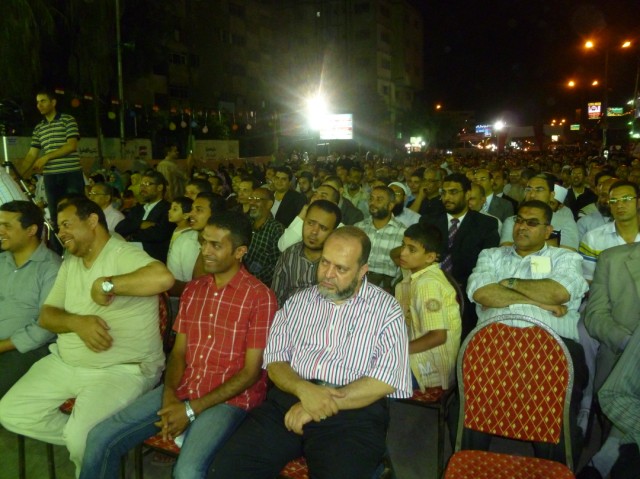
There were approximately 800-1000 people in attendance, seated in a tent erected in a central square of Shubra under the evening sky. Most people appeared to be of lower middle class economic status.

While no space was given for questions and answers, in subsequent research we would like to probe further the relationships between the Freedom and Justice Party, the Muslim Brotherhood, and the Salafi movement. Specifically:

  • What is the relationship between the FJP and the Brotherhood? According to reports it is to be independent in administration and finance, yet its leaders are all Brotherhood veterans, appointed by the group. How will the political party function in practice?
  • What is the role of the FJP headquarters in Manial, Cairo? By appearance this is a small office on the 3rd floor of a nondescript building. Yet inside was a caretaker, with his bed set up near the conference table, with a direct line to al-Erian. The Muslim Brotherhood headquarters, meanwhile, are an impressive stand alone multi-story building recently constructed on a major road in Muqattam, Cairo. Does this suggest a practical subjection of party to greater Brotherhood leadership?
  • To what degree does the FJP include Muslim Brotherhood youth? These are depicted in the media of having disagreements with the traditional Brotherhood leadership. Is this a reality?
  • What is the relationship between the Muslim Brotherhood and Hamas? Several years ago al-Erian was heavily involved in supplying Gaza with medical supplies through the doctors’ syndicate, utilizing Hamas connections.[1] Do official links between the movements exist? Is their coordination or funding involved? However sympathetic with the plight of Gaza, does the Muslim Brotherhood approve of Hamas’ tactics?
  •  What relationships exist between the Muslim Brotherhood and the military council? Through personal conversations between Cornelis Hulsman and Osama Farid, a Muslim Brotherhood senior figure, the group maintains a direct line with senior military officers. What is the extent of their communication? Does it differ from that between the military council and other political or social groups?
  • What links exist between the Muslim Brotherhood and Salafi groups? Will there be political cooperation between the FJP and Salafi parties? Some Brotherhood members have criticized the Salafis, while others have hosted conferences between the two groups. Is there an official stance?
  • What are the different trends among Salafis, who generally are not an organized presence in society? What are their methods of propagation? From where does their funding originate? Do they serve foreign or transnational agendas? Does the Muslim Brotherhood?

Many people, both in Egypt and the west, are asking these questions right now. While both the FJP and the Muslim Brotherhood are working hard to demonstrate they are a moderate, centrist political and social force, their answers to questions like these will go a long way in demonstrating their credibility.

One final note concerning the historical reality of the Muslim Brotherhood, highlighted by Badran, a resident of Shubra and a Brotherhood supporter: in 1948 the Muslim Brotherhood first began conversations with the Egyptian armed forces, which were repeated in 1952. This opened the political space for them, but by 1954 they suffered repression. In 1970 President Sadat, a military official, once again engaged the Muslim Brotherhood, giving wide space for operation, but by 1980 began repression once again.

This pattern is undoubtedly known and feared by the Muslim Brotherhood. Regardless of conspiracy theories which posit military favor for the group, it is certain that once again the Brotherhood has approval to operate openly. This may be one reason behind the constant reassertions of their civil, democratic, moderate intentions. If true, there is no need for repression. Yet it may be asked if they also wonder if their window of opportunity is now open, and that they intend to consolidate power before they are repressed once again.

The political future of Egypt is wide open. May all participants operate from integrity and concern for the nation. The short term horizon will be very interesting, and perhaps foundational. May peace, stability, freedom, and justice mark what is to come, Islamist or otherwise.


[1] From a personal conversation several years ago between al-Erian and Cornelis Hulsman, editor-in-chief of Arab West Report.


Categories
Arab West Report Middle East Published Articles

Conventional Wisdom and the Muslim Brotherhood

Logo Muslim Brotherhood
Muslim Brotherhood Logo

In the early days of the Egyptian revolution, one of the significant fears, especially in the West, was that a transition to democratic rule would usher in an Islamic government headed by the Muslim Brotherhood. This has since been established as the conventional wisdom, even in Egypt. Liberal groups urge postponing anticipated September parliamentary elections, in order to gain more time to form viable political parties able to compete with the newly created and Brotherhood-backed Freedom and Justice Party.

Conventional wisdom was established following the results of the March 19 popular referendum on amendments to the Egyptian constitution. A yes vote was the adopted position by Islamist groups, many of which portrayed the effort as a defense of religion. They won overwhelmingly, with 77% of the vote, in unprecedented 40% voter turnout.

Yet in recent days there have been a few contrarian indicators concerning widespread popular support for the Brotherhood. Gallop conducted a poll in which only 15% said they support the group. The poll does match the uncertain and contradictory state of Egyptian politics, however, for although only 1% support a theocracy, 69% believe religious leaders should have an advisory role in legislation. Depending on how campaign rhetoric is spun, the population may vote Islamist out of fear from godless liberals, or else run screaming out of fear of becoming a new Iran. Yet in terms of tangible support, if the poll is accurate, the Muslim Brotherhood is not inherently perched to assume political power.

Part of the assumption of Brotherhood popularity is built upon their reputation of providing support to the poor in social services. This is true from their inception, and in the 1940s they built a wide network of service provision throughout rural and urban Egypt. Yet in the more recent decades under Mubarak in which the Brotherhood was an outlawed, though tolerated, social presence and the only semi-legitimate opposition political force, measuring and verifying their welfare reach became more difficult. Nevertheless, the assumption remained.

This assumption has been challenged in research conducted by Daniella Pioppi. She argues:

The Muslim Brotherhood’s social activities after the Nasser parenthesis have never reached the levels of diffusion and organization of the 1930s and 1940s. Furthermore, they are generally aimed at the middle to upper classes rather than the most disadvantaged social strata. Since the repression cycle that started in the 1990s, the Muslim Brotherhood’s social activities have been drastically reduced and do not seem to play a significant role in popular mobilization, not least for lack of a clear political and social project.

Her paper, and others, can be found here.

Excepting the previously stated referendum, Egypt has not had open, democratic elections for over fifty years. In the absence of criteria by which to judge, it is nearly impossible to forecast the electoral choices of over 80 million Egyptians, most of whom have been depoliticized their entire life. Will the ‘uneducated, religious masses’ be swayed to vote Islamist, believing this to be a vote for God? Will the ‘taste of freedom and liberty’ make them forswear the Muslim Brotherhood, widely known as an authoritarian organization in its own right? No one knows. Neither the Gallop poll, nor the referendum should be taken as an accurate gauge of political currents.

Politics is always full of surprises. In all likelihood, an unfettered election process will produce nothing less, no matter what the end result may be.

Categories
Personal

The Islamic Political Landscape

In the aftermath of the Egyptian revolution, many have wondered about the strength of the Islamist movement, and whether or not it would come to power in free elections. A more vital question concerns whether or not it would cede power in subsequent elections, should the population so desire. Yet the diversity within the Islamist movement is often not appreciated. In recent days various groups with Islamic identities illustrate this reality.

The Muslim Brotherhood

The most recognizable organization, at least to Western political awareness, is the Muslim Brotherhood. Founded in the 1920s, this grandfather of the Islamic movement has had a distinct evolution. Both a social organization to call Muslims to God and provide for the needs of the poor, as well as a political institution dedicated to creating a state based on God’s law, the Brotherhood early on violently confronted the state and assassinated public figures. Yet for decades now it has renounced violence, yet still found itself at odds with an autocratic state, resulting in an official ban. As such, Brotherhood activity tended toward a policy of preservation, which caused the once dynamic organization to gentrify and become reactionary in contemporary politics. This helps explain their reticence to join the revolution, as well as their decision to negotiate with the Mubarak regime during its final days in power.

These decisions, however, caused great internal division within the Muslim Brotherhood. Younger members enrolled in the revolutionary struggle, and are credited with a lead role in the defense of Tahrir during the Battle of the Camel, when pro-Mubarak thugs sought to displace the protesters from the square. These younger members have now organized a reformation conference, which has been denounced by senior leadership. The youth claim they are not trying to break rank, but to revitalize the Brotherhood. They argue for greater leadership inclusion of Muslim Sisters, and express divergent views on whether or not the Brotherhood should found a formal political party. Senior leadership has established the Freedom and Justice Party, which is widely viewed as a simple political extension of the Brotherhood. Yet some youths argued that politics must be kept separate so the Brotherhood can focus on its social mission. If a party emerges, it must represent Islamist thought, to be sure, but must include a minimum quota for Christian members as well. One liberal Islamist, Abdel Munim Abdel Futuh, has already violated senior leadership’s dictate that all Brotherhood members must support the Freedom and Justice Party, by announcing the launch of an independent party, Nahdat Masr (Egypt’s Renaissance). Yet perhaps the dominant theme of the youth conference was a call for greater internal democratization. They accuse the group of mirroring the autocracy of the state, even as they rallied against it.

Al-Jama’a al-Islamiyya

Internal democracy, however, is exactly the proclamation of a long suppressed Islamic movement, al-Jama’a al-Islamiyya. During the 1970s when the Muslim Brotherhood renounced violence, al-Jama’a vowed to continue the jihad against the state, and suffered accordingly. They and other extremist groups were pursued ruthlessly by the state security apparatus, and effectively disarmed by the 1990s. Though made marginal, its leadership, led by Akram Zuhdi, also maneuvered into a non-violent posture.

Following the revolution, however, al-Jama’a reentered the political scene, seeking to be part of the emerging system. A key preliminary step is the revitalization of its internal organization. General assembly elections have begun, starting at the local level and proceeding until full governorate positions are chosen by members across the country. Leadership has announced these elections will be fully supervised by Egyptian civil society organizations, which has not been true of the Brotherhood, nor of the Egyptian state. Yet leadership will not consist of Akram Zuhdi, who has resigned from his role following cantankerous internal debates about the direction of the group. He states that he wishes to return to the function of calling people to God; does this signal a reversal of al-Jama’a’s orientation? Perhaps the democratic trend is assuaging, but what of the departure of a dovish leading figure?

The Salafis

If a democratic spirit is emerging in the two Islamic groups mentioned above, it is actively opposed by a third association, the Salafi movement. Similar to and influenced by Wahhabism in Saudi Arabia, the Salafi call is to imitation of Muhammad and his contemporaries in their cultural and political outlook. Politically, this means submission to the ruling powers, and unlike the Brotherhood, Salafis cooperated with the Mubarak regime, even if they would recognize aspects of his governance as un-Islamic. In turn, their preachers were allowed to operate certain mosques, and freedom was given to demonstrate against certain policies of the Coptic Church.

During the recent referendum on constitutional amendments, Salafi preachers urged a ‘yes’ vote, corresponding to the perceived will of the military. Yet they argued their position not on reasoned political grounds, but on the fact that it was God’s will, which should not be opposed. Recently, they have been distributing flyers stating that democracy itself is a perversion of God’s law, taken instead from non-Muslim sources. It is the Islamic scriptural sources, they say, which constitute political authority, and not the will of the people. As such, they oppose a civil state, whereas many Muslim Brotherhood members support it, variously defined. Yet perhaps paradoxically, certain Salafi leading figures have announced their intention to form a political party and advocate for their position. If some fear a reversal of democracy, their apprehensions may have legitimacy here.

The Sufis

In contrast to the above groups, the Sufi movement has historically maintained an inclusive focus. Generally seen to prefer a spiritual over a literal interpretation of religion, Sufis rarely reject other Muslims as apostate, and often have welcoming perspectives on the legitimacy of Christian faith as well. Fittingly, Sufi leader Mohamed Alaa Abul Azayem has called for an initiative to unite these various and divergent streams of the Islamic movement. Though Sufis tend to reject the mixing of religion and politics, Azayem believes they share the commitment of the Brotherhood and the Salafis to call believers to God. He also believes politics has a role in society, and as such has founded his own party, called Tahrir (Liberation).

The Church

Though The Coptic Orthodox Church represents Christian interests, there is interplay with the Islamic movements, though initiative sometimes comes from the outside. The Muslim Brotherhood, especially, is aware of the fear that should they gain power, they will return Copts to a dhimmi-like second class status. As such, sincerely or not (most Coptic Christians believe their assertions to be insincere), many proclaim their desire for a civil state in which Copts would be equal citizens. A major debate within Brotherhood circles currently is whether or not a Copt should be allowed to be president, not whether or not he or she should be allowed a vote.

Within their effort to assuage these fears, the Brotherhood has stated it will conduct official dialogue with the youth of the Orthodox Church. Though Pope Shenouda has denied negotiations have taken place, Brotherhood members state this only represents a misunderstanding, and that discussions will indeed take place. Meanwhile, Pope Shenouda has officially welcomed dialogue with the Azhar, the chief institution of Sunni Islam, but also with the Salafis. The church argues forcibly for a civil state, yet it finds itself intertwined in the politics of Islamist groups as well.


Egypt has now entered the difficult period of post-revolutionary politics. The future is not yet clear, though outlines are emerging in preparation for legislative elections, likely held in September. Islamic groups do not represent all Muslims, nor are they monolithic. Their share in a democratic future is certain, their victory is not. The cooperation, or lack of, which emerges between Islamist, secular, and to a lesser but influential degree, Christian orientations may play a deciding role in the outcome. May God guide all to mutual respect, understanding, and love, even as each legitimately, and hopefully genuinely, pursues its vision of God’s will.