Categories
Excerpts

On the Message of Bishop Raphael to Coptic Mourners

From Ahram Online, during the funeral sermon for Copts killed in sectarian violence in Khosus, but before the attack on the cathedral itself:

“This deep wound, which is not the first of its kind, leaves me with three messages in my heart,” said Rafael.

“One is to the heavens…We [Copts] believe in heavens’ justice…Christ taught us that he avenges the blood of the martyrs and that the martyrs’ blood is not forgotten by God,” he said, to which mourners responded by chanting: “With our souls and blood, we will protect the cross.”

“My second message is directed to Egypt: We will not leave…governments cannot rule by shedding blood,” Rafael added, to which mourners responded: “We will not leave; this is our country!”

“My third message is directed at Egypt’s Copts: We shall not abandon our faith,” the Bishop concluded. “The bloodshed only makes us embrace our faith even more… We will not compromise our religious ethics, which call us to love all.”

Bishop Raphael is the general bishop for the region of central Cairo, and was one of three candidates for the papacy following the death of Pope Shenouda. His first message is one of patience, but the people responded aggressively.

His second message was of anger, and is odd. The government did not kill the Copts of Khosus, though most Copts are very frustrated with President Morsi and the failure to properly investigate sectarian attacks since the revolution. Perhaps he refers to the bloodshed in Egypt under Morsi’s administration in general. Whatever his meaning, the people responded with a haughty and defiant assertion of their status as the original Egyptians.

His third message must set everything right, and the response of the people is not given. Perhaps that is appropriate, as the next stage is not yet written. Egyptian Christians are facing a tremendous challenge, and their spontaneous reaction was to return violence against attackers and security forces alike.

There is a legitimacy of defending the cathedral; enough has happened in Egypt so far to have made them fear the worst. But it is their call to Christian ethics, to love, which must take hold of clergy and laity alike.

It is no guarantee of success, but it is the way of their faith. Will God prove faithful? If so, how? It is not usually in ways which equate with our comfort.

Rarely, however, has so much been asked of believers.

Categories
Prayers

Friday Prayers for Egypt: Poisoning the Azhar

Flag Cross Quran

God,

So much of Egypt’s identity is tied up in the Azhar. The pinnacle of Islamic learning among Sunni Muslims, the Azhar was one of the world’s first universities. Always straddling the line between fidelity and challenge to the ruler, the institution was muzzled by Egypt’s successive military governments. Now, the controversy is back.

But is it healthy, God? For 500 students suffering from mass food poisoning, the answer is no. For the university president fired after the flare-up, the answer is no. For the place of the Azhar in Egypt’s post-revolutionary transition, the answer remains to be seen.

The Azhar was politicized by the constitution, giving it a role in the process of legislation. The same document guaranteed its independence and the right to select its own leadership. This process has also set off what many observers see as a struggle to gain control of the institution. A prominent Salafi leader publically said as much, admitting their ambition.

But the rumors swirl around the Muslim Brotherhood, prompting them to officially issue a denial of any involvement. But their spokesman did praise the firing of the president, saying this move against corruption proves the revolution is on the right track. Coincidentally or not, he was appointed by the military council, prior to the constitution.

God, so much seems wrong with this situation. First and foremost, heal the sick students. But heal an institution as well, and a political system which has put it in the heart of controversy. Certainly a student protest over sick colleagues can be seen as a spontaneous reaction. But to call so deliberately for the removal of the president – and even of the Grand Sheikh himself – has all the markings of political expediency.

Hold leaders accountable, God, but is this corruption? Investigations are ongoing. Perhaps corruption was part of the old regime everywhere, God, even in the Azhar. If so, then yes, purge. No sin remains hidden forever. Give the institution men of knowledge and integrity, who will prepare the generations to come in an honorable path. In a land where much is religious, men of religion matter deeply.

Therefore, God, protect the Azhar from men who use religion – whoever they may be. Right religion is meant to help us understand you, ourselves, and to secure a society of virtue. But religion can also enrage or sedate, and not always righteously. May religion in Egypt produce humble men; may the Azhar aid in the process.

But now in Egypt, God, the poison seeps everywhere. May this be a wrong diagnosis: Perhaps it is medicine which weakens the body as it kills the contagion. But there is much in Egypt to be healed, God.

You are the healer. May Azhar make this known.

Amen.

Categories
Excerpts

Kidnapping Christians in Upper Egypt

From the AP, providing an excellent and balanced account of reported Christian kidnappings in Upper Egypt. Following the Fox News story I highlighted two days ago, this is the type of investigation the issue deserves. I’m both jealous and proud, and quite concerned over the content:

Crime has risen in general across Egypt, hitting Muslims as well. But the wave of kidnappings in Minya has specifically targeted Christians, and victims, church leaders and rights activists ultimately blame the atmosphere created by the rising power of hard-line Islamists.

They contend criminals are influenced by the rhetoric of radical clerics depicting Egypt’s Christian minority as second-class citizens and see Christians as fair game, with authorities less likely to investigate crimes against the community.

Over the past two years, there have been more than 150 reported kidnappings in the province — all of them targeting Christians, according to a top official at the Interior Ministry, which is in charge of the police.

Of course, I wish this official’s name was provided. Egypt is a nation of rumors, and much reporting is based on ‘sources’ obtained from the military, police, judiciary, Muslim Brotherhood, whoever – and it often seems the purpose is to steer the media discourse without owning responsibility for the accusation. But here is an official who provides his name:

Responding to the allegations that authorities do not aggressively investigate crimes against Christians, Minya’s security chief Ahmed Suleiman said it is because victims’ families negotiate with kidnappers rather than report the abductions.

“We cannot be held responsible for kidnappings that are not reported to us,” he said, blaming hardened criminals for the kidnappings.

Christians say they don’t bother to report because they have no confidence in the police.

And here is the Islamist denial of responsibility along with a highly controversial and politically expedient remedy:

Essam Khairy, a spokesman for the hard-line Islamist group Gamaa Islamiya in Minya, said “there is not a single case of Christian kidnapping that has a sectarian motive or linked to the Islamist groups.”

He blamed the “security chaos” in Egypt and said the way to stop kidnappings is to create popular committees — vigilante groups that the Gamaa Islamiya has been promoting since a spate of strikes in the police last month.

The governor the region is a member of the Muslim Brotherhood, which the article highlights holds continual meetings with local Christian leaders. But members of the party do not necessary believe in equality:

The Brotherhood and its political party frequently underline their respect for Christian rights. But at times members reveal an attitude suggesting a second-class status for the community.

On Wednesday, Yasser Hamza, an official in the Brotherhood’s party, argued in a TV interview that while the campaign slogan “Islam is the solution” is permissible, the slogan “Christianity is the solution” would not be. He was addressing specific election rules, but then broadly declared, “This is an Islamic nation with an overwhelming Muslim majority … The minority doesn’t have absolute rights, it has relative rights.”

But perhaps the reason behind these attacks is as old as it is simple:

The Interior Ministry official acknowledged that Christians are seen as less defended.

“Kidnapping Christians is an easy way to make money,” he said. They “don’t have the tribal or clan backup that will deter kidnappers and they are happy to pay the ransom to gain the freedom of their loved ones.”

Wouldn’t you? Goodness, such a horrible situation. Solving it only makes it worse. Please click here to read the rest of the article at AP.

…….

Update on the Fox News post: My wife suggested the presenter in the video may have been referring to ‘Garbage City’ as the Christian quarter and slum. If so, he is right, it is a slum, where a nearly 100% Christian population sorts and recycles the nation’s trash, living in the middle of it.

This area is very close to suburban Muqattam where the Muslim Brotherhood headquarters is. But the suburban development came long after Christian migrants from Upper Egypt settled off in their isolated mountain community. The reason has nothing to do with discrimination or lack of political rights: Garbage collection involved raising pigs, and pigs were the province of Christians alone.

The pigs have since been killed, in what appeared to be a very discriminatory act ostensibly taken several years ago now to prevent the spread of swine flu. But the Christians of Garbage City labor on, though some of their livelihood has been further removed as trash collection is outsourced to foreign based companies – who do not recycle nearly as well.

For anyone who would like more information about this community, check out the documentary ‘Garbage Dreams’. It’s quite good.

Categories
Personal

Jon Stewart on Morsi and Bassem Youssef

Fans of Jon Stewart probably have already seen this video, but here is a ten minute segment in which he lambasts Egypt’s president for the arrest warrant given to his friend, and clone, Bassem Youssef.

It is quite funny, and biting, as is the exchange of criticism issued by the US Embassy in Cairo, the Muslim Brotherhood’s Freedom and Justice Party, and the Office of the Presidency, which insists it has nothing to do with the suit. Have a look at Salama Moussa’s blog for a good run-down of the situation.

Check out this article also, by HA Heller, describing the international public relations nightmare Egypt has stumbled into. Arresting a comedian… It is comic in its own right, and Egyptians love their humor.

Categories
Arab West Report Middle East Published Articles

Fox News: Were Christians Tortured in a Cairo Mosque?

Fox News

From my recent report on Arab West Report:

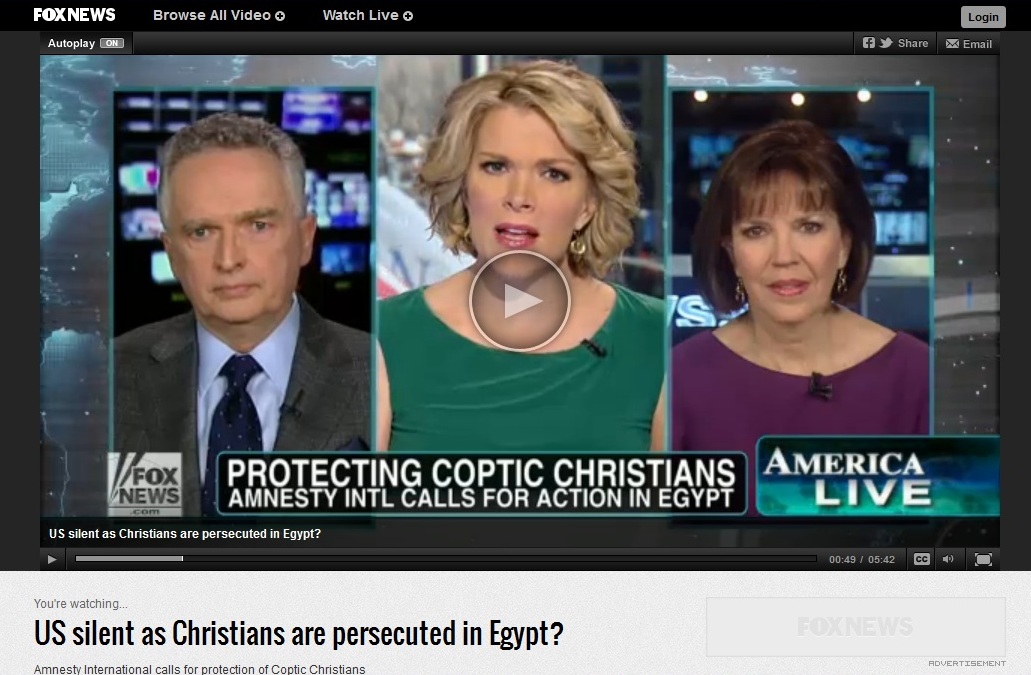
On March 28, 2013 Fox News broadcast an incendiary video report entitled, ‘US Silent as Christians are Persecuted in Egypt?’ It is understood that media relies on a level of sensationalism in order to attract the viewer or reader to a story. Yet this report moves beyond sensationalism to distortion, in which elements of truth are stretched to create an impression far removed from reality.

I watched this report after friends and family brought it to my attention. I’m sorry to say it made my blood boil. Several months ago I published a report on AWR examining if the Muslim Brotherhood was crucifying its opponents, but this alleged incident was reported only by fringe and internet-based sources. Here, we’re talking Fox News! Certainly it is known that the station has a conservative bent, but this video makes it seem as if they are pushing an agenda.

Egyptian news coverage is generally of poor quality, un-sourced, and designed to shape opinion rather than inform. Here, Fox News does its best impression. I have heard similar descriptions of US stations MSNBC, and to a lesser degree, CNN, only from the liberal side. I am fearful the American public has entered an era in which news is meant to entertain and confirm opinions, rather than to educate and challenge them.

I am also dreading this aspect of being back in America for an upcoming visit.

Of course, something very terrible appears to have taken place in this mosque in Cairo, and to a Christian in particular. From al-Monitor:

During the clashes that erupted last Friday [March 22] between the Muslim Brotherhood and protesters in Mokattam, the Brotherhood arrested left-wing activist Kamal Khalil and detained him inside a mosque. He saw a number of demonstrators stripped of their clothes and brutally flogged in the mosque, to the point that most of them lost consciousness. Brotherhood members were using a big whip to strike their victims. Khalil asked the flogger [about it], who replied: “It’s a Sudanese whip. I soaked it in oil a while ago. … A single strike can cut through skin.”

Luckily, Khalil recognized his neighbor from among the Brotherhood members, who intervened and prevented him from being tortured. Yet, Khalil posted his testimony about the Brotherhood’s slaughterhouse on the website of Al-Bedaiah newspaper. Soon after, the testimonies from victims published in newspapers confirmed that they had been brutally tortured. Amir Ayad, a demonstrator, revealed that when the Brotherhood found out that he was a Copt, they increased the severity of his torture, pushing him to the brink of death as they called him a “Christian dog.”

But excerpting from my report:

0:50

Broadcaster leads with words, ‘We were not able to independently confirm this reporting by Mideast Christian News’ which claims ‘Islamic hardliners stormed a mosque in suburban Cairo and turned it into a torture chamber for Christians’

If news is not able to be confirmed by a reputable news agency, it should not be repeated, and certainly not the lead story. At least they mention this detail up front.

Mideast Christian News did not report about a torture chamber for Christians, however, as best I could research following their newsfeed. On March 23 they ran an article featuring testimony from Amir Ayad, a Coptic activist. He related how he was ambushed by the Muslim Brotherhood during the clashes and tortured in a mosque in Muqattam.

Muqattam is the suburban Cairo neighborhood mentioned by Fox News. It hosts the headquarters of the Muslim Brotherhood and as such was the site of an anti-Brotherhood protest. The administration of the mosque in question publically confirmed that Islamist activists took over the facilities and turned it into a detention center.

A similar incident took place during the clashes at the presidential palace in protest of President Mursī’s declaration immunizing his decisions from judicial review during the controversy over the drafting of Egypt’s constitution. Muslim Brotherhood members attacked a small but peaceful sit-in at the palace, which led into large-scale confrontations between the two sides. During the clashes the Muslim Brotherhood also created detention centers in adjacent facilities, though not in a mosque.

Details and testimony about what happened at both events is contradictory, but it appears likely the Brotherhood or supporting Islamists assumed police-like prerogative to apprehend protestors – perhaps rioters – on the opposing side. Furthermore, there is no reason to dismiss the testimony of Ayad that he was tortured; the article includes a picture of him in the hospital suffering from multiple wounds.

The protest at the Brotherhood headquarters, however, was not a Christian protest, it was political. Ayad, as a Christian, was detained, perhaps along with other Christian protesters. The great majority of protestors, and therefore detainees, however, were Muslim, consistent with the makeup of Egyptian society.

For Fox News to report this incident as a mosque transformed into a torture center for Christians – with none of the context of these recent clashes – is an egregious distortion of a story terrible in its own right.

And finally, showing an element of the Fox News report which is absolutely contrary to reality, and would be known by anyone who spent any time in Egypt at all apart from the pyramids:

3:15

Peters continues, saying Miller went to the Coptic quarter where the Christians live. It’s a shabby slum where they are third-class – not second-class – citizens

It is fair to ask what Miller believes is the difference between a second- and third-class citizen. Clearly this is only a rhetorical device. But it is in service either of wanton ignorance or clear distortion. There is no ‘Christian quarter’ in Egypt or any of its cities. Christians are spread everywhere throughout the country.

Perhaps he was referring to the district of Shubra in Cairo, which has a large percentage of Coptic residents. Shubra is a lower- to lower-middle-class neighborhood, but it is hardly a slum. If it is, it is equally populated by Christians and Muslims together.

Or perhaps he had in mind Heliopolis, which also has a large percentage of Coptic residents, but is one of the wealthier districts of the city. In either case, these areas are characterized by the best relations between Muslims and Christians, as they grew up together in an integrated community. They are far from second-class citizens. They are neighbors.

Please click here to watch the original video, and here to read the rest of my point-by-enraged-point rebuttal (and occasional agreement).


Categories
Arab West Report Middle East Published Articles

Independence of the Egyptian Judiciary

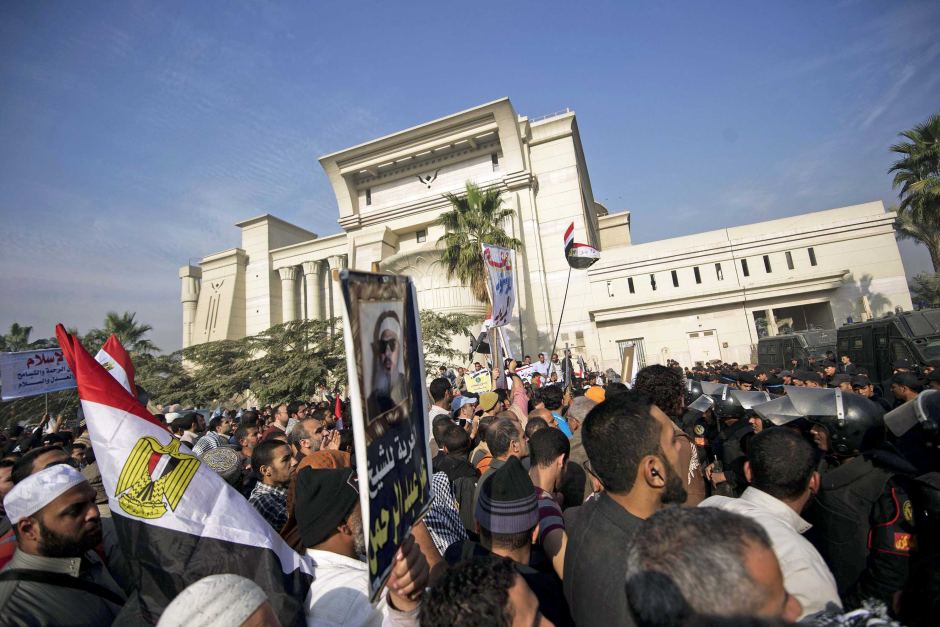
The Supreme Constitutional Court, under protest by Islamists, December, 2012.

From my recent article on Arab West Report:

The Egyptian transition following the 2011 January 25th revolution has been fraught with controversy; among many has been the reform of the judiciary system. While the 1971 constitution guaranteed an independent judiciary, the following year President Sadat presided over the passing of law 46 which moved many judicial proceedings – including appointments, transfers, and inspections – to the executive branch through oversight of the Ministry of Justice. President Mubarak continued use of these privileges to ensure a regime-friendly judiciary.

Though the reform of the judiciary was not chief among the primary demands of the revolution, many reformist judges had long been seeking to expose these executive abuses. The tensions came to the fore during the transitional period, as the judiciary became a battleground between the revolutionary popular will and what was interpreted as pro-regime rulings from the court.

Though published recently, this article was written September of last year after Mursi assumed the presidency, but before his full-on clashes with the judiciary. In this light the following recommendations are noteworthy, as many anti-Islamists look to the courts to curb presidential power and prerogative:

The first guarantee [of judicial independence] is for security of tenure. Judges must understand their position is safe, not subject to removal for rulings issued against the government. Second, the judge and court system as a whole must enjoy financial security. All necessary resources must be made available for the smooth functioning of justice. Third, there must be sufficient guarantees for individuals in the justice system. A culture of rights ensures the public demand for judicial independence, making it more difficult for the government to infringe upon it.

Unfortunately, Binnie noted, the current Egyptian arrangement does not lend itself to judicial independence. First, the body tasked with inspecting judges is within the executive Ministry of Justice. This allows the executive branch to offer rewards to compliant judges – such as promotions or post-retirement ambassadorships – while penalizing judges who buck the system by assigning them judgeships in remote locations.

Second, there is a threat to the independence of the judiciary if there is not sufficient public confidence in the system. Binnie noted that even if independence is achieved, the courts can operate as an ‘old boy’s network’, appointing from their own circles rather than drawing from the diversity of society. The presence of women is particularly helpful, he noted, but a comment from the audience helped demonstrate his point. Egypt boasts only 42 women judges, but 39 of these are the daughters of established judges.

Third, the presence of a parallel court system undermines judicial independence. Even the best system will fail, Binnie noted, if the government can simply bypass it. With separate jurisdictions for military, security, and emergency courts – each able to try civilians – Egyptian justice suffers. Binnie noted that some drafts of the coming constitution do not sufficient guarantee rights during periods of national emergency, threatening to perpetuate the current system into the post-revolutionary era.

The constitution limited the use of military courts, but it did not eliminate their jurisdiction of civilians. Still, this has not been a practical issue since the end of direct military rule. Noting the importance of public confidence, it is at an all time low. Islamists have none at all, while non-Islamist revolution supporters still see it as in service of the regime in concept, if in particularity the identity of the regime is still under contention. Meanwhile, courts across the country issue rulings that send advocates of human rights up in arms.

But consider these examples, the latter of which was held as a pro-revolution step only a few months ago. If implemented now it would cause shockwaves:

In Egypt, moving from an autocratic tradition, enshrinement in the constitution is necessary. This must be done in detail, lest the situation resemble Russia where vagueness in wording has allowed erosion of judicial independence. Experts expect it may take years to reverse Russia’s political culture of judges as servants of the executive branch.

A positive example could perhaps be taken from the experience of Bosnia. Political leaders took the decision to sack all judges, and then require them to reapply for their positions in competition with new applicants. In the end, 70% of judges were reinstated, but two significant results were produced. First, this measure resulted in a great sense of public confidence in the governing system. Second, the judges themselves ‘bought into’ the new program from the necessity of keeping their jobs. It also reset their orientation, as most judges everywhere, Lund believes, desire independence.

As with much of the state infrastructure, bold reforms are necessary, but political conditions do not permit the unity needed for orchestration. It is a shame polarization has reached such a point.

Please click here to read the whole article on Arab West Report.

Categories
Christianity Today Middle East Published Articles

Is Coptic Evangelism in Africa Really on the Rise?

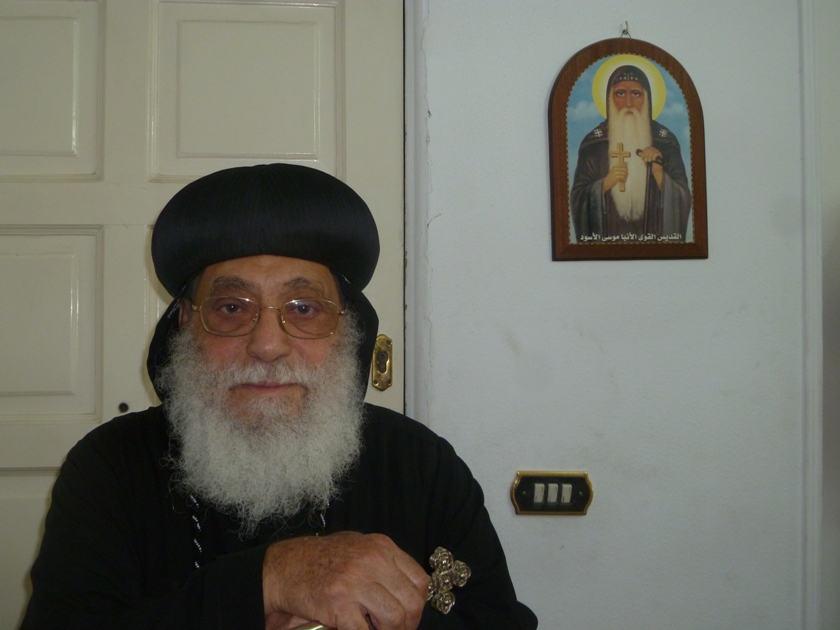
Bishop Antonious Marcos, missionary bishop for Africa. Behind him is a picture of the Coptic saint know as St. Moses the black.
Bishop Antonious Marcos, missionary bishop for Africa. He served first in Kenya and now in South Africa. Behind him is a picture of the Coptic saint known as St. Moses the black.

From my latest article on Christianity Today, published March 28, 2013:

Many Egyptian Christians wear their faith on their sleeve—literally. The cross tattooed on the wrist of Coptic Orthodox believers is a public display which marks their identity for all to see.

Such a quiet witness usually avoids reproach. But recently in Libya, radical Muslim militias detained dozens of expatriate Christians in Benghazi. Amid allegations that captors seared off such tattoos with acid, one Christian died from medical complications during the ordeal, and a Libyan church was repeatedly attacked.

Accusations of evangelism have been at the heart of a series of recent incidents of violence—including the first Coptic martyrs of the modern era—against Copts in Libya, Sudan, and Egypt. Which raises the question: Are Copts starting to recover their missionary heritage?

This article was co-written with a colleague from Sudan, who mentioned the following incident:

Last December, two Coptic Orthodox priests were arrested after baptizing a female convert from Islam. Since the arrests, stories about arrests of Westerners and other Christians attempting to spread the faith circulated in media linked to the state security apparatus, although the accuracy of the reports is hard to ascertain.

Though some Sudanese Copts have enjoyed business success under the Islamist government of President Omar al-Bashir, other denominations have seen their churches destroyed either by mobs or by the state, which cites the breaching of planning laws. With the independence of South Sudan removing the great majority of the nation’s Christians, Bashir has promised a 100-percent Islamic constitution.

Tensions are high also in some Egyptian villages:

There are signs Muslims feel threatened in Egypt as well. Recently churches have been attacked in Beni Suef and Aswan over female converts to Christianity alleged to be hidden inside. Generally this is understood as a Muslim community effort to save face when a woman breaks community traditions or runs away with a lover. Others think true faith might have a role.

“It is an untold story that every now and then a Muslim can be convinced and convert to Christianity,” said Youssef Sidhom, editor-in-chief of the Coptic newspaper Watani. “It is always done secretly, but somehow here it became public. In Upper Egypt especially, this creates a social scandal regardless of the direction of the conversion.”

But far from politically and religiously sensitive conversions in Muslim lands, the Coptic Orthodox Church maintains missionary bishoprics in sub-Saharan Africa:

The reality is the Coptic Orthodox Church remains committed to planting churches—just not in the direction of Muslims. In the 1970s, Pope Shenouda consecrated the first of two bishops for service in sub-Saharan Africa. Today, 65 churches serve more than 400,000 Copts in Kenya, Zambia, Congo, and other nations.

“The early riches of the Orthodox tradition are spreading again in Africa,” said Antonious Marcos, appointed missionary bishop to Kenya in 1976 and now based in South Africa. “Our church is a missionary church, because it was started by a non-Egyptian: John Mark.”

This was a very interesting article to research and write, showing a side of Coptic Christians often not well known in the West. As for the question in the title, are they recovering their evangelistic impulse: Well, they are accused, it seems some are, and reality is just as murky as with Christians around the world.

Please click here to read the full article on Christianity Today.

Categories
Prayers

Friday Prayers for Egypt: Intelligence and the Public Prosecutor

Flag Cross Quran

God,

To secure a stable society, institutions matter more than people. But the people in the institutions matter greatly.

Preserve the institutions of Egypt, God, and populate them with good men. Assist whatever reform is needed; create the political will to see it through.

But the squabbling and innuendo, God; have things done right.

Egypt has an institution of prosecution, but everyone wants their man in it. Some want the Mubarak-era figure, finding him wrongly evicted by the president. Some want the president’s man, finding him approved by a clause in the constitution. And some want the judiciary to pick anew, finding in them a way forward and a guard on separation of powers.

The stakes could be high, if only we knew, God. Few crimes since the revolution have been prosecuted successfully. Old regime, businessmen, military, police, Brotherhood, activists – all have accusations swirling around them. Who is protecting who?

Bring Egypt to a place, God, where institutions can rise above politics. But it takes the right man. If only for as long as he lasts – and the court says he must go – equip him as man of integrity and principle. As pressure, scrutiny, and perhaps political instruction weigh down upon him, make justice his only goal. So much in Egypt’s transition depends upon his post.

But behind the scenes is another institution, brought out into the light in further squabbling. The nation’s intelligence apparatus is accused of undermining the president and destabilizing the country. Some say the president wants his men in charge.

Perhaps they should be, God. But ‘his men’ is the talk of individuals, not of institutions. All were quick to deny the comments in the media, praising intelligence for its loyalty and patriotism. At times one must speak as the occasion requires, God, but increase the sincerity of Egypt’s political discourse.

Many Islamists find the institutions of the state conspiring against them. Liberals, meanwhile, see Islamists seeking takeover of the institutions to use them at the behest of their own agenda. Who knows there isn’t validity in each charge?

But even the question flows from intelligence, as intelligence governs the flow of information. Is the president advised correctly? Is the opposition led to believe their stridency will be rewarded? Do ‘sources’ speak the truth or only inject useful speculation? Is intelligence a puppeteer pulling the strings of all? Or are they a boogeyman summoned to distract from real issues?

God, when so much is confusing, protect the mind from conspiracy. Give Egyptians discernment and conviction to tell right from wrong, which usually need not be so muddled a process. Conscience and common sense are strong weapons against obfuscation; distribute these gifts widely, God.

Unfortunately, neither human nor institutional behavior is simple. But if complexity is a given, single-mindedness is a possibility. Purity of heart is a necessity.

These are not common to politics, God, and perhaps they are not common to humanity in general. But you are good, and you can transform. Bless Egypt with your redemptive touch.

So where an institution can corrupt what is good in the Egyptian nature, strengthen their moral integrity. And where an institution can bind what is corrupt in the Egyptian nature, strengthen its framework to keep them in line.

But only men can create institutions, God. And only men can corrupt them. Within the struggle ongoing since the revolution, your men are needed to guard this difference. Supply them sufficiently. Be they found in few or many, through them may your will be done.

May they bless Egypt, and shape her anew for the good of all.

Amen.

Categories
Arab West Report Middle East Published Articles

George Messiha and the Constitutional Assembly

George Messiha
George Messiha

From my recent article in Arab West Report:

George Messiha is young, an up-and-coming member of the political scene. In an effort to increase the representation of youth and Copts, the ruling Supreme Council of the Armed Forces appointed him to serve in the elected parliament. After the dissolution of this body by the Supreme Constitutional Court, Messiha returned to general Wafd Party politics, but also participated in a delegation to the Netherlands arranged by AWR editor-in-chief, Cornelis Hulsman. Members from each political trend participated, including Amr Darrag of the Muslim Brotherhood, who spoke proudly of the good work being done in the Constituent Assembly.

Messiha was already selected as one of fifty alternate members, but listening to Darrag convinced him to play a role once it became clear many non-Islamist figures were resigning in protest over the failure to achieve consensus. On October 16, 2012, he submitted his name for election to the body, and became one of nine replacement members tasked with completing the constitutional draft.

Unfortunately, his own experiences as a non-Islamist liberal did not match the impressions he obtained from the presentations of Darrag in The Netherlands.

The article is somewhat lengthy, but provides a very good overview of each member in the Constituent Assembly which wrote Egypt’s constitution. The point is to determine if the writing of the national charter was ‘dominated’ by Islamists, as it is often portrayed.

According to Messiha, 55% of the original members were Islamist in orientation. Following the mass withdrawal of many non-Islamists near the close of the process, the final count was 75%.

This article is not meant to be the final word. Arab West Report is currently producing a book on the Egyptian constitution; the question of member orientation is being put also to Islamists, both independent and affiliated with their official parties.

Holding judgment until then, here is the conclusion from the discussion with Messiha:

The Egyptian constitution reflects work inclusive of substantial non-Islamist participation. Many of the articles were discussed, argued, and formalized as divergent interests compromised and found agreement. But the charge that this is an ‘Islamist dominated’ constitution is also true. It is the product of a clear super-majority which approved the final text, recommending its presentation to the people in a referendum. Rightly or wrongly, non-Islamists felt themselves marginalized, and abandoned the process.

Whether it could have been otherwise is another story.

Please click here to read the whole article at Arab West Report.

Categories
Prayers

Friday Prayers for Egypt: Protesting Brotherhood

Flag Cross Quran

God,

Protests turned violent across the nation as opposition and revolutionary groups focused their attention on Muslim Brotherhood headquarters. Several were attacked, clashes broke out between the two sides, and police fired tear gas to disperse the crowds. Many were injured, but no deaths were reported.

The protests were preceded by two events of notice. First, a preliminary court judgment recommended dissolving the group for being illegal, only to be followed by a ministry announcement their paperwork was accepted as a now-registered NGO. Formally, the group is now subject to law and financial oversight.

Second, minor clashes at the Brotherhood headquarters took place when journalists/activists were assaulted while filming/vandalizing the building with graffiti. Outraged, they called for a Friday protest, a few opposition parties backed the effort, and since, the primary revolutionary youth group has condemned the violence.

Is this a turning point, God? Is popular frustration building up against the Brotherhood and discrediting their legitimacy by attacking the institutions of their administration? Or is this just a blip; limited frustration acting out from general impotence?

God, it is good the Brotherhood is now registered. If they have suffered previously from temptations to avoid the scrutiny of the law, this stricture will help them be open and transparent. If they have been wrongly maligned in the past, this oversight will validate them.

But no law can compete with conscience, God. Give them – and their opponents – pure hearts in service of Egypt. Bless them as they call on your behalf to service and obedience. Bless them in seeking the righteous transformation of society. And if they – or their opponents – have mixed good intention with ill conduct or selfish gain, bless them through rebuke and repentance.

But the violence, God, what good will it bring? It is hard to sort the reality from the propaganda when each side blames the other. Put an end to childishness, if it is there. Put an end to thuggery, if it is there. Give wisdom to resist foolish provocation; honor no one who picks a fight. Aid the state in convicting all who have done wrong, without prejudice or partiality.

God, what do you want the Brotherhood to be? If they are your tool to advance Egypt then give them their due. Silence those who mar them, who feel threatened by their gains. May they work righteously, humbly, mercifully, and inclusively.

But if they are a tool for anyone else, even themselves, then give them their due. Silence them as they mar others, who sense their threat to Egypt. May this be done openly, transparently, justly, and inclusively.

Inclusive, God, for even these prayers are wrong. It is too convenient to see one side right and the other wrong. Guard Egyptians from the ease of rumor and conspiracy. Expose wrong wherever it is found, but bring Egyptian rivals together. Create a system where all win, where opponents need not be vanquished.

Egypt is not settled yet, and perhaps it is not yet time. But she longs for stability as she longs for reform. As the Brotherhood holds the reins of governance, give them wisdom and acumen to govern well.

And may protests continue – peacefully – until all are satisfied with all.

Amen.

Categories
Excerpts

The Police as Part of the January 25 Revolution

From Ahram Online, reporting President Morsi’s visit to the central security force headquarters, in what must surely be a typo:

“You are the protectors of the country’s inside and outside safety [said Morsi]. The police were part of the successful crossing of the Suez Canal in the 1973 war and also part of the January 25 Revolution,” he added.

The initial demands of Egypt’s 25 January uprising, intentionally organised on the same day as the annual police day, included an end to police brutality and the State Security apparatus run by the Mubarak regime.

Much of the speech was commendable, encouraging them during difficult times:

“Any obstacles you’re facing, we will get through them – together,” he stressed.

He continued: “You are the watchful eye of the homeland. The country’s best interest needs your efforts and sacrifices.”

“You all know that our Egypt is going through a critical period, but with the aid of God and cooperation of the police and military, we will be able to pass through this phase.”

But he included also a reference to foreign interference – an old tactic of Mubarak, unless, of course, it is actually true:

“Beware, our outside enemy is seeking to create division among us, and we must not allow it,” President Morsi said in his opening speech.

One recent tweet criticized Morsi, saying he promised to visit Port Said, then only addressed them on TV, and the next day honored the institution which shot them.

Morsi’s job with the police is incredibly complex, but the January 25 comment is over the top. The revolution’s initial central focus was the end of the police state. Perhaps Morsi will get to this eventually, but here, he calls them heroes.

I can only imagine the rest of the speech gave more context, but the revision of history is not a firm foundation for social and institutional change. Yes, summon forth their better natures, but clean the skeletons in the closet, too.

Categories
Current Events

Friday Prayers for Egypt: Community Policing

Flag Cross Quran

God,

In the darkest days of the revolution, the police disappeared from the streets and neighborhoods across Egypt banded together to protect their properties. As criminals fled prisons, this spontaneous action contained the chaos and rallied the nation in support of Tahrir Square. Though many died, your grace was present, and Egypt avoided the fate of many of its neighbors. In less than three weeks, the revolution won.

Today, that opinion is deeply in question by many, even as circumstances tenuously repeat. In the two years that followed security was not restored, crime continued unabated, and political struggles began dripping into political violence. With police under attack and accused of attacking, many went on strike.

There are too many agendas at play to sort, God, but here is the recent development. The public prosecutor reminded the nation the penal code allows for citizens to make arrests under certain conditions, and Islamist groups responded by saying they would organize citizens to defend state institutions and curb crime.

God, bless the people of Egypt who will stand against crime and vandalism. Bless the Islamist leaders in their role of community organizers. Bless the prosecutor general, who reminded the people of their share in keeping the peace.

But God, so much seems wrong and manipulated. If this is a result of the media tarnishing good citizenship, then expose their discrediting campaign. May the people of Egypt take the reins of their nation, and steer it to the right path. As normal people act, God, multiply their effectiveness.

Yes, God, the police appear negligent, and fix this problem first and foremost. Wherever the will is lacking – officers or rank and file – strengthen their hand to police firmly and justly. Protect citizens, property, and institutions alike, through all official channels.

But has crime exploded exponentially in the last week? Is Egypt about to be burned to the ground? Or are Islamists flexing their muscles and seeking legitimacy as a power on the streets? Believing the conspiracy – not without evidence – that the police are against them, are they laying the groundwork for a parallel force?

This, even, amid accusations and denials they seek to infiltrate the Ministry of Interior, and amid ‘sources’ in the military harshly warning against the paragraph above.

God, may it not be. Egypt is in deep need of reform and an Islamist government presides over every institution. Grant the president wisdom to make hard and honest choices. Grant him thick skin to withstand the relentless criticism he faces no matter which way he chooses. Grant him advisors who will accurately represent the reality on the ground. Without these, God, he is lost.

May Egypt neither be lost with him, nor dependent upon him for her salvation. But protect him and use him, God, in service of the nation.

But in the end, strengthen each and every Egyptian community. In security and prosperity, grow this nation anew.

Amen.

Categories
Personal

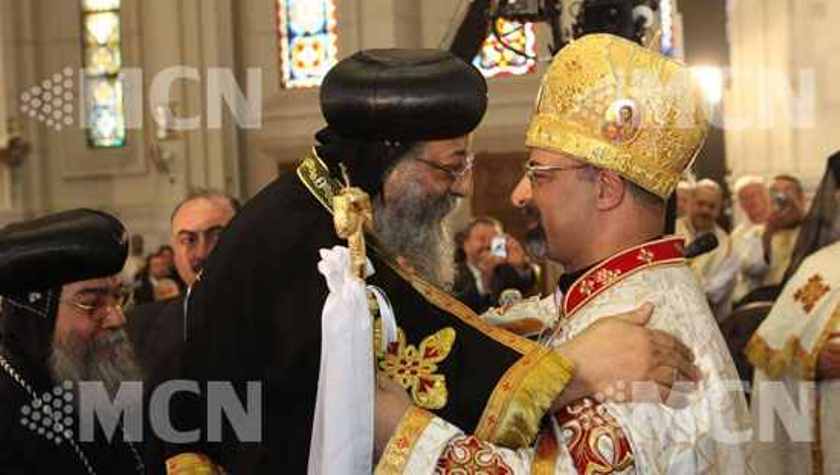
Tawadros Celebrates New Coptic Catholic Pope

Image

From MCN (behind paywall):

Pope Tawadros II noted the word patriarch has three meanings; the first is fatherhood, as the patriarch is a father who carries the feelings of fatherhood which stem from the work of the Holy Spirit towards each one, adding humans need this feeling of fatherhood every day.

“The second meaning is love, which is the main need of humans,” Pope Tawadros II continued. He acknowledged the world is currently hungry for the true love God planted in their lives to present to everyone.

The third meaning, Pope Tawadros II remarked, is service, adding the priority for the patriarch is to be a servant but that service means humans should serve everyone.

The Coptic patriarch added that washing the feet is one of the traditions established in the monasteries to express humility. He said their service comes from a heart of love and fatherhood to meet the needs of everyone, including marginalized people, tired people, the old and young. Service, he stressed, is the work of the patriarch.

These are good words. The new Coptic Catholic Pope is named Ibrahim Isaac. He replaces Antonious Naguib, who retired for health reasons, but is currently in the Vatican enclave due to his status as a cardinal.

The article is not clear about all that took place during the ceremony, but Pope Tawadros’ words could have been even more powerful if accompanied by the symbol he mentioned.

Imagine if he had stooped to wash the feet of the new Coptic Catholic Pope.

The Coptic Orthodox Church represents the overwhelming majority of Egyptian Christians. Interdenominational relations have ebbed and flowed over the years with Catholic and Protestants, but Pope Tawadros appears intent on fostering unity. As mentioned previously, he has helped facilitate the Egyptian Council of Churches. Each denomination will have equal weight and rotational leadership. It is a humble concession on the part of the Orthodox.

Pope Ibrahim Isaac also spoke of the connection between leadership and service, according to MCN:

During his speech at the inauguration, Pope Isaac remarked that the Holy Bible teaches us authority is there to serve, taking after Christ and his teachings.

It is a common practice in the Coptic Orthodox Church for the leadership to wash the feet of the people, in a special ceremony once (perhaps more?) a year. Perhaps the Coptic Catholics do similarly, I don’t know.

But on this occasion, if only Pope Tawadros had washed the feet of his counterpart – equal in ecclesiastic authority but so much less influential in Egypt. This is no criticism, only imagination. But to demonstrate this teaching on such an occasion would have been noteworthy. In Christianity, the greater serves the less.

Even just in writing that sentence the protest issues: Shouldn’t Christianity make all people equal?

Yes, and it does. But the world does not. Therefore, those who are invested with authority and privilege of position must do all they can to demonstrate their humility. They must overturn the way of the world, however rife with hypocrisy the statement may be, if they are not careful. Washing the feet can easily become the new pride. It is proved otherwise away from the cameras, in demonstrated service away from the eyes of the world.

If only to continue imagining, might also the Grand Sheikh of the Azhar wash the feet of Pope Tawadros? Here, we are crossing religions which maintain their own traditions. It is not a proper comparison.

But the Sheikh of the Azhar has consented to a similar humble concession. He has helped facilitate the Family House, in which he and the heads of all Christian denominations meet regularly to maintain good relations and solve sectarian conflicts.

Muslims represent the overwhelming majority of Egyptians, yet the Grand Sheikh is outnumbered.

In the world, everyone knows where power lies. This reality will not change because of humble participation in councils, nor in symbolic gestures like foot washing. People in power also have it in their interest to appear humble, which actually increases their effectiveness.

But to lift up the lesser, to honor, and to give more power even at your own expense – this is of God. “He must become greater, I must become less,” said John the Baptist of Jesus. Jesus, meanwhile, said of those who follow him, “They will do greater works than these.”

Egypt’s spiritual leadership, Muslim and Orthodox, appear to heed this pattern. God only knows, but may he similarly equip Pope Ibrahim Isaac, and make him a shepherd to his people.

Categories
Excerpts

Upper Egypt Imam Confronts Conversion

From Ahram Online, following up on a story in which Muslims surrounded a church in Kom Ombo, Aswan, to demand the release of a local woman they believed was held against her will, forced to convert to Christianity:

A sheikh addressed a crowd of men in Kom Ombo to explain the events and dispel any rumours that had been circulating.

“Some say that she had a relationship with a man [who convinced her to convert] and others claim that a woman used to visit her and talk to her about Christianity,” he began.

He said that a man from Cairo, a former Muslim and Christian convert, communicated with her via the internet and the phone.

Allegedly, the divorcee in her mid-30s, had expressed thoughts about converting to Christianity.

“He told her that no one will be able to help, not even Christians, except one priest in Cairo who is [expelled from the Church] because he’s been attempting to convert Muslims,” the sheikh said.

The crowd reacted angrily to this information, interrupting the Sheik.

“When we sat with [Church leaders] they told us that they [do not encourage] such acts and explained to us that this priest is expelled from the Church,” he continued.

“This is a mere financial issue, the [man] came and told her ‘I will help you’ in exchange for EGP 3,500’

“We will bring the man here so that everyone can take revenge on him,” he added.

The sheikh then talked to the crowds about Islamic values and presented some counter-arguments to issues in the Christian religion that affected the girl during her absence.

“The woman told us that she was not fully convinced of several things she was told [by Christians] including the concept of the Trinity,” he said.

“She came and talked to us clearly, she said ‘I do not know if I am right or wrong,'” he added.

“We asked her to write down every point of confusion and we replied to all her concerns – everything has an answer in our religion.”

The sheikh said that curiosity had prompted the woman to leave; it is not known exactly where she had been staying during the past week.

“The woman’s brother had found a Christian hymn on her phone; when we asked her about it, the she said that she had asked for it… She obviously was… You see, the devil manipulates people’s minds. She was curious,” he said.

As the sheikh spoke, men from the crowds raised questions and points of concern to them.

“Do people who [encourage others to convert to Christianity] work through the internet?” one asked.

“Look, so that you know, the nearest person on such a network is from Luxor and the rest are from Cairo and Alexandria, they log on with fake names and we can’t –” but he quickly reassures, “We will get to them all.”

“Because we have already found three of them,” he added.

Additionally, the sheikh responded to the crowds several times saying, “Anyone involved will be held to account.”

This is a fascinating transcript. Very often in Egypt conversions in either direction are due to non-religious reasons such as love affairs, escaping difficult family situations, or securing a better financial situation.

Here, however, this woman appears to have simply been attracted to Christianity, likely through her association with Christian friends.

That which the imam speaks of also likely exists. Both religions have those who promote conversion on the internet, as well as individuals working to gain converts. In Egypt, of course, only the Muslim efforts are welcome.

The church probably had nothing to do with the woman, but needed to present official denials anyway. To placate the people, the imam needed to promise investigations and justice, even retribution.

In the West we would say ‘that poor woman’, and so we should. There appears no conspiracy here, just an individual with religious curiosity and inter-religious friends. Such trouble.

But here, they say ‘that poor family’, over what this innocent curiosity has done to the community. Such a description would apply equally if a Copt was found exploring Islam, though the scope here is much wider.

In both responses there is virtue, but where in all this, if anywhere, is God most pleased? The Muslim and the Christian may have very different answers, let alone the Egyptian and the Westerner.

It is a shame, I think, we have to know about this incident at all. And I’m the one sharing it. It is just too descriptive of Egyptian reality on the subject of conversion.

Categories
Prayers

Friday Prayers for Egypt: Police, Protest

Flag Cross Quran

God,

The dynamic is changing in Egypt, but it is happening outside of Cairo. Violence and civil disobedience characterize Delta and Suez Canal cities, while police themselves go on strike throughout the nation. In fact in Port Said they were ordered of the street.

There is little to commend here, God. Surely the grievances are many, and perhaps many are just. But as protestors attack police, the police demand better weapons. Some of the latter protest against ‘Brotherhoodization’ of the police force; others to be allowed to grow their beards.

In much of Egypt life carries on, but it is as if the state is breaking. Why is the presidential palace covered in graffiti? Why are major roads shut down for hours by rowdy youth? Why is the best solution for popular anger against police abuse to stop policing a city entirely?

These are questions for the administration, God, and give them wisdom to handle their many challenges. But the issues are deeper. Egypt was a police state, and the revolution broke it. Perhaps the police are ill equipped to do their job otherwise. Perhaps freedom and human rights have entered the equation, but without experience in balancing with law and order.

If so, God, there are lessons to be learned. May they be learned quickly. Give the Ministry of the Interior a wise and strong figure to reform from within, and facilitate accountability from the outside.

But if not, God, the conspiracies speak. Are the police ignoring the president and working to undermine him? Or have they yielded their old tools to a new regime more than willing to repress? Is the counterrevolution drawing Egypt into more and more chaos to kill revolutionary ideals and garnish popular support for the return of an iron hand? Or is the Islamist idea to secure their project on the ashes of the republican system?

May these be far from the truth, God, however much they are whispered. But fix the country, though only with righteousness. Remove those who retard her, though only with justice.

Give Egypt leaders who can do this; equip the people to ensure it.

God, sponsor their work, and bring it to completion. Keep Egypt safe, secure, and free.

Amen.

Categories
Arab West Report Middle East Published Articles

Interview with Dr. Essam al-Haddad, Presidential Advisor

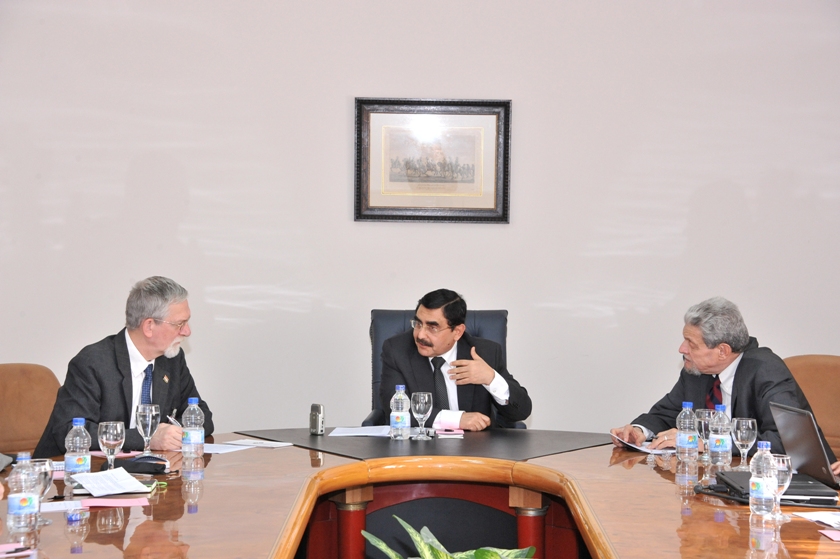
Essam al-Haddad, with Hulsman (L) and Schleiffer (R)

The following is an excerpt from an interview I was privileged to be a part of with Arab West Report. We visited the presidential palace in Heliopolis to meet with Essam al-Haddad, President Morsi’s advisor on foreign and security affairs.

Visiting the palace itself is a strange experience. The walls are covered with anti-Morsi graffiti and lined with barbed wire due to recent clashes in the vicinity. It is a good symbol of the current state of Egypt. An Islamist occupies the top office but faces significant backlash, as the state appears to be breaking down, unable to maintain the respect necessary for such a vital institution. Can you imagine if the White House was similarly afflicted?

Here is Haddad’s take on this, including his explanation on why the conspiracy against Morsi has not yet been brought to light:

Dr. Essam Al-Haddad: The amount of violence against security which was not experienced before, has reached a level where security is now responding but with tear gas and water cannons. But for each rule there are exceptions. Our position is that there is no tolerance for violence against peaceful demonstrations and there is no tolerance for violent demonstrators who are attacking either other people or institutions. So the balance is very tight.

However, if there are any documented incidents of violation, we are taking this very seriously on two sides. First, it has to be investigated and those accountable need to be brought to justice. Second, strategic measures need to be taken to ensure it won’t happen again within the ministry and within the officers. And in this case we would say that we have experienced that the level of restraints, self-restraints by the police is not seen in the Egyptian public for years.

And I invited you to come here to see how we are operating within Ithahadiya [Presidential Palace]. By night on Friday Ithahadiya is attacked by Molotov cocktails and graffiti on walls and everything. Nobody is doing anything to them. So because they are not allowed to carry bullets, the police force, they are only allowed to use tear gas and water cannons. So this is what is going on in the police. But if things are going more violent from some of the violent demonstrators then they have to take action. The rule is using the acceptable level of force in order to stop this from going on.

Any violation of these acts, whether those who have been here in Ithahadiya or anywhere else, will be investigated and those who have been considered accountable will be brought to justice. This is the rule we are working on. Going back to the other side where we have experienced women harassment, huge women harassment at Tahrir Square, there have been claims that these had been organized by the FJP and the MB. This is nonsense, complete nonsense. We have information now that these people are paid by the day, sometimes by hour to demonstrate and to do whatever damage in any part they are and we even know that the fee reaches nearly 1000LE for a day and if they are wounded they could get up until 1500LE, so it is a good job.

Prof. Abdallah Schleiffer: If you have this information why don’t you bring them to charge?
Dr. Essam Al-Haddad: Because this information is not 100% on record. Like drug trafficking, you can see that this person is giving that person an amount of drug to be used and he is selling it and he is getting the price. If you don’t have the license from the public security…

Prof. Abdallah Schleiffer: But you could simply arrest the perpetrators, because there are groups who are fighting them and they could testify evidence, because, again, this is where there is a credibility problem. I have no reason to doubt you at all.

Dr. Essam Al-Haddad: We had a revolution 2 years ago. The dictatorship has been there for 30 years with all its levels of corruption. And people are now experiencing a totally new atmosphere that they are free to do whatever they want and there is no security apparatus enforcing law on them. And they feel this as an opportunity to do whatever they want.

I have been to South Africa for nearly five years after the Apartheid rulers. I was not in Johannesburg, but in Cape Town. I was not allowed to go outside the five-star hotel where I was staying without having a stick and without being warned. When I went around the streets of the five-star hotel everyone was holding a stick. And this was five years after the Apartheid regime.

You don’t have a complete change in such a short time. I always say, you need nine months to have a baby. Can you have a baby in less than nine months? Sometimes, maybe. But you need two years to start to speak two words. And another ten, thirteen years to be mature in order to be a responsible person. This is traditional of course. You cannot expect that after a full collapse and a full blown over of the regime, things would go back to normal immediately.

And you have a counter revolution going against you. But what I can say, we know very well where we are going. And we expect that this time will come and we are determined to carry on building our institutions. And carry on in the reforms we are trying to make in order to make the environment more acceptable and attractive for investors. This is how we want to do it.

Drs. Cornelis Hulsman: The issues we mentioned thus far are all issues for which you need consensus building. How would you find a consensus in Egypt to address all these issues that are of major importance to Egypt because a consensus will help to address this?

Dr. Essam Al-Haddad: Yes you are right, it is important, we are trying our best. Mr. President has invited for dialogue, once, a second, a third time. His invitation was that everything could be discussed, no constraints. You can discuss whatever. But what we are seeing from the other side is that we will not sit unless you are meeting this condition. So, it is a conditional dialogue. “No we will not sit with you ‘cause you are not credible enough”, “no we will not accept this, no we will not accept that.”

Our experience is that, not only experience, our information is that there are elements who are not willing to enter the dialogue, but they are only willing to delay the democratic process. This is their point. Whenever there is an election, they say this is not the right time for an election. If there is a referendum, they will say that this is not the right time for a referendum. If there is any sort of action building democratic institutions in order to go forward there is a sincere trial to hamper and to obstruct it.

This is what we see so in order to archive consensus within this environment, it is not that easy to reach a 100% consensus. But you have to reach out and to open the door and whoever will be joining you will carry on with them. And those who are sending their own agents inside the country and playing outside and sending money, there is more than country and business man who are intervening in our country to avert whatever is going on.

Prof. Abdallah Schleiffer: There is a credibility problem. What countries are you talking about? When you are talking about foreign countries intervening, especially since that is a phrase that has been used over sixty years, so it has a very negative, when I hear that it is like I am hearing…

Drs. Cornelis Hulsman: Mubarak.

Prof. Abdallah Schleiffer: Mubarak or Qadafi. Is there any way you could clarify that? What countries are intervening? I understand why you do not want to, but just asking whether you can.

Dr. Essam Al-Haddad: We do not want to spoil the relations with this country, because this is a brotherly country, which is scared of what is going on here. We prefer to keep it calm. And to avoid it, with the hope that they would realize that intervening in the internal affairs of Egypt is not at ease.

Please click here to read the full interview at Arab West Report.

Related Posts:

Categories
Arab West Report Middle East Published Articles

Assault on the Church of St. George: Dissecting Media Reporting in Sarsena, Fayoum

Photo of a brick thrown through the window, reportedly taken from inside St. George Church, by a woman who snuck a camera past security.

From my latest article in Arab West Report:

In Egypt, sectarian conflict can be dizzying. When news breaks it explodes – Muslim mobs, churches burned, priests attacked. When the news crests it collapses – Muslim denials, church agreement, security clampdown. Only when the news settles can the situation be understood – however incomplete, contradictory, and subject to enduring confusion.

The recent incident at the Church of St. George in Sarsena, Fayoum, approximately 100 kilometers southwest of Cairo, contains all the above elements.

This is a somewhat lengthy report, but the basic summary (disputed) is this: A church in a small village was bothersome to its Muslim neighbor. Perhaps this was because the priest was looking to expand the building, perhaps because of the noise of the mass, perhaps because he simply did not want a church as a neighbor.

During a priest-arranged reconciliation session between the two, the family of the neighbor appears to have attacked the church with stones and handmade firebombs. During a second reconciliation session to settle this development, the attack began again. Eventually, the church agreed to a number of restrictions on its noise and future expansion, but was allowed to remain on it current plot of land.

This is the basic summary. The full report shows how this understanding developed, wading through the different versions which circulated in the media, including the denial of the local bishop that anything happened at all. The report also includes testimony from researchers who visited the village firsthand, as well as the account of the local priest.

Here is the conclusion:

At this point it is important to recall Allam’s editorial. Exaggeration and sensationalism do not serve the Coptic cause, let alone the cause of justice. Initial reports of hundreds of attackers, thrust from the mosque, recall the worst examples of sectarian tension since the revolution. As the reality appears much simpler, though still serious, media attention prompted immediate denial from the church.

The church denial now casts all in suspicion. Fr. Dimyadios appears a crusading priest. Nader Shukry appears an activist first, a journalist second. Coptic-focused news outlets appear more bent on discrediting Muslims than on reporting truth. Even the mostly corroborating testimony of the judicious EIPR appears doubtful – are they making a mountain of a molehill in service of their distaste for Islamist governance?

Of course, all the above may be true, even if only in degree. But EIPR’s Ibrahim states why this case is relevant, even in its less than exaggerated details.

“The law must apply to all,” he said. “The customary, traditional solution is only a temporary solution.

“Letting go of your rights through reconciliation sessions only provides encouragement to those who transgress, and shows Christians are less than full citizens.”

That is, unless nothing happened at all. Such is sectarian tension in Egypt.

Please click here to read the full report.


Related Posts:

Categories
Personal

Harlem Shake in Egypt

The popular dance craze not only reaches Egypt, but targets the Muslim Brotherhood. This version was performed outside their headquarters in Cairo.

It is quite amateur, but expresses a popular urban youth sentiment that Islamist government is out to limit freedom and instill a more religiously conservative society. This dance, including other Western and Arab songs, is a pelvic thrust in their direction.

Is the Harlem Shake a better recourse than debates, seminars, and elections? If nothing else it demonstrates the utter creativity of Egyptians in undermining their leaders.

Categories
Prayers

Friday Prayers for Egypt: Election Boycott

Flag Cross Quran

God,

As with many things in Egypt, just because this opposition boycott is announced, does not mean it is final. But as for now the upcoming parliamentary elections will be without drama, unless you are an Islamist, seeing how the spoils will be divided. The primary indicator of worth will be how many people go to the polls.

But wisdom, God, is greatly contested. Should the opposition cede all branches of government to Islamists? Will this result in Islamists greater empowerment, or further discrediting? Or, is it sour grapes in advance, worried they would not win anyway?

Or should they run, accept any losses, but build a democratic process? This is well and good if all is fair; do opposition claims to the contrary ring shrill or true?

God, give Egypt ideas. If all the opposition serves is obstruction, of what value are they? Islamism has been an idea for a long time; finally it is being tested. Judge and prove its worth, God. Save Egypt from its specter if failure is coming, but is this the only way to dull its lure among the religiously-minded?

But if it is of great worth, God, may they endure these present tribulations. Develop their leaders into statesmen, figures who serve beyond themselves to bring hope and prosperity to all. The learning curve is steep and the obstacles are many. Amid all scenarios, God, may right prevail.

Especially as much is wrong, even if there is disagreement over identification. But you can bring order out of chaos, strength out of weakness, life out of death. Even evil cannot escape your purposes, which you transform into the greater good. God, Egypt longs for these days to come.

Help her then to join your redemption. May Egyptians lessen their desire for control, esteem their weakness, and die unto themselves. May they humble themselves, not just that you may lift them up, but that you, your name, and your way receive all due.

But do not make them wait for a miracle. In fact, chastise those who are. May they work hard, argue, and create. Give stomach to endure all difficulty; give heart to love their homeland.

Give mind to boycott, or not. Yes, God, give them elections; give Egypt sovereignty. But give them bread, freedom, and social justice too. Help Egypt to sort out the proper order.

Amen.


Categories
Christianity Today Middle East Published Articles

Egypt’s Five Largest Denominations Unite for the First Time

Egypt Council of Churches

From my recent article in Christianity Today, published February 22:

February 18, 2013 may prove a monumental day in the modern history of Egyptian Christianity. Heads of the five largest denominations – Coptic Orthodox, Catholic, Protestant, Greek Orthodox, and Anglican – created the Egyptian Council of Churches. Since the dawn of Catholic and Protestant missions in the 17th and 18th Centuries, Egypt’s Christians stand united.

“I believe history will record this day as we celebrate the establishment of a council for all churches of Egypt,” said Pope Tawadros II of the Coptic Orthodox Church, which boasts approximately 90 percent of all Egyptian Christians. “I think such a step was delayed for years.”

The rest is a brief summary, in which participants actively deny any political role for the council, closing instead with these words of faith:

“The Lord has answered prayers which have been offered for thirty years,” said Baiady. “Our diversity must become a source of richness rather than a struggle.

“Unity is built on fruitful, humble love which favors the other over the self.”

Please click here to read the whole article, containing quotes also from the Catholic and Anglican representatives. It is a good step, a formal admission to the unity asserted by most Christians I know here.