Categories
Personal

Corridor 18, Plot 86 – A Coptic Funeral

I woke up this morning to a troubled phone call from a friend. His mother, with whom he is very close and of whom he is the primary caretaker, died sometime during the night. There were only a few hours until the whirlwind of a Coptic funeral began.

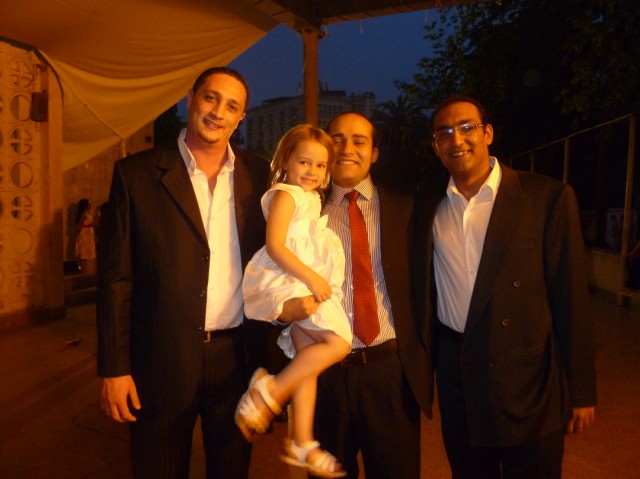
My friend, at the level of my daughter, during happier times

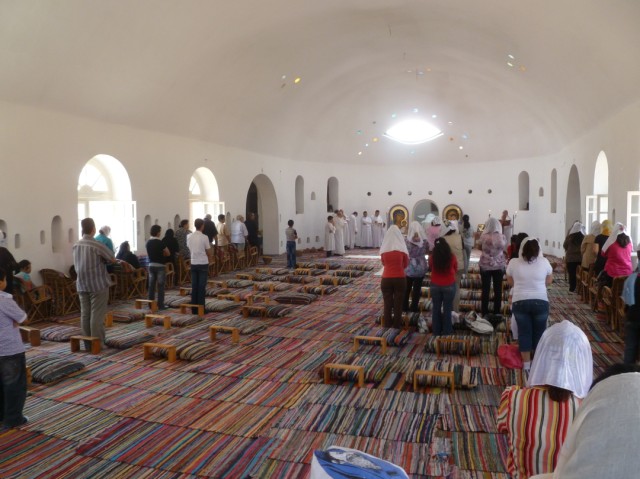
He told me the prayer service would begin at 11:30am, and I arrived with mutual friends having met coincidentally at the microbus line taking us into a poorer area of Maadi. St. George’s Coptic Orthodox Church is a smaller structure sandwiched between commercial buildings along the route, and was where my friend and his family worshiped for many years. We sat in the courtyard waiting for the main group to arrive.

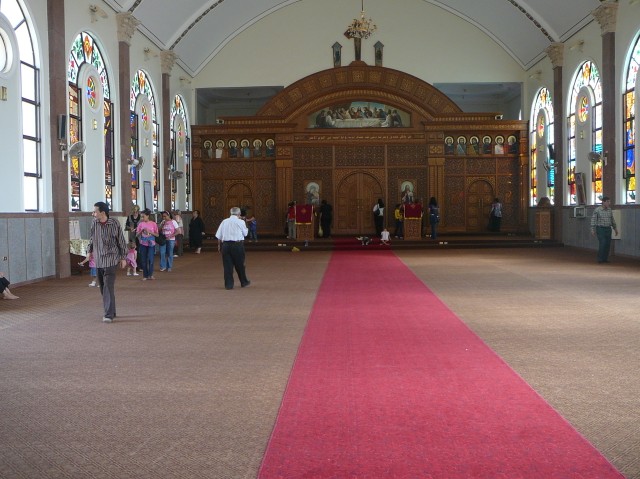
Around noon the family entered. The women were dressed completely in black; several were wailing. The men were more subdued, and a number carried the casket into the church, placing it on a platform in front of the iconostasis, behind which is the sacramental altar. When the priest arrived, mass began.

Mass followed its basic structure, including recitations of the Lord’s Prayer and the Nicene Creed. One gentleman read from the resurrection passage of I Corinthians 15, while my friend labored valiantly through the reading in John where Jesus states he is the resurrection and the life. The priest reminded that all will die, and our reaction should be to prepare now to face judgment. The traditional Egyptian funeral greeting – ‘the remainder (of the deceased’s life) to your life’ – is suspect, however, as it posits a life ended before its time. Death is only a door to eternity, he clarified, in which there is no remainder.

At the close of prayers all exited, with the men carrying the casket to load into the hearse. Surely enough, its license plate read ‘Cairo, under request’. This was explained to me previously in the context of the Coptic protest march from Shubra to Maspero, in which some wore white garb stenciled with the hearse’s label signaling their readiness for martyrdom. Prophetically, many of the protestors did die; a moving memorial tribute march occurred yesterday. A video news clip can be seen here.

My friends and I followed the hearse in a taxi, going downtown to Old Cairo to the Latin Cemetery. As best I could tell, there were no plots in the earth. Instead the grounds were filled with mausoleums, the cheapest of which could be purchased for 30,000 LE, approximately $5,000 US. Each unit then became the property of the family to be passed down through the generations. Caskets would be piled on top of each other until they would dry rot with the passing of time. They would then be removed, the bones inside placed in a box which would then be interred in a common area, with no special marking. Interestingly, many names in this ceremony were of foreign origin – Italian, French – though Egyptian names were prevalent also. Catholic in origin, the cemetery accepted anyone. Somewhere in history my friend’s Orthodox ancestors purchased space – in corridor 18, plot 86.

When the mourners arrived they either did not know this number or else did not know how to navigate the grounds. One in charge then quickly led the pallbearers who hustled under the weight of the heavy casket. Once there, what appeared as chaos erupted. The casket was carried into the crypt, as the wailing of the women began again. One of the male relatives had to be physically removed from inside, not wishing to depart from the beloved matriarch. Other men cried out, including my friend: Goodbye, mama. Everything happened so fast, and then the door was shut.

Whoever did so then reapplied the plastic-bag-like covering to the lock, to avoid corrosion so another body might enter, at the next appointed time. Mourning individuals huddled together, still inconsolable, but calm settled over the majority. When the priest arrived (though he had no responsibility), the men formed a greeting line around the corner from corridor 18. We walked quickly through, shaking the hands of each. We whispered condolences, but nothing of ‘remainder’. Following the lead of friends, I kissed my friend on both cheeks.

With this, everyone left. The time was about 2:00pm. The intensity of grieving must stem from the compacted burial schedule. The mother died sometime during the night; prayers were lifted by noon; she was buried only two hours later.

I cannot say why culture or religion dictates such a rapid process, but its implications were observed following the deaths at the Maspero protest. Church tradition and priests seeking to be helpful urged the families of the victims to take their bodies quickly and bury their dead. Activists on hand, however, assumed the terrible task of convincing grieving loved ones to delay these rites and have their dead undergo autopsy. As such, public record now indicates the number of dead by gunshot or crushing, under the weight of government armored personnel carriers. Fears existed these would otherwise have been swept under the rug.

My friend’s mother was no victim; there was no need for an autopsy. She was simply a kind woman who received the devotion of her family, and the appreciation of us as foreigners who were blessed on occasion by her hospitality. Women of her kin will continue to wear black for some time, and in forty days a commemoration service will be held. The moment of grief is explosive, but time is allotted for more gradual mourning.

Yet my friend is confident that death is only a door to eternity. When he called me with the news he stated, with broken voice, that his mother had ‘relocated’. With Muslims, the standard and commendable reply is, ‘God have mercy upon her.’ Copts have their own special phrase, connoting something like, ‘God prepare her for Paradise.’

The mourning is no less severe, nor the need for consolation. Hope, however, springs eternal. ‘I go to prepare a place for you…’

Categories
Arab West Report Middle East Published Articles

Video Analysis of Maspero: Part Five and Conclusion

To read the Introduction, please click here. For Part One, click here. For Part Two, click here. For Part Three, click here. For Part Four, click here.


Corpses Gathered in Hospitals or Elsewhere

Video Thirty-Four: Martyrs of Maspero 2  (Three minutes)

Video footage is from inside the Coptic Hospital, where many injured and dead were taken. The halls are crowded with people with a steady murmur in the air.

0:10        Person sitting on side of hallway with an obvious but not life threatening head wound

0:20        Dead body lying on floor; it appears his throat has been cut and has bruises to his head

0:37        To his left is another body which appears to be alive, with someone attending him

0:47        A cover is removed from a bloody corpse with horrific head wounds

1:08        A pool of blood is shown on the floor

1:20        Another corpse is shown lying on the ground with a head wound

1:50        Video switches to another hallway, where another corpse is lying on the floor

2:20        Camera returns to the corpse of 0:47, from this angle it appears he could have been run over by an APC


Video Thirty-Five: Special for al-Shuruk: Corpses at the Entrance to the January 25 Building at Maspero (Three minutes)

Video footage is from inside a hallway of the building housing at the aforementioned January 25 TV studio, which was stormed by military personnel.

0:03        Two dead bodies are lying side by side, the one to the right appears to have wounds in his shoulder and head

0:36        A man standing against the wall has blood dripping from his head, but appears ok

0:52        Another corpse is shown with a heavy wound to his head

1:15        Moving up a short flight of steps, a man is lying on the ground writhing with a pool of blood under his leg

1:30        A man crouches over a body on the floor who appears to be alive; pools of blood are all around

1:44        Video switches to another angle, showing three dead bodies lying in a hallway


Analysis: None necessary. These people were killed brutally.


Compiled Footage

The final three videos assemble footage from throughout the day, as compiled by their author. Important events therein not highlighted earlier will be identified by minute.


Video Thirty-Six: The Egyptian Army Runs Over the Copts with APCs in front of Maspero (One minute)

0:01        An APC speeding through traffic, swerving, but slowing as it approached a person directly so as not to run him over

0:17        People surrounding a soldier, beating him, as a priest tries to intervene and bring him to safety (clearer footage of that shown in video nine earlier)

0:56        A military vehicle is shown burning, perched up on top of a road divider


Video Thirty-Seven: Shubra – Maspero March, October 9, 2011, Graphic (Eleven minutes)

0:09        Footage from the march from Shubra under the bridge when attacked from above, some protestors throw stones back at them, many take cover under the bridge, no weapons or clubs are evident

3:55        Pieces of a man’s skull are held in a cloth up to the camera, people say he was crushed by a ‘tank’ (APC, presumably)

4:21        Crying women and children from inside the Coptic Hospital

4:38        Dead bodies on the floor, one is covered with a picture of Jesus, another – Michael Mossad – has his hand clasped by his fiancé, Vivian Magdy

5:15        A man identifies himself as Ibrahim Azouz, states that when they arrived at Maspero the army fired into the first row of people, a little latter the APCs went swerving through the people on the street, driving over some, it’s horrible, it’s the army, the army that is supposed to protect us, they kill us like animals

6:00        Distraught men are shouting and weeping

6:50        A man identifies himself as from Ezbat al-Nakhl,and as the brother of Mina inside who they killed, who killed him? Mohamed Tantawi, the field marshal, the Lord will take revenge on him, and not just him, all of them

7:28        Scenes from the funeral at the Coptic Orthodox Cathedral in Abbasiya, Cairo


Video Thirty-Eight: Most Important Heated Scenes from the Events of Maspero – Panorama (Nine minutes)

0:40        Close up view of the pickup truck proceeding from the Shubra march, it has loudspeakers and a priest riding upon it, with several other passengers

3:33        A man stumbles in view of the camera, bearing a head wound of some sort, someone calls for water and pours it on his head

6:20        Dead bodies strewn on the pavement

6:55        Another view of the skull in the cloth, presented by a priest, the boy carrying it identifies himself as Samih Gerges, his brother, perhaps age 12; priest says Fr. Philopater and Fr. Mityas have also been subjected to beatings, and were attacked; a car later pulls up and the priest gets in and they drive away


Final Analysis

The central and most important question to be determined from events of Maspero is this: Who shot and killed the victims? Unfortunately, on this point the video evidence is silent. No footage has been located to show either that protestors fired on the armed forces, or that military personnel fired on protestors. The causes of their death, from the standpoint of video, cannot be determined.

This does not mean that either side is innocent of the charge. Many testimonies exist stating the army opened fire, and the ‘confession’ of the soldier on the bus (in video 21) must be investigated.

From the other direction, the military council maintains the death of an unstated number of their men, as testified to by the soldiers on State TV. Their refusal to release names is announced as due to the threat of loss of morale among troops and increased tension within the nation. However legitimate these concerns, they do not aid the cause of investigation.

The presence of a third party cannot be dismissed on video evidence, neither can accusations of sniper activity, which would presumably be off camera. For further determination more footage is needed, either from amateur video, television networks such as German TV, or the closed captioned cameras at Maspero itself. These latter cameras have recently come to light through the human rights lawyer Amir Salem, who obtained their footage from the January 25 revolution.

Though video evidence is not able to absolve protestors absolutely, available footage demonstrates the vast majority of protestors were peaceful and unarmed (videos 2, 3, 5, 6). They were attacked previously in their march, yet failed to respond with any of the arms they are accused of possessing. Yet it must be noted that individuals within the march are witnessed carrying instruments which could be used as clubs (video 5), which are evidently not the crosses carried by many demonstrators.

Evidence is also slim which establishes protestors as the initiators of violence in general. Yet it is also clear that some demonstrators behaved in a provoking manner with the military police, striking at them and throwing stones at their lines (video 8). Once events unraveled, however, there are many scenes of protestors violently assaulting military personnel (videos 9, 18, 19). While it may plausibly be argued that violence was escalated as thugs entered the scene – cautiously established by video 15 – within the chaos there are images of protestors with crosses striking at the military, as well as a man wearing a martyr’s robe who tosses a large stone on a helpless soldier (video 9). Ultimately, however, video is unable to determine who among the rioters in question was a demonstrator or a thug, a Muslim or a Christian.

Considering the military role in violence, video cautiously establishes that a cordon was established to prevent the march from Shubrā from meeting up with the protest at Maspero (videos 7, 8, 13), which was then dispersed forcefully (videos 6, 7, 9). The manner this was done appears consistent with previous military efforts to disperse protests, sit-in or otherwise, and does not betray any predisposition for lethal violence.

Even the use of APCs to disperse lingering protestors does not necessarily betray such predisposition. Video does not establish well why the rioting ensued following the dispersal of protest. Equally plausible – in terms of video – are that frustrated protestors lashed out at the army, the military initiated sustained violence for its own purposes, or that a third party played one side against the other. Yet within this chaos there is footage both of APCs which carefully maneuver through the crowds so as not to strike protestors (videos 14, 18) as well as footage that depicts intention to kill (videos 9, 11). While it is plausible to imagine some had orders to inflict casualties, it is also plausible to imagine casualties resulting from individual soldiers, either panicked or enraged at events.

Yet other evidence raises questions which the military council must provide answers for, besides that of the soldier’s statement from the bus. Why did a driver move an empty military bus into the middle of the road, and then leave it there (video 17)? Why were so many military vehicles present which were left unattended, and thereafter set ablaze (video 13)? What was the soldier doing in the midst of the crowd, milling about unaccosted (video 9)?

Similarly, there are questions for the leadership of the Coptic protests to answer. How is it that demonstrators and their leaders were unaware of those in their midst with clubs (video 5)? Having been attacked under the bridge in the procession from Shubra (video 37), why was there not adequate caution about possible violence at Maspero? What were the intentions of Fr. Philopater in waving the procession towards the police cordon (video 8)? Why were some protestors dressed as martyrs, and who encouraged them to do so (video 2)?

Perhaps the greatest questions need to be posed to state media. In the episode at Maspero, did they act as a mouthpiece for the military council, independently, or at the behest of a third party? Was the footage of interviewed soldiers legitimate? Even if so, how was such inciting coverage allowed to be broadcast unedited (videos 23-25)? Why was a call issued for citizens to defend the army? Who wrote the news brief Rasha Magdy read on air (video 29)? Who issued the correction only one soldier was killed (video 33)? Why were the announced dead soldiers declared ‘martyrs’ (video 24, 29, 30)?

In conclusion, most of these questions posed are unable to be answered conclusively though video. Perhaps the analysis of eyewitness testimony and further investigations will contribute insight, though this is beyond the scope of this report. It is of concern that current investigations are conducted under military jurisdiction, bypassing the civil judiciary or an independently established commission.

For now, this effort is simply to collect existing evidence located on video, and present it openly for all who wish to investigate further. It is hoped to prevent all sides from selective interpretation of events in ignorance, willful or otherwise, of a counter-narrative to their favored account. Ultimately, it is hoped that the truth of events will come to light – partially through this analysis – so that justice and reconciliation may be pursued from a firm foundation.

The events at Maspero received a sectarian coloring, deservedly or otherwise. Christians in Egypt received alleged confirmation that the army is against them, or at least willing to exploit them, in deference to a larger Muslim constituency. Muslims in Egypt received alleged confirmation that Copts are disloyal, seek privileges beyond their due, and are potentially armed. If unchecked, these colorings threaten to undo Egypt at its seams. Muslims and Christians must be keen to forge good relations to confront these allegations.

To repeat, ultimate responsibility and culpability in the events of Maspero are not established through video evidence. The above colorings, therefore, must be studied in light of available evidence, but not assumed via predispositions where evidence is lacking. Evidence points to infractions from all sides; all are guilty, to one degree or another.

Yet this report must conclude with the most important question unanswered: Who shot the victims? Until this truth is established, all suspicions remain open. Unfortunately, this allows all colorings to linger. For the sake of Egypt, national unity, and basic justice, an answer must be found.


To read the Introduction, please click here. For Part One, click here. For Part Two, click here. For Part Three, click here. For Part Four, click here. To read the full report in pdf, click here.

Categories
Arab West Report Middle East Published Articles

Video Analysis of Maspero: Part Four

For the Introduction, please click here. For Part One, click here. For Part Two, click here. For Part Three, click here.

Media Coverage

Video Twenty-Three: Live Testimony from Injured Soldiers in Maspero (Two minutes)

Early on during the events of Maspero, State TV aired an interview with injured soldiers. It appears that the audio testimony does not match the lips of those speaking, but it is unclear if this is only from a delay in transmission. The news banner reads, ‘Scenes revealing the injured among the armed forces who have been transferred to the medical care room in Maspero.’

0:01        Soldier sitting on hospital bed, coughing

0:20        A man in civilian clothes is pictured lying down on bed, pants sprinkled with what appears to be blood

0:22        He says Christians threw stones gathered from the Maspero building and fired bullets at the soldiers, he went to help an officer and took a tissue and money from his pocket, when a Christian twisted his arm and took the money

0:50        First soldier says his colleague died right next to him, Christians hit them with stones and live gunfire, even though they were there to protect them, they were standing there talking to the Christians and then they attacked us off guard, Christians are ‘sons of dogs’


Video Twenty-Four: Revealing the Truth about the Copts on October 9 (Three minutes)

Another State TV feed from the same room showing injured soldiers, this video is a fuller treatment that begins slightly before the previous. It has similar issues with matching audio to soldier’s lips. It appears there are three soldiers in hospital beds. The news banner reads, ‘One martyr and twenty injured after Coptic protestors open fire on them at Maspero.’

0:10        Two soldiers videoed sitting quietly on the ground, they wave the camera away and cover their faces

0:22        As the camera moves, there appears to be a soldier lying in a bed to the left of the soldier described above who was sprinkled in blood

0:23        Camera pans to the left of the soldiers lying on hospital beds, showing a room full of soldiers and doctors

0:31        Some are attending to a soldier sitting in a wheelchair and treating his leg

0:50        This soldier is carried to the hospital bed, is treated by doctors, and sits up coughing to match the beginning of video twenty-three above

1:27        Video cuts and shifts to the soldier sprinkled in blood, same interview as above

2:05        Camera moves to the left to the soldier in a bed next to the one sprinkled in blood, same interview as above


Video Twenty-Five: Meeting the Injured Soldiers from the Armed Forces in front of Maspero, Watch what they say about Copts, and a word from Gen. Hamdī Badīn (Three minutes)

This video feed is from al-Hayat TV, a private station, apparently from within the same medical room at the Maspero building. The scene is much calmer as are the statements from injured soldiers, who do not appear to be the same ones speaking earlier.

0:19        Interview with soldier lying on hospital bed with a patch under his left eye; states they were standing at the Maspero building when the other march arrived, which attacked them with rocks, glass, Molotovs, and live ammunition, I tried to help my friend and took him to the 6th floor, but he died

0:55        Interview with another soldier lying in a hospital bed; there were about six hundred people at Maspero, crossing over the street when the march arrived, they joined together and attacked us with rocks and glass, and we had no orders to interact with them, a few soldiers died and we’re in the hospital, but praise God

1:45        Interview with another soldier, with a patch stretching from between his eyes, over his nose, and onto his cheek; says they were standing at Maspero but had orders to withdraw, drove the APCs in circles around the area, but people attacked us with gas and we couldn’t breathe and my eyes started to tear, we got down and then they surrounded us and beat us

2:28        Interview with another soldier on a hospital bed; says they were there protecting the demonstrators but then they came with Molotovs in a truck and began attacking us with machine guns, and I was shot in the back

2:45        Gen. Hamdī Badīn visits the injured soldiers, says what happened was an effort of someone to divide our one nation into Muslim and Christian, or this place and that place, to make us weaker, what each of you have suffered should be considered a medal on your chest


Video Twenty-Six: Violent Clashes between Security Forces and Coptic Protestors (Ten minutes)

This video is taken directly from State TV as the events unfolded.  It is an eerie broadcast with long periods of silence. The news banner states, ‘Breaking: Protesting Copts in front of the Maspero Building Block the Cornish Road.’

0:10        Traces the origin of events to the troubles of the church in Marīnāb

0:20        Announcer states there were warning shots from the military police to evacuate the demonstration which developed into acts of rioting

0:50        Says the protestors blocked the Cornish Road completely

1:15        States the protest began peacefully with chants and slogans for their demands but developed quickly into clashes between the demonstrator and the armed forces

1:40        Introduces Emad Gad, a Coptic researcher from the Ahram Center for Strategic Studies

1:50        Gad states what happened is a crime of which Gen. Tantawi and the military council is responsible, for I have seen how the APCs were driving through the crowds and running them over; the demonstrators were not armed, but were run over and shot with live ammunition, whoever did this should be tried and held accountable as a crime against humanity

2:40        In response the announcer says that events developed into clashes and throwing stones and Molotovs after beginning peacefully, Gad replies it developed so because of the army!

3:12        A whisper is heard, but it is inaudible

3:30        A voice whispers ‘Cut, cut’

3:40        Announcer acknowledges Gad’s anger but cuts him off from continuing, thanking him for his comments

3:50        Recaps events in which Coptic demands over Marinab concerning a guesthouse which is alleged to be the Church of St. George, and for a unified law for building houses of worship descended into clashes with the burning of military vehicles

4:50        Period of silence from the announcer

5:08        Begins recapping events again, saying some Copts threw stones at the army and police who were guarding the Maspero Building, the escalation began when they blocked the Cornish Road completely

6:55        Another period of silence

7:15        Announces that several fire trucks have arrived to put out the fires

7:35        Time is shown on screen as 6:55pm, and the news banner changes to ‘Coptic protestors in front of the Maspero Building throw stones at the army and police assigned to guard it’

8:00        Silence continues until the introduction of ‘Alī Jum‘ah, a villager from Marīnāb and eyewitness to the events there

8:25        Jum‘ah is not there, so announcer repeats the basic news story

9:00        Jum‘ah gets reconnected, is asked his opinion about what is taking place, and whether or not Marinab warrants all this escalation

9:20        Jum‘ah answers that Marinab Muslims and Christians are currently living in complete peace and security, we are negotiating things and there is nothing to warrant what is taking place here

9:50        Announcer asks his reaction to what he sees on the screen of throwing rocks at the army and burning vehicles, he answers we live in peace but the video ends before he finishes speaking


Video Twenty-Seven: Storming the January 25 TV Channel and Cutting their Broadcast of Covering the Demonstrations (One minute)

This video is taken from the live feed of the January 25 TV station with offices in the Maspero area. It opens with a woman screaming and several voices in the background. It was stated the army entered to search for demonstrators hiding in the offices. As it turns out, they were, but were not found. The video on screen is from an elevated position down onto the empty Cornish, with cars driving through at night. It also says the transmission is ‘live’. The banner states, ‘Gen. Sāmih Sayf al-Yazl, security expert’, presumably the guest at the time the offices were entered.

0:15        Someone says, ‘There is no one here’

0:25        Woman whimpers terrified and continues amidst background chatter

1:05        Silence, until a voice (the woman’s?) says that’s enough everyone, the silence then continues until the end


Video Twenty-Eight: The Moment the Headquarters of al-Hurra TV Station were Stormed (Fifteen minutes)

Again, video feed is taken directly from the station’s broadcast, transmitted from the Maspero area. In a similar set-up, the army entered searching for demonstrators. Before the entry al-Hurra had two screens, one of which was a live transmission of events, the other providing the feed from State TV. The announcer maintains his nerve impressively. The news banner reads, ‘Breaking News: Cairo clashes: Injuries suffered in violent confrontations between Coptic demonstrators and security forces

0:17        Live video from al-Hurra cameras switches to generic feed from Cairo streets

0:18        News banner adjusted to read, ‘State TV: Tens injured in confrontations between Coptic demonstrators and security forces’

0:20        Announcer states individuals from the army have entered the studio

0:33        Announcer tells people in studio (presumably army), we are on air, and, I’m Egyptian!

0:43        Announcer raises his voice as tension rises in the studio

0:53        Video feed switches to al-Hurra’s live broadcast only

1:00        Video switches to announcer who states the soldiers are in the studio, raising their weapons, searching for demonstrators

1:20        Tries to calm the situation down and tells the soldiers to search the studio as they wish

2:55        Announcer spent time trying to regain composure and update viewers on proceedings; news banner changes, ‘Individuals from the Egyptian army storm the al-Hurra studio’

3:23        Announcer continues the conversation with the previous telephone guest

3:40        Video feed switches to that of State TV, time shown on bottom as 7:57pm as news scroll begins

4:42        News banner adds the following, ‘…searching for demonstrators’

6:27        News banner now reads, ‘Coptic protestors set fire to Egyptian army vehicles’

6:40        News banner announces, ‘State TV announces the death of a soldier from the army in confrontations with the Copts’

7:05        News banner reads, ‘Tens injured and military vehicles burned in Coptic confrontations with Egyptian security

7:20        News banner reads, ‘Coptic demonstrators in violent confrontations with security forces in front of State TV building’

7:54        Two live feeds restored to the broadcast, al-Hurra’s feed of an onramp with individuals milling about as traffic passes by above

8:12        News banner reads, ‘Heavy gunfire in Coptic demonstrator confrontations with Egyptian security forces

14:14     Phone conversation continues as the news banner recycles the above headlines, then the announcer apologizes saying for security reasons we have to stop, I don’t know if we’re on air or not

14:20     News banner reads, ‘Individuals from the Egyptian army storm the al-Hurra studio’

14:40     Screen goes blank as announcers repeats, we’re on the air?

14:48     Transmission cuts off as the program logo comes on screen, and video ends


Video Twenty-Nine: Egyptian Television Inciting Egyptians against the Copts (Three minutes)

Announcer Rasha Magdy has come under fire for her description of events on State TV. This broadcast is from the independent channel OnTV, owned by Coptic businessman Naguib Sawiris, which was transmitting the State TV feed.

0:06        News banner reads, ‘Breaking: Coptic protestors throw stones and Molotovs at soldiers from above the October bridge, and burn …’ (rest illegible)

0:15        Praises the Egyptian army for its past accomplishments, and how the people stood with it, stating we should be celebrating this spirit from the days following October 6 (a national holiday commemorating the war which liberated Sinai)

0:25        States the events of Maspero show that everything has changed; what is happening to Egypt? In whose interest is this?

0:55        Announces that as of this moment there are at least three martyrs and twenty injured, all of which are from the army’s soldiers – not from the hand of Israel, or of an enemy, but of a group from the children of this country

1:15        This army stood by the revolution, and protected the revolution, refusing to fire on any Egyptian, it is now being fired upon

1:32        Any group from Egyptian society, no matter what their demands or however legitimate, to build a building or not build a building, does it deserve to burn the nation in its entirety?

2:25        May Egypt fear God, may your area fear God, we have endured a lot

2:37        There appears to be a cut in the video, switching to what appears to be Rasha Magdy now reading the official news briefing, but perhaps it is not a splice, as the video maintains continuity

2:38        Three soldiers killed and thirty injured as Coptic demonstrators gathered in front of the Maspero building fire upon them; eyewitnesses confirm that hundreds of Coptic demonstrators, who blocked the Cornish Road, threw stones and Molotovs on the army and police who were assigned to guard the Maspero building; the army and police are attempting to secure the area and disperse the protestors, mounting iron barriers in front of Maspero and locking all the doors to prevent it from being stormed

3:21        Video switches to a talk show on OnTV in which a guest, George Ishak of the Kifāyah movement, accuses Rasha Magdy of inciting viewers against the Copts, especially when she said, ‘May Egypt fear God’


Video Thirty: Surprising Video, for the First Time the State TV Announcer who was Accused of Inciting Against the Copts States on Air the Comedy in Television as Muna al-Shazalī Makes Clear (Fourteen minutes)

Muna al-Shazalī is a talk show host on the channel Dream2. In this episode she hosts a number of prominent Egyptian personalities and conducts a phone interview with Rasha Majdī.

0:37        Magdy states the announcer is the last stage in the operation of news production, there are a number of people who pass on the news, whether written or otherwise, before it reaches me

1:12        I want to confess that what happened was a mistake of the media, it is necessary that if I present one side, I must also present the other, and this did not happen

1:40        In my coverage I said ‘group of people’, not ‘group of Copts’

2:00        That which was written below about the Copts was prepared by the editor, by a certain responsible one

2:20        In response to clarification, Magdy states no one who works in television can take a single step or print any news on the screen without authorization (implied, from the state)

2:40        Yes, there were mistakes, but they were not the mistakes of the editors or the announcers, they were the mistakes of those who manage the matter underneath it all

3:00        We are not newly trained announcers, we know that if you present one side you must present the other

4:53        After restatement from al-Shazalī, Magdy clarifies that the responsible person is in the media production, not the state

5:50        If I go, the problem will remain, it rests with those responsible for media production who leave us lost in our work

6:10        Did you know that this responsible person stated that he is innocent from what was announced? Fine, then state who wrote that news!

6:30        I received the news from MENA (Middle East News Agency, the office news agency of Egypt)

7:10        In answer to a question asking Magdy to demonstrate her innocence from inciting the people, she states, the only thing that I stated in my own words that has been taken as incitement is ‘May Egypt fear God, where are the wise men of Egypt’, but I maintain this statement and it is my right to do so

8:30        In response to words from Emad Gad appreciating what Magdy said, she replies I only stated ‘a group of Egyptians’ since I had no information on what was happening or who was hitting who, I sit in the studio, I have no guests, and I don’t know what happened, when I saw that news was contradictory, I stated ‘a group of people’, when I spoke of the three martyrs from the army, this was the only news that came to me from MENA, and I read it, there was no incitement from me

12:40     After conversation between studio guests, Magdy returns and states she and a number of her colleagues are very frustrated with those who leave the announcer to be responsible for what is stated on the news, don’t blame me when you leave me lost and then say you are the reason for what happened

13:50     Al-Shazalī concludes the phone conversation by stating it is Magdy right to bring a lawsuit against the person who provided her with the news


Video Thirty-One: Middle East News Agency Denies what the Announcer Rasha Magdy Said (Eight minutes)

In this video Ali Hassan, deputy editor-in-chief of MENA, is asked by telephone by a talk show host about the comments of Rasha Magdy, in which she laid blame for her broadcast at the feet of his news agency.

3:00        Announcer asks ‘Alī Hassan, about the news banner which stated Coptic protestors set fire to military vehicles and also fired upon the soldiers

3:23        Hassan answers, MENA did not publish this news, nor does it know anything about it, and Rasha Magdy should bring the evidence she has to prove what she said; furthermore, Magdy is known for a poor reputation from the revolution when she announced there were no demonstrators in Tahrir on January 28


Video Thirty-Two: Families from Septia Support the Army Against Armed Coptic Demonstrators (Two minutes)

Video footage is from al-Arabia channel, at 1:00 the announcer states that families from Septia have come to support the army, and that the army is present among many civilians. The announcer states ‘this is told to me’, but this is presented in place of charges leveled against State TV claiming it asked ‘honorable citizens’ to go to the street to support the army. I was unable to find video evidence of this though it was reported in many outlets. CIDT managing director Hani Labib stated he watched State TV that evening and heard it announced.


Video Thirty-Three: The Program? Bāsim Yūsif: Maspero … Ground of Hypocrisy, Part One (Eleven minutes)

Bāsim Yūsif is a comedic news producer along the lines of John Stewart in the United States on the Daily Show. In this episode he assembles video footage from the media coverage of the event. Of importance here is the footage at 8:45 from State TV in which the announcer makes a correction: ‘Viewers, as a correction to the news we presented recently, one soldier from the armed forces has died a martyr, and not three soldiers, with twenty injured after Coptic protestors fired upon them at the Maspero building’.

Analysis: Taking the statements of the injured soldiers at face value, they provide powerful testimony that Copts were involved in striking the armed forces. It should be noted, though, that none of the soldiers presenting testimony have visible injuries. Regardless of the credibility of their testimony, however, presentation of this footage on State TV could only have had an incendiary effect on events, effectively mobilizing sentiment against the Coptic demonstrators, if not Copts in general – ‘Copts are sons of dogs’. It appears certain that citizens did go to Maspero, though video cannot confirm why.

As for the presentation of Rasha Magdy, in light of her confession afterwards she appears to be innocent of incitement against the Copts. Where it appears she is reading the news, accusation is leveled against the Coptic demonstrators that they killed three soldiers. Her own commentary before this, however, is much more judicious, though still full of shock at what is taking place. Yet she makes clear the official news comes from official sources.

Yet the testimony of ‘Alī Hassan raises more questions. ‘Amr al-Masrī, a journalist in MENA, confirms Hassan’s words, stating that while MENA received word directly from the military council that three soldiers had died, it published no information about Coptic demonstrators being the ones who killed them. If indeed Magdy was reading, then, who gave her that statement?

This makes the later correction all the more confusing. It could be as time passes that corrections are made to increase the number of dead. Yet how is it possible for official news to be mistaken in that two officially martyred soldiers are now alive?

It is impossible to say from video evidence if the entry of the army into the studios of January 25 TV and al-Hurra had any impact on the content of broadcasting. In fact, it has been demonstrated there were protestors hiding out at least in the January 25 offices, justifying the soldiers’ entrance and search. Yet it can be noted that the live video broadcast did change during their presence, and that the news banner underneath became more clear in labeling ‘Coptic demonstrators’ behind the confrontations in a manner consistent with State TV. To note: January 25 TV is understood to be an initiative supported by Islamists, and al-Hurra is understood to be an initiative supported by the United States government.


For the Introduction, please click here. For Part One, click here. For Part Two, click here. For Part Three, click here. To read the entire report in pdf, click here.
Categories
Arab West Report Middle East Published Articles

Video Analysis of Maspero: Part Three

For the Introduction, please click here. For Part One, click here. For Part Two, click here.

Scenes of General Chaos

Video Thirteen: The Christians began Attacking the Army, I wish We Focus and See who Steals the APCs and Drives Over the Copts (Three minutes)

Video taken from the State TV feed. It may represent the continuation of scenes described above where the march from Shubrā arrived at Maspero and was met by a cordon of riot police, as the pickup truck appears to be the same. The screen displays the headline, ‘Coptic protestors throw stones at the army and police assigned to protect the Maspero building’.

0:10        Protestors and the pickup truck advance slowly, pushing back the police cordon; clashes are not obvious, neither are the crowds very large, most are simply lingering in the area

0:55        The police cordon has reestablished itself and is not being met with consistent aggression

1:10        One person seems to run at the cordon and attack a policeman, it ends quickly as he retreats

1:33        Scene jumps forward in time, APCs drive on the Nile side of the Cornish but away from any proximity to protestors

2:15        Army police are seen moving away from the area to the north, towards Maspero, as the camera shifts south protestors are seen attacking unmanned army jeeps

2:30        An APC drives along the Cornish between protestors where the attack on the vehicles is ongoing

2:53        Opening footage is replayed again


Video Fourteen: Soldiers Strike the Protestors and Break Cars to Cast Blame on the Protestors (Three minutes)

This video continues the scene from video twelve in the APC section, and provides another angle from the ending scene of video ten, in which police are striking at protestors shielding themselves behind parked cars. The video is very dark and unclear, but again depicts well the chaos of the event.

0:05        An APC drives down the road as protestors swing clubs at it

0:15        Another APC advances, slowly enough for a person to run out of its way

0:33        A contingent of riot police charge toward those gathered in the street

0:40        The cameraman moves behind a parked car up against a wall, and a policeman follows striking at him and others with his baton

1:00        Scene of a car with its back windshield smashed out, no one witnessed doing so; women’s voices heard nearby

1:15        Policeman gathered between the cars and the walls, not clear what they are doing

1:40        Voice of one standing by chanting ‘Kyrie Eleison’

1:50        Video goes dark, but sounds heard of smashing in the vicinity of the cars

2:25        Gathering of police around the cars, not clear what they are doing but they do not appear under duress


Video Fifteen: Vehicle Carrying Thugs in front of Maspero (One minute)

Video taken from the television feed of al-Arabiya. At the 0:10 second mark the footage shows a pickup truck pull behind an army transport vehicle. Many of those standing around are carrying obvious planks of wood. Those in the truck also seem so armed, but one of the people appears to be carrying a cross. If thugs, they represent a segment among lower classes who engage in mercenary violence, often for political purposes. This phenomenon is well known in Egypt, and accusations exist under Mubarak the state made common use of what in Arabic is termed ‘baltajiyyah’.


Video Sixteen: Killing of a Christian during the Events of Maspero (One minute)

This video is filmed from among the protestors during sounds of gunfire. The purported death is not on video, and while the footage is apparently real, the screams at the time of death may have been sliced into earlier footage. It is unclear, but if real suggests the death of a protestor while warning shots, claimed to be blanks, were being fired into the air. If spliced, then the death is still presumably real but the timing and cause is uncertain.

0:10        Familiar chant of ‘Peaceful, peaceful’ as in earlier videos, some motioning protestors forward

0:20        Sound of gunfire in the distance

0:38        Filming gets chaotic and focuses toward the ground

0:41        If spliced, it occurs here

0:42        Woman screaming and presumably shot body filmed lying on the pavement


Video Seventeen: Army APCs Break through the Maspero Sit-in, Terrifying Scenes of the Dead (Four minutes)

This video is filmed from within the general chaos, including graphic pictures of slain protestors.

0:05        APC mounts median to change directions, as another one continued down the stretch of road; protestors largely on the sidewalks

0:11        Military transport bus, empty, drives into the median and stops unprompted, driver not pictured; several people seen with wooden planks, clubs

0:30        Pickup truck parked stationary in the street, with several people sitting inside motionless, several holding crosses; was this is vehicle which came in the march?

0:43        Body seen on the ground, then carried by protestors in a blanket; person appears to have been shot in the head

1:12        As people scurry about, a priest is pictured with his back to the camera

1:30        Many people run away from the general scene towards the south, reason unknown

1:39        Scene switches as the video shows footage from another angle; running away continues as an APC drives slowly down the street; cars are seen undamaged parked alongside road, some people carry wooden planks

2:15        Someone is heard screaming from the ground, people gather around as an APC drives quickly back in the other direction, sending people rushing to the sidewalk

2:50        Scene switches again, a priest is seen briefly, from across the street a cheer goes up as it seems people have stormed an APC

3:18        A person walking enters the video, he has a very bloody face; remain scenes are of people milling around


Video Eighteen: Events of Maspero, Scenes not Shown Before (Two minutes)

Video footage here was taken from the German TV feed, filming from their elevated offices at Maspero.

0:04        Camera view is from a high position, looking down on a crowd of gathered demonstrators

0:10        A couple people strike the military bus with objects, a man tries to push them away

0:22        Elevated footage of four fires, presumably set to area vehicles

0:25        Altercation between people and riot police, swinging clubs at them, one person swinging a cross

0:33        An APC driving road with protestors on the sides, swerving to avoid something lying in the road

0:38        People surround an open top army vehicle which had crashed into the military bus; the soldier is crouching down inside to hide while people swing clubs at its sides; one person climbs on top and hurls a large stone down upon him as another swats at him with a cross from down below

1:03        Footage of an army vehicle on fire as people linger around it

1:15        Two soldiers jump down from a stalled army vehicle and take off running as people chase; one stumbles and is surrounded by people beating him with sticks

1:28        Another scene of burning vehicles, with a soldier surrounded and accosted by those around


Full transcript of the German commentary:

Thomas Stephan is the commentator. Translation provided by Cornelis Hulsman, editor-in-chief of Arab West Report.

“The images are from in front of our studio, an escalating demonstration. Demonstrators are armed with sticks and who carry crosses. Coptic Christians protested and are hitting a bus because this probably carried military police. They protect the state television and the Ministry of Information. There are horrible scenes. The military seem helpless in the face of this aggression. Soldiers become victims and are crushed. Their fate: unknown. Military are trying to divide the masses with vehicles. Useless! An open (army) car drives into a burning bus. What is happening here is horrible. Soldiers are falling. No mercy. A man takes a stone and… [on the footage one sees him throwing a stone at the soldier who was  alone and was trying to hide. Someone else tries to beat him with a cross]. Soldiers find no ways to stop the mob. Those who fall into the hands of the mob are screwed. An APC gets stuck in the crowd. Hateful rejoicing is heard. What is the origin of this outbreak of violence?  Is it a response of Copts placed in a second rank status about which they complain so often? Is it from the hate of the military that had just tried to end a Coptic demonstration? The APC is set afire. Soldiers get close [to the burning APC]; the locked up soldier get hope. They run for their lives and are caught, beaten, and trampled upon. Allegedly three soldiers were killed this night, at least 30 were wounded. Smoke and teargas is in the air. Only slowly the military are able to drive the mob away. Cairo is burning this night. Many thought after the revolution that it would improve. But the images of this night, immediately in front of our studio, make people hesitate. There was much hate!”

Comment from Hulsman:  The German TV crew has seen a lot of hate and must have much more footage. The commentary is their interpretation of what they have seen. It is obvious from this footage that the mob was full of anger and hate and used violence against individual defenseless soldiers. Their conclusion that ‘Cairo is burning this night,’ should not be taken literally. It was quiet in Al-Ma‘ādī and other parts of Cairo but at the scene of the clashes it was burning and people, Christians as well as Muslims, were deeply hurt.


Video Nineteen: Egyptian Ministry of Health: 24 Dead in Clashes between Copts and the Armed Forces and Police (Two minutes)

This video is directly from the al-Arabiya website as a news story, it shows several scenes of chaos that unfolded.

0:15        A priest attempts to lead a soldier to safety away from angered crowds

0:30        An elevated camera angle, perhaps of the Shubrā demonstration approach to Maspero

0:58        Scene of a vehicle burning on the median of the Cornish

1:30        Soldier jumps down from a vehicle to be met by an angry mob striking at him

1:40        Announcer states Muslims entered into the clashes so as to support the army, warns of the possibility of sectarian sedition in the country


Video Twenty: Maspero 9 October 2011, Part Two (Ten minutes)

This video continues the series from video nine, focusing on the aftermath of violence when people were still milling around in the streets though the situation had calmed considerably.

0:30        Gunshot heard as people react terrified, seemingly different sound than earlier warning shots; camera switches to show person lying on ground, perhaps shot, unsure if in sequence

1:10        Calmer scenes, video taken of a man supported by two others, whose foot appears to be broken

1:23        Crowd of people charging down a street under a bridge, as soldiers run away from them

1:45        Another person staggering down the path, hopping, as his foot is bloodied

2:00        Crowd of people marching with raised crosses, chanting the Nicene Creed

2:43        Tear gas fired from police at a distance

3:00        People, some of whom identify as Muslims, call the army ‘infidels’, one is holding a gas mask, shaking it as if he found it or seized it, saying they fired at us and even attacked a priest

4:00        Crowds chanting, ‘The people want the downfall of the field marshal,’ and, ‘Muslim, Christian, one hand,’ and, ‘Fall, fall, military government’

5:00        Group of people pull an injured or dead colleague in a blanket down the street

5:16        Najīb Jabrā’īl, prominent Coptic activist and lawyer, is videoed holding a strip of bullets, as people around him shot the army shot him, and show a bloody leg – he appears otherwise ok

5:45        Another body is carried down the street in a blanket

6:15        A motorbike drives an injured or dead person down the street, whose leg is very bloody from an apparent gunshot wound

6:26        Video shifts to inside the Coptic Hospital, where many bodies were taken; similar or same as videos to be shown and commented on below; emotive music begins to play in background


Video Twenty-One: An Egyptian Soldier Brags about Killing a Maspero Protestor with a Bullet (One minute)

As an army transport bus filled with soldiers departs the Maspero area after calm is restored, they are cheered by a crowd of onlookers. One of the solders puts his head out and speaks to the crowd at 0:21. Much of what he says is not understandable, but among his words are, ‘He took a bullet in his chest’. The man appears to be bragging, and an onlooker shakes his hand and calls out, ‘You’re a man!’ The crowd claps enthusiastically.

Video Twenty-Two: Priests Declare the Army to be Infidels and Incite toward Killing Soldiers (One minute)

This video takes the reaction of priests after calm has been restored. They have strong words for what took place, declaring at 0:08, ‘This army is not Egyptian.’ At 0:15 another priest speaks, ‘We are demanding our rights, are these our rights? They are infidels. They are not Egyptians at all. They don’t have any religion.’ At 0:31 the scene shifts to demonstrators calling for the fall of the field marshal.


Analysis: These are very disturbing scenes. It is clear that violence escalated very rapidly. It may be that thugs entered the scene and led violence, but while there is little to absolve the majority Christian protestors of responsibility, there is little to directly identify them with blame them, either. What is clear is that many present were attacking soldiers as they found them. It is also clear many seem to be standing around, while smaller numbers commit violence.

The footage apparently depicting a priest seeking to help an injured soldier is given fuller treatment in video nine above, yet the response of the priests at the end is lamentable, if understandable in the heat of them moment. The call of the soldier from the bus may be damning; though he does not say he shot personally, nor who was shot, the implication appears to be an admission of responsibility that he killed a demonstrator. This also could come from the heat of the moment or from self-defense, but it must be understood in light of the official statement afterwards that soldiers were unarmed. Those surrounding the bus are unlikely to have been Copts, and may have been either hired thugs or Muslim residents from nearby areas. If the latter, they came either to defend the army (as explained below), or as curious witnesses to the events unfolding.


For the Introduction, please click here. For Part One, click here. For Part Two, click here. To read the full report in pdf, click here.
Categories
Arab West Report Middle East Published Articles

Video Analysis of Maspero: Part Two

For the Introduction, click here. For Part One, click here.

The Beginnings of Violence

Video Six: The Coptic Protest in front of Maspero (Five minutes)

This is the best video I could find which seems to locate the outbreak of violence. There are several hundred protestors standing outside the Maspero building, and the camera is elevated and seemingly in front of the building. The Nile Cornish road is open with traffic flowing slowly, but consistently. There are police assembled on the other side of the road. Bambuser, which the service hosting this video, provides a live feed directly from event to internet, and stores it thereafter.

0:22        Following a speaker, the crowd cheers as if a normal moment in a demonstration

1:00        Camera angle widens to show traffic progressing along the Cornish

1:15        The attention of protestors is turned to the north, and they begin clapping excitedly

2:05        Chant leaders tells crowd to ‘welcome’, but the rest of the audio is inaudible

2:25        Chants of ‘Million-man, million-man’ begin among protestors[1]

2:38        It appears some protestors move into the Cornish towards the police

2:45        Attention of protestors turns to the south, and it appears the march from Shubrā has arrived

2:55        It appears another group, carrying a banner, arrives from the north

3:05        A van is able to drive very slowly toward the south, showing one lane of the Cornish still open

3:15        All protestors are turned to the west, facing the river, with raised hands chanting

3:22        It appears the police stationed across the street move forward into the demonstration, causing those in front of them to pull back slightly

3:35        The Cornish is cleared completely, showing that at first protestors filled one lane

3:55        Another contingent of police emerge from the east, apparently from near the Maspero building

4:05        The scene is filled with black clad riot police, which move in tandem to the south

4:18        The sound of gunfire begins, and all fall further back to the east, down a side street, as the police pursue

4:45        Camera flashes back to the Cornish, which has traffic flowing through

5:19        There appears to be another gathering, though unclear, to the south in the corner of the screen

Video Seven: The Army Beginning to Open Fire in Maspero (Two minutes)

This video is taken from inside the gathered crowd at Maspero. It is less clear than the first, but provides another angle on events.

0:15        Traffic is flowing on the Cornish

0:20        Some people apparently move toward the police across the Cornish

0:40        It appears that helmeted riot police stand at attention near the protestors as if making a cordon

1:07        Camera circles behind to show the Maspero building

1:19        Cries go out from the protestors with the sounds of gunfire in the background

Video Eight: Fr. Philopater, a Few Minutes before the Clashes at Maspero (Three minutes)

This video shows the approach of the march from Shubrā, now meeting up with the main protestors. They come from the south, and meet a cordon of police officers which block their way. Small altercations break out, but the video ends before anything conclusive is determined.

0:05        A pickup truck is with the approaching protestors, perhaps the same one as earlier

0:10        Some protestors are moving back away from the direction of the march

0:15        Fr. Philopater appears, waving people forward toward the direction of Maspero, someone yells, ‘Don’t move back, go forward’

0:35        The road opens up, to show a gap between assembled protestors at the front lines and others falling back a bit

0:38        Two cars move against the demonstrators, showing Cornish traffic is still nominally flowing

0:55        Side view of Fr. Philopater, still motioning protestors onward

1:10        Sounds of gunfire, direction indeterminable

1:44        Picture of man wearing purple with a plank of wood, near him is a dissembled banner from which it possibly could have came

2:00        Demonstrators find the path blocked by military police wearing helmets and with riot shields

2:11        Man wearing a white shirt kicks at police shields

2:14        Altercation between demonstrators and police, police swing batons at protestors

2:26        Protestor wearing black throwing something in the direction of the police, behind him one wearing purple does the same

Video Nine: Maspero 9 October 2011, Part One (Eleven minutes)

This video is assembled and edited, but shows a remarkable narrative from within the events beginning with the demonstration at Maspero, showing many of the above scenes (and those afterwards with APCs and general chaos) from a street-level, as-it-was-happening angle.

0:48        View of the protest at the Maspero building, with a closer angle to the front lines at the Cornish near the military police; crowd is engaged, chanting, ‘Raise your head high, you are an Egyptian’

1:00        A raised plank of wood is seen moving forward in the crowd, towards the police, but the camera turns before any outcome, if there was one

1:17        Video shows the protestors have moved into one lane of traffic on the Cornish, but not crossed to the opposite lane; APCs parked, but few soldiers immediately visible

1:22        First sound of gunfire, location unknown, then scene changes

1:25        A bit darker, but traffic still flowing, so this scene must be not long after earlier one ended; several police seen beating a protestor on the ground in the median of the Cornish

1:30        Cameraman runs away toward the south, perspective now appears to be from the side of the march; much gunfire heard

2:20        Chants of ‘Peaceful, peaceful’ emerge from protestors – same location as video from earlier, but from a different angle?

2:30        Protestors lying down in the road in a line, do not appear injured but rather making a passive protest, perhaps

3:10        Military riot policeman charging at demonstrator swinging baton violently at him

3:26        Protestor swings a whip – perhaps his belt – over his head in a threatening manner towards police, then withdraws

3:54        APC appears in motion, plows into the back of an army jeep, pushing people at front of jeep backwards

4:20        Scene in which people stand on APC and throw huge stones down on soldier inside, while others swing at him from outside with clubs, a cross; one of those on top is wearing the white martyr’s robe seen at the beginning of the Shubrā march

4:42        Great care needed here: It appears one in the crowd attacking a passing APC is wearing army fatigues and their standard red cap; he raises his baton nearer to people than the vehicle, but scene switches; he does not appear under duress nor are people attacking him, at 4:50 appears again standing around in middle of scene, and moving at 4:56

4:49        APC drives toward Maspero, appears to ‘jump’ in the street

5:00        As chaos continues, people are seen lying on the street, obviously injured but unsure of nature, though one case seems connected to the APC which just drove past

5:30        Large crowd beating on stalled APC with iron circular clubs – resembling those broken off the wall of the Foreign Ministry fence which I saw from when the sit-in was dispersed a few days earlier

5:45        Second APC speeds alongside it, plowing over many; crushed bodies seen in its wake

6:40        Police chase crowd of people down the Cornish to the south, some appear to jump into the Nile

6:50        Police retreat, people throw rocks at them, policeman throws back a cross

8:50        Priest conveying a soldier to safety as people surround and try to continue to beat him

9:43        Someone strikes at the priest and soldier from behind, not sure who he hits, but priest goes to the ground covering the soldier, crowd surrounds them there without attacking

Analysis: The protest gathering at Maspero appeared to be peaceful, but then something caused an apparent advance toward the military. It may well have been the arrival of the Shubrā demonstration march, but this is not certain. In any case, from the angle of Maspero it does not appear that the demonstrators attacked the police, rather, perhaps responding to provocation or nerves, the police charged into the protest and dismissed it forcefully. From the other direction, it appears the police had no intention to allow the demonstration from Maspero to join the already stationed protest, and cordoned it off. There is evidence of some protestors responding violently, though most people are standing around innocently.

Fr. Philopater is a controversial figure. He speaks clearly that his presence as a priest does not represent church endorsement, yet his status as a priest helps give religious legitimacy to many Coptic participants. His claim to end the procession ‘inside Maspero’ could have only been exaggerated language use for effect, though it is easy to understand its reception as a threat. Later on, as he encouraged the crowd to advance in front of the police cordon, he may have been seeking only to assert the will of the protest to join together. There is no video evidence he encouraged violence in this effort.

Armored Personnel Carriers (APCs) Driving along the Cornish

Video Ten: Maspero (Two minutes)

This video is taken directly from the television coverage of al-Arabiya. It shows APCs driving through the crowds, apparently seeking to disperse the protest.

0:10        APC driving along a mostly open road, with people throwing objects at it from the side

0:20        The speed of the APC can be gauged at a wider angle, and suddenly it turns 180 degrees, over the dividing median when people are standing; it does not appear anyone is struck

0:35        The APC is obviously swerving through the people, including riot police which evade its path; again, objects appear to be tossed at the vehicle

0:55        Video switches to riot police striking at protestors hiding behind parked cars

Video Eleven: CNN BBC RT: Christians Copts Genocide by Muslim Egyptian Army, Run over them with Army Tanks (One minute)

No timeline is necessary for this video, as it is a loop depicting a scene in which an APC plows through a crowd of people standing unaware, shown earlier. A group of protestors have mounted an APC stalled on the median, and are striking at it with sticks. Those standing around on the road doing nothing are hit by an APC at high speed, running over at least two.


Video Twelve: Most Dangerous Video showing Running Over Copts with Jeeps and APCs, and Killing with Army Bullets (Three minutes)

This video is taken from within the crowds as APCs and Army Jeeps were driving through. It demonstrates the chaos of the scene as well as the aggressive behavior of people there.

0:17        As the cameraman walks through the crowds, some begin chanting ‘Peaceful, peaceful’

0:45        An empty stationary military transport bus is being struck by people with different objects

0:55        Shots of gunfire are heard

1:00        The first APC rolls through, only a few feet from the cameraman, a second follows behind; speed of vehicles does not seem overly fast

1:15        A third APC drives across the same stretch of road along the Cornish

2:00        People seen vandalizing a parked army jeep; mix of those holding crosses or signs from the demonstration with those clearly holding clubs, sticks

2:10        Another APC drives through, as people strike at it with clubs and sticks as it goes by

2:25        Army jeep pushing another jeep forward through the crowds, second jeep veers toward the people and nearly runs someone over before stopping short

2:30        People, with both clubs and crosses, run towards the stopped vehicle rapidly as video ends abruptly

Analysis: Different pictures are presented in each video, and unfortunately chronology cannot be determined. It appears the APCs were conducting an organized mission to drive through the protestors in order to disperse them. It also is clear these APCs were met with aggression, though video suggests the drivers also meted out aggression of their own. Certainly the chaos of the scene was overwhelming and it is impossible from this footage to determine, on the one hand, if there was a policy of running over protestors, or on the other hand, if those crushed resulted accidentally from drivers who lost their nerve. Evidence can be marshaled from these videos to support either conclusion.

For the Introduction, click here. For Part One, click here. For the full report in pdf, click here.

[1] This chant emerged during the protests of the revolution, which witnessed massive gatherings in Tahrir Square. It has been repeated since, even in demonstrations significantly less than one million strong.

Categories
Arab West Report Middle East Published Articles

Video Analysis of Maspero: Part One

On October 9, 2011 at least twenty-seven people were killed and over three hundred injured, following a largely Coptic demonstration culminating at the Egyptian Radio and TV Building at Maspero, in downtown Cairo. Clashes began at roughly 6:30pm and lasted long into the night, involving the military police, central security riot squads, demonstrators, ordinary citizens, and perhaps paid thugs.

Four main explanations have since emerged:

One Party Blaming the Other:

  • Coptic demonstrators were frustrated at recent perceived slights from the military council against their community, and at least a segment of them attacked the armed forces with stones, Molotov cocktails, and gunfire. They may also have attempted to storm and occupy the Maspero building.
  • The military council has come under increasing criticism for its handling of the democratic transition, and may even be undermining it seeking to stay in power. As such they attacked the peaceful demonstration and used State TV to blame and demonize the Copts, playing a sectarian card in order to unite the majority population behind them.

No Blame Offered for Premeditated Violence:

  •  Both military police and Coptic demonstrators were caught off guard when an unknown third party infiltrated the protest and fired on both soldiers and protestors alike. This may have been from an internal enemy, such as the remnants of the former regime or radical groups seeking to drive a wedge between the army and the people (or perhaps Christians), or external, from any number of nations wishing chaos to prevail in Egypt.
  • A series of misunderstandings and mistakes complicated and aggravated an already tense situation, in which no one is guilty of premeditated aggression but in which all parties succumbed to the use of violence and demonization.

The following report will analyze video evidence to describe what took place on the night of October 9, relying on video evidence uploaded to the internet, largely on YouTube. A few limitations must be noted:

  •  While videos have been sorted into a general timeframe, it is not possible to establish a complete sequence of events.
  • It is not possible to guarantee the integrity of these videos. Where editing or manipulation may be involved it will be noted appropriately.
  • The collection of videos followed an extensive search process, but one which cannot be described as exhaustive. Important videos may have been overlooked, and accusations exist that some videos have been removed from YouTube. This is the testimony of Hānī Labīb, managing director of the Center for Intercultural Dialogue and Translation, commenting on a television program on which he was a guest. The broadcast was originally on YouTube, but is now missing.

It is also the testimony of AWR executive secretary Diana Maher Ghālī, conveying the sentiment of Vivian Majdī, fiancé of Michael Mus‘ad, who was killed in the protest. Majdī told Ghālī she is in possession of videos uploaded to YouTube which have now been removed. To note, I attended two press conferences hosted by groups critical of the military council version of events, one of which included Vivian Majdī. Their videos presented did not differ significantly from the ones to follow, nor did they speak of videos being removed. If additional videos can be obtained later an update will be provided, and if readers are in possession of additional evidence they are welcome to submit it for review.

This report will not consider the evidence of written testimony, though it acknowledges its essential value. Witnesses on either side provide partial perspective, may color their testimony, or outright fabricate accounts. A full investigation must include all such evidence, weighing carefully all perspectives. Yet this report focuses only on video, which together convey images independent of explanation.

The analysis will seek to present the reader with what is visible in the videos, avoiding speculation or implications. Additional background material will be provided as necessary. It is not imagined that any of the four scenarios listed above will be confirmed through this process, but these overarching narratives will inform what follows. Links will be provided for all videos, and the reader is invited to explore the evidence on his or her own. Videos will be titled according to their original posting, and sorted into the following categories:

  • The Initial March from Shubrā
  • The Beginnings of Violence
  • Armored Personnel Carriers (APCs) Driving along the Cornish
  • Scenes of General Chaos
  • Media Coverage
  • Corpses Gathered in Hospitals or Elsewhere
  • Compiled Footage

As noted above, the issue of chronology is important, and impacts especially categories three and four. This report, based on video evidence alone, leaves exact determination of instigation in these categories open for further research.

The Initial March from Shubrā

Video One: Philopater will Lead a March the Likes of which Egypt has Never Seen, which will Conclude Inside Maspero (Five minutes)

Fr. Philopater is a priest of the Coptic Orthodox Church, a member of the Maspero Youth Union, and one of the principle organizers of the demonstration. During this video he is speaking publically in church and inviting attendees to join the march the next day. Shubrā is a suburb of Cairo with a disproportionately high percentage of Christians. ‘Maspero’ is the name given to the Radio and Television Building in Cairo, which has for decades been under heavy security to prevent non-state entities from entering by force and broadcasting unofficial messages.

0:10        We love the armed forces and we love the army, since they are from us

1:15        Copts will never surrender their rights

1:30        Honor us with your presence tomorrow at Shubrā Circle at 3pm, for a march the likes of which Egypt has never seen

1:50        We will conclude our march inside Maspero

2:15        We will not be able to take our rights except with the moderate Muslims of Egypt

3:15        They say you are a minority; no, we are the majority – not as Christians, but as true Copts and moderate Muslims, against the forces of backwardness who are foreigners here in Egypt and the minority

Video Two: The Gathering of Protestors in Shubrā Circle, Demonstrating they have No Weapons and Not Even a Glass of Water (Three minutes)

This video provides a panoramic view of the protestors from their gathering point in Shubrā. Hundreds of people, including many women, are seen standing, milling about, simply waiting for the march to begin. No weapons are visible, though several people carry wooden crosses. To be noted, generally in demonstrations the chant leaders are chosen by the organizing party, and therefore their calls are sanctioned. While spontaneous chants often develop as well, anyone who deviates from the general sentiment of the crowd is shouted down.

0:50        Small chant of ‘Illegitimate’ begins among some protestors

1:22        Camera zooms on a group of protestors wearing white, with a slogan written in red saying ‘Prepared for Martyrdom’. The phrase used for ‘prepared’ is commonly found on hearses during funeral processions

2:00        The group in white marches off in a line, apparently signaling the start of the march

2:35        A chant begins calling for the downfall of the field marshal, military council head Gen. Tantāwī

Video Three: The Coptic March at Shubrā Circle (Thirteen minutes)

Despite the title locating this video at Shubrā, it is actually a compilation of several scenes from along the march route, including two interviews. All scenes appear to be free of weapons, with many women and children present.

1:00        Chanting against the military council, at one point calling ‘Dictator, dictator’

2:07        Scene switches, opening with Fr. Philopater, Fr. Mityās, and a monk walking together amidst the people

2:25        Scene switches again, the march is joined by two vehicles, among the chants are ‘The People Want the Fall of the Field Marshal’

3:27        Scene switches to an interview with Fr. Mityās, listing Coptic complaints and how they suffer attacks no one is brought to justice over, but that even sometimes, like with the Aswan governor, we are incited against; it makes us feel like this isn’t Egypt

6:00        Fr. Mityās describes demonstrations as an available and legitimate means of protest for all to express their opinions

6:34        Scene switches as the march continues under a bridge, much darker in this scene

7:40        Protestor speaking earlier in the day describing participants (Copts without Restrictions, Free Copts)

8:30        We are called a minority or a foreign entity, no we are the original inhabitants of the land

9:00        If we are not heard today after this march, we will have to study all possible, legitimate means to achieve our rights

9:20        Our demands: a committee to study the event of Marīnāb Church, arrest of all criminals in the proceedings, immediate rebuilding of the church, resignation of the Aswan governor (we will protest every day for this, and even sit-in, since he has transgressed our holy places and our possessions)

12:25     Scene switches to two more general scenes of protest and marching

(Note: Along the way, the protest march was attacked at an underpass by civilians throwing stones and glass. Footage is included in video thirty-seven, at minute 0:09.)


Video Four: The Reason Behind the Event of October 9 at Maspero (Two minutes)

This video features the main priests and the monk among the organizers of the march, and includes incendiary comments from the monk. His identity is unknown to AWR at this time.

0:15        Protestor chanting ‘We are the owners of this land’

0:30        What are the demands of the march? Monk answers: For the governor to give his resignation (and other demands listed above). If he doesn’t, he knows what will happen. If he doesn’t respond in 48 hours he will die a heinous death

Video Five: The Size of the March before the Clashes Clearly Showing No Weapons, as the Army had Said (Ten Minutes)

In this video the march has been underway for some time, and it is darker outside. The scene is captured by a camera filming from above on an onramp to a bridge. It appears to be right next to the Hilton Hotel leading into the Nile Cornish a few hundred meters from Maspero. If correct, this video leads directly into the clashes to be described below. Many women and children are present. Some of those clothed in white are at the front, which is very sparse at the opening.

1:38        A lone man is seen with a plank of wood using it as a walking stick

1:50        Another person seems to have a similar plank of wood, and nearby is another with a stick

2:25        Another person appears to be carrying a plank of wood, walking along the wall by himself

3:04        Another person is walking with a stick

3:50        Chant of ‘Kyrie Eleison’ (Lord have mercy) begins, an oft repeated hymn in church

4:20        Another person is visible to the left of the screen using a walking stick

4:45        Chant of ‘Raise your Head High, You’re a Copt’ begins

4:50        Two people waive objects above their heads during the chanting

5:25        A pickup truck drives down the procession with people aboard chanting the Lord’s Prayer

6:00        The procession begins to get much denser, showing the extent of the size of demonstration

6:45        The chant of ‘Illegitimate’ begins

Analysis: The march was very large, included women and children, and appeared to be peaceful at every stage along its path. Protestors were very frustrated with the current situation, and many chants were against the military council. The vast majority was certainly without weapons, though many carried crosses; though unclear it does seem that a few in the procession had planks or sticks which could be used violently.

Note: To download the full report in pdf, please click here. For  Part Two, click here.
Categories
Arab West Report Middle East Published Articles

Video Analysis of Maspero: Introduction

October 9 witnessed riots in Cairo that led to the death of at least twenty-seven people and the injury of over 300, mostly from Egypt’s Coptic Christian community. The conflict followed a peaceful march from the neighborhood of Shubra, with its high percentage of Coptic residents, to the Radio and TV Building in Maspero, which has become the location of choice for Coptic protests following the revolution. Early on in the coverage state media announced Coptic protestors had assaulted the army assigned to guard the Maspero building with stones, Molotov cocktails, and live ammunition, killing at least three. Yet when the dust had settled nearly all dead were Copts, with many witnesses laying blame upon the military for the entire event. Since then, speculation has posited the presence of a third party which may have set the two sides upon each other. The investigation is still ongoing, undertaken by the military prosecution.

This report does not seek to answer fully the ultimate question of responsibility, yet it treats in detail one of the main sources of evidence: Video testimony. Uploaded to YouTube are accounts filmed by eyewitnesses, television channels, and State TV. In all, this report has collected thirty-seven videos, beginning with initial march from Shubra, the onset of violence, the ensuing chaos, media coverage, and ending with images of the dead bodies strewn across the floor. A link for each video is provided, and minute-by-minute commentary explains the scene.

Simple analysis will accompany each section of videos, with a final assessment of video evidence provided at the end. Though presumably a transparent rendering of events, video is limited in establishing final judgment, if only because not all evidence is filmed. Eyewitness testimony and forensic reports must also be granted a hearing, which is beyond the scope of this report. Instead, the text places the events before its readers, allowing them their independent evaluation.

Yet it is hoped as well this effort will establish a common ground of analysis in what has become fiercely divided ground of controversy. Individual videos, in isolation, threaten to distort the overall picture, which otherwise could be exploited to serve a partisan narrative. It is not a question of seeking ‘balance’ or equal guilt; when twenty-seven people die justice is demanded. Rather, it is an effort to place all video evidence possible before the public view. As tensions are already enflamed, the situation needs sober judgment; the truth will come out of its own accord. This report is intended as a contribution – for the sake of justice, and the sake of Egypt. These are difficult times; may the nation know peace.

For Part One, please click here. For the full report in pdf, click here.
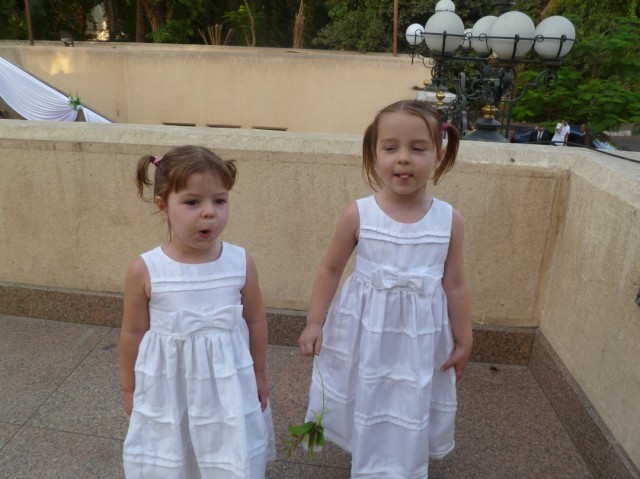
Categories
Arab West Report Middle East Published Articles

Coptic Iconography: From the Pharaonic Age to the Arab Spring

Magdy William is one of the world’s premier Coptic iconographers, having studied under the renowned reviver of the long neglected art, Isaac Fanous. William discussed his craft, its history, and spiritual impact during an exhibition hosted by St. John’s Episcopal Church in Maadi, Cairo, on October 21, 2011, under the sponsorship of Rev. Paul-Gordon Chandler. Jessica Wright served as curator for over fifty commissioned pieces, and provided translation for William’s presentation, entitled ‘The Making of Coptic Icons’. The event was part of ‘The Eternal Eye’, an exhibition desiring a new Egyptian society, which honors all its religious diversity. Bishop Daniel, bishop of Maadi and assistant to His Holiness Shenouda III, pope of the Coptic Orthodox Church, opened the event.

Rev. Chandler, Bishop Daniel, and Magdy William

There is a direct connection, William states, between Coptic icons – indeed all icons – and the artistic heritage of Egyptian Pharaohs. When a Pharaoh died, his portrait was drawn and placed on his sarcophagus to lead his spirit back to his body at the resurrection. The portrait was idealized, imagining his appearance at age 25 – the prime of life, but intended to be faithful in representation. So also do Coptic icons not seek to be a realistic picture of a saint, but to convey his spiritual reality to both teach and impact the viewer.

Production of icons also mirrors its Pharaonic history. Only natural pigments are employed, to preserve color for thousands of years as witnessed in the pyramids and royal tombs. William first prepares a piece of wood to use as the base, covering it with gelatin and then a cotton cloth. After an initial twenty-four hours he removes the cloth along with any excess, and reapplies the hot gelatin mixture. He repeats this process ten times over five days to smooth it properly for application.

Thereafter William applies a thin gold leaf over the wood, and adds first the darker colors. To this broad lines are added shaping the landscape for where lighter colors are added. A black outline then completes the picture to highlight distinction, and a final varnish covers the icon for preservation. It is a detailed process, and William is a perfectionist.

Jessica Wright, curator and translator

Early Christians in Egypt, like elsewhere, often worshipped in tombs, caves, or secret places, but drew their holy images upon the walls. Icons developed, at least in part, as a way to make their images mobile should their worship locations be discovered. Demonstrating continuity of culture, Egyptian Christians imitated the style and production of their heritage, and exported the use of icons throughout the Christian world.

This process came to an abrupt halt after the 6th Century when icons came under fire as idolatry, and many were burned as the art declined in Egypt. Elsewhere, however, Christian emperors became great sponsors of iconography, as Byzantium and Russia developed their own distinct styles. Yet except for a revival during the Fatimid period, Egyptian iconography stagnated until the 18th Century.

During this time Egypt produced only poor quality icons, as local rulers and patrons sponsored art and architecture from within their religious traditions, drawing the best artists away from the church. Seeking to outfit their community the Coptic Orthodox Church recruited Armenian iconographers, who produced worthy material on Egyptian soil.

This arrangement continued until 1965, when Pope Cyril sent Isaac Fanous to study iconography from a Russian living in Paris. He received a PhD, as well as a blessing from the Russian, who told him we received this tradition from you, and now we give it back. Returning to Egypt, Fanous revived indigenous Egyptian iconography, founding the neo-Coptic school, which William joined in 1986.

At the time William was an artist of a different sort; he created the templates for promotional movie posters, which were then mass distributed. He credits his wife for helping him turn to art of a more spiritual variety, which he called a transformation.

William was keen to impress that Copts do not worship their icons, which serve to remind of the person or event depicted. It is a lesson, recalling Biblical tales or stories of the saints, which among millions of illiterate Egyptians impart the values and knowledge of divine history. But it is more than a lesson; it is communion. Copts believe the spirits of the saints are present in prayer, drawing the believer into a wider fellowship. This is one reason icons are prominent in Orthodox churches, and many Copts set up a prayer corner with an icon in their homes.

Stories abound as well of the intercession of the saints being multiplied as an icon is contemplated, resulting in miracles of healing or fertility. Some icons are celebrated as having cried tears, which drip from their painted eyes. Such miracles happen around the world, not just in Egypt, William asserts, and is due to the choice of God, having nothing to do with the skill of the iconographer.

An exhibition attendee, contemplating an icon of St. Macarious

Today, many in the Western Christian world have turned their eye to the East, seeking additional sources of spirituality which ring with authenticity and history in a material and disjointed age. Stories of miracles may cause these sons of the Enlightenment to pause, but for Copts they are simply the continuation of the faith, for which God has worked miracles through his saints throughout the ages.

Regardless, the continuity of history is source of great comfort for Copts, especially in this current age, as Egypt and Egyptian Christians are facing an unknown future. Many fear the worst, worrying that sectarianism, even persecution, could be on the horizon.

If so, icons are a worthy reminder of God’s ultimate triumph. What are St. George, St. Mina, and even Jesus, but martyrs of earlier ages? Yet their icons are serene, reflecting the idealized portrait of their eternal restoration. The Coptic Orthodox Church is a martyrs’ church, from whose blood the seed of faith has sprouted. If Copts today fear, then a greater contemplation of their artistic heritage is recommended.

Icons are a tool to aid in connecting with the divine, and divine comfort and rebuke vary from age to age and from person to person. Magdy William is only one in a long chain of men who assist others in their path to God. Though his rendition of each saint varies slightly from the next, the eternal eye binds them as humanity, universalizing the individual, placing him in the divine story and spiritual reality of God. God’s means are many, yet the icon is there for all who wish to enter in.


Related Posts:

Categories
Personal

Maspero Youth Union Press Conference: Photos

Today the Maspero Youth Union conducted a press conference to put forth its version of events of what took place the evening of October 9, when at least 27 people were killed and over 300 injured in clashes following a largely Coptic peaceful demonstration. The MYU assembled testimonies and video evidence to demonstrate the innocence of the Copts in contradiction to the early official narrative. They also place blame squarely on the shoulders of the army. A good summary of the conference can be read here, at al-Masry al-Youm English Edition.

While in attendance I took a few pictures, and will provide short descriptions of the people below.

From L to R: Nader Shukry, Emad Gad, Khaled el-Belashi

Nader Shukry is a prominent Coptic journalist who writes for Watani newspaper, a Coptic daily. Emad Gad is a political strategist at the Ahram Center for Strategic Studies, as well as a founder of the Egyptian Social Democratic Party. Khaled el-Belashi is the editor-in-chief of the Badeel Newspaper, and made his offices available for the press conference. The Arabic in the banner behind them states the title of the press conference: Crushing Egypt.

Tony, member of the MYU

Tony spoke on behalf of his friend Mina Daniel, a prominent revolutionary activist, and Copt, who was killed during the events at Maspero. His tee-shirt reads: We are all Mina Daniel, the Guevara of Egypt.

Vivian Magdy

Vivian was the fiancee of Michael Mossad, a member of MYU who was also killed during the events of Maspero. Her picture with his dead body has circulated widely in Egypt since then:

The video evidence presented by the MYU was largely available on the internet on YouTube. I am currently working on a report for Arab West Report which assembles the bulk of relevant video and provides commentary on what is visible, what is not, and what it may infer. I hope this report will be finished and available in the next few days, so if interested, please check back over the weekend or early next week.

Note: This report is now completed, and available in five parts. Please click the link below for the introduction.

Categories
Arab West Report Aslan Media Middle East Published Articles

Clashes, Deaths at Coptic Protest in Maspero

Scene from the Violen Dispersal of the Protest

Egyptian State TV confirms 23 dead and over 170 injured in clashes between largely Coptic protestors, unknown assailants, and Egyptian military police on October 9, 2011. Protestors began their march from the heavily Christian neighborhood of Shubra at 5pm, culminating at the Egyptian Radio and TV Building in Maspero in downtown Cairo. The peaceful march was scheduled to end at 8pm, but was attacked at various stages along the route by unknown opposition.

I received word of the protest earlier in the day. Having witnessed the Coptic attempt at a sit-in at Maspero five days earlier, which was eventually dispersed by the army, I wished again to get a sense for the manner in which Copts were expressing their grievances. These largely centered on the burning of a purported church in the village of Marinab, in Edfu, in the Aswan governorate on September 30. Many Copts believe the interim government to be lax in protecting their community and securing equality of citizenship; what is certain is that a lack of security throughout the country has led to abuses.

I arrived by metro to Tahrir Square near Maspero at 7pm. Coming up from the underground I received a phone call from a colleague asking if I was on my way, and to be careful, as a protestor had been shot. Stunned by her statement, I immediately noticed the tension in the air as the metro entrance area was surrounded by Egyptians – many of them presumably Copts from lack of head coverings – pale, and in shock. Many had tears in their eyes. Shortly thereafter I did as well.

This group stated with vehemence they had been attacked by the army, emphasizing it was the army, and not simple thugs. People had been shot and armored vehicles had run over protestors as they swerved through the crowd. Some claimed there were snipers. Confusion reigned, and it was hard to know what was happening.

Only a few minutes later a group of protestors marched by where I was standing on their way to Tahrir Square. They were carrying what appeared to be dead body, chanting against Field Marshal Muhammad Tantawi, head of the ruling military council. I saw no signs of blood, but the body was inert.

I moved northward along the side of the Egyptian Museum toward Abdel Munim Riyadh Square, site of a major bus station. Hundreds of Egyptians were milling about, simply watching events unfold. From a distance I could see clashes between protestors and police taking place on the 6 October Bridge, both sides throwing rocks back and forth.

Ahead of me at an intersection of the Cornish Road along the Nile River several protestors were angrily destroying stop lights and street signs. A scuffle broke out around a taxi – it seemed two people were simply fighting to get in and drive away. Several of those standing around carried planks in their hands. Others carried crosses. The former were presumably informal members of ‘neighborhood committees’ which had been formed after the revolution to combat looting. The latter were presumably remnants of the protest, now scattered about.

One of these latter was an older gentleman from the church I attend in Maadi, Cairo. He was livid, but despondent. ‘Let the whole country get enflamed,’ he said. ‘It will serve them right. Do you see what is happening! They are killing us!’ I tried to comfort, and remind. ‘No, remember your faith. Let love hold in your heart. Copts must now be peacemakers.’ It was of little use, as we stood and watched another clash take place on the bridge. Comfort was better. I put my arm around him and cried. ‘I’m sorry for what is taking place. God protect Egypt.’ A moment later a stranger noticed me and asked if I was a foreigner. ‘Why are you here?’ he demanded. I kept quiet, said I was only watching, and moved away.

It should be noted that although I use the word ‘protestors’ throughout the text, it was impossible to tell Muslim from Christian, protestor from bystander from ‘thug’. Who was committing violence, and who was suffering it, was impossible to say.

This fact makes interpretation of events near impossible as well. A phone call to my wife allowed me to receive updates from the news and Twitter. Reports were conflicting. Wildly different numbers of dead were being reported, from two or three to thirty or fifty. Furthermore, there were reports that army personnel were also killed. Some said that Christians had machine guns. Others reported that State TV announced the army was under attack, and urged Egyptians to come into the streets to defend it. The largely activist and liberal Twitter community understood that official media was blaming the protestors for what happened, saying that they fired first.

I cannot say the truth of what took place, for I arrived no more than fifteen minutes or so late to the scene, and was never in a front line position. Yet before too long an acquaintance from the Maspero Youth Union recognized me and gave me his version of events. He stated there were 10,000 Copts and Muslim supporters in the march from Shubra, which was met with violence when their path was blocked. He blamed thugs sent by the army, but also that people were pelting them with rocks and glass from apartment buildings along the road. Eventually, they were able to proceed again. He insisted the group did not plan for a sit-in, but was ready to disperse freely at 8pm. Upon arrival at Maspero, however, the army began attacking immediately, he maintained. People were shot in the head, and others were run over by military vehicles. I discovered later that one member of the Maspero Youth Union, Michael Mossad, was among those killed.

As he was relating events tear gas was fired on the bridge, and he left to go check in on events. From time to time waves of protestors fell back, and gradually security regained control of the area, pushing everyone back toward the direction of Tahrir Square. Suddenly a fire engine sped through the area and was pelted by rocks as it went by. Whether or not this caused the driver to lose control of the vehicle, it swerved, hopped over the central median, struck one or two people along the way, and crashed into a street light. Waves of protestors then descended upon it, but I could not tell if they were beating the driver or pulling him from the wreck. Several climbed on top and began vandalizing. A car fire raged shortly thereafter on the other side of the street.

Contrary to media reports, however, I did not witness ‘clashes’ in Abdel Munim Riyadh Square between protestors and others. There was much tension, sounds of occasional gunfire, and tear gas lobbed throughout the area, but I never witnessed actual fighting except at a distance. The area is large, however, so I am hopeful if it took place I was stationed in the safer locations.

Contrary to other media reports, I did not witness large reactionary protests in Tahrir Square. Egyptians were all over, and at times small bands of protestors would march and chant slogans against the military council. Yet when I was present there was certainly not a mass gathering in response to what took place. I wandered a bit more throughout the area, before leaving to go home around 9pm.

As news continues to unfold there will be much to confirm amidst the rumors. There are reports the military entered media offices preventing transmission of live feeds. There are reports of clashes outside the Coptic Hospital where many injured are being treated. There are reports liquor stores – owned by Christians – are being attacked downtown. Meanwhile, Prime Minister Essam Sharaf has called for an emergency cabinet meeting tomorrow, and has posted on his Facebook page:

What took place was not a confrontation between Muslims and Christians but an attempt to create chaos and ignite sectarian sedition, which is not fitting for the children of the nation who were and will remain ‘one hand’ against the powers of destruction and extremism. Application of the law is the ideal solution for all of Egypt’s problems. I urge all children of the nation who are keen for its future not to answer those who call for sectarian sedition. This is a fire which will consume us all, without distinction.

These are wise words. May they prove true especially now and in the days to come. God protect Egypt.

Categories
Personal

Marinab, Maspero, and Faith on the Earth

Please note: The following was written a few days ago following a largely Coptic protest at Maspero. Obviously, it must be reconsidered in light of the horrible events of this evening, in which several were killed. All the same, this should do well to set the context for what happened today.


Outraged at the burning of a church in Marinab in the governorate of Aswan, over 1000 Copts and Muslim supporters marched in Cairo on October 4, 2011 from the heavily mixed Muslim-Christian neighborhoods of Shubra to the Court of Cassation in Ramsis. Afterwards, several hundred moved to the Egyptian Radio and TV Building in nearby Maspero, announcing a sit-in at the site of several previous Coptic protests.

The Setting

Unfortunately, the immediate spark that ignited this protest in Marinab is not at all clear. Many if not most demonstrators believed otherwise. A common interpretation claims  extremist, likely Salafi, Muslims surrounded a church and torched it, besieging their minority Christian neighbors in an effort to keep them from having a place of worship and perhaps to drive them from the area. This despite the fact that local Copts possessed official documents authorizing building renovation.

A full report on what transpired will be published soon, based on the findings of Cornelis Hulsman and Lamis Yahia during a visit to Marinab. What is emerging, though, is a far more complicated tale. While it appears the Christians of the village may have had authorization, this may have been gained on false pretenses. Or, it could have come through a ‘deal’ made between the governor and the deputy priest of the bishop to keep quiet a conversion case – which often result in sectarian tension – in exchange for authorization to construct a church. Stay tuned for full analysis of documents and testimonies, but regardless, the burning of the building occurred on a slow boil.

Christians in Marinab had long used a nondescript structure as a church, which was well known to the Muslims of the village. Negotiations had been underway to tear down the building and replace it with a formal church building. Muslims objected not to the conducting of religious rites but to the physical markings of church architecture. Confident in their authorization, the Christians began to build. Then, in light of the security void in the region following the revolution, they began to exceed their mandate.

Muslims brought this to the attention of authorities: Christians exceeded the approved height of the structure, and added four unauthorized domes to the roof – typical of Coptic Orthodox architecture. This was not disputed by local Copts, and they began to dismantle. Two of the domes were removed and the walls lowered. Copts stated this required careful, painstaking effort, lest the building collapse. Muslims felt they were moving slowly, stalling, and perhaps deliberately leaving some domes untouched.

On Friday, September 30, something set the Muslim community off, which will require more investigation. Perhaps fearful Christians would circumvent agreements and get away with it, a group of 200-300 youths took the matter into their own hands, using simple tools to tear down the building. This eventually swelled into around 1000 strong, and security looked on doing nothing. At some point some Muslims arrived with gasoline, and used it to set the structure ablaze. As the church-to-be is in a densely populated area of the Christian ‘quarter’, the flames spread and consumed much inventory in the neighboring warehouse. Christian properties were also damaged, and looting took place. The general sense – which can be disputed – is that Muslims wished to target the church, and some wayward youths engaged in violent excess. It is clear, however, that Muslims could have done far more damage to Marinab Christians had they wished, and did not do so.

There is nothing redeemable in the actions of these Muslims, as their Islamic chauvinism led them first to oppose a physical Christian imprint on their village, and then to take the law into their own hands. Yet perhaps law is a misnomer, for it seems both Christians and Muslims abused its absence. Application of law had long been a neglected feature of Egypt; after the revolution the ongoing security void is a deep mystery.

The Protest

It is this lack of government that gives legitimacy to the Coptic protest at Maspero. Marinab is the third church to be attacked since the revolution, following Atfih and Imbaba. Christian hopes raised during the revolution, which appeared to portend a new spirit of cooperation and national unity, are being dashed as frustrations with the former regime re-circulate, and perhaps increase. Yet the response of anger to the Marinab attacks reflects a lack of understanding and a jumping to conclusions. Neither the state nor the church provided (or were able to provide) the depth of complexity and shared complicity which led to the unjustified Muslim attack, however much both groups felt they needed to take the matter into their own hands. Yet a simple narrative of persecution and extremist opposition is more easily digestible.

Unfortunately, it is a narrative which is polarizing, even as it bears marks of true suffering. It is a tale that isolates Christians, even as it is self-fulfilling. It was also clearly evident at the Maspero protests.

I was in attendance with Cornelis Hulsman, who supplies many of the remarks which follow. I also know a few of the Coptic organizers, and find them to be good people who are not manipulators. Yet that might not be true of all.

Whether or not they possessed a true history of the Marinab conflict, Fr. Philopater, Fr. Mityas, and Fr. Abram Suriyani, a monk, are all Coptic Orthodox clerics with strained ties to church hierarchy. They, along with other priests from Shubra, Ma’asara, Beni Mazar and elsewhere, appeared to be coordinators. While they were celebrated by many, followed by large gatherings, one protestor in particular upbraided the priests as bringing trouble on the Copts. He said this while repeating the frequently heard Coptic chauvinism of being ‘pure-bred’ from the Pharaohs, as opposed to the Muslims of mixed Arab blood.

Since the revolution there has been a movement among Christians to rejoin society as opposed to remaining walled in the church leaving Pope Shenouda to represent Coptic interests. This, I find, has been a largely positive development, even as it imitates the popular activist techniques of protests and sit-ins. The above priests appear to reflect this trend, and constantly remind both Copts and media their presence does not infer church sanction of the event. I do not know the priests well, and must be reticent to cast accusations. Yet an activist by nature is often single-minded; as he may have the tendency to neglect greater context, he may also face the temptation to simplify a narrative. This is no sin, yet it may not reflect wisdom.

Their fellow activist, Rami Kamel, general coordinator for the Maspero Youth Union, received a phone call from the office of Prime Minister Essam Sharaf, seeking to know their demands and sit for dialogue. He refused, stating he would offer demands the next morning. At another point during the evening Fr. Philopater was removed by security, apparently for negotiations, but later returned and the sit-in continued. The entire time the Maspero area was surrounded by military police and central security; veterans of public demonstrations we know – one an activist, the other security – conjectured appearances suggested they would violently clear the area.

Meanwhile, the Maspero Youth Union had drawn up and printed demands, reflecting a simplified and exaggerated narrative. It stated, for example, that though noble Egyptians have followed the news of the Marinab church, ‘we Copts follow with weeping hearts as our churches are daily exposed to burning and destruction’.

Furthermore, a threat was issued: ‘We know full well that the events of Marinab will not be the last as long as the military council and those running the country remain incapable of protecting Egyptian Copts’ churches and the lives of their sons. … As such, we have no choice but to struggle for our just cause by taking all possible measures of political escalation until we gain all of our squandered rights.’ They then list the following six demands:

  1. Arrest of criminals who incited and caused the incident (in Marinab).
  2. Resignation of the Aswan governor and investigation into his inflammatory statement to the media against the feelings of Copts, and of his lie about the truth of what happened.
  3. Immediate investigation of Officer Ahmed Fathi, security detective in Edfu, and the security director of Aswan, and their collusion in the sinful aggression.
  4. Rebuilding the church of Marinab on state expense.
  5. Rapid issuance of a unified law for building houses of worship, as well as laws to criminalize incitement and sectarian discrimination.
  6. Setting a specific timetable to implement the above mentioned demands.

The October 4 sit-in was in fact an escalation, though no more than the Maspero Youth Union had organized in the past, and no more than countless other groups have done since the revolution. Taking up residence in front of the Radio and TV Building, 1000 Copts lingered here and there, unimposing in terms of sheer mass, but blocking the busy Cornish Road along the Nile River all the same. Hundreds of security personnel actually stopped the traffic, with tension in the air if their presence was to deter an attack against the Copts, as happened during their last sit-in, or in fact to remove them.

A sit-in protest requires large numbers to solidify presence, and a few Copts murmured their disappointment at the turnout. They pressed forward all the same, but most appeared subdued, even dulled to the effort. Some said people were getting tired of protesting.

Not all. There appeared to be a group of fifty or so, never organized as such exactly, but asserting themselves right at the front lines of the security cordon. There they would chant in their faces, provocatively – ‘Muslim, Christian, one hand!’ or even ‘the people want the fall of the field general!’ (i.e. Tantawi, the head of the ruling military council). One protestor even went as far as to slap a policeman in the face. Showing great restraint, the army removed him without incident.

The restraint did not last, and the agitators continued. Earlier in the day Fr. Philopater urged the Copts to be peaceful, and several stated security was itching for conflict as an excuse to remove the protestors, and slander their reputation in the process. Yvonne Mossad, a media coordinator for the Maspero Youth Union, showed great courage to put herself in the middle of nearly every run-in, urging Copts to back down. They did not always, and in one flare-up the military police began hitting a protestor with his shield, and gunshots were fired into the air.

This was about 12:30am, and we had already made the decision to begin leaving in order to catch the last metro at 1:00. At the sound of gunfire everyone scampered chaotically, but things calmed down again. We left, hoping for the best, hoping the sit-in would proceed peacefully. As it turns out, I wish we had stayed, though it was probably for the best we left.

According to media reports the sit-in was dispersed forcibly around 1:00am. Other sit-ins have been dispersed by security, so there is nothing anti-Coptic in the government response. Force, to be sure, is required when resistance is met, even if that resistance is passive. Having left the area, we cannot comment on the behavior of the protestors. One video circulating afterwards on the internet, however, clearly shows an excess of violence. Even if the man in question was one of the agitators, surely an internal military investigation will be forthcoming.

Reflection

In a certain town there was a judge who neither feared God nor cared about men. And there was a widow in that town who kept coming to him with the plea, ‘Grant me justice against my adversary.’

For some time he refused. But finally he said to himself, ‘Even though I don’t fear God or care about men, yet because this widow keeps bothering me, I will see that she gets justice, so that she won’t eventually wear me out with her coming!’

And the Lord said, ‘Listen to what the unjust judge says. And will not God bring about justice for his chosen ones, who cry out to him day and night? Will he keep putting them off? I tell you, he will see that they get justice, and quickly. However, when the Son of Man comes, will he find faith on the earth?’ (Luke 18:2-8)

What then for the Copts of Egypt? How should those in Marinab be judged, or in Maspero, for that matter?

Let us imagine the Coptic villagers to be completely innocent in this case – victims – as investigations may yet conclude. Certainly their situation is not easy, and one Muslim in Marinab allegedly told his neighbor, ‘May God rest the soul of Islam. If we let this church be erected then Islam is buried in this village.’ Testimony on both sides seems to point to a shared causation, if of a different manner, between Muslims and Christians, but in such an atmosphere, Christians may wonder if they are equal citizens under the law. Difficulty in building churches has been long established.

The history and commonality of this difficulty should not numb the reader, as if it is a normal, simple inconvenience. Add to this slight the tales of discrimination, educational and media bias, and the pressures of a growing extremism, and the picture is painted of the Copts as the widow in the parable, calling out for justice. The sit-in at Maspero was not just about Marinab, it was about accumulation of grievances and frustrations. It is the experience of a community; legitimate or not it is the perception of many. Not a few Muslims agree with them as well; there are issues between Muslims and Christians in Egypt.

Allow a minute for the conspiracy to be advanced to undo this statement. Under Mubarak, many say, the security apparatus would play with religious tensions for political gain. These many now attribute the attacks in Atfih, Imbaba, and elsewhere to the remnants of the Mubarak system seeking to preserve their power base by discrediting the revolution. Enflaming Muslim-Christian tensions is among the best ways to do so both home and abroad. Noteworthy is the fact that the Aswan governor was a Mubarak appointee who maintained his job. Could the church insistence in building a church – with domes – come from subtle suggestions quite aware it could spark tensions? Could the individuals who brought the gas to burn the church simply have been paid thugs – as well as those who thereafter looted? It is unlikely investigations will uncover anything of the sort, but within a confusing post-revolutionary setting, questions of all natures are asked, and linger.

Either way – under a dominant Islamic chauvinism or a lingering security conspiracy – Copts have been crying out for justice for a long time. The parable encourages them to continue, for God is not an unjust judge. Surely he will grant respite – quickly, it assures – and without a begrudging heart. Do Copts believe this? Or has God proved himself unjust, unhearing, uncaring? Many Copts seem to believe God hears and answers better in America or Europe, for they are leaving their villages for cities, their cities for the capital, and the capital for refuge abroad. As one Copt stated in Maspero, ‘Egypt is rubbish; a garbage country!’ However difficult the plight, this is the voice of one having long given up on God; is he not the judge of every nation?

It is not that Copts must only pray. It is right for them to strive politically. It may even be right for them to demonstrate. Yet the question of Jesus must cut them to the marrow: When the Son of Man comes, will he find faith on the earth?

Did the Copts in Marinab call out for justice, or did they seek to manipulate for their interest? Did the youths at Maspero carry forward the cries of previous generations, or did they take justice into their own hands? Yes, both are dealing with reality as best they can, as normal efforts, they find, are frustrated. Yet are they acting from faith? Are they acting in accordance with faith? Faith changes reality. Or, is God unjust?

It is a frightening question. Answers are not easy. It calls for humility and introspection. It calls for creativity and action. It calls for hope and love.

The Jews to whom Jesus addressed his parable were waiting for the restoration of the kingdom. They are still waiting. Their picture of justice – a people governing their own land – is surely commendable, but was ultimately faulty. They cried to God for centuries; some abandoned this for increased moral purity, others for political escalation, still others for isolation from society. Each of these responses is current to some degree in Egypt today. Yet all of them failed. The kingdom never came.

At least not as they expected it. Jesus’ kingdom was of the spirit, and it remains established around the world, including Egypt. What does God intend, then, as justice for the Copts? It remains to be seen. It is proper for Copts to pursue all manner of human justice, as long as they recognize this is not necessarily the same as the vision of God. His justice – whatever its fulfillment – is coming quickly. It only remains for Copts, and all Egyptians, to maintain faith on the earth, and to act accordingly.

Categories
Personal

Customary Formation of Politics: Muslim and Christian Examples

The Pink Finger Signals a Vote Cast

Generally speaking, the customary rules of politics issue and evolve from hard earned consensus historically and informally negotiated among public figures and society. Eventually these are crafted into constitutions and laws to formalize the political system along grounds to which all agree. The success of the political system rests in the degree to which all political forces submit to the system and recognize its equity.

Under the nearly thirty year presidential administration of Mubarak customary rules of politics did exist, and political forces largely submitted to the system. Even the Muslim Brotherhood, though outside the formal structure of politics, acceded informally to the relationship between society and state. Few, however, either inside the system or outside it – and the vast majority of the Egyptian population was outside – recognized its equity. Eventually this disquiet, among many other factors, led to the Egyptian revolution.

Now eight months into the transition to democracy, the rupture caused to customary politics has not yet been repaired. Egypt does have a liberal democratic tradition to recall, but its benefit is largely in legacy, as the experience was lost through successive autocratic presidencies. Meanwhile, there is great debate over the nature of the constitution to come, let alone the specific formal rules of the political system. Depending on the rhetoric, civil and Islamic political forces either agree in substance on nearly all but nomenclature, or else have vastly different visions for the future polity of Egypt. This is natural, for building anew a political system forces even the most fundamental questions to be reconsidered. Who are we, and how will we get along to balance our interests?

During this interim period one of the old rules of the system was recalled, though perhaps customarily adjusted to new realities. It has long been forbidden in Egypt for a political party to be based on religion. This was one of the difficulties facing the Muslim Brotherhood, and caused their candidates for parliament to formally run as independents. There was no deception, for everyone knew the nature of the arrangement, which also signaled essential Brotherhood submission to customary politics, even as they railed against it.

Post-revolution, then, though it was clear the Muslim Brotherhood would no longer be an outlawed political force, what structure would emerge to legalize them, and others like them? Guarding the fabric of religious life and protecting national unity, the ruling military council maintained the law forbidding religious political parties. The nuance which emerged, however, allowed for political parties with a religious reference. The difference is not at all clear, but a practical result has been an effort to enroll at least some Christians into the new Islamic-reference parties. The Muslim Brotherhood’s Freedom and Justice Party, for example, includes a Christian vice-president, and boasts 100+ Copts among their 10,000 members. Though I am unaware if other Islamic-reference parties also have Christian members, the precedent set for the Freedom and Justice Party of the Brotherhood has led also to a party for al-Jama’a al-Islamiya and various Salafi trends. No semblance of a Coptic party has yet emerged, but the Free Egyptian Party, financed by wealthy Coptic businessman Naguib Siwaris, is composed 30% of Copts, far above their percentage in population.

Like their Muslim counterparts, Egyptian Copts have been long depoliticized. Many are fearful of the Islamist developments in politics, at least partially explaining their membership in the Free Egyptian Party, representing liberal trends. Yet the effort to draw Copts further into the emerging political system has been slow going, and leads also to an anecdote illustrating the in-flux nature of customary and legal politics.

My family and I attend St. Mark’s Orthodox Church in Maadi, Cairo. My wife regularly attends a mostly women’s Sunday School meeting, and on this particular day it advertised the speaker would address the topic of ‘Raising Political Consciousness’. Eager to hear how the topic would be presented, I also joined in the meeting.

The speaker was a member of the church, though not of the meeting, and delivered an engaging lecture on the basics of civics. There are different types of political systems, he explained, and went through the basics of American democracy, various European examples, as well as the Egyptian system under President Mubarak. He explained the technical aspects of the new election laws, in which half of the representatives would be selected in a winner-take-all election, and the other half in a list-based party arrangement. As an American, I recognized our standard winner-take-all individual candidacy approach, but I took closer interest in the unfamiliar list-based system, used more frequently in Europe.

Under this arrangement, political parties submit a list of candidates for election, which may be done in coalition with other parties. Voters then select one entire list among the different choices offered, and the percentage of votes received determine the percentage of candidates elected. If the list contained ten names and this party received 30% of the total vote, for example, the top three candidates named on the list would be victorious.

It is still unclear how the combination of winner-take-all and list-based elections will exist side-by-side, and most political parties are unsatisfied with the system issued by the military council and interim government. Yet the speaker tried to educate the group about a possible deception which might occur as parties lobby for Coptic votes, especially on the part of Islamic-reference trends. For example, the Freedom and Justice Party (not specifically named by the speaker) might place a few of its hundred Coptic members on their official list, and proclaim how they are not just a Muslim party but also seeking election of Coptic representatives. Yet if these Coptic names appear near the bottom of the list, it will be extremely unlikely they will reach the percentage threshold necessary to be elected. If a party placed a Coptic candidate near the top of a list, or in the winner-take-all election, that would be a different gesture entirely.

In conclusion, the speaker recommended that his listeners do indeed take part in shaping the emerging political system, especially as many are fearful their rights could be trampled upon if the next government is Islamic. Up until now the lecture was basic, educational, and a very valid plea to overcome lingering de-politicization. When he stated clearly they should enroll in liberal political parties, however, my American ears began perking up. When he further mentioned the political party of his participation, and invited anyone to come and take literature about it, my eyes began to bulge.

In American politics it is both customary and illegal for churches to endorse particular parties or candidates. There is customary leniency on issues, but the non-profit and tax-exempt church is forbidden from using its religious leverage to serve a political cause. As stated earlier, the laws in Egypt are still emerging, and customary procedures are under debate.

To be certain, the literature made available was rather innocuous. It stated very little about the particular party, and instead was a general call to recognize politics as an essential part of life – the best means to defend your rights. In fact, it specifically states,

It is not important that you become a member in a party, it is important that you work for the benefit of your neighborhood.

Furthermore,

If there is any respectable man you would be honored to have him represent you, encourage him to nominate himself. If the ideas of any party impress you, join it.

By no means was this partisan literature, yet the name, logo, and contact information for the party were clearly and prominently visible. The speaker was careful not to be forceful in his invitation; rather, he was almost sheepish. He stated later, however, that he did not take permission before making the party literature available. No one in the audience seemed to be offended; some approached for literature while others left and went their way. One person I asked later did state that the action was a bit controversial, and may have been uncustomary, but that it was not a big deal.

St. Mark’s Orthodox Church in Maadi is in an upscale neighborhood, and many of its members have lived or studied in foreign countries, and are familiar with (and envious of) their political cultures. To a degree this may help explain the hesitation experienced in the meeting. Yet according to many media reports, such decorum is completely missing in many of Egypt’s mosques. This is not surprising, given that Western, Christian influenced societies have largely accepted the notion of separation of church and state. Many Muslims, however, and especially Islamists, believe that politics is an essential component of religion, as Islam encompasses all of life.

The upshot was most visible during the constitutional referendum of March 19, in which the population was asked to either validate or reject the military council roadmap to amend the current constitution, paving the way for legislative elections, which would select the council to draft a new constitution, followed by presidential elections.

Though it is true the referendum was somewhat hastily organized, and the consequences of either choice were not clear, many Islamist leaders urged Muslims to vote ‘yes’, with a few even declaring it to be a religious duty. Not a few liberals also voted yes, finding the rapid return of the military to its barracks to be the best outcome of the transitional process. Still, the religious influence was unquestionable (though probably not decisive), and 77% of voters approved the referendum.

Following the approval of this roadmap, liberals realized the gain made by Islamist parties. Weak liberal penetration into the countryside and among the poor was well known, and likely Islamist success in elections was admitted. Yet the roadmap dictated the current uncertain rules of politics during the transition would be formalized by the coming parliament. If the legislature would be dominated by Islamists, perhaps they would craft laws to their advantage, and in establishment of an Egyptian Islamic identity. Or, maybe they would not, and would respect the will of the revolution and promises made to liberal parties to establish a civil democratic state through cooperation. Egyptian politics has since been dominated by the elusiveness of this answer, with most liberals leaning toward distrust.

America endured thirteen years from its declaration of independence to the ratification of its constitution. This period was full of sharp rhetoric between federalist and anti-federalist political camps, each with a radically divergent belief on the best shape of governance. America inherited a customary political process from England, but its formalization was much more difficult, negotiated in light of her particular history. In the end the federalist position triumphed, and political forces fell in line. Significant evolution in American democracy has continued to the present day.

It is hoped this history may be of encouragement to Egypt. Yes, issues being discussed now are of vital and foundational importance. After seven months, however, the renegotiation of customary politics into formalized structures has only just begun. It is contentious, and it should be. It requires, however, all parties to play the game, and eventually to fall in line. If not there will be either a reemergence of autocracy or a descent into anarchy. Politics being the art of compromise, though it may take significant time, all things being equal, Egypt will find its way.


Categories
Personal

A Window into Character: The Conflict at Maspero

The Coptic demonstration prior to the attack

All men have ideals; it is when they are tested that they are revealed as true or false, or somewhere in-between. Psychologists have identified the ‘fight or flight’ response to conflict: One either meets it head on or withdraws from the scene. Neither one nor the other is wisdom necessarily, but rather the gut reaction to a situation of danger. Such urges presumably can be resisted in either direction, but decisions made in these few seconds will either haunt or honor the character of a man.

On May 14 the Coptic sit-in protestors at the Egyptian TV and Radio Building at Maspero, along with their Muslim sympathizers, faced such a challenge. I have written about this previously here, and in more detail shortly thereafter here. In an effort to disperse their sit-in ‘thugs’ led by certain Salafi Muslim elements attacked their location, using guns, knives, stones, and Molotov cocktails. For this text I have had opportunity to speak with Fadi Phillip, one of the leaders of the Maspero Youth Union (MYU) which called for the protest. He was on the scene, and described his role in and perspective of the attacks.
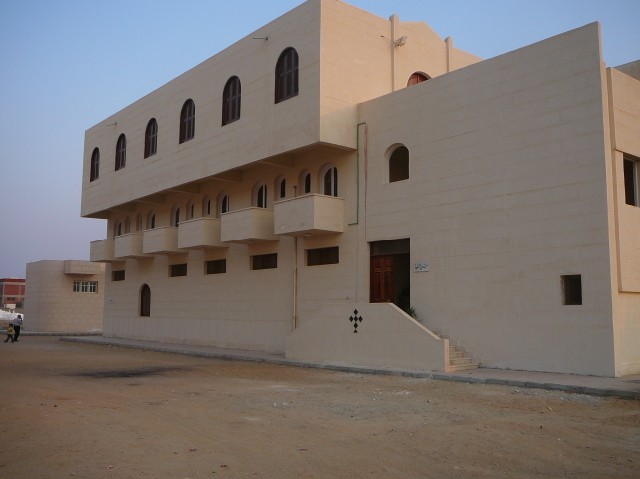
Fadi is the English language media representative for the Maspero Youth Union; as such he is not generally to be found on the front lines. Some Copts are assigned roles with security, others in the clinic. In general, though a leader, Fadi works hardest when things are calm and journalists arrive to seek a story. When the attacks began he was idle, far from the front lines, like most other protestors. As a leader he tried to spring into action, but the situation was spiraling out of control.

Quickly he ran to the front lines to inquire what was going on. Whoever he spoke with grasped his badge and seemingly rebuked him for not knowing. The MYU is well organized internally, but a sit-in attracts all sorts. This enthusiastic Copt, from wherever he came, was eager to defend the group, but he did not fall in with or recognize Fadi’s titular leadership identity.

The initial attacks were not hand-to-hand combat, but rather the ‘thugs’ taking advantage of their elevated position on the bridge and off-ramp to fire pistols and hurl Molotov cocktails. Fadi joined in with a group trying to get MYU parked cars away from the range of the attackers. With most sit-in protestors still far removed from the front lines, using keys was not possible. Fadi and others broke the windows of many vehicles to disengage the parking brake and then roll the cars to safer position.

During the altercation Fadi ran back and forth several times between the front lines and the group, which included many female protestors. On one occasion he went to the police, who were standing by in the open area between the protest group and the front line attackers. He asked them to get involved, but they communicated they had no orders to do so. He then went to the army, which was deployed closer to the sit-in site, and told them eight people were not injured. When an officer stated only that those afraid should go home, Fadi brazenly asserted that they would not desert their sit-in; they would not go home unless dead. Yet as another Copt was there also screaming at the officers, Fadi left him to make his point and returned again to the group.

At one point as the conflict was increasing in intensity, Fadi lifted his arms to heaven, recited the Lord’s Prayer, and asked that God would not allow his children to be eaten by dogs, should they be killed today. It was a strange prayer, but Fadi remembered that it was said of the Copts who died in the Alexandria bombing that after the major remains were collected, the smaller body parts were left in the streets and consumed by dogs. Before he finished praying, however, someone interrupted him and rebuked him, saying this was no time for stillness. After this, Fadi reengaged.

On his way back to the front lines he found an enraged Copt, pouring water all over himself and picking up a gas canister to run with into the fray. Fadi tried to reason with him, trying to stop him, but somewhere in his effort he was struck with a blunt object in the middle of his back. Stunned, he fell, and was disabled for a period of time. After this he left, limping back to the protest area.

From here on out Fadi sought to make himself useful in the clinic, which was now overflowing with injured. Though possessing no medical training, he was stitching wounds and bandaging gashes. He purposed to avoid head injuries, out of fear he might do more harm than good. Yet even so on one occasion he was given some sort of medical ointment, and spread it upon the head of one injured to the point of revealing his skull.

Among the injured were some of the ‘thugs’, captured by the Coptic protestors. One who appeared to be a ringleader suffered deep cuts and was brought into the clinic. Fadi witnessed how he was told that if he confessed on videotape to his crimes they would treat his wounds; otherwise, they would leave him languishing in the clinic. Under such duress, he confessed to being paid 500 LE (about $85 US) to take part in the attack.

A more serious confrontation took place when the Copts purposed to capture one of the Salafis involved in the attack. They formed a small group, rushed forward, and then snatched one from the front lines, tossing him backwards into the Coptic throng. The one who apprehended the Salafi suffered several stab wounds in the effort. Once captured, however, the protestors beat the Salafi relentlessly. Fadi relates this was due to their rage over the attack on their sit-in; a supplemental factor may have been the pent up anger over allegations that Salafis orchestrated several attacks on Copts after the revolution.

Some of the Copts tried to intervene from their Christian convictions. Others, including Fadi, intervened for more practical reasons. First, he said, they wanted to get information from him. Second, they wanted to secure proof that Salafis were involved in the attack, lest the media portray it as simply the work of ‘remnants of the former regime’, as has become a common accusation. Third, Fadi was concerned that the repercussions could be severe should a Muslim die in their custody. In his efforts to stop the beating Fadi was kicked in the groin as Copts fought each other over the Salafi. Eventually he was freed and transferred to a nearby ambulance and taken to a hospital. He provided no confession.

Eventually the police became involved, firing tear gas in-between the two groups to disperse them. The direction of the Nile air, however, wafted the gas toward the sit-in area, choking those who stayed back either to avoid clashes or to help in the clinic. At this time objects also began raining down from the apartments of residents situated above the sit-in area. This enraged the Copts further, but Fadi recognized they were tossing onions, which are a known local antidote to the symptoms produced by tear gas. He made effort to calm down his fellow protestors.

Though the tear gas did put an end to the fighting, Fadi related that the sounds of gunfire started again as the ‘thugs’ pulled back and the tear gas clouds obscured vision. The Copts did not know if this was from the ‘thugs’ or the police, and Fadi began to run back toward the front lines to see what was happening. On the way, though, he stopped, vomited, and then collapsed from exhaustion and tear gas inhalation. Shortly thereafter all was calm once again.

In reflecting on the event, Fadi stated that the altercation showed the need for an emergency committee in the Maspero Youth Union. Initial shots were fired from the bridge around 8pm, but the actual fighting did not get underway until 10am. The whole time, Fadi states, many Copts were itching to rush and engage the attackers, sensing they were under threat. Yet during this two hour interval wiser heads might have been able to prevent the chaotic clashed did not take place, or were at least more strategic.

Fadi stated in retrospect that the Copts should have had more discipline to hold their line at the sit-in, instead of rushing out to meet the attacking group. In their haste they ran past the army and police, which can now accurately portray the clash as between two attacking parties. Had the Copts at least waited until their assailants passed by the authorities on their way to the sit-in, it would have forced the hand of the police and army. Either they would have to interfere and stop the attacking group, or else the evidence they stood by and did nothing would be clearly confirmed.

Such are the thoughts one may have after involvement in a crisis. There are always things which could have been done differently, words that should or should not have been said, and lessons earned through simple hard knocks.

It is not possible to confirm Fadi’s testimony, but it corresponds with earlier investigation into the Maspero sit-in. Yet just has humans have a tendency towards ‘fight or flight’ when facing conflict, they also may be tempted to exaggerate the severity of danger in their flight, or the degree of heroism in their fight. Could this have been true of Fadi? You can be the judge.

In reading the testimony, however, are you able to envision yourself in his place? What would you have done? Would you have been there in the first place?

Everyone has times when they imagine themselves in a potential conflict, writing a script for how they would behave. While this is likely useful, it can also be an exercise in self-flattery. Rarely will anyone fail in such a test.

Instead, the best preparation for a test of character is simply to live by your ideals in the day-to-day monotony of life. Temptations to cut corners or compromise will be many, and the stakes, as well as consequences, will be low. Giving in to these base urges whittles away character, imperceptibly, until a crisis comes and the test is failed before one realizes it is even being administered. Conversely, moral muscles are strengthened through such exercises of resistance.

Preparation is no key to success. People of great character may stumble, and virtue may arise from the unlikeliest of sources. Grace is needed for all, to prime the pump in advance and aftermath of a crisis.

Egypt languished without active moral exercise for years, but people summoned the courage to rise in revolution. While some, and perhaps many, transgressed boundaries the great majority acted with conviction and character. In the months that have followed there have been other challenges, but the revolutionary struggle has slipped back into routine monotony. Some seem fixated on maintaining the crisis, or beginning new ones, and their intensions on the whole should not be doubted. It can be easier to summon courage in a crisis. It is more difficult to maintain character in monotony.

Yet having passed their test, can Egyptians cement their gains? I do not mean the gains of the revolution, however legitimate they may be. I mean the gains of character, taking pride in their dignity, their unity, and their integrity. Rebuilding their country will require such strength, for not all will honor these virtues.

Finally, for the reader outside of Egypt, in what stage of life are you? Where will your character lead when put to the test? What little tests are faced now, far from the heat of battle?

May we all be strengthened, encouraging one another, giving grace in time of need. May Egypt, and all mankind, meet its many challenges.


note: I hope tomorrow or the next day to post an interview with Fadi about the Maspero Youth Union.

Categories
Personal

Rebuilding the Social Fabric: Muslims and Christians in Community Service Organizations

Yousry Fu'ad Abdel Latif (and me)

Civil society is one of the hallmarks of a strong nation. Conspicuously, it was rather absent in pre-revolutionary Egypt. President Mubarak did his best to depoliticize the people, with even extension of social services neglected. While religious groups such as the Muslim Brotherhood and the Orthodox Church picked up the slack on both counts, this also contributed to the increasing polarization of the two religious communities, especially Christians, who felt discriminated against in the public square and thereafter largely abandoned it.

These faults have been recognized since the revolution; overcoming them is the current challenge. Yousry Fu’ad Abdel Latif is one man who is trying.

Yousry is a lawyer, aged 44, who lives in Hadayak al-Maadi. Following the revolution he has created and coordinated the Coalition of Dar al-Salaam Youth, submitting paperwork to establish it as a legally recognized community association. Dar al-Salaam is a traditional, working class area to the north of the affluent Cairo suburb of Maadi; Hadayak al-Maadi belongs more properly within its ensign.

I stumbled upon this group quite by accident. Wandering through the Hadayak neighborhood I saw signs posted calling the youth of the area to join in a trash cleanup campaign. Two things were noteworthy: One, the signs were posted on both the mosque and the church, opposite one another across the street. Two, the campaign was taking place the very hour I was passing by. I met three or four of the youth, wearing surgical gloves and mouth coverings, hauling garbage bags behind them. They introduced me to Yousry, and we set up an appointment.

Poster for the Coalition of Dar al-Salaam Youth

The goal of the coalition is to begin transforming Egypt from the local community outward. Individuals must take responsibility for themselves and their area, seeking reform, development, moral consciousness, social justice, and cultural awareness. It is meant to deliberately include Muslims and Christians together, ultimately producing a democratic society in which all are free to participate. Though the coalition organizes seminars and medical testing to accomplish its goals, garbage collection was the starting point. It is the practical work that will forge youth of the area together as a team.

Yousry introduced me to a few members of the coalition. Mahir Fayiz is a 24 year old Copt, of Orthodox heritage but involved with an evangelical social group. He possesses a high school diploma and works in his family’s neighborhood shop, selling rugs and tapestries. One day he heard the calls of a few youth, who he knew but was not necessarily friends with, to come out and clean the streets of Hadayak. Thinking it was a good idea, he joined in.

Mahir asked specifically if he could clean the steps of the mosque, and was so designated. He saw the goals of the coalition as worthy in their own right, and wished to promote community integration by taking this symbolic act of service. He stated that doing so earned him respect among his peers in the coalition, most of whom were Muslim. “The more we focus on our nation,” he says, “the more our country will grow. The more we focus on religion, the more we will divide.” Yousry was particularly impressed by his attitude and actions.

Sharif Muhammad Zakaria is a 21 year old Muslim. He possesses a high school technical degree and works as an interior painter. He knew of Yousry previously as a neighborhood lawyer, and as such has been involved from the beginning. What originally took his attention for the garbage cleanup campaign, however, was the pile of trash accumulated on the side wall of the church. This was unacceptable, he said, and dishonorable for a place of worship. Sharif is a practicing Muslim, but finds groups like the Muslim Brotherhood to focus too much on religion. “Religion is for God,” he says, “but the coalition is united around service to our country, which is for all.”

Yet despite the intentions of the coalition to integrate community Muslims and Christians, so far it has been slow going. Yousry states there are about 70-80 committed members of the group, but only 3-4 of these are Christians.[1] Meanwhile, though the coalition consists of eight separate committees, none are coordinated by Christians.

Fayiz stated that he hoped to bring other Christians into the coalition, but as his friends are primarily among the fewer evangelicals in Hadayak, he is not part of the much larger Orthodox youth group. Sharif stated he has found a good reception to the coalition among his friends in general, but he has not yet invited the one Christian friend he has. He plans to, however.

Yousry noted this was an issue, and stated he desires to increase Christian participation in the coalition. He noted his instructions to the youth to ask permission at the church and mosque before posting their flyers. In separate conversation with Fr. Arsanius of the local Orthodox church in Hadayak, he signaled receptivity to meet Yousry, which was appreciated when I relayed the news. Hopefully, the two will be able to sit down soon.

Yet instead of critiquing the coalition makeup, it should be remembered the effort is only five months old. The forces which have worked to separate Muslims and Christians in Egypt have been operating for decades, largely overcoming the inherent national inclination for tolerance and cooperation. What is necessary now is commitment to fight the status quo.

Sharif noted that about 80% of his friends reacted positively to the ideal of the group, but far fewer have joined. “They are used to initiatives coming to nothing,” he says. Post-revolution Egypt has given new hope, but old mindsets are hard to change. The power of inertia requires great effort to reverse.

Time will tell if Yousry and his team possess the dedication necessary. Time will tell if Christian youth will emerge from the church to join a Muslim majority community effort. Yet Yousry’s focus may appeal to their Christian virtue: “Love is the basis of my organizing. If they feel you love them, they will follow you.”

Love can be a fickle emotion, or it can be the most powerful force in the world. To be the latter, it requires commitment to serve the interest of the other. May the youth of Dar al-Salaam find the means to discover it together.


[1] This equals about 4%, whereas the Christian population in Egypt is about 6-7%. I am unaware of the percentage split in the Dar al-Salaam area.

Categories
Arab West Report Middle East Published Articles

Kidnapped Girls and a Besieged Church: Conflicting Details

Coptic Protestors Block Road in Minya

Issues of sectarian tension in Upper Egypt create a double problem in establishing fact. First, many news agencies do not commit resources to the area, so journalism often relies on hearsay rather than first-hand reporting. Second, religious biases often serve to either cover over or amplify aspects of the story that play into an established narrative. This is true both among those involved and in the reporters themselves, as rumors are easily conflated into facts.

In the last week the governorate of Minya in Upper Egypt witnessed two examples of Muslim-Christian tension. Unfortunately, these incidents often go unreported in major media outlets, and within Egypt often receive scant coverage as well. This is seen in the brevity of two reports in al-Masry al Youm, English edition, which also serve to establish the basic facts.

In the first report, clashes are reported between Copts and the police, when the former attempted to block a road in protest of two local girls who were rumored to have been kidnapped and forced to convert to Islam.

In the second report, the police this time disperse hundreds of Muslims surrounding a church in Beni Ahmad village in the governorate of Minya. They were protesting the reinstatement of a priest who had been previously removed by agreement of the church and authorities, allegedly for inciting sectarian tension.

With the dearth of first-hand, in-depth reporting, however, comes coverage that often relies on one-sided sources, promoting a cause with lack of objectivity. Whereas the lack of coverage can be interpreted as complicit silence against Coptic grievances, this latter reporting is wholesale adoption of their perspective. Indicative are these two articles from the Assyrian International News Agency (AINA), which tells these stories, and others as well.

These articles rely on statements taken from the area, and do a good job of increasing the level of detail.

In the first report, the two Coptic girls are identified as Christine Azat (age 16) and Nancy Magdi (age 14). These were reportedly abducted on June 12 while on their way to church. The article quotes Christine’s father, and describes how the Christians of the area have scrambled to assemble the 200,000 LE ($33,333 US) ransom demanded for their release. Once done, however, they were rebuffed saying the girls were already sold to another group, which was now demanding twelve million LE (two million USD) to hand them over. The article mentions the rumor that they ran away and willingly embraced Islam, but dismisses this as the Azhar rejects underage conversions.

In the second report, the village of Beni Ahmad West is located seven kilometers south of Minya. The conflict relates to an incident from March 23rd, 2011, in which Muslims surrounded St. George Church and threatened to destroy it when licensed renovation appeared to be expanding the building. Eyewitnesses are quoted saying the Muslims chanted they would kill the priest, Fr. George Thabit, for his role in events if he and his family did not leave the village. In a previous article AINA states there are 23,000 Muslims and 8,000 Christians resident in the village.

The report states that Fr. George did leave the village. Muslims, however, heard rumors he would be returning, and began to camp out at the church in small numbers. When he did come back, on June 24 there was another major demonstration against him. Five hours later he was escorted away in a police vehicle. The Muslims remained until security later dispersed them. The archbishopric is quoted as condemning this interference in ecclesiastic affairs, asking for the rule of law and maintenance of security.

The information above is fair enough, but it is couched in language that betrays bias. For example, the report about the two girls ends with the speculation that, “as females, their lot is to be raped, enslaved, and sold off to some rich, sexually-depraved man who believes it his divine right to own infidel sex-slaves.” The second report does not have such blatant speculation, but ends with communication of a non-identified threat from the Muslim ‘mob’, that unless they hear that, “the priest is banned from returning to the village, they will hold their Friday prayers tomorrow, June 24, inside St. George’s church.”

If indeed this is the story, it is important to relate it as such. Given the sensitive reality of sectarian tension, however, it is vital to either consult contrary sources or else convey the story with appropriate doubt. The English language Ahram Online web newspaper provides alternate coverage of the kidnapped girls.

This article places both girls’ ages at 14, and states they ran away from home months ago, with their families searching for them frantically. A policeman discovered them walking on the streets, conspicuous with their face veil but with the tattoo of a cross on their wrists. The article states the girls have produced a YouTube video stating their voluntary conversion to Islam, and that they were not kidnapped. It states they are being held in a safe house until an Azhar scholar can determine if the story of their conversion is true. Meanwhile, the families of the girls have asked that they be returned home.

It should be noted that Ahram Online is a government owned newspaper. Though it has appeared to have more freedom to criticize the government than its printed counterpart, al-Ahram, the story must still be understood in light of its ownership reality.

Arab West Report was able to contact Nermine Rida, a Coptic Orthodox journalist for Akhbar al-Minya. She stated the girls were involved in a teenage crush with two Muslims, Ali Gomaa Rashid and his relative Ezzat Gomaa Rashid. These along with another relative, Saudi Gomaa Rashid, were currently being held in custody, along with five Copts still detained for their role in the demonstrations. Rida stated that Copts transgressed the acceptable levels of peaceful demonstration by blocking the road, and that the police were justified in breaking up their protest.

Rida also stated that the Azhar rejected the girls’ conversion to Islam since the law does not allow for  the conversion of anyone under eighteen years of age. She did watch the YouTube video, however, and was convinced the girls were not kidnapped and made the video without compulsion. She understood that they were being held currently by authorities, but were soon due to return to their homes.

Rida was unable to confirm the ransom demand, except to say a call to raise 200,000 LE was issued by a Christian satellite channel, al-Tariq.

Concerning the incident in Beni Ahmad village, Rida confirmed the outlines of the story centering around Muslim demonstrations and Fr. George Thabit. There was a disagreement about the dimensions of the church and the role played by Fr. George, resulting in an agreement with Bishop Arsanius of Minya to send him away. During his absence from the village the church was repaired satisfactorily along the lines agreed upon by all village members.

After completion, the bishop returned Fr. George to the village, and Muslims were angered and resumed their demonstration. Yet Rida makes clear Muslims were not the only party in disagreement with his decision. Around thirty Copts joined the Muslims in demonstrating against the return of Fr. George, headed by one named Rifaat al-Qummus.

Arab West Report is unable to independently verify the account of Nermine Rida.

What should be made of these situations, then? Without traveling to the area and investigating directly, one should be cautious about claiming certainty about events. Even then, one would be likely to discover contradictory testimony.

Kidnappings regardless of religion have taken place in Egypt within the security vacuum since the revolution. Many Copts, however, believe their community is especially targeted by extremist Muslims. Yet it is also clear that at times Copts respond with accusations of kidnapping when facing the shame of a female relative running away from home, either due to a bad family situation or in a love affair with a Muslim.

One of the issues lies in the definition of kidnapping. Generally understood, kidnapping involves the use of physical force in an abduction. Some Copts, however, expand the meaning to include the luring away of adolescent women from their family, helping (or deceiving) her to escape from difficult domestic situations. Cornelis Hulsman of Arab West Report has written extensively on this issue.[1]

Camilia Shehata represents the most recent example of an imagined kidnapping, which captured the attention of the nation. Frustrated by her marital situation, she ran away and disappeared for four days. Local Copts immediately began demonstrating demanding her return from her assumed Muslim captors.

Muslims, meanwhile, circulated pictures in which she was wearing a hijab, and claimed Copts had kidnapped her – a willing convert to Islam – holding her in a church or monastery. Salafi Muslims held rallies in her defense, and some threatened to storm the monasteries in search of their ‘sister’. Immediately on the heels of this story followed the case of Abeer Talaat, which culminated in the horrors of Imbaba when Muslims tried to enter the church upon a rumor she was captive there, held apart from her Muslim husband.  The ensuing clash resulted in multiple deaths and the burning of a nearby church with no connection to the rumor.

One day before the Imbaba incident, Camilia Shehata appeared on al-Hayat Christian satellite channel and told the truth of her story. She sat with her husband and child, and confessed to running away from home, due to marital issues. She never converted to Islam, however, and she was sorry for the trouble caused.

In terms of church building issues, it is well known that Christians have had difficulty securing permits. During the Mubarak era, decision-making power was held by the security apparatus, which often decided upon granting or withholding permits due to the perceived reception of Muslims in the area. There is currently a new, draft, unified law for building houses of worship, to govern both churches and mosques on an administrative basis. The first draft has been rejected by the churches of Egypt, in part due to the perception the locus of decision will not move from security.

This issue is similar to a church building conflict in Ezbet Bushra from June 2009, in the governorate of Beni Suef. In this location Fr. Ishaq Kastour was involved in a controversy in which Copts built a factory which was actually purposed to become a church, which included a place for his personal residence. The process was done without approval, and Muslims vandalized the building at various stages. Fr. Ishaq was also removed from the village by the bishop (presumably at the urging of the security apparatus), returned, but was eventually permanently assigned elsewhere. A government sponsored Muslim-Christian reconciliation meeting led to the decision to grant Copts a church building, but on the outskirts of the village, as a hastily constructed mosque was given preference at the original location. As of the completion of an AWR report on the subject, authorization of the church had not yet been granted.

It also is not uncommon for parishioners to disagree about their church leadership. The Coptic Orthodox Church is a hierarchical organization which appoints priests to their diocese. While local sentiment can be and often is taken into consideration, it is not unheard of for a small but active contingent of a congregation to reject their given priest. According to Rida’s report, only thirty Copts participated in the protest against Fr. George. Was this a contingent of malcontents, or indicative of widespread frustration with his leadership? In any event, it would be improper to label the demonstration strictly as Muslim transgression in church affairs.

None of this explanation should be used to justify the parameters of the two stories, but will hopefully make actions more understandable. The girls may have been kidnapped or not, but if not, surely most demonstrators did not know the truth of the situation. It is the case in Egypt, and certainly since the revolution, that the best way to achieve results is to gather masses of people and pressure authorities to grant your demands. In the face of perceived official neglect of Coptic issues, including other cases of alleged kidnapped girls, the demonstration on the part of most was in imitation of other groups’ success.

Should this be necessary? No. Should underage girls have been immediately returned to their family? Yes. Should Copts have blocked roads and resisted dismissal? No. Have there been real cases of kidnapping Coptic adolescents? Perhaps.  Is there blame, when in occurrence, on those who quickly circulate false or unsubstantiated claims of kidnapping? Absolutely.

What is the reality of this case? It is not altogether clear.

Similarly, Muslims have used the power of demonstration to great success in pressuring government to yield to their will. This was seen most recently in the case of the appointed Coptic governor of Qena. Initial demonstrations against him were joined by Copts, in protest of the previous Coptic governor’s poor record and the newly appointed governor’s alleged role in killing protestors during the revolution. Yet the demonstrations against him quickly took on a religious dimension, as area Salafis, and some Muslim Brothers, rejected the idea of having a non-Muslim governor altogether. They blocked roads and threatened to cut off supply lines to popular tourist areas to the east on the Red Sea coast. The government was unable to dislodge them, and a solution was crafted in which the governor was ‘suspended’ for three months. When he left the area, the demonstrations subsided.

Were the Muslims of Beni Ahmad looking to similarly assert their will against a rejected priest? Perhaps. Was the conduct of this priest deserving of their rejection? It is not known. Is it the reality of Upper Egypt that decisions are taken communally rather than through the rule of law? Yes. Is this an acceptable way to govern a nation? No. Is it right for the priest to be removed in this way? No.

What is the reality of this case? It is not altogether clear.

What is clear is the poor, partisan, and inflammatory reporting of these incidents by the Assyrian International News Agency. Whereas AINA did an admirable job of presenting a perspective of these events, when much mainstream reporting is either in ignorance or dismissive of its importance, they failed to present other sides of the issue. Furthermore, amidst this negligence, they assumed the total credibility of the reported Coptic position, in doing so warping the perspective of their readership.

Sectarian issues do not plague Egypt, but they are a significant social problem. Underlying them is an unspoken frustration with the ‘other’, as competing storylines place explanation of these incidents into a greater narrative. Depending on perspective, they are either aberrations in a centuries-long culture of tolerance, or else a disturbing confirmation of pervasive discrimination.

Greater narratives, however, smooth over details. Each individual sectarian incident has its own details, many of which are disputed or unknown. Reporting of these events must take utmost care to prevent their automatic assumption into a narrative. At the same time, reporting must call a spade a spade, when this is clear.

Such clarity is difficult to achieve. With sectarian conflict, both metaphorically and literally, the devil is in the details.


[1] Cornelis Hulsman, “Forced Conversions or not?”, report presented to the New York Council of Churches, June 28, 1999 [RNSAW, 1999, week 26A, art. 37], http://www.arabwestreport.info/node/2126

Rodolph Yanney, “Conversions of Christians to Islam,” January 9, 2001 [RNSAW, 2001, week 01A, art. 4] http://www.arabwestreport.info/node/4251

Cornelis Hulsman, “Open letter to former US Congressman Pastor Ed McNeely for writing President Bush a letter with wrong claims about Christian girls being kidnapped by Muslims,” AWR, 2003, week 30, art. 34, http://www.arabwestreport.info/node/11472

Cornelis Hulsman, Usāmah W. al-Ahwānī, Sawsan Jabrah and Nirmīn Fawzī, Was converted girl kidnapped? AWR, 2004, week 28, art. 21, http://www.arabwestreport.info/node/16317

Usāmah Wadīc al-Ahwānī, Christian girl Ingy became a member of a Muslim Family, AWR, 2004, week 28, art. 22, http://www.arabwestreport.info/node/6372

AWR editorial board, “Western misreporting on Ingy’s conversion to Islam,” AWR, 2004, week 28, art. 38, http://www.arabwestreport.info/node/6361

Cornelis Hulsman, Muslim-Christian relations in Egypt; opinions from Egyptians in various positions, AWR, 2004, week 38, art. 28, http://www.arabwestreport.info/node/7698 (with a comment of rev. Menes Abdel Nour about the alleged kidnap of Injī Edward Nājī)

Janique Blattmann, Christian Solidarity International claiming forced conversion of Coptic girls to Islam, AWR, 2005, week 53, art. 8, http://www.arabwestreport.info/node/12409

Sara Aguzzoni, Media reports of Christians converting to Islam, Arab-West Papers no. 6, August 2008, http://www.arabwestreport.info/node/27517

Categories
Personal

Could Imbaba Happen in Maadi?

An upscale home in Maadi

It used to seem that sectarian conflict occurred in distant regions of Egypt, mostly centered in the traditional towns of the south. In recent years these have been creeping closer and closer to Cairo, though still isolated mainly in poorer, fragmented neighborhoods which maintain a traditional Upper Egyptian mentality. Yet the question is fair: Is the trend indicative, and may such incidents affect even the cosmopolitan areas?

My family and I live in the neighborhood of Maadi, a southern suburb of Cairo which has always been and remains an upper class enclave, populated by many foreign residents. Muslims and Christians living here are well-off, well-educated, and lament any hint that the two religions cannot get along. Furthermore, safeguarding the economic interests of the community, police presence is strong, crime is minimal, and life is a level above the struggles faced in other areas of the city.

Yet our home lies somewhat on the border of a lower to middle class neighborhood called Hadayak al-Maadi. Literally translated ‘the gardens of Maadi’, there is little greenery to be seen at all, in contradistinction to the grassy circles and plentiful trees slightly south in Maadi proper. We do much of our shopping here, finding prices to be lower than in the import-focused markets of Maadi elites. We also enjoy the descent into what feels like ‘real Egypt’, though our populist notions might be dismissed by the suggestion of living there. People, however, have always been friendly, and we do not feel out of place.

Yet if a sectarian conflict were to envelop Maadi, Hadayak might seem like more fertile ground for it to begin. Despite our ventures into the area, we don’t know it well. Do Muslims and Christians get along? Are they neighbors and friends, or does each community tend to itself? I approached Fr. Arsanius, one of two priests serving at the Coptic Orthodox Church of Abu Sayfain. This church is about a fifteen minute walk from our home, located in the heart of the Hadayak area.

Relations are good here, he assures. He would not expect a sectarian conflict to arise in the neighborhood. His answer in elaboration, however, is not only nuanced, it is near contradictory.

Approximately 2,200 Christian families live in the area, and these enjoy good relations with their neighbors. In this part of town everyone knows everyone else, which confidently leads Fr. Arsanius to state there are no ‘thugs’ in Hadayak. In recent sectarian conflict in other parts of Egypt, thugs have borne the brunt of condemnation, along with Salafi Muslims of extremist ideology. Accusations continue in that the thugs in question have been brought from elsewhere to attack an area. There is nothing to be done about this, Fr. Arsanius states, but local relations would not yield to it. Furthermore, in terms of Salafis, he has seen a few resident in Hadayak, but they have no centers of activity here, and illustrate no evidence of violence.

Directly across the street from the church is the Maghfara (Forgiveness) Mosque. After the Alexandria church bombing on New Year’s Eve, one week later on Coptic Christmas local Muslims encircled the church, and several went inside during the service to express solidarity with their Christian brothers. Then, during the days of revolution the imam called publically for Muslims to protect the church, calling it ‘our church’. A few days after Mubarak stepped down, the mosque organized public speeches in celebration, to which he invited Fr. Mercurious of the church to also address the crowd. For its part, the church organized a local garbage clean-up effort; young Christians went to the mosque and asked for assistance, and many Muslim youth joined in.

Yet despite the sincere and appreciative words of Fr. Arsanius, he also expresses concern about the mosque, beginning from its very inception. Abu Sayfain Church was built in 2001, along the pattern of many church construction projects in Egypt. A local Christian owned land and in coordination with church authorities began constructing a house of worship. He did not bother seeking prior permission, as many Christians believe this is an endless process leading nowhere. The effort did not meet resistance, however, and since then the church has been fully functioning. It is currently seeking funds to construct a service building on the plot of land next to the church, hopefully to house a small medical clinic among other activities.

While the construction did not meet opposition, it did engender competition. The land across the street from the church was owned by a Muslim with Muslim Brotherhood sympathies. During this time the Muslim Brotherhood was an outlawed, but tolerated, group. Similarly, it was unable to build houses of worship through official channels. Building a mosque in general, however, is easy. It was constructed under the supervision of the officially registered NGO al-Gama’iyya al-Shara’iyya (the Religiously Legitimate Association), which some accuse of promoting Islamist ideology. This NGO is nationwide, controlling hundreds if not thousands of mosques, and operating charitable service centers. While a good number of the mosque imams would be under the supervision also of the government, ensuring moderate interpretations of Islam, Fr. Arsanius did not know if the imam here was so linked.

He did know, however, the centrality of the mosque in Hadayak Muslim Brotherhood activity. While some understand the post-revolution Muslim Brotherhood to be a centrist political organization working for a civil state, albeit with an Islamic reference, Fr. Arsanius disagreed. Yes, some of their members present a moderate, even liberal vision. Others, including important leadership, call for full implementation of sharia law, an Islamic state, and even resurrection of the caliphate. Besides, what does ‘an Islamic reference’ in a civil state even mean? To him their discourse seems disingenuously vague.

Fr. Arsanius’ son was a revolutionary in Tahrir Square. There he rubbed shoulders with youthful members of the Muslim Brotherhood, many of which seem to be in opposition to their leadership. Fr. Arsanius recognized this, and was hopeful the bonds created in Tahrir between Christians, Muslims, and even Islamists might hold true. Yet whatever the future portends, Fr. Arsanius notes the concerns of the present, tying them specifically to the Maghfara Mosque.

Over the years, it has not been uncommon for the imam to refer to Christians as kuffar, or infidels. During Muslim holidays they choose to pray outside, publically asserting their religious identity, filling the street in front of the church. When this falls on a Christian day of worship, usually one of the service times has to be cancelled since people cannot enter through the crowds. When I asked if he could introduce me to the imam, he politely declined. Though they are known to each other, Fr. Arsanius could not remember his name, but said the people of the mosque do not like America. How might they then interpret my effort, within their superficial relationship, to bring them an American?

At the heart of the Islamic religion, Fr. Arsanius declares, is the teaching to kill the non-Muslim. Oddly, this was the first comment he made as we opened our discussion. Thereafter, he proceeded to tell me about all the good relations notwithstanding.

When I asked him to explain this psychological tension in Coptic views toward their Muslim neighbors, he related the following anecdote. Last year, isolated criminal activity took place on the street in front of the church, and in the altercation the police officer assigned to guard the church shot and killed the perpetrator. Word spreads quickly in a traditional neighborhood such as Hadayak; the word which was spread, however, was that the ‘church guard’ shot and killed a Muslim. In no time at all, hundreds of neighborhood Muslims surrounded the church, perhaps seeking to burn it. Quickly the doorman closed the front gate, and other policemen came to investigate, eventually dismissing the crowd.

Were these hundreds representative of the thousands of Muslims in Hadayak, Fr. Arsanius asked rhetorically? No, we enjoy good relations with the Muslims of our area. Yet in an incident, when tensions are high along religious lines, there is an Islamic saying obliging Muslims to ‘support your brother, whether he is oppressed or oppressing’. Even if among a few, this spirit can overpower good relations.

There is tension permeating society, and the situation is fragile. Fr. Arsanius stated clearly that it is not appropriate for Copts to confront agitators head on, such as Salafi Muslims or the Muslim Brotherhood; this is not a Christian response, even if Copts appear to be increasingly adopting a confrontational stance, however non-violent. Yet he is not sure what the proper response is. How might love be extended to such as these? How might it be lived in relation to the Maghfara Mosque?

In any case, the church is committed to good relations, and Fr. Arsanius is confident these do exist. A sectarian incident is not likely to occur in Maadi. May his confidence be properly placed, both in God, and in the goodness of surrounding neighbors.


Note: It is my hope to visit also the imam of the Maghfara Mosque, and seek his perspective on community relations. I will write about this further following our discussion.

Categories
Personal

Whose Wedding is it Anyway?

Last night Emma and Hannah were in their first Egyptian wedding as “ashbiinaat.”  This is basically the equivalent of the western “flower girl” or “ring bearer.”  I still can’t tell you the name of the bride or the groom, but I can tell you how it came about and how it played out.

About three weeks ago, one of the Sunday School teachers at the Arabic Evangelical Church of Maadi approached me to ask if Emma could be in the wedding of a fellow teacher.  She mentioned the name of the teacher, but said she wasn’t present that day so she couldn’t introduce me.  I told the teacher that I would ask Emma, but didn’t think she would want to be in the wedding as she had recently been saying she didn’t want to be in any weddings.  Both girls had preformed beautifully as flower girls in their Uncle Aaron’s wedding last fall, but Emma had decided she didn’t like the attention and chose not to be in any more weddings.  I promised the teacher I would talk about it with Emma, and as long as the white dress still fit from the previous wedding, I had no objection to her taking part.

Emma surprised me by quickly agreeing to be in this wedding and once we tried on the dress and learned that both hers and Hannah’s still fit, I took that information to the teacher the following week at Sunday School.  I cautioned that while Emma agreed, she may change her mind under pressure as everyone is staring at her, taking pictures and getting in her face.  I suggested that if there was trouble, maybe Hannah could join her at that moment and it might make Emma feel more comfortable.  I really wasn’t trying to push for Hannah to be in the wedding, but who knows how they understood it.  In any case, she came back to me a few minutes later, after talking with the bride, and they wanted both girls to now be in the wedding.  At this point I got to meet the bride, who I kind of recognized as one of the teachers, but I can’t remember her name now.  I still don’t really know why she asked Emma to be in the wedding, as she has no relationship with her; I can only assume she wanted a cute foreign kid in her wedding.  And now she had two!

The wedding took place on Sunday night, the day after our enjoyable, yet long, rihla to Anafora.  The girls had both gone to preschool that day, then had lunch, then Emma did her homework, and then they played outside a bit before it was time for dinner and getting in their white dresses.  Both girls were excited about their role and telling our neighbors all about it.  The wedding was supposed to start at 6:00, and we were told to arrive between 5:30 and 5:45.  Being the punctual foreigners, we ate dinner, dressed the girls, combed their hair, and hopped in a taxi, arriving at the church around 5:35.  The florists were there decorating the church and the videographer and photographer looked to be present, but there wasn’t any sign of anyone else, let alone the organizers.  I had the girls sit down on the white aisle runner and snapped a few pictures before anyone arrived.

And then we waited, and waited, and waited.  People very slowly started arriving, and Emma and Hannah danced around outside as Layla toddled around inside the church.  As it got closer to 6:00, and it became obvious that this was not going to start on time, Jayson and I wondered about allowing our girls to be in weddings of people we don’t know.  It’s one thing to do this for friends or acquaintances, but strangers?

As we waited for more people to come, we watched the road for signs of the bride’s car.  Emma and Hannah practiced their Egyptian wedding call, which is called the “zigruut.”  It involves moving your tongue back and forth inside your mouth very rapidly while making noise. I’m sure they will be experts at this by the time they are 8, if not earlier.

You may notice that Emma and Hannah have their hair in pigtails.  Perhaps this isn’t the dressiest thing to do with hair, but I am not the best when it comes to styling hair.  Also, the girls’ hair is fine and light so   I don’t feel like there is much I can do with it.  So, for something different, I put it in pigtails.  This is their last picture in pigtails, because when the bridesmaid, Miss Mary, arrived, she asked me to let their hair down.  Emma’s worked okay, despite the fact that I had no comb with me.  But poor Hannah has very little hair in the back, and once it is in pigtails, it keeps that shape for a long time!

It was about 5:50 when Miss Mary arrived and explained to the girls exactly how to walk with her.  It turns out there were other children in the wedding as well, and they would all walk in formation with the one bridesmaid who would be accompanying the bride from the car, up the stairs, and into the church.  Once they got into the church, the role of the children was over.

As we waited for the bride to arrive, the many children who were attending the event, posed for pictures with some of the Sunday school teachers who were also present.

And then, finally, we heard the familiar “honk—honk—honk-honk-honk” of the bride’s car as it approached the front of the church.

The kids lined up with Miss Mary to welcome the bride.

Emma had told me she would smile nicely for the wedding, and I especially notice it in this picture as that is not her natural look.  I also notice that this is when Hannah really started to fade.  Due to the long trip the previous day, she was wiped out and ready for bed already.  She did make it all the way to the inside of the church, but just barely.

As the bride exited the car, led by her father, I barely recognized her as the woman I spoke with two weeks prior.  For one, her hair had been brown, and she wore glasses.  The amount of make-up was quite different from her normal look as well.  This is all to be expected on the wedding day, but the change of hair color really threw me.  The kids lined up in front of the bride, ready to lead her up the stairs.  All the guests surrounded the procession and the big mob moved into the back of the sanctuary.

At this point, Miss Mary and the kids stopped as the bride and groom continued to the front stage.  Emma and Hannah came back to me and they were free to do as they pleased.  Hannah, who was very tired, chose to sit with us, which quickly turned to lying down on a pew.  Emma, who was still excited about the whole wedding thing, wanted to sit in the front where she could see better.  I let her go, figuring she would behave well.  I also realized that these weddings are different from our traditional western weddings where the wedding party and pastor may be on stage, but everyone else is sitting in the pews.  Perhaps the photographer or videographer move about inconspicuously, but as much as possible, no one blocks the view of the bride.  You may be able to see from this picture that these events are much more informal as some gather as close to the stage as they can.  Also, the pictures and video of the wedding is of utmost importance, and the professionals do not need to stay out of sight.

Among the crowd, the groom is standing on the right edge of the photo, and the bride is next to him, outside the frame.

Emma spent most of the ceremony as close as she could to the bride.  At one point, Jayson went to the front to take pictures and told me she was standing next to the iconostasis.  I couldn’t believe she felt comfortable up front and center where all the attention was focused.  Perhaps because it was her choice to be there, she felt okay.  I also wondered if it was okay with the bride that Emma was right next to her.  I was told later that it was no problem.

Around 6:30, Jayson took Hannah home to put her to bed, and I pushed Layla around the church in the stroller to keep her content.  Emma came to the back of the church about 5 minutes before the ceremony ended and told me that she now wanted to play outside, as many of the other kids were doing.  She also wanted chips like the other kids.  So, we took one last picture with three of her teachers (at top of post) and bought a bag of chips for the taxi ride home.  She had done a great job in performing her duty, and even enjoyed a close-up view of the ceremony.  Now it was time to have a snack and get home to bed as she returned to being a normal schoolgirl the next morning.  Maybe one day we will learn the names of the bride and groom, but until then, we’ll be thankful it was a good experience for our girls.

Categories
Personal

An Egyptian ‘Rihla’ (Outing)

Last Saturday, our family of five joined a busload of Egyptians for an all-day trip to two monasteries.  This was the first trip we took like this since Layla joined our family a year ago, but Jayson has traveled with many from this group on several.  While these outings are great opportunities to see different parts of Egypt and also to interact with Egyptians on a deeper level, being out all day long with three young children can also be exhausting.  We often have to weigh these two thoughts to determine if a “rihla” is worth taking.  Obviously, we decided to be adventurous and give it a go this time.

Here is a little glimpse into our family’s experience on this latest rihla.

The bus was to leave from the bishopric church in Kozzika, just south of Maadi, by 6:45am.  We assumed that the bus would not leave on time as punctuality is not the most important trait of the Egyptian culture.  However, being the foreigners in the group, and not totally sure how late we could be, we opted to follow our Western ways and be there on time.  Sure enough, we were among the few who arrived on time.  The bus didn’t leave until around 7:30am, although I did hear others complain about not leaving on time.  These “others” however, were not at the meeting place at 6:45, so I’m not sure why they complained.  The fact that we left late didn’t really bother us since we expected it.  And actually, our two older girls enjoyed running around the church grounds as we waited, and being one of the first to arrive allowed us to choose the front seats of the bus to try to prevent the frequent car-sickness our girls’ exhibit.  Further, leaving later actually lined up better for our one-year old’s morning nap which she easily took in her car seat.

Our first stop of the day was to a monastery/retreat center called Anafora, which we learned means “sacrifice.” We had heard of this spot from foreigner friends who sometimes frequent the place for two to three day retreats with their families.  We even heard there was a pool which is sometimes suitable for swimming.  I wasn’t sure what to expect with this so I packed the bathing suits, but didn’t mention the possibility to the girls ahead of time.  This turned out to be a good idea since we never did see the pool to know if it was filled and clean for swimming.

Our first event of the day was mass in the church at Anafora.  At first I wasn’t sure if I would sit through the mass with an active one-year old in my lap, but it turned out to be the best place for our not-yet-walker to crawl around.  The whole place was carpeted with small, colorful carpets.

Inside the Sanctuary

It was a simple, yet beautiful building to take in.  Our two older girls enjoyed playing with their Egyptian peers in various ways throughout the mass, as I continuously looked toward their Egyptian parents to see if our girls were overstepping the expected norms.  Hannah was enjoying conversation with a group of kids, and at times laughed out loud during mass.

Surrounded by friends

At other times, Emma and Hannah were running and skipping around the back of the sanctuary with two Egyptian 3½ year olds from our group.  It didn’t seem to faze anyone too much, but I guess I am just used to Western expectations of children in church services.  I was so glad they were playing happily with the other kids; this is just what I hoped for.  However, I really wanted them to wait until AFTER mass was over.

Urging the kids to 'shhhh'

Meanwhile, Layla kept busy crawling and climbing and being picked up by total strangers.  And a few times, she even visited her Daddy on the men’s side of the church.

Keeping one still

When the mass ended, I told the girls they could finally run around.  But once again they had to sit as a woman briefly shared about the church building.

Taking in a lecture

Following mass, I assumed we would eat breakfast.  It is the Orthodox practice to fast until after communion.  This meant that most of those in our group had not eaten breakfast yet and it was now 10:30 in the morning.  I learned, however, that we would first visit the gift shop before eating.  This was followed by another surprise when Jayson told me we were getting back on the bus to drive somewhere else for breakfast.  This was unexpected as I thought the plan was to spend a few hours in this first monastery.  We soon learned that we were just going down the road slightly to another part of this monastery where we would eat breakfast and hang out for a few hours.

The other part of the compound was nice in many ways, but not great for the not-yet-walker.  There was no inside clean floor for her to crawl around on, and so she was a bit limited in her movement.  This part of the complex had a large courtyard surrounded by a shaded area where the tables and chairs were.

Entering the courtyard

This is where we ate breakfast, some listened to a lecture, and kids played.

Fun in open space

By about 2:30, we were ready to head to the second monastery of the day, about a 45-minute drive by bus.  This lined up perfectly with Layla’s afternoon nap, although wasn’t quite as long as I would have preferred.  Still, I was thankful for any sleep she had that day.  We had visited this second monastery before and remembered that the church here was also carpeted.  We figured this is where I could hang out with the kids even as Jayson attended a second lecture of the day.  We arrived at the St. Toma monastery shortly after 3pm.

St. Toma Monastery

I carried Layla in her car seat into the church with hopes that she would sleep longer, but to no avail.  Still, it was a carpeted place where she could crawl around for awhile.  Unfortunately, the two older girls saw a lot of open space and just assumed they could run back and forth.

The monastery sanctuary

Again, being the foreigner, I wasn’t sure what was appropriate, but it didn’t seem quite right to be so playful in the church building.  Many others, after all, were walking around and looking at the icons contemplatively.  I didn’t want our foreigner kids disturbing them.  We soon learned that they shouldn’t be running and playing, and they were sent with the adults to an outside open space where they could play while the second lecture took place.  I stayed in the church for another half hour or so with Layla since she was much less obtrusive in her playing around.

Following the lecture, it was time for lunch.  For us, it was basically dinner time since it was almost 5pm.  The girls had been having a great time all day running and playing with the other kids from the group.  One of the great things about the monasteries is that they provide lots of open space where you can feel safe letting the kids run around without them being able to get lost.  The girls got lots of exercise and made some new friends, and this was great to watch.  Had Layla been able to move around on her feet more, the trip would have been even more enjoyable.  As it was, we found creative ways to let Layla move in relatively clean environments.

But back to lunch/dinner.  The man who organizes these trips often likes to bring the meals with him rather than get them from the monasteries.  We aren’t sure why this is, but he sometimes arranges delicious food, and other times, we aren’t so sure.  This was one of those “not so sure” times.  Our meals were packaged on a Styrofoam plate wrapped in plastic wrap.

Chicken, hamburger, mincemeat-between-baked bread, cucumbers - all likely a day old

The food was not too bad, but the main question was, how safe was it?  We had no idea when it was cooked or how it could possibly be stored safely as we had been out and about since 7am that morning.  But we had eaten this food before and not had any trouble, so we dug in again.  We didn’t force the girls to eat too much of it, but they ate their fair share.

We finished our lunch/dinner and washed up and expected to be heading out shortly.  However, when I asked what time we would leave, he told me 6:15.  This was a little disappointing as I thought we were aiming to arrive back in Maadi around 7, but once again, we try not to expect anything too hard and fast.  Jayson disappeared for awhile with Layla and when I called him on his cell to locate him, he told me he was talking with a resident of the monastery.  I enjoyed the respite from holding and occupying Layla and enjoyed watching Emma and Hannah play with their new friends. (video clip)

When the bus did finally pull out of the monastery around 6:30, I settled in for a comfortable ride.  Layla did not need much coaxing to fall asleep in her car seat once again, and Hannah was out pretty quickly too.  Unforunately, the ride home took much longer than the morning ride as Cairo traffic added at least an hour to our trip and our family of five stumbled wearily into our home around 9:30pm.  I quickly got Layla ready for bed while Jayson tucked Emma and Hannah in, and all three were sound asleep within minutes.  It was a full and exhausting day on our Egyptian rihla.

Categories
Personal

John, the To-Be Monk, Eventually

The St. Toma Monastery

Becoming a monk in Egypt is a long process, one I have not studied completely, but encounter often on visits to various monasteries. This weekend my family and I visited St. Toma Monastery to the northwest of Cairo, about two hours away. It is among the newer monasteries in Egypt, but is a sister monastery to the original St. Toma Monastery in Sohag, deep to the south in Upper Egypt, where the saint lived centuries ago.

St. Toma was a wandering ascetic, but a community grew around him in the desert that begins only a few kilometers away from the banks of the Nile. Today, as Egypt’s population continues to explode, the city of Sohag has encroached upon the ancient monastery, stealing the seclusion so valued by monks.

In order to rectify the situation, as well as create more outlets for the burgeoning monastic movement, St. Toma in Sohag spawned this new monastery. John, who I met and told me this story, is originally from Sohag. He states that while twelve monks or so reside in the newer location, significantly in the desert off the Cairo-Alexandria road, only about three monks remain in the original.

For himself, he felt the spiritual longing to devote his life to God, but found the monastery nearby too connected to the world. His family, friends, and neighbors could still have claim on him, or at least access, no matter how confined he kept to his cell. In the early days of testing his calling, he was encouraged to spend a few days at a time, several times a month, in silence and meditation at the monastery. When his aptitude was confirmed, both internally and by his spiritual leadership, he decided to head north.

John was a teacher, in his mid-twenties, when he sought his monastic vows. At the northern St. Toma monastery he was given charge over hospitality, offered to those like himself early on, who wished to spend a day or two in prayer and isolation. These he would receive, provide lodging, and instruct on the ways of the monastery. He would also help assign each a task in which to contribute at the monastery. For Girgis, who I met earlier, this involved washing the dishes for the many day visitors – like ourselves – that the monastery receives.

Chamber rooms for visitors who wish to spend a day or more in meditation.

John was soft-spoken and humble in our conversation, and only reluctantly spoke of his love for God and prayer. It was prayer, in fact, he asked of me. He has now been in his training period, joining the monks in their activities, for over a year. He is with the monks, but not one of them. He did not know when his consecration might come, but he was not overly bothered. The life of a monk is one of long and patient waiting, in obedience to spiritual superiors. To wait on God, as he waits on a man, is part of his calling.

All the same, he asked for prayer. Please feel free to join along with me. If nothing more, it is the desire of his heart.

It is good to have such desire. Much in life must be done for the sake of responsibility, and there is honor and reward for fulfilling one’s duty well. It is desire, however, that helps provide meaning to life. It offers a task that may not be necessary in the formal sense, yet is absolutely necessary as internal compunction. It is a fire in the belly that not only endures, but forges through adversity, sacrifice, and the obstacles which stand in the way.

This was a spirit witnessed among many Egyptian revolutionaries. It is a spirit evident in John. Is it found in you, or me?

Maybe it is not a spirit present in all. Maybe it does not need to be. Maybe it only inhabits some. Maybe both God and the self can be fully satisfied with a life well lived, simply.

But if it is there, nurture it. It is the spirit that changes both self and the world. This change cannot be defined – it may be as wide as Tahrir Square, or as narrow as the entryway to a monk’s chamber. It may be broadcast around the world, or never noticed by a single soul. The fire is internal; though it gives light to all around, it is not meant for an audience. It burns because that is its nature.

The burning will consume its host, but only that which is not essential. What remains will be pure, the truest self. May God be honored; may the cause be just. May each locate their discontent, and channel it into the fire.

May our world be the better for it.

Categories
Personal

Jesus Baptized Peter, Others

Awaiting submersion baptism in the Jordan river
Awaiting Baptism in the Jordan River

As we mix and mingle with Orthodox Christians in Egypt, it is not irregular to discover items in the faith that do not square exactly with what we were taught in Protestant circles in America. This week, while at an end of year conference for the Coptic Bible Institute I have been attending, I learned that Jesus baptized the twelve disciples.

This probably isn’t a make-or-break point of theology, but John 4:1-2 appears to say the opposite:

The Pharisees heard that Jesus was gaining and baptizing more disciples than John, although in fact it was not Jesus who baptized, but his disciples.

The point came up in a discussion of John 13, where Jesus washes his disciples’ feet. When Peter protests, Jesus states he must do this for Peter to have a share with him. Peter then swings to the opposite pendulum:

Then, Lord, not just my feet but my hands and my head as well!

But Jesus rebutted:

A person who has had a bath needs only to wash his feet; his whole body is clean. And you are clean…

The key point to the story is what does the ‘bath’ connote? According to Orthodox theology, it is baptism, by immersion, which makes one pure before God.

Protestants, by comparison, tend to believe that baptism is only a pictorial representation of one’s new identity as a Christian. As one descends into the water, he mirrors Jesus’ death, and when he comes out, he mirrors his resurrection. It is not the water that makes one pure, it is the faith expressed in Jesus which leads one to obey his command to be baptized.

This is not the site to build systematic theology, but it should be noted that Protestant explanation, though justifiable logically and Biblically, does not fit well with Jesus’ simile of a ‘bath’. Nor does it account well for this verse, from Acts 22:16, where the just-converted Paul is told:

Now, what are you waiting for? Get up, be baptized and wash your sins away.

Before one leans toward Orthodox opinion, however, we must return to the washing of Peter’s feet. The ‘bath’, for them, is baptism, and through it Peter became clean. But when? The gospels give no indication of Jesus ever baptizing. Many of his disciples were baptized first by John, but both Orthodox and Protestants agree this was a baptism of repentance from sin, in preparation for Jesus’ ministry, of whom John said would baptize with the Holy Spirit.

I am certainly not acquainted well with the details of Orthodox baptismal theology, but I learned that the traditions of the church state that Jesus did indeed baptize the twelve disciples. Jesus instructed his disciples to baptize, initiating them in a rite which they were to pass on to others. Logically then, Jesus must have baptized them, inaugurating the movement. Besides, it is baptism that makes one clean, and the disciples needed to be clean in order eventually to multiply the church.

Perhaps the verse quoted above, in which Jesus did not baptize, does not read absolutely. It could be that the Pharisees believed Jesus baptized this great number of followers, but that they were wrong about the multitude, even if right about the twelve. I don’t think it reads naturally that way, but it is possible.

The larger issue seems that Jesus himself defines what made the disciples clean only a short while later. In John 15:3 he states:

You are already clean because of the word I have spoken to you.

Again, perhaps there is a puzzle in determining what this ‘word’ is, but it does not seem to be the baptismal ‘bath’. If anything, it would seem to align better with Protestant thought that it is faith in the word of Jesus that grants an individual salvation, making him clean before God.

Granted, this is only a very superficial treatment of a deep and often debated theological point. There are other sections of the Bible that can be marshaled in defense of baptismal purification, but on my first look, it does not seem to ground well in the story of Peter and the washing of feet, nor in the discipleship experience of the twelve.

Protestants tend to dismiss tradition too easily. Yet without second level study, I wonder if the tradition of Jesus baptizing the twelve was necessary to backtrack a developed theology of baptismal purification into the ministry of Jesus. Then again, just because a story isn’t told in the Bible does not mean it did not happen. John makes this clear at the end of his gospel:

Jesus did many other things as well. If everyone one of them were written down, I suppose that even the whole world would not have room for the books that would be written.

Besides, who would know better about these non-recorded acts than ‘tradition’, preserved and passed down through the community of the church?

Those who have studied well on either side of the issue are invited to state their case in the comments of this post. For the rest, and perhaps especially for them, we do well to take care our developed views do not dictate understandings upon the written text. It is there to speak to us, not for us to speak through it.

For those outside the traditions of the Bible, the point is much the same. We cannot live life without adopting overarching explanations for our experiences. These explanations may well be right; we should take confidence in our best efforts to understand. We should teach what we learn, so the other may benefit. Yet humility must triumph, lest knowledge become cemented, along with the ‘other’, defined in opposition.

Humility is a chief point of the story. Jesus, the one who had the greatest claim on overarching explanations, stooped to serve those who knew less. Yet it takes humility also to be served; this is a trait Peter had in short supply. Eager to prove he had the situation figured out, he nearly rejected the one who could teach him the most, oddly enough, in deference to him.

Yet it was this interplay which gave us the story in the first place. As we live our messy lives one with the other, as long as we hold on to our togetherness, we will learn. So doing, we will teach others.

Along the way, may we all become clean, even as we disagree as to how this happens.