From my recent article at Arab West Report, the first in a series of interviews of members of the committee which wrote Egypt’s constitution. Mohamed Abla is an internationally acclaimed Egyptian artist and was a leading figure in the protests against the appointment of an Islamist head to the Ministry of Culture. As such, protection of culture became a constitutional necessity:
One area that was mostly uncontroversial, but dear to his heart, was the inclusion of several articles promoting culture. Articles 47-50 oblige the state to foster cultural development and protect its cultural heritage, but this section was strange to many only in that it was new. In the end, only Salafīs opposed.
Most of the interview dealt with controversial elements, however. One area in question was the decision of the committee to yield the decision on electoral order and system to the president. Some have wondered if this was cooked in advance to make way for Sisi’s presidential campaign:
‘Ablah said this was completely absent from their negotiations. Some members favored presidential elections first, other parliamentary. Some favored a parliament elected by individual candidacy, some by party list or something in-between. As they debated, positions shifted. In the end, the Committee of Fifty decided two things. First, they were unable to come to an agreement. Second, they were unequipped to come to an agreement. Technical matters such as these require data that would take a long period to study judiciously. Given their sixty day timeframe, proper determinations were not feasible. The president, however, will be able to summon all the tools of state to engage in social dialogue, gather pertinent data, and make a decision in the best interests of the country. Beside, ‘Ablah stated, such matters should not be made permanent in the constitution. Members desired flexibility in the political system; if an individual candidacy is preferred now, perhaps party list will be better in ten years when political life is stronger.
‘Ablah admits he was an anomaly in the committee, as he is not connected to the government. But as such he may have been ignored in any backroom political machinations. He saw very little, however, that even approached the idea of trading votes for certain articles. “These issues were not postponed for anyone’s interests.”
Please click here to read the rest of the article at Arab West Report.
The referendum passed, decisively. Turnout was strong, comparatively. The meaning is debated, heatedly. And here the prayers are needed.
A few dispute the turnout, which was the key indicator. Supporters of Morsi have claimed only about ten percent of the electorate voted, while unofficial figures of both participation and affirmation supersede the results for the 2012 constitution.
Unless massive fraud is demonstrated, the people have ratified Morsi’s removal, the crackdown on the Muslim Brotherhood, the constitution itself, and perhaps, the presidential candidacy of General Sisi.
In this choice, God, bless Egypt. Bless her for the virtues displayed, for the wisdom exhibited, and in spite of the manipulations present. Whether this choice honors or dishonors your will, God, bless the nation moving forward.
For there was manipulation, God, and herein lies the arguing. State and media vigorously campaigned for a yes vote. The few campaigning for no were arrested. The boycotting opposition was either in jail or in the streets – and even here there is argument. Are the Brotherhood terrorists in label or in reality? Were their protests disrupted, or were they disruptive?
In these questions, God, bless Egypt. Make clear the status of those accused, that they may be tried and judged, sentenced or acquitted, justly and transparently. Make both their supporters and their condemners simultaneously resolute and compassionate. And protect the safety of the streets, for both traverse and protest. Too much traffic has been halted, far too much blood has been spilt.
But as Egyptians and analysts alike argue over the meaning of the referendum, sift the virtue from the vice like the wheat from the chaff. Do results indicate the sovereignty of the people or the authoritarianism of the state?
In this dichotomy, God, bless Egypt. If a mixed bag, then refine them both. Strengthen and encourage a necessary hard hand in difficult times. But rebuke and hold accountable that which violates the law, certainly, but also your standards of righteousness. In your time, God, unmix this bag that Egypt may move forward in full confidence of its cause.
And if it is not mixed at all, bless Egypt tenfold for the offense to which she is subjected, from whichever faction is in the wrong.
Harness the passion in these arguments, God, and marshal it for Egypt’s good. Then cool these fires, so that differing opinion might mutually benefit, educate, and reform. Give meaning to this struggle, and have the nation emerge clean.
Bless Egypt with her new constitution. May consensus come, and with it peace.
As Egypt votes on its new constitution, this picture sums things up very well. Shortly before polls opened an unknown individual drove past a courtroom in Giza and threw a small bomb. No one died and injuries were few, and turnout in the nearby polling stations was reported afterwards as stronger than usual.
This is a testimony to Egyptian voters, but the picture captures a different image. Across the street from the courtroom is a local cafe, and customers sit stoically smoking shisha amid bomb debris scattered in the street. It is unknown if they cast a ballot.
Early reports say that nine have died in scattered protests, but that they day has generally proceeded calmly. There have been many pictures of long lines outside polling stations; there have also been many pictures of empty ones. Conventional wisdom says turnout in support of the constitution will be strongest in urban areas, while rural ones may be more inclined to boycott.
But perhaps these shisha smokers represent the nation in general, sitting idly by despite the turmoil. If the turnout is impressive, this characterization will have to be revised. If the turnout is poor, Morsi supporters will say the country rejected the ‘coup’. But throughout the past three years, waves of protests and politicians have jostled over slogans of change and promises of stability, while Egypt soldiers on.
At this moment, I have no estimate of turnout. The polling station on the way to Layla’s preschool had a long line at the beginning of the day, but was empty by her pickup in early afternoon. Whether large or small it will offer a political message, an important indicator that pundits will analyze.
The constitution will pass – that is not in question. It will provide a legal basis for continuing the transition and lead into presidential and parliamentary elections. Will the promised stability come? Or is more trouble on the horizon?
Either way, these two men will sit there, emblematic of the mass of Egyptians who want life to get back to normal. May they soon be offered that privilege, enjoyed by so many around the world.
From my recent article in Arab West Report, about warnings that Salafis, despite only having one member in the Committee of Fifty to amend the 2012 Constitution, were nonetheless exerting undue influence against a liberalizing majority. Some argued they were being placated on several issues so as to keep them involved in support of the overall roadmap:
Arab West Report does not here differ with Coptic Solidarity about the potential implications of furthering the role of sharī‘ah law in the Egyptian Constitution. Their concerns are valid and worthy for discussion. Their statement, however, allows an opportunity to provide context for this struggle.
The mobilization of Tamarrud against President Mursī culminated on June 30 in vast protests calling for early presidential elections. A significant percentage of protestors were motivated by sectarian tendencies reflected in his policies and the predominance of the Muslim Brotherhood in the administration of government. But many protestors also called for his removal due to the ineffectiveness of his government in terms of the economy, security, and general standard of living of the ordinary citizen. Finally, the decision to oust Mursī, taken on July 3, was supported also by the Nour Party, Egypt’s largest political representation of Salafīs.
It is not possible to gauge the level of ordinary Salafī support for the removal of Mursī. It is clear that many sided with the president through their participation in the sit-in protests dispersed violently on August 14. But many Salafīs also voiced consistent opposition to Mursī, though for reasons at times very different from those of their liberal and leftist allies of convenience.
Therefore, Arab West Report wishes to nuance the sentiment of Coptic Solidarity when it speaks of the “dreams of most Egyptians”. The Egyptians who bravely fought against Mursī were diverse.
Yes, diverse, though the Salafi presence was one of the less numerous participants. But their strength in the committee came from another source:
By including the Nour Party among the Azhar and Coptic Orthodox Church, the military was able to portray its action as one of national unity, to remove Mursī who had transgressed the popular will. Early overtures to the Muslim Brotherhood also contributed to this rhetoric, though whether offered sincerely or otherwise, failed to bring Mursī’s parent organization on board. But without the key role played by Nour, the military risked allowing an opposite rhetorical stratagem, that of portraying Mursī’s removal not only as a coup against democracy, but as a war against Islam. With the largest Salafī political party in cooperation, this latter accusation was severely muffled.
By acting either from brave conviction or political acumen, the Nour Party risked alienation from its key constituency that still hoped Mursī might provide the rule of sharī‘ah. As the crackdown ensued on the Muslim Brotherhood in general, non-Islamists might say that Nour’s survival as a political entity is reward enough for their participation. But as article after article is debated, Nour holds the threat of switching sides and mobilizing against a constitution free of sharī‘ah. In an already polarized environment, supporters of the new government are ill at ease risking further agitation against them, let alone igniting a voter base that may rise against the constitution in the upcoming referendum.
This, therefore, is the “intense pressure” to which Coptic Solidarity is worried the committee will succumb. It is an understandable fear. This close to a “window of opportunity” in which they can win every article demanded, will the chance be thrown away simply to placate the Salafīs?
Unfortunately, this idea that Salafi viewpoints should simply be outvoted recycles the logic of the earlier constitutional committee which exhibited Islamist numerical dominance. The failure of consensus was greatly criticized by liberals at the time. Now, it appears, some desire it.
Or, such language was simply a pressure technique of their own. If so, here is the final article excerpt, from the conclusion:
But AWR also recognizes that long term social peace depends on the ability of all Egyptian citizens to come together and decide their national charter. None must yield on principles, and Coptic Solidarity is right to advocate strongly.
As Salafīs advocate in return, it is good to take a step back to see the big picture. They also are part of the June 30 revolution. However much the Committee of Fifty represents the diverse institutions of Egypt and the participants in the overthrow of Mursī, it does not represent fully the diversity of political-religious thought. Fair enough, perhaps, as many Islamists rejected their place at the table. But unless a wide consensus of society is able to approve the final constitutional text, it will take its place in the line of charters drawn by an elite and swallowed by an unengaged people, even if they vote for it.
Salafīs should not be placated, but neither should they be alienated. Their pressure is valid.
Please click here to read the full article at Arab West Report.
In a few days Egypt will be asked to vote again. The cause is the referendum on a new constitution, but the importance is far deeper. Deeper even than a constitution, the basis of a nation’s governance? Yes, for it is not is not just a document being voted on, but the process which led to it. Six months ago the democratically elected Mohamed Morsi was deposed. At the time there were massive protests against him; will they now ratify with their vote?
Which means, in part, will they ratify with their feet in potentially long lines? Egyptians have voted five times already, and now they are starting over. Will they care?
Which means, in part, will they ratify with their heart in potentially dangerous circumstances? Anti-‘coup’ demonstrations have been on the increase, as has terrorist violence. Will there be sabotage?
Which means, in part, will they ratify with their head in a potentially still unclear roadmap? The constitution has merits to evaluate on its own, and it is yet undecided if presidential or parliamentary elections will follow next. Will it be worthy?
God, each Egyptian must answer individually, but guide the nation in the collective. Above all, protect the process from violence and manipulation, that this referendum might express the will of the people.
Give clarity, also, for how to interpret this will. Most opponents are boycotting, not rallying for ‘no’. So in the near-inevitable approval, what percentage is necessary to demonstrate mandate? What percentage of turnout?
But as long as there is boycott, God, there is no full consensus. Use this referendum to communicate to all players. If there is legal ratification but less than popular mandate, do what is necessary to have the winners draw back non-participants – all whose hands have not been stained in blood. May the constitution open the playing field, fairly and justly.
And if the people respond with enthusiasm, God, do what is necessary to have non-participants recognize their failures – all which came from their own actions as opposed to alleged manipulation. May the constitution force its reality upon all, fairly and justly.
Bless Egypt, God, with reconciliation – no matter the result. But in these days to come, help her to get to the result. Help her to maintain faith, to care. Help her to maintain vigilance, to prevent sabotage. And help her to maintain discernment, to evaluate the worth of what is before her.
God, if this referendum and constitution are part of your plan, make it clear to all in the process of ratification. Set Egypt right, and do so deeply, far deeper than any document can establish.
From my recent article in Christianity Today, published December 10, 2013:
Egyptian Christians will soon have a law to regulate church building. But this is only one achievement celebrated by Copts in the revised national charter scrubbed of most of its Islamist tinge.
“Christians have freedom of belief and practice,” said Safwat al-Baiady, president of the Protestant Churches of Egypt and a member of the constitutional committee. “And for the first time in the history of Egypt’s constitutions, building churches becomes a right.”
Article 235 of the new draft constitution addressed this longstanding complaint, where permission to build or repair required presidential and security authorization.
Egypt’s constitution of 2012, written by an Islamist majority under the now-deposed president Mohamed Morsi, also provided for many personal and religious freedoms. But that text included clauses of limitation “according to shari’ah law.”
Please click here to read how limitations on freedom were removed – or not – from the constitution, at Christianity Today.
Egypt has taken its first concrete step forward since President Morsi was removed. By completing the draft constitution, set for a referendum in January, the roadmap for rebuilding democracy is underway.
But it is ill-defined. The constitution leaves open the order of elections, if parliamentary or presidential will occur first. It also does not determine the nature of the parliamentary system, if by individual candidates, party lists, or some combination thereof. These will be decided by interim presidential fiat.
God, constitutional delegates were unable to come to consensus, why? Are there power politics behind the scenes? Is there an explanation that is more comforting? Given the chance to shape one of the most crucial aspects of democracy – the parliament – the committee passed.
It may be, God, that Egypt needs a strong head of state, and power to determine these matters is being passed to the eventual holder of this post. Your principles, God, are higher than the details of political systems; establish one that is just, equitable, and transparent.
But do so transparently. Hold accountable those in the committee and those they represent. Hold accountable the government and the police and the military. They have been given a trust; may they prove faithful.
Within the document, for those that support the removal of Morsi in the first place, perhaps they have tried. Provisions for rights and freedoms have been strengthened, with the limiting language of religion largely removed.
Unless, God, this represents their weakening. For many against the removal of Morsi the language of religion is not to limit, but to protect. How much license should the state give to violate your law?
If it is. For others these are distracting issues of identity which mask a different problem: Many articles establish a principle, leaving definition determined by a law to come. Will parliament decide these issues wisely?
But now, God, the constitution is in the hands of the people. Help society to study well and debate thoroughly. Voting yes will continue the roadmap and potentially validate Morsi’s removal. Voting no is unclear in result, but requires a return to the drawing board.
Whether now or later, God, give Egypt consensus in her constitution. All is open.
From a recent article on Arab West Report, to which I contributed a section reporting from a conference held by Egyptian liberals on the ideal constitution. Somewhat surprisingly, there was a good deal of sentiment against the military council:
Essam al-Din Hassan next spoke about the principle of freedom and the encroachments against it in negotiations over the new constitution. One feature of these negotiations is the efforts of the Ministry of Defense and al-Azhar to entrench their independence from the rest of the state. In terms of the military, standing apart from the rest of the executive authority – essentially two heads of state – would be terrible for the civil state and allow Egypt to again become a military, police state.
It is not unreasonable to think, he stated, that the military might trade this status with religious forces that are also looking for gains in the constitution, especially the Salafīs. They are arguing to keep Article 219 somewhere in the text, providing a conservative, Sunni-specific interpretation to the clause in Article 2 saying sharia is the primary source of legislation. But even Article 2, he argued, designating a religion for the state, has no place in a civil state. Article 3, similarly, guaranteeing special religious rights for the Copts, only reinforces the idea of a religious state. To curb such sectarian advances, firm consensus must be gathered in the committee of fifty which is rewriting the Constitution, so that civil state principles are protected, even from the tools of democracy which might undo them.
Ahmad Raghib spoke less about the necessary constitutional provisions for human dignity than the danger of their constant undermining. He noted that previous Egyptian constitutions, such as the 1971 version which governed up until the January 25 Revolution, provided guarantees for human dignity. This did not, however, stop the state from ignoring them, or even trampling upon them as was visible in the police torture cases against Khalid Saeed and Ahmad Bilal.
Raghib expanded Hassan’s warning about the military saying most institutions of state are seeking to enshrine their independence in the Constitution. This is expressly against the will of the people, however, who should have their elected officials administratively responsible for all these institutions. Unfortunately, in the previous Constitution, the Muslim Brotherhood collaborated with these institutions to preserve Mubarak’s state and keep it and the military council immune from their crimes. He closed with the expectation that a third wave of the Revolution might be necessary to put things right and secure a true modern civil constitution.
Please click here to read the full article at Arab West Report, which contains further reporting from the conference as well as observations from an interview with Rev. Safwat al-Baiady, president of the Protestant churches of Egypt and a member in the constitutional committee.
It has been three months since Morsi’s ouster, and the first step in the announced transitional roadmap is still underway. It is, in many ways, the linchpin. The constitution is to be amended and presented to the people in referendum.
When it comes, the Brotherhood will have to make a choice: Vote no or boycott. But the primary Salafi party has made their choice to participate, while deferring the choice of consequence: Yes or no.
Salafis possess nearly inconsequential power in the mechanics of the constitution: They are one vote out of fifty. But they possess great legitimizing power. Without them on board the removal of Morsi is much more easily portrayed as an attack on Islam, or at the least, Islamism.
In exchange they want the religious identity and sharia provisions of the old constitution preserved. As the committee of fifty does its work to revise, they tackle the easier questions first. These are left for later.
God, the Salafi party has been praised for having great political acumen; give them also great wisdom, for they are not necessarily the same.
As the Islam and sharia principles are debated one-by-one, help them to know where to yield and where to stand firm. Where, God, is the proper point of consensus?
And as they go back to their supporters, give them the skill to communicate their choices. Having earlier been maximalist in their demands under Morsi, can they now justify an accepted minimalism? Will it be a valuable political lesson for newly politicized religious conservatives? Or will their earlier rhetoric eat them alive?
Or, might you use these men to lead their supporters deeper into the multi-particular national good?
But God, what if the national good is non-Salafi, as many of the fifty will argue? Give them wisdom if they don’t get enough of their way, or anything at all.
Should they accept? Should they vote no? Should they demonstrate? Should they mount a new revolution?
So give wisdom also to the committee at large. What of Salafi demands is in the national good? To be certain this good involves diligent discussion of a significantly popular viewpoint.
Perhaps there is wisdom, God, in handling easier articles first. There is still time to complete their task. But help the committee to avoid deadline deals from political expediency.
Rather, let this discussion find space now in the national debate: How should the political claims of Islam, as interpreted by some, be incorporated into the political system of a nation, as experienced by all? In their entirety, in continual negotiation, or not at all?
Your answer, God, determines how Egyptians should both pray and politic. Pull as many to your side as possible, in sincere conviction and purity of heart.
And for those who remain in other opinions, honor them also. May they never willfully fight against you, and may they never be fought against as if on your behalf. Knit these together into one nation, where you are present in the messy workings of men, in all their insincerity and impurity.
And in this, God, give them a wise and worthy constitution. Do not delay the conflict, but resolve it in the end, with embraces all around.
The new Egyptian constitution was unnecessary from the start, says Ragy Sulayman of the Free Egyptians Party (FEP). The 1971 constitution, with added amendments, would have served just fine.
Sulayman is the founding lawyer who brought the liberal FEP into existence following the January 25 revolution. A member of the party’s political office, he also heads its legal and constitutional committees. Though the FEP declined participation in writing the constitution in protest of the lack of sufficient women and Coptic representation, they actively opposed the final draft. Rather than delving into the problems of content, Sulayman preferred to describe how the process was flawed from the beginning.
The basic problem is that though nearly all segments of society agreed on the need for a new constitution following the success of the revolution, there was no unified justification for why. This lack of consensus would come to polarize the political scene, made worse by the initial decisions of the suddenly ruling military council.
His main critique of the text of the constitution is interesting, for he does not take aim at its increased religious language but its virtual replication of the old system:
Once formed, however, the Constituent Assembly proved uncreative and unprepared to write a new constitution. First of all, they failed to conduct any social studies to determine the problems of the Egyptian people and take them into account. But second of all, the new draft largely patterned itself off the 1971 constitution, often using the exact same wording. The only significant divergence, which Sulayman admits as substantial, is the transformation from a presidential system of government to a parliamentary.
Even the religious aspects of the constitution do not represent a radical change in parliamentary procedure. Watching the Muslim Brotherhood’s majority Freedom and Justice Party deal with recent legislation concerning Islamic bonds, it is clear they intended the Azhar to play only a consultative role when the Supreme Constitutional Court is brought a case. Sulayman agrees with this interpretation, actually, though the Azhar has insisted on prior review. But parliamentary procedures under the old system also called for sharia-compliant legislation, with a designated committee to seek the opinion of the Azhar on relevant draft laws. Even the controversial Article 219, defining the principles of sharia, does not significantly alter the system.
This convinces Sulayman the increased religious language of the constitution was mainly a campaign tool – coupled with efforts to convince the population of a yes vote for ‘stability’ – to ratify the document by referendum. A rushed process hammered through a flawed constitution to a population misled by propaganda. The Egyptian people were denied a chance to achieve a national charter worthy of their aspirations.
Elsewhere Sulayman takes note of a significant divergence from the old system, in which a mixed presidential-parliamentary system replaces the former presidential.
Overall his critique seems fair, but if the 1971 constitution would have been fine, why does he criticize the new draft patterning off of it? Especially if he approves (seemingly) of the new governing relationship between president and parliament?
I suppose it is due to the hodge-podge nature in which everything was done, but please click here for the full article on Arab West Report and decide for yourself.
Reversing these dynamics requires efforts on two fronts. Politically, the key is mutual acceptance of two realities: that the Brotherhood’s electoral victories give their rule legitimacy, but that a historic, complex transition in a challenging security and economic context requires exercise of power to be tempered by meaningful consensus-building.
Several steps would help: an end to opposition calls for the president to step down and agreement by Morsi that the constitution, whose adoption was marred by boycotts and low voter turn-out, ought to be revised to allay the apprehensions of non-Islamists and notably the Coptic community. Likewise, the process for designing the elections law — another topic of sharp disagreement, especially on district boundaries and the representation of women — should be revisited to reflect broader agreement among factions. Finally, in the wake of approaching parliamentary elections, parties should seek to form a national coalition, a result that would serve both the Muslim Brotherhood (which would gain from the opposition becoming a responsible stakeholder) and the opposition (which would be better positioned to impede what it views as efforts to institute single party rule).
Very good analysis (if you read the whole thing), and workable solutions. The main monkey wrench could prove to be the Salafis. Amending the constitution implies making it more liberal and less religious. If the Brotherhood signs off on this the Salafis could turn against them quickly, and it is unlikely middle-ground liberals would come to their electoral rescue.
The concerning point is that the best path to power for the Salafis could be in a full chaotic rupture of society, requiring a full military-religious partnership simply to restore order. Certainly not publicly, but does the Brotherhood implicitly threaten the liberals that they (the MB) are the best bet going? Otherwise, we turn the Salafis on you?
But if this is part of the Brotherhood negotiation tactic, it will certainly ring hollow for liberals when the MB turns consistently to Salafis for support. Their rubber-band-like moves from the right to the center must be wearisome to the opposition. What does the Brotherhood want, and what do they represent, truly?
Not that the opposition plays clean or consistently, either, as the article makes clear. But the constitution has soiled all trust and destroyed the middle ground. It would be a shame if the constitution itself is, in fact, the best middle ground that can be obtained. Ugh, as illiberal as portions of it might become.
Rarely has a constitution so divided a nation. Protests, both for and against and sometimes violent, have filled the street. Egypt’s Christians, meanwhile, are caught in the middle. Though united against the proposed draft, their responses have varied considerably.
“It was definitely right for Christians to protest,” said Youssef Sidhom, editor-in-chief of the Coptic newspaper Watani and a long time advocate of cooperation with the Islamist administration.
“But this was not a Christian move, it was a liberal Egyptian protest meant to save the civil state.”
Despite his conciliatory position toward the Muslim Brotherhood, Sidhom had warned the day might come to return to the street if Islamists tried to implement a religious agenda. When President Morsi assumed temporary dictatorial powers to push through this constitution, he believed it was time.
“There are many indirect clauses that can lead to an Islamic state, and a few direct ones as well,” he said. Chief among these is Article 219 which makes traditional Islamic jurisprudence the primary source of legislation. Article 4, furthermore, gives a role to unelected Muslim scholars who must be consulted on laws regarding their conformity with shariah.
But it was the Islamist response to these protests which makes Sidhom believe they have shown their true colors.
“They made vicious remarks stating the protests were 60-80 percent Christian,” he said. “This shows they realize the solidarity that exists between liberals, moderate Muslims, and Christians, and they are trying to break it.”
Indeed, in an effort to mobilize votes for the constitution, the official Muslim Brotherhood website featured a story alleging Christians exchanged SMS messages urging a ‘no’ vote because they wanted ‘a Coptic state’. Safwat Hegazi, appointed by Morsi to the National Council for Human Rights and a fixture during his presidential campaign, warned the church that if it threatened Morsi’s legitimacy Muslims will threaten them ‘with blood’.
Hegazi’s remarks were filmed at a Salafi Muslim sit-in protest at Media Production City, where they believe their image is being disfigured in the press.
“In the sharia, which people do not understand correctly, everyone takes their full rights – the woman, the non-Muslim, everyone,” said Ibrahim Eid, an ophthalmologist and the media coordinator of Students for Sharia, present at the protest. Salafis there were peaceful and friendly.
This message came across to Daniel Wahba, a Coptic taxi driver. Idling in the parking lot, Salafis engaged him winsomely.
“Is there anything in the constitution that will hurt us as Christians?” he said. “Won’t we still be able to go to the church and pray?”
But it was the fear associated with general Islamist domination that affected Susie Fayiz, a Coptic housewife. “I didn’t vote,” she said. “They are just going to rig the referendum in their favor anyway.”
Preliminary results show the ‘yes’ vote in the lead with 56 percent, amid accusations of fraud. Half of Egypt’s electorate is scheduled to vote next week.
Thousands of Christians took to the streets to protest, and thousands of Christians went to the polls to vote. In between, ten thousand gathered to go to their knees in prayer.
Fr. Simaan
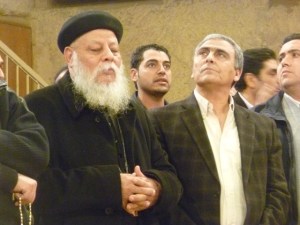
“We are here tonight to pray for Egypt in all that it is going through, and let us pray with tears,” said Fr. Simaan, a Coptic Orthodox priest serving the city’s garbage collectors. Their expansive cathedral is built into a cave in the Muqattam Mountains east of Cairo.
One year earlier, Fr. Simaan conducted a similar prayer gathering for all of Egypt’s Christian denominations, which drew upwards of 40,000 people. Plans to repeat the expression of unity have been in the works for months, but this meeting was only announced one week earlier, scheduled for two days before the referendum.
If there was any intentionality it did not appear during the rally. From 6pm until 6am the next morning, not once was the referendum mentioned. The general state of Egypt, however, was on everyone’s mind.
“Some of us see demonstrations and conspiracies, but I see Egypt going right. I see great days ahead of us,” said Fr. Andrawus, an Orthodox priest from Damanhour in the Nile Delta.
“Some say this country is being destroyed or being stolen. I say God is coming and he will not be late. This coming year will be the best ever for the church. The heavens will open, the church will be united, and we will be freed from fear and learn to love.”
Love is Fr. Simaan’s great emphasis, and he wishes to tell the world Copts love their nation and their fellow citizens. As Egyptian flags flew everywhere, six different satellite channels carried his exhortation.
“We pray for our brothers, both Christian and Muslim. We pray for our brothers, the Salafis and the Muslim Brothers,” he preached to great applause.
“We pray for them that God will open their hearts and keep them from harm. We are not in a war, we are in prayer.”
The church took no official position on the referendum, other than to encourage people to vote. Many participants, however, freely interpreted the point of these prayers.
“We pray for stability, safety, and a constitution we can all agree on, not one from just one slice of the country,” said Michael Magdy. Others, however, were less specific of divine providence.
“We love Egypt because it is our country, and we love God,” said Amal Samy. “We’re confident he will stand with us and lift this crisis, giving a rescue no one can expect.”
Fr. Simaan does care for a good constitution, but his focus is elsewhere.
“Perhaps the current circumstances are permitted by God as part of his plan,” he said. The Islamists have their sharia and their plans, and God will hold them accountable according to what they have received.
“But he will hold us accountable for how we live with them.”
Protests and prayer have their essential place, but amid the crises of Egypt, perhaps this is the way to peace.
Perhaps this prayer is the same as before. As the rest of Egypt goes to the polls to cast their ballot in the constitutional referendum, give them wisdom. ‘Yes’ or ‘No’ – what is best for their country?
If ‘yes’, help Egypt to begin the path of rebuilding its representative institutions. Heal the stridency that has developed between the parties, between the people, and may politics return to the high road. May the Shura Council lay out a good roadmap to parliamentary elections, and may this eventual body interpret the constitution well. Hammer out the people’s differences with words, God, not with rocks and tear gas.
If ‘no’, help Egypt to start over. Heal the stridency mentioned above, and may the people elect representatives worthy to write a new constitution. Protect the nation in the interim period, which will necessarily stretch even longer. But if this is right, correct whatever errors may be present in the constitution through a deep, abiding, and respectful consensus.
Either way, God, place your hand on Egypt’s judiciary. Squeeze, comfort, or pat on the back – the institution is vitally important for the nation’s future. May it act honestly and with wisdom; may it be treated honestly and with wisdom.
But for referendum results, God, for those who win, help them to avoid triumphalism and exclusion. For those who lose, help them to avoid abdication and rancor. May the struggle continue; may the struggle subside. In either victory or defeat, Egypt is not yet built; the social contract is not fully accepted. For the sake of Egypt, help unity to be found again soon.
The proposed Egyptian constitution offers something to everyone, and its supporters know how to address the audience.
Article 3 gives Christians and Jews the right to govern their communities according to the internal rules of their religion. Articles 31-80 give liberally-minded citizens assurances on a litany of basic rights, including expression, belief, education, and even playing sports.
Less heard in the West, however, is the local message: articles designed for conservative Salafi Muslims may undermine every other guarantee.
‘This constitution has restrictions [on rights and freedoms] that have never been included in any Egyptian constitution before,’ said Sheikh Yasser al-Burhami, Egypt’s leading Salafi and founder of the Salafi Call, on a YouTube video attempting to convince his community to vote for a document many of them find not restrictive enough.
Ibrahim Eid is another leading spokesman for those who seek to return Egypt to the ancestral ways and beliefs of Arabia. An ophthalmologist and media coordinator for Students of Sharia, a Salafi association, he told Lapido: ‘There are two aspects to this constitution: that which designs a political system, and that which legitimizes it. I reject its legitimacy completely’.
Sovereignty belongs to God alone, he says.
Article 5 is therefore an anathema. It states: ‘Sovereignty is for the people alone and they are the source of authority. The people shall exercise and protect this sovereignty, and safeguard national unity in the manner specified in the Constitution.’
‘Is it reasonable to justify God’s law by a constitution, or to submit it to a referendum? Not at all!’ he said.
‘But we agree to its political necessity for the sake of the stability of the nation.
‘Let’s move through this crisis, elect a new parliament, and then the first thing they will do is change the defective articles.’
Bishop Mouneer Anis of Egypt’s Episcopal (Anglican) Church finds defective articles as well, but of the opposite kind.
‘This constitution does not lead to social cohesion, but to division,’ he told Lapido Media, as preliminary results of the first round referendum suggested 43 per cent of the population reject it. ‘It does not ensure the freedom of the minority to the extent Egypt was expecting.
‘But it ensures the rule of the majority and has many questionable, vague expressions.’
These are the very expressions Burhami celebrates, witnessed chiefly in the dispute over Article 2, defining the identity of the Egyptian state.
In the previous constitution, Article 2 declared the ‘principles’ of Sharia law to be the primary source of legislation. Egypt’s High Constitutional Court consistently interpreted the word ‘principles’ in a general fashion, avoiding direct reference to specific Islamic laws.
Liberal members of the 100-person Islamist-dominated committee writing the constitution were able to fend off Salafi demands to remove the word ‘principles’ and force legislation toward Sharia alone.
But to satisfy the Salafis, the committee added Article 219, to interpret ‘principles’ in accordance with traditional Islamic jurisprudence. Furthermore, Article 4 assigns an unelected body of Islamic scholars the right of consultation on legislation.
Burhami’s chief pride, however, is in Article 81, concluding the extended section on rights and freedoms. It seeks an elusive compromise.
‘No law that regulates the practice of the rights and freedoms shall include what would constrain their essence,’ reads the text. But what follows defines this essence:
‘Such rights and freedoms shall be practised in a manner not conflicting with the principles pertaining to state and society included in Part One of this constitution.’
Part One however includes Article 2 which is defined by Article 219, subjecting all freedom to Islamic Sharia.
Gamal Nassar, Freedom and Justice Party
‘What is the problem with being an Islamic state? Egypt is Islamic and there is nothing else to be said,’ the Muslim Brotherhood’s Gamal Nassar tells Lapido.
Nassar is a founding member of the Brotherhood’s Freedom and Justice Party. He believes the discussion of these details ignores the agreement on 90 percent of the constitution.
‘No one, even among the liberals, opposes the Sharia. This is at heart a political struggle,’ he said.
‘All freedoms must be regulated and not go against the nature of Egyptian society, which is Muslim.’
Nassar sees the nature of the politics in the behaviour of the church, which resigned from the constitution writing committee.
He accuses church representatives of negotiating the agreement of all articles, including Article 219, and then withdrawing suddenly to cause controversy and discredit the committee’s work.
Revd. Safwat el-Baiady, president of the Protestant Churches of Egypt and one of these official representatives, disagrees – and strongly. He sees a different type of politics at play.
‘This article [219] was added late and not discussed in any sub-committee,’ he told Lapido Media. ‘Because of its controversy it was postponed until the end, and dealt with only in the concluding consensus committee.’
The problem with this he said was that this consensus committee was no consensus at all, but a small number of members handpicked by the assembly head. It included a Christian, but no official members of the church.
Church representatives, and liberal Muslim members, resigned in protest en masse only once it dawned on them that Article 219 and other controversial aspects were to be presented as if it were the will of the entire body – which was not the case.
A constitution is ideally built on consensus, but it is fleshed out though law. Egypt’s constitution, if it passes, gives something to everyone.
The gift to Salafis, offered freely by the Muslim Brotherhood, is an open door to Sharia law and the conformity of legislation to it.
Egypt’s future freedoms hinge on the make-up of the next parliament, tasked with the contentious business of interpretation.
Note: The 2011 Egyptian parliament, dissolved by court order, was led by the Muslim Brotherhood-led Democratic Alliance, claiming 45 per cent of 498 seats. The Islamist Bloc, led by the Salafi Nour Party, finished second with a quarter (25 per cent) of seats. Two liberal parties received roughly 7 per cent each. Two Copts were elected to parliament, and of the ten members appointed by the then-ruling military council, five were Copts.
Article 229 of the proposed constitution declares procedures for electing the new parliament will begin no less than 60 days after it is ratified, possibly this weekend, following the second referendum vote.
Today Egypt witnessed a historic referendum over a highly disputed constitution. Two days earlier, Christians placed their nation in the hands of God.
Many did so hoping for a miracle. Egypt’s churches earlier withdrew from the committee writing the constitution, finding their voice sidelined amidst an Islamist super-majority. Noteworthy, however, was that not one speaker prayed against the constitution. Instead, they asked God to be with Egypt, give her peace and stability, and bless Islamists in particular.
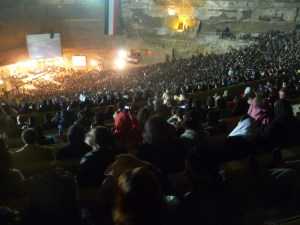
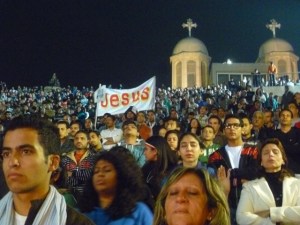
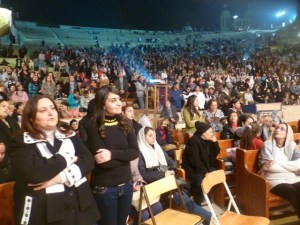
I will save more description for a few articles I hope to write in the coming days, but here is the essential fact: About 10,000 Christians from all Egyptian denominations interceded with God for their nation. Slightly less than half of these spent the whole night in prayer.
Here are the pictures, with links to video interspersed:
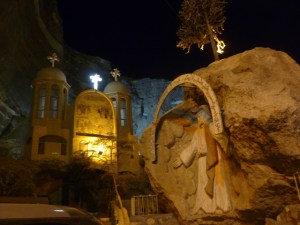
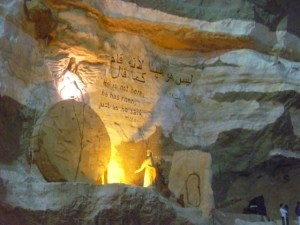
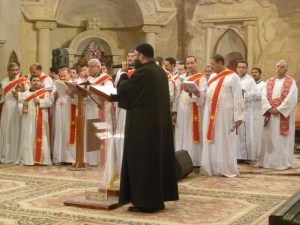
The entrance to a church, carved into a cave. It is a magnificent modern facility on an ancient Coptic site, where God saved his people by splitting the mountain in half.Throughout the area stone carvings illustrate Biblical scenes. This one overlooks those worshiping.The church is led by Fr. Simaan (Simon), who serves the Christian garbage collectors among whom he built this church.Most Egyptian Christians are Orthodox, and there has been tension between them and other denominations. Fr. Simaan’s heart is for Christian unity, however, and he organizes many meetings with Rev. Sameh Maurice, lead pastor of the largest Protestant Church in the Middle East.Fr. Simaan’s church is fully Orthodox – note the icons – but incorporates modern evangelical features such as a praise team.
Please click here for a medley of Arabic praise songs from the meeting. It includes the crowd’s favorite – chanting Yesuu’ (Jesus) over and over again.
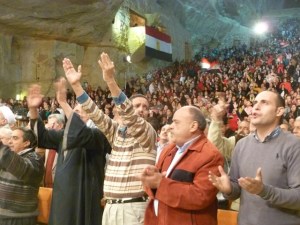
This particular choir was composed of members from various churches, of different denominations. All worship leaders, as well as speakers, however, were Orthodox.An Orthodox mass is a solemn, holy event. Many, however, have learned how to shout to the Lord in praise.One of the purposes of the event, besides praying for Egypt, was to broadcast the love Copts have for their nation. Note how many Egyptian flags filled the auditorium.
Please click here for a variation on the above link. One of the speaking priests urged the audience to add the word ‘Masr’ (Egypt) to their ‘Jesus’ chant. Boisterously, they went back and forth.
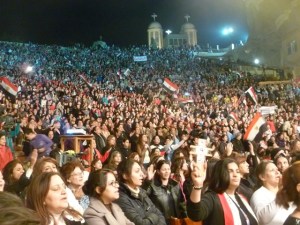
Here are a few pictures showing the size of the crowd:
The praise segment of the evening went from 6pm to about midnight. Thereafter the prayer took a more Coptic feel, with traditional hymns lasting until 6am, followed by morning mass.
Please click here to watch this choir perform and the crowd chant along.
Finally, this is about the size of the crowd that stayed to worship throughout the night.
Only God knows what is best for Egypt in terms of this current constitution. But may he honor the prayers of this community, of Muslims, and of Islamists, who pray for the peace of Egypt.
Addressing the nation in a televised interview Thursday, President Mohamed Morsi welcomed the sudden completion of Egypt’s draft constitution after months of gridlock.
Amid public outcry against his decision last week to grant himself immunity from judicial review, Morsi praised the constitution’s speedy completion as a necessary step in order to end the nation’s transition to democracy and reestablish separate executive, legislative, and judicial authority.
He also dismissed questions about the legitimacy of the document, especially given the withdrawal of Christian and many liberal members of the assembly drafting it.
“The withdrawal of the church from the constitutional assembly is nothing to worry about,” Morsi said. “It’s important to me that they be part of it, but not to worry.”
The article features the voice of Rev. Safwat el-Baiady, president of the Protestant Churches of Egypt, one of the church’s official representatives who withdrew from the constitutional assembly. His perspective is given on the more controversial articles, including the role of sharia law, the Azhar, and society in determining both law and social morality.
Please click here to finish reading at Christianity Today.
You never spare man from difficult choices, but you always prepare a way out. Help Egypt to find it.
Months of wrangling over the constitution ended this week as majority Islamist members of the assembly brought a final text to vote. Without boycotting liberal and Christian parties, it passed easily, and would have even if they were there.
Against this backdrop are the promises of the president to rescind his declaration granting himself immunity from judicial review, once the constitution is passed.
Of course, God, for many in Egypt, perhaps even most, there is not even a choice here. But these see the issue in wildly different manner.
For those completely pleased with the president and the constitution, God, challenge their way of thinking. Do they permit defying the law because the president is of their line of thinking? Do they play with words, granting freedom and human rights in one article and limiting them in another? Do they wish to use the state as decisively as it was once used against them – to shape society according to a particular vision? God, have mercy, forgive, and restore.
For those completely opposed to the president and the constitution, God, challenge their way of thinking. Do they wish Egypt to falter endlessly in transition? Is this the strategy to defeat the president? Do they disdain the common person so that they dare not let the constitution come to a vote? Do they wish to keep religion from the public square? God, have mercy, forgive, and restore.
But perhaps there is not equality in wrongs, God. Support those whose aims for Egypt are pure in heart. Expose those who manipulate, even for worthy ends.
And where these ends are worthy – on all sides, God – honor them. Help Egypt achieve an end to its revolutionary struggles. Help her to have a constitution of consensus. Give leaders determination to take hard decisions against entrenched interests. Give them determination to always do so according to the right.
God, all in Egypt need your wisdom in these days. Save her from chaos; save her from authoritarianism. Bridge the divide between those who define these so differently. May they find this salvation in each other.
Bring the nation’s suffering to an end, God. Restore to her the joy of salvation.








 Jayson Casper