Categories
Personal

Unintended Recipients of Generosity

Generosity

‘Make sure your kids come to Sunday School tomorrow,’ their teacher told Julie. Snug in bed, my wife ignored her first call at 10:45pm, but then picked up on her second effort at 11:00. Egyptians are well known as night owls, though they don’t usually call us so late.

‘There will be special visitors,’ she told Julie in Arabic, but the key word to follow was in an unclear English. ‘They will give each child books.’

Great, we thought. Emma and Hannah both have been making progress in their Arabic reading, and now they would be receiving additional age-appropriate materials we could use at home. Only we weren’t sure she said books. It might have been boox.

Regardless, it was nice to be invited. She didn’t want our children to miss out.

Upon our arrival in Egypt four years ago we began attending the Coptic Orthodox Church, which we discovered had a wonderful Sunday School program. Coptic laity is required to complete a year-and-a-half long training course before they serve officially in any capacity. We kept a close eye on content, especially early on, as we were still learning the intricacies of Orthodoxy. But we appreciated the spirit and love with which they teach, and our kids’ participation helped us as parents feel part of the community. Besides, David and Goliath is the same in any tradition, and on the occasions they taught about specific saints it was a learning process for us, too.

But this teacher was calling from the Arabic Evangelical Church. Her earnestness was in part due to the fact our kids hadn’t gone there since we came back to Egypt after a summer in America. This wasn’t the first time she called to inquire.

The Evangelical Church is more akin to our American heritage, but consistent with the night owl nature of Egyptians, their services don’t begin until after our kids go to bed. So we never became part of that community, though we discovered their Sunday School program began right after the one at the Orthodox Church ended. The two are about ten minutes away walking distance, and our kids are not the only ones who attend both.

They, and we, appreciate this Sunday School also, but churches across Egypt changed over the summer. President Morsi was deposed, hundreds of his supporters were killed when their protest site was cleared, and the next day dozens of churches across the nation were attacked. Nearly every Friday since then, Morsi supporters have marched through the streets. Many have been peaceful, a few have been involved in unclear violence, but all have sprayed graffiti on every nearby wall or sign. Anti-Christian slogans have been commonplace, blaming them for siding with the popular revolt against the Islamist president.

As a result, many churches have moved up their service times so that people can get home before Friday demonstrations begin, just in case sectarian violence rears its ugly head. And here it is necessary to clarify that in Christian Egypt, Sunday School takes place on Friday. The weekend is Friday and Saturday, and most churches hold their main services coinciding with the Muslim day of prayer, when everyone is off.

This meant the Evangelical Church now held its Sunday School at the same time as the Orthodox Church. We had to choose, and our Egypt roots were stronger in the latter. The teacher called us regularly to invite us back, and we apologetically explained our situation.

But this time there were boox.

The teacher assured we just had to get there before a certain time, so we booked out of the Orthodox Church and made our way. Hannah, especially, led the charge pushing the stroller beside me. When we arrived we noticed a few other new faces, perhaps like our own.

That is, in the sense of ‘not regular attenders’ rather than ‘foreigners’. The open area outside the church was filled with Egyptian mothers dressed in the traditional village garb of a long robe and head covering. Granted, we haven’t attended for a while, but this Evangelical Church is more generally frequented by the middle-to-upper class residents of Maadi, the upscale Cairo district where we live. Not far away are lower-to-middle class areas, too, but village dress is not the norm for this church. Maybe they were there also for the boox?

Now, Egypt unfortunately is not known for its love of literacy. We began to suspect the teacher was not promising books, but a box. As the first few children left their classes, we saw we were right.

We didn’t know how right, though Julie started to wonder. Were these boxes from Samaritan’s Purse?

Operation Christmas Child

Samaritan’s Purse is an American based Christian charity, and one of their signature campaigns is Operation Christmas Child. Kindhearted people in churches across the country fill shoeboxes with toys for underprivileged children around the world, who might not otherwise receive anything for Christmas.

And out marched our three girls with huge smiles.

I’m sure Samaritan’s Purse orchestrates with churches throughout the country, distributing many boxes in poor areas. 40 percent of Egyptians live below the poverty line, so there are certainly many needy. But dollar store type toys are readily available in Egypt, and the Orthodox Church does a very good job of making Christmas special, here celebrated on January 7. Toys and treats are given freely even in rural village churches, and families sacrifice to make sure their kids have new clothes for the holidays.

I’m not saying the charity is unnecessary, but it was odd to see Samaritan’s Purse in Maadi. And it was fully ironic that a generous Florida mother sent her shoebox across the ocean to be received by our five year old daughter. Her toys were not even the made-in-China variety; Hannah got an electronic battle hamster that darts across the floor.

Perhaps God’s generosity is similar. He makes his rain fall on the just and the unjust. He gives full wage to those who work but a few hours, while praising others for contentment with the crumbs that fall from their master’s table.

We can trouble ourselves – and perhaps we should more often – why God’s generosity seems instead withheld from those who need it most. Or, we can take the lesson and apply it with whatever we have, to whoever we meet. When we visited that poor, rural church, our children were honored also. There is a similar ministry here in Cairo that gives Christmas gifts to the children of local Sudanese refugees. Perhaps the value of the Florida mother’s gift was to prompt imitation in our family to them.

In one sense we are to bless those we know in need; in another, we are to cast our bread upon the waters. We were unintended recipients of generosity, and while laughable, it is humbling. Therefore, let us be generous also, by nature, so that blessing comes to all who cross our path, many of whom will be unintended.

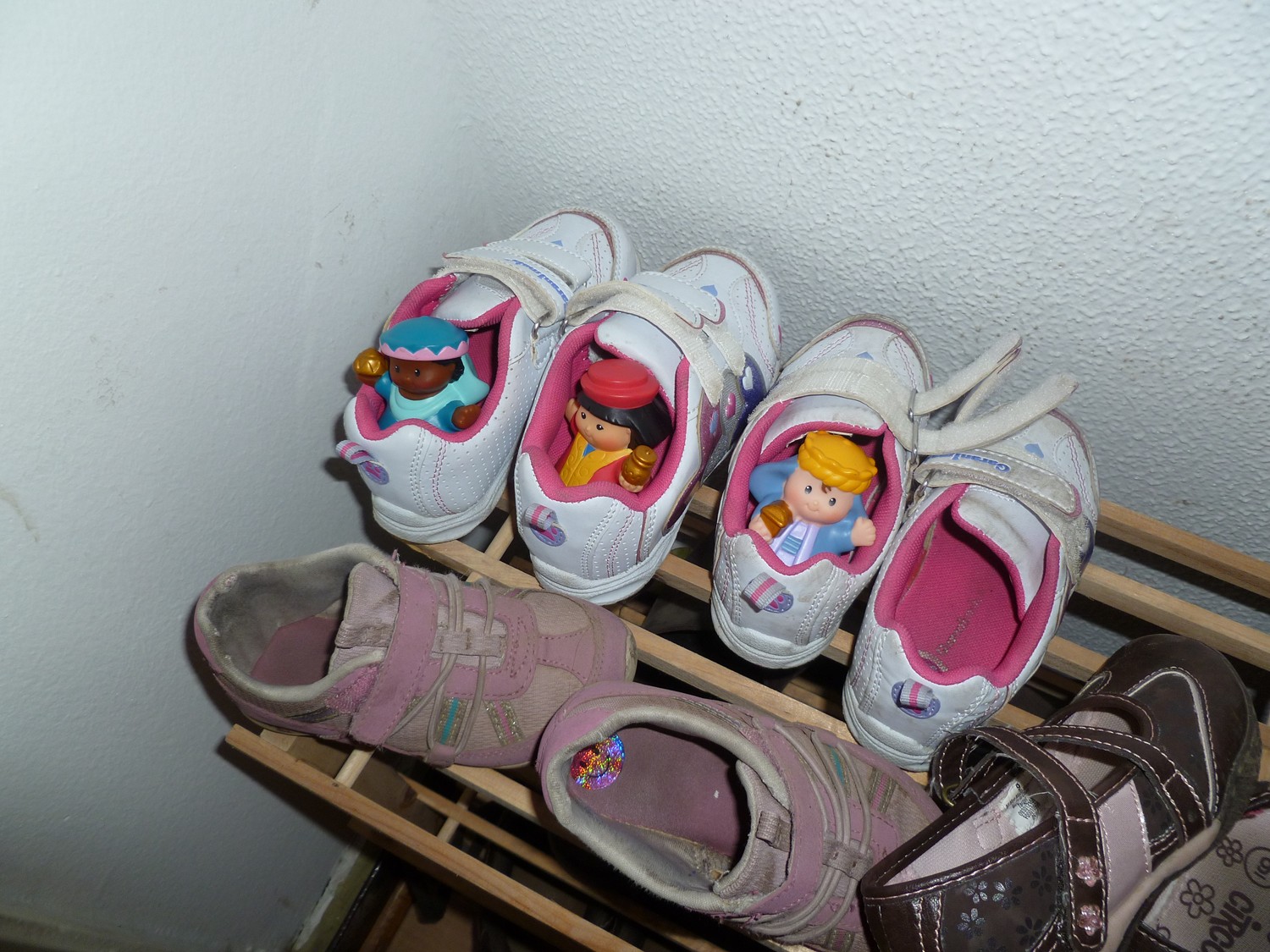
 Girls with OCC Gifts

Categories
Personal

Church, State, and Revolution in Egypt

His Holiness Pope Shenouda III, Pope of the Co...
Pope Shenouda, head of the Coptic Orthodox Church

Many Christians in America are keen on emphasizing that the ‘separation of church and state’ is found nowhere in the constitution. Rather, they state, it was from the personal letters of Thomas Jefferson – his guiding opinion, of course, but never adopted in America’s founding documents.

This is true. The constitution guarantees freedom of religion for the individual, while also keeping government from imposing a religious test for any public office. Many Christians, however, find that the modern interpretation of these clauses – read through Jefferson – squeeze religion from public life.

They don’t know how good they have it.

Coptic Christians in Egypt are currently caught between two relatively good systems. The modern secular state, as in America, allows personal freedoms and independence of religious institutions. This was somewhat the promise of Mubarak, but never really arrived. Especially in light of the Arab Spring, many Copts look to the west and hope for the implementation of such enlightened policy.

Yet on the other hand, also driven by the Arab Spring, is the understanding that Islam-as-state protects a subservient church. This also is enlightened, and for many centuries Christians lived comfortably under the caliphate, participating in society, economy, and government. There were abuses in history, and it is not the equivalent of modern citizenship. Yet many Copts are fearful of such a return, while Islamist groups like the Muslim Brotherhood and the Salafis are head-over-heels trying to assure them their fears are baseless.

Unfortunately, Mubarak muddled between the two.

While the church was officially independent, it was not free. Relations between the president and the pope were conducted along the lines of the old caliphal system. No jizia was paid, but in exchange for guaranteeing the subservience of the Christian community, the pope received a direct line to the leader and relative freedom of internal rule. If Christians got out of line, though, or if it was necessary to hold them in line, a measure of sectarian strife was allowed. Some say it was even encouraged, if not promoted.

A few days ago I posted about a controversy in the church, which erupted during Christmas celebrations. With the massacre at Maspero in the background, Pope Shenouda welcomed the military council, as well as the Muslim Brotherhood. The church has regularly welcomed representatives of the state, which in the past have been members of Mubarak’s National Democratic Party.

This year, it is members of the military council, and of the triumphant Islamist powers. Though the faces have changed, the pope was following a protocol long established.

Revolutions, however, disrupt protocol. Many young Copts invested themselves heavily in the revolution, seeking greater freedom for society at large. Instead, at Christmas, they find the pope continuing the same pattern. The military, they believe, killed demonstrating Copts at Maspero, and no one has been held accountable. The Muslim Brotherhood is an open question; will they simply continue politics-as-usual, with a democratic face?

If these young Copts desire freedom throughout the society, they desire it on the part of the church as well. It was humiliating, or else cowardly and insulting, to see the pope receive those who shed Coptic blood, as well as Islamists who seem very comfortable with the military.

They want the pope to be revolutionary. They want him to refuse greetings until justice is met. To a large degree, they want a western version of freedom of religion.

They are not alone. Many Egyptians desire this, including many Muslims. The question is: Is it best for the church?

The pope is a man of tradition, and old men are set in their ways. He is also a fountain of wisdom, and he knows his society. He believes the church is safest under the protection of the state.

Is he wrong? Maybe. Jesus was a revolutionary, though of a different kind. But he was willing to sacrifice himself for what was right. If the church challenges the state – currently constituted as the military council – it might rally both Christians and Muslims to continue the revolution until military rule is abolished. Then, with governance in the hands of civilians, even an Islamist parliament would be free to … well, what would it do?

Or, if the church challenged the state, the state might hit back. Would Muslims rally behind it? If so, would they be strong enough? Or would this only push them deeper into Islamism, seeing Coptic comeuppance, ‘those ungrateful Christians’?

One might pragmatically say the church should stay by the side of the military against the Islamists, as under Mubarak. Activists, and most Copts, would now say that Mubarak did not work out so well for them. They were certainly very critical of him before the revolution. But will Islamists be worse?

Pope Shenouda is probably not making bets for one side or the other. In all likelihood, he is simply following protocol. He is not promoting the military council or the Muslim Brotherhood. He is acknowledging their place in the governance of Egypt.

History is riddled with examples of minorities who backed the wrong side. If Pope Shenouda is licking the boots of the powers-that-be, this is beneath the dignity of his position – indeed of any Christian, or of any individual human being. But if he were to thumb his nose, this also is a threat to dignity, and more.

Perhaps unfortunately, revolutions demand one choose a side. This puts Christians in a very difficult position. On the one hand, their religion encourages them to sacrifice themselves for others, for truth, and for the cause of justice. On the other, it encourages fealty to the ruling powers, with prayers offered on their behalf. How, then, should a first loyalty to God drive a Christian in Egypt today? How should it drive the pope?

Perhaps Pope Shenouda leans a bit too much in deference to the state. This is certainly the activists’ charge. Yet it must also be noted this criticism is leveled from the perspective of a western system of religious freedom, or at least from the longing thereof.

It may well be Egypt is moving back to an official caliphal system, where the pope represents his community. Or perhaps the mixed-Mubarak system will stay in place. The future could be very bad, or it might not be bad at all. Activists must continue to labor for what they believe in, and convince others of the same. The pope must be given room to do the same. Indeed, his conduct now may be guaranteeing activists their relative freedom of operation.

Americans, imagining themselves in the middle of all of it, might wish for a little more Jefferson.


Categories
Lapido Media Middle East Published Articles

Coptic Leaders Enrage their Youth as they Avoid Conflict with the Military

note: This article was published on Lapido Media. The version below contains a few more quotes which did not make the final edit.

Young Coptic activists disrupted Christmas mass in St. Mark’s Cathedral in Cairo on January 7, shouting slogans against the military council.

Around ten individuals coordinated to erupt the moment Pope Shenouda, head of the Coptic Orthodox Church, extended Christmas greetings to military members, as captured on YouTube.

Among these was Gen. Hamdy Badeen, head of the military police. Many activists hold him responsible for the deaths of 27 people during a mostly Coptic protest at Maspero in October.

The pope has faced challenges leading the church during the revolution. Even so, he welcomed those whom many activists consider at odds with the Copts. This represents not only the military council, but also the Muslim Brotherhood, reported previously by Lapido Media.

Ramy Kamel

Ramy Kamel organized the Christmas protest in the cathedral – a rarity in the hierarchical church where the holiness of the pope is widely respected.

‘It has not yet been three months since Maspero and they invite the military council?’ Kamel stated.

Sameh Saad of the Maspero Youth Union echoed this dismay.

‘We are very angry because the Pope invited them. Nothing has happened to hold anyone in the military accountable since Maspero, and we do not want to greet them.’

‘Still, we will be silent because we love the pope.’

Kamel had been a leading member of the Maspero Youth Union, but resigned due to silence like this.

‘The organization was becoming content simply to issue statements, but people need to be awoken into action.’

Nevertheless, if not for his mother, Kamel would have passed the holiday at home. He states church security threatened him with attack dogs if he led a demonstration inside the cathedral.

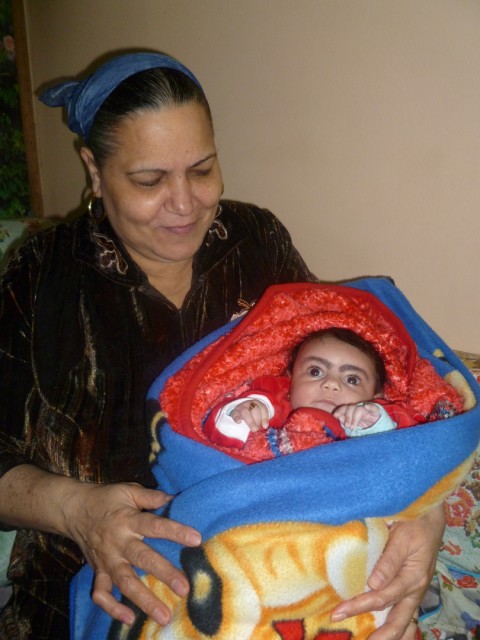
Ramy Kamel's Mother, with grandson

Karima Salama is Kamel’s mother. ‘I pushed him to go. The common Copts here in our neighborhood are outraged, so how could my son sit at home doing nothing?

‘We must not say the pope makes mistakes but here he did.

‘The church should welcome all but the pope should not have invited them.’

Bishop Bisenti emphasizes such open reception in defense of the pope.

‘The pope expresses his love to welcome all, and if they want to come they are invited as brothers.

‘Those who reject this are looking from the point of view of punishment for what happened in Maspero, but we look from the point of view of love.

‘The question of punishment is left to the judge and we will accept this.’

The military council has stated lower ranking officers are being investigated concerning the tragedy at Maspero. Official charges, however, have only been leveled against activists.

A week before Christmas, Coptic confusion increased over the church’s reluctance to demand military accountability. Pope Shenouda stated peace and security prevailed in Egypt due to the military council, as reported in the local press.

Amir Bushra, another member of the Maspero Youth Union, was among those affected by Kamel’s protest.

‘I personally apologize to Ramy Kamel because I was opposed to doing anything in the cathedral, but realized I was mistaken when I saw Pope Shenouda with Gen. Hamdy Badeen.

‘The church should take pride in her sons, because their chants are the chants of all who lost loved ones at Maspero.’

A subsequent blow of protest was issued a week later at mass by Fr Yuhanna Fuad, priest of the Virgin Mary Church in Old Cairo, and presented on YouTube. He was present at the cathedral on Christmas.

‘Hamdy Badeen greeted me. I apologize I kissed him and shook his hand and was pictured with him. He arranged this to improve his image.

‘You have to know that your priest is honest and has to say the truth. These people are unjust. They are liars and thieves, holding on to power.’

Samir Morcos is a respected writer and researcher in Coptic Church affairs. He states, ‘This is a new dynamic we must accept after January 25, especially among the young people.

So it must be noted that while Bishop Musa [bishop of youth affairs] justified the presence of the military council, he did not condemn the youth.’

Samir Zaki, who works under Bishop Musa as the general secretary for encouraging civic participation, makes clear this perspective.

‘The system works that security and VIPs always come to Christmas, and we issue invitations to allow them through the doors of the cathedral. The military council stated they are coming to wish Christmas greetings. Should we not say thank you?’

As concerns the demonstrating youth, Zaki states, ‘The pope put forward the official church position, but they were representing their personal opinion. No one has done anything to them.’

Samir Morcos believes no one knows exactly the extent of Coptic frustration with the church, in its accommodation to the military council.

It is clear, however, there is an undercurrent of revolutionary sympathy. Ramy Kamel wants it to transform the church.

‘No one should be able to represent the position of the church absolutely, no matter who he is.’

For many, this itself is a revolutionary idea.

Please read the published article on Lapido Media.

Related Articles:


Categories
Lapido Media Middle East Published Articles

Christmas with the Brotherhood

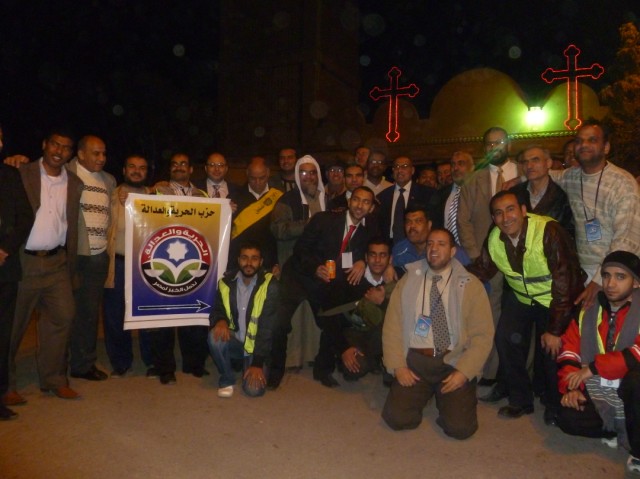
MB Delegation Outside a Helwan Church

Following two years of bloody winter holidays, and following also resounding Islamic success in elections, the Muslim Brotherhood coordinated with security forces – and probably Orthodox Church leadership – to stand watch outside church buildings throughout Egypt.

I was able to visit one installation in Helwan, to the south of Cairo. After moving from church to church in the district of Maadi, finding no Brothers present, I happened upon a Christian taxi driver who told me they were at his church, to which he subsequently brought me. It would have been difficult to find on my own.

I wrote about this story for Lapido Media, a British website focusing on telling religious aspects of the news which might be overlooked by other outlets. That the Brotherhood would come and spend Christmas with Copts is a fairly big deal, but many Western news agencies missed it. Not only is the event newsworthy, but so is its undercurrent. Please click here to read the story.

The basic question is this: Is the Brotherhood coming to Christmas celebrations because they love Copts as fellow citizens and Egyptian brothers? If so, this is wonderful.

Or, does their effort to ‘defend’ Christians issue from a place of Islamic superiority which offers protection to religious minorities in exchange for their acceptance of an Islamic system of government? If so, this is concerning.

Read the story for several wonderful quotes which insist upon the former. Yet upon pushing them for their eventual goal – after reestablishing security, economy, and demonstrating the virtues of Islamic government – they deftly skirted the issue. They insisted it was not proper to speak about Christians under dhimmi protection ‘now’.

I don’t necessarily doubt their sincerity. I believe that most Brothers, being Egyptians, have a love of their fellow Copts. It is a laudable feature of Islam that it urges Muslims to defend the rights of (at least Abrahamic) religious minorities.

Every religion has a natural chauvinism with which it imbues believers concerning their own faith. One of the prominent interpretations of Islam insists it has the right to rule – and rule justly – but to accord non-Muslims a special place in subservience to an Islamic order. Even if the Muslim Brotherhood does not have a ‘strategy’ to turn Copts into dhimmis, this aspect of their faith may be bubbling to the surface, no matter their simultaneous sincere expressions of love and equality.

Being a dhimmi may not even be a horrible thing, but neither is it liberal democracy. Currently the Muslim Brotherhood straddles the fence, insisting both on a civil state with equality of citizenship and an Islamic reference to guide legislation. Can they pull it off? Time will tell.

Yet despite the desires of many Muslim Brothers to postpone this question, it is essential it be answered now. Otherwise, the system may take root and produce effects from sources far more deeply rooted than assertions of national unity. These assertions are true, they are even sharia. Yet historically, sharia also often included dhimnitude.

Muslim Brotherhood overtures at Christmas hint in both directions. As one Brother states in the article, he wants Christians to know what is in their heart. This is good, but Copts also deserve to know what is in their vision.


Categories
Prayers

Friday Prayers for Egypt: Christmas

God,

As Christmas comes to Egypt, Islamists rise to power. The military council stands prominently in the background of both.

What do you wish for Egyptian Christians, God? They are no mere minority, but have little independent power. They are dissolved into every community as part and parcel of the Egyptian fabric. Yet they are different, and sometimes subject to the approbation of ‘other’.

They all will say their security resides in you. As such, God, honor them in this. May their faith be rewarded as political winds vacillate.

But where should their earthly security reside? Is it with the ruling power? Is it with the Islamists? Is it with a democratic system? Is it aloof from all of these? Give Christians wisdom, God, to choose friends wisely during these tumultuous days. Yet beyond gaining friends, cause them to be servants to all, yet servile to none. Give them a sense of purpose to utilize the fruits of their faith on behalf of the nation, bringing to bear what might be missed by others. May their salt savor and their light shine.

Give such wisdom and purpose to Islamists as well, God. You have blessed them with favor from the majority of the people; may they be grateful and humble. Their challenges are many. Help them to draft a constitution of consensus. Help them to navigate relations with the military. Give them the skill of governance, God, for the good of the nation.

Meanwhile, God, the pope has invited both to Christmas. Many Copts are angry, finding both army and Islamists to be against their community. If true, do Jesus’ words demand he invite them? Do Jesus’ words allow for church-state politics? Are Jesus’ words simple rhetoric?

Bless Pope Shenouda, God. Help him to care for his flock, and care for his nation. Sanctify his prayers for the rulers of state, and help him to lead all Christians in this. Guide the church through these days, both the institution and the people, the body of Jesus.

May they find peace and kinship with the community of Muhammad. May all submit to one another in love and trust. Grant both a government in which they take rest, and take part.

Keep Christmas safe tonight God.

Amen.  

Categories
Personal

Contemplating a Terrorist Strike

SUICIDE BOMB
Image by wannaoreo via Flickr

Jayson and I attended St. Mark’s Coptic Orthodox Church here in Maadi, Egypt on Coptic Christmas Eve.  This is not so unusual, as it is the main church we attend weekly, but this particular night was a little different.  You may have heard in the news about the suicide bomber who attacked a Coptic Church in Alexandria, Egypt on New Year’s Eve.  Egypt’s churches had been threatened by terrorists back in November, and on New Year’s Eve, that threat became reality!  The week that followed was interesting reading the news reports and hearing about the heightened security as Coptic Christmas approached.  Each day as I took my girls to preschool across the street from the Coptic Church, I noticed more and more security measures.  The teachers told me about bomb-sniffing dogs and scanners to be put in place for the Christmas Eve service.  We had planned to take a trip three hours south of Cairo for the holiday to celebrate with the same priest’s family we had celebrated with last year, but were advised to change our plans due to the threats.  And yet, we couldn’t forsake the place where we had been striving to belong over the last year.  It was Christmas Eve, the second biggest Christian holiday, and threats or no threats, it was time to attend church.

It was a long day in many ways.  I began work making a “contingency plan” over a year ago, and yet, with the immediate cares of everyday, I usually forgot about it and certainly didn’t make it a priority.  And yet, that day, with the thought of attending church under threat of attack, my thoughts turned to our three little girls, and what information people would need if something happened to Jayson and me.  I finally got around to writing down where our important documents are kept, phone numbers of parents in the states, and contact information for other connections we have.  I even wrote down phone numbers of friends in the country who I knew would be able to help with babysitting, even though I never asked them if they would be on my contingency plan.  It was necessary, but foreboding, to be writing down the girls’ daily schedules:  Emma and Hannah go to bed at 7pm, Layla is eating squash and peas … things people would need to know IF something happened.  But yet, the thought of this information being needed was very disturbing!

I lived that day a little differently I think.  I prayed more.  I hugged my girls more.  I had realized in the past that I didn’t have many pictures of me with the girls simply because I am usually the one taking the pictures.  And I knew I didn’t have any recent pictures of me with Hannah, my second girl.  So, one of the things I did that day was take some self-portrait shots with Emma and with Hannah.  I figured IF something happened, at least the girls would have these photos to hang on to.  How depressing!  But it was the first time I really went through a day thinking, this COULD be my last day.

I even taught the girls a song that day which I had recently remembered when reading Psalms.  I heard this song years ago on one of Steve Green’s Bible Verse Song tapes and it goes, “When I am afraid I will trust in You, I will trust in You, I will trust in You….”  I thought it a perfect song, not only for when they wake up at night with bad dreams, but especially today … IF something happened to me, I wanted them to have a song to sing as they were afraid without their Mommy and Daddy.

I tried not to think about the possibility of this being my last day on earth too much, but it really was a strange feeling.  I wasn’t overcome with fear, but I really did want to be prepared … or have my girls prepared for what COULD happen, without letting them think about what COULD happen.  My “I love you’s” to them when we put them to bed had a little more weight behind them than normal, and I looked at them just a few seconds longer than usual as I left their room.

I wasn’t sure if I would be nervous the whole time we were in the church, as the best time for the attack would be as people were exiting the building, but while I thought about it some, it wasn’t at the forefront of my mind.  I was impressed by the security presence at the entrance.  I was impressed by the number of people who were in the church, and the numbers who just kept coming and made it standing-room-only for a time.  I felt proud to be there and proud of the others who came despite the threats.  I was grateful to the Muslims I noticed in the crowd, for their standing with their Egyptian brothers in a possibly dangerous place.  And I enjoyed what I could understand of the sermon.

I got a little nervous toward the end as the priest made several announcements to the congregants to exit and go straight to their cars following communion.  They reminded them not to stand around and chat either inside or outside the building.  They wanted to cooperate with security as much as possible and get people home safely.  I felt comfortable inside and couldn’t imagine something happening at that point, but still, we had to leave the church and walk through the barriers before we were “safe.”

And you all know, since I am writing this post after the fact, that nothing happened and I am still alive and well and still able to be a Mommy  to Emma, Hannah and Layla, for which I am very grateful. But I now have a good start on our contingency plan, and a good reminder of what it’s like to live more “in the moment,” realizing that any day COULD be my last day here.  I don’t want to live in the depressing “what if’s” of thinking about death, but I want to hug my kids hard each day, tell them I love them truly each day, teach them songs and take pictures with them each day.

I’m thankful for the days God gives me here, but I don’t want to live in awareness of this only when the thought of death becomes a possibility.  Though there are many good things to live for, sometimes we only recognize it when the status quo is threatened. Terrorism can do that to you, but it can also lead to paralysis. Hopefully, in the days to come, we can find the balance.


Categories
Personal

How Many Days of Christmas?

The Christmas season is upon us and we are enjoying watching Emma and Hannah learn about the Christmas story.  We are doing a few new things this year with them in mind, and it’s been fun to watch.  At the same time, I wonder what confusion they may be experiencing, particularly with the “days of Christmas” in the land of Egypt. First, a new song.

Last month, a good friend gave the girls a new book called, “The Twelve New Days of Christmas”, by Bonnie Fite.  It’s a great new rendition of the old song many of us are familiar with, but it uses elements from the Bible story instead of some odd combination of birds and musicians.  Emma already has the whole thing memorized and Hannah is close behind (see video here).   What a perfect way to learn all the different parts of Jesus’ story of arrival on this earth.

The song goes like this:

  • On the first day of Christmas, my true Lord gave to me, the Babe in a manger bed.
  • 2nd – two earthly parents
  • 3rd – three wise men
  • 4th – four elder saints (referring to Elizabeth and Zechariah, parents of Jesus’ cousin, John; and also, Simeon and Anna, two saints at the temple)
  • 5th – five Roman guards (referring to the only sad part of the Christmas story where King Herod sends his soldiers to kill the babies in Bethlehem)
  • 6th – six chickens clucking (the author admits to taking some liberties here, but says that certainly there were chickens in the stable with Jesus)
  • 7th – seven kings in waiting (referring to seven good kings in the line of Jesus in the Old Testament days)
  • 8th – eight shepherds praising
  • 9th – nine sheep a-bleating
  • 10th – ten prophets predicting (referring to those who prophesied the coming Messiah)
  • 11th – eleven people sleeping (referring to all the people visiting Bethlehem for the census)
  • 12th – twelve thousand angels (with the shepherds at the manger)

So this started our “days of Christmas” with the idea of twelve days.

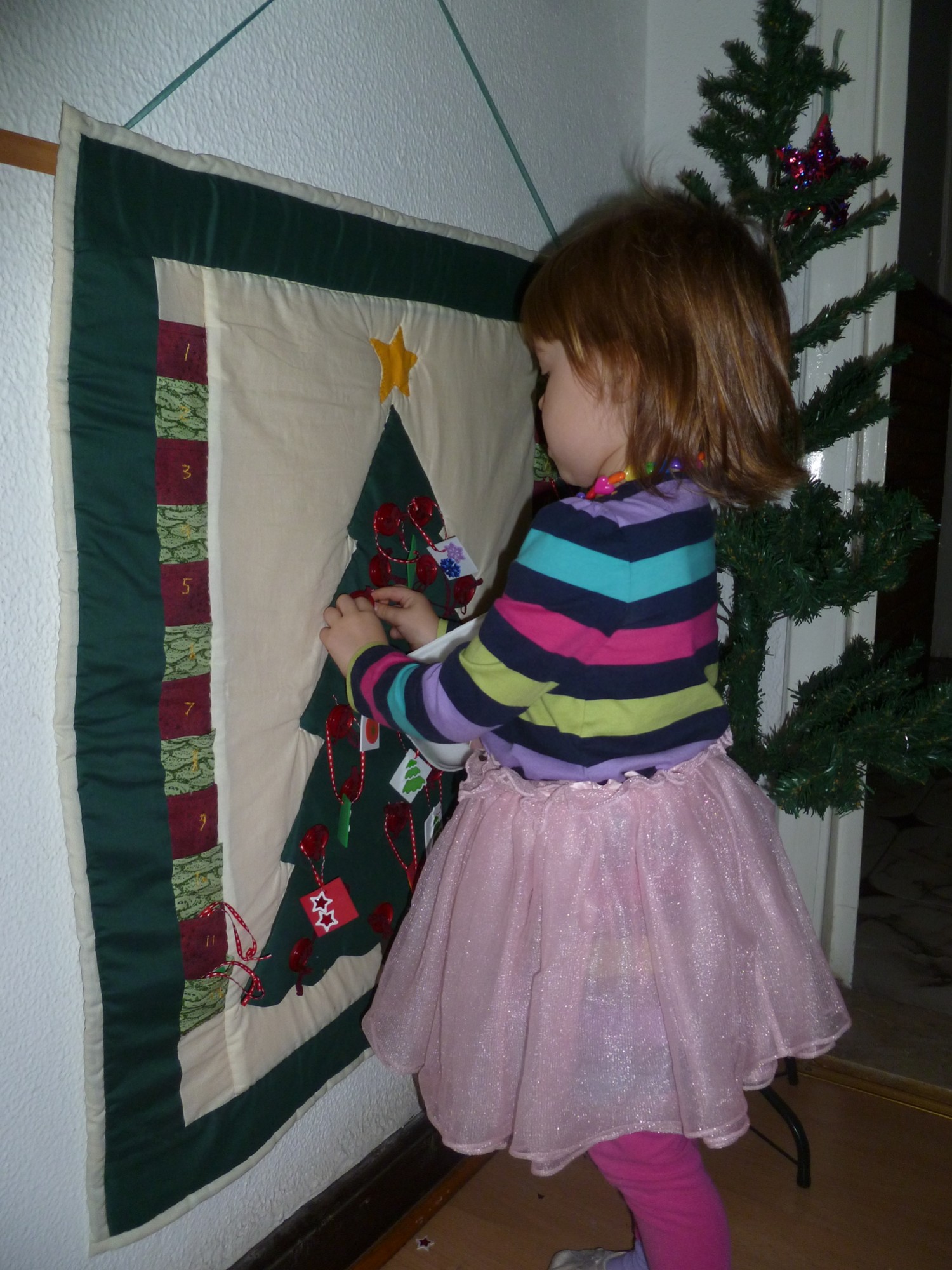
Meanwhile, last year we bought a wall hanging Christmas tree that also works as an advent calendar.  We bought it from the people who do handiwork at the recycling center in Muqattam, otherwise known as ‘Trash City’, here in Cairo.   But last year we didn’t use it as an advent calendar as it required some thinking about what could actually fit on the hanging.  My mom and niece and nephews helped out this year and sent us some great little ornaments to pull out each day, so now we can use it and count down the twenty-four days until Christmas!

To add to this number confusion, in Egypt, we will celebrate Christmas on two different dates, December 25 and January 7. Most of Egypt’s Christians belong to the Coptic Orthodox church, and they celebrate Jesus’ birth on January 7.  However, we are Western Christians and have always celebrated on December 25 as much of the world does, and so, we will have some sort of celebration on each of the days.  One other item that is mildly confusing is that many of our Egyptian Muslim friends, and even some Christian ones, seem to assume that we celebrate Christmas on December 31; I suppose this is because the televised celebrations in America are much more pronounced on that day.  They see fireworks and big parties and people “counting down to the New Year” and assume this is our big holiday.  You might say we have three Christmas dates to consider.

So all these things may confuse our preschoolers as to when Christmas actually is, but we’re thankful they are learning more about the Biblical story and less about the ever-present Santa Claus.  This is the first year we put out a play nativity scene which they enjoy every morning, acting out Mary and Joseph in the stable, the angels announcing the baby’s birth, the shepherds coming to see the baby and the wise men going on a long journey to find baby Jesus in Bethlehem.  (We hide the wise men somewhere in the house after they go to sleep.)

Emma and Hannah are learning familiar Christmas carols like “Away in a Manger” and “Joy to the World,” and belting them out for all to hear.  Emma even may sing in her first Christmas concert this year, appropriately enough, on New Year’s Eve.  So whatever date you celebrate and whatever your traditions may be, our family wishes you all a Merry Christmas and a Happy New Year, and then another Merry Christmas.

Categories
Personal

Press Review of Nag Hamadi — Part Three

I have little commentary to offer today; we continue to follow the story and think about what we might do, if anything. The last thing I would like to do in presenting this information is put forward a false hope in ourselves. As an Egyptian friend here recently told us, as we asked his advice and wondered if he might go and play a role, the most important thing to do now is to pray. Please join us in this effort.

Click here for today’s link.

Categories
Arab West Report Middle East Published Articles

Coptic Christmas: Day Three

Today we visited two “Holy Family Sites” near Maghagha.    For those who know the Bible story, you may remember that due to the threat of Herod’s soldiers coming to kill the babies under age 2 in Bethlehem, Joseph took his small family down to Egypt before returning to Nazareth.  From what I know and remember, the Bible doesn’t say much more than, “They went down to Egypt,” but here in Egypt, there is a whole route mapped out where Joseph, Mary, and Jesus, i.e. The Holy Family, went.  I am not sure where all the information comes from, but just about a month ago, I learned that Maadi, the town where we live in Egypt, was one of the Holy Family stops.  There is now a church built on the spot, right along the banks of the Nile.  In some ways, this reminds me of our visit to Jerusalem a few years ago where we walked along the Via Delarosa … the path Jesus took to the cross.  There is a lot of history and archeology that could map a basic route he walked, but there are also places along the way that seem impossible to believe, like the place where Jesus stumbled and fell and his hand print is embedded in the wall.  But, the Holy Family tour is one of the important Coptic things in Egypt, and since Maghagha is near two of these sites, we took the opportunity to visit.

Our gracious host, a priest in a village near Maghagha, was unable to go with us this morning, but he did provide a driver, and another priest, to accompany us.  Not only that, but we rode in the Bishop’s private van … complete with air conditioning and curtains on the windows.  We felt a little like secret service or something since no one could see in.  It was very clean and comfortable … at least before we started the trip.

Traveling to the first site, Dair al-Garnous, took about 40 minutes.  I had been prepared for Emma to get car sick because she sometimes does, and I warned her that if she started to feel sick, she should close her eyes and lay her head back.  After about 30 minutes, she said she wasn’t feeling good, so she actually laid down in the empty back seat.  Hannah laid on my lap most of the time, not sleeping exactly, but resting.   I should have taken that as a clue that she wasn’t feeling well, but I didn’t think of it.  With about ten minutes left in the trip, although we didn’t really know how much longer it would be, Hannah wanted to join Emma in the back.  I didn’t mention yet that the road we traveled on was sometimes just dirt, very bumpy, and required lots of stopping to let the donkey carts, people, or other animals pass by, so it wasn’t a very smooth ride.  I took Hannah back myself because I didn’t want her to fall over.  A couple minutes after getting to the back, Hannah lost her breakfast all over herself and me.  I quickly called for Jayson’s assistance and he got me the bag I had prepared for Emma.  It didn’t do too much good since Hannah didn’t give us the warning that Emma usually does, and my clothes and hers were pretty much a mess.  I sent Emma toward the front because I didn’t want her to get sick from the smell, and I would have liked to get out of there at that point too since my stomach wasn’t doing too well either from all the bumping around.  Jayson offered me his undershirt to wear under my sweater; fortunately I had taken off my sweater since it was warm in the van, so I could wear his undershirt under my still-clean sweater.  I had a change of clothes for Hannah since she is still being potty trained, so I took off her dirty clothes and let Jayson hold her in her dressed-down state while I changed and cleaned up.  All in all, we didn’t get too much in the van itself.

When we were about one minute away, Hannah and I were changed and Jayson was holding Emma when she said “bag.”  We quickly grabbed the bag Hannah had used and caught Emma’s breakfast.  Poor kids!  She managed to stay quite clean thanks to her forewarning, and Jayson did too.  Good thing as we didn’t have any more clothes to spare!  And with that, we arrived at the site, all four of us feeling a bit queasy, and glad to get out, walk around a bit in the fresh air.

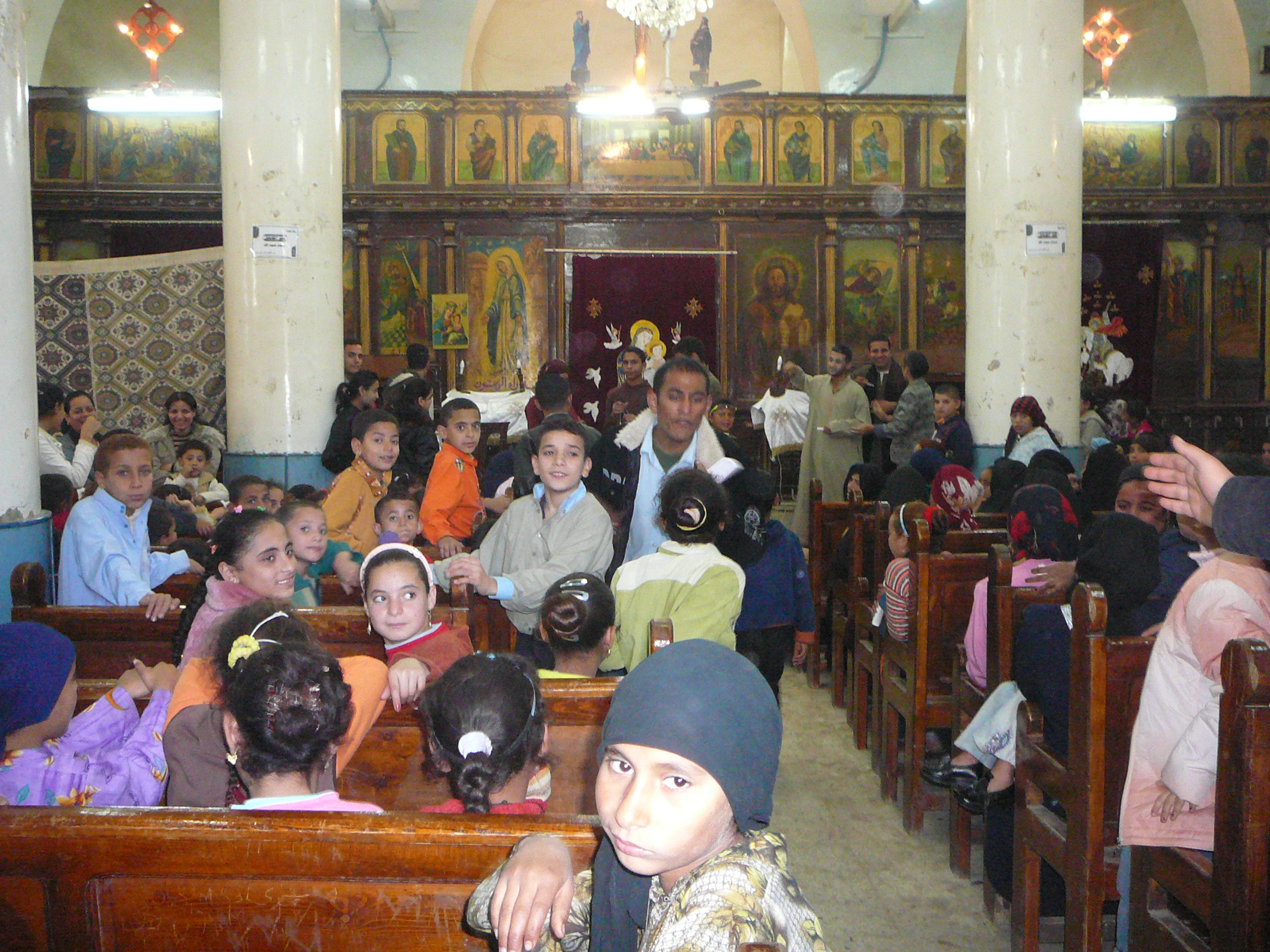
This first site was actually the second of the two in order of Jesus’ visits.  Since it was Friday morning, the day of worship for most Egyptians, the church at the site was filled with children having Sunday school.

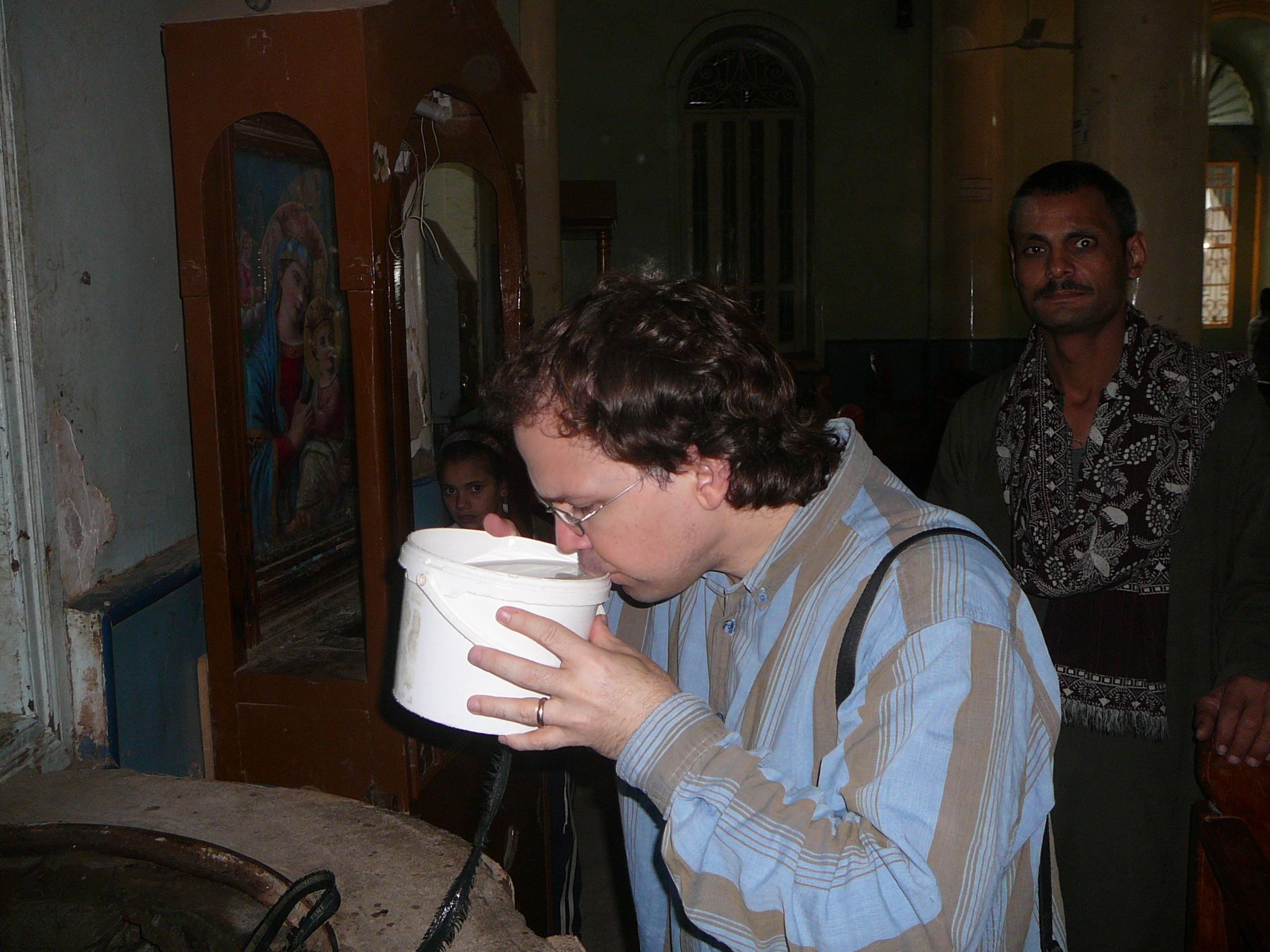
This place was interesting because it was in an entirely Christian village of about 12,000 people.  No Muslims live in this town.  The well where Jesus’ family drank from was locked up, but we saw it, and by the end of our time there, they found a key so Jayson could drink from it. 

We all drank some Sprite to settle our stomachs, and I visited the bathroom while Jayson and Emma climbed the steps to the top of the under-construction new church

so they could see the whole village.  Since this post has been graphic enough, I won’t share too many details of the bathroom.  It wasn’t the most pleasant experience, and they didn’t have anything but a hole in the ground, and I did think to myself while I was in there, “Oh boy, what a trip this has been,” but we made the best of it, and Hannah and I soon joined the other two at the top of the building.  I remember being glad that both girls lost their breakfast in the van, as I thought they might have trouble using the facilities if they needed them. 

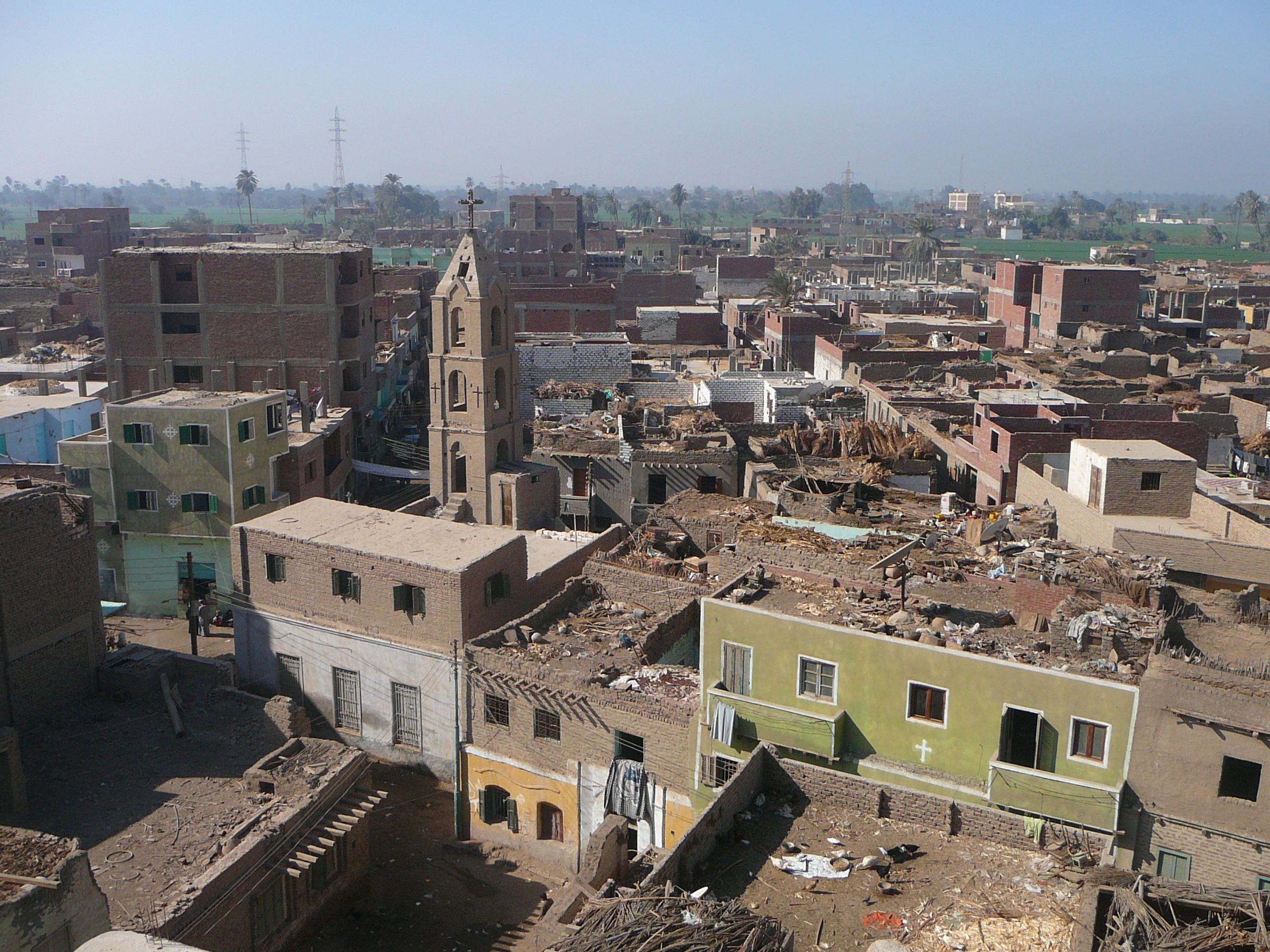
The view was very interesting with lots of unique things on people’s roofs like pigeons, chickens and ducks, which people raise to sell.   The roofs here are flat so that allows for people to store things, or raise things on them until they may decide to add another floor to their existing building. 

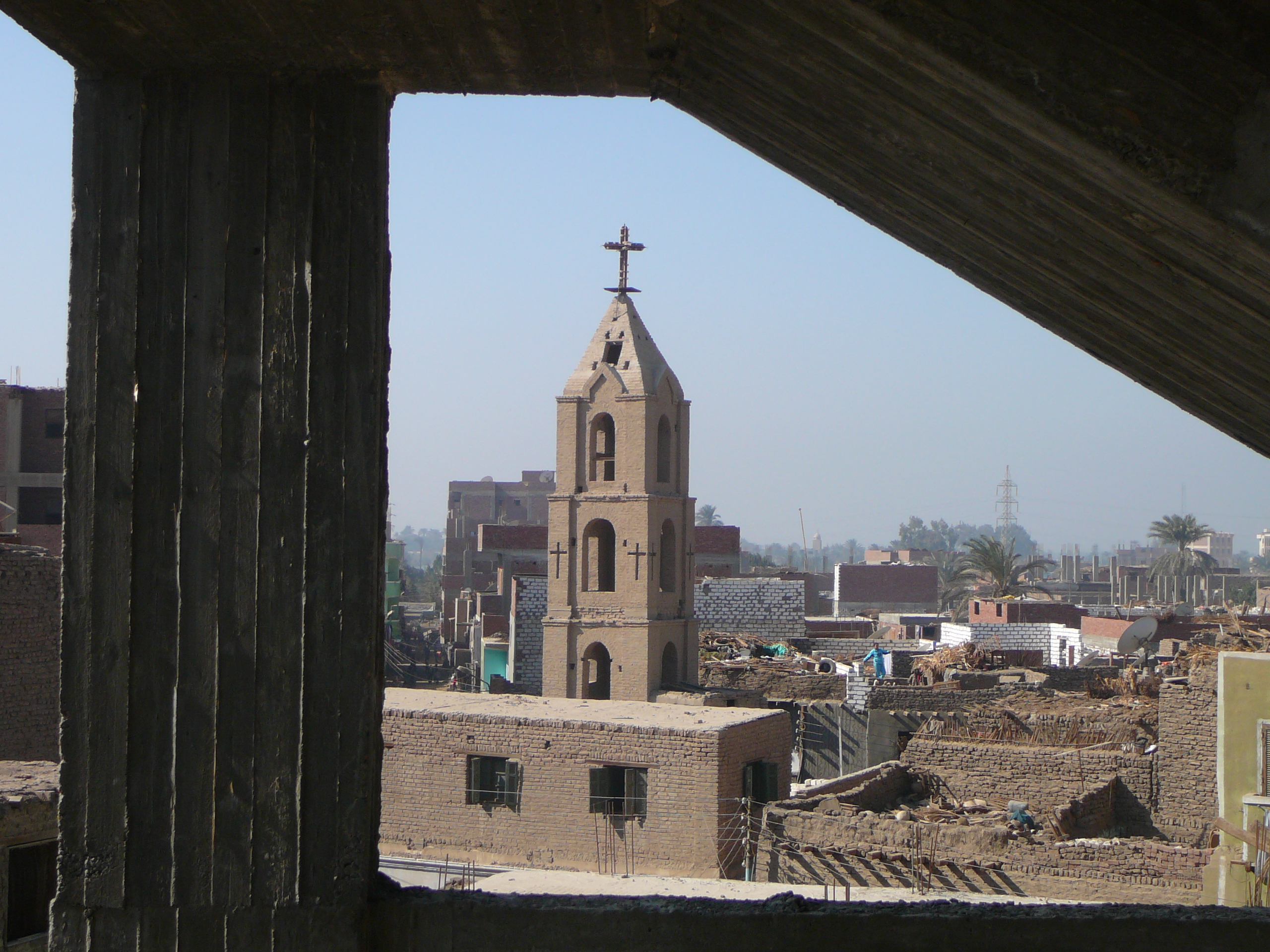
The steeple of the evangelical church in town was not too far from this site. 

The one unique thing about what we saw from our view was that there were no mosques … a rare thing in Egypt.

But, as I said, this was an entirely Christian village, and we later found out that when a Muslim family wanted to move in, they were refused.

After looking around for a bit and taking some pictures, we climbed back into the van … somewhat hesitantly.  We knew the ride to the next place would also be bumpy, but we hoped for the best.  We all sat as close to the front as we could, and each held a daughter on our lap.  The girls took a short nap and Jayson and I kept our eyes closed as we rode to the next place.  Fortunately it didn’t take too long to get to Shineen al-Nasara, which means ‘garden of the Christians’ in the Coptic language, where the Holy Family had come directly from Maadi (our current town) and spent seven days before traveling on.  This was an interesting place for us to visit because this is where our host had been priest for about 20 years. They had a life-size manger scene set up and the girls enjoyed getting close to baby Jesus and the animals, cardboard, though they were. 

Then we entered the church where Jayson took pictures and the girls played “church,” and I just sat and rested.  The church was decorated with streamers and balloons for the holiday celebrations of New Years and Christmas.

It was an interesting look considering Coptic churches are filled with icons of Jesus, Mary, the apostles and other saints; the streamers and balloons didn’t quite fit in.  The church also houses a 500-year old baptismal, a small one, since it is for infants.

We couldn’t stay in the church too long since a funeral was about to take place.  Just 30 seconds after we exited, the wailing women came into the church followed by a group of men carrying a coffin high above their heads.  We went to a different building in the complex where they had two smaller churches, a guesthouse and a large reception room. 

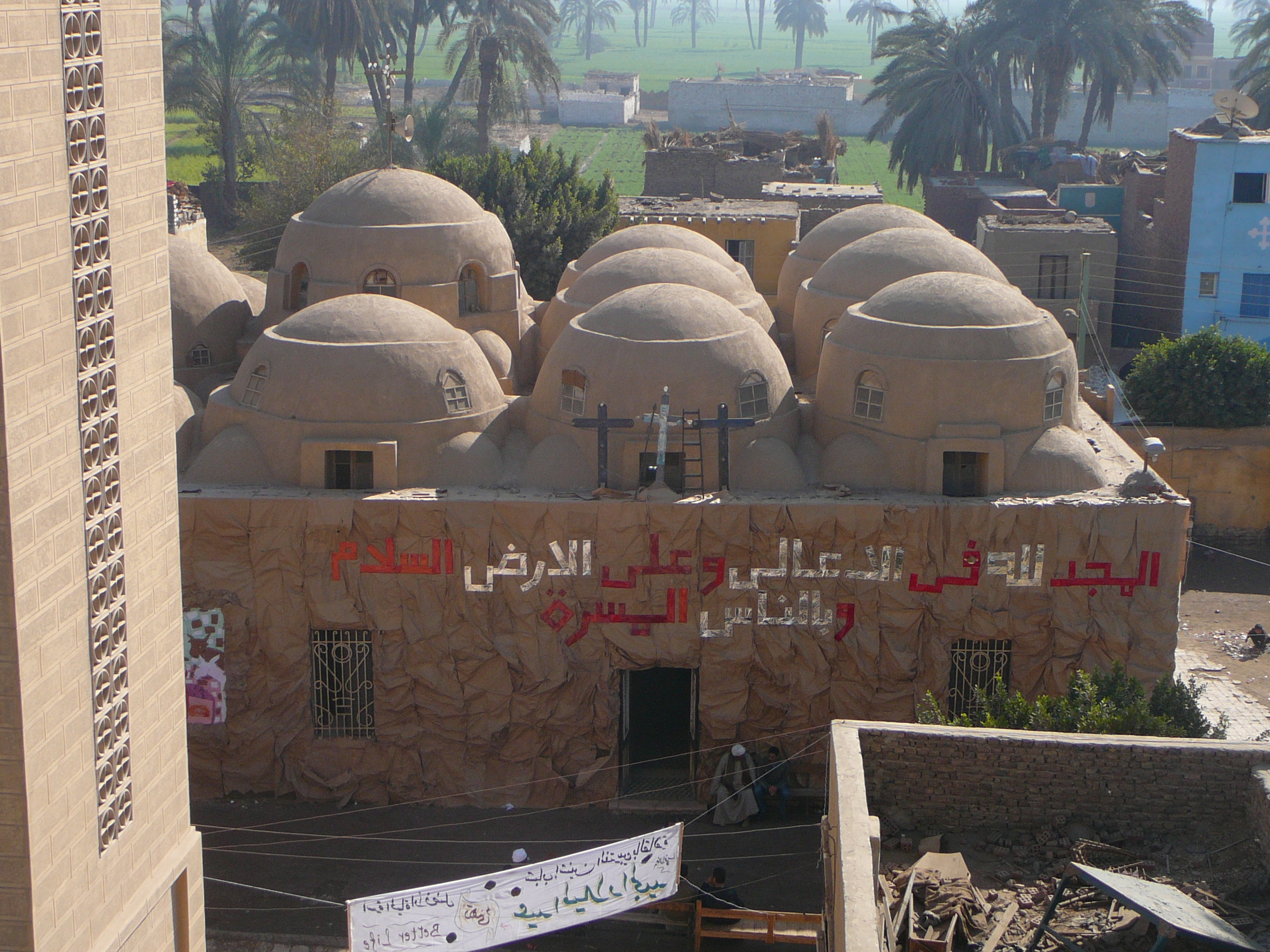
We climbed to the roof to get a better view of the surrounding area and we could see the thirteen domes on top of the church—representing the twelve apostles, with a larger one representing Jesus. 

We climbed back down the steps and saw another well which the Holy Family drank from, and also the plaque on the wall with the names of the people who helped to build the building, our priest being one of them.

Then it was time to climb back in the van for our return trip to the priest’s house for lunch.  We had planned to visit a third site after lunch, but seeing what the long car rides did to the girls, and knowing they really needed afternoon naps, especially as we planned to go to someone else’s house for a 9:30pm dinner, we decided to split responsibilities and let Jayson visit the site while I stayed home and napped with the girls.  So Jayson may write about his visit in a later post.

The rest of the day was somewhat restful—after too big of a lunch, the girls and I, along with the priest’s wife, all took naps, while Jayson and the priest went to visit the site of a modern day saint, whose lowly dwelling place has now been transformed into a massive church as a place for local pilgrimage. It was a late nap for Emma and Hannah, but we figured a late night was coming up, and we were right.

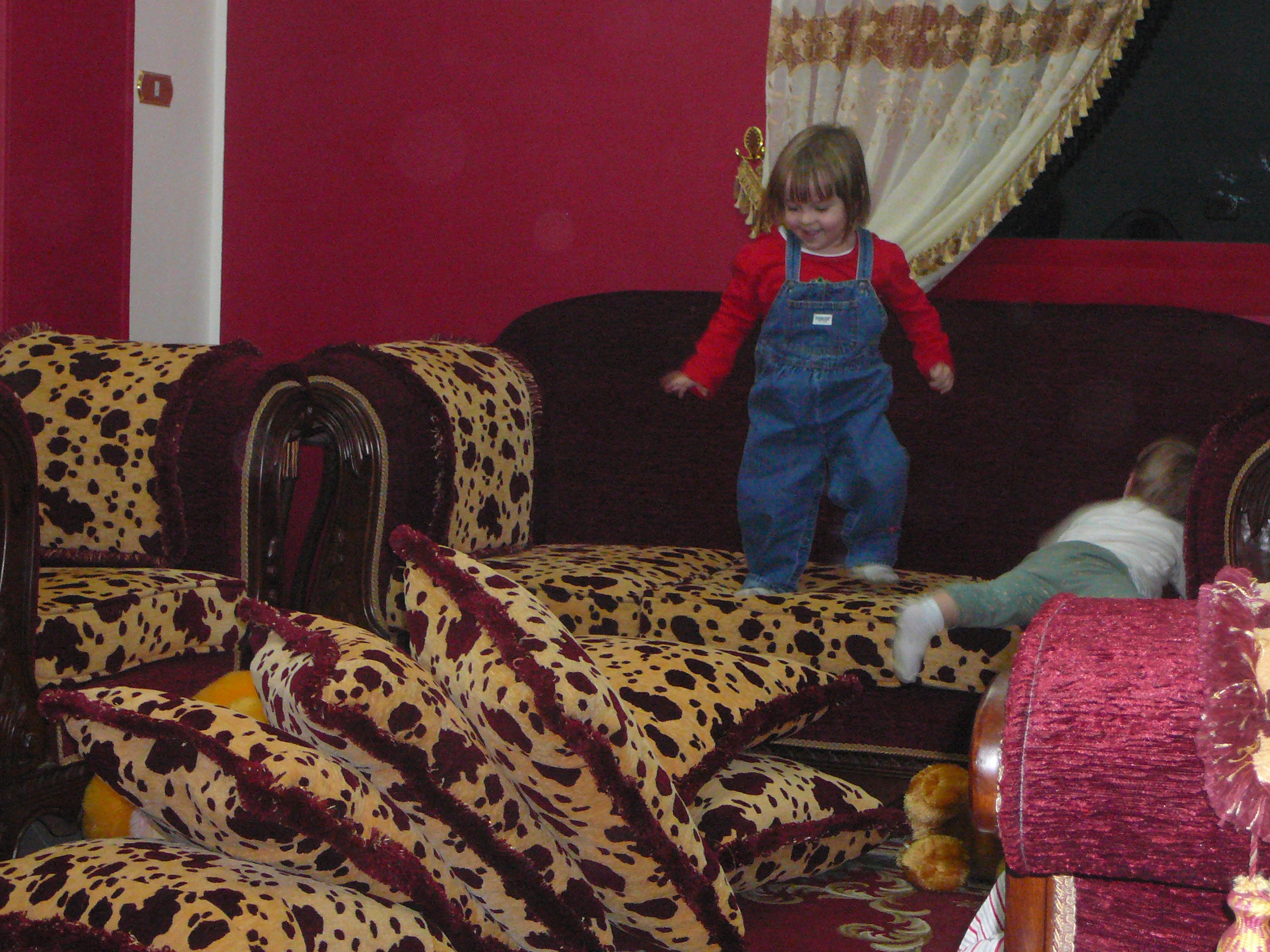
Around 8:15pm, the priest and Jayson finally returned home to pick us up to take us a few blocks to one of his daughter’s houses.  She had visited us the night before and really wanted to meet the girls, but they were already in bed.  It worked out for our schedules to visit and have dinner with her and her husband on this night so we climbed 8 floors to their new apartment as they are still waiting for their elevator to be installed.  Everyone was quite concerned for me, being pregnant, but the steps didn’t bother me at all.  Even Emma and Hannah walked the whole way up.  The apartment was very nice, and we enjoyed some nice conversation as Emma proceeded into a separate living room where she eventually put all of the pillows from the couches, maybe 6 or 7 large pillows and 3 or 4 smaller ones in all, on the floor and created a pillow train to jump on. 

She was having a blast, and Hannah joined her. 

Even though I am sure the furniture was brand new, our hosts didn’t mind and in fact, enjoyed the entertainment the girls provided.  At around 9:15, they asked if we wanted to eat dinner yet, or just feed the girls, and I said that we were ready to eat dinner, but I guess it was still early for them.  They kind of agreed as 10pm is more normal for them, so we compromised and said between 9:30-9:45 we could aim to eat.  Good thing the girls got late naps! 

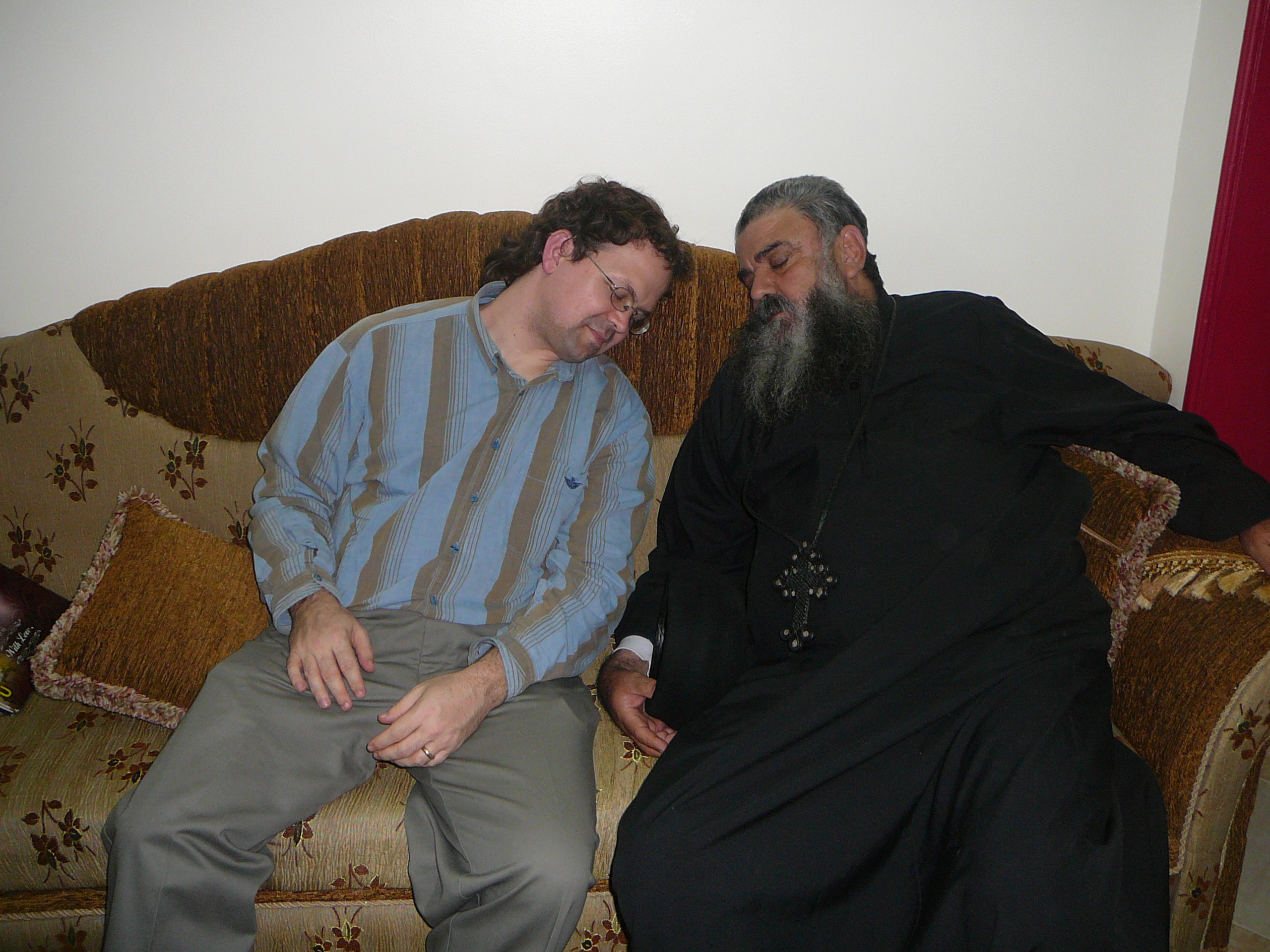
Dinner was delicious, but once again, way too big!  We had a plate full of rice, large pieces of chicken, kefta, another meat dish, cut up raw vegetables and okra.  At just about every meal, we had to eat some of everything, and I felt like I ate quite a bit, yet at each meal they asked me, “Why haven’t you eaten anything yet?  Why does your plate look the same as when you started?”  We really had to insist that we had enough, everything was delicious, and thank you, thank you, thank you!  We sat and talked and drank Pepsi and ate fruit for another hour or so after dinner was over, as the priest fell asleep on the couch after his very busy few days. 

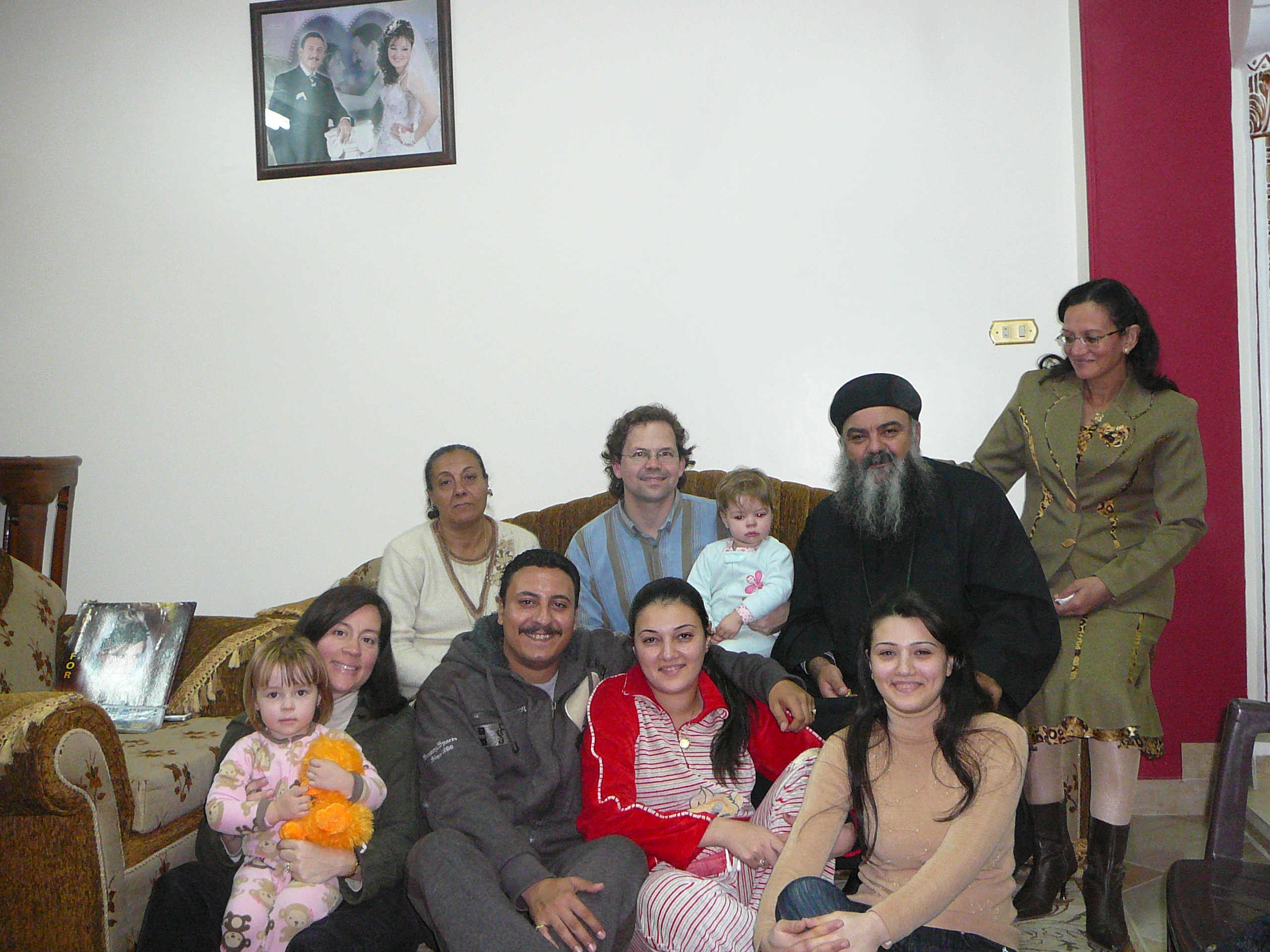
Finally, after 11pm, we were able to take a group picture

and then leave their house, descending the 8 flights of stairs and returning to our hosts’ house.  Fortunately, our next day wasn’t starting too early, and we could sleep in.  But for now, the Christmas celebrations were over and therefore Day 3 ends this series of posts!

Merry Christmas to all and to all a good night.

Categories
Personal

Press Review of Nag Hamadi — Part Two

In an effort to keep you up-to-date with the news, I will continue to post the media summaries we provide as long as the subject is dominating the Egyptian press. As you read in the last update, it is difficult to sift the wheat from the chaff in these reports. The true and accurate often stands side-by-side with the exaggerations and inventions, and it is hard to know which is which. Right now, it is important just to listen and record. If we are able to investigate this situation further, these reports will be the foundation from which we can ask further questions. If any of you have the time to help us play detective, please feel free to read along and keep track of the names, crimes, insinuations, and accusations. Other perspectives are always helpful.

Click here for the link. Thank you.

Categories
Personal

Press Review of Nag Hamadi

We hope you have enjoyed our accounting of Coptic Christmas; there is still one more day to come, and hopefully some pictures to be shared thereafter. In the background of our Christmas stories, however, has been the events of Nag Hamadi, in which six Christians and a Muslim policeman were killed in a drive-by shooting while exiting the Christmas Eve mass. The incident has received international attention, and has dominated the Egyptian media consciousness in the days which have followed.

Our work at Arab West Report translates articles from the Egyptian newspapers and provides detailed summary thereof. In addition, we review these articles as necessary to provide fact checks and analysis. Due to the sheer number of articles on this topic, however, we have instead provided a press review, which we often do when there is a topic which dominates the news. This press review summarizes all the relevant articles from the major newspapers and combines them in one report. This manner of summary allows all voices to be heard, no matter how contradictory. This sampling may not clarify our understanding—our minds prefer a simple sound bite we can digest and process—but it does establish the complexity of the situation. It is hoped that by beginning from complexity clarity can emerge.

I have provided a link here to the press review. The assembly and analysis you will read is not my personal work, rather, it is that of my colleagues. The larger question for us here is what can we do about this? Do we have a role in encouraging reconciliation in the area? If so, how and when? I cannot say we have the answers to these questions yet, and even when we do, it may take a while to share them. I will look to link to further press reviews as we develop them, however, that you can follow along. If you care also to pray for peace in this region, and wisdom for us on how to contribute, that would be greatly appreciated.

Categories
Personal

Coptic Christmas: Day Two

The lack of sleep did cost us the next morning, though, as we were due to pay a visit to the area bishop for breakfast at 8:00am sharp. In the Coptic Orthodox Church the bishop is only one level below the pope, and carries great authority and responsibility. Christmas duties pressed on everyone, but he allowed us about an hour of his time, and the exchange of greetings was necessary on both sides. For us and the priest, it would have been an offence if we did not honor him with a visit, however short. The same would have applied if he failed to receive the foreign visitors in his area. Needing to receive the governor in only an hour, however, he allowed us a few questions, gave us Christmas gifts of wooden and cloth crosses in addition to an icon of the Virgin Mary, and allowed us our leave. The priest himself was due at his church in the village, so we left promptly.

The responsibilities, however, were simple. All he had to do was sit in his office and receive Christmas greetings. It made for little conversation as every two minutes in the morning another child would enter, kiss his hand, and then leave. This continued for about two hours, interspersed with a phone call of Christmas greetings every minute in between. It was somewhat boring, to tell the truth, but it was a complete cultural experience.

All during this time the church grounds were an open playground. As parents enjoyed a morning of rest their kids gathered and exploded miniature firecrackers one after the other. They were clearly enjoying themselves, but as I sat in the office I could only imagine the chaos outside, except for when the kids threw their fireworks inside. Surrounded by walls, the noise was deafening, but the priest did not seem to mind at all. I got increasingly perturbed, but what can you do when this is normal and accepted behavior? I have noticed that priest may have a slight hearing problem; after twenty-plus years of service, these bi-yearly celebrations can perhaps take their toll. My imagination of the chaos, however, can be presented as reality by Julie, who was outside with the girls, and will take over the authorship of this next session.

I don’t think Emma enjoyed herself too much.  I wasn’t exactly sure what it meant that we would go sit at the church and “play” all day.  I knew Emma liked to play with kids, but the sheer number of the kids would probably overwhelm her.  What I imagined came true.  We arrived to a crowd of children, dressed in their new Christmas clothes.  They surrounded our car, knocking on the windows and holding out bags of chips to our children who were behind the closed windows.  It really felt like a Hollywood star experience, and we were the celebrities.  As we entered the courtyard through the church gates, the kids followed the car.  We parked and got out and they just kind of stared and smiled at us as we exited the car.  I offered typical Christmas greetings, “May you be well all year,” as I carried Hannah and Jayson carried Emma.  Wherever we walked with them, the kids followed, not saying much, but not leaving us alone either.  Emma was overwhelmed, but handling it okay.  Jayson and the priest went into the office, and told us we could play out in the courtyard.  So, holding Emma’s hand, and Hannah in the other arm, we walked around, surrounded by kids.  We eventually went to a ledge that was in the sun and sat down in the warmth.  The kids surrounded us, some of them saying in English, “What’s your name?” or, “How are you?” to the girls, and not getting much of a response.  The firecrackers either started then or else that was when we noticed them, and from that moment on, Emma’s hands were up on her ears every time she was outside the office.  It probably looked kind of funny to the kids, but I felt bad for her.  They offered her the firecrackers; I’m not sure what their thought was: Does she hold it as its lit and then throw it, or is it just something for her to hold in her hand?  I kept refusing and told the kids that she doesn’t like noise; it scares her and hurts her ears.  This seemed a foreign concept to them.  They offered chips or cookies, which was about the only thing the girls responded to positively.  They asked me their names and I told them.  An older girl asked if I knew a certain game, and I didn’t understand her.  She said they wanted the girls to play with them.  I said, “Okay, we can try.  If you all start playing, the older one may join you.”  But everyone just stood there.  I wasn’t sure what they wanted us to do.  How do fifty children play exactly?  I didn’t see a ball and it didn’t seem they were going to organize a big game, yet, we had the directive to “play.”  One of the older boys started trying to disperse the crowd to go play so maybe we could move around or get up, so I took both girls by the hands, well, Emma by the elbow because her hand was covering her ears, and we walked around the courtyard, looking for people playing, yet still being followed by a crowd of children who were NOT playing.  The noise of the firecrackers was really getting to Emma, and at some points, the kids would throw the lit noisemaker near us.  I don’t really think it was malicious, but it did seem intentional.  I think it just enthralled them to see someone so affected by the noise, as they obviously weren’t.  Emma said she wanted to go to daddy, so we all went into the office, where we finally could sit in peace for a bit.  For the next few hours, we either sat in the office, where we usually had some sort of snack from someone, or we walked around the courtyard, Hannah’s hand and Emma’s elbow in my hands, walking around, followed by children and the sound of firecrackers.  When it got too much, we would reenter the office and sit for awhile again.  After awhile, the thought of “playing” all day at the church, didn’t sound too fun!

Ok, Jayson is back. Around noon the priest’s brother came into the office and offered to take us to his house in the village where we were to have lunch around 3:00pm. That seemed a very good idea for the girls, but I thought it best that I stay there in the office. I walked with them to his home, about five minutes away, to keep all propriety, promising the priest I would be back shortly. All seemed fine with the brother’s family, and by the time I came back the ATM had opened. The priest had stacks of bills which he was distributing one by one as each child entered, kissed his hand, and received his $0.045 cents. This apparently was a custom for the holidays.

When this ended the sitting became much more enjoyable. The men of the village now came to pay their Christmas greetings, and several of them would sit and talk for a while, especially the ones who were working abroad or in Cairo and came home for the occasion. I even met someone who was working in Jordan, as a gardener in the church we worshiped in way back when. Many of these people only return home once a year, but some can come more frequently. It is especially hard because most have left their families in the home village.

Julie and the girls were able to take a nap before lunch, and I took mine afterwards. By this time, though, the news was filling the village. Six Christians were gunned down as they existed Christmas mass. Not everyone really knew what was going on, but all expressed concern, though not surprise. Many Christians have surrendered themselves to the idea that the country is against them, and this was just the latest confirmation. Even at that early point, however, there were complicating features, or at least rumors. This event was said to be connected to an ongoing controversy related to a nearby village, in which a Christian was said to have raped a Muslim girl, and the Muslims then responded against the Christians at large as the perpetrator of the crime escaped. In Upper Egypt the practice of revenge killings is not uncommon, and this may have been a continuation. Or, it may have been terrorism clear and simple. ‘Terrorists’ was the word on most of the Christians’ lips.

After lunch ended we left the village, returning to Maghagha, and things were quiet as the priest had to leave for family responsibilities, allowing me to write much of this summary. We had dinner earlier that night, at around 11:00pm, but we had put the girls to bed around 9:00pm. With a full stomach once again we weren’t much in the mood for sleep, and enjoyed good theological conversation until 2:00am, taking full advantage of our time together. It was another long but good day, but with a pall over the events of the day.

The events also could threaten us, as surely the security would be increased throughout the country. Would we be able to continue our program? The next day we were to visit two places reputed to be visited by the Holy Family during their escape to Egypt, and another place which was a pilgrimage site for a modern day saint. Would we be sent home immediately? Would we be confined to the priest’s home? There was no worry about safety whatsoever, but as we finally did collapse into sleep, there were concerns aplenty. The ones highlighted here in this last paragraph pertain to us, but may our prayers highlight those concerns of the country, pertaining to all.

Categories
Personal

A Coptic Christmas of Joy and Sorrow

There is complicating news today. It is significant enough that you may already know about it. Six Christians and a policeman were killed today in an ambush as they were exiting midnight mass in an Upper Egyptian town to the north of Luxor. I wish to be careful in conveying information because I have been far from the news in our relative isolation in Maghagha, over ten hours away from the attack, but it has been the talk of the community since we awoke this morning.

Our day began in Maadi, as we fought through Cairo traffic to get to the train station in Giza. We left a full hour to arrive, thinking this would be plenty as the station is just on the other side of the Nile River. We should have known better. We left on the 6th of January, a Wednesday, but in addition to all the Christians who would be in transit to get to their homes and churches, there was weekend traffic with which to contend. Coptic Christmas, the 7th of January, is a national holiday, so whereas Thursday night is often prime traffic with the Friday-Saturday weekend, Christmas led to a three day weekend for the entire country, and it seemed like the nation had emptied onto the streets.

We did arrive on time, but with only about fifteen minutes to spare. We appeared to be the only foreigners at the location, asked about how and where to board the train, had a policeman direct us informing him we were traveling to Maghagha, and settled into our seats, which were reserved by number. The train was very comfortable and we by coincidence sat next to another couple also traveling to Maghagha, and enjoyed pleasant conversation with them the entire two and a half hour journey.

Upon our arrival I am afraid we may have offended some. It was fairly comical, at least from our perspective. It is a bit complicated to descend from a train with two small children, a pack-and-play, suitcase, and backpack, but we managed, and it was no surprise to find a willing porter ready to help us with our bags. If any of you would wish to visit us, please be prepared for this at the airport. They can be friendly, helpful, and by comparison inexpensive, but they can also be insistent.

The first thing we should have noticed is that this porter was not very insistent. He offered to help me with the suitcase, and per custom I refused, with a quick ‘no thank you’, barely an exchange of glances, and began advancing. It may not be the most polite manner, but you get used to the necessity of not getting drawn into conversation, lest you be forever unable to escape.

My advancement, however, was quickly halted as I found the gentleman who was to receive us. Our stay was arranged with the priest of a village not far from Maghagha, but due to our late arrival (now about 9:30pm) he was already involved in leading mass. In his place he sent his brother, who now began helping us with our bags, but only for a moment.

Within two minutes he was surrounded by the police, among them the ‘porter’ who earlier tried to help us as we got off the train. It was all very friendly, and no one was unnerved, but Julie counted seven people who were involved in our arrival. Who are you? Who are they? Why are they coming? Where are they going? Each question had a very simple answer, and the appropriate people recorded the information, finally taking a look at our passports and recording our names. They continued to escort us to the priest’s brother’s car, with a small diversion as I remembered it would be better to purchase tickets for our return trip before we departed the station. It turned out this was rather unfruitful, for the trains were sold out on the day we had purposed to leave as well as the next day, except for either the 5:00am train or the one leaving at midnight. At this point we have no return ticket, but the police assured everything would be taken care of. As great as their attention had been to this point, it seemed the best thing to trust their word. They indicated, if I understood correctly, that we should just show up at the normal time of departure at 10:30am or 1:00pm, and we would (likely) find a place. In any case, the priest would take care of everything.

Here is the background, some of which is known, some of which is conjecture, all of which is the normal and expected procedure. My boss has been friends with this priest for many years, and he selected him for our visit to Upper Egypt in part because he has a very good manner with his Muslim neighbors and the regional authorities. In securing the priest’s agreement for us to visit, he then informed the police in our area, who also gave their approval. This is the known. The conjecture is that the policeman I inquired with concerning how to board the train likely conveyed his knowledge to the station in Maghagha. Therefore it should have been no surprise to find the concerned authorities as part of our official welcome.

The normal and expected procedure has been in place for many years. Egypt has had sporadic violence against foreign tourists who visit the Pharonic heritage sites in Upper Egypt, and consistently sends all tourists with a police escort. Foreigners who go to places like Maghagha, however, are much less frequent, and generally have very limited reasons to be there. Their presence attracts attention, and Egypt is concerned about their security. In a country which depends to a great extent on tourism and outside investment, the death of a foreigner could have wide ramifications. Upper Egypt has a reputation as being a haven of Islamist activity, and while the vast majority of people are against violence of any kind, including the vast majority of Islamists, there are pockets of extremist sentiment. Though the government has made great strides in combating these elements, they do still exist, as was seen today.

The police presence takes some getting used to, but it is very friendly. At the station the officer who recorded my passport information apologized several times. One of their number joined us in the car and accompanied us to the church in the village fifteen minutes from Maghagha, where the mass was in progress, and then joined with his colleagues who make up the normal guard outside the church during every mass, but especially during holidays. He came in a few times to check in on us, and when everything ended two officers joined us on the trip back to Maghaga. One sat on the lap of the other in the passenger seat, and they joked with the priest almost the entire trip home. The next day we returned to the village to join in Christmas day celebrations, and though they checked regularly with the priest about our program, they generally left us to ourselves, as best we knew. Even so, it is now 10:00pm, and an office just knocked on the door of the priest’s home to inquire if we are going out again tonight. After assuring him we were done for the day, we may have allowed him an early evening home.

In terms of the chronology of the day, however, we return to the Christmas Eve mass. We arrived about 10:30pm with an hour and a half of a four hour service remaining. Our girls were doing remarkably well given the hour, and though Hannah largely stayed quiet (but not sleeping) on Julie’s lap, Emma was having a great time. Automatically becoming the guests of honor we were ‘seated’ in the first row of the church, directly in front of the altar boys. Seated is a misnomer as most of the mass requires standing, and as I held Emma she preferred standing on the dividing wall between the congregants and the altar boys, and quite attracted their attention. Three of them in particular paid no further care to the mass and played with her the whole time. Emma was alternatingly shy and engaging, but was causing no stir. There were several children milling about in the pews, and the worshipper standing next to us was goading her the whole time, and was even father of one of the three altar boys. It was fun to join in the chants while at the same time catching Emma as she turned from the attention, slipped off the wall, and fell into my arms. It may not be acceptable behavior for most masses, but on this occasion we fit right in.

As the mass ended the priest left rather quickly and we returned to his home with the aforementioned escort. In the car our girls finally fell asleep, but of course woke upon arrival, which may have been good since food was waiting for all. Though actual practice varies, Orthodox Egyptians fast for fifty-five days before Christmas. The fast is of a vegetarian variety, as all meat beside fish is prohibited. Christmas then becomes the worthy celebration, and the meat flows freely. In addition to a plate of rice and a bowl of salad, there was chicken and the most delicious beef I have ever eaten. It did make me wonder, however, how many ‘foolish’ things we do in our celebrations of which we are unaware. After fifty-five meatless days, it seems strange to gorge on such a feast, especially at 1:00am. We did not have the most pleasant sleep that evening (morning?), but there were no regrets concerning the consumption.

To be continued…

Categories
Personal

Tomorrow is Christmas Eve

You may remember Jayson’s post from Dec. 25 entitled “Today is Not Christmas”.  Well, we have been able to extend our celebration of Christmas being here in Egypt, and finally, tomorrow, January 6, we will celebrate Coptic Christmas Eve.  We are still establishing our traditions, as he mentioned, but for this first Christmas in Egypt, we decided to travel to a town about 3 hours south of Cairo, called Maghagha.  We will travel by train tomorrow evening, arriving around 10pm as the Coptic Church is in full swing for their very special Christmas Eve service.  All over Egypt, Christians will be worshipping God in their churches until midnight, at which time they will return to their homes for the big Christmas meal.  One of the reasons the meal occurs directly after the midnight mass is that traditionally, Copts fast for 40+ days prior to Christmas.  This fast includes abstaining from all animal products, and thus, once midnight of Christmas Eve hits, the fast is broken, and the Christians can celebrate the birth of their Savior with food and fellowship.

I am sure we will have more to say about this when we return from our trip on Saturday, but for now, just know that we will participate as best we can in this midnight mass, with our two little ones in tow, and then in the Christmas feast at someone’s house, again, with our two little ones preferably sleeping in tow.  I am sure we will have many stories and adventures to share following four days of celebration outside of Cairo.  Stay tuned.

Categories
Personal

Today is Not Christmas…

… but neither am I Scrooge. Well, that could be interpreted as a matter of opinion, as may be seen.

Perhaps many of you are aware that in Egypt, Christmas is celebrated on January 7. I imagine there are deep and profound historical reasons for this, but to date I have not cared particularly enough to research them. Coptic Orthodoxy split apart, or rather was expelled, from the to-become Catholic faith at the time of the Chalcedonian creed, I believe in 451. One of the consequences was a divergence in fixing the celebration of Jesus’ birth, which for early Christians was never regarded with any importance. Easter also became separately marked, though this was of greater import, both biblically and liturgically.

We discovered while living in Jordan that the Christians there created a novel solution. The Coptic and Orthodox branches of Christianity, about evenly split in the country, agreed to celebrate Western Christmas on December 25, and Eastern Easter according to the lunar rites of the Orthodox Church. I would wish that the worldwide church might make such an agreement as well. For our part in America I imagine this would be easy. Ubiquitous Western culture has established December 25 as Christmas even throughout the non-Christian world, and none of us can ever figure out when Easter is going to be anyway. What would be the difficulty in uniting with our Eastern brothers in faith by celebrating Easter according to their calendar? I doubt anyone would even know the difference.

This could be harder for the Orthodox, however, as it could be seen as yielding to the very unchristian culture which surrounds the birth of Jesus. What should stop the Western world, however, from making a unilateral gesture of unity to Orthodoxy by taking up their Easter? Perhaps the Pope could champion this cause from the Catholic side; if he did, would Protestants go along? Or, under what scenario could the initiative emerge from the Protestant community; who might lead us forward? Might any of you propose such a measure this year in your churches? Might you develop a sufficient sense of belonging to the worldwide church so as to contemplate it?

Our sense of belonging to Egypt, however, has created in us a bit of a quandary. When is our Christmas? Most foreigners here simply celebrate December 25 as they always have, and the local expatriate community churches host Christmas Eve services and have times of caroling. For those spending time abroad away from home, certainly this is a welcome reminder of valued traditions.

But it completely misses Egypt. The non-Orthodox Egyptian Christian community is but a small percentage of the millions of Coptic faithful. Again, I lack the history of why and if this was always so, but the Egyptian Catholic and Protestant Churches celebrate Christmas in unity with their brethren, on January 7. Though Jordan also was a predominantly Muslim country, there were still Christmas lights hanging from the windows of Christian apartments and manger scenes set up among the families we would visit. Here, there is nothing. Not only is there no Christmas cheer, but the Orthodox precede Christmas with fifty-five days of fasting. As we went to sleep last night, it was almost eerie to imagine the excitement among children back in America, and the labors of parents to run the gauntlet through that most sacred of national institutions, the mall. Here, save for the sounding of the call to prayer, there is silence.

This is not quite true, however, and it creates a confusion that is quite palpable. The Orthodox are proud of their traditions and history; why then are there so many trappings of Western Christmas? Last Friday at the Orthodox Church we attend was held the annual church bazaar. There were Santa Clauses being sold, wreathes to buy, and a big sign proclaiming, “Merry Christmas and Happy New Year!” Why was this not reversed in order? Are the Egyptians yielding in fact to the inevitability of Western cultural dominance? Or, is there simply no escape?

There is a possible explanation in that this church in particular was consecrated on either December 24th or 25th, and from the coincidence of Christmas the two celebrations blend together. Another explanation is that the Christians also celebrate New Year, and the holiday festivities start early, continue through the end of 2009, and pick up steam as true Christmas approaches. Perhaps, but later this evening we will attend the choir concert at this church, which will feature carols in both Arabic and English. We do not have the benefit of familiarity over time; is this normal, both here and throughout Egypt?

In any case, what should we do? The principles of belonging suggest that we should do as the Egyptians do and celebrate according to their calendar. No one claims that Jesus was actually born on this day, so what does it matter? We also have the benefit of having children young enough not to be traumatized by a different date. We could just ignore the 25th and then let the momentum build in both family and country in expectation of the 7th. Yet if this can be interpreted as the noble solution, what do we do in the face of the ignoble bowings to yuletide found among so many Copts? Do they themselves open our door to the legitimacy of Western celebrations?

 Regardless, the noble solution may not be the easiest, or even healthiest. While our children may be able to switch with little difficulty, we ourselves cannot. Furthermore, what of the phone calls back to family in America? These will not stop, but how will they be defined? We have taken to saying, “It is Christmas in America,” but this is forced. I nearly prayed this morning at breakfast, both unconsciously and with a smirk on my face, “Thank you God that Jesus was born in America today.” Of course I will not play with such blasphemy, but is this a duality that can be maintained?

If only for year one in Egypt, we will try to maintain it. Perhaps our children will grow up bragging, “We get to celebrate two Christmases!” Our current solution is to avoid the expatriate church focus on the 25th, in the manner which we generally avoid this church anyway. Still, we will wake on Western Christmas and have a special breakfast, after which we will open our stockings. Before lunch we will participate with other foreign friends by taking a boat ride on the Nile. Later in the day we will call our families to join in their celebrations, and will close the day at the aforementioned Orthodox choir sing. All this will be Christmas, in very nature and being.

Yet it will not be Christmas, amen and amen. Eastern Christmas is still to come. I am not sure what this will entail in terms of participation in the greater life of the Coptic community. For ourselves, though, we will leave the opening of presents until this day, when we will also have a cake to celebrate Jesus’ birthday. Perhaps this suggests that we will treat the 7th as ‘true Christmas’. So be it. We can never leave behind our own culture, nor should we try. Yet we should give ourselves as completely as possible to those we live among, and the sole celebration of the 25th would be tantamount to insisting, “We are not of you, we remain foreigners.” It is doubtful that anyone would care; they expect foreigners to remain so. Yet we hope that if only in a symbolic way some might see our holiday adoption, albeit short of transfer, as an expression of love and appreciation.

The celebration of Christmas, on either the 25th or the 7th, is a celebration of incarnation. The word of God took on flesh, and dwelt among us. Following this pattern, all who follow him can take on the flesh of those they live among. As he remained God, so we will remain American, and all will keep the identity they possess. None of this need be set aside, but so much more can be added. For the good of Egypt, for the good of all the communities in which we live, and for the good of our very souls, may such incarnation take hold.