Categories
Lapido Media Middle East Published Articles

Islam Greets Christianity in Oman

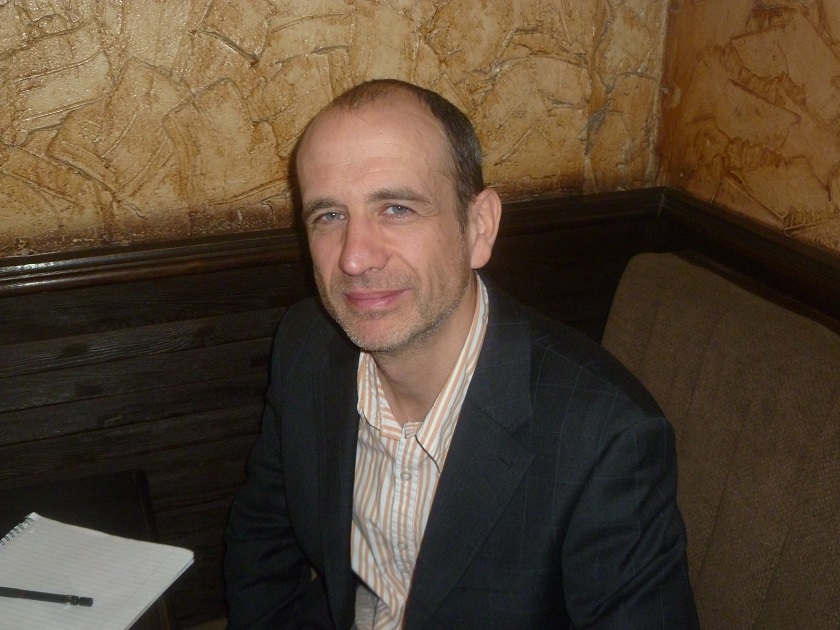
Staff, students, and local friends of the al-Amana Center

Imagine David Cameron in Norfolk, about to speak on ‘British values’. He then invites forward a Muslim Brotherhood leader, and asks him to explain Islam.

And in the Zippo’s Circus-like atmosphere, the audience leaves pleased.

Transfer the scene to the Sultanate of Oman, and witness an American Christian pastor make clear the gospel in the austere heartland of Ibadi Islam.

Now picture a tolerance that predates Britain’s embrace of multiculturalism—on the border of Saudi Arabia.

The analogy is not perfect. Sultan Qaboos bin Said is an absolute monarch, ruling since 1970. Proselytisation is forbidden in any direction.

But the Shiva Temple in the capital of Muscat has served the Hindu community for over 200 years. Since the early 1900s the government has given land to build churches.

Saudi Arabia’s chief cleric has repeatedly called for all non-Muslim houses of worship in the Arabian Peninsula to be destroyed in accordance with sharia law.

Clearly, Oman does not share Wahhabi convictions. There appears a similarity in strict practice, but not in the approach to others. The Ibadi branch of Islam is far older than the eighteenth-century Saudi creed, dating to its formative scholar from the old capital in Nizwa in AD 711.

And to this region where Islam originally took hold, the Ministry of Religious Affairs invited Revd Douglas Leonard to speak.

Heritage

Leonard is the director of al-Amana Centre in Muscat, an outgrowth of the Reformed Church in America’s (RCA) mission dating back to 1893. Today its focus is on interfaith dialogue.

Leonard expected a quiet discussion with twenty imams. He found a huge tent full with 500 people, over a thousand outside, and twenty imams seated in the front row. Three television stations were present, broadcasting his lecture to the whole nation.

It was a lecture, not a Billy Graham crusade. But it focused on countering misconceptions about Christianity, dealing with differences and not content to settle for ‘common ground’.

A kindly reception was guaranteed by his official introduction as part of the heritage of ‘Dr Thoms’, an RCA missionary-surgeon remembered fondly. Omani’s eyes soften, Leonard said, and tell stories of how he healed their grandparents, or delivered then when they were born.

Leonard also teaches a course each semester at the College for Sharia Sciences. Its thousand strong student body goes on to become imams, jurists, lawyers, and bureaucrats.

‘The government wants every Omani to gain appreciation of other religions,’ he said.

Piety

Ibadism sees tolerance amid conviction as the essence of original Islam.

Twenty years after the death of Muhammad the nascent caliphate was in civil war. Unlike the eventual Shia, they rejected Caliph Ali when he agreed to negotiate with Muslim rebels deemed insufficiently pious. And unlike the eventual Sunni, they did not reconcile with the rebels after their victory established a hereditary throne.

History records one of the leading rejectionist parties as the Kharijites, a violent and puritanical sect who declared anyone in disagreement a non-Muslim, much like ISIS today. But though they emerged from the same political position, Ibadis separated completely from the Kharijites and became quietists. They insist on piety but do not judge, as only God can know one’s heart.

Ibadis are less than one per cent of Muslims worldwide. But in Oman they are a majority, with a substantial Sunni minority. Shia are roughly five per cent, though the government does not keep official statistics. In law and practice, all mosques are open to all faith interpretations.

According to the CIA World Factbook, Oman’s population is 3.2 million, 30 per cent of which are foreign workers. An estimated 85 per cent are from India, mostly from the southeastern state of Kerala where Hindus and Christians together have shaped the culture.

Centuries of trade across the Indian Ocean have nurtured an open spirit. A few Hindus and Christians have become citizens.

But nearly all Omanis are Muslim, and the demographic explosion of foreigners since the oil boom has put pressure on traditional society. Sultan Qaboos has developed interior cities such as Nizwa, but despite employing extensive foreign labor the city has not been allotted a church.

Doing so would be sensitive, Leonard said, just as building a mosque can be sensitive in parts of the West. But in his experience the people are kind and the government wants to do all it can to facilitate the ability of foreign Christians to worship.

Appreciation

And one reason Leonard is trusted is because he does all he can to facilitate the ability of Omani and Christian alike to appreciate the other.

Over the past five years al-Amana has hosted 42 American university students in a semester-abroad program. Besides taking introductory classes on Arabic and Islam, they have been matched with 40 Omanis in ‘scriptural reasoning’.

Much interfaith dialogue does not go into the details of religious difference, afraid to cause offense or devolve into argument. Scriptural reasoning seeks to honor each faith at its core, studying the texts as holy in the eyes of the other, and not just stop at common ground.

Each year for the past four the Omani government has sent ten religious sector employees to Cambridge University for training, where Leonard is an instructor. One became emotional reading the Sermon on the Mount, saying he would now tell other Muslims that what they say about Christians is wrong.

An experience mirroring that of Kory McMahan, a junior at Northwestern College in Iowa and al-Amana’s most recent graduate.

‘At my school there is no Muslim voice, but it deserves to be heard,’ he told Lapido Media. ‘I can’t speak for Muslims but I can share what I have seen and learned.’

Leonard hopes the pattern of religious tolerance in Oman can be replicated throughout the Middle East, as well as combat anti-Muslim sentiment in the West.

‘Ours is a 120 year example of Muslims and Christians working together,’ he said. ‘Imagine what would happen if instead of being suspicious, we came together for the common good.’

Whether in Norfolk or Nizwa, British and Omani values may not be that far apart.

This article was originally published at Lapido Media.

Categories
Excerpts

A Christian Taliban

Ukraine Christian Taliban

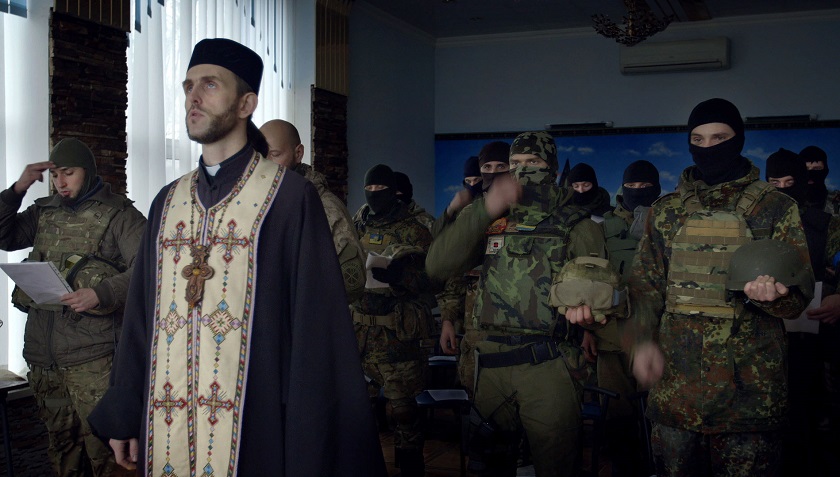
In case anyone needed reminding, the use of religion to further militant political goals is not exclusive to Islam. The Intercept reports from Ukraine, where middle aged Dmytro Korchynsky has formed a private battalion, the Jesus Christ Hundred, dedicated to St. Mary, to fight the Russians.

In the 1990s he fought alongside Muslims in the Caucasus. Now he consciously borrows from them:

Korchynsky points approvingly to Lebanon. There, Hezbollah participates in government as a political party, while its paramilitary wing wages war independent of the state (and is thus considered, by the United States and the European Union, a terrorist organization). Korchynsky believes that sort of dual structure would be beneficial for Ukraine. He sees himself as the head of an informal “revolutionary community” that can carry out “higher order tasks” that are beyond the formal control of government.

That’s the theory. In practice, Korchynsky wants the war in eastern Ukraine to be a religious war. In his view, you have to take advantage of the situation: Many people in Ukraine are dissatisfied with the new government, its broken institutions and endemic corruption. This can only be solved, he believes, by creating a national elite composed of people determined to wage a sort of Ukrainian jihad against the Russians.

“We need to create something like a Christian Taliban,” he told me. “The Ukrainian state has no chance in a war with Russia, but the Christian Taliban can succeed, just as the Taliban are driving the Americans out of Afghanistan.”

The article is long and interesting, but here are his Christian foundations:

Just as Islamic extremists selectively highlight Quranic passages that endorse violence, the St. Mary’s Catechism opens with the words of Jesus from the Gospel of Matthew: “Think not that I am come to send peace on earth: I came not to send peace, but a sword.” The Catechism then adds its own interpretation: “Christianity should be treated like a sword, and not as a pillow.”

And like the jihadi emphasis on the glories of martyrdom and life in the afterworld, the Catechism explains that only those who follow the path prescribed by the Brotherhood shall receive the highest reward in heaven: “The end of the world is joyous, the destruction of the solar system will be a great celebration, and the second coming of Jesus to earth will be unexpected, and the terrible Final Judgment will become joyful. In the name of the Father, the Son and the Holy Spirit, Amen.”

The battalion naturally has a chaplain. Here is how he came to fight:

When the fighting first started, he saw supporters of the separatist Donetsk People’s Republic bullying young girls on Ukrainian Independence Day simply because they wore traditional Ukrainian embroidery. One time, he says, the separatists brutally punished a woman for wearing the embroidery. They drove nails into her feet and forced her to walk through the street.

It was pure evil, he explains, and is why it’s now necessary to fight. Father Volodymyr invoked the words of St. Paul, who said, “if you do that which is evil, be afraid; for he bears not the sword in vain: for he is the minister of God, an avenger to execute wrath upon him that does evil.”

Here is the testimony of one of his fighters:

“Everything with us is based on faith in Jesus Christ,” says Partisan. “We believe that only a religious community can win in today’s world, and in a society where all our values have declined in importance, and only faith survives. War makes this evident. There is no place for atheists when there are mortars and rockets firing.”

In posting this story, I do not wish to claim an equivalency between Christianity and Islam, concerning violence. This topic is deep and nuanced, deserving of careful analysis. But the misuse of religion for any goal is as well known as the inspiration of religion toward any ideal. Drawing the lines between them is crucial.

And besides, Korchynsky does not claim an equivalency either:

I asked what distinguishes his organization from Islamic jihadists. The radical Islamists in Afghanistan and the Middle East are, according to Korchynsky, interested in destroying the world order. Not so with the St. Mary’s Battalion.

“We really like civilization,” he explained. “We want to have hot water in the bath and a functional sewage system, but we also want to be able to fight for our ideals.”

Maybe he has something to teach the Christian pacifists of this world, rightly divining the goals of jihadists through purer methods? Maybe not. Here is the article’s closing quote:

Korchynsky wants to move the war to Russian territory, and he says his people have already formed underground structures there. Like the Islamic State, one day his “brothers” will receive orders and begin their work.

“We will fight until Moscow burns,” he says.

Categories
Personal

Christians at the Cairo International Book Fair

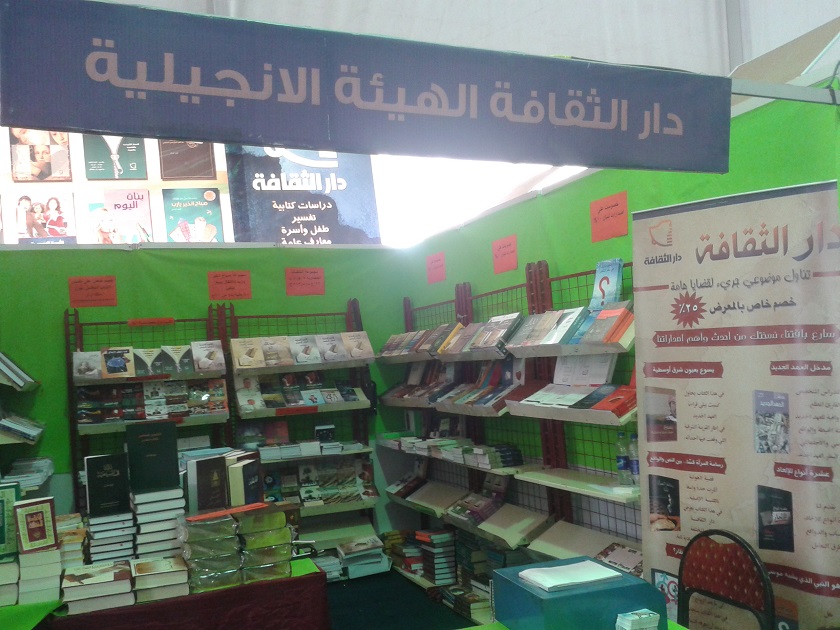
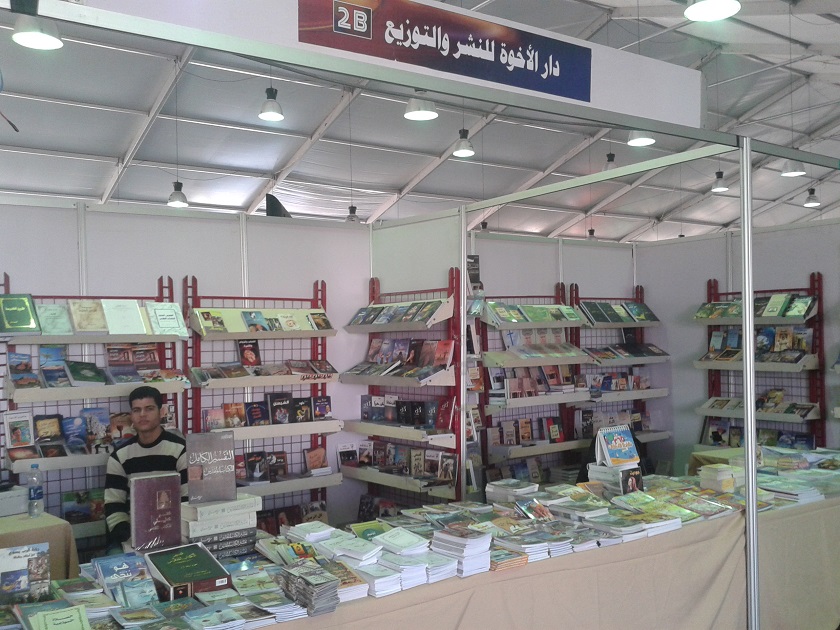
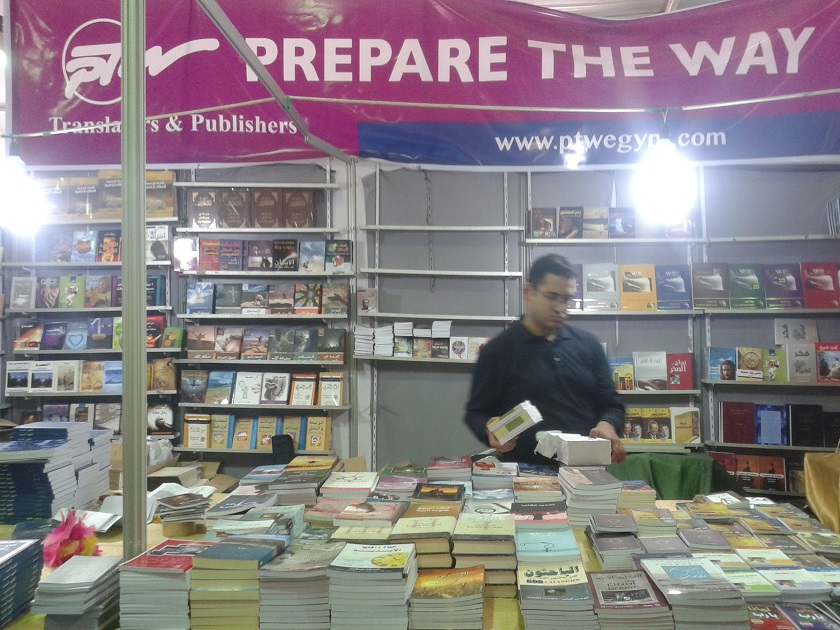
The 46th Cairo International Book Fair is coming to a close on February 12, and I enjoyed strolling through the hundreds of booths selling mostly Arabic books from around the world. The guest of honor this year is Saudi Arabia, but prominent also in a central location are more than a dozen Christian publishing booths selling their products freely.

This is not a surprise. Each is registered with the Egyptian Publishing Union and they have long had a presence at the fair. But this images to follow may not be familiar to many readers who assume either one of these two common perceptions.

First, that Christians are persecuted by a majority Muslim country. Second, that censorship is rampant as the government clamps down on alternate voices.

Both of these perceptions deserve their own comment, but here take a moment to see the diversity of Christian representation. Around two million people frequent the book fair over a two week period, browsing the marketplace as they see fit.

The Bible Society of Egypt
Local distributors of the Jesus Film
Seventh Day Adventists
Local distributors of Focus on the Family and other products
Eagles, local distributors of Focus on the Family and other products
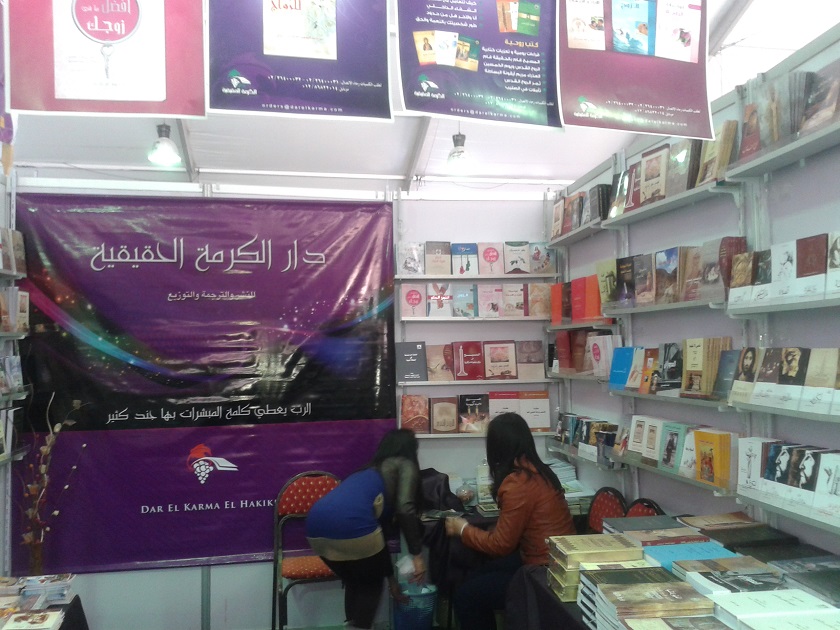
Culture House, the leading evangelical publishing house in Egypt
Culture House, the leading evangelical publisher in Egypt
The Brethren Publishing House
Prepare the Way, a semi-Catholic but ecumenical publishing house
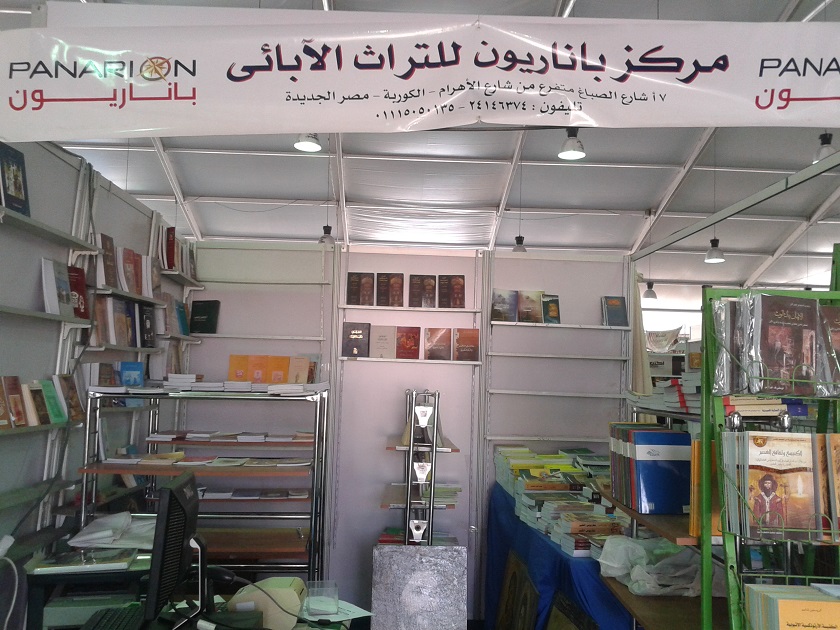
Panarion, publishing works of the early Egyptian church fathers
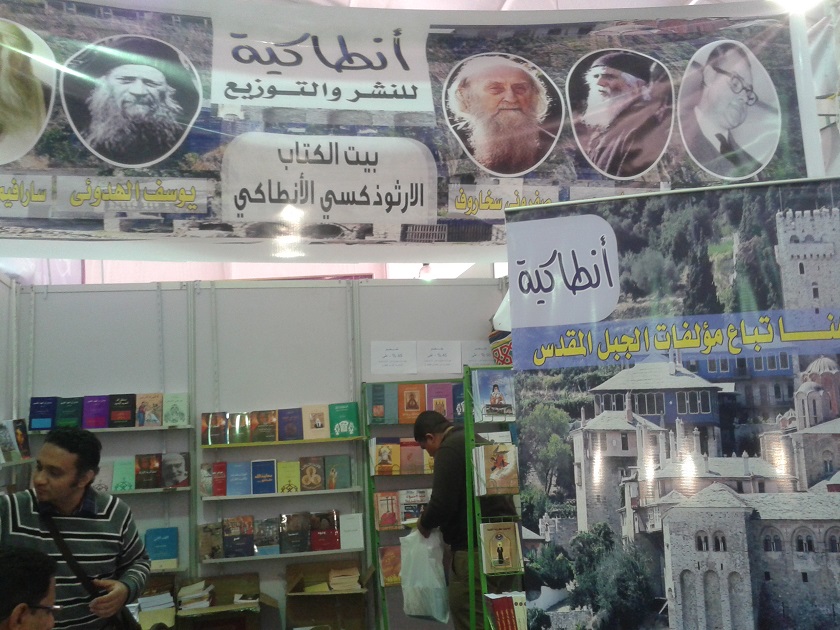
The Antioch Orthodox Publishing house, visiting from Syria
The Anglican Publishing House of Egypt
The Episcopal Publishing House of Egypt
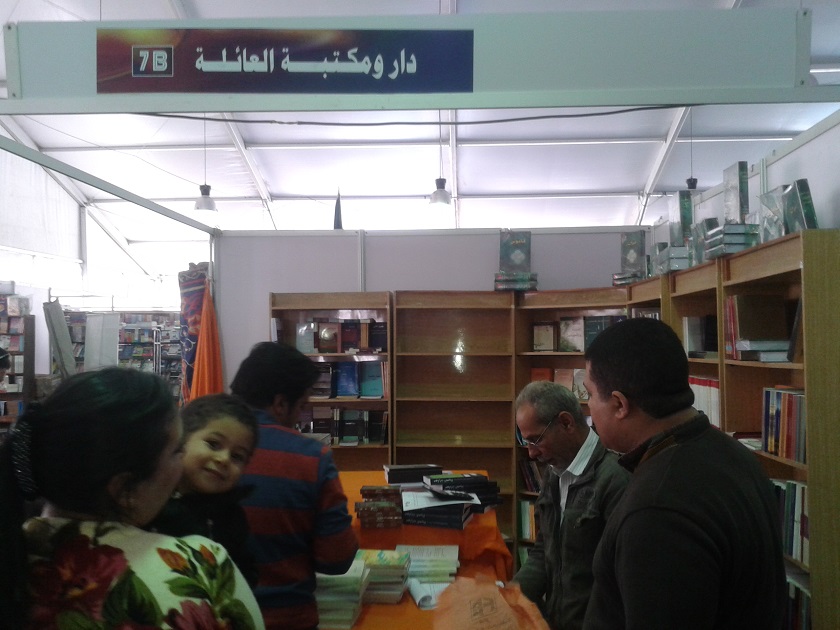
Family Publishers
Family Publishers
True Vine Publishers

I am hopeful a full article about the Christian presence at the book fair will soon follow. Please stay tuned.

Update: The article was tied into the story about the 21 Christians killed by the Islamic State, and How Libya’s Martyrs are Witnessing to Egypt.

Categories
Excerpts

Darwin in Arabia (and America)

Darwin in Arabia

From the Times Literary Supplement, a book review on the reception of Charles Darwin’s evolutionary ideas in the Arab world. First, and especially for Arabic students, the trouble of language:

For a long time, the reception of Darwinism was bedevilled by the need to find either neologisms or new twists to old words. As Marwa Elshakry points out, there was at first no specific word in Arabic for “species”, distinct from “variety” or “kind”. “Natural selection” might appear in Arabic with the sense “nature’s elect”. When Hasan Husayn published a translation of Haeckel, he found no word for evolution and so he invented one. Tawra means to advance or develop further. Extrapolating from this verbal root, he created altatawwur, to mean “evolution”. Darwiniya entered the Arabic language. Even ‘ilm, the word for “knowledge” acquired the new meaning, “science”. With the rise of scientific materialism came agnosticism, al-la’adriya, a compound word, literally “the-not-knowing”.

There is generally a great cultural component to knowledge and science, upon which peoples develop a sense of superiority. There are struggles first to appropriate the new ideas into a new setting, and then, to deny (or ignore) the uniqueness of the culture that produced it.

This process is often seen in the Western (American, at least) historical pedagogy that basically skips from Greece and Rome to the colonial era, with a nod in the direction of the Dark Ages that preceded the Reformation and Renaissance.

But our Dark Ages were a period of great Arab advancement, and the rediscovery of Greek thought was translated through the scholars of the then-dominant Muslim civilization. I’m not sure how much education has changed since I was in school, but this is a theme generally left to the specialists at university level or beyond.

Similarly, the modern Arab world has struggled with resurgent Western superiority. This article demonstrates the point through the theory of evolution, and all the controversy surrounding it:

There were those, like the journalist, philosopher and social reformer Shibli Shumayyil (1853–1917), who welcomed Darwinism and, more specifically, the theory of spontaneous generation as reinforcing the materialist case against Islam. Yet there were also apologists who, like Abduh, claimed that Islam was more compatible with science than Christianity, since Islam was less burdened with excess theological baggage and superstition.

Beyond that there were those, like al-Afghani (eventually), who held that not only had Darwin and his allies and rivals come to the right conclusions, but that Muslim Arabs beat them to it. The Kitab al-Hayawan (“Book of Animals”) by the ninth-century Basran essayist al-Jahiz was often compared to The Origin of Species, and al-Mazhar cited al-Jahiz’s account of how two varieties of dung beetles copulated to produce a third kind as prefiguring Darwin. The tenth-century Syrian poet Abu al-‘Ala al-Ma‘arri was another imaginary ancestor of evolutionary theory and Afghani cited a verse of Ma‘arri’s referring to the transformation of minerals into plants and plants into animals as evidence of this. As far as Afghani was concerned, Darwin had merely recycled ancient ideas about evolution.

… The quest for Arab precursors of Darwinism was not solely or even mainly a matter of cultural pride, for there was also a need to make Darwinism more acceptable by inserting it into a familiar cultural tradition.

This is the example of adaptation, but rejection also mirrored Western patterns, though the review, and the book, does not tease this out as much:

Muslim polemicists against Darwinism gratefully borrowed the Protestant theologian William Paley’s analogy of a watch found abandoned on a beach, since the intricate design of such an instrument surely argued irrefutably for a designer.

… As Elshakry notes, enthusiasm for Darwin and his followers fell away after the Second World War and that enthusiasm turned to outright hostility from around 1970 onwards. The reasons for this lie beyond the scope of Reading Darwin in Arabic. Perhaps the intellectual prestige of the British declined as their empire was dismembered. Perhaps Muslim scholars took their lead from American creationists. The rise of a militant political Islam may also have been a factor.

In my years in the Arab world, I have never engaged anyone over evolution at the scientific level, basically because I have not known many scientists. But at a cultural level I have never found it to be an animating issue. Most have just shrugged it off, either dismissing the idea as antithetical to Qur’anic creationism, or with an general sense that all the West has produced in science has precursors in the Qur’an.

A good number have argued passionately about the ‘scientific miracle’ of the Qur’an (whether for, against, or moderating evolutionary ideas), while a few have identified positively with the prevailing views of the scientific community in favor. Maybe these imprecise percentages would be similar to the views of religious conservatives in America?

The difference would be that a literal reading of the Qur’an is used in both directions, for and against evolution. The pro-evolution category of Muslim literalism believes that the scripture is a book of science; that the mind of God produced it and revealed secrets which make sense only centuries later. Muslims generally believe the Qur’an is unmediated by man, and therefore Muhammad and his cultural setting do not need to be decoded to understand the message. Mankind just needs to advance sufficiently to comprehend what is already there, and sometimes non-Muslims do so first.

A literal reading of the Bible, however, is generally only employed against evolution and in defense of creationism. These maintain a similar idea of the Bible as a science book, or at least trustworthy in its historical and scientific offerings, properly understood. But even the idea of ‘properly understood’ reveals the Christian distinctive vis-a-vis Islam that human and cultural factors influence the Biblical text and our understanding, without giving up the doctrine of God’s inspiration.

Christians, then, who accept evolutionary ideas in part or in full do so with Biblical fidelity to ideas like intelligent design, granting theological truth and divine inspiration to the creation account, without literal acceptance of a seven-day historical sequence. The spectrum, and perhaps slippery slope, in which this and similar accommodations is acceptable is greatly debated. Abduh, above, hints at the larger doctrinal issues at stake.

There is much we can learn from each other, from science, from God. In all, humility is necessary, for no learning can take place without it.

Categories
Christianity Today Middle East Published Articles

175 Leaders Urge US Support in Christianity’s Historical Heartland; Egyptian Churches Not So Sure

From the Ethics and Religious Liberty Commission

From my latest article in Christianity Today, published May 9, 2014:

More than 175 Christian leaders crossed denominational and political divides this week to urge the United States government to do more to help the rapidly diminishing, historic Christian populations of Syria, Iraq, and Egypt.

The solidarity pledge—signed by National Association of Evangelicals (NAE) president Leith Anderson, Focus on the Family founder James Dobson, Southern Baptist Theological Seminary president Al Mohler, and Samaritan’s Purse president Franklin Graham, among other prominent names—presented on Capitol Hill asks for the appointment of a special envoy on Middle East Religious Minorities, a review of foreign aid, and refugee and reconstruction assistance.

“These defenseless religious communities are facing an existential crisis, which threatens their very survival in the lands they have inhabited for centuries,” said Rep. Frank Wolf (R-VA), a longtime religious freedom advocate who helped create the U.S. Commission on International Religious Freedom (USCIRF) in 1998. “The faith leaders … recognize that unless the American church begins to champion this cause, the foreign policy establishment will hardly lead the way. They are committing to be their ‘brother’s keeper,’ whether in Nineveh, Cairo or Homs.”

But Egyptian Christians have a longstanding reticence about outside help:

“We value so much the prayers and concerns of our Christian brethren around the world, and in the U.S. especially,” said Fawzi Khalil, pastor at Kasr el-Dobara Church in Cairo, the largest evangelical congregation in the Middle East. “But we don’t believe outside pressure would be best for our daily life with our Muslim friends. The government of Egypt with local Christian leaders are best suited to fix our problems.”

Please click here to read the full article at Christianity Today, including testimony from other Egyptian Christians and one US Copt who is a signatory.

Categories
Personal

Churches Burn, Christians Sing

This video – with transliterated subtitles – was produced by a church choir in Minya, Upper Egypt, a region which witnessed several severe church burnings. They stand within one church’s charred remains, and sing about love and forgiveness.

May they truly live these words.

Many Christians have spoken that if these heinous attacks are the price they must pay to secure a civil state of free and equal citizenship, they are willing. But are they willing also not just to forgive alleged Islamists who committed these crimes, but also reach out to them in love and understanding? Right now, their temptation is to celebrate the upswing of their fortunes and join in the condemnation, if not demonization, of all things Islamist.

For a view of some of these crimes, please see this video, recently released by the Bible Society showing the attack on its branches in Minya and Asyut.

Yes, if they wish, condemn all things Islamist, but not all people Islamist. This is the test of their song: All crimes notwithstanding, can they differentiate between actions, ideas, and the people themselves? The love of which they sing demands they stand against the tide and seek transparent justice for all currently accused.

And then, amidst it all, to forgive. This is far easier in song than in deed, but meditation in song can transform the heart. Can it transform the Copts? Can it transform the nation? The outlook is bleak, therefore, keep singing…

Categories
Atlantic Council Middle East Published Articles

The Quest for Minority Rights in Egypt

Minority RightsFrom my recent article on Egypt Source:

Coptic Christians have reason to celebrate… alone. While they and many others rejoice at the removal of the overall Islamist tinge of the 2012 constitution, this largely liberal-produced draft leaves other religious minorities out in the cold.

“One of the main concerns we have is that freedom of religion is limited to the heavenly religions,” said Chris Chapman, noting the non-recognition of Egyptian Baha’is in particular. “Freedom of religion is absolute and there should be no exclusion.”

The current draft of the constitution, slated for referendum on January 14, makes absolute the freedom of belief. Practicing religious rites and building houses of worship, however, is limited to Islam, Christianity, and Judaism.

But the article is not an analysis of the constitution but a description of why the largely liberal drafting committee did not secure greater rights for all, and what might be necessary for Egypt to fall in line with the international agreements it has signed. The interview is with Chris Chapman of Minority Rights Group, who recently presented his findings in Cairo.

Chris Chapman
Chris Chapman

From the conclusion:

If this constitution, however, does not fully satisfy liberal activists, a long term focus is necessary to transform a repressive environment to one respectful of human rights. “It happens gradually,” Chapman assured, “as a process of consultation and negotiation. I see Egypt as moving in the right direction, but it hasn’t got there 100 percent yet.”

Until it does, Chapman has the advantage of calling from the outside for both the rule of law and proper legislation. He urges activists and citizens alike to lobby for the rights of Copts, Baha’is, Shia, and others, but the ultimate onus falls on the government.

“This is international human rights law,” Chapman said. “If Egypt is going to live up to its obligations it must respect freedom of religion and belief.”

Please click here to read the full article at Egypt Source.

Categories
Arab West Report Middle East Published Articles

Christian Convert Arrested in Egypt: Details and Background

Mohamed Hegazy, now known as Bishoy Armia, though not legally

From my recent article on Arab West Report:

Muhammad Hijāzī, born in Port Said in 1982, converted to Christianity in 1998 at the age of 16. Now 31, he was arrested on December 4, 2013 in the governorate of Minya on charges of espionage, inciting sectarian tension through evangelism, and unlicensed photography and journalism.

In 2007 Hijāzī became the first Egyptian convert to Christianity to petition the state to change the religion field on his ID card, and has changed his name to Bishoy Armia Boulos. According to his former lawyer, Mamdūh Nakhlah, had anyone else but Hijāzī been working in Minya, no charges would have been filed.

Nakhlah agreed to represent Hijāzī in his 2007 lawsuit, but later withdrew due to pressure from the church. His information now comes from overall familiarity with the current case, as well as contact with those in the area where he was arrested. Nakhlah believes the main charge of espionage is fabricated, but that there are enough convenient details surrounding the case to give the prosecutor a pretext to arrest Hijāzī.

Please click here to read the full article, speaking of these pretexts – including a media relationship with one of the figures involved in the production of the ‘Innocence of Muslims’ film that sparked protests throughout the region. The article also goes through the history of his efforts to register his religious change, which are still pending on appeal.

(photo from MCN via Google Images)

Categories
Personal

Surveying Foreign Christian Residents in Egypt on the Interpretation of Political Events

St. John's Church Maadi

In Egypt’s current political struggle both sides are using the media to highlight their interpretation of events. State media is accused of turning the nation against the democratically elected president and his backers in the Muslim Brotherhood. Meanwhile, anti-Islamists target Western media in particular of having a bias toward the Brotherhood, against the military, and neglect the popular role in Morsi’s overthrow.

This survey was designed to test one overlapping segment within this struggle to establish a media narrative: foreign Christian residents.

Two assumptions were made of this community. First, they would be sympathetic to local Coptic opinion, which is strongly anti-Islamist. Second, they would be consumers of Western media and generally trust their journalistic professionalism.

Thirty-three individuals were surveyed, including both leaders and laity of the Catholic and Protestant foreign communities of Egypt. They were asked fifteen questions concerning recent political events beginning with the election of Mohamed Morsi as president. Each question was provided various options, reflecting the opinions and conspiracies of both camps.

Participants were allowed to choose more than one answer, if multiple interpretations were possible. They were asked only to choose according to their leanings and perceptions, not according to an elusive certainty or proof. Not all participants answered each question. In the results which follow, this explains why some percentages are provided with the qualifier ‘among those responding’.

Here are the questions as they were posed to participants:

1.      Did Mohamed Morsi legitimately win the presidential election?
2.      Were Egypt’s political problems caused by:
The desire of the Muslim Brotherhood to dominate
The deliberate non-cooperation of opposition parties
Normal competition after a revolution
3.      Were Egypt’s economic problems caused by:
Morsi’s mismanagement
State sabotage of gas and supplies
Continuing deterioration since the revolution
4.      Did Western powers support Morsi because:
He was the legitimately elected president
They desired the Muslim Brotherhood to replace Mubarak
They desired Islamist rule to weaken Egypt
They desired to discredit Islamism by letting it rule temporarily
5.      Did Morsi and the Brotherhood desire:
To turn Egypt into an Islamic state
To recreate the Mubarak regime
To shepherd in a civil democracy
6.      Was the Rebellion (tamarrud) Campaign:
A grass-roots movement expressing popular rejection
Aided by the military/state/businessmen
A conspiracy to end the Morsi presidency early
7.      Should the military have:
Intervened to depose Morsi as actually happened
Waited longer to see how things would develop
Not intervened at all
8.      Was the military action a coup d’etat?
9.      Was the removal of Morsi:
Mostly positive for Egypt
Mostly negative for Egypt
Both positive and negative in different ways
Necessary for Egypt
10. Should the Rabaa al-Adawiya protest site:
Have been dispersed
Have been relocated to another area
Have been left to protest indefinitely
11. Why did so many people die:
Because of deliberate excess force used by the security services
Because of poor training in crowd control
Because of pro-Morsi armed resistance
12. Were the widespread attacks on Christians and their churches:
Orchestrated by the Muslim Brotherhood
A spontaneous reaction by pro-Morsi supporters
The action of criminals exploiting the situation
A conspiracy by the state to tarnish the Islamists
13. Should the Muslim Brotherhood:
Be labeled as a terrorist organization, banned, and prosecuted
Be invited into national reconciliation
Be allowed to participate in the new democratic roadmap
Be forbidden from politics but allowed a social role
14. Does the military desire:
To rule directly (perhaps through a retired general)
To have influence and guardianship from behind the scenes
To maintain its economic privileges
To secure a true and open democratic transition
To destroy the Muslim Brotherhood
To prevent Islamist rule in general
15. Will the coming months/years in Egypt witness:
The development of an emerging democracy
The return of an autocratic state
New economic prosperity
Continued economic deterioration
A reversal back to Islamist rule (democratic or otherwise)
Low-level, but violent Islamic insurgency
War (either civil or regional)


Each possibility was given a ‘yes’ or ‘no’ choice to indicate the perception of the participant.

Here are the key findings:

Did Mohamed Morsi legitimately win the presidential election?

  • 52% said yes, 48% said no, roughly mirroring his percentage of winning

Egypt’s political problems were caused by:

  • 97% of all surveyed believed it was due to the MB’s desire to dominate
  • 45% also blamed deliberate non-cooperation on the part of the opposition
  • 36% attributed it to normal competition after a revolution

Egypt’s economic problems were caused by:

  • 82% blamed Morsi’s mismanagement
  • 42% also blamed a state policy of sabotage
  • 82% believed the poor economy following the revolution played a role

Western powers supported Morsi because:

  • 73% believed it was because they recognized him as the legitimately elected leader
  • 24% believed they desired the MB to continue Mubarak’s policies, with 9% support for other conspiracy theories

The political desire of the Muslim Brotherhood was:

  • 100% to turn Egypt into an Islamic state
  • 0% to turn Egypt into a civil democracy

The Tamarud Campaign was:

  • 82% believed it to be a grass roots campaign
  • But 67% believed it also to be sponsored by the army, state, or businessmen
  • Even so, respondents divided evenly if it was a conspiracy to remove Morsi from power, though only 30% of everyone surveyed indicated this

On military intervention to depose Morsi:

  • 70% agree with their decision to do so, as opposed to waiting longer or doing nothing
  • But 47% call it a coup anyway, while 53% believe it does not deserve that label
  • 93% of those responding believe this action was mostly positive for Egypt
  • 75% find that it was also somewhat negative
  • 85% believed it was necessary

On dispersing the pro-Morsi sit-in:

  • 79% agreed with the decision to do so
  • 88% believe that many people died due to the MB’s decision to resist with arms
  • 45% also believed the security forces deliberately used excess force
  • 48% believed poor training on the part of the security forces contributed

On the subsequent attacks on churches:

  • 76% believe these were orchestrated by the Muslim Brotherhood
  • 58% believe it was a spontaneous action by Morsi supporters
  • 48% also thought criminal elements were involved
  • 9% believe it was at least also a state conspiracy to make Islamists look bad

The Muslim Brotherhood should be:

  • 42% believed it should be labeled a terrorist organization and banned
  • Only 27% opposed this designation
  • Responders were roughly divided between inviting them to national reconciliation and allowing them political participation in the new elections, with slightly more positive response

The military desires:

  • Of those responding, 59% did not believe the military wants to rule directly
  • But 73% believe they want to maintain significant influence behind the scenes, and 52% to maintain their economic interests (0% opposition to this idea)
  • Of responders, 60% believe the military wants to conduct an open democratic transition, but 40% do not
  • 48% believe they want to destroy the Muslim Brotherhood, and 61% believe they want to prevent Islamist rule in general

The future holds:

  • 48% of all and 73% of responders are confident a real democracy will begin to emerge
  • At the same time, of those responding, half fear the return of another autocratic system
  • 55% believe the economy will continue to deteriorate, with only 27% predicting new prosperity
  • Only 3% predict a return to Islamist rule, but 79% predict a continued low-level Islamist insurgency
  • 9% predict war in Egypt’s near-term future

In quick summary, therefore, this sample of foreign Christian residents of Egypt indicates the community largely accepts the anti-Islamist narrative concerning the Muslim Brotherhood, while at the same time displaying significant, but not universal, distrust about the role and intentions of the military and state.

Determining whether their perceptions are correct or incorrect was not the goal of this survey. Rather, results indicate the following possibilities:

  • Foreign Christian residents are disproportionately influenced by local anti-Islamist sentiment or their own anti-Islamist inclinations
  • Western media has not exhibited sufficient pro-Islamist bias to sway their interpretation of events, but has contributed to a distrust of local actors
  • As residents, these foreign Christians are well placed to interpret local events.

Other interpretations are also possible, including combinations of these three.

Western media is understood to be professional in its coverage, though subject to the ability to find suitable local spokesmen to convey perspectives. Most actors in Egypt are polarized and subject to their own biases.

Egyptian state media, however professional, is understood to be the voice of the government, and independent media has been drawn into the local dispute. Pro-Islamist media has largely been shut down.

In wading between the two, one further assumption is necessary concerning foreign Christian residents: They will represent the truth as they perceive it. The value of this survey consists therein.

Categories
Excerpts

An Alternate History for Pope Tawadros

From Salama Moussa, writing with deep respect for the Coptic pope and the impossible leadership position thrust upon him during divisive political times. Still, he wonders if things could have been different:

Three months after the July 3 events it is still impossible to criticize Pope Tawadros II presence on the stage with General Sisi and Sheikh Al Azhar. It is, however, possible to think of an alternative history. In that history the Pope would have indicated his support privately but refrained from the public display to lessen his political burden, one that he insisted he did not want in the first place.

He could have also indicated privately that while disapproving of the ideology of the Muslim Brotherhood, and not wishing them an exclusive role in running Egypt, he could not sanction the killing of either the innocent or the guilty. In doing so he would have assumed the role of a father to the Muslim Brothers, of whose behavior he surely disapproves, but whom he must love as children of God. It is a tough task, fit only for a Patriarch.

Would such a stance have lessened the attacks against the Copts?  Probably not. Would it have made the state serve them less? Possibly. The current feeble efforts can still be weaker. It would have placed the Pope among the ranks of the most exceptional men of the new century, and possibly given a template for reconciliation to the hardened hearts of the Egyptian political class. There is no doubt of the risk of such actions toward the Copts of Egypt, but maybe it is time for the Coptic Church to aim wider than just Egypt, and higher than just its needs.

It would also have been Christian in the literal sense; the sense that Christ’s ministry aimed for the fallen and deluded.

Moussa is cautious about issuing his opinions from afar, not being in Egypt. But perhaps this vision can still be considered, and not just viewed as a missed opportunity.

Categories
Current Events

Egyptian Writer May Face Jail for Defaming Religion

From Ahram Online, telling a story that is not unusual:

Saber says those who filed the lawsuit took his words out of context, adding that he did not defame religion in his short stories.

“In my stories, the characters are wondering where God is in the face of all the grievances and evils that they face. It’s like they’re asking him to interfere; this is not in contempt of religion, it is merely posing a question,” Saber explained.

Here is an angle, though, what while also not unusual, is less known by many:

According to a statement made by a coalition of Egyptian right human rights organisations, the prosecutors undertaking the investigation consulted the church in Beni Suef as well as Al-Azhar to seek out their opinion as to whether the accusations were correct.

The church told the prosecution that the content of Saber’s literary work contradicted divine religions, ridiculed the divine, and invented stories that stray from noble and sophisticated literature.

Al-Azhar affirmed the church’s stance, stating that the work destroys intellectual values and tears apart the fabric of Egyptian society.

The church in Egypt is a very conservative institution that is not shy to seek the power of the state as a defense against encroachment on religious values. I do not know anything about the content of the book, if it targets Islam, Christianity, or religion in general. The author’s name also does not infer his religious background.

But the church would do well to review its own literature. Habbakuk the prophet does little but rail against God’s apparent inaction in the face of injustice:

How long, Lord, must I call for help,
but you do not listen?
Or cry out to you, “Violence!”
but you do not save?
Why do you make me look at injustice?
Why do you tolerate wrongdoing?
Destruction and violence are before me;
there is strife, and conflict abounds.
Therefore the law is paralyzed,
and justice never prevails.
The wicked hem in the righteous,
so that justice is perverted.

And his answer is simply to trust God, even when he does not ‘deliver’:

Though the fig tree does not bud
and there are no grapes on the vines,
though the olive crop fails
and the fields produce no food,
though there are no sheep in the pen
and no cattle in the stalls,
yet I will rejoice in the Lord,
I will be joyful in God my Savior.

It is unfortunate when religious leaders ‘protect’ their flock from the very same doubts and questions that fill their scriptures. But this, also, is not an unusual story.

Categories
Personal

Humble Wrestling: The Only Solution for Islamists and Christians?

I believe events like this conference in Jordan, excerpted below, are absolutely necessary, even if they don’t really go anywhere. But agreement can never be achieved unless they go at all. Here, from al-Monitor, is an example illustrating absolutely different worldviews:

So an obvious question was posed to the Islamists: Do you accept, alongside your Islamic laws and alongside the personal status laws for other communities, that in your countries there is also one civil personal status law that is optional? In other words, do you accept that a person is given the choice to either follow the laws of his sect or leave his sect and resort to the civil law under the confines and protection of the state?

Faced with this question, the Islamists did not hesitate to assert their absolute refusal of the proposal: a civil law, even if optional, is forbidden — a person may not leave his religion. By “person” they mean a “Muslim,” because current laws allow non-Muslims to convert to Islam. Sometimes they even encourage it as a means to either escape harassment or obtain a government job reserved for Muslims, in addition to dozens of other reasons.

In lieu of agreement, the article states attendees suffered ‘a vicious cycle of pleasantries’. Such a description characterizes much inter-religious dialogue, and is useful in its own right. Pleasantries can lead to friendship.

But what is necessary, especially in Egypt, is for Christians and Islamists to wrestle over the future of their nation. Christians may not be able to force their way, but if Islamists were to seek their blessing, and do all that is necessary to get it, they just might succeed.

The Islamists did not hesitate to confirm they have the right to reach power as they see it and practice it. They kept repeating the following mantra: “We will only resort to democracy that emanates from the ballot box.” Many tried to explain to them that democracy is not just the ballot box, but the Islamists did not pay them much attention. The Islamists’ main concern was to assert their rejection of what happened in Egypt and confront the rule of the “coupists,” as they call Gen. Abdel Fattah al-Sisi’s rule, against the legitimate authorities. Regarding the concerns of their fellow Christian citizens, it seemed to a large extent to not be part of their concerns today or tomorrow.

Unfortunately, this has largely been Egypt’s experience.

It is hard for anyone to be humble. Many Islamists might find it even more difficult to seek this Christian blessing, as they see themselves as the possessors of the completed and perfected faith, and furthermore, they are numerically superior. How arrogant, they might think, of Christians not to yield. Don’t we give them protection under sharia law?

Ah, but this means little to them:

One last example that illustrates the dialogue’s difficulties was the discussion about personal status laws in countries dominated by Islamists. The Islamists usually try to show that they are open to other groups by supporting, as a rule, that other sects are given their own personal status laws — whereby every sect is given its own laws governing marriage, divorce, inheritance, adoption, transfer of ownership and other family matters. But at the same time, the Islamists insist that Islamic law is a “major” or a “principal” source of legislation of the state. Discussion by Christian participants at the conference showed that this rule is not sufficient, fair or balanced. In fact, it often conceals a gradual process to subdue non-Muslim citizens in those countries by degrading the minorities’ demographic and geographic presence, Islamicizing society and eliminating pluralism.

Islamists either smile slyly at this complaint, choose to ignore it, or else they cannot even comprehend it – confident in their understanding of God’s will in sharia law as best both for them and for Christians. True humility is harder for the one who believes that he already humbly and generously gives to his ‘lesser’. They have a point, but humility does not prove points. It loves and embraces.

So what should humility look like for the Christians? No one must ever abandon principles and convictions. Humility is not a game of power and pressure. Rather, it must come in an acknowledgment that Islamism is a strong societal impulse, and those who possess it are their fellow citizens.

Here is where it is easy, and necessary, for me to duck out of the discussion. If both sides came humbly, what would they decide? Here, I have no say. Even in asking both sides to come to the table I have nearly gone to far. Why should they yield even that initial bargaining position, when sides are viewed in mutual distrust?

I don’t know, and I can’t convince them. All I can do is trust that it is ‘right’. All I can hope for is that God would honor it, and dishonor all who seek first their particular benefit.

After all, the status quo is not working. Christians are often ignored or used as pawns, and Islamists have failed to successfully establish their project anywhere there is religious diversity.

It is not dialogue that is necessary, though it is helpful. It is wrestling. It is the sort that, like Jacob with the angel, would not let go until he secures a blessing. It is the sort that engages in respect and will not cease until it is mutual.

I don’t know, maybe that is not humility at all. But humility might be able to avoid Jacob’s fate. Though he obtained his blessing, he lived the rest of his life with a dislocated hip.

Christians and Islamists have dislocated far more. Perhaps it cannot be otherwise. Perhaps their ideas are completely incompatible.

Fair enough. Ideas cannot be humble, they can only seek their own. But people are more flexible. People can wrestle.

People can bless. It is time Christians and Islamists begin this strategy with one another, even if unilaterally.

Categories
Excerpts

Brief Portraits of Egyptian Atheism

Arabic Atheism

From Egypt Independent, on a very taboo subject in which some have given their full name and testimony:

Those who have come out publicly as atheists have been not only isolated by their friends and families, but also society in general. However, others who turn down their familial religion have faced many worse trials than mere isolation.

Asmaa Omar, 24, who has just graduated the Faculty of Engineering, said that once she revealed her beliefs to her family, they began to physically and mentally torture her. Her father slapped her in the face and broke her jaw. She was not able to eat properly for seven months.

Both her immediate and extended families began to insult her. “You just want to have free relations with boys,” they would say, or “You used to be the best girl in the family,” and “Now you’re a prostitute.”

Some come from a Christian background:

Ayman Ramzy Nakhla, 42, comes from a Protestant background. He worked in preaching Christianity with the church, but then decided to abandon religion altogether. He is now not very much concerned with knowing if God really exists or not.

Nakhla’s father was a priest, and Nakha worked for ten years as librarian in the Theology College of the Evangelical Church, and as an assistant to a priest, which is an administrative position. Ramzy says that this background was the one that actually led him to lose interest in religion, getting so close to the truth of the Church made him decide to leave it.

Others from a Muslim background:

Other atheists say they believe atheism is in fact more moral than the old, rigid moral codes offered by traditional religions.

Omar says her journey began when prominent cardiologist Madgy Yaqoub managed to treat a two-year old relative of hers in open heart surgery. Rahman, the child, had a valve that did not work and another with malformation.

The successful operation led Omar to wonder how a man such as the doctor, who had lived his life saving many children like Rahma, could be thrown to hell for not being a Muslim. Omar found that religions just chose its followers to end up in heaven, and say that other people would go to hell, regardless for whatever good deeds they do in their life.

Omar says she believes in God, but is against all religions. She says she is still looking for Him and is not aware of His truth.

As a result, some mix between the two:

Some atheists, however, still feel without religion, they are missing something. Despite her rejection of religion, Kamel still misses the spiritual side, resorting to Sufism as she attends Sufis meetings and listen to sufi music, especially those of al-Naqshbandi and Nasr Eddin Tobar. She also enjoys listening to Christian hymns and is massively affected by them. She says, however, that this is just a need for spirituality, nothing more.

Kamel goes back to saying that she has not yet reached a final result for her inner conflict.

Indeed, Egypt is changing. Your vote: Is this for better or for worse?
Categories
Christianity Today Middle East Published Articles

Conversion Confusion

Conversion Confusion Image

From my latest article in Christianity Today, from the April edition and published online on the 18th:

Nadia Mohamed Ali was raised in a Christian home, but when she married Mustafa Mohamed Abdel-Wahab in 1990, she converted to Islam. After his death, she obtained new identity cards—required under Egyptian law—that declared her and her seven children Christians.

Then came the ruling by a criminal court this January: “Egyptian Court Sentences Family to 15 Years for Converting to Christianity” read the Western headlines. Several U.S. religious freedom watchers declared Ali’s sentence a “real disaster” that “underscores the growing problem of religious intolerance” under Egypt’s new, Muslim Brotherhood-backed government. A shocking headline, indeed.

A cut-and-dry case of religious persecution? Not quite.

“They were imprisoned for fraud, not for conversion,” says Mamdouh Nakhla, founder of the Word Center for Human Rights in Cairo. The Coptic lawyer claims the family paid government workers to forge new identity cards. They registered their religion as Christian under Ali’s maiden name so that she could obtain her inheritance.

There is an underground market for such fraud:

“I was introduced to a certain priest—now deceased—who knew a certain Christian who works in the Civil Registry,” says Sheikh Saber (using his Muslim name, not his forged Christian identity). “He takes the bribe and distributes the money around for assistance in covering it up.” In 2003 Saber obtained new IDS, birth certificates, and a marriage license for his family. The cost of this illegal “service” now runs up to $2,500 per person.

The article proceeds to discuss in some depth the role of inter-religious love affairs and marriage in conversion, to which difficult social conditions also contribute. But there are accusations the conversions are not just a product of sociology:

Meanwhile, some Muslims target Coptic Christians for marriage to convert them. “The Coptic people are downtrodden,” says Isaiah Lamei, a priest who provides pastoral care for troubled Copts. “Muslims take advantage and get them to sign papers of conversion [so Copts can] fix their problems.”

Every year, Lamei ministers to 30-40 families in his diocese that have been approached by Muslims offering such “help.” “These problems can be emotional or financial,” he says. He estimates that in his diocese every year, “two or three convert to Islam.”

It’s hard to verify whether Muslims really marry Copts just to draw them into Islam. But it’s also hard to verify the sincerity of Muslim conversions to Christianity.

“We must be cautious,” says Cornelis Hulsman, editor in chief of the Arab West Report. “I have met converts who are sincere, and I’ve met converts who have other interests.”

Nakhla agrees. “Some converts come to me and say they want to marry a Christian. Or they request money, or work, or an apartment,” he says.

From time immemorial mankind has known of the power of religion in both fraud and piety, manipulation and sincerity. It is frustrating to navigate the divide.

Examples of grace and ‘ungrace’ abound, but in service of both mankind and God, toward whom religion is said to direct, the navigation is necessary.

Please click here to read the full article on Christianity Today.

Categories
Christianity Today Middle East Published Articles

Is Coptic Evangelism in Africa Really on the Rise?

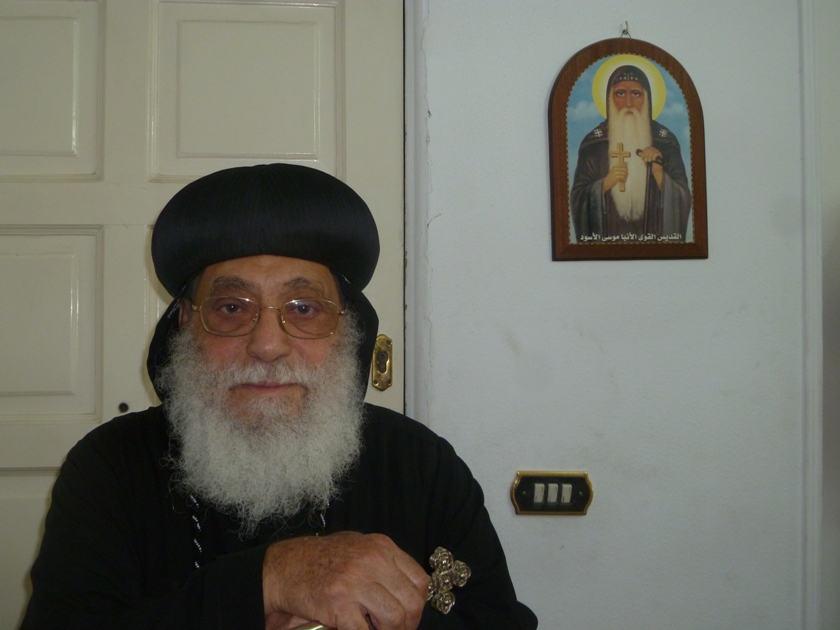
Bishop Antonious Marcos, missionary bishop for Africa. Behind him is a picture of the Coptic saint know as St. Moses the black.
Bishop Antonious Marcos, missionary bishop for Africa. He served first in Kenya and now in South Africa. Behind him is a picture of the Coptic saint known as St. Moses the black.

From my latest article on Christianity Today, published March 28, 2013:

Many Egyptian Christians wear their faith on their sleeve—literally. The cross tattooed on the wrist of Coptic Orthodox believers is a public display which marks their identity for all to see.

Such a quiet witness usually avoids reproach. But recently in Libya, radical Muslim militias detained dozens of expatriate Christians in Benghazi. Amid allegations that captors seared off such tattoos with acid, one Christian died from medical complications during the ordeal, and a Libyan church was repeatedly attacked.

Accusations of evangelism have been at the heart of a series of recent incidents of violence—including the first Coptic martyrs of the modern era—against Copts in Libya, Sudan, and Egypt. Which raises the question: Are Copts starting to recover their missionary heritage?

This article was co-written with a colleague from Sudan, who mentioned the following incident:

Last December, two Coptic Orthodox priests were arrested after baptizing a female convert from Islam. Since the arrests, stories about arrests of Westerners and other Christians attempting to spread the faith circulated in media linked to the state security apparatus, although the accuracy of the reports is hard to ascertain.

Though some Sudanese Copts have enjoyed business success under the Islamist government of President Omar al-Bashir, other denominations have seen their churches destroyed either by mobs or by the state, which cites the breaching of planning laws. With the independence of South Sudan removing the great majority of the nation’s Christians, Bashir has promised a 100-percent Islamic constitution.

Tensions are high also in some Egyptian villages:

There are signs Muslims feel threatened in Egypt as well. Recently churches have been attacked in Beni Suef and Aswan over female converts to Christianity alleged to be hidden inside. Generally this is understood as a Muslim community effort to save face when a woman breaks community traditions or runs away with a lover. Others think true faith might have a role.

“It is an untold story that every now and then a Muslim can be convinced and convert to Christianity,” said Youssef Sidhom, editor-in-chief of the Coptic newspaper Watani. “It is always done secretly, but somehow here it became public. In Upper Egypt especially, this creates a social scandal regardless of the direction of the conversion.”

But far from politically and religiously sensitive conversions in Muslim lands, the Coptic Orthodox Church maintains missionary bishoprics in sub-Saharan Africa:

The reality is the Coptic Orthodox Church remains committed to planting churches—just not in the direction of Muslims. In the 1970s, Pope Shenouda consecrated the first of two bishops for service in sub-Saharan Africa. Today, 65 churches serve more than 400,000 Copts in Kenya, Zambia, Congo, and other nations.

“The early riches of the Orthodox tradition are spreading again in Africa,” said Antonious Marcos, appointed missionary bishop to Kenya in 1976 and now based in South Africa. “Our church is a missionary church, because it was started by a non-Egyptian: John Mark.”

This was a very interesting article to research and write, showing a side of Coptic Christians often not well known in the West. As for the question in the title, are they recovering their evangelistic impulse: Well, they are accused, it seems some are, and reality is just as murky as with Christians around the world.

Please click here to read the full article on Christianity Today.

Categories
Personal

The Deeper Meaning in Oriental Orthodox Colors

If you’d like a look at me in action, a friend found this video from a few months ago. I simply stand, and mouth the words to the Nicene Creed along with the rest of the Syrian Orthodox congregation.

The occasion was the installment of Pope Tawadros; representatives of this sister Oriental Orthodox Church were in attendance. Before traveling back to their own countries in Syria, Lebanon, and Iraq, they had a joint service together in downtown Cairo.

My appearance is at about the 7:00 minute mark. It is worth a few minutes of your time, just to enjoy the different and vibrant color schemes of each church. In attendance with me was the former head of the Middle East Council of Churches, who I’m sure could explain the differences.

I remember at the time thinking I would write about the experience, but other projects placed it on the back burner until it was forgotten. But now I recall the fun, the boredom, the familiarity, and the small differences between these ancient adherents of the faith and their Coptic brothers I have come to know.

On the one hand, they seem utterly irrelevant. They are small, declining churches surrounded by violence and conflict. They have funny hats and peculiar beards. They did have a good time together, as did the small congregation of a hundred or so worshipers.

But of what value are these churches, these dresses, these colors, to the people of Syria, Lebanon, and Iraq? What difference does this faith make to those suffering, to societies in collapse, the remaining faithful?

Perhaps the question can be what good is this faith anywhere? Does it transform, does it serve, does it save? There is no peculiarity to the Arab world.

But this faith is ancient, and those privileged to existentially wonder about it from the comforts of Western experience would do well to learn. I only wish I knew what the lesson is.

Is that the point? There are Christians in this world in the lap of luxury, and others in the deepest poverty. There are some who preside over the greatest military power in history, and others who are stomped upon by the weapons of war.

The world has made it possible for these worlds to connect, only adding to the complication. But for centuries it was such, and each slice of the Christian world had only slight knowledge of the extended family.

So what good does it do Syria to have a Christian costume party in Cairo? What good does it do America to have a Christian rock concert in a movie theater? What good does it do you to see a transplanted American in their mix, who assaults you with these questions?? What good does it do them that I was there at all?

Of course, each of these questions presupposes the ‘good’ of Christianity is for this world. It is, right? I would so like it to be.

But the Oriental Orthodox churches remind amid their colors and pomp and circumstance that worship probably has very little relevance to what good this world needs. More poignantly for me and probably most readers here, what I as an individual need.

But with God you cannot say it is what he needs, either. So what is the point?

Still, I have no lesson. Can faith and humility be ok with this? They must, lest you throw it all away.

Here, there is no certainty, there is no peculiarity, there is no victory. God can grant them each at other times if he wishes.

Instead, we wonder, we reflect, we appreciate. If all is well, we share, we worship.

If we like, we wear funny colors, or do interpretive dance.

And if he leads, we welcome marauding militias, or sign petitions against hovering drones.

And if he leads, we fight against oppressive regimes, or lobby against oppressive taxes.

But in the end, together, we mouth the Nicene Creed.

We believe in one God…

And we trust, in the end, it will be good.

Categories
Excerpts

Is Islam by Nature Political?

From Ahram Online, an op-ed arguing on behalf of Islamists, that Islam is essentially political:

A final point. Some of the opposition figures keep invoking the term “political Islam,” as if the term were a source of shame to Islamists.

Well, political Islam is not the invention of the Muslim Brotherhood or other Islamists. It is rather solidly rooted in Islam and its holy scripture, the Quran.

I am not going to discuss certain arguments made by anti-Islam secularists who claim that the rule of Sharia is not a must upon Muslims and that Muslims might opt for modern Western-style democracy without violating the tenets of their faith. These arguments are quite nonsense, even for first grade Muslim children.

But I do want to point out that one cannot reject political Islam as a matter of principle, without rejecting Islam itself.

Yes, one might disagree with certain Islamist modalities, behaviours and interpretations. We all reject violence and terror committed in the name of religion. And we all would like to see a kinder and gentler practice of Islam everywhere.

But we must never allow ourselves as Muslims to compromise the main principles of our faith in order to appear more in tune with the age, and more acceptable to the West.

As a non-Muslim, it is never wise to argue what Islam is or is not. This, ultimately, is for Muslims to decide. But just as many demonize Islam saying it is a terrorist and illiberal religion, others assert the opposite, making it a personal faith akin to the Christianity of the West.

Religion and culture easily bleed together; certainly many Western Muslims do practice a personal faith. This voice, however, asserts that Islam is inherently political. It may be (and is) able to live peacefully as a minority faith, but it is not content here.

Consider a similar example: Does the word ‘Jew’ represent a faith or an ethnicity? Many Jews are agnostic or atheist; some convert to Christianity yet still consider themselves Jews. Perhaps there are few converts to Judaism outside of the ethnicity, but the line is sufficiently blurred to be confusing. Are you an anti-Semite if you deny the historicity of Moses?

Along the same lines, is Islam a faith or an ideology? Many Muslims are non-political, but does the faith demand more? Those who have claimed the mantle of leadership in the Arab Spring overwhelmingly say yes. Do they distort their religion? Or, do they compromise the many western Muslims who are forced to defend themselves from polemicists suspicious of them as a fifth column?

Judaism was birthed as the religion of a chosen family, marked by circumcision, wary of outsiders. Islam was birthed as the religion of a state, marked by confessions of loyalty, enveloping the outsider. Each one today houses the paradoxes of its emergence.

Can anyone attempt a similar consideration of Christianity?

Related Posts:

Categories
Uncategorized

Christian Center Opens in Iraq

From Ahram Online:

Authorities on Sunday opened what they billed as the first Christian cultural centre in Iraq in a decade, despite a dramatic decline in the country’s once significant Christian population.

The building was inaugurated in the northern city of Kirkuk, home to a diverse population of Arabs, Kurds and Turkmen, and is to host conferences and meetings to promote inter-faith communications between the city’s Muslim and Christian communities.

“This centre is the first of its kind in Iraq since 2003, it sends a message of peace, and promotes the language of dialogue,” said Louis Sakho, Chaldean archbishop of Kirkuk. “The communities of Kirkuk are one family,” he added.

Construction of the cultural centre, which lies next to Kirkuk’s Chaldean church, began in early 2012 and was completed at a cost of around $305,000, officials said.

Iraq’s Christian community is one of the oldest of its kind in the world, but they suffered persecution, forced flight and killings in the aftermath of the 2003 US-led invasion.

Before 2003 there were more than a million Christians living in Iraq. Now they number around 450,000.

Half a community lost in a decade, a nation ruined during the same period (and before). All from a demagogue’s pride, a superpower’s dismantling, and a divided people’s sectarianism.

Perhaps this small step will represent an effort to rebuild from anew, inclusively.

Related Posts:

Categories
Christianity Today Middle East Published Articles

Titling a Story on a Religious Divide

Believe TV

From my recent article on Christianity Today, published online on January 10, 2013:

The stakes have been raised for Christian satellite broadcasting in the Arab world.

On November 28, a Cairo court sentenced to death Nakhoula Basilli Nakhoula and six other Coptic Christians—who all live outside Egypt—for their alleged roles in producing The Innocence of Muslims. The film, which mocks the Prophet Muhammad, prompted violent protests worldwide.

Nakhoula is relatively safe since he and the Way, the satellite channel that broadcasted the film, are based in the United States. But the sentence drew attention to how such channels have proliferated in recent years, seeking to present the gospel to Arab Muslims by—in part—directly criticizing Islam.

“Since satellite TV is widespread across the Middle East and is uncensorable, it is obviously a key way to make the good news of the gospel available,” said Terence Ascott, CEO and founder of SAT-7.

Please click here to read the whole article, which includes testimony from Egypt based religious broadcasters SAT-7 and Coptic CTV, as well as internationally based Coptic Logos TV, and Life TV.

The location can make a difference. While the legal consequences vary from nation to nation, Islam as a religion highly discourages conversions away from the faith – certainly public ones. There is a range of response; some advocate death, others social estrangement, and some say (quoting the Qur’an, not necessarily definitively) there is no compulsion in religion.

I am comfortable with the fairness and objectivity of the article, and every source spoke on the record. But based in Egypt where almost everything religious is highly sensitive, there is one element of the story beyond my control – the title.

Every magazine takes the prerogative to title an article according to their best understanding of audience marketing. After all, it is the title which draws the reader to the content. I always suggest a title; sometimes it is accepted, sometimes it is discarded. Generally there is collaboration on the matter. Usually the choice of final title doesn’t make very much difference to me, and most often their wording is best.

This article originally was published in print, that is, for local distribution in the US market only. This means it would exist largely away from any local Egypt sensitivities.

But it was also purposed to publish online eventually. This means the article is open and available to all. The sensitivities remain.

My original suggestion was: ‘Broadcasting the Gospel in Arabic: For Christians or Muslims?’ One suggestion along the way, which I liked best, was: ‘Target Audience’.

In the print edition the final choice was: ‘Carrot or Stick?’ with a subtitle of ‘Broadcasters debate best way to reach Muslims’. And online the title became: ‘How Should Christian Broadcasters Evangelize to Muslims?’

I think these titles somewhat miss the point, because much of the existing Arabic language religious broadcasting is produced for the Christian audiences of the Middle East. Even the channels which speak more directly about Islam are watched extensively by Christians, featuring testimonies, for example, of Muslims who have become Christians. For a community in regional numerical decline, such ‘proof’ that their religion is truly from God is comforting amidst the challenges of being a minority.

Therefore, the balance necessary in choosing a title is certainly tricky. Each publication has its own standards and religious convictions, but for the evangelical audience of Christianity Today, it is a given that the message of Jesus is for all – including Muslims. Of course media should give them exposure of and invitation to the teachings of Christianity, in their own language.

Meanwhile, for most in Egypt, it is Islam which should draw the converts. It is anathema that a Muslim might leave Islam to any religion at all, and many are offended when others try to encourage the process. As the article points out, this is even more so when the attempt directly criticizes Islam or Muhammad.

Christianity Today also has another article on the subject, which highlights some navigating a middle ground. It is an interview unlikely to fully please either the Christian or the Muslim.

In America, religion is largely a private matter, with religious ideas being free game on an open market. One should respect the convictions of an individual, but religions themselves are subject to ridicule, criticism, indifference, allegiance, support, belief, or robust apologetic – as the case may be. Most Americans accept this as good and natural.

In Egypt, religion is largely a public matter, with religious ideas protected to preserve social harmony. One should allow, almost begrudgingly, an individual to harbor divergent views in his heart, but the religions themselves – at least concerning Islam and Christianity – are from God and not to be questioned. Most Egyptians accept this as good and natural.

In this light, the title options chosen for the article come from a very American perspective, designed to draw the most readership. My favored titles strive to be as neutral, yet descriptive, as possible. The content is the content, accepted by both. Hopefully all who read will get a fair picture of what is at stake.

Related Posts:

Categories
Arab West Report Middle East Published Articles

Egyptian Education and the Journey to Islam

Christiane Paulus
Christiane Paulus

From my new article on Arab West Report:

When it comes to Egyptian education and Islam, Christiane Paulus is both a critic and supporter. So much so, she adopted both.

Paulus is a German national, resident in Egypt since 1998. She is currently a professor of Islamic studies and Protestant theology at the Azhar University, through the medium of the German language. Her journey here is a story all its own.

Paulus studied Protestant theology and postmodern philosophy in Marburg, Germany, with the intention of becoming a Lutheran minister. But in 1988, before her final tests, she married her husband, an Egyptian Muslim. Unless he converted to Christianity, the church ruled she could not receive her preaching license, as both spouses needed to be of the faith.

Years thereafter Paulus remained in her Christian faith, even after moving to Egypt with her family.

Paulus does describe what she finds are the culturally derived faults of the Egyptian education system, with consequences falling directly on religious and political relations:

Dialogue, Paulus believes, is a subject of the social sciences – a discipline largely ignored in Egyptian education. Curriculum, methodology, and pedagogy have remained stagnant since the Nasser era, when a resistance to new ideas was the norm. Since then, however, both students and teachers have sought to escape the system. At the basic level this involves the reliance on private tutors; for those able it means enrollment in private or foreign schools.

Women, she noted, are in general educated relationally. This equips them for dialogue more readily than men. But in addition to educational lacking, the Egyptian culture is bound by concepts of honor and shame. Together with pride, this produces an atmosphere of ‘not talking’. An Upper Egyptian husband, for example, will ignore his wife and stay silent with her when upset. Outside the family, discord produces the same result. The first casualty of Egypt’s political division is a lack of communication between liberals and Islamists.

But her focus in presentation was on what drew her to Islam as a religion. Much of this was due to the influence of her husband and his family, but it was also from historical study:

In 2005 Paulus read a book by the Egyptian Muslim theologian Amin al-Kholy, an active intellectual in the early 20th Century. ‘Islam and the Connection to Christian Reform’ summarized his presentation on the Protestant Reformation, representing the Azhar at the 1935 Brussels conference on the religious sciences.

Kholy noted that the early Protestant reformers – prior to Luther – emerged from areas long occupied by Muslims. From Spain under the Reconquista, Lyon, and Monaco, figures such as Peter Waldus and William of Ockham adopted ideas originating in Islam, translated them into Latin, and began applying them to criticize European Catholic Christianity. The Muslim populations of these areas had been forcibly converted into Christianity but retained their Islamic beliefs in secret. A few centuries later, Islamic-cum-Protestant ideas such as no mediation between man and God, private reading of the Scriptures, and clerical marriage began to take hold.

But she remains critical of prevalent Islamic thinking as well, which generally leaves their received religious heritage unquestioned:

Of course, a great deal of irrationality has entered the Muslim world, too. Where education is lacking the religious discourse takes over everything. Contrary to the prevailing religious spirit, Paulus says each individual Muslim has the right to read and evaluate Islam’s religious sources – the Qur’an and Hadith – weighing their value. The condition is to keep the Islamic culture of discussion respectful, objective, and academic.

This individuality also comes out in Paulus’ decision not to wear a headscarf.

Paulus is a charming person who is clearly a deep and sensitive thinker. Her testimony was given in a presentation with brief time for questions and answers; otherwise, it would have been useful to probe many of her arguments further. Please click here to discover them by reading the whole article on Arab West Report, and here for an Arabic language article on Paulus.

But less interesting than arguments is the story of an individual human being, seeking to make sense of the world. Tomorrow I hope to post a link to another recent article I have written, this time in the other direction.


Related Posts: