As one era passes, another begins. One died, and then two others. There is no connection, save a pernicious idea.
Defeat it, God, and save the people – target and targetter alike.
Far away in America, the Blind Sheikh passed away after many years of incarceration. Linked to terrorism in the first World Trade Center bombing, the Sadat assassination, and the plundering of Copts, he was the beloved spiritual guide of the Islamic Group.
Egypt received his body and permitted a gathering at his funeral.
Far away in Sinai, two Copts were murdered by the Islamic State. A father shot, his son burned alive. A video was issued calling for many more.
Egypt continues its assault against them.
Many years ago she subdued the Blind Sheikh’s disciples; God, as the idea morphs further grant success again.
But the cost is so high. Win their hearts and dry their ground.
Perhaps the funeral helped?
Some chafed, God, that people would celebrate one deemed a criminal. Others nodded at respect for the dead.
Egypt offered dignity to his family, God. Preserve her dignity in turn.
But strengthen her also in the dignity of her citizens, especially the threatened, neglected, and disadvantaged among them.
God, may this new era be short. May the old era be remembered. Long forgotten let be the idea.
The demonstrations and violence surrounding the anti-Muhammad film Innocence of Muslims reveals two worlds which could not be further apart.
The West cherishes freedom of expression and allows religious ideas to be subject to debate, denial, and even ridicule.
Meanwhile, efforts to enshrine blasphemy provisions in Egypt’s new constitution are well underway, surely to receive a boost from this most recent outcry.
Those most offended took to the streets and unleashed the vilest invectives against those who insulted their prophet. Lapido filmed people at the US embassy in Cairo who were noisy, though not riotous.
Of the involvement of a supposed Israeli-American Sam Bacile (now known to be an alias for an American Copt Nakhoula Bacile Nakhoula) the crowd shouted, ‘Khyber, Khyber, oh you Jews! The army of Muhammad will return!’ Khyber refers to Muhammad’s victorious 629 AD siege of a Jewish oasis in the Arabian Peninsula, where he imposed the jizia tax for the first time.
Of the involvement of Coptic-American Maurice Sadek in the movie’s promotion, the crowd shouted, ‘Copts of the diaspora are pigs!’ A sign held aloft declared, ‘We are all bin Laden, you [Coptic] dogs of the diaspora.’
And besides the ubiquitous ‘Allahu Akbar!’ protestors chanted, ‘With our lives and our blood we will redeem you, oh Islam!’
Lapido Media spoke with two Islamists about the recent protests, in a bid to understand.
Mohamed Omar Abdel Rahman
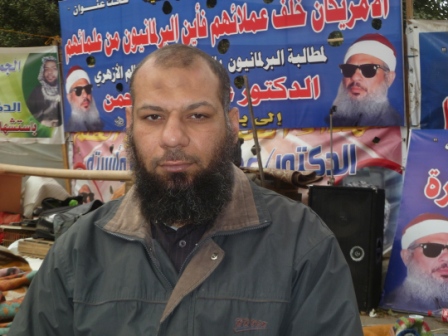
Mohamed Omar Abdel Rahman of the Islamic Group received Lapido the evening of the first day’s protest, when the flag of the US embassy was removed and burned.
His family has maintained a sit-in protest on the opposite side of the embassy for over a year, demanding the release of their father, Omar Abdel Rahman. Better known as the Blind Sheikh, he is in prison in America over his role in the 1993 World Trade Centre bombings.
Abdel Rahman is not a religious scholar, but a veteran jihadist from the wars in Afghanistan.
‘For any offence against Islam,’ he said, ‘the Muslim has the right to defend himself against the one who says it, and shouting “our lives and our blood” displays his love of his religion.
‘It does not mean to kill an embassy employee, but if the filmmaker comes to Egypt, he will be torn limb from limb. This is permitted in Islam.’
Concerning the signs praising bin Laden and calling foreign Copts ‘dogs’ and ‘pigs’, Abdel Rahman stated this was not meant literally, but ‘to scare them’.
‘They want to destroy Egypt and are its enemies, so this frightening is permitted in Islam.’
Asked about condemning all foreign Copts without distinction, Abdel Rahman stated this was a misunderstanding of Arabic rhetoric, where the general was meant to convey the particular, and exaggerate the grievance.
The use of insults was also misunderstood by the West, conveying not literal figuring but contempt.
‘This also is allowed in Islam,’ he stated, when invited to compare such contempt with the Qur’anic verse extolling ‘good preaching’ against a non-Muslim challenger.
‘Everything has its time and place,’ said Abdel Rahman. ‘It makes no sense to issue simple good preaching during jihad. If someone is attacking you, you resist and fight back, you do not just say a good word.’
Abdel Rahman al-Barr
Lapido then asked Abdel Rahman al-Barr, a member of the Muslim Brotherhood’s Guidance Bureau specializing in the shariah, to comment in a written interview.
By this time the American ambassador to Libya had been murdered, the embassy and school attacked in Tunisia, with outbreaks of violence in many other parts of the Muslim world.
‘Religion is one of the sanctities that man will protect and defend with all he has, even if this leads to giving his life,’ he said.
‘In the case of this offensive film it is necessary to announce refusal, condemnation, and anger with the most powerful expressions.’
To explain what makes this a religious obligation, al-Barr drew from a well-known tradition of the prophet.
‘Islam requires the Muslim to reject error and seek to change it with his hand, if he is able. If he cannot he must reject it with his tongue, and demonstrations are one of the ways to do so.’
Al-Barr noted that many of the demonstrators were ‘common people’, and Egypt did not have a culture of demonstrating. He hinted that the slogans used might be questionable.
‘Islamic morality is moderate in both satisfaction and anger,’ he said. ‘Powerful expressions of anger must respect justice. The Qur’an says: “God does not like the public mention of evil except by one who has been wronged” (4:148).
‘So if a man is oppressed he may use forceful phrases to express this oppression, but without triviality or debasement.’
Al-Barr blamed the media for taking an obscure film and throwing it in the face of Muslims. He gave no credence to the idea that religious scholars had a share in the blame for the excesses which took place, but did suggest some regret.
‘It is natural the scholars could not stay silent in the face of this rejected crime. Personally, if it was in my power I would not have given this subject any importance because it is a vile work.’
Instead, ultimate blame lay elsewhere, indicating the vast difference in cultural perspectives.
He concluded: ‘We request the government which allowed this film to appear – that is, the United States of America – to prevent [its showing] and to hold those who made it accountable, as they have instigated hatred and incited animosity between peoples.’
This article was first published on Lapido Media on September 19, 2012
Abdullah, the Blind Sheikh's son, 3rd from left, and Taj al-Din al-Hilali to his left.
Seeking to keep the case of their father in front of the public eye, the family of the Blind Sheikh, Omar Abdel Rahman, organized another conference at the site of their open sit-in across from the American Embassy.
The conference was conducted by the World Forum for Moderate Islam, under the title ‘Omar Abdel Rahman: Between the Crimes of America and the Neglect of Egypt’. The highlighted speaker was to be Mohamed Shawki al-Islamboly, the older brother of the man who assassinated President Sadat. The 75 year old Islamboly, however, apologized as he was ill and unable to attend. Islamboly had recently been released from prison on health grounds, after being deported to Egypt by Iran.
Abdullah Omar Abdel Rahman, the Blind Sheikh’s son, moderated the conference. He opened by mentioning the brief clashes between pro- and anti-military council demonstrators outside the US Embassy, and gave praise to God these did not escalate further. He further announced the organization of a march from the sit-in to the nearby parliament at 9am the next day, to present a request to the parliament for intercession with the government to demand Abdel Rahman’s return to Egypt.
The next speaker was Khalid al-Sharif, the secretary-general of the World Forum for Moderate Islam. He stated that if it is the right of the United States to defend its citizens abroad (in the case of the returning NGO workers), then why is Egypt not defending its Azhar scholar and others of its citizens in the United States.
Furthermore, he stated, Omar Abdel Rahman is diabetic and cancer-stricken; it is only humane to return him to Egypt. Yet more than being an act of mercy, this request is both legitimate and legal, unlike the actions of the US government to interfere in Egypt’s judiciary and fly the NGO workers out even before their travel ban was officially lifted.
The next speaker was Osama Rushdi, head of the Front to Rescue Egypt. He argued that Omar Abdel Rahman was an innocent man framed by the US and Egyptian governments to silence his criticism of Mubarak. It is a political issue, he stated, reflecting the longstanding relationship between the two nations, in which Egypt is America’s greatest agent in the region.
Rushdi spent most of his presentation detailing how the United States has conspired previously with the intelligence apparatuses of other nations, showing similarity to the case of the Blind Sheikh. He focused on Talaat Fuad Abu Qasim, who was apprehended in Croatia and returned to Egypt where he was executed.
Rushdi criticized the United States for not yet realizing the extent to which Egypt and the region as a whole is changing. History, he declared, will not forget these crimes.
He also interceded in the case of Abdel Rahman’s lawyer, Lynne Stewart, who is in prison for facilitating communication between the Blind Sheikh and al-Jama’a al-Islamiyya. Rushdi praised her as an American and as a Christian, arguing this was the ‘alleged’ reason, but that in fact she was being punished for her defense of her client’s human rights.
On this fact Rushdi is incorrect. Whatever bias may have been suffered by Stewart for her role, Mohamed Omar Abdel Rahman, another of the Blind Sheikh’s sons, admitted to me that she did break the law and transmitted messages.
The keynote speaker of the conference was Sheikh Taj al-Din al-Hilali, the controversial ‘Mufti of Australian Muslims’. He was given a warm welcome having returned to Egypt from such a long distance.
Hilali focused his comments on Islamic history, recalling a time when the sun did not set on the Muslim caliphate. He compared the neglect given by Egypt to Omar Abdel Rahman with the vigilance of Caliph Haroun. When fighting ‘the dogs of Rome’ – comparable now to ‘the dogs of America’ – he insisted on the return of a single Muslim woman captured during war.
Hilali also celebrated the period of Islamic dominance of the Mediterranean, which he called an Islamic sea. During the 1700s even the United States had to pay ‘jizia’ to the navy of Algeria, to secure the right of shipping in the region.
Hilali then quoted the Muslim Brotherhood creed – God is our end, the Apostle is our leader, the Quran is our constitution, jihad is our way, and death is the path of God is our highest hope. He stated the weakness of the Islamic world now is due to the fact that we have no leadership and we fight each other.
In Egypt, this represents the treachery of the military council. He compared the situation to that of the Arabian Nights: Ali Baba has fled, but his 40 thieves remain.
Hilali praised the revolution, but promised a greater revolution to come. This would include going to Palestine and breaking down the wall of shame, revolting against the current borders which divide the Islamic ummah, and finally in liberating Jerusalem.
Throughout the conference a official supporter led the audience in various chants. These included:
Oh Katatni, oh Erian, where is Omar Abdel Rahman? (these are leaders in the Muslim Brotherhood)
Oh Abu Ishaq, oh Hassan, where is Omar Abdel Rahman? (these are popular Salafi preachers)
Oh Tantawi, oh Anan, why submit to the Americans? (these are leaders of the military council)
Oh Abdel Rahman, we will not leave you, even if they shoot us we’ll bring you home
Why is Omar Abdel Rahman imprisoned why America and the military trample us?
The blood of Muslims is not an offering for the Jews or the Americans (reflecting a popular anti-Jewish urban legend that Jews mix human blood with their Passover bread)
They say our sheikh is a terrorist, but America has arranged this
Oh Interior Ministry listen well, the national security forces do not belong to us
They provoke us generation after generation, fall, fall Israel
Egyptian people wake from your sleep, we want to rule by Islam
However legitimate or illegitimate the cause of Omar Abdel Rahman, speakers and chants such as these will not gain much support among a Western audience. Of course, if the basic charge against America is true, then perhaps some of the above statements can be understood differently.
One of the interesting subplots to the Egyptian revolution is the fate of Omar Abdel Rahman, known as the Blind Sheikh, who is incarcerated in America for his role in organizing the 1993 attempt to blow up the World Trade Center. His family has maintained a small sit-in protest outside the US Embassy in Cairo since August, convinced of his innocence. They believe he was framed due to pressure from Mubarak to silence him over his harsh criticism of the regime.
In recent days this undercurrent has intersected with a major crisis in Egyptian-US relations. The Egyptian judiciary has placed 43 NGO personnel under investigation, including 19 Americans, some of whom have been issued a travel ban. It concerns the post-revolutionary work of these NGOs, which are alleged to have instigated the protests and street fighting in and around Tahrir Square.
The rumors run even deeper. It is alleged the offices of the International Republican Institute and the National Democratic Institute possessed maps of Egypt identifying the location of churches, so as to spark sectarian tension. Other maps pictured Egypt divided into four small states. One would be specifically for Copts, another for Nubians, and a third under Israeli administration.
On Saturday, February 18, the family of Omar Abdel Rahman hosted a rally and press conference outside the embassy at the site of the sit-in. While only around two hundred people attended, speakers included several prominent Islamist and revolutionary figures.
The session was entitled: Americans have sent their agents, so where is parliament in terms of its scholars? Demanding parliament interfere for the return of the Azhar scholar (Omar Abdel Rahman).
Islamist lawyer Muntasir al-Zayyat achieved fame by defending many Islamists against the accusations of the Mubarak government during the years of his crackdown against them. He accused the US of violating its own laws in the detention of Omar Abdel Rahman, and led the call to parliament to sponsor the cause and pressure the military council to demand the US return him to Egypt. He wondered aloud why there were so few people in attendance, while a Salafi scholar detained in Egypt recently mobilized 70,000 people on his behalf.
Mamdouh Ismail is the vice president for the Salafi Asala Party. During an early session of parliament he interrupted proceedings and issued the call to prayer. The Muslim Brotherhood speaker of parliament silenced him and told him to pray in the outside mosque.
Ismail noted that it was Omar Abdel Rahman who taught Egypt the ways of revolution and opposing oppression during his long struggle against Mubarak’s regime. He harshly criticized the Muslim Brotherhood and the Salafi Nour Party, as well as the Building and Development Party of the Blind Sheikh’s own al-Jama’a al-Islamiyya, for failing to champion his cause. He believed liberals would not oppose the initiative, blaming Islamists for letting him languish in a foreign prison.
Magdy Ahmed Hussein is a leader in the Islamist-leaning Labor Party, and leveled vitriolic criticism against America. He state the United States, like all tyrants, will not submit to any ‘request’ but only to the response of power. He thundered that Egypt could do without US aid, and floated the idea of attacking Israel. He accused Islamists of being weak, catering to the United States and failing to impose sharia law.
One man cried out from the audience, ‘No, it is the Brotherhood only!’
Interestingly, Hussein’s bravado faded as he addressed Egyptian action. We should send from this rally a delegation to parliament – today, but tomorrow would be fine. We should ask them to consider our request, but be sure not to put too much pressure on them since they have a busy agenda. We should also take care not to have a big rally or march, as there is enough of that in Egypt already.
The next speaker was Hany Hanna, known popularly as the Preacher of the Revolution, for leading Christian prayers from the stage in Tahrir Square. He counseled that all Egyptians must be treated without distinction, whether they are Muslim or Christian. He warned that many divide between these citizens – between Islamists and Copts, and even against ‘foreign Copts’.
Furthermore, he stated that the government is now going after liberal NGOs in Egypt in the same manner it previously restricted Islamic organizations, and called for the sympathy of those present. In addition, he chided the conference for consistently calling for the release of the ‘Muslim’ or the ‘scholar’, but not for the release of the ‘Egyptian’. Our hope is in God for the release of Omar Abdel Rahman, he declared, but we must be a state of rights to pursue his cause justly.
To note, a son of the Blind Sheikh told me Hanna has been present at every rally for his father since the sit-in began.
Tarek al-Zumor is a leading member of the Building and Development Party of al-Jama’a al-Islamiyya, and is the brother of Abbud al-Zumor who led planning for the assassination of Sadat. He praised the revolution as one of the youth, which included Islamists, liberals, socialists, and all manner of Egyptians. He reminded, then, that though Abdel Rahman is now old, he has pursued an anti-Mubarak revolution since the days of his youth.
He urged effort to be made to free the Blind Sheikh despite US pressure and aid, believing America to be dedicated to extinguishing the fires of the Arab revolutions.
The highlighted speaker, however, was no less a luminary than Hazem Salah Abu Ismail, the Salafi candidate for president of Muslim Brotherhood heritage. He spoke with a calm and dignified demeanor in contrast to the bombast of many others.
He drew a parallel between the case of Omar Abdel Rahman and that of the US NGO personnel in Egypt. Both are judicial matters independent of politics – or – both are issues of national security. Either way, they should be treated the same and Egypt should not bow to US pressure.
In terms of the judicial angle, Abu Ismail criticized the Egyptian government in the case of the alleged US-Israeli spy Ilan Grapel. Charges of espionage were brought against him by the court, but he was later surrendered as part of a prisoner exchange with Israel. The trouble is that the judicial process was not completed, even if only in issuance of an official pardon. The Americans accused in the current NGO dispute must go through the full examination of Egyptian law.
The United States, however, is looking to expedite this process through extra-judicial pressure and threats of withdrawing US aid. He believes the US wishes to solve this crisis during the transitional period of military government.
The Egyptian government – and parliament – has been lax in terms of its pressure on behalf of Omar Abdel Rahman. For them it has been a matter of patience – ‘we have many matters to attend to in the revolution, perhaps just a week or so more’. He believes it is shameful his family has been forced to endure this.
Rather, US pressure must be met by Egyptian pressure, or else the situation will calm and everyone will forget about the Blind Sheikh again. If this threatens to cost Egypt the substantial US aid package, let us call their bluff. He imagines the US is too cowardly to actually withdraw its money.
Why? In reality, he says, it is not ‘aid’ at all. Most of the money is delivered directly to the military establishment and used to purchase US weapons – a American government subsidy, in essence, to the arms industry. The small percentage of money spent on civil society, meanwhile, largely pays the salary of US citizens who run US linked NGO programs.
The United States, furthermore, should not be understood as a ‘righteous’ nation with which to deal. It uses its ‘aid’ to pressure every nation of the region – save Turkey and Iran – into supporting Israel, while paying lip service to principles of democracy, freedom, and rule of law. Then the US turns back home and exports its political prison to Guantanamo so that it can escape its own principles of freedom and rule of law. This is the context in which the struggle to free Omar Abdel Rahman must be waged.
Between speakers an official designate issued chants which the crowd repeated. These included:
The people want Omar Abdel Rahman
Parliament, parliament, where is Omar Abdel Rahman?
Oh military, where is the Azhar scholar?
Fight, fight for Islam; rule, rule by the Qur’an
Why does America oppress the free? Jailing Abdel Rahman is sinful.
With Abdullah Omar Abdel Rahman, the Blind Sheikh's Son; Translation: Open Sit-In: To Support the Imprisoned Scholar and to Work to Return him to his Country, with God's Permission
As for the case of Omar Abdel Rahman itself, this requires more investigation.
It is noteworthy, however, that his family claims Mubarak pressured the US administration to jail him out of fear the United States would make of him an Ayatollah Khomeini and return him as a champion to Egypt, as France had done earlier to Iran.
Rumors and rumblings in Egypt suggest a possible solution to the NGO crisis may amount to a trade of the Blind Sheikh for the detained American NGO personnel. The upcoming trial, if the legal system runs its course, anticipates these Americans held in a courtroom cage, as per Egyptian custom. It is an image that will resonate deeply with the American public, and even invoke memories, if not wildly inaccurate comparisons, to the Iranian hostage crisis.
In an atmosphere of charged politics and conspiracy theories, the NGO crisis plays into fears of foreign interference. Among analysts who doubt these NGOs have done anything amiss, they bill the affair either as playacting to buttress the popularity of the military council, or else designed to move Egypt out of the US orbit, by hook or crook.
Is something major brewing geopolitically at the Blind Sheikh sit-in outside the US Embassy in Cairo? Or are these the sincere, devoted efforts of a family to reunite with their father, against an American justice system that will never bend to pressure? Or, finally, is it a simple matter of justice for a man long – and perhaps wrongly – imprisoned?
Revolutionary Egypt holds far more questions than answers. The case of the Blind Sheikh is far below even the local media radar, but bears monitoring all the same.



 Jayson Casper