Categories
Christianity Today Middle East Published Articles

Can a Lebanese Seminary Move Beyond the Liberal-Conservative Impasse?

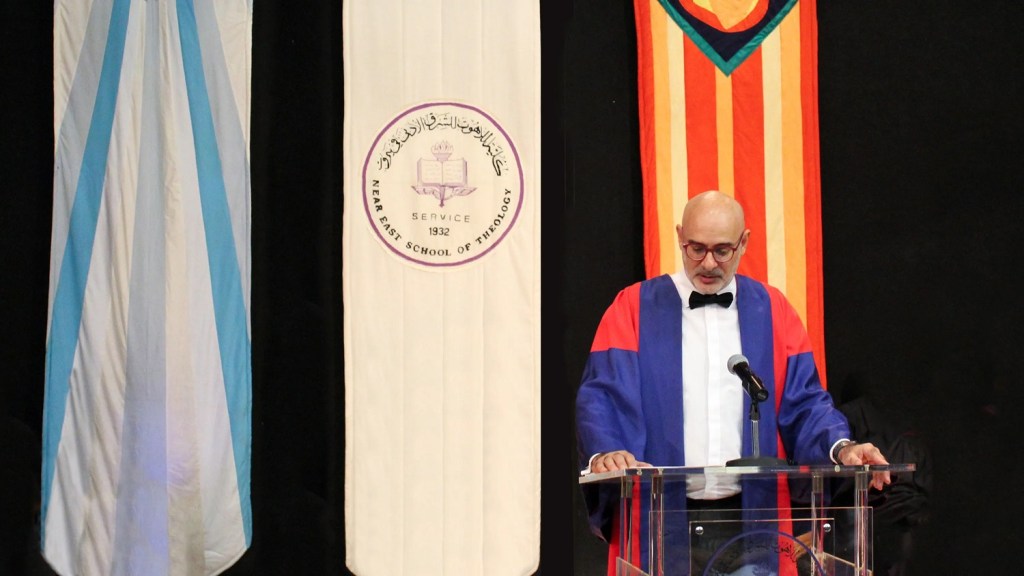
Courtesy of Near East School of Theology

The oldest Protestant seminary in the Middle East has a new vision.

Officially founded in 1932 but with origins dating back to the 19th-century missionary movement, the Near East School of Theology (NEST) is operated by the Presbyterian, Anglican, Lutheran, and Armenian Evangelical denominations.

Installed this week, its 11th president is a nondenominational Lebanese evangelical.

Martin Accad, formerly academic dean at Arab Baptist Theological Seminary (ABTS), was installed on Sunday at the historic institution’s Beirut campus. He graduated from NEST in 1996 with a bachelor of theology degree, eventually earning his PhD from the University of Oxford. Awarded scholarships by the World Council of Churches and the evangelical Langham Partnership, Accad is a locally controversial theologian who, like NEST, straddles the liberal-conservative dichotomy.

Author of Sacred Misinterpretation: Reaching Across the Christian-Muslim Divide, Accad has urged believers to approach Islam in a manner that avoids the twin pitfalls of syncretism and polemics. But before joining NEST he resigned his prior academic position at ABTS to apply his biblical convictions within Lebanon’s contested political scene. Creating a research center, his last four years have been spent in pursuit of reconciliation between Lebanon’s often-divided sectarian communities.

Accad will now bring his vision to a new generation of Middle East seminarians.

Although doing public theology is novel for the institution, NEST has long sought, with some struggle, to balance the two streams of its early predecessors’ commitments to evangelistic outreach and service-oriented witness. Its founding in 1932 resulted from a merger of two programs, each with its own distinctives.

One stream of NEST’s roots dates to 1856, when American missionaries began what Accad describes as a discipleship training program in the mountains of Lebanon. Along with providing pastoral development, it functioned as a mission station for sharing the gospel in local villages with non-Protestant Christians and diverse Muslim communities. Its remote location was also designed to isolate these early “seminarians” from the corruption of city life in Beirut.

American outreach to Armenians and Arabs in the Ottoman Empire (modern-day Turkey) led to the creation of similar schools beginning in 1839. After the Armenian genocide in World War I, these efforts relocated to Athens where they coalesced into a seminary that adopted an ecumenical, Enlightenment-informed model, emphasizing the importance of social service. This was especially true in its approach to Islam—sympathetic and comparative with an eye toward reconciliation.

The merger of these two programs created NEST, which eventually settled in the cosmopolitan Hamra neighborhood of Lebanon’s capital. Although it is situated near three historic Protestant liberal arts colleges—now known as the American University of Beirut (AUB), the Lebanese American University (LAU), and the Armenian-led Haigazian University—early cooperation was shattered by the Lebanese civil war in 1975 and has not been re-established.

Accad wants to restore this collaboration and embody an integration of scholarship and discipleship. CT spoke with him about Protestant distinctives, “electric shock” pedagogy, and how to understand the mainline-evangelical divide in the Middle East.

Why does serving as president of NEST appeal to you?

We need to rethink what it means to be a seminary student today. This question is a key issue globally, but especially in the Middle East. Ideally, the seminary leads the church to be relevant in society. This requires beginning with society and determining its needs. And then the seminary addresses the church—what does the pastor need? Finally, it works backward and designs a program to fit this profile.

Historically, NEST has been an ordination track. This is the traditional model, and it is still necessary if the church believes that it is. But I want to explore with the churches their vision for seminary training, for congregational service, and for regional witness—and how NEST can help prepare leaders to implement this vision.

How do you plan to prepare leaders to serve the church?

Nontraditional, focused tracks are becoming the way people want to learn. Accrediting bodies speak of micro-credentials that may contribute toward academic goals but have value in and of themselves and fit into the bigger puzzle of what students want to do with their lives.

But this system of training should not be only for evangelicals. I want NEST to attract…

This article was originally published at Christianity Today on September 27, 2024. Please click here to read the full text.

Categories
Christianity Today Middle East Published Articles

Gaza War Strains Bible Scholars’ Model of Christian Conversation

Mlenny / Getty

When Jesus told the 12 disciples to shake the dust off their feet in protest of any town that did not receive them, it is easy to forget their mission was among fellow believers in Yahweh. Jews were speaking to Jews, and the message was simple: The kingdom of God is near.

But Jesus foresaw even greater opposition than rejection, according to Matthew 10. His disciples would be dragged before councils, flogged in the synagogues, and betrayed to death by their own brothers, he warned. “I am sending you out like sheep among wolves.”

Christian discourse on the Holy Land conflict is often similarly contentious.

“A conversation is needed,” said Darrell Bock, senior research professor of New Testament at Dallas Theological Seminary (DTS). “People talk at each other, not to each other. But with the emotion and distance between the two positions, is it even possible to try?”

Not from what another Bible scholar witnessed when each camp gathers alone.

“Their conferences only preach to the choir,” said Rob Dalrymple, course instructor of New Testament and biblical interpretation at the Flourish Institute, the seminary for evangelical Presbyterians in the ECO denomination. “Nothing changes; it only reinforces how bad the other side is.”

Each academic belongs to a community traditionally associated with one or the other side of the Israel-Palestine conflict. DTS teaches dispensationalism, which anticipates the restoration of Jews to the Promised Land before the return of Christ. Presbyterians adhere to covenant theology, which interprets the promises given to Israel—including the land—as fulfilled in Christ.

The Jews of Jesus’ day also had factions. But while “shake the dust off” was the instruction given to disciples in the face of opposition to the gospel, to all who believed in him he gave a very different message in the Sermon on the Mount:

Take the log out of your own eye first.

One group of Bible scholars…

This article was originally published at Christianity Today on October 7, 2024. Please click here to read the full text.

Categories
Christianity Today Europe Published Articles

Ukraine’s Top 10 Bible Verses of 2023

Image: Dmytro Larin / Global Images Ukraine / Getty Images

Perennial favorite John 3:16 may have nothing to do with the war against Russia.

Isaiah 41:10 speaks more clearly to times of conflict—though it boasts a leading position in many other nations as well.

But missing from the top 10 list in Ukraine—and no other nation highlighted by YouVersion—is Jeremiah 29:11: “‘For I know the plans I have for you,’ declares the Lord, ‘plans to prosper you and not to harm you, plans to give you hope and a future.’”

Evangelical leaders shared their reflections on why millions of citizens in the Orthodox majority country may have found inspiration in the top 10 verses, not others, and suggest personal favorites that shed light on life in a war-torn nation:

Igor Bandura, vice president of the Baptist Union of Ukraine:

The results released by YouVersion are informative, inspiring, and challenging. My heart cries out in unison with all of them, as they reflect God’s love as the source of life within our deep search for meaning under the pressure of war. It is no wonder that John 3:16 ranks first, giving comfort against the power of darkness in the midst of loss, suffering, and simple exhaustion.

The Bible remains our most powerful source of encouragement, wisdom, and strength.

Perhaps Jeremiah 29:11 is left out because while God plans not to harm us, Russia does—and the imaginable near-term consequences keep Ukrainians from contemplating an unimaginable future. Certainly, this is a challenge for faith. But mine has been strengthened through a different unlisted inspiring verse in Zechariah 9:12: “Return to your fortress, you prisoners of hope; even now I announce that I will restore twice as much to you.”

There are two possible interpretations. First, that despite being prisoners of our overwhelming circumstances, there is still hope available to us. And second, that God’s hope has made us prisoners, and that we cannot live any other way. Both are true—and we await the “double” that God has promised.

Maxym Oliferovski, a Mennonite Brethren pastor and project leader for Multiply Ukraine, Zaporizhzhia:

That these 10 Bible verses have been shared the most in Ukraine does not surprise me at all. The first five focus on love, protection, and strength, communicating God’s care for us during the many hardships caused by the invasion. Most meaningful to me has been 1 Peter 5:7, “Cast all your anxiety on him because he cares for you,” because I tend to live in the future. But in the uncertainty of war, even short-term plans become impossible. God then reminds me I must rest in him, greatly decreasing my worry and stress.

The second five verses, taken together, strike me as a prayer for faith, holiness, and bravery. It is so easy to lose focus and get depressed. Certainly, we need healing, which comes through his Word.

But we also realize that…

This article was originally published at Christianity Today, on December 22, 2023. Please click here to read the full text.
Categories
Americas Christianity Today Published Articles

New Museum Stakes Claim for the Bible in US History—Right Next to the Liberty Bell

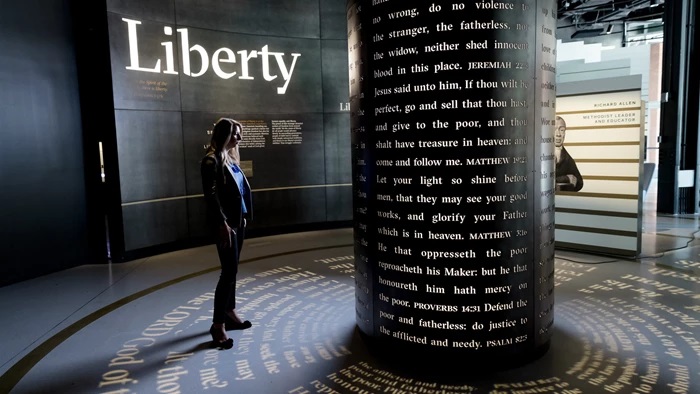
Image: Douglas Nottage / American Bible Society

America’s “most historic square mile” got a new resident on the Fourth of July weekend. Joining the Liberty Bell and Independence Hall in Philadelphia, the American Bible Society has opened a $60 million museum to highlight the role of Scripture in the founding of the United States.

“We are leveraging history to advocate for the Bible,” said Alan Crippen, chief of exhibits at the Faith and Liberty Discovery Center (FLDC). “The American story of liberty is unintelligible without knowledge of the Bible, and how it impacted our leaders.”

The new museum gives special space to William Penn and his “holy experiment” of Pennsylvania.

Alongside his Bible, the museum displays an original copy of Penn’s 1683 pamphlet, The Great Case of Liberty of Conscience Once More Briefly Debated and Defended. Informing Penn’s vision for governance, the charter of Pennsylvania guaranteed religious freedom and sought peace with the local Lenni-Lenape Native American tribe.

The FLDC’s six exhibits are more than a storehouse of artifacts, though. Interactive exhibits present six foundational American values: faith, liberty, justice, hope, unity, and love. An electronic “lamp” allows visitors to activate additional material, and store memories for retrieval at home.

The exhibits pose additional questions for contemplation or group discussion. The First Amendment section prompts: Do you agree that a just society requires freedom of religion and dissent? Another follows George Whitfield and asks: Do you agree that people can have a direct and personal relationship with God? “Exhibits are meant to be immersive, but not to proselytize,” said Crippen. “This question is meant…

This article was originally published at Christianity Today, on September 9, 2021. Please click here to read the full text.