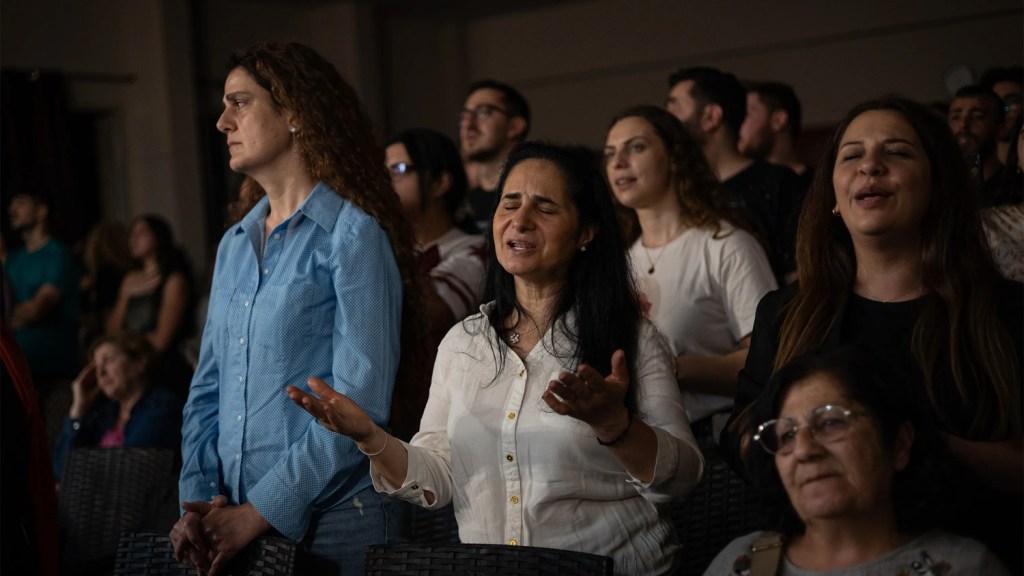
On a May evening, Claudette El Hajj organized five buses to bring 150 people displaced by the war in Lebanon to a worship night in a hilltop town overlooking Beirut. Many were Christians who had been forced to flee their homes in southern Lebanon due to heavy fighting between Hezbollah and Israel. But at least a handful of Muslims—invited by Claudette and other guests—also attended. As the event got underway, Claudette stood in the back of the crowded auditorium with dozens of others without a place to sit.
At the front of the room, Claudette’s 31-year-old son, Gabriel, and his evangelical band, B-Sharp, led the congregation in worship. They began with well-known Arabic worship songs, like “Asmaak Tadaouni” (“I Hear You Calling Me”). Then the focus shifted. Gabriel played the familiar opening notes to “Salam, Salam” (“Peace, Peace”), a popular ’90s Christian song by Egypt’s Better Life band.
But the band had changed the lyrics. After singing “Peace, peace upon God’s people across all of Lebanon,” Gabriel’s wife, Yara, and two other vocalists sang out the names of Lebanese cities and villages where Christians and Muslims have suffered through conflict for the past two and a half years. The audience began to shout, cry, and wail as they heard their hometowns mentioned.
“We thought that people would like the song,” said Gabriel, “but we didn’t expect such emotion.”
That night moved him and Yara as well. Yara hails from the biblical city of Sidon, while Gabriel’s family comes from the Christian border village of Rmeich. Both are among the 15 southern areas named in the song and caught in the seemingly endless fighting between Hezbollah and Israel. While the song’s lyrics captured the despair, the performance also offered a rare moment of unity amid a war that deeply divides Lebanon. At a time when many Lebanese Christians are glad to see Hezbollah-aligned Shiite areas under fire, the congregation prayed for peace over those areas.
Hezbollah’s March 2 retaliation against Israel for killing Iran’s Ayatollah Ali Khamenei scuttled a tenuous November 2024 cease-fire and inflamed long-simmering sectarian tensions in Lebanon. Three months into the war, support is growing for controversial government efforts to disarm Hezbollah, a Shiite Muslim militia and political party that for decades has been one of two primary representatives of the sect.
According to a recent poll, Christians are overwhelmingly critical of Hezbollah. With emotions still raw from the last full-scale conflict in 2024—which erupted after Hezbollah opened what it called a support front for its Palestinian ally Hamas in Gaza—Christians accused the group of dragging the country into yet another conflict.
The anger grows as the death toll mounts. Since March, Israeli attacks have killed more than 3,700 people and wounded 11,700 others, according to Lebanon’s health ministry, which does not distinguish between civilians and combatants. Hundreds of thousands of people remain displaced, uncertain of when or if they will be able to return home.
Though inflamed by ongoing events, criticism of Hezbollah predates the war. Critics have long accused the group of using its vast arsenal of weapons to hijack the state and assassinate opposition politicians, charges that Hezbollah denies and that have rarely been tried in court. And in recent weeks, Hezbollah officials indirectly threatened the government, warning that citizens could overthrow it if Lebanese officials continue direct negotiations with Israel.
Members of B-Sharp have felt this polarization firsthand. “I used to blame Shiites for much of the suffering and found myself struggling with bitterness and resentment,” Gabriel said. But in prayer…
This article was originally published at Christianity Today, on June 22, 2026. Please click here to read the full text.
I additionally published a two-part article about the artists who first altered the lyrics of “Salam, Salam.” Click here and here to read their stories at Middle East Harmony.

