Categories
Christianity Today Middle East Published Articles

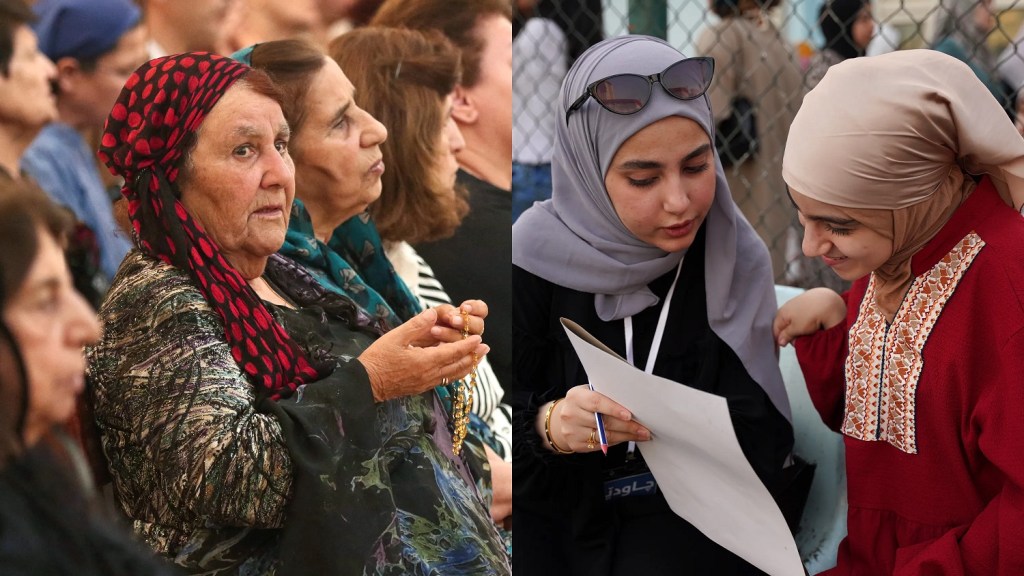
Grassroots Efforts Bring Together Diverse Sects in Iraq

Illustration by Christianity Today / Source Images: Getty

Three years ago in Iraqi Kurdistan, an adherent of the Kakai faith posted on social media that he had been called an infidel by a Sunni Muslim sheikh.

Kakai is a synthesis of Zoroastrianism and Shiite Islam, with between 110,000 and 200,000 followers in Iraq. Persecuted throughout their history, some Kakai consider themselves an independent religion, others a sect of Islam. But most Kurds are Sunni. The offending adherent felt a clear threat; some interpretations of Islam call for the killing of infidels.

Abdo Saad, regional programs director for Adyan Foundation, a Lebanon-based organization promoting interfaith dialogue and equal rights, reached out from his office in Erbil, Iraq, to the local ministry for religious affairs, alerting officials to the danger the Kakai follower may have faced. The authorities intervened and spoke to the sheikh privately. The Kakai man told Saad the issue had been resolved. But the ministry took no further action against the cleric.

Saad was not satisfied. In the honor-shame culture of the Middle East, it is often possible to resolve issues of religious freedom behind the scenes. Many converts to Christianity, for example, can live in relative peace if their Muslim families are not devout. Most authorities are not out to arrest believers.

However, if a conservative cousin publicizes the convert’s new faith, trouble may ensue. Wise officials may calm the situation, perhaps by relocating the convert to a different part of the city. They do not want Muslim extremists to discover the offense and call into question the religious legitimacy of a government that does not enforce the Islamic ban on apostasy.

Yet in the Middle East, only Lebanon allows a convert to officially register his or her new faith. For other nations in the region, religious scruples often trump religious freedom. Governments resolve many social issues along similar patterns, but human rights advocates lament that—as with the Sunni sheikh and Kakai Kurd—officials do not take a public stand.

Lebanon boasts one of the Arab world’s more robust expressions of political and cultural commitment to religious freedom. But Saad said the concept of rights-based citizenship has not sufficiently taken hold in any nation to enable a transition to a free and open democracy. He counsels Christians and Muslims to listen well to each other’s concerns so they can reform their nations together.

“I don’t have the answer for what this should look like,” he said. “I hope our grassroots work will push the leaders, but I don’t know.”

His uncertainty is warranted for Iraq as well. Under the dictatorship of Saddam Hussein, a Sunni, the nation had a nominally secular regime that integrated allied elites from different sects into its authoritarian governing structure. During the transition to democracy under US occupation, Iraqi political parties immediately organized along religious lines, and the majority Shiites captured power.

Sunni insurgencies followed, culminating in the creation of ISIS. Shiite militias backed by Iran joined the international coalition to defeat the jihadist threat but then kept their weapons and eroded national sovereignty. Neighboring Syria may witness a similar transition to conservative Sunni power now that a former al-Qaeda member has overthrown the Alawite-led regime.

Adyan registered in Iraq in 2022. An early project aimed to replicate the Lebanon success of Alwan, a school-based program to foster religious diversity and acceptance. Alwan means “colors” in Arabic. The Iraqi government welcomed the effort but insisted on calling it by the less kid-friendly name “Education on Active and Inclusive Citizenship,” as the original name made them think of the LGBTQ rainbow. Due to local sensitivities, the interfaith group accepted.

Other projects worked on social cohesion, Saad said. In a Chaldean Catholic city in the northern area of Nineveh, a Christian, Muslim, and Yazidi led joint efforts to renovate a public square damaged by ISIS. They restored electricity, installed benches, and held a public dinner. Some played backgammon long into the evening.

Similarly, in the southern city of Basrah, Iraq, with an overwhelmingly Shiite population, Adyan helped a Shiite and a Sunni lead a festival of diversity in the main city square. Artists and singers entertained onlookers, when a member of the minority Mandaean religion took the stage. He told Saad this was the first time he felt comfortable speaking publicly about his faith, in which John the Baptist is the greatest prophet.

Within a sectarian society, good social relations are possible—even common. It is harder to…

This article was originally published at Christianity Today, on October 29, 2025. Please click here to read the full text.

Categories
Christianity Today Middle East Published Articles

What Would a Liberal Democracy in Lebanon Look Like?

Images courtesy of Rabih Koubayssi.

In September 2024, when Israel escalated its bombing campaign against Hezbollah in Lebanon, Shiite sheikh Rabih Koubayssi was one of the few clerics, Muslim or Christian, to stay in the targeted southern region. He was needed to bury the dead.

His first Islamic duty was to wash the bodies, which were often charred or missing a limb. He laid the body on an elevated table, turned it to face Mecca, and washed each part three times. Then he wrapped it in a burial cloth. Finally, he recited a Muslim prayer for Allah’s mercy. Assistants enclosed the body in a green bag, the color of Islam. He wrote the person’s name on the outside with a black marker.

On one occasion, a woman clad in an all-black abaya tossed flowers onto the hospital gurney carrying her dead father and brother. On another, Koubayssi discovered the body belonged to one of his students at the Islamic university.

Then on October 9, 2024, a Christian body arrived. Israel had bombed a civil defense center in the village of Derdghaya, damaging the church next to it. The strike killed five emergency workers, including Joseph al-Badawi, who had sent his parents and wife to safer areas while he remained on the job.

“How do I respect a Christian body?” Koubayssi asked himself.

The sheikh, a member of the Supreme Islamic Shiite Council of Lebanon, called Marious Khairallah, a Catholic priest in a village near Tyre who had also stayed behind during the war. The two had worked together in the local Forum for Religious Social Responsibility, run by Adyan Foundation, a Beirut-based interfaith organization.

Although the Christian cleric was only 10 minutes away by car, he could not come because of the bombings. Instead, he reassured his friend that Christians do not have similar rituals and that he should take care of the body as best he could.

Koubayssi wiped down Badawi’s body, leaving on the tattered clothes. He struggled to enclose the corpse in nylon as rigor mortis had steeled the right arm in a raised position above the head. Eventually, during a pause in the bombing, the sheikh and priest arranged to deliver a Christian coffin from a nearby Christian-Shiite village. Koubayssi also found a cross, which he laid inside.

The sheikh then coordinated with the Lebanese Army and Red Cross to ensure safe passage to Khairallah’s church, where the priest led Christian funeral rites. Badawi’s family watched over video, and Koubayssi added a Muslim prayer.

On October 26, Adyan honored the cleric during the group’s Spiritual Solidarity Day, which it celebrates annually on the last Saturday of the month. The interfaith group sought nominations to vote for who best demonstrated religious unity during the war, and Koubayssi won handily.

“[Muslim and Christian] blood mixed together,” he said of the Lebanese killed. “Allah created us all and wants us to support one another.”

Established in 2006, Adyan won the 2018 Japan-based Niwano prize, informally known as the Nobel Peace Prize for Religions, focused on peacemaking through interfaith cooperation.

Many consider the Lebanese south as a stronghold of Hezbollah. Koubayssi is a member of the more secular Shiite Amal party, working in its cultural department. He is also the secretary of the Committee for Muslim-Christian Encounter in Tyre, engaging with bishops and priests for religious harmony in the overwhelmingly Shiite region. He enrolls his children in a Catholic school, and sent them and their mother to seek shelter in a monastery during the war. A missile struck his apartment complex on the last day before the ceasefire, damaging his fourth-floor home.

Koubayssi’s favored proposal to fix Lebanon’s corrupt political system is to…

This article was first published at Christianity Today on October 28, 2025. Please click here to read the full text.

Categories
Christianity Today Middle East Published Articles

Will There Ever Be Peace in the Middle East?

Illustration by Christianity Today / Source Images: Gett

The Middle East is a diverse region with Muslims, Jews, and Christians living together, along with each religion’s many sects or denominations. Ethnically, the region is peopled with Arabs, Jews, Kurds, Armenians, and Berbers. And despite speaking Arabic, many Assyrians, Copts, Samaritans, Yazidis, and Kakai maintain a separate ethnic identity.

Each sect, with its distinctive history and beliefs, is often deemed at least somewhat heretical by the others. While in Western countries theological disagreements do not usually end up harming the larger society, in the Middle East, sectarianism can lead to conflict and violence between different groups.

Sectarianism in the Middle Eastern context is defined in this article as the politicized prioritizing of one’s religious or ethnic group at the expense of a larger national identity.

Linda Macktaby, a Congregationalist pastor in the National Union of Evangelical Churches in Lebanon, illustrates the difficulty of dealing with sectarianism through a simple game she calls “Stick,” which is played during workshops she leads through Adyan Foundation, a Lebanon-based organization promoting interfaith dialogue and equal rights in the Middle East. Adyan means “religions” in Arabic.

The concept of the game is simple: Six individuals balance a single bamboo rod on their outstretched pointer fingers and lower it until they can lay it on the floor. They must cooperate and go slowly—if anyone’s finger loses contact with the stick, that person is replaced by someone from the crowd of about 20 people. Macktaby appoints from among attendees a referee, who watches carefully for any violation. The outside group can also collectively decide to swap out the original six players.

“We need someone shorter,” an onlooker may call out. “You’re going too fast,” says another. Multilingual Lebanese often speak Arabic, English, and French, but when mixed with other nationalities, one language prevails and the less fluent are quickly replaced for the sake of communication. Across the many sessions she’s led, Macktaby finds that, before long, the crowd tends to remove the tall people—who then stand on the sideline criticizing the shorter players. Those displaced by language sulk into the background. Sometimes the tide turns against the women.

But Macktaby makes it worse. She starts shouting advice to the players. She makes a blind suggestion that someone from the crowd would have a steadier hand. And she criticizes the referee, sometimes inserting herself to expel an offender. Tensions rise. The stick falls. Not once in all the workshops she’s led has Macktaby seen a group successfully reach the floor.

After the game, Macktaby explains that the task appears simple, but the rule of finger contact makes it nearly impossible. She gently rebukes the participants: “Why did you allow me to interfere? I undermined the judge and played you off against one another.” Without fail, the workshop attendees—all friends before the game—divide themselves into sects.

And this, she explains, is where sectarianism comes from.

In the game of Stick, the challenge is to lay down the bamboo stick. In nations around the world, including in the Middle East, the challenge is to create a functioning society. In both Stick and politics, the rules and behavior of the leader can erode trust and cooperation.

Many assume religion to be the root of division in the Arab world, but diverse beliefs…

This article was first published at Christianity Today on October 27, 2025. Please click here to read the full text.