Gaber Saleh, a 16-year-old revolutionary activist, was killed in confrontations with police in Tahrir Square last Sunday. That same day, Islam Massoud, a 15-year-old Muslim Brotherhood member, was killed in clashes between supporters and opponents of President Mohamed Morsi in Damanhour, a city in the Nile Delta.
The deaths reveal a nation deeply divided by the decision of Morsi last week to appropriate all governing authority until a new Egyptian constitution is completed and a new parliament elected. Protests have broken out throughout the nation; Tahrir Square has once again filled to capacity. Many of Egypt’s judges have decried the attack on their independence, with the two highest appellate courts joining others in a nationwide strike.
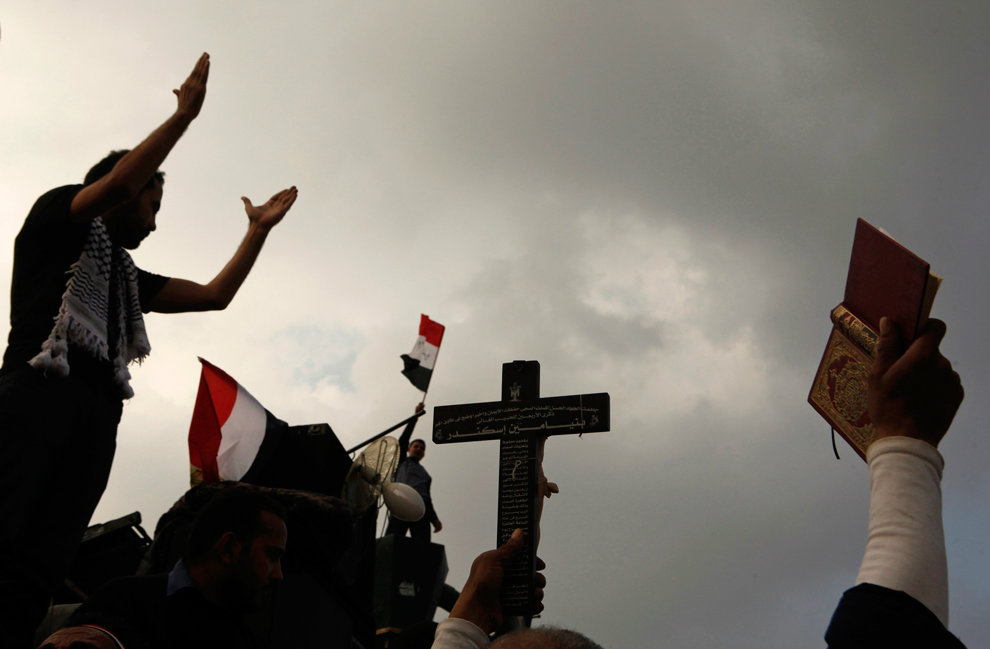
The nation’s Christians are firmly in the opposition camp.
At least officially, Egypt’s Christians are not calling to depose Morsy:
“This is a national issue, not a Christian one,” says Safwat el-Baiady, president of the Protestant Churches of Egypt and a former member of the constitutional assembly.
“As Christians, we are not calling for the downfall of the president. And we do not fight against the authorities. As a church, we ask only for a suitable constitution for Christians and Muslims.
“But normal people have the right to be in the squares.”
Some, if not many, might hope for it, but the outrage is directed primarily at his constitutional declaration. It has led a vice president to resign from his administration:
Morsi’s opposition is not just in the street. Samir Marcos, Morsi’s vice president for democratic transition and the most prominent Coptic member of his administration, has resigned.
“I refuse to remain [in my position],” he told the international Arab newspaper Asharq Alawsat, “in light of this presidential decision that is crippling to the democratic transition process … and which is contrary to what I am trying to achieve through my position.”
One idea floated now is that his powers could be submitted to a referendum, or yield to a referendum on a rushed constitution:
This might also create a scenario where a weary public votes “Yes” in the constitutional referendum to follow, simply to end the deadlock and restore stability. In the process, liberals and Christians fear, the public would accept a flawed and religiously tinted constitution.
Of course, either way the people vote, a deadlock might continue. The Muslim Brotherhood will hold a rally on Saturday to support the president, whereas they previously canceled a competing protest out of fear for “bloodshed.”
“In order to save Egypt from going back to square one—dropping into chaos and nearly civil war—we have to think of a compromise,” said Sidhom. “But I fail to see how or where.”
Please click here to read the whole article at Christianity Today.
With Egypt possibly on the brink of a new uprising tomorrow, I have not written much having had other projects. Among them, though, is this worthy one – honoring the memory of a good man who passed away recently. Here is the introduction:
With the passing of Dr. Baha Bakri, the world has lost a friend. Among those mourning are the universities of Cairo and Sinai, the Moral Rearmament Association, the Egyptian Green Party, and Arab West Report.
Dr. Baha Bakri was an environmental architect and a professor of urban ecology whose passion for uplifting the human condition was matched only by his devotion to his students. They loved him as a father, receiving even his rebuke as if from a familial hand. He encouraged without distinction, caring little for appearances, personal glory, or financial gain.
Nagwa Raouf, one of his former students, related the following anecdote. When asked one why he did not write to preserve his wisdom for future generations, he replied, ‘If anyone desires this let them proceed. As for me I don’t have time.’
Indeed, he did not.
Please click here to read the rest of the eulogy at Arab West Report.
In another blow to Egypt’s democratic transition, representatives of the Muslim nation’s three main Christian bodies jointly decided to end their participation in writing a new constitution.
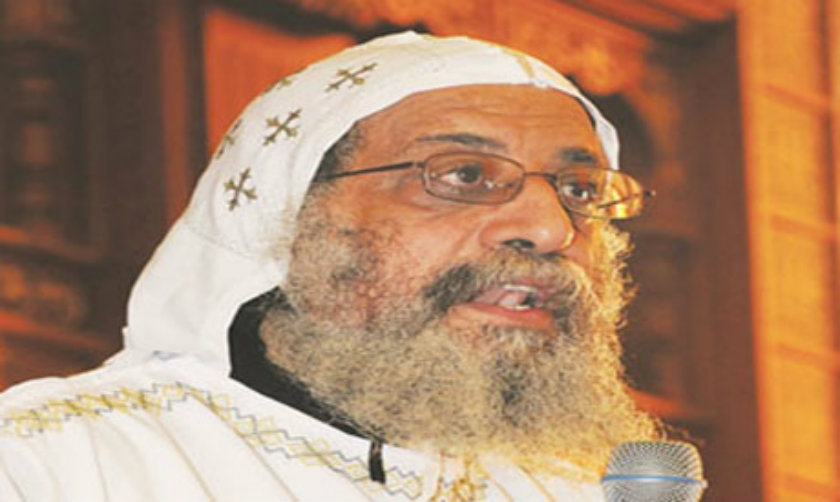
“The constitution … in its current form does not meet the desired national consensus and does not reflect the pluralistic identity of Egypt,” said Bishop Pachomious, acting patriarch for the Coptic Orthodox Church. The announcement was made one day before Pope Tawadros II assumed the papal throne of St. Mark, the gospel writer.
A primary complaint is over the role of shari’ah. Article Two of Egypt’s 1971 constitution, as well as the current draft of the new constitution, enshrines the “principles” of shari’ah to be the primary source of legislation. Pope Tawadros does not dispute the article as currently defined—including its designation of Islam as the religion of the state. But all churches reject its expansion.
“They left Article Two as is, but then added another article defining the principles of shari’ah.”
Please click here to continue reading at Christianity Today.
In a solemn, emotional ceremony, Pope Tawadros II was enthroned as the 118th Coptic Orthodox patriarch on Sunday, November 18. Only one day earlier, a different atmosphere prevailed. Acting Patriarch Bishop Pachomious announced the withdrawal of church representation from the constituent assembly writing Egypt’s new constitution.
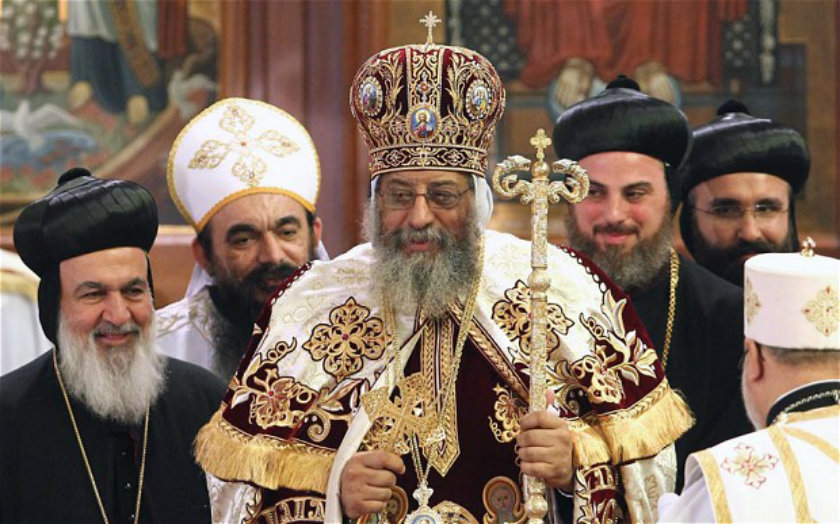
As Pope Tawadros took his seat on the papal chair of St. Mark, he was the picture of spiritual reflection. His demeanor was subdued, almost resigned to his new responsibilities. On a few occasions he shed a tear.
Two days prior, the church – behind closed doors – was the picture of enflamed political discussion.
Tawadros is the disciple of Pachomious, who spoke of his protégé:
Following the reading of the gospel, Pachomious introduced the new pope. Tawadros’ gravity was matched by Pachomious’ triumphal proclamation. “I tell him I will be his son and his servant,” stated Pachomious, “for we know the meaning of spiritual fatherhood.” He then exclaimed, driving home an intended contrast, “There is no struggle for authority in the Coptic Orthodox Church!”
The contrast, of course, is with the Egyptian political system, which the church strove hard to rise above.
But why would Pachomious make such a critical decision a day before the new pope, presumably, should start guiding these matters?
According to Bishop Yohanna Golta, Deputy Patriarch of the Coptic Catholic Church and its representative in the constituent assembly, the pope’s distance was deliberate. “The goal of Bishop Pachomious’s announcement … was to avoid entangling the new pope in this matter,” he said.
Politics entered the papal ceremony through another route – the decision of President Morsy not to attend. Many saw this as a failure to assuage the Copts amid an Islamist presidency, but others were relieved.
Perhaps Morsi, like Pachomious, also spared Tawadros the difficulty of political complications. The pope may prefer a non-politicized papacy, but this luxury may not be afforded until Egypt’s government stabilizes, if then.
And finally, here was the lead-up to the conclusion which needed to be edited out to fit with EgyptSources political focus:
Regardless of the explanation, during the ceremony Bishop Pachomious publically thanked President Morsy for sending a deputy, but focused on the spiritual definition of leadership.
‘We are the children of St. Mark,’ he said, ‘who taught us to wash each other’s feet.’ In this he referred to the example of Jesus, who took the place of a servant to wash the feet of his disciples.
Perhaps Pachomious and the church did so for Pope Tawadros, leaving him enough room to change the decision positively should circumstances warrant.
Though only speculation, perhaps it was these wranglings which produced Tawadros’ tears.
Please click here to read the whole article on EgyptSource.
Yet from my perspective in Egypt, I wonder if the Israeli motivation is to test Cairo more than Hamas. Of course, domestic factors always outweigh international ones. But at the least Tel Aviv may wish to discover what sort of president it faces in Mohamed Morsy, if not seek to discredit him altogether.
Muslim Brotherhood rhetoric during the Mubarak administration was always to harshly condemn the state’s refusal to take decisive action against Israel vis-à-vis Palestine. Yet Mubarak was not shy to issue strong verbal condemnations against Israel, nor did he refrain from withdrawing his ambassador to Tel Aviv. Morsy’s government, to prove consistent, must do more.
Morsy is not the Muslim Brotherhood, officially, which allows for an undefined relation of influence and agency:
Interestingly, the Muslim Brotherhood called for massive protests on Friday, as did every other political force rallying behind Gaza. Opposition to Israel has always been a hallmark of every Egyptian political movement, but it is ironic to see liberal parties now in condemnation of an Islamist presidency’s failure to stand up to Israel. But the Brotherhood is not falling behind: It has called for cutting all ties.
Do they mean it? How much effort will they pour into protest mobilization? Are they forcing the hand of the president? Or are they simply covering themselves should Morsi’s obliged inaction have to be explained away later?
But maybe Israel is seeking more definition:
Perhaps Israel is nudging at one of these contradictions. Morsi and the Brotherhood built their power base on anti-Israeli rhetoric. Yet seeking the approval of the international community and commercial interests also pledged to respect all treaties. There is little wiggle room. If they imitate Mubarak’s outrage they risk losing the people. If they take decisive steps against Tel Aviv they risk losing credibility. Such are the demands of leadership; can they step up to the plate?
The full text notes also the domestic considerations of Israel’s actions, and notes as well certain conspiratorial factors involved. Please click here to read the article at EgyptSource.
Four and a half months into Mohamed Morsy’s presidency, much of Egypt’s democratic transition is still on hold. Parliament remains dissolved. A new constitution is still pending, beset by legal challenges. In this political limbo, Morsy has appropriated even more power than former dictator Hosni Mubarak enjoyed before the January 2011 revolution.
However, alongside Morsy in this limbo is Samir Marcos, a Coptic intellectual serving as assistant president for democratic transition.
This is the opening of my new article on Christianity Today, discussing if it was wise for him to join an Islamist administration, and, if he will have a real voice. Please click here for the full article, featuring diverse Coptic answers to these questions.
“We told him, ‘Accept the position and be involved in the administration, and we will be behind you and support you. But if you feel you are being marginalized and not listened to, resign and make this clear to everyone,'” said Gaziri.
Of course, others disagree.
“The Muslim Brotherhood’s reputation in the international community will improve with him there, but Copts will not gain anything,” said Mamdouh Nakhla, head of the Word Center for Human Rights. “It is very difficult to change the regime from the inside.”
But I appreciate this perspective:
“The most unwise thing to do would be to refuse working with the administration due to its ties to the Muslim Brotherhood,” he said. “Despite our different perspectives concerning the civil state, we must maintain at least the minimum of dialogue so that we can work together for the good of Egypt.”
It is well and good to play politics, and Christians, like all people, can disagree about how to play it properly. But at the end of the day, the defining criteria must be to do what is right, even if others will take advantage.
There are degrees of right and wrong, so one must be very careful before rejecting the political stance of another. For someone like Nakhla, who is convinced the Muslim Brotherhood is a hypocritical, power hungry organization, it can certainly be ‘right’ not to aid or abet them.
Still, for good or for ill, they are currently entrusted with running the state for the good of the country. Succeed or fail, all citizens must work for the same aim. I believe Marcos is doing well.
When the candidates for the Coptic papacy were reduced to five, Bishop Tawadros, along with all the others, gave an interview on Coptic television. The full video, along with English subtitles, can be found here.
I culled the interview for useful nuggets about the pope-to-be’s background and views about church and ministry, and arranged them for an article with Arab West Report. The full text can be found here, excerpts follow below.
Tawadros was born in 1952 in the city of Mansoura. At age five his father, a landscape engineer, moved the family to Sohag for work where they remained for three years before settling in Damanhour. Here, he studied in a Coptic school run by the sister of then-Pope Cyril VI.
Tawadros’ family was very religious; many of his uncles and cousins were or became priests. His mother was originally from the area of St. Dimyana Monastery near Mansoura, and each summer would take her family there to visit. He has two sisters.
‘All our life was related to the church,’ said Tawadros.
Later on in the interview he addressed certain issues. Here is an example.
‘As Egyptians we live with our brothers the Muslims, and it is a priority to keep this unified life,’ he said.
He spoke positively about how Pope Shenouda was called a ‘safety valve’, and then answered this question in light of necessary history.
‘Look at our beautiful diversity: a Pharaohnic obelisk, a Christian steeple, and a Muslim minaret. This is the diversity that Egypt brings to the whole world,’ stated Tawadros.
‘Do our youth know these treasures? We have many common roots, and the media should focus on them.’
It had been stated in the media that Bishop Tawadros was commended as keeping good relations between Muslims and Christians, and with Islamists in particular. Labib questions the last point.
‘You cannot say that he has had good or bad relations with Islamists, as he has no relations at all, he stated.
‘He just has no clashes with anyone. I have no documented information otherwise.’
From the conclusion:
The picture provided of Bishop Tawadros is at best incomplete, but does offer a slice into his personality and upbringing. He is a faithful son of the church. He is quiet, thoughtful, and concerned about its long term internal spiritual growth. He offered few insights into issues of state or relations with Muslims, except for the necessity of mutual esteem and preservation of unity. He grounded this relationship in the diversity of Egyptian history, which in light of current politics can be understood as a nod to its identity.
Further research, of course, is necessary. Certainly Bishop, and soon-to-be Pope Tawadros will offer more than enough insight into his papacy in the days and years to come.
It is usually not an easy process to vote overseas. And then, all of a sudden, I had.
Weeks ago we printed out our internet registration form, necessary to secure a ballot sent from America. We also heard we could drop this off at the US Embassy in downtown Cairo, but delays – including a few days of rioting you may have heard of – kept us away.
But even then the process was complicated. Even after we received the ballot and sent it back, it was still necessary to physically mail an official registration form, even if it arrived late.
It has been a while since I voted in America, but basically all I recall is signing my name and pulling a lever. There is much I took for granted.
This includes, apparently, not having to walk through a war zone.
I exaggerate. Everything downtown is calm and has been for weeks. But the earlier riots only ended when the army intervened to impose its staple post-revolution solution: Build a wall. The main street of access to the embassy from Tahrir Square is now barricaded completely, forcing a five minute walk around the corner.
Didn’t I just lament taking things for granted? Now I complain about an extra five minute walk? The sign on the wall shows those who have a right of grievance. The shop owners outside the embassy and all along the now barricaded road are pleading with the government to take it down.
Once around the corner, however, the second security step is visible. During the original demonstration against the film protestors scaled the embassy walls and took down the US flag, replacing it with a black flag of Islam. The rest of the evening they stood atop the wall, holding placards but doing nothing in particular.
Now, barbed wire lines the embassy wall in its entirety.
Getting in was nearly as simple a process as usual. There was a line outside, ID, phone, and camera to leave at the desk, a metal detector to pass through, and then… that’s when things were different.
Normally the American Services Center of the embassy is calm and orderly, waiting in turn for your number to be called. The embassy advertized two days, however, to assist the absentee voting process, which was held outside regular visiting hours.
The line outside was due to the great crowd, let in by smaller groups to ease the congestion. There were few instructions given on what to do upon arrival. Forms were everywhere – mostly organized – but only one very helpful and very patient embassy employee inside. I had figured I only needed to drop off my ballot request form, so I was a bit confused.
And then she handed me my ballot.
I wasn’t quite prepared to vote on the spot. The main problem is that my attention is given almost entirely to Egyptian politics. Outside the headlines, I haven’t followed the US race much at all.
Basically, I hadn’t done my homework, nor had I reflected sufficiently. The only solution was to pray quickly, swallow hard, and write down a name.
With that, it was over. My envelope was sealed and placed in embassy mail. I don’t even have a hard copy registration letter for later, as they mailed that too.
Really, it was wonderful facilitation by the embassy, and a good reminder of the blessings of our system. It was a responsibility to cast a vote, but it was also a privilege.
Mid-Sunday morning, after three days of fasting, the Coptic Orthodox Church selected Bishop Tawadros of the Diocese of Baheira to be its 118th patriarch, succeeding Pope Shenouda III, who passed away in March of 2012. Tawadros’ name was drawn from a wax-sealed glass ball by a blindfolded child, supervised by the acting patriarch Bishop Pachomious.
Immediately after holding the paper with Tawadros’ name aloft for all to see, Pachomious then removed the other names from the remaining two balls to prevent allegations of fraud. Muhammad Hassanain Heykal, a prominent journalist, had disputed the selection of Pope Shenouda in 1971, alleging all three ballots bore the same name. Such a claim was not likely, but it resulted in doubts.
Bishop Tawadros was born in 1952 and is a graduate of Alexandria University with a degree in pharmaceutical sciences. In 1997 he was appointed as an auxiliary bishop to serve with Bishop Pachomious, now the acting patriarch. The lot was cast in his favor on his birthday, November 4, 2012.
The above excerpt is from the article I wrote for Arab West Report, reporting on Bishop Tawadros, the selection process, and issues moving forward. Please click here for the full article. Additionally, please click here for analysis from the AWR editor-in-chief Cornelis Hulsman, and here for a first-hand account from the cathedral from the managing director Hany Labib.
As for a brief description of the new pope-to-be, here is another excerpt:
Bishop Tawadros is also appreciated as one who reached out to the youth of his diocese, and kept good relations between local Muslims and Christians. He is also said to have decent relationships with Islamists.
And from the conclusion:
‘Civil society organizations can enter into confrontation with the state, but the church cannot,’ stated Sidhom. ‘Things are stable now, but it will be the time of crisis and sectarian strife that will be the real test.’
But today, and until then, Egypt’s Copts rejoice in a new leader, having asked God to grant them a ‘good shepherd’. Tawadros will need to prove himself, but he receives his position following a selection process esteemed not only clean, but spiritual – in distinction to national politics.
‘The lot lifts the election above politics as if it were for parliament.’ stated Labib. ‘The last choice is for God; this makes Christians very comfortable.’
It is a day of celebration for the Coptic Orthodox Church. May God give wisdom to their new shepherd.
From left: Bishop Tawadros, Fr. Raphael Ava Mina, Bishop Raphael
While Americans prepare to elect their next president on Tuesday, Egyptian Christians are leaving this Sunday’s choice for their highest leader up to a higher power: God.
On November 4, one of three final candidates will succeed Pope Shenouda III, the beloved “pope of the Bible” who died in March, as the 118th patriarch of Egypt’s Coptic Orthodox Church. But in contrast to the “group consensus” method used to select Roman Catholic popes, the casting of lots will determine whether Bishop Raphael of Cairo, Bishop Tawadros of Beheira, or Father Raphael Ava Mina, a monk from the Monastery of St. Mina near Alexandria, becomes the next spiritual leader of Egypyt’s 8 million Orthodox Christians.
This excerpt is from my article describing the papal selection process for Christianity Today. Please click here for the article in full.
It is an exciting day for Coptic Christians; may God honor their faith and grant them wise leadership. Two other angles to note:
First, all observers declared the election process prior to the lot was very organized, clear, and transparent. A limited pool of around 2,400 electors brought the number of candidates from five to three, of whom the lot will fall on one.
Some remarked the church wanted to present a picture of democracy and order that has so far escaped the Egyptian transition. Yes, for both parliament and president, democracy has been present and the lines to vote have been orderly. Yet the church has bent over backwards to ensure its election majors on the key missing ingredient in Egypt: transparency.
Second, if indeed there is transparency in selecting one of these three names, it presents an unmistakable spiritual picture of leadership to Egypt. One liberally-minded Muslim friend questions the reality of the lot, saying there is no way any large institution can leave their top leadership position to chance. He believes Bishop Raphael will be chosen; tomorrow we will see.
I am not sure how to interpret this spiritual picture, if indeed the blindfolded child has three separate names from which to draw. Yet given the wrangling, ambition, and conspiracy that has surrounded the Egyptian presidential contest – with unmistakable religious overtones – the church is saying: We trust in God.
As always, statements must be modified. The church is not saying it is a model for the Egyptian state. On the contrary, if anything, it is a rebuke by contrast. As a church we can be clearly spiritual in our leadership selection, but we are all Christians. The state, as a mixed polity, should be clearly secular.
If this is the lesson offered by the church, it is received. But it is not received with full transparency. The final choice is for God, and the election from five to three was by an accredited election. But the movement of candidates from seventeen to five was not particularly transparent. Twelve candidates were removed by a committee, and among these were the most controversial and polarizing figures.
Of the five that remained, three were of a similar disposition, while two were monks who were largely unknown. Please read the article to learn a little more of this disposition, but if the election from five and the lot from three will result in a similar pope no matter the candidate, where is the transparency?
By and large, Copts are very happy with their choices, so there is no need to complain. Furthermore, the church is not a democracy and should not be held to the standards of modern revolutionary conventional wisdom.
But on what basis were other candidates removed? Perhaps, simply, spiritual wisdom? This is not the same as transparency, on which democracy rests. Democracy can be transparent yet produce an unwise choice. But spin this differently, and the question is necessary: Is an appeal to spiritual wisdom simply a justification for paternalistic arrogance?
Now extend this question to Egypt, as President Mubarak did: Is Egypt ready for democracy?
Countless non-Islamists might look at the results and wonder, for they dare not articulate contrary to holy democratic principle, ‘No’. Democracy demands faith in the people, who can be rather fickle and easily manipulated.
Meanwhile, countless Islamists recognize ‘faith in the people’ as idolatry. They demand the coming constitution state clearly that sovereignty belongs – not to the people as currently written – but to God.
In the above, three models are presented: the reception of a system from God, the full sovereignty of people, and the paternalism that allows choice along a spectrum. Where does wisdom lie?
As I stated, I am not sure how to interpret the lessons from the papal selection process to the Egyptian society at large. I sense, however, the observations are poignant. I only wish for their proper translation.
My article about life in an Upper Egyptian village published today on EgyptSource. Click here for the full article; excerpts are in the boxes that follow, interspersed by other material needed to be cut for focus or word count.
During a visit to the city of Maghagha to learn more about surrounding village life, the local priest brought me along to a family’s baptism party in Qufada, celebrating the forty day mark of their new baby boy. Earlier at mass the child received his rites of entrance into the Coptic Orthodox Church; it is conventional thereafter to invite the priest to their home for a meal.
The Coptic home of the now deceased patriarch, Shafik Khilla, in Qufada conveys few signs of luxury but has a dignity fitting proper village family life. The ground floor houses common areas such as the reception, kitchen, and bathroom facilities, as well as a place to store the family animals during the night. The upper level contains a single room for each of the five nuclear families who maintained residence. But is ‘nuclear’ a proper word when all the husbands are away?
Today, Shafik’s sons Masry and Ruweiss are elderly, peasant farmers like their father. They spend all day in the fields watching the animals, for if they were to join in the life of the house thieves might steal them away. The men return to bed with the beasts, privileged above them by life on the upper floor. Neither attended the church service for the baptism of their grandson.
Also absent were the three husbands of the home. Masry had three sons, Samir, Medhat, and Milad. Samir and Medhat married their cousins, the two daughters of Ruweiss. Milad had to step outside the family to marry, yet by appearance all six of their children avoided the genetic defects of intermarriage. All are in school or preschool.
In the article I describe how they found work outside the village. Speaking of one husband, the priest made his wife blush:
Milad, meanwhile, found a job as a clerk in Cairo, for which he earns roughly the same salary and comes home just as infrequently. The priest playfully asked his wife why she had missed early morning mass the week before. She looked at him sheepishly and replied, ‘Oh, you know, Father, my husband was home.’
The two younger wives also received education up to the high school level, which inspired Samir’s wife to also improve her situation. She took literacy classes from the church and recited in our presence a poem she crafted about Jesus and his love. Mother to three daughters, the priest wished for her a son. She demurred, denying cultural expectations, and expressed thanks to God for what she had. Still, the priest held up both his own example and described mine as well, where three girls were finally followed by a boy. He said he would pray.
Here is the root of the problem:
‘There is no opportunity to work in Qufada,’ states Fr. Yu’annis. ‘People finish their education, but because they have no land, money, or chance to open a project, they must search elsewhere. The only other option is to work the land as a peasant farmer. ‘Work can be found in the nearby city of Maghagha, says Fr. Yu’annis, but it pays poorly and transportation costs eat a quarter of the earnings.
And from the conclusion:
Amid the cries that Islamist government may whittle away the Christians of Egypt, a far more subtle phenomenon is underway. Christians, and their Muslim neighbors, are depopulating the villages of their ancestors, simply to find a better life elsewhere. Will Samir, Medhat, or Milad ever return to live in Qufada? How long can their families live there without them?
Demographic changes as these are not unique to Egypt. As the nation undergoes vast political upheaval, no less significant are these social realities. In fact, the question is fair: For the great majority of Egyptians, which is more significant – a president, or a husband?
Please click here for the full article. I’m glad for the chance to place more slice-of-life material in the blog, but the official version is crisp and better analysis – thanks to the professional editing which suggested to cut the above material in the first place.
This blog does not venture outside the Arab world very often, but today I will share a story I helped edit for Lapido Media. Sunny Peter is the author and reports on an ‘Arab Spring / Occupy Wall Street’ moment from India.
Of course, India is the originator of much non-violent theory and practice, and has much to teach the above mentioned imitators.
The story that follows is especially informative. Some of the Arab Spring has turned violent. The Occupy movement seemed like a party. Both relied simply on filling up a space and waiting.
By contrast, this India achievement is much more proactive. It starts as a march, requiring substantial effort on the part of protestors. Then, as a march, it takes time. Not only does this maximize media attention, it leaves room for negotiation.
Please enjoy the story that follows, and click here for the original article on Lapido.
———————-
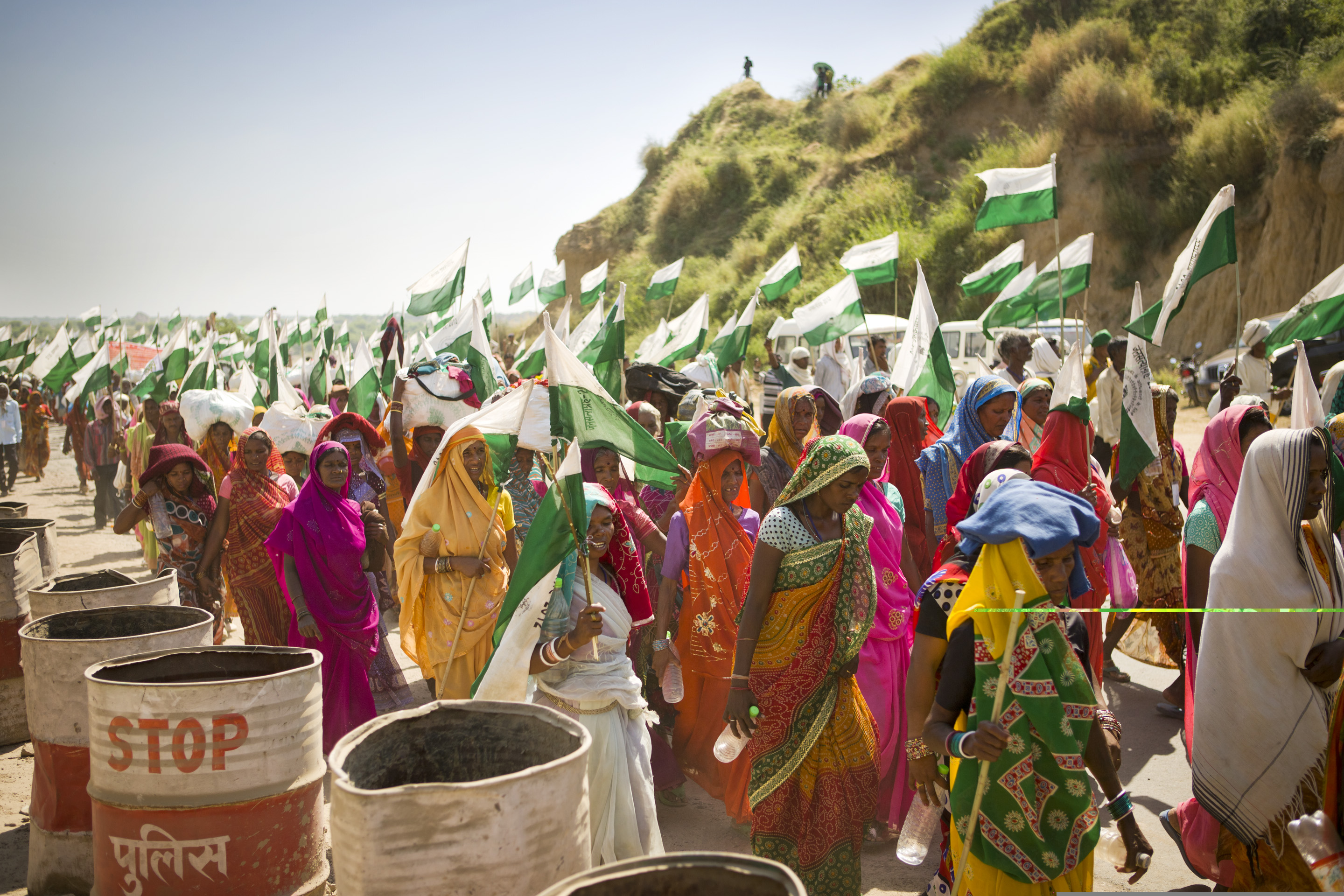
Recalling the spirit of Mahatma Gandhi, 50,000 mostly lower-caste Indians marched over 120 kilometers to secure a comprehensive government agreement on land reform. A ten point document in lieu of a promised National Land Reform Act was signed by India’s Minister of Rural Development Jairam Ramesh and movement leader P.V. Rajagopal in the presence of cheering protestors.
Rajagopal is the founder and president of Ekta Parishad, a non-violent social movement working for land and forest rights. Several hundred other Indian and international community-based groups, civil rights organizations, NGOs, and aid organizations also supported the march.
It was a struggle ‘for dignity, security, and identity’, according to Rajagopal in an Ekta Parishad press release.
The connection to Gandhi was deliberate. The march began on October 2, Gandhi’s birthday, which is also the International Day of Non-Violence.
Imitating Gandhi’s 1930 Salt March to the Sea, Rajagopal assembled landless, lower caste Dalits and tribal Indians from throughout the country in the city of Gawlior, 350 kilometers south of New Delhi. By October 28 over 100,000 protestors were expected to present their demands in the capital city.
Dalits are traditionally regarded as untouchables within a largely Hindu social structure in India. Although a majority of them are Hindus, in several provinces they have converted to Buddhism or other religions.
Recently, several smaller civil anti-corruption movements have disrupted New Delhi and other cities. Not wanting to see another mass descent on the capital, the Indian government began negotiations even before the march commenced.
The agreement was signed along route in Agra, over 200 kilometers away. As the crowd celebrated and dispersed, the government bought itself a six month window for implementation.
Jan Satygraha: Non-Violent Protestors
‘The deprived people are often silent spectators to their own misery,’ stated Rajagopal in a movement blog. ‘They often need someone to help them voice their concerns and fight for their rights.’
In rural India land is both a means of economic sustenance and a denominator for citizenship. A lack of property deeds is a cause of poverty, often preventing citizens from obtaining insurance for crops, loans from banks, and access to other government services.
Though few would dispute the need for a better system, even government statistics do not present uniform data for analysis. The 2009 Report by the Committee on State Agrarian Relations and the Unfinished Task in Land Reforms is a prime example.
The report quotes surveys from different government studies, including the 1997 Draft Plan Paper. It establishes 77 percent of Dalits and 90 percent of the indigenous tribes are either de jure or de facto landless.
Despite its internal contradictions, however, the report reveals the appalling social gap inherent in rural India’s entrenched feudal hierarchy. Large landowners invariably belong to the upper castes, while cultivators belong to the middle castes. As for lower caste agricultural workers, they found representation in the march.
Without land title, Dalits and others are subject to exploitation. Once uprooted from their homestead, many move to the slum pockets of urban centers as unskilled laborers.
Some take to violence and join armed rebel movements. In 2006 Prime Minister Dr Manmohan Singh called such insurgencies the ‘single biggest internal security challenge ever faced’.
These challenges and statistics belie the fact that India’s socialist-leaning policies are enshrined in the constitution, which guarantees indigenous people the right to own the land they live on. Yet according to a 2001 report from the Indian Rural Development Ministry, only 1.3 percent of arable land has been redistributed.
Past pressures on the government have not succeeded in enacting reform. Rajagopal’s October 2 march follows up on earlier non-violent protests organized by Ekta Parishad.
Dalit March
A 2007 march consisting of 25,000 people also marched 350 kilometers to highlight the plight of landless Dalits. They disbanded following a government promise to study the issue. Two different committees submitted reports to the National Land Reform Council in 2009, but it never met to examine the recommendations.
This time, government signatory Ramesh assured his personal support for the demands, though he cautioned not everything could be implemented. Still, the promise of a national land reform policy within six months is a significant improvement. An Ekta Parishad press release states this could assure land title for up to 2.5 million people.
An extra 75,000 protestors makes a difference. It also reflects the philosophy of Rajagopal.
‘A country like India where problems are so many will demand larger mobilization to bring about basic change,’ he states on Ekta Parishad’s website.
‘We are trying to address change at the social and economic level. We are also interested in strengthening a process of participatory democracy and responsible governance.’
Responsible government is best assured through transparent institutions, but Rajagopal is prepared to continue the mobilization as necessary.
‘If nothing happens in six months we will assemble here in Agra and march to Delhi,’ he stated to the Indian press.
Considering the abysmal record of land reform over 65 years of independence, it remains to be seen how much the government can accomplish in six months.
For the first time since the revolution, protestors from opposite camps attacked each other at Tahrir Square. The events have been well documented – and disputed. Here is my version.
Please read this EgyptSource article for a good summary of events and context. Please read here for my brief introduction in the form of a prayer. In brief, a protest against the constitution drafting committee was joined by a protest against the ‘not guilty’ verdict in the revolutionary ‘Battle of the Camel’.
The former protest was called for largely by liberal and leftist forces; the latter by Islamists and revolutionaries. Perhaps there was some overlap between them.
‘Perhaps’ is the key word in all that follows. Previous violent skirmishes all involved the people against the police force. When protestor turned on protestor it was very difficult to tell one from the other.
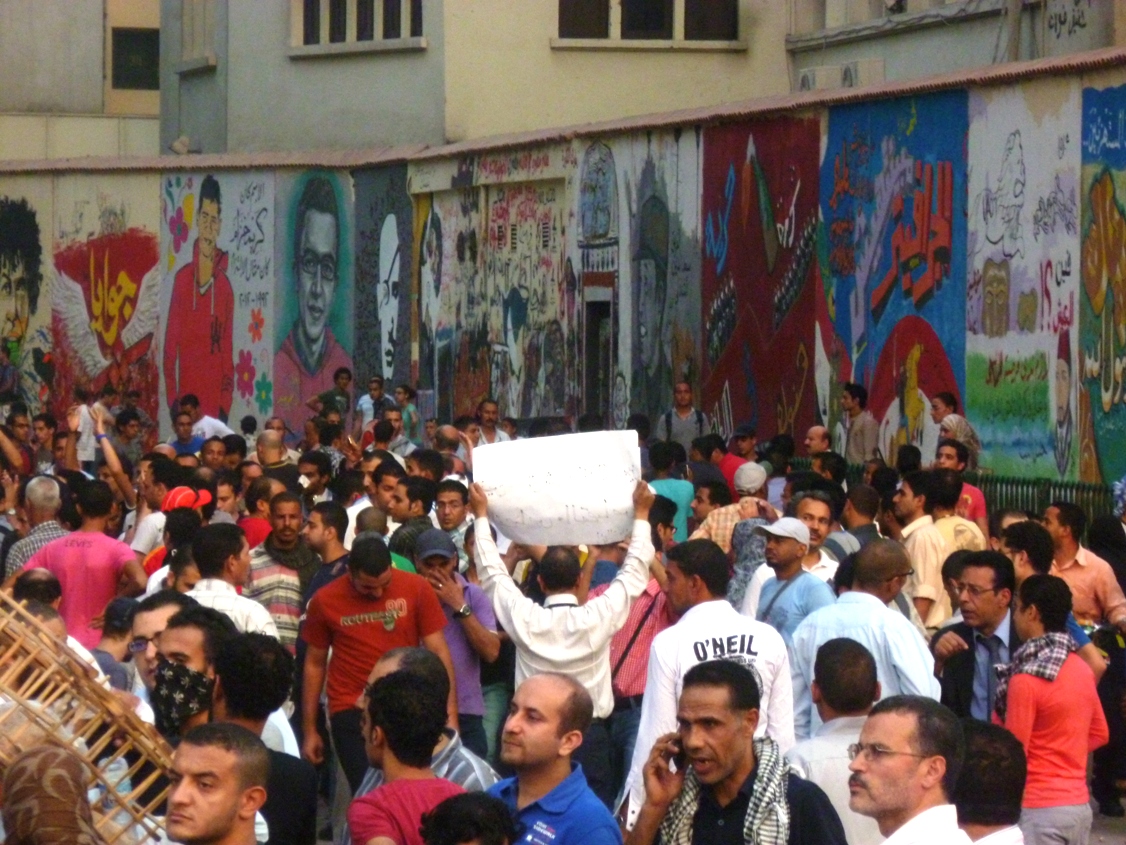
I arrived at around 3:30pm. As I ascended from the Metro I looked around to see sporadic rock throwing in several locations throughout the square. It took me a little while to gain my bearings. I anticipated a full crowd of dueling chants. Instead, I discovered Tahrir to be quite empty.
As I watched I was surprised to find my only reaction was to laugh. The scene was so surreal. I was standing calmly beside the Metro steps with a few dozen others, while about fifty yards away on the other side of the Omar Makram statue rocks were being hurled through the air.
Onlookers told me there was a single stage set up by the anti-constitution protest, but it was destroyed by supporters of President Morsy. Others told me it was the Muslim Brotherhood members who were attacked first by rocks, and then responded. See the EgyptSource link above for video about the stage destruction. Clearly they are Morsy supporters, but how can one tell if it was the Brotherhood or not?
While we were watching the nearby rock throwing, other bystanders told me the Brotherhood had now withdrawn from the square. Their organization has since issued contradictory statements, but the official spokesman stated their members were not present at that time at all. I could see some of those tossing rocks wore beards in Islamist fashion. But then again, anyone can wear a beard.
Eventually the scene settled down nearby, and fighting concentrated on Mohamed Mahmoud Street towards the Ministry of the Interior. Months ago the clashes there with security had been fierce. Now, the battle lines were on the edge of the square leading in, with little to suggest either side cared particularly to advance.
But who was ‘either side’? Onlookers were completely confused and had no idea who was fighting. Eventually one person who seemed like he knew said it was the two wings of the April 6 Movement fighting each other. Indeed, the black flags with clenched fist of April 6 were on both sides. Then again, anyone can hold a flag.
Please click here for my video of this scene (three minutes). The proximity is from the zoom lens, but there were a few moments I thought to judge how close the stones were coming to my vantage point. At this point I wasn’t laughing. If anything, my eyes were a touch moist watching Tahrir disintegrate.
Again, it was hard to tell who was who, but I did not see many bearded protestors; one was assaulted by fists and ran away from the scene to the relatively open Tahrir Square behind us. As for April 6, they have long been divided into two fronts with separate leadership and institutional decision making. One front has closely aligned with the Muslim Brotherhood as a revolutionary movement. Perhaps the other increasingly sees this as a betrayal. It was hard to know.
And then, the reconciliation happened, sort of. All the while the stones were being thrown other revolutionaries were gathered to the left in front of Hardees, chanting furiously, but peacefully. They made their way towards Mohamed Mahmoud Street, and upon arrival, united the two groups. Once together, they chanted the now-popular anti-Brotherhood slogan, ‘Sell the revolution, Badie,’ referring to Mohamed Badie, the Muslim Brotherhood General Guide. Perhaps they were not fighting over a supposed allegiance to the Islamists.
Please click here for my video of these scene (four minutes). It is after the reconciliation itself but shows that perhaps a quarter of Tahrir was now relatively packed, presumably by liberals and leftists.
Somehow they were still divided. A short while later the fighting broke out again.
But by now the main fighting had moved to the Talaat Harb Street entrance to Tahrir Square. This was too far away for me to determine who was who, but onlookers said the Revolutionary Socialists march had just arrived. Again, if flags are any indication, their banner was on one side, while April 6 was on the other.
At this point I decided to leave, figuring there was not much left to see. The only possible development would be if the riot police entered to stop the fighting. Indeed, that was my first thought near the Metro: Why did President Morsy not put an end to in-fighting?
One observer commented, likely correctly, this would then turn into a brawl against the police which would fall on Morsy’s account. At the same time, should it not be the role of the police to calm a civil disturbance? Was Morsy letting the protestors paint each other black? Does he not feel confident he has full control over security forces? Did he just hesitate? Or were there Muslim Brotherhood members present who were stoking tensions, even deliberately?
These are too many questions, which unfortunately fits with the lack of answers that characterizes Egyptian politics these days. Perhaps in days to come everything, everywhere, will be made known.
A few days ago I posted an article I wrote for Lapido Media exploring the religious motivation and justification for protesting an insult to Islam. Much of the perspective rested on the answers of Abdel Rahman al-Barr, a member of the Guidance Bureau of the Muslim Brotherhood and a specialist in the Islamic sharia.
Due to the events al-Barr was unavailable for a face-to-face interview, but graciously provided his time in answering my written questions. For deeper understanding of the subject treated in the article, here is the transcript in full:
A popular chant during the protest was: ‘With our souls and our blood we will redeem you, oh Islam!’ What does ‘blood’ imply, and how will it ‘redeem’ Islam?
This phrase means the speaker is ready to give his life for the sake of his religion, willing that his blood may flow in its defense. If it becomes necessary he will enter a military confrontation to defend Islam even if he must face being killed or martyred in the path of God.
The film was clearly offensive to Islam. But what does Islam teach about defending the religion against insult? Even if peaceful, why are such demonstrations religiously necessary?
Religion is one of the sanctities that man will protect and defend with all he has, even if this leads to giving his life. In the case of this offensive film it is necessary to announce refusal, condemnation, and anger with the most powerful expressions. We request the government with allowed this film to appear – that is, the United States of America – to prevent [its showing] and to hold those who made it accountable, as they have instigated hatred and incited animosity between peoples. Expressing this refusal is a religious obligation, because Islam requires the Muslim to reject error and seek to change it with his hand, if he is able. If he cannot he must reject it with his tongue, and demonstrations are one of the ways to do so.
During the demonstrations, some called the Copts of the Diaspora, especially those involved in the film, ‘dogs’ and ‘pigs’. What does Islam teach about the use of insults against those who insult it?
Those who use such phrases are likely from the common people – not scholars – who were pushed by their anger from the enormity of the crime. But Islamic teachings call for the use of good phrases which do not insult. God the exalted said in the Qur’an: ‘Speak well to people’, ‘Say to those who worship me, “Speak what is good”’, ‘Return the evil with that which is good’, and ‘Return what is good if there is animosity between you’.
The Qur’an states in al-Nahl, 125: ‘Invite to the way of thy Lord with wisdom and beautiful preaching and argue with them in the best manner.’ Even peaceful protests seem to diverge from this, and open the door for many to express anger poorly. How do demonstrations, though politically legal, help shape an Islamic morality? How should anger be expressed in Islam?
We must know that free demonstrations are a new experience for our people, as the repressive regimes dealt with them extremely harshly, to not allow them. Because of this, until now the culture of demonstration remains disfigured for many. Maybe this will improve in the future, but the careful observer will note that demonstrations organized by the Muslim Brotherhood are better disciplined even in the slogans and phrases used. This is because Islamic morality is moderate in both satisfaction and anger. Powerful expressions of anger must respect justice and avoid triviality. The Qur’an says: ‘God does not like the public mention of evil except by one who has been wronged’. So if a man is oppressed he may use forceful phrases to express this oppression, but without triviality or debasement.
Almost no Americans had ever heard of this film until Egypt began to demonstrate against it. To what degree to Muslim religious leaders bear fault for the excesses of these protests, as the Brotherhood called originally for escalation?
Religious scholars are not the ones who began the incitement, and they had no means to prevent it. Those who incited people were some activists who knew of it from the internet, and from here the common people began talking about it. It is natural the scholars could not stay silent in the face of this rejected crime. Personally, if it was in my power I would not have given this subject any importance because it is a vile work. Its producers do not posses human decency or creative value, and the film has no artistic merit. But the new media in its modern form diffuses the insignificant to work up the people – this is what happened with this vile film lacking creative value. Of course, the expansive publication via media had the largest influence on the common people, stirring them up and giving attention to this insulting film.
Thanks to Amr al-Masry for translating the questions into Arabic; any errors in translating the answers are my own, with graciousness asked specifically for the verses from the Qur’an.
The demonstrations and violence surrounding the anti-Muhammad film Innocence of Muslims reveals two worlds which could not be further apart.
The West cherishes freedom of expression and allows religious ideas to be subject to debate, denial, and even ridicule.
Meanwhile, efforts to enshrine blasphemy provisions in Egypt’s new constitution are well underway, surely to receive a boost from this most recent outcry.
Those most offended took to the streets and unleashed the vilest invectives against those who insulted their prophet. Lapido filmed people at the US embassy in Cairo who were noisy, though not riotous.
Of the involvement of a supposed Israeli-American Sam Bacile (now known to be an alias for an American Copt Nakhoula Bacile Nakhoula) the crowd shouted, ‘Khyber, Khyber, oh you Jews! The army of Muhammad will return!’ Khyber refers to Muhammad’s victorious 629 AD siege of a Jewish oasis in the Arabian Peninsula, where he imposed the jizia tax for the first time.
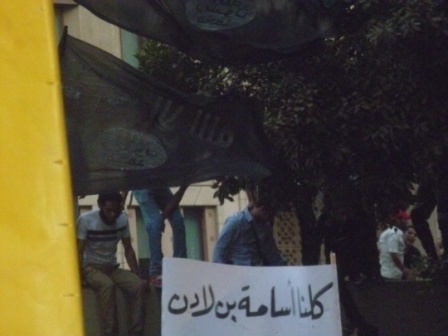
Of the involvement of Coptic-American Maurice Sadek in the movie’s promotion, the crowd shouted, ‘Copts of the diaspora are pigs!’ A sign held aloft declared, ‘We are all bin Laden, you [Coptic] dogs of the diaspora.’
And besides the ubiquitous ‘Allahu Akbar!’ protestors chanted, ‘With our lives and our blood we will redeem you, oh Islam!’
Lapido Media spoke with two Islamists about the recent protests, in a bid to understand.
Mohamed Omar Abdel Rahman
Mohamed Omar Abdel Rahman of the Islamic Group received Lapido the evening of the first day’s protest, when the flag of the US embassy was removed and burned.
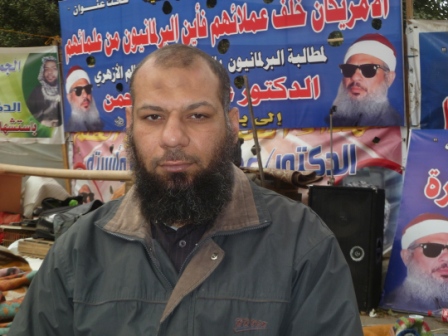
His family has maintained a sit-in protest on the opposite side of the embassy for over a year, demanding the release of their father, Omar Abdel Rahman. Better known as the Blind Sheikh, he is in prison in America over his role in the 1993 World Trade Centre bombings.
Abdel Rahman is not a religious scholar, but a veteran jihadist from the wars in Afghanistan.
‘For any offence against Islam,’ he said, ‘the Muslim has the right to defend himself against the one who says it, and shouting “our lives and our blood” displays his love of his religion.
‘It does not mean to kill an embassy employee, but if the filmmaker comes to Egypt, he will be torn limb from limb. This is permitted in Islam.’
Concerning the signs praising bin Laden and calling foreign Copts ‘dogs’ and ‘pigs’, Abdel Rahman stated this was not meant literally, but ‘to scare them’.
‘They want to destroy Egypt and are its enemies, so this frightening is permitted in Islam.’
Asked about condemning all foreign Copts without distinction, Abdel Rahman stated this was a misunderstanding of Arabic rhetoric, where the general was meant to convey the particular, and exaggerate the grievance.
The use of insults was also misunderstood by the West, conveying not literal figuring but contempt.
‘This also is allowed in Islam,’ he stated, when invited to compare such contempt with the Qur’anic verse extolling ‘good preaching’ against a non-Muslim challenger.
‘Everything has its time and place,’ said Abdel Rahman. ‘It makes no sense to issue simple good preaching during jihad. If someone is attacking you, you resist and fight back, you do not just say a good word.’
Abdel Rahman al-Barr
Lapido then asked Abdel Rahman al-Barr, a member of the Muslim Brotherhood’s Guidance Bureau specializing in the shariah, to comment in a written interview.
By this time the American ambassador to Libya had been murdered, the embassy and school attacked in Tunisia, with outbreaks of violence in many other parts of the Muslim world.
‘Religion is one of the sanctities that man will protect and defend with all he has, even if this leads to giving his life,’ he said.
‘In the case of this offensive film it is necessary to announce refusal, condemnation, and anger with the most powerful expressions.’
To explain what makes this a religious obligation, al-Barr drew from a well-known tradition of the prophet.
‘Islam requires the Muslim to reject error and seek to change it with his hand, if he is able. If he cannot he must reject it with his tongue, and demonstrations are one of the ways to do so.’
Al-Barr noted that many of the demonstrators were ‘common people’, and Egypt did not have a culture of demonstrating. He hinted that the slogans used might be questionable.
‘Islamic morality is moderate in both satisfaction and anger,’ he said. ‘Powerful expressions of anger must respect justice. The Qur’an says: “God does not like the public mention of evil except by one who has been wronged” (4:148).
‘So if a man is oppressed he may use forceful phrases to express this oppression, but without triviality or debasement.’
Al-Barr blamed the media for taking an obscure film and throwing it in the face of Muslims. He gave no credence to the idea that religious scholars had a share in the blame for the excesses which took place, but did suggest some regret.
‘It is natural the scholars could not stay silent in the face of this rejected crime. Personally, if it was in my power I would not have given this subject any importance because it is a vile work.’
Instead, ultimate blame lay elsewhere, indicating the vast difference in cultural perspectives.
He concluded: ‘We request the government which allowed this film to appear – that is, the United States of America – to prevent [its showing] and to hold those who made it accountable, as they have instigated hatred and incited animosity between peoples.’
This article was first published on Lapido Media on September 19, 2012
A spiritual man, Fr. Mercurious knows the only guarantee is from the hand of God. At the same time, his surgery to prevent a heart attack was in the hands of Muslims.
A few weeks ago the forty year old monk in the Monastery of St. Makarious in Wadi Natrun had open heart surgery. Suffering from high cholesterol, his doctor advised this course of action at the earliest date possible.
With genetic propensity from his father, and narrow arteries from his mother, the simple diet of a monk was not enough to guarantee health.
Fr. Mercurious did not intend it to be so originally, though this had nothing to do with religious preference. Like many Egyptians, he inquired first if he could travel to the US or UK for surgery. When embassy procedures did not go anywhere, his doctor recommended a specialist hospital in 6 October City, a new development outside of Cairo.
The surgery went well. Muslim Egyptian doctors grafted veins from his arms and legs to bypass his arteries, which were blocked at 95%. They even gave him special deference due to his clerical disposition.
It is not a remarkable thing, really. Well trained doctors demonstrate their skills on a human being. Unfortunately, it is often not the sort of story heard about Egypt.
Fr. Mercurious related his operation in the context of the changing religious climate of Egypt. While admitting his isolation from the world, he keeps up with events through visitors to the monastery and their tales of political and social developments.
Before entering the monastery after university studies, Fr. Mercurious stated he had only the best of relations with all Muslims he knew. Yet in the past several years he had the impression that the number of ‘extremists’ was increasing.
Is this a function of real change in the character of Muslims, or of real change in the perceptions of his Christian visitors? Surely the two must be somewhat related.
Dr. Mohamed el-Menissy is a Muslim doctor who volunteered at the field hospital in Kasr el-Dobara Evangelical Church near Tahrir Square during clashes in November. In asking him about his experience – not his faith – he insisted over and over again that Muslims and Christians love each other in Egypt. He was near desperate to get this message across to the West. He even gave me the phone number of his Christian doctor colleague so as to confirm their friendship.
Of course Dr. Menissy is telling the truth of his experience, but does such single-mindedness betray a deeper reality frantically denied? Is he hoping the world to be right, if only by insisting it is?
Perhaps it is as simple as rightful offense at media – both Western and Arab – which focuses on problems to such degree it obscures reality, perhaps even to the extent of transforming it. Speaking to media, perhaps Dr. Menissy wanted to transform it back.
What purpose does this story serve, then? In highlighting a non-news event of a Muslim doctor operating successfully on a Coptic monk, do I help stem the tide of negative reporting? Or do I play into the narrative of distinction between Muslim and Christian?
Fortunately, I carry no such burden. I tell the story of the monk because he is my friend and it is interesting. I tell the story of Dr. Menissy because it fits in this context and honors his desire. Both show a slice of life that is worthy to be known more widely.
As for what these stories say about Muslim-Christian relationships in Egypt: They say the truth. It is not the whole truth, but it is an essential truth.
The next time a church burns, it is important to acknowledge this as the truth also. One story balances another.
Such complexity marks our own lives – we chafe at being reduced, simplified, or misunderstood. Let us grant the same grace to Egypt.
After all, as these stories show, she shows much grace to her own.
As clashes continue in the areas surrounding the US Embassy, I have had opportunity to publish my account and analysis from the original incident on EgyptSource. Please click here for the article in full, and excerpts follow below:
The sad spectacle on display at the US Embassy in Cairo on September 11 shows nearly everyone in a poor light. Sadder still is that most parties involved acted from a sense of virtue, but misunderstanding and prejudice corroded the good intentions.
I next proceed to describe some of the background events as well as the misunderstandings on the part of the US Embassy and US media. Next follows perhaps the most crucial observation I gained:
The stranger inference is that the embassy was not surrounded from the beginning. The protest was announced in advance, and yet Egyptian riot police were present throughout the demonstration. Yet it was the army, absent the entire time, which secured the premises.
The US Embassy complex is surrounded by a high wall lining almost entirely the adjacent street. The entrance is located in the center of the wall. Black clad police with helmets and shields lined the wall to the right of the entrance, but yielded the left side to protesters. Essam, an older Salafi protester, told me the police deferred to the ‘Islamists’ to keep the youth under control.
Next follows viewpoints expressed by some of the participants, including these:
Consistently the crowd shouted, ‘With our lives and blood we will redeem you, oh Islam.’ Muhammad, another son of the Blind Sheikh, explained, “For any offense against Islam, the Muslim has the right to defend himself against the one who says it, and this slogan displays his love of his religion.
“Everything has its time and place. It makes no sense to issue simple good preaching during jihad. If someone is attacking you, you resist and fight back, you do not just say a good word.”
Another participant in the protests, Mustafa, who had returned to Egypt after living fifteen years in Brooklyn, commented further. “Those Copts making this film should be killed.”
The sad fact is that so few involved in this episode, whether gathered at surrounding the embassy or abroad, exhibit a will to understand and appreciate the other. For his part, Muhammad Abdel Rahman acknowledged the legitimacy of debate. “A Copt in Egypt may stand publically and state he does not believe in Muhammad. But there is a difference between discussion and insult.”
Yet where is the line to be drawn? What Muhammad might allow Mustafa might murder. Both act from the virtue of principle, yet each is open to the condemnation of fellow Muslims. Such difference in interpretation is witnessed in all actors.
The transition to conclusion involves weighing each actor on the basis of their motivation from virtue, only to be spoiled by misunderstanding. Of course, the virtue of each may be completely false, which is also considered. I end looking ahead to tomorrow, a day seeming increasingly ominous:
The test will come on Friday, when Islamist groups, including the Muslim Brotherhood, have called for more demonstrations against the film. Meanwhile, their political arm the Freedom and Justice Party, described the film as “a failed attempt to stir strife between Muslims and Copts.”
These rallies will only cement the ill image many Arabs and Westerners have of one another. The former see the latter as irreligious libertines, while Muslims get labeled as oversensitive fanatics. It is a sad exchange, overcome only through awareness, acceptance, understanding, and respect. Will wiser heads prevail? Humankind is capable of great virtue, but it is easily marred.
Perhaps nothing of significance will take place, but the fear is that there is significant political capital to play with. Demonizing America has long been a feature of Egyptian domestic policy, even while official relations are maintained, even strengthened. President Morsy and the Muslim Brotherhood again face the choice to imitate Mubarak, or change the political culture of Egypt.
But if they change, in what direction? Better, or worse?
To mark September 11, Muslims in Egypt stormed the US Embassy.
Actually, it is not that simple. Certain Copts resident in America produced an amateur film purporting to expose the frails and falsities of Muhammad, and advertised its release for September 11. Word carried back to Egypt, of course, prompting protest from religious institutions, Muslim and Christian alike. Salafi Muslims in particular called for a protest at the US Embassy, and they were joined by hardcore soccer fans in denouncing the film as well as the US government for allowing it to be made. The US Embassy, for its part, issued an official condemnation, calling the effort an abuse of freedom of expression.
Several thousand Egyptians gathered at the entrance of the embassy, falling into roughly two categories. While it was clear all participated, bearded Salafi Muslims largely stood peacefully, while the soccer youth led vociferous, and playful, chants. It was the latter which scaled the walls of the embassy, pulled down the US flag, and burned it.
Later, they also draped a black Islamic flag over the signage of the embassy, above its entrance. These flags were in abundance and resemble the standard used by al-Qaeda. It is al-Qaeda, however, which appropriated the black flag from earlier in Islamic history, which was used in Muhammad’s campaigns. It bears the Islamic creed: There is no god but God, and Muhammad is his apostle. Its use at this rally does not imply the presence of al-Qaeda.
I did not witness the US flag being desecrated, but Egyptian security was present in abundance and permitted the action. I was told that the Islamic contingent of the protest calmed the youth and did not permit a more serious storming of embassy grounds, if this was even intended. Security seemed to rely on these Islamists to make certain things did not get out of hand.
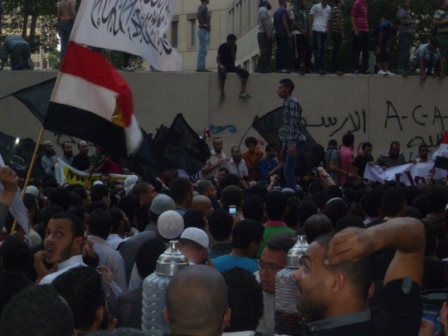
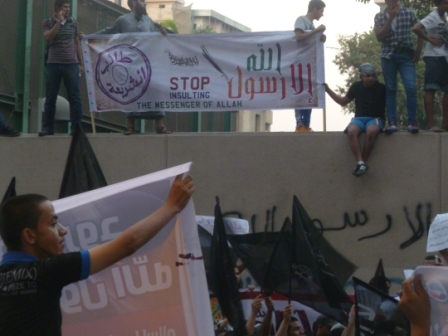
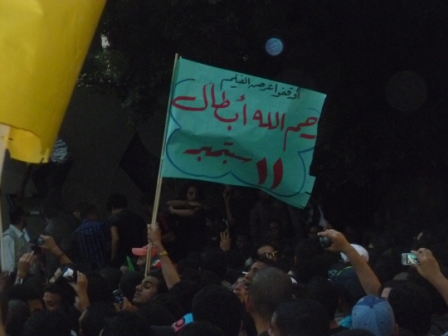
The atmosphere was charged, but calm and peaceful. Even so, offensive chants were issued and questionable signs displayed. Foreign Copts were called ‘pigs’, and the Jews were warned about the soon return of Muhammad’s army. One sign declared, ‘We are all bin Laden, you (Coptic) dogs of the diaspora,’ another celebrated the heroes of September 11, asking God’s mercy upon them. Please click here for a brief video of the protest, and pictures follow below.
I would not say this demonstration was representative of Egyptian society; several thousand people are a small scale protest. Yet dangerous ideas are afloat and society is yet in an unstable transition. I felt somewhat uncomfortable in their midst and kept a low profile, yet spoke with some and suffered no ill reception. Afterwards I spoke at length with some Islamists there I know well, and hope to convey their thoughts in a separate post, perhaps tomorrow.
Such is Egypt these days, for better or for worse. May God bless them.
Black flag draped over US Embassy signYouth Leading ChantsTranslation of graffiti: Muhammad is God’s ApostleProtest bannerSome signs were in English for foreign understandingCalling for Egyptian nationality to be revoked from foreign CoptsSome Copts were present in solidarity with offended MuslimsTranslation: We are All bin Laden; continues underneath, You (Coptic) Dogs of the DiasporaTranslation: God have Mercy on the Heroes of September 11
If not for the wisdom of two men, the world would be aware of the village of Sheikh Masoud in Upper Egypt for all the wrong reasons.
This hamlet deep in the rural backwater south of Cairo would have been added to the well-publicized list of Egyptian locations torn apart by sectarianism.
As it is, you do not know about it – unlike Dahshur, Giza, which was the most recent casualty of religious division, and the first village to suffer under the new Islamist regime of Mohamed Morsy.
Located 40 kilometers south of Cairo and home to the famous Red and Bent Pyramids, on 28 July Muslims and Christians in Dahshur confronted each other with shouts and exchanges of Molotov cocktails. It ended with a death and a devastated population.
The incident started when a local Christian laundryman burned the shirt of a Muslim client while ironing.
A stray Molotov cocktail accidently hit a Muslim passer-by. When he died from his burns a few days later, Muslims surrounded Coptic homes and businesses, setting fire to them. By 3 August, security forces had evacuated 120 Christian families from the village until calm could be restored.
Wisdom
The events in Dahshur however are part of a more complex pattern of sectarian relations that is often missed by the media. Sensationalist headlines and attention-grabbing pictures often start out as ordinary social problems that escalate, feeding on religious difference.
Far more common is local community wisdom snuffing out the tension, as happened in the village of Sheikh Masoud, 160 kilometers south of Cairo.
It could have gone either way in this sleepy countryside hamlet whose population recently surged to 25,000, 80 per cent of it Muslim.
The village also hosts an area church. Here it was that on 5 August a wedding ceremony took place for Christians of a neighboring village that had no church. All proceeded well and the wedding guests got into cars to drive back home. But trouble developed when the bridal party rearranged the seating in their vehicles to allow the bride and groom to drive to Cairo on their own to begin their honeymoon.
To do so they stopped in the middle of the main street in the village, halting traffic. Only half an hour shy of sunset when hungry Muslims could break their Ramadan fast, an argument ensued.
According to Fr Musa Ghobrial, priest of the St George Coptic Orthodox Church in Sheikh Masoud, the street in question lies thirty meters from the church and is a public gathering area for local Muslim youth.
Muslim drivers tossed insults at the bridal party, shouting especially at the sister of the bride getting out of the car, unaware that she was blind.
Flustered, her uncle, unable to shout back as he happened to be mute, spat upon one of the youths. Within moments the argument spilled over into the church compound, with more than a hundred Muslims gathered inside.
Sheikh Masoud Church Grounds
‘I was absent at the moment of the event,’ said Mohamed Ali, a 43-year old power station manager and father of the youth who was spat upon.
‘I heard that Christians were attacking us, and came after five or ten minutes with my relatives and neighbours to stop the insults,’ he told Lapido.
Fr Musa states there was no violence in the church, but that the atmosphere was charged.
‘Muslims in our area look for opportunities to stir up trouble, especially the younger generation. We keep good relations with them, but other Muslims consider this village to be weak because it has a church,’ he said.
It was these good relations which averted the crisis.
‘What happened was a reaction from the Muslims,’ Ali said. ‘I told them to go home because this is a place of worship and there should be no problems here.
‘Then I saw Fr Musa and the other priests leaving the church and told the crowd, “I know these priests. They will take care of this.”’
As the scene quieted and the church courtyard emptied, Fr Musa sped off after the bride and groom, persuading them to return. He spent the next day sitting with Christian villagers convincing them of their need to apologize over the spitting.
The third day Fr Musa gathered the Christians in Ali’s home, and all drank tea together.
‘Nothing happened,’ Ali told his guests, ‘We are all one.’
According to Fr Musa, neither side issued a public apology, but the gesture in Upper Egyptian culture signified both sides owned their wrong and extended forgiveness.
If Mohamed Ali had been an extremist, or if Fr Musa had angrily shouted at the Muslims in his church, the situation in Sheikh Masoud could have escalated like Dahshur.
Instead, the village remains as unknown as thousands of others throughout Egypt. In each, Muslims and Christians negotiate the status quo, despite the increasing trend of religious polarity nationally.
At times the mixture leads to combustion, but more often than not, contrary to assumptions carried in the press, wisdom prevails.
Fr Musa and Mohamed Ali are courageous – but mercifully not unique – peacemakers.
This article was first published at Lapido Media on August 29, 2012. Please click here to access it.
It has taken me a long time to write anything about the Sunday surprise: President Morsy forcing the resignation of senior military men Mohamed Tantawi and Sami Anan. At the same time, he unilaterally canceled the army announcement appropriating legislative authority and constitutional oversight to itself. Morsy then gave himself these privileges.
Much of my delay was due to shock, the rest due to efforts to figure out what it all meant.
My first response came almost a week later by necessity, as I am glad for the habit of writing Friday Prayers. It was very helpful to try to frame the event in a manner all people here could pray.
Morsy’s moves were good, but not as good as some make them out to be. They were also bad, but not as bad as others make them out to be.
Certainly the army leadership was guilty of mismanagement during the democratic transition, if not worse. Moreover, it was never fitting for the military to formally take the powers it did, even if there were justifying factors.
In one sense Morsy put things right, but by taking power to himself he put them wrong again.
One of the main reasons the revolution railed against Mubarak was over his dictatorial command of the regime. Now, as the beneficiary of the revolution, Morsy has even more power.
Yet while this image is there, it should be drawn in. Morsy could not have sacked army leadership without the help of junior army leadership. These may be less adversarial in public, but in private may still act as a check on his power.
The question is, if this is true, are they a check on his revolutionary and democratic ambitions, or on his Islamist ambitions? Which does Morsy hold closer to his heart?
In contemplating this question I recalled a conversation I had with a leading Coptic media figure several months ago. Then I found a new writing opportunity, resulting in my first full reflection on Morsy’s gambit, published yesterday at Egypt Source. I wrote:
The worried Coptic voice interprets this as a grand scheme to implement an Islamic state. The frustrated liberal voice interprets it as evidence of their Machiavellian lust for power. Both may be right.
But what if the Brotherhood really means it? ‘Trust us’ may not result in everything the Copt or the liberal desire, but it may reflect a real Brotherhood wish to honor the goals of the revolution in respect to the conservative social reality of Egypt.
Or perhaps I have the wool pulled over my eyes.
In November of last year following the Islamist victory in the first round of parliamentary elections, I interviewed Youssef Sidhom, editor-in-chief of the Coptic newspaper Watani. Imagining I would hear alarm bells from an intellectual leader in the community, I was surprised by the exact opposite.
“I believe the Muslim Brotherhood wants to prove they can create a form of democracy,” Sidhom said, “that respects the rights of all Egyptians.” He went on to describe several positive pre-election meetings with Brotherhood leaders, from which he was convinced they were ‘decent people’.
Yet when asked why they would not submit to a consensus over binding constitutional principles, his answer has echoed in my mind in all events since.
“Perhaps … they don’t want it said, ‘They did so only because they were forced to.’”
Upon finishing the article I had the disquieting feeling I had functioned as an apologist for the Muslim Brotherhood.
But here is the rub. The West enjoys liberal governance and has for decades. The revolution in Egypt is only now seeking its creation. Does the Brotherhood seek this? If so, they may need an autocratic moment to give it birth. All their concentration of power may be to show themselves the ultimate servant, when they bequeath it back to the people.
They should not be given the benefit of the doubt – there is no room for this in politics. The possibility, however, needs to be raised.
I am very cautious. Most testimony I have heard across the Egyptian political spectrum is that Morsy is a good man. I believe that power corrupts; while a man can be a benevolent dictator or philosopher king, a system cannot.
Is Morsy ushering in a new era, or is the Muslim Brotherhood ushering in a new system?















 Jayson Casper