Categories
Lapido Media Middle East Published Articles

As President Morsy Preaches Peace, Muslim Brotherhood Sanctions Jihad

Morsy hailed at Tahrir Square

In both his presidential campaign and inaugural addresses, President Mohamed Morsy has assured the world of Egypt’s commitment to peace. Yet in the run-up to the final election on June 14, the Muslim Brotherhood published an Arabic article calling this commitment into question.

‘How happy would Muslims be if the leaders of the Muslims … would make recovery of al-Aqsa Mosque [in Jerusalem] their central issue – to cleanse it from the filth of the Zionists and impose Islamic sovereignty over all quarters of Palestine,’ wrote General Guide Mohamed Badie, the group’s top leader.

Furthermore, he referenced a fatwa given by ‘Muslim scholars’ without further designation, ‘Jihad with life and money for the recovery of al-Aqsa Mosque is an individual duty incumbent on every Muslim.’ The article was published on IkhwanOnline, the official website of the Muslim Brotherhood.

This message is very different from the public statements of Morsy, who emerged from the Brotherhood to win Egypt’s first free democratic presidential election.

‘We will preserve all international treaties and charters,’ said Morsy. ‘We come in peace.’

Though Israel was never mentioned by name, the inference was obvious.

The international community is watching closely as importance lies in what Morsy does, not in what he says. Still, his assurance is understood as one of the necessary guarantees to the Egyptian military as well as the United States to not stand in the way of a Brotherhood presidency.

Yet the principle of action over rhetoric is necessary also concerning domestic Brotherhood politics. As US-MB delegations were in continual contact, Badie’s article sanctioning jihad betrays little intention to honor a peace treaty. On the other hand, at this point, they are just words, not actions.

Which words should be believed?

According to Sheikh Osama al-Qusi, an Egyptian Salafi scholar with no love for the Brotherhood, the word jihad does not necessarily imply fighting. ‘The term with life designates that one must be ready to give his life for the cause of Islam. It may include engaging in battle, but this is not demanded.’

Even so, al-Qusi links ‘jihad with life and money’ to its Qur’anic source, where God instructs the Muslims, ‘Allah has purchased from the believers their lives and their properties [in exchange] for that they will have Paradise. They fight in the cause of Allah, so they kill and are killed.’

Speaking with Lapido Media, Muslim Brotherhood spokesman Mahmoud Ghozlan makes a different distinction. ‘As a citizen I am different from the state or the presidency,’ he says.

‘Just because we have gained the presidency should we give up on our principles concerning Palestine, including that Jerusalem is for us?’

Ghozlan then reiterated Morsy’s assurances that Egypt would respect all international treaties. Indeed, the rest of Badie’s article references non-violent methods to expose Israeli occupation of Palestine, such as the ‘Miles of Smiles’ aid convoys from March 2012 to break the blockade of Gaza.

Dr. Nadia Mostafa, professor of international relations at Cairo University, agrees with this non-violent interpretation. ‘We can make jihad,’ she told Lapido Media, ‘in a different way.

‘It does not mean to make a suicide bomb. Jihad with life means we must offer everything in our life for the just cause, even to the last extent in which I die.’

Badie’s article, indeed, does not call specifically for jihad. It urges patience on the Palestinian people and a focus on reconciliation between Fatah and Hamas.

Yet it also urges persistence, that they should make their ‘motto and starting point the confrontation of the Zionists’. That is, perhaps, it is a Palestinian struggle, even if they should be encouraged that ‘every sincere Muslim mujahid in every nation of the world stands with you’.

For Mostafa, Palestine is the issue which will decide the presidency of Morsy. But it must not be allowed to distract from critical domestic issues, including overcoming the secular-Islamist divide. She expects, however, a firm rejection of the Gaza blockade.

‘The Brotherhood will say what they have to say, but we must separate between them and the presidency, and I believe Morsy understands this well.’

Mohamed Morsy formally ended his membership in the Muslim Brotherhood following his official declaration as president.

As president, however, he is not expected to have much love for Israel, no matter his international obligations. Political analyst Sameh Fawzy expects a zero-tolerance strategy towards Israel.

‘Egyptians have had a very limited margin of normalization with Israel over the last decades,’ Fawzy told Lapido Media. ‘This margin is expected to be even narrower than before.’

Therefore, while the Muslim Brotherhood may well continue its strident rhetoric, Fawzy believes the Israel file will remain in the hands of the foreign ministry and security apparatus.

While these cabinet positions are still being negotiated, many analysts believe these ministries will remain firmly under military supervision, if not direct control.

This combination is not predisposed to result in war, but the consequence may well be a continuation of the status quo. For Fawzy, the bilateral outlook is bleak.

‘Cold peace is the expected option.’


Published first at Lapido Media.


Related Posts:

Categories
Lapido Media Middle East Published Articles

Brotherhood Faces Both Ways as Egypt Votes for President

Mohamed Morsy

The Islamist front-runner in today’s historic presidential election in Egypt, the Muslim Brotherhood’s Mohamed Morsy, has ‘clarified’ the Islamic position on conversion, in what could be seen as an appeal to liberal election watchers.

He said on the popular al-Nahar satellite TV station, on 17 May, in Arabic: ‘There is a wrong concept widely misunderstood, that the apostate [convert] is subject to Islamic punishment. This needs clarification,’ he said on the eve of the first free elections in Egypt’s history.

The man described by the Times today as an ‘uncharismatic party bureaucrat’ was not the Brotherhood’s original candidate, but emerged after the interim authorities banned Khairat al-Shater, who had spent time in jail under the Mubarak regime.

His pronouncement is startling since apostasy – renouncing Islam – carries the death penalty in much of the Muslim world.  It is not proscribed by the constitutional law in Egypt, although citizens can bring cases against those suspected of contravening any aspect of the sharia which is still the primary source of law.

Opportune

Morsy’s own conversion has come at an opportune time, on the eve of the second day of polling.  He believes he has found a new perspective on what is widely seen as the root cause of oppression in the Islamic world:  ‘The Egyptian citizen, between himself and God, if he wants to change his faith or his doctrine, he has complete freedom.’

Morsy, like all candidates, in appealing to as many voters as possible, speaks the language of Islam, with competition fierce between him, other Islamist candidates such as Abdul Moneim Abou El Fotouh and secular figures like former Foreign Minister Amr Moussa.

Current polls show Morsy trailing in as low as third or fourth position, but few people doubt the organizational capabilities of the Brotherhood to get out the vote.

For his part, Morsy predicted he would capture 60 per cent of the vote in first round elections which began yesterday (23 May) but there would be a run-off if any candidate failed to win 50 per cent-plus-one of the electorate, between the top two, on 16/17June.

He has clearly chosen this issue due to its high symbolic value among human rights advocates, with two cases of Muslims converting to Christianity currently going through the courts, according to the 2011 US Department of State International Religious Freedom Report.

A third case concerns around 100 Coptic applicants seeking re-conversion to Christianity, having previously adopted Islam.

Countries where conversion is treasonable are Iran, Saudi Arabia, Mauritania, Qatar, UAE, according to the Amman Center for Human Rights Studies’ 5th annual report in 2010, and this has a chilling effect on Egyptian religious freedom.

A case can be made against any Egyptian citizen for any crime against Islam and a judge has the ability to accept or deny that case.

In the past decade, a number of judges have taken it upon themselves to rule according to Islamic law regardless of what the constitutional law says, and have imposed draconian punishment ranging from imprisonment and torture to enforced divorce and loss of position.

The apparent arbitrariness of this as a system – since Sharia is so widely interpreted in the Muslim world – accounts for the insecurity felt by many.

Revd Fayez Isack is a pastor at the evangelical church of Kasr el-Dobara in Cairo, the largest Protestant church in the Arab world. He maintains these legal cases are only the tip of the iceberg, but there is no sound research on precise numbers.

He finds little comfort in Morsy’s statement.

‘This is typical of the way they talk. The apostate has all the rights until he becomes a threat to the system of God, and then the law of God is applied,’ he said.

According to other Protestant sources, who asked not to be named for the sake of security, there are hundreds of thousands of ‘secret believers’ who have converted to Christianity. For these, the ‘clarification’ Morsy mentioned is important.

Morsy contends that religion is a private matter – up to a point.  He stated:  ‘Anyone who keeps his trouble in his home, to himself – no one has the legal or Islamic right to knock on his door and ask what he’s doing. But when the home begins to affect society, this is where the law and the sharia have the right to interfere.’

Official Brotherhood spokesman Mahmoud Ghozlan backs up Isack’s critique. ‘Egyptian society is not like the West; calling to a different religion causes social strife, even if just one person to another.’

Jerusalem

Morsy’s appeal to liberal voters contrasts with other MB efforts to reach conservatives with a pan-Islamic vision that has horrified some commentators in the wake of the Revolution.

Sheikh Safwat Hegazi, a popular television preacher who appears frequently with Morsy at rallies, was banned from entering France in April.

Safwat Hegazi

Endorsing Morsy, he declared recently before thousands at Cairo stadium: ‘We can see how the dream of the Islamic caliphate is being realized, God willing, by Dr. Mohamed Morsi.

‘Our capital shall not be in Cairo, Mecca or Medina; millions of martyrs march toward Jerusalem.’

Ghozlan dismissed these comments, but stopped short of condemning them.

‘Egypt is a sinking ship, and we need to get back on our own feet before we can worry about regional issues.

‘This is less a strategy than a dream, and his comments are not based in any reality.

‘We are part of the Arab world and we believe in Arab unity and greater integration both politically and economically, but we would need to wait decades, even centuries, before we can see a caliphate realized.

‘Wisdom says let the statement go and seek to clarify, rather than embarrassing the person who came to support you.’

Yet another MB commentator, Hassan Abdel Sattar Mohamed, member of the media committee of the Brotherhood for south Cairo, is clearer.  He stated: ‘Hegazi sees in Morsy one who will apply the goals of sharia, and who has a vision for the unity of Arab and Islamic states.

‘We refuse the Zionist entity which occupies al-Aqsa [in Jerusalem], and we support the Palestinian cause.

‘It is the ultimate goal to have Jerusalem as the capital and to march for its liberation, but reality does not permit this now.’

Politicians around the world seek ‘big tent’ politics, but often by default fall back on the strength of their base. Seeking the centre, the Muslim Brotherhood has made countless statements on their intention to create a civil state with full citizenship rights for all.

The question that remains to be resolved is whether such statements as these on apostasy and the caliphate represent an appeal for votes – or core policy objectives.

This piece was originally published on Lapido Media.


Related Posts:

Categories
Lapido Media Middle East Published Articles

Does God Permit a Muslim to Break a Promise?

Mahmoud Ghozlan

The Muslim Brotherhood set Egyptian politics ablaze recently with their decision to nominate their chief financier, Khairat al-Shater, for the presidency. Though he has since been disqualified, they continue to run with their backup candidate, Mohamed Morsy. All political groups recognize the right of the group to do so but many have criticized them harshly, recalling their promise from early in the revolution.

The Brotherhood assured both revolutionary forces and Western observers they had no intentions for the presidency, anxious to calm fears of an Islamist takeover. They even expelled a prominent member, Abdel Munim Abul Futuh, who declared his candidacy early on.

MB Spokesman Mahmoud Ghozlan explained to me this promise was necessitated by fear the West would extinguish the revolutionary movement. Now the reversal is necessary to protect the revolution from former regime members seeking the presidency.

Perhaps this political analysis is reasonable, but the Brotherhood are not simply politicians; they are also Muslims. An anxious West expects men of religion to keep their promises.

Pressed on this question, Ghozlan was quick to answer.

‘If you want religious justification, the Prophet said: “If someone swears by his right hand, saying, ‘By God I will do this or that…’, but then sees something better than it, he may atone for his right hand, and do that which is better.”

‘There is a difference between matters of principle and political decisions. Politics is firstly concerned with the general benefit.’

Yet as the Brotherhood defines this benefit in accordance with their own, they risk confirming fears the group cannot be trusted, which some in the West extend to Muslims in general.

I inquired of scholars of three different Islamic trends to test Ghozlan’s interpretation. All three confirm the message of the tradition, though they differ in application.

Mohamed Omar Abdel Rahman

Mohamed Omar Abdel Rahman is a veteran jihadist who fought in Afghanistan. He is also the son of Omar Abdel Rahman, better known as the Blind Sheikh, currently serving a life sentence in the United States for plotting the 1993 bombing of the World Trade Center.

He contrasts two examples,

‘There is a difference between a pact and a promise. A pact is an agreement between two parties and cannot be changed without common agreement, as in the Camp David Accords between Egypt and Israel.

‘This tradition of Mohamed refers to a promise and applies only to one’s self. So this can be changed if something better emerges or if circumstances change, which the Brotherhood clearly believes has happened.’

Osama al-Qusi

Osama al-Qusi is a Salafi scholar, trained under Wahhabi thought in Saudi Arabia and Yemen. He is controversial in Egypt, however, for his oft-criticized liberal interpretations.

He believes Ghozlan is misusing Mohamed’s words.

‘There is a big difference in what I say between me and God, which is the meaning of this tradition, and what I say to other people.

‘This is a religious mistake, no matter how politically justifiable it might be.’

Abdel Muti al-Bayyoumi is a member of the Islamic Research Academy and a traditional Azhar scholar. He and his institution represent mainstream Muslim thought throughout the Sunni world.

Like Abdel Rahman, he clarifies as to the nature of the Brotherhood’s commitment. ‘This tradition does not apply because they did not swear to God but only made a promise.

‘In terms of a promise the right to change it depends on their intention; if it was good it is acceptable.

‘The matter is between them and God, but they have to offer their justification, which if good should be accepted.’

Yet Bayyoumi, like many in Egypt, find neither their intention nor their justification acceptable.

‘It appears to me they want to consolidate power. They are aiming for the presidency, the parliament, the constitution, and who knows what else.’

While a man’s word should be his bond, most admit honest circumstances can free one from a pledge. For many in the West, though, religion in politics risks staining the former and manipulating the latter.

The Muslim Brotherhood, however, believes Islam and politics to be compatible, even inseparable.

How they navigate the quagmire will affect not only their own political fortunes, but also the greater Western perception of Islam.

This article was originally published at Lapido Media.


Related Posts:

Categories
Lapido Media Middle East Published Articles

Beauty and Women Celebrated at Inter-Faith Art Exhibition

‘We came here today to satisfy our soul for its need of beauty.’ With these words Azhar Sheikh Mohamed Gamia addressed the crowd at the Caravan Festival of Arts, hosted by St. John the Baptist Church in Maadi, Egypt.

But then he continued, rather surprisingly given the oft-assumed perspectives of Muslim scholars.

‘When you look to the heavens, you see beauty and love. When you look to the kingdom of earth, you see beauty and love. When you look in the faces of people, you see beauty and love…

‘And when you look at the form of a woman, you see beauty and love.’

Rev. Paul-Gordon Chandler

The rector of St. John’s is Rev. Paul-Gordon Chandler who stated, ‘Art is one of the best means for encouraging friendship among those with differences.’

From left: Dr. Azab, Bishop Mouneer, and Sheikh Gamia

This evening, these differences were in short supply. In addition to Gamia mentioned above, Chandler introduced Bishop Mouneer, head of the Anglican diocese of Egypt, North Africa, and the Horn of Africa, and Dr. Mahmoud Azab, head of the Azhar committee for interfaith dialogue.

Bishop Mouneer declared, ‘Many things divide us, but love, the love of God, brings us together. When we love God truly, we love each other also.

‘Art also serves a role in bringing us together.’

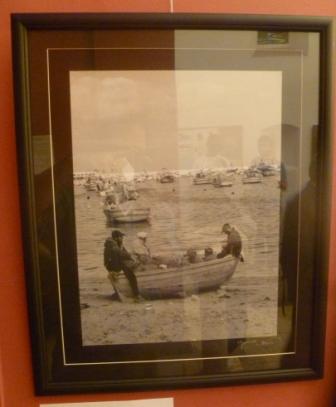
Bishop Mouneer is also a participant in the exhibition, supplying one of his photographs. Referring to it, he stated, ‘The road ahead in the revolution is to realize we are all in one boat.

‘All in the Same Boat’ – Rev. Dr. Mouneer Anis, Egypt

‘We must take care of this boat, which is Egypt.

‘We must also row in the same direction.’

Dr. Azab declared, ‘Religion as a sign of civilization is an inspiration to scholars and artists alike.

‘Christianity is the religion of love, Islam is the religion of mercy, and Egypt is in dire need of both.’

The Caravan Festival of the Arts also featured two prominent Egyptian performers.

Yousra

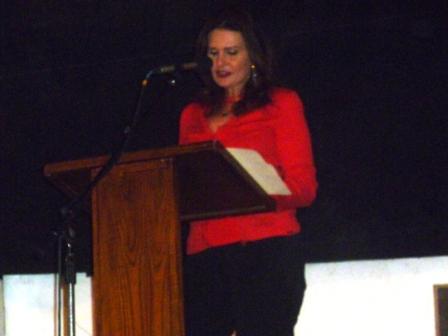
Yousra is a famous Egyptian actress, and has also been honored by the United Nations as an advocate for the oppressed. She stated, ‘The arts are one of the most powerful ways to bring society together.

‘This is true even though those who wish to restrict freedom also often wish to restrict art.

‘Art unites us, it is a language of love, a language of peace; it goes straight to your heart.’

Yet Yousra expressed concern for the future as well.

‘One year after the revolution we are starting to hear voices that threaten our freedom.

‘This scares me, but it also makes me want to fight harder for it.

‘You can never negotiate a person’s freedom.’

Rula Zaki

Rula Zaki is a popular Egyptian singer. Though she offered no remarks, she captivated the crowd through her beautiful rendition of ‘People of the Book’, celebrating the unity of Muslim and Christian in Egypt.

Click here for a YouTube link of her performance with English subtitles.

The Caravan Festival of the Arts exhibition was entitled ‘The Road Ahead’, contemplating the future direction of the Egyptian revolution. It featured 45 artists from both the East and the West. All pieces are available for purchase, with 20% of all proceeds going to charities aiding the poor of Egypt.

The following are a few selected works of art. Remembering Sheikh Gamia’s praise, take note of the prominence of women:

‘She is our Mirror’ – Khalil al-Hakim, Lebanon; the portrait is of Alia al-Mahdi, who caused caused great controversy in Egypt by posting nude artistic images of herself online, in defense of revolutionary freedoms
‘He Holds the Future’ – Dr. Faris Fadel, Egypt; the image suggests an emergence from the desert in full faith in God to guide the road ahead
‘Unraveling’ – Julia Moran-Leamon, USA; a careful look will reveal this to be a woman’s dress, upon which is written the word ‘freedom’ in Arabic
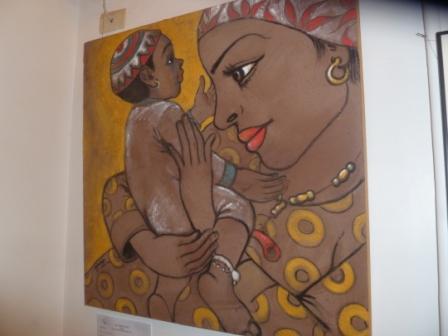
‘Motherhood and the Future’ – Dr. Ahmed Salim, Egypt; Hailing from Aswan, this image depicts the Nubian people of Egypt and their hope for the future

In addition to these, two canvases bore particularly revolutionary images:

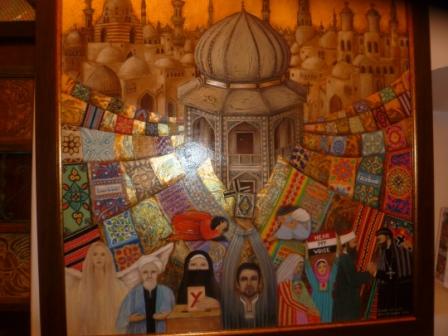
‘Colours of Hope’ – Renee van Lille-Demetroudes, South Africa; note the iconic revolutionary scenes of priests and imams embracing, under the banners of Facebook and Twitter
‘Bread’ – Julie Klimenton, UK; the text reads: By the year 2050 the population will increase to 60 million

This last painting is a reminder that no matter how beautiful is creativity, or how uniting is art, humanity must eat, and revolutions much achieve social justice. If not, all such celebrations are in vain.

Like many questions in Egypt, this one is still unanswered. The Caravan Festival is right to focus on ‘The Road Ahead.’

Related Posts:

Categories
Lapido Media Middle East Published Articles

Coptic Leaders Enrage their Youth as they Avoid Conflict with the Military

note: This article was published on Lapido Media. The version below contains a few more quotes which did not make the final edit.

Young Coptic activists disrupted Christmas mass in St. Mark’s Cathedral in Cairo on January 7, shouting slogans against the military council.

Around ten individuals coordinated to erupt the moment Pope Shenouda, head of the Coptic Orthodox Church, extended Christmas greetings to military members, as captured on YouTube.

Among these was Gen. Hamdy Badeen, head of the military police. Many activists hold him responsible for the deaths of 27 people during a mostly Coptic protest at Maspero in October.

The pope has faced challenges leading the church during the revolution. Even so, he welcomed those whom many activists consider at odds with the Copts. This represents not only the military council, but also the Muslim Brotherhood, reported previously by Lapido Media.

Ramy Kamel

Ramy Kamel organized the Christmas protest in the cathedral – a rarity in the hierarchical church where the holiness of the pope is widely respected.

‘It has not yet been three months since Maspero and they invite the military council?’ Kamel stated.

Sameh Saad of the Maspero Youth Union echoed this dismay.

‘We are very angry because the Pope invited them. Nothing has happened to hold anyone in the military accountable since Maspero, and we do not want to greet them.’

‘Still, we will be silent because we love the pope.’

Kamel had been a leading member of the Maspero Youth Union, but resigned due to silence like this.

‘The organization was becoming content simply to issue statements, but people need to be awoken into action.’

Nevertheless, if not for his mother, Kamel would have passed the holiday at home. He states church security threatened him with attack dogs if he led a demonstration inside the cathedral.

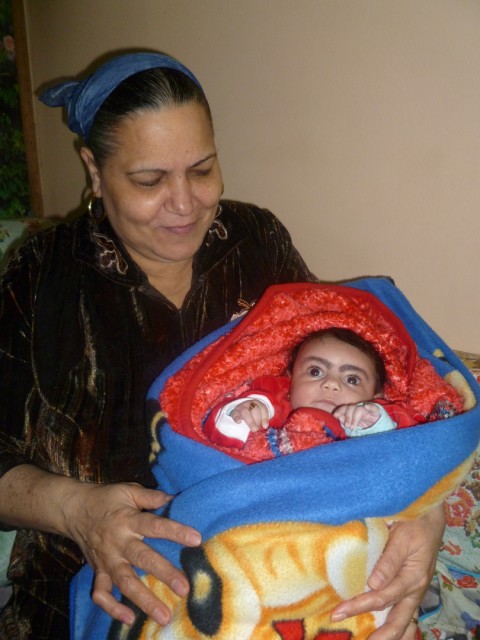
Ramy Kamel's Mother, with grandson

Karima Salama is Kamel’s mother. ‘I pushed him to go. The common Copts here in our neighborhood are outraged, so how could my son sit at home doing nothing?

‘We must not say the pope makes mistakes but here he did.

‘The church should welcome all but the pope should not have invited them.’

Bishop Bisenti emphasizes such open reception in defense of the pope.

‘The pope expresses his love to welcome all, and if they want to come they are invited as brothers.

‘Those who reject this are looking from the point of view of punishment for what happened in Maspero, but we look from the point of view of love.

‘The question of punishment is left to the judge and we will accept this.’

The military council has stated lower ranking officers are being investigated concerning the tragedy at Maspero. Official charges, however, have only been leveled against activists.

A week before Christmas, Coptic confusion increased over the church’s reluctance to demand military accountability. Pope Shenouda stated peace and security prevailed in Egypt due to the military council, as reported in the local press.

Amir Bushra, another member of the Maspero Youth Union, was among those affected by Kamel’s protest.

‘I personally apologize to Ramy Kamel because I was opposed to doing anything in the cathedral, but realized I was mistaken when I saw Pope Shenouda with Gen. Hamdy Badeen.

‘The church should take pride in her sons, because their chants are the chants of all who lost loved ones at Maspero.’

A subsequent blow of protest was issued a week later at mass by Fr Yuhanna Fuad, priest of the Virgin Mary Church in Old Cairo, and presented on YouTube. He was present at the cathedral on Christmas.

‘Hamdy Badeen greeted me. I apologize I kissed him and shook his hand and was pictured with him. He arranged this to improve his image.

‘You have to know that your priest is honest and has to say the truth. These people are unjust. They are liars and thieves, holding on to power.’

Samir Morcos is a respected writer and researcher in Coptic Church affairs. He states, ‘This is a new dynamic we must accept after January 25, especially among the young people.

So it must be noted that while Bishop Musa [bishop of youth affairs] justified the presence of the military council, he did not condemn the youth.’

Samir Zaki, who works under Bishop Musa as the general secretary for encouraging civic participation, makes clear this perspective.

‘The system works that security and VIPs always come to Christmas, and we issue invitations to allow them through the doors of the cathedral. The military council stated they are coming to wish Christmas greetings. Should we not say thank you?’

As concerns the demonstrating youth, Zaki states, ‘The pope put forward the official church position, but they were representing their personal opinion. No one has done anything to them.’

Samir Morcos believes no one knows exactly the extent of Coptic frustration with the church, in its accommodation to the military council.

It is clear, however, there is an undercurrent of revolutionary sympathy. Ramy Kamel wants it to transform the church.

‘No one should be able to represent the position of the church absolutely, no matter who he is.’

For many, this itself is a revolutionary idea.

Please read the published article on Lapido Media.

Related Articles:


Categories
Lapido Media Middle East Published Articles

Christmas with the Brotherhood

MB Delegation Outside a Helwan Church

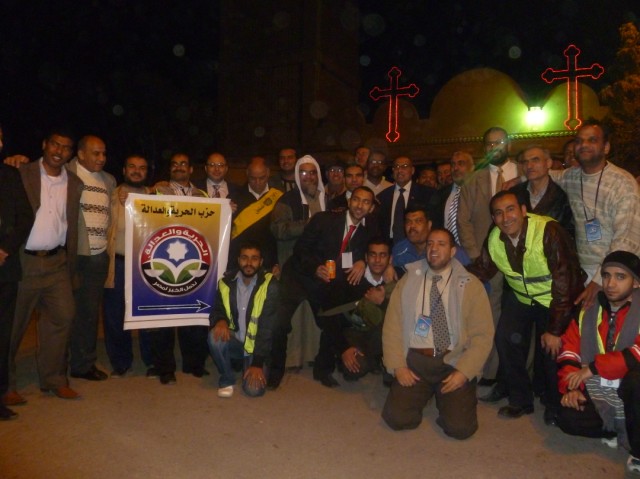
Following two years of bloody winter holidays, and following also resounding Islamic success in elections, the Muslim Brotherhood coordinated with security forces – and probably Orthodox Church leadership – to stand watch outside church buildings throughout Egypt.

I was able to visit one installation in Helwan, to the south of Cairo. After moving from church to church in the district of Maadi, finding no Brothers present, I happened upon a Christian taxi driver who told me they were at his church, to which he subsequently brought me. It would have been difficult to find on my own.

I wrote about this story for Lapido Media, a British website focusing on telling religious aspects of the news which might be overlooked by other outlets. That the Brotherhood would come and spend Christmas with Copts is a fairly big deal, but many Western news agencies missed it. Not only is the event newsworthy, but so is its undercurrent. Please click here to read the story.

The basic question is this: Is the Brotherhood coming to Christmas celebrations because they love Copts as fellow citizens and Egyptian brothers? If so, this is wonderful.

Or, does their effort to ‘defend’ Christians issue from a place of Islamic superiority which offers protection to religious minorities in exchange for their acceptance of an Islamic system of government? If so, this is concerning.

Read the story for several wonderful quotes which insist upon the former. Yet upon pushing them for their eventual goal – after reestablishing security, economy, and demonstrating the virtues of Islamic government – they deftly skirted the issue. They insisted it was not proper to speak about Christians under dhimmi protection ‘now’.

I don’t necessarily doubt their sincerity. I believe that most Brothers, being Egyptians, have a love of their fellow Copts. It is a laudable feature of Islam that it urges Muslims to defend the rights of (at least Abrahamic) religious minorities.

Every religion has a natural chauvinism with which it imbues believers concerning their own faith. One of the prominent interpretations of Islam insists it has the right to rule – and rule justly – but to accord non-Muslims a special place in subservience to an Islamic order. Even if the Muslim Brotherhood does not have a ‘strategy’ to turn Copts into dhimmis, this aspect of their faith may be bubbling to the surface, no matter their simultaneous sincere expressions of love and equality.

Being a dhimmi may not even be a horrible thing, but neither is it liberal democracy. Currently the Muslim Brotherhood straddles the fence, insisting both on a civil state with equality of citizenship and an Islamic reference to guide legislation. Can they pull it off? Time will tell.

Yet despite the desires of many Muslim Brothers to postpone this question, it is essential it be answered now. Otherwise, the system may take root and produce effects from sources far more deeply rooted than assertions of national unity. These assertions are true, they are even sharia. Yet historically, sharia also often included dhimnitude.

Muslim Brotherhood overtures at Christmas hint in both directions. As one Brother states in the article, he wants Christians to know what is in their heart. This is good, but Copts also deserve to know what is in their vision.