This article was first published in the Jan-Feb print edition of Christianity Today.
Jesus did not show up to defend ISIS—and the first to celebrate was a Muslim.
“The [ISIS] myth of their great battle in Dabiq is finished,” Ahmed Osman, a Free Syrian Army officer, told Reuters in October after coalition forces drove more than 1,000 extremists from the backwater Syrian city known as the Armageddon of Islamic eschatology. The jihadists had expected the Messiah to appear and bloody his lance on approaching Christian crusaders.
Muslim belief in the end-times return of Jesus may seem surprising, but according to recent polls, they expect him with greater anticipation than do many American Christians.
A Pew Research Center survey in 2012 found that more than half of Muslims in Iraq, Lebanon, and Tunisia—and just under 50 percent in Morocco and the Palestinian territories—believe in the “imminent return” of Jesus. Outside the Arab world, more than half of Muslims in Turkey, Pakistan, Malaysia, and Thailand say Jesus will return to Earth in their lifetime.
By contrast, a 2015 poll by the Brookings Institute found that only 12 percent of US evangelicals believe that Jesus will return in their lifetime.
Past polls communicate a greater expectancy. In 2010, Pew found that 27 percent of US Christians expected Jesus to definitely return within the next 40 years, while another 20 percent found it probable. Among white evangelicals, 34 percent said “definitely” while 24 percent said “probably.”
The Qur‘an alludes to the return of Jesus (accompanied by a figure called the Mehdi), who on the Day of Resurrection will be a witness against Christians who claim him as the Son of God. But Muslim eschatology is derived primarily from Islamic traditions that have varying degrees of canonicity.
The exact timing of events does not tend to be the concern of Muslim theologians. But the general narrative is that Jesus will descend to Earth, kill the pigs, break the crosses, perform the pilgrimage to Mecca, defeat the Christian armies of Rome, kill the Antichrist, and usher in a period of worldwide Islamic prosperity.
Please click here to read the full article at Christianity Today.
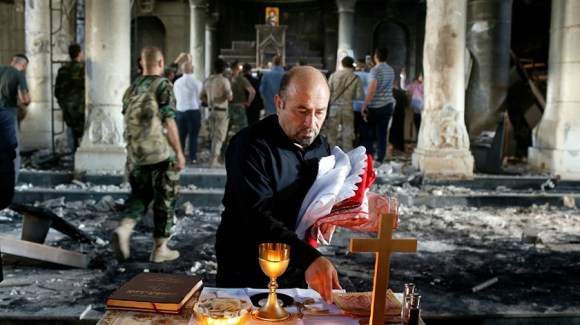
Ahmed Jadallah / Reuters Preparation for Qaraqosh’s first Sunday mass since the Iraqi Christian town was recaptured from ISIS (October 30, 2016).
This article was first published at Christianity Today on January 30, 2017.
Married in December to a Syrian woman with American citizenship, Fadi Hallisso went to Beirut to apply for a green card.
A Syrian Christian, Hallisso has worked with refugees in Lebanon since 2012. Funded by different American agencies, he was no stranger to the US government. He even testified about the situation in Syria to the US State Department and to Harvard Divinity School.
But this week, Hallisso was told he was no longer welcome to apply. The new US administration said so.
“It is very humiliating to be put in the category of potential terrorist,” said Hallisso. “Just because I carry a certain passport.”
As more details of President Donald Trump’s new security policies emerge—including a promise to prioritize Christian refugees for resettlement in America—much appears lost in translation.
“This executive order has created a new atmosphere very hostile to people in the region,” said Chawkat Moucarry, World Vision’s director for interfaith relations—and Hallisso’s uncle. “Unwritten rules seem to be implemented as a result.”
Is Trump’s executive order on refugees a de facto “Muslim ban”? Is it not? Is it prudent? Is it overdue? As American Christians debate these questions from the small towns of Middle America to the nation’s major airports, so also Arab Christians are trying to figure out what is going on.
“I read the executive order,” said Adeeb Awad, chief editor of al-Nashra, the monthly magazine of the Presbyterian Synod of Syria and Lebanon. He remarked…
Please click here to read the full article at Christianity Today.
This article was first published by Christianity Today, on December 11, 2016.
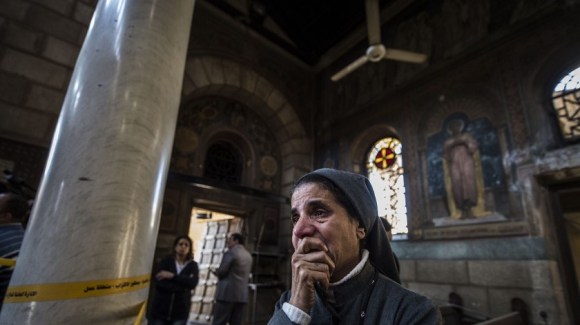
At least 25 people were killed and 49 injured when a bomb exploded around 10 a.m. this morning during a worship service at the spiritual center of Christianity in Egypt.
It is the worst terrorist attack on Copts since the New Year’s bombing of a church in Alexandria in 2011 that killed 23 people.
A worship service of mostly women was targeted in the St. Peter and St. Paul church, adjacent to the St. Mark’s Cathedral and papal residence of Pope Tawadros II, the leader of the Coptic Orthodox community in Egypt and worldwide.
Tawadros was traveling in Greece at the time of the attack. He will cut short his visit and lead funeral prayers tomorrow in the Nasr City district of Cairo.
So far, there has been no claim of responsibility for the attack.
“This is an unbelievable act against Egypt first and Christians second,” Andrea Zaki, president of the Protestant Churches of Egypt, told Christianity Today.
Please click here to read the full story at Christianity Today.
This article was published in the November print edition of Christianity Today.
(via Coptic Solidarity)
Long live the crescent and the cross!” shouted Egypt’s parliament in joy. All 39 Christian members joined the two-thirds majority to vote to end a 160-year practice instituted by the Ottomans requiring Christians to get permission from the country’s leader before building churches. The long-awaited reform was promised by the 2014 constitution after the overthrow of Muslim Brotherhood president Mohamed Morsi.
The new law shifts authority into the hands of the governor, who must issue a decision within four months of an application and give detailed reasons for refusals. The law also established a process to retroactively license hundreds of churches erected without a presidential permit.
“It is a good step,” said Andrea Zaki, president of the Protestant Churches of Egypt, who helped negotiate the draft law with government officials. “If we wanted an agreement to include everything and please everyone, it would have taken 100 years.
“This is the best we can get right now.”
But even as they celebrated, Christians debated if they failed to fully seize a unique opportunity to pursue equal citizenship…
Please click here to read the full article at Christianity Today.
On the first full day of the sixth Anglican Global South conference, delegates met Egyptian President Abdel Fattah al-Sisi and began private deliberations for the eventual “trumpet”, the concluding communique.
But in preparation they were led in a Bible Study by former Bishop of Singapore John Chew, and given a lecture by former Bishop of North Africa Bill Musk. Each applied the topic at hand to contemporary issues in the Anglican Global South.
Chew began by emotionally recalling his participation in the initial Global South gathering in Nigeria in 1994, then called the South-South Encounter. It helped us get to know each other, he said, and whether the way we did it was right or wrong, it clearly led to what followed.
That meeting was followed up by the 1997 conference in Malaysia, which galvanized the conservative primates of the Global South to achieve Resolution 110 of the 1998 Lambeth Conference, rejecting homosexual practice as incompatible with scripture.
Building on this history, he asked the delegates to reflect with him on Ezekiel 37’s valley of dry bones. “Can these bones live?” asked God to the prophet, to which Ezekiel wisely responded, “Lord, you know.”
Chew suggested that similarly, in light of the crises in the Anglican Communion, a proper response is to be silent and wait on God. When division is deep-seated, action cannot overcome action, but only God’s transformation of hearts.
But God did not leave Ezekiel to be silent, said Chew. God told him to “join the stick of Judah with the stick of Israel, and I will make them one stick.” Chew noted that perhaps many in Judah were pleased to see the compromising Israelites scattered in exile, but the heart of God, indeed the vindication of his holiness, is in bringing them back together.
Chew left the implication of this teaching to weigh on the delegates without direct application, but asked them if this was their orientation: To let God achieve it, rather than their own activism.
Afterwards, Musk led the delegates in exploration of the history of the church in Carthage, Tunisia, guiding them through the Donatist controversy and the religio-political shifts in the Latin-Berber, Vandal, and Byzantine eras.
The early church was divided along cultural lines, he said, between a foreign Latin elite that favored a compassionate response to Christians who denied their faith under persecution. The indigenous Berbers, however, held to a standard of purity that insisted upon faithfulness until death.
Various church fathers responded in different ways under different circumstances, Musk explained. But he esteemed the Council of Carthage which affirmed the right of a diocese to regulate its own affairs, rejecting the right of one to discipline leaders in another.
Similarly, Musk asked delegates if they could also create a mutually supportive Global South despite differences of viewpoint, while at the same time speaking the truth as they understand it on the important issues of the day.
Like the Christians of North Africa then, Christians of North Africa and elsewhere are persecuted now. Musk urged the lesson be learned of the dangers of a divided Christian community. The Arab invasions eventually overwhelmed the church, but the seeds of its demise were sown long before. Alongside apostolic gifts, a patient, long-suffering pastoral ministry is also of vital importance.
Anglican delegates closed the day by self-selecting themselves into four taskforce groups on the topics of theological education and leadership development, economic empowerment, evangelism, discipleship, and missions, and ecumenical and interfaith relations. Their practical recommendations were forwarded to the primates for further deliberation and planning.
This article was first published at Christianity Today in the June print edition.
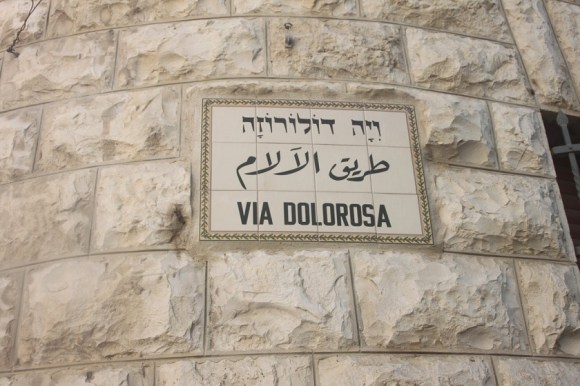
Walking down the Via Dolorosa, Nabil placed his hand on the wall where Jesus reportedly stumbled on his way to being crucified.
I am a lucky man, thought the 58-year-old. I can feel the Holy Spirit in my body.
This wasn’t how the Coptic Orthodox pilgrim had expected to feel in Jerusalem’s Old City. “Most Egyptian Christians want to visit as part of their faith,” he said, noting that he saw many elderly women dressed in black, weeping at each station of the cross. “Not me. I’m retired, I have nothing else to do, and I like to travel.”
Touring the Holy Land has been a transformational experience for Christians worldwide. In 2014, more than half of the 3.3 million tourists who visited Israel were Christians, according to the Israel Ministry of Foreign Affairs. Of these, one out of four was Protestant.
But among these tourism figures, the Arab Christian community is nearly a no-show. In 2014, Jordan sent only 17,400 tourists (which were not differentiated by religion). Egypt, only 5,200—all Copts. Lebanon forbids travel to Israel entirely.
So Close Yet So Far
There are many reasons Arab Christians don’t tour Israel. The ancient sites are right in their backyard, so familiarity breeds complacency. And economic and political conditions hamper travel.
“I grew up minutes from Mary’s Well in Nazareth, and walked to school daily past the Church of the Annunciation,” said Shadia Qubti, a Palestinian evangelical. “It’s where I met friends for coffee.”
Please click here to read the full article at Christianity Today.
This article was first published at Christianity Today in the April print edition.
With the lilt characteristic of a Southern megachurch pastor, Bob Roberts Jr. introduced the most significant Muslim statement on religious freedom in 1,400 years.
“I am a Texan, an evangelical, and a Baptist,” the NorthWood Church leader told the crowd of more than 250 leading Muslim clerics from around the world. “You have made my job to build bridges so much easier. You have gathered to call people to change.” He drew hearty applause.
“It is a very promising initiative. You could even say it is groundbreaking,” said Medhat Sabry, the Anglican Communion’s dean for Morocco and one of several non-Muslim observers (alongside Roberts) to the declaration’s signing. “But it is way too early to tell.”
This is because—from Cairo to Amman to Nazareth to Baghdad—the news caused barely a ripple in Christian communities in the Middle East and North Africa, whom the document is meant to comfort. Some Arab Christians saw a headline in the local news. Others didn’t hear of it at all.
Please click here to read the full article at Christianity Today.
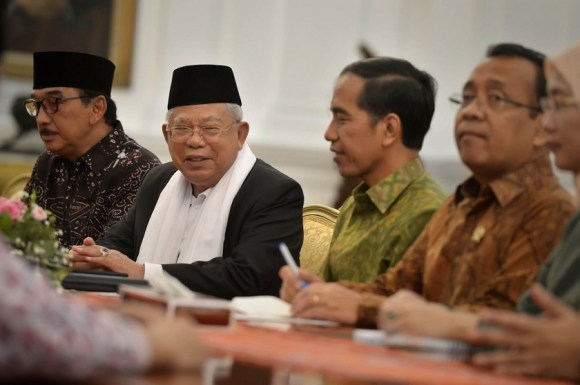
From the Jakarta Post: President Joko “Jokowi” Widodo (center), accompanied by State Secretary Pratikno (second right), talks with Nahdlatul Ulama (NU) advisory board chairman Maruf Amin (second left) at the State Palace on March 31, during the International Summit of The Moslem Moderate Leader.(ANTARA FOTO/Yudhi Mahatma)
Secretary of State John Kerry recently confirmed what most already knew: ISIS is committing genocide against Christians and other religious minorities in the Middle East.
Many Islamic leaders knew it too. In January, 200 Muslim religious leaders, heads of state, and scholars gathered in Morocco. They released the Marrakesh Declaration, a 750-word document calling for majority-Muslim countries to protect the freedom of religious minorities, including Christians.
Last week, another 300 Muslim religious leaders from about 30 countries did much the same. Gathering in Jakarta, Indonesia, the country with the largest Muslim populus and historically known for its religious peace, the leaders denounced extremism and addressed its causes.
Texas pastor Bob Roberts, who has been actively building relationships with Muslims, thinks this is a sign of things to come. Roberts was present at the Morocco conference but not Indonesia.
“Muslim majority nations are now making statements globally and nationally to push back on extremism, and you will see more of it,” the evangelical interfaith leader told CT. “This is sending signals to their citizens and the world that the tide is turning.”
The Indonesian conference was hosted by Nahdlatul Ulama (NU), the largest Muslim organization in the world, and was opened by the vice president of the officially secular country.
Please click here to read the full article at Christianity Today.
From my new article for Christianity Today’s Behemoth publication:
The Pyramids of Giza used to be in the middle of the desert. Eventually Cairo’s urban sprawl pushed right up to the Sphinx. The Citadel of Saladin towers over the city. The southern approach requires an overpass straddling the City of the Dead. In Tahrir Square, the Egyptian Museum and its famed mummies were overrun with the bedlam of a revolution.
Tourism has dropped dramatically since then, but intrepid travelers can hardly help notice the encroachment of squalor on the glories of antiquity.
What most miss is the reversal: A glory rising out of the garbage. To create it, 40 years ago one man had to literally trudge through a pigsty. Today it is simpler to reach the massive cave church complex in the Muqattam Mountains on the eastern edge of Cairo. But the journey still requires a pungent assault on the senses.
Women and children pick through 15,000 tons of the city’s collected refuse, sorting out recyclable waste from the biodegradables useful for wandering livestock. Men haul burlap trash bags twice their size into garbage trucks poised to tip from overfill…
The article tells the story of how a Coptic Orthodox priest inhabited this world and gave birth to one of Egypt’s most beautiful sites.
Please click here to read the full article and see the photos at The Behemoth.
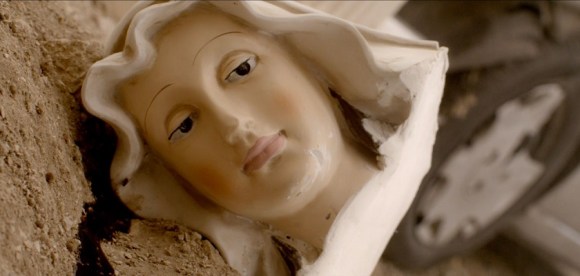
The plot to Ave Maria is as improbable as it is provocative. A Jewish settler family crashes their car into a statue of the Virgin Mary at a Palestinian Carmelite monastery in the West Bank.
Bound by the onset of Sabbath, the Jews can do little to get home. Bound by a vow of silence, the nuns can do little to help. Bound by mutual distrust and annoyance, the odd couple pairing can do little but bicker. Fortunately, spellbound by the comedic touch of 34-year-old producer Basil Khalil, critics around the world can do little but laugh.
This 14-minute short already won top prizes at film festivals in Grenoble, Montpelier, and Dubai before securing a nomination for best live-action short film at this year’s 88th Academy Awards.
Ave Maria is Khalil’s second comedic venture into the deeply divisive and often somber portrayal of the Arab-Israeli conflict…
Please click here to read the full article at Christianity Today. Here’s a sample question, followed by the trailer:
You were raised by a Palestinian Christian father and a British mother, were you comfortable in both settings?
You don’t really choose where or how you’re born, so you just live with it and make the most of it. I do believe being of both worlds did give me a more critical perspective. I know how the West sees us, and I’m able to give them something fresh, yet at the same time I know our stories and culture from Palestine so I’m able to portray accurate stories from there.
Theresa, the nine-months-pregnant wife of a Coptic Orthodox juice stand owner, could not hide her admiration when told how a Christian professor had donned a hijab in solidarity with Muslims facing prejudice in America.
“It is a beautiful thing she has done, going beyond the norm to better approach others,” she said.
“But it would not work here.”
Her comment came on the heels of her husband Hani’s discomfort. He called the symbolic act “extreme.”
In doing so, the humble man mixing mango and strawberry mirrored the reactions of most regional evangelical and Orthodox theologians to the core question of the Wheaton College dispute: not Hawkins’s hijab, but her “same God” explanation for it. All commended her intentions, but only one—the Palestinian head of a seminary—praised it as a stand for justice.
One pastor called it “excessive.” A bishop, “unnecessary.” And therein lies the rub. Whether considering donning the hijab in solidarity or debating if Muslims and Christians worship the same God, Arab Christians operate in a vastly different religious context.
Only recently have American Christians had to deal with issues raised by Muslims in their midst. The 9/11 tragedy birthed a political culture that seeks unity through theological terms, said Salim Munayer, head of the lauded Musalaha reconciliation ministry in Jerusalem.
“But among Muslims and Christians in the Middle East, the discussion is not over whether we worship the same God,” he said, “but rather Muslims challenging us that we worship one God at all.”
Please click here to read the full article at Christianity Today, and here for CT’s op-ed on the controversy so far.
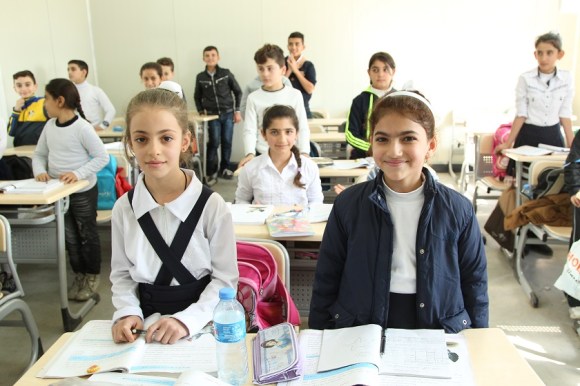
Myriam (L) and her friend Sandra reunite at school (via SAT-7)
Last spring, a 10-year-old Christian girl famously forgave ISIS for driving her family from their home in Mosul, Iraq’s second-largest city. Myriam’s video interview with Christian broadcaster SAT-7 went viral, witnessed by more than 3 million people on television and social media.
When Myriam fled from ISIS, so did her friend Sandra. Sandra’s family first took refuge in Lebanon, while Myriam’s family headed for Erbil, the capital of the Kurdish region of Iraq. Eventually, both families settled into a refugee camp at Mar Elias Catholic Church in Erbil.
Myriam previously told SAT-7 she had three wishes. The first: For her message of forgiveness to reach the world.
Now her second and third wishes have also been fulfilled. She has returned to school, and Sandra has joined her. She now shares a desk with her childhood friend.
“I can’t describe the joy that I felt,” Myriam told SAT-7.
But the joy of school is unknown to most of the approximately 3.5 million internally displaced children of Syria and Iraq. World Vision estimates that 2.5 million Syrian children—including both the internally displaced and refugees—are not attending school.
Terry Ascott, CEO of SAT-7, told CT that without school, money, or dignity, these children are at great risk.
Please click here to read the full article at Christianity Today.
List of Churches within the Evangelical Church of Abu Dhabi
Christianity Today recently interviewed me about my September article on the churches of the Persian/Arabian Gulf.
There are about 2.3 million Christians in the Arabian Peninsula—more than nearly 100 countries can claim. What does that look like on the ground? Christianity Today‘s Middle East correspondent Jayson Casper recently spoke with assistant editor Morgan Lee on his fascinating story on why Christianity is surging in the heart of Islam. In the interview, Casper explains why Gulf States want churches, how globalization affects religious freedom in the region, and what most surprises him about the region’s Christianity.
As judged by the Facebook shares (over 6,000), this story surprised many of our readers. To what extent did you “stumble” on this story?
The story was suggested by CT’s News Editor Jeremy Weber, but I was eager to take it on. I was aware that there were churches in the region for a long time, but always curious about what local Christianity looked like.
Would the number of churches come as a surprise to those who live in the Gulf?
As far as the Gulf is concerned, the presence of churches is well known. If one is nonreligious, they would not necessarily be spotted, but anyone looking can find them easily. Many churches have an active web presence.
Christian leaders in the United Arab Emirates, as well as a high ranking member of the royal family, told me the government wants to do all it can to facilitate the worship of Christian foreign workers. They value the wholeness the church can provide.
Otherwise they deal with the normal vices found in Western society but out of place in the Gulf, and on top of it suffer from loss of productivity when workers suffer loneliness and depression.
What was hard about doing the reporting for this piece?
Balancing the good news—foreign Christians have been largely welcome to the country—with the reality that this freedom does not extend to Gulf citizens. Overwhelmingly, Christian leaders wanted to accentuate their appreciation to the authorities.
But there was also a tenor among some — off the record — that a glowing portrayal would not be right. The focus of the story is to help correct the wide assumption among many Western Christians that the Islam of the Arabian Peninsula is intolerant to Christianity in general. But getting the right tone of ‘yes-but’ was not easy.
What did you find most surprising in your own reporting?
The physical size of the church buildings, how they are part of the landscape of the community and not hidden away as eyesores. There is money in the Gulf, so everything is big. But while I knew that Christianity existed within a level of tolerance, I had no idea about the level of normalcy these buildings imply. (See pictures here.)
What’s something you wish you could have included in the final draft that didn’t make its way in?
There were several charming stories of interactions normal Christians had with their neighbors. A Sunday School teacher. A military instructor. An IT manager. Each one came for a job, but was living their Christian life—and often speaking of it—in winsome ways.
I also heard about churches organizing service trips into the migrant labor camps, and some of the difficulties experienced by the majority Asian population. Not all of these stories made it into the article, but they served to confirm what leading sources conveyed.
In the article you write, “Thanks also to global capitalism, that freedom is not going away.” To what extent do you think this freedom will expand?
It is difficult to say. Because the nations of the Gulf are so young and their economies are expanding so rapidly, many sources told me that the authorities sort of make it up as they go along.
Concerning the churches, this means there is often no set of regulations that can be followed in a clear cut manner. So much depends upon decisions of higher-ups that come through relationship more than bureaucracy. They prefer to deal with a head of denomination and let them regulate affairs internally. So one measure of expanding freedom can be seen if this freedom simply gets written down into law.
Another measure of freedom, perhaps, exists in comparison between the Gulf States and Europe, both of which have received many migrants over the past decades. Europe has extended citizen rights to many, while the Gulf does not. Will the Gulf ever offer a similar opportunity? If so, can they accept Christians as citizens as opposed to guest workers?
Globalization and multicultural realities often produce a liberalizing effect, even as they can spark backlash. Over time will these realities fundamentally change Gulf attitudes? It is a fascinating possibility to observe.
[Note: Both Bahrain and Kuwait have a tiny number of Christian citizens originally from other Arab countries.]
In the article you write “that Gulf churches exist at all stems from relationships, not economics or law.” Who are those relationships open to? In other words, is it only between Arab men and Western white men? Or are these accessible regardless of ethnic background or gender?
In the article, that sentence meant the origin and continuance of the churches is due to the very specific relationship between Christian leaders and the ruling authorities. In terms of relations between guest workers and Gulf citizens, I think the general culture does not facilitate mixing.
In many settings the migrant workers are the majority, and many citizens do not work except in management at the level of “boss.” This would include the vast sector of domestic labor, which I did not sufficiently encounter. Non-Western migrants also complained about a level of hierarchy, with increasing discrimination felt by the darker of skin and the lower of economic level.
In your observation, how has the Western Protestant church been affected by Gulf State culture?
Most leaders celebrated a far greater level of diversity than would be experienced by most Christians in America. They would say that our congregation is a ‘taste of heaven’ as they listed the number of nationalities and languages worshiping together. This is certainly part of Gulf culture stemming from economic realities—not necessarily the Arab Muslim culture they maintain among themselves, though in some settings it is also seen here.
Morgan Lee is assistant editor of Christianity Today.
From my article on Christianity Today, co-written with Tim Morgan, published September 18:
Menes Abdul Noor, who served as pastor of Kasr el-Dobara Evangelical Church in Cairo, Egypt, for over three decades, died on Monday, September 14, from Parkinson’s disease. He was 85.
Under his leadership, the 8,000-plus Presbyterian congregation became the largest Protestant church in the Middle East.
Abdul Noor authored and translated over 100 books, and taught at the Haggai Institute and Evangelical Theological Seminary in Cairo for more than 25 years. He is survived by his wife, Nadia, his son Farid, and his daughter Violet. He had six grandchildren and four great grandchildren.
His memorial service Wednesday was attended by officials of the Orthodox, Catholic, and Anglican churches, as well as a representative of Al-Azhar, the foremost Muslim institution in the Sunni world. It was also broadcast live on the SAT-7 Arabic satellite television network.
Please click here to read the full article at Christianity Today, including quotes and anecdotes from an unpublished CT interview with Abdul Noor in 2008.
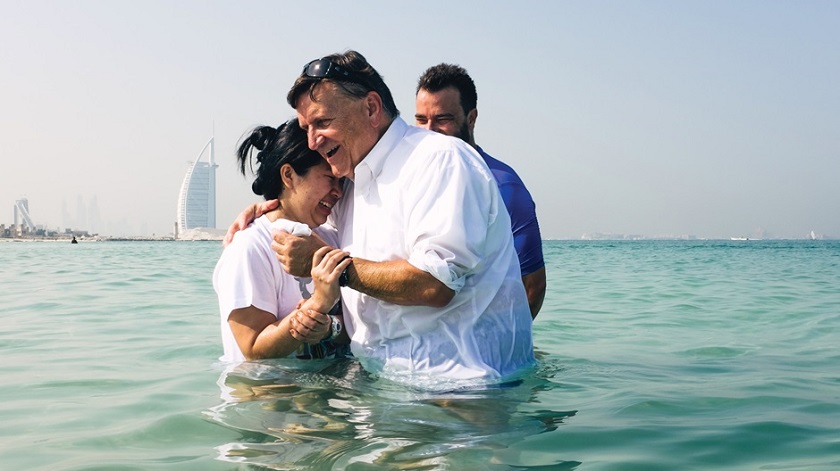
Public baptism service in the Gulf, in front of Dubai’s Burj al-Arab. Photo courtesy of Fellowship of the Emirates.
My article for Christianity Today was published September 11, 2015. Here is an excerpt:
Espada, an architect, is one of the millions of foreign workers transforming the former desert oasis into a global center for business and travel. The UAE’s Dubai is the fifth-fastest-growing city in the world; its population is now more than 80 percent migrant.
The great majority of migrant workers in the region come from India and Southeast Asia, sometimes suffering exploitation in labor camps to send a collective $100 billion back home. As an American, Espada is unusual.
But as a Christian, he is not. Today the Pew Research Center numbers Christians in the Arabian Peninsula at 2.3 million—more Christians than nearly 100 countries can claim. The Gulf Christian Fellowship, an umbrella group, estimates 3.5 million.
These migrants bring the UAE’s Christian population to 13 percent, according to Pew. Among other Gulf states, Bahrain, Kuwait, and Qatar are each about 14 percent Christian, while Oman is about 6 percent. Even Saudi Arabia, home to Islam’s holiest cities (Mecca and Medina), is 4 percent Christian when migrants are counted.
Together, they represent the largest Christian community in the Middle East outside of Egypt. But their experiences vary considerably.
In Bahrain and Kuwait, Muslims can enter church compounds. In Qatar, guards allow only foreigners. Saudi Arabia’s Grand Mufti (the nation’s highest official of religious law) has called for all churches in the peninsula to be destroyed.
Surprising to many observers is how many of these churches there are.
Please click here to read the full article at Christianity Today. Next post I’ll share some photos of church buildings.
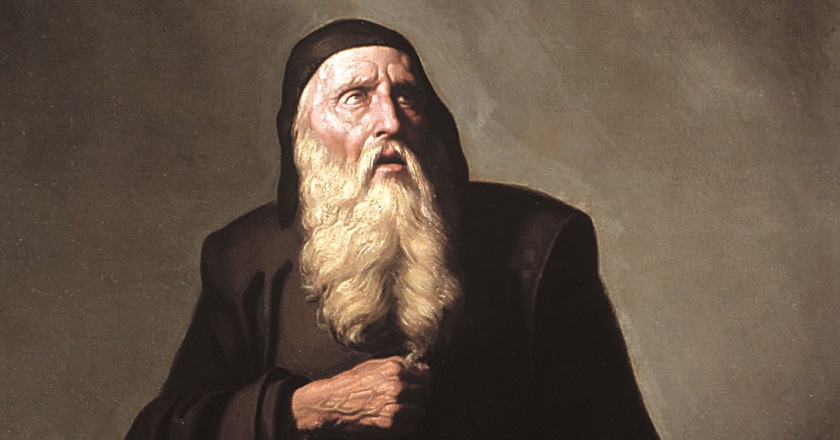
From my article at The Behemoth on the 13th century Spanish missionary, Ramon Llull. This year marks the 700th anniversary of his death.
Most missionary careers are not launched by a suicide. Neither do most end with deliberate martyrdom. What Ramon Llull did in between rebuked a Christian Europe fighting jihad with its own crusades.
The Mediterranean world in the 13th century witnessed a conflict in transition. The 1212 Battle of Toloso signaled the decisive decline of Muslim civilization in Spain. But in 1291, the crusader city of Acre fell, the last major outpost of Christian power in the Holy Land. Merchants from Genoa and Venice established control of seafaring trade routes. But Arabic philosophy governed the discourse of European intellectual circles.
Born around 1235 in Majorca (a Spanish island near Barcelona his father helped to liberate), Llull was a product of this time. King James I of Aragon granted the family land, and Llull served in the court of his son. A troubadour in the classic sense, he was an accomplished musician and poet, also authoring treatises on horsemanship and warfare. Palma, the family home, was a center of shipbuilding. And Llull was a devotee of courtly love, a palace and literary tradition that germinated in Andalucía.
Here, arresting his licentiousness, God got his attention.
Deep in flirtation with a married woman of the court, Llull’s wooing poem was interrupted by a vision of the crucified Christ. Blood dripping from head and hands, Jesus looked at him reproachfully. Llull immediately retired to his chambers, but was not yet converted. The married father of two tried to resume his poem a week later.
God intervened again, later giving the vision a third time. Now around 30 years old, Llull surrendered to the compassion of Christ, abandoning the king’s court in Aragon.
Back in Majorca, …
The Behemoth is an ad-free, subscription-based sister publication of Christianity Today. The article is behind a paywall, but for those interested a free 30-day trial is available.
During the 2013 terror attack at the Westgate Mall in Nairobi, Kenya, al Shabaab gunmen paused for a moment and made an announcement in Swahili: All Muslims could come forward and leave.
Among those trying to escape was Joshua Hakim, who covered up the Christian name on his ID as he showed it to the gunmen.
“They told me to go,” Hakim later told The Guardian. “Then an Indian man came forward, and they said, ‘What is the name of Muhammad’s mother?’ When he couldn’t answer, they just shot him.”
Other terror attacks by al Shabaab, a Somali terrorist group with ties to al Qaeda, have followed a similar pattern. Those who could prove they were Muslim—by reciting a prayer in Arabic or answering questions about Islam—were allowed to go free. Those who couldn’t were killed.
As a result, some Kenyans have begun to share tips online about how to pretend to be Muslim, just in case. This includes learning to recite the shahada—Islam’s main creed—in Arabic.
This pragmatic response to terror attacks is understandable. But is it biblically sound? Kenyan Christian leaders are divided on the issue.
No, says David Oginde, head of Christ is the Answer Ministries, one of Kenya’s largest parachurch organizations with 45,000 members. “A true Christian must be ready to live and to die for the faith,” he said.
But two professors at St. Paul’s University, a conservative Anglican institution in Nairobi, say the answer isn’t that clear-cut. Reciting the shahada doesn’t amount to denying Christ, says Samuel Githinji, a theology lecturer.
The article also included Arab theologians, who mostly responded that pretending to be a Muslim is not acceptable, but forgiveness should be offered to those who succumb. It also touched on similar themes in Christian history, during the Roman era.
Here is the conclusion:
The persecutions of old backfired, bringing many into the Christian fold. It is too early to write of the impact today. But Ajaj is hopeful, and counsels faithfulness when called upon.
“I hope they give a good testimony, and glory to God’s name.”
Of course nothing is certain. Martyrdom may not change a hardhearted terrorist. Pretending may not save your life either.
But for the record, the mother of Muhammad is Aminah bint Wahb.
Please click here to read the full article at Christianity Today.
April was a terrible month for Ethiopian migrants. Tescma Marcus and his brother Alex were burned alive during xenophobic attacks in South Africa. One week later, Eyasu Yekuno-Amlak and his brother Balcha were dramatically executed in Libya by ISIS, along with 26 others.
One reason Ethiopians were involved in high-profile tragedies at opposite ends of the continent: Their nation is the second-most populous in Africa as well as the second-poorest in the world (87 percent of Ethiopia’s 94 million people are impoverished).
Roughly two-thirds of Ethiopians are Christians. The majority of these belong to the ancient Ethiopian Orthodox Tewahedo Church; the rest primarily to Protestant denominations such as the Ethiopian Evangelical Church Makane Yesus (which recently broke ties with the Evangelical Lutheran Church in America over theological concerns).
The Orthodox and Protestants have long had in common the search for a better life. Increasingly, they share even more.
Veteran SIM missionary Howard Brant celebrates that “the two groups are coming closer and closer together” in Ethiopia, which he calls “one of the great success stories of evangelical Christianity.”
Please click here to read the full article at Christianity Today.
A few excerpts from my article for Christianity Today, published April 20:
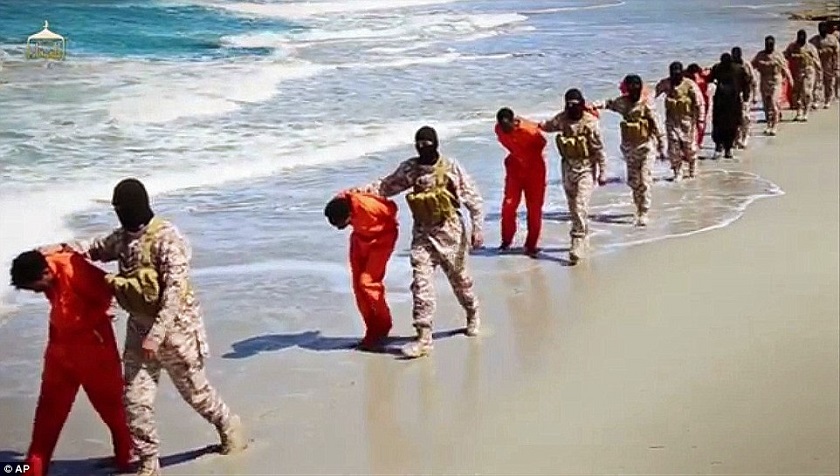
Once again, ISIS has orchestrated and filmed the dramatic mass killing of African Christians who refuse to deny their faith.
This time, the approximately 28 men targeted by the Libya affiliate of the self-proclaimed Islamic State (also known as Daesh) were Ethiopian Christians. In February, the killing of 21 mostly Egyptian Christians drew widespread horror and fears of future massacres, but also led to Egypt’s largest Bible outreach.
…
The video was released the same day the Archbishop of Canterbury, Justin Welby, arrived in Cairo to offer condolences for the previous martyrs in Libya: 20 Coptic Orthodox Christians and a sub-Saharan African. (CT reported how their deaths were unifying Egypt and inspiring Muslims throughout the Arab world, as well as honored in the Coptic calendar.)
“Why has Libya spoken so powerfully to the world?” asked Welby during a public sermon. “The way these brothers lived and died testified that their faith was trustworthy.”
…
The Ethiopian government has not yet been able to confirm the video, or certify the victims are its citizens.
But Grant LeMarquand, the Anglican bishop of the Horn of Africa, says they certainly appear to be.
“If they were given the chance to convert and did not,” he told CT, “they should be considered what ISIS calls them: ‘People of the Cross’, and therefore true followers of the crucified one.”
Bishop Angaelos, the general bishop of the Coptic Orthodox Church in the United Kingdom, underscored the Ethiopians’ testimony.
“Once again we see innocent Christians murdered purely for refusing to renounce their faith,” he said in a statement.
“As Christians, we remain committed to our initial instinct following the murder of our 21 Coptic brothers in Libya, that it is not only for our own good, but indeed our duty to ourselves, the world, and even those who see themselves as our enemies, to forgive and pray for the perpetrators of this and similar crimes,” he said. “We pray for these men and women, self-confessed religious people, that they may be reminded of the sacred and precious nature of every life created by God.”
Please click here to read the full article at Christianity Today.
Israel’s election wasn’t easy on its Arab Christian citizens.
From one direction, Prime Minister Benjamin Netanyahu rallied his base by warning, “The Arabs are flocking to the polls in droves.” From the other, Ayman Odeh, a Palestinian-Israeli politician from Haifa, led an unprecedented but disjointed coalition of Arab secularists, communists, and Islamists, and received the endorsement of Hamas.
The tension illustrates the struggle of Arab Israeli Christians to craft a national identity between the increasing clamor of Zionism and Islamism. The result, according to evangelical leaders: a “ghetto mentality” among Christians and fewer opportunities for public witness and ministry.
Netanyahu’s Likud emerged victorious over its left-of-center rivals, the Zionist Union, buoyed by promises to abandon prospects for a Palestinian state. Foreign Minister Avigdor Lieberman, a Likud ally, told Odeh during campaigning, “You’re not wanted here.”
As voter turnout surged, however, so did Arab participation. Odeh’s “Joint List” placed No. 3 among the 10 parties that captured seats in the Knesset, Israel’s parliament. “I’m very wanted in my homeland,” Odeh replied.
But where is this homeland for Arab Christians? The answer is quite contested.
Please click here to read the full article at Christianity Today.








 Jayson Casper