The condition of Egypt is quietly very concerning these days. I say quietly for two reasons. First, in terms of the Western audience, most is slipping under the radar. Second, in terms of Egypt, the nation waits for presidential elections, and the areas of concern are easily ignored if no attention is paid to news headlines and their fascination with politics.
Yet it is in the realm of politics that power is often determined. Often, I say, because once again this struggle has been taken into the street.
Reminiscent of clashes prior to the legislative elections, eleven people at least were killed recently while demonstrating against the military council. Still, the odd quiet continues as these protests are near the Ministry of Defense in Abbasiyya, not in the iconic Tahrir Square.
Furthermore, they are characterized as ‘Salafi’ protests, as the initial gathering was by supporters of Hazem Salah Abu Ismail. The long-bearded presidential candidate was barred from competing at the last moment when it was determined his mother held American nationality. Current law requires candidates and their parents to hold Egyptian nationality alone.
Abu Ismail claimed fraud and conspiracy, and his followers took first to Tahrir, and then to Abbasiyya. There, they had been joined by many of traditional revolutionary spirit, looking to end military rule completely. The size of the sit-in was substantial without being overwhelming. Most in Egypt were just ignoring it.
But nothing in Egypt can be simple or straightforward. Repeatedly over the last week ‘thugs’ attacked the sit-in around midnight through the hours until dawn. As usual, the thugs are not identifiable with any particular party, but most assume some connection with either the military council or the old regime elements still clinging to their positions.
Yet this has been seen before, and the pattern is predictable. The best way to escalate a protest is to attack it. True to form, protestors have been increasing since then, and political forces, including the Muslim Brotherhood, are calling for massive protests tomorrow on Friday.
In past writing I have sought to dive into all of the different conspiracy theories to try to make sense of the senseless violence and loss of life. Perhaps reflective of the odd quiet is that my mind is boggled sufficiently after fifteen months of conspiracy that I am unable to do so and reluctant to try. Instead, the task requires description of the politics preceding the street fighting.
For months, the aforementioned Muslim Brotherhood has escalated its rhetoric against both the ruling government cabinet and the military council which stands behind it. Both prior to and following the disqualification of their own primary candidate for president – Khairat al-Shater – the MB has called for this cabinet to be sacked. In its place they ask to form the government themselves, as they reflect the majority will of the people in parliament.
The military council has refused, as is appropriate, even according to previous MB logic. During the run-up to parliamentary elections many liberal and revolutionary forces objected to the roadmap laid out by the military council. Rightly, the MB insisted on the ‘will of the people’ as represented in the results of the March popular referendum, which endorsed the military roadmap.
Yet this roadmap also made it clear the parliament had limited responsibilities which do not include executive authority. The MB recognizes this, but now translates the ‘will of the people’ into parliament composition, in which they are chief. The MB speaker of parliament took the unilateral step of suspending parliament activity as a pressure tool – since they cannot sack the cabinet themselves – and this was without any consensus from the larger body. It is not clear if he even called a full vote.
The Muslim Brotherhood is running a candidate for president, but he was the backup to al-Shater, and does not appear to enjoy wide popularity. The race – barring more surprises – has shaped into a choice between a former MB member, Abdel Munim Abul Futuh, and a former member of Mubarak’s cabinet, Amr Moussa.
Abul Futuh was expelled from the MB when he early on declared his intention to run for president while the group denied ambition to the post. He is an Islamist, but within this spectrum he is widely credited as a liberal.
Moussa, meanwhile, does not suffer unduly from the stain of Mubarak’s legacy as he enjoyed a lengthy tenure in the Arab League, away from the running, and corruption, of government. At the same time, due to his connections with government he benefits from the desire on the street to see a return to stability and is a somewhat anti-revolutionary figure, as opposed to the necessity of reform.
Some conspiracies say Abul Futuh is the secret MB candidate, and that his expulsion is theater. Others say Moussa is the candidate of the old regime, with the military seeking its re-formation through him.
And then there are the conspiracies which abound over the recent violence. Do some powers not want the issue of power decided in presidential elections? Is this the last final push before executive authority – of any stripe – is reasserted?
If so, is it from the frustrated youth who have seen their precious revolution mangled in the halls of politics?
Is it from the frustrated Salafis who have seen their populist candidate barred on the slightest of violations, if not on fraud altogether?
Is it from the frustrated Muslim Brotherhood, who also had a candidate barred and find themselves trapped in a powerless parliament?
Is it from the frustrated old regime, which finds itself on its last legs and is desperately trying to discredit the revolution and its democratic transition?
Is it from the frustrated military council, which desires to hold on to its privileges – if not its rule – while presidential frontrunners cannot necessarily be trusted to play along with it?
It is best, fitting with the lethal quiet, to put aside the conspiracies and simply say yes to all of the above, to whatever degree. There is a deep conflict over power playing out its final acts. This struggle has been rumbling ever since the revolution succeeded in overthrowing Mubarak but failing to decisively result in a change of system. Each actor has a role. As it may not result in one winner-take-all, each is seeking their biggest slice of the pie.
Given there are no deep patterns of democratic succession, it is unsurprising the conflict spills out into other means, even violence.
Yet it is the violence that is most concerning. Weapons have proliferated. Militant attacks occur in the Sinai. Suspicious fires – literal flames – have broken out across Egypt. While they may simply be the work of coincidence, the question of who is ‘burning Egypt’ has been a popular query, even if a manipulated one.
So, eleven Egyptians are dead in Abbasiyya, added to the post-revolutionary toll. Perhaps on Friday their numbers will swell further. Is more violence coming, or was the violence simply a means to increase the crowds?
Last time there was such violence, in November at Mohamed Mahmoud Street near Tahrir, it brought about a change in government as the cabinet was sacked. If the conspiracy which posits a deal between the Muslim Brotherhood and the military/old regime is in play, will we see the same soon?
Or, as a leftist presidential candidate with little chance of victory has interpreted this deal, will it result in a military coup? Recall, these protests are not in Tahrir; Abbasiyya hosts the military headquarters.
Perhaps one day Egypt will settle. Perhaps the positive social forces unleashed in the revolution will eventually coalesce into open and transparent governance.
These days are not now. It is likely Egypt must suffer a little while longer. There are three weeks remaining until presidential elections.
Perhaps, only perhaps, these will signal the end of transitional troubles.
Salafi politics has taken Egypt by storm. This has surprised many commentators who underestimated their base of thought and non-political nature. For others, it has been a validation of years of Salafi work in mosques and surrounding communities to preach Islam and help the poor.
As an aid to understanding this phenomenon, and in effort to understand it myself, this text will function as an inverted pyramid. It will start with broad strokes concerning the Salafi coalition in Egypt – the Nour Party, focus on one member in particular – the Asala Party, demonstrate their base in a typical neighborhood – Warraq, and then feature one member in particular – Essam al-Sharif. Appreciation is given for his help in gathering the story which follows.
For a historical background to Salafism in Egypt, click here for a previous post. Though lines overlap, Salafis can be distinguished from Muslim Brothers and Islamic revolutionaries based on methodology, rather than thought. All three groups desire some sort of an Islamic state in which sharia law is the basis of governance. After a history of struggle against the state, the Muslim Brotherhood foreswore violence and sought to transform society while seeking entrance into the political arena. Believing the Brotherhood to have betrayed the jihadist struggle, revolutionary groups such as al-Jama’a al-Islamiya continued to agitate against the state, seeking its overthrow.
Salafis, meanwhile, are understood to be quietist. They eschewed political participation, with some, perhaps many, declaring it to be heretical to Islamic law. At the same time their theology called for obedience to a Muslim ruler. Unlike many in the revolutionary groups, Salafis accepted the broad, liberal, and traditional interpretation of ‘Muslim ruler’, accepting Mubarak as having been given by God.
Therefore, while the state pounded revolutionary Islamic groups out of existence in the 1990s and early 2000s, and placed countless political obstacles and jail terms in the path of the Muslim Brotherhood, Mubarak generally allowed Salafis free reign to propagate their religious interpretations. While strict limits were enforced, Salafi preaching proliferated in the mosques of lower class areas as well as on popular satellite television channels. Rumors are rife concerning extensive financial support from conservative Gulf nations, but the result was the emergence – below the attention of middle class society and politics – of an authentic Egyptian Salafi movement.
Conventional wisdom states given their unique situation in the Egyptian scene, Salafis did not join the revolution of January 25. By and large this is true; many of their leaders declared such activity as religiously haram. Yet many Salafis did participate. This is the testimony of Hani Fawzi, a political activist from Helwan and party leader for the Salafi Asala Party in Nasr City, Cairo. He joined the demonstrations on January 28, as did a few of his favored Salafi sheikhs, such as Nashat Ahmad, Hassan Abu al-Ishbal, Fawzi al-Sayyid, and lastly Mohamed Abdel Maqsoud Afifi, who will be mentioned later.
Nevertheless, upon the success of the revolution and the opening of the political scene, most were surprised to see the enthusiastic participation of newly formed Salafi parties. This was accompanied by much internal discord. Some continued to criticize political participation, and those who formed parties witnessed several divisions and splits. In the end, two main groupings emerged.
The first and largest issued from Alexandria, understood to be the greatest base of Salafi strength. Leaders there created the Nour (Light) Party. Meanwhile in Cairo, the Asala (Origin) Party was formed. Other parties also emerged, but did not come to national prominence. Nour and Asala were not true rivals, however. One Salafi stated the reason to have more than one party was pragmatic. If any difficulties were encountered by one party – political, legal, administrative – the other one could assure representation.
Over the summer Egypt’s political powers negotiated alliances as the Muslim Brotherhood’s Freedom and Justice Party seized the place of initiative. They created the ‘Democratic Alliance’, seeking as broad a coalition as possible. The historic liberal party, the Wafd, joined them, as did the newly created Salafi entities. Newer liberal parties rejected the central place of the Brotherhood and doubted their democratic credentials. The Free Egyptians and the Social Democratic Party allied instead with the youth revolutionary parties, setting up a liberal vs. Islamist electoral battle.
Yet further splintering emerged. The revolutionary parties split from what became known as the Egyptian Bloc, largely over issues of representation and nomination of members. Meanwhile, the Wafd Party decided the Brotherhood-dominated Democratic Alliance did not fit with its liberal heritage, and decided to go it alone in elections.
The surprise came when the Salafis later split from the Brotherhood, although the reason is similar to that which dissolved the Egyptian Bloc. Egypt’s electoral system created a two-thirds ‘party list’ and a one-third ‘individual’ competition for seats. In the party list system, a slate of candidates would be presented, to be voted on as a whole. The number of candidates elected would correspond to the percentage of the vote captured by the list within a particular district. For individual seats, only one person could be nominated and receive support from the coalition.
In the Egyptian Bloc, youthful revolutionaries and established middle-class professionals vied for positioning at the top of the list, and for nomination in individual elections. When the youth felt they were being marginalized, they formed their own coalition. It should be mentioned additionally that leftist-liberal orientation played a role in their division, though it did not take down the alliance. The remaining Free Egyptian Party (right of center economically) and Social Democratic Party (left of center) held together in support of a liberal political system, and perhaps in opposition to Islamist trends.
The story is similar for the Democratic Alliance. The largely middle-class and politically established Muslim Brotherhood clashed with the lower-class and populist Salafis over representation in the coalition. It should be mentioned additionally that moderate-conservative orientation also played a role. Yet rather than this designation, it might be more true to label the conflict as pragmatic versus idealistic. In any case, the Salafi parties left and created a coalition under the name of their dominant partner, the Nour Party.
This coalition included the Reform and Development Party, created since the revolution by al-Jama’a al-Islamiya, the former Islamic revolutionaries. After being greatly weakened by the state, the group controversially foreswore violence in the late 1990s. Laboring internally over their identity and purpose, al-Jama’a maintained a base of support in Upper Egypt, and allied with the Salafis during the elections.
The other partner with Nour is the aforementioned Asala Party, to which the rest of this essay will turn. This largely geographical alliance – Alexandria, Cairo, Upper Egypt – gave the Salafis a national base of support, allowing each partner to draw from their positions of strength. The result has been a solid 25% of the national vote. The Muslim Brotherhood drew support from many Egyptians for its role as major opposition party to Mubarak, as well as a lack of alternatives, and not necessarily from its Islamist politics. Salafis, meanwhile, drew only from their base and their religious-identity based campaign strategy, suggesting their representation does indeed encompass one in four Egyptians.
Yet before moving on in complete acceptance of this fact, it is suspected by many the Salafis also received the benefit of official fraud. If this accusation is true, it does not necessarily imply their complicity. Rather, it is maintained the ‘old regime’ remnants in the state wish to prop up the Salafis for one of two reasons. First, given their political acquiescence to the stability of order, otherwise non-Salafi political apparatchiks and business interests believe they can rule through the Salafis and maintain a Mubarak-style regime. They would allow Salafis to institute a more conservative social order, but themselves exist outside of its reach. The assumed political naiveté of Salafis would also allow the same level of corruption in administration and policing.
The second reason proposed for state-sponsorship of the Salafis is that they are meant as a counter-balance to the Muslim Brotherhood. It is maintained the Brotherhood could not be denied leadership in the post-revolutionary order, but they are pragmatic enough to play political games. Mubarak scared the West by saying support me, or face the Brotherhood. Old regime members can now make back-door deals with the pro-business Brotherhood to say, support us, or face the Salafis. Meanwhile, to keep the Brotherhood honest, the old regime can threaten them with the populist Salafis, who can ‘out-Islam them’ if push comes to shove, especially if the state greases the wheels of low-level electoral fraud. Either way, it is a dangerous game, but many liberals believe it is being played, if only from sour grapes.
Shifting focus to the Asala Party in particular, it is interesting to note it was not the first Salafi Party formed in Cairo. This honor goes to the Fadila (Virtue) Party. According to reports, the co-founder of the Fadila Party, Khaled al-Said, had disagreements with elected chairman Adel Abdel Maqsoud Afifi, resulting in the parting of their ways. The latter then went on to found the Asala Party.
Afifi had been a general in the police force and the director of the Passports and Immigration Control section of the Interior Ministry. He is also noteworthy for being the brother of the celebrated Salafi television preacher Mohamed Abdel Maqsoud Afifi, who also served as a government chemist. His Egyptian ministry is based in Shubra, a neighborhood in the north of Cairo.
Afifi was elected president of the party, which he co-founded with Ehab Shiha, an engineer who owns a mid-level building company. Shiha is vice-president of the party, along with Mamdouh Ismail, a lawyer renowned for handing the defense of Islamist clients, especially from al-Jama’a al-Islamiya.
Subtitle: A Contemporary Vision of Original Principles
The Asala Party literature declares it to possess ‘a contemporary vision of original principles’. This vision consists of six founding principles which influence eight goals in particular.
Founding Principles
Islamic sharia law is the principle source for legislation, which guarantees justice for all denominations of the people.
The national benefit will be promoted through the search for professionals of high capability and sincerity to work in government.
The Egyptian people have the right to personal freedom of expression, and the Egyptian citizens must have their respect and dignity protected.
The Egyptian people have the right to chose their representatives in both legislative councils and executive bodies.
Elected representatives are chosen by the people to express their viewpoints, not to be considered better than them.
The ruling authorities – president of the republic and the cabinet ministers – are employees who work for the good of the people, who have the right to question, hold accountable, and judge them if they perform poorly.
Party Goals
Intellectual, social, and moral development through purifying souls and the elevation of traditional values drawn from Islamic sharia law.
Complete economic renaissance in all sectors of the state resulting in an increase in GDP through ideal use of national resources.
Just distribution of wealth and lessening the class divisions to improve the social situation of the general Egyptian people.
Preserving the dignity of the Egyptian citizen, whether inside or outside of Egypt, without looking to his social position, as the simple citizen is the primary member of society.
Complete improvement in social services necessary for the public, including educational, health, and security.
Establishing the foundation of justice and equality between citizens in their rights and the rule of law, through implementing Article Two of the constitution to ensure the regulations of Islamic sharia are the true and veritable primary source of legislation.
Crafting strong relations with neighboring countries, especially of the Nile Basin to preserve the interests of Egypt both domestically and internationally.
The return of Egypt to her position of leadership in the region, in Africa, and among Islamic nations, as deserving of her history, civilization, and the potential of her great people.
The Asala Party then went about the work of building party infrastructure. They chose Essam al-Sharif as party secretary for Warraq, a neighborhood in north-west Cairo. Warraq is a mixed industrial-agricultural area, lower class, with Christians populating in general accordance to their national percentage. There are several churches, one of which is alleged to have received an appearance of the Virgin Mary in December 2009. The name of the area is derived from the Arabic for ‘maker of paper’. As such, it hosted papyrus manufacture from ancient days as well as the first modern printing press in Egypt. It is also well known for production of women’s Islamic dress.
During elections, Warraq constituted a district along with the neighboring areas of Awseem and Manashi. The district was allotted ten seats for party-list competition. The Muslim Brotherhood backed Freedom and Justice Party captured 40% of the vote, while the Nour Party alliance received 30%, capturing three seats. Two of these three – Adel Azayzi and Abu Khadra – are from the Nour Party proper, while the third – Nazzar Ghurab – represented the Reform and Development Party of al-Jama’a al-Islamiya. The Asala Party did not field a candidate in this district, but campaigned for its partners all the same.
The campaign for individual candidates followed national law to vote for one seat for ‘professionals’, and another for ‘workers/farmers’. This peculiarity is a holdover from Nasser-era elections designed to assure better representation for the working class in his socialist system. Over a hundred candidates campaigned, but only a few had enough prominence to secure victory.
One major issue for parties was the dominance of Mubarak’s National Party in all constituencies of Egypt. This did not concern the professionals’ seat, in which Mahmoud Amer of the Freedom and Justice Party defeated Emad al-Halabi from Nour in the run-off election. This was a friendly competition in which the two candidates shook hands after the final result was declared. On the street however, the FJP candidate received the vote of a Salafi partisan, angering some within Asala. Many commentators expect a replication in the years to come. The Muslim Brotherhood and the Salafis are ideologically similar, yet competition often brings out the worst in men, even among friends.
Yet the problems of candidacy with the old regime National Party complicated the workers’/farmers’ election. Newer parties were under pressure not to nominate any Mubarak era figures, but this eliminated so many potential candidates. In the end, both the FJP and the Nour Party selected individuals, but their applications were rejected legally for not meeting worker/farmer qualifications. As such, Islamist forces failed to feature a candidate for this Warraq slot.
Even so, they represented a major voting constituency, desired by other candidates. In the initial election neither the FJP nor the Salafis endorsed a candidate. The run-off resulted in the easy victory of Mustafa Sulman, an independent candidate, over Yusuf Khalid of the Egyptian Bloc. Sharif explained both candidates had ties to the National Party, though neither occupied significant leadership. To play in politics under Mubarak meant getting your hands dirty in the party; Sharif believed Khalid’s hands were dirtier. Islamists threw their weight behind Sulman in the run-off, which was decisive.
One of the more prominent campaign tactics of the Nour Party coalition was widely criticized by other parties. Outside the party headquarters of Asala a pickup truck would arrive several times weekly, stocked with gas bottles. These are needed by the majority of residents as the state does not provide independent gas lines into each home. Due to a purported shortage in supply the black market drove up rates, yet the Asala Party sold each at the designated government price. It was assumed there was either money from the Gulf funding this program, or else government corruption to facilitate it.
Sharif explained there was indeed corruption, but that the Asala Party was combating it. The offices of the local governor would authorize certain people as agents, sell them bottles for 3LE ($0.50 US), and allow them to resell at 5LE ($0.80 US). Instead, due to shortages, bottles were being sold for as much as 20-25LE ($3.25 – $4 US). In many parts of Egypt there were protests over these shortages, with the poor bearing the brunt of others’ profit.
The Nour Party coalition went to the governor and threatened to bring him up on charges of corruption if this process did not cease. They then arranged directly with the agent at the point of loading, paying him his due price, and directing the pick-up truck to party neighborhoods in each district. There, to gathered crowds, party coordinators would sell the bottles at price, plus 1LE markup for transportation. According to Sharif, there was neither profit nor expense for the party. There was, however, great popular acclaim. When one recipient entered the party offices and asked who to vote for, Sharif stated (at least in the presence of the author), ‘Whoever you want.’ Upon insistence, he said the Nour Party is good. Asked about the Brotherhood, he said they were good also.
This program could have been done by any party, Sharif explained, but the success of the Salafis stems from their connection to the people. Sharif is a son of Warraq; he is a local businessman who owns a coffee bean shop. He is not wealthy, but is able to travel to Sudan on business to import supplies. Furthermore, he works for the Asala Party on a volunteer basis. He believes in his principles, and sacrifices for them.
As an example of sacrifice, connection to the people, but not fanaticism to the party, Sharif offered his intervention on behalf of his Christian neighbor. Shadia Bushra is a 45 year old widow, living in an apartment complex owned by her extended family. When her aunt decided to move to a more affluent quarter, she attempted to sell the building. Shadia, however, refused to leave. She was paying 10LE ($1.80 US) monthly rent for years, and a now grandfathered housing law dictated the freezing of the original rental contract. If Shadia moved she would have to find a new apartment at current market prices, which would overwhelm her and her three children. Shadia earned around 300LE ($55 US) per month working in a local nursery, and received a 120LE ($20 US) monthly stipend from the government as a widow.
Shadia’s aunt could have sold the building without forcing the move, but this would have resulted in a lower sale price, as the new owner would be legally obligated to honor the original rental agreement. Shadia, however, had long lost the original contract, and her aunt decided to take her to court.
Having been neighbors for many years, Sharif helped Shadia when the priest in the local church took the side of the wealthy relatives. He went with her multiple times to the court, and bore witness she was a long standing resident of the apartment. The judge ruled in her favor, and she is now the sole resident in an empty apartment building.
Shadia asked Sherif if he would have helped her had the litigant been a Muslim. Sherif answered he only became involved because she bore the side of right, and was acting on behalf of a neighbor. Shadia wound up voting for the Freedom and Justice Party of the Muslim Brotherhood, following the general word on the street. She gave no indication Sherif influenced her to vote in any direction.
Egypt is learning the ways of democracy, yet within a historic struggle for power. Part of the acclaim of Islamist parties is they represent a departure from the ways of corruption in the former regime, bound, as they are, by the moral strictures of Islam. Whether they will prove incorruptible is subject to much doubt, and though Sharif’s explanation of the gas bottle campaigning is reasonable, it also seems to skirt the line of the acceptable.
Yet Sharif displays a magnanimity and sincerity bearing well on his party. Its principles and goals may be another matter, requiring further analysis. Whether or not an open-minded, reasonable personality like Sharif is representative of his party is yet another question. To what degree are Salafis other-rejecting extremists, and to what degree are they simply portrayed this way in liberal propaganda, which has rarely descended to learn from or benefit the street?
Answers to these questions will require the wisdom of the years to come, yet requires immediate action in electoral decisions. Salafis are part and parcel of Egypt; their place is demanded in representation. How Egyptians decide – or are manipulated – is subject to debate; this small window into their world is offered simply as a means to understanding.
From Left: Makram Ebeid, Hulsman, Windfuhr, Casper, Labib
Near thirty journalists gathered at the Cairo Foreign Press Association headquarters to gain insight on the process involved in selecting a successor to the recently deceased Pope Shenouda. Arab West Report presented its research on the subject, accepting also further inquiries.
The March 27 meeting was opened by FPA board member Sayid Ghuriyat, and presided over by FPA chairman Volkhard Windfuhr.
AWR Editor-in-Chief Cornelis Hulsman began by mentioning the 1957 regulations which govern issues concerning papal selection. AWR published a translation of these regulations into English on the internet for the first time in history, which can be accessed here.
The 1957 regulations make it clear that all papal candidates must be a minimum of 40 years old and have at least 15 years of experience living as a monk in a monastery. Yet other questions of eligibility can be perplexing.
For example, until the 20th Century only monks were eligible for selection as pope, not bishops. This changed for the first time in the 1920s when a diocesan bishop was selected, breaking with church tradition going back to the Nicene Council. The influential but controversial Makarius Monastery in Wadi Natrun supports the idea of returning to this ideal.
Hulsman noted another eligibility interpretation allows for the election of general bishops who do not serve in a diocese but rather in specific fields like education. Then Bishop Shenouda was the first general bishop in Coptic history, and was elected as pope from this position. Given the legitimizing popularity of Pope Shenouda, current Coptic consensus would allow for the election of another general bishop.
Finally, a minority position in the Coptic Church believes it is acceptable for a diocesan bishop to be elected pope. Though done in the past, it is widely believed such an action would contradict the 1957 regulations. The number two man in the church, Bishop Bishoy, is general secretary of the papal council, but also the bishop of Damietta, thus disqualifying him in the process.
Hulsman concluded his presentation by summarizing the research of AWR Managing Editor Hany Labib, introducing the leading candidates for the papacy from the community of bishops. Details of this research can be accessed here.
AWR Researcher Jayson Casper then presented the influence of expatriate Copts on the selection process. Though the population of Copts both within Egypt and abroad is disputed, both high and low estimates establish that between 10-25% of Coptic Orthodox Christians live outside of Egypt.
Many expatriate Copts logically complain they have no voice in the process of selecting the next pope, given the 1957 regulations reflected a situation before widespread Coptic emigration. Two factors limit this complaint however. First, ordinary Copts in Egypt also have little to no voice in the selection process, as it is a largely internal process conducted by the church, and explained further below.
Second, the most influential voice in the electoral process belongs to the bishops of the church, of whom roughly 20% preside over foreign dioceses. This is in approximate accordance with the population of Copts living abroad, so through their bishops they maintain an influence.
Casper provided statistics for these bishops, mentioning them by continent:
Africa: 4 bishops in 14 countries with 90+ churches and three monasteries, most of which are indigenous
Asia/Australia: 3 bishops in 11 countries with 70+ churches and two monasteries
Europe: 10 bishops in 10 countries, including the indigenous dioceses of England and France
North America: 5 bishops serving 240+ churches and two monasteries
South America: 2 bishops in 2 countries, including an indigenous movement in Bolivia
Nevertheless, foreign Copts have put forward a proposal to have each overseas bishop present ten or so lay members of his diocese to serve on the committee selecting the pope. Approximately half of these bishops are conservative and traditional say these Copts, and ignore the issue. The others have at least sympathetically listened, but it is not anticipated this proposal will be adopted.
Finally, Casper noted that among the often overlooked achievements of Pope Shenouda’s reign was his ability to institutionalize the Coptic Orthodox Church around the world. Not only may this extension of the hierarchy prevent Copts from dissolving into their adopted culture, but positively may result in a revival of Orthodox Christianity around the world, fitting with the church’s original missionary posture.
AWR board member Amin Makram Ebeid, from a prominent and historical Coptic family, then briefly provided his personal reflection on the process. He hopes the next pope will be transitional, so as to eventually return the church to its traditional spiritual role. He nevertheless noted that the sacred and the secular have been mixed in Egypt since the days of the Pharaohs, noting the difficulty of the task.
Finally, Labib provided the details of the selection process through the forum of questions and answers. Specifically, those who will select the pope are constituted from the Holy Synod (the presiding bishops), the Community Council (20+ lay members who tend to administrative affairs), and the managing group for Coptic properties. In addition to these are a select number of public figures, journalists, and politicians.
This group of over 100 members first selects a nomination committee of 18, to be composed of nine clergy and nine laity (their names have been made public here). These will tend to all proposed candidates, of whom either five or seven will be accepted. These names return to the larger group for the official vote, and the top three names will then be put forward by ecclesiastical lot, with the final choice made by God.
Unless there are extenuating circumstances, the process should take between two to three months.
Labib noted that interim chairman of the Holy Synod Bishop Pachomius insisted the 1957 regulations will remain unchanged. New interpretations, however, will be considered. Some journalists present believed this would open the process up to undue controversy, but Labib and others disagreed. They found it to be an appropriate adjustment to changed circumstances as well as favoring greater transparency.
For example, Labib returned to the question of whether or not a diocesan bishop could become pope. Though often reported as ‘no’ in the media, the 1957 regulations stipulate that any bishop may become pope. Regulations stipulate also the candidate must be celibate, but herein lies the rub. In traditional Coptic understanding, a bishop is ‘married’ to his diocese. Should this then preclude eligibility for the papacy? Traditionally, yes, but the question is open for reconsideration. Labib echoed church voices, however, in insisting the church is not Tahrir Square. It is an ancient institution not subject to the whims of the street.
Labib was asked about the different trends present in the church. He described two, suggesting the choice of pope might be determined as a choice between these two trends.
One trend he labeled the rigid, almost confrontational. Labib believed this trend was growing due to tensions over the emergence of Islamist groups. Bishop Bishoy is at the head of this trend, as is Bishop Armiya.
The second trend he described as moderate, seeking consensus and conciliation. Bishops such as Musa, Yu’annis, and Marcos represent this trend.
In answering a separate question Labib noted Pope Shenouda was between the two trends, especially over time. While very confrontational before his banishment to the monastery in 1981, he became much more conciliatory after his return. Thereafter his conduct varied issue by issue as he deemed best.
Another question concerned whether or not these trends pertained to intra-church issues such as divorce and relations with other denominations. Another pertained to whether or not ordinary Copts are putting pressure on the selectors for their papal preference.
Labib stated that social issues are not a resonating factor and do not serve to be discussed by the church at this time. These intra-church matters must wait until the election of a new pope and then probably about six months or so afterwards, before they re-emerge for discussion or decision. In any case, if there is a semblance of popular pressure, it consists in the fact that the ordinary Copt is fearful the community no longer has a representative or protector in front of the state and/or Islamists.
One question wondered if the current constitutional crisis and threatened Islamist dominance affects Coptic concerns over the selection of the pope. No, Labib replied, as the selection is a wholly internal matter unaffected by parliament or the constitution. If the church purposed to amend the 1957 regulations this would have needed ratification in parliament, which could have complicated the issue.
To close the press conference after this note Windfuhr remarked that which binds Egyptians together is much stronger than that which divides them, believing Egypt would ultimately succeed in its transitional phase, however difficult it may be. Along these lines he noted that the great majority of all Egyptians received news of Pope Shenouda’s death with emotion and sympathy. Even those who made a show of their rejection in parliament by failing to stand for a moment of silence probably went home and regretted it, he remarked. If not, they were surely rebuked by their families upon arrival.
In appreciation, the Foreign Press Association ended the press conference with everyone standing for a minute of silence.
The atmosphere at Pope Shenouda’s funeral today was not what I expected. At first it was dull, and then sympathetically chaotic.
Entrance to the church itself could only be secured with a personal invitation, so I made my way early to the courtyard of the Coptic Orthodox Cathedral to witness the swelling throngs. Over the past few days since his death thousands upon thousands of Copts gathered to collectively mourn both outside and inside the church, where Shenouda’s body was sitting-in-rest, perched upon his papal throne.
The only issue: The crowds did not come.
The inside of the church was packed with dignitaries, as was visible from the giant movie screen set up both in the courtyard and in the garden below. I maneuvered to a platform by the side of the stairs, to try to capture a picture of when the whole area would lurch with mourners.
As the sun beat down and I tired from standing as the funeral service proceeded, it became apparent the crowds were not coming. The upper level of the courtyard at the entrance to the church was packed, but with hundreds, not thousands. This entryway was shut to seal off the proceedings, while dignitaries entered from a smaller door to the side.
I walked around wondering. The entrance I came through amid tight security had now been shut, as had the other gates to the cathedral. Temporary cloth walls cordoned off other areas.
Apparently, authorities wanted to keep the official funeral as peaceful and ordered as possible. The day before three Copts died and dozens were injured as a semi-stampede erupted among those trying to pay their last respects.
At this point I wondered what would happen if all the doors remained closed. Despite the fewer numbers there were still over a thousand people outside the church, not including the several thousand inside. Might there be another stampede when the service ended?
Yes, but in the other direction.
Near the close of service the funeral leader read off the list of names present. These included top military brass, major presidential candidates, senior figures from the Muslim Brotherhood and other parties, and ambassadors from around the world. Nearly all major religious denominations were also present. It was an impressive list.
But not to the crowd waiting outside. They listlessly attended to the names, and awaited the final farewell video of Pope Shenouda.
When it came, they raised their hands and tearfully waved him goodbye.
Then when they were bid farewell in peace, the crowd rushed across the entranceway courtyard to the balcony for one last glimpse of his physical body. He was taken from his throne and escorted outside to the street, where he would be flown for burial at St. Bishoy Monastery in Wadi Natroun.
When this scene ended, as most were unable to see, a small contingent started to physically break down the cathedral door to enter inside. Only the rapid reaction of the church’s scouts prevented this from happening.
I did not quite notice how it happened next, only that a few minutes later another door was forced open. It may have been aided by those inside seeking a more rapid exit, but before long the crowd was jamming itself through the narrow entrance, past the cries of those inside forbidding the action.
The object was Pope Shenouda’s throne. Before too long scores of Copts had surrounded it, trying to get close enough to touch. These were seeking blessing, as the pope had only minutes early been occupying the seat. Most would never get that close to either a pope or his chair again.
Many Copts believe in the physicality of blessing, and they have scriptural warrant to do so. It says in Acts 19:11-12,
God did extraordinary miracles through Paul, so that even handkerchiefs and aprons that had touched him were taken to the sick, and their illnesses were cured and the evil spirits left them.
The Coptic Orthodox Church believes itself to be an extension of the original apostolic authority. As Peter became pope in Rome, so did Mark the gospel writer in Alexandria. Their power given to work miracles continues today.
I cannot say whether the following is official doctrine or not, but one mourner told me that no injections had been given the corpse of Pope Shenouda. He died three days ago but his body has not yet begun the process of decay. He has sat-in-state since then, for public display and affection, as a mark of God’s approval.
I found the example of the priest in the video to be inspiring. His spiritual leader had just died, all order was breaking down inside the cathedral, and he sat patiently in the papal chair serving the crowd. Instead of rebuking them, he assisted the gathering of tissues from those who were too far away, touched the chair, and gave them back. May God bless him.
Today was a sad day, and I wish I was not so occupied with gathering pictures so as to more fully join in. The Bible commends us to mourn with those who mourn. At times I did, especially when witnessing others shed tears. But for the most part I was too distracted with the surroundings.
May God bless the Copts, give them space to mourn and sympathy from their neighbors, and an eventual next good pope to come.
Abdullah, the Blind Sheikh's son, 3rd from left, and Taj al-Din al-Hilali to his left.
Seeking to keep the case of their father in front of the public eye, the family of the Blind Sheikh, Omar Abdel Rahman, organized another conference at the site of their open sit-in across from the American Embassy.
The conference was conducted by the World Forum for Moderate Islam, under the title ‘Omar Abdel Rahman: Between the Crimes of America and the Neglect of Egypt’. The highlighted speaker was to be Mohamed Shawki al-Islamboly, the older brother of the man who assassinated President Sadat. The 75 year old Islamboly, however, apologized as he was ill and unable to attend. Islamboly had recently been released from prison on health grounds, after being deported to Egypt by Iran.
Abdullah Omar Abdel Rahman, the Blind Sheikh’s son, moderated the conference. He opened by mentioning the brief clashes between pro- and anti-military council demonstrators outside the US Embassy, and gave praise to God these did not escalate further. He further announced the organization of a march from the sit-in to the nearby parliament at 9am the next day, to present a request to the parliament for intercession with the government to demand Abdel Rahman’s return to Egypt.
The next speaker was Khalid al-Sharif, the secretary-general of the World Forum for Moderate Islam. He stated that if it is the right of the United States to defend its citizens abroad (in the case of the returning NGO workers), then why is Egypt not defending its Azhar scholar and others of its citizens in the United States.
Furthermore, he stated, Omar Abdel Rahman is diabetic and cancer-stricken; it is only humane to return him to Egypt. Yet more than being an act of mercy, this request is both legitimate and legal, unlike the actions of the US government to interfere in Egypt’s judiciary and fly the NGO workers out even before their travel ban was officially lifted.
The next speaker was Osama Rushdi, head of the Front to Rescue Egypt. He argued that Omar Abdel Rahman was an innocent man framed by the US and Egyptian governments to silence his criticism of Mubarak. It is a political issue, he stated, reflecting the longstanding relationship between the two nations, in which Egypt is America’s greatest agent in the region.
Rushdi spent most of his presentation detailing how the United States has conspired previously with the intelligence apparatuses of other nations, showing similarity to the case of the Blind Sheikh. He focused on Talaat Fuad Abu Qasim, who was apprehended in Croatia and returned to Egypt where he was executed.
Rushdi criticized the United States for not yet realizing the extent to which Egypt and the region as a whole is changing. History, he declared, will not forget these crimes.
He also interceded in the case of Abdel Rahman’s lawyer, Lynne Stewart, who is in prison for facilitating communication between the Blind Sheikh and al-Jama’a al-Islamiyya. Rushdi praised her as an American and as a Christian, arguing this was the ‘alleged’ reason, but that in fact she was being punished for her defense of her client’s human rights.
On this fact Rushdi is incorrect. Whatever bias may have been suffered by Stewart for her role, Mohamed Omar Abdel Rahman, another of the Blind Sheikh’s sons, admitted to me that she did break the law and transmitted messages.
The keynote speaker of the conference was Sheikh Taj al-Din al-Hilali, the controversial ‘Mufti of Australian Muslims’. He was given a warm welcome having returned to Egypt from such a long distance.
Hilali focused his comments on Islamic history, recalling a time when the sun did not set on the Muslim caliphate. He compared the neglect given by Egypt to Omar Abdel Rahman with the vigilance of Caliph Haroun. When fighting ‘the dogs of Rome’ – comparable now to ‘the dogs of America’ – he insisted on the return of a single Muslim woman captured during war.
Hilali also celebrated the period of Islamic dominance of the Mediterranean, which he called an Islamic sea. During the 1700s even the United States had to pay ‘jizia’ to the navy of Algeria, to secure the right of shipping in the region.
Hilali then quoted the Muslim Brotherhood creed – God is our end, the Apostle is our leader, the Quran is our constitution, jihad is our way, and death is the path of God is our highest hope. He stated the weakness of the Islamic world now is due to the fact that we have no leadership and we fight each other.
In Egypt, this represents the treachery of the military council. He compared the situation to that of the Arabian Nights: Ali Baba has fled, but his 40 thieves remain.
Hilali praised the revolution, but promised a greater revolution to come. This would include going to Palestine and breaking down the wall of shame, revolting against the current borders which divide the Islamic ummah, and finally in liberating Jerusalem.
Throughout the conference a official supporter led the audience in various chants. These included:
Oh Katatni, oh Erian, where is Omar Abdel Rahman? (these are leaders in the Muslim Brotherhood)
Oh Abu Ishaq, oh Hassan, where is Omar Abdel Rahman? (these are popular Salafi preachers)
Oh Tantawi, oh Anan, why submit to the Americans? (these are leaders of the military council)
Oh Abdel Rahman, we will not leave you, even if they shoot us we’ll bring you home
Why is Omar Abdel Rahman imprisoned why America and the military trample us?
The blood of Muslims is not an offering for the Jews or the Americans (reflecting a popular anti-Jewish urban legend that Jews mix human blood with their Passover bread)
They say our sheikh is a terrorist, but America has arranged this
Oh Interior Ministry listen well, the national security forces do not belong to us
They provoke us generation after generation, fall, fall Israel
Egyptian people wake from your sleep, we want to rule by Islam
However legitimate or illegitimate the cause of Omar Abdel Rahman, speakers and chants such as these will not gain much support among a Western audience. Of course, if the basic charge against America is true, then perhaps some of the above statements can be understood differently.
Mahmoud Ghozlan, official spokesman for the Muslim Brotherhood
In recent weeks the Muslim Brotherhood has been engaged in public squabbles with the military council over formation of the government. According to most interpretations of the constitutional declaration which guides the transition in Egypt, the presidency – here the military council – has the right to appoint members of the administrative cabinet.
At first the Muslim Brotherhood requested to form a new government, but the military council refused. More recently they are stating they will field a vote of no confidence in the parliament against the Ganzouri government. Though it does not appear this will lead to its fall constitutionally, it may put pressure on the military council to sack it. The Brotherhood may then be poised to inherit this mantle given the legitimacy of its electoral gains.
A major question to be put to the Brotherhood is this: Why now? Ever since the Ganzouri government was appointed in November revolutionary forces have rejected it. The Brotherhood line has been one of patient support, fueling suspicion of a ‘deal’ between them and the military council. Yet their logic was sound; the government is only transitional.
Would their logic be even more true now, with three months remaining until a new president takes office, and with it the right of appointing a cabinet. That is, if such a right remains after drafting a new constitution.
Mahmoud Ghozlan, official spokesman for the Muslim Brotherhood, put it this way in a statement to Ahram Online:
We initially accepted this government as a replacement for the [previous] cabinet of Essam Sharaf, believing that Ganzouri had considerable experience, especially given that the most pressing issues were security and the economy. Today, however, we realize that the incumbent government is no different from its predecessor. No one was arrested for the massacres at Maspero, Mohamed Mahmoud Street, and Qasr Al-Aini under the Sharaf government, which insisted on blaming all the problems on a ‘third party’.
His mention of Maspero, however, brought back to mind previous statements of the Brotherhood at the time of the massacre, when 28 people were killed during a mostly Coptic demonstration.
At the time, Brotherhood Supreme Guide Mohamed Badie told al-Masry al-Youm he suspected former members of Mubarak’s National Democratic Party were behind the massacre. Furthermore, he rejected the widespread calls for the resignation of the government, saying, ‘Sharaf’s cabinet is a transitional one.’
In addition, ‘We must be a little patient and when there is an elected parliament that monitors the ministers and cabinet elected by the people, it will certainly set in place a long-term plan to solve all problems.’
Why is there no longer any patience? There is an elected parliament, and it is monitoring the ministers and cabinet. Speculation is possible: Was the Brotherhood confident it would capture the legislature but is less sure about the executive branch?
A more revealing memory comes from the official website of the Muslim Brotherhood, IkhwanWeb. Their statement following Maspero also urged patience for the current Sharaf government, but then ended in this manner:
Finally, we remind those who have already forgotten what General Amos Yadlin, former Director of Israeli Military Intelligence, said and published in newspapers on 2/November/2010, before the revolution:
“Egypt represents the biggest playing field for Israeli military intelligence activity. This activity has developed according to plan since 1979. We have penetrated Egypt in many areas, including the political, security, economic, and military spheres. We have succeeded in promoting sectarian and social tension there so as to create a permanent atmosphere of turmoil, in order to deepen the discord between Egyptian society and the government and make it difficult for any regime following that of Hosni Mubarak to alleviate this discord”.
Is it time to wake up?
So while Ghozlan criticizes the Sharaf and Ganzouri governments for blaming a ‘third party’, this was exactly what the Muslim Brotherhood did at the time. Who is a better third party than Israel?
Essentially, the Muslim Brotherhood is correct. No one has yet been held accountable for the massacre at Maspero, though three security personnel are currently submitted to prosecution. Certainly the Ganzouri government, as Sharaf before him, are to be held accountable for this and other as yet prosecuted offenses.
Mahmoud Ghozlan explained the perspective of the Brotherhood in a telephone interview.
The third party in these cases is still unknown, and we are unable to say who it is. It could be remnants of the NDP, corrupt businessmen who have lost their access to power, former regime members now in Tora Prison, or foreign powers.
But the role of the government is to find the culprit and keep security, and they have not done so.
In the days of Sharaf we gave him lots of opportunity, but he failed. This is the same of Ganzouri, who had much more experience for the job. But he has made the same mistakes as Sharaf, especially in terms of the Port Said massacre and the economic situation. Additionally his statement before parliament failed to impress many members, not just from the Brotherhood.
As for the difference between patience with Sharaf and eagerness now to form a government, Ghozlan clarified,
With Sharaf there was no evidence as to the political balance of power. But now after elections we see it distributed in parliament. Therefore, it is logical that these powers be left to represent the people.
Concerning the right of parliament to form a government according to the constitutional declaration, which most experts deny, Ghozlan explained,
The constitutional declaration was only temporary. In fact, the military council stated in the beginning they would only govern for six months and then return to their barracks.
It is known that any parliament in the world is responsible for oversight over the executive branch. Furthermore, we are like any other parliament with the right of legislation. Therefore, it is necessary we exercise these rights and hold them accountable.
Ghozlan was unaware if a date for a vote of no confidence has yet been set by the parliament. This is a matter in the hands of the speaker, Saad al-Katatni.
With these additional comments Ghozlan makes clearer the case of Brotherhood legitimacy. Yet however legitimate the complaint, are they operating under false pretenses? Observers must answer this for themselves, for who can know the heart of those involved. The only evidence available is their words and deeds, past and present.
Sheikh Hamdi Abdel Fattah is a unique personality in Egypt. Little known outside of his home region of Maghagha in Upper Egypt, he is a candidate for parliament running under the banner of the Salafi Nour Party. In and of itself, there is nothing unusual here – the Nour Party has searched for and nominated local popular candidates throughout Egypt. What is unique is that Sheikh Hamdi has the endorsement of the local Coptic Orthodox priest of his village, Fr. Yu’annis.
This interview discusses why Sheikh Hamdi has received Coptic support, but also explores his understanding of the application of sharia law in the modern world. Sheikh Hamdi is eager to correct common misperceptions, but, perhaps unwittingly, confirms others. Topics include tourism, war booty, jiziah, dress, legislation, and the legality of democracy.
Sheikh Hamdi is an engaging and friendly person. He was sincere and believable, and I trust he will work on behalf of the Copts, as he promises. At the same time it was a challenging interview, as getting him to answer intended questions proved difficult. Whether this was due to language issues, culture and worldview differences, or political doublespeak is hard to say. Nonetheless, Sheikh Hamdi provides an insightful view into the mindset of a modern day Salafi, both confirming and undoing typical stereotypes.
As a final note, Sheikh Hamdi lost his electoral race. After stage one he finished in second place behind the candidate of the Muslim Brotherhood, and thus qualified for the run-off. Though he lost the run-off, the judge ruled to nullify the result, given the level of fraud witnessed on behalf of his competition. Sheikh Hamdi stated there were 40,000 additional votes cast illegally for his opponent. Nevertheless, rather than a second run-off, the ruling was issued simply to accept the results of the first round voting. Sheikh Hamdi replied, ‘It is God’s will,’ and refused to be angry. Still, he holds out hope for a reversal.
JC: Please introduce yourself to us.
HAF: My name is Alaa’ al-Din Abdel Fattah Muhammad, but I am known by the name of Sheikh Hamdi Abdel Fattah. I have a general institute for the calling of people to religion. I worked thirteen years in Saudi Arabia as a mosque lecturer and teacher of the Qur’an. I am a member of the Maghagha Reconciliation Committee which works according to traditional regulations.
I joined the Salafi Nour Party immediately after it was established, and presented myself as a candidate to which they agreed. I did this after reading their platform which I determined to be moderate. It is comprehensive and without fanaticism toward anyone. Among its priorities is the call to implement sharia law, but it emphasizes to do this gradually.
Among the accusations against the Nour Party is that it will prevent tourism, but this is not logical. On the contrary, our program is very powerful. If you compare Egypt, with all its civilization and history, Jordan, Turkey, and Malaysia all have higher tourist incomes. This is because we rely on luxury tourism only. We can boost conference tourism, which not only can bring more money that luxury tourism, it also profits the nation scientifically as doctors and professors bring knowledge in addition to money spent on airfare, hotels, clubs, and general expenses.
There is also medical tourism. We should build world-class hospitals that will draw the majority of medical travelers from the Gulf and from Africa, rather than them going to America or France, where the costs are very high. Here, we have the medical proficiency and lower costs. This will again raise our scientific benefit as well as financial from airfare and hotels, as before.
Yes, we will also promote luxury tourism, but only that which is religiously legitimate. It is not necessary to mix the sexes on the beach. We have many unmarried young men. When they view these mixed settings the result can be one of sin. What is the problem with establishing some family-only or single-sex chalets, where you can enjoy yourself freely without temptation? Turkey has done this, for example. Should there not be freedom for this, is this not respect for freedom? You might say we should be open-minded, but I reply I don’t want anyone to see my wife. So as you call for freedom for the other, I also call for the freedom to keep my wife from being seen.
JC: Would you also allow for beaches where people wish to mix with the other sexes?
HAF: Exactly. But I know from tourists they wish to inquire about the customs of the country in which they are visiting. But are we forgetting about the tourists from the Gulf when we concentrate on Europe? Gulf countries have more tourists, and Egypt is the closest country to them. Right now, they are going to Turkey.
Then, another issue concerns the Copts. What is their status under sharia law?
JC: This is a very important topic and we will approach it soon, but let’s return to you as a person. You are from the village of Qufada, and friends with Fr. Yu’annis. You are also a sheikh, but was does this mean? How did you become a sheikh? Are you an Azhar graduate?
HAF: No, I have a diploma from the High Institute for Calling which is a private center attached to the Religious Legitimacy Association of Egypt.
JC: What do you do in Maghagha, what is your job?
HAF: I am a real estate agent, buying and selling buildings, apartments, shops, etc.
JC: Do you preach in the mosque?
HAF: Yes, but not in one in particular. I preach often both in Qufada and outside.
JC: Here in Qufada, you are good friends with Fr. Yu’annis.
HAF: Yes, Muslim-Christian relations here in the village are very strong. It is friendship, not just greeting each other in the streets. If there are problems, even between two Christians, we come to the church to help solve them.
JC: You are speaking of your work with the reconciliation committee. Tell me more about that.
HAF: In most instances the reconciliation committee is able to solve problems faster than the legal system. It takes only one session, and the decision is binding on both parties. We search for the truth, no matter who it is with.
Every day we sit to solve problems between Muslim. Often we sit to solve problems between Christians. But what happens is when there is a problem between a Muslim and a Christian the media twists the issue somewhat to become a religious matter. They take refuge in religious chauvinism and turn it from a personal struggle into a religious one. There are occasions where a Muslim boy and girl will make an improper relationship, and the same with Christians. But if it happens between religions, we must treat it with reason and wisdom in the same manner we would otherwise. We don’t accept any religious chauvinism in either direction.
JC: One of the benefits of the reconciliation is that it is fast.
HAF: Yes, court cases can take years. This is one of the problems our party wishes to address.
JC: But what if the issue is criminal, especially if blood is shed?
HAF: In our religion we must confront strife before it grows, and shedding blood is among the worst things for us. Our prophet said, in his farewell address during the pilgrimage, your blood, your money, and your honor are sacred to you. Is this just for Muslims? No, it is for anyone of religion, whether Christian, or Jewish, or Buddhist. Blood may not be shed except by right, such as in punishing murder.
JC: But is there a verse in the Qur’an that permits the taking of female prisoners during war?
HAF: Yes, this is present in sharia law, and was part of Arab tradition before Islam. In war, it was permitted to take as booty money, horses, sheep, camels, men, and women. If a woman was taken she became a female slave. But does this exist today? No, it was a description of the culture that was present in its day. Today, there is no jihad.
JC: But if it returns?
HAF: When will jihad return? If a nation attacks America, will it not respond militarily? It is not permitted for Muslims to announce jihad unless their lands or honor are violated. If they are not attacked, they will not attack others.
JC: So this would apply in Palestine, where their lands have been taken?
HAF: Yes, it is permitted for Muslims to respond in the manner of which they have been violated. If he destroys my house, I will not stomach this, I will destroy his house. But I may not destroy two houses. If you attack me, I have the right of defense. This is even international law.
JC: So, in application of sharia as Muhammad permitted in his era, is it allowed for their women to be taken as the spoils of war?
HAF: Is Israel a democratic country? No, it is a Torah-governed country. Why then does the world protest if I say I want an Islamic state which implements sharia law? If jihad is made mandatory and our women are taken, it is permissible to take them in kind, but it is not necessary. In sharia we have what is called ‘exchange’. If there is a prisoner taken he can be swapped, and this is what happened in the period of ibn Taymiyya.
There were many battles in his day with Christians, and the Christian forces took both Muslim and Christian prisoners. Ibn Taymiyya went to the Christian king and asked for the prisoners to be returned, and the king told him to take the Muslims. Ibn Taymiyya refused, saying the Christians are under our protection. I will not take a Muslim and leave the Christians behind, but insist on taking the Christian prisoners first.
Or consider when Amr ibn al-‘As entered Egypt. Christians were under the most horrible situation during this time under the Romans, to the extent the patriarch went into hiding. Who protected him? Amr ibn al-‘As. He made a pact with him and guaranteed his safety.
JC: This reminds me of a question: Why did the Muslims stay in Egypt and not return to their lands after defending the Copts?
HAF: This is what the families of Egypt wanted. Why? The Copts at that time were under severe persecution. They requested the Muslims to stay, since this represented security for them from the Romans.
The proof? One day, when the son of Amr ibn al-‘As was horseracing with a Christian, the Christian spat on him. In response he hit the Christian and said, ‘Will you spit on the son of the most noble?’ The Christian then lodged a complaint with Caliph Omar ibn al-Khattab in Medina, who summoned not just the son, but his father as well. The Caliph asked the Christian if this was the one who hit him, and he ordered the Christian to hit him in return, which he did. Then the Caliph said, ‘Now, hit the most noble one also,’ referring to Amr ibn al-‘As, who at that time was the ruler of Egypt. You see that Islam does not permit oppression for anyone, whether ruler or ruled.
The caliph then sent the Christian away and asked Amr, do you not take from him the jizia? Will you take it from him while he is strong and then leave him weak that he has to beg in the streets? Give him a salary from the public funds of the Muslims.
Today, many Copts feel that jizia is a form of contempt or shame. But does he not pay taxes? Fine, we will cancel the word jizia, and call it taxes. We’ll say, ‘Pay your taxes, and what will you get in return? No one will attack you in your worship, or your doctrine, or your homes, or your persons, or your money, or your honor. You will have complete security, and have your protection guaranteed. If you don’t want to enter the army, you won’t have to.’
JC: Will it be permitted for him to serve in the army?
HAF: Yes.
JC: Will this be in replacement of jizia?
HAF: No, jizia will still be taken, but if you want to enter the army, go ahead, and even so I am committed to your protection.
JC: So if the Salafis gain control of government in Egypt, what will you do with jizia?
HAF: Let’s talk first about the perspective of Muslims toward Christians if the sharia is implemented. We will treat them with righteousness, respect, friendship, and justice. In terms of rights, everyone will be the same. There will be no difference between a Muslim and a Christian. In terms of their family affairs – marriage, divorce, inheritance – we will not apply sharia here but they can judge themselves.
JC: What rights will they have exactly?
HAF: They will have all rights. The prophet said, ‘What is for them is for us,’ which means, if I can take salary, or gain positions, or have houses, or …, in everything that has to do with putting together a government there is no difference between Muslim or Christian.
JC: Even the high positions in government?
HAF: Yes, and there will be equivalence in their salaries as well.
Is there a constitution today that guarantees the rights of minorities like the sharia law? No. They are ahl al-dhimma, under our protection. They have rights over us and we have responsibilities toward them. As long as they don’t kill me, or raise a weapon against me, or attack me, I am obliged to protect them and give security to them and their houses of worship as well.
JC: But does not this designation as ahl al-dhimma raise the status of the Muslim over that of the Christian?
HAF: No, but the opposite. They will be more comfortable than the Muslims.
JC: Yes, maybe he is comfortable, but is he equal?
HAF: Let’s look at a Muslim and a Christian student. If the Christian scores higher on his marks, is it right for me to appoint the Muslim to a position over him? No.
JC: Is there a verse that says, ‘Do not take them [Jews and Christians] as friends/guardians? (Qur’an 5:51)
HAF: This is not speaking about Christians, so to speak. Of Christians it says, ‘You will find the nearest of them in affection to the believers those who say, “We are Christians.”’ (Quran 5:82)
But the most difficult religion, which hates all of humanity, is that of the Jews. They hate Christianity also. In Palestine, do they make any difference between Muslim and Christian? No, they will kill them both.
So the Jewish religion has the most hate for humanity, but as for Christianity, there is friendship, ‘because among them are priests and monks and because they are not arrogant’ (continuing verse above).
JC: To be sure I have not memorized the verse, but people tell me that the one I mentioned warns Muslims from allowing Christians to take positions above them.
HAF: This does not intend Christians in particular. But let me ask you a question: Did you know that in Britain there is a law preventing the prime minister from being other than a Protestant? Why? The majority is Protestant, so the prime minister must also be Protestant. So if we have a nation where the majority is Muslim, what should we expect the ruler to be?
JC: The issue of the ruler is one thing, but that of positions in society is another. What is intended by the word ‘guardians’ in that verse?
HAF: Guardianship is that of which you lean on for support, or to which you hand over your affairs. But it does not mean the one who is with you, it speaks of the foreigner.
There is domestic politics, and there is international politics. It is not possible that I give the guardianship to someone outside – a Jew, for example. Or let’s speak about American support. Will America give funds and let you spend them as you wish? Or will they demand conditions and severe restrictions?
JC: Sure, you should not accept the money in the first place.
HAF: Right, and in truth, we are not a poor country. There has been a study showing the sand of Sinai is among the best quality in the world for the production of glass? Erdogan, the Turkish prime minister, when he visited Egypt said all he did was to close the faucets of corruption. In terms of Africa we are the number one producer of natural gas, and eighth in terms of the world.
JC: Very good, so you refuse the guardianship of foreign powers, but domestically – can a Copt head a ministry? Can he run a company? Can he be a school principal?
HAF: What is the problem with any of this? As long as he has the qualifications, why not?
Did you know that our educational policy in Egypt is a complete failure? That is why in our party we will work on developing education. Statistics show the most intelligent children in the world are Egyptian. But as soon as he enters school he becomes the stupidest student in the world.
JC: Allow me to move to a different subject. I live here and I know the genius of the Egyptian people (both laughing). Something that is not known, though, is your commitment to the values of democracy. Some of your sheikhs speak of it as something foreign, imported, and not Islamic.
HAF: What does the word ‘democracy’ mean? It is that a people are ruled by the people. But if there is a heavenly law…? Here’s a question: If you have an appliance, like a TV, will you turn to the agent or just some person when it needs fixing? The agent, of course, since he knows the appliance.
So if God created humanity, he knows what is good for it, and what will keep it from corruption. This is why he gave his law.
JC: In terms of faith, this is fine. But what in terms of democracy?
HAF: You will not find democracy or freedom greater than what is found in the sharia. We say you are free as long as you do no harm. There are three types of harm: to doctrine, to public property, and to private property. Does freedom give one the right to transgress on the will of others?
JC: What happens if the majority does not desire the rule of sharia?
HAF: Some people say the Salafis will cut of hands (of thieves). This is correct, but at the same time, it is wrong. If your hand is to be cut off, you must first be offered five things: work, a living wage, a home, a wife, and a means of transportation. If you have all five, and you still transgress against the property of others, what do you deserve?
JC: This is logical, but you are justifying why the sharia is good. If the people choose this punishment, fine. But I am asking, what if they change their mind? What if you fail in your policies? Can the people then choose against you?
HAF: Of course, we accept this. If we feel we are not able to perform our duty for the people, we will resign. We are not seeking parliament seats for pride. These are seats of service.
Some in the former ruling party used their seats to grant favors and enjoy immunity. We want to take away this immunity from members of parliament, as pertains to affairs outside parliament. We will work as any other citizen.
JC: Has not one of the Salafi sheikhs declared democracy to be unbelief?
HAF: This is Eng. Abdel Munim al-Shahat. What does he mean by unbelief? It is what we have been talking about. But the media exaggerates this issue, calling him the official spokesman of the party. He is not; there are two: Dr. Nader Bakar and Dr. Yusri Hammad. He is simply a candidate.
But what did he mean by democracy and unbelief? Is democracy the rule of the people by the people? No, for us ruling is only for God.
JC: Let us suppose you and the Muslim Brotherhood make an alliance in parliament. You will be able to create the laws you wish. After the term is over, following six years, you will allow for the people to choose once again, even for other parties?
HAF: Yes. Let us speak of the president. We want to put conditions on the position so we don’t have a return of dictatorship. We must make sure the parliament does not become subservient to the president. The parliament must hold the president accountable, not the other way around.
JC: So in parliament, who decides if a law is consistent with or contrary to the sharia?
HAF: The sharia functions as does the constitution. So any law must move in accordance with the constitution, just as it must with sharia.
JC: So taking an example: Must a woman cover with the hijab, the niqab, or is she free to wear what she wants?
HAF: Nothing religious will be imposed on anyone. We will advise only, and the one who refuses is free.
JC: Are there differences among Muslims as to what sharia is exactly?
HAF: No, not as concerns the roots of sharia, all are in agreement.
JC: What about new interpretations, consistent with the modern era?
HAF: This has to do with the details, not with the roots.
JC: Or, what if a Muslim interprets concerning bank interest. Might one say that the regulations of sharia were good for their era, but argue that today such policy is allowed?
HAF: We will work with the banks gradually. Most banks in Egypt work with interest. We will let them be, but we will also create sharia-compliant banks.
JC: Fine, but this is not my question exactly. Let the people choose their policy. But what if a Muslim wants to argue in terms of sharia that interest is allowable? Sheikh al-Azhar did this in terms of Mubarak’s policies. Maybe he was wrong, but can he not argue this way and differ in terms of sharia? And if so, who rules?
HAF: In terms of Sheikh al-Azhar, we must return to a situation where he is chosen by his peers and not appointed by the president, so that he does not become subservient to politics.
JC: You are justifying your position here, but you are just a person.
HAF: No, this is the position of everyone. It is textual in sharia, interest may not be taken from a loan. Many speak about interest being too high, and how we must lower it. But why should you lower it when it shouldn’t be there originally? Isn’t God the one who knows what is best for humanity?
We reject a religious state. Why? A religious state is one where the ruler states that what he decides is from God. No. We want a civil state which is ruled by sharia. If the ruler makes an error we declare his error, and if he is correct, we say thank you and accept it.
The religious state, as the media makes out that we believe in, is the equivalent of Europe in the Middle Ages where the church ruled by God’s law and there was no room for discussion. The church ruled as if it was in the place of God.
We say we are not in the place of God on earth. No, we present the law of God, and we implement the law of God, but not with haughtiness or pride.
JC: So if the parliament passes a law that violates sharia…
HAF: We will say no.
JC: But who’s word prevails? Who decides?
HAF: If the majority is now Islamic, should not the will of the majority prevail?
You are a Christian, and you will raise your children to be Christian. I, likewise, am a Muslim and do the same. But if we take someone like the liberal Amr Hamzawi, who says I will let my children choose their faith… Do the traditions of Egypt allow someone to do this?
There must be preservation of the identity of Egypt. You are an American and you have your customs, but is it acceptable to implement your customs on the people of Egypt?
If we look at the spread of AIDS in the world, is it greater among liberal countries, or among those who preserve their cultural heritage and respect religion?
JC: Laws can protect religion, but at the same time, cultures and peoples change. Perhaps you will make a constitution that establishes a civil state ruled by sharia. It is the role of the courts to judge laws according to the constitution. If the parliament makes a law that some believe violate the sharia, will the judge rule against it?
HAF: If any project in Egypt violates the sharia, I will oppose it, and I expect the whole party will as well.
JC: But if your legislative power isn’t enough to oppose?
HAF: We will do our best. But if a matter transgresses the will of the majority, we not accept it. But we respect freedom in everything except that which is against the established principles of religion. And we respect all minorities.
JC: This issue leads to the last, and most important, question: Why should a Copt vote for the Nour Party?
HAF: Today in a conference someone asked me if we would be like previous parliament members, or if we would work for the interest of Muslims.
I told him I consider myself a candidate for Christians, before I represent Muslims, even if they don’t give me their vote. If I am selected for a seat, I represent the district, not just those who vote for me. This is democracy, and it is also sharia. I will treat the Christian like the Muslim, and in fact be sure to be responsible for them.
While campaigning someone approached me and said, ‘I am a Christian, but by God I will vote for you. You are a respectable and just man.’ I didn’t know who he was, but he had been involved in a reconciliation meeting in which I honored his rights.
I have spoken with Copts in all sincerity. I can be found in the mosque, but I can also be found in the church. I am confident I will capture their votes greater than any other candidate, even if he is a Christian.
Why? I am not interacting with them as if I seek their votes. Actually, elections are a very recent thing. I have behaved this way with Copts for a long time now. I do not speak of ‘national unity’, I speak about the ‘national fabric’. National unity implies there is a difference between us but we come together to solve it and reconcile. No, I say that Egyptian society – Muslim and Christian – is one fabric. The blood of one is the blood that drips from the other.
Who are the Muslim Brotherhood, and what do they represent? Having thousands of members means that many people are able to speak as representatives, whether they are qualified or designated to do so or not. Yet if one relies only on an official spokesman, it is difficult to know if the comments are sanitized for public consumption, especially if directed towards a Western audience. A useful remedy can come through personal interviews, though one must still be wary of a politician’s skill in PR.
Cornelis Hulsman, editor-in-chief of Arab West Report, secured such an interview in June 2011 with Osama Farid, the son of Dr. Farid (94), secretary-general of the Muslim Brotherhood, several decades ago and until today highly revered in the Muslim Brotherhood.
Based on his notes I prepared this report.
Osama Farid echoed the caution needed in applying any and every statement a Muslim Brother makes as the heartbeat of the group, saying care should distinguish between the organization and the community. As an example he spoke of Subhi Saleh, who in the past several months has made outspoken comments on how the Muslim Brotherhood will apply Sharia law if elected, and that Muslim sisters should take care to only marry within the group. Salah had been a high profile Muslim Brother in the aftermath of the revolution, having served on the legal committee to propose constitutional amendments submitted for the March 19 referendum. Osama Farid, however, states categorically that he does not represent Muslim Brotherhood thinking, though he gets frequent attention in the press.
The press has been equally misleading, states Osama Farid, by characterizing the Muslim Brotherhood as beset by internal splits. Yes, he says, there is a difference of opinion on several issues, and there are different attitudes in how to deal with change. This is normal in an organization of its size, but reflects only the biased press the Brotherhood has dealt with for years.
Is, then, Osama Farid a capable source of information for the group? As a the son of a Guidance Bureau member he speaks from authority, and in this interview provides insightful comments on his personal history with the Brotherhood, the current relationship between the Brotherhood and its political arm, the Freedom and Justice Party, the relationship with Hamas and attitudes toward Israel, as well as other comments on Salafis and other Islamists in the contemporary arena. Osama Farid is an accomplished businessman; his investments once included a fleet of private airplanes for charter.
Members
Osama Farid described several periods of the Muslim Brotherhood. In the 1970s many members of the al-Gama’a al-Islamiyya joined the group. Osama Farid states that al-Gama’a was internally divided, however, over the question of violence. The members opposing violence broke away and enrolled into the more established Muslim Brotherhood, which had committed itself to a nonviolent methodology. The large influx represented a sort of second founding for the historic organization, which began in 1928 founded by Hasan al-Banna.
Osama Farid expresses admiration for the thought of Sayyid Qutb, a Muslim Brotherhood ideologue executed in 1966. Osama Farid described his execution as a tragedy, and celebrated him as a great thinker whose philosophy was on par with Georg Friedrich Hegel. Though many believe Qutb was a primary factor in the radicalization of the Muslim Brotherhood, Osama Farid countered that Qutb’s view of hakimiyya (God’s sovereignty) has been mistranslated and misunderstood by the majority of media and critics.
The Brotherhood, Osama Farid says, looks to select members who enjoy a good reputation in society, and who demonstrate leadership in morals, athletics, and intellect. If agreeable, candidates are given a syllabus to progress through. Yet regardless of entry, many Muslim Brothers have wound up imprisoned for their association and/or activities – over 30,000 in the group’s history, according to Osama Farid. His own uncle, Saleh, spent twenty-five years in prison.
Relationship with the Freedom and Justice Party and current politics
As an organization, the Muslim Brotherhood seeks to engage Egyptians to build a good culture of citizenship. Historically, though always having a political component, this has meant the provision of social services, engagement in society, helping the jobless (with priority to members but including all). They have also supported the families of imprisoned members, and provided legal services to those run afoul of the government. Only following the revolution, however, has the Muslim Brotherhood been able to channel their social gains into a legal political party.
The Muslim Brotherhood believes the primary purpose of government is to cultivate the good life for the people, so they can be happy. Yes, the government should be concerned with matters of Sharia, but it also needs to promote a culture of tolerance. The Freedom and Justice Party, Osama Farid believes, is working towards this end.
For example, the Muslim Brotherhood, through their party, will seek neither the majority of seats in parliament nor the presidency. Yet he also believes that the ruling military council should fulfill its vow to the people and turn over soon the matter of governance to the people. The military council made agreement to do so in six months, providing elections first for the parliament, then the Shura Council (upper house), then the presidency, and culminate in the drafting of a new constitution. They should not deviate from this, though some decry liberal parties and others have not yet had time to develop their constituencies. Farid, though, believes this to be their own problem, and of more serious concern is the return to civilian rule.
The Freedom and Justice Party (FJP) has faced criticism within Egypt on several fronts, and Osama Farid provided perspective on certain issues pertaining. Political parties must be independent, and in the case of the FJP not be based on the organization of the Muslim Brotherhood. The Freedom and Justice Party is believed by many to simply be an extension of the Muslim Brotherhood. Osama Farid said the current leadership of the party was proposed by the broad Shura Council of the Brotherhood, and chosen by the Guidance Bureau. Yet he confirmed that this was only for the creation of the party, and that after their initial term expired all positions would be determined by internal party elections.
Yet Osama Farid also provided some statistics that suggest an ongoing strong linkage between the party and the Brotherhood. 40% of the party membership originated in active, working members of the Muslim Brotherhood, all of whom had 10-15 years of experience in the group. Though not a majority, there is the potential for significant overlap between the agendas of the two entities.
In another controversial accusation, some believe there to be a secret pact between the Muslim Brotherhood and the military council. Osama Farid finds it normal that there is a direct line of communication between the two since the Brotherhood has a large following, but the military council also has established links with other political forces.
Osama Farid also gave historical perspective to suggest that the Muslim Brotherhood has not been averse to making such deals. In 2005 many Muslim Brotherhood members ran as independents for parliament, as the group at that time was banned from official participation. Eight-five of these members won a seat, and Osama Farid believed it could have been much more had the elections not been rigged. Yet he stated that within the context of political corruption, the Muslim Brotherhood cooperated with the authorities to determine which Brotherhood candidate would be victorious in which district. That was politics at the time, and the Muslim Brotherhood played along.
Relationship with Hamas and Israel
Another fear expressed about the Muslim Brotherhood in Egypt concerns their relationships with Hamas and their Israel policy in general. Osama Farid stated that Hamas are our brothers, but that while there is coordination between the two groups, the level of coordination is low. Personally, Osama Farid hopes this coordination will increase, but he recognizes the sensitivity of the issue keeping the groups largely separate.
Osama Farid also stated that each group secures its own financing. While there is no money that moves from the Muslim Brotherhood in Egypt to Hamas (though there has been sharing of medical supplies during Israeli operations), the Brotherhood does provide consultative services if needed, though Hamas takes its own decisions. As an example Osama Farid revealed that the Brotherhood intervened to secure the release of the Israeli soldier Gilad Shalit, but their advice was not heeded.
Concerning Israel, Osama Farid stated the Muslim Brotherhood believes that all international resolutions directed at Israel (such as UN #242) should be implemented. While he does not want normal relations with Israel, he also stated the Muslim Brotherhood does not want war. He stated they know the line between the ideal and the possible, and that the Brotherhood is realistic. Any war with Israel would be suicide. In this matter and in political matters of all sorts, he believes the Brotherhood to be a wise and moderate organization, aiming for stability both domestically and internationally.
Salafis and Other Islamists
In presenting the Brotherhood as a moderate organization, he contrasted it starkly with another Islamist group emerging in Egyptian politics, the Salafis. Having never been in political life previously, Osama Farid explained, the Salafis were taken advantage of by Mubarak since many opposed participation in politics. For many Salafis, the God-appointed leader should be obeyed without question. These believe democracy to be akin to kufr (unbelief), and though they may enter into upcoming democratic elections, they are not democratic. Osama Farid believed they needed to be monitored due to the danger they posed; it is quite possible they could win a large percentage of parliament.
The Salafi role in society, by contrast, is quite positive, Osama Farid explained. They help families and widows, provide finances for the poor to go on pilgrimage to Mecca, as well as for needed school supplies and fees. Yet they have an aggressive social agenda, focusing on gaining control of the larger and more influential mosques where they are strong in number. Small mosques, Osama Farid elaborated, are not as influential, and will often follow the ideological trend of the largest mosque of the area.
Osama Farid also provided a description of Salafi organization in Alexandria, considered a stronghold of the movement. There are three main Salafi trends, the largest of which is led by Sheikh Hasan Yaqub, drawing support from the slum areas of the city. These three trends have organized a Shura Council for each of Alexandria’s fifteen districts, and each trend supplies five members so that each council has fifteen members. As such they have established themselves in the city, and their influence is strong.
Osama Farid recommended contacting Salafi sheikh Safwat Hejazi for more information. Though he is not their official coordinator he unofficially links between the Salafis and the Muslim Brotherhood.
Osama Farid made briefly a few closing comments about al-Gama’a al-Islamiyya. These also are participating in politics since the revolution, and the group has sought to make revisions to its former methodology, especially in forswearing the use of violence. Mitwali al-Sharawi is in the lead of the revision group, but not all members accept the changes. Without placing him in either category, Osama Farid commented on al-Gama’a al-Islamiyya leading figure Abbud al-Zumur, who is unapologetic over his involvement in the assassination of President Anwar Sadat. Osama Farid believed al-Zumur to be deficient in Islamic jurisprudence.
The essential question posed concerning the Muslim Brotherhood remains: Do their public statements reflect internal policy, or, especially when speaking to the West do they put on a moderate face? It is never possible to know a man’s heart or to discern fully his true intentions. Yet the information provided by Osama Farid displays a level of openness suggesting his words to be both transparent and authoritative. Certainly he has commented on matters often not addressed in Brotherhood public discourse.
As such, this interview is offered for public consumption, so that interested parties might hear from the Muslim Brotherhood through an Egyptian who knows them well. In the controversial and confusing public square of Egypt, it is necessary to filter the news from the din. Much more is necessary, but it is hoped this contribution may help shape English language readership in their understanding and opinion of the Muslim Brotherhood.
One of the interesting subplots to the Egyptian revolution is the fate of Omar Abdel Rahman, known as the Blind Sheikh, who is incarcerated in America for his role in organizing the 1993 attempt to blow up the World Trade Center. His family has maintained a small sit-in protest outside the US Embassy in Cairo since August, convinced of his innocence. They believe he was framed due to pressure from Mubarak to silence him over his harsh criticism of the regime.
In recent days this undercurrent has intersected with a major crisis in Egyptian-US relations. The Egyptian judiciary has placed 43 NGO personnel under investigation, including 19 Americans, some of whom have been issued a travel ban. It concerns the post-revolutionary work of these NGOs, which are alleged to have instigated the protests and street fighting in and around Tahrir Square.
The rumors run even deeper. It is alleged the offices of the International Republican Institute and the National Democratic Institute possessed maps of Egypt identifying the location of churches, so as to spark sectarian tension. Other maps pictured Egypt divided into four small states. One would be specifically for Copts, another for Nubians, and a third under Israeli administration.
On Saturday, February 18, the family of Omar Abdel Rahman hosted a rally and press conference outside the embassy at the site of the sit-in. While only around two hundred people attended, speakers included several prominent Islamist and revolutionary figures.
The session was entitled: Americans have sent their agents, so where is parliament in terms of its scholars? Demanding parliament interfere for the return of the Azhar scholar (Omar Abdel Rahman).
Islamist lawyer Muntasir al-Zayyat achieved fame by defending many Islamists against the accusations of the Mubarak government during the years of his crackdown against them. He accused the US of violating its own laws in the detention of Omar Abdel Rahman, and led the call to parliament to sponsor the cause and pressure the military council to demand the US return him to Egypt. He wondered aloud why there were so few people in attendance, while a Salafi scholar detained in Egypt recently mobilized 70,000 people on his behalf.
Mamdouh Ismail is the vice president for the Salafi Asala Party. During an early session of parliament he interrupted proceedings and issued the call to prayer. The Muslim Brotherhood speaker of parliament silenced him and told him to pray in the outside mosque.
Ismail noted that it was Omar Abdel Rahman who taught Egypt the ways of revolution and opposing oppression during his long struggle against Mubarak’s regime. He harshly criticized the Muslim Brotherhood and the Salafi Nour Party, as well as the Building and Development Party of the Blind Sheikh’s own al-Jama’a al-Islamiyya, for failing to champion his cause. He believed liberals would not oppose the initiative, blaming Islamists for letting him languish in a foreign prison.
Magdy Ahmed Hussein is a leader in the Islamist-leaning Labor Party, and leveled vitriolic criticism against America. He state the United States, like all tyrants, will not submit to any ‘request’ but only to the response of power. He thundered that Egypt could do without US aid, and floated the idea of attacking Israel. He accused Islamists of being weak, catering to the United States and failing to impose sharia law.
One man cried out from the audience, ‘No, it is the Brotherhood only!’
Interestingly, Hussein’s bravado faded as he addressed Egyptian action. We should send from this rally a delegation to parliament – today, but tomorrow would be fine. We should ask them to consider our request, but be sure not to put too much pressure on them since they have a busy agenda. We should also take care not to have a big rally or march, as there is enough of that in Egypt already.
The next speaker was Hany Hanna, known popularly as the Preacher of the Revolution, for leading Christian prayers from the stage in Tahrir Square. He counseled that all Egyptians must be treated without distinction, whether they are Muslim or Christian. He warned that many divide between these citizens – between Islamists and Copts, and even against ‘foreign Copts’.
Furthermore, he stated that the government is now going after liberal NGOs in Egypt in the same manner it previously restricted Islamic organizations, and called for the sympathy of those present. In addition, he chided the conference for consistently calling for the release of the ‘Muslim’ or the ‘scholar’, but not for the release of the ‘Egyptian’. Our hope is in God for the release of Omar Abdel Rahman, he declared, but we must be a state of rights to pursue his cause justly.
To note, a son of the Blind Sheikh told me Hanna has been present at every rally for his father since the sit-in began.
Tarek al-Zumor is a leading member of the Building and Development Party of al-Jama’a al-Islamiyya, and is the brother of Abbud al-Zumor who led planning for the assassination of Sadat. He praised the revolution as one of the youth, which included Islamists, liberals, socialists, and all manner of Egyptians. He reminded, then, that though Abdel Rahman is now old, he has pursued an anti-Mubarak revolution since the days of his youth.
He urged effort to be made to free the Blind Sheikh despite US pressure and aid, believing America to be dedicated to extinguishing the fires of the Arab revolutions.
The highlighted speaker, however, was no less a luminary than Hazem Salah Abu Ismail, the Salafi candidate for president of Muslim Brotherhood heritage. He spoke with a calm and dignified demeanor in contrast to the bombast of many others.
He drew a parallel between the case of Omar Abdel Rahman and that of the US NGO personnel in Egypt. Both are judicial matters independent of politics – or – both are issues of national security. Either way, they should be treated the same and Egypt should not bow to US pressure.
In terms of the judicial angle, Abu Ismail criticized the Egyptian government in the case of the alleged US-Israeli spy Ilan Grapel. Charges of espionage were brought against him by the court, but he was later surrendered as part of a prisoner exchange with Israel. The trouble is that the judicial process was not completed, even if only in issuance of an official pardon. The Americans accused in the current NGO dispute must go through the full examination of Egyptian law.
The United States, however, is looking to expedite this process through extra-judicial pressure and threats of withdrawing US aid. He believes the US wishes to solve this crisis during the transitional period of military government.
The Egyptian government – and parliament – has been lax in terms of its pressure on behalf of Omar Abdel Rahman. For them it has been a matter of patience – ‘we have many matters to attend to in the revolution, perhaps just a week or so more’. He believes it is shameful his family has been forced to endure this.
Rather, US pressure must be met by Egyptian pressure, or else the situation will calm and everyone will forget about the Blind Sheikh again. If this threatens to cost Egypt the substantial US aid package, let us call their bluff. He imagines the US is too cowardly to actually withdraw its money.
Why? In reality, he says, it is not ‘aid’ at all. Most of the money is delivered directly to the military establishment and used to purchase US weapons – a American government subsidy, in essence, to the arms industry. The small percentage of money spent on civil society, meanwhile, largely pays the salary of US citizens who run US linked NGO programs.
The United States, furthermore, should not be understood as a ‘righteous’ nation with which to deal. It uses its ‘aid’ to pressure every nation of the region – save Turkey and Iran – into supporting Israel, while paying lip service to principles of democracy, freedom, and rule of law. Then the US turns back home and exports its political prison to Guantanamo so that it can escape its own principles of freedom and rule of law. This is the context in which the struggle to free Omar Abdel Rahman must be waged.
Between speakers an official designate issued chants which the crowd repeated. These included:
The people want Omar Abdel Rahman
Parliament, parliament, where is Omar Abdel Rahman?
Oh military, where is the Azhar scholar?
Fight, fight for Islam; rule, rule by the Qur’an
Why does America oppress the free? Jailing Abdel Rahman is sinful.
With Abdullah Omar Abdel Rahman, the Blind Sheikh's Son; Translation: Open Sit-In: To Support the Imprisoned Scholar and to Work to Return him to his Country, with God's Permission
As for the case of Omar Abdel Rahman itself, this requires more investigation.
It is noteworthy, however, that his family claims Mubarak pressured the US administration to jail him out of fear the United States would make of him an Ayatollah Khomeini and return him as a champion to Egypt, as France had done earlier to Iran.
Rumors and rumblings in Egypt suggest a possible solution to the NGO crisis may amount to a trade of the Blind Sheikh for the detained American NGO personnel. The upcoming trial, if the legal system runs its course, anticipates these Americans held in a courtroom cage, as per Egyptian custom. It is an image that will resonate deeply with the American public, and even invoke memories, if not wildly inaccurate comparisons, to the Iranian hostage crisis.
In an atmosphere of charged politics and conspiracy theories, the NGO crisis plays into fears of foreign interference. Among analysts who doubt these NGOs have done anything amiss, they bill the affair either as playacting to buttress the popularity of the military council, or else designed to move Egypt out of the US orbit, by hook or crook.
Is something major brewing geopolitically at the Blind Sheikh sit-in outside the US Embassy in Cairo? Or are these the sincere, devoted efforts of a family to reunite with their father, against an American justice system that will never bend to pressure? Or, finally, is it a simple matter of justice for a man long – and perhaps wrongly – imprisoned?
Revolutionary Egypt holds far more questions than answers. The case of the Blind Sheikh is far below even the local media radar, but bears monitoring all the same.
Dr. Abdel Munim Abul Futuh is a frontrunning candidate in the Egyptian presidential elections. He has been a member of the Muslim Brotherhood’s Guidance Council for twenty-five years, but now finds himself officially outside the organization as a result of his desire to run for the presidency. The Brotherhood has stated it will not field a candidate for this post, and thus expelled him from the group. Nonetheless, his stature as a liberal-leaning Islamist positions him well among current declared candidates, and there is a better-than-fair chance he may be Egypt’s next president.
Arab West Report was able to secure an interview with him; questions were posed by Editor-in-Chief Cornelis Hulsman, and composed under his supervision by Yousef Habib, Jenna Ferrecchia, and myself. Prior to the full transcript and analysis thereof I will place now a brief preview. The final transcript will be posted with a link to the video of this interview in a few days.
The interview was conducted in Arabic, so the nuances of his answers must wait until the proper and precise translation is finished.
How do you plan to unite Egypt as president, given her current divisions?
Egypt has diversity, not division. In order to unite Egyptians the president must have four characteristics:
He must work for Egypt’s independence and national benefit
He must be religious to fit with the population
He must deepen the reality of citizenship
He must render justice according to the law
Are you truly independent from the Muslim Brotherhood?
I take pride in the Muslim Brotherhood and in its moderate Islamist ideology. But my separation now is not a tactic. I do not represent the Brotherhood and am completely independent in terms of organization.
What is your opinion about the caliphate?
This is not an Islamic religious term. It represents simply the idea of international cooperation but is misused by many. In any event it does not concern me. I am interested in building Egypt. Besides, as we are now, who can we unite with?
What is your opinion of the Hassan al-Banna quote: ‘The Qur’an has made Muslims to be the guardians for an incapable humanity, giving them the right of superintendence and sovereignty over the world.’
If Banna or anyone else said this, it is an incorrect idea. No person may claim guardianship over any other person, and Islam does not support this. If someone claims to be on better standing with God than someone else, fine, but let him take this up with God. Between men, anyone who sets himself up as better than another, even religiously, damages the essential dignity of humanity.
Note: al-Banna is the founder of the Muslim Brotherhood. Click here for a summary translation of a compilation of his writings, here for an analysis thereof, and here for the response of a regional leader of the Brotherhood to some of its quotes.
Earlier your said creating the Freedom and Justice Party was ‘a risky gamble’ in the likelihood it would mix proselytizing and politics. What do you think now after their electoral success?
Now as before I do not support the Muslim Brotherhood in creating a political party, as there is an obvious mixture between the two. Every day you get some Muslim Brother – non-affiliated with the Freedom and Justice Party – speaking about politics. It is not good.
How do you see the proper role of Egypt’s president and parliament?
The president should have strong powers but these should be shared with parliament, which maintains both a legislative role and one of oversight on the executive branch.
How do you view the process of reform at the Ministry of Interior?
It is not simply a matter of firing officers, but engineering a change in culture so the police become in service to the people. But this must be done with respect to the preservation of stability.
What are you views about the coming constitutional assembly?
This must be representative of all sectors of society, some of which may come from parliament, but not most. It must produce a national dialogue in order to create consensus, even if this takes time. But out of respect to the March referendum, the writing of the constitution should take place after presidential elections, not before.
What is your view about Article Two of the old constitution, making Islam the religion of the state and the principles of Islamic sharia to be the source of legislation?
It was part of the 1971 constitution and was approved widely by the people. Today, everyone supports it, including Christians.
How many Christians do you think are in Egypt, and should their official number be made public?
I do not have an estimate on their number, but the fact of their number should be part of public information. What is done about this number is another matter, but as a statistic it should be released.
You stated previously there should be no barriers to religious conversion in any direction. What is your view?
Freedom of doctrine is a basic human right and enshrined in the recent Azhar document. But neither the Azhar nor the church should have any role in conversions, as if they must give their approval. It is the state alone which must guarantee this freedom.
What do you think about the unified law for building houses of worship?
This is an invented issue. There is no need for a law but only for administrative permits where there is a need. But really, Egypt does not need more mosques or churches; it needs farms and factories.
How do you view issues of marriage and divorce?
In Islam, marriage is a civil matter, not a religious issue. But if a Christian wishes to have a religious marriage, this is a matter for his community. But in terms of the state marriage and divorce should be civil matters. The problem some Christians have in getting divorces is simply a matter between him and the church; the state is not involved.
What are your ideas on economic policy and Islamic banks?
Time does not permit a full answer, but the gap between the rich and the poor is largely an issue of corruption and poor administration. As for Islamic banks, they exist now everywhere in the world. People should have the freedom to choose the bank they wish to use, with all options available.
Thank you very much for your time, Dr. Abul Futuh.
Update: The interview has now been transcribed. Please click here for the post.
In Tahrir and in squares throughout the nation, Egyptians once again filled public space. In fact, by appearances they did so in greater numbers than at the height of the January 25 revolution which deposed President Mubarak. What is not clear altogether is why they were there, or who they represent.
Tomorrow may tell.
Some Egyptians, the revolutionaries, are very clear. They demand the fall of the regime, just as they did a year ago. Mubarak, they say, was only the public face of a military regime that still stands. For Egypt to be truly free, the army must return to its barracks, guard the borders, and yield to a civilian president.
There are different variations on this theme. Some want power immediately transferred to the parliament, with its speaker as head of government as an interim measure. Others desire the formation of a civilian presidential council to guide through the writing of a constitution and election of a president proper. Nearly all, however, find the military council to be leading the counter-revolution seeking to preserve the status quo under a new guise, and many find the Muslim Brotherhood to be complicit in a power sharing agreement.
The Muslim Brotherhood is also in the square. Their presence is less clear. They have taken the lion’s share of responsibility to secure entrances to Tahrir, to prevent unruly factions or clandestine weapons to enter. They stop short of proclaiming today as a day of celebration, but they are pleased. One of their leading figures declared revolutionary legitimacy is in the hands of parliament, and no longer in Tahrir. Yet they still speak of an unfinished revolution, though they rarely speak ill of the military council. Another leader has proposed the idea of a ‘safe exit’ for the military, implying they have committed crimes while in power. Yet they firmly stick to the announced military timetable to hand over power, after presidential elections in June.
Salafis are also in the square, but their voices are diverse. Some are very anti-military council, others less so, equally pleased with their gains in parliament. Yet Salafism is not a united movement, even having banded together under a political party. While committed throughout their ranks to a state which enforces sharia law – however gradually – some see military rule as an obstacle while others see it as a fight not worth waging, as long as they have room to transform Egypt socially. Salafi presence is not a dominant makeup of today’s protest, but they are there.
Then there is the average citizen, who is impossible to qualify. The military council has been heavily lauding the January 25 revolution, billing today’s anniversary as a great celebration. They praise the heroism and bravery of the youth. They also praise the armed forces, as guardians of the revolution. Revolutionaries claim they have brainwashed the people through state media; equally likely is that the average citizen has always trusted the army, as most men have served within its ranks. Is the average citizen there to celebrate with them?
Or has the average citizen, at least in Tahrir, come to see the military council as the problem? Following the most recent clashes on Qasr al-Aini Street outside the Cabinet building, a female volunteer at a field hospital in Tahrir was beaten by military personnel and in the attack stripped of her full length niqab, revealing a provocative blue bra. This image was widely circulated, and a newspaper the next day posted it on its front page, with the title – Kazeboon (Liars). The military denied using force to dismiss the sit-in, and this paper was outraged.
In the weeks following this incident activists have created a Kazeboon movement, taking a projector through the lower class streets of Cairo and showing footage of the clashes in public spaces. They have often been resisted forcefully by military sympathetic residents, or, according to some accusations, paid thugs.
Has this campaign affected the average citizen? Is this why the numbers in Tahrir have swelled?
What is clear is that the numbers came from everywhere. Previous demonstrations used Tahrir as a gathering point; this effort recalled January 28, 2011 when marches set off from around the city to converge there. Most of these marches today appear to have been of revolutionary sentiment, and found Tahrir Square filled before they even arrived. As such they encamped in the side streets and on bridges crossing the Nile, while the mixed groups described above gathered around their various stages – Islamist, liberal, socialist, and families of the martyrs.
The differences are immense, one year to the next. In 2011 the demonstrators were met by security forces who confronted them with batons, water cannons, and tear gas. From a different angle, once the demonstrators secured the square after the withdrawal of security, there were no stages in Tahrir; all the people were one. Now, the paths to Tahrir were open to all, but divided once they arrived.
This description illustrates why tomorrow may be indicative. Revolutionary groups have announced efforts to conduct an open sit-in. Meanwhile, the Muslim Brotherhood has announced they are leaving the square. The average citizen will go back to his home and sleep. What will he do tomorrow? Today, the numbers were immense; what will they look like tomorrow?
Perhaps tomorrow will not be deciding, in the same manner January 26 meant little last year. Yet still, the script is flipped. On January 25 the demonstrations were led by activists, with the Muslim Brotherhood wavering on the sidelines, and the Salafis largely maintaining political quietism. The 26th and 27th were met with smaller confrontations, but momentum was building in anticipation of Friday, the 28th, the Day of Rage. On the weekend, following Friday prayers, the nation was asked to validate the revolution. They, including the Muslim Brotherhood, did.
This time, religious groups have begun in participation, but at least in the case of the Brotherhood, now withdraw. Tomorrow, the 26th, will see a sit-in, but what will be of Friday, a day earlier this calendar year, on the 27th? Tomorrow and continuing there will be no conflation of Tahrir revolutionary celebrants; all who continue will be revolutionaries.
Without the Brotherhood and their vast skills of mobilization, can they succeed?
The question may not be that simple, as we still have a day in-between to change the equation. Since the fall of Mubarak sit-ins have ended violently. Often there has been an attempt at escalation, which eventually was met by force. Some say the escalators are infiltrators seeking conflict so as to mar the public opinion of continued revolution. Others say the escalations have been peaceful, and met with a security response that has been unwarranted and reminiscent of the Mubarak regime, or worse. What will happen with tonight’s sit-in, if anything?
Already some of the revolutionaries have moved the place of protest from Tahrir Square about three blocks to the north to the Maspero Radio and TV Building – the seat of state media. In occupying this site they wish to highlight what they believe to be media distortions, but they do so at a point of great state sensitivity. Will they be allowed to stay? Or, do some wish to storm it altogether? If so, are they infiltrators looking to spark a fight?
Also in the air are rumors the demonstration will move to the military hospital where Mubarak is residing, so as to bring him to the square for trial. Additionally a procession is foretold that will move to Tora Prison to bring his sons and other remnants of the regime yet to receive full trials. If these are more than rumor, they will certainly merit resistance. But who issues the rumor/plan – revolutionaries or infiltrators?
Engineered or otherwise, the spark that may change the equation is violence. A simple attempt by police to violently clear a small sit-in in November made immediate waves on Twitter. Within hours it brought a deluge of support, leading to five days of street fighting on Mohamed Mahmoud Street outside Tahrir. The square itself filled once more, leading to the sacking of the government when all was said and done.
Surely the military council will not use violence tomorrow, but who knows? Or, will someone use violence in effort to pin blame on them, or their supposed plain clothed thugs? If violence occurs, will it keep people away, or attract them in numbers? So much is unknown.
Equally unknown is the reaction if no violence occurs. How big will the sit-in be? Will it grow on Friday? Can it maintain itself until forcing the military council to hand over power somewhere? Will it maintain its presence until June, waiting for presidential elections? So much is unknown.
And, equally unknown is where the Muslim Brotherhood will be. By siding against Tahrir now do they reveal an understanding with the military council? Or, are they the best revolutionaries of all, seeking to undo the military state via an elected parliament with widely accepted legitimacy? Do they risk losing their own popular legitimacy among the people? Or, are they waiting in the wings – perhaps as before – to see where the winds blow? The Brotherhood has consistently denied any interest in securing the presidency since the first days of the revolution. Yet if the military council were to fall, might they claim this prize as well, maintaining public posture that they never sought it?
Of course, the next few days may pass entirely without incident. If it is true the majority sentiment from January 25 is against military rule, perhaps today is only a preview of June, in case of delayed presidential elections or the ascension of a military candidate. The Brotherhood, and the people, may not wish confrontation now – might the numbers padded through their mobilization have been a warning shot?
Such is Egypt during revolution, one year on. It is nearly impossible to read the tea leaves, as conventional wisdom is consistently turned on its head, and surprises await around every corner. Even today, no one expected these numbers.
Following the revolution the status of Article Two in the Egyptian constitution has been a subject of great debate, as it serves to great degree to define the identity of the state. It reads: Islam is the religion of the state, Arabic is its official language, and the principles of Islamic law are the chief source of legislation.
Hani Labib, managing director of the Center for Intercultural Dialogue and Translation, moderated the discussions, which were held at the Association for Upper Egypt in downtown Cairo.
Labib provided an identical introduction to each of the three groups. He stated clearly that CIDT does not take an official position on Article Two. Yet given that this article has become a point of contention between groups who wish it to remain as it is, to be amended, or to be removed altogether, Labib asked each participant to provide answers to three questions:
Do you wish the article to remain in the constitution?
Do you believe the article is in need of amendment?
What is the proper formulation for Egyptian society?
Not all participants answered these questions clearly, yet most provided insights to illuminate the discussion and did not shy away from controversy. Summaries of their responses are below.
The Clerics’ Roundtable
Fr. Rufaeel Tharwat, a Coptic Orthodox priest, opened the discussion by stating that Article Two provided peace and security to Egypt. Nevertheless, he recognized that the 40% of the population which is illiterate demand that clerics from both religions interpret it correctly for the people. This would help assure that the government is for the nation and not for any particular part of it. In accordance with this, he wishes assurances that judges would not be able to use Article Two so as to change the law as they see fit. One particular area of concern – worthy of amending the article – is that non-Muslims be guaranteed to be ruled by their own religious laws. This would help ensure the principles of citizenship and prevent any possible loss of rights on the basis of Article Two.
Fr. Philopater Gameel, a Coptic Orthodox priest and leader in the Maspero Youth Union, followed by stating the worthiness of some of these points, but found that the emergence of more radical Islamic groups necessitated the cancellation of Article Two, keeping the constitution from any religious reference. He stated he had proof, for example, that judges have used Article Two to protect Muslims following crimes against Copts, as sharia, he maintained, does not allow execution of a Muslim for the killing of a non-Muslim. He fears also the article could be used to impose jizia (a tax on non-Muslims), as well as support accusations of takfir (calling someone an infidel). Article Two would be improved if it contained a clause to allow non-Muslims recourse to their own religious law, but this would only solve some of the issues, so it is best to remove the article altogether.
Abd al-Fattah Asakar, an Islamic writer and apologist, offered a completely different understanding of the Egyptian religious scene. He said there is only one religious community – Muslims and Christians together – for they are all monotheists and Egyptians. Anyone who harms a Copt harms God himself, for in his eyes the value of a Copt is more than the value of, say, a Pakistani Muslim. The Islamic liberal system is the best the world has ever known for protecting human freedom – even that of an atheist – but some have corrupted it by following men, such as the un-Islamic Salafis. There is no problem with Article Two, for a Muslim is a Christian and a Christian is a Muslim, but there are problems with the people and cultured Egyptians must educate better about true religion. All the same, he favors the amendment of the article to include a clause mentioning also the Gospel and the Torah.
Muhammad Muhammad Abdo is a professor of sharia and law from the Azhar University, and finds that Article Two is a guarantee for Copts as it is for Muslims, and should stay as it is. He agrees that Copts and Muslims have always lived closely together in one country, and that problems lie with the people, not the article itself. As for those who fear the article, he says it refers only to the broad principles of the law, protects diversity, and cannot be applied on laws in particular. Keeping a religious reference, on the other hand, prevents Egypt from going the way of Europe in adopting secularism with the resulting change in society; people must always be religious to something.
Fr. Antonious Aziz is a Coptic Catholic priest who is against any reference to religion in the constitution, even in personal status laws. He stated that Spain is assumed to be a Catholic nation, but it allows homosexuality, and the church takes no role in legislation, but rather supports human freedom. Consider the Bahai or atheist, he said. Shall a religion legislate against even these? No, religion should not have a dominating role in any state; it is not needed, for everyone has a conscience.
Muhammad Hajaj, a lawyer, like others looked to history and proclaimed that Muslims and Copts have cooperated in order to secure a state of justice. Problems that have existed recently, he claimed, were sown by the former regime. The constitution is meant to speak to broad principles, not details; as a sequential document he wondered why there was a problem. Article One establishes Egypt first and foremost as a democratic republic built on citizenship, and only then does Article Two build on this foundation. Further articles also establish equality between citizens and protect the right of religious practice. If anything, the article should be amended to remove the word ‘principles’, since such a word is dependent upon interpretation.
Osama al-Qusi is a doctor and Salafi preacher of Islam, and also believed the former regime’s corruption, oppression, and lack of transparency hurt the national fabric. Ibn Taymiyya for one praised the just government, even if it was not Muslim. Furthermore, if we say there is no compulsion in religion, how can we judge someone by a religion not their own? As such, this is present in Article Two, which would not differ if we amended it to say ‘all heavenly religions’, for example. Each religious community should be able to govern itself by its own laws, under the system of a general law for the nation.
Rev. Rifaat Fikry is an evangelical pastor in Shubra, who finds no civilized country in the world which puts religion in the forefront of its constitution. Secularism is needed, which is not that people leave God but that all are treated equally regardless of religion. In 1923 the constitution did establish Islam as the state religion, but it made no mention of sharia until the ‘believer president’ Sadat inserted it, and people have been playing with sectarian conflict since then. He agrees that Egyptian society is not ready to cancel Article Two, but it should be amended to say: “Islam is the religion of the majority of the population. Arabic is the official language of the country. Principles of all religions’ shari’ahs and international treaties for human rights are the principal sources for legislation.”
The Media Roundtable
Said Shuaib, a journalist, stated he was against Article Two, since the constitution does not represent the majority but the entire country. Sanctity of belief must be protected, and as such the constitution should be free of religious bias. For those who believe the article protects the Islamic identity of the state, he recommended the identity of Egypt is more properly grounded in that it protects the rights of all people equally.
Alaa Azmy, a journalist, is also for cancelling Article Two from the constitution, since he recognized a large part of the problem lies in that the general population does not understand the terms of debate. Therefore, the article should be dropped, an education campaign launched, and then a general societal debate should take place without calling one group religious and the other infidels. Currently, Article Two not only harms Copts, but Copts and Muslims together.
Wafaa Wasfy, a journalist, is against Article Two since in effect it cancels the state in favor of religion. Noting that Egypt is a religious society, she finds its people can sometimes run behind ideas rashly without sufficient thought. As such, society should move gradually in accord with what people can accept. This way, decisions made now might also be acceptable fifty years from now.
Bashir Abd al-Raziq, an editor, believes that Article Two is acceptable, but not in the way it currently is used by different groups for different interpretations. It must either evolve into something that all – Muslims, Christians, and Jews – can agree on together, or else it should be dropped entirely.
Robair al-Faris, a journalist, is against the merger of religion and state, but finds that as the majority of the population is illiterate, this means democracy will be the rule of them over the rest, which is dangerous. As such, he is not against cancelling Article Two, but it must be done the right way. First steps include removing the religious reference from the ID card, and then from education, so students do not receive religious orientations. Only then will society be prepared to accept cancellation of this article.
Said Tawfiq, a journalist, is in favor of keeping Article Two, since the problem is not in the text but in its application. Nevertheless, it should be amended to better guarantee the rights of Copts. A major problem lies in the fact that the governments of the region have always played with religion, but politics is a part of Islam, and who can reject Islam? Many people have reservations against the article, he believes, but will be afraid to speak up out of deference to the will of the majority.
Remon Edwards, a journalist, supports cancelling the second article, but believes reform in education and the media is necessary first. There should be no religious reference in the constitution, but the liberal parties who espouse such a position generally do not conduct activities in the street, so the message does not reach the majority poor.
Hassan Yahya, a journalist, finds that there is no value in Article Two, since every group interprets it according to their own understanding. Religious questions, he finds, have only mattered in the last several decades, forced upon the region by Israel as a Jewish state. Currently, it is Salafi groups causing problems, especially as they circulate a treatise called ‘The Curse of the Groups of the Coptic Nation’, which accuses Pope Shenouda of seeking to create an independent Coptic state.
Finally, Ibtisam al-Gindy and Shaimaa al-Shawarbi, both journalists, are in favor of amending Article Two. Al-Gindy believes it is biased against the Copts but if it is amended to include a guarantee for Coptic rights then it can remain. Al-Shawarbi meanwhile thinks it should be amended to make sharia ‘a’ source of legislation only, and not the primary one. She adds that if this article were to assist the ascent of the Muslim Brotherhood to power, she would be in favor of its cancelation.
The Civil Society Roundtable
Nabil Ahmed Helmi, professor of international law, believes that Egypt has always had a civil government, but that following the revolution Islamist and extremist voices emerged to frame the discussion that liberals are trying to turn Egypt into a civil government. A state does not have a religion, though a majority may. For this latter reason, even though he wants to keep religion from the state, it will be impossible to remove the article; the best that can be done is to amend it.
Imad Felix, a lawyer, weighed in saying that it is not improper to have the principles of Islamic sharia as a source of legislation. The difficulty comes in making sure these principles do not harm the members of other religious communities. It is essential in the coming period to make sure the religion of the majority does not control or influence the minority populations.
Samia Arisha, a writer, stated she was afraid of the future in what might be done through Article Two, agreeing that it would be difficult to remove, and harder still to speak about this with the groups that play with religion. The question is how to amend it. Can it respect the confession of Islam as the religion of the minority while protecting individual freedom? Can each religious community be given to rule by its own sharia? Regardless, anyone who threatens a person outside of his own group’s sharia must be tried in a civil court.
Irini Thabit, professor of languages at Ain Shams Univeristy, for example, questioned if the discussion concerning principles of sharia was in terms of popular understanding, or legal. She asked furthermore if Islamic sharia addressed both Muslim and Christian concerns. Helmi, acting as a moderator, answered yes to the latter question, saying there is no compulsion in religion and Christians are free to govern themselves in religious matters. He added as well he was upset the Jews left Egypt, for then the nation would have even more diversity.
Mahmoud Khayyal, a doctor, also was not sure of the parameters of the discussion, asking if interest was in the opinions about Article Two, or what was best to do with it in the future. He stated though born a Muslim he is an agnostic, and is against Article Two, even if amended to let other groups work according to their religious laws. What would be the outcome, he wondered – 4,000 religions needing to be written into the constitution? Furthermore, resting on the ‘principles’ of sharia does not help either, for principles can change also – look at Afghanistan. No, the article should be cancelled altogether.
Munir Mogahed, an engineer, agreed that Article Two should be cancelled, since the constitution is a proscriptive document, not a descriptive one. Therefore, if remaining, it allows a judge to rule not just based on the law and constitution, but also on his particular interpretation of sharia. Besides the law, the article will also lead to making education religious as well. These factors will push Egypt in the direction of becoming a sectarian country, which is a shame, since Article Two was scripted in bad form, for worldly reasons based on politics.
Tharwat Kharbali, a lawyer, spoke from an Islamist perspective, having been a Muslim Brother and active in the Wasat Party. He agreed there was a danger from extremist religious perspectives, saying there was no place for Wahabism in Egypt. Salafism does not help either, since during the era of the Prophet and Companions, whom they imitate, there were liberals and extremists also. The constitutional court must prevent such developments. He found Erdogan of Turkey to be an example, for during a conference he attended he addressed the concerns of his city (Istanbul), while others pontificated about Islam. Article Two is important, and should remain in the constitution, but it should be amended to define Egypt as a secular state with an Eastern understanding.
Medhat Bishay, a writer, agreed about the power of the Islamist trends, who speak loudly against liberals making the country secular to the level of rhetoric that they will die as martyrs to prevent this. Given the backwardness that exists in Egypt, great care must be taken. This is in light of the desire to bequeath a good nation to our children, requiring wisdom for the moment.
Felix spoke again, wondering if the solution would be to amend the article so as to include respect for international agreements. But he also believed the media would not be helpful, as so many people would require knowledge and definition of what these agreements are. Helmy closed believing the fear expressed was not completely necessary, for the military will never allow extremist trends to rule Egypt. The army, he stated, wishes to rule in accord with Egypt’s nature as a country, but unfortunately, 99% of the population is not able or engaged to have a discussion on the topic as we are doing today.
Translation: Martyrs of the Two Saints' Church; New Year's Eve, 2010
One year ago this evening Egypt was rocked by an explosion in Alexandria, killing twenty-one and injuring over 170, at the Two Saints’ Church in the Sidi Bishr region. One year before that, at Coptic Christmas on January 7, six Christians were killing along with a Muslim security guard at a church in Nag Hamadi, in the governorate of Qena, when a Muslim opened fire as they exited following mass.
It has been a difficult spell for Egypt as a whole, and for its Christians in particular. This year opened with a revolution holding great promise of Muslim-Christian unity, but has been largely displaced with liberal-Islamist political competition and attacks on Copts in Atfih, Imbaba, Maspero, and elsewhere. The nation is trembling, but some hopeful Copts see connections, in which God intervenes to avenge his children.
In Egyptian culture a death is commemorated on the 40th day, as loved ones gather to remember the deceased. Back in September of 1981 then-President Sadat arrested over 1500 political opponents, and within this sweep he banished Pope Shenouda to a monastery withdrawing official recognition of his leadership. Before the 40th day fell, Sadat was assassinated by the hand of a Muslim extremist.
Fast forward to Alexandria, and a similar pattern emerges. The Two Saints’ Church was bombed on January 1. Though the government blamed Islamic extremists from Gaza, it is widely believed to have been the work of Habib al-Adly, President Mubarak’s Minister of the Interior. Roughly forty days later, on February 11, President Mubarak resigned his position following a revolution which appeared out of nowhere.
Incidentally, it was also roughly forty days after the massacre of mostly Coptic protestors at Maspero on October 9, that the government of Essam Sharaf fell during the clashes of Mohamed Mahmoud Street.
Has God been at work in Egypt, redeeming the blood of Christians through political events? While largely open to interpretation, it is noteworthy this has not been the desire of the Two Saints’ Church.
Cross at the Entrance to the Memorial; See Translation Below
The Coptic Orthodox Church maintains its identity as a church of martyrs. The church calendar begins Year One counting from the time of the Roman Diocletian persecution in the 4th Century; saints are commemorated in icons, relics, and hymns of praise. Following this spirit, the Two Saints’ Church dedicated space to the memory of these modern day martyrs.
The cross in the picture above houses a bloody cloth salvaged from the bombing, but the selected verse is telling. Quoting Steven, the first Christian martyr, it calls out: Oh Lord, do not hold this sin against them (Acts 7:60).
It is very powerful, considering further the commemoration to the right of the cross.
Jesus, Surrounded by his Slain Children
The mural of Jesus was originally outside the church at street level, when it was damaged by the blast. Damaged also was the façade of the church, splattered with blood. Damaged completely were those whose pictures now ring the mural of Jesus, having received the crown of martyrdom. They now have their own hymn of praise to the left (translated below), and the maroon box overflowing with paper represents prayer requests for which their intercession is asked.
When the explosion happened I had never been to Alexandria. Inquiries about the area gathered that the Sidi Bishr area in which the church was located was a poorer district, and I imagined the church to be along these lines as well. Original video from inside the church at the time of the explosion does not suggest a place of great wealth either. It appears to be just a simple place of worship.
A recent visit to Alexandria revealed it to be quite the opposite.
Sanctuary of the Two Saints' ChurchJesus, with the Four Evangelists in a Mural above the SanctuaryFacing the Street are St. Mark and Pope Peter, Patrons of the ChurchThe Church is Directly Opposite an Equally Massive Mosque
Upon reflection, it is fair to wonder about the oft-repeated Coptic practice of building elaborate churches amidst areas of poverty. It is also fair to wonder about the dueling massive places of worship on opposite sides of the street, and what this conveys of Egypt. Yet the primary impression I received from my visit was the audacity of the attack in its chosen location.
Alexandria as a city is the birthplace of Christianity in Egypt and the original seat of the Coptic papacy. I cannot say why the Two Saints’ Church was chosen out of the many places of Christian worship in Alexandria. Clearly, however, a message was delivered – striking at a place of Coptic ecclesiastic pride. This was no small and easily targeted church. It was a slap in the face targeting Coptic comeuppance.
What was the message exactly cannot be known, at least until the perpetrators are properly convicted. Until now the revolutionary government has not reopened investigations, despite repeated legal requests from Alexandria’s local church leadership. Yet given the uncertainty, and given the carnage, the response is all the more Christ-like:
Oh Lord, do not hold this sin against them.
As the Egyptian revolution sputters along, at times bloodily, this is a message in dire need of remembrance. One year following Alexandria the blood of these pre-revolutionary martyrs calls out from the ground, saying, ‘Where is your brother?’ Muslims and Christians must rediscover such unity, if the gains from the revolution are to be preserved.
Song of Praise for the Martyrs of the Two Saints’ Church
Note: After each line is a repeated refrain: The martyrs of the Two Saints’ Church
In the Church of the Two Saints – There are victorious martyrs – We praise them every moment
Our Coptic Church – Is worthless in Alexandria – Martyrs of Christianity
At the beginning of the year – Their spirits rose peacefully – With the Lord of humanity
The time of St. Mark has returned – With the beginning of celebrations – With our new martyrs
Your blood dripped like liquid – Like of St. Mark the Apostle – In the surrounding streets
Oh children of the seal of martyrs – Heaven has called you – And you answered the call
The oppressors killed you – And we ask of God – Always lifting up prayer
Give all consolation – To the families of the martyrs – And give us faith and hope
With shouts and wailing – Rachel has cried once more – Over all martyrs in this generation
We all announced our mourning – Throughout the whole country – After the explosions
Their limbs flew off – As their intestines also exited – From the bodies of the children
You have consecrated our lands – We in the midst of your blood – For the sake of our Redeemer
We make a record of – Our patience over the departure – of the martyrs of Iraq,
Nag Hamadi, Umraniyya – Kushh and Alexandria – Rejoice Oh Orthodoxy
Hearts have been broken – Over every beloved martyr – Blessed are you, children of Job
Your path is sweet and beautiful – We sing it in our hymns – A bouquet of long remembrance
In your remembrance we welcome you – As you arrive to your Redeemer – And we call to you in our prayers
Light us to be a candle – As our eyes are full of tears – Mention us before Jesus
Today St. Mark is joyous – As well as Pope Peter – That you have joined them now
You have become our intercessors – In the monastery of St. Mina – With Pope Cyril and St. Mina
Pray at all times – For Pope Shenouda the faithful – That the Lord the Helper will support him
Oh children – You have become our treasure – Mention every soul
The final refrain: The mention of your name in the mouths of all believers – Everyone says: Oh God of the martyrs of the Two Saints’ Church, take care of us all
Following publication of a report detailing video evidence from the October 9, 2011 attack on a mostly Coptic demonstration at Maspero, a few people have sent in additional evidence. This appendix report updates the original text.
Video is of the television feed from al-Arabiya. The scene depicts an APC rapidly driving south along the Cornish, with the Nile River visible on the right. The vehicle swerves back and forth as protestors flee, mostly along the sidewalk on either side. At the 0:03 mark a flash of light is visible from the gun of the soldier who is standing through a hole at the rear of the APC. His gun is pointing downward into the crowd of people. Video does not demonstrate if a protester was injured as a result of this shot. The video thereafter runs on a loop, with the editor providing a red circle to highlight the soldier at 0:08.
Bilal Fadl is a popular columnist and television presenter, and here he hosts a segment on Maspero for the channel Tahrir. The first video he presents is covered earlier in the main report, but the second provides additional evidence not discovered earlier.
5:43 Presents a video in which citizens/thugs descended on Maspero to confront the protestors, from the direction of the north along the Cornish
6:45 One of those pictured is carrying a long knife
7:00 These people are filmed mingling with the security forces, military and police
8:27 Person seen holding a glass bottle in his hand
9:43 Someone calls out, ‘Is that a Christian, is that a Christian, hit him!’
10:04 Person pictured raising his arm and striking downward, unclear who is involved
11:38 Scene switches in video, now presenting from a side street near the Hilton Hotel
11:41 Person carrying sticks in both hands scurries down the sidewalk
12:39 Two people (identified as Christians) are brought out and are struck by people and police alike
13:30 Video fast forwarded but scene continues as one of the two stumbles on the ground and is struck again
13:46 Some civilians surround the person and push away the police and soldiers striking him
Analysis
For the most part, the evidence presented here reinforces what is already known. The first video demonstrates that military personnel fired their weapons, while the second video reinforces evidence that citizens (thugs?) heeded the call of the media to come to Maspero to defend the armed forces.
As witnessed, many of these people were armed, and they mingled freely among the police and military. For the most part, however, the video scenes are free from violent activity. The comfort displayed on the part of security could represent familiarity – as according to one theory the military/police have employed thugs to do their dirty work. On the other hand, it is equally plausible the citizen/thug presence among the security forces represented the aftermath of a largely settled situation, as the demonstrators had already been largely dispersed.
Yet the video confirms that within this aftermath there were significant violations going on. General testimony states that bands of citizens/thugs were roaming the streets looking for Christians to accost. Not only does the video display how the military and police allowed this activity to take place, it shows also how at times they took part. As the Maspero case has now been referred from military jurisdiction to the public courts, it is imagined the individuals identifiable in this video will be required to give account for their actions, and inactions.
The first video, however, is even more important for legal review. Clearly the soldier aimed his weapon into the crowd. What is not clear is whether or not he discharged live ammunition, or a simple blank. If a blank, why would it not be fired into the air, as has been witnessed as standard procedure when looking to quiet an unruly demonstration? Might the soldier have been looking to further scare the protestors by aiming at them in a threatening manner? It is possible.
Yet it is also possible that this video demonstrates the manner in which several protestors were killed by live ammunition. The fact of these deaths has been established; official testimony states the military was issued only blanks, and that an unidentified third party was likely involved. With a public investigation now authorized, these claims, along with this and all other video, must now be subject to a transparent review.
Many questions still remain concerning the tragic outcome of the Maspero events. Readers are invited to submit additional evidence collected in order to further examine what took place.
Mohamed Mahmoud Street, with barricades in the near- and far-ground, erected by the army
note: This is Part Two of the Mohamed Mahmoud Clashes. For Part One dealing with surrounding conspiracies, click here.
Balancing Conspiracy with Testimony
Each of these conspiracy theories has several flaws; indeed each flaw is revealed in the theory of its opposite. Furthermore, the theories thrive not on fact, but on speculation where facts are absent. In each of the above suspects there is little transparency; even where it exists it is doubted due to the sizeable stakes allotted to the winners. For more clarity direct testimony is needed.
Even testimony, however, is colored by the media. Furthermore, activists have their own causes which filter through their narrative. Even so, this report is able to present the testimony of one ‘combatant’ in the Mohamed Mahmoud Street clashes. His perspective appears credible, and sheds light on why many, perhaps, were there. At the least it reveals why he took part.
The testimony comes from a Coptic Christian resident of Shubra, Cairo, who prefers to remain anonymous. Though he has spoken of his tale on Facebook and Twitter, he believes these avenues to be largely ignored by the police. Foreign media, on the other hand, is monitored and suspect.
Non-Revolutionary Pedigree
Mina, as he will henceforth be called, was an onlooker during the January revolution, connected only to the pro-Mubarak State TV. Slowly he became politicized as he considered joining, but refrained, fortunately, the morning of the infamous Battle of the Camel. Yet momentum triumphed and he descended to Tahrir the Friday after Mubarak resigned, swept up in the euphoria.
Interestingly, Sheikh Yusuf al-Qaradawi, the renowned Islamist scholar connected with the Muslim Brotherhood, gave the traditional Friday sermon. Mina’s church community in Shubra was long suspicious of the revolution as the agenda of political Muslims, and Mina found himself in the position of having to represent Tahrir Square to apprehensive friends and family. Qaradawi’s words, he said, were inclusive and wise.
Over the months that followed Mina became increasingly concerned about the fate of the revolution vis-à-vis the ‘remnants of the former regime’ or the slow-moving government cabinet. He followed devotedly major activists on Twitter and saw events through their lens. He lent his presence during many major summer demonstrations. Yet he also grew critical of the sectarian Christian slice of revolutionary activity. Following each sequential attack on a church or Christian community, he foreswore the Coptic-specific protests in Maspero in favor of wide ranging condemnations issued from Tahrir, only two blocks away.
Over time, in fact, Mina began to see his chief revolutionary contribution to lie in translation of Tahrir to the traditional Coptic residents of Shubra, at least those within his circle of influence. He began to go less and less to the square, instead spending more time defending it among his friends on Facebook.
In Mohamed Mahmoud Street
Until, that is, the Twitter community broadcast the injuries suffered in Tahrir Square on November 19. He followed along horrified, and then went down the next morning when he found a friend of like mind.
The idea was not to engage the police, but to swell the numbers of demonstrators. It was a well known rule among protestors that small crowds meant increased chances for violent suppression. Hoping simply to be one of many, Mina and his friend arrived in Tahrir and found some, but no signs of conflict.
It did not take much searching. Tahrir was peaceful but they followed the commotion to Mohamed Mahmoud Street and found themselves via a side street immediately at the front lines.
Their description fits with that above. Protestors and police swayed through patterns of advance and retreat. Though the security movement was based on tactics, the crowd relied on emotion and passion. Mina was drawn in; police brutality was a central point of the January revolution, a principal cause of transitional frustration, and was once again in play. His friend threw rocks, but Mina chose not to. Both soon fell into the semi-violent rhythm: Watch the tear gas canister shot through the air to gauge its landing spot, run away, re-congregate, and advance again from another angle. As protestors were either shot by pellets or collapsed from tear gas inhalation, a Salafi riding a motorbike would come and ferry the injured back to Tahrir makeshift field clinics. To Mina and his friend, this man was a hero.
Characterizing the Combatants
The Salafi was notable by his beard and robe, but fit right in with the diversity of the crowd. It was clear to Mina that some were upper class as they twiddled on Twitter or were outfitted with expensive gas masks. Then there were others with torn sandals, shabby clothing, and a piece of cloth tied under their nose for protection. Yet they were one, and Mina was with them.
They were the good guys. They coordinated with residents to remove cars from the street so they were not damaged in the clashes. They climbed the buildings to put out fires caused by errant tear gas canisters landing in residential apartments. There was no vandalism. At one point during a temporary halt in hostilities, the protestors cleared the street from all rocks and debris.
The police, meanwhile, were the absolute bad guys. Groupthink solidarity took hold and Mina and his friend purposed not to abandon their newfound colleagues. At one point after several hours they pulled away to buy a sandwich to refuel for the evening, and a stranger asked sympathetically for them not to leave them. It was their furthest thought. They were in it together, and they were angry. They were determined not to yield their ground to police. They would not be defeated.
Mina relates there were no plans to storm the Ministry of the Interior. Yet he confessed also he somewhat fantasized about it – what they would do if the police gave up. Its burning would not have been for the sake of destruction, he explained, but for the sake of its corrupt symbolism. The people must win; the institution needs purging. Though never feeling on the cusp of victory, their greatest advance led them within eyesight, 700 meters away.
The Role of the Army
To Mina’s surprise, their conflict was not with the police alone. Earlier in the day Mina and his friend tended to nature’s call in a computer mall on Bustan Street, a few blocks north from the conflict flashpoint. Shortly later they found themselves in a mix-up with the military, who, unknown to them, had just cleared Tahrir Square completely with the help of the police. In Taalat Harb Square he witnessed a soldier fire a tear gas canister directly at a protestor, who turned just in time to avoid being hit in the chest. Yet before this conflict tarried too long, the scene was quiet as all security forces withdrew. Their displaced local group lurched back to Tahrir, found it empty, and reoccupied. Meanwhile, the battle continued on Mohamed Mahmoud.
During the evening hours Mina believed the military was involved again. He judged from their brown uniforms and sturdy build, as opposed to the black of the riot police with their equipment covering their normal Egyptian scrawny bodies. At nightfall only the soccer hooligan contingent continued scuffles with the police, who were now more passive behind a barricade. On a Mohamed Mahmoud side street leading to Sheikh Rehan Street, however, the protestors fought the army.
Nightfall was much more violent, with more casualties. Tear gas canisters could not be sighted in the sky, and victims fell from gunshot, not just pellets. He saw dead bodies. Mina had never repeated calls against the military council, though he joined many in condemning military trials for civilians. Yet that night in the street he prayed God would not allow military rule to continue. He did what he could on his part, maintaining his presence until the early morning hours.
Once home he was grilled by family and friends. Once again they wondered why he was there at a Muslim protest. Two days earlier Islamists, primarily, had called for a massive demonstration which led to the small sit-in violently dispersed. He was far too tired to answer, or even to think coherently. After several hours of sleep he arose, answered all possible questions on this Facebook page, and referred all inquisitors there. He did not return to Tahrir, which continued its protest for several days. Mina relates his community now understands better what took place, trusts him, and is sympathetic.
Conclusion
It is only one testimony, and should not be generalized. Nevertheless the sentiment that comes through is of a situation that escalated quickly, pungent with emotion and a lingering sense of grievance. Anger and solidarity drove the protestors, not strategy. Where there is no strategy, there is also no conspiracy – at least not from their part.
While testimony is lacking, it may well be anger and solidarity which drove the police as well. Images from this and other confrontations with protestors depict police taunting and celebrating against their rivals. Rivalry may be an apt description; it is said police feel as if they ‘lost’ in January, while protestors feel their ‘win’ has not been cemented as the Ministry of Interior fails to reform. The explosion at Mohamed Mahmoud Street may have stemmed from these unresolved tensions.
This is not to absolve any ringleaders from the charge of conspiracy, whoever they may be. Rumors are the catalyst for conspiracy, and Twitter is fertile ground. Surely most retweets were innocent; could some have been planted to provoke an onslaught of support? Were the specters of Tahrir in play?
Little else from Mina’s testimony adds to charges against the other suspects listed above, except for his tentative identification of military contribution to the clashes. While the reasons behind clearing Tahrir Square remain mysterious, the contingent at nighttime may well have been seeking to stand between the two factions. Or not, but Mina’s words alone are not sufficient to state either way.
The main contribution is simply to highlight his own heart during the Mohamed Mahmoud clashes. Conspiracies concern the big picture, the puppet master, but may well have no basis at all in reality. On the other hand, Mina and thousands of others represent the detail. They do not represent puppets. They are the reality. They are flesh and blood willing to put their lives on the line for the most visceral – and perhaps noble – of reasons. Their mistakes may have been many; their wisdom may have failed them. Yet they were there, and may we trust they were there for good.
If testimony was available from the side of the police, it is quite possible similar nobility would come through. Individual policemen also represent the detail. They too are the reality. They stood their ground in front of what must have appeared an angry mob. They did their job.
If either one were puppets, may God forgive those who abused them. Much of Mohamed Mahmoud, and even Tahrir Square in its entirety, may only make sense in retrospect, several years from now. Until then, while focus is needed on the big picture, the individual details must not be forgotten. These are the lives fighting for Egypt’s future, just as much as any army general or political leader. Conspiracy may enwrap them all, but it must not obscure them. Each is given a share, and each will be held accountable.
May God honor all who strive for right.
Translation: Martyrs Street, formerly Mohamed Mahmoud Street
Note: Yesterday and today Tahrir Square witnessed new violence between demonstrators and the military police. Right before the start of elections, however, demonstrators were engaged in a pitched battle with the regular police. I wrote about it here, but did not delve into the surrounding issues, which were far to numerous and complicated. In this essay I do, aided by the testimony of a participant, which will be provided tomorrow in part two. As for any light shed on the larger question by today’s confrontations, well, that may still need additional reflection. May God aid Egypt.
——
One of the most confusing aspects of the recent clashes in Tahrir Square is why they happened at all. The basic story, told at length here, is that a small group of sit-in protestors were dispersed violently by police, and as word spread more and more protestors joined their ranks. Eventually several thousand, and then tens of thousands, re-converged in Tahrir, provoking another political crisis which eventually led to the resignation of the government and a promise to hold presidential elections by the end of June 2012. This is not what the protestors were demanding; they wanted no less than the return of the military to its barracks and the immediate transfer of governance to a civilian council. Yet this basic description obscures the fact that over forty people died during these few days of clashes, which is the most likely reason why there were mass crowds at all. Blood and suppression rallied the troops.
But why did they die? Most clashes occurred on Mohamed Mahmoud Street, which leads from Tahrir Square along the American University in Cairo and toward the Interior Ministry. During this time the square itself was peaceful, with one exception when police and army cleared it together, but then immediately re-allowed its occupation. From my observer standpoint the two posited explanations made no sense at all. One, the protestors were trying to storm the ministry and burn it down. Two, the protestors were defending Tahrir against the police, who wished to raid it and prevent further protests. I do believe that participants in Mohamed Mahmoud may well have believed these explanations, one against the other.
But with so many deaths and injuries, why did this fight rage for several days? Protestors could have pulled back to Tahrir and its relative safety; if the police stormed through their aggression would have been obvious. By continuing the fight the protestors enabled accusations against them.
Yet the same can be said of police. Though they suffered far fewer injuries, they could have pulled back to the Interior Ministry and set up barricades. By engaging the protestors so far from these grounds they enabled the accusations of trying to suppress peaceful proteStreet
So was either group then seeking one of these objectives? If police were seeking to clear the square, they could have done so from any number of entry points. In fact this was done (as mentioned), and required little effort at all. Why then did the fighting rage in the side streets?
Perhaps there were a few thousand protestors in Mohamed Mahmoud. Though they threw stones and Molotov cocktails, they were otherwise weaponless. Did they believe they would overcome police? Perhaps. Protests in January led to the burning of several police stations throughout the country, when the police withdrew. This is still a mysterious part of the revolution for me, but it is plausible, however unlikely, there was a real offensive underway.
A Video Depiction of the Conflict
Furthermore, video from Mohamed Mahmoud gives a different picture than the circulated images of ‘warzones’ from the media. This video was filmed on the 20th, while numbers were still growing. It was also filmed during the daylight, and testimony suggests there was more violence after dark. Yet assuming the manner of clashes was consistent throughout, the video depicts a very slow moving conflict.
A vanguard of a few dozen protestors stand at the front lines and throw stones, while another hundred or so mill behind them, with the mass of a thousand or so further back. The story is similar on the police side. One or two move forward with tear gas launchers, or bird pellet shotguns, and fire towards the crowds. Behind them are several others, with even more further back. Every once in a while they charge briefly, but all in all, the conflict rarely moves more than a few meters. Even more telling, between the two sides is the length of at least half a city block, or more. It is not trench warfare; it is a faceoff.
Even so, no one stands their ground to be killed for no reason. Something was at stake, but what?
Seeking Sense through Conspiracy Theories
The assumed implausibility of these two scenarios has led to a number of conspiracy theories. The chief line of conspiracy analysis says the protests were manufactured; excessive violence was employed and blood shed so that protestors would flock back to Tahrir Square. Telling support is marshaled in lieu of the elections, which were only a week away at the time. In whose interests were protests manipulated? That depends on the storyteller, but there are three candidates: The military, the liberals, and the Islamists, with shadowy Tahrir specters floating throughout them all.
Against the Military Council
The conspiracy for the military is simple. The armed forces have ruled Egypt since the 1952 revolution and they are loathe to give up power now. Circumstances have forced the Arab Spring upon them, and they are not entirely opposed, but must remain in control. Elections are a threat, whether liberals or Islamists come to power, so why not engineer a crisis to ‘postpone’ them, and continue to manipulate public opinion back to pre-revolutionary sentiments?
Against the Liberals
The conspiracy for the liberals is less simple. All indications pointed to an Islamist victory in elections, which could well lead to the cementing of an Islamic state in the new constitution. While ivory tower liberals could not engineer this crisis on their own, either the police or the army provoked a situation to delay elections and work towards a situation in which the powers-that-be – business interests, media, the political establishment – marginalize the Islamists. Here is where the simplicity is loStreet
One line of conspiracy imagines this crisis was meant as a trap for the Islamists. One day before the small sit-in was raided Islamist forces led a massive protest in Tahrir Square. Perhaps it was hoped that these forces would be drawn into conflict with the police, and then fall accused of fermenting violence, resulting in widespread discrediting. This is the interpretation publically issued by the Muslim Brotherhood. If it was a trap, they did not fall for it, as they refused to engage. Their official line was that participation would have led to more bloodshed.
The other line of conspiracy accounts for this possibility. The protestors of Mohamed Mahmoud were championed in many circles as heroes against the ‘Mubarak-style’ repression of police. By not joining the protests the Islamists would be seen as abandoning the original spirit of Tahrir Square for their long desired electoral success. In fact, the Brotherhood was panned by many, both political parties and simple residents of Cairo. Yet if it was a conspiracy to discredit them politically it failed, as Islamists are currently sweeping the vote in the majority of constituencies.
Against the Islamists
The conspiracy for the Islamists is complicated. Islamists are suspected of playing both sides of an issue, so they come out the winners on either result. Recounting conspiracies must therefore jump back and forth across possibilities.
In the background is the question of international support. Conventional wisdom and Egyptian history suggest the ruling powers are threatened by Islamists. Yet there is a flip side, casting shadows on all possibilities, that a shift is underway. Some observers believe the ‘West’, the US, and via their international aid the Egyptian military council as well, are now poised to accept Islamist rule provided it respects international norms and the market economy. The Muslim Brotherhood, perhaps, is pragmatic and business oriented enough to accept this arrangement.
If true, or even otherwise, why would Islamists be behind the events of Tahrir Square, which ostensibly threatened elections? It should be noted, first of all, that despite official Brotherhood denials, there were Islamists in the square. Salafis were present in good number, and many youth from the Brotherhood ‘broke rank’ and joined in as well. Brotherhood youth are revolutionary, and forged many bonds with their secular activist counterparts. Conspiracy suggests, though, they could have been there by design.
Why? There are two options. First, as long as the Brotherhood could publically deny their official presence, distance from the ‘revolutionaries’ could help their cause. As most liberal political groups threw their support behind the protestors – winning the sympathies of the Tahrir crowd – the Brotherhood remained in the background as the rest of Egypt grows tired of endless protests. Even if elections were to be postponed, the Brotherhood would do well whenever they were held. Perhaps some leaders even feared their support might not have been as strong as was rumored. An election delay, and further discrediting of Tahrir liberals, might give them a boost.
Second, if the demonstrations in Tahrir succeeded, the presence of Brotherhood youth would allow the group to stake its claim as a revolutionary force, similar to January, when official leaders remained in the background. There would be damage control to render, of course, but if the military council resigned the weight of the Brotherhood could not be ignored in subsequent negotiations.
Another scenario is that Islamists did not want the postponement of elections, but did desire the chaos leading up to it. In fact, they initiated the massive Friday protest preceding the clashes. The security situation in Egypt has been deteriorating with rumors rampant the elections would be terribly violent. Against the backdrop of Tahrir, many average Egyptians might be afraid to go to the polls. The Brotherhood is understood as benefiting from low turnout, as their political machine would be able to command its usual support. While deaths and injuries mounted, Islamists demanded elections be held on time.
Against the Revolutionaries
Finally, the conspiracy for the Tahrir specters is obscure. This theory centers on the makeup of the core demonstrators in the square. That the masses came was necessary, but others call the shots. A murky figure in this camp is Baradei, who was present among them briefly, and hailed as the savior of a proposed ‘national salvation government’.
The mechanisms to achieve success in this conspiracy are unclear however, as Tahrir has no real power. Yet many hard core activists insist on the reality of the term: Egypt has had a revolution, and it is not yet finished. Revolutions are not won through elections, but through the seizing of power by a few. Baradei is not a revolutionary, and he is not in the trenches. He is considered a liberal, connected with Islamists, and under suspicion by many. It is said he has no credibility on the Egyptian street, and could thus never win a popular vote. Is there another operation underway to bring him to power? Is Tahrir the method, whatever that means?
Part Two, focusing on a participant’s testimony, will be presented tomorrow.
A primary accusation against the Muslim Brotherhood is that it is two-faced in its politics. Within Arab contexts the organization, it is said, promotes a radical Islamist agenda, yet when addressing Western audiences its discourse becomes more moderate. A comprehensive answer to this charge is not possible within a single interview, and may be impossible altogether. The Muslim Brotherhood is composed of diverse membership, all of which may be categorized as Islamist in the sense of esteeming the role of Islam in government, but which harbor different visions as per means, extent, and implementation. This interview is but one man’s opinion on some of the hard issues Western critique levels at the Brotherhood, but it is hoped that he is, to a degree, representative.
Dr. Gamal Nassar is a journalist, writer, and the director of the Civilizational Center for Future Studies. He has been a member of the Muslim Brotherhood for over thirty years, and served nine years as media advisor to the General Guides Muhammad Mehdi Akef and Muhammad Badie. He is a founding member of the Brotherhood’s Freedom and Justice Party (FJP), and one of the 550 members of the regional party office in Giza. He is a graduate of Cairo University, with MA degrees in Philosophy and International Negotiation.
The following text will convey Dr. Nassar’s perspective on the relationship between the Muslim Brotherhood and the FJP, the Salafis of Egypt, and Hamas of Gaza. It will also seek his perspective on the writings of Hassan al-Banna from the treatise, ‘Who are We, and What do We Want?’ as described in a previous text. Dr. Nassar spoke passionately, authoritatively, and clearly on these topics.
The Freedom and Justice Party
Why does the Muslim Brotherhood have just one party, and why is it kicking out members who seek other political visions? What is the political vision of the FJP? What is the role of Islam? Furthermore, is it truly independent, as required by law, or under the direction of the Brotherhood? Each of these questions betrays distrust that the Muslim Brotherhood is being sinister. Are they after democracy, or an Islamic state?
Dr. Nassar celebrates that after the revolution all segments of society have had the freedom to craft political parties. Though only about 10% of Muslim Brotherhood activity is political in orientation, it is appropriate their politics formalizes into a party. Why only one party? It is pragmatic – otherwise the power of the Muslim Brotherhood would be diffused.
The extent of rebellion, he states, has been greatly exaggerated in the press. Yes, there have been several breakaway parties from the Muslim Brotherhood – the Renaissance Party, the Pioneer Party, and the Egyptian Current Party – but those members, generally acknowledged as youth, represent less than 1% of Brotherhood youth membership.[1] Sixty percent of the Muslim Brotherhood, in fact, are youth (under 40 years old), which is the same percentage as society at large. Dr. Nassar wondered that perhaps the Brotherhood might allow free political participation for members in the future, but that for now those leaving do not represent a new trend – in the 1990s the Wasat Party also emerged from the Brotherhood organization, and is independent today.
As for the independence of the FJP, Dr. Nassar related that party leadership tendered their resignation from their Brotherhood responsibilities in the Guidance Bureau and Shura Council, though they maintained general membership. The FJP is administratively and financially independent, taking its own decisions.
Does their continuing membership, however, imply necessary obedience to the general guide? This is not the way the Muslim Brotherhood functions, Dr. Nassar replied. First of all, the general guide does not issue instructions unless they are thoroughly studied by the group. Second of all, membership in the Muslim Brotherhood is akin to membership in a club. Anyone is welcome to join, but there are rules to abide by. The FJP operates within the framework of these rules.
Dr. Nassar made it clear that the FJP, like the Brotherhood in general, desires a civil state. It rejects the idea of a religious state, for this has never existed in the history of Islam. Yet what then about the ‘Islamic frame of reference’ which the party espouses? What does this entail?
The frame of reference is in one sense recognition of the heritage of Islamic civilization. In another and more telling sense, it is the obligation of the government to not issue laws which violate Islamic sharia. Dr. Nassar stated that sharia protects Muslims and Christians alike, guaranteeing their citizenship. This was seen with Muhammad during his Compact of Medina, in which Muslims, Jews, and pagans lived equitably under Muhammad’s rule. It was also witnessed during the caliphate of Omar ibn al-Khattab, when he entered Jerusalem and guaranteed freedom of worship to Christians now under his rule.
The decision on what violates the sharia, he added, is not to be made by religious scholars. An Islamic frame of reference is not the rule of men of religion. Rather, it places the decision in the hands of the regular judiciary, culminating in the constitutional court. This is the prerogative of a civil system.
Laws permitting adultery and the drinking of alcohol, for example, would be struck down as clearly contradicting sharia. Dr. Nassar believed, however that forced wearing of the hijab would not be enacted, as this was not a clear matter. He did state that the Brotherhood would encourage all women to be appropriately modest in their dress.
The Salafis
Well enough that the FJP wants a civil state, but what about Salafis? Does not the Brotherhood cooperate with them, even as they call openly for an Islamic state? Do they not call democracy a form of unbelief? Will democracy in Egypt be a one-time event?
Dr. Nassar acknowledged that the FJP cooperates with Salafi groups in Egypt, but that it does also with liberal and socialist perspectives. When asked the difference between the Brotherhood and Salafis, though, he stated there was no essential difference, only in non-essential matters. A key distinction was that traditionally Salafis avoided politics, while it has always been a component of the Brotherhood program.
Dr. Nassar went on to clarify, then, that when Salafis call for an Islamic state, he believes they are asking in essence for the same thing he described above. The problem is that the term ‘secular state’ has entered the political discourse, and Salafis take this to be anti-religion. They compensate by calling for an Islamic state, to make sure religion and politics are not separated.
Dr. Nassar realized that some were afraid Salafis, as well as the Muslim Brotherhood, would treat democracy like a ladder to power, and then kick it away once it was obtained. This is not the case, with the FJP at least. He believes in a democratic system that rotates and shares power. The Brotherhood does not seek to dominate the political scene. Rather, it is working for an overall goal of promoting an Islamic renaissance, not just for Egypt, but for all Muslim peoples and the world at large. It is a civilizational project, not to be achieved by force, but by wisdom, preaching, and good communication.
In terms of Egypt, however, Dr. Nassar appeared agitated. We are not from Mars, he declared, we are Egyptians. Everyone has the right to seek to gain authority, as do we. Yet it is the people who are to choose in elections, and we hope they will choose us. Just look at the recent university elections in Ain Shams. We lost; did anything bad happen afterwards? No, our goal is to serve the people, and Egyptians know well enough what they want.
Hamas and Israel
Is Hamas part of the Muslim Brotherhood network? Are their terrorist activities supported by the Brotherhood in Egypt? What does the Brotherhood think of the Camp David Accords? Of Israel as a state? Of Jews in the Middle East?
Dr. Nassar described the Muslim Brotherhood as an ideological organization, spread worldwide in over eighty countries including the United States. Yes, the general guide represents the Brotherhood in the world, but there is no worldwide organizational structure, and each region is free to shape its own policy as long as it does not go against the general principles of the group. This is the situation with Hamas; they know their circumstances best.
To begin with Egypt, however, Dr. Nassar acknowledges the Muslim Brotherhood does not recognize the state of Israel. All the same, they deal with the situation in reality, and are asking for the amendment of the Camp David Accords, given that the treaty works in favor of Israel and to the detriment of Egypt. Yet any international adjustments, such as these, must be ratified by the Egyptian parliament.
Asked, however, if reality permitted, would the Muslim Brotherhood seek the disappearance of the Israeli state, Dr. Nassar said this was not only the wish of the Brotherhood, but of Egyptians and all Arabs. He was clear that Islam called Muslims to support the followers of Judaism and Christianity, but that it was also clear Muslims should fight those who fight them. The state of Israel is akin to a thug who entered your home by force. Is it not right to resist his occupation? Should the homeowner recognize the thug’s right to be there? Should he enter negotiations with the thug in order to get him to leave? Should he accept any situation that grants the thug the living room and kitchen in exchange for the bedroom? Should there be a democracy in which the thug gets to vote? This is all ludicrous, Dr. Nassar explained, and as such the resistance of Hamas is legitimate.
Even the means Hamas utilizes, such as the firing of rockets into Israel, is legitimate. Dr. Nassar noted that Israel also fires rockets into Gaza, which kill indiscriminately. Yet the residents of southern Israel are not strictly civilians – they are settlers and occupiers; they have usurped the land. Even outside of the West Bank and Gaza, the Jews there have come from Europe, Russia, Africa and elsewhere, taking land that was not theirs. Should Palestinians then only ask for up to the 1967 lines? No, the whole land is occupied, and it is moral to fight back against oppression.
In this sense, in the ideal, even a one state solution would not properly satisfy justice. Dr. Nassar stated that while the Jews of Palestine resident for generations had every right to live in the land, the others should go back where they came from. Reality may not permit this, as the Zionist lobby is strong, especially in America. Why else is the United States threatening to veto UN membership for Palestine, when South Sudan has been granted a state? The US is neither for democracy nor justice, simply its own interests. By contrast, the Muslim Brotherhood idea is moderate, believes Islam is incorporated in all aspects of life, and intends to reform humanity.
Commenting on the Writings of al-Banna
Click here for a previous text exploring ‘Who are We, and What do We Want?’
The Quran establishes Muslims as guardians over an incapable humanity, giving them the right of superintendence and sovereignty over the world.
God has chosen Muslims to be guardians, or witnesses, to the world because they have received his grace. Humanity is not able to know the truth or what is good, suffering many problems and limitations. Muslims should therefore rise to meet this need, acting as guardians – though not as father to child – to benefit, advise, and direct the people.
In terms of sovereignty, previous prophets like Moses and Jesus were sent only to their own people, but Muhammad was sent to the whole world. In the world there is a struggle between right and wrong which will continue until the resurrection. Muslims enter this struggle to bless the whole world peacefully – not through war – and spread the message of Islam. As this message spreads, it will also take sovereignty over the areas that accept it.
We will pursue them and raid in their own lands, until the entire world celebrates the name of the Prophet and the teachings of the Quran.
Even though they are a minority, Muslims are in Europe, for example, and can play a role in spreading Islam there. European civilization is filled with materialism and desires, which Islam can balance with its focus on spirituality. This should be done with wisdom and good communication, and not with force, for there is no compulsion in religion.
Why not use a different word, then? And do not Muslims celebrate the raids of Muhammad?
When al-Banna wrote his message what I explained was understood naturally; ‘raiding’ was not intended. What is meant is that the religion should spread, but it is not my job to force you. I can only advise you, since freedom of religion is very important.
The Muslim should then work to restore the international position of the Islamic nation, so that its lands are liberated and its glory revived in the return of the lost caliphate and all desired unity.
We desire the flag of God to fly high over the lands which once enjoyed Islam and the call of prayer declaring ‘God is great’, but then returned to unbelief. Andalusia, Sicily, the Balkans, southern Italy, and the islands of the Mediterranean were all Islamic colonies and must return to the bosom of Islam.
‘Caliphate’ is only a word; what is intended is the unity of the Islamic nations, not dissimilarly to the European Union. We want them to cooperate, even to have a single leadership decided by elections.
Yes, this should also include the former Muslim lands – this should be the goal of every Muslim, not just the Muslim Brotherhood. ‘Colony’ in Arabic linguistic terms is positive – it means to develop and build up. What European nations did, however, was to destroy and exploit, seeking to make the colonies European. In terms of those nations mentioned in the text, they were originally Islamic, until the European raids took them away.
We desire to announce our call to the whole world, and to cause every tyrant to submit to it, so that there is no sedition and all of religion is for God.
The Muslim should work for professorship of the world by spreading the call to Islam in all corners (quoting the Quranic verse): Fight them until there is no sedition, and all of religion is for God.
A tyrant, like Israel today, overturns what God has made natural for people. This is the meaning of sedition; it should be fought against, so that religion – the natural state – is for God. Elsewhere the Quran teaches that you should only fight someone who fights you, and that this should be a last resort.
Yet if it is your job to spread Islam and others deny and fight you, should you be silent? Reason says you should fight back; people must know that God’s will is to be implemented. Yet if it is said that the United States is oppressing Muslims, this does not mean there should be a counterattack in the US. No, the foundation of preaching religion is in wisdom and good communication; fighting is only a last resort.
Do not adorn tombs of the deceased or call upon the help of departed saints.
If Sufism in its interpretation of Islam helps people to lift up their souls, it is very good. Yet if they deviate from proper religion, the Muslim has an obligation to make their error clear to them. This also is the role of the state, to raise consciousness as per right religion. Yet we should stop no one from visiting tombs, nor should we tear them down as happened in Saudi Arabia. A large part of the problem is simple ignorance, but yes, the practice should be prevented.
[1] Bassam Qutb, who had his membership frozen for supporting the presidency of Abdel Munim Abul Futouh, running in defiance of a Brotherhood decision not to pursue the presidency, estimated in June that 4000 youth were similarly disciplined. Unofficial estimates put total Muslim Brotherhood membership between 400,000 and 700,000 people, suggesting Dr. Nassar’s figure to be accurate.
Polling Station Info, Handwritten on an FJP Leaflet
The morning of elections, I marveled at the political acumen of the Muslim Brotherhood. By afternoon, I was disappointed.
At polling stations across Egypt the Brotherhood’s Freedom and Justice Party volunteers manned tables equipped with laptop computers and logged into the voter registration system to assist confused citizens where their vote must be cast. The volunteers wore yellow FJP hats and wrote down the requisite information on a specially designed party leaflet. It was a beautiful stroke – practical service to create last minute impressions. The only problem, I discovered later in the day, was that it was illegal.
Election law proscribed campaign activity during the final two days before the vote. Many parties violated the law by passing out literature to passers-by as well as those waiting captive in long lines to cast their ballot. The Brotherhood’s violation was simply more creative and effectual than all others. Shame on the rest for not thinking of it first.
But shame on the Brotherhood for doing it at all. Many volunteers denied knowing of the regulation, and likely they were innocent. Party leaders, however, either failed in knowing the law or failed more egregiously by ignoring it. Yet this is politics, which is rarely celebrated as an arena of virtue. Why then should disappointment reign?
I am among those not wishing to dismiss Islamist governance out of hand. A nation’s rulers should reflect the makeup of their people, and there is a place for religion (morality, virtue) in crafting legislation. While politics can corrupt religion – and vice versa – I would, in general, desire a God-fearing man or woman to represent me in office. Religion should promote the humility and other-centered-service required of transparent leadership. I would wish to believe the Muslim Brotherhood, being Muslims, might fit this bill.
The laptop affair violated not only the law, to which believers should submit, but also the ideals of religion. I am most familiar with Christianity, where Jesus says,
Be careful not to do your acts of righteousness before me, to be seen by them. If you do, you will have no reward from your Father in heaven … but when you give to the needy, do not let your left hand know what your right hand is doing, so that your giving may be in secret. Then your Father, who sees what is done in secret, will reward you. (Mt. 6:1-4)
Truly the Brotherhood was giving to people in need. Perhaps the reward of electoral victory, having been seen by men, is enough for them.
I must pause before pronouncing anything concerning Islam, but I understand it contains similar sentiments:
If ye disclose (acts of) charity, even so it is well, but if ye conceal them, and make them reach those (really) in need, that is best for you: It will remove from you some of your (stains of) evil. And God is well acquainted with what ye do. (Qur’an, Baqarah, 271)
Seven people will be shaded by Allah under His shade on the day when there will be no shade except His. They are … (#6) A man who gives in charity and hides it, such that his left hand does not know what his right hand gives in charity. (Sahih Al-Bukhari, vol. 2, no. 504)
Islamic morality champions niyyah, or intention, in weighing the value of good works. No man can state what was in the hearts of Brotherhood leaders when they crafted their polling station strategy. Yet they could have worked without their hats, without their leaflets, without ever mentioning their identity, and provided the exact same service.
I wish to believe an Islamist government will root out corruption. I wish to believe it will aim to create a just economic order. I worry about the absolutism of claiming ‘God’s will’ for that interpreted by men, but I wish to believe Islamist leaders are at heart decent, pious Muslims who fear God.
They may be, but early appearances suggest they are also politicians who seek to please men. It is an inauspicious start.
From before the revolution, many Copts have realized their community suffers from a dearth of political and civic participation. The Coptic Orthodox Church’s Bishopric of Youth, for example, has an area of focus entitled ‘Promoting Coptic Participation in Society’, which I encountered when a representative spoke at our local church encouraging the congregation to register to votein the 2010 legislative elections. When he informally polled them for who planned to vote, only a handful indicated any interest at all.
That was before the revolution, when everyone knew that election results were rigged. Yet conventional wisdom still suggests the Copts of Egypt are reticent in their political participation. Recently, a representative of the Egyptian Social Democratic Party presented a brief primer on basic civics in a Sunday School meeting at church, and while the subject received more apparent interest than earlier, the attitude still seemed subdued.
It was not always such. Copts were equal participants with Muslims when British colonialism was repulsed, and helped shape a liberal democratic polity under the Egyptian monarchy. The revolution of 1952 steadily put an end to the budding democratic system, and Copts began to feel excluded from the corridors of power. The increasing religiosity of the state under Sadat accelerated the feelings of marginalization, and Mubarak succeeded in concentrating the Coptic voice within the walls of the church, with Pope Shenouda as its spokesman in both religion and politics. Whatever merits the Copts gained from their direct line to the president, it cemented their tie to the autocratic state, especially against the feared possibility of Islamist rule.
This line of reasoning was heard recently from Bishop Boula, head of the Clerical Council of the Coptic Orthodox Church and bishop of Tanta, a city in Delta region an hour’s drive north of Cairo. He spared me a few minutes of his time in between meetings with the supreme military council, in Cairo – to discuss the Maspero affair – and an election preparation meeting with the priests under his charge, in Tanta.
He related to the priests that despite the military council being much in the wrong in Maspero, where twenty-six people were killed following protests, almost all being Copts, Christians must still support the army. It is the only functioning institution left in Egypt, and Islamists are chomping at the bit. Much of his counsel, however, was to keep the anger of Copts at bay. Priests should work to prevent other political forces from getting Copts all fired up, and too many were going out to demonstrate during a time of economic trouble. The military is having trouble running the country, and Copts should be careful not to make things worse.
There was Biblical counsel in his words as well. Christians should take care not to chant against Field Marshal Tantawi, head of the military council, as this was against Christian teaching. In response to the Maspero tragedy, the church must remind its flock that as the Bible says, ‘All things work together for good,’ and that now was a time to increase societal dialogue, not protest.
The thrust of the meeting, however, was in application of an unmentioned Biblical concept: Render to Caesar the things that are Caesar’s. Coptic attention during this time must focus on the vote of every single Christian – a chief responsibility of citizenship. Bishop Boula then reviewed the homework he had each priest prepare.
Each priest had reams of paperwork – maps, graphs, or hand drawn versions of the same. They demonstrated the results of previous instructions to select a church volunteer to be responsible for every fifty houses in his area. Many priests had done admirably; others had not done enough. These had failed to map their constituency down to the details of names and exact street location. The bishop wanted nothing left to chance, or for anyone to slip through the cracks. Not only should the volunteer know each and every Christian under his responsibility, he must also be readied to give clear instructions on voting procedures. He must master the content of www.elections2011.eg, so there would be no confusion the day of the vote.
Bishop Boula issued further instructions during the session as well. Many Christians in Tanta have their official residence outside the area, and several poorer professions, such as the doormen, come from Upper Egypt. Each priest must identify these Christians as well, and study arrangements to assure they are present in their home district for elections. If this involved the church paying their transportation back home, it is worth the expense. Even beyond the coming legislative elections, priests also must help mobilize for the more immediate syndicate board elections. All Christian professionals – engineers, doctors, journalists, etc – must be located and encouraged to vote.
It was a very impressive meeting. Bishop Boula went far beyond exhortation to convince Copts of the necessity of political participation; he actively served as campaign coordinator. It should be noted he gave no instructions on which candidate or party to vote for, only that a vote be cast. The necessity, however, was lost on no one.
According to the results of the March referendum, the elected parliament will appoint the delegates charged with writing the new constitution. The importance of these first elections, therefore, goes far beyond simple legislation. It will set the ground rules for future governance.
If as expected the Islamist parties perform well at the ballot box, will they craft a civil, democratic constitution? Only a handful of Copts admit to the possibility they would fare better under an Islamic system; the rest lean overwhelmingly with the liberal parties, at least among those who have a political inkling. Copts are commonly constituted as 10% of the population. They may be as low as 5-6%, and one partisan estimate tallied them as high as 20%. Regardless, if all mobilized they would have much electoral sway.
Does the effort of Bishop Boula represent illegitimate church interference in politics? Does it represent wholesome spiritual impetus for civic engagement? Or, does it represent the desperation of a religious community pressed between the history of autocratic rule and the fear of Islamist? How much is it a combination of all three?
The Copts of Egypt are well represented in many aspects of business and professional life, but the political arena requires savvy and acumen long left unpracticed. The Egyptian revolution has opened wide the doors to politics, but many Christians are only in the aperture. Bishop Boula is trying to push them through; God may weigh the intentions of his heart, but the ballot box will measure the extent of his success.
This article was originally published on Aslan Media.
I took a stroll through our neighborhood this morning to see the early activity surrounding our four public schools hosting parliamentary elections. Polls opened at 8am, and I crossed the street, walked a block, and began to observe.
A few things stuck me immediately. First, a long line. Over 100 people were in cue, side by side. Second, they were all men. I thought this was peculiar. Third, the guard. About four or five soldiers manned the entrance to the school, while two or three policemen monitored traffic and paid general attention to the surroundings.
Fourth, the propaganda. Opposite the school were about twenty volunteers for the Muslim Brotherhood’s Freedom and Justice Party, distinguished by their bright yellow hats with the party logo. Some were distributing leaflets, some seemed around just to establish presence. The main contribution, however, was to set up a table with two laptop computers, helping voters identify their polling station.
Some have complained about the odd distribution of voters through various districts, with family members in one home often in three different places. Still, the government has established a website in which one’s national ID number will provide the exact location for voting. The Muslim Brotherhood effort provides an uninformed voter which neighborhood school to visit. It also provides them with a leaflet for the party, on the back of which their volunteers write down the polling station info, to help with ease of access. Last Friday at church two laptops were set up in the courtyard to provide a similar service, without the leaflets.
Interestingly, the electricity to run the laptops was provided by the private school across the street, where our daughter attends kindergarten. Private schools do not serve as polling stations.
Leaving this location I walked down the street for about three blocks to visit a second school, which cleared up my confusion about gender participation. Actually, two schools here were back to back, both receiving only women voters. Two lines were formed, each having at least 200 people. I saw a few people from church, waiting their turn, optimistic and excited about this their first vote ever.
Returning back home I passed by the first school with the men, with the line just as long as when I left it. I noticed a fourth school around the corner, however, which also serviced male voters. Only about 50 were in line here, however.
Standing on the corner keeping observation there are two other minor events to relate. First, a campaign car for Mohamed Amara of the Salafi Nour (Light) Party drove by, with a prominent sticker of his mug shot on both back windows. This helped identify him as he stepped out, shook the hands of one of the Muslim Brotherhood volunteers, got back in his car, and drove away. To note, Amara is the lead local candidate on the Islamist Alliance for Egypt list, headed by the Nour Party, which is in competition with the Democratic Alliance, headed by the MB’s Freedom and Justice Party. Liberal and other parties are also in competition, of course.
Second, our elderly neighborhood gardener saw me standing around and motioned that I follow him away from the area. The presence of a foreigner, he stated, might concern and worry the people. In addition, there are police around in civilian clothes taking note, which he could see but I would be unaware of. Having seen enough anyway, it is best to follow the advice of a friendly Egyptian, so I left with him, as he was himself off to vote at a station three metro stops to the south. The Freedom and Justice Party helped him find his way.
Three final observations. First, though the Muslim Brotherhood volunteers were out in force, they were not the only ones. Many party representatives were distributing leaflets and information. I received information additionally from the moderate Islamist Wasat (Centrist) Party, the liberal Egyptian Bloc electoral alliance, and a couple independent candidates as well. I am not familiar with all campaign laws, but I have read that each of these propagandists are breaking the law forbidding party promotion at the polling stations 48 hours to the lead up of elections.
Second, given that in Egypt one’s religion can be outwardly identifiable, I can make some very rudimentary and cautious exit poll guesses. In the men’s line, about 20% of the people wore long robes, had heavy beards, or prominent prayer calluses on their foreheads. These are often signs of being a conservative Muslim, particularly of the Salafi trend. A beard and robe can be worn by any Muslim, of course, many of whom do not support political Islam. Many Brotherhood supporters, meanwhile, do not necessarily have distinctive dress, and many ordinary non-Islamist Egyptians may vote for the Freedom and Justice Party, given their longstanding role as an opposition party and the relative newness of other liberal entities.
As for the women, perhaps around 30% of those in line were non-veiled. This indicates in general that there are Coptic, or else Muslims willing to resist the cultural pressures to wear a head covering. This segment of society would be unlikely to vote Islamist, though some may. To note, only about 10% or less of the population is Coptic, and though I have no official estimates, non-veiled Muslim women appear to be a similar minority. On the other hand, wearing a veil is no necessary indicator of political affiliation. I saw only a handful of women wearing the niqab, which covers all but the slit over the eyes. This could be reflective of conservative tendency, but as in all the above deductions, caution is needed above all.
Third, everything concerning the vote seemed orderly and peaceful. Yesterday’s rains made the environment wet and muddy, but turnout was impressive and lines were respected – which is not always true in Egypt. Voters were let into the school a couple at a time, and everyone behind waited their turn. In our neighborhood at least, early signs are promising.
There may yet be surprises of many sorts, let alone in results. From what I understand, results from the individual election competitions will be announced on Wednesday, followed by runoff elections as needed. Results from the list-based competition, however, will wait until all three election stages are completed, geographically arranged across the country. Most pundits expect a plurality of votes for Islamist parties. Meanwhile some predict their victory will be overwhelming, while others think they will receive surprisingly little support. Now has begun the process to tell, for the first time in modern Egypt. May it be the first of many.


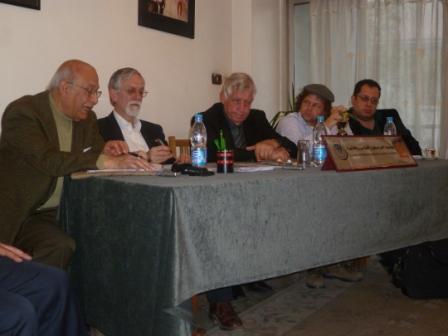


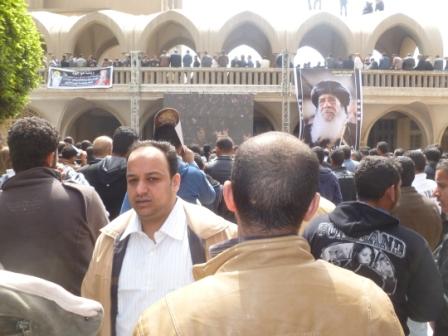
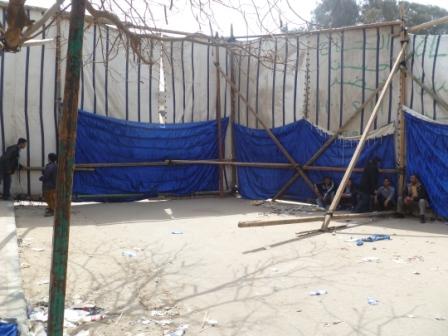
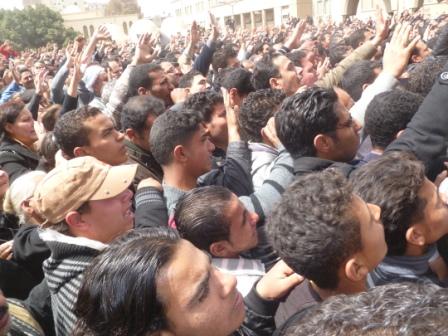
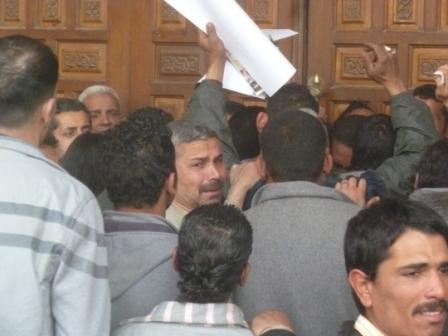
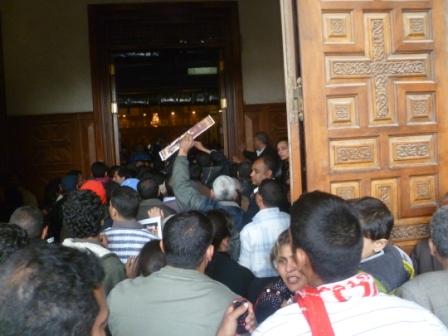
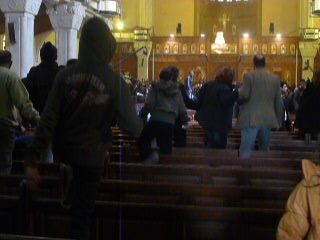
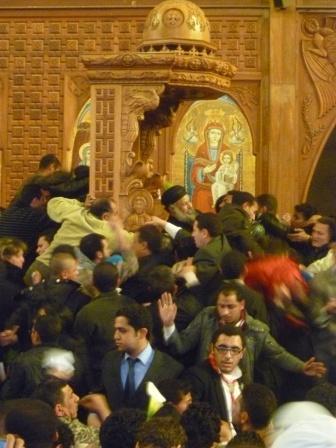


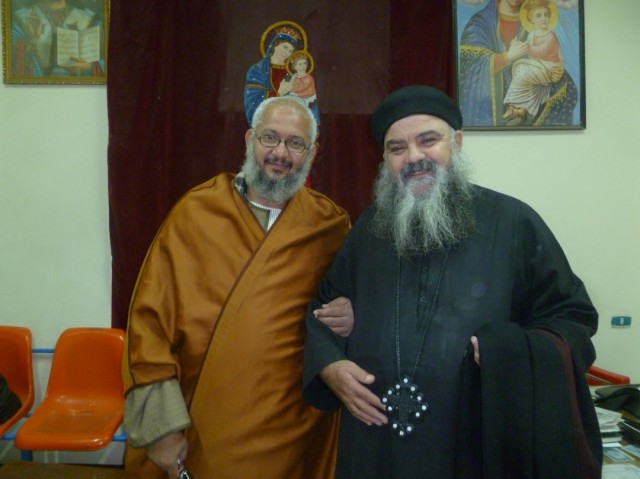




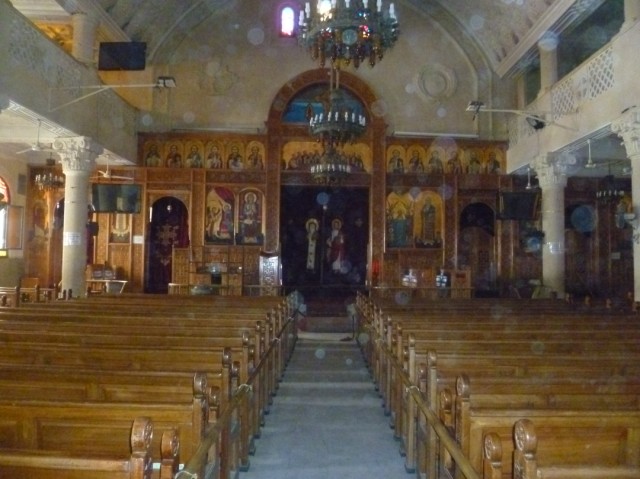


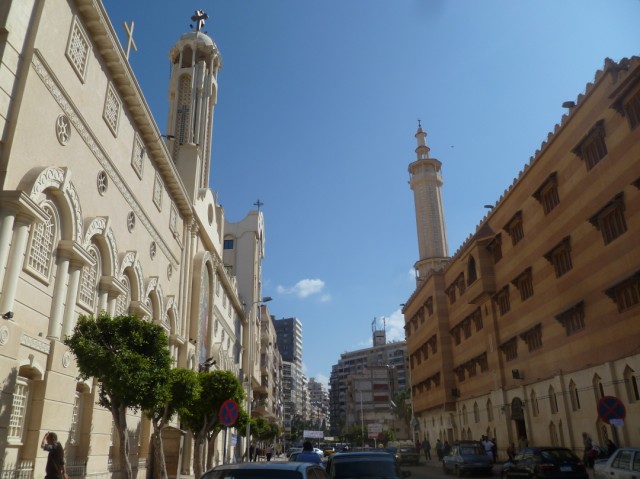

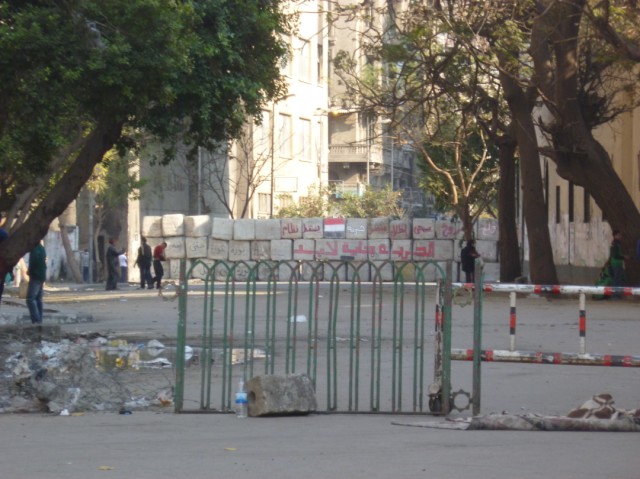
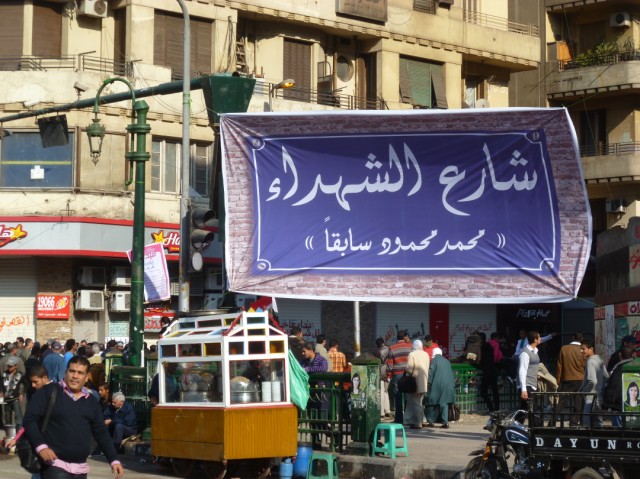


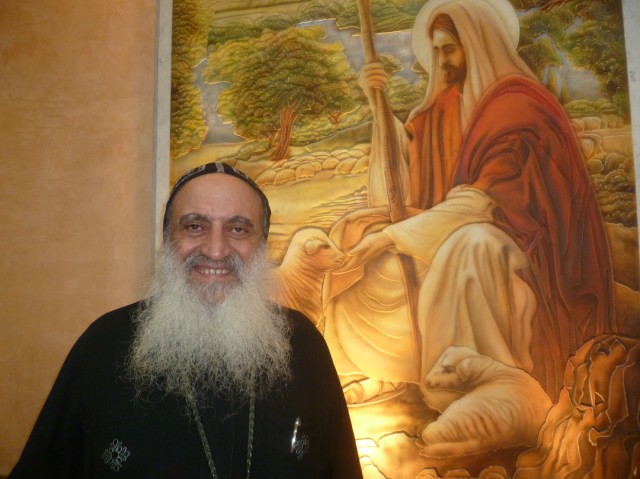

 Jayson Casper