Categories
Personal

A Salafi Speaks in Church on Shenouda

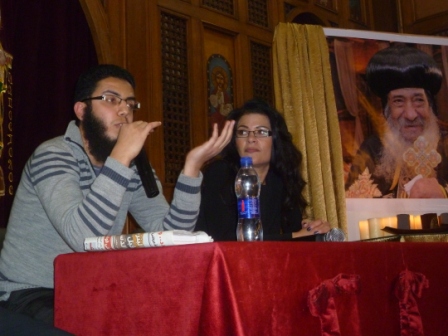
Fatima Naout and a surprise Salafi guest

The evening was supposed to be about Fatima Naout and Pope Shenouda. It turned out to be so much more.

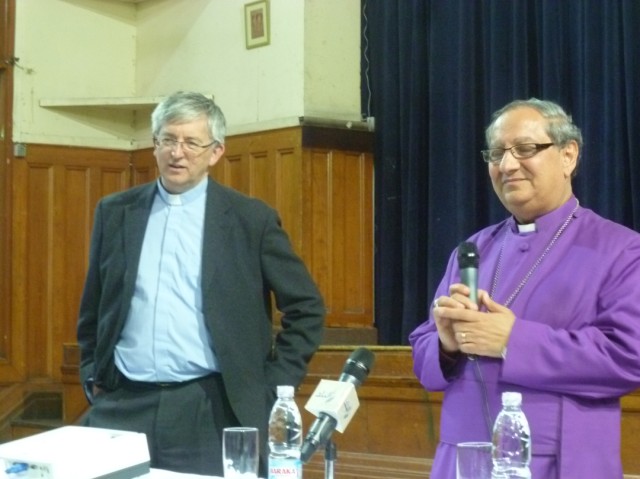
That it included Fatima Naout is semi-exceptional in itself. St. Mark’s  Coptic Orthodox Church in Maadi invited her to be the keynote presenter for a memorial service for Pope Shenouda. Naout is a Muslim.

Yet she is well known in Egypt – and celebrated by Copts – as a staunch defender of citizenship, liberal principles, and Coptic rights. There are many Muslims like her, of course, but she goes further. She has memorized many verses of the Bible and lauds Christians over the sublime teachings of their religion.

She stated she loves to go to church because she is jealous of Christians. She finds much in Islam to be their antithesis.

During her presentation Naout made many beautiful remarks about Pope Shenouda, and was received warmly. It was not until the end, however, that the evening got really interesting.

Mahmoud arrived, complete with the full length beard marking a Muslim of Salafi persuasion.

He was noticed quickly, and must have explained himself sufficiently, for before too long he was brought to the front to speak. He apologized for being late, and offered his condolences over the death of Pope Shenouda, offering kind words about their spiritual leader.

The church was electrified. In the days after Pope Shenouda’s death a popular Salafi preacher forbade Muslims from saying the common cultural expression over a death, ‘God have mercy on him.’ Shenouda was an infidel, and the head of the infidels, and God would not have mercy on an infidel, especially one who brought such sectarian tension to Egypt and wished to create an independent Coptic state.

In parliament the Muslim Brotherhood speaker Saad al-Katatni paused proceedings and asked everyone to stand for a moment of silence out of respect for Pope Shenouda. The Salafi members stayed in their seats, except for those who chose to walk out.

The entrance of a Salafi into a memorial for Pope Shenouda, then, caused quite a stir. Later on Naout’s Christian secretary apologized to Mahmoud publically. When she saw him come in she immediately feared he was going to blow himself up in the church.

Mahmoud stated he was afraid himself. Before coming in he thought he would be searched rudely, if not barred at the gate. Instead, he was astounded at his welcome.

These confessions came later. After his two minute offer of condolences the service ended with a final hymn, and all exited. Mahmoud, however, had a crowd around him outside.

Naout and Mahmoud

Some wanted to get a point across, though were friendly in doing so. It was certainly an opportunity to address a Salafi on their own turf, with numbers in their favor. Mahmoud was gracious and didn’t seem to be bothered by his instant celebrity.

Most of those present, however, simply offered their welcome, and thanked him for coming. He was invited back, so that he might see how Christians pray and get a fuller picture of the faith and the community. He appeared willing to do so.

The whole while Naout was still inside speaking with the organizers of the service, but made a point to speak to Mahmoud. When she exited and found him, the crowd around them doubled in size.

Eventually it led to a spontaneous second seminar. Naout and Mahmoud sat at a quickly arranged table and simply talked about their understandings of religion. Several in the crowd asked questions.

By this time Mahmoud’s story was known, though he repeated it for those who did not hear. He came only to hear Naout speak.

After the revolution the Muslim Brotherhood launched a campaign entitled, ‘Listen to us, don’t listen about us.’ Aware of their poor reputation in the press and their late entry into the revolution, the Brotherhood enjoined people to learn directly from the organization about its principles and values.

Mahmoud wanted to do the same, in reverse.

Given that Naout has such a poor reputation among Salafis, he heard about her presentation and came to the church to listen. Unfortunately, he was late and missed most of it. Yet the swell of attention and the interest of Naout to engage with such an open attitude led to his invitation to speak directly to the whole assembly.

I identified with him, had respect and sympathy for him, but advised him to think twice about doing it. I probably shouldn’t have, but it was my reaction after having been in his shoes. I will never regret wearing them, but I feared he was unprepared, and I feared the Coptic audience.

Several weeks ago I was in Tahrir Square, and I stumbled upon a tent representing the Coalition to Support New Muslims. This was a group that provoked/responded to – depending on perspective – great sectarian tension over the summer concerning a woman named Camilia Shehata. She was the wife of a priest who disappeared, fueling rumors she had been either, one, kidnapped and forced to convert to Islam, or two, converted willingly and was kidnapped by the church to prevent the announcement.

The Coalition to Support New Muslims rallied behind her according to their interpretation, and led multiple marches of thousands of conservative Muslims. On one occasion they marched threateningly past the Coptic Cathedral, the seat of Pope Shenouda.

I had long been curious about this group, but had no idea how to get in contact with them. By this occasion in Tahrir Square the Camilia Shehata issue had long since passed, but here I was at their doorstep.

I was received warmly and learned extensively of their perspectives. Despite the fact that Shehata appeared publically with her husband and child on satellite television and confessed her belief in Christianity, the Coalition held to the fact that she had indeed converted, and the church pressured her to return. Of note, the television station she appeared on was foreign based, and she spoke from abroad.

After a little while, though, the conversation changed. There were ten to fifteen people in the tent, and they began asking accusatory questions about Christianity. The Coalition, incidentally, had begun as individual members identified themselves on Paltalk, a popular chat service that hosts multiple rooms for interfaith, um, dialogue.

In reality it is a place of proselytizing, on all sides. The Muslims of the Coalition were long practiced at combating Christian witness on the site, and doing their best to convince in the other direction.

Unlike Mahmoud, they did not have the attitude of ‘listening to us, not about us’ to learn, but to pick Christianity apart. After finishing the basics about the Coalition and Camilia Shehata, they turned their sights on me.

It was not pleasant. A question would be posed, an answer attempted, and then someone else would jump in from a different direction. They were not rude, just purposed, and in the end, annoying (not all, of course, mostly one in particular). It was as if they had never interacted with a real live Christian before, and certainly not a foreigner.

And now, Mahmoud was in the same place.

He handled himself well, as did the audience. The only challenge came from Naout. She asked him about the difference between Quranic verses composed early in Mecca, which are largely irenic, with those from when he later resided, and ruled, in Medina. This is from where ‘verses of the sword’ issue, and most Muslim exegetes consider later revelation to abrogate the earlier. How could he, a kind and open-minded Muslim, accept such commands to kill and discriminate?

It was the sort of question I feared for him, as Naout is well versed in these matters and a strong personality, while Mahmoud, presumably, just wanted to learn. He ducked deftly enough, and no one was out for blood. The overwhelming sentiment in the audience was gratefulness that a Salafi had joined them. The evening ended with the idea Mahmoud could return with other Salafi colleagues, ones able to answer the question well, and the church could host them in seminars to get to know each other better. Fr. Butrous of St. Mark’s Church even offered to visit a Salafi mosque to do the same on their turf. Mahmoud indicated these were good ideas.

They are, in fact, beautiful ideas. The beauty stems from both sides, though in different manners. Mahmoud made the effort to get to know the other. He risked his own community’s condemnation by offering condolences for the pope. He even risked the chance the police guard outside the church might have misunderstood his intentions and gotten into trouble.

The beauty of the church stems from their reception. Copts feel under tremendous pressure from Islamists in general, and Salafis in particular. By and large, they did not take their unprecedented opportunity to lay into a Salafi who was actually kind hearted enough to listen to what could have been their many legitimate complaints. Instead, they welcomed him, and made certain his visit was appreciated.

It is beautiful, but it is also revealing. The Coptic Church is widely panned as being an insular institution whose people have grown more and more isolated within its walls. Salafis can be understood somewhat similarly. There is very little connection between the two groups, and as such, acrimony is frequent on both sides.

I cannot say what the real Salafi attitude is toward Christians, if it differs from that of many of their high profile leaders. Yet the church attitude demonstrated that even if Christians are isolated, they desire to be known. Most may not desire it enough to be as brave as Mahmoud, but when offered a chance to interact with a Salafi, they jumped at the chance. They are desperate to give a good, and corrective, impression.

Naout closed the impromptu session by referring back to Pope Shenouda. She claimed this evening was ‘one of his miracles’. Indeed, had the pope not died, this memorial service would not have been held, Naout would not have been present, and Mahmoud would never have set foot in a church. Is it a miracle?

The answer is probably dependant on theology. Is it safe to say it is a miracle of the revolution? Is God arranging to bring the diverse strands of Egyptian belief closer and closer together? Is it just a token sociological accident? Or has good already begun to emerge from Pope Shenouda’s death?

Regardless, greater interaction between Copts and Salafis, Islamists and liberals, urbanites and villagers, and all manner of Egyptians is desperately necessary. Tonight, Pope Shenouda, Fatima Naout, and Mahmoud all circumstantially intertwined to begin a small chapter.

Or should it be labeled ‘providentially’?


Related Posts:

Categories
Personal

CNN in Cairo: Ben Wedeman

It is not an Arab Spring, says Ben Wedeman, CNN’s Senior Correspondent in Cairo, as it has lasted through several seasons, and is likely to continue several more. He prefers the term Arab Revolt, and believes there is no going back.

Wedeman spoke at the Abraham Forum hosted by St. John the Baptist Episcopal Church in Maadi, Egypt on March 22. The forum is directed by church rector Rev. Paul-Gordon Chandler, and aims to promote dialogue between religions and cultures for the sake of peace and better understanding. The title of Wedeman’s lecture was ‘Reflections on the Current Middle East’.

Wedeman began with a question he is often asked: Did you see it coming? While he said the conventional wisdom on Egypt was that with Mubarak’s looming death a power struggle would soon emerge, no one anticipated Tunisia. Yet with the level of education and demographics of youth, the gains of the Arab Revolt are here to stay, even as the struggle will likely continue for a while to come.

Wedeman’s lecture walked the audience through the harbingers of the revolt in Egypt, stating why there was some evidence discontent was in the air. In 2000 several thousand Cairo University students protested Israeli policy in Palestine and Egyptian complicity. In 2003 there were clashes between police and protestors in Tahrir Square over the US invasion of Iraq.

Shortly thereafter the nation went temporarily silent as Mubarak collapsed while addressing parliament on State TV. Finally, in 2008 the protests at Mahalla al-Kubra in the Nile Delta witnessed significant anger against Mubarak himself, with demonstrators smashing his picture and stomping upon it.

Still, the January 25 protests caught everyone by surprise. Whereas during even the sizeable protests of the past there were at least five policemen per demonstrator, on this occasion the security forces were overwhelmed. Being on the street, Wedeman noticed as well they were largely new, young conscripts, whose fear was palpable in their visage.

Among the noteworthy anecdotes Wedeman shared was his comment to a fellow journalist following an ‘alternate reality’ speech given by then-speaker of Egypt’s upper house, Safwat el-Sharif at the headquarters of Mubarak’s National Democratic Party, given on January 28.

Wedeman told his colleague to take a picture of this building, as he wasn’t sure it would last much longer. That evening, on the Day of Rage, it burned.

The evening grew even more interesting as Rev. Chandler opened the floor for questions and answers. The following is a capsule of the different topics:

SCAF?

I think the military council will hand over power as they have promised, as they do not want the responsibility of running the country. What they want is to keep their significant perks, as they control between 30-40% of the economy. SCAF will go back to their barracks while they maintain an influence, but their fate will be decided by their coming interactions with the elected parties.

Syria?

I can’t predict anything, but unlike Egypt there is a significant percentage of the population which is truly afraid of what will happen if the regime falls. The consequences could get very nasty. I recently spoke with activists in Jordan and asked if they were planning to push forward. No, they replied, we have been watching Syria and we think it is best to give reform a chance first.

Iran in Syria?

Certainly Iran has a lot at stake in Syria, as it is their main connection to the Arab World. Yet the news that their Quds forces have been operating is not sure, as it is mainly reported by Washington and Tel Aviv, where news should always be taken with a grain of salt. Iran’s interest is comparable to that of the Sunni Gulf states, which are heavily calling for the fall of Assad. It underscores a Sunni-Shia split in which the Gulf States are now retaliating against the interference of the Iranian regime in their region following the Khomeini revolution.

Egypt becoming Pakistan?

This is not a realistic scenario, because the Egyptian character will push back against the extremism which is seen in Pakistan. Yes, Egyptians are very religious, but they have a long history of welcoming foreigners and do not have a deep hatred of the ‘other’. Having a significant percentage of the population as Christians also works against a Pakistan outcome, as seen in the example of the historic Wafd Party.

Saudi Arabia?

Ah, they are the elephant in the room. Even President George Bush’s democracy promotion agenda left Saudi Arabia off the table. Their influence through oil is simply too large to ignore. There have been demonstrations there, which have been met with violence. Yet here we see how the interests of the West trump their principles – and then some. But yes, they definitely need change, especially in the area of women’s rights.

Muslim Brotherhood?

I see the Brotherhood as pragmatic businessmen who know they must compromise to get and stay in power. I’m not worried about them in the short term, as opposed to the Salafis, who are more hardline and seem to have come out of nowhere. But it is always a concern when a political group puts religion as a central focus. Religion is a least common denominator which serves to divide. Take Hizbollah, for example. It means ‘Party of God’. If you are against the party of God, you are against God, and if against God, you are an infidel. Still, many in the Brotherhood refer to the example of Turkey, which is not that bad a model, actually.

Democracy with Islamists?

It seems clear that the Salafis are not converts to democracy as an end but as a means to power. The Brotherhood is different, as they have struggled for decades to get into politics, even being persecuted. They talk the talk of democracy, but now they will be put to the test. The reality of governance will probably not allow them to descend into extremism.

Salafis?

Salafi success in the elections was surprising, but they out-Brotherhood-ed the Brotherhood. They engaged in social service work both traditionally and with the elections, and pulled on the power of religious allegiance. Yet it should be noted the Salafis have a long relationship with Egyptian intelligence, which sees them as a counter-weight to their ‘archenemy’ the Muslim Brotherhood. For instance the head of the Salafi Asala Party used to be the head of the Mugamma, the central administrative building in Cairo – just without a beard. Many parts of the regime fell with the revolution, but others remained, chief among them the intelligence services.


Ben Wedeman has won numerous awards in his journalism career and speaks many languages, even dabbling in classical Mongolian. He is married with three children.


Related Posts:

Categories
Personal

Mother’s Day: Culture, Parenting, and Last-Minute Chocolate

Our American readers may wonder why I am writing about this topic two months before the US celebrates their matriarchs, but here in Egypt, our big day is on March 21st.

Mother’s Day has been celebrated in the last three countries we have lived in: Jordan, Tunisia, and now, Egypt.  I don’t remember the dates in each country, but I do remember asking a friend in Jordan if they celebrate Father’s Day.  She laughed and said, “Here, everyday is Father’s day!”

It could be interesting to research what countries have official mother’s and/or father’s day, but I don’t think I will get around to that anytime soon.  If any readers have any insight, please share in our comment section!

I have noticed this year that Mother’s Day is quite a big deal around here.  I guess as our girls are getting older, and involved in more things, I will collect more and more handmade crafts of love from various venues.  As such, I thought it worth writing about what I’ve noticed so far before first, I forget, or second, get too busy to write (being a mother and all).

This is the first year Emma is in school, and she has been singing a few songs about mothers in both Arabic and English over the last couple weeks. Still, the day passed without any word of an assembly, so maybe it is still in the works? Sometimes it is hard to figure out the culture, especially when mixed with an Arabic administration!

Emma also made a mother’s day surprise for me last Wednesday, but had to hide it in her backpack until yesterday when she presented it to me along with the flowers that she purchased with her sisters and Daddy – from her own allowance.

The weekend before I scored four different mother’s day crafts!  Fridays are both weekend and “church day” for us.  In the morning, the girls attended the Coptic Sunday School and each made a flower in their individual classes:  Emma made a flower balloon, and Hannah made a paper flower to put on the refrigerator.  At this same church, we will celebrate mother’s day in my adult Sunday school class tomorrow, and a friend mentioned that next Saturday night is a special service for moms, complete with gifts!  That’s a lot of celebrating!

Meanwhile, the second church where the girls attend Sunday School actually changed the time of their normal meeting today and invited the moms to attend a special party.  And so the three girls and I headed over to the local Arabic Evangelical church where we first listened to the kids sing some of their normal songs.

Then one of the teachers took some comments from the audience.  First she asked the kids what are some things their parents do that really bother them.  The answers included: Limiting internet, making me do homework and go to school, and yelling at me.

And then it was the moms’ turn to share about the kids, which included: Not taking care of their stuff and not listening to their parents.  During this time, Emma got out of her seat and came back to me to translate the question (in case I didn’t understand) and ask me to share an answer!  Kind of funny that she wanted me to answer such a question.

After it was all over, I asked what she would have shared if she said something.  She liked the “Mom makes me do homework and go to school” comment.  I was glad she identified with that first over some of the others!

After the mutual sharing, the kids all went to their respective classrooms while the moms were invited to move forward in the sanctuary for a talk geared for them.  The speaker shared that when she deals with kids, she emphasizes four things about them: They are important, loved, different and good.  She then expanded each of these points, but since I had our two-year old with me, I wasn’t able to sit and concentrate on her talk.  I caught some things here and there but missed the bulk of the message.

When I came back inside after letting Layla run around a bit, there was a question/answer time.  I would have enjoyed really listening to the exchange here, but it was a bit challenging.  I was able to listen to one or two questions regarding teaching children not to interrupt, or at what age can you start punishing a child.  As I listened, I soon realized that I was very pridefully and smugly listening to these questions and answers with an air of: “These poor people don’t know anything about child-raising.”

Like I do!  I was ashamed when I realized my superiority complex!  It’s not that I think I parent perfectly, and I am willing to admit my faults, which are more on some days than others.  However, I do think that I have studied how to parent well, even if I can’t always apply it properly.  And this isn’t all pride.  I have the privilege of great role models and friends who share struggles and ideas, as well as numerous books on the topic from so many perspectives.  I almost don’t have an excuse for not having all the answers!

On the other hand, I have lived in this part of the world long enough to at least know some of the stereotypical child-rearing strategies.  And I am guilty of thinking all parents use these strategies.  But we all tend to apply what we have learned growing up.  Unless you really don’t like some things your parents did, and you have resources to find better ways, then you will probably repeat those things.  I come from a place where resources are abundant and we are taught to search for ideas.  That isn’t as true in this culture.

Some of the things I observe here as adults relate to children have their roots in what people have been taught, and this stemming from good things.  As I have mentioned in other posts (see below), Arabs, as a whole, love children.  My kids have gotten so much attention from perfect strangers over the last 5 ½ years living in two different Arab countries, that I cannot doubt this culture’s love and care for children.

One natural response here is that adults don’t like to see or hear children cry.  If a child falls and scrapes his knee, the nearby adult will scoop him up, tell him, “It’s okay, don’t cry,” as he wipes the tears away, and then offer a lollipop or bag of chips to help him forget his pain.

Remember as well that Arabs are generous.  This continues along as a child gets into a fight with a friend or sibling and their feelings get hurt.  A candybar helps to mend things.  And then it gets carried further when a child gets upset because they can’t have what they want.  If a two-year old is told not to touch the computer, and cries about it, they may be soothed by a bag of cookies.  And so a young child may not be taught to deal with disappointment or learn to accept no for an answer.  Instead, they may be placated with sweets.

Sometimes my friends ask me how I discipline my children and they have often been surprised at how much I talk to my toddlers.  I believe little ones can understand a lot at a young age, and we have explained our expectations to them from the start.

I have noticed that younger children here are not expected to be able to listen and obey.  At times my friends make fun of their own child-rearing practices as they explain that after telling a child no yet again and having that child disobey, then the parent will lose their temper and yell and maybe even hit their child.  The parent’s anger has built up as the child disobeys time and time again, yet without real consequence, and then once the parent gets fed up, the child gets a punishment perhaps too harsh for the offense.  Again, this is a stereotype, and certainly it is not only Egyptian parents who fit this scenario, but it is one that plays out time and again.  There aren’t always resources to try something different.

Well, I have strayed a bit from the title of the piece.  After the question/answer time, we enjoyed a few snacks outside and the girls each brought me the pictures they colored of a mom and child.  The church gave out small cutting boards to each mom and we walked back home to head to bed.

It is nice, all this attention for Mother’s Day.  Another friend invited some moms to her place for tea on Mother’s Day morning, and that was nice too.  Perhaps there will still be an unknown school assembly to come!

I know I have a most privileged job here as a mom to our three girls.  Today I was reminded that I don’t have all the answers, and as parents we do the best with what we know.  I am always praying that God would make up the slack and give me more wisdom than I possess on my own!


Update: Now that it is Mother’s Day night, I can finish this post with a learning experience.  When I dropped Emma off at school this morning, I kind of noticed half-heartedly that other moms and kids were coming to school with gifts.  I barely thought about it until later that morning when another foreigner was asking if Emma had taken a gift to school for her teacher.  Then it occurred to me that the other parents were doing just that!

I wondered why, since many of the teachers weren’t actually moms, but I tried to find a quick suitable gift for Emma’s teachers before picking her up for the day.  I stopped at the local sweet shop and bought some chocolate after asking the workers there if this was an appropriate gift.

I then asked why teachers get gifts on this day and they mentioned that the teachers are like moms to the kids.  That made a lot of sense.  I quickly paid and walked down the street to the school and as Emma came out of her classroom excitedly ready to tell me something important, she saw the two bags in my hands and exclaimed, “Yes!  Are these for my teachers?!”

I was so glad I decided to stop and get something even though it was a last-minute thought.  Emma was so happy to give a gift to her teachers and glad to be doing what the other kids did.  A nice tradition, to give teachers gifts on mother’s day.  Let’s hope I remember by this time next year.


Related Posts:

Categories
Personal

A Few Thoughts and Links on Pope Shenouda

His Holiness Pope Shenouda III of Alexandria

Living here in Egypt as a writer, I have long worried over the looming death of Pope Shenouda, head of the Coptic Orthodox Church. Speaking only personally, it seemed a daunting task to try and summarize his life, as long, influential, and controversial it has been.

This mostly has to do with my preference for writing analysis and context, as opposed to news. Yet the death of a major figure demands quick production. Doing justice to the man and the future of the church of Egypt seemed incredibly complex a task. There is so much about the Coptic Orthodox Church which still escapes me.

Arab West Report has produced a fine obituary on Pope Shenouda, one submitted the day of his death with substantial analysis and contextual content. The author and director of our center has lived long in Egypt and is clearly well researched and contemporary to the events described. I hope to attain such proficiency some day.

Please click here for the link.

Another good report comes from the Guardian, a UK based newspaper. I provide this link not only for its content, but also because it links to a report I wrote several months ago after the Maspero massacre. I was the only foreigner present during a press conference hosted by the Maspero Youth Union, and after all this time it was picked up by the major media.

I hope a more extensive analysis of this situation can come in a few days. I spent today surveying Egyptian Protestant leaders for their reaction, and hope to make this report available tomorrow.

For now, let us pray for Egypt’s Copts, as they are mourning. Analysis can come later. Below are a few pieces I have written about him in the past.

Related Posts:

Categories
Personal

Christian Zionism: A Lecture in Cairo

Rev. Stephen Sizer

Rev. Stephen Sizer, a renowned expert on Christian Zionism delivered a series of lectures in Egypt at Cairo University, the Anglican Cathedral, and other venues. This article is a summary of his presentation delivered on February 15, 2012.

According to Sizer, Christian Zionism is the view that the modern state of Israel is the fulfillment of Biblical prophecy and thus deserving of our moral and political support.

Sizer opened with a brief history of Zionism, tracing its first political sponsor to Napoleon, who wished to wrest Jewish banking favor away from the British Empire in their struggle for supremacy. Britain eventually emerged triumphant, and then engaged Germany in the lead up to World War I, as both sides solicited Jewish favor in exchange for their support for a return of Jews to Palestine. The Belfour Declaration in 1917 was the pinnacle of Britain’s promise, set in the context of many geopolitical maneuvers with both Jews and Arabs.

The Christian element of Zionism received a great boost with the election of President Jimmy Carter in 1976, who believed the state of Israel represented the fulfillment of prophecy. During this time Rev. Jerry Falwell emerged as the leading advocate of Christian Zionism, and promised 70 million evangelical Christian votes for supporters of the cause.

After his death in 2007, Rev. John Hagee received his mantle, promising 50 million evangelical Christians would stand side-by-side with the 5 million Jews of Israel. Today, Sizer estimates 25% of US Christians identify with Christian Zionism, though this contrasts with only 5% of Christians worldwide.

Sizer identified five primary theological underpinnings of Christian Zionism, including:

  • Jews are to be restored to Greater Israel
  • Jerusalem is the eternal Jewish capital
  • The Jewish Temple is to be rebuilt
  • Antipathy towards Arabs and Islam
  • There will be a war of Armageddon

Theology, he noted, drives behavior. Sizer then illustrated how Zionist Christians:

  • Contribute money to support settlements and help Jews emigrate to Israel from Russia and elsewhere
  • Lobby the US government to move the embassy from Tel Aviv to Jerusalem
  • Support the Orthodox in their effort to rebuild the Temple
  • Oppose the peace process as it compromises ownership of the land
  • View politics through the lens of a coming war between Russia, China, Arabs, and Europe against Israel

The consequence of Christian Zionism, Sizer noted, was the destruction of the church in the Middle East. Historic Arab Christian communities are being squeezed by the competing powers of Zionism and Islamism, finding no place for themselves. Many are immigrating.

Former Archbishop of Canterbury George Carey warned that the holy sites of the Middle East could be transformed into a Christian theme park, in which the only Christian witness is carried by tourists and pilgrims.

Sizer closed his remarks by quoting from the 2006 Jerusalem Declaration on Christian Zionism, signed by the heads of the Latin, Syrian Orthodox, Anglican, and Evangelical Lutheran churches in Jerusalem. Highlights include:

We categorically reject Christian Zionist doctrines as false teaching that corrupts the biblical message of love, justice and reconciliation.

We reject the teachings of Christian Zionism that facilitate and support these policies as they advance racial exclusivity and perpetual war rather than the gospel of universal love, redemption, and reconciliation taught by Jesus Christ. Rather than condemn the world to the doom of Armageddon we call upon everyone to liberate themselves from the ideologies of militarism and occupation. Instead, let them pursue the healing of the nations!

We call upon Christians in churches on every continent to pray for the Palestinian and Israeli people, both of whom are suffering as victims of occupation and militarism.

We affirm that Israelis and Palestinians are capable of living together within peace, justice and security.

We are committed to non-violent resistance as the most effective means to end the illegal occupation in order to attain a just and lasting peace.

With urgency we warn that Christian Zionism and its alliances are justifying colonization, apartheid and empire-building.

During a question and answer session afterwards, Sizer explained how Israel would like to have three separate achievements, but can only have two. These include:

  • Democracy
  • A Jewish State
  • The Occupied Territories

Israel can succeed in being a democratic Jewish state if it gives up the territories to an independent Palestine.

Greater Israel can succeed in being a democracy should it incorporate the inhabitants of Palestine as full citizens with equal rights, if it gives up its Jewish nature.

Or, Israel can succeed (?) in being a Jewish colonial state, but only at the expense of giving up its democratic nature.

Sizer’s presentation was warmly received by the majority of attendees, many of whom were less than familiar with this largely American religious phenomenon. The only issue taken with Sizer was his acceptance of the term, Christian Zionism. Some angrily rejected the coupling as an oxymoron – Zionism is not Christian at all.

Rev. Sizer and Bishop Mouneer, who provided translation into Arabic.

Personal Reflection

I wince when issues of the world are reduced to banking and Jewish conspiracies. Sizer does not take this bait and run with it, but much of anti-Zionist discourse does. Still, ‘follow the money’ is a truth worth reflecting upon, but surely historic world capital has been available via other than the Jewish ‘cabal’, no matter how disproportionate Jewish influence might be relative to their population.

Yet from my superficial studies of world Judaism, I believe that for most of modern history the majority of Jews have been anti-Zionist themselves. Before the creation of Israel they waited for the advent of the Messiah to restore their fortunes to Jerusalem. Furthermore, many deemed Zionist efforts to be counter-productive to the social necessity of proving themselves loyal citizens to the nations in which they lived. Why then would Jewish bankers wish to swing worldwide sentiment to creation of a Jewish state? Far more research than I have done is necessary to determine the validity of the question, but however it is sliced, Zionism is a peculiar entity.

As per Christian Zionism, I wish to recognize first that few evangelicals I am familiar with would use this phrase as a self-appellation. It is not a movement, however much it is a sizeable theological-political sentiment. Moreover, its sympathizers are good Christians, contra the disbelief of some who commented at the close of the lecture. Money given to support poor Jews in Russia may be manipulated politically, but it comes from a generous heart to help ‘the least of these’, as Jesus commanded.

One omission from this particular lecture of Sizer was an evaluation of the Biblical sources. Why is Christian Zionism faulty interpretation? Its proponents certainly name chapter and verse to demonstrate the grand plan of God.

Sizer’s website contains resources to address this question, as do the writings of Colin Chapman. I do not wish to enter into this discussion here, but it will suffice to say I recognize many of the principles of Christian Zionism, or of dispensationalism, its theological underpinning, as worthy Biblical options for interpretation. Christians disagree over interpretation all the time – what is important is that a common reference point judge between disputants. Both sides appeal to scripture, and therefore must not be excluded as the enemy, even if in error.

For me, the definition of Christian Zionism as given by Sizer contains the key to its essential error. Modern political Israel may or may not be the fulfillment of Biblical prophecy. Yet even if it is, this should not translate into the necessity of moral and political support.

Rather, it is the principles outlined in the Jerusalem Declaration that must guide Christian evaluation of Israel, as of all nations, including their own. Do the policies of a state nurture or hinder the flowering of love, justice, and reconciliation? Careful reading of the news is necessary, but in many cases the government of Israel violates these values. When it does, Christians must object.

The Bible maintains that it was God’s anointed hand and the fulfillment of prophesy which smashed the Jewish state via the scepter of wicked Babylon in 586 BC, and then again by the Roman Empire in 70 AD. That this was God’s design did not call on the people to approve, only not to stand in the way. On the contrary, in the case of Babylon God promises he will judge its rulers for their injustice and oppression.

Is God moving history toward a final confrontation between the world and Israel during which Jesus will return and inaugurate his kingdom? Perhaps. Those who scoff would do well to view events through this particular interpretive lens and gauge the odd correspondence. Why else would such an unimportant piece of land command attention of the whole world?

Yet even if this vision is true, God will hold Israel’s leaders to account for their conduct – not based on political exigency, but on divine righteousness.

He will hold Christian Zionists to account all the same. He will, in fact, judge the world.

As Coptic Orthodox repeat incessantly in prayer, ‘According to your mercy, oh God, and not according to our sins.’

note: Please click here for a five minute video of Stephen Sizer giving an interview to a member of the Arab media after his presentation. Due to sound quality the questions were edited out, but should be clear enough from his answers given, which are presented in full.


Related Posts:

Categories
Personal

Understanding Egypt’s Elections

Egypt’s first free elections in over thirty years did not err on the side of simplicity. Even so, this did not deter massive national participation and excitement, as 54% of the nation lined up for hours on the street to cast their ballot. Many, however, admitted to having little knowledge about the political process, enabling accusations of fraud and voter manipulation. In this they mirrored many casual Western observers who valued the accomplishment of the elections, but were confused by the mind-boggling complications.

The results were simple: Islamists won a major victory, securing around 70% of the seats. The tale of this victory, and what it means for Egypt, is the subject of this recap.

The Set-Up

Egyptian elections for the People’s Assembly were conducted in three stages over a period of nearly two months. Each of Egypt’s 27 governorates was then subdivided into electoral districts, according to population. Two-thirds of the seats were awarded by proportional representation according to votes cast for their party. The remaining third was chosen by individual ballot for the candidate alone. Of the total representatives chosen, fully one-half were required to be workers or farmers. Together, the People’s Assembly consists of 508 seats, 10 of which were appointed by the military council.

Confused? Naturally. The process did not result from consensus planning or a democratic heritage. Instead it was cut and pasted from a mishmash of Egyptian history through pressure and compromise between political parties and the military council.

The 50-50 division between workers/farmers and professional seats is a holdover from President Nasser. He stipulated a place for the common man in the People’s Assembly in accordance with his Arab nationalist and socialist policies, but in reality the designation was little more than an administrative token. The military council represents a continuation of his legacy, and insisted on keeping the division. Political parties did not raise significant objection.

There was loud protest, however, over the electoral system. The party list format groups candidates together under broad alliances. Citizens then cast one vote for their party of preference, which is awarded seats per district according to the total percentage won. If a district, for example, represents ten seats, every party must field ten candidates. Should the party capture 60% of the vote, its top six candidates would claim seats.

This was the system Egypt utilized for elections in the 1980s, before switching to an individual candidacy format more akin to politics in the United States. The winner was the first to capture 50%+1 of the ballots cast, requiring a run-off for the top two candidates, if necessary. Intentional or not, this allowed for simpler vote-rigging and intimidation of voters, allowing the National Democratic Party to win a sweeping (fraudulent) victory in 2010.

Fearful the remnants of the NDP would claim victory after the revolution through similar methods, political parties argued to return to a party list system. Through subsequent pressure on the military council the percentage of such party list candidates moved from one-third, to one-half, and finally to two-thirds. The military council refused to abandon individual candidacy altogether, leading to fears it would promote old regime fortunes in the election process.

These fears were also buttressed by their refusal to allow international observation of the elections. Instead the military council decreed the nation’s judges would supervise legitimacy, but this created a problem of logistics. In order to guarantee a judge at every ballot box, the elections were divided into three stages. Stage one took place in the governorates of Cairo, Alexandria, and others, while stages two and three mixed between the governorates of the Delta and Upper Egypt.

In the end, the military council did allow limited international observation. Former US President Jimmy Carter was prominently involved through his Carter Center, with its longstanding work in democracy promotion. While noting irregularities, he ultimately judged the elections ‘acceptable’.

The Parties

The military council further placated popular demand and issued a law to bar former members of the NDP from participating in elections. Though this law was struck down by the court, it proved to be unnecessary. A number of old regime parties acquired legal registration and ran in elections, but altogether secured only 3.5% of the seats.

The true competition centered on five parties/alliances, though initial efforts sought to maintain one national effort to unite all political forces. This hope quickly degenerated into a liberal-Islamist divide, as fears rose some wished to craft Egypt into a religious state.

Soon greater divisions emerged on both sides. The broad Democratic Alliance was led by the Freedom and Justice Party of the Muslim Brotherhood. It tried to position itself a religious but centrist force, keeping an alliance with the historically liberal Wafd Party. It faltered, however, as conservative Salafi Muslims split to form their own alliance, under the banner of the newly created Nour Party. Eventually, the Wafd also decided it could not align with the Muslim Brotherhood in good faith, and decided to go it alone.

On the liberal side, political parties from both the right and left of the economic spectrum formed the Egyptian Bloc, dedicated to the civil state. Yet the young revolutionaries felt marginalized, and split to form a left-leaning activist alliance named The Revolution Continues. A major factor in the dissolution of all alliances was the placement of candidates on the party list and assignment to favorable individual districts. The interests of party outweighed formation of a common front.

The Results

In the end this hurt the liberal far more than the Islamists, if indeed it was a factor at all. The Democratic Alliance headed by the FJP did slightly better than anticipated, winning 45% of the seats. The surprise of elections was the showing of the Islamist Bloc headed by the Salafi Nour Party. Assumed to be marginal and full of political novices, they captured a solid 25% of the People’s Assembly.

The liberal Egyptian Bloc fared decently in the first stage of elections due to concentrations of upper class and intellectual pockets in the big cities. Their appeal failed to materialize in the rest of the country, however, in the end receiving only 7% of the seats. The Wafd Party captured a slightly higher number, as their name recognition echoed through the rest of the nation winning the allegiance of most non-Islamist-inclined voters. Despite the popular appeal of the revolution, however, the Revolution Continues Alliance faltered miserably, winning only 2% of parliamentary representation.

The Stakes

Though the powers of the People’s Assembly remain undetermined, the military council has bequeathed it full legislative authority. This raises significant questions for the coming period. Will the Islamist forces align to move Egypt in the direction of a religious state? Will liberal forces find common ground with the Muslim Brotherhood’s FJP to marginalize the Salafis? Will the FJP evolve into a new NDP with the blessing of the military council, to revive the former regime? Or, will they gradually continue the revolution in effort to send the military council back to their barracks?

Not much is clear except the existence of a popularly elected legislative body. This in itself is an achievement of the revolution.

note: This article is a bit dated but has been held until publication in the Maadi Messenger, a monthly magazine for the expatriate community in Cairo.

Related Posts:

Categories
Personal

Muslim Brotherhood Ties Israel Peace to US Aid amidst NGO Crisis

Essam el-Erian, a senior leader in the Egyptian Muslim Brotherhood, called into question the Brotherhood’s commitment to the peace treaty with Israel.

Essam el-Erian

He commented on the ongoing NGO crisis embroiling the United States and Egypt. American and local NGO personnel in Egypt stand accused of fermenting chaos under the guise of democracy promotion.

The US has warned $1.3 billion in annual aid is in jeopardy if the charges, denied as frivolous, are not dismissed.

Erian told Lapido Media, ‘If the US withdraws its aid it gives us the right to review our side of the agreement as well. Aid is a part of the Camp David Accords, or why else would the US be giving this money to Egypt?’

There is only one problem. Former US president Jimmy Carter, who orchestrated the accords in 1978, stated, ‘There was no commitment of any finances going to Egypt as the result of the Camp David Accords.’

Is Erian ignorant of the text of these accords, or is something else in play? According to Raymond Ibrahim of Jihad Watch, Erian’s words fit into a larger context of Islamic behavior based on ‘circumstance’.

‘All Islamists understand that the treaty with Israel is a matter of necessity (i.e., Egypt cannot at the moment defeat Israel, therefore it is in its own interest to agree to peace). Might as well get money out of it.’

Ibrahim recently highlighted a video of Yasser al-Burhami, a prominent sheikh with the Salafi Call, an ultraconservative Muslim association. Burhami comments on how Mohamed at times made peace with the Jews, and at other times, subdued them through force and imposed jizia, a payment by non-Muslims in return for protection within the Muslim community.

Burhami then generalizes, ‘The prophet’s methods of dealing with infidels are available for Muslims to replicate depending on their situation and their capabilities.’

Speaking to Lapido Media, Ibrahim gave application. ‘Islamist politics and worldview are quite clear that once capability allows, Islam must go on the offensive.’

Gamal Nassar, a leader in the Muslim Brotherhood from Giza, Cairo, reinforces the notion of circumstance while commenting on Erian’s statement. ‘Things have changed since the revolution, and the US must realize it is not the same as before.’

Sheikh Osama al-Qusi is an independent Salafi scholar often criticized in his community for distinguishing between the affairs of religion and the affairs of the world.

Osama al-Qusi

Qusi notes that Burhami is correct in terms of Mohamed adapting to his circumstances, but notes many Islamists take this as license to be Machiavellian. Even so, ‘Just because Mohamed did something politically does not mean it applies to us. No, we must leave politics to the politicians.’

Furthermore, circumstance does not change the Islamic attitude toward other communities. ‘We are peaceful with those who are peaceful with us, and we fight against those who fight against us.’

Yet for many Islamists, ‘us’ applies to all Muslims. Essam al-Sharif is a leader for the Salafi-based Authenticity Party in Warraq, a district of Cairo. ‘According to sharia law, I have the obligation to defend Muslims.

Essam al-Sharif

‘If the Camp David Accords do not allow us to help the Palestinians in Gaza it is invalid and we must fight Israel. In sharia we respect the borders of this world administratively to honor our agreements, but they do not override our duty to support Muslims.’

Sharif believes Muslims must treat non-Muslims well whether they are strong or weak regardless of their circumstances. Yet this does not preclude jizia, and Muslims must be honest about it.

‘If we say we will not collect jizia, this is hypocrisy. No, non-Muslims must pay it, even if we are too weak to collect it now.’

Sheikh Abdel Muti Bayyoumi is a member of the Azhar’s Islamic Research Academy, a pillar of the Islamic establishment in Egypt. He dismisses Burhami completely, saying he is not specialized in jurisprudence, and is not fit to issue religious rulings.

Bayyoumi agrees the Quran allows Muslims only to fight those who fight against them. Where there is a pact of peace, however, Muslims must work with non-Muslims for justice.

As this concerns Israel and the opinion of Erian, ‘There is no relation between US aid and the Camp David accords. Thus, we are still bound to the treaty so long as Israel also keeps to it and does not review it first.’

Interestingly, Carter suggests issues of justice have been neglected in the treaty.

‘There is one element of the Camp David accords that has been abandoned in the past, even in Egypt, and that is the protection of the Palestinian rights.’

Interpretations of Islam are part and parcel of post-revolutionary Egyptian attitudes toward peace with Israel. Some reflect Burhami’s attitude about ‘circumstance’, and others Bayyoumi’s attitude about justice.

With whom does Erian’s interpretation lie?


Related Posts

Categories
Personal

Military Rank

I know very little about military affairs, either in America or the rest of the world. With the important role of the armed forces in Egypt, however, I thought it useful to understand the local chain of rank.

The enlisted soldier is known as either a jundi or ‘askari. He has received no formal education, but is able to achieve a level of promotion. Once elevated, he joins the rank of non-commissioned officers, or dubat al-Saff.

  • Corporal (‘areef) – wears two chevrons (shareet)
  • Sergeant (raqeeb) – three chevrons
  • First Sergeant (raqeeb awwal) – three chevrons plus an eagle (nisr)
  • Master Sergeant (musa’id) – eagle

The path to being a commissioned officer (dabit) begins in military academy as a cadet (talib). The path of promotion is as follows:

  • Lieutenant (mulazim) – wears a star (nigma)
  • First Lieutenant (mulazim awwal) – two stars
  • Captain (naqeeb) – three stars
  • Major (ra’id) – wears an eagle
  • Lieutenant Colonel (muqaddam) – eagle plus star
  • Colonel (‘aqeed) – eagle plus two stars
  • Brigadier General (‘ameed) – eagle plus three stars
  • Major General (liwa’) – wears two swords crossed (sayfain)

This promotion path also mirrors that in the police force. Further promotion, however, is available only in the military.

  • Lieutenant General (fareeq) – wears two swords, an eagle, and a star
  • Colonel General (fareeq awwal) – two swords, an eagle, and two stars
  • Field Marshal (musheer) – wears crossed olive branches (ghasn zaytun), with crossed swords in between, and an eagle above

The current constitution of the Egyptian military has three officers at the rank of Lieutenant General. These head the Navy (quwat bahriyya), Air Force (quwat jawiyya), and Air Defense (difa’ jawwi). The head of the army proper is also the Chief of Staff, at a rank of Colonel General. The members of the ruling Supreme Council of the Armed Forces are all at the rank of Major General or above.

As a final note, translations of the above are qualified as the research of a civilian, but all is from the public domain. More knowledgeable readers are invited to submit their corrections.

Categories
Personal

Rethinking Iran

English: President of Iran @ Columbia University.

Three reports related to Iran came across my attention this past week. All three cast doubts upon the common American narrative of Iran as an evil Islamic nation bent on destroying Israel through a developing nuclear weapons capability. There may be ample reason for the United States to oppose Iran as a geopolitical opponent; care must be taken, however, that American public opinion not submit to manipulative propaganda or self-deceit over assumed righteousness.

An example of this last sentence may be viewed here on YouTube, in which a TV commentator argued the US has the ‘moral authority’ to launch a pre-emptive strike on Iran, which ‘deserves to be annihilated’ because they are ‘evil’.

This rhetoric is parallel to the statement of Iranian President Ahmadinejad to ‘wipe Israel off the face of the earth’. Lest the tit-for-tat be accepted and dismissed as the voice of two extremists, however, the first report suggests Ahmadinejad’s statement was never made at all.

Shortly after his election in 2005, the New York Times quoted Ahmadinejad in a conference entitled ‘A World without Zionism’, ‘As the imam said, Israel must be wiped off the map.’

In a full translation, the NYT issued a slightly different version: ‘Our dear Imam said that the occupying regime must be wiped off the map.’

Perhaps this translation, however, also took liberties.

In analyzing the speech and providing a word for word translation, Arash Norouzi states Ahmadinejad said: ‘The Imam said this regime occupying Jerusalem must vanish from the page of time.’ Click here for his further analysis, including a survey of how this quote transformed itself in the media into ‘from the face of the earth’, as well as the context in which the quote from the Ayatollah Khomeni – not Ahmadinejad – is utilized.

The brief story, interestingly, does not simply blame Western powers with outright invention. Rather, it was the Iranian IRNA news agency which (mis?)translated his statement as ‘wiped off the face of the map.’ From here the story has become well known, and Ahmadinejad has been compared to a new Hitler desiring a new Holocaust.

Only God knows what is in his heart. Yet from his words he is not arguing for a nuclear strike to demolish Israel as a nation. He is wishing the removal of the Israeli government which according to international law illegally occupies Palestinian land. As Arab revolutions have called for the fall of the regime – Mubarak, etc – he was not specifically calling for the destruction of the state, let alone the Jews as a people.

There is a more than fair possibility Ahmadinejad views Israel, like many Muslims, as an illegitimate creation of Western dominance, and would wish to see its disappearance as a political entity. Repetition of ‘wiped off the map’ or ‘from the face of the earth’, however, must not be utilized in a campaign to demonize him or the Iranian regime.

He did not say it.

Could he do it? Well, this is the focus of the continual focus on Iran’s purported efforts to develop a nuclear weapon. This second news item was widely reported, so it is likely to have already entered American consciousness. While the UN’s atomic energy watchdog has reported that Iran is taking credible steps to enrich uranium, the New York Times released a report doubting Iranian efforts to make a bomb.

The NYT report relies on what it terms ‘the consensus of American intelligence agencies’. That is, our people tasked with determining what is happening on the ground do not believe Iran is undertaking steps to develop a nuclear weapon. Read the whole article for what uranium enrichment might entail, as well as the Israeli intelligence opinions which doubt the American consensus.

As above, the truth of the matter may be difficult to obtain. The point is to take note of all evidence which runs counter to a rush at demonization, and worse, a call to war. The call has not been issued yet, but some are certainly arguing for a pre-emptive strike, at the least.

The third news item is not as geopolitically important as the first two, but serves similarly to call into question established conventional wisdom. There is palpable fear, much of it reasonable, that the Arab revolutions opened the door to the rule of a backwards and inflexible sharia law. Of the Muslim nations in the world, Iran is one of the few to actually seek its full implementation.

This is why it is noteworthy to recognize the Iranian parliament amended all laws to forbid the penalty of stoning, whether for adultery or other offenses.

That this is a debate at all will lend evidence to common Western opinions about the backwardness of Iran and the nature of Islamic sharia. The more nuanced point to take away is that Iran – far removed from any need to polish its reputation to the West – decided to reinterpret sharia. The linked article details the internal controversy this has sparked, but gives evidence that a legal reference to sharia, demanded by many Islamist parties, does not necessarily entail draconian provisions cemented during the Middle Ages.

None of the above argues in favor of sharia, only that in all cases, what is accepted as the law of God can only be implemented by the hands of men. Men can be just or unjust with any legal code, not all of which are equal.

A fourth news item, however, serves to reinforce the common narrative. Christian pastor and Muslim convert Youcef Nadarkhani still faces the sentence of hanging for his apostasy.

Does Iran hate Israel and desire its destruction? Is it seeking to produce a nuclear weapon? Does it enslave its people through medieval codes of justice?

The answer to each of these questions is maybe. It is the task of diplomats, intelligence agents, and human rights activists to answer this question more definitively, and it is the task of media to convey their answers to the public.

What I fear is that some media has also taken upon itself the task of simplification at the least, obscuration perhaps, and manipulation at the worst. Many paint Iran as the chief obstacle to world stability, yet this map – however disputable in detail – paints a different picture as to which nation is under threat:

American Military Bases Surrounding Iran

It is a given that every nation must pursue its interests, and these are often at odds with one another. Yet the United States suffers from the inconvenient reality that the majority of its population holds to a sense of morality vis-à-vis interests. In order to take decisive steps in the international arena, the government must assure the public it is an issue including right versus wrong.

In the case of Iran, the United States may well be ‘right’. America has strong and legally enshrined traditions of freedom, human rights, and respect for national sovereignty. Yet we must be aware not only of the above counter-interpretations concerning Iran, but moreover the reality of this American truism. We are not free to simply impose our will, we must remain a defender of freedom and justice for all.

Were this not so we could simply be an empire.

Therefore, when the truism is summoned, it can also be doubted. Is our Iranian policy determined by freedom and justice, or are these principles manipulated to support a more interests-based global agenda? I don’t know, and the problem is the vast majority of the public does not know either. But at the very least, we must ask the question, and not allow misrepresentation when it is discovered.


Note: One posited explanation can be found here, defining the issue in terms of global energy and currency. Common tropes, to be sure, which also deserve to be questioned.


Related Posts:

Categories
Personal

Touring Egypt with Egyptians

Our family recently had the privilege to go on a Nile tour from Luxor to Aswan.  With my parents visiting from the US, one of the sites my Dad wanted to see was the Valley of the Kings.  At first we said it was too far to try, but then Jayson heard our local Orthodox church advertise a trip to Luxor/Aswan, and so we enquired.  Turns out, no one else in the church signed up, but the travel agent, who worships at this location, was able to get us the same good price as he was offering to the Egyptian congregation, and so we made the arrangements for Mom, Dad, Jayson, me and our three little girls to embark on this great tour.

First step was getting to Luxor which is located about 8-9 hours south of Cairo by train.  We debated going by train or plane – big difference in time and price – and in the end, went with the more adventurous route.  We weren’t sure what to expect as we boarded the sleeper train in Ramses station, but we had three sleeper cabins which were quite comfortable and roomy.

Sleeper Car in the Train to Luxor

Since we left town around 8pm, we got our girls to bed as quickly as possible, anticipating a 5am arrival in Luxor.  Then we enjoyed a good dinner before retiring to our different beds.  I don’t think I slept too much and among the adults, we got varying hours of sleep.  The beds were comfortable enough, but the train was really rough.  We stopped and started all through the night, and felt like we were going to blow right off the track at different points.  About an hour before Luxor, we got some breakfast, then woke and dressed the girls before arrival.

We were met in Luxor by a representative from the travel company and taken to a big tourist bus along with about 25 Egyptians.  Our agent in Maadi had told us he had a group of doctors going on the same trip so we would be with them.  After traveling together a bit, we realized that many of us were together in the same train car from Cairo to here.  We went straight to the Valley of the Kings while our tour guide, Mohamed, began telling us about Luxor and what we would be seeing soon.  He usually works with English groups, but of course could guide in Arabic as well.  And so, our little family had our own English translation from him each time he finished his Arabic spiel.

The sites that day were interesting, and the three girls did well despite it being hot and including lots of walking.  We were all enjoying the places we visited, but also curious to get to the boat where we would be living for the next five days.  It wasn’t long before we learned of a complication in this trip.  Due to a workers’ strike at the locks near Luxor, our boat was parked about one hour south of Luxor in the town of Esna.  This meant that we had to drive over an hour after touring before boarding the boat.  And so, the schedule I had worked out for day one was not going to work.  Fortunately, our littlest one was able to nap during the long bus ride, and we all made it till the 3pm lunch when we finally got to the boat.

Exhausted on the Unexpected Bus Ride

By that first evening together, Emma and Hannah had made friends with a young single Egyptian named Mahmoud, who was traveling with his two sisters, parents and grandmother.  He quickly became like an uncle to them and throughout the week I often heard Emma call out, “Mahmouuuud, Mahmouuuud” as we walked around the temple ruins.

Mahmoud, with Hannah our Future Archaeologist
Mahmoud, with Emma our Future Captain

Day two was another complicated day due to the lock strike.  Since we had more to see in Luxor, we now had to drive an hour each way making for a long morning.  Or so I thought.  We were supposed to leave by 8 or 9 am, but by 10am our whole group was waiting in the lobby of the boat as the tour bus we were supposed to ride was having trouble finding gasoline due to a gas shortage.  I don’t know exactly what time the bus arrived to pick us up, because the boat left the port for about half an hour to allow another boat to set sail, and when we docked once again closer to noon, our tour guide was more than ready to get on with the tour.

(Click here for a tour of our Nile cruise boat, and here for a lazy gaze at a pastoral Nile River island.)

During our waiting time, the girls were once again playing with Mahmoud and this gave me a chance to meet him and his family and we had a nice time getting know each other.  I wasn’t sure if I was the only one stressed out about such a late start to our day since the boat was supposed to sail for its next destination at 3:30.  I knew we had two places to tour in Luxor and at least two hours of driving.  How could we possibly do it?  I was relieved to hear the concern of others in the group too, but they said that the sites we were to see, the Luxor and Karnak temples, were among the most important of the tour.  We couldn’t just skip out on these sites.  I quickly tried to refigure Layla’s eating and nap plan as it was obvious she would not be doing either of those things on the boat this day.

Out of the six or seven families in our tour group, there were four young children: our three girls, and a 1 ½ year old boy, Yusuf.  He was traveling with his parents, aunt, and grandparents, and Emma and Hannah really took to him.  By day four, Hannah practically looked like she was in their family as she walked along with them at the sites and played with Yusuf on the boat.

With Yusuf, on the Sun Deck

We also met up with them a time or two in the disco room and the kids all danced together.  On the final day, Yusuf’s dad delivered three black plastic bags to our girls, each one filled with the same assortment of snacks: a pack of crackers, a lollipop, a tube of chocolate, a small cake, some gummy worms and a juice box.  By that point, Hannah was too sick to enjoy any of it, but the gesture was so typical of the generous Egyptians we know.  It never even crossed my mind to buy something small for anyone, and yet, they bought all three of our girls bags of snacks.

Several other people in our tour group enjoyed playing with our girls as well.  One of the daughters in a family of three older girls often played with Layla when she was strapped to my back.

Layla, with One of Many Children Lovers

It wasn’t unusual to find Layla in someone else’s lap on a motorboat ride or as we were waiting in the lobby of the boat.  Even though we were the only non-Egyptians in our group, they welcomed us in and made the trip extra-special for our kids.

Not only were we the only foreigners in our particular tour, we were the only foreigners on the whole boat of three tour groups.  According to one of the workers on the boat, they’ve only had Egyptians riding the boat for quite awhile now.  One evening while I was in line for dinner, one of the servers asked me how I liked the food.  I answered that I thought it was very good, and he tapped the lady next to me in line and said, “See, she is American and she thinks the food is very good!”  I felt very strange when he said that like my opinion is more important than anyone else on the boat?!  But perhaps he was excited about the presence of foreigners in his restaurant for the first time in a long time. Tourism has taken a severe dive since the revolution.

Among New Friends

There were three or four elementary-aged girls on the boat, and after the first or second day, they became friends with Emma and Hannah.  Their time was limited together since we didn’t tour at the same time, but they could see each other on the sun deck or in the disco room.  One night there was a gallabeya party.  A gallabeya is a traditional robe-like dress which is a typical dress for men living in upper Egypt.  Technically the woman’s equivalent for that is called an abaya.  We weren’t planning on mentioning this party to our girls since it wasn’t going to start until 9pm which is two hours past their normal bed time.

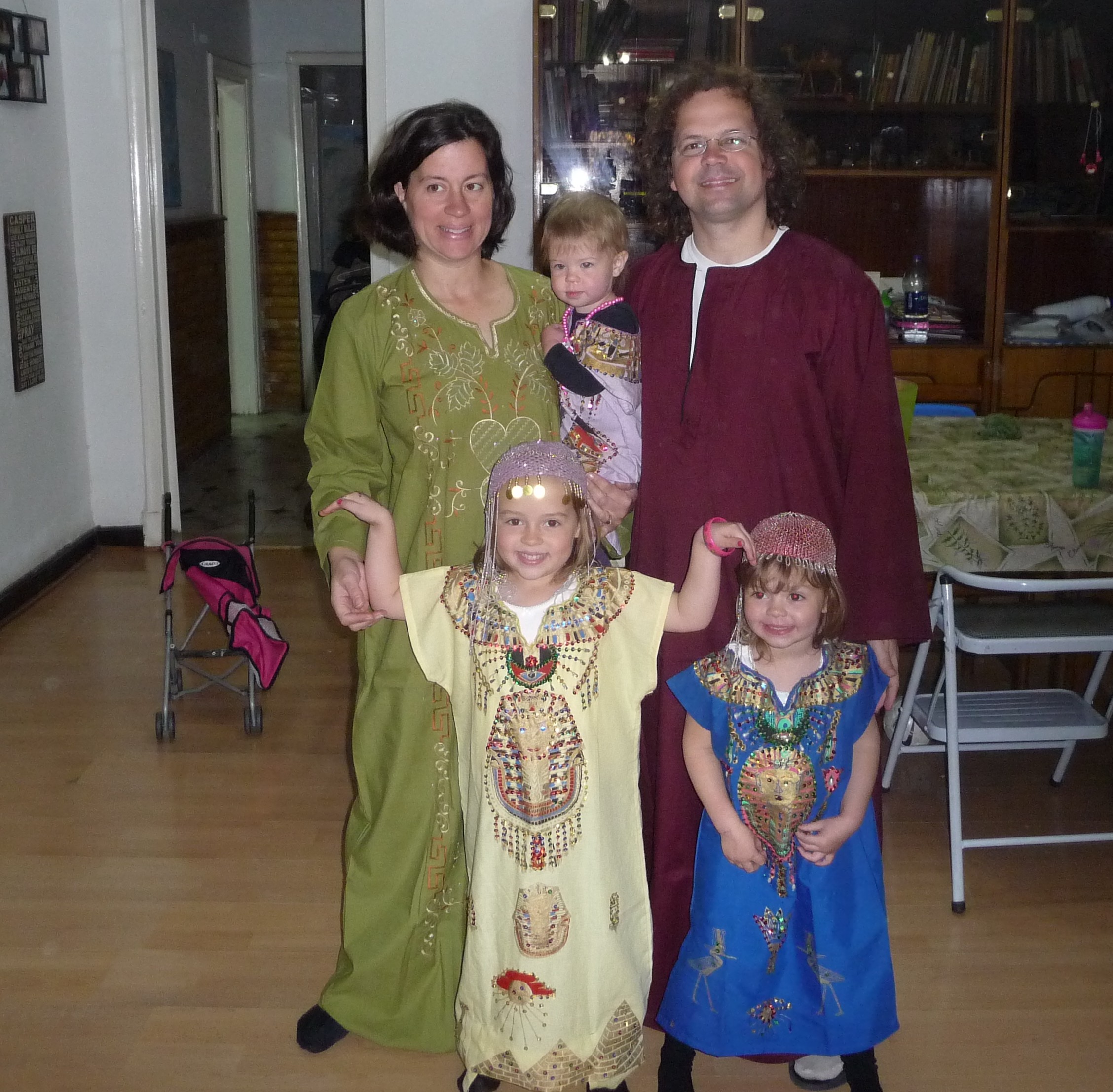
However, the young girls on the boat, as well as the older girls in our group, were very excited about this party and asked Emma and Hannah if they planned to attend.  Not only did this mean staying up quite late, but also buying a gallabeya!  Following the lead of those in our group, we purchased a gallabeya for Emma and Hannah at one of the shops during our stop in Kom Ombo.  We later purchased some more on the boat and then some fancy head-ware at the market in Aswan.  Although it wasn’t in time for the party, by the end of the trip, our whole family was properly outfitted.

At dinner, just an hour before the party, Hannah was too tired to eat and decided to go to bed rather than attend the party.  This meant only Emma had a chance to participate, and she had a great time with her friends.

Dressed up for the Party
Dressed Up at Home - Adults have more Inhibitions

We had a wonderful trip and saw amazing sites in the south of Egypt, but probably the highlight of the trip for our entire family was the living people of Egypt, rather than its ancient monuments. You can see pictures of the temples anywhere, but how else could you get memories like these?

Our Touring Party

(Too bad the normally punctual Americans were late for this group shot. Oh well.)

Categories
Personal

Living in Fear

Looting during the revolution

“I haven’t gone out in over a year.”

This was one of the statements my friend said to me the other day in talking about the changes in Egypt recently, particularly the lack of safety.

“I used to go out with my sister-in-law.  I would leave the kids at my mother-in-law’s house, and my sister and I would go downtown and walk around, do some shopping, all of this after 11pm.  We would come back around 1 or 2 in the morning.  Now I won’t even walk around Maadi at night, we are in our own house by 11:00.”

So many of my recent conversations with my Egyptian friends have either revolved around, or at the least, mentioned the lack of safety and the growing fear in everyday life.

Prior to the January 25, 2011 Revolution, the lack of crime in this huge city of Cairo was amazing.  I don’t know the statistics, but people didn’t generally worry about purse-snatching, carjackings, kidnappings, robberies or violent crime.  One of the reasons was the iron-fist of the previous regime, complete with a strong secret police system and the extreme power, and sometime corruption, of the regular police.

In truth, people were afraid of the police, and yet the average law-abiding citizen had nothing to worry about.  In this way, their everyday life was safe.  They could leave their cars running while they grabbed something from a kiosk, or send their children down the street for bread.  They could go out late at night, as Egyptians are known for doing in this city that never sleeps, and walk along the Nile River, without a thought for personal safety.  All this has changed for those I’ve talked with.

“Be very careful of anyone you see on motorcycles.  Two guys on a motorcycle stole my friend’s bag from inside her car while she was sitting behind the wheel!  Another friend’s car was stolen right in front of her apartment.”

Another friend of mine cautioned me as she related these stories of people she knew.  Friends from her old neighborhood or colleagues at work, who live in our Maadi neighborhood, let their guard down for a moment, or perhaps, never had their guard “up” quite enough, and lost a bag and a car.

“Keep your eye on your children.  Don’t let them play outside without you.  People are being kidnapped now for ransom.  It is happening to Egyptians, but they may see you and think you have a lot of money.  Hold onto those kids.”

The same friend who hasn’t gone out for a year told me how when she goes out, she no longer carries a purse.  Rather, she will put some money in her pocket, and only enough for what she needs to buy.

I then shared with her how my wallet was stolen just the other day.  We went to the local Coptic Orthodox church for the worship service, and I was across the street at the church’s coffee area.  I had just been sitting with some Egyptian friends and I went to pick up my daughter from her Sunday School class.  I had my bag on my shoulder with Layla in that same arm.

As is common, my bag was too full to zip, since it contained cups for all three girls, plus a water bottle for myself, diapers and wipes, maybe some library books and random other things, and so my wallet was in the bag, laying on top, exposed to the world.  I had to push through people to get to Hannah’s classroom, and then again, push through people to get out the door as her classroom is located in the same place as the cash register and food service counter.

Less crowded than other times, this is church coffee area, with the door to the classroom bottle-necking in the background. Daughter Layla is at the table.

As I was going through the doorway to get to the outside seating area, I felt someone run into me, perhaps a lightening of my bag and I turned to look.  A woman with a child in her arms apologized briefly, and I nodded, understanding how babes in arms often touch people who are close to them, much to a mother’s chagrin.  But something in me made me pause, and after taking a few more steps, I released Hannah’s hand and swung my bag to the front of me so I could check it.

No wallet.

I dug a little deeper to see if it was still in there, but it wasn’t.  I quickly went back to the table I had been at to make sure I hadn’t left it there.  Nope.  I looked around at the tables where people were talking, drinking their coffee, eating their falafel sandwiches.  No one was paying attention to me.  What did that woman look like?  Where did she go?  Could she really have taken my wallet right there, surrounded by church folk, inside the church property?

I cautiously approached a table where I thought she may have gone, but I was trying to figure out how I could ask the people sitting there if they had stolen my wallet?  How do you ask someone if they have seen the wallet that was just in your own bag?  How accusatory is that?  I looked around in vain.

Later, friends informed the staff at the shop who told them this was the third wallet that was stolen in the last month or so. I was kicking myself for putting it right on top with the bag open.  I couldn’t do much about being distracted by my children, one on a hip, the other in hand, but I could have been more careful.  If someone had to unzip my bag to get to my wallet, I probably would have noticed that quicker.  Oh well, add me to the statistics.

My friend, who attends the same church, was sorry to hear the story, and especially that it happened at church.  But she said the priests are often telling people to watch their bags.  Wallets and purses have even been taken from inside the church during mass.  The church is open to all, you can’t implicitly trust all who come in.  I told her that I used to leave my whole bag (minus the money) on a table at the coffee shop to save a spot while I dropped my kids off.  We both agreed that wasn’t a good idea!

“Praise the Lord it was just your stuff, and not your children.  Hold onto them!”  And that is the truth.

Another friend has often told me how scared she is these days, especially as a Christian.  The first time I saw her after the Maspero incident in October, where about 27 Christians died during a peaceful protest, she was visibly nervous.  State TV had turned people against Christians during that night and it left some of the Christians feeling vulnerable.

“I watch the news constantly because I want to know what is going on.  But I am more scared each time I watch it.  I don’t know what is going to happen in Egypt.  But what can I do?  I can’t go anywhere.  I don’t have the means for it.  We can only hope and pray.”

Egyptians are scared, at least the ones I talk to.  Whether they are Christian or Muslim, they have fears now that they didn’t have before.  Some are tired of the protests and just wish things would be stable again, but mostly, they want to be able to live without fear, as they lived before.  They can see the problems with the old regime, and most I’ve talked to are glad that Mubarak is out of power.  However, their personal lives are worse than before because they feel no safety on the streets.

Personally we don’t feel afraid.  We feel our house is secure, and we are careful as we move about, aside from the wallet incident!  We hold onto our kids and take precautions with our money.  We call each other when we are heading home and as a woman, I don’t go out alone in the dark.

I feel for our friends, though, who feel safety has been taken from them.  I don’t know how long it will take before that is restored.  It’s not a quick process, and in the meantime, it makes life uncomfortable.

Categories
Personal

Revolutionary Valentine’s Day Humor

A small collection of jokes in Egypt celebrating February 14 (I find the last one the most humorous):

  • Our romantic date was spent protesting
  • I love you as much as the Muslim Brotherhood loves parliament
  • I would catch a tear gas canister for you
  • He finally said the three words I have been waiting for: Yusqut Hukm al-‘Askar (Down with Military Rule)


Collected from Paul Attallah, who sends out a daily collection of links to Egypt news articles. Contact me if you would like to be added to his list. Some of his digital artwork can be found here.


While we’re on the subject, here is my favorite pre-revolution Mubarak joke:

During an international summit between George Bush, Vladimir Putin, and Hosni Mubarak, God appeared and announced the end of the world in two days. He instructed the leaders to return to their countries and warn the people.

George Bush announced, ‘I have met God and have good news and bad news. The good news is our religion is true. The bad news is the world will end in two days. Prepare to meet your maker.’

Vladimir Putin announced, ‘I have met God and have bad news. First, our atheism is false. Second, the world will end in two days. Everyone go get drunk.’

Hosni Mubarak announced, ‘I have met God and have good news. First, our religion is true. Second, I will be your president until the end of time. Everything is fine.’

Categories
Personal

Walls All Around

The disturbances in and around Tahrir Square in recent weeks have resulted in the erection of several walls cutting across downtown streets. These were built at the time to separate demonstrators from security forces as they battled in the streets. Additionally, some were built to provide additional protection from sensitive government facilities, especially the Ministry of the Interior, which runs the police. Some of these walls – namely near the Parliament building – are barbed wire allowing for foot traffic to flow while preventing mass demonstrations. The majority, however, are massive cement blocks which make Cairo begin to resemble an apocalyptic scene.

Julie’s parents have been visiting us, and the other day I accompanied them downtown to the Egyptian Museum, in the heart of Tahrir Square. I took advantage of the time to check out the scene. Many areas are too sensitive to photograph, but in and around the places of confrontation there were dozens of cameras – mainly for demonstrators seeking documentation – so I was more comfortable.

Fortunately I made my tour during a comparative lull in the conflict, but not without a reminder of how terrible tear gas is.

The most recent clashes occurred when angry protestors gathered near the Ministry of the Interior following the deaths of near eighty soccer fans in Port Said. While this may have been the result of hooliganism gone amuck, many people feel the tensions were deliberately stoked and facilitated by the security forces. The hardcore soccer fans then took to the streets, joined by other hardcore protestors who believe the police – the target of widespread anger in the January revolution – still reflects and works on behalf of the former regime.

In these street battles there is often little fighting. Usually a handful of protestors advances to the front lines, and will often throw rocks or Molotov cocktails. The police respond with tear gas, and there is a no man’s land in between the two sides. In addition, the police stand accused of using shotguns which fire pellets that scatter, resulting in small, but multiple wounds on a body. At times these have been fatal, or caused protestors to lose their eyes.

These clashes appear to have been different, though it is hard to verify. With all the walls downtown the Ministry of the Interior is effectively sealed off. Police could simply remain behind the walls, but some reports claim they have driven around the streets in their vehicles chasing after protestors. Whether or not this is true, other reports suggest the police have been the ones under pressure. One of the stone barriers has been destroyed as demonstrators filled the streets en masse. It also appears some demonstrators have fired similar shotgun pellets at police, resulting in many injuries. Whoever the aggressor is, to date around fifteen people have died in clashes over the past few days.

This picture is of a historic French research center housing many old documents. It was the scene of earlier clashes, in which an errant (or intentional) Molotov cocktail landed inside and destroyed the building with much of its content. Following the street to the right will lead to the largest Protestant Church in the Middle East, which has doubled in function as a field hospital during clashes over the past few months.

The next picture shows the street – Mohamed Mahmoud – which was also a scene of earlier clashes, described here and here. Not much was happening but many were gathered, and I wandered down to get a feel for the atmosphere. About halfway in the crowd turned and ran in my direction, but many at my level were calm and stationary. I turned to walk out with them, and soon knew why. The police had launched another round of tear gas.

I neither heard nor saw anything, but on the way out it became more and more difficult to breathe. My eyes watered and I was grateful to soon be back out in the open air of Tahrir Square. I stayed put for a little while just watching from a distance, but again, little was happening. The tear gas was meant simply to drive people back, keeping the sanctity of no man’s land.

I walked around town a bit to see where other clashes had taken place, as well as the barriers erected here and there. Near the Parliament I passed by about two hundred women who were leading a march to deliver demands to their representatives. They shouted against the military regime, and were viewed by many curious onlookers. Earlier in the day there was news of a larger ‘mother’s march’ which went to the site of the clashes to demand their sons stop being killed. This group, though, was much younger in appearance.

I kept moving and after taking several city blocks to maneuver around the barricades wound up on the other side of the clashes. The police line by this point was very calm, with many pedestrians milling about. This was the site of a great battle the night before, and many shops were damaged and the pavement scarred. All felt well, but it did not seem like the place for pictures.

Continuing the circuit, I wound up parallel to Mohamed Mahmoud looking in at the action from side streets. At the entrance were large crowds, appearing to regulate traffic in and out. It was not quite a human wall, but there were several arguments between people about joining the demonstrations or accusing them of ‘burning Egypt’. After several minutes of just watching, I meant to move through, but one of the group whistled and told me to come back. It was an easy decision to comply.

The next side street down had a similar scene. Again I waited within the crowd to get a sense of the situation. After a while I moved again to go to the main street and this time just sauntered by. It was eerie, as the street was deserted save for the handful of people moving either direction. Once I got back to Mohamed Mahmoud, though, I was back among the demonstrators and the several onlookers, as well as the multiple cameras, and all was well.

There was no conflict, except a philosophical one among those present. Several people rallied in the middle of the street and shouted, ‘To the Square, to the Square, he who goes is not a coward.’ Others adjusted their chant against the military council, shouting against this effort, ‘Down, down with the (Muslim) Brothers.’

There was nothing distinguishing about the effort to lead people away from the areas of conflict, but in the news were the efforts of different parliamentarians, among them the Muslim Brothers, who tried to mediate to end the clashes. The Muslim Brotherhood has positioned itself as the party of stability in the past several months. While this has played well among the electorate at large, it has infuriated the protestors who feel the Brotherhood is betraying the revolution now that they have won their legislative majority. Whether or not this effort was Brotherhood, it brought the anger of several. Most did not leave, even as the group clasped arms across the street and tried to sweep everyone away as they left.

Shortly after this I noticed a large contingent of Azhar sheikhs milling among the people as well. The Azhar has scholars of different persuasions, but is generally understood to be non-Brotherhood though socially conservative. Whoever these sheikhs represented, they were seeking a similar result, urging people to go back to the square.

Azhar Sheikh Holding a Megaphone

At one point a sheikh mounted a wall with a megaphone, but was drowned out by protestors shouting against him. His non-sheikh colleague took the megaphone and tried to gain an audience, beginning with ‘Down, down with military government.’ At this everyone cheered, and at least listened somewhat as they tried to argue the merits of protesting in Tahrir rather than in the streets leading to the Ministry of the Interior. They convinced no one, and after a bit the soccer fan among the protestors grouped together and raised their own cheers, dancing around and waiving their hands. All the while the police looked on from their line right even with the wall on which the Azhar sheikh stood.

By now several hours had passed and I started back to the museum to receive my in-laws. The following pictures show scenes from the center of conflict back out toward Tahrir Square.

A Wall Demolished by Protestors, between Tahrir and the Site of Clashes
The Size of a Single Boulder in the Wall
A Wall on a Side Street from Mohamed Mahmoud; Translation: Down with the Field Marshal, Down with Military Rule

At the end, I offered in-laws a chance to see the action and smell the lingering tear gas. All was calm, and they agreed, coming to the entrance to Mohamed Mahmoud before we found the nearest metro to return home. The following picture shows them in front of a sign accusing the military council figures of being oppressors, condemning them through a quote from the Qur’an.

Translation: And those who have wronged are going to know to what kind of return they will be returned.

There is a much different feel about the protests compared to that experienced last January. While the initial revolution was met with violence, there was a sense of hope and purpose, buttressed by the sheer number of people and the diversity of their backgrounds.

This time there is much revolutionary fatigue, and the revolutionaries are largely on their own. The anniversary of the 25th brought the masses, renewing their vitality, and every bloody incident serves to rally more troops. But for the most part those there now are troublemakers, curious onlookers, hardcore activists, street children, or some combination of the sort. Without commenting on the rightness or wrongness of their continuing struggle against military rule, the hope of earlier days has been replaced by the reality of death and struggle.

The following picture is a beautiful graffiti rendering of a few recent ‘martyrs’ who have perished on this street. Yet above them is written a curious phrase, seen elsewhere on city walls. It translates, ‘Peaceful is completely dead.’  In another place it continued, ‘Now we will take our rights by our own hands.’

In January every time the protestors were met with violence on the part of the police they called out ‘Peaceful, peaceful’. Now, though many still cling to this commitment, others have been induced to let it go. They feel that since Mubarak stepped down they have been increasingly killed during their protests, and must now change tactics. By no means is the situation as in Syria, where armed groups have formed among military defections, but this is a strong indication of the loss of hopeful idealism.

The latest change in tactics serves to take advantage of the final anniversary from the earlier revolution. Last year on February 11 Mubarak stepped down from power as the people celebrated. This year, a broad revolutionary alliance is calling for nationwide civil disobedience and a general labor strike, in addition to a boycott of all consumer products manufactured by the military.

It is unclear how much support this initiative has. The Muslim Brotherhood has condemned it, while several university student groups have indicated their participation. It is not a turn toward violence, but rather an effort to find another avenue toward hope (or chaos) – forcing the military to surrender power to civilians. The demand is that power be given to the Parliament with presidential elections to follow at the earliest moment possible.

The military council is currently weighing its options, and a prominent general has promised ‘good news’ will shortly be issued. What this entails is anyone’s guess.

So is the next phase in the Egyptian revolution.

Categories
Personal

Instability in Upper Egypt, Experienced

Ever since the revolution Egypt has suffered / benefited from waves of popular protest. The expressions in Tahrir Square were largely political, yet included a significant expression of social and economic discontent. The original chant which rang through the streets demanded, ‘Bread, Freedom, and Social Justice.’

Most focus since the revolution has been on political matters, and these have yet only partially been achieved. The achievement is significant, as Egypt now has a parliament freely elected by its people. Yet the primary lesson learned by the population is that if you have a grievance, fill the streets.

‘One Hand’ on the Railroad

A few weeks ago I was assisting American documentary filmmakers obtain an interview with a Coptic priest and a Salafi sheikh, the latter of which was running for parliament with the former’s support. The couple is producing a film entitled ‘One Hand’, which focuses on youthful and unique expressions of national unity. They had other business in Asyut, and I was to meet them with the priest in Maghagha.

My train arrived as usual from Cairo, but coming from Asyut was another story. With the priest I waited at the station, and waited, and waited. Finally we learned that nearby villagers decided to escalate their protest against the local government for failing to deliver the normal supply of gas bottles needed for cooking. The shortage prompted a huge increase in price on the black market, so they decided to block the railroad tracks.

At this news we knew it could be hours, though probably not days, until the track was opened again. The priest and I drove an hour south to collect them on the side of the tracks. For whatever reason, the task was complicated by the fact there was very poor cell phone coverage, but we managed to speak with their neighbor who assisted them in their disembarkation. The filmmakers spoke very little Arabic.

Eventually they made it over to us, surrounded by a group of young men who were offering to ‘help’. They may or may not have been, but once we got them in the car one of them asked where we were from. Oddly, I felt a bit unnerved out of concern for the (young) couple, answered ‘America’ with a smile, and received a reply suggesting his ‘help’ may have been variable. ‘F*** America,’ he said, ‘We hate America.’

‘I know,’ I replied smiling still. We got in the car quickly and drove away, with both exhaustion and a sigh of relief. The long delay made little impact on their work, as the sheikh was not free until near midnight to begin a very friendly and welcoming interview.

Lock the Lock

The next two examples come from a Nile cruise on the occasion of Julie’s parents visit to Egypt. We boarded the sleeper car from Cairo and unloaded in Luxor, very pleased there was no railway protest to extend the journey.

Yet after the first few local sightseeing locations we noticed something strange. We got on a bus and drove over an hour away to board our cruise and spend the night. The next day we repeated the same ritual, only delayed an additional two hours. There are many ancient Pharaonic sites to see in Luxor, and both the delay and the absurd driving distance played havoc with our scheduled itinerary.

Mother and Daughter Exhausted from Extra Travel

The normal agenda is to get off the train, see the sites, and then board the boat right there in Luxor, stopping at all the tombs and temples along the way.

Unfortunately, we learned the workers at the canal lock in Isna were on protest, refusing to let any boats past. They began their sit-in on the 25th of January, to commemorate the revolution.

This left the boats in Luxor stranded, but fortunately our boat was trapped on the other side. This explains the hour plus bus ride after we finished sightseeing. We had to drive south to Isna in order to spend the night in our cabin, and then return the next day for Luxor sites, day two.

Only the next morning we encountered another post-revolutionary difficulty. The nation as a whole, but Upper Egypt especially, has suffered periodic gasoline shortages. The bus, we learned, was desperately searching for an open tap.

After several hours delay, a different bus met us at the dock and filled up from the boat’s supply of gasoline. I’m not sure there weren’t other shenanigans we weren’t being told, but we did see long lines of vehicles at the gas stations we passed on our way back to Luxor. I’m also not sure who’s bottom line must accommodate the extra costs of bus and gasoline – travel agent, cruise, tour guide – but the blow to tourism is substantial.

Other tours which knew of the lock strike at Isna cancelled their trips altogether.

A Free Pass at Edfu

The Massive Temple at Edfu

Later on in our tour we had a pleasant outcome from local instability. Our boat docked in Edfu, but the captain told everyone the tourism workers at the temple were all on strike. The rumor circulated but before it had time to settle in the guide rounded everyone up and we went ashore. From there, we rode horse drawn carriages to the site of the temple.

What we didn’t realize until later is that our carriages stopped at the back side of the temple. We passed along an open area along the wall of the massive complex, circled to the temple gate, and moved through en masse.

At the entrance of nearly every tourist location there is a small area to mill about where the grandeur is open to all onlookers. Then there is a welcome center where a ticket is purchased and then a souvenir section where tourists – foreigners especially – are all but assaulted by desperate sellers.

We skipped all this. By coming in the back we avoided whatever protest prevented entry from the front. At the temple gate some semblance of guard took money from every tour guide, but then allowed the group in without tickets, no questions asked. Ticket prices for Egyptians range from 1-5 LE ($0.18-0.80 US), but foreigners must fork over between 35-80 LE ($6-13 US) depending on location. It is still minimal, but it was a nice surprise – pleasant also, as we avoided the souvenir gauntlet.

Groups Moving Past the Entrance as Tour Guides Give a Little Baksheesh (Tips)

The Big Picture

It is difficult to know what to make of these protests. On the one hand, they are at the least annoying and disruptive, and perhaps even damaging to the local economy. Several people, especially in Cairo, criticize such strikes. They say people should be patient: ‘We waited thirty years to get rid of Mubarak, we should not expect things to get better immediately. In fact, such continuing ‘special interest’ protests are only making things worse.’

Fair enough, but how can this point be enforced when there is a window of opportunity now? Forty percent of Egyptians live on under two dollars a day, wages are low even in the middle class, and few people have benefits of any kind. The revolution has changed political leadership, but not so much at the regional level. Protests have proved effective for many in getting what they want – which could be as basic as a living wage. Who knows but if they wait longer the system will reset itself and local leaders will pay as little concern to their needs as before?

In many ways, the problem is one of trust. President Mubarak allowed the failure of the social contract which ensures domestic stability. Open political participation was minimal, but so was food on the table. As Egyptian institutions eroded from the inside, it will take a long time to rebuild following the revolutionary collapse. Unless such a contract is widely renegotiated, small and localized strikes will – and perhaps reasonably – continue.

Who pays the bill? Is it reasonable for the average working Egyptian to wait until the Muslim Brotherhood, elite liberals, and the armed forces get around to a new economic policy? If so few cared for their needs then, should they trust anyone will care now?

Perhaps they will. The only one of the three to demonstrate practical concern for the poor were the Islamists, who have now been widely elected to parliament. It is fair to ask if Islamist concern is opportunistic or transformative, but many have worked sincerely. Will they follow through? Will they be allowed to? Will the people wait? If so, for how long?

Revolutions are not easy, and the pain can linger even after resolution. Egyptians are among the most patient people on earth; they are now being put further to the test.

Postscript

On the sleeper train ride home I woke at about 2am from a lack of movement. It is difficult to catch shut-eye while the car lurches back and forth, but I was able. After about 45 minutes of standstill, however, I inquired. A baggage handler told me there was a train driver strike over assignments on the newer cars, which also came with a higher compensation.

Our car was newer, and despite my complaints above was much smoother than the older model we semi-suffered on the way south.

The handler assured me things would be settled soon, so I used the calm to get back to sleep. It worked, as I was unaware of another long delay that woke my wife around 4am.

In the morning I asked the porter about the delays. He replied there was just a normal backup of several trains at a particular station. Asking more specifically about a strike, he denied anything of the sort. I think I ran directly into the noble Egyptian quality of saving face.

In the end our scheduled twelve hour trip took sixteen. I don’t know if the drivers got what they wanted, or how it came about we did not spend an additional evening or two in the sleeper car. I just hope Egyptians remain patient as their lives accommodate such disturbances at an increasing frequency.

I suppose if everyone is doing it, it is easier to forgive.

Fortunately, They Slept Through the Night

Final Postscript

Today the media carried the news that a Luxor-Cairo train the day after our travels was attacked by thugs who tried to steal luggage from car number five. The passengers successfully beat them off.

Categories
Personal

Cultural Insights on Marriage and Children

Today I had a nice long visit with a fairly new Egyptian friend. Her name is Suzi and she is the mom of one of Emma’s classmates at school.  This was our third visit together, once at our house and twice at hers.  The kids all have fun playing together – Emma and her school friend, along with my Hannah and Layla, and the friend’s little brother who is the same age as Hannah.  While they played, we mostly chatted about life.  I thought I’d record some of the things I heard today as they provide an interesting insight into culture here.

Marriage Differences

One of the topics we spoke about was marriage.  It is common here for a man to come to a woman’s house to inquire about marrying her.  He may have known of her for a long time, or perhaps a friend mentioned her or he saw her in some spot and asked others about her.  There are a variety of ways that this meeting can come about, but it is still a norm for marriages to be “arranged” this way.  In most cases, it seems that the woman has full rights to say yes or no, but it is often the way a relationship begins.

That’s not to say there aren’t many, many relationships that start because people work together or go to school together or whatever, but this man coming to ask for a woman’s hand, while basically absent from the American culture, is still very present here.  Suzi was asking if it was harder or easier to get married in America and I said that it was harder because of the absence of the arranged marriage.  She seemed somewhat surprised to know that it doesn’t happen in the states.  I couldn’t just wait at my parent’s house for possible suitors to come calling; I had to meet people and take initiative without being too forward.  I told her it was tricky as it is a bit of a game to let someone know of your interest without being aggressive (as the woman). And meeting potential spouses in general can be challenging.  While I appreciate the American dating system as a whole, I thought it might be a bit easier to find a husband in this culture.

That being said, she asked if the man must have a house or apartment already purchased and furnished before proposing to someone.  He sometimes must have a car and enough money for a good amount of gold jewelry as well, that will be shown off at the engagement ceremony.  In this way, I said, things might be easier in America.  Many couples will start off living in an apartment and work together to afford a house after getting married.  Whatever the particular timetable, it is not expected that a man have all the material goods before he can even look to get married.  This is one reason that Egyptian men are getting married later in life as it is getting harder and harder to earn enough money to buy a flat and furnish it before proposing to a future bride.

Suzi’s story itself was quite interesting to me, and perhaps bizarre from the Western perspective.  She is married to her first cousin.  Her mom and his dad are sister and brother.  We talked about this a bit as I told her it is illegal in the states to marry your cousin.  (I guess I don’t really know if it’s illegal, but I think it is.)  I tried to explain that one reason is the possible genetic problems with the offspring, but she said they just trust God for the health of their children.

I have encountered this frequently in this part of the world—the idea of marrying within the same family.  Suzi said it makes sense as you know where the spouse comes from if they are from your family.  It is a risk to marry an outsider.  Her sister also married a cousin, and they have already, somewhat jokingly, arranged for Suzi’s daughter to marry the sister’s son, which is many years down the road considering they are both five now.

Even though Suzi married her cousin, she had never actually seen him until the wedding day!  His family has lived in Cairo his whole life and she grew up about 8 hours south and at one point when they were very young they saw each other, but not another time until the day of the wedding.  They got engaged over the phone and spent the following year planning things, and getting to know one another over the phone, before Suzi came to Cairo to get married to her cousin whom she had seen once in her life!  They have been married 7 years now and seem to be happy with the arrangement.

Children Sleeping

Another topic we covered was children sleeping.  We’ve talked about this each time we were together as Suzi cannot get over the fact that my girls go to bed at 7pm.  In Arabic there is a word specifically for “staying up late,” and Egyptians, in particular, are known for their love of the late night.  Especially in summer when kids are off school and the weather is so hot during the day, the streets will be busier at night with people enjoying a walk downtown or the view of the Nile.  As such we have to miss out on some of these late-night activities if we want to hold to the regular bedtime.

Today Suzi was trying to figure out how she could get her kids to sleep earlier.  As of now, her six-year old daughter sleeps at 2 or 3am, maybe midnight on an early night.  Apparently, she doesn’t struggle with being tired during the day, and is not too difficult to wake in the morning, but Suzi complained that sometimes she, as the mom, would like to go to bed earlier but can’t since her kids won’t.

How the kids fall asleep is another factor.  Suzi couldn’t get over the fact that I put Layla in her crib awake and she would just fall asleep.  She mentioned that they would rock their kids until they fell asleep and then lay them down.  I assured her that even in America, moms do different things with their kids, but I followed others who had success with this method and I really appreciated being able to not take the extra time to put the kids to sleep.

There are some downfalls to this, however, as my babies have always been used to sleeping in a crib. The few times I have wanted them to fall asleep on me or in another bed often didn’t work.  One nice thing about the sleeping habits of babies around here is that they can sleep anywhere!  Sometimes that could come in handy.

Besides the time factor, they have been working on getting the kids to sleep in their room without the parents.  Emma’s friend is scared to sleep without her mom and so Suzi will begin the night in the kids’ room before moving to her own room.  They have begun rewarding the kids for sleeping on their own.  The parents are ready to sleep and stay in their own room and let the kids be in theirs!  I suggested using a similar reward system to slowly move up the bedtime to a more reasonable hour.  I can’t imagine how the kids function going to bed so late, but besides that, I cherish those hours in the evening when the kids are in bed and I am still awake.  Somehow Suzi is cheerful and full of energy even though it seems she doesn’t get much time to herself.

Potty Training

Once we exhausted the sleeping topic, I thought I would ask about her method of potty training since I have heard very different ideas in the Middle East than I have in the states.  I asked her when she began potty training with her children and her answer was when they were about eight months old!  I guess when she noticed them going to the bathroom, she would quickly strip them and put them on a small child’s potty so they got used to the idea.  At night, of course, they would wear diapers as they had no control over nighttime toilet needs, but during the day, slowly, slowly, they would get used to the idea of using the potty.  It seems it may have been a long process but by the age of 1 ½, the children would be fully potty trained.

I asked why she did it this way, was it because diapers are expensive?  This is one of the reasons I heard in Jordan when I asked a friend who said she begins as soon as the child can walk.  Suzi said this is the way her mom did it except that she would begin as early as five months!  I shared with her that in the states, people may begin the process at 2 for girls, and 3 for boys (as a general figure).  She pointed out that kids will do what they learn and get used to.  This is what I had told her about sleeping: my girls are used to falling asleep on their own and sleeping early.  Her kids got used to using the potty at an earlier age and needed no daytime diapers by age 1 ½.

Two different cultures; two different ways of doing things.  We share so many things in common such as marriage and child rearing, but our methods vary greatly.  Who has it better?  Who does it better?  What can we learn from each other?

Categories
Personal

Church, State, and Revolution in Egypt

His Holiness Pope Shenouda III, Pope of the Co...
Pope Shenouda, head of the Coptic Orthodox Church

Many Christians in America are keen on emphasizing that the ‘separation of church and state’ is found nowhere in the constitution. Rather, they state, it was from the personal letters of Thomas Jefferson – his guiding opinion, of course, but never adopted in America’s founding documents.

This is true. The constitution guarantees freedom of religion for the individual, while also keeping government from imposing a religious test for any public office. Many Christians, however, find that the modern interpretation of these clauses – read through Jefferson – squeeze religion from public life.

They don’t know how good they have it.

Coptic Christians in Egypt are currently caught between two relatively good systems. The modern secular state, as in America, allows personal freedoms and independence of religious institutions. This was somewhat the promise of Mubarak, but never really arrived. Especially in light of the Arab Spring, many Copts look to the west and hope for the implementation of such enlightened policy.

Yet on the other hand, also driven by the Arab Spring, is the understanding that Islam-as-state protects a subservient church. This also is enlightened, and for many centuries Christians lived comfortably under the caliphate, participating in society, economy, and government. There were abuses in history, and it is not the equivalent of modern citizenship. Yet many Copts are fearful of such a return, while Islamist groups like the Muslim Brotherhood and the Salafis are head-over-heels trying to assure them their fears are baseless.

Unfortunately, Mubarak muddled between the two.

While the church was officially independent, it was not free. Relations between the president and the pope were conducted along the lines of the old caliphal system. No jizia was paid, but in exchange for guaranteeing the subservience of the Christian community, the pope received a direct line to the leader and relative freedom of internal rule. If Christians got out of line, though, or if it was necessary to hold them in line, a measure of sectarian strife was allowed. Some say it was even encouraged, if not promoted.

A few days ago I posted about a controversy in the church, which erupted during Christmas celebrations. With the massacre at Maspero in the background, Pope Shenouda welcomed the military council, as well as the Muslim Brotherhood. The church has regularly welcomed representatives of the state, which in the past have been members of Mubarak’s National Democratic Party.

This year, it is members of the military council, and of the triumphant Islamist powers. Though the faces have changed, the pope was following a protocol long established.

Revolutions, however, disrupt protocol. Many young Copts invested themselves heavily in the revolution, seeking greater freedom for society at large. Instead, at Christmas, they find the pope continuing the same pattern. The military, they believe, killed demonstrating Copts at Maspero, and no one has been held accountable. The Muslim Brotherhood is an open question; will they simply continue politics-as-usual, with a democratic face?

If these young Copts desire freedom throughout the society, they desire it on the part of the church as well. It was humiliating, or else cowardly and insulting, to see the pope receive those who shed Coptic blood, as well as Islamists who seem very comfortable with the military.

They want the pope to be revolutionary. They want him to refuse greetings until justice is met. To a large degree, they want a western version of freedom of religion.

They are not alone. Many Egyptians desire this, including many Muslims. The question is: Is it best for the church?

The pope is a man of tradition, and old men are set in their ways. He is also a fountain of wisdom, and he knows his society. He believes the church is safest under the protection of the state.

Is he wrong? Maybe. Jesus was a revolutionary, though of a different kind. But he was willing to sacrifice himself for what was right. If the church challenges the state – currently constituted as the military council – it might rally both Christians and Muslims to continue the revolution until military rule is abolished. Then, with governance in the hands of civilians, even an Islamist parliament would be free to … well, what would it do?

Or, if the church challenged the state, the state might hit back. Would Muslims rally behind it? If so, would they be strong enough? Or would this only push them deeper into Islamism, seeing Coptic comeuppance, ‘those ungrateful Christians’?

One might pragmatically say the church should stay by the side of the military against the Islamists, as under Mubarak. Activists, and most Copts, would now say that Mubarak did not work out so well for them. They were certainly very critical of him before the revolution. But will Islamists be worse?

Pope Shenouda is probably not making bets for one side or the other. In all likelihood, he is simply following protocol. He is not promoting the military council or the Muslim Brotherhood. He is acknowledging their place in the governance of Egypt.

History is riddled with examples of minorities who backed the wrong side. If Pope Shenouda is licking the boots of the powers-that-be, this is beneath the dignity of his position – indeed of any Christian, or of any individual human being. But if he were to thumb his nose, this also is a threat to dignity, and more.

Perhaps unfortunately, revolutions demand one choose a side. This puts Christians in a very difficult position. On the one hand, their religion encourages them to sacrifice themselves for others, for truth, and for the cause of justice. On the other, it encourages fealty to the ruling powers, with prayers offered on their behalf. How, then, should a first loyalty to God drive a Christian in Egypt today? How should it drive the pope?

Perhaps Pope Shenouda leans a bit too much in deference to the state. This is certainly the activists’ charge. Yet it must also be noted this criticism is leveled from the perspective of a western system of religious freedom, or at least from the longing thereof.

It may well be Egypt is moving back to an official caliphal system, where the pope represents his community. Or perhaps the mixed-Mubarak system will stay in place. The future could be very bad, or it might not be bad at all. Activists must continue to labor for what they believe in, and convince others of the same. The pope must be given room to do the same. Indeed, his conduct now may be guaranteeing activists their relative freedom of operation.

Americans, imagining themselves in the middle of all of it, might wish for a little more Jefferson.


Categories
Personal

St. John the Short

The Relics of St. John the Short

The Coptic Orthodox Church is filled with the stories of saints, so much that the production of their movies has become a cottage industry. They are not always the best acted or of the highest Hollywood production value, but they open a window into the worldview of Egyptian Christians.

I first heard of St. John the Short when I visited the Monastery of St. Makarious, located in the Wadi Natrun Desert between Cairo and Alexandria. It is there I saw his relics; the monastery also houses those of John the Baptist, Elisha, and the Three Makarii, after one of whom the monastery is named.

The Relics of John the Baptist and Elisha the Prophet
The Sign above the Previous Photo
Relics of the Three Makarii

St. John the Short’s relics came to settle here as it was his abode for most of his monastic life, indeed, his life entire. John left Bahnasa near Minya in Upper Egypt at the age of 18. He was raised by Christian, God-fearing parents, though his mother was distraught he fully followed his spiritual commitment into monasticism. His father was more accepting, as was his older brother who bore family responsibilities preventing his own monastic choice until after his parents passed away.

John’s path to monasticism led him to a company of hermits who abused him incessantly in tests to decipher his commitment. In general a monk is by nature an individualistic solitary; the film presents them with few social skills. Yet for the most part it was a ruse, and John proved faithful. Eventually an angel appeared to the abbot and commanded him to accept John into their band.

Even so, the testing continued, leading to the event for which John is best known. The abbot instructed John to find deadwood in the desert, plant it, and then water it every day from a river twelve miles away. Faithfully, John did so, as obedience is a mark of Christian character. The abbot was astonished, for John kept at his work, never complaining a word.

This was only the beginning of the astonishment. After a long duration (stated in Coptic records as three years), the deadwood sprouted leaves, produced fruit, and became a full-grown plant. In popular Coptic lore it is known as the Tree of Obedience.

The Tree of Obedience, in Wadi Natrun

Years later John would give example to the fact that however monks desired independence and were often caustic with each other, beneath it all was a foundation of love. The abbot who abused John for so many years grew to love him like a son, and John cared for him in his debilitating illness over twelve years.

John’s miracles were many. The film displays him driving out a demon from a woman who aimed to kill him. He gave sight to the child of a woman to whom he was led from charity to give bread. He healed the stuttering of a man for whom he also cured his withered hand.

Yet despite his miracles he cared most for the cure of souls. A wealthy woman in the nearby village discovered the joy of the Lord when she gave away her possessions to the poor. Yet upon their exhaustion, none cared for her in return, and she slipped gradually into a life of ill repute. John went to her and rebuked her, but with the love of one who cried over a broken masterpiece.

The woman repented and followed John through the desert to take residence in a nunnery. John pushed her, urging her on as penance for her descent into sin. When she could go no further John allowed the opportunity for both to sleep, yet awoke in the morning to find her dead. He wept at his error, cursing himself that he allowed her to die before her sins could be expunged. Yet an angel appeared to him to lift his sorrow. God had forgiven her sins at the moment of repentance, and had now accepted her into paradise.

Eventually John moved from Wadi Natrun to the present day area of Suez. The film does not give the reason, but Coptic records state it was in response to Bedouin raids on area monasteries. Yet in Suez he faced another danger; the Roman prelate Clopas demanded to see who was giving comfort to the tortured village Christians.

He did not have opportunity to torture John himself. God struck Clopas with a painful disease, semi-comically labeled in the film as ‘chicken pox’. It drove him blind and gave him unbearable shivers. A palace servant instructed Clopas to beg healing from John, as he had healed others. When all other options failed, he humbled himself to do so.

In what struck me as odd, John refused. He sent message to Clopas he would not come unless he renounced his gods and worshipped Jesus, the Son of God. Encouraged to come, John heard his confession, and restored Clopas to full health.

John came to Suez in 395 AD, and died in his nearby isolated cave in 409 AD. An angel visited him the day of his death to declare his acceptance before God, that he had finished the course. Coptic records state he led the majority of Suez’s inhabitants to Christianity.

In an earlier post I wrote about Coptic miracle stories and the pervasive acceptance of these throughout the community. I also wrote once about the value of monasticism, though I don’t wish to rehash either of these reflections here.

Perhaps the only remark is the didactic simplicity of these films, seeking to bring the life of the saints into greater focus for the modern world. The cheesiness factor relates mostly to them being dated, but didactic films are often not that entertaining anyway.

Pope Shenouda opens each of these films with footage from one of his weekly meetings forbidding the improper copying and distribution of these films. He states that those who made them have a right to their intellectual property. In Hollywood, the FBI issues such a warning, threatening imprisonment or fine. In Egypt, it is the head of the church, threatening nothing in particular, but you know where this can go…

I mostly jest. I do enjoy the films, though their re-watch-ability is nil. But as I opened, they are a wonderful window into popular Coptic spirituality. The question is if I profit spiritually myself, or only as a sociological student. The former is far better, and St. John the Short offers lessons, to be sure.

Yet I am far too Western to give too much credence to the details of the story. Perhaps here there is a spiritual lesson to come, when I receive my comeuppance.

There is another question: Tonight, should we watch the more modern tales of Sister Irini, or Pope Kyrillos? Any suggestions?

Related Articles

Categories
Personal

The History of Salafism in Egypt

The title of this post requires far more than this excerpt, but Project Syndicate gives a very useful article on Egyptian Salafism:

Al-Nour is one of two Egyptian Salafi groups that were organized and centralized decades ago, the other being the relatively apolitical Ansar al-Sunnah (Supporters of the Sunnah). The roots of the organization go back to 1977, when the Muslim Brothers dominated the Islamic Group at Alexandria University. In reaction, students with Salafi convictions, mainly studying in the faculty of medicine, formed the “Salafi School,” arguing against the Muslim Brotherhood’s ideology and domination of Islamist activism.

By mid-1985, the Salafi School was calling itself the “Salafi Call Society.” It had its own educational institution, the al-Furqan Institute, a magazine entitled Sawt al-Da‘wa (the Voice of the Call), and a complex social-services network. The Zakat Committee (Islamic tithe) was in charge of funding and administering orphanages, support of widows, relief work, and free health clinics and other community facilities.

To manage its operations in Alexandria and elsewhere, the SCS leadership established an executive committee, a governorates committee, a youth committee, a social committee, and a general assembly. All of this was accomplished under the hazardous conditions of Mubarak’s rule, which banned the movement’s leaders from leaving Alexandria without travel permits from the State Security Investigations Service. The regime regularly closed their institute, banned their publications, and arrested their leaders.

This oppression perhaps explains the SCS leadership’s initial reaction to last January’s revolution. “They would have bombed us from the air if they saw our beards in Tahrir!” said one of the SCS leaders. Indeed, the SCS leadership did not officially back the revolution until the final days before Mubarak’s fall, although their mid-ranks and grassroots activists did join the protests. This includes Emad Abdel Ghafour, the head of al-Nour Party.

The article goes on to describe possibilities following elections, including whether or not the Salafis will align or collide with the Muslim Brotherhood. It is an informative discussion; read the rest here.

I hope to continue to study this topic, not in the least because it is easy to label Salafis as ‘ultra-conservative’, and have already become a prop in the propaganda of ‘support us (the old regime/Muslim Brotherhood/military council) or face the Salafis’. They may well be ultraconservative, they may well be a worse political outcome than any of the above. At this point, however, I can state that among those I have spoken with, they are all nice people. Nice does not mean politically capable or desirable, but it is more than they are often given credit for.

In the days to come I hope to share some of my findings.

Related Posts:

Thoughts on Belonging and the Salafi Label

Categories
Personal

Christians in the Sinai

The Sinai Region

Bishop Cosman is the presiding bishop of the Coptic Orthodox Church in the diocese of North Sinai, consisting of an area 200km long and 127km deep. This roughly stretches from Port Said to Suez along the west (though these cities do not belong his bishopric).

Bishop Cosman states that the population of his bishopric is roughly 400,000-500,000 people, of whom about 3,000 are Christians, represented by 740 families. By contrast, over 2,000 Christian families live in the urban Cairo district of Hadayak al-Maadi. The bishop relates that the low population density makes for a quiet life, and that Christians have good relations, by and large, with their neighbors.

There are two principle cities in North Sinai, Rafah and Arish, each of which has been in the news recently with regularity. Rafah is the site of the crossing into Gaza, which was reopened following the reconciliation of rival Palestinian factions Fatah and Hamas. As the reconciliation has sputtered, however, so has the crossing of goods through the border, as many restrictions remain. Illegal tunnels in the area compensate in black market trade, and near here Gaza Palestinians stand accused of crossing the border to infiltrate through Sinai to Eliat, where several Israelis were murdered in a terrorist attack.

Arish, meanwhile, has been the site of internal Egyptian unrest. On Jan. 29 following a massive, peaceful Muslim Brotherhood and Salafi demonstration in Tahrir Square and elsewhere, including Arish, masked gunmen attacked the city police station in a shootout lasting several hours. Flyers were distributed calling for an Islamic emirate in the Sinai, linked to a supposed local al-Qaeda branch. This event that prompted the entry of the Egyptian military, though special agreement had to be secured first with Israel, as much of the area is demilitarized as mandated by the Camp David Accords.

Each of these two cities hosts a Coptic Orthodox Church. Arish is the seat of the bishopric, which was built in 1939 in the neighborhood of Dahya. Rafah, however, hosts the only licensed church, which was built in 1996. This church, however, was destroyed during the lawless initial days of the Egyptian revolution, and has not yet been rebuilt despite promises by the state, according to Bishop Cosman. He states the Christians are waiting patiently to take their rights to pray in Rafah Church. He does not know who committed this crime, as the sixty-plus attackers covered their faces while wielding automatic weapons.

In addition to the two churches the diocese owns three additional ‘service buildings’ that resemble ordinary structures but host regular masses and provide social outlets for the Christian community. Two of these buildings are in Arish itself, with the other in Masa’id, a smaller town roughly 12km to the east. A community of five priests, in addition to Bishop Cosman, serves the Christians of the area.

Only two of these priests, however, stem originally from the diocese of North Sinai. Neither does Bishop Cosman, who hails from Beheira in the Delta region, and was appointed ten years ago from the St. Mina Monastery to the west of Alexandria. That even two priests are local is quite an accomplishment, however, as nearly all of the area Christians originally emigrated from other quarters.

The original inhabitants of the territory of the diocese are native Arishis, some Palestinians, and large Bedouin families which historically roamed the desert. To this number came significant Nile Valley transplants seeking work, beginning in the 19th Century. The Christians of North Sinai belong to this last group, and live mainly in the cities of Arish and Rafah, though some are in the smaller, inland villages of Hassana and Nikhl, and some in temporary worker outposts connected to projects. Like the inhabitants of the area, Christians tend to be poor. They are employed primarily as teachers, employees of government ministries, or in construction.

As stated earlier, Bishop Cosman emphasized the Christians of North Sinai enjoy good relations with all their neighbors, as well as the Bedouins, which is one reason he does not suspect them of involvement in the Rafah church attack. These relations are cemented through mutual visits during holidays and funerals, though the small number of Christians stipulates their reach in the community is not that far.

Yet the real danger in the area comes neither from the Salafis nor the Bedouin, but the lawless and criminal elements hiding in the desert. Even so, the bishop seemed mostly unconcerned. “We trust in God,” was his simple reply.

The region of Sinai is mysterious, beyond the experience of either urban or rural Egyptians. It exists in the nexus of struggle between Egypt and Israel, state and Bedouin, and civilization and tribe. Within this flashpoint is a small community of Christians, mostly imperceptible in each of these conflicts. Yet their faith maintains they are salt and light nonetheless. Further research, including hopeful visits to the area, is necessary to determine if it is true.

Categories
Personal

2011 Blog Statistics Review

The Casper Family

At the end of the calendar year WordPress provides its users with a helpful summary sheet on statistics concerning the blog. Please accept this semi-self-congratulatory post with thanks to everyone who has enjoyed our reflections. It is a pleasure to share our lives and thoughts with you; we hope it has been helpful.

  • The blog received about 22,000 views in 2011 to equal 64 views per day. I’m not sure if that is a lot in the larger scheme of things, but it is nice to see the increase from 34 in 2010 and 19 in our abbreviated 2009 beginning.
  • Most viewers came from the United States, followed by Egypt, and then Australia. Thanks to you all. Topping the list from the other continents were the United Kingdom, Brazil, and Jordan. Unfortunately WordPress did not provide percentages.
  • Outside of Facebook and Twitter, the top referring site to our blog was from Milo Flamingo, who also writes about experiences in Egypt. Please click on her link as an expression of our thanks to her readers. Our Twitter account if you wish to follow is @jnjcasper, and we have started a new Facebook page for the blog, which you can ‘like’ by clicking here.

If you would like to review, or catch some posts you may have missed, these were our five most read articles from 2011:

  • Emma’s Saliib – February 26, 2010. ‘Saliib’ is the Arabic word for ‘cross’. Our daughter Emma, now in kindergarten, was attending preschool at a Coptic Orthodox Church, and drew a cross on her hand like many Egyptian Christians do. This article gets many references from Google Search looking for ‘Coptic cross on hand’ or the like.
  • Rafik Habib: On Sharia, State, and Christianity – April 14, 2011. This article is also fueled by Google, as people search for more information about the son of an Egyptian Protestant pastor who has become the vice president in the Muslim Brotherhood’s Freedom and Justice Party. Many Copts consider the MB a political enemy, and I had the privilege of interviewing him.
  • Egyptian Protests, Day Two – January 26, 2011. If you would like to recap our perspective from the first days of the Egyptian revolution, you can read also thoughts from the 25th and 27th, before the internet was cut and our contact with the world ended. Surely the readership of these articles increased as people checked in out of concern for our wellbeing. For all good wishes and prayers, we thank you.

Just as a possible preview, we may be looking to change the template of the blog, and perhaps remove the ‘wordpress’ part of its address in the days to come. Despite any modifications, we hope to keep sharing what we learn of Egypt, issuing from a sense of belonging that we hope will continue to mark all we write, think, and do. Thanks once more for following along.