Categories
Personal

Remembering the Christmas ‘Martyrs’ of Nag Hamadi

“Don’t cry for me, mother; to a martyr you’ve given birth. Murderers killed your son, on a night of Christmas mirth.”

These lines of poetry were crafted for the fortieth day memorial service held for the six young Egyptian Christians randomly gunned down while exiting a Coptic Christmas Eve mass, January 6, 2010, in Nag Hamadi, three hundred miles south of Cairo. They reflect the worries of the Christian community of Egypt that their situation as citizens, even in terms of safety, is steadily declining.

The particular use of the word ‘martyr’, however, carries a strong implicit message. It is common in Egypt for both Christians and Muslims to use this word for anyone in their community who dies unnaturally, regardless of cause. Beneath this general usage, though, is a Coptic remembrance of the hundreds of martyrs celebrated daily in the liturgy, who suffered death for their Christian faith. The message is given that these young men were killed for their faith in Christ, and this at the hand of a killer alleged to have cried while firing, “I avenge my Muslim sister!”

The vengeance in question refers to an event two months earlier in a nearby village, where a Christian man is alleged to have raped a 12 year old Muslim girl. This is the opinion of Sheikh Ahmad al-Sayih, retired professor of Islamic doctrine and philosophy at Azhar University, who grew up in a village fifteen miles from Nag Hamadi. While he condemns the murder on Islamic grounds, he sees it as part of the culture of revenge killings for which the area is known. In this understanding, shared by many Muslims, the attack was simply an expression of tribal justice, having nothing to do with sectarian strife.

Amin Makram Ebeid, a retired doctor and Coptic intellectual, disagrees. He sees the incident as part of an unorganized but increasing pattern of sectarian violence against the Christians of Egypt. He doubts the account of rape, as well as the status of the girl as a minor. He states that tribal revenge would be executed only against family members, not random worshippers exiting a church on the holiest of Christian holidays. These considerations indicate the sectarian nature of the crime, and in these matters he echoes the opinions of many Copts.

Governor Magdi Ayoub of Qena, in which Nag Hamadi is located, is the only Copt among the twenty-nine governors of Egypt. Instead of being acclaimed by his religious community, however, he is reviled as being subservient to Muslim interests so as to maintain his post. Though he states that he is an Egyptian governor first and a Copt second, many Copts reject him for failing to address Christian concerns in deference to his position in what is seen as an increasingly Islamic state. Viewing religious discrimination as part and parcel of true Islamic religion, more than a few Copts anticipate further violence as a coming inevitability.

A different explanation is offered by Osama al-Ghazoly, a prominent Egyptian journalist. He agrees that violence in Egypt is increasing, but this is true of society in general, independent of sectarian tension, though it is certainly an aspect of it. He criticizes both Muslims who deny that sectarian violence exists at all, as well as Christians who view it only through this lens. Regardless of the origin, it is only the government which can extend protection to any citizen, Christians included. Copts may do well to criticize the governor’s performance, but not his position.

The Egyptian government is treating the attack as a non-sectarian isolated incident and increased its promotion of national unity. Egyptian society, however, remains divided about the causes and necessary responses to the attacks in Nag Hamadi, though all have categorically denounced the violence. Yet as the interpretations of the killing vary so dramatically between the two communities, the religious divide threatens to grow deeper. As the forty day commemoration service is a shared practice of both Muslims and Christians, and given the mingled blood of the young Christians with the Muslim policeman also killed in the attacks, perhaps this occasion may serve as a reminder that peace and the future of Egypt is built upon both religious communities.

Categories
Personal

The Problem of Dialect – Part Two

The strange thing about different language dialects is that the most basic words you use everyday differ from country to country.  I remember Jayson telling me this after his experience in Mauritania.  He would say, “The words for bread, water, and house are different in the Mauritanian dialect than in other dialects, but the deeper you go in the language, the more similarities you find.”

Here is a case in point.  In Jordan, we studied Arabic in a language school.  This was great in so many ways, one of them being that the teachers taught us all the basic greetings we needed to know.  So we probably learned within the first week how to say, “How are you,” which in that dialect was “Keef hallak?”

Fast forward to Tunisia, where we didn’t study in a language school, but tried to pick up their dialect on the street and in our everyday interactions.  It took quite awhile, and one of the most basic things troubled me for some time.  After someone greeted me, they would often ask me, “Faynik?” which literally means, “Where are you?”  At first I would answer them, probably with a confused look on my face, “I am here.”

Or if we were talking on the phone, I would say in my confused tone, “I’m at home,” or, “I’m out shopping,” or whatever.  It wasn’t always an inappropriate question.  I mean, if I was supposed to meet them, and they were calling me, they could ask me where I was so they knew when to expect me.  But when I went to visit my friend in her store and her first question was, “Where are you?” it was really weird.  It took a little while to realize that this was their way of saying, “How are you?”

Don’t ask me why they chose those words, people usually don’t choose the words of their greeting, they are simply taught from generation to generation, but somewhere it must make sense.  I wonder how many of my friends were confused, however, when I supplied them with my location.  Even after I realized what this really meant, it still took some forethought to not answer their question, but rather say, “Good, thank you.”

The experience changed again in Egypt.  Again, they don’t use the typical, “How are you?” that we learned in Jordan, and most of the time, they don’t even use the word we expected to hear here which is “Zayyik?”  Instead, they say, “Aamila aye?” which means “What are you doing?”  It took me right back to Tunisia.

Before I realized that this was their way of saying, “How are you?” I would answer them with what I was doing, which again, was usually an odd, confused answer, “Well, I am coming to visit you.”  Or, “I am coming here, to church.”  Of course, my thought was, “What do you mean, what am I doing?  Isn’t it obvious?”  Probably thanks to my experience in Tunisia, I caught on more quickly, and realized this was their way of greeting, and that it could probably be equated to our equally incongruous “What’s up?” in English.  Oh, the joys of learning the language on the street!

Another word that has been tripping me up some is the word for “Today.”  A most basic word, to be sure, and one that I should know well if I say I can speak the language.  Probably half the time, however, I use the word I learned in Jordan, “il-yawm.”  I was thinking through this word the other day and realized that in the three countries we’ve been in, Jordan is the only one that makes sense.  Here’s what I mean.

In Jordan, the word “il-yawm” is used for “Today.”  Following this the days of the week each have a name along with the word “yawm” in it.  One of the neat things about the days of the week in Arabic is that they are kind of forms of the numbers 1-7, so it is fairly easy to pick up, or at least logical.  So, for instance Sunday would be “yawm il-ahad,” which is kind of like “the first day”.

Well, moving onto Tunisia, they use the same word for today, which is probably one of the reasons I am having a hard time switching it now.  However, when they speak of the days of the week, they use a different word in place of “yawm,” and that is “nahhar,” which also means daytime or morning.  So, Sunday would be “nahhar il-ahad” or “the first morning”.  It was tricky to learn that at first, but we got used to it after awhile.

Now in Egypt, I realized that they do the opposite of Tunisia.  For the days of the week, we are back to the Jordanian word, “yawm il-ahad,” but the word “Today” is now “innahhar da” which literally means “this, the morning.”  Now my logical brain looks at Tunisia and Egypt and says that they should kind of switch things up a bit so at least their word for “Today” matches with the word they use in the days of the week, but who am I to criticize the language.  I’ll just keep using the wrong word for awhile until it finally sinks in and becomes habit.  Until then, I think people usually know what I’m saying, but I do think I’ve confused some of the kids at Emma’s preschool.

Since we’re on the topic of time, the last word that I will point out is the word for “Now.”  Again, it is a word I use all the time.  In Jordan it was “halla.”  In Tunisia it was “towwa.”  Now in Egypt it is “dillwaqti.”  Do you see any relationship between those three words?  Me neither, but at least I can see a familiar word in the Egyptian choice which makes it mean literally, “this, the time.”  Oh, the sweet sounds of Arabic … if only it wasn’t so confusing!


Related Posts:

Categories
Personal

Coloring Theology

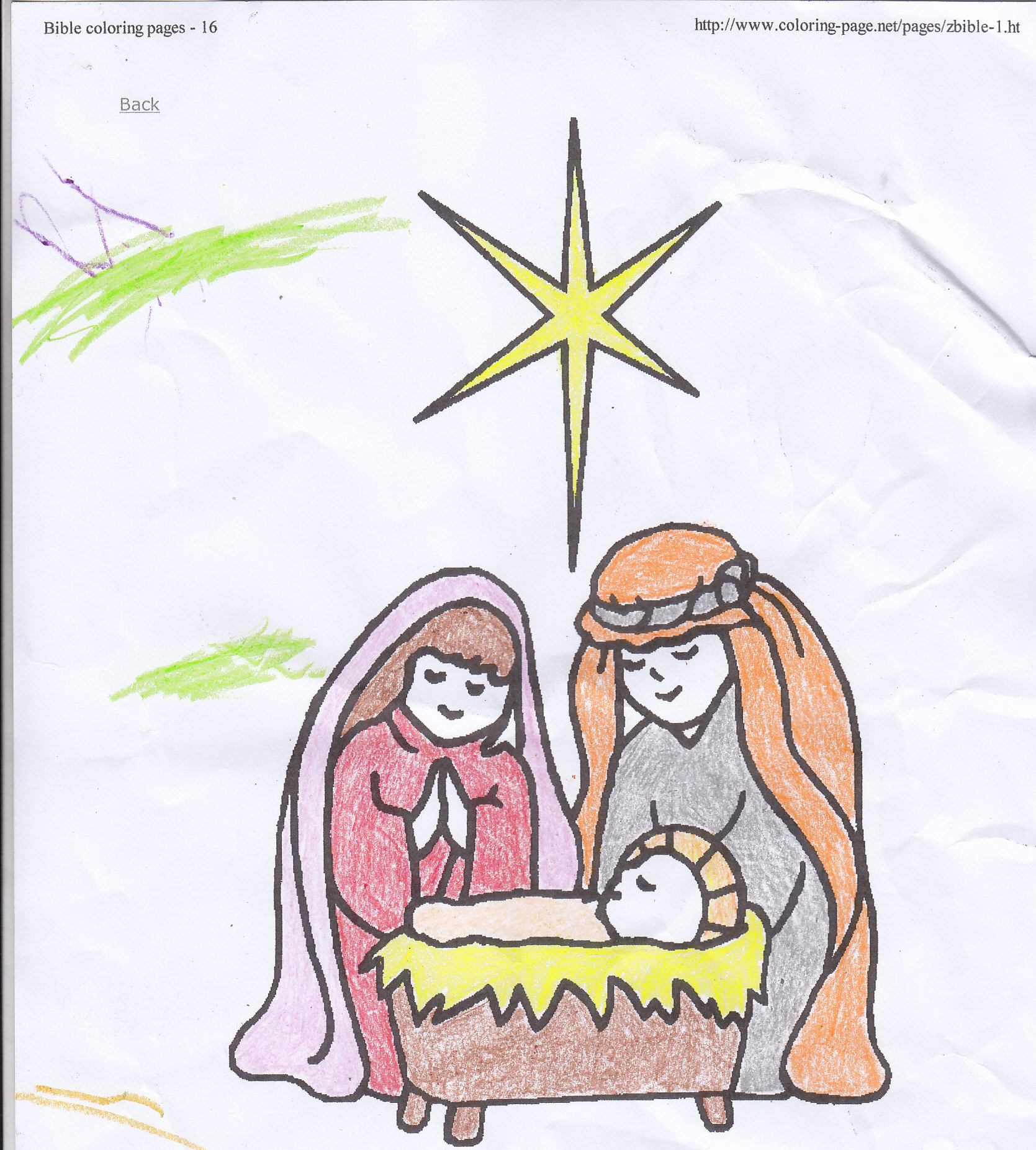
What do you notice in this picture? Try to identify subtle messages before you read on.

This picture was a product of craft time in our home. Julie distributed several coloring sheets printed from the internet, and Emma and I were taking daughter-daddy time sitting at the dinner table applying color to white spaces. Emma’s work, seen on the margins of the picture, was added during a previous session, while daddy can limit the usefulness of this togetherness by getting caught up in the artwork. In any case, I hope you like it.

While Emma and Hannah’s artwork gets hung on the wall, my occasional contributions usually just linger around. There is no need to add it to their gallery, but there is something that says you just can’t toss creativity into the garbage. Since our table has more space than the four of us need for meals, the picture sat quietly at the other end, always within my eyeshot.

One day I noticed something interesting that may never have dawned on me if not for time in the Orthodox Church. Icons hang from all corners of the sanctuary; pictures are painted in almost all available spaces, even the ceiling. One dominant image is of the theotokos, Mary, the mother of God.

She is a majestic, towering figure, holding the baby Jesus in her bosom. Like Mary, Jesus is upright; though an infant he is ruling the world from his mother’s lap. Despite her prominence, the theotokos is still a secondary image. The central icon behind the altar is of a risen Jesus, the pantocrator, the ruler of all.

Mary maintains her high place, however, in the esteem of the Orthodox Church. One of the central prayers during mass has the congregation in chant with the priest:

Through the intercession of the Mother of God, Saint Mary,

O Lord grant us the forgiveness of our sins.

We worship You, O Christ,

With Your good Father and the Holy Spirit,

For You have come and saved us.

The mercy of peace, the sacrifice of praise.  

Such devotion of Mary is of common knowledge to Western audiences through the Catholic Church as well. Protestant reaction is also familiar to most. Believing that an individual has direct access to God through Jesus, the Protestant wonders why such intercession is necessary. As such, the role and prominence of Mary is significantly decreased. Consider, therefore, the message of the picture.

Imagining, though not knowing, this internet coloring picture was designed by Protestants, notice first the folded hands of Mary. This was the image which first captured my attention. Her hands are folded in prayer to the baby Jesus. In stark contrast to the proud figure of Mary carrying the divine child, this humble figure emphasizes her subjection. In addition, she is drawn in equal proportion to Joseph, again marginalizing her importance. Furthermore, though both are kneeling, Joseph’s hands are not folded. It is the prayers of Mary that are emphasized. The message is subtle, but pictures communicate. The artist is directly imbuing the coloring child with Protestant theology.

I have sought to write this post so far without a coloring theology of my own. Of Protestant heritage, I maintain the question for Orthodox audiences: Why are these intercessions necessary? I understand and appreciate the overarching idea of the communion of the saints. The Orthodox challenge their Protestant brothers with irrefutable logic: If you ask your living sister to pray to God for whatever issue you are facing, why would you refrain from asking your ever-living sister, Mary, in heaven?

The theology of prayer is difficult in any case, intercessions or not. Why does God sometimes answer prayer, and sometimes seemingly ignore the pure petitions of his faithful? Answers are numerous, and I will not go into them here. Yet whatever answer is given to address one part of the equation always seems to violate a different scriptural precept. Prayer, if analyzed, can be very frustrating.

This, though, is where the Protestant undoes the Orthodox rebuttal. Perhaps this is a mark of American Protestantism, but most people I know who ask others to join them in prayer are not requesting intercession as much as they are asking for them to share in their suffering. The thought is not that if you also pray for me then perhaps God will now grant my request, as if it were a matter of addition. It is the natural human inclination to seek out support in time of need. Of course, since we do not know the mind of God, the prayers offered could not hurt. Depending on how great the need, perhaps the supplicant is indeed keeping count. God, answer me.

Prayer is one of the deepest expressions of human existence. The disciplined, regular prayers that we conduct with our children before meals and bedtime are pale comparisons. So also are our efforts to teach them to pray to God in their time of need, most recently expressed during occasional nightmares.

When Emma truly wakes with a nightmare it is obvious. She cries out and needs immediate consolation. Whoever put her to bed that night will go in and comfort, and then pray with her. Emma has learned this lesson, though, and will sometimes call out just fifteen minutes after going to bed, that she “had a bad dream about a rabbit.” Or, a bear, or cat, or sharks, etc. Our patience wears thin, and we will call from the door, “Did you pray to God about it?”

Clearly, our concern is more for our quiet than her relationship with God. Though the concept is good, we make a mockery of prayer, using it as a tool to wean her dependence off us, not for her spiritual development, but for our few moments of quiet at the end of the day.

What is most interesting is her usual response. “Daddy, I want you to pray to God for me.” Granted, she has heard far more prayers than she has been encouraged to utter, but the question is there: Is the desire for intercession wired into the human soul? If it is, is this positive or negative, a quality to encourage or one from which to mature? The answer may depend partially on the denomination.

Yet even in the Protestant understanding, why should one not seek to share one’s suffering with Mary, or with any other saint? Of course the Protestant cannot conjure this, any more than can be done with a stranger on the street, or perhaps more fittingly, a character from a story. The Biblical figures and the spiritual giants from bygone eras have past from living conscious into the tales of history and the register of heaven. In neither do they impact the Protestant’s daily life, nor enter the circle of relationships. Such a one should not be pressed to do so, for every relationship takes time. Does the lack of feeling toward this cloud of witnesses, however, betray a missing hue of Protestant theology?

On the other hand, if the Protestant has a warm relationship with Jesus, of whom the Bible states specifically intercedes for people before the Father, for what cause is appealing to Mary necessary? Once an Arab Catholic friend remarked, “If you can’t get what you want from someone, who better to go to than his mother!” This is interesting cultural insight as to the strong and continuous relationship an Arab man has with his mother, but contained therein is a point worthy to ask the Catholic/Orthodox: Your theology agrees with the superiority of Jesus and the access of every believer to him; do you indeed have such a relationship, or are you afraid of approaching the throne of grace? If the answer is yes there is no shame; every Protestant trembles as well that a supplication will be rejected. To ask is to risk; it is better to stay silent than to face the possibility of disappointment.

Of course, few of our prayers carry risk. Offers of thanksgiving and requests for well-being are well within our own power to accomplish; asking God’s help is good form, and cements the importance of humility, however feigned in actuality. A true supplication, however, empties the soul. Or, rather, it emerges from a soul which has been emptied. If God is the only answer left, how terrifying it is if he also fails.

This is no different than in any relationship; approaching anyone in weakness strikes at the core of our independence and self-satisfaction. Yet while we loathe our abasement, suffering is stronger in calling out for consolation. Be it for help, or for company, this is the truest of prayers. Jesus promised, “Blessed are the poor in spirit, for they shall inherit the kingdom of heaven,” and the Hebrew prophet before him, “I live in a high and holy place, but also with him who is contrite and lowly in spirit.” The prayer, it seems, is given a promise.

Ah, but what if it proves untrue? Is this an explanation of the practical side of Catholic/Orthodox appeal to saintly intercession? Is God held innocent if I only ask of Mary? I cannot answer this question, having no inherited reality of this world. If true, however unconscious, it is only parallel to the Protestant gymnastics which explain God’s inaction toward our cries for help. More likely, we fail to answer this question since we have never truly cried; our soul is not yet empty. The gymnastics are a tool to avoid the contrite and lowly spirit necessary to know God’s comfort.

I ask the Catholic/Orthodox for patience, since I am yet unable to enter this world. We both ask patience from the skeptic and secular, who scoffs at this whole conversation. It is hard to understand that which you do not know, and it is hard to know without entering in. Yet the hands of Mary, folded in the picture, illustrate both the dilemma and its solution. Hands clasped together can hold on to nothing else. This is prayer in its truest form. Though each person kneels alone before God, how much more comforting if we are joined by others. May we each so offer ourselves to those around us; may it be we also profit from those who have gone before?

Categories
Personal

Emma’s Saliib

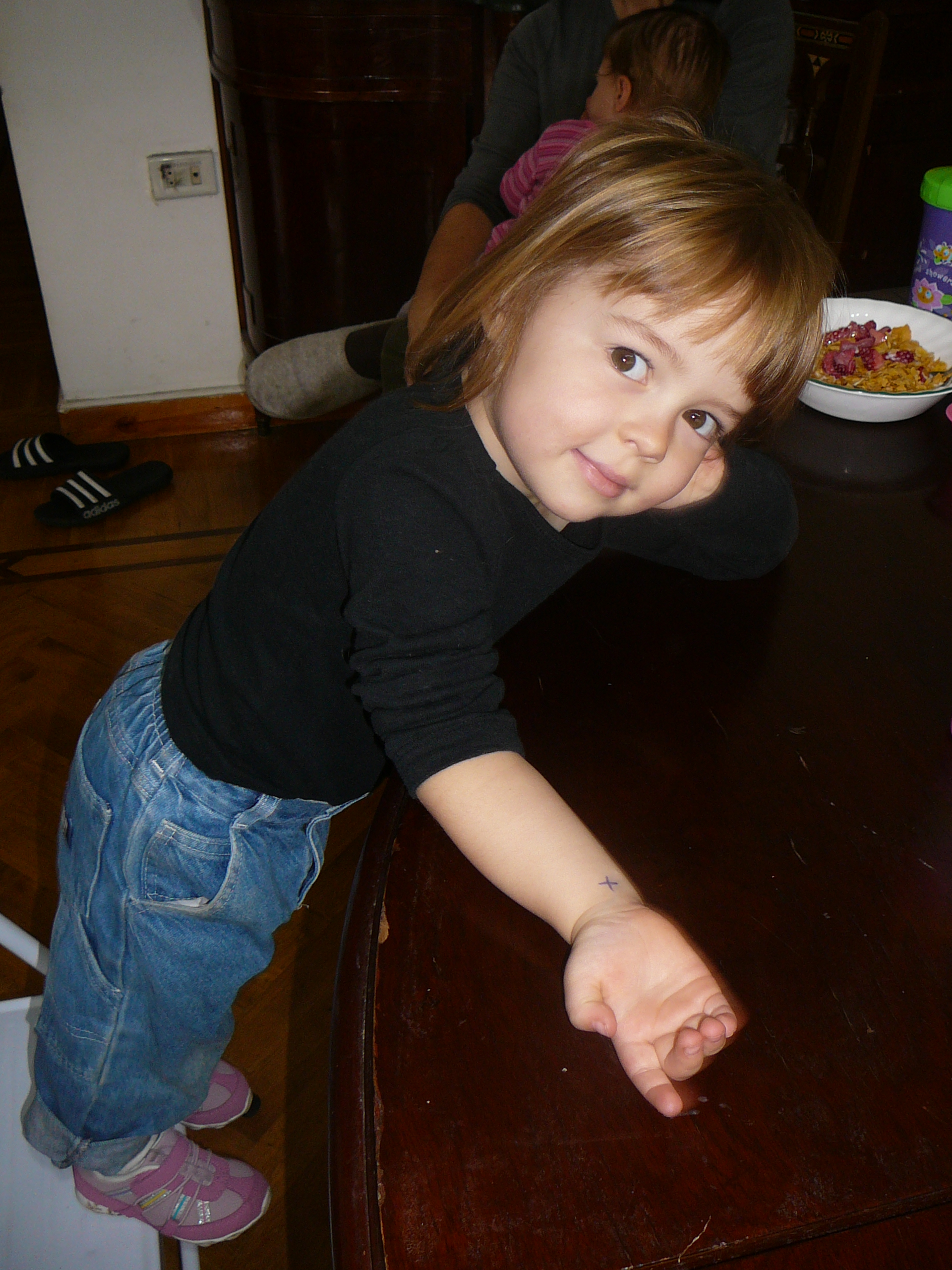
Today Emma showed that she is being affected by peer pressure … but not in a way I expected.  I was sitting with Hannah in the bathroom for awhile, and Emma asked if she could write.  I probably don’t let her play with a pen and paper often enough, but since Hannah was occupied, and therefore wouldn’t see what Emma was doing and want to copy her, I told her she could write for awhile on her own.  She has done this enough to know the basic rules: Only write on the paper, not on books, or toys or walls or yourself, etc., so I didn’t think she needed a reminder.  After about five minutes of no sound coming from Emma, Hannah and I finished in the bathroom, and Emma came to show us her “artwork.”  She had scribbled nicely on the envelope, but I noticed two things about her: 1) she had a pen mark on her face and 2) her left hand was covered by her sleeve.  So, I asked her to show me her hand.  She took it out of her sleeve, and showed me her hand which had a cross-like shape on the topside,

and she explained, “this is my saliib (Arabic word for “cross”) and I want to show the kids at hadaana (Arabic for “preschool”) my saliib on my hand.”  The unspoken words which I added were, “because all of the kids and teachers at hadaana have saliibs on their hands.”  Makes sense.  Poor little Emma is the only one there without a tattoo of a cross on her wrist. 

 I never thought of it before.  I had thought many times, I wonder when the day will come when she comes home begging to get her ears pierced because she’s the ONLY girl without pierced ears in the whole country!  I didn’t anticipate that sending her to the Coptic Church preschool would mean she was the ONLY person there without a cross on her wrist!  You see, many Christians in Egypt tattoo a small cross on the inside of their right wrist to identify themselves as Christians.

It’s a nice symbol which a friend commented on the other day, “I like the idea that no one can take this cross away … they may be able to take the cross off my neck, but can’t remove it from my wrist.”  I’m not sure if there is a general age at which this is done, but the kids in Emma’s class are 3 and 4 years old, so it’s done quite early. 

So, I told Emma that her cross would probably come off her wrist before she returns to hadaana in a few days, especially when she gets a bath.  I told her that the kids at her school had to get a needle to get their crosses so they don’t come off.  She really wanted to show the kids her saliib, though, so I told her that we could give her a new one the morning she goes to hadaana.  Jayson did the honors and she was very excited about showing the kids and teachers her cross on her hand.

I wonder how the kids reacted.  Had they noticed she didn’t have one?  Did they even think about it?  Did they think it strange that she showed them her saliib?  It’s just a natural part of who they are, and they wouldn’t think of showing it off to others; yet perhaps it is a symbol of pride right after they get it done?  There are many things that I don’t know.  I am guessing the teachers understood the peer pressure factor of Emma being the only child without a cross.  I’m not sure we’ll do it for her again, or if she will kind of forget about it, but it was an interesting experience.  I’m not ready for her to get a tattoo at age 3, but I was much happier that she wanted a saliib on her hand than holes in her ears, although I’m sure that will be coming in the near future.

Categories
Personal

A Seven Minute Walk to Work

We have been blessed in our location here in Maadi, Cairo, in that my office is located walking distance from our home. Seven minutes walking distance, to be precise. Since working hours can be somewhat flexible, this means that most days I am able to come home for lunch, then return to work for the afternoon. This makes four jaunts every day, equaling nearly half an hour. Not a bad exercise routine.

We don’t know if this arrangement will last forever. Our oldest daughter is three years old, meaning that we are already considering schooling options, many of which are outside of Maadi. While it is not a given that we would live in the same neighborhood as the school, it is our current preference. This would likely mean a twenty to thirty minute metro ride, twice a day, not nearly as good for exercise or for lunch options.

The other consideration is that we do stay in Maadi, but in another apartment. The one we are renting currently is furnished, which was our choice for year one in Egypt but more expensive long term. There are many nice parts of Maadi, but while some might be even closer to work, others might mean my exercise program increases to twenty or thirty minute stretches. Possible lunch complications are here as well.

Do you get the idea I enjoy lunch? Being able to be home in the middle of the day also gives us the advantage of having our big meal earlier, allowing for bread, cheese, fruit, vegetables, yoghurt, and hummus to serve as dinner on most nights. It is a nice privilege to arrange the day in this way, but may be threatened by a future move.

Anyway, the point of this post is to allow you a look into my daily commute. I have provided narration for the various landmarks I pass, which for me is by now normal, but gives a good picture of a typical Maadi neighborhood. Maadi is not at all a typical Egyptian neighborhood, however; please notice the greenery you will encounter is rare for the concrete jungle of Cairo.

One final note: Apologies for the final scene – I forgot in filming that I had just utilized the zoom lens.

Please click here to enjoy the YouTube video.

Categories
Personal

Finding Church (part three)

In early October we began this blog, and after the opening post our next two entries were about the challenge of finding a local church in which to worship. In part one we described our general attitude toward this process, and in part two we described some of the local options from which to choose. I had imagined at the time that part three would follow shortly thereafter, but as you can tell it is now mid-February, and we have gained almost four months experience from where we were. It is high time for an update.

At the end of part two I previewed that we would describe our thoughts toward the Coptic Orthodox Church, which is the primary church of Egypt. Back then it was to be a philosophical description of the value of discovering a new tradition, one which reached back to the earliest days of Christianity. It was to promote the idea of belonging to the church in its local form, feeding and being fed with a people now our own. It may have mentioned the ideal of each Christian possessing something which would strengthen the neighborhood body, wondering what it could be that they might gain from us. It would have admitted the anticipated difficulties of finding spirituality in liturgy, but been hopeful that this was the pattern among millions, and for centuries, so why should we not also find our way?

This is what I would have written; I might yet still. In the previous four months we have had confirmed the troubles described in part two in worshipping late night with the Evangelicals, as we prefer to put our girls to bed early. We have gone several times to stay only for the worship, which has been enjoyable, but has been short of church. At night, however, at the end of a long working day (Sunday), it has been very easy to let this experiment slip.

In the previous four months I have also joined a Coptic Orthodox Bible Institute which—this class at least—is focused on how to extend Christian belonging to those on the fringes of the church. I wrote about a recent conference with this group here. This has been a very good experience for rubbing shoulders with real, believing Orthodox Christians of Egypt. While I do not learn as much about Orthodoxy as I had hoped, it is invaluable for learning of the things which are important to them. I have been received well, despite a Protestant background—many are often concerned about Protestant inroads into the Orthodox Church—and will speak well of them to you.

Finally, as for introduction, in the previous four months we have been a part of their traditional Friday mass community. While mass itself begins at 7:00am, many people do not show up until much later, and the sermon begins between 8:30 and 9:00. Communion is served around 10:15 and not finished until a few minutes before 11:00 when everyone has been served. Thereafter there are closing prayers and the sprinkling with holy water—a practice I must describe one of these days in its own right. At 11:00 the mass ends, and people exit.

Outside of the mass there is a children’s mass in a separate hall which begins at 8:30, followed by Sunday school at 9:30. This ends also at 11:00, at which point the families come back together, and many cross the street to the church owned villa where drinks and food are available for purchase. As best we can tell this area is open throughout the week, and people hang out all day on Friday.

Our pattern has been to go to church and sit together in the main mass from about 8:30 to the beginning of Sunday school. Emma and Julie tried the children’s mass early on but it was crowded and Emma did not have a very good experience. So I take Hannah on my lap and sit on the men’s side, while Julie takes Emma and sits on the ladies’ side. Actually, we both sit in the balcony which seems to be less divided, but we do stay apart in hope this would be easier for our girls to be still. So far, they have both behaved admirably.

Julie then takes Emma across the street to the villa which houses Emma’s age Sunday school. At times she sits outside with the other mothers, but recently has discovered a ladies’ class in the neighboring room. Meanwhile Hannah and I remain in the mass, after which Hannah enjoys getting down from my lap and sitting in all the chairs, climbing through all the wooden pews. After a little while, during which most of the church empties, we cross the street to rejoin Julie and Emma, who have since bought for all an early lunch. We split falafel sandwiches and French fry sandwiches, and sometimes find other families with which to talk, sometimes not. The same goes for our girls and playing with the other kids. We usually leave around 11:45 or so, and cross back to the church, where we take a few kids books—Arabic and English—from the library, unchain our double stroller, and walk to second Sunday school.

Second Sunday school is at the Evangelical church closer to our home, where Emma enjoys her class and Julie stays around and watches from the side. Quite a few of the Orthodox children also attend the Evangelical Sunday school classes, or, perhaps it is the other way around. In any case, Emma likes both and Julie has been getting to know some of the bi-denominational mothers.

 It has been very educational for me to be part of the mass. I have even enjoyed it. Since I am experiencing everything in Arabic (and Coptic) there is that which makes me concentrate more than if all was in English. It has taken time, but I have become familiar with the patterns of liturgy and the communal prayers, even if I don’t always capture every word. At the same time, with Hannah on my lap there is ample room for distraction, which does not seem to be a problem to those around us. The same program, more or less, is repeated week after week, and has been for two millennia. It does not seem to matter if here or there a baby cries or people rise to leave mid-service. The traditions go on as they always have.

This aspect of the service has been enjoyable, as it also allows me time to daydream. By this I mean spiritually daydream, as I contemplate ancient rituals and contemporary importance. If this is what church was in its earliest days, does this carry forward in establishing legitimacy? Or is this church doomed to increasing irrelevance in favor of a growing worldwide contemporary evangelicalism? Do evangelicals do well or poorly in shaping church so closely to culture? Would Orthodox benefit from adding variety to their worship? Since Orthodox believe the bread and wine are truly Jesus’ body and blood, how does this affect their partaking? Do they truly believe, or are they going through the motions? If that is a poor way to ask, are they repeating ritual with sincerity? When they prostrate themselves before the elements, do they ‘feel’ God? He is, after all, present in all his holiness. What would it be like to feel this? Should I even try? Will it happen one day by itself? Do I believe at all? Is what I am doing worship? Am I just an observer, a sociologist? Does any of this, in them or in me, please God at all?

These are fun questions to consider, even if they are troubling at times. Add these to the icons, the incense, the architecture, and the cymbals, and the time goes very quickly. In moments here and there I have been moved; never have I been bored.

This week, however, was a setback.

One week ago we contacted one of the priests who had previously invited me and my wife to sit down and discuss Orthodoxy. He mentioned that though everyone seeks to speak with him after Friday mass, the Saturday services are less regularly attended, especially the English mass celebrated the first of every month. So we called him to reserve a time, made arrangements for a babysitter to watch the girls, and gave our Saturday morning to this endeavor.

He didn’t show up.

I learned later that he forgot, and asked if we wished to meet with him next week. He didn’t seem particularly disturbed that he forgot, nor was he particularly inviting, though not insincere, in his offer. Of course he did not know the troubles we undertook to meet the first time, but his attitude revealed something that was lingering in the back of our heads during the previous four months. There is little welcome extended in the Egyptian Coptic Orthodox Church.

I can imagine that our presence there in the first place is very odd for people. Maadi, Cairo is full of foreigners, but we are the only ones I can notice in the church. Orthodoxy is not a Western tradition, so this is not unusual, and therefore our attendance is. Nevertheless, in four months almost no one has asked why we are there, or offered to help in understanding the liturgy, or even greeted us as the service ends. There are plenty of admiring stares at our girls, and at the villa people are friendly if we approach them, but it seems most people seem to believe we wish to be left alone. Perhaps they are accustomed to this being the normal Western attitude.

If the reader here senses some frustration, it may not be far off, but that is not the point. One other comment on the setback, however, before I get to it.

Getting up for church has been a fabled difficulty in America for a long time, so there is nothing unique in this anecdote. Nevertheless, it is a little different from the norm, for Sunday church in America follows the chance to sleep in on Saturday following the workweek. Here, Friday church is the next day after the Sunday through Thursday workweek, so after rising early for the boss, a Westerner like myself feels entitled to take a day of rest, but finds instead we have to rise again early, this time for God.

A mistake with the snooze button today led to an extended morning rest, and then a few snoozes more. Before we knew it it was clear that we would be late for the sermon at church. Whereas we don’t strive to get there for the start of mass, it is beneficial to hear a sermon, and all the readings from the Bible take place before the sermon. Afterwards, it is all liturgical preparation for communion.

Having had four months of getting used to the liturgy, and having attended the English liturgy the week before, suddenly all desire to go to church was gone. I have not mentioned yet this post that non-Orthodox are barred from taking communion. I will explain more about this sometime in the future when I learn more, but only baptism at the hands of a priest qualifies one to take part in sharing the body and blood of Jesus. We have known this since the beginning, and have not allowed it to bother us or prevent our efforts to belong. I would rather partake with them, and will explore any opportunities for this, but during the extended communion time Hannah and I simply watch the others move forward to receive.

Therefore, no sermon, known liturgy, and no communion equal little desire. We went anyway, of course, going to church has been an established habit since I can remember. It was again as it has always been, which is both good and bad.

Therein lies the point. It is as it has always been. This is a difficult aspect of Orthodoxy to get used to. As for the lack of a felt welcome, we are measuring this against the hyper-seeker-sensitive American evangelical church. If I say ‘hyper’ here many American readers will immediately nod their heads in agreement, thinking of that flashing lights megachurch that gets all the attention. No, I mean your church. Most churches give instruction to certain people to make certain they approach any noticeable newcomer. They must not be overly friendly, lest they be scared away, but they must feel welcomed, lest they complain afterwards no one talked to them. It is a tightrope walking game the American church has almost mastered.

Furthermore the very idea which informs this blog—a sense of belonging—is nearly established dogma in Western society, and as such in the church as well. We want to feel, to experience, to be loved, to be wanted, and we expect our churches to provide this for us. Of course, we need a top notch children’s program as well, so they can share in all of these ‘needs’. This is written with a touch of critique, but it also is both positive and Biblical. The church is a body, full of relationships.

Before moving on it would also be wise to mention the cynical flip side of this arrangement. People must be welcomed, of course, so that they may with us receive the benefit of salvation, if they do not know it, but then can also grow spiritually through sound teaching and service opportunities. This is true and real. It does not stop the critique, however, that we welcome them in pursuit of church growth, either for the crass but real idea of gaining donations to perpetuate existence, or for the slightly improved but still suspect notion that bigger is better. I know this world well; no one thinks this way, but these concerns are never far from the surface. The practice of religion is rarely far from the practice of capitalism. We fail to consider this mammon at our peril.

I am highlighting these features of American church to provide a stark contrast to the Coptic Orthodox Church. Surely there are negative pictures here as well, which I will share with you as I learn them. For now, however, consider the simple fact of continuity. The church here has existed for two thousand years. It has birthed Christianity in many other countries, started worldwide monastic movements, won an entire nation to the faith, become famed for spectacular miracles, experienced waves of bloody persecution, witnessed numerous theological controversies, given way to a dominant rival faith, lost its ancestral language, descended into dry and lifeless repetition of rituals, and experienced unprecedented spiritual revival. Throughout all this the mass has stayed—so as best I can say at this time—exactly the same.

The church is as it was, and presumably will be. Each and every church is the same. Though one priest may differ in style from another, there is no competition between bodies. Deacons, like priests, are appointed by a regional bishop, and may preside over mass in any church to which they come. Worshippers may go to one church one week and another the next. Mass is the same if it is full of people, or attended by only one or two. Outside the sermon and communion, the priest’s back is turned to the congregation almost the entire time. The presence of any one individual makes no difference at all.

In this description I am focusing on the mass; church in Egypt does appear to have a web of relationships and activity that we have not yet been privy to. Perhaps it would be better to say that Christians of Egypt have this network, which is centered on the church. I plan to write a post about this soon.

The mass, however, is timeless worship. As in the Bible, where the same words have informed Christians for generations, so does the liturgy inform Christian spirituality and definition. I have been looking for a sense of belonging, and somewhat been hoping for a give and take from the church. With all patience I have realized our acceptance may take a long while, as would our own ability to know how to belong. The setback of the last week has made me wonder about this expectation, indicating I have aimed incorrectly. The mass is not set up as a give and take with the church, it is set up only for God. The congregation gives itself in worship; it takes an immaterial blessing. God, presumably, will welcome all who prostrate before him; those who come on their own terms are left to themselves.

We do not know what these thoughts will do for our hope to find church soon. These four months have not been sufficient to decide where our family should worship. It remains a request in our personal prayers; to the extent you wish to join in these we are thankful. Church has been part of our family for a long time, and we desire it to be a foundation of our lives here as well. Where we choose to belong we will strive to give ourselves fully. However informed by American Christian culture we are in this respect, we hope it is still our prostration to God, of whose welcome we desire. May it be with Egyptians of all convictions that we gain a sense of belonging, which is the immaterial blessing we seek from God. We pray this is on his terms, and not our own.
Categories
Personal

An Arabic Pregnancy

Being pregnant in an Arabic-speaking country has allowed me to learn a whole set of vocabulary related to pregnancy and child-bearing.  We probably learned the words for “pregnant” and “to give birth” while in language school, but it wasn’t until I was pregnant that the words really started to sink in and stay with me.  Being pregnant in three different Arabic-speaking countries has also allowed me to learn many different words surrounding pregnancy, and giving birth in two of those countries has and will teach me even more vocabulary.

The word for “pregnant” in Tunisia is different than in Jordan and Egypt.  I’m not sure of its origin or root meaning, but the word is “hibla.”  Now, that word, for whatever reason, also means “fool.”  I never asked a lot about it, and it may not be the exact same word, but to my ears, it sounds the same, and from the tongue of a non-native speaker, it sure can sound the same.  You see, in Arabic, they have two different “h” sounds; one is a heavier sound and the other is more like our English “h.”  I still cannot differentiate the two when I hear them from a native speaker, and I know I don’t do a good job of speaking them differently, so, it is possible that this word, “hibla” is slightly different in pronunciation so that “I’m pregnant” sounds different than “I’m a fool.”  However, I am sure I say the two words exactly alike.  Thankfully, my friends could tell the difference according to context!

In Jordan and Egypt, they use the word “haamil.”  Now, this word makes sense on one hand because it is from the verb, “to carry.”  It literally means one who carries.  Makes sense, right?  The only thing I can’t understand is that it is in the masculine form.  You see, most feminine words in Arabic end with an “a” sound, so that a man who carries something is “haamil” and a woman is “haamla.”  However, the word for a pregnant one is “haamil.”  I did ask about this somewhat in Jordan, I’ll have to do the same here in Egypt and see what explanation I get.

Another interesting word I found in Jordan was the way they would talk about giving birth.  When you asked someone when they were due, you would ask, “When are you going to BRING the baby?”  I always thought that was such an interesting word choice–to bring the baby.  I kind of chuckled every time I would say, “By God’s will, I will BRING the baby in September.”  It’s kind of like, bring it where?  However, when I think about it in English, we usually say we are going to HAVE a baby.  What does that mean exactly?  Sure, after I give birth, I will definitely HAVE a baby, but we usually refer to HAVING a baby as the act of childbirth.  Probably not the most logical word choice either.  I believe that in Egypt they use the more encompassing word of “to give birth.”  This makes sense.  “By God’s will, I will give birth to this baby the end of May.”

This brings up one more confusing point for me.  When I have been telling people I’m pregnant here in Egypt, they usually ask what month I am IN.  I think it is more common in the US to ask what month you are DUE.  So, even after I say which month I am in, I am kind of inclined to include which month I am also due.  However, this has been kind of odd for me, especially this month.  You see, in Egypt, they have two different ways to say what month it is.  They have names for the months, but since they have been different in all three countries, I haven’t quite learned them all yet.  I am kind of learning the names as we go.  It’s easy to remember what “August” is, because that is the month we arrived, and people are always asking us when we arrived.  It’s easy for me to remember “January” because that was the month of Coptic Christmas and I heard people say the date, “January 7th” a lot.  I have not yet learned the word for “May” although I think it resembles our English word a bit, just not exactly sure of its pronunciation.  So, the other way they say the months is by the number of the month.  So, January is “month one,” February is “month two,” and so on.  This means, that right now, I am in my “fifth month” of pregnancy and also due to deliver in “month five.”  In some ways it should be easy to say that, as it’s almost the same thing, but sometimes I think people think I am confused.  Oh well, I am almost to my sixth month, and then it may be easier!

I look forward to the words I will continue to learn here surrounding this happy event and I’m pretty sure I will be writing more about the whole experience of having a baby in Egypt along with all that follows.

Categories
Personal

Coptic Conference, Egyptian Triumph

The two items in the title today bear no relation to one another except for the day. In the end, it was a true Egyptian experience.

This past weekend the class I am with at the Coptic Bible Institute – its actual name is the Institute for Orthodox Doctrine and Spiritual Guidance – had its winter retreat at a former monastery turned conference center in Beni Suef, the first major city to the south of Cairo, about a two hour drive away. Julie and the girls were able to come, as did the families of other students in the class, which made for a nice atmosphere for all. We were put together in a single room in a typical dorm style residence facility, and while I participated in the activities Julie was free to roam around the grounds with the kids, not quite a babysitter, but not exactly comfortable with the hands-off attitude which prevailed. The retreat lasted three days and two nights, and was a nice break from the routine of the city.

The program of the conference focused on communication skills, body language, and the five love languages, which may be known to some readers of this blog as a popular study in many churches. It surprised me somewhat to see it in an Egyptian Orthodox retreat program, but much of American Christianity has come to Egypt through its Protestant churches, and then works its way as well into the greater Orthodox majority. Each day had two lectures and a study group, which I was able to ‘feel’ as normal retreat procedure, but the rest of the activity reminded me I was among those of a different tradition.

We did not necessarily wake early, but the day started with prayer, which was not the common ‘everyone give a request and talk to God’ procedure during Protestant sessions. Instead, we worked through the Orthodox prayer book. Traditionally, and still present in monastic practice, Christians would pray seven times daily. These prayers are scripted, though there seemed to be some variety in the selections. I was more confused than would ordinarily be expected, for instead of breaking for prayer seven times, we combined two prayer sessions into one, ending the day with the single, seventh prayer, and according to a pattern everyone knew except me, intermingled the selections from the two readings.

Within each session there consisted the Lord’s Prayer, the Apostle’s Creed, a ‘Lord have mercy – Kyrie Elasion’ reading, a Psalm, a reading from a Gospel, and general other intercessions. It was all very scriptural, but it was very fast. In part this was because my Arabic reading is still slow, and I was trying to keep up with unfamiliar material, but it also seemed like readers rushed through the selection given them to read. Some seemed like they had memorized the portions, others were less confident, but some read in a sing-song that was very beautiful. We stood standing the whole time, about twenty to thirty minutes, and faced East. I would say that East is the direction of Jesus’ second coming, but that doesn’t sound exactly right, as early Christianity expanded in all directions around Jerusalem, and his return, though to be seen by the whole world, will be, according to his own word, on the Mount of Olives. Nevertheless, within the Orthodox liturgy is a directive to ‘Look to the East’; I will need to ask a bit more to find out why.

 The other activity was also unfamiliar; following the prayer we learned a Coptic hymn. Though most of Coptic Orthodox liturgy is now conducted in Arabic, and has been for centuries, there is a conscious effort on the part of Orthodox Christians to maintain the use of their original tongue. It is only a liturgical language, but its study is mandatory for all priests and monks, though no one speaks it at home and only the learned would be able to follow along except for the known and familiar passages. At the Orthodox church we attend they put the words of the liturgy on a screen; on one side is the Arabic text, on the other is the Coptic language, written in Arabic script.

This hymn was being taught in preparation for the coming Easter fasting session, for it is used only near the end of Lent, if I understood correctly. It contained also an interesting theological twist. The opening lines praise Jesus for his fast, which he undertook for us. I had not heard this notion before. The question of why Jesus chose to fast forty days is a question not really answered definitively in the Bible, but the general answer that I have heard was that it was in preparation for his public ministry, which began immediately after he emerged from the desert. For Protestants who rarely fast, this is seen as a commendable but exceptional event, but one that is designed to draw one especially close to God, and as such, it is understood that Jesus did this for himself.

I am not yet sure of all the formulations, but Orthodox do fast regularly, almost half the year in varying levels of severity, and it has an element of repentance from sin. I may be wrong in this, but if I am not, they do have Biblical warrant. Yet since Jesus had no sin of which to repent, nor need to draw closer to God, the Orthodox may be more pressed in this understanding to figure out why Jesus fasted in the first place. The answer I received, as the hymn celebrates, is that he fasted for us. He undertook his fast to teach us to fast, and in some way, to perfect and complete the fasting required of his followers. Christians are said in the Bible to be ‘in Christ’; as such their lives are mixed with his, and his deeds also become theirs. I was nervous that this made Jesus’ life somewhat of a theater, in which he was playing a role rather than living his life in a real way. The Orthodox believe, of course, that Jesus was both fully human and fully divine, and that during his fast he suffered greatly, as any human would. The motivation, however, seems peculiar. Again, I will have to ask more questions.

Less people were familiar with the hymn than with the prayers, and people seemed less eager to participate in the learning thereof. I thought it was fun in the beginning, but I tired of it as the retreat went on, realizing I was never going to memorize it, and even if I could, would I even recognize it during the few weeks it entered into the liturgy? Perhaps other people felt the same way.

As a note, I have by now memorized some of the more celebrated parts of the liturgy that are repeated every week. It is fun to be able to participate fully during these parts of the service, whereas so much else is still unfamiliar. I keep in the back of my mind, however, the traditional Protestant critique of liturgy. It may well be fine and Biblical, but does the eternal repetition lead to routine monotony? I would like to be inclined to believe it does not have to, but this is an answer I can only discover in time through experience. By the visible participation of many during the mass I can see they are engaged; by the visible participation of many others, there is little indication.

During the retreat, however, mass was the one thing we failed to participate in fully. Justifying ourselves that this was a retreat and thus a good time to catch up on some needed rest, we slept in, resisting the knock at our door which was given to all at around quarter to seven. We did arrive a good half an hour before it ended at 11:00, so who knows what type of credit we received if we were found in attendance following communion. I suppose for full disclosure we should also admit to not participating in the seventh late night prayer, performed at around 10:30pm. We may be striving for a sense of belonging, but we are not yet Egyptians, we need our sleep.

Following Sunday mass and a final group session we were due for lunch and then departure at 3:00pm. This is a key detail, for Sunday was also to be the final of the African Nations Cup. Egypt had defeated hated rival Algeria (see this post, from Julie, and this one, from Jayson) in the semifinal, 4-0, and the country was awash in excitement in advance of the final match against Ghana. In addition, having won the past two African Nation Cups, but missing out on qualification for the upcoming World Cup, this was a chance at national redemption. Our bus was scheduled to leave with plenty of time allotted to return to Cairo before the match began.

Of course, nothing in Egypt goes according to schedule. Lunch was prepared by a classmate’s family who lived in the area. Though delicious, it was an hour late. Then when we had finished, the bus to return had still not arrived. When it came, it was smaller than the one which brought us, causing extra delays in trying to fit everyone and their luggage (we did, somehow). Meanwhile, three of our group had gone into the city for some reason, and needed to be picked up along the way out, except that they were not where they were supposed to be, and we had to search for them. At long last we got on the road, and it was clear we would not make it home in time for the start of the match.

In vain we tried to find the match broadcast on the radio. The best we could do was find a station which gave updates every few minutes, but the frequency was not clear. Fortunately, we were in the first row, so we could hear the time pass with confirmation of the same result, no score. We had no indication of the time elapsed, however, but it seemed likely we could make it home before it ended, and certainly for the overtime which seemed likely.

Then, the bus had an accident. It was no real accident, but there was no reason for it, as best I could tell. We were so close to home and the driver pulled into what seemed like a strip mall. I think he was looking for a shortcut to get over to the main road to take us back to the church, realized he made a mistake, but then backed up into another car. Five or six of the men of our group got out with the driver to investigate, and another lengthy delay ensued. I let things be and stayed in my seat, otherwise I could fill in the details, but I have seen the confrontations that sometimes occur over fender benders, and thought the presence of a foreigner might not help things. In any case, about fifteen minutes later we were on our way again, as there seemed to be no complications from the accident.

During the final approach back to church we saw evidence of the result. People were slowly but increasingly swarming into the streets to celebrate. Those in cars began honking their horns incessantly, including what seemed to be a wedding party in convoy. Children were dancing while waving flags over their heads. Others were shooting off fireworks. Every club or café we passed was emptying. The nation was in euphoria.

We learned in the taxi ride on the way home that Egypt had scored in the final five minutes, and then held off the Ghanaian attack to win 1-0. The next several hours were filled with horn honking throughout the city. Egypt, seven times champion, three in a row. I am glad we attended the Coptic conference, wished we would have been able to watch the match, but at least witnessed the emergence of celebration. We witnessed true Egypt, from the first experience to the last.

Categories
Personal

Mirror or Myth?

As we have had opportunity to live in several different countries of the Arab World we have been able to make friendships, some of which have lasted over the years. Certainly the internet aids in this process, and allows us to discuss matters though we physically exist hundreds of miles apart. Today I would like to give you a chance to join in this conversation.

Below is the text of a friend from Mauritania who now becomes our first guest blogger. I asked him permission to use this selection from an email to present here publicly, as it expresses an important message. Here is the way that many in the Arab World see us. Is it a mirror or a myth?

This blog is about Egypt, and though I have not yet heard this perspective here during our first few months, it would not surprise me if it exists, as I have heard it everywhere we have lived, though of course not from everyone. In this case, my friend will not hold to what follows, but he puts on a convincing performance.

“Today it is not me who is talking; I am taking you from your territory to look at things from another perspective, the perspective of the conservative Muslims. With their foundations I totally disagree, but in my quest for balance and understanding of the way others may see things differently, I am plagued with this sickness, entertaining ideas from the perspective of the person I am talking with, to see the amount of merit it has.

The discussion about the West and the Muslim world is raging all the time here, with very conflicting views. People here in general tend to see the West as an example of creativity, freedom, and wealth, but at the same time they hate it — mainly for its policies and government decisions, such as taking sides in the Arab-Israeli conflict and supporting Arab dictators.

People here in this conservative Muslim country tend to look to things from the following perspective. I would like you to read it through, and to let me know your feedback. I don’t necessarily want you to defend the West as I consider myself a Westerner in many aspects.

The West is an Empire, and it is an evil empire, it has failed morally, as it looks only to its interests. Historically, it used the wealth and sweat of other nations to build its hypocritical and consumption-oriented civilization; it has usurped and stolen the wealth of other nations to build its cities and agglomerations. The civilization the West is a Greek civilization where only the master has rights, and where the slaves exist only for the pleasure of the master. In application the master here is the West, and slaves are other non-developed nations. Nations were made extinct in this process, such as the native Indians in the US and Australia. The West has used the sweat of the nations — America was built by African Americans and Latinos, Australia was built by Indonesians and Chinese, and the UK used the Indians. When all the building was done, they started preaching “human rights”, and they use it to prevent other nations from taking the same path they took. Look at Dubai: Human Rights Watch is saying Dubai skyscrapers builders don’t respect the human rights of the employees, but Human Rights Watch was not there when New York, Paris, or Sydney skyscrapers were built in the Nineteenth and early Twentieth Century. It is not fair to not give a chance to those nations, demanding they meet the western standards of human rights during the building process. Now that the West has its stomach full, it wants the hungry others to play by new rules that it didn’t respect when it was hungry – slavery, war, colonization.

The West uses violence against other nations, and other nations use violence against the West. The only difference is that the West uses organized violence in contrast with the sporadic, unorganized violence used by other nations. For example, the US staged a war without any valid reason on Iraq, killed thousands of people, and destroyed the life of a nation, but when an oppressed and uneducated young Muslim tries to make an isolated act, it is called terror, and is labeled by the media as Islamic — what is the difference between the two? There is no difference except that one of the acts is committed by men in uniform, with their leaders in nice ties and clean offices, whereas the other is committed by isolated men with no uniform, whose leaders are ignorant clerics with big funny beards.

The bottom line is that it is about a competition in style of life, between barbarian oriental traditionalist societies with religion in the background, and barbarian western societies with democracy and conceptions of Greek freedom in the background.”

Do you have a response? My friend would be eager to read your comments. Please post freely.

Categories
Personal

A Tale of Three Refrigerators

Once upon a time there was one refrigerator. 

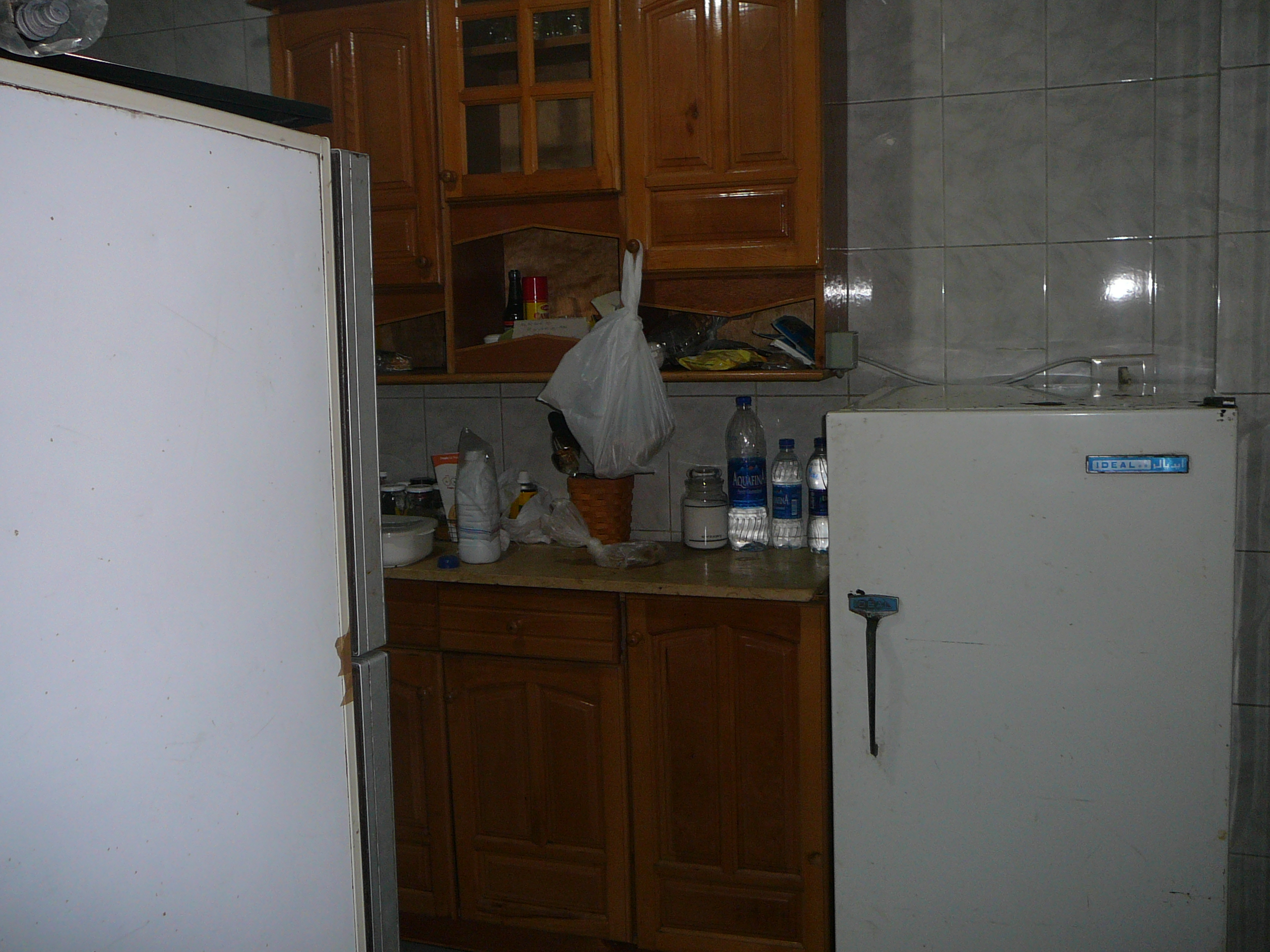
It was a decent refrigerator.  Big enough for our family’s needs, not brand new, but basically clean.  This was the refrigerator present in our apartment on the day we moved in.  We had seen our apartment originally without much furniture, but the landlord promised to furnish it completely by the time we moved in.  We were certainly glad to have a refrigerator; it seemed important.  There was one problem, however.  While the freezer worked just fine, the refrigerator part did not get very cold.  It wasn’t sufficiently cold for us, and after fiddling with the settings and trying it out for several days, we realized it wasn’t going to work.  The landlord called the refrigerator repairman, who, surprisingly came quite quickly, and confirmed that, even with adding some freon, this refrigerator really couldn’t be helped.  Time for plan B: Refrigerator number 2.

It didn’t take long for the second refrigerator to come.  Turns out it was just next door at the doorman’s place.  This caused a little trouble as he announced when he delivered our refrigerator.  His family had been using it since their refrigerator wasn’t working properly, and now that we needed it, he had to pay a lot of money to get theirs fixed.  He definitely wasn’t happy.  I felt bad for him, and a little guilty.  I knew they didn’t have a lot of money, but at the same time, I just asked the landlord to provide a refrigerator; I didn’t realize it meant taking it from the doorman.  So, he vented to me, but really, it was an issue between the doorman and landlord.  Anyway, he delivered the second refrigerator and right away I was concerned.

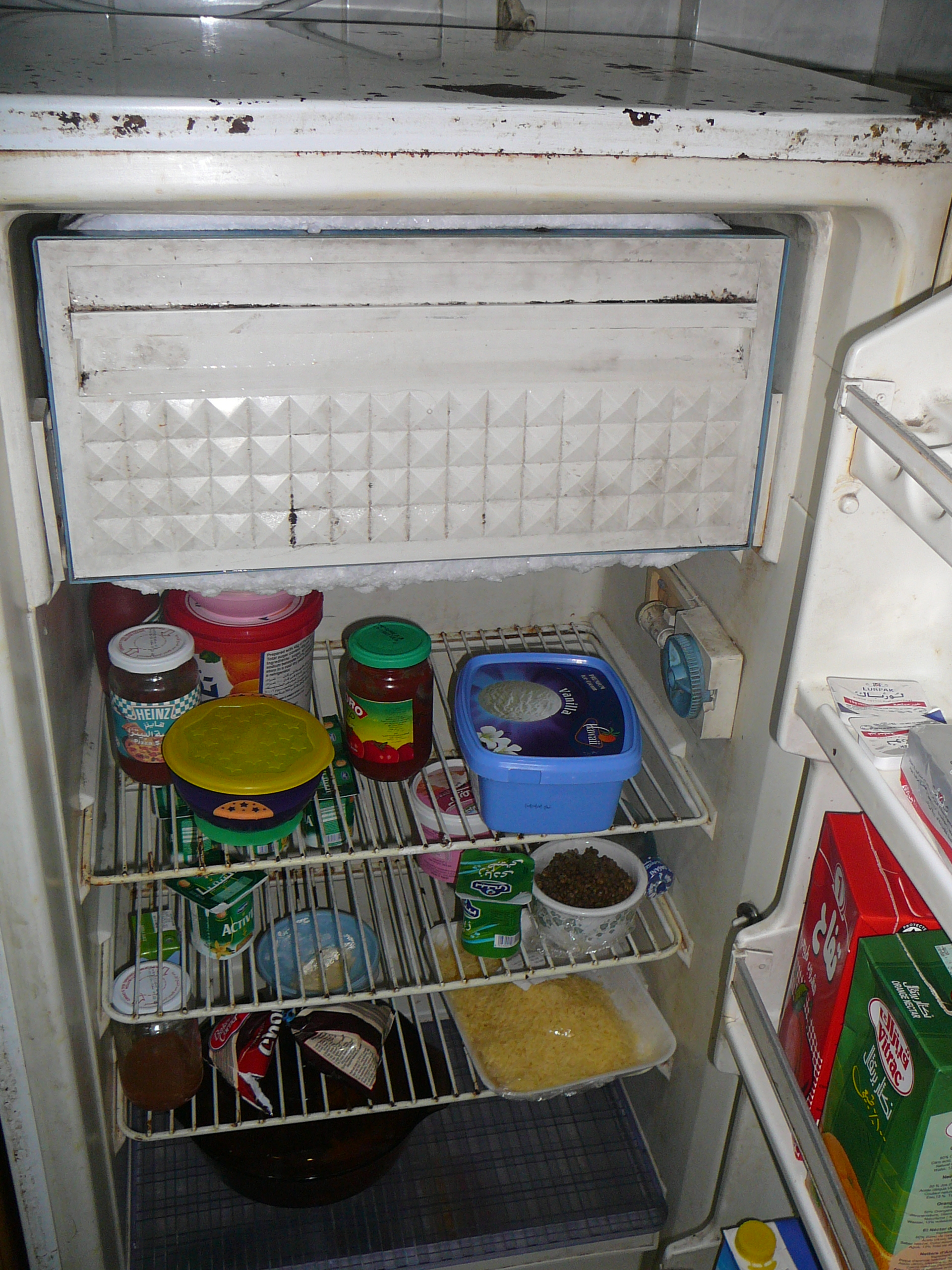
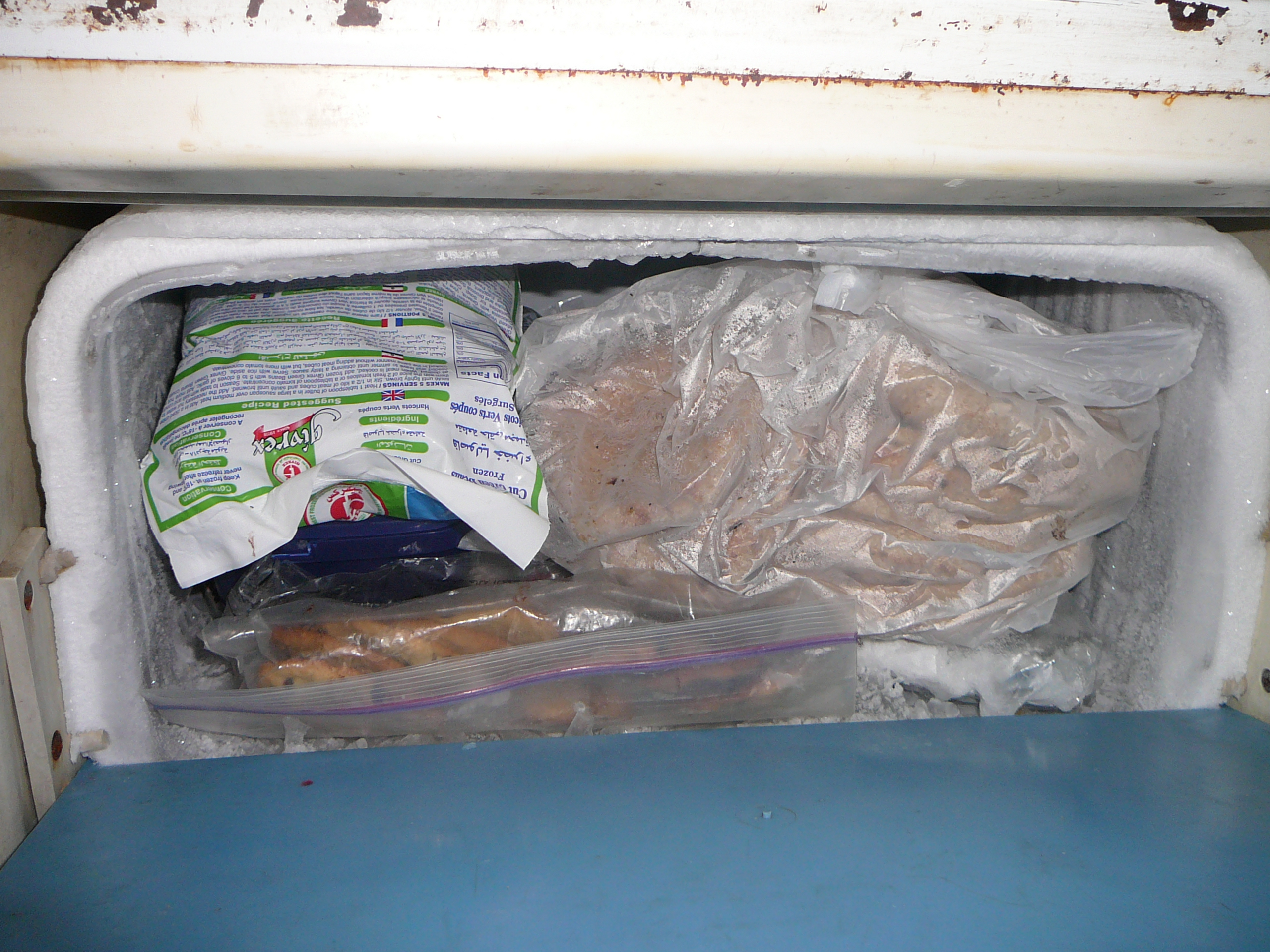
It was a little on the small side.  Not big enough for our family’s needs.  I opened it looking for the freezer.  Oh, there it was!

I usually like to make things ahead of time and freeze them, especially here in Egypt where you can’t easily get all the convenience foods.  Where will I put my tortillas?  And what about the off-season fruits and vegetables?  And of course we need space for that occasional box of ice cream!  Needless to say, I wasn’t quite satisfied with this refrigerator.  But what do we do about it?  The first one didn’t work so the landlord replaced it.  And if we ask for yet another one, what will that do?

I forgot to mention that when the doorman brought refrigerator number 2, he didn’t take refrigerator number one out of the kitchen.  He did manage to break the plug off, though, so that when we thought about maybe combining the two refrigerators and using the freezer on the big one, it was further complicated by needing to fix the plug.  The other complication to that plan was space.  The kitchen really couldn’t take two refrigerators.  It was getting tight in there.

Oh well, make the best of it.  That seemed our only choice.  A couple days later, things were complicated by the presence of lots and lots of little ants.  We had been pleasantly surprised by the complete lack of bugs in the apartment.  Both ants and cockroaches were absent, and that was a wonderful thing.  But all of the sudden, we had a colony of ants in the kitchen.  It seems they were coming from refrigerator number 2.  Ugh.  A very small refrigerator with almost no freezer space, infested with ants.  This is not what we signed up for! 

I killed a lot of ants in those first few days.  I mainly stepped on them or used a rag and smushed them or washed them down the sink.  I was able to get a lot of them at once when they made a long line from the refrigerator to our trash can.  I took the lid off the trash can and just ran water over it drowning all the ants who dared to venture out of their home.  However, if you’ve ever battled ants, you may know it’s a losing battle.  Somehow, they just keep coming back.  I eventually bought some spray and sprayed the refrigerator down each night, then swept up the dead ants in the morning.  Oh, and just to clarify, the ants weren’t really INSIDE the refrigerator, it was mostly in the back.  But my main problem was that they were coming out of the refrigerator into my kitchen! 

A few days later, we noticed the next problem with this small, no-freezer-space, bug-infested refrigerator.  It did not have that handy “no frost” feature that more modern refrigerators have.  This means that every so often, I would have to take everything out, unplug the refrigerator and let all the ice melt that had accumulated mainly all around the freezer box, and then wipe that up from inside and outside the refrigerator.

I don’t really know what the average period of time is that you usually need to do this … every six weeks, maybe three months.  But, this refrigerator required defrosting every 10 days!  It seemed to ice up quickly, and also as the ice grew, the space in the freezer shrunk … not a good thing.  So, now I felt like I had a lot of maintenance on this piece of equipment, and I was getting a little stressed out about the refrigerator situation, as I started referring to it.  When people would come visit our apartment, I would give them a tour, then show them the kitchen with two refrigerators in it, and briefly say we have a “refrigerator situation.”  I think it became some sort of badge with me.

Well, things started looking up a month or so after receiving refrigerator number 2.  We were gone all day and when we came back, there was a lot of water on the floor near the fridge.  Yes, the refrigerator is broken!  I was ready to sign on to that.  But the landlord wasn’t so sure.  She wanted to make sure the door had been closed all the way.  I think it had, but I couldn’t be totally sure.  Either way, it was kind of random as that was the first time it leaked water everywhere, and it still seemed cold inside.  Maybe it’s not broken!  Over the next few days, I tried to convince the landlord that this refrigerator had problems.  I brought her to see it when there was a long line of ants coming out of it, and when the ice had accumulated.  But she suggested bug spray and defrosting.  I weakly explained it really isn’t big enough as I like to make things ahead of time when the kids are napping and I have a spare moment.  I think we had a little problem.  We REALLY wanted a new refrigerator, and they REALLY didn’t want to buy one.  Jayson went to bat for us a couple times, but it didn’t seem to make them budge.

But eventually, budge they did.  I can’t even remember quite how we ever got this refrigerator situation resolved, but I think the landlord realized that we weren’t really given what we were promised, and this refrigerator number 2 was not the best.  So, we are happy to say we now have refrigerator number 3 in our kitchen, and numbers one and two are gone.

Although getting the first two refrigerators removed took some work in itself — the doorman and his daughter carried them out the door and into the hallway to the elevator, and we didn’t care to pay attention after that. It feels like we have a new kitchen … expanded.  This new refrigerator is not huge, but it’s definitely sufficient and it has the “no frost” feature!  We were so grateful and a bit surprised when she told me a new refrigerator would be delivered the next day!  But I’m happy to say I now have some tortillas and strawberries in the freezer … as well as some frozen chocolate chip cookies to pull out when guests come.

And we hope that is the end of this tale, as we all live happily ever after with refrigerator number three … at least through the end of our year-long lease.

Categories
Personal

Press Review of Nag Hamadi — Catch-up Summary

As promised, here is the latest, and currently last installment on press articles on the Nag Hamadi shootings. Today I attended a press conference hosted by an Egyptian NGO which sent an investigative team to the area, conducting interviews and drawing conclusions, or at least further questions. Two of my colleagues are working on a report about their presentation, and I can post that when they are finished and it goes online. In the meanwhile, unless we produce another catch-up press review tomorrow, I will likely post a reflective piece I composed about this incident which we emailed out along with other reports to both our paid and unpaid subscribers. Should you wish to be on such a list you can follow the links through the Arab West Report link on the right, or if you email me at Jayson (dot) Casper (at) ideasworld (dot) org, I can take care of it for you.

After that post, unless there is new news to relate, as I mentioned yesterday I hope we can intersperse some ordinary stories about our lives here. Julie has written a wonderful piece, for example, about our refrigerator. If you can stand the anticipation, I will try to post that one soon.

Here is the link to the press review.

Categories
Personal

Press Review of Nag Hamadi — Part Six

As I mentioned yesterday, this is the last of the original daily updates following the Coptic Christmas murders at Nag Hamadi. Tomorrow I will post the piece added to our webpage today, which summarizes the news as recorded in the press up to today. Thereafter we will only do summary press reviews every couple days as there is news to report. I will seek to keep you up to date, but hopefully in a few days we might return to our normal blog activity, letting you read reflections about our normal life, including work, every couple days or so. Normal is nice, but active can also be fun.

Please click here for the press review: http://www.arabwestreport.info/HotNews.php?NId=204.

Categories
Personal

Press Review of Nag Hamadi — Part Five

Current plans for this press review series have slowed on the daily edition at part six, but there is another cumulative press review in the works today. In my estimation tomorrow I will link to part six, perhaps the next day to the weekend summary, and then see what happens thereafter.

Here is the link to part five: http://www.arabwestreport.info/HotNews.php?NId=203.

Categories
Personal

Press Review of Nag Hamadi — Part Four

I have supplied the next link in the series of media summaries about the events in Nag Hamadi. I am a couple of days behind, but I think that is ok for now. The news is slowing down, so we may not need to continue the practice of daily summaries for much longer, though of course we will continue to chronicle the news. We currently have these reviews posted through day six, and I will post links to these day-by-day until it runs out. Should you wish to be as up-to-the-minute as possible, the link in the right-hand column to Arab West Report will bring you to our homepage, where you can follow this and other news.

Here is the link to the Day Four press review: http://www.arabwestreport.info/HotNews.php?NId=201.

Categories
Personal

Press Review of Nag Hamadi — Part Three

I have little commentary to offer today; we continue to follow the story and think about what we might do, if anything. The last thing I would like to do in presenting this information is put forward a false hope in ourselves. As an Egyptian friend here recently told us, as we asked his advice and wondered if he might go and play a role, the most important thing to do now is to pray. Please join us in this effort.

Click here for today’s link.

Categories
Personal

Press Review of Nag Hamadi — Part Two

In an effort to keep you up-to-date with the news, I will continue to post the media summaries we provide as long as the subject is dominating the Egyptian press. As you read in the last update, it is difficult to sift the wheat from the chaff in these reports. The true and accurate often stands side-by-side with the exaggerations and inventions, and it is hard to know which is which. Right now, it is important just to listen and record. If we are able to investigate this situation further, these reports will be the foundation from which we can ask further questions. If any of you have the time to help us play detective, please feel free to read along and keep track of the names, crimes, insinuations, and accusations. Other perspectives are always helpful.

Click here for the link. Thank you.

Categories
Personal

Press Review of Nag Hamadi

We hope you have enjoyed our accounting of Coptic Christmas; there is still one more day to come, and hopefully some pictures to be shared thereafter. In the background of our Christmas stories, however, has been the events of Nag Hamadi, in which six Christians and a Muslim policeman were killed in a drive-by shooting while exiting the Christmas Eve mass. The incident has received international attention, and has dominated the Egyptian media consciousness in the days which have followed.

Our work at Arab West Report translates articles from the Egyptian newspapers and provides detailed summary thereof. In addition, we review these articles as necessary to provide fact checks and analysis. Due to the sheer number of articles on this topic, however, we have instead provided a press review, which we often do when there is a topic which dominates the news. This press review summarizes all the relevant articles from the major newspapers and combines them in one report. This manner of summary allows all voices to be heard, no matter how contradictory. This sampling may not clarify our understanding—our minds prefer a simple sound bite we can digest and process—but it does establish the complexity of the situation. It is hoped that by beginning from complexity clarity can emerge.

I have provided a link here to the press review. The assembly and analysis you will read is not my personal work, rather, it is that of my colleagues. The larger question for us here is what can we do about this? Do we have a role in encouraging reconciliation in the area? If so, how and when? I cannot say we have the answers to these questions yet, and even when we do, it may take a while to share them. I will look to link to further press reviews as we develop them, however, that you can follow along. If you care also to pray for peace in this region, and wisdom for us on how to contribute, that would be greatly appreciated.

Categories
Personal

Coptic Christmas: Day Two

The lack of sleep did cost us the next morning, though, as we were due to pay a visit to the area bishop for breakfast at 8:00am sharp. In the Coptic Orthodox Church the bishop is only one level below the pope, and carries great authority and responsibility. Christmas duties pressed on everyone, but he allowed us about an hour of his time, and the exchange of greetings was necessary on both sides. For us and the priest, it would have been an offence if we did not honor him with a visit, however short. The same would have applied if he failed to receive the foreign visitors in his area. Needing to receive the governor in only an hour, however, he allowed us a few questions, gave us Christmas gifts of wooden and cloth crosses in addition to an icon of the Virgin Mary, and allowed us our leave. The priest himself was due at his church in the village, so we left promptly.

The responsibilities, however, were simple. All he had to do was sit in his office and receive Christmas greetings. It made for little conversation as every two minutes in the morning another child would enter, kiss his hand, and then leave. This continued for about two hours, interspersed with a phone call of Christmas greetings every minute in between. It was somewhat boring, to tell the truth, but it was a complete cultural experience.

All during this time the church grounds were an open playground. As parents enjoyed a morning of rest their kids gathered and exploded miniature firecrackers one after the other. They were clearly enjoying themselves, but as I sat in the office I could only imagine the chaos outside, except for when the kids threw their fireworks inside. Surrounded by walls, the noise was deafening, but the priest did not seem to mind at all. I got increasingly perturbed, but what can you do when this is normal and accepted behavior? I have noticed that priest may have a slight hearing problem; after twenty-plus years of service, these bi-yearly celebrations can perhaps take their toll. My imagination of the chaos, however, can be presented as reality by Julie, who was outside with the girls, and will take over the authorship of this next session.

I don’t think Emma enjoyed herself too much.  I wasn’t exactly sure what it meant that we would go sit at the church and “play” all day.  I knew Emma liked to play with kids, but the sheer number of the kids would probably overwhelm her.  What I imagined came true.  We arrived to a crowd of children, dressed in their new Christmas clothes.  They surrounded our car, knocking on the windows and holding out bags of chips to our children who were behind the closed windows.  It really felt like a Hollywood star experience, and we were the celebrities.  As we entered the courtyard through the church gates, the kids followed the car.  We parked and got out and they just kind of stared and smiled at us as we exited the car.  I offered typical Christmas greetings, “May you be well all year,” as I carried Hannah and Jayson carried Emma.  Wherever we walked with them, the kids followed, not saying much, but not leaving us alone either.  Emma was overwhelmed, but handling it okay.  Jayson and the priest went into the office, and told us we could play out in the courtyard.  So, holding Emma’s hand, and Hannah in the other arm, we walked around, surrounded by kids.  We eventually went to a ledge that was in the sun and sat down in the warmth.  The kids surrounded us, some of them saying in English, “What’s your name?” or, “How are you?” to the girls, and not getting much of a response.  The firecrackers either started then or else that was when we noticed them, and from that moment on, Emma’s hands were up on her ears every time she was outside the office.  It probably looked kind of funny to the kids, but I felt bad for her.  They offered her the firecrackers; I’m not sure what their thought was: Does she hold it as its lit and then throw it, or is it just something for her to hold in her hand?  I kept refusing and told the kids that she doesn’t like noise; it scares her and hurts her ears.  This seemed a foreign concept to them.  They offered chips or cookies, which was about the only thing the girls responded to positively.  They asked me their names and I told them.  An older girl asked if I knew a certain game, and I didn’t understand her.  She said they wanted the girls to play with them.  I said, “Okay, we can try.  If you all start playing, the older one may join you.”  But everyone just stood there.  I wasn’t sure what they wanted us to do.  How do fifty children play exactly?  I didn’t see a ball and it didn’t seem they were going to organize a big game, yet, we had the directive to “play.”  One of the older boys started trying to disperse the crowd to go play so maybe we could move around or get up, so I took both girls by the hands, well, Emma by the elbow because her hand was covering her ears, and we walked around the courtyard, looking for people playing, yet still being followed by a crowd of children who were NOT playing.  The noise of the firecrackers was really getting to Emma, and at some points, the kids would throw the lit noisemaker near us.  I don’t really think it was malicious, but it did seem intentional.  I think it just enthralled them to see someone so affected by the noise, as they obviously weren’t.  Emma said she wanted to go to daddy, so we all went into the office, where we finally could sit in peace for a bit.  For the next few hours, we either sat in the office, where we usually had some sort of snack from someone, or we walked around the courtyard, Hannah’s hand and Emma’s elbow in my hands, walking around, followed by children and the sound of firecrackers.  When it got too much, we would reenter the office and sit for awhile again.  After awhile, the thought of “playing” all day at the church, didn’t sound too fun!

Ok, Jayson is back. Around noon the priest’s brother came into the office and offered to take us to his house in the village where we were to have lunch around 3:00pm. That seemed a very good idea for the girls, but I thought it best that I stay there in the office. I walked with them to his home, about five minutes away, to keep all propriety, promising the priest I would be back shortly. All seemed fine with the brother’s family, and by the time I came back the ATM had opened. The priest had stacks of bills which he was distributing one by one as each child entered, kissed his hand, and received his $0.045 cents. This apparently was a custom for the holidays.

When this ended the sitting became much more enjoyable. The men of the village now came to pay their Christmas greetings, and several of them would sit and talk for a while, especially the ones who were working abroad or in Cairo and came home for the occasion. I even met someone who was working in Jordan, as a gardener in the church we worshiped in way back when. Many of these people only return home once a year, but some can come more frequently. It is especially hard because most have left their families in the home village.

Julie and the girls were able to take a nap before lunch, and I took mine afterwards. By this time, though, the news was filling the village. Six Christians were gunned down as they existed Christmas mass. Not everyone really knew what was going on, but all expressed concern, though not surprise. Many Christians have surrendered themselves to the idea that the country is against them, and this was just the latest confirmation. Even at that early point, however, there were complicating features, or at least rumors. This event was said to be connected to an ongoing controversy related to a nearby village, in which a Christian was said to have raped a Muslim girl, and the Muslims then responded against the Christians at large as the perpetrator of the crime escaped. In Upper Egypt the practice of revenge killings is not uncommon, and this may have been a continuation. Or, it may have been terrorism clear and simple. ‘Terrorists’ was the word on most of the Christians’ lips.

After lunch ended we left the village, returning to Maghagha, and things were quiet as the priest had to leave for family responsibilities, allowing me to write much of this summary. We had dinner earlier that night, at around 11:00pm, but we had put the girls to bed around 9:00pm. With a full stomach once again we weren’t much in the mood for sleep, and enjoyed good theological conversation until 2:00am, taking full advantage of our time together. It was another long but good day, but with a pall over the events of the day.

The events also could threaten us, as surely the security would be increased throughout the country. Would we be able to continue our program? The next day we were to visit two places reputed to be visited by the Holy Family during their escape to Egypt, and another place which was a pilgrimage site for a modern day saint. Would we be sent home immediately? Would we be confined to the priest’s home? There was no worry about safety whatsoever, but as we finally did collapse into sleep, there were concerns aplenty. The ones highlighted here in this last paragraph pertain to us, but may our prayers highlight those concerns of the country, pertaining to all.

Categories
Personal

A Coptic Christmas of Joy and Sorrow

There is complicating news today. It is significant enough that you may already know about it. Six Christians and a policeman were killed today in an ambush as they were exiting midnight mass in an Upper Egyptian town to the north of Luxor. I wish to be careful in conveying information because I have been far from the news in our relative isolation in Maghagha, over ten hours away from the attack, but it has been the talk of the community since we awoke this morning.

Our day began in Maadi, as we fought through Cairo traffic to get to the train station in Giza. We left a full hour to arrive, thinking this would be plenty as the station is just on the other side of the Nile River. We should have known better. We left on the 6th of January, a Wednesday, but in addition to all the Christians who would be in transit to get to their homes and churches, there was weekend traffic with which to contend. Coptic Christmas, the 7th of January, is a national holiday, so whereas Thursday night is often prime traffic with the Friday-Saturday weekend, Christmas led to a three day weekend for the entire country, and it seemed like the nation had emptied onto the streets.

We did arrive on time, but with only about fifteen minutes to spare. We appeared to be the only foreigners at the location, asked about how and where to board the train, had a policeman direct us informing him we were traveling to Maghagha, and settled into our seats, which were reserved by number. The train was very comfortable and we by coincidence sat next to another couple also traveling to Maghagha, and enjoyed pleasant conversation with them the entire two and a half hour journey.

Upon our arrival I am afraid we may have offended some. It was fairly comical, at least from our perspective. It is a bit complicated to descend from a train with two small children, a pack-and-play, suitcase, and backpack, but we managed, and it was no surprise to find a willing porter ready to help us with our bags. If any of you would wish to visit us, please be prepared for this at the airport. They can be friendly, helpful, and by comparison inexpensive, but they can also be insistent.

The first thing we should have noticed is that this porter was not very insistent. He offered to help me with the suitcase, and per custom I refused, with a quick ‘no thank you’, barely an exchange of glances, and began advancing. It may not be the most polite manner, but you get used to the necessity of not getting drawn into conversation, lest you be forever unable to escape.

My advancement, however, was quickly halted as I found the gentleman who was to receive us. Our stay was arranged with the priest of a village not far from Maghagha, but due to our late arrival (now about 9:30pm) he was already involved in leading mass. In his place he sent his brother, who now began helping us with our bags, but only for a moment.

Within two minutes he was surrounded by the police, among them the ‘porter’ who earlier tried to help us as we got off the train. It was all very friendly, and no one was unnerved, but Julie counted seven people who were involved in our arrival. Who are you? Who are they? Why are they coming? Where are they going? Each question had a very simple answer, and the appropriate people recorded the information, finally taking a look at our passports and recording our names. They continued to escort us to the priest’s brother’s car, with a small diversion as I remembered it would be better to purchase tickets for our return trip before we departed the station. It turned out this was rather unfruitful, for the trains were sold out on the day we had purposed to leave as well as the next day, except for either the 5:00am train or the one leaving at midnight. At this point we have no return ticket, but the police assured everything would be taken care of. As great as their attention had been to this point, it seemed the best thing to trust their word. They indicated, if I understood correctly, that we should just show up at the normal time of departure at 10:30am or 1:00pm, and we would (likely) find a place. In any case, the priest would take care of everything.

Here is the background, some of which is known, some of which is conjecture, all of which is the normal and expected procedure. My boss has been friends with this priest for many years, and he selected him for our visit to Upper Egypt in part because he has a very good manner with his Muslim neighbors and the regional authorities. In securing the priest’s agreement for us to visit, he then informed the police in our area, who also gave their approval. This is the known. The conjecture is that the policeman I inquired with concerning how to board the train likely conveyed his knowledge to the station in Maghagha. Therefore it should have been no surprise to find the concerned authorities as part of our official welcome.

The normal and expected procedure has been in place for many years. Egypt has had sporadic violence against foreign tourists who visit the Pharonic heritage sites in Upper Egypt, and consistently sends all tourists with a police escort. Foreigners who go to places like Maghagha, however, are much less frequent, and generally have very limited reasons to be there. Their presence attracts attention, and Egypt is concerned about their security. In a country which depends to a great extent on tourism and outside investment, the death of a foreigner could have wide ramifications. Upper Egypt has a reputation as being a haven of Islamist activity, and while the vast majority of people are against violence of any kind, including the vast majority of Islamists, there are pockets of extremist sentiment. Though the government has made great strides in combating these elements, they do still exist, as was seen today.

The police presence takes some getting used to, but it is very friendly. At the station the officer who recorded my passport information apologized several times. One of their number joined us in the car and accompanied us to the church in the village fifteen minutes from Maghagha, where the mass was in progress, and then joined with his colleagues who make up the normal guard outside the church during every mass, but especially during holidays. He came in a few times to check in on us, and when everything ended two officers joined us on the trip back to Maghaga. One sat on the lap of the other in the passenger seat, and they joked with the priest almost the entire trip home. The next day we returned to the village to join in Christmas day celebrations, and though they checked regularly with the priest about our program, they generally left us to ourselves, as best we knew. Even so, it is now 10:00pm, and an office just knocked on the door of the priest’s home to inquire if we are going out again tonight. After assuring him we were done for the day, we may have allowed him an early evening home.

In terms of the chronology of the day, however, we return to the Christmas Eve mass. We arrived about 10:30pm with an hour and a half of a four hour service remaining. Our girls were doing remarkably well given the hour, and though Hannah largely stayed quiet (but not sleeping) on Julie’s lap, Emma was having a great time. Automatically becoming the guests of honor we were ‘seated’ in the first row of the church, directly in front of the altar boys. Seated is a misnomer as most of the mass requires standing, and as I held Emma she preferred standing on the dividing wall between the congregants and the altar boys, and quite attracted their attention. Three of them in particular paid no further care to the mass and played with her the whole time. Emma was alternatingly shy and engaging, but was causing no stir. There were several children milling about in the pews, and the worshipper standing next to us was goading her the whole time, and was even father of one of the three altar boys. It was fun to join in the chants while at the same time catching Emma as she turned from the attention, slipped off the wall, and fell into my arms. It may not be acceptable behavior for most masses, but on this occasion we fit right in.

As the mass ended the priest left rather quickly and we returned to his home with the aforementioned escort. In the car our girls finally fell asleep, but of course woke upon arrival, which may have been good since food was waiting for all. Though actual practice varies, Orthodox Egyptians fast for fifty-five days before Christmas. The fast is of a vegetarian variety, as all meat beside fish is prohibited. Christmas then becomes the worthy celebration, and the meat flows freely. In addition to a plate of rice and a bowl of salad, there was chicken and the most delicious beef I have ever eaten. It did make me wonder, however, how many ‘foolish’ things we do in our celebrations of which we are unaware. After fifty-five meatless days, it seems strange to gorge on such a feast, especially at 1:00am. We did not have the most pleasant sleep that evening (morning?), but there were no regrets concerning the consumption.

To be continued…

Categories
Personal

Tomorrow is Christmas Eve

You may remember Jayson’s post from Dec. 25 entitled “Today is Not Christmas”.  Well, we have been able to extend our celebration of Christmas being here in Egypt, and finally, tomorrow, January 6, we will celebrate Coptic Christmas Eve.  We are still establishing our traditions, as he mentioned, but for this first Christmas in Egypt, we decided to travel to a town about 3 hours south of Cairo, called Maghagha.  We will travel by train tomorrow evening, arriving around 10pm as the Coptic Church is in full swing for their very special Christmas Eve service.  All over Egypt, Christians will be worshipping God in their churches until midnight, at which time they will return to their homes for the big Christmas meal.  One of the reasons the meal occurs directly after the midnight mass is that traditionally, Copts fast for 40+ days prior to Christmas.  This fast includes abstaining from all animal products, and thus, once midnight of Christmas Eve hits, the fast is broken, and the Christians can celebrate the birth of their Savior with food and fellowship.

I am sure we will have more to say about this when we return from our trip on Saturday, but for now, just know that we will participate as best we can in this midnight mass, with our two little ones in tow, and then in the Christmas feast at someone’s house, again, with our two little ones preferably sleeping in tow.  I am sure we will have many stories and adventures to share following four days of celebration outside of Cairo.  Stay tuned.