Categories
Personal

Islamist Victory: What Next for Copts, Liberals?

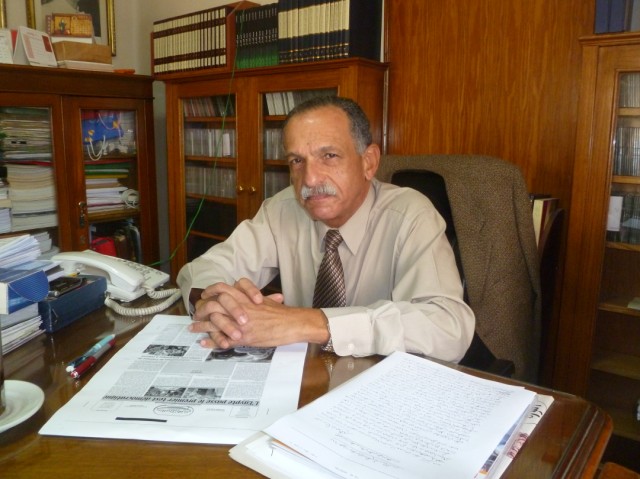
Youssef Sidhom

During the January revolution in Egypt many, including Christians, feared the worst. Behind the euphoria of courageous demonstrations for freedom lurked an Islamist threat believed to be anti-Western and anti-Christian. Nearly a year on, early results foretell its decisive victory. The Muslim Brotherhood’s Freedom and Justice Party is tagged to receive 40% of the vote, while the ultra-conservative Salafi Muslim coalition won an additional 20%. Liberal parties, socialists, and those connected to the former regime divided the rest among themselves. The early pessimism appears to be warranted.

Yet according to a leading Egyptian Coptic intellectual, Youssef Sidhom, editor-in-chief of the Coptic newspaper Watani, pause should be given before adopting this sentiment. Most important to realize is these early results pertain to only one-ninth of parliamentary seats. Due to Egypt’s complex election structure, the polls of November 28-29 included nine of twenty-seven governorates. Each governorate elects only one-third of seats through traditional single-winner competition. The remaining two-thirds are determined by proportional party vote, and these will not be revealed until after all three election stages have been completed. ‘Though Copts and liberal groups have been greatly disappointed,’ states Sidhom, ‘we must encourage their continued participation in the next two rounds.’

Yet it is true that preliminary results are not encouraging for those opposed to the Islamist project, as the greatest concentrations of liberal sentiment, including Cairo, were part of first round voting. Of concern is the current plan for parliament to draft Egypt’s new constitution. If an absolute Islamist majority rules, they may be able to pressure the military to ignore agreed upon principles to define Egypt as a civil state guaranteeing rights for all its citizens. An optimist by nature, Sidhom is prepared for this worst-case scenario. ‘If Egypt is hijacked into an Islamic state we will oppose this in the ratification referendum. If it is passed, Copts and liberals, representing 40% of the population, will take again to the streets. A parliamentary majority has the right to pass legislation, but the constitution, which governs legislation, should reflect the will of the whole nation.’

Nevertheless, Sidhom does not expect this dire outcome. Having participated in dialogue with Islamist leaders including the Muslim Brotherhood, he believes them to be ‘decent people’ despite the ‘vast area of mistrust which has not been overcome through their nice words’. He is puzzled by why Islamists reject efforts to craft a ‘Bill of Rights’ type document to bind all political parties to certain civil constitutional principles. Yet, ‘I believe the Muslim Brotherhood wants to prove they can create a type of democracy which respects the rights of all Egyptians. Perhaps they reject the document because they do not want it said they did so only by being forced.’

To ensure this result, Sidhom believes liberal parties must not adopt the role of opposition and reject Islamists in the upcoming parliament. Rather, as the Brotherhood’s Freedom and Justice Party has intimated, they should join a coalition government. ‘This does not mean liberals give up their values, but instead represent their national duty not to leave the scene entirely for Islamists. In order to keep any vicious Islamist appetite at bay we must be at the table with them, to remind them they promised not to hijack Egypt.’

As for the Christian community, this is also a time of transition. Coptic turnout is estimated around 70%, exceeding the national percentage. Yet as Pope Shenouda of the Coptic Orthodox Church ages, the future is uncertain. Sidhom states, ‘Too many priests either encourage Christians to stay in the church, or else to go into the streets and fight.’ It is good Copts are operating politically independent of the church, he believes, but their manner of demonstration often does not reflect Christian values. ‘Copts do not know how to do this; our culture is hurting us now.’

As for whether or not Christians have gained anything since the revolution, Sidhom says, ‘I believe we should give democracy a chance to work. It is illogical to imagine changes by now, but this will rectify itself over time.’ He does not fear great sectarian troubles as in other countries, as long as Christians fulfill their responsibilities. ‘Egypt is not Nigeria or Lebanon; Copts are scattered throughout the whole country. Our only hope is to integrate completely into the political and social arenas.’

Sidhom’s hope will be put to the test in the coming few years. May his vision prove true, over much prevailing fear.


note: This text was written following the close of the first round election phase. The third and final phase begins in a few days.

Categories
Personal

Pessimism from an Egyptian Sandmonkey

The Egyptian Sandmonkey

Mahmoud Salem, the self-moniker-ed Sandmonkey, has made a few previous entries into this blog. Several months ago when the revolution appeared to be faltering over the summer, this widely-read Egyptian blogger outlined the reasons for his optimism. Later on, I had the opportunity to hear and wrote about his campaign speech as he ran for parliament in the recent elections (and lost). He has been quiet on the internet since then, but resurfaced with a new post – Underneath– which I will excerpt from below.

‘Underneath’ is Sandmonkey’s effort to put to words his diverse thoughts about the current Egyptian situation. Several weeks ago protestors were fighting the police in Mohamed Mahmoud Street off Tahrir Square; now they are fighting the army in Qasr al-Aini Street a further 90° to the south. The mood is sour, people are dying, and a media battle is underway about who deserves the blame.

Within this context Sandmonkey’s earlier optimism is gone. What remains is his lucid commentary as a revolutionary partisan. The opinions are his, but they summarize what many are thinking. Or perhaps more appropriately, what many are confused about. I rank myself among the confused, and trust he will forgive my additional comments interspersed with his own.

This is not an uplifting post. You have been warned.

On the Context

My helplessness reached its peak when my friend S. came over two nights ago, and she was not alright. Fighting to release the thousands that are getting military tried over the months has been a draining crusade for her, and it only got worse the moment she got involved in trying to ensure that the death reports of those killed in Mohamed Mahmoud do not get forged, which meant she had to be at the Zeinhom morgue the night those bodies would come in, surrounded by wailing families and crying loved ones, seeing dead bodies after dead body come in, and almost getting arrested by the authorities that didn’t want her stopping the cover-up. She told me after wards that she now sees those dead bodies everywhere, and she can’t escape them. But that night, 2 nights ago, she had just come back from Tahrir, where a man, standing inches away from her, ended up getting set on fire due to an exploding Molotov cocktail. She could see the fire engulf him, the smell of burnt flesh and hair, his agonizing screams for help. She was silent. Very calm and silent. She was sitting next to me and I couldn’t reach her, and all I could do is hold her without being able to tell her that things will be alright. Because… how? How will they be alright exactly?

Human rights activists have stated that over 10,000 people have been sentenced under military law since the revolution. The ‘No to Military Trials’ campaign has been helping individual cases and seeking a halt to the entire process. Certainly many of these 10,000 – I do not know how the number is calculated – have committed crimes of different natures. With the police ineffective and the judicial system painfully slow, the military has stated it must use military law to keep security and ensure justice. Activists claim it has been used against demonstrators – who get labeled as thugs – and in any case even a criminal is due a trial before a civilian judge. This particular activist is fighting hard against what she believes to be stark injustice, and seems nearly spent.

On Culture vs. Politics

One of the biggest mistakes of this revolution, and there are plenty to go around, was that we allowed its political aspects to overshadow the cultural and social aspects. We have unleashed a torrent of art, music and creativity, and we don’t celebrate or enjoy it, or even promote it. We have brought the people to a point where they were ready to change. To change who they are and how they act, and we ignored that and instead focused all of our energies in a mismanaged battle over the political direction of this country. We clashed with the military, and we forgot the people, and we let that small window that shows up maybe every 100 years where a nation is willing to change, to evolve, to go to waste.  

It is true Egypt exploded in hope and creativity following the revolution. I don’t know if idealistic artistic utopia can last forever, but it has certainly been sidelined by the political struggle for power. Particularly damaging has been the Islamist vs. liberal rhetoric which has dominated, casting many into a defensive politics of fear and culture war. This is not fertile ground for the arts.

On the Elections

The parliamentary elections are fraudulent. I am not saying this because I lost- I lost fair and square- but because it’s the truth. The fraud happened on the hands of the election workers and the Judges. People in my campaign were offered Ballot boxes, employees and judges in polling stations were instructing people who to vote for and giving unstamped ballots to Christians in polling stations where they are heavily present to invalidate their votes, and the Egyptian bloc has about half a ton of correct ballots- ones that showed people voting for them- found being thrown in the streets in Heliopolis, Ghamra, Shubra, Zaitoun, Alexandria, Suez and many other districts. The amount of reports of fraud and legal injunctions submitted against these elections are enough to bring it all down and have it done all over again. Hell, a simple request for a vote recount would be enough to expose the fraud, since the ballots were thrown in the street. The people, however, are not privy of this, because it all looked very functional and organized to them. This is very important, because it tells you the shape of things to come.

The Egyptian Bloc is the grouping of liberal parties which organized for a civil society, but appeared to be motivated chiefly by opposition to Islamist parties. Sandmonkey ran with the support of this coalition. All sides have engaged in electoral violations to some degree, but what he reports here, if true, demonstrates organized fraud. One member of the Egyptian Social Democratic Party – a member of the Egyptian Bloc coalition – went as far as to state the current violence is meant as a distraction from the electoral violations. Beginning one day after the vote, the world did not look at the elections but the violence which followed, maintaining the belief the elections were sound because they were comparatively free from violence. From my readings this is little reported internationally.

We had one of our campaign workers fall victim to a hit and run “accident”, a campaign operative getting arrested by the military police at a polling station for filming the army promoting the Salafi Nour Party (with a big banner carrying the Noor Party slogan being placed on the side of an army truck) and his film confiscated of course, our campaign headquarters got attacked with Molotov cocktails by thugs sent by a “moderate” Islamist centrist party, the hotel we were staying in got repeatedly attacked by thugs till 3 am, with the army platoon leader protecting the hotel informing me that if I don’t resolve the situation, he will “deal violently” with those outside and inside the hotel, the Leader of the 3rd Egyptian Army calling us looking for me, the Chief of Security for Suez doing the same thing, lawyers and thugs working for a semi-leftist party filed police reports against us claiming we hired them and owed them money when we didn’t, and the other campaign manager finally going to deal with the situation, ends up getting arrested, and the two campaign members that were with him were left outside under the mercy of groups of thugs, and we managed by the grace of God get them all out unharmed and we escape Suez while trucks filled with guys with guns going around Suez looking for us.

Oh, and we also sent in one of our campaign operatives dressed as a Salafi into the Suez central committee for vote counting, where army personnel assured him that they have helped the Noor Party and told him that they hooked them up with two seats, while winking.

Well, this is testimony. Take it or leave it. The Noor Party represents the electoral alliance of Salafis, who campaigned both against the Egyptian Bloc and the Muslim Brotherhood dominated Democratic Alliance. I have heard tales that American democracy was similar a hundred or so years ago. Doesn’t make it right, if true, but it might put a brake on judgmentalism, though not on demands for transparency.

So, why would the military be “helping” the Salafi Noor Party get votes? Well, mainly because they invented them. It was a match made possible by State-Security, who probably alerted the military of how reliable were the Salafis in their previous “cooperation” to scare the living shit out of the population into submission and supporting the regime. … Ensuring that the Salafis have a big chunk of the parliament (one that is neither logical or feasible considering their numbers in Egypt) achieves two goals: 1) Provide a mechanism for the security apparatus to keep the Muslim Brotherhood in check if they ever thought of using religion as a weapon against SCAF (As far as the Salafis are concerned, the MB are secular infidels) and 2) to really frame the choice in our (and the international community’s) heads between a “Islamist country or a military regime”, because, let’s face it, The MB are not scary enough for the general population. But the Salafis? Terrifying *#@!.

Even before the revolution there was suspicion that state security had its hands in the Salafi movement. The rationale was that their theology promoted obedience to the ruler, whereas the Muslim Brotherhood continually advocated for reform, criticizing the president and his policies. Salafis were supposedly built as a counterweight, and allowed freedom to propagate in mosques whereas the Brotherhood was constantly curtailed. As Mubarak maintained a policy of ‘it’s me or the Brotherhood’, the military council has now raised the Salafis to play the same game (it is maintained).

In speaking with Salafis since the revolution they counter this argument, saying their silence was because they did not want to take on a regime that would crush them if they got out of line. They preferred to focus on the moral reform of society along Islamic lines, and let politics be. For what it is worth, those I have spoken with have seemed perfectly nice and normal people. Some of their leaders on the other hand, at least in the media, well …

On the Electorate

There is a disconnect between the revolutionaries and the people, and that disconnect exists in regards of priorities. Our priorities are a civilian government, the end of corruption, the reform of the police, judiciary, state media and the military, while their priorities are living in peace and putting food on the table. And we ignore that, or belittle it, telling them that if they want this they should support what we want, and deriding their economic fears by telling them that things will be rough for the next 3 to 5 years, but afterwards things will get better on the long run. Newsflash, the majority of people can’t afford having it even rougher for 3 to 5 years. Hell, they can’t afford to have it rough for one more month. We tell them to vote for us for a vague guarantee and to not to sell their votes or allow someone to buy their loyalty, while their priorities are making sure there is food on the table for their families tonight. You sell them hope in the future, and someone else gives them money and food to survive the present. Who, do you think, they will side with?

Living in upscale Maadi, I don’t have a pulse on the economic state of Egypt, but conventional wisdom states it is degrading rapidly. Egypt was always suffering from poverty, however, and to my knowledge the state is maintaining its subsidies. At the risk of ‘letting them eat cake’, I wonder about the dire situation of the common family. They are poor, but are they destitute?

Nonetheless his point is interesting. It is well demonstrated Islamist parties joined their campaigning with social charity to sell meat or supplies or gas bottles at discount prices. Would liberal parties not ‘stoop that low’? Do they not know how, being far from the street? Meanwhile, praise God for their charity, but was it a masquerade for their manipulation? Only God knows their hearts.

Here is a fun fact: About 40% of the people head to the polls not knowing who they will vote for, and are simply there because they are afraid of the 500LE fine they must pay for abstaining to vote; about another 50% go to the polls with a piece of paper that has the names & symbols of the people they will vote for, people that they don’t know, or their history or anything about them. They simply asked their friends and they told them that these are “good people to vote for”, and this is true across the board in all classes, upper and lower, uneducated and educated. And you can’t blame them really, because each district has over 100 candidates fighting over 2 seats and only 4 weeks to campaign. If you are the average new voter, there is no time to meet or evaluate or educate yourself about all of them in order to choose objectively between them. I know people that voted for me simply because I was the only candidate they met. I am not kidding.

I don’t know where he got his statistic from, but the fine for not voting is correct, as is his description of the peoples’ virgin political experience. He could have continued with a description of how 1/3 of seats go to individual candidates, and 2/3 go to party lists, both of which must have 50-50 professional vs. worker/farmer representation. By compromise politics or design, these elections must have been among the most confusing ever.

On Liberal Opposition to the Islamists

So many times I have met people who are terrified at the electoral successes of the Islamic parties in the election, and while they acknowledge that there “must be a deal” between the SCAF and the Islamists, they sit back with a knowing smile and tell me: “But you know what? The SCAF are not stupid. They will screw the Muslim Brotherhood over. They are just waiting for the right moment and they will destroy them. You just wait and see!”

I tell them that they are disgusting for thinking this way. That they are like a raped woman who is rooting for her rapist to rape the other woman who got away so that she wouldn’t be the only raped one.

A violent and pejorative metaphor, but he describes liberal thought well. I don’t know they express this with the glee he puts into their mouth, but there is an expectation of this eventuality – unless there is a deal, which if it holds returns to the United States for their still-undetermined support of Islamists, which confuses everyone. Furthermore, the expectation is often one of relief. ‘If we don’t win at least they won’t either.’

And he is right to condemn it.

On the Army

I love it when a fellow revolutionary asks me:  “I don’t understand what’s going on. Why are the Police/Military shooting and killing people and prolonging street conflicts in Mohamed Mahmoud/Qasr al-Aini? What do they want? What’s the big plan?”

Well, to put it simply, the big plan is the same as the immediate plan: they want you dead. It’s not that they want to kill opposition; they want to kill the opposition, literally. This country ain’t big enough for the both of you, and they have everything to lose. And they have guns. And the media. And all the keys of power. And you want to overthrow them. How do you think they will react to that? Give you cookies?

I think his zero-sum analysis of power sharing is apt in the post-revolutionary struggle for power. But it is hard to imagine ‘the point’ is to be killing people. If they wanted people dead they could be much more efficient in their killing. Furthermore, it is not the major activists who are dying for the most part, but the average man in the street (as best I know – apologies to those who know them better). Do they want to kill off the opposition by attrition? Are there infiltrators in the military? This is where things get so confusing again. Unless Sandmonkey has hit the nail on the head.

On Tahrir, and Confusing the Symbol with the Cause

But here is the truth: Tahrir is not a magical land, one which if we occupy we can hold all the magical keys of our kingdom and bring down the evil regime of whomever is in Power. Tahrir is a square. A piece of land. A symbol, but a piece of land nonetheless. And just because it worked before, it doesn’t mean it will work again. We are like an old married couple trying to recapture the magic of their early days by going to the same place they went to on their honeymoon, or dance to the same song they fell in love to, and discovering that it’s not working because there are real problems that need to be resolved. Symbols are nice, but they don’t solve anything.

And this is why I didn’t get involved: I couldn’t understand the Battle for Mohamed Mahmoud, because it’s a battle to hold on to a street of no actual significance or importance, and yet some of the best youth this country had to offer died or lost their eyes or were seriously injured protecting it. The same thing goes for the current battle. What is the purpose? What is the end Goal? A battle for the sake of battle? Just like maintaining a sit-in for the sake of maintaining the sit-in, even though a sit-in is supposed to be a means to an end, not an end in itself? I mean, I would understand if the aim was to occupy Maspiro or something, but they are not even attempting that. They are maintaining a fight in the street, because they got attacked at that street, so the street immediately becomes a symbol and we must fight back and not be driven away even as we get beaten and killed. Because it’s all about the Symbol, and not about the cause or the goal, and people are dying.

Maspero is the center of State TV broadcasting, which critics maintain is whitewashing military abuses during these clashes. The confusion I mentioned above can be partially resolved here, in that the protestors are themselves confused. They are fighting a battle with little point, and the police and army oblige them. Determining the perspective on police and army still leaves ample room for confusion, but this clears up why so many people are sacrificing themselves. It is sad.

Conclusion

There must be a way out, but I can’t seem to find one without more blood getting spilled. There is no panacea here, no exit strategy. Just helplessness, and waiting for whatever it is that will happen next, even though we can rest assured it won’t be good news. I am sorry that I cannot comfort you, but maybe, just maybe, this is not the time to be comforted.

Here is where his pessimism reigns, and where he himself is probably most distraught. Sandmonkey is an ideas person who focuses on solutions. Here, he has none. Perhaps it will come soon, perhaps not. In this, at least, for now, he needs comfort. Comfort offered helps one regroup. Of course, in all this he could be wrong and deluded. Regardless, he and everyone else deserves comfort all the same.

Categories
Personal

Christianity in Ebiar Village, Tanta

A few weeks ago I had the opportunity to interview Bishop Boula of the Coptic Orthodox diocese of Tanta. While we discussed several subjects, the timely publication stemming from our meeting concerned how local Christians are preparing for parliamentary elections, under the guidance of the church. Click here to review if you missed it earlier.

The bishop’s schedule was busy and unpredictable, and I was obliged to stay three days in order to meet with him. This afforded a pleasant opportunity to understand local relations, and to enjoy the comfort of St. Mina Monastery. On the site of an ancient monastery which was the birthplace of St. Mina, an early Coptic martyr under the Roman persecution, it is no longer a residence for monks but serves as a guest house and retreat center.

Please enjoy a walk through the grounds in these two videos. The first is about nine minutes long, and the second is five. I narrate as I walk, based on what I learned while there.

The pictures below highlight certain aspects as well:

Overlooking the garden grounds from the guesthouse is a giant mural of St. Mina.
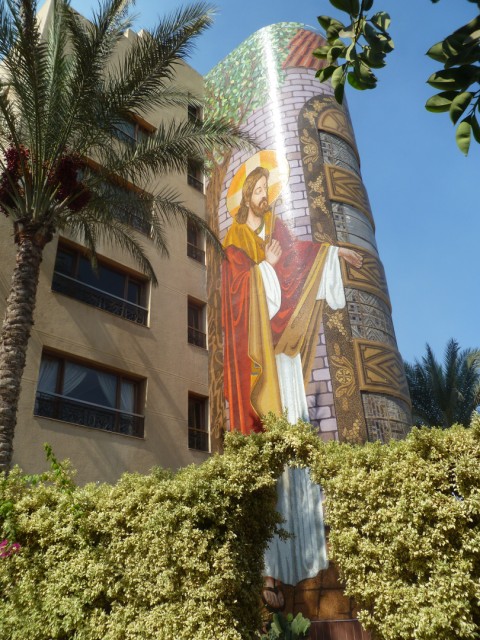
On the other side is a giant mural of Jesus.
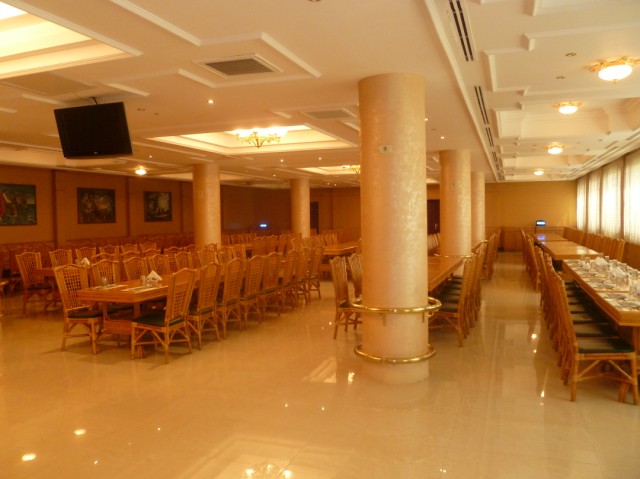
The guesthouse contains a large meeting hall. It hosted an area wide youth meeting as well as a priests’ election planning meeting while I resided there.
In the foreground is an 18th Century church, rebuilt several times since then. Behind it are the older cells for meditating visitors.
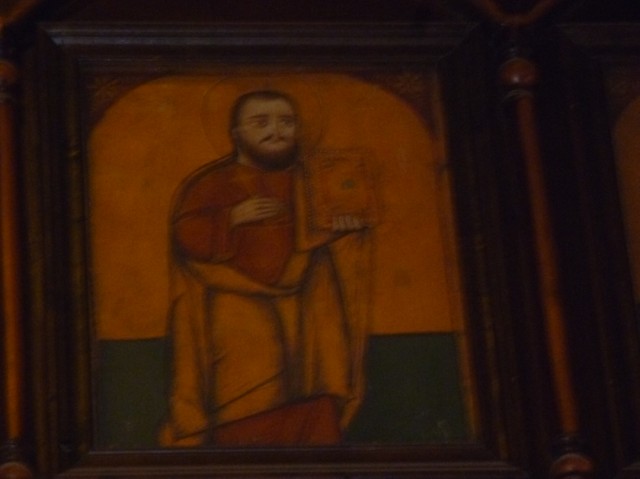
The church’s icons were painted to highlight the ‘Eastern’ character of Christianity, to highlight the religion’s diversity.
The garden contains life-size statues of the Holy Family nativity scene…
… and of their Flight to Egypt.
It also has a very romantic bridge crossing over a lagoon. The couple should take care of the Virgin Mary watching from above the waterfall.
The entire garden complex, pictured within the surrounding village farmland.
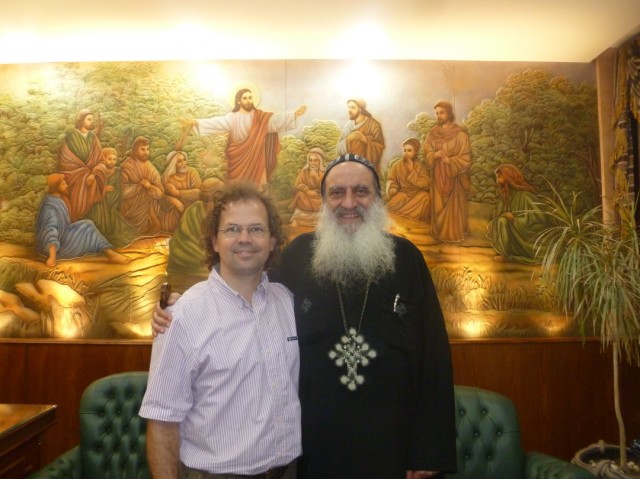
Me and Bishop Boula, inside his office at the monastery.

The monastery lies in the village of Ebiar. From the train station in Tanta to the village would cost a simple 1 LE ($0.18 US) in a microbus, and then an additional 3 LE from the village center to the monastery in a smaller tuk-tuk (three wheeled motorized rickshaw).

Ebiar has approximately thirty Christian families which make up an estimated 10% of village population. They have good relations with neighboring Muslims, though they mention the occasional harassment of a Christian girl or the under-the-breath cursing of a successful Christian businessman. Christians, like Muslims, tend to be farmers, traders, or government employees. Though they interact in all manner of relations, Christian families live almost exclusively around the church – which is not unusual in village settings in Egypt.

St. Mary Church, in the heart of the village.
The view inside the church.

The St. Mary Church is over 200 years old. The icon of the Virgin Mary is well known in the area as being a source of healing to those who intercede through it. The church is presided over by Fr. Boula, who was appointed in 1981 and is beloved by all. He is celebrated for his assistance to the poor, attracting people from surrounding villages as well as Tanta itself.

Muslims in Ebiar fall into three categories. The first and traditional category is that of a simple farmer. In this they would be nearly indistinguishable from village Christians. Over the last few decades, however, several from Ebiar now identify with the Muslim Brotherhood. Their percentage equals about 30-40% of the village. Practically every family, however traditional, has a Brotherhood member – if not a Salafi – influencing the rest. Salafis make up an additional 30% of the population, but have less influence due to their recent public emergence. Though my visit was substantially before elections, the Salafi Hizb al-Nour (Party of Light) banner flew prominently over the main road.

As I spent most of my time in the monastery complex I was unable to experience the reality of Ebiar village life. Yet through testimony and extrapolating conventional wisdom about village life, it appeared to fit the norm. Christians make up a small percentage, center their existence around a church, and enjoy traditionally good relations with a rapidly politicizing Muslim population.

In the weeks and months to come, it will be interesting to see if elections have any impact on Christianity in Ebiar. The village is traditional and poor, yet hosts a massive and elaborate Christian monastery. Bishop Boula – from Tanta – is mobilizing Christians to vote, and while he does not give instructions, nearly all Christians are motivated by worry over Islamist government. Meanwhile, the emerging political identity of village Muslims is exactly that, whether Brotherhood or Salafi.

Will traditionally good relations keep politics a separate slice of life, allowing Muslims and Christians to interact as always? Or will the language of suspicion on both sides inject a subtle poison, unintentionally damaging much? Will Fr. Boula’s love for the poor characterize Christians of the village, or will his simplicity be trumped by the grandness of the monastery?

Village life has always faced challenges, and the free exercise of politics is simply the newest visitor to Ebiar. Perhaps the mutuality, integration, and respect of traditional village life prevail over unavoidable trends. Perhaps Bishop Boula, Fr. Boula, Brotherhood and Salafi leaders, and village elders all find common cause in love and support, rather than rivalry. I bet the Egyptian nature of the village holds; elections will come and go as life goes on.

Cairo is the beating heart of Egypt, but her villages are the nation’s lifeblood. I only wish I knew more about their reality.

Categories
Personal

The Church Field Hospital at Tahrir Square

L - church; R - mosque

As clashes and demonstrations have resumed in Cairo and throughout Egypt, I have been closely following information to try and decipher what is going on. I wish soon to be able to publish a helpful summation of events, but things are happening so quickly, and in essence I remain confused about the ‘why’ of everything, as well as where it is going.

In light of this, here instead is a short human interest piece describing a video from al-Masry al-Youm, a local Egyptian newspaper, highlighting the efforts of Kasr al-Dobara Church,[1] a Presbyterian congregation one street removed from Tahrir Square, to treat the injured from the recent clashes.

This work was not unique. There were at least three areas in the square which had field hospitals, and another hosted inside Omar Makram Mosque which is a prominent feature of Tahrir. Yet the church opened its doors all the same, seeking to serve all who were in need. To note, while many churches in Egypt have adjoining clinics, this one does not. All medical supplies, in all locations, came through the donations of protestors or sympathizers with their wounded. The official count from the recent clashes count over twenty dead and over one thousand injured.

The video is a little over two minutes long, and in Arabic only. Below is a translation of both text and audio. Please click here to open the video.


Introductory Text on YouTube:

Maybe it wasn’t expected for the Kasr al-Dobara Church near Tahrir Square to become a temporary headquarters for a field hospital which treated tens of victims who fell during bloody confrontations between security forces and the army and thousands of protestors.


0:09        Caption: Kasr al-Dobara Church, Downtown Cairo, November 21, 2011

0:15        Chanting from a distance: The people want the downfall of the field marshal (Tantawi, de facto head of the ruling military council)

0:18        Caption: Victims of Tahrir in the Hospitality of Kasr al-Dobara Church

Speaker: Fayiz Ishaq

0:22        Have mercy on the tired ones. In the middle of events, this is the idea of the Bible, the idea of the church. In the middle of events we find ourselves invested in them. First of all, the church is downtown, in Tahrir Square, and this is a miracle. The church was built in the late 1940s when it was very difficult to build churches, and perhaps the reason for being here is revealed now, being so close to events.

Speaker not named, female doctor:

1:13        We knew there was pressure in the square, so we came yesterday around seven o’clock and opened the field hospital. For the first two or three hours we mainly distributed supplies. There were lots of people, and if the other field hospitals didn’t have supplies we’d send them out – tools, syringes, bandages. Then people discovered there was a field hospital here and began to come. In the first two or three hours there were about eight cases with simple injuries. By about 2:30 in the morning we heard they attacked the field hospital in the middle of Tahrir, and the doctors came here. They brought all their things and we set up three zones – here we dealt with the cases that were easy to treat, not dangerous. Over there we had two zones for the critical cases which required greater concentration.


It would be very interesting in the days to come to speak to church leaders and those involved to know more. If possible, I will relate these stories later. For now, it is good to see a church involved in its community, however temporary and extraordinary this community was.


[1] If you click on the link, the page will have a map of the church. Drag the picture down with the curser and you will soon see Tahrir Square to the north, with a large administrative building inbetween.

Categories
Personal

Sign of the Times

Exiting our local metro station the other day I saw this sign posted above the entrance:

It translates: The hijab (Islamic head covering) is a religious obligation, just like prayer. Cover yourself before you are held accountable.

That sounds ominous, but it can read that the holding accountable is done by God. Still, in some countries there are groups of religious police. It is interesting to note this sign is posted without any reference to its author. Muslim Brotherhood? Salafi groups? Unknown.

Is it a warning, a reminder, or an encouragement? At the least it is a sign of the times.

Categories
Personal

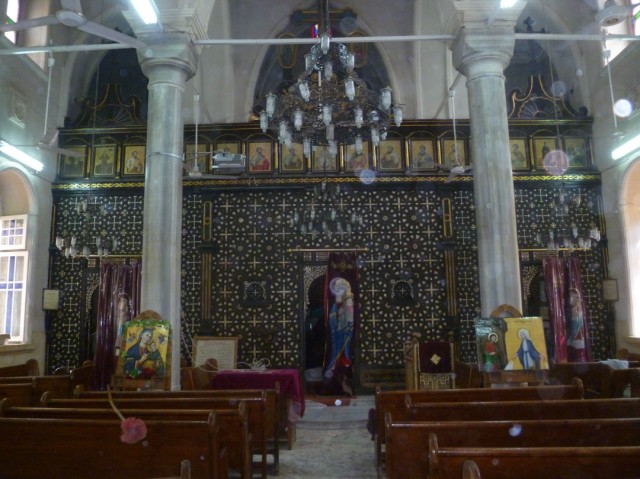
Corridor 18, Plot 86 – A Coptic Funeral

I woke up this morning to a troubled phone call from a friend. His mother, with whom he is very close and of whom he is the primary caretaker, died sometime during the night. There were only a few hours until the whirlwind of a Coptic funeral began.

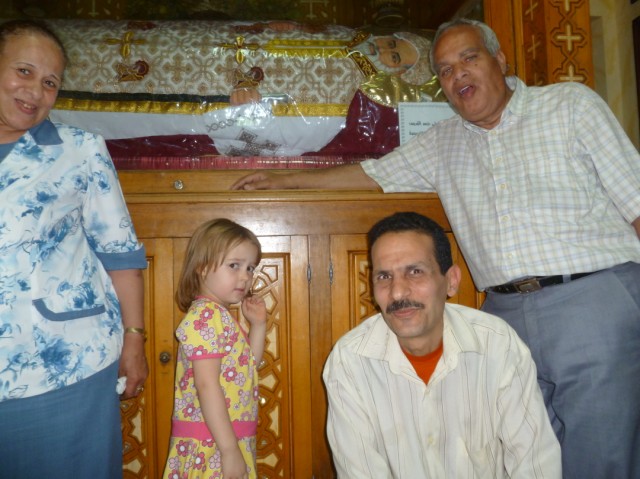
My friend, at the level of my daughter, during happier times

He told me the prayer service would begin at 11:30am, and I arrived with mutual friends having met coincidentally at the microbus line taking us into a poorer area of Maadi. St. George’s Coptic Orthodox Church is a smaller structure sandwiched between commercial buildings along the route, and was where my friend and his family worshiped for many years. We sat in the courtyard waiting for the main group to arrive.

Around noon the family entered. The women were dressed completely in black; several were wailing. The men were more subdued, and a number carried the casket into the church, placing it on a platform in front of the iconostasis, behind which is the sacramental altar. When the priest arrived, mass began.

Mass followed its basic structure, including recitations of the Lord’s Prayer and the Nicene Creed. One gentleman read from the resurrection passage of I Corinthians 15, while my friend labored valiantly through the reading in John where Jesus states he is the resurrection and the life. The priest reminded that all will die, and our reaction should be to prepare now to face judgment. The traditional Egyptian funeral greeting – ‘the remainder (of the deceased’s life) to your life’ – is suspect, however, as it posits a life ended before its time. Death is only a door to eternity, he clarified, in which there is no remainder.

At the close of prayers all exited, with the men carrying the casket to load into the hearse. Surely enough, its license plate read ‘Cairo, under request’. This was explained to me previously in the context of the Coptic protest march from Shubra to Maspero, in which some wore white garb stenciled with the hearse’s label signaling their readiness for martyrdom. Prophetically, many of the protestors did die; a moving memorial tribute march occurred yesterday. A video news clip can be seen here.

My friends and I followed the hearse in a taxi, going downtown to Old Cairo to the Latin Cemetery. As best I could tell, there were no plots in the earth. Instead the grounds were filled with mausoleums, the cheapest of which could be purchased for 30,000 LE, approximately $5,000 US. Each unit then became the property of the family to be passed down through the generations. Caskets would be piled on top of each other until they would dry rot with the passing of time. They would then be removed, the bones inside placed in a box which would then be interred in a common area, with no special marking. Interestingly, many names in this ceremony were of foreign origin – Italian, French – though Egyptian names were prevalent also. Catholic in origin, the cemetery accepted anyone. Somewhere in history my friend’s Orthodox ancestors purchased space – in corridor 18, plot 86.

When the mourners arrived they either did not know this number or else did not know how to navigate the grounds. One in charge then quickly led the pallbearers who hustled under the weight of the heavy casket. Once there, what appeared as chaos erupted. The casket was carried into the crypt, as the wailing of the women began again. One of the male relatives had to be physically removed from inside, not wishing to depart from the beloved matriarch. Other men cried out, including my friend: Goodbye, mama. Everything happened so fast, and then the door was shut.

Whoever did so then reapplied the plastic-bag-like covering to the lock, to avoid corrosion so another body might enter, at the next appointed time. Mourning individuals huddled together, still inconsolable, but calm settled over the majority. When the priest arrived (though he had no responsibility), the men formed a greeting line around the corner from corridor 18. We walked quickly through, shaking the hands of each. We whispered condolences, but nothing of ‘remainder’. Following the lead of friends, I kissed my friend on both cheeks.

With this, everyone left. The time was about 2:00pm. The intensity of grieving must stem from the compacted burial schedule. The mother died sometime during the night; prayers were lifted by noon; she was buried only two hours later.

I cannot say why culture or religion dictates such a rapid process, but its implications were observed following the deaths at the Maspero protest. Church tradition and priests seeking to be helpful urged the families of the victims to take their bodies quickly and bury their dead. Activists on hand, however, assumed the terrible task of convincing grieving loved ones to delay these rites and have their dead undergo autopsy. As such, public record now indicates the number of dead by gunshot or crushing, under the weight of government armored personnel carriers. Fears existed these would otherwise have been swept under the rug.

My friend’s mother was no victim; there was no need for an autopsy. She was simply a kind woman who received the devotion of her family, and the appreciation of us as foreigners who were blessed on occasion by her hospitality. Women of her kin will continue to wear black for some time, and in forty days a commemoration service will be held. The moment of grief is explosive, but time is allotted for more gradual mourning.

Yet my friend is confident that death is only a door to eternity. When he called me with the news he stated, with broken voice, that his mother had ‘relocated’. With Muslims, the standard and commendable reply is, ‘God have mercy upon her.’ Copts have their own special phrase, connoting something like, ‘God prepare her for Paradise.’

The mourning is no less severe, nor the need for consolation. Hope, however, springs eternal. ‘I go to prepare a place for you…’

Categories
Personal

The Political Education of a Sandmonkey

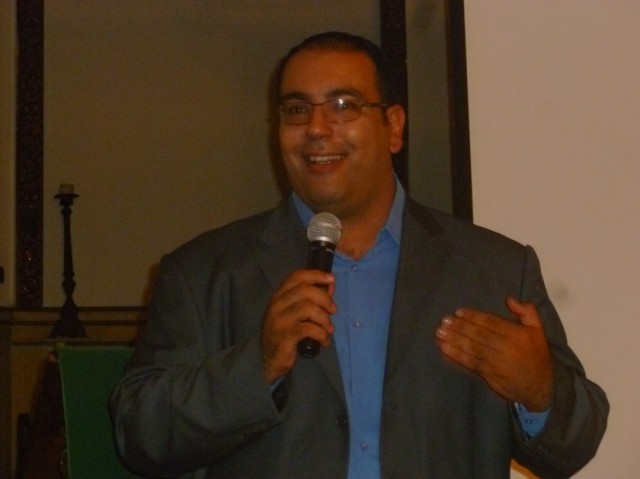
Mahmoud Salem, the Sandmonkey

As a result of the Arab Spring and the fall of Mubarak, Egypt is witnessing a surge in political participation as young revolutionaries enroll in the political process. One such figure is Mahmoud Salem, otherwise known from his blog as ‘Sandmonkey’. Salem was an early activist against Mubarak, using social media such as Facebook and Twitter, in which he tongue-in-cheek labeled himself a ‘micro-celebrity’. Since then his fame has grown electronically, having over 50,000 followers. By contrast, NBA superstar Deron Williams of the New Jersey Nets has only 33,000.

As the democratic transition has stuttered in Egypt, Salem realized the necessary commitment now was not activism alone but political and civil society participation. Though discouraged by current post-revolutionary conditions, he decided to run for office in the People’s Assembly, from his home district of Heliopolis, seeking to do something good for his son for the future of Egypt. This remark came from a political stump speech delivered in Heliopolis on November 3. The invitation was issued to the Sandmonkey, fittingly, through Twitter.

Disappointingly, nowhere near the 50,000 followers of Salem attended. By my count there were only twenty-six Egyptians, joined by fifteen foreigners. Salem spoke for about twenty minutes, answered questions for another twenty, and then left quickly at 9pm to get to another meeting.

Perhaps it served as a dry run. It is not an easy thing to run for office, or to become a politician. Until learning of the reasons for his quick exit, I figured he was either disappointed by the turnout or else reticent to ‘press the flesh’ and interact with potential voters, however few. At least he had one more notch on his belt in making campaign speeches, imagined to be much more difficult than writing an engaging blog post.

During his presentation Salem spoke of his hopes for Egypt as well as his focus on the local district of Heliopolis. The chief problem the country faces, on both the national and local level, is poor administration of work. This is seen currently in three areas: security, economy, and transparency.

In terms of security, Salem spoke of his efforts to interact with local policemen, though as a unit the police force is widely despised. They told him there has not been a great increase in crime, as popularly believed, but that the police feel impotent after the revolution to police as before. They requested, and Salem supports, an effort to equip them with cameras so that their interactions with the people are recorded. Such evidence would keep police from abusing their position, as well as protect from the abuse of false accusation. Salem also spoke of the popular committees which defended their neighborhoods during the revolution. These must continue and expand their work, representing positive community participation upon which the new Egypt should be built.

In terms of economy, Salem concentrated on the local needs of Heliopolis. Though the district is comparatively well off, it suffers as the money to pay government services throughout Egypt is collected almost entirely from the tax base of Cairo and Alexandria. More money must be retained locally, as garbage collection and hospital care in Heliopolis stands in need of improvement.

In terms of transparency, Salem spoke of the problems of bureaucracy, in which he like many hates going to government offices. The people are underpaid, and thus seek bribes, as the labyrinth-like process scuttles confused applicants from one line to the next. Instead, a simple 1-2-3-4 order should be established everywhere, to streamline movement and pay only at the end.

The question and answer period was dominated with concerns about the sectarian tensions in Egypt. Salem spoke of the role of the state, especially in the 70s when President Sadat gave a religious veneer to government that continued, to a lesser degree, under Mubarak. But he also spoke of the role of society, lamenting the poor integration of Muslims and Christians, as well as the poor understanding Muslims have of Christianity – a problem generally not reciprocated, he believed. His general advice was to encourage Copts to participate in society and politics, stating they would achieve their rights if only they properly mobilized. There are an estimated 400,000 to 600,000 Muslim Brothers in Egypt, he stated, if their extended family members are counted. By contrast, he counts twelve million Copts.

I attended this event curious to see what an activist looked like. Young, middle class, social media friendly Egyptians are credited with driving the revolution, but are increasingly marginalized and accused of serving foreign agendas. What is the reality with Sandmonkey? I have read his blog in the past and been impressed by his analysis; it was hoped a face to face encounter would be more telling.

I was surprised by his appearance. I had assumed an ‘activist’ would be a grizzled combatant. Instead, he appeared more akin to a teddy bear. His normalcy was appreciated, as was his speaking demeanor. Salem was comfortable addressing the room, but not polished, and certainly not charismatic. While admitting the difficulty in addressing a handful of people, there was little that was magnetic in his presentation. Void of rhetoric, he simply spoke what he believed, and of what he was doing to study and improve the lot of his country. He was very much a non-politician.

Conversation after the event mirrored my appreciation for his style and person, but added a resignation that he was likely to fail. I was more hopeful, if only from faith. It is true that he does not speak the language of the street and would be hard pressed to win over large crowds. Yet if he met the person on the street, could he not win him over through sincerity of heart? Can he do so sufficiently to win Heliopolis? That is the art of politics.

It is an art that surely Salem is learning on the fly. Sandmonkey has 50,000 votes won in Egypt and abroad, but the tens of thousands of Heliopolis residents need much more than a Twitter account. Salem knows this, and has thrown his hat in the ring to pursue the transformation. He, and many activists like him will soon discover if they have what it takes – experiencing now what may only pay off in the future. Win or lose, it is a necessary process for Egypt, but also a test for the revolutionary generation. They overcame their apathy and political restraints in January 2011; can they mobilize and strengthen civil society in November, in 2012, and beyond? Mahmoud Salem is among those leading the charge.

Also see: Optimism from an Egyptian Sandmonkey, written following one of his blog posts from June 2011.

Categories
Personal

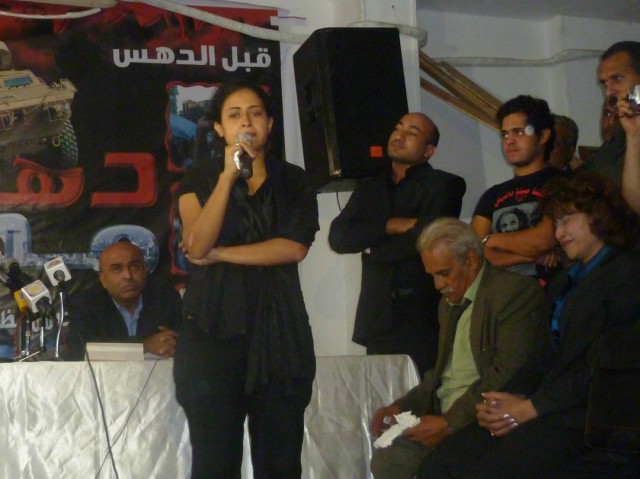
Maspero Youth Union Press Conference: Photos

Today the Maspero Youth Union conducted a press conference to put forth its version of events of what took place the evening of October 9, when at least 27 people were killed and over 300 injured in clashes following a largely Coptic peaceful demonstration. The MYU assembled testimonies and video evidence to demonstrate the innocence of the Copts in contradiction to the early official narrative. They also place blame squarely on the shoulders of the army. A good summary of the conference can be read here, at al-Masry al-Youm English Edition.

While in attendance I took a few pictures, and will provide short descriptions of the people below.

From L to R: Nader Shukry, Emad Gad, Khaled el-Belashi

Nader Shukry is a prominent Coptic journalist who writes for Watani newspaper, a Coptic daily. Emad Gad is a political strategist at the Ahram Center for Strategic Studies, as well as a founder of the Egyptian Social Democratic Party. Khaled el-Belashi is the editor-in-chief of the Badeel Newspaper, and made his offices available for the press conference. The Arabic in the banner behind them states the title of the press conference: Crushing Egypt.

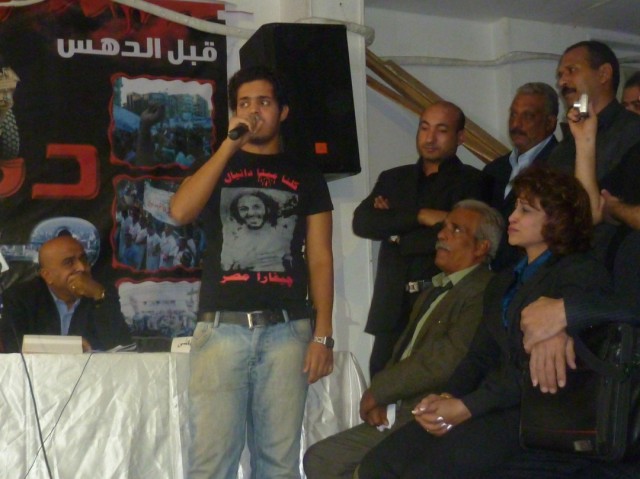
Tony, member of the MYU

Tony spoke on behalf of his friend Mina Daniel, a prominent revolutionary activist, and Copt, who was killed during the events at Maspero. His tee-shirt reads: We are all Mina Daniel, the Guevara of Egypt.

Vivian Magdy

Vivian was the fiancee of Michael Mossad, a member of MYU who was also killed during the events of Maspero. Her picture with his dead body has circulated widely in Egypt since then:

The video evidence presented by the MYU was largely available on the internet on YouTube. I am currently working on a report for Arab West Report which assembles the bulk of relevant video and provides commentary on what is visible, what is not, and what it may infer. I hope this report will be finished and available in the next few days, so if interested, please check back over the weekend or early next week.

Note: This report is now completed, and available in five parts. Please click the link below for the introduction.

Categories
Personal

Friend’s Brother Killed by US Drone

Translation: Conference of Supporters for the Imprisioned Scholar, Dr. Omar Abdel Rahman; No to killing civilians or innocent; No to persecuting Muslims or religious scholars; On the 10th Anniversary of September 11, 2001

I should take care with a word like ‘friend’. It may well be this line of work promotes a false intimacy between the subject and the interviewer. My goal is to learn, to honor, and then to share. A friendship, however, is self-contained; others may be invited in, but there is never an inside-out. If the subject has a message to share, he is inclined to be friendly, that it be given justly. I know this. All the same, the power of this line of work lies in the crafting of relationships. They may be false; I aim for them to be true. I aim also to maintain objectivity, while seeking to incline my heart.

Ahmed Omar Abdel Rahman was killed in Afghanistan on October 14, 2011, by an American drone. One of thirteen sons of the ‘Blind Sheikh’, he and his brother Mohamed followed the encouragement of his father to travel to Afghanistan to fight against the Soviet occupation. Ultimately successful in league with a chorus of such mujahideen, both foreign and local, the Egyptian contingent discovered they could no longer go home. In absentia, Egypt convicted them of plotting to overthrow the Mubarak government, at least in association with groups like al-Jama’a al-Islamiya, of which the Blind Sheikh is the spiritual head.

Mohamed was captured by the Americans when the superpowers passed the baton, and was extradited to Egypt in 2003. He spent four years in a secret underground prison in Nasr City, Cairo, with all communication between him and his family halted. Afterwards he was transferred to a public prison in Tora to the south of Cairo, current home of former Mubarak regime figures deposed since the revolution. Mohamed, however, was never a fellow inmate, as his release was granted in August 2010. He reentered society and decided to continue his education, pursuing a degree in historical literature at Cairo University.

Mohamed joined in the events of the revolution, but thereafter dedicated himself to a further goal – gaining the release of his father, the Blind Sheikh, from an American prison. It is within these efforts I met him, as well as his brother Abdullah, at a sit-in protest outside the American Embassy in downtown Cairo.

Omar Abdel Rahman, the Blind Sheikh, was imprisoned in 1993 as part of the plot to blow up the World Trade Center. He is kept, at least some of the time, in solitary confinement, though he is able to communicate with his family in Egypt. He is now old, and perhaps dying. His family sits-in day and night on the pavement outside the embassy asking the United States to allow him to return home, and for Egypt to help plead his cause.

Mohamed and Abdullah not only ask his release on humanitarian grounds, but also because they maintain his innocence. Abdel Rahman freely criticized the government of Mubarak during his residency in America. Fearing America might facilitate a triumphant return home as France allegedly did with the Ayatollah Khomeini, the Mubarak regime sent agents to the United States to incriminate Abdel Rahman. His sons argue their father never advocated violence against civilians, and is wrongly charged. In exchange for doing away with this political menace, Mubarak promised to toe the American line on Israel and other issues of concern.

I have not yet investigated these claims, nor the original case. Neither am I fully aware of the activities of Mohamed and the now deceased Ahmed in Afghanistan. Mohamed tells me they stood on the sidelines during the internecine conflict that enveloped the nation after the Soviet pullout. He states as well they were never in league with Osama bin Laden and al-Qaeda, and that their father condemned the attacks of September 11. I will need to have further conversations on these matters, as well as do my homework.

Originally, I had planned on holding the content of these early conversations until I was more fully prepared. Then the newsflash: Their brother was dead.

I have been long troubled by the use of drones, which have increased significantly during the administration of President Obama. The issue surfaced in American political consciousness when al-Qaeda strategist Anwar al-Awlaki, an American citizen, was killed by a drone in Yemen. Meanwhile a Reuters report revealed the existence of a secret government council connected to the National Security Council, which places American citizens on a ‘kill list’ to be submitted to the president. Additionally, Turkish President Erdogan states the United States has agreed to give drones to his nation, and Saudi Arabia has asked for them. Currently, Israel flies drones over its border with Egypt.

Few Americans would lodge complaints against the nature of person killed so far in drone attacks. The profile is of the terrorist, al-Qaeda member, dedicated to killing innocent civilians. I will inquire if this was true of Ahmed.

Furthermore, there can be a logic to the use of drones. Scattered in caves in far away, unfriendly nations, such militants oversee operations that directly threaten American soil. Drones are cheaper in both expense and human lives. Our soldiers need not risk the operation necessary to apprehend the criminal.

Yet I argue this is exactly why the use of drones is dangerous. A virtue of democracy is that it is less likely to promote war, as the nation’s citizens must commit to bear the cost of its own sons’ lives. The use of drones breaks this link, placing the decision to kill squarely in the hands of the government. Yes, the government is still accountable, but it is a step removed from requiring a popular mandate. Elected representatives, we trust, are judicious in who they label an enemy, or at least in their appointment of military and intelligence officials bequeathed with this task, however extra-judicial it may be. Is there adequate monitoring? Is there transparency? If the public is largely separate from decision making, are their checks on who may be killed? Without a contingent of American troops also suffering casualties, who will care, or even know, that Ahmed is now dead?

To some degree at least, I do. Upon hearing the news I called Mohamed and Abdullah and offered my condolences. They were not grieved; they believe he died in the path of God and is now a martyr in paradise. All the same, I will render my social duty and pay them a visit soon.

The question is, will I be rendering a duty of friendship? Am I being played? Was Ahmed a terrorist? Was Mohamed? Is he still? I don’t yet know, but neither do I yet feel it.

All I have experienced so far are two men among many, with families and children, who have sat outside the American Embassy since August for the sake of their father. This is a noble act, whether or not they and their father are ignoble men. I hold the questions above as a check for my objectivity. I write with this in mind, but also with an inclined heart. I have not yet fully learned, so I cannot yet fully share. But I can honor, and I wish this plea against the use of drones to be a mark of what may become a friendship. It may be false; I aim for it to be true.

Categories
Personal

Statistics on Religious Perspectives in Egypt

On September 25 al-Masry al-Youm published a very interesting survey on religious perspectives conducted by the Information and Decision Support Center of the Egyptian Cabinet of Ministers. Here are a few of the significant findings; keep in mind that Christians make up between 6-11% of the population:

  • 73% of Egyptians are religious and pray regularly.
  • 38% are open to friendships with those of other religions, while 62% are not
  • 87% would not mind having a neighbor from another religion, while 13% would
  • 78% believe there are no problems between Muslims and Christians, while 19% say there are
  • 16% wish to omit the reference to religion on the national ID card, while 76% favor it
  • 58% stated they would not vote for a president of a religion different than their own, while 36% said they would
  • 37% stated they would not vote for a parliamentary candidate different than their own, while 60% said they would
  • 65% stated they would not be affected if a cleric endorsed a certain candidate, 16% said they would consider it, and 14% said they would follow it
  • 25% stated they support the Muslim Brotherhood, 25% said they are indifferent to it, and 21% said they opposed it

Please note there are other interesting statistics in the article, but I did not include them because the percentage totals seemed to be in error. Imagining this to be the error of the article, it should add an additional grain of salt to the above figures, beyond that which should be given to statistics in general.

Observations

Should the statistics presented be accurate, however, it sheds light on Egyptian society and political questions.

  • It confirms that Egyptians are very religious in nature, which has been documented elsewhere.
  • It confirms the statement that Muslims and Christians live peacefully as neighbors in mixed communities, but confirms also the suspicion that their relationships are not very strong.
  • Assuming, perhaps wrongly, that many Christians would be among the 19% claiming interreligious problems, it illustrates a large number of Muslims, though certainly the minority, agree with them.
  • It lends confirmation that religion and identity are strongly intertwined, as the percentage of religiosity roughly equals the percentage wishing religion to remain an official national designation.
  • It illustrates a high percentage of the population is uncomfortable with political leadership being in the hands of a different religion, yet mostly at the level of the head of state. In Islamic history, while the caliph was necessarily a Muslim, members of other religions have often served as high level functionaries in government. It appears the majority of the population translates this notion into acceptance of interreligious parliamentary representation.
  • It counters the notion that religious clerics exert a great influence on the voting patterns of the population. During the March 19 referendum passed overwhelmingly by the population, opponents complained that many clerics urged their communities to vote yes, even declaring such a vote to be an Islamic duty. While 14% acceptance of a clerical endorsement is still large, it by no means characterizes the Egyptian people.
  • It confirms the strong popular base of the Muslim Brotherhood while illustrating also a similarly large opposition to their program. Upcoming elections may well be determined by which group successfully mobilizes their supporters and recruits the middle ground. With committed and organized members, however, these statistics may confirm that the Muslim Brotherhood has an advantage in the competition.


Categories
Personal

In Aftermath of Maspero, a Muslim holds a Cross

Just to pass on briefly, with no verified authenticity or knowledge of details, here is a picture taken of a solidarity demonstration over Christian deaths at Maspero. If a Salafi, as the original link asserts, it would represent a very necessary coming together of two sides almost completely isolated from each other. May they be brought closer, though through other means than this.

Categories
Personal

Marinab, Maspero, and Faith on the Earth

Please note: The following was written a few days ago following a largely Coptic protest at Maspero. Obviously, it must be reconsidered in light of the horrible events of this evening, in which several were killed. All the same, this should do well to set the context for what happened today.


Outraged at the burning of a church in Marinab in the governorate of Aswan, over 1000 Copts and Muslim supporters marched in Cairo on October 4, 2011 from the heavily mixed Muslim-Christian neighborhoods of Shubra to the Court of Cassation in Ramsis. Afterwards, several hundred moved to the Egyptian Radio and TV Building in nearby Maspero, announcing a sit-in at the site of several previous Coptic protests.

The Setting

Unfortunately, the immediate spark that ignited this protest in Marinab is not at all clear. Many if not most demonstrators believed otherwise. A common interpretation claims  extremist, likely Salafi, Muslims surrounded a church and torched it, besieging their minority Christian neighbors in an effort to keep them from having a place of worship and perhaps to drive them from the area. This despite the fact that local Copts possessed official documents authorizing building renovation.

A full report on what transpired will be published soon, based on the findings of Cornelis Hulsman and Lamis Yahia during a visit to Marinab. What is emerging, though, is a far more complicated tale. While it appears the Christians of the village may have had authorization, this may have been gained on false pretenses. Or, it could have come through a ‘deal’ made between the governor and the deputy priest of the bishop to keep quiet a conversion case – which often result in sectarian tension – in exchange for authorization to construct a church. Stay tuned for full analysis of documents and testimonies, but regardless, the burning of the building occurred on a slow boil.

Christians in Marinab had long used a nondescript structure as a church, which was well known to the Muslims of the village. Negotiations had been underway to tear down the building and replace it with a formal church building. Muslims objected not to the conducting of religious rites but to the physical markings of church architecture. Confident in their authorization, the Christians began to build. Then, in light of the security void in the region following the revolution, they began to exceed their mandate.

Muslims brought this to the attention of authorities: Christians exceeded the approved height of the structure, and added four unauthorized domes to the roof – typical of Coptic Orthodox architecture. This was not disputed by local Copts, and they began to dismantle. Two of the domes were removed and the walls lowered. Copts stated this required careful, painstaking effort, lest the building collapse. Muslims felt they were moving slowly, stalling, and perhaps deliberately leaving some domes untouched.

On Friday, September 30, something set the Muslim community off, which will require more investigation. Perhaps fearful Christians would circumvent agreements and get away with it, a group of 200-300 youths took the matter into their own hands, using simple tools to tear down the building. This eventually swelled into around 1000 strong, and security looked on doing nothing. At some point some Muslims arrived with gasoline, and used it to set the structure ablaze. As the church-to-be is in a densely populated area of the Christian ‘quarter’, the flames spread and consumed much inventory in the neighboring warehouse. Christian properties were also damaged, and looting took place. The general sense – which can be disputed – is that Muslims wished to target the church, and some wayward youths engaged in violent excess. It is clear, however, that Muslims could have done far more damage to Marinab Christians had they wished, and did not do so.

There is nothing redeemable in the actions of these Muslims, as their Islamic chauvinism led them first to oppose a physical Christian imprint on their village, and then to take the law into their own hands. Yet perhaps law is a misnomer, for it seems both Christians and Muslims abused its absence. Application of law had long been a neglected feature of Egypt; after the revolution the ongoing security void is a deep mystery.

The Protest

It is this lack of government that gives legitimacy to the Coptic protest at Maspero. Marinab is the third church to be attacked since the revolution, following Atfih and Imbaba. Christian hopes raised during the revolution, which appeared to portend a new spirit of cooperation and national unity, are being dashed as frustrations with the former regime re-circulate, and perhaps increase. Yet the response of anger to the Marinab attacks reflects a lack of understanding and a jumping to conclusions. Neither the state nor the church provided (or were able to provide) the depth of complexity and shared complicity which led to the unjustified Muslim attack, however much both groups felt they needed to take the matter into their own hands. Yet a simple narrative of persecution and extremist opposition is more easily digestible.

Unfortunately, it is a narrative which is polarizing, even as it bears marks of true suffering. It is a tale that isolates Christians, even as it is self-fulfilling. It was also clearly evident at the Maspero protests.

I was in attendance with Cornelis Hulsman, who supplies many of the remarks which follow. I also know a few of the Coptic organizers, and find them to be good people who are not manipulators. Yet that might not be true of all.

Whether or not they possessed a true history of the Marinab conflict, Fr. Philopater, Fr. Mityas, and Fr. Abram Suriyani, a monk, are all Coptic Orthodox clerics with strained ties to church hierarchy. They, along with other priests from Shubra, Ma’asara, Beni Mazar and elsewhere, appeared to be coordinators. While they were celebrated by many, followed by large gatherings, one protestor in particular upbraided the priests as bringing trouble on the Copts. He said this while repeating the frequently heard Coptic chauvinism of being ‘pure-bred’ from the Pharaohs, as opposed to the Muslims of mixed Arab blood.

Since the revolution there has been a movement among Christians to rejoin society as opposed to remaining walled in the church leaving Pope Shenouda to represent Coptic interests. This, I find, has been a largely positive development, even as it imitates the popular activist techniques of protests and sit-ins. The above priests appear to reflect this trend, and constantly remind both Copts and media their presence does not infer church sanction of the event. I do not know the priests well, and must be reticent to cast accusations. Yet an activist by nature is often single-minded; as he may have the tendency to neglect greater context, he may also face the temptation to simplify a narrative. This is no sin, yet it may not reflect wisdom.

Their fellow activist, Rami Kamel, general coordinator for the Maspero Youth Union, received a phone call from the office of Prime Minister Essam Sharaf, seeking to know their demands and sit for dialogue. He refused, stating he would offer demands the next morning. At another point during the evening Fr. Philopater was removed by security, apparently for negotiations, but later returned and the sit-in continued. The entire time the Maspero area was surrounded by military police and central security; veterans of public demonstrations we know – one an activist, the other security – conjectured appearances suggested they would violently clear the area.

Meanwhile, the Maspero Youth Union had drawn up and printed demands, reflecting a simplified and exaggerated narrative. It stated, for example, that though noble Egyptians have followed the news of the Marinab church, ‘we Copts follow with weeping hearts as our churches are daily exposed to burning and destruction’.

Furthermore, a threat was issued: ‘We know full well that the events of Marinab will not be the last as long as the military council and those running the country remain incapable of protecting Egyptian Copts’ churches and the lives of their sons. … As such, we have no choice but to struggle for our just cause by taking all possible measures of political escalation until we gain all of our squandered rights.’ They then list the following six demands:

  1. Arrest of criminals who incited and caused the incident (in Marinab).
  2. Resignation of the Aswan governor and investigation into his inflammatory statement to the media against the feelings of Copts, and of his lie about the truth of what happened.
  3. Immediate investigation of Officer Ahmed Fathi, security detective in Edfu, and the security director of Aswan, and their collusion in the sinful aggression.
  4. Rebuilding the church of Marinab on state expense.
  5. Rapid issuance of a unified law for building houses of worship, as well as laws to criminalize incitement and sectarian discrimination.
  6. Setting a specific timetable to implement the above mentioned demands.

The October 4 sit-in was in fact an escalation, though no more than the Maspero Youth Union had organized in the past, and no more than countless other groups have done since the revolution. Taking up residence in front of the Radio and TV Building, 1000 Copts lingered here and there, unimposing in terms of sheer mass, but blocking the busy Cornish Road along the Nile River all the same. Hundreds of security personnel actually stopped the traffic, with tension in the air if their presence was to deter an attack against the Copts, as happened during their last sit-in, or in fact to remove them.

A sit-in protest requires large numbers to solidify presence, and a few Copts murmured their disappointment at the turnout. They pressed forward all the same, but most appeared subdued, even dulled to the effort. Some said people were getting tired of protesting.

Not all. There appeared to be a group of fifty or so, never organized as such exactly, but asserting themselves right at the front lines of the security cordon. There they would chant in their faces, provocatively – ‘Muslim, Christian, one hand!’ or even ‘the people want the fall of the field general!’ (i.e. Tantawi, the head of the ruling military council). One protestor even went as far as to slap a policeman in the face. Showing great restraint, the army removed him without incident.

The restraint did not last, and the agitators continued. Earlier in the day Fr. Philopater urged the Copts to be peaceful, and several stated security was itching for conflict as an excuse to remove the protestors, and slander their reputation in the process. Yvonne Mossad, a media coordinator for the Maspero Youth Union, showed great courage to put herself in the middle of nearly every run-in, urging Copts to back down. They did not always, and in one flare-up the military police began hitting a protestor with his shield, and gunshots were fired into the air.

This was about 12:30am, and we had already made the decision to begin leaving in order to catch the last metro at 1:00. At the sound of gunfire everyone scampered chaotically, but things calmed down again. We left, hoping for the best, hoping the sit-in would proceed peacefully. As it turns out, I wish we had stayed, though it was probably for the best we left.

According to media reports the sit-in was dispersed forcibly around 1:00am. Other sit-ins have been dispersed by security, so there is nothing anti-Coptic in the government response. Force, to be sure, is required when resistance is met, even if that resistance is passive. Having left the area, we cannot comment on the behavior of the protestors. One video circulating afterwards on the internet, however, clearly shows an excess of violence. Even if the man in question was one of the agitators, surely an internal military investigation will be forthcoming.

Reflection

In a certain town there was a judge who neither feared God nor cared about men. And there was a widow in that town who kept coming to him with the plea, ‘Grant me justice against my adversary.’

For some time he refused. But finally he said to himself, ‘Even though I don’t fear God or care about men, yet because this widow keeps bothering me, I will see that she gets justice, so that she won’t eventually wear me out with her coming!’

And the Lord said, ‘Listen to what the unjust judge says. And will not God bring about justice for his chosen ones, who cry out to him day and night? Will he keep putting them off? I tell you, he will see that they get justice, and quickly. However, when the Son of Man comes, will he find faith on the earth?’ (Luke 18:2-8)

What then for the Copts of Egypt? How should those in Marinab be judged, or in Maspero, for that matter?

Let us imagine the Coptic villagers to be completely innocent in this case – victims – as investigations may yet conclude. Certainly their situation is not easy, and one Muslim in Marinab allegedly told his neighbor, ‘May God rest the soul of Islam. If we let this church be erected then Islam is buried in this village.’ Testimony on both sides seems to point to a shared causation, if of a different manner, between Muslims and Christians, but in such an atmosphere, Christians may wonder if they are equal citizens under the law. Difficulty in building churches has been long established.

The history and commonality of this difficulty should not numb the reader, as if it is a normal, simple inconvenience. Add to this slight the tales of discrimination, educational and media bias, and the pressures of a growing extremism, and the picture is painted of the Copts as the widow in the parable, calling out for justice. The sit-in at Maspero was not just about Marinab, it was about accumulation of grievances and frustrations. It is the experience of a community; legitimate or not it is the perception of many. Not a few Muslims agree with them as well; there are issues between Muslims and Christians in Egypt.

Allow a minute for the conspiracy to be advanced to undo this statement. Under Mubarak, many say, the security apparatus would play with religious tensions for political gain. These many now attribute the attacks in Atfih, Imbaba, and elsewhere to the remnants of the Mubarak system seeking to preserve their power base by discrediting the revolution. Enflaming Muslim-Christian tensions is among the best ways to do so both home and abroad. Noteworthy is the fact that the Aswan governor was a Mubarak appointee who maintained his job. Could the church insistence in building a church – with domes – come from subtle suggestions quite aware it could spark tensions? Could the individuals who brought the gas to burn the church simply have been paid thugs – as well as those who thereafter looted? It is unlikely investigations will uncover anything of the sort, but within a confusing post-revolutionary setting, questions of all natures are asked, and linger.

Either way – under a dominant Islamic chauvinism or a lingering security conspiracy – Copts have been crying out for justice for a long time. The parable encourages them to continue, for God is not an unjust judge. Surely he will grant respite – quickly, it assures – and without a begrudging heart. Do Copts believe this? Or has God proved himself unjust, unhearing, uncaring? Many Copts seem to believe God hears and answers better in America or Europe, for they are leaving their villages for cities, their cities for the capital, and the capital for refuge abroad. As one Copt stated in Maspero, ‘Egypt is rubbish; a garbage country!’ However difficult the plight, this is the voice of one having long given up on God; is he not the judge of every nation?

It is not that Copts must only pray. It is right for them to strive politically. It may even be right for them to demonstrate. Yet the question of Jesus must cut them to the marrow: When the Son of Man comes, will he find faith on the earth?

Did the Copts in Marinab call out for justice, or did they seek to manipulate for their interest? Did the youths at Maspero carry forward the cries of previous generations, or did they take justice into their own hands? Yes, both are dealing with reality as best they can, as normal efforts, they find, are frustrated. Yet are they acting from faith? Are they acting in accordance with faith? Faith changes reality. Or, is God unjust?

It is a frightening question. Answers are not easy. It calls for humility and introspection. It calls for creativity and action. It calls for hope and love.

The Jews to whom Jesus addressed his parable were waiting for the restoration of the kingdom. They are still waiting. Their picture of justice – a people governing their own land – is surely commendable, but was ultimately faulty. They cried to God for centuries; some abandoned this for increased moral purity, others for political escalation, still others for isolation from society. Each of these responses is current to some degree in Egypt today. Yet all of them failed. The kingdom never came.

At least not as they expected it. Jesus’ kingdom was of the spirit, and it remains established around the world, including Egypt. What does God intend, then, as justice for the Copts? It remains to be seen. It is proper for Copts to pursue all manner of human justice, as long as they recognize this is not necessarily the same as the vision of God. His justice – whatever its fulfillment – is coming quickly. It only remains for Copts, and all Egyptians, to maintain faith on the earth, and to act accordingly.
Categories
Personal

Customary Formation of Politics: Muslim and Christian Examples

The Pink Finger Signals a Vote Cast

Generally speaking, the customary rules of politics issue and evolve from hard earned consensus historically and informally negotiated among public figures and society. Eventually these are crafted into constitutions and laws to formalize the political system along grounds to which all agree. The success of the political system rests in the degree to which all political forces submit to the system and recognize its equity.

Under the nearly thirty year presidential administration of Mubarak customary rules of politics did exist, and political forces largely submitted to the system. Even the Muslim Brotherhood, though outside the formal structure of politics, acceded informally to the relationship between society and state. Few, however, either inside the system or outside it – and the vast majority of the Egyptian population was outside – recognized its equity. Eventually this disquiet, among many other factors, led to the Egyptian revolution.

Now eight months into the transition to democracy, the rupture caused to customary politics has not yet been repaired. Egypt does have a liberal democratic tradition to recall, but its benefit is largely in legacy, as the experience was lost through successive autocratic presidencies. Meanwhile, there is great debate over the nature of the constitution to come, let alone the specific formal rules of the political system. Depending on the rhetoric, civil and Islamic political forces either agree in substance on nearly all but nomenclature, or else have vastly different visions for the future polity of Egypt. This is natural, for building anew a political system forces even the most fundamental questions to be reconsidered. Who are we, and how will we get along to balance our interests?

During this interim period one of the old rules of the system was recalled, though perhaps customarily adjusted to new realities. It has long been forbidden in Egypt for a political party to be based on religion. This was one of the difficulties facing the Muslim Brotherhood, and caused their candidates for parliament to formally run as independents. There was no deception, for everyone knew the nature of the arrangement, which also signaled essential Brotherhood submission to customary politics, even as they railed against it.

Post-revolution, then, though it was clear the Muslim Brotherhood would no longer be an outlawed political force, what structure would emerge to legalize them, and others like them? Guarding the fabric of religious life and protecting national unity, the ruling military council maintained the law forbidding religious political parties. The nuance which emerged, however, allowed for political parties with a religious reference. The difference is not at all clear, but a practical result has been an effort to enroll at least some Christians into the new Islamic-reference parties. The Muslim Brotherhood’s Freedom and Justice Party, for example, includes a Christian vice-president, and boasts 100+ Copts among their 10,000 members. Though I am unaware if other Islamic-reference parties also have Christian members, the precedent set for the Freedom and Justice Party of the Brotherhood has led also to a party for al-Jama’a al-Islamiya and various Salafi trends. No semblance of a Coptic party has yet emerged, but the Free Egyptian Party, financed by wealthy Coptic businessman Naguib Siwaris, is composed 30% of Copts, far above their percentage in population.

Like their Muslim counterparts, Egyptian Copts have been long depoliticized. Many are fearful of the Islamist developments in politics, at least partially explaining their membership in the Free Egyptian Party, representing liberal trends. Yet the effort to draw Copts further into the emerging political system has been slow going, and leads also to an anecdote illustrating the in-flux nature of customary and legal politics.

My family and I attend St. Mark’s Orthodox Church in Maadi, Cairo. My wife regularly attends a mostly women’s Sunday School meeting, and on this particular day it advertised the speaker would address the topic of ‘Raising Political Consciousness’. Eager to hear how the topic would be presented, I also joined in the meeting.

The speaker was a member of the church, though not of the meeting, and delivered an engaging lecture on the basics of civics. There are different types of political systems, he explained, and went through the basics of American democracy, various European examples, as well as the Egyptian system under President Mubarak. He explained the technical aspects of the new election laws, in which half of the representatives would be selected in a winner-take-all election, and the other half in a list-based party arrangement. As an American, I recognized our standard winner-take-all individual candidacy approach, but I took closer interest in the unfamiliar list-based system, used more frequently in Europe.

Under this arrangement, political parties submit a list of candidates for election, which may be done in coalition with other parties. Voters then select one entire list among the different choices offered, and the percentage of votes received determine the percentage of candidates elected. If the list contained ten names and this party received 30% of the total vote, for example, the top three candidates named on the list would be victorious.

It is still unclear how the combination of winner-take-all and list-based elections will exist side-by-side, and most political parties are unsatisfied with the system issued by the military council and interim government. Yet the speaker tried to educate the group about a possible deception which might occur as parties lobby for Coptic votes, especially on the part of Islamic-reference trends. For example, the Freedom and Justice Party (not specifically named by the speaker) might place a few of its hundred Coptic members on their official list, and proclaim how they are not just a Muslim party but also seeking election of Coptic representatives. Yet if these Coptic names appear near the bottom of the list, it will be extremely unlikely they will reach the percentage threshold necessary to be elected. If a party placed a Coptic candidate near the top of a list, or in the winner-take-all election, that would be a different gesture entirely.

In conclusion, the speaker recommended that his listeners do indeed take part in shaping the emerging political system, especially as many are fearful their rights could be trampled upon if the next government is Islamic. Up until now the lecture was basic, educational, and a very valid plea to overcome lingering de-politicization. When he stated clearly they should enroll in liberal political parties, however, my American ears began perking up. When he further mentioned the political party of his participation, and invited anyone to come and take literature about it, my eyes began to bulge.

In American politics it is both customary and illegal for churches to endorse particular parties or candidates. There is customary leniency on issues, but the non-profit and tax-exempt church is forbidden from using its religious leverage to serve a political cause. As stated earlier, the laws in Egypt are still emerging, and customary procedures are under debate.

To be certain, the literature made available was rather innocuous. It stated very little about the particular party, and instead was a general call to recognize politics as an essential part of life – the best means to defend your rights. In fact, it specifically states,

It is not important that you become a member in a party, it is important that you work for the benefit of your neighborhood.

Furthermore,

If there is any respectable man you would be honored to have him represent you, encourage him to nominate himself. If the ideas of any party impress you, join it.

By no means was this partisan literature, yet the name, logo, and contact information for the party were clearly and prominently visible. The speaker was careful not to be forceful in his invitation; rather, he was almost sheepish. He stated later, however, that he did not take permission before making the party literature available. No one in the audience seemed to be offended; some approached for literature while others left and went their way. One person I asked later did state that the action was a bit controversial, and may have been uncustomary, but that it was not a big deal.

St. Mark’s Orthodox Church in Maadi is in an upscale neighborhood, and many of its members have lived or studied in foreign countries, and are familiar with (and envious of) their political cultures. To a degree this may help explain the hesitation experienced in the meeting. Yet according to many media reports, such decorum is completely missing in many of Egypt’s mosques. This is not surprising, given that Western, Christian influenced societies have largely accepted the notion of separation of church and state. Many Muslims, however, and especially Islamists, believe that politics is an essential component of religion, as Islam encompasses all of life.

The upshot was most visible during the constitutional referendum of March 19, in which the population was asked to either validate or reject the military council roadmap to amend the current constitution, paving the way for legislative elections, which would select the council to draft a new constitution, followed by presidential elections.

Though it is true the referendum was somewhat hastily organized, and the consequences of either choice were not clear, many Islamist leaders urged Muslims to vote ‘yes’, with a few even declaring it to be a religious duty. Not a few liberals also voted yes, finding the rapid return of the military to its barracks to be the best outcome of the transitional process. Still, the religious influence was unquestionable (though probably not decisive), and 77% of voters approved the referendum.

Following the approval of this roadmap, liberals realized the gain made by Islamist parties. Weak liberal penetration into the countryside and among the poor was well known, and likely Islamist success in elections was admitted. Yet the roadmap dictated the current uncertain rules of politics during the transition would be formalized by the coming parliament. If the legislature would be dominated by Islamists, perhaps they would craft laws to their advantage, and in establishment of an Egyptian Islamic identity. Or, maybe they would not, and would respect the will of the revolution and promises made to liberal parties to establish a civil democratic state through cooperation. Egyptian politics has since been dominated by the elusiveness of this answer, with most liberals leaning toward distrust.

America endured thirteen years from its declaration of independence to the ratification of its constitution. This period was full of sharp rhetoric between federalist and anti-federalist political camps, each with a radically divergent belief on the best shape of governance. America inherited a customary political process from England, but its formalization was much more difficult, negotiated in light of her particular history. In the end the federalist position triumphed, and political forces fell in line. Significant evolution in American democracy has continued to the present day.

It is hoped this history may be of encouragement to Egypt. Yes, issues being discussed now are of vital and foundational importance. After seven months, however, the renegotiation of customary politics into formalized structures has only just begun. It is contentious, and it should be. It requires, however, all parties to play the game, and eventually to fall in line. If not there will be either a reemergence of autocracy or a descent into anarchy. Politics being the art of compromise, though it may take significant time, all things being equal, Egypt will find its way.


Categories
Personal

Interview with the Maspero Youth Union

Demonstrations in front of the Radio and TV Building, Maspero, Cairo

Fadi Philip is a 26 year old veterinary physician, but his priority of love and labor is as an activist with the Maspero Youth Union (MYU), for which he serves as English language media spokesman. I became acquainted with Fadi and the MYU through several visits in May during their sit-in protest at the Maspero Radio and Television Building in Cairo, protesting the Imbaba attacks. On this occasion I introduced Fadi to a visiting researcher from George Washington University, and took the notes necessary to record his views here. To note: this interview was conducted in early June.

What is the philosophy of the Maspero Youth Union?

We aim to be a political face for Egyptian Christians, doing so away from the church. We are not trying to be leaders in place of the church, but rather to show people they do not need to run to the church when they meet with difficulties.

What is the role of liberation theology in your movement?

After the Egyptian revolution many Christians have adopted liberation theology, but in Egypt today, right and wrong are determined in the street. The problem is that the church will not go into the street. Christians aim to have a secular state, but how can we say this when we run to the church to solve all our problems?

Do you want to change the church?

The problem is that the Christians do not have leaders in any significant way. We must have these leaders, but we must have them outside of the church.

Is this then a rejection of the church?

No, what is necessary is that Christians get involved in politics, but when the church gets involved in politics things become very complicated. Some priests of the church are with us, but others are worried our actions could increase fundamentalism among Muslims, who might get upset when Christians do not simply sit quietly. Unfortunately, many Christians have become negative, thinking that they can move God and change things simply by praying and singing. I believe praying and singing is important, but we must do more.

What about the opinion of Pope Shenouda? Didn’t he speak against your sit-in?

Well, the pope is not the leader of the MYU. In any case, we don’t believe he really spoke against our efforts, but that he was pushed to say what he did.

What convinces you of this?

Our representatives went to the cathedral and asked him his opinion. He did not ask us to end the sit-in, but that he was afraid his sons and daughters there would be in danger. Furthermore, when Bishop Yu’annis related his message, he quoted the pope as saying ‘And God is the one who makes prosper.’ This is a very well known army phrase, used after all their public statements. It is not an expression the pope would use.

In any case, the church is trying to avoid problems, and many people believe that problems can happen when Christians are in the street. But we believe there is no freedom without cost, and we are willing to pay the cost.

By identifying yourselves as Copts do you identify yourselves as a minority, or against your Egyptian identity?

The word ‘Copt’ means ‘Egypt’ etymologically, but yes, it is true we are working for Coptic rights. We are a Christian movement in what we work for, though, not in our composition. We have Muslim members, though they are a small percentage. Yet we do receive much spiritual support and encouragement from Muslims, as well as media support from personalities like Nabil Sharaf al-Din and Fatima Naout. It must also be mentioned that several Muslims came to defend our group when we were attacked.

Currently, though, we do not have open membership, and there is no particular profile about the Muslims who have joined us. At this stage we are less interested in enrolling those who ‘love’ us in favor of those who know our issues well. Currently, we are pursuing legal registration as a human rights organization, and not as a political party.

What is the composition of your group?

We are between 200-300 people who bear some sort of responsibility within the MYU, each of which oversees between 10-15 people. We are not looking to expand too quickly, but we have opened branches in Alexandria, Ismailia, and Asyut. We will look into expanding our membership once we have completed the registration process.

What is the role of Fr. Philopater and Fr. Mattias?

These two priests have been with us from the beginning, when the MYU was created by merging several groups, including the one around the magazine they founded, al-Katiba al-Tibiyya. Though they are with us, we do not constitute that they represent the church in being with us. They have joined us as Egyptians. Yet at the same time, in being a priest they do confer legitimacy upon us in the eyes of many Egyptian Christians.

It is not true to say they work as ‘double agents’, but they are trying to work on both sides – the people and the church. They can certainly help us with inner church workings.

Fr. Philopater is a very outspoken person. During the Mubarak regime he spoke harshly against it and was suspended for one year. Yet he would not accept to be sent abroad, such as to America, in the manner which Fr. Marcus Aziz was sent to serve the church in Australia. To be clear, though, both Fr. Philopater and Fr. Mattias are still practicing priests.

al-Katiba al-Tibiyya is very popular in the Coptic Diaspora. Is the Maspero Youth Union connected to the Diaspora as well?

al-Katiba al-Tibiyya is concerned about  what is happening, speaking the truth as it is; I believe it is also popular here in Egypt. People living abroad do not know what is happening here, but they trust the magazine since those here do.

We do have connections to Copts living abroad, and we have met with Michael Munir and Michel Qilada, for example. We will not push anyone away from us, and all are welcome to cooperate with us. Yet there is a problem in that many of these call for international protection for the Copts, wishing for UN involvement and calling for sanctions. This, however, does not meet with our needs. Perhaps they can help with human rights issues.

I reject the call for international protection because I will not risk the security of Egypt for my own security. Some Muslims hear ‘international protection’ and understand it to mean what is happening in Libya. These might then interpret that Copts are looking to make trouble, attack us, and this will harm the stability of Egypt.

What can the Diaspora do to support the MYU?

The most important thing is media coverage. 60-70% of the revolution’s success was based on the media’s attention. It prevented Tahrir Square from becoming Tienamen Square. Good media overage can help overcome the general illiteracy about Christian rights in Egypt.

Young Egyptians abroad were helpful with the revolution. Are you connected to them?

The image of the revolution being made by the young was just a play. The revolution was not made through the internet but from the hatred directed toward the Mubarak regime and its inept handling of the protests.

Yes, many Egyptians abroad ‘felt proud’ to be Egyptian, but did they feel any pressure or help in any real way? Not really.

What is the final summary of what you would like to say?

We have discussed the most important matters. I would like to emphasize that we are looking to take pressure off the church. The greater our success in representing Coptic issues, the less pressure the government will put on the pope concerning us.

Thank you very much for your time.

Thank you, it was my pleasure.

Categories
Personal

A Window into Character: The Conflict at Maspero

The Coptic demonstration prior to the attack

All men have ideals; it is when they are tested that they are revealed as true or false, or somewhere in-between. Psychologists have identified the ‘fight or flight’ response to conflict: One either meets it head on or withdraws from the scene. Neither one nor the other is wisdom necessarily, but rather the gut reaction to a situation of danger. Such urges presumably can be resisted in either direction, but decisions made in these few seconds will either haunt or honor the character of a man.

On May 14 the Coptic sit-in protestors at the Egyptian TV and Radio Building at Maspero, along with their Muslim sympathizers, faced such a challenge. I have written about this previously here, and in more detail shortly thereafter here. In an effort to disperse their sit-in ‘thugs’ led by certain Salafi Muslim elements attacked their location, using guns, knives, stones, and Molotov cocktails. For this text I have had opportunity to speak with Fadi Phillip, one of the leaders of the Maspero Youth Union (MYU) which called for the protest. He was on the scene, and described his role in and perspective of the attacks.

Fadi is the English language media representative for the Maspero Youth Union; as such he is not generally to be found on the front lines. Some Copts are assigned roles with security, others in the clinic. In general, though a leader, Fadi works hardest when things are calm and journalists arrive to seek a story. When the attacks began he was idle, far from the front lines, like most other protestors. As a leader he tried to spring into action, but the situation was spiraling out of control.

Quickly he ran to the front lines to inquire what was going on. Whoever he spoke with grasped his badge and seemingly rebuked him for not knowing. The MYU is well organized internally, but a sit-in attracts all sorts. This enthusiastic Copt, from wherever he came, was eager to defend the group, but he did not fall in with or recognize Fadi’s titular leadership identity.

The initial attacks were not hand-to-hand combat, but rather the ‘thugs’ taking advantage of their elevated position on the bridge and off-ramp to fire pistols and hurl Molotov cocktails. Fadi joined in with a group trying to get MYU parked cars away from the range of the attackers. With most sit-in protestors still far removed from the front lines, using keys was not possible. Fadi and others broke the windows of many vehicles to disengage the parking brake and then roll the cars to safer position.

During the altercation Fadi ran back and forth several times between the front lines and the group, which included many female protestors. On one occasion he went to the police, who were standing by in the open area between the protest group and the front line attackers. He asked them to get involved, but they communicated they had no orders to do so. He then went to the army, which was deployed closer to the sit-in site, and told them eight people were not injured. When an officer stated only that those afraid should go home, Fadi brazenly asserted that they would not desert their sit-in; they would not go home unless dead. Yet as another Copt was there also screaming at the officers, Fadi left him to make his point and returned again to the group.

At one point as the conflict was increasing in intensity, Fadi lifted his arms to heaven, recited the Lord’s Prayer, and asked that God would not allow his children to be eaten by dogs, should they be killed today. It was a strange prayer, but Fadi remembered that it was said of the Copts who died in the Alexandria bombing that after the major remains were collected, the smaller body parts were left in the streets and consumed by dogs. Before he finished praying, however, someone interrupted him and rebuked him, saying this was no time for stillness. After this, Fadi reengaged.

On his way back to the front lines he found an enraged Copt, pouring water all over himself and picking up a gas canister to run with into the fray. Fadi tried to reason with him, trying to stop him, but somewhere in his effort he was struck with a blunt object in the middle of his back. Stunned, he fell, and was disabled for a period of time. After this he left, limping back to the protest area.

From here on out Fadi sought to make himself useful in the clinic, which was now overflowing with injured. Though possessing no medical training, he was stitching wounds and bandaging gashes. He purposed to avoid head injuries, out of fear he might do more harm than good. Yet even so on one occasion he was given some sort of medical ointment, and spread it upon the head of one injured to the point of revealing his skull.

Among the injured were some of the ‘thugs’, captured by the Coptic protestors. One who appeared to be a ringleader suffered deep cuts and was brought into the clinic. Fadi witnessed how he was told that if he confessed on videotape to his crimes they would treat his wounds; otherwise, they would leave him languishing in the clinic. Under such duress, he confessed to being paid 500 LE (about $85 US) to take part in the attack.

A more serious confrontation took place when the Copts purposed to capture one of the Salafis involved in the attack. They formed a small group, rushed forward, and then snatched one from the front lines, tossing him backwards into the Coptic throng. The one who apprehended the Salafi suffered several stab wounds in the effort. Once captured, however, the protestors beat the Salafi relentlessly. Fadi relates this was due to their rage over the attack on their sit-in; a supplemental factor may have been the pent up anger over allegations that Salafis orchestrated several attacks on Copts after the revolution.

Some of the Copts tried to intervene from their Christian convictions. Others, including Fadi, intervened for more practical reasons. First, he said, they wanted to get information from him. Second, they wanted to secure proof that Salafis were involved in the attack, lest the media portray it as simply the work of ‘remnants of the former regime’, as has become a common accusation. Third, Fadi was concerned that the repercussions could be severe should a Muslim die in their custody. In his efforts to stop the beating Fadi was kicked in the groin as Copts fought each other over the Salafi. Eventually he was freed and transferred to a nearby ambulance and taken to a hospital. He provided no confession.

Eventually the police became involved, firing tear gas in-between the two groups to disperse them. The direction of the Nile air, however, wafted the gas toward the sit-in area, choking those who stayed back either to avoid clashes or to help in the clinic. At this time objects also began raining down from the apartments of residents situated above the sit-in area. This enraged the Copts further, but Fadi recognized they were tossing onions, which are a known local antidote to the symptoms produced by tear gas. He made effort to calm down his fellow protestors.

Though the tear gas did put an end to the fighting, Fadi related that the sounds of gunfire started again as the ‘thugs’ pulled back and the tear gas clouds obscured vision. The Copts did not know if this was from the ‘thugs’ or the police, and Fadi began to run back toward the front lines to see what was happening. On the way, though, he stopped, vomited, and then collapsed from exhaustion and tear gas inhalation. Shortly thereafter all was calm once again.

In reflecting on the event, Fadi stated that the altercation showed the need for an emergency committee in the Maspero Youth Union. Initial shots were fired from the bridge around 8pm, but the actual fighting did not get underway until 10am. The whole time, Fadi states, many Copts were itching to rush and engage the attackers, sensing they were under threat. Yet during this two hour interval wiser heads might have been able to prevent the chaotic clashed did not take place, or were at least more strategic.

Fadi stated in retrospect that the Copts should have had more discipline to hold their line at the sit-in, instead of rushing out to meet the attacking group. In their haste they ran past the army and police, which can now accurately portray the clash as between two attacking parties. Had the Copts at least waited until their assailants passed by the authorities on their way to the sit-in, it would have forced the hand of the police and army. Either they would have to interfere and stop the attacking group, or else the evidence they stood by and did nothing would be clearly confirmed.

Such are the thoughts one may have after involvement in a crisis. There are always things which could have been done differently, words that should or should not have been said, and lessons earned through simple hard knocks.

It is not possible to confirm Fadi’s testimony, but it corresponds with earlier investigation into the Maspero sit-in. Yet just has humans have a tendency towards ‘fight or flight’ when facing conflict, they also may be tempted to exaggerate the severity of danger in their flight, or the degree of heroism in their fight. Could this have been true of Fadi? You can be the judge.

In reading the testimony, however, are you able to envision yourself in his place? What would you have done? Would you have been there in the first place?

Everyone has times when they imagine themselves in a potential conflict, writing a script for how they would behave. While this is likely useful, it can also be an exercise in self-flattery. Rarely will anyone fail in such a test.

Instead, the best preparation for a test of character is simply to live by your ideals in the day-to-day monotony of life. Temptations to cut corners or compromise will be many, and the stakes, as well as consequences, will be low. Giving in to these base urges whittles away character, imperceptibly, until a crisis comes and the test is failed before one realizes it is even being administered. Conversely, moral muscles are strengthened through such exercises of resistance.

Preparation is no key to success. People of great character may stumble, and virtue may arise from the unlikeliest of sources. Grace is needed for all, to prime the pump in advance and aftermath of a crisis.

Egypt languished without active moral exercise for years, but people summoned the courage to rise in revolution. While some, and perhaps many, transgressed boundaries the great majority acted with conviction and character. In the months that have followed there have been other challenges, but the revolutionary struggle has slipped back into routine monotony. Some seem fixated on maintaining the crisis, or beginning new ones, and their intensions on the whole should not be doubted. It can be easier to summon courage in a crisis. It is more difficult to maintain character in monotony.

Yet having passed their test, can Egyptians cement their gains? I do not mean the gains of the revolution, however legitimate they may be. I mean the gains of character, taking pride in their dignity, their unity, and their integrity. Rebuilding their country will require such strength, for not all will honor these virtues.

Finally, for the reader outside of Egypt, in what stage of life are you? Where will your character lead when put to the test? What little tests are faced now, far from the heat of battle?

May we all be strengthened, encouraging one another, giving grace in time of need. May Egypt, and all mankind, meet its many challenges.


note: I hope tomorrow or the next day to post an interview with Fadi about the Maspero Youth Union.

Categories
Personal

The Walk to Preschool

With blocks in the preschool

Our family lives in the Cairo suburb of Maadi, which is an upper to upper-middle-class neighborhood composed of many foreigners. Our particular house, however, is toward the border region consisting of more ordinary Egyptians, living at a lower-middle-class neighborhood. We featured this area in an earlier post following the sectarian attacks in Imbaba, Cairo, wondering if something similar could take place nearby.

We would like to present the following video walk through our neighborhood, following the path from our home to where our middle daughter goes to preschool. In a previous post we described the circumstances forcing us to move our children from the Coptic Orthodox Church preschool, when it closed down. We did a previous walking video tour to this preschool (from our old home), which you can watch here.

The new preschool was opened just recently by one of the teachers from the church preschool, and we are happy to keep our daughters in her care. She opened the preschool in the ground floor apartment owned by the family, where she lives above. This area, however, causes us to ‘cross the tracks’, so to speak. It is an area we are not fully familiar with, but in time, walking this route, we will become so. Hopefully people also become accustomed to us.

Video One (nine minutes) – Starting off until the dividing road

Video Two (four minutes) – An unexpected pause in videoing

Video Three (three minutes) – Inside the preschool

For an epilogue, first watch the videos, and then read on …

At the door of the preschool garden
Categories
Personal

Religious Dialogue and Civil Society

Representatives of the major Egyptian religious communities

Under the slogan, ‘We live together, think together, work together’, The Egyptian Evangelical Synod of the Nile opened the Religious Dialogue and Civil Society Conference September 20-22, sponsored by the Konrad Adenuer Foundation. The conference featured an impressive array of participants among Egyptian religious and civil society leaders.

Opening remarks were moderated by Dr. Imad Abul Ghazi, the Egyptian Minister of Culture. He introduced each of the many religious representatives to follow.

Archbishop Michael Fitzgerald is the Papal Ambassador to Egypt. He described the living together of Muslims and Christians in Egypt to be natural, but fragile. He lauded the efforts of the Azhar to create a ‘Family House’ in which religious leaders meet to discuss issues affecting Egypt and their communities. He urged, however, this effort to seep down to the grassroots – its imitation represented in each local community. He also described the necessity for religious communities to have a share in civil society to raise concerns against government policies. For this to be effective, he declared, religion must maintain some distance from the state.

Dr. Safwat al-Baiady is the President of the Egyptian Protestant Council of Churches. Following on the imitation of God who dialogues with man, he urged dialogue between men to transcend baser stages to the more effective. From Shared Monologue to Skillful Discussion to Reflective dialogue to, finally, Creative Dialogue, he declared that partners must enter dialogue as freemen, not slaves to their constituencies. The goal of this effort is not to defend yourself or to convince the other, but to reach common ground on the basis of friendship and love. This requires, he believed, not only self-confidence, but also confidence in the other.

Rev. Albert Ruiess is the President of the Synod of the Nile. He noted that the valuable process of reform often results in the emergence of different groups. This was noticeable in the Protestant Reformation, as it is noticeable in Egypt today. What is necessary is to find the elixir that can make Egypt one again. The Bible, he declares, teaches that humanity is one body with many different parts, and that the elixir needed to unify them is love.

Dr. Mahmoud Azab is the Azhar Advisor for Dialogue and Deputy to the Grand Sheikh Ahmad al-Tayyib. He stated that as the Azhar views Islam as a religion of mercy, so it also sees Christianity as a religion of love. He noted the historic cooperation between Muslims and Christians in Egypt, seen in their opposition to the British occupation, and more recently in the January 25 Revolution. He praised the efforts of the Azhar to guide discussion of the future Egyptian state between liberals and Islamists, declaring the Azhar document demanding Egypt to be a civil state was recognized by almost all parties. He also commended the ‘Family House’ initiative, in which Orthodox, Protestant, Catholic, and Anglican leaders join with the Azhar to promote dialogue, discuss interreligious issues, and confront extremist religious discourse, whether in churches, mosques, or on satellite television channels.

Bishop Mouneer of the Anglican Church

Dr. Mouneer Hanna is the Anglican Bishop for Egypt, North Africa, and the Horn of Africa. He provided examples of the commitment of Anglicans in Egypt to serve their communities, as well as of Anglicans worldwide and locally to engage in Muslim-Christian dialogue. He praised especially the agreement between the Azhar and the Archbishop of Canterbury, crafted after September 11, 2001, to conduct yearly sessions to better know one another. Finally, he urged application in Egypt of wisdom he learned from political leaders during a recent trip to China: I don’t care the color of the cat, as long as it catches the mouse. So in Egypt, religious affiliation should be unimportant in the civil state, as long as citizens contribute to the good of the nation.

The conference was held at the Movenpick Hotel in Media Production City, near 6 October City on the western outskirts of Cairo. Panel sessions included other well known Egyptian figures from the churches of Egypt, civil society, and the Muslim Brotherhood.

Categories
Personal

Misnomers and Idealism in the Palestinian Question

As the Palestinian Authority prepares to request statehood from the United Nations, this essay will highlight a few terms which serve to obscure the public debate, as well as idealize the best way forward. It will not propose an answer to the ‘yes –no’ question faced by the United States at the UN, as either answer falls short of what will be offered as ideal.

The Right to Exist

This expression is often put forward to explain Israeli difficulties in securing peace with the Palestinians. To be sure, the official proclamation of Hamas to seek elimination of the Israeli state is an overwhelming obstacle to relations. Yet by seeking ‘the right to exist’ Israel overreaches.

Part of the difficulty this expression causes Palestinians and Hamas in particular is that the phrase not only establishes the Israeli state, it provides it positive moral approval. Before the prevalence of Zionism as a world Jewish movement there were limited numbers of Jews in the current geographical territories in dispute. There were also limited numbers of Palestinians, but this should not overshadow the fact the vast majority of current Jews in Israel came from elsewhere. Some of their land was purchased, some was taken through violence, terrorism, and displacement, and some was conquered through war.

Palestinians assert, rightly, that the majority of this land used to belong to them. That it does no longer is a political fact, but Israel does not simply demand recognition of their state, but also the right of its existence. Such moralistic language is a slap in the face to the thousands of Palestinian refugees forced from their homes.

Furthermore, the ‘right to exist’ expression is not the language of diplomacy and international relations. Do the Kurds have a right to exist? Do the South Sudanese? Do the French? Awkwardly, in light of American ‘Manifest Destiny’ history, does the United States? Countries come into existence through political norms of various means, and sometimes disappear. Israel is constituted among the number of legitimate states by the only organization with jurisdiction to declare in the nation-state system – the United Nations. Palestinians should admit to this reality and recognize Israel. They should not be forced to admit the morality of its existence.

Negotiated Settlement

It is right and proper that the outcome of the Israeli-Palestinian conflict be decided through negotiation. The basis for peace rests upon mutually agreed decisions taken to bring parties closer together. Ultimately, there is no substitute for this inevitability.

Yet the popular discourse in discrediting the Palestinian effort to achieve UN recognition in favor of a ‘negotiated settlement’ overlooks certain realities in the equation. First and foremost is Israel’s own status as a sovereign nation. This was not accomplished through a negotiated settlement, but by Jewish immigration, their armed militias, and ratification by the United Nations. Arab nations stood opposed to the decision, which was forced upon them by the international community. Improperly, they responded in war, which only hurt their cause further. Israel achieved its recognized status through the international means available. It is now seeking to deny Palestinians access to the same means.

Yet a further aspect of ‘negotiated settlement’ obscures the issues at hand. Israel has treated its settlements in the West Bank and Jerusalem as a topic for negotiation. It similarly treats the issue of the right of return for Palestinian refugees. In doing so, however, it seeks to negotiate two items which stand patently against international law. Yet during recent ‘negotiations’ not only has Israel sought to balance its expropriated settlement territories with traded land elsewhere, it has continued expanding its settlement claims. It is fair enough for Palestinians to consider land swaps if they so choose, but they should not be forced to. The settlements are illegal, however much they may be facts-on-the-ground. Yes, human Jewish lives reside there, and after all this time their displacement would be problematic. Yet Israeli culpability in establishing the settlements should not be a subject of negotiation, but of condemnation. How can Palestinians negotiate over that which is illegal to begin with?

If Palestinians gain access to UN membership, they will have access to file suit against Israel in the International Court of Justice. Israel has successfully resisted UN resolutions to withdraw from the occupied territories. It has successfully resisted negotiations with the Palestinians to cede full control over the territories. Israel does face the thorny issue of Hamas-led resistance to mutual recognition, but it should also be noted that only sovereign nations can recognize each other. Recognition of Israel is a proper negotiating carrot for the Palestinians, one they cannot even offer until they receive a state of their own. Member status at the United Nations, even on observer basis, may achieve this through the international court.

De-legitimize Israel

This phrase has also been utilized in the rhetoric to discredit the Palestinian effort at the United Nations. Closer examination, however, reveals the exact opposite to be true. This explains the reticence of Hamas to support the UN process initiated by the Palestinian Authority.

If anything, the creation of a Palestinian state immediately legitimizes Israel. No longer will Palestinians be able to refuse recognizing Israel without threatening their credibility in the international community. Hamas and others still maintain international justice should discredit the very establishment of the Israeli state. With a UN recognized Palestine, this claim goes by the wayside. In all likelihood, with it will go the right of return for Palestinian refugees as well. They will now have their own state to return to, even if their original home was on the other side of the 1967 border.

What the Palestinian bid at the UN does do, however, is de-legitimize Israeli policies in the occupied territories. This, though explained above, includes also disproportionate Israeli access to West Bank resources and criss-crossing the territory with settler-only lines of transportation. By moving these issues to an international forum, Palestinians do bring into question issues of legitimacy. Their overall message, however, legitimizes the Israeli state, as is proper and good.

The Arguments for No

If the above reasoning is correct, it is difficult to imagine why Israel is opposing the measure, unless it wishes to annex the territories of Judea and Samaria entirely. By granting Palestinians their state, it wins the international community as a partner to resisting any terrorism which issues from it, which would now be state-sponsored unless rigorously opposed. Perhaps more importantly to many, it also safeguards the status of Israel as a Jewish state, as the overwhelming Jewish majority would not be threatened demographically by the inclusion of additional Palestinians, either refugees seeking return or original residents in the occupied territories.

Should then the United States, with enthusiastic Israeli support, vote yes? There are a few problems lingering to suggest no. The ideal solution offered as well aims beyond it, however much it might threaten the advantages of yes.

In addition to the intransigence of Hamas, the Palestinian people suffer from a lack of true representation on the part of all their leaders. While a recent poll does suggest that 83% of Palestinians favor the move for statehood, neither Fatah nor Hamas has received a mandate through elections in quite some time. The only protests in Palestine during the Arab Spring have been against their nominal leadership, refusing their stridency in maintaining a political division. If Palestine receives statehood would the people be able to transcend this division? Would Fatah and Hamas allow them to? It remains to be seen.

Secondly and more seriously, immediate statehood would likely cement the animosity between Israel and Palestine, establishing a cold war even if there is official peace. Such a war could quickly get hot as the new Palestinian government would face the question of what to do with the Jewish settlements within its borders. Would it consider them Palestinian citizens? Would it violently uproot them? Would the settlers institute violence to seek maintenance of their now bygone privileged societal position? It is a thorny issue.

Thirdly and problematically, how do the West Bank and Gaza represent a functioning state given the lack of geographical congruity with Israel in between? As a tiny, landlocked entity save for the Gaza strip, Palestine would be barely a political district in the makeup of many countries. How could it function as an independent nation?

To vote no in the UN would throw these questions back to the negotiating table, and it is not certain a solution would be found there, either. Yet which outcome is more dangerous, yes or no?

An Ideal Solution?

It is admitted that the move away from negotiations is a move away from the ideal. A unilateral action towards statehood threatens to put the Palestinian question into the hands of the international court. While this step may greatly improve the Palestinian negotiating position, it hardens hearts and relationships, as true peace can only come from mutual embrace.

Calling for an ideal mutual embrace, however, moves the discussion from the realm of geopolitics into the realm of morality. Does the current situation in Israel/Palestine represent morality? Certainly not, on all sides. Would an imposed two-state solution represent morality? Sadly, no. Could a negotiated settlement represent a moral position? Perhaps, but these efforts have been underway for decades, and the political will seems to be lacking on both sides.

A mutual embrace, for now, purposely sidelines the fact that two peoples are largely in hostility. A solution of mutual embrace will assume the very difficult work of reconciliation. Yet the core of this idea is the undoing of two mutually contradicting narratives: A state for the Jews, and a state for the Palestinians. Roughly speaking, it calls for a one state solution.

Label this state what you want, though in fact its name will be one of the contentious issues to solve. ‘Israel’ – ‘Israelistine’ – ‘Paliel’ – ‘Israel-Palestine’ – ‘Palestine-Israel’. The very exercise of naming demonstrates the deep ethno-centrality of both sides. It is good for a people to have their own state. Is it better – more ideal – for an intermixed people to live together in one state, peacefully?

Admitting to this notion would require Zionist-inclined Jews to give up the idea of a Jewish state. Though deeply challenging, not all Jews are Zionists, and for most of history many Jews believed it a sin to seek reestablishment of a state before the appearance of the Messiah. That there is a current Jewish state is a political fact, may be the will of God, and is not immoral. But is there something better?

Admitting to this notion would require anti-Semitic Palestinians (and other Arabs) to give up the idea of a Jew-free Middle East. Though deeply challenging, not all Palestinians are anti-Semites, and for most of history many Arabs have lived peacefully side-by-side with Jews. That there are Palestinians who question Zionism-as-racism is a political fact, may be the will of God, and is not immoral. But is there something better?

What is better is the ideal of a civil democratic state with equal rights for all its citizens. Jew, Christian, and Muslim would each contribute to the success of the nation. Significant biases and economic disparities would need to be overcome. This was challenging with the reunification of Germany; it would be doubly so in this case. Yet as an ideal – that men might live together and form a representative government accountable by law – this is a more sublime goal for which to strive. In contrast to the current clamor at the United Nations, it is nearly heavenly.

Alas, ideals fall easy prey to politics and reality. Yet men of ideals can change both their politics and their reality. What is necessary is vision and commitment. Few so far have adopted the vision of one-state reconciliation; perhaps in the outcome of the UN process, if the United States does indeed vote no, more will find it.

I myself lack the full vision and courage to advocate the ideal. Even the attempt to define an ideal is subjective and often naïve. Problems in application are myriad and obvious.

Yet resistance to an ideal is often a refuge in the baser instincts of human nature. No ideal can come to be in willful ignorance of human depravity, yet the human struggle calls for virtue and sacrifice in pursuit of worthy ideals. Peace between Jews and Palestinians should certainly qualify. This is but one solution, perhaps more hopeful, in the path to its reality.


Related Post: 1967 and the Right of Return

Categories
Personal

Egyptian Religious Groups Denounce Attack on Israeli Embassy

On September 9 three thousand Egyptians gathered at the Israeli Embassy in Cairo, cheering the destruction of a recently erected wall around the complex, after which nearly one hundred protestors stormed the embassy and threw official paperwork to the crowd below. The incident was a continuation of rising tensions between Egypt and Israel, following the accidental killing of six Egyptian officers during an Israeli cross-border raid pursuing Palestinian militants in Sinai.

Minister of Information Osama al-Heikal issued strong condemnation. “The incident was an insult to Egypt – it is not fair to link it to the January revolution (which) had been a genuine, peaceful revolt that sought to bring down and replace the old regime.”

Religious spokesmen echoed his sentiment, including Christian voices from the protest itself. Earlier in the day tens of thousands of mostly youthful and liberal protestors gathered in Tahrir Square, pressuring the government on several demands, including an immediate end to the use of military trials for civilians. Among the groups represented was the Maspero Youth Union, a mostly Coptic Christian organization supporting religious and political equality.

General Coordinator Rami Kamel stated, “The incident breaks all diplomatic protocols and will result in trouble for Egypt. It is our role to pressure the government in both domestic and foreign policy, but we reject the breaking of the wall and the storming of the embassy.”

Official Muslim representation also denounced the attack. Abdel Muti al-Bayoumi is a member of the Islamic Research Academy of al-Azhar University, widely respected throughout the Islamic world as its most venerable institution. Speaking from sharia law he defended the sanctity of all foreign delegates. “The Israel ambassador resides legally in Egypt on the basis of a diplomatic visa, which was granted by the Egyptian government. In sharia law this represents ‘aqd al-aman, or a compact of security, which guarantees safety to the beneficiary.”

Even the conservative Salafi Muslim groups derided the attack as “not thought out”, and implicitly accepted the peace treaty with Israel, though with a wholly different perspective. The Salafi Call Organization stated the attack “will work in favor of Israel and will transform them from perpetrators to victims. The focus will shift from our demands to amend the Camp David agreement to Israel’s calls for help to protect their embassy in Egypt. Egyptians are united in their hate for Israel, thank God. We must fight cultural normalization [with Israel] and we should push for the international isolation of Israel.”

Bishop Marcos, chairman of the Coptic Orthodox Church Public Relations Committee, concurred that the Egyptian government should take a suitable response to Israeli violations on the Egyptian border, though he declined recommending specific steps as it was not the place of the church. Nevertheless, he condemned the attack on the embassy and stated all the wise men of Egypt do likewise.

“This event is not good for our relations with other countries; we must respect all nations and even our enemies.” Though he did not know who the perpetrators were, he refused to see the incident as evidence of sectarian problems or increasing Islamic identity.

Categories
Personal

A Date on Public Transportation

The ubiquitous Cairo microbus

Last week Jayson and I got a chance to spend time together … just us.  Since it is summer in Egypt where the weather is not so conducive to lots of outdoor walking, and it was also Ramadan which means no stopping for water breaks, we decided to go hang out at a mall for awhile where we could walk around in air conditioning and enjoy a nice meal as well.  After settling the girls with a babysitter, we had five hours all to ourselves.  We decided to take the cheaper and more exciting way to the mall, rather than simply hop in a taxi for the 30-minute ride.

We got directions from our neighbor who works out by the mall and could tell us which microbuses to get on and where.  This is important since routes are not posted but one just has to learn from experience where these blue and white Volkswagen vans go.  This is definitely a cheaper way to travel, but often involves more time as you must wait until a van fills up before it starts on its route, and your destination may not be directly on its route.  As for us, we were supposed to walk 10 minutes to board the first minivan, then ride that to the end of the route where we were to walk a few minutes to find the next minivan to take us the rest of the way, dropping us off on the highway near the mall.  I say, “supposed to” because we only followed the first half of the directions.

We started off from our house and crossed the metro tracks a little earlier than normal just to try a different route.  We found that it was an interesting place to walk, but not necessarily the easiest route.  Our double stroller would not have fared well on some of the paths, so we were glad to be free of the baby gear for this trek.  We found the first microbus easily enough and boarded it to wait about 10 minutes before it filled up to leave.  It was warm out and the microbuses depend on open window a/c only, so we were hot at times, but I realized during the ride that it was better on the microbus for couple time, as at least here we would sit together.  In a taxi, Jayson sits up front and I’m in the back.  One point for the microbus!

We got to the end of the line and the others riding along let us know that this was the place to get off.  Jayson briefly asked one man to direct us to the next microbus going the direction of the mall.  We thought we could see which direction to go, but he insisted we go another way as he was going to the same area and would accompany us.  As we’ve learned in this culture, it’s not unusual for someone who is giving you directions, to actually walk with you to your destination to make sure you get there.  I hoped this man was actually going our direction, and not just going out of his way for us.  As we walked the 15 minutes between the last stop and our next vehicle, the man complimented Jayson on his Arabic and asked basic get-to-know-you questions.  He was friendly and surprised to find an American speaking his language so well.  He made a brief stop at a store and then we waved down a bus going our way.

Again, as is common to what we’ve found, this man who took us under his wing to show us where we were going also paid the bus fare for both of us when we boarded the bus.  He directed us to move forward in the bus and pointed out an empty seat for me.  Jayson exchanged phone numbers with him, his name was Anwar, and briefly asked him what time we would need to be sure to leave the mall in order to find a taxi before the fast-breaking time of day when life stops briefly for people to eat.  Anwar didn’t answer the question, but instead asked why in the world we would take a taxi when we could go by bus and microbus!  Truth is, these other modes are so much cheaper, but we also didn’t want to be late getting back to the girls.

Before long, we saw the mall on the side of the highway, but Anwar told us to wait until the bus turned off the road and actually let us off quite close to the entrance.  We thanked him for his help and got off the bus, amazed to realize that we both got this far for the mere cost of 1.50LE (about 30 cents).  We entered the mall and were refreshed by the air conditioning from the start.  We spent about three hours walking around, eating dinner, walking some more and ending our time there with some ice cream.  It was so nice to be able to start and finish conversations without interruption as well as have a leisurely meal without feeding anyone else!  A nice break from the norm!

We left the mall about an hour before we hoped to be home just in case we ran into trouble finding a taxi.  We had decided to take a taxi back thinking that would be simplest, but at the same time were open to other options if we found them.  Our friend had said it was hard to find a microbus coming back toward Maadi with empty seats and we didn’t want to stand by the highway and wait forever.  However, before we even climbed all the way to the highway we saw some maroon microbuses parked along the road.  Jayson asked if these were going to the area where we had switched modes of transportation before and they said yes.  So, we climbed in, waited a few minutes and took off, enjoying the breeze that took our breath away.

The intersection we were dropped in the middle of

Five minutes down the road, the van pulled over on the side of the highway, but no one made a move to get out.  Then I saw the driver looking at us in his rearview mirror and he told us this was our stop.  It wasn’t quite what we expected, but he pointed down the on-ramp and said the area we wanted was down there.  We kind of laughed together about this as we weren’t expecting to just be dropped on the side of the road, but the driver never said he actually goes to the drop-off area.  So we carefully walked down the on-ramp, admiring some grassy areas, overloaded trucks and people traffic as we walked.  Once at the bottom, we had some busy roads to cross before we arrived at another set of microbuses.

Overlooking scenic Cairo

These weren’t going into Maadi, but could drop us off near a metro stop, and so we agreed and climbed in the front.  It was fun to be riding in these areas that I don’t usually get to see.  We passed a several block section of marble/stone workers where there were large pieces of rock stacked up to sell.  There were many piles of various garbage and under one particular bridge there must have been about 20 old microbuses that were discarded there forever.  At one point, we pulled over to let people out and noticed a stairwell built that would take people directly to the other busy road underneath us.  This was one of those instances where it was reinforced that you have to know your route and where the microbuses go.  So many people were going up and down these stairs because they knew this is the place to find transport.

This wasn’t the place, however, where we got out.  We went a little further up and the driver pulled over and pointed out the metro station at the bottom of the on-ramp.  Once again, we got out and navigated our way down the side of the road, past the piles of garbage, the shop selling garden decorations and the graffiti-covered walls of the metro until we found the entrance to the station.  We briefly considered walking the 2 ½ stops to our house, but decided it may take too long and we don’t even know the way exactly.  So, we bought our tickets and sat on a bench until the metro came.

It was about 6:30 by this time and fast-breaking was approaching quickly.  Things were mostly quiet at the station and the metro itself wasn’t too full.  We boarded and found a seat and enjoyed the last leg of our journey.  At the stop before ours, someone threw something into the windows of our car.  Others around us distributed the small bag of 3 dates and we got them too.  As we exited the metro at our stop, we noticed a couple men filling cups and handing them out to metro passengers.  People give away a lot during Ramadan and this was one example we saw up close.

We completed our journey by walking the final 10 minutes to our house where our three girls happily played with our wonderful babysitter.  We had again made our way back for a pretty inexpensive amount, but even more importantly, enjoyed a little adventure together and saw a little more of this interesting city.

A sunset to end a romantic outing