Categories
Excerpts

Misrepresenting the Coptic Church and Politics

EGYPT-POLITICS-RELIGION-COPTIC-SISI

The debate is valid: What is the proper role of the Coptic Orthodox Church in the nation’s politics?

It is also an unavoidable debate. Once Pope Tawadros appeared with the Grand Sheikh of al-Azhar to back the popularly-backed military overthrow of President Morsi, he reasserted the church into the political scene.

The decision of the pope can be criticized, but in a recent article for the Carnegie Middle East Center, Georges Fahmi goes much too far. He writes:

With the election of Abdel Fattah el-Sisi as president in June 2014, the Church has attempted to reestablish itself as the monolithic voice of Egypt’s Coptic community. But that role, too, carries risks. Rather than trying to unify Egypt’s Christians under its leadership, the Church should withdraw from the political sphere and allow Copts to defend their interests themselves by joining political parties and movements. The Church should focus on being an institution of civil society that defends universal ideals such as human rights and social justice, and on supporting developmental projects for both Muslims and Christians.

In the essay which follows, Fahmi does an admirable job of summarizing the recent history of the Coptic Church in politics. Within a limited political sphere, President Mubarak allowed Pope Shenouda to represent the Coptic community outside the realm of law. After the revolution Pope Tawadros spoke against a political role for the church, but increasingly found himself drawn in during the Morsi administration. Famhi helps the reader track with an often neglected sub-theme in the Egyptian transition.

But in his summary critique, he makes statements that do not completely gel with my understanding of the situation.

  • Though the church does invest much charity in Christian focused projects, it also benefits local Muslims. Surely it could do more, of course.
  • He recommends the church defend universal ideals, but would this not also be a form of political engagement?
  • Perhaps his wording is poor, but is the church doing anything to disallow Christians from joining political parties and movements?

The church has always presented its participation in the overthrow of Morsi and the backing of the roadmap as a national decision, not a political one. It backed the constitution and the presidential election, but did not back a specific candidate. Again, its decision to speak at all can be criticized, but the nature of its speaking does not represent an attempt “to reestablish itself as the monolithic voice of Egypt’s Coptic community,” as the author accuses.

Here is his evidence:

The Church’s support for the military’s 2013 intervention has given it a privileged position in the new regime, prompting the Church to try to revive the old pact it had with the Mubarak regime. And changes carried out by the state have helped the Church regain its position as the only representative of the Coptic community.

As the new political authority has tightened its control over the public sphere, youth movements, including the Maspero Youth Union, have lost their ability to mobilize. Coptic politicians have also lost their influence, as the new regime seems to see little role for parties; President Sisi has not held any meetings with political parties.

What sort of privilege does the author intend? Is the church any more privileged than the judiciary, or the police, or the administration, or other institutional bodies that backed the overthrow? And where is the evidence of the church’s intention to “revive the old pact”? One can guess at their internal desire, but the author confuses the conduct of the state with the approval of the church.

The Maspero Youth Union lost its ability to mobilize long before the overthrow of Morsi. But it says that despite initial uncertainty it has a good relationship with the church. And within the political parties, Coptic politicians are still quite numerous and influential. Yes, the public sphere has shrunk, and political parties appear marginalized. Yes, the church has not spoken out against this, but few have. This is a national issue, and not one to lay at the foot of the church.

So should the church take a stand? Fahmi argues in his conclusion:

In terms of discourse, the Church needs to differentiate between defending universal values in the public sphere and engagement in deals with the state or political parties. While the first is needed and would improve the Church’s public image among Egyptians, the latter could have drastic consequences because it makes the Church a part of the political regime. The ideals of human dignity, social justice, and human rights need to be integrated into Church discourse. Only by struggling for a political regime that respects these principles will the Copts, together with all Egyptians, receive their full social and political rights.

In this and Fahmi’s other recommendations are found much wisdom. But where he wants to differentiate, I see simply a different involvement. To hold out a discourse for these values would be to very obviously criticize the current regime. Perhaps this prophetic voice is the burden of the gospel, but it is also very political. If the author wishes to accuse the church of hypocrisy for criticizing Morsi and not criticizing Sisi, let him do so. But the stakes for Christians were different, and as mentioned above, the church presented its approach in a national context, not one of religion or politics.

The consequence of its decision, however, is to put the Muslim Brotherhood and Morsi supporters outside the national context. Indeed, Egypt’s Christians are convinced of the terrorist designation with which the government labels them. And Christians suffered much terrorism, as their churches were attacked by Morsi supporters across the nation.

This is a high price to pay for the church, but the author comes very close to blaming the victim.

This leads to a situation in which Church decisions can put the lives and property of any individual Copt at risk, even if he or she did not actually participate in making a political choice.

Earlier he wrote:

The strategies of both the Muslim Brotherhood and the Church in this period have increased the level of religious polarization between Egyptian Muslims and Christians. The result has been a cycle of sectarian violence, with each side accusing the other of attacks on its followers.

Unfortunately, this critique is partially true, but is it a cycle? The Brotherhood has certainly accused the church of a conspiracy, but their manner is deeply sectarian and propagandist. If the church had stayed silent, if Christians were not among the many, mostly Muslim activists who campaigned against the Muslim Brotherhood, perhaps they would not have been targeted.

But did the church stand against Morsi for political gain only, to reset the Mubarak-Shenouda relationship? Or, did they place themselves in jeopardy because they thought it was right – for Coptic liberty, yes, but also for human rights and the good of the nation?

If their intentions were true, which can be debated, then this is exactly the situation Fahmi calls for now, with the church defending universal values as part of its discourse. Many Muslims have spoken positively of the church, for what it has suffered, and many Copts appreciate that the bulk of ‘moderate Muslims’, as they call them, now see Christians in a different and better light.

Like Fahmi, I can read into recent actions of the church a pattern of political engagement and representation of Copts as a community. I lean toward his perspective, wishing Copts as citizens would be in the forefront. But I try to watch carefully for evidence of this being the intention of the church, and I have not yet seen it. Fahmi links considerably to articles which trace history, but he can only interpret on this issue, and not link to any quotes.

Certainly I have not seen the church discourage its people from their own participation in politics. If movements are faltering and parties are weak, is this not their own fault? They have had three years since the revolution to assert themselves, to build apparatus and win support on the street. They have not done so. If Sisi ignores them, as mentioned above, is it because they do not yet have sufficient weight to force their hand.

The church does have weight. Fahmi’s correct question concerns how the church should wield it. The weight of the gospel does call for a prophetic voice, for self-limitation, and the promotion of the common good. Within the sharp political polarization and challenge to state authority, the church has a very difficult line to walk.

It is right to call the church to sublime ideals, but Fahmi’s article misrepresents in its critique. His opening sentence stated:

The Coptic Church’s recent involvement in politics in Egypt has harmed both the Church and the country’s Christian community.

If so, were he in Egypt, he would be one of the very few Christians to say so. Nearly everyone else is overwhelmingly positive about the status quo.

Perhaps this is why his own prophetic voice, even in overstatement, is needed. May his readers in Egypt bristle, but also consider.


Categories
Excerpts

Sisi, ISIS, Tunisia, and Arab Spring Values

Sisi - ISIS

In a recent article at Foreign Policy, Iyad el-Baghdadi described the near-eternal and present dichotomy hoisted upon the Middle East: Support a dictator, or his overthrow via violent Islamism. He finds an ironic symbolism in that the names of Sisi and ISIS are spelled backwards, and describes their evils as parallel.

Near the end of the article he reasserts the hope that motivated many in early 2011:

The Arab Spring is about believing that we don’t have to eternally choose between these two evils, and that we can present a real alternative. Arab Spring activists come from across the political spectrum, but they share a belief in fundamental individual rights, coexistence within one political system, and an open marketplace for ideas. These are the people who represent me — and whom I hope to have successfully, if briefly, represented in a public forum.

These are worthy values, and the author was briefly critical of others beside Sisi and ISIS in his critique:

Both extremes are born out of the same twentieth-century political culture that gave us authoritarian interpretations of just about every ideology: authoritarian Islamism, authoritarian nationalism, authoritarian socialism, and even, yes, authoritarian liberalism. Both view human rights not as inviolable or inherent, but as granted by the state, which can then reduce or suspend them at will. And both envision a state in which some people have less rights than others.

…..

Both sides have a deeply exclusionary, “with us or against us” worldview that manifests itself in a profound refusal to coexist with others. In the run-up to the 2012 elections, we saw the Mubarak-associated figure Shafik hint at banning Islamist parties should he get elected; during Morsi’s term we then watched Islamist discourse squeeze the space for civil society.

It would be worthy to dialogue with Baghdadi (the author, not the caliph!) about his opinion of the Muslim Brotherhood, for his criticism of them is far less severe, at least in this article. Indeed, he has tweeted and written prolifically, so his analysis is available.

But within the opening quote and listing of values comes a very poignant highlight: the open marketplace of ideas. Egypt did experience this open marketplace during its revolutionary period. With full respect to the diverse forces influencing public opinion, Egyptians overwhelmingly chose the Brotherhood and Salafis over the vision Baghdadi presents. Then, perhaps over and against his vision again, they overwhelming rejected Morsi.

The system that could tolerate this pendulum was never established, and perhaps this is Baghdadi’s lament. If left alone, would the Brotherhood have helped its establishment? Or are they just a milder version of ISIS, focused on a long term Islamization inconsistent with Baghdadi’s vision?

One problem is that the system the Brotherhood helped establish through their 2012 constitution enshrined an illiberalism antithetical to this vision. Shadi Hamid has explored this theme in his writing. Islamist organizations tend to moderate while in opposition, but then revert to their extremes when in power. But if such an illiberalism is what people vote for, if it wins the marketplace of ideas, how does it square with Baghdadi’s desire for fundamental individual rights?

He does not want to be forced back into a dichotomy, and this is noble. But would his vision have been able to triumph over time, allowing the people to reject Morsi four years later? Or eight? Or…

Perhaps, though the argument of urgency on the part of anti-Islamists is well known. To summarize, the Brotherhood would do all it could to sink its teeth into the existing system, to gain control of its levers and use it to their own advantage.

Fair or unfair, there is a distinction between the two current camps in the Egyptian struggle. The ideology of the Brotherhood — at its end goal, not necessarily through its stages or current rhetoric — does not support Baghdadi’s vision.

  • Fundamental individual rights: These are curbed by sharia, however variously defined.
  • Open marketplace of ideas: There are religious norms not allowed to be touched.
  • Coexistence within one political system: …

Here is the rub, and am I trying to find a comparison. A socialist versus capitalist vision of the economy can be very divergent. But European nations have navigated a path that has allowed various governments to traverse the path in different directions.

But how much allowance can there be for a democratic versus communistic approach to the state? Should the open marketplace of ideas, ostensibly welcomed in a democracy, allow momentum to build that would overthrow the system that enshrines it?

This later comparison seems closer to the struggle in Egypt. Liberal forces in Egypt have enshrined liberal values (to a degree) in the constitution, however much they recognize the violations used in putting down pro-Morsi protests, understanding also the violations on the part of certain protestors.

The question for this camp is if it will tolerate, or be able to resist, the continual violation. That is, will they accept reversion to Baghdadi’s dichotomy? The Mubarak regime held forward liberal values for thirty years — and all the while implemented a state of emergency that made it easy to circumvent them.

In all this, perhaps Baghdadi, like many, will find hope in Tunisia. The United States, two centuries ago, began a political experiment that removed religion from the sphere of the state, setting up a system meant to guard liberty and freedom. It has endured numerous contradictions along the years, but has been largely successful.

Now, Tunisia is beginning a political experiment that is seeking to integrate a religious, Islamist element. Will it be successful? Many Tunisians are worried, for in creating a system that allowed coexistence they had to beat back Islamist efforts to encode religion into the constitution. Efforts to do so in 2012 with the Brotherhood were not successful – the Brotherhood chose even more conservative Salafis as their partner. But the Brotherhood and the Tunisian Nahda come from the same family tree.

Is Nahda simply postponing a greater Islamizing goal? But more to the point, perhaps, of Baghdadi’s hope: Will the system created allow for the emergence and entrenchment of his Arab Spring values?

Consider the recent anti-liberal political moves of Turkey’s Islamist Erdogan, after an extended period of winning democratic elections. Will Tunisian Islamists consistently nudge and needle against values they have temporarily accepted? Will fear of a similar Islamist agenda lead to preemptive crackdown against them? Time will tell.

But the experiment is on, and perhaps Baghdadi and other activists frustrated with the dichotomy have a fledgling example of a third way.

Categories
Excerpts

Economic Aid to Egypt

Egypt Economic Aid

Curious about who is funding Egypt these days? American military aid gets all the press, but many have contributed to support Egypt’s economy. Daily News Egypt recently provided a detailed breakdown. Except for deposits made to the central bank, I have not listed loan agreements. In some cases it is not clear if the money has been received already or only pledged. For ease of access, here is a simplified list:

United Arab Emirates

  • $10.125 billion in grants, deposits, fuel shipments, and water and micro-enterprise projects

Saudi Arabia

  • $6.3 billion in grants, deposits, fuel shipments, and petroleum and electricity projects

Kuwait

  • $4 billion in grants, deposits, and fuel shipments

World Bank

  • $934.4 million in electricity, economic, and transportation projects

Arab Fund for Economic and Social Development

  • $412 million in energy projects

Joint European Aid

  • $260.7 million in clean water projects

European Union

  • $236.2 million in educational, economic, and various regional projects

France

  • $137.2 million in micro-enterprise projects

Italy

  • $78.5 million in agricultural projects

China

  • $24.4 million in economic projects

African Development Bank

  • $2 million in waste management and micro-enterprise projects

and finally…

Qatar

  • $7.5 billion demanded to be returned from assistance given under the Morsi administration


I suppose there is a fair question: How can anyone in Egypt still be poor?

Categories
Excerpts

An Israeli Solution to the US Racial Crisis?

Lieberman Race Protests

With America gripped by conflicting rhetoric over the nature of race relations and police performance, has anyone yet suggested this solution: Just get the African-Americans to go back to Africa?

If so, surely it would be from the political fringe. If anyone knows of a more mainstream source among right-of-center bulwarks like Fox News or Rush Limbaugh-type radio programs, please comment below.

But essentially, this is a talking point on racial issues in Israel. And it is not a marginal viewpoint, but from the center of current government.

A little over a week ago, according to Reuters:

Israeli Foreign Minister Avigdor Lieberman proposed on Friday that Arab citizens of Israel be offered financial incentives to leave the country and relocate to a future Palestinian state.

“Those (Israeli Arabs) who decide that their identity is Palestinian will be able to forfeit their Israeli citizenship and move and become citizens of the future Palestinian state,” he wrote in the manifesto, entitled Swimming Against the Stream, published on his Facebook page and his party’s website.

“Israel should even encourage them to do so with a system of economic incentives,” he said.

Lieberman’s party, Yisrael Beiteinu (Israel, Our Home), captured 11 of 120 parliament seats in the most recent elections, as part of the winning coalition with Benjamin Netanyahu’s Likud.

Encouraging Arabs to leave is not official government policy, but apparently leading Israeli politicians believe it is good rhetoric to rally their base, at the least.

America did have a moment in history when such views were put forward. Certainly the context in Israel today is different than America, both then and now.

But America, despite its faults and residual, often unconscious biases, has forged a society establishing full racial equality in law and in the mindset of most its citizens. The protests today are demanding improvement of an already present good.

The sometime (perhaps often?) poor administration of this good speaks to the widespread triumph of the ideal. Comparing it to other contexts reminds about how fleeting an ideal can be, and how easily it can be threatened.

Israel seeks to navigate two principles not easily combined given its demographic makeup. It wishes to be both a Jewish and a democratic state. As I wrote in an earlier post summarizing the critique of Stephen Sizer, especially as concerns the Occupied Territories, one of these principles seemingly must slide.

Perhaps not. But fortunately America can sidestep the question. It is not a nation for whites, blacks, Jews, Arabs, or anyone in particular. It is a nation for citizens.

Cultural questions still seek definition by many, or perhaps, there should be no definition, for many others. This debate is warranted, within the scope of the Bill of Rights.

But Lieberman’s debate is not. Certainly not in America; morally not, I and many Jews would argue, in Israel.

Or should those who disagree be sent to exile instead?


Categories
Excerpts

Who Profits from US Aid to Egypt?

Lockheed Martin

From Global Post, two articles which detail the contracts given out the past two years, and which companies receive them:

Until recently, the United States and Egypt shared a very special arrangement.

Here’s how it went: the US government would collect taxes from the American people. It would give a portion of the proceeds — about $1.3 billion a year — to help Egypt’s military. Egypt’s military would then give that money back to the United States, or at least to the country’s major defense corporations, in return for goods and services.

Would you like to round your budget figures as precisely as the following:

Contract details cited here were compiled from the US Defense Department database, where contracts over $6.5 million are published each business day. Dollar amounts are rounded to the nearest tenth of a million.

And here, without ado, is the beginning of the list:

The list below were the 10 biggest US Defense contracts involving direct military aid to Egypt from 2009 to 2011, according to The Institute for Southern Studies.

See the table at the bottom of the page for full details of the contracts.


1. Lockheed Martin

Amount: $259 million

Boeing (5th) and Raytheon (6th) were the only other names I recognized. It is not that US military spending is improper, it is that US aid must be recognized also for this reality: It is a subsidy to the defense industry.

If we define our terms properly we can have better debate on policy.

Categories
Excerpts

Mubarak Verdict Reactions

Mubarak Verdict

From Paul Attallah, a roundup of reactions to the verdict acquitting former president Hosni Mubarak from responsibility for the deaths of protestors during the January 25, 2011 revolution. His perspective is evident, and he is a decent representative of  local, non-Islamist opinion:

Mixed reaction

According to Professor Said Sadek of California Miramar University, there is a mixed reaction as Egypt Court drops charges against Mubarak. The 86-year-old former leader’s trial generated sympathy after his supporters said the charges against him were a conspiracy against Egypt.

However, Sadek also said some Egyptians are displeased with the court’s ruling. “For the victims of the 2011 revolution and those who feel he was responsible for a lot of the legacy of corruption, religious extremism, bad education system, they feel justice has not been done,” said Sadek.

The people said this revolution was a conspiracy against Egypt’s stability, security, safety and future. “People are fed up with revolutions or any attempt to call for big demonstrations.

Percentage of pro and against Mubarak verdict

What’s the percentage of those who are against Mubarak’s innocence? I would say that it is equal to the percentage Hamdeen Sabahy got during the presidential elections (about 3 to 4%). In fact, Hamdeen Sabahu said: Shame for the tyrants even if they had been unpunished and glory to the martyrs.

This tone cannot get more than 4%.

Negative reactions

It’s amazing to see that the West media goes to the MB, 6 April, Ayman Nour and Alaa el Aswany to get the Egyptian reaction forgetting that they represent just a minority, but a minority which gives to this media the statements they are looking for:

“The politicized decision to acquit Mubarak is a declaration of the collapse of the judiciary,” the Muslim Brotherhood’s Freedom and Justice Party, said on its website. The party called upon what it described as “revolutionary forces” to unite and respond to the ruling in squares. “Rise up to proceed with the revolution and resist injustice,” the statement read.

The April 6 Youth Movement, one of the most prominent activist groups against Mubarak’s rule, said on its Facebook page that one of its members, Mahmoud Hussein, was arrested at Faisal Street in Giza for writing “down with Mubarak” on his bare chest. “Down with Sisi Mubarak rule,” read a post on the page.

“I offer the sincerest condolences to the families of the January revolution martyrs,” Ayman Nour, chairman of Ghad al-Thawra Party, who was jailed following his presidential quest against Mubarak in 2005, said in a tweet. “Justice is dim and injustice is glowing… protesters get 15 years, hundreds are executed for murdering one person, while those who killed hundreds are acquitted.”

“The plan’s last stage is executed successfully. Lobby spies and media drumbeaters. People, never raise your chins before your masters again,” tweeted prominent author Alaa al-Aswany, who is known for his fierce criticism of Mubarak.

Balanced reaction

Wael el Obrashi said that the verdict must not give to the Muslim Brotherhood an opportunity to create divisions and achieve their ambitions.

Egyptian political parties refuse the MB call to protest after Mubarak’s trial

The Muslim Brotherhood are trying to ride the popular anger again to repeat the 25 January revolution scenario. This brotherhood is the real enemy of the Egyptian people

Ahmad Mousa: The Muslim Brotherhood and 6 April are calling for an armed protest in Tahrir square

A Salafi preacher: Mubarak innocence proves that the Muslim Brotherhood are involved in killing the Egyptians

Arab Gulf double reaction

King of Bahrain congratulated Mubarak for the verdict

But, A Qatari Emir, Faysal ben Gasem, incites the Egyptians to start a revolution.

He twitted: The Muslim Brotherhood must put all their weight to support the revolution. They must bandon their slogans (?) and not to make a distinction with the people. By God’s will the revolution will succeed even if thousands killed

(what’s the matter of your mother ya Faysal Ben Gasem)

Mubarak says he committed no crime, calls January 25 Revolution ‘weird’

In his first published comments since being found not guilty of graft and cleared of charges of murdering protesters demonstrating against his rule in 2011, former President Hosni Mubarak said in a phone call with Sada El-Balad TV he “didn’t commit any crime,” and gave no orders during the January 25 Revolution.

Protests

One dead after Egyptian security forces disperse Mubarak verdict protest

One has been confirmed dead and 8 injured according to Health Ministry spokesperson Hossam Abdel-Ghaffar after Egyptian security forces dispersed over 3,000 protesters who had gathered near Tahrir Square on Saturday evening to protest a court verdict that dropped charges against Hosni Mubarak of killing protesters.

The “ultras” tried to occupy Tahrir square and chanted against the regime, the army and the security.

(The “ultras” had been politicized becoming a destructive political group under a Muslim Brotherhood and 6 April control. Actually, all football games are not attended by people).

85 arrested in storming of Abdel Moneim Riad Square protests

Security forces arrested 85 protesters, after storming Abdel Moneim Riad Square on Saturday evening during demonstrations against the acquittal of Hosni Mubarak, according to a Cairo Security Chief Ali al-Demerdash.

Protesters gather near Tahrir Square to denounce Mubarak verdictThe Muslim Brotherhood alliance support calls the members of the alliance to go to Tahrir Square

And, here is an interesting take from blogger Maged Atiya at Salama Moussa, resident in the US but a keen and sympathetic observer of Egyptian affairs:

The author of this blog will note that he never liked Mubarak. It was not a reasoned response, but a visceral reaction. Mubarak seemed to embody the worst aspects of Egyptian male misbehavior, controlling, domineering, occasionally indifferent, sometimes sneering, and at other times self-pitying. The reaction was enough to persuade this former Egyptian to avoid the country for the duration of his rule, and beyond. Mubarak made being born in Egypt a congenital condition worthy of seeking cure in a larger and perhaps less visible identity. Of course, it is wrong to pin all the blame on Mubarak; but he was case 1 of what has gone wrong in Egypt. He lived on to see himself, and by turns, his country humbled. Yet one senses that no grand understanding came his way. His derisive survival mocked his country as poor and humble and incapable of greatness.

There were some positive aspects to the long years of Mubarak. The Army was persuaded to stay away from politics. Infant mortality was reduced dramatically. He made deft moves diplomatically in the 1990s to have the country’s external debt wiped off.  He tried to open up some political room for the Muslim Brotherhood. He made stumbling steps toward liberalizing the economy. Yet, every positive step lived in the shadow of greater errors.  But few of his errors match his performance in February 2011, and none of his successes are as great as his final acquittal in court.

Mubarak insisted that he stood between Egypt and disaster. We are tempted to think of this as the refrain of a humble and limited man who rose above all he ever expected to be, only because he never did much about it. He was not delusional enough to expect immortality, yet he never developed leadership to follow him and stave off disaster. He never even appointed a Vice President, until he was nearly gone. He raised his palms against a nation, insisting that it should not look behind him where abyss looms, but did nothing to point to a better direction. He got away with it because his opponents were too pious or too foolish to point out this simple fact. They railed against him as a dictator, but demonstrated little liberality themselves.

Mubarak’s greatest sin came in February 2011. He attempted to stay in office by a patronizing display of self-pity. He begged his nation to respect him as an elderly father. He should have taken a different tack. He should have simply explained that to shove him off with 6 months remaining in his term would legitimatize arbitrary transfer of power to the Army by street mobs, and God help a country that sets up such a precedent. He should have begged to stay on as the elderly humble Bawab, who would sweep around while younger men built a better structure. His final magic act would have been to finish his term humbled for the sins of his errors. But a man capable of such reach would not have stayed in office for so long, nor left a vacuum in his wake.  His final atonement and redemption would be to offer his country a Shakespearean tragic denouement. He went for the tawdry television serial.

If Mubarak’s greatest error came in February 2011, his final success came afterwards. We should praise him for what he did not do. He did not flee the country. He did not beg for mercy. He stood in court, judged by men we judge inferior, even by his lowered standards. There was indeed the flood after him. A torrential downpour of errors, and blood. Nowhere near as much blood as the rest of the cursed region, but far too much by Egypt’s perceived gentle standards. In the end he was acquitted of charges that could not be proved, but not tried for errors that he demonstrably made. Those errors were that of a nation; formed of its clay and shaped by its humiliation.

In the end Mubarak was acquitted, and acquitted himself perhaps better than the mercurial and damaged country that sought his removal and now longs for his reign.

And finally, here is the reaction of CNN. After recapping the first trial and the political situation at the time, the author concludes:

The defendants appealed and the retrial began in January 2013. It would take more than 50 sessions to arrive at a verdict but this time Mubarak’s trial would be overshadowed by growing turmoil in the country.

Egypt’s Supreme Constitutional Court dissolved the first democratically elected parliament after declaring it unconstitutional. The Egyptian military ousted Morsy on July 3, 2013 following another popular uprising. Security forces began arresting the Muslim Brotherhood’s leadership and thousands of their followers. The following August, security forces would clear Morsy supporters from two squares in Egypt resulting in more than 1,000 people killed. Morsy now stands trial over the death of protesters as well as an array of other charges.

From the chaos emerged Abdel Fatah al-Sisi. He served as the head of military intelligence under Mubarak and was promoted by Morsy to be minister of defense. He oversaw the overthrow of Morsy and handover of power to Adly Mansour, although many believed al-Sisi remained the power behind the throne. In May of this year, Egyptians elected him president and thus the fourth recent leader of Egypt.

Today’s verdict reflects the times. Fewer people were outside the courthouse for the trial. Small bands of protesters took to the streets. Most Egyptians vented their anger online. Talking to Mubarak supporters and protesters on both sides, they did agree on one thing. They told me the revolution is dead.

With whom do you agree?


Categories
Excerpts

Baghdadi, the Prince of Criminals

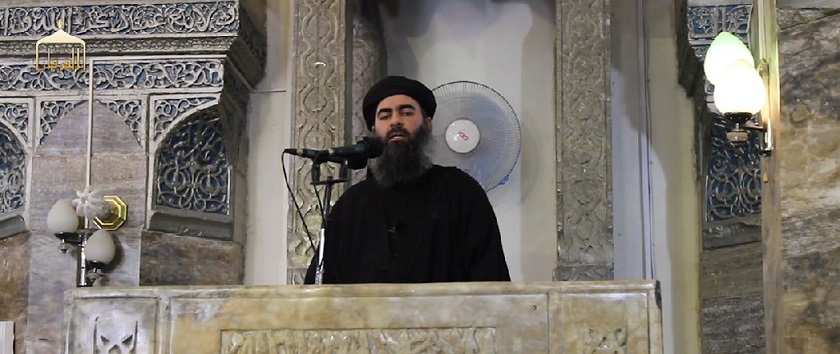
Abu Bakr Bagdadi

In traditional Islamic terminology the caliph is known as amir al-mu’mineen, or, the prince of the believers. In this new music video, Shaban Abdel Rahim adjusts the Arabic slightly to call him amir al-mugrimeen, the prince of criminals.

https://www.youtube.com/watch?v=6HmGv5BMLAk

The video blasts the Islamic State for its conduct, and declares Islam to be innocent of their crimes. But there is political commentary also. Baghdadi is asked how much money he is receiving from Qatar, and the world is asked why Egypt is being left to fight its local terrorism alone.

These concerns are not unique to Egypt but certainly reflect much popular sentiment about the group. The video also hails the Egyptian army for its role in fighting terrorism in Sinai, where Ansar Bait al-Maqdis (Supporters of Jerusalem) has pledged its allegiance to ISIS. Egypt, however, has committed no troops to the coalition effort in Syria or Iraq.

In my opinion neither the song nor the satire is all that good, but the message is not missed by Baghdadi. According to Paul Attallah, to whom thanks are given for sharing the video and adding English subtitles, Abdel Rahim has already received death threats for his mocking.

Here is another humorous offering, from the Lebanese band, the Great Departed. It is called ‘The moulid of Sidi Baghdadi’, using phrases that laud him as a Sufi saint, an interpretation of Islam he vigorously opposes. The crowd laughs in delight.

Thanks to Arabist for this link, as well as a partial translation:

The song starts out showering traditional blessings and titles on Baghdadi, but quickly takes a turn into mockery. It has lines like this:

علشان الإسلام رحمة، رح ندبح ونوزع لحمة، وعلشان نخفف زحمة، حنفجر في خلق الله

عشان لا إكراه في الدين فلنقض عالمرتدين والشيعةوالسنيين والنصارى يا خسارة

(In Arabic it rhymes. My awkward translation is “Because Islam is merciful… we’ll butcher and hand out meat/To make it less crowded/We’ll blow folks up/Because there’s no compulsion in religion/we’ll kill unbelievers..and Shia and Sunnis and Christians, what a loss!”)

Arabist makes an interesting point. There is no doubting the cruelty of the group and its desire to be feared. Perhaps the best remedy, therefore, is not to take it seriously. Deny ISIS the strength it seeks.

Surely there are other more practical responses, but the response of humor to crisis is a particularly characteristic Egyptian trait. Military and religious efforts have their place, perhaps, but the cultural struggle may be paramount. It is here these two videos offer their contribution.


Categories
Excerpts

The Face of the Former NDP

Suleiman al-Hout (L), with Prime Minister Ibrahim Mehlab. (via New Republic)

Much has been speculated about the coming Egyptian parliament being dominated by figures who used to belong to the National Democratic Party of former President Hosni Mubarak. Given the favor conveyed to the January 25 activists, this proposition scares many.

Perhaps it should. The understanding of the old parliamentary system was that it was a non-ideological patronage network, living off corruption while extending government, business, and other services. It certainly was neither clean nor efficient.

But it was human. Unfortunately, few carry the stories of such figures beyond their ugly caricature. Fortunately, this article from New Republic does, profiling Suleiman al-Hout.

In 2007, Suleiman al-Hout had a problem. Local officials in the Suez Canal city of Ismailia refused to license the food-cart from which he sold kebda, or fried liver, a common Egyptian street food. At first he asked a relative who sat on Ismailia’s local council to intercede on his behalf, but to no avail. So Hout took matters into his own hands. He walked into the local headquarters of then-President Hosni Mubarak’s National Democratic Party (NDP) with one simple question: “How can I vote for you?”

Within two years, Hout was a card-carrying NDP activist with excellent government and business connections, which he put to good use by “solving problems” for others. He frequently acted as an intermediary between local businessmen and the poor, between his neighbors and the electricity ministry, and, of course, between food-cart owners and the registration bureau. If your mother-in-law needed special medical care, he could get you into the top government-run hospital. If you had a problem at a nearby police station, he knew the officers. If there was a street fight, his “men”about 30–40 toughs, depending on the eveningtook care of it. And if street combatants didn’t accept his intervention? Well, that never happened. “They know that if they don’t respect me, I’ll take it personally,” he darkly boasts.

The author, Eric Trager, compares Hout to a different fruit cart vendor, Mohamed Bouazizi, the Tunisian who launched the Arab Spring when he set himself on fire to protest inability to obtain a license. But the question is fair: Whose reaction was superior?

Trager continues to chronicle Hout’s political activity during the revolution and throughout the period of Brotherhood rule. It is insightful and comical, a precious insight to how life was actually lived on the streets during this time, far from the rhetoric issued by both sides.

But Hout himself allows Trager to conclude with the common ‘ugly caricature’ that so infuriates many Egyptians, and certainly those who desire a transparent, non-patronage system:

But four months after Sisi’s inauguration, Hout feels let down. “I was among the first to call for Sisi to run for president,” he told me. “And I still haven’t made my money back yet. I have no job, no position, and it makes me angry. … He didn’t give us our rights.”

By “rights,” Hout means a high-level governmental appointment, such as serving as an assistant to a minister or governor. Hout was sure that this would be his reward for mobilizing his patronage network to support Sisi, since this is the way things have historically worked in Ismailia. “I deserve it!” Hout, who has a high school education, insisted. “I served this country. I am an eyewitness against the Brotherhood in two [court] cases. And I returned that vehicle to the police, which costs 450,000 Egyptian pounds.”

Instead, Hout is living off of the local businessmen who fund his patronage network, and growing more frustrated by the day. “[Sisi’s] chance is, maximum, one month,” Hout told me. “If he doesn’t give us our rights, it’s thank you, goodbye. … If I don’t take my rights, I will be very angry and you never know what my reaction might be.”

In lieu of a governmental appointment, Hout intends to run in the upcoming parliamentary elections. “I think I deserve to go [to parliament], and I wish to go,” he told me. “But it depends on the arrangements.” Hout explained that he’s still waiting for businessmen to back his campaign. “A businessman will pay, and I’ll be his face in the parliament,” Hout said. “This is normal.”

And apparently, this is normal Egyptian politics. It is also human.

Reform is necessary, and entrenched inertia is no excuse to refuse it. But have patience, and be sympathetic. This is life on the streets.

Categories
Excerpts

Who Will Run Egypt’s Parliament?

A soldier stands guard outside the parliament building during a meeting between U.S. Secretary of State Clinton and Egyptian Prime Minister Sharaf in Cairo

Ahram Online recently reported that Egypt’s minister of transitional justice appointed a military official as secretary-general of the parliament, now renamed the House of Representatives.

The news surprised me on different levels, most notably in that Egypt does not yet have a parliament. How can it then have a secretary-general? Whatever the position is, shouldn’t it be chosen by the parliament itself?

Eventually, it will be.

According to the executive regulations of the House of Representatives, issued in 1979, the speaker and his two deputies are entrusted with naming the House’s Secretary-general, but only under approval of two thirds of deputies.

“When a new parliament is formed in the first half of next year, the new speaker and his deputies will have the right to keep Al-Sadr in his position or name a new one,” said a legal expert with the House.

Much is open for debate about the composition of the coming parliament, but it may prove difficult to reach a consensus threshold, which may result in everyone agreeing to keep the acting secretary-general.

In a recent article, Nathan Brown argues that a similar pattern is emerging in which the executive branch issues laws which will eventually be subject to parliamentary review:

In the absence of a parliament, article 156 of the constitution gives the president the right to issue laws by decree provided that they concern emergency matters that do not permit delay and are submitted to the parliament for approval once that body has been elected and can meet.

Regardless of when parliamentary elections are held, the new body is unlikely to have either the coherence or the will to strike down legislation regarding purported emergency matters.

Brown sees this as an effort to preemptively establish authoritarianism, before the legislature can complicate policies:

For Sisi, there is also a temptation to use article 156 now, because it might soon become more difficult to enact authoritarian laws. Egypt’s 2014 constitution, like that of many other countries, often offers vague principles but defers the details to legislation. Aware of the way past rulers interpreted any vagueness in an authoritarian direction, the drafters of Egypt’s constitution inserted a provision (article 121) requiring that such laws giving precise meaning to general clauses—including those governing political parties, elections, the judiciary, and rights and freedoms—obtain a supermajority of two-thirds of the parliament.

The effect of this will be to keep any existing law frozen in place until the new parliament can organize such a vote. But it also gives the president a golden opportunity in the current interregnum to modify any law he likes before the parliament meets, without having to face this threshold. It remains unclear whether the parliament will have to muster such a supermajority to approve the laws when it does sit.

Regardless of the correctness of this opinion, it appears the government’s appointed secretary-general will have a good deal of bureaucratic influence on the workings of parliament. Returning to Ahram Online:

Regulations state that the secretary-general position is fully responsible for running the daily business of parliament, ranging from preparing the daily schedule of parliamentary debates, supervising the performance of 18 parliamentary committees, to managing the daily affairs of parliamentary staff and personnel.

The previous secretary-general held his position for many years, both under Mubarak and the Muslim Brotherhood-led parliament. He was a former judge, and may have been little more than an expert functionary.

But if the new expert functionary comes from a military background, what degree of supervision/control/influence will the military have over parliamentary affairs? Will it matter?

I am not an expert in the inner-legislative workings of any nation, and certainly not yet of Egypt. Anyone with more experience is invited to explain if this position is essentially irrelevant, or the lynchpin of efficient political process.

Categories
Excerpts

Ancient Egyptian Church Renovated

Hanging Church

It is often said of Egypt that it is impossible to build or repair a church without presidential permission, even simply to fix a toilet or change a light bulb. There are historical reasons for this statement and contemporary examples of the difficulty.

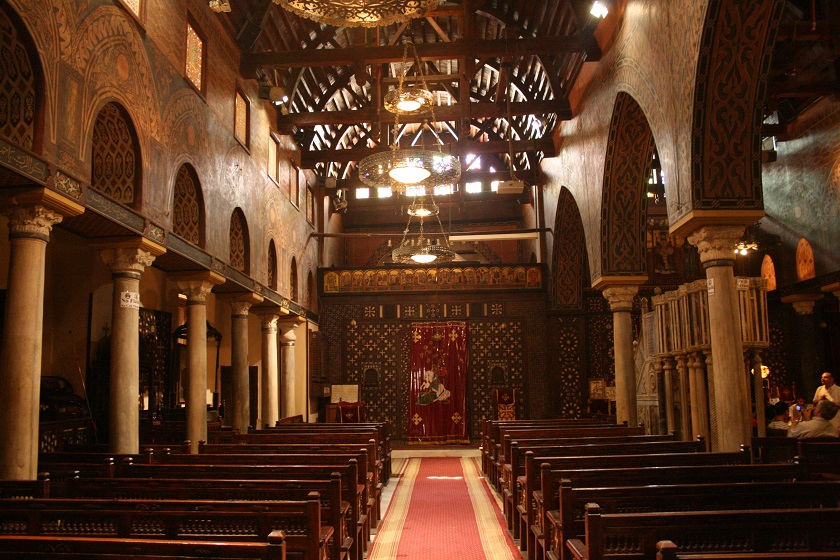
But this article in Ahram Online celebrates the full reopening of the 4th Century ‘Hanging Church’, following sixteen years of renovation.

Work was carried out under the supervision of the Ministry of Antiquities with a $14 million budget.

He explained that the restoration work was carried out in three phases to reduce water leakage and strengthen the church’s foundations and the Babylon fortress located beneath it, to protect them from potential future damage. The walls were reinforced, missing and decayed stones were replaced and masonry cleaned and desalinated. The decorations and icons of the church were also subject to fine restoration in collaboration with Russian experts. New lighting and ventilation systems have also been installed.

Located in a heavily populated area, says Wadallah Mohamed, assistant of the head of the projects section at the ministry, the Hanging Church was suffering from environmental hazards including air pollution, a high subsoil water level, a high rate of humidity, and leakage of water from the outdated and a decayed 100-year-old sewage system. Other damage included decorations of the church’s wooden ceiling being stained with smoke and the impact of the 1992 earthquake, which resulted in cracks in the church’s walls and foundations.

“The church is now safe and sound and its restoration was carried out according to the latest technology,” asserted Mohamed.

The church was beautiful before the renovation, I look forward to visiting it now. It is located next to the Coptic Museum, which also has opened recently after a long period of repair.

This news should not let Egypt off the hook for its record in facilitating church construction. A high profile worship site and tourist attraction is far different from some church in an obscure village. It should be said, however, that obscure village churches are often built in a style far more grandiose than local need might warrant. It should also be said, further, that once a church is built, a mosque springs up next to it, so that local Christians will call it ‘the church’s mosque’. There is often a competition over height; both religious adherents often prize the building for its social statement over its functional purpose.

But this requires a full and separate analysis. For now, simply celebrate that Egypt has cooperated to repair a grand church together – toilet, light bulb, and all.

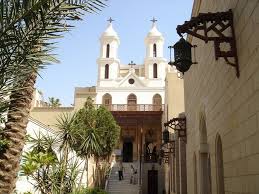
Hanging Church Outside

Here is the message given on the occasion by church and government official figures, as related by Paul Attallah:

Pope Tawadros II gave three messages on this occasion:

First message: A message of gratitude towards our ancestors who built this church on the Roman Babylon Fortress ruins.

The second message is a “promise” to all Egyptians: Egypt is a museum of civilization and history. Each archeological spot is a jewel. We need to be aware about this richness to rejoice and to preserve our monuments.

The third message is a peace message given from this place thanks to the State efforts to deliver a message of peace to the whole world that everyone can coexists in peace. In fact, Egypt is carrying a part of all religions.

The religions don’t exist for rivalry but for peace, and when we begin our celebration with the national anthem it gives a model to the whole world that we can live in peace in the middle of an region full of conflicts and violence. But in Egypt we provide a model and example of religions coexistence.

The Egyptian Prime Minister gave a speech: I remember Pope Shenouda III saying: Egypt our homeland lives in us. It gathers people and don’t divide them. It’s a country which knows love and peace and never give up. Look to the whole region: as long as we are united we will not be scared and we will build our country.


Categories
Excerpts

Why Does Egypt Suffer Power Cuts?

Power plant

Even into late September Cairo temperatures reached 100 degrees. Statistics show that 40 percent of energy demand comes from home consumption, and increased air conditioner use contributed to overloading the system.

The one complaint about a recent article at the Middle East Institute on the energy crisis is that it does not describe the ‘how’ of this overloading. That is, why does the power grid shut down in certain neighborhoods, at certain times, and for certain durations? Cairo residents complained of several outages a day over the summer, often lasting an hour at a time.

Were these planned and distributed? Was suffering experienced equally by neighborhood? These are fascinating questions for which I have not yet heard an answer.

But the article does a good job at giving the background to the energy crisis. If one is to be inconvenienced, it helps at the very least to understand why. Here is a brief summary of the main points:

1. From long before the revolution, the government estimated yearly increases at 10 percent, but the actual increases averaged 12 percent.

2. The government did increase its power generation capacity in response, so that by the end of 2013 it equaled 30,000 megawatts. But for near 90 million people this is still inadequate, especially when compared to the near 50 million populations of South Africa and South Korea, which produce 44,000 mw and 80,000 mw respectively.

3. The government anticipated energy growth would coincide with increased production of natural gas. Contracts were signed with international companies, but the 2011 revolution interrupted the ability to pay. Work stopped and production lagged.

4. The existing power grid was forced to work at full capacity to meet local demand, canceling scheduled periods of shutdown for regular maintenance. This contributed to a loss of efficiency and times of irregular shutdown.

5. The Ministry of Electricity has counted 300 acts of terrorism against electricity towers since the June 30, 2013 deposing of President Morsi. Similar accusations of sabotage were issued by the Morsi administration during its year in office.

The end result is that by the summer of 2014, Egypt’s power generation industry is operating at only 70 percent of capacity.

This information will help no one feel cooler in Egypt. Nor will it help anyone feel better about Egypt. The article also described current steps the Sisi government is taking to relieve the crisis; depending on your point of view this information may or may not be helpful either.

But at the least, we can be thankful it is now October.

Categories
Excerpts

The Case against Qatar

Qatar

A recent Foreign Policy investigative report details Qatari foreign policy. It describes a strategy of intervention-by-proxy, which keeps its hands clean officially while funneling money to groups it deems ideologically similar, that is, those they can trust.

Primarily, this has been the Muslim Brotherhood and various activist Salafi factions.

The article is long but worthy, and one interesting section describes how Qatar has helped the US disengage from the region. This was evident in Libya, when Qatar not only provided crucial Arab support for the operation, but also took the lead in sponsoring militia groups against Gaddafi.

But now that the US is reengaging the region, this time against the Islamic State (ISIS), officials are examining anew the sponsorship by Qatari individuals and charities which have gone to the al-Qaeda affiliated al-Nusra Front. Following three years or more of looking the other way, the dispute has become public:

In Syria, meanwhile, it wasn’t until the Islamic State gained prominence that Washington sat up and took notice. In March, David S. Cohen, the Treasury Department’s undersecretary for terrorism and financial intelligence, took the unprecedented step of calling out the Qataris in public for a “permissive terrorist financing environment.” Such stark criticism, counterterrorism experts say, is usually left for closed-door conversations. A public airing likely indicated Doha wasn’t responsive to Washington’s private requests.

But if initial requests were private, that means the US – for a long while, at least – tolerated and possibly approved of the general strokes of Qatari foreign policy. Two key aspects of Qatar’s leverage over the United States include its hosting of the US Central Command air base, as well as the usefulness of its network to liaison with otherwise disreputable characters. Discussions with the Taliban in particular have often flowed through Qatar. Without them, back-door channels would not be possible; hostages released might still be held.

Has the US, therefore, been a partner in the wanton destruction of Syria? President Obama has forcefully spoken against Assad, but has never decisively moved against him. The article deems the chaos there less to be a result of coordinated conspiracy, than uncoordinated incompetence:

In other words, there was no one winner. Qatar and other international powers haphazardly backed dozens of different brigades and let them fight it out for who could secure a greater share of the funding. They had few incentives to cooperate on operations, let alone strategy. Nor did their various backers have any incentive to push them together, since this might erode their own influence over the rebels.

Says one analyst:

“One of the things about Qatar’s foreign policy is the extent to which it has been a complete and total failure, almost an uninterrupted series of disasters,” says Hussein Ibish, a senior fellow at the American Task Force on Palestine. “Except it’s all by proxy, so nothing bad ever happens to Qatar.”

Except its reputation in much of the Arab world. Egyptians in particular have been furious at Qatar over its support for the Muslim Brotherhood. Saudi Arabia and the United Arab Emirates have signaled displeasure in manners unusual among Gulf monarchies.

Long ago Qatar made a bet on the Islamist factions becoming the prominent power players in the region. For a while they seemed vindicated; now they appear in retreat. Qatar has been publicly acquiescing to the criticism, sending away top Brotherhood figures it has long hosted, for example, but it is unclear if its long term strategies have changed.

Were Qatar and its allies-by-proxy simply outmaneuvered? How much of the Arab Spring was manipulated by the regional and international power struggles? What role did America have is a key question. Most Arabs view Washington as the chief puppet master, allowing its public allies – the Saudis, Turks, UAE, Qatar, and Israel, of course – to mess around with local sovereignty.

Or, did the US just pull back, and allow others to run the show? Either way, the result is a disaster, however many parties share in the blame.

One other controversial point converges with this article. Many Egyptians see the Muslim Brotherhood as one aspect of an Islamist agenda that includes and coordinates with groups like ISIS, on the far end of the spectrum. The point is not necessarily that the MB keeps its hands clean while sending out clandestine orders to others to ferment chaos – though this is certainly believed locally.

But if the Brotherhood is one part, and a key part, of Qatar’s proxy network, a linkage does seem to exist. This article does not make the accusation, and I do not wish to lend it weight in the mentioning. But it bears consideration.

Of course, Brotherhood sympathizers simply turn the equation on its head. They see Qatar as the good guy, standing with the people and the forces of democracy, against fearful Gulf monarchies, their own proxies, and the US.

God bless this part of the world. Maybe one day the oil will run out and they can all be left alone again.

Categories
Excerpts

They Really Do Hate Us … at Least on Twitter

From AhramOnline, on research analyzing Twitter:

In the case of Egypt, the researchers analyzed more than 2.2 million Arabic tweets that mentioned the United States and found just three percent could be termed pro-American, with 23 percent neutral and the majority critical of the United States.

Ok, so they hate our foreign policy – no big news there. But the following is more disturbing:

By contrast, about 30 percent of those tweeting in Arabic about Hurricane Sandy expressed concern about Americans or defended Americans.

Only 30 percent? Ugh. I hope there is some confusion in reporting or answering, between ‘concern’ and ‘defended’. But this doesn’t reflect well, I’m afraid.

So how to interpret the general conclusion:

“Reactions to cases where the US is influencing Middle Eastern affairs are 95 percent to 99 percent negative,” Keohane said.

Is our foreign policy just really bad? Or are we inept at PR, at least in comparison to local outfits? The research showed these numbers hold no matter what side of the domestic divide these tweets support.

I generally think that ‘winning hearts and minds’ is an overblown concept. But in as much as it is a policy goal, the US is failing miserably … at least on Twitter.

Categories
Excerpts

Gaza and the Right to Self-Defense

There is much wrong on both sides. The situation is complex and begs for thorough analysis. All this is granted but within this debate, here is a well-researched article from Jadaliyya exposing a false rhetoric that seems eminently logical:

On the fourth day of Israel’s most recent onslaught against Gaza’s Palestinian population, President Barack Obama declared, “No country on Earth would tolerate missiles raining down on its citizens from outside its borders.” In an echo of Israeli officials, he sought to frame Israel’s aerial missile strikes against the 360-square kilometer Strip as the just use of armed force against a foreign country. Israel’s ability to frame its assault against territory it occupies as a right of self-defense turns international law on its head.

A state cannot simultaneously exercise control over territory it occupies and militarily attack that territory on the claim that it is “foreign” and poses an exogenous national security threat. In doing precisely that, Israel is asserting rights that may be consistent with colonial domination but simply do not exist under international law.

The article was first published two years ago, under near exact circumstances. It continues by detailing the legal arguments that invoke the right to national self-defense, and finds they come up short – even as judged by the Israeli High Court:

Since the beginning of its occupation in 1967, Israel has rebuffed the applicability of international humanitarian law to the  Occupied Palestinian Territory (OPT). Despite imposing military rule over the West Bank and Gaza, Israel denied the applicability of the Fourth Geneva Convention relative to the Protection of Civilian Persons in Time of War (the cornerstone of Occupation Law). Israel argued because the territories neither constituted a sovereign state nor were sovereign territories of the displaced states at the time of conquest, that it simply administered the territories and did not occupy them within the meaning of international law. The UN Security Council, the International Court of Justice, the UN General Assembly, as well as the Israeli High Court of Justice have roundly rejected the Israeli government’s position.

Again, there is much wrong on both sides. But do recall the essential foundational fact: Gaza and the West Bank are occupied territories. A just solution has escaped the international community since 1967. Proportion of fault can be debated, but Israel bears responsibility for the land it holds.

There is no winner, there is only more destruction. Unfortunately both sides seem more than willing to engage.

Categories
Excerpts

Christians and Political Manipulation

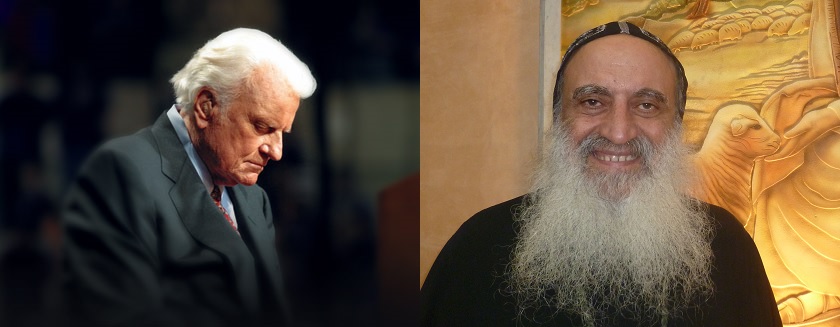
Graham and Boula

Many Egyptians these days shed no tears over the demise of the Muslim Brotherhood, seeing in them an unhealthy and manipulative merging of religion and politics. But religion, politics, and manipulation are known the world over. First take a look at this excerpt from Christianity Today, describing two evangelical leaders during the Jimmy Carter presidency:

Balmer also describes Jerry Falwell’s mendacity and Billy Graham’s duplicity as they worked to bring Carter’s presidency to an end. Falwell brazenly lied in his report that Carter had told a group of evangelical leaders he supported gay rights. Eleven days after telling the Reagan campaign that he wanted to “help short of [a] public endorsement,” Graham reassured a Carter liaison that he was “staying out of it.”

I hate to think these descriptions are true, but perhaps this only shows we are quick to believe the worst of the other while doubting it for our own kind. The anecdotes are from a new biography of Carter, so I can only assume, perhaps wrongly, it was well researched.

But no research is needed to see the all-but manipulations of Bishop Boula of the Orthodox Church. Even here my ‘all-but’ exposes my will to disbelieve, but how can you doubt when his efforts are admitted? Here is a translation of his recent comments on Egyptian television, translated by Middle East Monitor (video included):

Bishop Paula (Boula): How do I estimate it? Let me tell you what I would do for instance in Tanta. I come to each one of the churches. Let’s assume that in this particular church there are six priests. We divide it into six squares and each priest is put in charge of one square and that would be the region he is responsible for. We tell the priest: father, you are in charge of this region. How many homes are there within it? I want to appoint one young man for each group of thirty homes to prompt them and make sure to bring out those who have not yet come out. The young man who is in charge of the thirty houses would submit a report about each of these houses, one by one. In this way, we would know who went out and who did not. We call the father in charge by phone and he goes and knocks on the door. So, we have extremely accurate information about the ratio of those who went out and those who did not.

Presenter: I am saying this to you but it might be possible that those who hear us might take to mean something else. Was the Church playing politics?

Bishop Paula: No, no. Look. The Church is playing patriotism.

Presenter: It plays patriotism?

Bishop Paula: It has a patriotic role. The Church has always been a patriotic church. And in this particular time it should have a strong patriotic role. The patriotic role is the prompting role. And to be telling the truth, it includes, if possible, unifying opinions through persuasion as to who is the best (candidate).

If not for that last statement, the ‘all-but’ could remain. It is, perhaps, patriotic to stimulate and even ensure the voting of the flock. Christians should be good citizens; the church should help them know how to engage their civic responsibility.

But could he not help himself? Did the Christian in him demand he reveal the full truth? Did his pro-Sisi/anti-Muslim Brotherhood giddiness expose it? Is he just proud of himself and the monumental task he organized? Bishop Boula invited me into a meeting once during parliamentary elections in 2011. I saw his efforts then, but did not notice any ‘persuasion’. Of course, that was just one session.

But, oh, this is fuel for the Egyptian political fire, and it is well deserved. Pope Tawadros, do you have a comment given your insistence of church neutrality? I wrote you an ‘all-but’ interpretation in that article. Has Bishop Boula made me a liar?

A worthy question also for the Muslim Brotherhood, for Jerry Falwell, and for Billy Graham. May God honor you all for the good you sought within your best interpretations. May he hold you all accountable for the means by which you pursued it.

And may be be merciful to us all for our many manipulations, both great and small. We self-justify far too easily.

Categories
Excerpts

Egyptian School Children on Sexual Harassment

These two videos, with translated subtitles, come from Dignity without Borders. The first interviews boys about their perception of sexual harassment, while the second gets the girls’ perspective.

Both are intriguing and shed light on what is widely acknowledged as a significant social problem. Listen in and find out why.

Categories
Excerpts

Block 1, Cell 8: A Letter from Damanhour Women’s Prison

mahinour

From Mada Masr, publishing a letter by Mahienour al-Massry, an activist from Alexandria imprisoned for illegal protest:

Ever since I set foot in Damanhour women’s prison and was placed with my inmates in ‘Block One’ — The cluster of cells assigned to those accused or convicted of embezzlement — only one thing has been on my mind and I repeat it like a daily mantra: “Down with this classist system.”

Most of my inmates have been imprisoned for defaulting on the payment of instalments or small loans. They are loans taken out by a mother buying some direly needed items for her bride-to-be daughter, or by a wife who needed money to afford treatment for her sick husband, or a woman failing to pay back a LE 2,000 ($280 US) loan on time, only to find herself slammed with a LE 3 million ($420,000 US) fine in return.

She recalls a similar, but more high profile recent case:

At this point, news reaches us of Hosni Mubarak’s three-year sentence for charges of widespread corruption, embezzlement of funds, and financial fraud in the ‘Presidential Palaces Case.’ Cracking up, I ask them, “What kind of future do you expect me to have in an unjust society, in which the regime thinks that Umm Ahmed (‘Ahmed’s mother’), who has been incarcerated for the past eight years and still has six more to go for signing a bad check worth no more than LE 50,000 ($7,000 US), is more of a dangerous criminal than Mubarak?”

Let us imagine that these women are indeed guilty, have broken the law, and are justly imprisoned, however unjust their sentence and the system behind it may be.

Mahienour and other January 25 activists forged their revolution at least in part to overturn this system. I imagine other activists are laboring with those like Umm Ahmed, to provide legal counsel and advocacy for those perhaps guilty but entrapped in this system.

This post is not for evaluation of Mahienour’s option; this choice is three years ongoing with mixed but still inconclusive results, even if she has found herself on the wrong side of the bars.

But even so she counsels:

Freedom for Umm Ahmed, who hasn’t seen her children for eight years. Freedom for Umm Dina, who is the sole provider of her family. Freedom for Niamah, who agreed to go to prison instead of someone else in return for money to feed her children. Freedom for Farhah, Wafaa, Kawthar, Sanaa, Dawlat, Samia, Iman, Amal and Mervat.

Our pains compared to theirs are nothing, as we know that there are those who will remember us, say our names from time to time, proudly mentioning how they know us. Instead, these women, who deserve to be proudly remembered, will only be mentioned at most in family gatherings.

Do they deserve freedom? Allow lawyers and judges to argue over this. But they deserve remembering. They deserve advocacy.

Lord, when did we see you in prison and go to visit you? … I tell you the truth, whatever you did for the least of these brothers of mine, you did for me.

Surely there are a number of activists who intercede already for the likes of Umm Ahmed, but is this not a challenge to lay before the Egyptian church?

Lawyers and judges can argue over Umm Ahmed, but does she even have a lawyer? What if Umm Ahmed and all in similar circumstances knew they could go to their local church and find advocacy?

This challenge would not be Mahienour’s. It is not to overturn the system, not even to reform it. Let other activists labor in these struggles, as warranted.

But that someone might stand with Umm Ahmed in the courtroom, plead her case and seek at least the minimum sentence, would this not be a service worthy of the church?

Some might be bold and say the church should stand with Mahienour also. Perhaps they are right; I do not know the details of her case. If she is jailed unjustly, if the law imprisoning her is unjust, should not the church speak?

Let Christians debate this; some might find it an improper interference in politics. Perhaps it is.

But there are no politics with Umm Ahmed. There is no statement against the system. There is no public protest, there is no agitation.

There is only solidarity with the occupant of Block 1, Cell 9. And 10, and 11. Maybe 12 deserves her fate. But Cell 13, and 14, and …

The Anglican Church of Egypt already has a program to visit foreigners imprisoned in local jails. Some have committed crimes, others are detained on visa irregularities. But the church regularly visits to encourage and furnish needed supplies. It is a good application of the above verse, and donations are welcome.

But could the churches of Egypt do more? If not the churches, could the Christians? Could they do so in close partnership with like-minded Muslims?

If so, I imagine they would please Mahienour immensely. But more importantly, they would please the women of Damanhour prison, their families, and even, it could be imagined, the state.

Here, Mahienour will likely disagree. But which would the state prefer? An activist calling “Down with this classist system,” or citizens working quietly on behalf of individual cases of justice? The guilty would still be sentenced, but the women and their families would know they were treated right. The church would ensure it was not otherwise.

And with accumulated evidence, the church could possibly ensure that all are treated right. Once a critical mass of accountability is reached, the system might naturally reset. A large segment of popular discontent with the regime might be quieted. A revolution might not be necessary.

Surely Mahienour would have been happier if she had the last three years of her life back, and with it a more just society. Let activists and citizens argue the type of activism needed, but surely there is some.

What kind can the church provide?

Categories
Excerpts

Nour’s Quiet Dissenters

From the Carnegie Endowment for International Peace, a lucid article explaining the current situation of the Salafi Nour Party.

Having backed the popularly-led military overthrow of President Morsi, the party ensured at least its short- to mid-term survival, and did not go the way of the Brotherhood. But in doing so they have fractured their internal cohesion and invited the derision of many Islamists, their natural constituency. The results of their gamble remain to be witnessed, likely in upcoming parliamentary elections.

But here is an interesting excerpt about leadership in the Salafa Dawa, the socio-religious preaching association that gave rise to the Nour Party:

The movement’s controversial support for the military has also heightened internal divisions. The initial division that weakened the movement followed a disagreement between Emad Abdel Ghaffour, the former leader of the Nour Party, and Yasser Borhami, deputy head of the Salafi Dawa, that led to the former splitting off to form his own Watan Party in January 2013. Nour’s backing of the military and the crackdown on the Brotherhood deepened the rifts between those remaining in the party. A number of the original founders of the Salafi Dawa have stopped attending its meetings, such as Dr. Said Abdel-Azeem, who before June 30 had announced that he believed in “the legitimacy of President Mohammed Morsi.” Abdel-Azeem stayed the course after July 3 and appeared on the speakers’ podium at the Rabia al-Adawiya protest repeatedly; he has been against the Nour Party’s support of the military since the crisis between Nour and the Brotherhood began in January 2013. Dr. Mohammed Ismail al-Muqaddam has also been absent from the movement since July 3, declining to appear in public or speak about politics.

Even more illustrative of the fragmentation within the Salafi leadership is the sermon given by prominent Salafi figure Dr. Ahmed Farid at a mosque in the Amiriyya district of Alexandria on February 28, in which he called for “returning to our origin.” He added that “for 40 years, we have wanted to return to missionary work (al-dawa) and forget politics,” even though only a few days earlier he himself had participated in a political conference supporting the latest constitution. Even though a majority of the Salafi Dawa leadership is sympathetic to these dissenters, Borhami, the most powerful figure in the movement, continues his efforts to convince his followers that the political Salafi Dawa organization is emerging from the current crisis stronger than before. Borhami has sent his pupils and followers throughout Egypt’s provinces to rally Nour Party supporters and convince them of the wisdom of nominally condemning the use of violence against pro-Brotherhood protesters while tacitly accepting it by supporting the military regime, including Nour’s recent endorsement of Abdel Fattah el-Sisi for president and calls for their followers to vote for him.

I have no evidence to the contrary, but I am curious how the author judges the majority to be sympathetic to dissenters. Is it an emotional sympathy, or something more? If more, might they be letting Borhami take the lead, watching to see what happens, but ready to let him take the fall if necessary?

Under this speculation, ‘if necessary’ could come from two directions. The first, as the author makes clear, is the possibility that Nour Party support for the transition may still not be enough to preserve their political presence. If they are denied a continuing place in politics under Article 74 of the new constitution, Borhami would be the one to hold accountable.

Less likely, but still the goal of many Brotherhood-sympathetic Islamists, is that the military overthrow of Morsi might still be reversed. If so, Borhami could be highlighted as the traitor while those keeping quiet now quickly seek to mend fences.

In any case, the interactions are fascinating. Read the full article linked above to get a good overview of the situation.

Categories
Excerpts

An Anecdote on Christian Kidnapping

From Slate, a unique first-person account of travels to Upper Egypt, to witness the alleged surge in weapons trading. The journalists find a sleepy town filled with older arms models, feuding families, and unengaged police, but little evidence of proliferation.

But they do encounter a local thug:

A man in a karakul hat—a favorite with Soviet party leaders and Bond villains—strides up to our table and sits next to the omda [village mayor]. He regards us with a rather unctuous smile, revealing his coffee- and nicotine-stained teeth.

Before he arrived we had been talking about government negligence. He offers us a curious anecdote. We’re, it seems, in the company of a kidnapper.

He is a kidnapper armed with what he and the omda’s pals think is unassailable logic. That is, without loans from agricultural banks—who refuse them on “security grounds”—he and other farmers are left without a steady income. Kidnapping, being a very lucrative trade, allows him and others like him to purchase property and build.

“Some ask why we target Christians and not Muslims,” he says with a smirk, looking at my colleague and me. “Because our [Muslim] men are not worth as much.”

He turns to one of the omda’s friends, a Christian who is seated at the table. “It’s nothing personal.”

Often amid the evidence of Christian persecution in Egypt is the tragedy of Christians being kidnapped. Many times the stories say the victims, usually underage girls, are forced to marry and convert to Islam. Surely some of these stories are true, sometimes perhaps not.

But this anecdote reminds us the reality is very complex. Some might use this version alone to deny the more obvious persecution accounts. But a single, simple narrative is best to advance a cause, on whatever side of the issue you advocate.

Meanwhile, muddying the waters in complexity works well to promote confusion and immobility, denting outrage through a fog of uncertainty. It elevates the status of the ‘expert’, but does little to help everyday realities.

God help us. The task is a commitment to both truth and justice. Truth includes the diversity of anecdotes, testing every narrative to divide the wheat and the chaff. Justice proceeds further, to process the wheat and cast off the chaff. The former is made useful into sustaining bread; the latter deemed worthless and thrown to the wind or fire.

May we remember, and act accordingly. And, may all kidnapping cease.

Categories
Excerpts

…and in this Corner: Media Narratives and Sisi’s Candidacy

Egypt has yet to experience an issue-based electoral contest. Of course other nations, even with deep political history, are known also to sensationalize campaigns and demonize opponents. But as Egypt learns the best and the worst from these international examples, with which of these two commentators do you side?

Hamzawy (L), Sisi (C), Abou Taleb (R)

In recent op-ed articles, both Hamzawy and Abou Taleb see media manipulation as the central feature of Sisi’s candidacy. But they aim in different directions.

Hamzawi, writing in Egypt Source, ‘Dismantling the Myth of the Candidate of Necessity’:

There is a myth now being promoted by intellectual, political and media groups who favor the regime that followed the July 3 2013 overthrow of Mohamed Morsi, and support former Defense Minister Field Marshal Abdel Fattah al-Sisi’s run for president. While this myth deals with Egypt’s current situation, its structure is far from new. In fact, consecutive ruling elites have relied on this myth since the 1950s to justify oppression, human rights violations, restriction of freedoms, autocracy, and lack of democracy and sustainable development.

The “candidate of necessity” myth reduces Egypt and its issues to one person, the hero-savior, being introduced to the public before the presidential elections as “the only candidate” capable of “rescuing the nation from the current danger” and “the last hope” for “saving the nation from the evils and harms of the enemies, inside and out” and achieving its greater goals and objectives.

Abou Taleb, writing in Ahram Online, ‘Speaking about Rights, but Aiming for Chaos’:

We all know Egypt is being targetted and it is no longer a mere suspicion or hypothetical conspiracy theory but a reality we live day and night. This includes statements and threats by the terrorist alliance, sabotage and murder, and the ultimate goal — that will never materialise, God willing — of pushing Egypt into chaos and ruin.

Media personalities, politicians and alleged clergy who want Egyptians to believe this targeting is temporary and contingent on the removal of one very popular presidential candidate are a key and fundamental part of the plot to disrupt Egypt, and raise the price of transitioning into political and institutional stability. They also send a misleading message to Egyptians that their salvation is contingent on abandoning this candidate. But these people do not realise the majority of Egyptians have matured politically and now have an innate ability to sift through the political din.

One of the commentators speaks the language of the international community, the other the domestic. That alone does not lend credence in either direction. But it is noteworthy that their central argument is essentially the same: There is deep manipulation in framing the candidacy of Sisi.

One frames in favor, the other against. Both commentators indirectly expose the other. The reader is invited to provide the round-by-round scorecard for these two heavyweights, as both sides have come out swinging…