Give Egypt the grace to get out of the moment. Literally speaking, bring peace to troubled areas, give peace to troubled hearts. End this contagion to protect lives, property, and the reputation of Islam.
Figuratively speaking, help Egypt and the world to see the big picture. Encouraging transitions are underway across the region. Dictators have been deposed and the people have a voice. The transition is not without significant struggle, however, and has opened up the fault lines of society. Film or no film, sincere or exploited, these protests cannot obscure there is much good at work in Egypt and elsewhere.
The big picture is also that God can take care of himself. May those who are righteously aggrieved remember God the Merciful, and so imitate. Comfort all who call on you, keeping them from turning against each other, or the other. May your purposes for Egypt be fulfilled, among both the both the calm and the furious.
But the small picture requires your attention as well, God. This film appears produced for trouble and trouble alone. Whatever legal right they own, your law goes far deeper to judge intention and result. Hold them accountable, God, and rebuke. Spoil any influence they may seek in American politics.
If for trouble, the trouble was shared. Manipulation owns no nationality, and surely some Egyptians are guilty of fanning the flames. Both have exploited religion for evil ends; both show contempt for the faith of normal Muslims. One aims to offend, the other to enrage. Hold them accountable as well, and keep them from a vital share in the Egypt to come.
Continue your grace between Egyptian Muslims and Christians; thank you for the wisdom that has kept them together. May such grace multiply between Arabs and Westerners. Prevent the world from hardening into ill views of the other. May all differences be admitted and discussed, and may the right prevail. But may all be transcended in respect and relationship.
May these fires soon extinguish; may they spread no further.
May love instead consume the hearts of men, even toward those who hate, insult, and damage. Punish, God, but redeem and restore.
As clashes continue in the areas surrounding the US Embassy, I have had opportunity to publish my account and analysis from the original incident on EgyptSource. Please click here for the article in full, and excerpts follow below:
The sad spectacle on display at the US Embassy in Cairo on September 11 shows nearly everyone in a poor light. Sadder still is that most parties involved acted from a sense of virtue, but misunderstanding and prejudice corroded the good intentions.
I next proceed to describe some of the background events as well as the misunderstandings on the part of the US Embassy and US media. Next follows perhaps the most crucial observation I gained:
The stranger inference is that the embassy was not surrounded from the beginning. The protest was announced in advance, and yet Egyptian riot police were present throughout the demonstration. Yet it was the army, absent the entire time, which secured the premises.
The US Embassy complex is surrounded by a high wall lining almost entirely the adjacent street. The entrance is located in the center of the wall. Black clad police with helmets and shields lined the wall to the right of the entrance, but yielded the left side to protesters. Essam, an older Salafi protester, told me the police deferred to the ‘Islamists’ to keep the youth under control.
Next follows viewpoints expressed by some of the participants, including these:
Consistently the crowd shouted, ‘With our lives and blood we will redeem you, oh Islam.’ Muhammad, another son of the Blind Sheikh, explained, “For any offense against Islam, the Muslim has the right to defend himself against the one who says it, and this slogan displays his love of his religion.
“Everything has its time and place. It makes no sense to issue simple good preaching during jihad. If someone is attacking you, you resist and fight back, you do not just say a good word.”
Another participant in the protests, Mustafa, who had returned to Egypt after living fifteen years in Brooklyn, commented further. “Those Copts making this film should be killed.”
The sad fact is that so few involved in this episode, whether gathered at surrounding the embassy or abroad, exhibit a will to understand and appreciate the other. For his part, Muhammad Abdel Rahman acknowledged the legitimacy of debate. “A Copt in Egypt may stand publically and state he does not believe in Muhammad. But there is a difference between discussion and insult.”
Yet where is the line to be drawn? What Muhammad might allow Mustafa might murder. Both act from the virtue of principle, yet each is open to the condemnation of fellow Muslims. Such difference in interpretation is witnessed in all actors.
The transition to conclusion involves weighing each actor on the basis of their motivation from virtue, only to be spoiled by misunderstanding. Of course, the virtue of each may be completely false, which is also considered. I end looking ahead to tomorrow, a day seeming increasingly ominous:
The test will come on Friday, when Islamist groups, including the Muslim Brotherhood, have called for more demonstrations against the film. Meanwhile, their political arm the Freedom and Justice Party, described the film as “a failed attempt to stir strife between Muslims and Copts.”
These rallies will only cement the ill image many Arabs and Westerners have of one another. The former see the latter as irreligious libertines, while Muslims get labeled as oversensitive fanatics. It is a sad exchange, overcome only through awareness, acceptance, understanding, and respect. Will wiser heads prevail? Humankind is capable of great virtue, but it is easily marred.
Perhaps nothing of significance will take place, but the fear is that there is significant political capital to play with. Demonizing America has long been a feature of Egyptian domestic policy, even while official relations are maintained, even strengthened. President Morsy and the Muslim Brotherhood again face the choice to imitate Mubarak, or change the political culture of Egypt.
But if they change, in what direction? Better, or worse?
As noted yesterday, I was at the protest at the US Embassy in Cairo. Really, it struck me very much as a non-event. Similar to when the Israeli Embassy was stormed last year, it seems like the work of a small few, looking to make trouble, perhaps even allowed to do so. It fits in with the manipulations all around this country, and hard to tie to any one party.
I am not pleased it happened, of course, but I can accept it. The burning of the American flag is simply a political statement. I have long learned to live with diatribes against American foreign policy, and watching a flag burn is in several ways easier to digest than someone arguing with you over why America hates Muslims, or something of the like.
But when I learned this afternoon that the American ambassador to Libya was killed in a vicious attack on the consulate there, it was a different matter entirely. My stomach sank and my day was placed on hold, as the facts settled in. Burn the flag, curse my nation, do as you wish. Many times, there is a semblance of legitimacy, if not justification, behind their frustration.
But do not kill.
Yesterday I stated I was somewhat uncomfortable among the protestors. It was mostly in the beginning, when their chants were most vociferous and individuals melted into a collective whole. After a while, it was fine, as I realized they were more summoning the will to protest than driven by rage. I always feel somewhat ashamed when I take note of my reticence; these are people who must be engaged as people. In 99% of the cases, simple human decency wins the day and creates a relationship, however temporary. It is my job and joy to serve them, to help their perspectives become understandable.
But in that 1% humanity is lost and the person becomes a canvas to paint a political message in blood.
That is Libya, and it is a reminder of what is at stake, of the depths of human depravity. Yet the blood for that canvas flows from the heart, which must bleed differently if misunderstandings and antipathies are to be overcome. This is Egypt, at least for now.
But it is Libya also, and every corner of the globe. If the heart does not bleed differently life-as-existence will continue but life-as-abundance will stagnate and die.
Unless the seed falls to the ground and dies it will produce no fruit; but if it dies it will bring forth a harvest. The heart may in the 1% bleed on a canvas, but it must bleed differently in the 99%.
It is said this is true of the American ambassador. May he rest in peace.
To mark September 11, Muslims in Egypt stormed the US Embassy.
Actually, it is not that simple. Certain Copts resident in America produced an amateur film purporting to expose the frails and falsities of Muhammad, and advertised its release for September 11. Word carried back to Egypt, of course, prompting protest from religious institutions, Muslim and Christian alike. Salafi Muslims in particular called for a protest at the US Embassy, and they were joined by hardcore soccer fans in denouncing the film as well as the US government for allowing it to be made. The US Embassy, for its part, issued an official condemnation, calling the effort an abuse of freedom of expression.
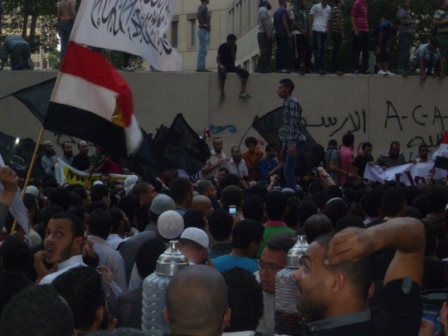
Several thousand Egyptians gathered at the entrance of the embassy, falling into roughly two categories. While it was clear all participated, bearded Salafi Muslims largely stood peacefully, while the soccer youth led vociferous, and playful, chants. It was the latter which scaled the walls of the embassy, pulled down the US flag, and burned it.
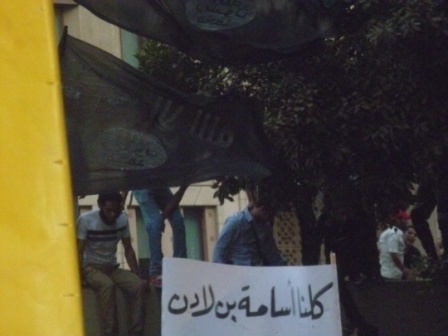
Later, they also draped a black Islamic flag over the signage of the embassy, above its entrance. These flags were in abundance and resemble the standard used by al-Qaeda. It is al-Qaeda, however, which appropriated the black flag from earlier in Islamic history, which was used in Muhammad’s campaigns. It bears the Islamic creed: There is no god but God, and Muhammad is his apostle. Its use at this rally does not imply the presence of al-Qaeda.
I did not witness the US flag being desecrated, but Egyptian security was present in abundance and permitted the action. I was told that the Islamic contingent of the protest calmed the youth and did not permit a more serious storming of embassy grounds, if this was even intended. Security seemed to rely on these Islamists to make certain things did not get out of hand.
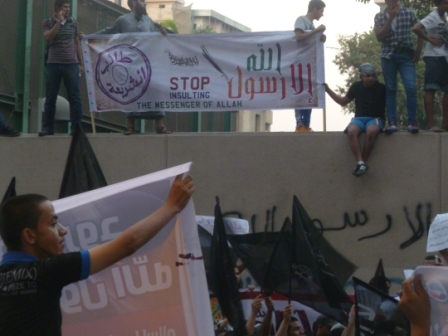
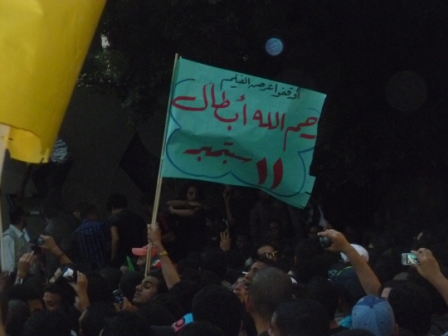
The atmosphere was charged, but calm and peaceful. Even so, offensive chants were issued and questionable signs displayed. Foreign Copts were called ‘pigs’, and the Jews were warned about the soon return of Muhammad’s army. One sign declared, ‘We are all bin Laden, you (Coptic) dogs of the diaspora,’ another celebrated the heroes of September 11, asking God’s mercy upon them. Please click here for a brief video of the protest, and pictures follow below.
I would not say this demonstration was representative of Egyptian society; several thousand people are a small scale protest. Yet dangerous ideas are afloat and society is yet in an unstable transition. I felt somewhat uncomfortable in their midst and kept a low profile, yet spoke with some and suffered no ill reception. Afterwards I spoke at length with some Islamists there I know well, and hope to convey their thoughts in a separate post, perhaps tomorrow.
Such is Egypt these days, for better or for worse. May God bless them.
Black flag draped over US Embassy signYouth Leading ChantsTranslation of graffiti: Muhammad is God’s ApostleProtest bannerSome signs were in English for foreign understandingCalling for Egyptian nationality to be revoked from foreign CoptsSome Copts were present in solidarity with offended MuslimsTranslation: We are All bin Laden; continues underneath, You (Coptic) Dogs of the DiasporaTranslation: God have Mercy on the Heroes of September 11
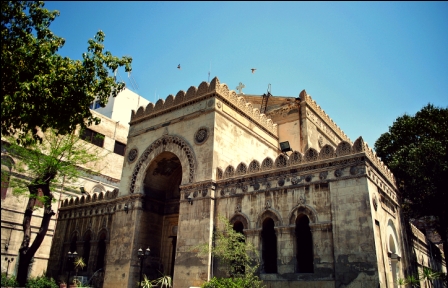
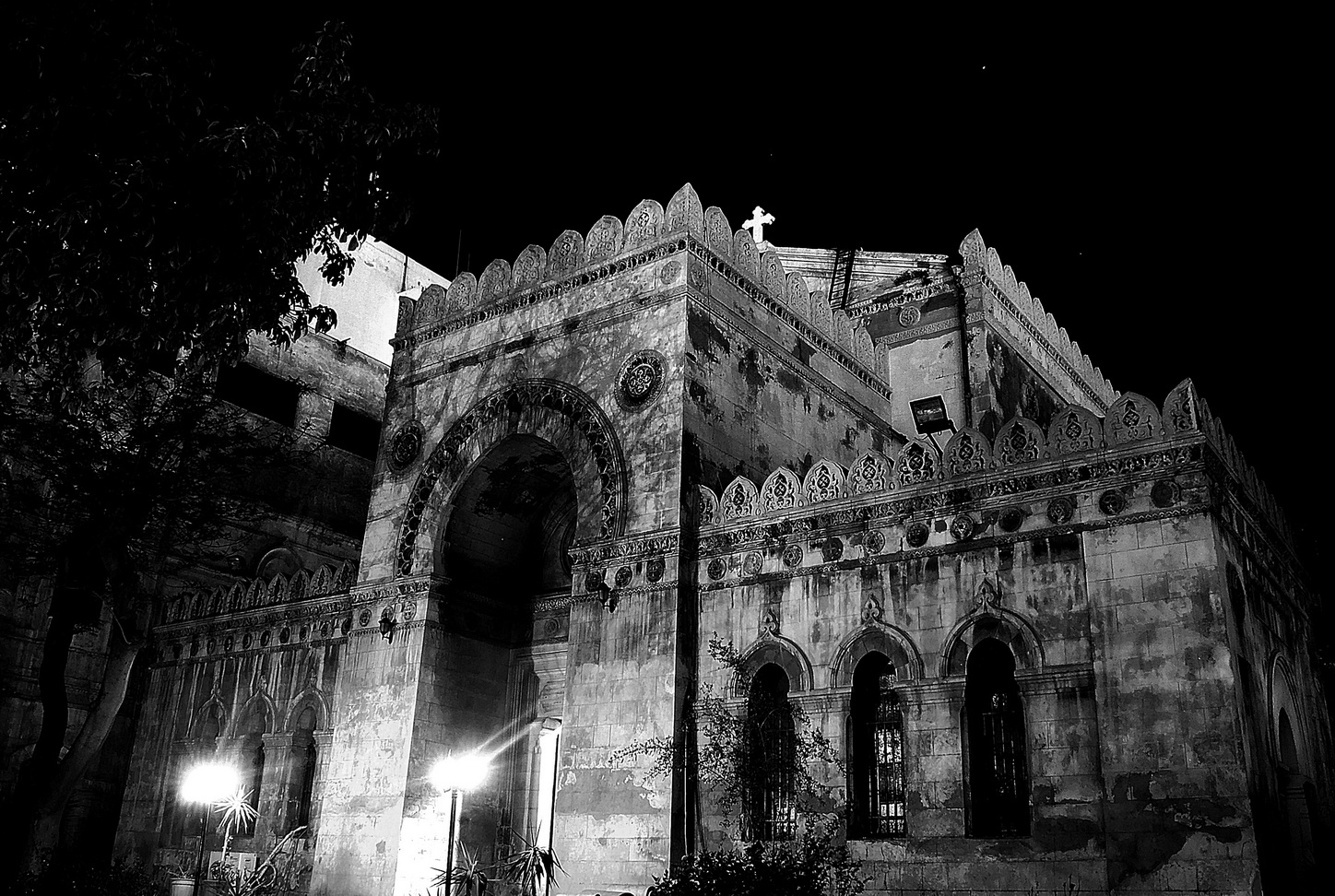
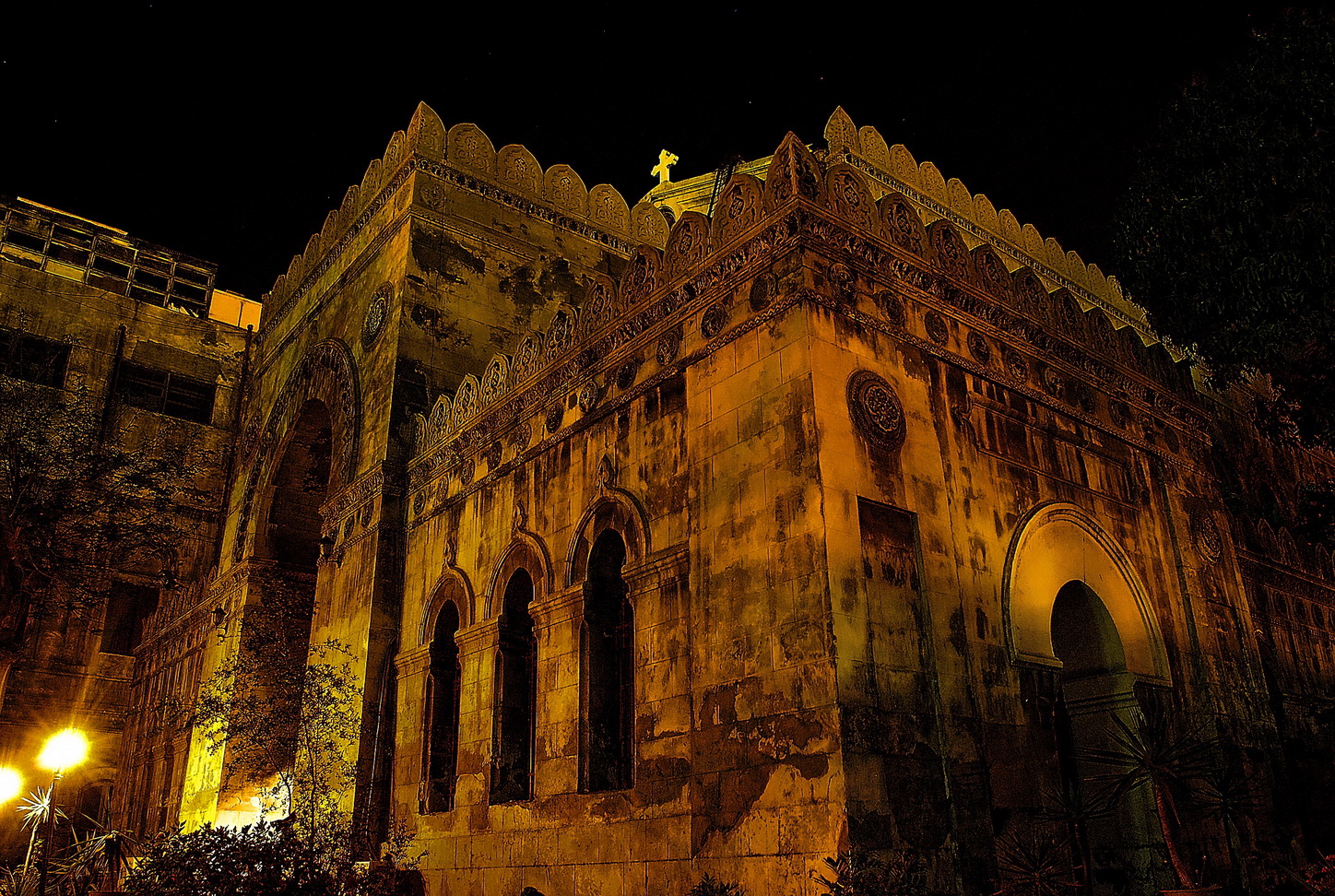
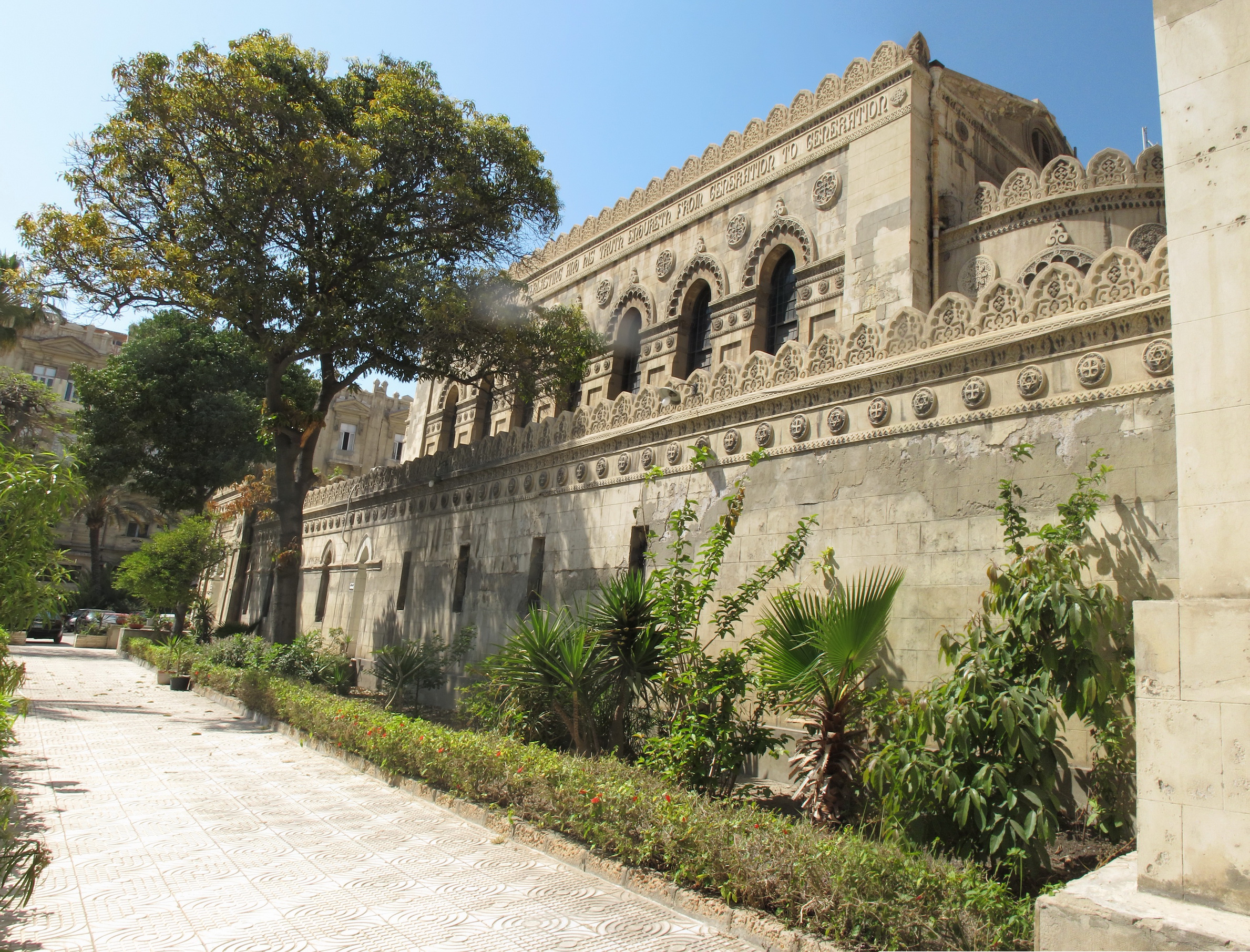
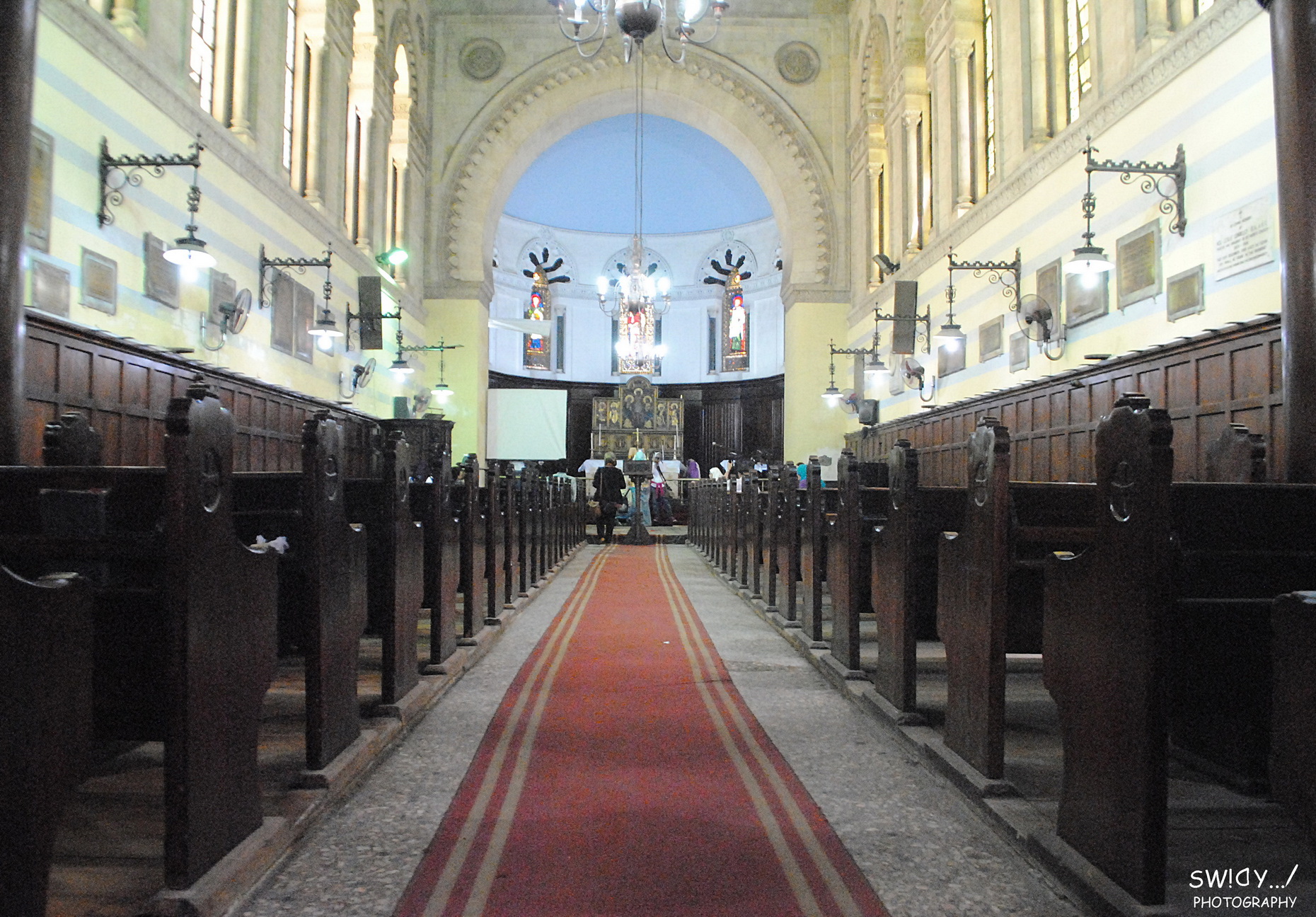
One of the more unique churches in Egypt is located in Alexandria, home of St. Mark’s Anglican Pro-Cathedral. St. Mark is cherished among Egyptian Christians as the apostle who brought the Gospel to Alexandria, from which it spread throughout the Nile Basin and North Africa. A ‘pro’ cathedral is a parish church that serves as a temporary or co-cathedral in a diocese. The primary Anglican cathedral in Egypt is the Church of All Saints located in Zamalek, Cairo.
The first reason for the uniqueness of the church in Alexandria is its history. Its cornerstone was laid on December 17, 1839 following an agreement between the ruler of Egypt, Mohamed Ali, and Queen Victoria, who provided extensive donations for its construction. Various delays complicated completion, however, and its first service was not held until Christmas, 1854. St. Mark’s also received the services of the first Egyptian ordained as an Anglican priest, Girgis Bishay, in 1925.
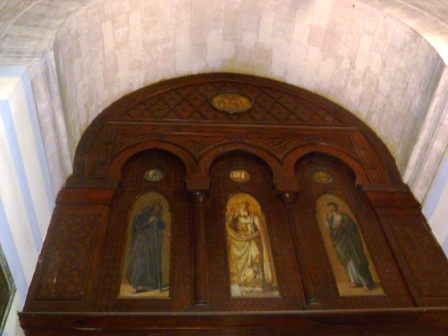
From Left: St. Anthony, St. Athanasius, and Origin
The second reason for the uniqueness of the church is its interior design. Straddling the Protestant and Catholic traditions, in imitation of local Orthodox the church is full of icons. The entrance to the sanctuary his headed by the icons of heralded Egyptians St. Anthony (the founder of monasticism), St. Athanasius (defined the canon of scripture), and Origen (the controversial Biblical exegete). Behind the altar St. George and St. Patrick represent the eastern and western reaches of Christianity, while David and Andrew represent the unity of Old and New Testaments in the Bible.
From Left: St. George, St. Patrick, David, and Andrew
The third reason for the uniqueness of the church is its architecture. Though clearly a church, it honors both the Egyptian Jewish and Muslim communities. The archways and other elements draw from Islamic patterns, while the Star of David is prominently chiseled both into external stone and internal woodwork. The Jews of Egypt have almost entirely disappeared, leaving these marks either a memory of past realities or a possible current source of sectarian misunderstanding.
Star of David Alternating between Crosses
The final reason to highlight the uniqueness of the church comes from its contemporary example. St. Mark’s has opened its doors to house a community cultural center. A church lay leader oversees a team of Muslim artists, who train anyone who comes in drawing, photography, acting, fine arts, and other disciplines.
I wrote about this effort for Christianity Today here, but have wanted to show more of their product than that site allowed. Namely, I hoped to feature the pictures of the church taken entirely by local amateur and professional Muslim photographers.
For those who missed that article and are wondering what the big deal is, in Egypt, this is a very unique happening. While Muslim-Christian interpersonal relations are often fine, people do not ‘hang out’ in the house of worship in the opposite faith. The church, especially, has been a haven of escape for the Coptic community, with its social service centers largely serving only their own.
Muslims, meanwhile, while having Christian friends, often know little to nothing about the faith of their fellow citizens. Soon I would like to return to Alexandria to ask these photographers to comment on their pictures, what the experience meant to them, and what their pictures represent of Muslim-Christian relations (if anything). It would then be submitted as an article for Orient and Occident, the online magazine of the Anglican Church in Egypt.
Please laugh and notice the difference in quality between these photographs below, and mine above. Fortunately, though God is honored by all things beautiful, he judges primarily from the heart.
There is little to pray for this week except for wisdom for men. Many new faces are receiving new responsibilities, as the president has appointed new people to fill the offices of governorates, the National Council for Human Rights, and the Supreme Press Council.
Not all governors are new; only ten of twenty-seven have so far been replaced. In doing so President Morsy has both preserved and broken with tradition. In the sensitive border governorates he appointed only military men. Yet in calmer areas he appointed civilians, and among them, Muslim Brotherhood members.
Again, God, the speculation is open, and only you know his heart. Guide it, God, and may these be men of integrity and conscience. As presidents have done before, is Morsy cementing his power – now regionally? Or is he gradually dismantling a military state? If you would have these positions chosen by the people, God, give wisdom to writers of the constitution.
But for these men now, may they serve their constituencies. May they learn their job quickly, and represent their area to the central government with skill. May they establish security, dignity, and freedom. May they respect the law.
As for the Council for Human Rights, the membership is curious. Breaking with past precedent to select party loyalists, the composition is mixed. There are many Islamist members, but liberal and leftist as well. A few members seem almost extremist, but the head is a well respected judge. Will the body exist as cover for the president, or will they dare to scour Egypt for all vestiges of injustice?
May it be the latter, God. May these members rub shoulders, argue, and develop respect for each other. May they respect above all their task. Many are good men, God, may they demonstrate this for the good of the nation.
And lastly, the journalist appointments have continued for a while now, upsetting many that the Muslim Brotherhood appears to seek control of the media. True or false, the appointments proceed as they always have, through an obscure, but popularly elected branch of the legislature – now dominated by Islamists.
The same question as before, God. Is this a purge of institutions accustomed to kowtowing to the state? Or are they simply new sycophants of a different stripe? Do those who accuse simply find themselves on the out, or are they raising warning flags?
Preserve the media, God. May voices vary, but all speak only from their understanding of the situation. Promote those who promote the truth. Sideline those who write with agendas under the guise of objectivity. May the profession be marked by strong personal integrity, and may it be free from temptation of government to interfere. May it be free as well from the temptation to bootlick.
God, a state is made up ultimately only of men, human beings of your creation. May the institutions be strong, but may the men be moral. Provide multiple layers of accountability. Nurture an aware populace. Give Egypt the tools she needs to recover, and from there to thrive.
Bless the president and his men, God. Through them, bless Egypt.
In our last post I described our hope to provide readers with an easy way to access the Egyptian news, and gave a preview of trying to do the same with Arabic language links.
Well, perhaps encouraged by the relative ease of getting the English links online, I got all excited and gave analysis links as well.
The Arabic links are provided near-daily by a friend who sends them by email, but would prefer to stay behind the scenes and not mention his name. He especially follows news that concerns the Muslim Brotherhood and Salafis, concerned there is an effort to turn Egypt into an Islamic state. I cannot vouch for the reporting standards of every article to which he links, but it is a very useful picture of an angle of Egyptian developments.
The analysis links will come less frequently, provided by Issandr el-Amrani, who maintains the outstanding regional blog – The Arabist. He has given his permission to copy the links he provides on a more or less weekly basis. These include noteworthy events, but also the best of what people are writing about Egypt and the region. Please explore his own commentary regularly as well on his site.
The Arabic page proved a bit more difficult to work with, so if there is a reevaluation down the road that feature might be the first to go. But I love the idea of being semi-bilingual, so I hope it is not too time consuming. As always, please note your preferences, and perhaps we can try this for a month or so and see where it goes.
An Egyptian friend of mine, Paul Attallah, provides a near-daily service of linking to the major news headlines pertaining to Egypt. He also provides his own commentary, which tends towards suspicion of the post-revolution transition and the ambitions of the Muslim Brotherhood.
The thoughts and links are his own, but they provide both a good glimpse into how many Coptic Christians view Egypt these days. He has granted his permission for me to paste his work here, which I hope will be a service for those who would like to take a quick glance at the daily news, and click where a story takes your attention. He often provides English summary translation for the Arabic links as well.
As I am able, I will delete, copy, and paste his work as he sends out his email updates. I will place them in the menu bar with an updated date for new postings.
Right now I am looking at this as a bit of an experiment. I value my friend’s work but I’m not sure how valuable it will be to regular readers of this blog, or, if it might help attract new readers. Please let me know what you think, and if you might like to access his links regularly.
I have another friend who provides a similar service wholly in Arabic. He has also given his permission for me to share, but I think I’ll evaluate this effort first. Please let me know if you’d be interested. I trust that visitors to this blog span the spectrum of limited Egypt knowledge to specialists, but I desire to treat you both the same: I write what I learn and hope it is helpful. But I have to mind my own time as well.
It’s a start, and your feedback is valuable, so thanks. Please click here to access the page if you did not see it above.
Much of Egypt’s attention turned outside its borders this week, and though Sinai is not foreign, it is almost a separate land. Military operations against Islamic extremists have been underway for some time, but lately there have been religious delegations sent, even from the president. These have involved former jihadists who wish to turn those in Sinai from the error of their ways. Or, at least, to halt operations.
Meanwhile the president has been in personal deliberations with the IMF over a nearly five billion dollar loan to support the economy. Beyond the financial implications lie religious controversies, if Islam permits such interest based credit. Now in power, Islamist seem to be finding it more difficult to forbid, while others – supporters and opponents – accuse them of hypocrisy.
A useful escape and popularity boosting effort was provided by the president’s travels to China and Iran. In the former he reinforced and increased economic ties, while in the latter he stood on the world stage of the Non-Aligned Movement and condemned Syria without wholly offending Tehran. Egypt and Iran have been without ties since 1979. In both nations he demonstrated a desire to move beyond uni-polar dependence on the United States.
These are the matters of governance, God, and bless Egypt in them. Give peace to the Sinai, and convict criminals who use violence in the name of religion. If there is any duplicity involved, as some liken to the political use of the US War on Terror, then expose manipulations, God. And anticipating evolution of the region to touch the Camp David Accords with Israel, may these two nations speak to each other and find ways toward mutually agreeable and just peace. Amid it all, bless the people of Sinai; may they find full citizenship and freedom of opportunity in the new Egypt.
As for the IMF, God, give the president good and honest advisors. May those who know economics well sort through the competing propaganda on the liberating / enslaving nature of IMF monies. Whatever the outcome, may the economy stabilize with sovereignty secured for the Egyptian people. As for the relationship between Islam and interest, preserve the integrity of the religious scholar. May he not bend to political pressure, nor pander for political influence. May he fear you alone as he guides the people.
As for foreign policy, give wisdom among competing interests. May the president serve only that which serves his people. May Chinese investment create jobs and aid infrastructure. May Syrian criticism lead to the cessation of violence and bloodshed and a just solution to popular grievances. May Iranian contact promote dialogue between former enemies and possibly current adversaries.
May the region avoid more war.
God, rebuild Egypt and help her to turn to all the practical matters of governance. Yet while these international issues are of deep importance, provide solutions soon to the domestic problems which plague Egypt. Restore security; lift the economy; help the poor. Build an open, free, and democratic structure to include all. Resist any attempts to close ranks, settle scores, or marginalize.
Give respect among Egypt’s political forces, one to the other. Give respect between poor and rich, and narrow the gap between. Heal wounds; issue justice; promote reconciliation.
God, the solutions to these conundrums are in your hands. Enlighten Egyptians that they may find them as well.
If not for the wisdom of two men, the world would be aware of the village of Sheikh Masoud in Upper Egypt for all the wrong reasons.
This hamlet deep in the rural backwater south of Cairo would have been added to the well-publicized list of Egyptian locations torn apart by sectarianism.
As it is, you do not know about it – unlike Dahshur, Giza, which was the most recent casualty of religious division, and the first village to suffer under the new Islamist regime of Mohamed Morsy.
Located 40 kilometers south of Cairo and home to the famous Red and Bent Pyramids, on 28 July Muslims and Christians in Dahshur confronted each other with shouts and exchanges of Molotov cocktails. It ended with a death and a devastated population.
The incident started when a local Christian laundryman burned the shirt of a Muslim client while ironing.
A stray Molotov cocktail accidently hit a Muslim passer-by. When he died from his burns a few days later, Muslims surrounded Coptic homes and businesses, setting fire to them. By 3 August, security forces had evacuated 120 Christian families from the village until calm could be restored.
Wisdom
The events in Dahshur however are part of a more complex pattern of sectarian relations that is often missed by the media. Sensationalist headlines and attention-grabbing pictures often start out as ordinary social problems that escalate, feeding on religious difference.
Far more common is local community wisdom snuffing out the tension, as happened in the village of Sheikh Masoud, 160 kilometers south of Cairo.
It could have gone either way in this sleepy countryside hamlet whose population recently surged to 25,000, 80 per cent of it Muslim.
The village also hosts an area church. Here it was that on 5 August a wedding ceremony took place for Christians of a neighboring village that had no church. All proceeded well and the wedding guests got into cars to drive back home. But trouble developed when the bridal party rearranged the seating in their vehicles to allow the bride and groom to drive to Cairo on their own to begin their honeymoon.
To do so they stopped in the middle of the main street in the village, halting traffic. Only half an hour shy of sunset when hungry Muslims could break their Ramadan fast, an argument ensued.
According to Fr Musa Ghobrial, priest of the St George Coptic Orthodox Church in Sheikh Masoud, the street in question lies thirty meters from the church and is a public gathering area for local Muslim youth.
Muslim drivers tossed insults at the bridal party, shouting especially at the sister of the bride getting out of the car, unaware that she was blind.
Flustered, her uncle, unable to shout back as he happened to be mute, spat upon one of the youths. Within moments the argument spilled over into the church compound, with more than a hundred Muslims gathered inside.
Sheikh Masoud Church Grounds
‘I was absent at the moment of the event,’ said Mohamed Ali, a 43-year old power station manager and father of the youth who was spat upon.
‘I heard that Christians were attacking us, and came after five or ten minutes with my relatives and neighbours to stop the insults,’ he told Lapido.
Fr Musa states there was no violence in the church, but that the atmosphere was charged.
‘Muslims in our area look for opportunities to stir up trouble, especially the younger generation. We keep good relations with them, but other Muslims consider this village to be weak because it has a church,’ he said.
It was these good relations which averted the crisis.
‘What happened was a reaction from the Muslims,’ Ali said. ‘I told them to go home because this is a place of worship and there should be no problems here.
‘Then I saw Fr Musa and the other priests leaving the church and told the crowd, “I know these priests. They will take care of this.”’
As the scene quieted and the church courtyard emptied, Fr Musa sped off after the bride and groom, persuading them to return. He spent the next day sitting with Christian villagers convincing them of their need to apologize over the spitting.
The third day Fr Musa gathered the Christians in Ali’s home, and all drank tea together.
‘Nothing happened,’ Ali told his guests, ‘We are all one.’
According to Fr Musa, neither side issued a public apology, but the gesture in Upper Egyptian culture signified both sides owned their wrong and extended forgiveness.
If Mohamed Ali had been an extremist, or if Fr Musa had angrily shouted at the Muslims in his church, the situation in Sheikh Masoud could have escalated like Dahshur.
Instead, the village remains as unknown as thousands of others throughout Egypt. In each, Muslims and Christians negotiate the status quo, despite the increasing trend of religious polarity nationally.
At times the mixture leads to combustion, but more often than not, contrary to assumptions carried in the press, wisdom prevails.
Fr Musa and Mohamed Ali are courageous – but mercifully not unique – peacemakers.
This article was first published at Lapido Media on August 29, 2012. Please click here to access it.
In the past few weeks the story has circulated in conservative news circles that the Muslim Brotherhood has crucified its opponents outside the presidential palace. This story is almost certainly a hoax.
I have been able to draw from elements in the media on both sides of this issues, combining all evidence I could find in a report. For the full text of this report, please click here to access it on Arab West Report. Here, however, are some excerpts:
A primary circulator of the story in the English press is WorldNetDaily, which published an exclusive report on August 17. The article in entitled: ‘Arab Spring Runs Amok: ‘Brotherhood’ Starts Crucifixions. It states ‘Middle East media confirm…’ and then links to a website called The Algemeiner.
Published on August 16, the website published a story written by Raymond Ibrahim, a Shillman Fellow at the David Horowitz Freedom Center. It is entitled: ‘Muslim Brotherhood Crucifies Opponents, Attacks Secular Media’. It states, ‘Several Arabic websites … (listing four) … reported that people were being crucified.’
As I describe in the report, however, these sources do not ‘report’, but rather carry a single news outlet’s report, which it later retracted. Those holding to the truth of the story, however, are quick to point to evidence in the Quran and sharia law.
Websites supporting the accuracy of the story also give as corroborating evidence verse 5:33 of the Qur’an, which states:
Indeed, the penalty for those who wage war against Allah and His Messenger and strive upon earth [to cause] corruption is none but that they be killed or crucified or that their hands and feet be cut off from opposite sides or that they be exiled from the land. That is for them a disgrace in this world; and for them in the Hereafter is a great punishment.
They also quote Egyptians, including a parliamentarian Adel Azzazy from the Salafi-oriented Nour Party and a Salafi sheikh , who called for the crucifixion penalty to be applied in Egyptian law.
The evidence again this actually taking place is in the report, but the mere mention of crucifixion suggests the most horrific of pictures. Yet this is not the reality at all and, though those who circulate the story admit this, they play readily on the popular imagery. From the conclusion:
It should be noted that ‘crucifixion’ conjures notions of Jesus upon the cross in standard presentation, nailed to two perpendicular pieces of wood. What is alleged is simply that people were strung up upon a tree. Could it be they may have been only minimally tied to the trunk?
If there was an altercation that evening in front of the presidential palace, however, there are no names of victims provided. Furthermore, all that would be known was that the alleged attack would have been the work of ‘thugs’, as has been common during Egypt’s traditional period. It would be impossible to tie these thugs to the Muslim Brotherhood, or establish they were doing its bidding, except through due process of law.
In light of the assembled evidence, however partial, the best conclusion is that the stories circulated by Algemeiner and WorldNetDaily, and popularized by the Shoebats and others, are meant as propaganda pieces against the Muslim Brotherhood.
There is insufficient evidence to establish that crucifixions took place at all. While it appears there may have been an altercation, even imagining a possible victim tied to a tree, it is a far, far jump to label this as Muslim Brotherhood crucifixions.
While the Qur’an does contain of verse about crucifying a brand of criminal, and marginal Egyptian forces have called for its implementation, the linking of this possible event with these sources is a clear effort to demonize the Muslim Brotherhood as a political force. Even if someone was strung upon a tree, these websites know full well the image of crucifixion in the Western mind is of Jesus and his horrific killing, along the lines of the film ‘The Passion of the Christ’.
This is irresponsible and dangerous journalism. Such verses of the Qur’an deserve rational questioning. The quotations of Salafi politicians and preachers are unnerving. The agenda of the Muslim Brotherhood is under suspicion. But the websites in question have not simply failed to properly investigate a likely hoax; they have aided and abetted it.
Please click here to read the whole article. And, if you have come across this story in the media or from otherwise well meaning friends, please share this to help suppress a campaign of misinformation. Thank you.
What do you make of the anti-Muslim Brotherhood protests? There was so much confusion in the preceding weeks; so much tied to broader events in the nation. Yet the fact of the matter is a few thousand people demonstrated at the presidential palace. Calls for a sit-in are pending.
If the turnout was somewhat weak in terms of Tahrir, it was somewhat sizeable in its own right. But the event could not live up to its billing – false or otherwise. Rumors abounded the demonstration – billed originally as a 2nd revolution – would be violent, though revolutionaries and Brothers traded accusations at who would be the instigator. Yet the day was chosen to commemorate the burning of Muslim Brotherhood headquarters in 1954, and the nation was on alert for repetition.
Even so, the clamor for the awaited day of protest had waned following Morsy’s sacking of army leadership and the silencing of two anti-Brotherhood media outlets. Some analysts say a coup d’etat was in the works; when it was snuffed out behind the scenes the air went out of the protest balloon. Indeed, it is difficult to know if there is legitimacy behind it at all.
The nation has chosen a president, God, but one with a very thin mandate. His moves seem to outpace his support, but is there any room to call for his dismissal?
On other protest cries there may be more. The Muslim Brotherhood is still an unregistered organization, existing outside the law. Should it be dissolved, or at least regulated?
But in the many manipulations of rumors surrounding the event, coupled with assurances of peacefulness and freedom to protest, what is really at stake? It may be no less than mutual attempts at de-legitimization.
If so, God, please do not allow it. There are many reasons to either support or oppose the Brotherhood, and equally their opposition. But if democracy is the goal, they must do so on the basis of ideas, while accepting the other’s right of difference. But Egypt has been in the long bad habit of exaggeration and defacement, and despite the onset of democracy the situation is still very revolutionary, very unsettled. For many, too much is at stake for honest transparency.
God, will you withhold your blessing from those who lack integrity? Or will you allow this sin to prevail that greater grace might abound elsewhere?
The fears of many concerning the Brotherhood have a reality behind them, God. As you know the situation, give clarity and courage to confront, or else peace of mind and heart to accept. And as the Brotherhood holds power, guide and enlighten them toward good governance and promotion of liberty.
Yet even if acceptance is warranted, God, develop a viable opposition in Egypt. Not that they are correct – this is for your judgment – but that they are necessary. Create a civil and institutionalized check on the authority of power. Establish alternatives away from the street.
Yet within any opposition, God, hold Egyptians together in unity. Should this protest either wither or continue in strength, may the state of the nation be uplifted.
I was invited to comment on an article posted on the Mission of God blog, concerning the inevitability of the Arab Spring turning Islamist, and then the rejection of Islamism for Christianity. Please click here for the video post; my response (slightly edited) follows below.
I think Dr. Cashin’s core point is correct: A system that does not allow questioning of itself cannot stand. But there were a few points which lacked sufficient nuance. A great number of the Arabs in their revolution (at least in Egypt) did not choose Islamists out of love for Islam, but because they were the only viable alternative. While many others did so because they believed (or were told) it was God’s will, what is happening is not a massive choice for Islam.
Now, the MB in Egypt may well become a dictatorial force. Some signs are there as is the lack of organized opposition. Yet this is more likely to be along the lines of a Mubarak-NDP system than an Iranian imitation.
But, there are other indications which suggest the Islamism of the MB is akin to Protestantism, causing a shaking of the traditional religious establishments, such as the Azhar. I don’t predict an open, liberal system for Egypt, nor a full freedom for religious contemplation, but it could happen.
The recent Pew Survey of the world’s Muslims suggests that the level of religiosity among younger Muslims is much less than of the older generation. And while I maintain suspicion over MB promises to lead Egypt into democracy, I do imagine the economic and educational systems will improve. These factors are more likely to free the societies from the constraints of religious dogma, much like happened in European Christendom.
So, yes, if the MB seeks to impose religious hegemony over Egypt, it will eventually fail. But will this result in a massive turning to Christianity? It is fair to imagine, simply speaking sociologically – not in terms of faith claims in either direction – and as Dr. Cashin states, Iran provides an interesting case study. But the more likely result is the general turning away from religion – a process already underway among many youths. The nominal holding of a faith is far easier than the deliberate acceptance of another. The MB will bring an Islamic religious revival to many, but it will only hold if they foster freedom.
Dr. Cashin’s point is that they cannot – Islam as a religion constrains them. It is a fair point and there are examples to back him up. But Europe’s Christian culture also constrained questioning of Christianity, and if OT examples are used there are good Biblical texts that forbid religion from being questioned. Yet society moved on. Will it in the Arab world? It will be messy, but I think the answer is ultimately yes. Perhaps in this Dr. Cashin and I are agreed, but I leave open the possibility for the MB to be a partner in the process.
A very useful discussion though, and there are few certainties at all.
It has taken me a long time to write anything about the Sunday surprise: President Morsy forcing the resignation of senior military men Mohamed Tantawi and Sami Anan. At the same time, he unilaterally canceled the army announcement appropriating legislative authority and constitutional oversight to itself. Morsy then gave himself these privileges.
Much of my delay was due to shock, the rest due to efforts to figure out what it all meant.
My first response came almost a week later by necessity, as I am glad for the habit of writing Friday Prayers. It was very helpful to try to frame the event in a manner all people here could pray.
Morsy’s moves were good, but not as good as some make them out to be. They were also bad, but not as bad as others make them out to be.
Certainly the army leadership was guilty of mismanagement during the democratic transition, if not worse. Moreover, it was never fitting for the military to formally take the powers it did, even if there were justifying factors.
In one sense Morsy put things right, but by taking power to himself he put them wrong again.
One of the main reasons the revolution railed against Mubarak was over his dictatorial command of the regime. Now, as the beneficiary of the revolution, Morsy has even more power.
Yet while this image is there, it should be drawn in. Morsy could not have sacked army leadership without the help of junior army leadership. These may be less adversarial in public, but in private may still act as a check on his power.
The question is, if this is true, are they a check on his revolutionary and democratic ambitions, or on his Islamist ambitions? Which does Morsy hold closer to his heart?
In contemplating this question I recalled a conversation I had with a leading Coptic media figure several months ago. Then I found a new writing opportunity, resulting in my first full reflection on Morsy’s gambit, published yesterday at Egypt Source. I wrote:
The worried Coptic voice interprets this as a grand scheme to implement an Islamic state. The frustrated liberal voice interprets it as evidence of their Machiavellian lust for power. Both may be right.
But what if the Brotherhood really means it? ‘Trust us’ may not result in everything the Copt or the liberal desire, but it may reflect a real Brotherhood wish to honor the goals of the revolution in respect to the conservative social reality of Egypt.
Or perhaps I have the wool pulled over my eyes.
In November of last year following the Islamist victory in the first round of parliamentary elections, I interviewed Youssef Sidhom, editor-in-chief of the Coptic newspaper Watani. Imagining I would hear alarm bells from an intellectual leader in the community, I was surprised by the exact opposite.
“I believe the Muslim Brotherhood wants to prove they can create a form of democracy,” Sidhom said, “that respects the rights of all Egyptians.” He went on to describe several positive pre-election meetings with Brotherhood leaders, from which he was convinced they were ‘decent people’.
Yet when asked why they would not submit to a consensus over binding constitutional principles, his answer has echoed in my mind in all events since.
“Perhaps … they don’t want it said, ‘They did so only because they were forced to.’”
Upon finishing the article I had the disquieting feeling I had functioned as an apologist for the Muslim Brotherhood.
But here is the rub. The West enjoys liberal governance and has for decades. The revolution in Egypt is only now seeking its creation. Does the Brotherhood seek this? If so, they may need an autocratic moment to give it birth. All their concentration of power may be to show themselves the ultimate servant, when they bequeath it back to the people.
They should not be given the benefit of the doubt – there is no room for this in politics. The possibility, however, needs to be raised.
I am very cautious. Most testimony I have heard across the Egyptian political spectrum is that Morsy is a good man. I believe that power corrupts; while a man can be a benevolent dictator or philosopher king, a system cannot.
Is Morsy ushering in a new era, or is the Muslim Brotherhood ushering in a new system?
The fatwa is commonly known in the West as a death sentence. Among Muslims, the fatwa can be among the most powerful tools of Islamic populism. On a third front, the fatwa is simply a bureaucratic function. Which definition encompasses reality?
Since the dawn of Islam the scholar has had a place of prominence, celebrated for his command of the Quran, the traditions, and mastery of the sharia. For this reason, the state has always wanted to remain on good terms with the scholars, and if possible, to co-opt or institutionalize them.
What makes a scholar? There is a threshold of necessary knowledge, without which any claimant would be exposed as a fraud. But scholars must also be linked to networks, or else they would simply sit at home issuing fatwas to themselves. It is these networks which are under redefinition in Egypt and much of the Arab world today.
For example, the Muslim Brotherhood has a mufti – the Arabic term for one who gives a fatwa. Is he legitimate? What about each and every Salafi preacher around whom the people congregate? If someone appears on television, is he fit to issue a fatwa?
Conversely, though the state conveys legitimacy on many aspects of society, does it also pertain to religious life? Islamic societies have historically treaded carefully here, wary of the corrupting possibility of power but keen to preserve the stability of the nation.
For centuries, in Egypt especially but also throughout the Sunni Muslim world, the Azhar established itself as the pinnacle of Islamic scholarship. Its graduates secured both popular and institutional credibility. Yet in 1961 President Nasser brought the prestigious university under state control.
The process to diversify – and perhaps dilute – the influence of the scholars was already long underway, however. In the 19th Century under British occupation the Dar al-Ifta’ was created to issue official fatwas. The institution survived the 1952 revolution and was used at times thereafter to obtain favorable rulings for controversial state policies.
As both Sheikh al-Azhar and the Grand Mufti are positions appointed by the president, many have criticized the venerable bodies as being little more than mouthpieces for the ruling regime. It has not been uncommon, however, for many criticisms to issue from scholars of either dubious representation or extremist trends. Is not the state the societal organ best fit to establish proper regulations and qualifications?
Ibrahim Nagm
Though not a justification, Dr. Ibrahim Nagm explains the functions of Dar al-Ifta’. Serving as senior advisor to the Grand Mufti, he seeks to make understandable the concept of ‘fatwa’, which has been sensationalized due to what he would say is its frequent misuse.
Nagm defines a fatwa as ‘non-binding religious advice given by a qualified scholar in response to a question asked by a member of the public’. He then proceeds to unpack the meaning of each key phrase.
Non-binding: A fatwa carried no legal authority or compulsion of implementation. This invalidates the popular idea that a fatwa is a summons to kill a particular individual, for example.
Qualified: Though anyone can give their religious opinion, only a certified scholar is permitted to issue a fatwa. Dar al-Ifta’ insists upon deep Islamic scholarship from a respectable university (such as al-Azhar), and then provides three additional years of training before accrediting anyone.
Question: A fatwa must be spontaneous, issued in response to a real life issue submitted by the public. It cannot be internally generated according to policy. Every day the Dar al-Ifta’ receives +500 personal fatwa requests and +2000 by phone in up to nine languages from around the world.
To handle these requests, the Dar al-Ifta’ has about 50 accredited scholars working in its administration, with an additional 50 scattered throughout Egypt.
Each fatwa issued conforms to the basic methodology of Islamic scholarship, which Nagm outlined as the following:
1) Consult the Islamic sources: These include the Quran, the sunna, and the legacy of Islamic scholarship. Look for precedents and consider their application.
2) Understand the person and the issue: Fatwas are expected to apply differently according to circumstances. The legal texts are incomplete without full knowledge of the problem.
3) Issue the fatwa: To be done in a manner bridging tradition and reality.
As an example, Nagm described a request for a fatwa to see if it was permitted for a particular man to take a second wife. After consulting the sources, the indications were yes – it is permitted for a Muslim to marry up to four wives.
Yet after consulting the situation, the person requesting the fatwa was discovered to be residing in a non-Muslim nation which forbids polygamy. Bridging between the tradition and the reality, Dar al-Ifta’ issued a fatwa instructing the requester to submit to the laws of the country he lived in, and not marry again.
In another example a farmer requested a fatwa to permit or forbid the use of certain chemicals in the fertilization process. Nagm indicated clearly this was a matter beyond the competence of the institution. They referred the question to scientific specialists, who indicated the mentioned chemicals were harmful. Armed with this knowledge, it was a simple matter to issue the fatwa forbidding their use.
Returning to the question of Islamic legitimacy, Nagm does not answer the question, but does paint Dar al-Ifta’ as a thoroughly bureaucratic institution. Its methods are sound, but reflect the dry, thorough work of professionalism.
Professionalism is good, of course, but Nagm frequently contrasted it to academia, which is not enough. It is not scholarship that makes a mufti, but training.
Of course, training is also good. Nagm commented that Osama bin Laden was an engineer, and Ayman al-Zawahiri was a doctor. No matter how substantial their personal study of Islamic jurisprudence, they are not part of a credible, established network.
In terms of establishment, this is certain. But credibility is in the eye of the beholder. Dar al-Ifta’ walks the fine line between professional accountability and state submission. Yet this is no different from the family of Islamic scholars throughout history who have navigated the same challenge.
After all, though scholarship is immensely valuable, it puts no food on the table. It must market its knowledge somewhere. The public trusts the scholar, while marketing, to remain faithful ultimately to God.
Honor those in authority, and make them men worthy of honor. To the degree they are, may they receive honor from the people.
Yet this asks a lot of the people, God, when so much happens behind closed doors. Once opened and an action is taken, there is little in the way of explanation, leaving everyone in the dark. This past week has been an exercise in groping about.
When President Morsy sacked the top leaders of the military council, did he do so for revolutionary gain or Islamist? The rhetoric issued afterwards means little, for he also took unto himself the military-seized powers of the legislature and oversight of the committee to write the constitution. If it was right for him to remove this from the military, is the reality now an equally undemocratic arrangement? Or is it only so if he will misuse this power?
Perhaps consolidate of power is in itself misuse.
Furthermore, there is consolidation in the ranks of the press. New editors-in-chief appear to have Islamist bent, and worrisome actions have been taken against the president’s critics. But again the darkness obscures. The critics were not simply voicing opinion, they were calling for revolution. Yet the charges hearken back to the days of Mubarak-era oppression, seemingly trumped up and exaggerated. Meanwhile, is the editorial squeeze Islamist in reality, or just the reality of editorial policy, now in the hands of different heads? It is justified to fear, it is so hard to know.
Perhaps consolidation of opinion is in itself oppression.
But God, is consolidation necessary to move Egypt through these times of transition into a free and stable system, as Morsy promises? Is he an honorable man, or does he hold a hidden agenda?
Is it foolish to believe the right must be achieved in the right way? Not everything being done, even if justifiable, seems right.
God, hold accountable those who have committed crimes. Honor those who have presided over difficult days in Egypt. If these are the same men, God, sort out justice as you know best.
God, hold accountable those who have manipulated the news. Honor those who strive to sort through the many vagaries and contradictions of Egypt. If these are the same men, God, preserve the freedom of the press as you deal with them as individuals.
If consolidation is necessary, God, may it be temporary and keep its beneficiaries pure from the temptations of power.
If it is not necessary, then foil all plans, yet deal gently with those of good intention.
Where honor exists, God, no matter how small, honor and multiply it. Cleanse Egypt and make her whole. Shine light into the darkness, and purify all good.
May Egyptians be people of integrity, and their nation a beacon.
Orient and Occident Magazine is a publication of the Anglican Diocese of Egypt, North Africa, and the Horn of Africa. I have been working with the church on the project for a little under a year, and am proud to announce the first issue is now complete and online.
O&O is scheduled to be an online, quarterly, bilingual magazine. Its goal is to serve primarily Arab Christians of the region in providing articles that consider the intersection of the values of faith and the issues of society.
Many Christians have a strong sense of spirituality; many others are active in political life or defense of their community. Orient and Occident seeks to bring these worlds together – what practical difference should Christian values make for the good of all?
Love, peace, forgiveness, mercy, grace, justice. By no means are these Christian values alone. Orient and Occident also welcomes Muslim and non-religious writers to contribute – and seeks their readership – so that these values might increasingly find expression in the public lives of the region’s people.
Of course, there will be disagreement over how these values should be expressed. Orient and Occident will strive to welcome all opinions. It aims to take no editorial stand, except to insist on a perspective shaped by the values of faith.
The articles of the summer edition include:
It All Began Here (the Anglican Church and the Middle East)
Tunisian Christians and the Arab Spring (how they contributed, that they exist)
My Story with the Thug (necessary introspection of a societal crisis)
Political Choices and the Confusion of Believers (facing a presidential vote)
Religious Pluralism in Egypt in the Near Future (on Protestantism and Islamism)
The Truth No One Talks About (sectarian tension and its roots)
Two Cities (Augustine’s vision and Egyptian reality)
Caravan Reflections (contemplating a recent art exhibition)
Poisons We Love (on the dangers of sugar)
The Killer of Dreams (short story on parental expectations)
Two Faced (on political and religious hypocrisy)
In addition to articles, Orient and Occident features Christian bloggers from the Arab world. As these post new material to their site, O&O will automatically feature it in chronological order. Currently there are 17 bloggers featured, but we hope this number will grow as our magazine becomes better known.
Please click here to visit Orient and Occident, the English version. We hope you will enjoy it; please share widely to help this idea become better known.
Throughout Egypt the justice system is known to be very slow. Though it has a long and respectable history, as the population exploded and litigation increased, many turn to non-traditional methods to avoid spending a year or more in court.
Sometimes, a non-traditional method can be thuggery. A landlord, for example, might expel by force a legal tenant and deal with the consequences later – whenever the court gets around to hearing the case.
Sometimes, a non-traditional method can be arbitration. Egypt, mindful of the slowness of its judiciary, has established a limited number of licensed arbiters, especially for commercial and business disputes.
Yet for many, especially in Upper Egypt, the non-traditional method of choice is the reconciliation session. Completely outside the law, two aggrieved parties turn to a respected man of the community, and set their dispute before him.
Reconciliation sessions have a deserved bad reputation, especially as pertains to sectarian conflicts. Rather than ruling by law, the police enforce calm in an enflamed village, and then Muslim sheikhs and Christian priests sit together to ‘reconcile’ their people. Perhaps a local dispute – where a Christian may very well be at fault – escalates and a Muslim mob distributes group punishment by burning shops and homes.
If the judiciary in Egypt is slow, the law is weak. The efficient solution is to engage the sheikhs and priests to determine monetary compensation for the Christians and then make a public display of reconciliation. Valuable as this may be, too often it covers over smoldering resentment and rarely punishes wrongdoers.
Yet far more frequent in occurrence are the ordinary instances of two parties settling their grievance amicably. This does not always mean a happy ending, nor is it free of questionable rulings. But where a flawed legal system is the norm, it works.
I encountered two examples recently which help give perspective. These examples hear from only one side, and both involve Christians exclusively. At the very least, they indicate how Christians are not simply the victims of reconciliation sessions, as often portrayed in the media. On the contrary, they are willing participants mirroring exactly their Muslim neighbors.
In the first example, a Christian family consisting of three adult brothers suffered tragedy when the third brother died young. That he also died unmarried added conflict to the tragedy.
What to do with his share of the family inheritance? To whom should he leave it? If the simple answer is to divide it equally, the equation is complicated by the fact he lived with one of the brothers as a semi-dependent.
Yet the other brother stated he paid ‘rent’ to the first brother to help offset costs. In the end, they took their problem to the church. The two priests of the village convened, heard the stories, and pronounced a simple 50-50 division between the surviving brothers. All were satisfied, and life carried on.
In the second example the dispute involved the church – that is, the priests themselves. The family of the priest in question inherited a large tract of land, complete with ownership papers establishing their right. Further distant relatives, however, received no share but believed they were entitled. Yet as the church was complicated in the conflict, the petitioning family decided to go to a Muslim village sheikh.
This particular Muslim sheikh is very well respected as a non-traditional ‘reconciler’ in the village, by both Muslims and Christians. He is said to deal according to the right, and not by religion or benefit. Yet he also draws a fee for his services; it is not simply a service provided. His authority comes only from village reputation. He has no license from the government.
This fee can reach up to several hundred dollars, and is traditionally paid by the disputant who first appeals to arbitration, win or lose. Trusting the judgment of the sheikh, who has been known by both parties since childhood, the landowning family agreed.
In the end, the sheikh ruled for the landowners – their names were on the legal documentation; it was a simple case. But in doing so the sheikh put himself in a quandary. The landless family was poor; they had no means to pay his fee unless they won the judgment.
In saying so, care here must be taken since the sheikh’s perspective is not known. Yet it is said of him he was on watch for any impropriety on the part of the landowners, so as to extract from them a fee for ‘contempt’.
Apparently, the landowner believed the sheikh was listening too favorably to the complainant’s cause, and not letting him speak. At one point he interrupted angrily, ‘Shut up, sheikh!’
With this highly culturally insensitive remark, the sheikh fined the landowner the several hundred dollars which should have been his fee from the original litigant. Whether or not this swayed his understanding of the case, he then ruled according to what appears to be justice.
Of course, the winning Christian family finds this an example of injustice, but once the non-traditional reconciliation session is begun, its judgments are final.
It is reported the sheikh has spoken privately to other members of the family, saying he will return the fee if the insulting party simply apologizes, or even has his landowning relative do so for him. Both refuse.
These examples are not complete pictures of non-traditional justice in Upper Egypt. They do not include the issues of vendetta, honor killings, or the messy intersection of these with sectarian conflict.
What they provide instead is a picture of the normalcy and unremarkable nature of Christian participation in reconciliation sessions. It is not simply the headline-making instances of miscarriage of justice that characterize the practice.
Swift justice and rule of law would be better. In their absence, however, non-traditional methods work reasonably well.
Once again Egypt is bloody. When manipulations are political it can be understood as the nature of politics in times of transition. Yet this manipulation is evil. Sixteen soldiers were killed on the border with Gaza, by as yet unknown assailants.
Early reports blamed terrorist Islamist groups based in the Sinai. Then links with Hamas or other Palestinians were proposed. Some turned the other direction, including the Muslim Brotherhood, and alleged Israeli involvement.
The political fallout has similarly been all over the map. Some try to link the inefficient Morsy government to lax security and Islamist emboldening. Others nudge at the military council as proof they should leave transitional oversight and get back to protecting the borders. In the background is a budding new and anti-MB revolution planned for August 24, as well as moves to replace editors-in-chief of state newspapers and reorganize spy and security leadership.
The nation is abuzz, all while mourning.
In it all, God, who represents evil? Who would kill to advance their political goals?
How much longer must Egypt suffer, God? Encourage those who believe what has happened in the revolution is good, even if there is much wrong to overcome; even if there is much wrong in store.
May good men prevail. May those who have committed this atrocity be brought to justice. May those behind them be exposed.
May good men shoulder responsibility, God. May they find the truth and tell it. Cause all secrets to come to light; cause all rumors to dissipate. May Egypt be built again, but on a firmer foundation that what was.
Give strength, God. Give Egyptians faith to seize their nation and participate in shaping it. May that which was beautiful not be lost, as they discover now the road is hard and long.
Make it shorter, God, but more importantly, make Egyptians into the kind of people who can endure it. On the other side, may they be whole.
‘Should we sacrifice evangelism for coexistence, or coexistence for evangelism? This debate will concern us for the next several years.’
This quote from Rev. Andrea Zaki ended a presentation by the Evangelical Theological Seminary of Cairo. Founded in 1863 by American Presbyterian missionaries, preaching the Gospel has been a core component of the Coptic evangelical identity since its inception.
Perhaps this is not appreciated by the Western evangelical church. The common perception is that Muslim dominance over Egypt has prevented Christian witness. They see a church shrinking, not growing. On the contrary, the assumption is the church has abandoned evangelism in order to survive. The Western church is sympathetic, but wonders if in forsaking the Great Commission to preach the Gospel to all peoples, Egyptian Christianity is doomed to wither away.
In the choice above, many in the Western church see settling for coexistence is a death warrant for Christian vitality. Better the sacrifice of martyrdom than the slow and steady decline of accommodation. Most Western evangelicals do note the juxtaposition of this thought with the reality of their religious freedom.
Atef Gendy
Dr. Atef Gendy would protest the false choice of evangelism or coexistence. As president of the seminary, he oversees that both are taught. The Missions Department of ETSC has courses in dialogue and in evangelism.
‘We have adopted the holistic approach,’ says Gendy. ‘We encourage dialogue, we preach the Gospel through ethics, service, and ministry, but we also support direct evangelism.’
Yet he noted that dialogue was absolutely necessary, given the social reality in Egypt. A seminary professor polled both Muslims and Christians concerning values. The three worst sins in descending order ranked: 3) Killing someone, 2) Changing religion, 1) Committing adultery.
Such an order does not bode well for the convert, let alone the evangelist.
Therefore, Gendy takes pride in the good relations the seminary enjoys with Muslim leaders, especially the Azhar, the pinnacle of Islamic learning in the Sunni Muslim world. They not only frequently attend interreligious dialogue meetings, they also cooperate practically.
‘We try to develop the religious speech of both Christian and Muslim leaders. We emphasize a shift away from simple ritual and surface issues to focus on ethics and transformation.’
Gendy celebrates much which took place during the Egyptian revolution, but also is worried about increased restrictions on freedom in an Islamic context. Yet for this he emphasizes the strategic decision the seminary has taken in theological education.
‘We must recall our theology in incarnation, crucifixion, and resurrection. This is to challenge our leaders to empower the church. Why should Christians emigrate? Maybe we will suffer – along with many Muslims – but this is only a precursor to our resurrection!’
Within any potential suffering, love must push Egyptian Christians to stand by their Muslim neighbors, but love in the evangelical understanding implies more than just solidarity.
‘We must testify, amidst all sensitivities. But we must also show our love through service.’
In Egypt, the future is unknown, but this is fitting with evangelism, whose outcome is also unknown. Gendy’s hope is in God in both cases. Whether or not the church is declining, he knows his duty as an evangelical Christian.
‘We do not have the responsibility to convert anyone, this is for God. We only must witness to our faith.’
Perhaps he, along with Egypt’s Christians might add, ‘and coexist at the same time’. Over the next several years this will be the vital challenge facing the church.
This article was originally published on August 3, 2012 in Idea Magazine.




















 Jayson Casper