From Ahram Online, exposing how one Brotherhood leader has alternated in support and harsh opposition to Mohamed el-Baradei:
Leading Muslim Brotherhood figure Essam El-Erian on Tuesday accused opposition figure Mohamed ElBaradei, along with several world leaders, of facilitating the 2003 US invasion of Iraq and demanded their prosecution by an international court.
El-Erian, vice chairman of the Muslim Brotherhood’s Freedom and Justice Party, accused former British prime minister Tony Blair, former US state secretary Colin Powell and former Italian PM Silvio Berlusconi of having been instrumental to the US invasion of Saddam Hussein’s Iraq ten years ago.
“Defendants should also include the one [ElBaradei] who covered up for the scandal… without saying one honest word that could have saved Iraq from invasion,” El-Erian asserted.
“The International Atomic Energy Agency (IAEA) and its men, including ElBaradei, who served as agency director for 12 years, should be tried,” he said.
El-Erian’s allegations were met with criticism by many commentators on online social-media networks, who accused the Islamist leader – who had earlier voiced support for ElBaradei – of “hypocrisy.”
“If Mohamed ElBaradei runs in [Egyptian] presidential elections… then we [the Muslim Brotherhood] will definitely vote for him,” El-Erian said in a 2011 interview on Egypt’s Al-Qahira Wal-Nas television channel.
In other footage dating from before Egypt’s 25 January 2011 revolution, El-Erian referred to members of the Mubarak regime who attacked and defamed ElBaradei as “a handful of saboteurs.”
“ElBaradei was director-general of the IAEA and is well-respected worldwide,” El-Erian asserts in the footage.
Perhaps Erian would have a reasonable explanation for his differing assessments, but it would be fascinating to ask him.
It was an unprecedented offense, as this Coptic Orthodox cathedral has never before been besieged. But for several hours tear gas rained in a hailstorm of stones. Molotov cocktails exploded among volleys of birdshot. Two died. What died with them, God?
God, there is too much conspiracy – save Egypt from manipulation. Bring truth to light and expose the darkness in men’s hearts. But the darkness has infected everything, so that little can be known for sure. But certainty is on the lips of most.
All this for a funeral, God? Oh, that it was all spontaneous, as bad as that would be. An altercation outside Cairo devolved into the death of a Muslim and now six Christians. The funeral of the latter was held in the heart of Coptic Egypt, the seat of the pope. Politically charged, frustrated Copts chanted against the Muslim Brotherhood, and on exiting the cathedral were hit by stones thrown from neighboring residences. It is said Coptic youth smashed parked cars and picked fights with police. Perhaps, like countless times before, a street fight picked up steam and self-perpetuated.
But nowhere in Egypt had it self-perpetuated on sacred ground.
Egypt is tense, God, and if not desensitized, Egyptians are politically hyper-sensitive. So much is at stake, small things become combustible. Maybe the cathedral violence was Egyptian all natural. It is immeasurable sad this is the preferred scenario.
But the one conspiracy claims Copts hit themselves. What better way to discredit Islamists than sectarian tension in the Vatican of Coptic Orthodoxy? In cooperation with police trigger happy on the tear gas, a newly politicized pope can put longstanding charges of negligence in full view of the world. Not all need be planned, but set the stage and watch the sparks fly.
And the other conspiracy claims Islamists want nothing more than to distract the people through religious conflict. They can wash their hands officially, say all the right words, but paint the opposition with a sectarian lens. In light of papal support for establishment Azhar, this incident serves also to put them in their place.
God, how can Egyptians know?
Open their hearts, God, to know themselves first and foremost. Expose to each the depth of their blindness, sin, and self-deception. Here, all are guilty, but without malice. It is the state of mankind, but without your quickening, discernment is limited. Heal them, God, that they may heal their land.
And as their hearts open, God, open their eyes. May they see clearly, with simplicity. There are those who are playing games with the most sacred of subjects. Perhaps you care little for the symbolism, God, but you care greatly for integrity. For those guilty of the above, with malice, may you expose them to all.
Then God, with pure hearts and wide eyes, open their minds to new possibilities for their nation and selves. What is justice for the Egyptian, God? Lead him to know and structure his society accordingly. May creativity and conservatism hold hands.
And, God, may the hands of all be open. Open to embrace the other. Open, not for begging, but because the weapon has been dropped, the fist unclenched.
But for now, the cathedral, like these essential organs everywhere, remains shut. Open Egypt, for Egyptians. Open her to you.
The first rule of sectarianism: you do not talk about sectarianism.
In most of my writings I seek to counter inflammatory headlines about Coptic persecution. There is almost always an initial incident stemming from ordinary community disputes, of which a Christian can be at fault as easily as a Muslim.
There is almost always a context in which the incident is understandable, due to cultural peculiarities which outdate any current political leader.
But there is also a narrative that strings together almost every incident, which is frightening. Here, Tabula Sara outlines the sectarianism of Egypt in four easy steps:
There are typically four stages to a full-on sectarian crisis in Egypt. First, you have the long, hard, arduous work of actually spreading sectarian venom in society. Luckily, there is no shortage of people willing to take that noble task upon themselves.
…
Anyhow, after the successful spread of such rhetoric, the second stage of a sectarian crisis can begin. All it needs is a little spark, nothing big: a girl and a boy who happen to be from different religious background are rumored to be in love, a fight between two merchants, a facebook status update, a scribble on a wall etc.
In between her first two stages she absolves the political leadership while appropriately holding them accountable at the same time:
The majority of people who are involved in these attacks are arguably not paid to do so, nor ordered to so by some political figure. They are people whose minds are saturated enough with that venomous broth which has been slowly simmering in society for a long time. It is not Mubarak or Morsi who order these attacks, as some like to believe. Yes, they bear some responsibility for either leaving criminals unpunished or actively promoting sectarianism, but the fact of the matter is that sectarianism is well-founded in society so it doesn’t need a top-down approach.
She then continues:
So the violence happens, the third stage can commence. No sectarianism without victim-blaming. The circle is full when the incendiary rhetoric that was used in stage one is repeated again, this time to justify the violence or to claim it was the Copts themselves who are at fault (or whichever community is attacked).
…
Finally, the fourth and most important stage of any sectarian crisis commences. It is the part in which a lovely state representative with a wide smile tells us there is no sectarianism in Egypt. He then recounts stories from his youth in which he used to have a Muslim/Christian neighbor with whom he used to play in the street, or alternately, depending on the level of apparent tolerance needed, in whose house he used to eat during feasts and special occasions.
Unfortunately, in conversations aplenty, these stages are evident.
Fight Club is an organized conspiracy, and I don’t believe Tabula Sara is making this exact comparison. She is right at the edge, though, for ‘sectarianism’ has such a life of its own it is almost an entity itself. Like a cancer, it spreads and destroys, but has no earthly master, only pawns and victims.
Fight Club ends in redemption and victory, but only after death and resurrection, and amid much ambiguous destruction. Will Egypt follow the same path? Would that be good, or bad?
Please click here to read the whole article at Tabula Sara, including examples of her four stages.
If liberal values are going to spread in Egyptian society, politics is not the answer. Women are.
“The normal woman has a job, goes to market, and raises her family, but she is not part of a political party,” said Youssef Habib, editor-in-chief of the newly launched women’s magazine Lu’lu’a, or Pearl.
“Most Egyptian women think they are simply a servant in the home,” he continued. “We say no, you are a partner, and you are very important.”
Part of the research for this article included attending a festive gala with prominent Egyptian female personalities, and included the stinging quip below:
The name Lu’lu’a is drawn in comparison with the Egyptian woman. Like the sand in the shell which endures great pressure, she emerges beautiful. This point was made by Fatima Naout, the social and political commentator and self-described godmother of the magazine who is a hero of the liberal cause.
Naout headlined a gala affair hosted by Lu’lu’a to celebrate the launch of the magazine’s first bimonthly edition. Honored guests included luminaries such as Tahani al-Gibali, Lamis Gaber, and Farida al-Shobashi, in addition to Samira Qilada, mother of a January 25 martyred daughter.
Angham al-Gammal, a female co-founder of the magazine with Habib and Latif, also insists the magazine is non-political and does not belong to any particular trend. However true in intention, as Naout spoke of Maryam, Qilada’s daughter, she betrayed the sympathies of almost all in attendance.
“The martyrs have already taken their reward. They have gone to the place of beauty, justice, truth, and light,” she said, “a place where there are no Muslim Brothers.”
But the magazine is also a social initiative with a strong, though controversial message:
Latif hopes to take the subjects of the magazine directly to marginalized communities in at least one meeting per month. As such, he described Lu’lu’a as an initiative more than a simple business venture. Their team recently held an awareness meeting with over 150 teachers and 500 students from four private girls-only high schools. They discussed the importance of self-esteem and education, and the dangers of sexual harassment and early marriage.
Early marriage, in fact, is the cover story for issue one, and received the condemnation of Gaber, whose journalistic commentary includes calling the hijab a devaluation of women.
“If you want to silence a people,” she addressed the gathering, “silence the women, marry them early, and a whole generation will emerge ignorant.”
But lest a conservative public receive this message as godless, the editors assert they have a religious vision as well:
The magazine also seeks to accord with Egyptian religiosity, unwilling to cede the discourse on women to Islamists.
“Our core vision,” said Latif, “is that God created the woman and her value comes from him.”
From the conclusion, holding up the magazine as an example of Egyptian liberals trying to touch the people, whereas political leaders are often seen as elite:
Indeed, the revolution changed Egypt, but more is needed to transform the people. If liberal politics falter here, liberal Egyptians must extend the message themselves – socially.
Please click here to read the whole article at Egypt Source.
From my article on Arab West Report, on the recent attack on the Coptic Orthodox Cathedral:
Sectarian violence struck Egypt again on Friday, April 6, as at least four Christians and one Muslim were killed in an incident in Khusūs, in the governorate of Qalyubia, to the north of Cairo. Clashes continued on Sunday, and spread to the Coptic Orthodox Cathedral in downtown Cairo, where a funeral procession was attacked by unknown assailants. Religious and political leaders have condemned the violence and called for calm, but much about the original incident remains unclear.
The report aggregates information from varied local media sources, with links provided. But the unique contribution is the report of an investigative reporter who visited and spoke with local sources. His testimony is quite specific:
Many of these details are difficult to sort, but investigative reporter Rā’id Sharqāwī visited the area and offers a possible explanation. He collected testimony saying Muslim youths drew the Nazi swastika on the wall, and were confronted by authorities. A crowd gathered, as is common during disputes, and drew in local residents including members of a prominent Christian family living opposite the Azhar institution.
A younger member of this family confronted the Muslim youth, asking him why he was drawing offensive symbols on the wall. In the heated exchange this Christian drew his gun and shot the Muslim, killing him. This produced great tumult in the area, and took place around 12 noon.
The Christians, however, were not killed until around 4pm, and in a manner Sharqāwī found mysterious and perhaps conspiratorial. A group of men armed with automatic weapons drove in from outside the area on motorcycles and fired, somewhat randomly, at a group of assembled Christians. At this time stores were broken into and looted; Sharqāwī surmised it was an organized effort to take advantage of the chaos. The situation was not helped by the diffusion of rumors throughout the village, that each religious community was attacking the other.
The article continues by summarizing details of the attack on the Coptic Orthodox Cathedral, the seat of the pope, during a funeral procession for the slain Copts. It was an ugly, ugly incident. The response of the presidency will be closely monitored, but in immediate rhetoric he declares the attack on the cathedral was an attack on himself. Most Copts would say this is well and good, but nearly all previous, smaller scale attacks on Christians have gone unpunished.
Meanwhile, the Muslim Brotherhood protests and claims conspiracy against the stability of the state. This is from the conclusion:
Is there a conspiracy leveled against the Brotherhood to spark sectarian tension and drive the country to chaos? Or, must they invent a conspiracy to cover over the latent sectarian tension which exists and erupted naturally, in order to blame hidden hands for the failures of their governance? These questions are far beyond the scope of this report or any subsequent investigations. But they are the questions asked accusingly by both sides of the Egyptian street.
The nation is awash in conspiracy, allegation, and rumor, and who can say it does not exist? But it is hoped this report provides a first step at least in gathering the purported facts, to prevent manipulations based on only a sampling of the above.
Please click here to read a high ranking Coptic bishop’s spiritual response to recent events, and my brief reflection. Please click here to read the full article at Arab West Report. May God protect Egypt.
From Ahram Online, during the funeral sermon for Copts killed in sectarian violence in Khosus, but before the attack on the cathedral itself:
“This deep wound, which is not the first of its kind, leaves me with three messages in my heart,” said Rafael.
“One is to the heavens…We [Copts] believe in heavens’ justice…Christ taught us that he avenges the blood of the martyrs and that the martyrs’ blood is not forgotten by God,” he said, to which mourners responded by chanting: “With our souls and blood, we will protect the cross.”
“My second message is directed to Egypt: We will not leave…governments cannot rule by shedding blood,” Rafael added, to which mourners responded: “We will not leave; this is our country!”
“My third message is directed at Egypt’s Copts: We shall not abandon our faith,” the Bishop concluded. “The bloodshed only makes us embrace our faith even more… We will not compromise our religious ethics, which call us to love all.”
Bishop Raphael is the general bishop for the region of central Cairo, and was one of three candidates for the papacy following the death of Pope Shenouda. His first message is one of patience, but the people responded aggressively.
His second message was of anger, and is odd. The government did not kill the Copts of Khosus, though most Copts are very frustrated with President Morsi and the failure to properly investigate sectarian attacks since the revolution. Perhaps he refers to the bloodshed in Egypt under Morsi’s administration in general. Whatever his meaning, the people responded with a haughty and defiant assertion of their status as the original Egyptians.
His third message must set everything right, and the response of the people is not given. Perhaps that is appropriate, as the next stage is not yet written. Egyptian Christians are facing a tremendous challenge, and their spontaneous reaction was to return violence against attackers and security forces alike.
There is a legitimacy of defending the cathedral; enough has happened in Egypt so far to have made them fear the worst. But it is their call to Christian ethics, to love, which must take hold of clergy and laity alike.
It is no guarantee of success, but it is the way of their faith. Will God prove faithful? If so, how? It is not usually in ways which equate with our comfort.
Rarely, however, has so much been asked of believers.
So much of Egypt’s identity is tied up in the Azhar. The pinnacle of Islamic learning among Sunni Muslims, the Azhar was one of the world’s first universities. Always straddling the line between fidelity and challenge to the ruler, the institution was muzzled by Egypt’s successive military governments. Now, the controversy is back.
But is it healthy, God? For 500 students suffering from mass food poisoning, the answer is no. For the university president fired after the flare-up, the answer is no. For the place of the Azhar in Egypt’s post-revolutionary transition, the answer remains to be seen.
The Azhar was politicized by the constitution, giving it a role in the process of legislation. The same document guaranteed its independence and the right to select its own leadership. This process has also set off what many observers see as a struggle to gain control of the institution. A prominent Salafi leader publically said as much, admitting their ambition.
But the rumors swirl around the Muslim Brotherhood, prompting them to officially issue a denial of any involvement. But their spokesman did praise the firing of the president, saying this move against corruption proves the revolution is on the right track. Coincidentally or not, he was appointed by the military council, prior to the constitution.
God, so much seems wrong with this situation. First and foremost, heal the sick students. But heal an institution as well, and a political system which has put it in the heart of controversy. Certainly a student protest over sick colleagues can be seen as a spontaneous reaction. But to call so deliberately for the removal of the president – and even of the Grand Sheikh himself – has all the markings of political expediency.
Hold leaders accountable, God, but is this corruption? Investigations are ongoing. Perhaps corruption was part of the old regime everywhere, God, even in the Azhar. If so, then yes, purge. No sin remains hidden forever. Give the institution men of knowledge and integrity, who will prepare the generations to come in an honorable path. In a land where much is religious, men of religion matter deeply.
Therefore, God, protect the Azhar from men who use religion – whoever they may be. Right religion is meant to help us understand you, ourselves, and to secure a society of virtue. But religion can also enrage or sedate, and not always righteously. May religion in Egypt produce humble men; may the Azhar aid in the process.
But now in Egypt, God, the poison seeps everywhere. May this be a wrong diagnosis: Perhaps it is medicine which weakens the body as it kills the contagion. But there is much in Egypt to be healed, God.
From the AP, providing an excellent and balanced account of reported Christian kidnappings in Upper Egypt. Following the Fox News story I highlighted two days ago, this is the type of investigation the issue deserves. I’m both jealous and proud, and quite concerned over the content:
Crime has risen in general across Egypt, hitting Muslims as well. But the wave of kidnappings in Minya has specifically targeted Christians, and victims, church leaders and rights activists ultimately blame the atmosphere created by the rising power of hard-line Islamists.
They contend criminals are influenced by the rhetoric of radical clerics depicting Egypt’s Christian minority as second-class citizens and see Christians as fair game, with authorities less likely to investigate crimes against the community.
Over the past two years, there have been more than 150 reported kidnappings in the province — all of them targeting Christians, according to a top official at the Interior Ministry, which is in charge of the police.
Of course, I wish this official’s name was provided. Egypt is a nation of rumors, and much reporting is based on ‘sources’ obtained from the military, police, judiciary, Muslim Brotherhood, whoever – and it often seems the purpose is to steer the media discourse without owning responsibility for the accusation. But here is an official who provides his name:
Responding to the allegations that authorities do not aggressively investigate crimes against Christians, Minya’s security chief Ahmed Suleiman said it is because victims’ families negotiate with kidnappers rather than report the abductions.
“We cannot be held responsible for kidnappings that are not reported to us,” he said, blaming hardened criminals for the kidnappings.
Christians say they don’t bother to report because they have no confidence in the police.
And here is the Islamist denial of responsibility along with a highly controversial and politically expedient remedy:
Essam Khairy, a spokesman for the hard-line Islamist group Gamaa Islamiya in Minya, said “there is not a single case of Christian kidnapping that has a sectarian motive or linked to the Islamist groups.”
He blamed the “security chaos” in Egypt and said the way to stop kidnappings is to create popular committees — vigilante groups that the Gamaa Islamiya has been promoting since a spate of strikes in the police last month.
The governor the region is a member of the Muslim Brotherhood, which the article highlights holds continual meetings with local Christian leaders. But members of the party do not necessary believe in equality:
The Brotherhood and its political party frequently underline their respect for Christian rights. But at times members reveal an attitude suggesting a second-class status for the community.
On Wednesday, Yasser Hamza, an official in the Brotherhood’s party, argued in a TV interview that while the campaign slogan “Islam is the solution” is permissible, the slogan “Christianity is the solution” would not be. He was addressing specific election rules, but then broadly declared, “This is an Islamic nation with an overwhelming Muslim majority … The minority doesn’t have absolute rights, it has relative rights.”
But perhaps the reason behind these attacks is as old as it is simple:
The Interior Ministry official acknowledged that Christians are seen as less defended.
“Kidnapping Christians is an easy way to make money,” he said. They “don’t have the tribal or clan backup that will deter kidnappers and they are happy to pay the ransom to gain the freedom of their loved ones.”
Wouldn’t you? Goodness, such a horrible situation. Solving it only makes it worse. Please click here to read the rest of the article at AP.
…….
Update on the Fox News post: My wife suggested the presenter in the video may have been referring to ‘Garbage City’ as the Christian quarter and slum. If so, he is right, it is a slum, where a nearly 100% Christian population sorts and recycles the nation’s trash, living in the middle of it.
This area is very close to suburban Muqattam where the Muslim Brotherhood headquarters is. But the suburban development came long after Christian migrants from Upper Egypt settled off in their isolated mountain community. The reason has nothing to do with discrimination or lack of political rights: Garbage collection involved raising pigs, and pigs were the province of Christians alone.
The pigs have since been killed, in what appeared to be a very discriminatory act ostensibly taken several years ago now to prevent the spread of swine flu. But the Christians of Garbage City labor on, though some of their livelihood has been further removed as trash collection is outsourced to foreign based companies – who do not recycle nearly as well.
For anyone who would like more information about this community, check out the documentary ‘Garbage Dreams’. It’s quite good.
Fans of Jon Stewart probably have already seen this video, but here is a ten minute segment in which he lambasts Egypt’s president for the arrest warrant given to his friend, and clone, Bassem Youssef.
It is quite funny, and biting, as is the exchange of criticism issued by the US Embassy in Cairo, the Muslim Brotherhood’s Freedom and Justice Party, and the Office of the Presidency, which insists it has nothing to do with the suit. Have a look at Salama Moussa’s blog for a good run-down of the situation.
Check out this article also, by HA Heller, describing the international public relations nightmare Egypt has stumbled into. Arresting a comedian… It is comic in its own right, and Egyptians love their humor.
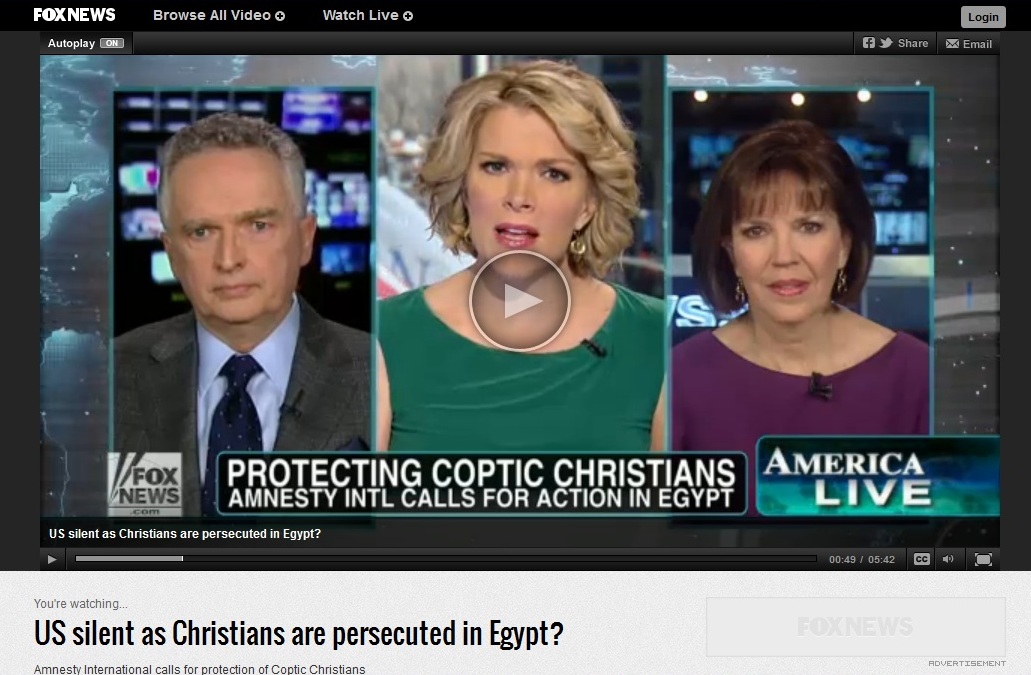
On March 28, 2013 Fox News broadcast an incendiary video report entitled, ‘US Silent as Christians are Persecuted in Egypt?’ It is understood that media relies on a level of sensationalism in order to attract the viewer or reader to a story. Yet this report moves beyond sensationalism to distortion, in which elements of truth are stretched to create an impression far removed from reality.
I watched this report after friends and family brought it to my attention. I’m sorry to say it made my blood boil. Several months ago I published a report on AWR examining if the Muslim Brotherhood was crucifying its opponents, but this alleged incident was reported only by fringe and internet-based sources. Here, we’re talking Fox News! Certainly it is known that the station has a conservative bent, but this video makes it seem as if they are pushing an agenda.
Egyptian news coverage is generally of poor quality, un-sourced, and designed to shape opinion rather than inform. Here, Fox News does its best impression. I have heard similar descriptions of US stations MSNBC, and to a lesser degree, CNN, only from the liberal side. I am fearful the American public has entered an era in which news is meant to entertain and confirm opinions, rather than to educate and challenge them.
I am also dreading this aspect of being back in America for an upcoming visit.
Of course, something very terrible appears to have taken place in this mosque in Cairo, and to a Christian in particular. From al-Monitor:
During the clashes that erupted last Friday [March 22] between the Muslim Brotherhood and protesters in Mokattam, the Brotherhood arrested left-wing activist Kamal Khalil and detained him inside a mosque. He saw a number of demonstrators stripped of their clothes and brutally flogged in the mosque, to the point that most of them lost consciousness. Brotherhood members were using a big whip to strike their victims. Khalil asked the flogger [about it], who replied: “It’s a Sudanese whip. I soaked it in oil a while ago. … A single strike can cut through skin.”
Luckily, Khalil recognized his neighbor from among the Brotherhood members, who intervened and prevented him from being tortured. Yet, Khalil posted his testimony about the Brotherhood’s slaughterhouse on the website of Al-Bedaiah newspaper. Soon after, the testimonies from victims published in newspapers confirmed that they had been brutally tortured. Amir Ayad, a demonstrator, revealed that when the Brotherhood found out that he was a Copt, they increased the severity of his torture, pushing him to the brink of death as they called him a “Christian dog.”
But excerpting from my report:
0:50
Broadcaster leads with words, ‘We were not able to independently confirm this reporting by Mideast Christian News’ which claims ‘Islamic hardliners stormed a mosque in suburban Cairo and turned it into a torture chamber for Christians’
…
If news is not able to be confirmed by a reputable news agency, it should not be repeated, and certainly not the lead story. At least they mention this detail up front.
Mideast Christian News did not report about a torture chamber for Christians, however, as best I could research following their newsfeed. On March 23 they ran an article featuring testimony from Amir Ayad, a Coptic activist. He related how he was ambushed by the Muslim Brotherhood during the clashes and tortured in a mosque in Muqattam.
Muqattam is the suburban Cairo neighborhood mentioned by Fox News. It hosts the headquarters of the Muslim Brotherhood and as such was the site of an anti-Brotherhood protest. The administration of the mosque in question publically confirmed that Islamist activists took over the facilities and turned it into a detention center.
A similar incident took place during the clashes at the presidential palace in protest of President Mursī’s declaration immunizing his decisions from judicial review during the controversy over the drafting of Egypt’s constitution. Muslim Brotherhood members attacked a small but peaceful sit-in at the palace, which led into large-scale confrontations between the two sides. During the clashes the Muslim Brotherhood also created detention centers in adjacent facilities, though not in a mosque.
Details and testimony about what happened at both events is contradictory, but it appears likely the Brotherhood or supporting Islamists assumed police-like prerogative to apprehend protestors – perhaps rioters – on the opposing side. Furthermore, there is no reason to dismiss the testimony of Ayad that he was tortured; the article includes a picture of him in the hospital suffering from multiple wounds.
The protest at the Brotherhood headquarters, however, was not a Christian protest, it was political. Ayad, as a Christian, was detained, perhaps along with other Christian protesters. The great majority of protestors, and therefore detainees, however, were Muslim, consistent with the makeup of Egyptian society.
For Fox News to report this incident as a mosque transformed into a torture center for Christians – with none of the context of these recent clashes – is an egregious distortion of a story terrible in its own right.
And finally, showing an element of the Fox News report which is absolutely contrary to reality, and would be known by anyone who spent any time in Egypt at all apart from the pyramids:
3:15
Peters continues, saying Miller went to the Coptic quarter where the Christians live. It’s a shabby slum where they are third-class – not second-class – citizens
…
It is fair to ask what Miller believes is the difference between a second- and third-class citizen. Clearly this is only a rhetorical device. But it is in service either of wanton ignorance or clear distortion. There is no ‘Christian quarter’ in Egypt or any of its cities. Christians are spread everywhere throughout the country.
Perhaps he was referring to the district of Shubra in Cairo, which has a large percentage of Coptic residents. Shubra is a lower- to lower-middle-class neighborhood, but it is hardly a slum. If it is, it is equally populated by Christians and Muslims together.
Or perhaps he had in mind Heliopolis, which also has a large percentage of Coptic residents, but is one of the wealthier districts of the city. In either case, these areas are characterized by the best relations between Muslims and Christians, as they grew up together in an integrated community. They are far from second-class citizens. They are neighbors.
Please click here to watch the original video, and here to read the rest of my point-by-enraged-point rebuttal (and occasional agreement).
The Egyptian transition following the 2011 January 25th revolution has been fraught with controversy; among many has been the reform of the judiciary system. While the 1971 constitution guaranteed an independent judiciary, the following year President Sadat presided over the passing of law 46 which moved many judicial proceedings – including appointments, transfers, and inspections – to the executive branch through oversight of the Ministry of Justice. President Mubarak continued use of these privileges to ensure a regime-friendly judiciary.
Though the reform of the judiciary was not chief among the primary demands of the revolution, many reformist judges had long been seeking to expose these executive abuses. The tensions came to the fore during the transitional period, as the judiciary became a battleground between the revolutionary popular will and what was interpreted as pro-regime rulings from the court.
Though published recently, this article was written September of last year after Mursi assumed the presidency, but before his full-on clashes with the judiciary. In this light the following recommendations are noteworthy, as many anti-Islamists look to the courts to curb presidential power and prerogative:
The first guarantee [of judicial independence] is for security of tenure. Judges must understand their position is safe, not subject to removal for rulings issued against the government. Second, the judge and court system as a whole must enjoy financial security. All necessary resources must be made available for the smooth functioning of justice. Third, there must be sufficient guarantees for individuals in the justice system. A culture of rights ensures the public demand for judicial independence, making it more difficult for the government to infringe upon it.
Unfortunately, Binnie noted, the current Egyptian arrangement does not lend itself to judicial independence. First, the body tasked with inspecting judges is within the executive Ministry of Justice. This allows the executive branch to offer rewards to compliant judges – such as promotions or post-retirement ambassadorships – while penalizing judges who buck the system by assigning them judgeships in remote locations.
Second, there is a threat to the independence of the judiciary if there is not sufficient public confidence in the system. Binnie noted that even if independence is achieved, the courts can operate as an ‘old boy’s network’, appointing from their own circles rather than drawing from the diversity of society. The presence of women is particularly helpful, he noted, but a comment from the audience helped demonstrate his point. Egypt boasts only 42 women judges, but 39 of these are the daughters of established judges.
Third, the presence of a parallel court system undermines judicial independence. Even the best system will fail, Binnie noted, if the government can simply bypass it. With separate jurisdictions for military, security, and emergency courts – each able to try civilians – Egyptian justice suffers. Binnie noted that some drafts of the coming constitution do not sufficient guarantee rights during periods of national emergency, threatening to perpetuate the current system into the post-revolutionary era.
The constitution limited the use of military courts, but it did not eliminate their jurisdiction of civilians. Still, this has not been a practical issue since the end of direct military rule. Noting the importance of public confidence, it is at an all time low. Islamists have none at all, while non-Islamist revolution supporters still see it as in service of the regime in concept, if in particularity the identity of the regime is still under contention. Meanwhile, courts across the country issue rulings that send advocates of human rights up in arms.
But consider these examples, the latter of which was held as a pro-revolution step only a few months ago. If implemented now it would cause shockwaves:
In Egypt, moving from an autocratic tradition, enshrinement in the constitution is necessary. This must be done in detail, lest the situation resemble Russia where vagueness in wording has allowed erosion of judicial independence. Experts expect it may take years to reverse Russia’s political culture of judges as servants of the executive branch.
A positive example could perhaps be taken from the experience of Bosnia. Political leaders took the decision to sack all judges, and then require them to reapply for their positions in competition with new applicants. In the end, 70% of judges were reinstated, but two significant results were produced. First, this measure resulted in a great sense of public confidence in the governing system. Second, the judges themselves ‘bought into’ the new program from the necessity of keeping their jobs. It also reset their orientation, as most judges everywhere, Lund believes, desire independence.
As with much of the state infrastructure, bold reforms are necessary, but political conditions do not permit the unity needed for orchestration. It is a shame polarization has reached such a point.
Please click here to read the whole article on Arab West Report.
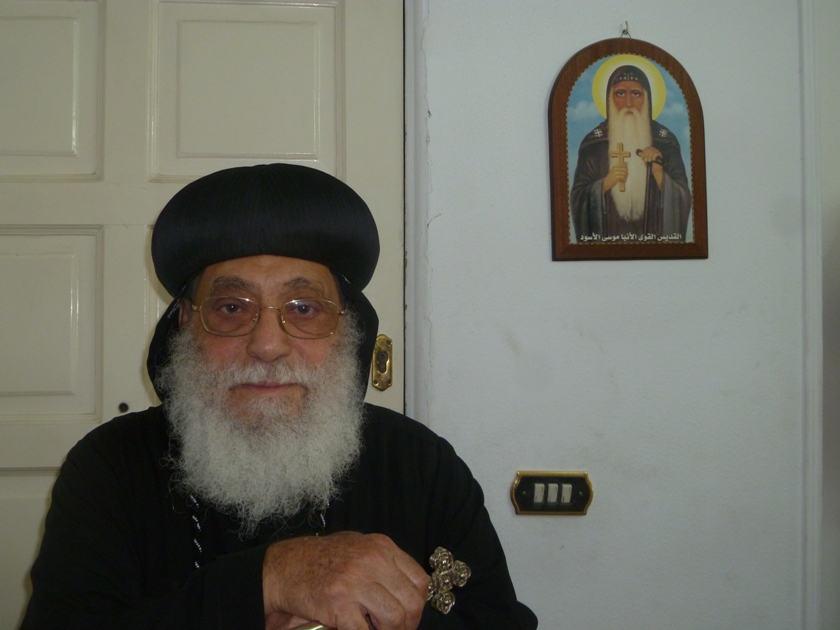
Bishop Antonious Marcos, missionary bishop for Africa. He served first in Kenya and now in South Africa. Behind him is a picture of the Coptic saint known as St. Moses the black.
Many Egyptian Christians wear their faith on their sleeve—literally. The cross tattooed on the wrist of Coptic Orthodox believers is a public display which marks their identity for all to see.
Such a quiet witness usually avoids reproach. But recently in Libya, radical Muslim militias detained dozens of expatriate Christians in Benghazi. Amid allegations that captors seared off such tattoos with acid, one Christian died from medical complications during the ordeal, and a Libyan church was repeatedly attacked.
Accusations of evangelism have been at the heart of a series of recent incidents of violence—including the first Coptic martyrs of the modern era—against Copts in Libya, Sudan, and Egypt. Which raises the question: Are Copts starting to recover their missionary heritage?
This article was co-written with a colleague from Sudan, who mentioned the following incident:
Last December, two Coptic Orthodox priests were arrested after baptizing a female convert from Islam. Since the arrests, stories about arrests of Westerners and other Christians attempting to spread the faith circulated in media linked to the state security apparatus, although the accuracy of the reports is hard to ascertain.
Though some Sudanese Copts have enjoyed business success under the Islamist government of President Omar al-Bashir, other denominations have seen their churches destroyed either by mobs or by the state, which cites the breaching of planning laws. With the independence of South Sudan removing the great majority of the nation’s Christians, Bashir has promised a 100-percent Islamic constitution.
Tensions are high also in some Egyptian villages:
There are signs Muslims feel threatened in Egypt as well. Recently churches have been attacked in Beni Suef and Aswan over female converts to Christianity alleged to be hidden inside. Generally this is understood as a Muslim community effort to save face when a woman breaks community traditions or runs away with a lover. Others think true faith might have a role.
“It is an untold story that every now and then a Muslim can be convinced and convert to Christianity,” said Youssef Sidhom, editor-in-chief of the Coptic newspaper Watani. “It is always done secretly, but somehow here it became public. In Upper Egypt especially, this creates a social scandal regardless of the direction of the conversion.”
But far from politically and religiously sensitive conversions in Muslim lands, the Coptic Orthodox Church maintains missionary bishoprics in sub-Saharan Africa:
The reality is the Coptic Orthodox Church remains committed to planting churches—just not in the direction of Muslims. In the 1970s, Pope Shenouda consecrated the first of two bishops for service in sub-Saharan Africa. Today, 65 churches serve more than 400,000 Copts in Kenya, Zambia, Congo, and other nations.
“The early riches of the Orthodox tradition are spreading again in Africa,” said Antonious Marcos, appointed missionary bishop to Kenya in 1976 and now based in South Africa. “Our church is a missionary church, because it was started by a non-Egyptian: John Mark.”
This was a very interesting article to research and write, showing a side of Coptic Christians often not well known in the West. As for the question in the title, are they recovering their evangelistic impulse: Well, they are accused, it seems some are, and reality is just as murky as with Christians around the world.
Please click here to read the full article on Christianity Today.
To secure a stable society, institutions matter more than people. But the people in the institutions matter greatly.
Preserve the institutions of Egypt, God, and populate them with good men. Assist whatever reform is needed; create the political will to see it through.
But the squabbling and innuendo, God; have things done right.
Egypt has an institution of prosecution, but everyone wants their man in it. Some want the Mubarak-era figure, finding him wrongly evicted by the president. Some want the president’s man, finding him approved by a clause in the constitution. And some want the judiciary to pick anew, finding in them a way forward and a guard on separation of powers.
The stakes could be high, if only we knew, God. Few crimes since the revolution have been prosecuted successfully. Old regime, businessmen, military, police, Brotherhood, activists – all have accusations swirling around them. Who is protecting who?
Bring Egypt to a place, God, where institutions can rise above politics. But it takes the right man. If only for as long as he lasts – and the court says he must go – equip him as man of integrity and principle. As pressure, scrutiny, and perhaps political instruction weigh down upon him, make justice his only goal. So much in Egypt’s transition depends upon his post.
But behind the scenes is another institution, brought out into the light in further squabbling. The nation’s intelligence apparatus is accused of undermining the president and destabilizing the country. Some say the president wants his men in charge.
Perhaps they should be, God. But ‘his men’ is the talk of individuals, not of institutions. All were quick to deny the comments in the media, praising intelligence for its loyalty and patriotism. At times one must speak as the occasion requires, God, but increase the sincerity of Egypt’s political discourse.
Many Islamists find the institutions of the state conspiring against them. Liberals, meanwhile, see Islamists seeking takeover of the institutions to use them at the behest of their own agenda. Who knows there isn’t validity in each charge?
But even the question flows from intelligence, as intelligence governs the flow of information. Is the president advised correctly? Is the opposition led to believe their stridency will be rewarded? Do ‘sources’ speak the truth or only inject useful speculation? Is intelligence a puppeteer pulling the strings of all? Or are they a boogeyman summoned to distract from real issues?
God, when so much is confusing, protect the mind from conspiracy. Give Egyptians discernment and conviction to tell right from wrong, which usually need not be so muddled a process. Conscience and common sense are strong weapons against obfuscation; distribute these gifts widely, God.
Unfortunately, neither human nor institutional behavior is simple. But if complexity is a given, single-mindedness is a possibility. Purity of heart is a necessity.
These are not common to politics, God, and perhaps they are not common to humanity in general. But you are good, and you can transform. Bless Egypt with your redemptive touch.
So where an institution can corrupt what is good in the Egyptian nature, strengthen their moral integrity. And where an institution can bind what is corrupt in the Egyptian nature, strengthen its framework to keep them in line.
But only men can create institutions, God. And only men can corrupt them. Within the struggle ongoing since the revolution, your men are needed to guard this difference. Supply them sufficiently. Be they found in few or many, through them may your will be done.
May they bless Egypt, and shape her anew for the good of all.
From the Jewish Chronicle Online, a very interesting article that casts Muslims in the role of the Biblical Esther:
Islam saved Jewry. This is an unpopular, discomforting claim in the modern world. But it is a historical truth. The argument for it is double. First, in 570 CE, when the Prophet Mohammad was born, the Jews and Judaism were on the way to oblivion. And second, the coming of Islam saved them, providing a new context in which they not only survived, but flourished, laying foundations for subsequent Jewish cultural prosperity – also in Christendom – through the medieval period into the modern world.
Here is the decisive central thesis:
Had Islam not come along, Jewry in the west would have declined to disappearance and Jewry in the east would have become just another oriental cult.
Concerning the degrading idea of ‘second class citizenship’:
Political change was partnered by change in the legal status of the Jewish population: although it is not always clear what happened during the Muslim conquests, one thing is certain. The result of the conquests was, by and large, to make the Jews second-class citizens.
This should not be misunderstood: to be a second-class citizen was a far better thing to be than not to be a citizen at all. For most of these Jews, second-class citizenship represented a major advance. In Visigothic Spain, for example, shortly before the Muslim conquest in 711, the Jews had seen their children removed from them and forcibly converted to Christianity and had themselves been enslaved.
In the developing Islamic societies of the classical and medieval periods, being a Jew meant belonging to a category defined under law, enjoying certain rights and protections, alongside various obligations. These rights and protections were not as extensive or as generous as those enjoyed by Muslims, and the obligations were greater but, for the first few centuries, the Muslims themselves were a minority, and the practical differences were not all that great.
Unfortunately, it did not last, though it did last a long time. When it ended, the experience picked up elsewhere:
This did not last for ever; the period of culturally successful symbiosis between Jew and Arab Muslim in the middle ages came to a close by about 1300. In reality, it had reached this point even earlier, with the overall relative decline in the importance and vitality of Arabic culture, both in relation to western European cultures and in relation to other cultural forms within Islam itself; Persian and Turkish.
Jewish cultural prosperity in the middle ages operated in large part as a function of Muslim, Arabic cultural (and to some degree political) prosperity: when Muslim Arabic culture thrived, so did that of the Jews; when Muslim Arabic culture declined, so did that of the Jews.
In the case of the Jews, however, the cultural capital thus created also served as the seed-bed of further growth elsewhere – in Christian Spain and in the Christian world more generally.
This is a very good article debunking much conventional wisdom, and certainly much religious polemic. Please click here to read the whole article.
If not for Frehun Ayele, Fatima would still be wet with urine. The eleven-year-old native of war-torn Somalia traveled over 500 kilometers to Addis Ababa for an operation on her bladder, which was completely open to the skin since birth.
‘For children in need of surgery, it is a big challenge,’ Dr. Frehun told Lapido Media, describing waiting lists of over a year. ‘The most vulnerable in terms of disease severity, poverty, and distance, suffer much. Only the fittest survive.’
Frehun is unique as the first Ethiopian to be trained as a pediatric surgeon in Africa. Three months ago he halved the waiting list by opening the nation’s second pediatric surgery clinic, BethanyKids, in cooperation with the Korean-founded Myungsung Christian Medical Hospital.
‘Before the arrival of BethanyKids, there were three pediatric surgeons for over ninety million people,’ said Dr. Dan Poenaru, Frehun’s training surgeon and now partner in the clinic.
This was a very fun article to write. It was also a challenge, done remotely, relying on email. Many thanks to the people of PAACS for helping. PAACS, by the way, stands for the Pan-African Association of Christian Surgeons:
an organization dedicated to the training and discipling of African surgeons to provide excellent, compassionate care to those most in need.
Their work is for the good of the continent and all its religious adherents, but a very clear commitment to Jesus is part of their methodology, one which they believe makes all the difference:
Gray helped arrange the exchange of residents with the national training center in Addis Ababa University, which is open to students of all faiths. But according to Dr. Bruce Steffes, the executive director of PAACS, it may have been the organization’s Christian commitment which made the difference.
Speaking with a particular government minister who was suspicious of the missionaries, Steffes pointed out all twenty-eight PAACS graduates were serving in their local context, often in rural areas.
‘I may have influenced his decision,’ he said, ‘by pointing out that their desire to serve Jesus is what motivates them to serve in those areas.’
By contrast:
‘Many of the brightest and best medical students leave for training abroad, but after five years of training put down roots and stay there,’ he said.
Thompson said there is a greater than ninety percent attrition rate, a significant brain drain costing Africa the surgeons it needs. Even for those who do return, he says, most cannot function for more than a few years, as they were trained in ideal conditions in the West.
‘We train them in these resource poor environments,’ Thompson said, ‘so they know how to operate here.’
Please click here to read the entire article on Lapido Media, and have a look at the PAACS website as well. Do consider them for your support.
George Messiha is young, an up-and-coming member of the political scene. In an effort to increase the representation of youth and Copts, the ruling Supreme Council of the Armed Forces appointed him to serve in the elected parliament. After the dissolution of this body by the Supreme Constitutional Court, Messiha returned to general Wafd Party politics, but also participated in a delegation to the Netherlands arranged by AWR editor-in-chief, Cornelis Hulsman. Members from each political trend participated, including Amr Darrag of the Muslim Brotherhood, who spoke proudly of the good work being done in the Constituent Assembly.
Messiha was already selected as one of fifty alternate members, but listening to Darrag convinced him to play a role once it became clear many non-Islamist figures were resigning in protest over the failure to achieve consensus. On October 16, 2012, he submitted his name for election to the body, and became one of nine replacement members tasked with completing the constitutional draft.
Unfortunately, his own experiences as a non-Islamist liberal did not match the impressions he obtained from the presentations of Darrag in The Netherlands.
The article is somewhat lengthy, but provides a very good overview of each member in the Constituent Assembly which wrote Egypt’s constitution. The point is to determine if the writing of the national charter was ‘dominated’ by Islamists, as it is often portrayed.
According to Messiha, 55% of the original members were Islamist in orientation. Following the mass withdrawal of many non-Islamists near the close of the process, the final count was 75%.
This article is not meant to be the final word. Arab West Report is currently producing a book on the Egyptian constitution; the question of member orientation is being put also to Islamists, both independent and affiliated with their official parties.
Holding judgment until then, here is the conclusion from the discussion with Messiha:
The Egyptian constitution reflects work inclusive of substantial non-Islamist participation. Many of the articles were discussed, argued, and formalized as divergent interests compromised and found agreement. But the charge that this is an ‘Islamist dominated’ constitution is also true. It is the product of a clear super-majority which approved the final text, recommending its presentation to the people in a referendum. Rightly or wrongly, non-Islamists felt themselves marginalized, and abandoned the process.
Whether it could have been otherwise is another story.
Please click here to read the whole article at Arab West Report.
Protests turned violent across the nation as opposition and revolutionary groups focused their attention on Muslim Brotherhood headquarters. Several were attacked, clashes broke out between the two sides, and police fired tear gas to disperse the crowds. Many were injured, but no deaths were reported.
The protests were preceded by two events of notice. First, a preliminary court judgment recommended dissolving the group for being illegal, only to be followed by a ministry announcement their paperwork was accepted as a now-registered NGO. Formally, the group is now subject to law and financial oversight.
Second, minor clashes at the Brotherhood headquarters took place when journalists/activists were assaulted while filming/vandalizing the building with graffiti. Outraged, they called for a Friday protest, a few opposition parties backed the effort, and since, the primary revolutionary youth group has condemned the violence.
Is this a turning point, God? Is popular frustration building up against the Brotherhood and discrediting their legitimacy by attacking the institutions of their administration? Or is this just a blip; limited frustration acting out from general impotence?
God, it is good the Brotherhood is now registered. If they have suffered previously from temptations to avoid the scrutiny of the law, this stricture will help them be open and transparent. If they have been wrongly maligned in the past, this oversight will validate them.
But no law can compete with conscience, God. Give them – and their opponents – pure hearts in service of Egypt. Bless them as they call on your behalf to service and obedience. Bless them in seeking the righteous transformation of society. And if they – or their opponents – have mixed good intention with ill conduct or selfish gain, bless them through rebuke and repentance.
But the violence, God, what good will it bring? It is hard to sort the reality from the propaganda when each side blames the other. Put an end to childishness, if it is there. Put an end to thuggery, if it is there. Give wisdom to resist foolish provocation; honor no one who picks a fight. Aid the state in convicting all who have done wrong, without prejudice or partiality.
God, what do you want the Brotherhood to be? If they are your tool to advance Egypt then give them their due. Silence those who mar them, who feel threatened by their gains. May they work righteously, humbly, mercifully, and inclusively.
But if they are a tool for anyone else, even themselves, then give them their due. Silence them as they mar others, who sense their threat to Egypt. May this be done openly, transparently, justly, and inclusively.
Inclusive, God, for even these prayers are wrong. It is too convenient to see one side right and the other wrong. Guard Egyptians from the ease of rumor and conspiracy. Expose wrong wherever it is found, but bring Egyptian rivals together. Create a system where all win, where opponents need not be vanquished.
Egypt is not settled yet, and perhaps it is not yet time. But she longs for stability as she longs for reform. As the Brotherhood holds the reins of governance, give them wisdom and acumen to govern well.
And may protests continue – peacefully – until all are satisfied with all.
From Christianity Today, in an interview with Brother Andrew of Open Doors:
Not long ago of course Osama bin Laden was assassinated, and the whole world rejoiced. Thousands have died in drone assaults. What is your response to such killing?
I have been speaking in meetings in America, and part of my sermon was, “Have you prayed today for bin Laden?” People were rather shocked, and some people said, “I must confess. I have never prayed for bin Laden, but now I do it.”
Bin Laden was on my prayer list. I wanted to meet him. I wanted to tell him who is the real boss in the world. But then he was murdered, I call it. Murdered, because he didn’t shoot back. He had no resistance. That’s not warfare. And I have had too much of that. A good number of my own friends in Gaza have been assassinated. Liquidated they call it in their terminology. I call it murdered.
We must witness to people. And all the people that I now talk about in Gaza that were murdered were people that I met in their homes and I gave a Bible. I prayed with them.
The title of this post is taken from Christianity Today, and is the part of this interview the magazine chose to highlight.
Let us suppose there was certainty about the object of a drone attack being a self-confessed, proud, and practiced terrorist. The reality is that this certainty is often lacking, and many otherwise innocent people die in the process of targeting them. But let us suppose.
One of the tensions of Christianity – a very positive one – is that it encourages fidelity to both country and creator. As an American, a case can be made that drone killings are cheaper, more effective, and save more lives than traditional warfare. Certainly they keep the lives of our own soldiers from risk.
But as a Christian? The appeal to Genesis – he who sheds the blood of man, let his blood be shed – only applies if you give America jurisdiction over the rest of the world. That such a terrorist be killed may represent justice, but that anyone assume the right to kill him is another matter.
The words of Brother Andrew are poignant, because he is not just an armchair theorist. He has met with such people, and loved them. Perhaps this distracts him from the necessary cold-hearted calculation required of a nation.
But let it tug at the heart strings of Christians, who must be merciful, as God is merciful. Who must love their enemies, and do good to those who hate them. Who must from love keep no record of wrongs, refuse to delight in evil, and always protect, trust, hope, and persevere.
Dear Christian, dear citizen, live in this tension, but remain whole.
If you’d like a look at me in action, a friend found this video from a few months ago. I simply stand, and mouth the words to the Nicene Creed along with the rest of the Syrian Orthodox congregation.
The occasion was the installment of Pope Tawadros; representatives of this sister Oriental Orthodox Church were in attendance. Before traveling back to their own countries in Syria, Lebanon, and Iraq, they had a joint service together in downtown Cairo.
My appearance is at about the 7:00 minute mark. It is worth a few minutes of your time, just to enjoy the different and vibrant color schemes of each church. In attendance with me was the former head of the Middle East Council of Churches, who I’m sure could explain the differences.
I remember at the time thinking I would write about the experience, but other projects placed it on the back burner until it was forgotten. But now I recall the fun, the boredom, the familiarity, and the small differences between these ancient adherents of the faith and their Coptic brothers I have come to know.
On the one hand, they seem utterly irrelevant. They are small, declining churches surrounded by violence and conflict. They have funny hats and peculiar beards. They did have a good time together, as did the small congregation of a hundred or so worshipers.
But of what value are these churches, these dresses, these colors, to the people of Syria, Lebanon, and Iraq? What difference does this faith make to those suffering, to societies in collapse, the remaining faithful?
Perhaps the question can be what good is this faith anywhere? Does it transform, does it serve, does it save? There is no peculiarity to the Arab world.
But this faith is ancient, and those privileged to existentially wonder about it from the comforts of Western experience would do well to learn. I only wish I knew what the lesson is.
Is that the point? There are Christians in this world in the lap of luxury, and others in the deepest poverty. There are some who preside over the greatest military power in history, and others who are stomped upon by the weapons of war.
The world has made it possible for these worlds to connect, only adding to the complication. But for centuries it was such, and each slice of the Christian world had only slight knowledge of the extended family.
So what good does it do Syria to have a Christian costume party in Cairo? What good does it do America to have a Christian rock concert in a movie theater? What good does it do you to see a transplanted American in their mix, who assaults you with these questions?? What good does it do them that I was there at all?
Of course, each of these questions presupposes the ‘good’ of Christianity is for this world. It is, right? I would so like it to be.
But the Oriental Orthodox churches remind amid their colors and pomp and circumstance that worship probably has very little relevance to what good this world needs. More poignantly for me and probably most readers here, what I as an individual need.
But with God you cannot say it is what he needs, either. So what is the point?
Still, I have no lesson. Can faith and humility be ok with this? They must, lest you throw it all away.
Here, there is no certainty, there is no peculiarity, there is no victory. God can grant them each at other times if he wishes.
Instead, we wonder, we reflect, we appreciate. If all is well, we share, we worship.
If we like, we wear funny colors, or do interpretive dance.
And if he leads, we welcome marauding militias, or sign petitions against hovering drones.
And if he leads, we fight against oppressive regimes, or lobby against oppressive taxes.
But in the end, together, we mouth the Nicene Creed.
From Ahram Online, reporting President Morsi’s visit to the central security force headquarters, in what must surely be a typo:
“You are the protectors of the country’s inside and outside safety [said Morsi]. The police were part of the successful crossing of the Suez Canal in the 1973 war and also part of the January 25 Revolution,” he added.
The initial demands of Egypt’s 25 January uprising, intentionally organised on the same day as the annual police day, included an end to police brutality and the State Security apparatus run by the Mubarak regime.
Much of the speech was commendable, encouraging them during difficult times:
“Any obstacles you’re facing, we will get through them – together,” he stressed.
He continued: “You are the watchful eye of the homeland. The country’s best interest needs your efforts and sacrifices.”
“You all know that our Egypt is going through a critical period, but with the aid of God and cooperation of the police and military, we will be able to pass through this phase.”
But he included also a reference to foreign interference – an old tactic of Mubarak, unless, of course, it is actually true:
“Beware, our outside enemy is seeking to create division among us, and we must not allow it,” President Morsi said in his opening speech.
One recent tweet criticized Morsi, saying he promised to visit Port Said, then only addressed them on TV, and the next day honored the institution which shot them.
Morsi’s job with the police is incredibly complex, but the January 25 comment is over the top. The revolution’s initial central focus was the end of the police state. Perhaps Morsi will get to this eventually, but here, he calls them heroes.
I can only imagine the rest of the speech gave more context, but the revision of history is not a firm foundation for social and institutional change. Yes, summon forth their better natures, but clean the skeletons in the closet, too.






 Jayson Casper