In order to justify removing a standing president, first an author must defend his democratic credentials. After an extended introduction, he writes:
This was last October, and up until that point I had been convinced that President Mohamed Morsi was the legitimate president of Egypt, and that even though I did not vote for him due to my conviction that neither his political experience, his mental capabilities nor his moral make-up qualifies him to rule Egypt, I still considered him not only to be a legitimate president, yet my personal president.
My respect for Mohamed Morsi stemmed from my awareness that his legitimacy emanated from the ballot box, from votes by citizens like myself, despite their different political inclinations. And I was looking forward to the day when another round of elections would come, and I would vote against him again, and hopefully bring him down, a thing which he makes easy for me by his poor administration and his deplorable record in the realms of security, economy, and politics.
So why then remove him now? In the opening the author described his chief reason for participating in the January 25 revolution was the systematic use of torture by the police force. Therefore, he is outraged because:
I expected that the Muslim Brotherhood, in particular, considering what they experienced in terms of oppression and injustice and torture at the hands of the past regime, would rush to restructure the security sector and put an end to the systemic torture still taking place in police stations, and to turn over those responsible for killing citizens to the authorities. Yet President Morsi and his Brotherhood opted to battle with the judiciary and the media, not the interior ministry, and they have turned a blind eye to daily horrors committed by the police.
Recall that January 25, the strategically chosen start date of the revolution, was the national holiday ‘Police Day‘. Many analysts suspect that the Muslim Brotherhood has played nice with the army and police and old regime in order to buy time to cement/protect their new found power. Some think they will still reform these sectors over the long term; others fear they only wish to replace the formerly ruling NDP and preserve the system.
Click here to see the Rebel Campaign petition translated into English.
With great relief and little wrangling, the abducted security personnel in Sinai were released this week. The president, political parties, and military all celebrated their peaceful transfer through the intervention of tribal chiefs in the area. No negotiation, no bloodshed – all celebrated a successful resolution.
Successful, that is, with two lingering uncertainties: No justice, no information. Officials declared the identities of the kidnappers are known but will not be released until a more appropriate time. And of the details in the media leading up to the release, officials admitted they used misinformation in order to confuse the criminals.
All this is fair enough, God. Thanks are to you for their release, accomplished through men and their necessary wiles. But amid the many accusations and conspiracies which surround Sinai, God, Egyptians long for clarity in all public affairs.
Are the president’s Islamist allies linked with extremists in the Sinai? Did they engineer the kidnapping and subsequent release to boost the president’s popularity or embarrass the army? Did the military and intelligence apparatus play the same role in order to create a crisis for the president and demonstrate their own indispensability? Are the two in cahoots to forge a new reality in the Sinai away from the old heavy hand of the police state and tribal manipulations? Or, was it just a random act of disaffected individuals? All these questions circulate.
They are a product of Egypt’s polarization and instability, God. Ease these issues and perhaps clarity can come.
But both now and then, God, give Egypt a new culture of transparency. Make public officials accountable to the people. Secure the release of information. Protect national security and the public order, but keep the limitations of freedom to the absolute minimum.
A little while ago a draft law for freedom of information was prepared, meeting with contradictory responses. Some hailed it as a new dawn for society; others claimed it couched draconian measures in liberal pronouncements.
God, deal with the text of any new law and the hearts of those who will implement it. May Egyptians know what goes on behind the scenes of their government, and may these scenes become clean and transparent.
God, deal with the Sinai in justice and development. Bring criminals to trial, extremists to repentance, and Bedouins to citizenship. May those responsible for the kidnapping be prosecuted openly, but may the region not suffer their crimes. Rather, integrate Egypt’s peoples together, and may the prosperity of your blessing be shared by all.
As you released the abducted from captivity, God, release Egypt from its captivity of unknowing. Perhaps you are enveloped in this cloud by nature of your being, but free the people and nation from the bonds of its yoke.
May they know both themselves and their maker. Release them, and in this knowledge make them free.
Though Islamists currently govern Egypt, they often behave as if they are still an oppressed minority subject to endless conspiracies. Among their chief targets of complaint is the independent media. Here, they have a point.
Riham Said receives a prominent Islamist lawyer, Sheikh Youssef al-Badri, on her show and proceeds to bait and berate him on what seems like an obscure point. The video is only a three minute clip, but the tenor of their conversation suggests it was a difficult interview throughout.
At heart is the issue of wearing a hijab, a head covering which reveals the full face. After the revolution several Islamists have demanded their interviewers wear a hijab, and Riham appears to relent, though she is not pleased.
But then she takes it off amid an argument, and reveals the amount of money Badri received to make an appearance on the show. It is good entertainment, but it looks also like a set-up. Certainly she showed little respect to Badri, an old man.
But then again, Badri appears to deserve little. He earned his reputation as as an activist lawyer. Long before the revolution he would bring lawsuits against prominent personalities who in his opinion violated sharia law. Often, the law (or at least the judge) agreed. He is a crusader and the scourge of Egypt’s intellectual class.
But perhaps he is also a hypocrite. Filming off air, he and Riham talk casually without her hijab, as they discuss whether or not she must wear it. But once the cameras are rolling, as she removes the head scarf Badri averts his vision, lest he improperly look at an uncovered woman. Furthermore he shouts about her betrayal of agreement amid boasts of his suit to shut down the whole station.
But his piety is public, and she exposes him. It is fair, I suppose; hypocrisy should be exposed. But perhaps one of the reasons Islamists detest the independent media is they violate the cultural values of honor and shame.
In traditional Egyptian understanding, sin is not a great problem unless it becomes known. Public morality is elevated over personal morality, and if an individual can conceal his or her deviant thoughts or behavior it does not embarrass the family or larger group. Everyone knows the arrangement; you protect me and I’ll protect you.
Independent media has its own objectives, which include entertainment, making money, and often, opposing Islamist politics. But to do so, they trash this unwritten understanding. Yes, Badri is exposed as a hypocrite, but Riham emerges as a woman with little honor.
Sometimes I find this balance to be difficult to maintain. In pursuing journalism I do not simply want a story. I want to tell the truth, but I also wish to honor those I speak with. Ideas and politics can be thoroughly opposed; their advocates must be treated with respect.
But what about a hypocrite? The honor and shame culture breeds hypocrisy, in my Western-developed sense of morality. There is much to be respected in covering over sin, but at the end of the day, sin will be exposed. Is it not the journalist to whom this burden falls?
Especially as a foreigner, lack of full understanding gives me pause, and knowledge of my own hypocrisy invokes the Golden Rule. There is a job to be done, but what manner of conduct results in the most good?
Randa embarrassed Badri, but Badri was rejected and hated by her audience from long before. Perhaps those outside her audience were also listening; maybe those outside Badri’s ideological camp but of non-liberal persuasion might see him in a new light. Let us consider that his activism is unbecoming and improper; did Riham’s behavior curb his influence? Did it damage an excessive Islamism?
What if she had simply ‘honored’ him? If she let him spew his viewpoints with deference perhaps he might have even have convinced some of her traditional audience. She would be hurting her own cause.
This is why honor is not enough. Riham showed little, and though she exposed Badri she comes off herself as brutish. She makes a point, and perhaps some are affected. But Badri remains an unchanged man.
What if instead of exposure or honor, Riham cultivated love for Badri? There would be no off-camera revelations, no set-up, no angry storming off the set. She would challenge him – pointedly and explicitly. But could she engage him and lead him to expose himself? Could she have sought to display his hypocrisy not to an audience, but to his own heart?
Maybe, and perhaps he would still have remained an unchanged man. Perhaps Riham would have lost rating points, and Badri maybe would even have gotten the better of her.
But this video brings out the worst of both. Hopefully Egyptian media – of all stripes – can find a better way.
Growing up I lived the first 18 years of my life in the same house, only moving to go to college. My mom has lived in the same town her entire life, and all four of my siblings still live within 20 minutes of that town. I didn’t grow up saying too many good-byes for the first 18 years of my life. The second 18 years, however, were quite opposite. College, grad school, first job, marriage, and then life overseas; lots of changes and lots of moves. Since my husband and I first moved overseas, we have lived in three different countries, four different cities, and five different apartments.
While not every expat moves often, saying good-bye to people and places is a common part of the expat lifestyle. Even if you are one who stays put in the same foreign country for many years, you must still say good-bye to the others who filter through year after year. And then add factors like childbirth, children’s schooling, medical needs and a revolution, and there are good-byes all over the place.
Good-byes are a reality for us, but they don’t have to be a negative aspect of expat living. Before traveling overseas, my husband and I took a course in grief counseling. We didn’t exactly realize it at the time, but it was great training for this lifestyle. Every good-bye is a loss. And every loss causes grief. Sure there are some losses more painful than others, but all losses are felt at 100%. Given this reality, how can we keep from shutting ourselves off to new friendships or new opportunities that we know may eventually require another farewell?
Stay ‘complete’ in your relationships
You never know when a relationship could end or be interrupted. There were people I could not physically say good-bye to when the revolution occurred two years ago. I didn’t anticipate needing to say good-bye, and so I wasn’t complete in all my relationships. I wasn’t able to tell people I was thankful for them, or that I loved them, or that I was glad they were in my life because….
On the other side of that spectrum, we have to deal with the difficulties that come between us and another person. If we work through the problems, we won’t let the pain of a strained relationship be a burden to carry into our next assignment.
We’ve all heard people lament, “I just wish I had said this to her before she died.” Or, “If only I told him I loved him before he left.” Living with those ‘unsaid statements’ makes you less free to join in a new relationship. Communicating them does not remove the pain of saying good-bye, but it does help to heal the pain.
Say ‘good-bye’ to people, places and things
This is one of the most practical points I took from the training those many years ago. Don’t be afraid to say good-bye. Embrace it. Hug. Cry. Say the words you hold within you. Saying something simple instead, like “See you later,” mayseem like it will hurt less, but if you know the good-bye is for a significant period of time, you must say it.
This is especially true for our children. We hate to see them hurting as they say good-bye to yet another friend. Sometimes we try to comfort them by telling them we can visit their friend next year, or maybe the friend will visit us again. But instead of offering such hope, which often proves false, grieve with your children. Agree with them that saying good-bye is really hard, that the friend they just said good-bye to can’t be replaced. That’s it. You don’t need to make promises or try to make it hurt less. Let them grieve and help them to say good-bye well.
Saying good-bye to places was a new concept for me, but we have done it in every flat we’ve lived in since living overseas. I am sure our 9-month old daughter doesn’t remember our apartment in Tunisia, but we still walked with her through each room of the flat and said good-bye to the rooms. We talked about what we enjoyed doing in those rooms or how we would miss them. It may seem trivial, but if you think about it, you can probably vividly picture some special places in the home where you grew up.
While the flat you have lived in for the last year may not seem as significant as your childhood home, it is still good to treat it as a place to say good-bye to. Again, for your children, you may not know what their special memories are in that place.
For some, Cairo is a tough place to live. As you move onto your next assignment, or return home, you may do so with a sense of relief. And yet, living here has changed you. The people you’ve met have affected you, for good or for bad. Even if you joyfully skip through you apartment on moving day, and say good riddance to your bawwab as you walk out of the building, it would still be good to close off those relationships and places completely.
Life overseas is exciting: It is a chance to visit ancient sites, interact with people so different from yourselves, perhaps also to help the poorest of the poor. But it also has its challenges, and the ‘good-byes’ are among the greatest. Learn to be complete in every relationship and say good-bye well, and this challenge will be just a little bit easier.
From Arabist, translating an article by political commentator and liberal politician Amr Hamzawy:
The bifurcation of Egypt’s government into an official and unofficial administration – as has been noted before – is at the root of a serious crisis that is blighting the chances for democratic transition and the rule of law. One half of this dual administration is made up of the president, his team of advisors and his government as the executive wing on one hand and the Freedom and Justice Party as the legislative wing on the other. Meanwhile, the other half of this administration is composed of the Muslim Brotherhood and the shadowy figures that they have placed in influential political and executive positions that involve direct, decision-making authority. This dual administration now holds sway over the Egyptian state, its institutions and agencies, while giving birth to disastrous mix-ups and derailing plans to reform the state, to implement transparency and freedom of information, and to ensure accountability and equal opportunity.
If this has been noted before, it is often overlooked as part of the current reality of Egyptian politics. But not just in government is it noted that Western governments engage the wrong actor, but within the MB structures as well:
They give support to the idea of fixing the relationship between religion and politics, then they elevate the Muslim Brotherhood over the Freedom and Justice Party — that was founded as the Brotherhood’s political wing — through their ongoing communication with decision-makers in the Brotherhood concerning Shura Council legislation, economic and social issues, matters related to aid, etc. This is despite the fact that all these issues fall within the Freedom and Justice Party’s purview, not to mention that of the official administration consisting of President Mohamed Morsi, his team and his government.
I have had several non-political Egyptian liberals tell me they do not want to see President Morsi fail, but to fulfill his mandate and then be voted out of office. They say as well they do not oppose political Islam as a concept, but wish to see them active through the registered Freedom and Justice Party, rather than through the nebulous Muslim Brotherhood.
Basically, they want politics up front, legal, and transparent. Hamzawy is convinced it is not happening, and in fact, the West is abetting the very opposite.
I got in a taxi on Thursday and within a few minutes of conversation the driver asked my nationality. This has been a sensitive question recently; last week an American near the embassy answered in the positive and was stabbed in the neck for his troubles. ‘I hate America,’ the assailant confessed afterwards.
For the taxi driver, however, it was an opportunity of a different sort. After I owned up to my nationality he leaned over to his glove compartment and…
… pulled out a sheet of paper.
In fact it was one of many, some signed, most not yet. The driver was preaching the merits of a new campaign to oust President Morsi, and wanted me to convey the message to America. As I mentioned in Friday Prayers yesterday, they aim to collect fifteen million signatures to their petition, vaulting over the total number of votes cast for Morsi in the presidential elections. They claim two million to date.
Their grand finale is planned for June 30, at the presidential palace, one year to the day in which Morsi took office.
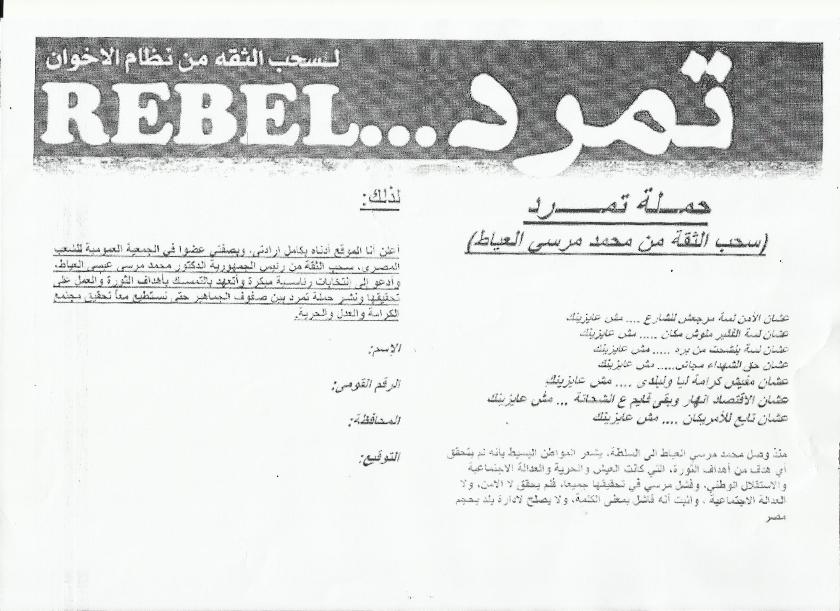
Here is the translation of their flyer:
REBEL
To withdraw confidence from the Brotherhood regime
The Rebellion Campaign
(to withdraw confidence from Mohamed Morsi ….)
Because security has not yet returned to the street … we don’t want you
Because the poor still do not have a place … we don’t want you
Because we are still begging from abroad … we don’t want you
Because the rights of the martyrs still have not been fulfilled … we don’t want you
Because there is still no dignity for myself or my country … we don’t want you
Because the economy has collapsed and is built upon begging … we don’t want you
Because you follow the Americans … we don’t want you
Since Mohamed Morsi the … came to power, the simple citizen has felt that not one goal of the revolution has been achieved – for bread, freedom, social justice, and national independence. Morsi has failed to realize them all. No security, no social justice – he is a demonstrated failure in the complete sense of the word. It is not fitting for him to administrate a nation of Egypt’s weight.
Therefore:
I, the undersigned, from my free and complete will, as a member of the general assembly of the Egyptian people, withdraw confidence from the president of the republic, the dictator Mohamed Morsi, and call for early presidential elections. I pledge to hold firmly to the goals of the revolution and to work on their behalf, spreading the Rebellion Campaign among the masses until we are able to achieve social dignity, justice, and freedom.
Egypt is not quite rumbling again; bubbling is more like it, though the bubbles can grow bigger. Security apprehended alleged terrorists plotting to blow up the US and French embassies, while their colleagues in the Sinai abduct seven security officers.
In Cairo a small protest in Tahrir threatens a creative escalation. The ‘rebellion’ campaign is collecting signatures to demand the departure of President Morsi. The have announced two million so far; they aim for fifteen – more than the total ballots cast in Morsi’s favor – by June 30, the day he assumed office. On that date they will return in mass to the presidential palace.
Many Islamists complain there is no legal legitimacy to their action. Of course they are right, but there was no legality to the demonstrations which deposed Mubarak either. It is the symbolism which is important – if they can get the numbers.
Terrorists, though, do not need numbers. They need space, materials, and determination alone. Few dispute their illegality, but along similar lines, the symbolism is important.
God, amid Egypt’s many problems, few prayers have been necessary concerning terrorism. For this thanks is necessary; terrorism has been a constant in Syria, with appearances in Tunisia and Libya as well. For all deserved criticism of the security void there has been vigilance on this front. May it continue; free the abducted personnel and give the authorities wisdom and perseverance in the Sinai.
And of rebellion? Surely the name is not that pleasing, God. Is the campaign? Is it honest? Does it use the memory and practice of demonstrations past simply for political pressure? Or is the real end game to remove the popularly elected leader? If so, by what mechanism?
It is good to have popular means of accountability and activism, but it is troublesome many feel this is the only avenue for political participation. Frustrations are high and shared ideals are broken amid widespread polarization. But does Egypt need another uprising? Can it stomach one?
God, you know what is behind the scenes, if anything. But may those putting their signatures to paper be represented well. May the opposition be properly empowered. May the president fulfill the demands of the people. May the civil political arena widen.
Give patience and determination to the ‘rebels’, God; urgency and flexibility to the president.
Give constriction and repentance to the terrorists, God; space and vision to the president.
For Egypt, God, give all of the above, merged together in sovereignty, prosperity, and peace. May the bubbles turn out beautiful.
John Stott was an Anglican writer and student of the Scriptures.
Christianity Today reprinted a sermon he gave on “Four Ways Christians can influence the world.”
Then, someone asked on Twitter, and @Copticorphans retweeted: “How does this apply to Copts in Egypt?” How can Copts move “beyond mere survival” to more truly become salt and light in society around them?
The blog then goes on to provide an excerpt of the sermon, which can be found here and is worth reading no matter what country you reside in.
The tweet, however, was mine.
In my best effort of humblebrag, I currently have 361 followers on Twitter. Please click here if you would like to increase the number, and here to read my reflection upon joining Twitter for the first time, in April 2011.
I am still slow to own a smart phone, though they are readily available in Egypt. Perhaps soon; after all, we’ll all have them in a few years. But because of this my tweeting is usually reserved for offering comments as I read articles on the internet, primarily of Egyptian news. I imagine most of these disappear into cyberspace; sometimes someone’s retweet makes me smile.
But that tweet, about John Stott, found an audience. It was then turned into a blog post on one of the most popular Coptic charity organizations. From there, who knows? It is bread upon the water.
One of my hopes for the Copts is that they might find the courage and faith to emerge from an often insular mentality, serving and blessing their society. Perhaps the cards are stacked against them as a minority, but salt is always a minority in the food it preserves.
But if they realize this, they can also be light, of which minority/majority makes no difference at all. Light, once lit, dispels darkness. It is its very nature.
One small tweet, but it found the administrator of a blog. From there it found readers of a blog. And from there perhaps it stimulated conversations among Copts around the world.
All humblebrag, perhaps, or a narcissistic search for relevancy. But perhaps it is also a reminder that within the scope of influence we have, we should speak. Ideas have power, but they must be heard.
Or tweeted. The world is changing, and surely tweeting will never be a substitute for ordinary human communication. But as a means among many, why not?
The news is not new, but it is current. This last week has seen another spate of activist arrests, coupled with yet another shuffle in the cabinet. The themes are on repeat with only names differing. But names can make all the difference.
One of the activists’ names is Ahmed Maher, founder of the principle youth movement behind the revolution. Having supported Morsi during the run-off presidential elections, he is now provisionally detained by the Morsi-appointed prosecutor general for ‘inciting protests’. A prominent Islamist, Hazem Abu Ismail, is under investigation as well, for roughly the same charge. As far as names go, these are major ones.
There are new names in the cabinet also. These are not so prominently noteworthy, but they include two judges and three additional Muslim Brothers. The longstanding call by the opposition for an inclusive cabinet was not answered; will this one prove more effective?
God, may it be so. Placing politics aside, the government must work. Increase the leadership and capability of each minister to nurture growth in each sector of society. Give them boldness to tackle the economic issues facing Egypt, with wisdom especially on the IMF loan. Their jobs cannot be easy.
But inasmuch as this cabinet is not reflective of societal consensus, God, may the playing of politics work as well. Opposition pressure must demand tangible results; government plans must stimulate opposition counter-proposals. Help the interplay to enliven debate in society about the direction Egypt must take. May both government and opposition fully represent the people.
But where politics leads to a scaling back of freedom, God, help the people to demand more. Perhaps these activists crossed a line. They live on the edge of the permissible, God, and need your wisdom deeply. The quest for justice is easily derailed by a single poor decision.
Of course, perhaps they made none and are simply targeted as a political nuisance. Give the government strength in its legitimacy, God, to accept protest, and as necessary, reform.
Activists and ministers are almost by nature at odds, but they are both Egyptians, both working for the betterment of Egypt. Help society to grasp this, God. Perhaps if it does then leadership will follow.
May the names of the nation be men of principle. As they shuffle, in and out of prison or of office, may these principles remain.
From April 25-28 I traveled with Arab West Report through a few Upper Egyptian Holy Family sites, places Mary, Joseph, and Jesus are recorded to have stayed according to Coptic tradition. This travelogue will share some of the insights and anecdotes learned along the way, by means of pictures taken at each location.
Please click here for the full commentary at Arab West Report. This posting represents the third of the articles I was able to write following the trip; I will only post the photos not used in writing about a cancelled Palm Sunday march through streets of a mostly Christian village, or about local perspectives of Copts toward the elephant in the room – emigration.
But the Arab West Report article is a good nine pages long featuring 35 photos. Most only have a paragraph or two of reflection, so it is easy reading. Here it will easier – pictures with a sentence or two. Please enjoy both here and there.
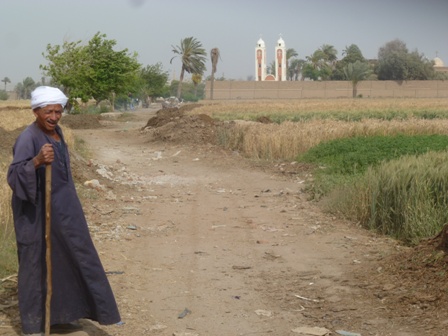
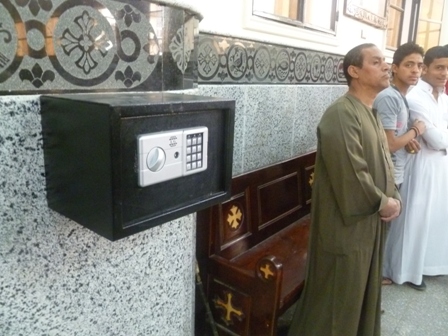
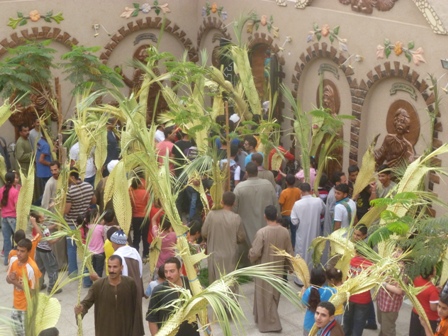
With professional photographers Norbert Schiller and Dana Smillie. Lining up a picture of a monk at Dronka Monastery, purported to be the southernmost extent of the Holy Family in Egypt.This is a Holy Family Tree at Sarabamoun Monastery, near Dayrut. Coptic tradition says they paused to rest under its shade. The white papers represent the prayers of pilgrims seeking intercession.The large tree in the upper right is the Holy Family Tree. The Sarabamoun Monastery is quaintly isolated in agricultural land. Here, a local farmer pauses by the side of the road.The village of Saragna is 90% Christian and on the way to perhaps the most holy Holy Family Site, Dayr al-Muharraq. It is a very traditional village built on the ancient pattern, extending out circularly from a high point above the elevation of the Nile flood, now halted by the Awsan Dam.The mayor and his deputy of Saragna. He is the 4th generation in his family to hold the position.Homes in Saragna pushing up against the massive new church recently built. Some homes were purchased and destroyed to make room.The greatly expanded Church of the Virgin Mary in Saragna. It cost just shy of $900,000, but had much free volunteer labor offered by residents. Most of the money came from Saragna men working abroad who tithed their earnings.The inside of the beautiful Saragna Church sanctuary.The Saragna church is modern in every sense of the word. Here the traditional wooden offering box is replaced and made more secure by electronic safe.The Monastery of Dayr al-Muharraq is esteemed as the southernmost extent of the Holy Family in Egypt. If this seems to contradict what I wrote earlier, you’re paying good attention. Do read on below. The walls are built to resemble the walls of Jerusalem, seeking to establish itself as an alternate pilgrimage site.Another example of the walls. For some reason I found this monastery strangely modern. It seemed more like a colonial villa compound than a place of asceticism.Almost all Coptic monasteries have been modernized. Here inside you can see the old versus the new.But here is old. It was great fun to watch the monks worship and interact. About 100 are resident in the monastery.Here a monk chants from the prayer book, joining his colleagues in unison.The chants were in the ancient language of Coptic, still used somewhat in the masses of Egypt but known only by a small group of specialized practitioners, such as in this monastery.I love this photo. Monks in Egypt are strangely free to join or not join communal worship as they see fit. It is a very individualistic calling, largely left to one’s sense of how to walk with God.On the way to the Holy Family site of Qusair we passed by a new but very traditional village. The women, Muslim, are doing dishes in the Nile.To get to the small chapel in a cave we had to cross the Nile in a traditional sailboat.Upon arrival we were met by tens of Muslim women coming out of their homes and cheering. As it turns out, arriving just after us was a released prisoner returning home for the first time in six years. The priests joined in the celebration.Upon returning north on the way to Palestine (from whichever location), the Holy Family rested in this cave before sailing the Nile. A small church is now inside; the priests lead weekly mass at 5am on Sunday.But we saw also the expansion of the site. The priests are preparing to host a summer festival for the first time, trying to increase the pilgrim awareness of this site. I fear it may ruin its pristine nature and tranquility.But can anything ruin this tranquility? This photo looks down from the cave upon the small distance we walked from the Nile.Returning now to the first scene, this is the Dronka Monastery on the edge of the Asyut Mountains. The connection with the Holy Family tradition is tenuous, and only accepted by church hierarchy in the 1970s. It has since been massively expanded from…… this cave, where the Virgin Mary is said to have appeared in an apparition. (Is that redundant?)Looking out from the monastery at the village and farmland below. It is said the Holy Family tradition emerged here when local businessmen had a falling out with the monks of Dayr al-Muharraq Monastery. In the AWR article I provide a somewhat extended reflection on how possible pious fraud can both strengthen and damage the faith of Coptic Christians.Concluding our trip was the celebration of Palm Sunday at the church in Saragna. Here, in defiance of the priest’s decision to cancel the street parade, Coptic youth go out the gate as opposed to into the service. Please read that article for further context, but fortunately, no trouble occurred.This is a good photo to close with, Coptic street vendors making palm leaves outside a church in Asyut. The little cross the man on the right is holding sold for $1.
The trip took in far too much in far too little time to really feel like I learned about these sites and the reality of Christian life in Upper Egypt. But I am very thankful for this first opportunity, hopeful for far better understanding in the future. Please click here for a few more photos and fuller commentary.
A horrible account of vigilantism mixed with politics, from Ahram Online:
Security sources told Ahram Online that hundreds of El-Qataweya village residents ransacked the house of Freedom and Justice Party (FJP) leader, Rabie Lasheen, in the early hours of Friday, setting his furniture and three cars on fire apart from killing his son. Revenge was their motive.
Lasheen’s son, Youssef, was accused of shooting a 28-year-old man merely for insulting his father in a Facebook post for his affiliation with the FJP. An auto rickshaw (tok tok) driver in his 40s was accidentally gunned down too.
The revengeful mob, including members of both men’s families, dragged Lasheen’s son to the street and used bladed weapons while assaulting him, according to Al-Ahram’s daily correspondent. The assistants then left him for dead in the street.
The Freedom and Justice Party issued a terse statement denying the killing was political. It must have been the most difficult press release they have written in some time.
The region where this murder(s) took place has witnessed several examples of mob violence against alleged criminals in recent months. Other governorates, including Cairo, have not descended into such chaos.
I won’t say it is ominous as much as it is sad. If the reporting above is accurate, it is a vivid illustration of the downward spiral of sin, metastasizing like cancer deeper and deeper into tragedy.
I wished to find a better word than sin. Ambition isn’t enough, and sin seems too harsh. Sin makes it sound like he/they deserved it. But small or large, well or ill-intentioned, is there a better description for what is ailing the nation? It just eats away at everything, and so many share in the blame.
From my latest article in Egypt Source, culling attitudes on emigration from a recent trip to Upper Egypt:
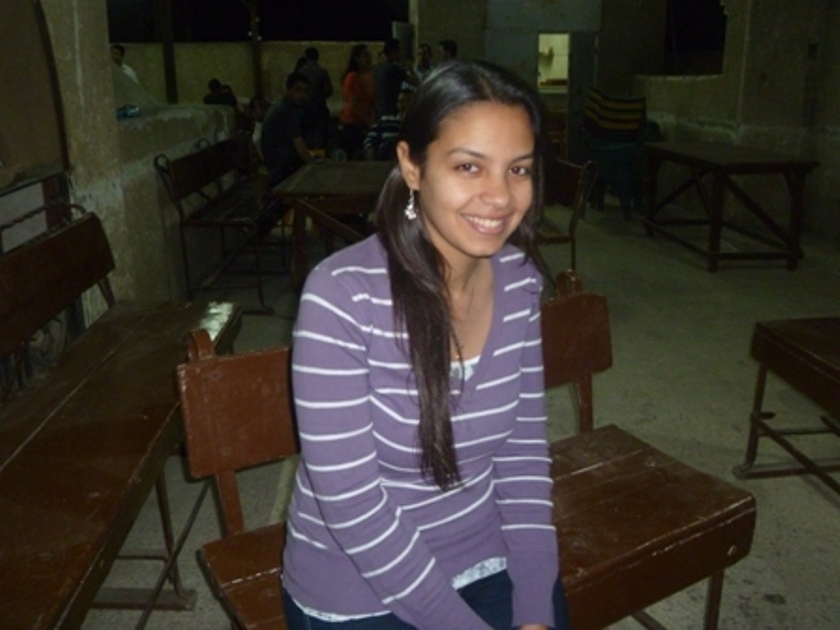
Sara Shuhdi
“I have nightmares every couple of days,” said Sara Shuhdi, a 23 year old assistant professor of analytical chemistry at the German University of Cairo. “I don’t see a bright future for Egypt; maybe it would be better for me if I left.”
Fifty-five days of fasting concluded on Coptic Easter, celebrated this year on May 5 according to the eastern calendar. Always a period of reflection and joy for Egyptian Christians, this year the community is deeper in the former and subdued in the latter.
Here are the photos of each person sharing, with a quote from each:
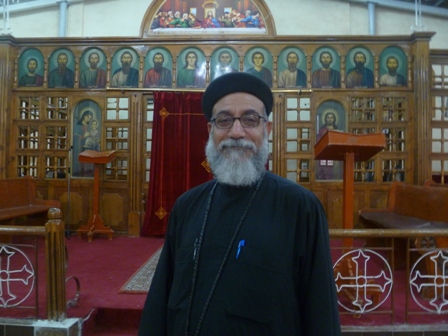
Fr. Seraphim, an Orthodox priest in Dayrut
“Of course we must stay here,” he said. “Our history, family, and churches are here – we cannot leave Egypt.”
Emad Awny, a businessman in Asyut
“The civil current – Muslims and Christians together – must provide a different way of thought and raise consciousness through business,” he said, “especially in poorer areas susceptible to extremism and ignorance.”
Fr. Kyrillos, an Orthodox priest in Saragna
“Twenty years ago, I tried to convince Copts not to emigrate, but now because of the bad economy I bless them if they want to go.”
Bishop Thomas of Qussia
“I raised people here, trained them, and watched them grow and become productive members of society,” he said. “And then they leave? It is sad.
“I can’t prevent them but I encourage them to stay. I try to speak to their conscience to make their land a better place. Why would someone leave their home and become a foreigner forever?”
The article concludes with a stinging quote by Bishop Thomas for the conscience of humanity; please click here to read the whole article at Egypt Source.
From the Washington Post, in an op-ed from Nathan Brown, a respected Egypt expert:
The U.S. message to Morsi should no longer be “We’re with you, watch out for some details around the edges.” Instead, Obama officials should be telling Egyptian leaders: We’re extremely concerned about your violations of core political and legal principles; we can’t be the partner we would like to be, and the partner Egypt needs, if you undermine the fulfillment of Egyptians’ democratic aspirations.
Putting this message into practice will require much sharper, clearer public responses by the White House and State Department to violations of basic democratic and rule-of-law norms. It will mean an end to justifying the Brotherhood’s negative political steps. And the United States should indicate that the possibility of new aid is not isolated from domestic Egyptian political realities.
This tougher line should not be coupled with an embrace of the opposition. U.S. policy should be based on firm support of core democratic principles, not on playing favorites.
Recalibrating the current policy line will require careful nuance. It has to be clear that the United States is not turning against the Brotherhood but is siding more decisively with democracy.
Earlier in the article Brown goes through the litany of Brotherhood illiberal and anti-democratic decisions. Here, he puts forward what is necessary to counter the widely believed Egyptian liberal and Coptic Christian conspiracy which says the US is ‘backing’ Morsi.
Brown’s words seek to hold on to the ideal in difficult geopolitical times. It is always best to do what is right, and call others to do the same. Messy and impractical, often, and with uncertain results. But it is always best.
There is much that Egyptian Muslims and Christians agree upon, much which unites the two and allows them to pray similarly. But at one point the religions are rather irreconcilable: Jesus was not crucified, and therefore was not resurrected. There is no Easter, celebrated by Copts this coming Sunday.
Fair enough. There are plenty of common troubles in Egypt these days. But Easter risks becoming another one, a further point of division in a polarized nation.
God, may it not be so.
The Egyptian status quo of good neighborliness has Muslims and Christians exchange greetings on all their holidays. The Muslim purist status quo of Islamic fidelity forbids congratulating religious error. Both have been around for some time.
The purists have generally been confined to Salafis, but now the Muslim Brotherhood is caught in the middle. Their mufti has given allowance to greet on Christmas, but Easter should be avoided.
The middle ground makes some sense, as Muslims accept Jesus as a prophet born miraculously from the Virgin Mary. But in Muslim eyes Christians are in religious error to hold the prophet born as the Son of God; why should neighborliness cover one and not the other?
God, bless the purists and give them wisdom and discernment. Honor them for fidelity to unpopular conviction, especially as many behave as good neighbors every day of the year. Give them love for these neighbors even as they seek to guide them to the right path. May it be for the sake of truth, and involve no division or discrimination.
God, bless the Copts as they interpret this refusal as a public insult. Honor them for fidelity to minority religion, especially as many esteem Muslims for their faith every day of the year. Give them patience and grace for those who find offense in them. May it result in greater love between all and honest discussion in that which divides.
But for all who play with the issue, God, issue your divine condemnation. Some purists seek to isolate the Copts and those who stand with them. Some non-Islamists seek to demonize their opponents as agents of social disintegration. Where accusations are true may you muffle their voice and end their influence.
The Easter issue does not warrant such rhetoric, God; calm things down. If you gave your son to be crucified your followers can take an insult. If you alone rescued your prophet from violent rejection your followers can allow you to continue this battle.
God, you know best the truths of religion, but you know also the needs of Egypt. Help the people to mind the balance, finding both in love and unity.
Joyous Copts raised palm leaves and shouts of welcome as Bishop Thomas, dressed in his regal red clerical robe, entered the Church of the Virgin Mary in Saragna, 325 kilometers south of Cairo.
But departing from tradition he arrived by car for the first time this year. For years local Copts would first parade him through the streets of the 90 percent Christian village.
For the first time in this Upper Egyptian diocese, the ancient parade on 28 April remained within church grounds to control the behavior of Christian youth.
‘It used to be that all churches would parade in the streets, but because of the pressures of the last few decades in most places it has stopped,’ explains Thomas.
Saragna was the last village of his diocese to maintain the parade. ‘We are mostly Christians here, so all is well,’ says Ramiz Ikram, the fourth generation Coptic mayor.
‘Some Muslims complain due to their fanaticism, but we don’t march in their areas so as not to make problems.’
Fr. Kyrillos of Saragna
But according to Fr Kyrillos Girgis, a Cairo-trained medical doctor who has served as priest in the village for 23 years, local youth recently began shouting offensive anti-Muslim chants.
He threatened to bar them from communion for a year, but eventually had to stop the procession entirely.
This past Sunday, as everywhere else in Egypt according to the Eastern religious calendar, palms were raised within church grounds instead of in the streets as of old. (Please click here for video.)
Bishop Thomas remains positive however. ‘The challenging religious situation in Egypt reinforces our religious identity,’ he says ‘and today we enjoy being in the kingdom of God.’
Fr Kyrillos can also see the silver lining in the dark clouds gathering over this country. He is leading a vast expansion of the Church of the Virgin Mary, tripling its size and adding a second sanctuary.
The greatly expanded Church of the Virgin Mary in Saragna
Local authorities licensed the expansion before the revolution, along with construction of new churches in the roughly 50 percent Christian villages of Titaliya and Manshia.
‘We have good relations with security and with local people,’ said Thomas, ‘We prefer to obtain proper permissions because we do not want to take any risks.’
Illegal construction
Outside of his diocese, however, other bishops are less risk averse. The 22,000-strong village of Bayadia which is more than 90 percent Christian, had a single church for six different denominations, despite many applications for building permission.
‘We felt great injustice under Mubarak,’ said Orthodox priest Fr Girgis, ‘because we had only one church despite being the great majority of Christians.’
His solution was illegal construction of four more churches. Other denominations followed suit, and Bayadia now has fourteen churches. In the nearby village of Dair Abu Hinnis which is 100 percent Christian, Fr Bemwa boasts of an increase of from five to ten churches since the revolution.
Bishop Thomas explains it can take up to fifteen years to gain a church building permit, whether from bureaucracy or discrimination.
Many priests take matters into their own hands.
With the collapse of government, this is increasingly the norm in Egypt. The Ministry of Housing and Local Development announced recently the existence of more than five million unlicensed buildings. A BBC report earlier this year documented the post-revolutionary surge in building, including many that have already collapsed.
But when Christians attempt such illegal church construction in Muslim majority villages, there is often resistance. Sometimes this is the case even when permits exist.
‘As long as it is a primarily Christian area there is no problem to build,’ said Cornelis Hulsman, editor-in-chief of Arab West Report (AWR). ‘But when it is in a mostly Muslim area it can cause clashes if neighbours are opposed.’
AWR investigated an attack on a church in Aswan in October 2011, and a February 2013 attack in Fayyoum. In both cases Muslims had been offended when local houses used for worship were expanded or renovated.
But on Palm Sunday, Egyptian Copts celebrate the success of a community which has maintained Christian roots since the visit of the Holy Family fleeing from Palestine.
The faithful flock to pilgrimage sites, such as the rural Serabamoun Monastery, believed by local Christians to house a tree which provided shade to Jesus and Mary.
Fr. Seraphim, offering a loaf of communion bread
Fr Seraphim, Coptic priest in the nearby city of Daryut, said, ‘Christians in Egypt have seen more persecution in the past than we see now.
‘And of course you have to make use of the opportunity: there is no government.’
The new Egyptian constitution was unnecessary from the start, says Ragy Sulayman of the Free Egyptians Party (FEP). The 1971 constitution, with added amendments, would have served just fine.
Sulayman is the founding lawyer who brought the liberal FEP into existence following the January 25 revolution. A member of the party’s political office, he also heads its legal and constitutional committees. Though the FEP declined participation in writing the constitution in protest of the lack of sufficient women and Coptic representation, they actively opposed the final draft. Rather than delving into the problems of content, Sulayman preferred to describe how the process was flawed from the beginning.
The basic problem is that though nearly all segments of society agreed on the need for a new constitution following the success of the revolution, there was no unified justification for why. This lack of consensus would come to polarize the political scene, made worse by the initial decisions of the suddenly ruling military council.
His main critique of the text of the constitution is interesting, for he does not take aim at its increased religious language but its virtual replication of the old system:
Once formed, however, the Constituent Assembly proved uncreative and unprepared to write a new constitution. First of all, they failed to conduct any social studies to determine the problems of the Egyptian people and take them into account. But second of all, the new draft largely patterned itself off the 1971 constitution, often using the exact same wording. The only significant divergence, which Sulayman admits as substantial, is the transformation from a presidential system of government to a parliamentary.
Even the religious aspects of the constitution do not represent a radical change in parliamentary procedure. Watching the Muslim Brotherhood’s majority Freedom and Justice Party deal with recent legislation concerning Islamic bonds, it is clear they intended the Azhar to play only a consultative role when the Supreme Constitutional Court is brought a case. Sulayman agrees with this interpretation, actually, though the Azhar has insisted on prior review. But parliamentary procedures under the old system also called for sharia-compliant legislation, with a designated committee to seek the opinion of the Azhar on relevant draft laws. Even the controversial Article 219, defining the principles of sharia, does not significantly alter the system.
This convinces Sulayman the increased religious language of the constitution was mainly a campaign tool – coupled with efforts to convince the population of a yes vote for ‘stability’ – to ratify the document by referendum. A rushed process hammered through a flawed constitution to a population misled by propaganda. The Egyptian people were denied a chance to achieve a national charter worthy of their aspirations.
Elsewhere Sulayman takes note of a significant divergence from the old system, in which a mixed presidential-parliamentary system replaces the former presidential.
Overall his critique seems fair, but if the 1971 constitution would have been fine, why does he criticize the new draft patterning off of it? Especially if he approves (seemingly) of the new governing relationship between president and parliament?
I suppose it is due to the hodge-podge nature in which everything was done, but please click here for the full article on Arab West Report and decide for yourself.
All too often Upper Egypt is neglected, unless there are problems. Then, they must be extraordinary and embarrassing; normal problems go unheeded and have for decades. Almost by nature, farmers do not agitate, and this nature has permeated much of the region’s character. But is Upper Egypt the frog that boils heedlessly or the camel on which one last straw is placed?
May a better metaphor be found, God. Both of these imply portending ill; perhaps others would imply continued suffering. Surely there is much to celebrate, if ever news would carry. But as the situation deteriorates in Egypt the pain is acute in the south. Some anticipate a revolution of the hungry.
Much is out of their control, God. Governors are appointed from Cairo and most decisions are centralized in the capital. Elected representatives often come from large families and patronage networks. Education is worse than the rest of the nation while religious and tribal rivalries are strong.
Even if Egypt requires a strong central government, God, provide this region the ability, space, and will to shape its own future. May innate common sense and practicality yield fruit; to these add cultural enrichment, political participation, and economic opportunity.
God, in these regions where Christians are plentiful, save them from surrender to a narrative of oppression. Where they have grievances may neutral arbitrators grant justice through the law. Where they suffer bias, rebuke and rebuild soiled mentalities. In both cases may they respond with love and forgiveness, even as they stand for their rights. But may they never generalize their neighbors or pull back from integration. Give them friends, God, but make them friendly. May they creatively initiate for the good of all.
And God, where Muslims see Christians withdraw into the church, expand unlicensed places of worship, and quietly whisper about the nature of Islam and oppose a particular political version thereof, give an understanding and engaging spirit. May they do what is necessary to reassure a troubled community of the unity of all. May they, too, resist the temptation of escalating rhetoric and accusatory recrimination. May Muslims be agents of peace and social healing.
God, provide for the poor. Grow the crops. Multiply the livestock. Establish business. Employ laborers. Upper Egypt is in great need, but has known this need for generations. You have provided, God; you have given patience and contentment. Chastise those who grow rich off their good nature without returning in kind. But make the region an example for the nation to follow.
To a fair degree Egypt is of their nature, for good and for ill. Preserve and transform, God. May Upper Egypt know and increase its strength.
As the world community condemned the recent bombings in Boston, the Muslim Brotherhood’s political arm joined the chorus.
“The Freedom and Justice Party categorically rejects as intolerable the bombings committed in the US city of Boston,” reported Ikhwanweb, the official English website of the Muslim Brotherhood. “The FJP offers heartfelt sympathies and solemn condolences to the American people and the families of the victims and wishes a speedy recovery to the injured.”
But, as many have complained, in Arabic the thought was different, expressed by a prominent leader on Facebook:
Erian proceeds to establish a timeline of suspicious violence, from Mali to Syria to Somalia to Kurdistan. No further mention is made of Boston, and he is led to questioning.
“Who disturbed democratic transformations, despite the difficult transition from despotism, corruption, poverty, hatred, and intolerance to freedom, justice tolerance, development, human dignity, and social justice?
“Who planted Islamophobia through research, the press, and the media?
“Who funded the violence?”
Erian’s musings on conspiracy are nowhere to be found on the Brotherhood’s English language websites.
But the focus of the article is to highlight a new blog which is translating questionable material on Brotherhood websites, both current and from their archive. It turns up gems like this one:
For example, an FJP article described “a growing case of hatred of the majority of Copts towards Islamists in general,” and “the Coptic spirit of hatred for everything Islamic.” The article concerned anti-Brotherhood chants during the funeral, but failed to condemn the subsequent attacks on the mourners exiting the cathedral.
From the conclusion, describing the blog’s grand goals, but subtle methods:
“Part of our appeal is that we make it very neutral – not in selection, but in translation,” said Carr. “We’re challenging the Muslim Brotherhood, but in an indirect way, we want it to be subtle.”
It is both subtle and a challenge, but Dabh and Carr are committed, expecting either the best – or the worst.
“We’ll continue until the Brotherhood falls or we fall,” said Carr. With a laugh she continued, “Or get shot.”
Please click here to read the full article on Egypt Source, and here to visit the mbinenglish website.
From my latest article in Christianity Today, from the April edition and published online on the 18th:
Nadia Mohamed Ali was raised in a Christian home, but when she married Mustafa Mohamed Abdel-Wahab in 1990, she converted to Islam. After his death, she obtained new identity cards—required under Egyptian law—that declared her and her seven children Christians.
Then came the ruling by a criminal court this January: “Egyptian Court Sentences Family to 15 Years for Converting to Christianity” read the Western headlines. Several U.S. religious freedom watchers declared Ali’s sentence a “real disaster” that “underscores the growing problem of religious intolerance” under Egypt’s new, Muslim Brotherhood-backed government. A shocking headline, indeed.
A cut-and-dry case of religious persecution? Not quite.
“They were imprisoned for fraud, not for conversion,” says Mamdouh Nakhla, founder of the Word Center for Human Rights in Cairo. The Coptic lawyer claims the family paid government workers to forge new identity cards. They registered their religion as Christian under Ali’s maiden name so that she could obtain her inheritance.
There is an underground market for such fraud:
“I was introduced to a certain priest—now deceased—who knew a certain Christian who works in the Civil Registry,” says Sheikh Saber (using his Muslim name, not his forged Christian identity). “He takes the bribe and distributes the money around for assistance in covering it up.” In 2003 Saber obtained new IDS, birth certificates, and a marriage license for his family. The cost of this illegal “service” now runs up to $2,500 per person.
The article proceeds to discuss in some depth the role of inter-religious love affairs and marriage in conversion, to which difficult social conditions also contribute. But there are accusations the conversions are not just a product of sociology:
Meanwhile, some Muslims target Coptic Christians for marriage to convert them. “The Coptic people are downtrodden,” says Isaiah Lamei, a priest who provides pastoral care for troubled Copts. “Muslims take advantage and get them to sign papers of conversion [so Copts can] fix their problems.”
Every year, Lamei ministers to 30-40 families in his diocese that have been approached by Muslims offering such “help.” “These problems can be emotional or financial,” he says. He estimates that in his diocese every year, “two or three convert to Islam.”
It’s hard to verify whether Muslims really marry Copts just to draw them into Islam. But it’s also hard to verify the sincerity of Muslim conversions to Christianity.
“We must be cautious,” says Cornelis Hulsman, editor in chief of the Arab West Report. “I have met converts who are sincere, and I’ve met converts who have other interests.”
Nakhla agrees. “Some converts come to me and say they want to marry a Christian. Or they request money, or work, or an apartment,” he says.
From time immemorial mankind has known of the power of religion in both fraud and piety, manipulation and sincerity. It is frustrating to navigate the divide.
Examples of grace and ‘ungrace’ abound, but in service of both mankind and God, toward whom religion is said to direct, the navigation is necessary.
Please click here to read the full article on Christianity Today.
Another protest was assaulted, this time one called for by Islamists. An otherwise peaceful demonstration calling to purge the judiciary was met by violence, when then lasted long into the night.
Not all Islamists participated; some believed such a protest would not help matters. Perhaps others remembered their own earlier criticism that continued demonstrations only serve to destabilize Egypt. This was a Muslim Brotherhood project, and it cost them Morsi’s minister of justice, an independent Islamist, who resigned in a protest of his own.
But if it is their project, what are they developing? What would a purge of the judiciary look like? The complaint is that many judges are of the Mubarak era, corrupt and aligned with the old order. The conspiracy claimed is that they are actively opposing the Islamist project, seeking to keep the nation in limbo by preventing development of democratic institutions on flimsy pretexts.
But the only proposal floated in the media currently is to lower the retirement age for judges, removing a few thousand of the most senior. Is such an across the board move a purge worthy of the name, eliminating corruption? Or does Brotherhood leadership have something else in mind?
God, it all seems clumsy and obvious. Certainly the justice minister thinks so. But in every sector of the old regime there was corruption. Mubarak manipulated the judges to the extent he could, but the judiciary was still relatively independent. He was unable to fully ply his will, and many opposed his policies. Surely there are good men among the senior judges.
Of course, many are also deeply suspicious of the Islamist project, which has shown willingness to step outside the law when circumstances merited. Where is the line between judicial pretext and blind justice? Are they subverting democracy, or catching Islamists when they try to cut corners?
Furthermore, are justices protecting former regime officers tried for the killing of revolutionaries? Or are they courageously issuing verdicts of innocence where insufficient evidence is presented? Someone killed hundreds; why do we still not know who?
No consensus exists for a straightforward purge of the judiciary, God. But to some degree the call is correct. Let the matter be in your hands. From good intention or ill, politicians may force a change. May it be that the sins of the guilty fall on the guilty. Protect the institution of the judiciary. Protect the honest judges. But for those who compromised themselves – no matter the commonness of their failing – may the guardians of Egypt’s law be clean moving forward.

















 Jayson Casper