Categories
Christianity Today Middle East Published Articles

Who Writes History When There Is No Winner?

Peter Charlesworth / Getty

Eight somber Muslims sat around white plastic tables on the gold-tinged red carpet of Sayyida Aisha Mosque in Sidon, Lebanon. Arabic sweets beckoned, but few partook. The seriousness of the occasion—reviewing their memories of Lebanon’s 15-year civil war that ended in 1990—seemed to make several uneasy. They did sip their tea.

Four were Lebanese native to Sidon. Four were Palestinian refugees. Several wore beards, some long and scraggly, others short and trimmed. One was a former fighter in the war. Another lost family members when a Christian militia massacred inhabitants in Tel al-Zaatar.

Beginning in 1975, Christians, Muslims, and Palestinians plunged Lebanon into a regional conflict that included Israel and Syria, leaving 150,000 dead. Those convening the meeting, a Lebanese evangelical and a Druze follower of Jesus, hoped to unravel the reasons behind the highly contested conflict. Their host, chief judge for the Sunni Muslim court in Sidon and imam of the mosque, lent his legitimacy to the sensitive proceedings.

As participants received a 12-page document presenting Lebanese history that preceded the war, they were taken aback by reading a fully Christian perspective. But then the story shifted to Muslim perspectives, divided between Lebanese and Palestinian views. Three versions of history, none legitimized over the other.  

Many Christians do not call Lebanon’s tragedy a civil war. They emphasize how Palestinian refugees brought local destruction in their fight against Israel. Meanwhile, Palestinians emphasize displacement from their homeland and their need for a base from which to fight Israel. Lebanese Muslims sympathized with Palestine but aimed to change a sectarian political order that disproportionately favored Christians.

When the group finished reading the document, the evangelical stood up.

“Which narrative do you sympathize with the most?” he asked.

Martin Accad, president of the Beirut-based Near East School of Theology, spoke in his capacity as founder of Action Research Associates (ARA), which is working on a project that presents civil war history through multiple narratives. Cofounder Chaden Hani took notes. Their project is unique because, in schools, history books end shortly after the country’s independence in 1943 and avoid discussion of the sectarian struggles that followed.

A few participants dominated the mosque conversation with their viewpoints. An elderly Palestinian former fighter mostly sat silent. Accad asked about their emotions, which prompted different responses. “Sadness at what happened,” said one. “Fear it might happen again,” said another. A third noted, “I am happy we are finally trying to talk objectively about what took place.”

To move on from the conflict, Parliament passed a general amnesty law in 1991 that pardoned all political and civil war–related crimes. Former militia leaders became politicians and ignored the peace accord to write a unified history textbook as each sect clung to its narrative.

In 1997, Lebanon mandated a new educational approach. After three years of work, the cabinet formally adopted the history curriculum. But it was never implemented due to political interference behind the scenes.

“History is written by the winners,” said Accad. “But there was no winner in Lebanon.” Christians and Muslims fought each other, and as allegiances shifted, each religion split into rival factions that clashed as well.

Accad said history became…

This article was originally published at Christianity Today, on December 18, 2025. Please click here to read the full text.
Categories
Christianity Today Middle East Published Articles

The Priest and Social Worker Deradicalizing Jihadists in Prison

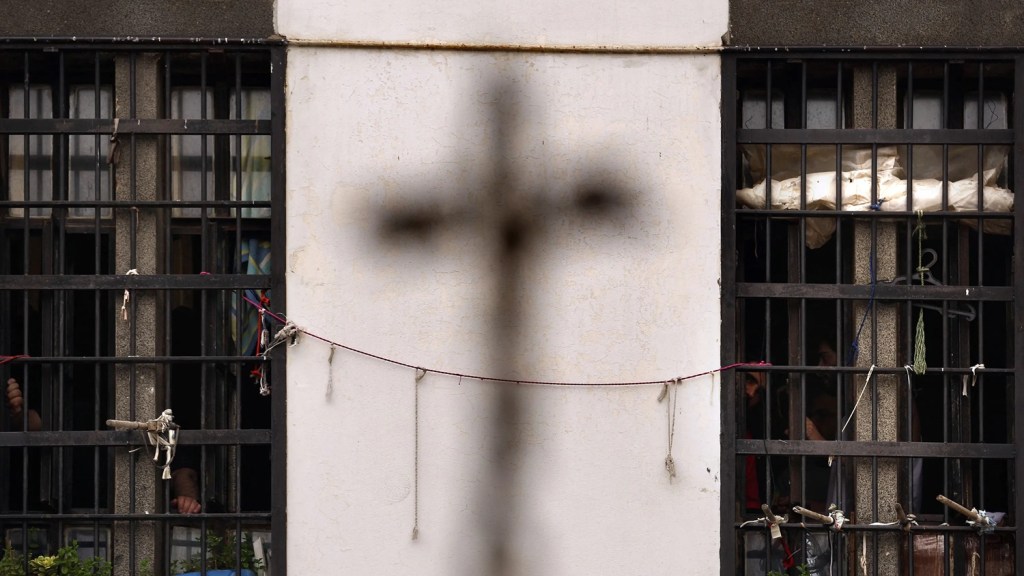
Patrick Baz / Stringer / Getty

Maya Yamout stared at the hardened jihadist sitting across from her over a plastic desk in the unkempt library prison. Books littered the floor. The man, a veteran al-Qaeda militant in the notorious Block B of Lebanon’s Roumieh jail pushed forward a glass of tea.

“Where’s the sugar?” Yamout asked.

The curt question fit their relationship. In their previous brief encounters, the prisoner called Yamout a spy, a pig, and all manner of insults that belittled her as a Muslim woman who did not wear a veil.

Yet this time, her mischievous smirk made the terrorist smile. Two weeks earlier, when he was sick, Yamout inquired about his health from prison guards and brought medicine and shampoo on her next visit. Once he recovered, he invited the visit, prompting the nervy but playful exchange. Sensing a breakthrough, Yamout proposed therapy. He accepted.

Eventually, filled with shame, he apologized for how poorly he treated her.

“To reach a prisoner, you have to bond over something,” said Yamout, the cofounder of Rescue Me, a Lebanese crime prevention and deradicalization organization.

But Yamout is clear: This something should not be religion. She’s found that speaking about faith often gets entwined in politics and leads to endless debate. It also rarely addresses what radicalized a militant in the first place.

Yet Marwan Ghanem, a priest in the Maronite Catholic church and president of the Lebanese chapter of Prison Fellowship International (PFI), takes the opposite approach. He centers his ministry on the story of Jesus and Zaccheus, believing the tax collector’s model of repentance can help any prisoner restore a debt to society.

Yamout and Ghanem worked independently in separate sections of Roumieh but met often for mutual encouragement. Despite their differences, when Yamout left in 2024 to pursue a PhD at the University of Swansea in the UK and budget restrictions at Rescue Me pinched its ability to go into prisons, she asked Ghanem to continue her work with extremists. She simply counseled him to go slow with religion, avoid provocation, be patient if insulted, and remember the prisoners’ humanity.

“Kill them with kindness,” Yamout said, “and kindness will prevail.”

Rescue Me, which Yamout and her sister Nancy founded in 2011, primarily worked among at-risk youth in the Hayy al-Gharbia neighborhood of Beirut until funding cuts in 2017 curtailed its service among the Lebanese poor as well as Syrian and Palestinian refugees.

Many in hopeless situations became easy targets for Islamic extremist groups, she discovered. And when prison overcrowding assigns ordinary criminals to Block B—designated for terrorist offenses—even the nonreligious can be radicalized through their need to belong, Yamout said.

She said Block B extremists fall into four categories. A quarter of her cases sought retribution for wrongs they suffered or the poverty they endured. Another quarter put a religious overlay on their frustration, while 35 percent did the same with politics. The remaining 15 percent are simple psychopaths—“I joined ISIS to smell the blood,” one told her.

Another prisoner she met fell into the second category. Born into Lebanon’s impoverished northern city of Tripoli …

This article was originally published at Christianity Today on December 3, 2025. Please click here to read the full text.