Categories
Christianity Today Middle East Published Articles

Report: Iran Arrested 166 Christians in 2023, Targeting Bible Distributors

Religious reeducation did not work on Esmaeil Narimanpour.

First arrested by the Iranian government in 2021, he and seven other converts to Christianity were cleared by the state prosecutor, who stated that their change of religion was not a crime under Iranian law. The following year, he was ordered with several others to attend ten sessions with Muslim clerics to “guide” him back to Islam.

Last December, Narimanpour was arrested again, this time on Christmas Eve.

The case is one of several highlighted by “Faceless Victims: Rights Violations Against Christians in Iran,” the 2024 annual report released jointly by advocacy organizations Article18, Open Doors, Middle East Concern, and CSW and presented at the British Parliament.

“This is a great example of agencies working together,” stated Mervyn Thomas, founding president of CSW (formerly Christian Solidarity Worldwide), at the event. “Iran claims to ensure freedom of religion or belief for all; but that is nonsense, as this report shows.”

Not yet convicted, Narimanpour is one of 166 Christians arrested and 103 detained by Iran during the 2023 reporting period. Another 22 have been sentenced, and 21 imprisoned.

While sentencings decreased by 8 from 2022, this year witnessed an additional 32 arrests and 41 detainments. Article18 has tracked incidents in Iran since 2015, when arrests were at a peak of 193. Detainments have fluctuated yearly between 26 in 2018 and this year’s high, while sentencings ranged between 12 in 2015 and a high of 57 in 2020.

The British parliament gathering included testimony from former prisoner Farhad Sabokrooh. Arrested with his wife in 2011, the couple served one year in prison and had their previously registered church closed down after 25 years. Accused of being a spy for Israel and the United States, he told the gathering that he was forced into a false confession, sentenced without his lawyer present, and once released was threatened with death if he did not leave Iran within one month.

“My plea to you is to hold the regime accountable,” Sabokrooh stated. He later noted, “They somehow feel Christians are orphans and have no one to protect them. We have to reverse that.”

The 36-page sixth report was released on February 19 to coincide with…

This article was originally published at Christianity Today on February 21, 2024. Please click here to read the full text.

Categories
Christianity Today Middle East Published Articles

Meet the Iranian Christians Crafting an Evangelical Alliance

Photo courtesy of Pars Theological Centre

Last week in Tehran, thousands rallied to commemorate the 45th anniversary of the Islamic revolution that established Iran’s modern theocracy. Last October in London, 130 Iranian Christians gathered to worship and pray, and celebrated a quiet decision to establish an evangelical alliance.

Time will tell which gathering was more consequential.

In 1979, one month after the fall of the shah, 98 percent of Iranian citizens voted to approve a constitution installing an Islamic government. Four decades of religious authoritarianism later, an online poll indicated that only 16 percent of the population would vote for it again.

An earlier survey, furthermore, found that only one-third of Iran’s population call themselves Shiite Muslims. More than half identified as either atheist, agnostic, no religion, vaguely spiritual, or Iran’s ancient Zoroastrian faith.

Those responding “Christian” totaled almost a million.

Thousands more Christians have fled persecution, taking refuge among the extensive Iranian diaspora in the West. Some have established ministries to evangelize among them, while others broadcast satellite TV programs, engage in remote discipleship efforts, or preside over a network of underground house churches.

Many multitask, while few collaborate—until now.

At the London gathering, members from over 40 diaspora churches and ministries voted almost unanimously to partner together in an evangelical alliance. Further votes were taken to choose a seven-member steering committee to represent the whole, tasked to take a year to study and recommend best practices, as an additional 60 leaders observed proceedings online.

Momentum had been building for years. Named the Iranian Leaders Forum (ILF), previous gatherings met in 2015 and 2018 until COVID-19 disrupted the triannual effort. While unity had been discussed previously in principle amid believers of different theological perspectives, 2023 represented the first practical step to formally establish it.

But the first mention of an alliance quieted the room. Gathered leaders—one-third of whom were female—had been beaming with joy at the reunion with colleagues separated by time and space. Hints of lingering tensions were whispered in the hallways, but worship was loud and heartfelt; prayers were passionate and pleading.

The ministries, however, were not used to cooperation, and many wondered what was intended. While a representative ILF steering committee planned the announcement of an alliance, it was not expected by most participants. Would such an alliance seek administrative control, establish a single denomination, or venture into politics?

Over the course of the five-day conference, leaders addressed the uncertainties. The motivation came from Jesus’ prayer for unity, to strengthen the witness of the Iranian church and to allow for one Christian voice where consensus exists. Breakout groups put diverse ministries in communication about what would be acceptable to all. But the purpose, organizers assured, was to agree on the benefit of forming a network of mutual relationships and then to take the time necessary to figure out the details.

A single denomination was ruled out, as was a political party. Currently under discussion is if membership will include only believing Protestants or if those of evangelical conviction in other denominations will also be welcomed. And while much of the house church movement is connected with gathered ministries, only God knows the full extent of the church within Iran.

Participants gave CT their various recommendations for success:

  • Avoid hierarchical structures and minimize administrative control.
  • Craft a clear strategy and process for decision-making.
  • Ensure election of capable and representative leadership.
  • Facilitate communication channels appropriate for active ministries.
  • Honor the theological and practical diversity of members.
  • Be mindful of inherited cultural authoritarian patterns.
  • Address the impact of Western money and denominational pressure.
  • Discuss competition over resources and ministry duplication.
  • Discern the role of women and non-Iranian participation.

Time will tell if the overwhelming agreement will hold. But CT asked a selection of participants to contribute short biographies of their ministries, along with their hopes for what an Iranian evangelical alliance can accomplish. Listed in alphabetical order, prayers are requested for all involved…

This article was originally published at Christianity Today on February 19, 2024. Please click here to read the full text and ministry biographies.

Categories
Christianity Today Europe Published Articles

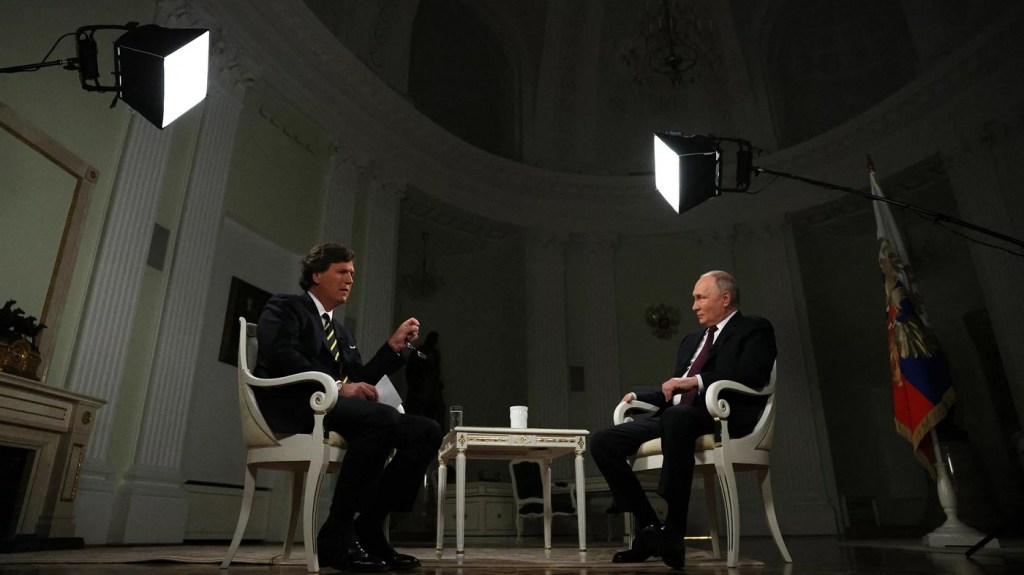
Tucker Carlson’s Putin Interview Explains Less Than Ukraine’s Evangelicals

Image: Gavriil Grigorov / Pool / AFP / Getty Images

Tucker Carlson is reviving American interest in Ukraine.

Approaching two years since the Russian invasion on February 24, 2022, the Slavic conflict has been eclipsed by the Israel-Hamas war in Gaza in the forefront of US media attention.

Many Americans, however sympathetic they remain, have tired of foreign wars in lieu of pressing domestic issues at home. Others, however, see continued US support for Ukraine as a low-cost check on Russian imperial ambitions.

Carlson, the controversial pundit, is presenting the views of Vladimir Putin.

While many American outlets have requested an interview with the Russian president, Carlson was granted the interview as his perspective “is in no way pro-Russian, it is not pro-Ukrainian,” stated the Kremlin spokesman. “It is pro-American, but at least it contrasts with the position of the traditional Anglo-Saxon media.”

Carlson said it would allow viewers to see the “truth” obscured by Western reporting.

Christianity Today invited Ukrainian evangelical sources to comment on any religious remarks conveyed. Seven stated they had no intention to watch what one called a “propagandist” in conversation with “the killer of my people.”

Putin gave them little to work with during the two-hour interview.

He described of the coming of Christianity to Eastern Europe within a nearly uninterrupted half hour answer detailing Russian history, during which he called Ukraine an “artificial state.” Pressed how as a professing Christian he could order violence, Putin spoke only of Russia’s “moral values.” And probing Putin’s personal faith, Carlson asked him if he saw God at work in the world.

“No, to be honest,” the Russian president replied, after a pause. “I don’t think so.”

Christianity Today has provided extensive coverage of the Russia-Ukraine war, including descriptions of the polarized American public, Russian-American pastors combating propaganda, and advice for interpreting misinformation no matter the source.

To understand any conflict requires knowledge of its background. CT has published articles about how Christianity came to Ukraine and Russia, the 160-year spiritual history behind today’s divide, and why Ukraine calls upon Michael the archangel. Concerning more contemporary pre-war history, CT covered Ukrainian politics and the efforts of evangelicals to win influence, in addition to the tomos of autocephaly that gave ecclesial independence to one-half of Ukraine’s Orthodox church.

But while Ukrainian sources declined to engage Carlson’s effort to understand the war through the rhetoric of Putin, they have informed most of CT’s ongoing coverage.

As Russia marshaled troops on the border, two articles provided Ukrainian evangelical perspective while waiting in limbo. And after the invasion, two more described the reaction of Christian leaders to their new wartime reality. As the previous Mennonite-inspired pacifism of Ukraine was pushed aside in defense of the homeland, reporting also provided the response of the foreign missionary community. Subsequent articles described ways in which concerned Christians can help.

An immediate need was…

This article was originally published at Christianity Today on February 9, 2024. Please click here to read the full text.

Categories
Christianity Today Europe Published Articles

Russia Restricts Churches in Ukraine. Divided Orthodox Critique Both.

Image: Photo courtesy of Mission Eurasia

Religious freedom is under threat in Ukraine. Some question by whom?

A Ukrainian delegation to last week’s International Religious Freedom Summit in Washington, DC, had a clear answer: Russia. Led by Sergey Rakhuba, president of Mission Eurasia, it presented “Faith Under Fire,” a December report detailing the crimes of war in eastern Ukraine and elsewhere.

“Faith communities are under incredible pressure in occupied territories,” he told CT. “The ideology of the Russian world is to completely monopolize religion.”

International lawyer Robert Amsterdam, however, warned that Ukraine was attempting the same control over one half of its divided Orthodox church.

Initial legislation passed by the Ukrainian parliament in October, he said, threatened to “ban” the historic Ukrainian Orthodox Church (UOC), the branch canonically linked to the Russian Orthodox Church (ROC) patriarchate in Moscow. In response, Amsterdam sent a 25-page dossier to the US, UK, and European Union heads of state on the UOC’s behalf.

“There is now a very serious question mark over whether Ukraine can meet its commitments to human rights and the rule of law,” the dossier stated. “This will have dire ramifications for Ukraine’s entry into the European Union and its place in the Western world.”

The authors of both reports share a common enemy.

Mykhailo Brytsyn, the lead author of the Mission Eurasia report, is a Ukrainian pastor who was previously arrested by the Russians during a worship service in Melitopol, occupied by Russia since March 2022. He was later exiled, and the army seized his church and turned it into a military base. Amsterdam, a Canadian lawyer with offices in DC and London, was also previously arrested in Moscow for defending Russian dissidents and subsequently banned from the country.

The United Nations is monitoring both Russia and Ukraine.

At a November meeting of the body’s security council, the UN assistant secretary general for human rights noted the yet-to-be finalized law in Ukraine and chided the country for failing to properly investigate 10 documented cases of violence at houses of worship, instigated by the Orthodox Church of Ukraine (OCU) against the Moscow-linked UOC.

The OCU was granted autocephaly—national independence—by Ecumenical Patriarch Bartholomew I of Constantinople in 2019, supported by the United States under the principle of religious freedom. But the move was rejected by the ROC, which continued in ecclesial jurisdiction over the UOC.

The UN official, Ilze Brands Kehris, continued her testimony to state that Russia is violating international norms by applying its own law in occupied territory, detailing restrictions on minority believers.

Rakhuba noted that there are many such restrictions.

“This war is not just territorial, it is ideological,” he said. “Religious freedom is missing from Russian terminology.”

Citing a concept called Russki Miir—“Russian World”—Rakhuba, a Ukrainian who previously worked with the Union of Evangelical Christian Baptists in the Soviet Union, contended that the ROC works hand-in-hand with the Kremlin to marginalize other Christian denominations. Since the invasion, the Russian military authority in the occupied Donbas region has steadily replicated that formula.

Rakhuba described three phases. In the first, from the January 2022 invasion until April of that year, the Russian army…

This article was originally published at Christianity Today on February 6, 2024. Please click here to read the full text.

Categories
Christianity Today Middle East Published Articles

Church Attack Leaves Turkish Christians Troubled and Confused

Image: Emrah Gurel / AP Images

Turkish Christians are shaken by last weekend’s terrorist attack on a Catholic church in Istanbul.

Claimed by ISIS, it comes amid threats that have already caused some believers to shy away from Sunday services. And like the rest of their nation, Christians are confused by details that eschew easy explanations.

“Everyone is a little nervous, questioning the future,” said Ali Kalkandelen, president of the Association of Protestant Churches (TeK). “And for the next few weeks—even months—everyone will watch their backs.”

Two masked gunmen casually walked into Mass at Santa Maria Catholic Church on Sunday morning, shot into the air, and killed one person. Security footage then shows them leaving the building, only slightly less casually than when they entered.

A statement issued by Martin Kmetec, archbishop of Izmir and president of the Episcopal Conference of Turkey, expressed his community’s “shock” that an innocent person was killed in a “sacred space of faith in God.” It demanded better security for churches, a curb on the culture of hatred and religious discrimination, and that the truth be revealed.

Shortly thereafter, security services arrested two foreign nationals, from Russia and Tajikistan. ISIS later published a statement saying the attack was in response to its call to “target Jews and Christians everywhere.” The statement was followed by another from a group calling itself ISIS’s “Turkey Province,” which said that it fired its pistols during the unbelievers’ “polytheistic rituals.”

While ISIS has conducted multiple terrorist attacks in Turkey, this is the first claimed by a local branch. The so-called province first emerged in 2019 but had only produced one propagandistic video.

But on January 4, ISIS’s spokesman called for worldwide targeting, which it later tallied to 110 attacks in 12 countries, killing or wounding at least 610 people. Turkey had already detained 2,086 suspected terrorists and arrested 529 since June 2023. Dozens more were detained following the Santa Maria attack, and 23 will be deported.

Kalkandelen said that amid the ongoing arrests, church attendance has declined. Families have kept their children at home, while new believers and seekers keep their distance. The TeK statement expressed condolences to the Catholic community, confidence in the authorities, and a plea to stop provocative discourse.

“This terrorist attack is obviously not an isolated or freak act,” stated the Protestant association. “From now on, the dark power behind it must be fully exposed so that it can no longer … terrorize Christians, minorities, and anyone with common sense.”

Condemning the attack, Istanbul’s mayor said the second referent was imprecise. “There are no…

This article was originally published at Christianity Today on January 31, 2024. Please click here to read the full text.