Categories
Christianity Today Europe Published Articles

Train Up a Child: Ukraine’s Christian Schools Model Wartime Education

Image: Christopher Furlong / Staff / Getty

As air raid sirens blared down the hallways, Tetiana Garkun hurried her middle school students outside the My Horizons Christian School campus into the designated bomb shelter.

Located in Khmelnytsky, 200 miles southwest of Kyiv, Ukraine’s capital, the school’s children moved in orderly fashion—a sign of how accustomed they’ve become to Russian missiles targeting military installations in nearby Lviv.

They prayed, waited for the all-clear signal, and returned to their Bible class.

Garkun’s own children, daughters aged 16 and 17, were similarly composed. Confident high schoolers who only a few years earlier were sharing their faith in Ukraine’s secular education system, they follow after their great-grandfather, a Pentecostal pastor sentenced to death by magistrates in the Soviet Union.

Times have changed, as have education authorities.

“The government encourages us to teach our students how to be Christians and live godly lives,” said Garkun. “They see that we are needed in these horrible days.”

She had earlier led the students in a discussion prompted by the official state health education curriculum: What helps us live a long life?

Model answers included a good diet, avoiding smoking, and participation in sports. But amid war, these answers no longer apply, she said, and even her prepared integration of Christian material hardly satisfied her own soul. In years past, she recited Ecclesiastes 7:17: “Do not be overwicked, and do not be a fool—why die before your time?”

However, she pondered, what about when the righteous are killed by Russian evil?

“When we follow God’s rules and truth, we lead happier and healthier lives,” Garkun said. “But I am honest. I have doubts. And I let the children know it is okay—we can be sincere with God.”

Daily devotions, regular chapel, and close-knit relations have helped sustain a teaching staff struggling to manage massive disruptions to work and family life. Garkun said her best friend, an Orthodox Ukrainian, has grown deeper in her faith since she joined the Christian school. But across the nation, 54 percent of teachers…

This article was originally published at Christianity Today, on June 22, 2023. Please click here to read the full text.
Categories
Christianity Today Europe Published Articles

Ukrainian Refugees Find Christian Welcome—in Russia

Image: Anadolu Agency / Contributor / Getty

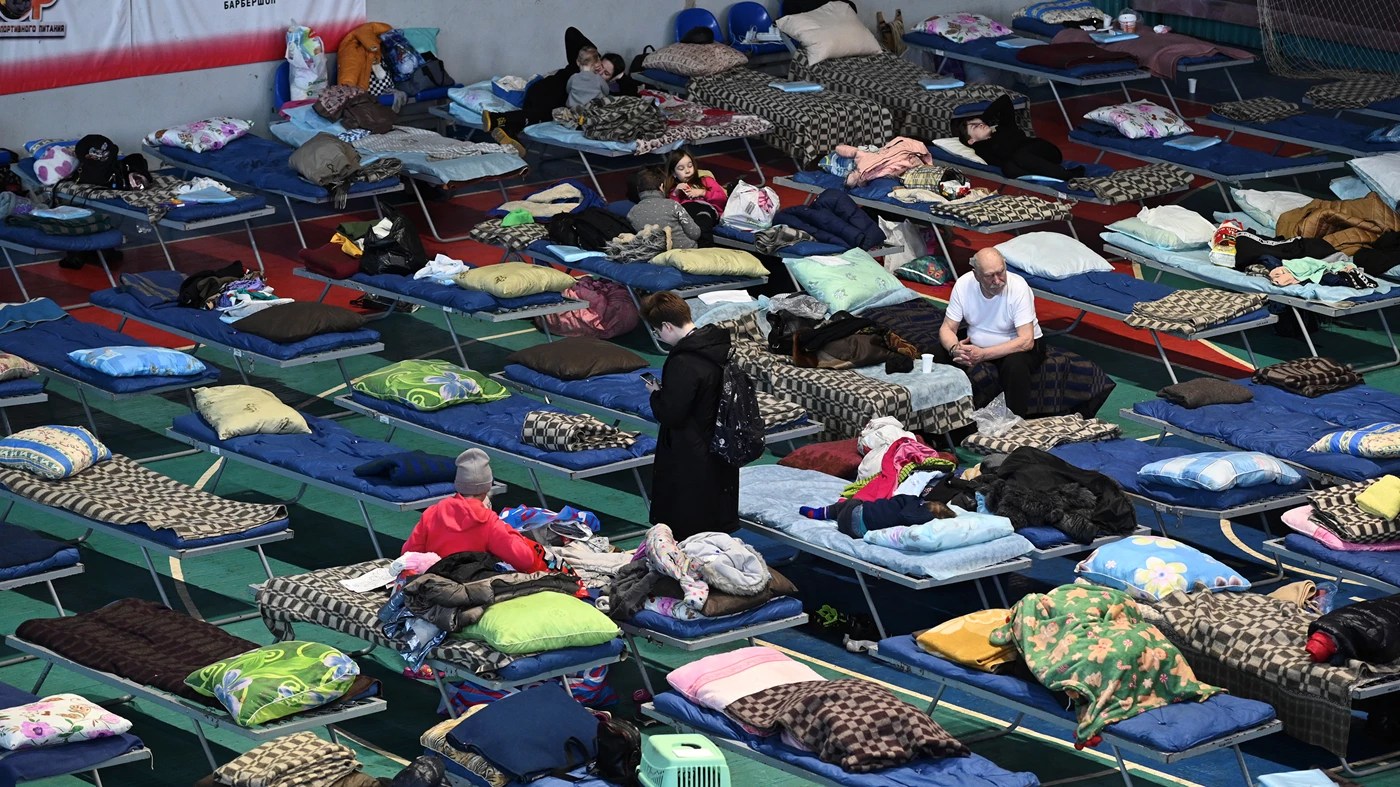
Disoriented and disheveled, the elderly Ukrainian woman stayed put in her seat. After several hours in a Temporary Accommodation Center (TAC) in Taganrog, Russia, 70 miles east of her month-long basement shelter in Mariupol, Ukraine, officials encouraged her to get on the bus—to somewhere else.

Earlier that day, she had been discovered by Russian soldiers and ushered through a humanitarian corridor to the first processing location east of Mariupol. From there she was dispatched to one of 800 such sites established throughout Russia, which are located anywhere from nearby Rostov to Moscow to Vladivostok on the Pacific coast.

Official papers registered her for temporary residency in Russia and access to its medical system. She was given a warm meal, new clothes, $142 in rubles, and a SIM card—though not a mobile phone. She could apply for citizenship if she desired.

All she wanted was to die.

Grandma, where are you going? Is someone coming to meet you?

No one is coming. Nobody wants me.

You have to go to a shelter. You can’t stay here.

I don’t want to live any longer. I wish I had died in the shelling.

Where are your children, or grandchildren?

I don’t know. They left. I can’t find them.

Government employees had done their duty. But after this exchange, a Russian evangelical volunteer sprang into action. After a few phone calls, she placed the woman with a local church family. The next day, she located the granddaughter.

“When we are genuinely involved in their lives, they see the love of Christ,” said Tanya Ivanenko. “They hug us, kiss us, and remember our names. Against the backdrop of war, we give them a little hope.”

Ivanenko did not provide the care, but she shared the grandmother’s story last year on a Russian evangelical church’s refugee coordination channel on Telegram, the region’s popular messaging app. The communication was verified by Pavel Kolesnikov, former co-chair of the advisory council for the heads of Protestant churches in Russia.

The council oversees relief, including over $3 million donated by affiliated unions, he said, impacting 200,000 Ukrainian refugees.

“The church in the West needs to know we are helping also,” he said. “The effort in Eastern Europe is more visible, but we are doing what we can.”

Since the war began, over 14 million Ukrainians have been displaced from their homes, with 8.2 million escaping abroad. The great majority of them have fled west, with Poland recording 1.6 million refugees and Germany 1 million. Through February, the United States has accepted more than 270,000.

But nearly 2.8 million have gone to Russia. Why would they flee into the arms of their enemy? It may not have been…

This article was originally published at Christianity Today, on June 21, 2023. Please click here to read the full text.

Categories
Christianity Today Europe Published Articles

Baptism by Flood: Kherson Christians Persevere After Ukraine Dam’s Destruction

Image: Felipe Dana / AP Images / Edits by CT

For eight months, the Ukrainian city of Kherson endured Russian occupation.

Now—along with at least seven churches—it is underwater.

Experts estimate that the collapse of the Nova Kakhovka dam, 44 miles upstream, released an amount of water equal to the Great Salt Lake. A new wave of evacuations is underway in southern Ukraine, with 25,000 people in Russian-controlled areas and 17,000 in Ukrainian-held territory advised to leave.

An estimated 2,000 houses have been flooded, with 16,000 people made homeless. A lack of drinking water, electricity shortages, and floating land mines have contributed to the humanitarian and ecological disaster.

The dam’s reservoir contributed 2,600 tons of fish to the local economy. Wheat prices have spiked, as 94 percent of Kherson’s irrigation system has lost its supply. And 150 tons of machine oil have been carried toward the Black Sea.

But that is just the physical damage.

Tavriski Christian Institute (TCI) in Kherson is a spiritual casualty. Liberated from Russian occupation last November, the seminary’s riverside properties suffered a new blow with the deluge. Early in the war, TCI president Valentin Siniy evacuated west with his wife, two children, and much of the student body. Today he continues education from Ivano-Frankivsk as he oversees relief efforts over 500 miles away.

CT spoke with Siniy about the state of the seminary campus, the emotional impact of the flood, and the rising challenges to faith that have led to newfound spiritual insights:

What is the situation with your seminary?

When the Russian military descended upon our cherished seminary, it was an emblem of knowledge and spiritual growth. They stripped it of its essence. Equipment from our printing shop vanished, books were burned, and I would say their very presence desecrated our sacred space.

A friend later retrieved one of my favorite pictures: an image of Jesus’ crucified feet.

But even after liberation, Russian missiles destroyed our buildings and sniper fire kept people away. I visited several times, but it was too dangerous to remain. Our once-vibrant campus, composed of five buildings, lay in ruins, mirroring the devastation that ravaged our nation.

And just when we thought we had faced the worst, the catastrophic flooding submerged our greenhouse farm. It had been a source of sustenance and support for our students and area residents—even as it remained in occupied territory on the east bank of the Dnipro River.

Now that the waters are slowly receding, our manager—also a local pastor—tells us that much can be repaired. But he has been threatened by the Russians, who also killed a pregnant volunteer woman while they confiscated the boats of those assisting others.

The Russian government is godless and immoral; it simply destroys people.

How have evangelicals been able to help?

There is a lot of dirt and debris floating about. Cemeteries and cesspools have been flooded; viruses and diseases are spreading. Our volunteers are helping on the liberated west bank, and we have delivered ten pumps with another ten on their way. Unfortunately, most of the damage has been in Russian-controlled areas.

Through the…

This article was originally published at Christianity Today, on June 12, 2023. Please click here to read the full text.

Categories
Africa Christianity Today Published Articles

Cyrus, Pharaoh, or Xerxes: Nigerian Christians Seek Parallels for New President They Opposed

Image: Sodiq / Xinhua / Getty Images

Bola Tinubu, the 16th president of Nigeria, has “absolute” faith in God.

“I know that his hand shall provide the needed moral strength and clarity of purpose,” he stated during his inaugural speech on Monday, “when we seem to have reached the limits of our human capacity.”

But what if the limits are self-imposed?

Tinubu, who infuriated many Christians by nominating a fellow Muslim as his running mate, became the West African nation’s first president to enter office with less than 50 percent of the vote. Despite record voter registration, only 29 percent of the electorate cast ballots. Tinubu, affiliated with the incumbent APC party, won 37 percent.

Atiku Abubakar of the opposition PDP party captured 29 percent, while the third-party surge of Peter Obi, a Christian, fell short with 25 percent. Neither candidate attended the inauguration, as they contest in court the validity of the electoral results.

The Christian Association of Nigeria (CAN), an umbrella grouping of the five main denominations, vociferously protested the Muslim-Muslim ticket, urging a vote for any other candidates. But with the nation roughly divided 50-50 along religious lines, results show that no candidate was able to marshal a conclusive sectarian advantage.

In breaking political protocol, Tinubu, two-term governor of the southwestern megacity of Lagos, stated the choice of Kashim Shettima as vice president simply reflected his personal competency. But most analysts linked it instead with the candidate’s northern origin.

Everyone jostled over this mostly Muslim bloc of votes.

Competition led the PDP to break regional political protocol in nominating a Fulani from the north, when outgoing APC president Muhammadu Buhari, also Fulani, per tradition should have been succeeded by a southerner. Obi also picked a northern Muslim as his presidential partner.

Tinubu, who helped secure Buhari’s victory eight years earlier, had long been acclaimed as a powerful political boss and kingmaker for others. Running for office himself, he declared at the start of his campaign: It’s my turn.

Yet despite alleged fraud and campaigns of voter intimidation, Tinubu lost APC electoral strongholds in the north to Abubakar, and his home city of Lagos to Obi. He enters office amid deep political division, worrying economic conditions, and a host of Christian leaders deeply wounded by his campaign.

“What he did shows no regard for Christians,” said Esther Ayandokun, rector of the Baptist College of Theology in the southern state of Oyo. “We are not happy, but there is nothing we can do.” She urged prayer, and…

This article was originally published at Christianity Today, on June 1, 2023. Please click here to read the full text.