Categories
Christianity Today Europe Published Articles

Christians Defend Cultural Heritage in Muslim-Majority Countries

khachkars

This article was first published in the November 2019 print edition of Christianity Today.

Dozens of men with sledgehammers pound slabs of stone in an otherwise empty mountainous field. Filmed in 2005 by the prelate of northern Iran’s Armenian church, Bishop Nshan Topouzian, the clip purports to show the destruction of khachkars, ornately carved headstones from a Christian graveyard, some dating back to the 6th century.

The site is in Nakhchivan, an enclave of primarily Muslim Azerbaijan geographically separated from the country by primarily Christian Armenia. Iran shares its southern border in the ethnically tangled web of states that make up the Central Asian Caucasus. Russia is to the north, Turkey to the west.

The destruction of more than 2,000 khachkars—in addition to 89 churches, 5,480 cross stones, and 22,000 tombstones—has been labeled “the greatest cultural genocide of the 21st century” by Simon Maghakyan, an Armenian American activist and scholar whose research was profiled in the Guardian. He believes the move represents a campaign by the Azerbaijani government to wipe out its Christian heritage.

“The destruction of these khachkars seems to match in scale and tragedy ISIS’ destruction of Palmyra in Syria and the Taliban destruction of the Bamayan statues in Afghanistan,” said Wissam al-Saliby, advocacy officer at the United Nations for the World Evangelical Alliance.

“This issue goes beyond religious freedom. It is the heritage of mankind.”

But Azerbaijan denies Armenians ever lived in Nakhchivan, and cites similar cultural cleansing…

Please click here to read the full article at Christianity Today.

Categories
Christianity Today Middle East Published Articles

Closing the Bible Gap in the Gulf

Bible Engagement Gulf
Image: Illustration by Rick Szuecs / Source Images: Pexels

This article first published at Christianity Today, on February 5, 2020.

Joining 80 leaders from 24 countries in Washington, DC, last September, the World Evangelical Alliance (WEA) announced 2020 to be the Global Year of the Bible.

“Ignorance of Scripture is ignorance of Christ,” said WEA general secretary Ephraim Tendero. “In contrast to the sacred writings of many other traditions, the Bible is meant to be read and understood by all people.”

But what if they cannot read? This is the case for up to 40 percent of the 1.5 million Telugu-speaking workers in the Gulf states. Having dropped out of school in their native India, these migrants find that the crowded labor camps of the United Arab Emirates (UAE) and Bahrain offer the best opportunity to support their families back home.

But having come to the glitzy Gulf to gain a meager share of petrodollars, many find also the spoken—and storied—words of Jesus.

In 2019, the Bible Society of the Gulf (BSG) was awarded “Best Mission Project” by the United Bible Societies (UBS). Honored in the category of “Focusing on Audiences,” BSG’s pioneering audio and storytelling work among illiterates distinguished it among the 159 UBS branches worldwide.

“We help migrant workers rediscover themselves as children of God,” said Hrayr Jebejian, BSG general secretary. “Through the faith and hope of scripture, they gain the strength to navigate their many challenges.”

Jebejian’s book, Bible Engagement, noted during the UBS ceremony, described the long working hours, high rates of suicide, and…

Please click here to read the full article at Christianity Today.

Categories
Christianity Today Europe Published Articles

Religious Freedom Comes to Europe’s Second-Newest Nation. But Christians Are Concerned.

"Crkva Gospa od Zdravlja" church, Kotor bay, Montenegro.
Orthodox Church in Kotor Bay, Montenegro

This article was first published at Christianity Today, on February 4, 2020.

Deep within the Orthodox heartlands of the Balkans, one might expect local evangelicals to celebrate the passage of Montenegro’s first religious freedom law.

Instead, as tens of thousands fill the streets to protest against it, the relative handful of believers find themselves on the sideline of a struggle between giants.

And the stakes could further shake the greater Orthodox world.

Europe’s 6th-least evangelical country is also one of its newer nations. Having achieved independence from Serbia in 2006 through a tightly contested referendum, Montenegro is now seeking autocephaly—spiritual independence—for its local Orthodox church, viewed as a schism by the Serbian Orthodox.

Protests have erupted in Belgrade also, with thousands rallying last month against Serbian “suffering” in Montenegro and other neighboring nations. Crosses, icons, and church banners peppered the demonstrations.

But in Montenegro, rather than waiting for a liberating tomos (decree) similar to the one issued to Ukraine by Archbishop Bartholomew of Constantinople, who is the ecumenical patriarch for Eastern Orthodox communities, the government is acting to register all of its religious communities.

The protesting ethnic Serbian citizens of Montenegro fear the religious freedom law is nothing but a trojan horse for an elaborate ecclesiastic land grab targeting Serbian Orthodox Church properties.

“The law is a step forward, as it helps us ‘small religious communities’ have a legal basis to operate,” said Sinisa Nadazdin, pastor of Gospel of Jesus Christ Church located in the capital city of Podgorica and one of the nation’s five registered evangelical churches.

“But none of us want to enjoy this benefit if it will create in Montenegro…”

Please click here to read the full article at Christianity Today.
Categories
Africa Christianity Today Published Articles

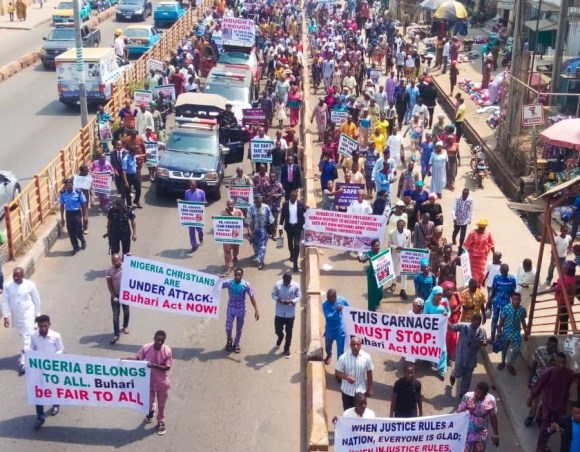
Nigerian Christians Marched Sunday to Protest Persecution

WhatsApp Image 2020-02-03 at 8.53.31 PM
Courtesy of CAN

This article was first published at Christianity Today on February 3, 2020.

Having finished his Sunday sermon from Psalm 18 on God as a stronghold who delivers his people from their enemies, Enoch Adeboye then led them to a cemetery.

It was an ironic yet appropriate choice.

Wearing a bright green tuxedo, the General Overseer of the Redeemed Christian Church of God (RCCG) in Lagos, Nigeria, marched three miles yesterday holding a placard that declared: “All Souls are Precious to God.”

Adeboye and his congregation, one of the largest in the world, answered the call issued by the Christian Association of Nigeria (CAN) for a three-day fast this past weekend, concluding in a prayer walk. Based on reports from its state chapters and local media, CAN estimates 5 million people marched in 28 of Nigeria’s 36 states on Sunday.

“Though we have protested before, this event took a new dimension,” CAN president Samson Ayokunle told CT.

“With one voice, we said ‘no’ to killings, ‘no’ to security negligence, and ‘no’ to the persecution of Christians in Nigeria. It is a wake-up call to the government.”

Launched on January 29 to protest the beheading of Brethren pastor Lawan Andimi, the chairman of a regional CAN chapter in Adamawa state, by Boko Haram two weeks earlier, the prayer was also a protest at the Nigerian government’s failure to stop the abductions and killings.

Terrorist attacks, as well as clashes between mostly Muslim herdsmen and mostly Christian farmers, resulted in more than 100 deaths in January alone.

“Lord, have mercy on Nigeria, let there be peace and security,” said Adeboye. “God sees all things and knows where the terrorists are hiding.

“We pray that God send his light to Nigeria and expose the evildoers in the country.”

In the perspective of CAN, these reach into the upper levels of government.

“O Lord, in Jesus Name, expose all the…”

Please click here to read the full article at Christianity Today, and here to read the op-ed submitted by Muhammadu Buhari, president of Nigeria.