Categories
ERLC Light Middle East Published Articles

A Tale of Three Churches

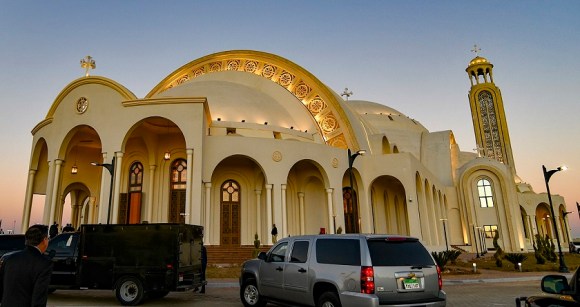
New Capital Cathedral
U.S. Secretary of State Michael R. Pompeo visits the Cathedral of the Nativity in Cairo, Egypt, on January 10, 2019. [State Department photo/Public Domain]
This article was first published in the Summer 2019 print edition of Light magazine, produced by the Ethics and Religious Liberty Commission.

In January, President Abdel Fattah al-Sisi of Egypt stood side-by-side with Pope Tawadros II, patriarch of the Coptic Orthodox Church. Inaugurating the Cathedral of Nativity, the largest church in the Middle East, he uttered two remarkable words that reverberated through the national broadcast to Muslim homes throughout the nation.

“Merry Christmas.”

If some Christians find this phrase under siege in America, they have no idea the power unleashed by the president’s words. Eight years earlier, emboldened by the Arab Spring and empowered by the Muslim Brotherhood presidency of Mohamed Morsi, ultra-conservative Salafi Muslims sparked nationwide controversy by declaring no pious Muslim could utter the words.

Their point was theological—Christmas celebrates God becoming man in Jesus, and a Muslim cannot congratulate a Christian neighbor for such blasphemy. But the impact was social. Easygoing Egyptians had long wished each other good greetings on respective religious feasts. Salafis are better practicing Muslims than we are, many would admit, and a chill began to spread in community relations.

When then-defense minister Sisi overthrew Morsi following widespread protests against his rule, he did so with Pope Tawadros—and the head of al-Azhar, the leading Islamic institution in Egypt—standing nearby in support. As president he became the first to attend a Christmas mass, a practice he has continued. He speaks strongly about the rights of Christians and their place in the nation. And in building a new capital city he made sure the centerpiece landmarks would be the region’s largest mosque and church, built side-by-side. There is no Merry Christmas controversy today.

But do Sisi’s words fall on deaf ears? Are the arms of the state too weak? Or might he be of double mind, grandiloquent in gesture, apathetic in implementation? Two other church examples counterbalance the cathedral…

Please click here to download the print edition; my article is on page 54.

Categories
Christianity Today Middle East Published Articles

Why Muslims Love Mary

Muslim Mary
Annunciation, from Chronology of Ancient Nations by Al-Biruni, 1307.

This article was published in the July/August print edition of Christianity Today.

Mohammed, a pious PhD student from Egypt, sat guardedly in the “Community of Reconciliation.” Invited by David Vidmar, director of coaching for Peace Catalysts International, the middle-aged Muslim seemed soured on the idea of interfaith exchange at his northern California university.

Vidmar suspected Mohammed came to the jointly led Muslim-Christian dinners because he felt obligated to do da’wah, the Arabic word for spreading Islam. But over a shared meal and discussion about Mary, the Egyptian’s attitude shifted. “The deeper we got into the life of Mary and how Christians understand the virgin birth of Jesus, he became very enthused,” Vidmar said. “There are so many misunderstandings . . . it was wonderful to observe him see the similarities and be able to relax.”

Peace Catalysts is a Jesus-centered peacemaking effort, focused primarily on Christians and Muslims. Vidmar and his family worked for eight years with Uighurs in Kazakhstan and still wish Muslims would experience the love and forgiveness God reveals through Jesus. But now he works to help both sides experience heart transformation through deep and genuine friendship—and Mary proved a fruitful bridge.

“Since so many Muslims use the term ‘Jesus, Son of Mary,’ it would be helpful for evangelicals to think more deeply about this,” Vidmar said. “Muslims often excitedly tell me their favorite chapter in the Qur’an is Maryam, and women especially express appreciation for it.”

Mary is mentioned 34 times in the Qur’an—more than in the New Testament—and its only named woman. Islam upholds the virgin birth, the annunciation by Gabriel, and—mirroring the Ave Maria in Luke’s gospel—declares Mary to be “exalted above all women.”

Yet even Catholics have been slow to recognize the similarities…

Please click here to read the full article at Christianity Today.