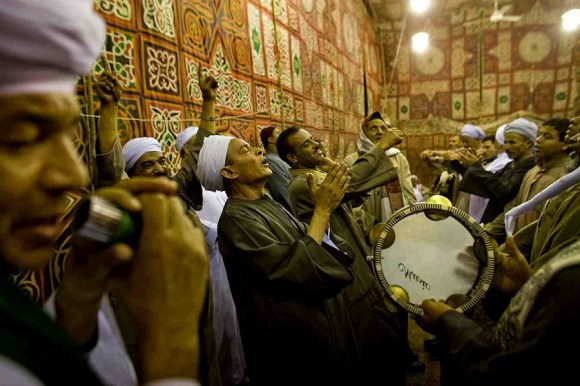
If the Egyptian government wants to combat the spread of radical religious ideology, it would do well to return to its Muslim roots. At a conference held at the headquarters of the Azamiyah Order in Cairo on April 21, which Al-Monitor attended, presenters argued that Sufi Islam is the authentic expression of Egypt’s Muslims.
The conference emphasized the brotherly bond between Muslims and Christians, following the Palm Sunday bombings on April 9. But Sufis are singled out as infidels by the Islamic State (IS), too.
“I have told President [Abdel Fattah] al-Sisi to take care of the Sufi leaders,” Sheikh Alaa Abu al-Azayem told Al-Monitor. “We are the ones who stand against terrorism, fighting not with weapons but ideas.”
Sufism is widely considered the default setting for Egypt’s Muslim community, and tombs of popular Sufi saints dot the landscape up and down the Nile…
The pope is here. Of course, Egypt already has a pope. But this one is different.
To most Egyptian Christians he is not. In the ancient world Rome and Alexandria were equals. But since then the Tiber has far eclipsed the Nile.
God, to you your church is one. Give humility to one and all, a spirit of brotherhood between servants of servants.
For joining them also is the heir of Constantinople. As the visible symbols of Christianity convene, fix their eyes on you the invisible. Give them wisdom for leading their flock. Give them encouragement for the small portion here.
Middle East Christians are under pressure, God. Evil men target them for death. Seductive dreams target them for immigration. Guide each one individually in the path you desire. But guide them together toward local flourishing.
For the sake of your name, God. For the sake of their peoples.
For with the three symbols is a powerful fourth. The Grand Sheikh of al-Azhar unites most of the world’s Muslims. He is the host, and their partner in peace.
May it be so, God. Certain forces wish to pit one religion against the other.
Some say it comes from texts. Some say it comes from power. Some say it comes from the devil.
Regardless, they say it should not be.
Strengthen their voice and witness, God. Unite them in purpose and friendship. May those who follow them follow their example. And with them, all peoples and nations beside.
For it is the state, God, with power to implement. Guide all who bear your sword, to wield it rightly.
And through men like these four, but only in accordance with your spirit and truth, may they hear from you.
The pope is here, God. May your peace come with him. May things thereafter be different.
Easter passed peacefully, but not Egypt. Though there were no troubles on the holiday, others sandwiched.
A few days earlier Copts praying in a village were pelted with stones, as police looked on. A few days later terrorism struck at St. Catherine’s Monastery in the southern Sinai, as police responded.
One officer died, a few others were injured.
God, protect the nation. Protect her churches. Protect her people. Protect her police.
The disturbing fact in the latest incident was the reach of ISIS to the south. Cells have perpetrated terrorism in various places on the mainland, but it was believed the group had no presence save northern Sinai.
So hem them in, God, and squeeze. Aid the security forces. Grant bravery, justice, and fidelity to law.
It was law also that settled justice for Aya Hegazi, a dual Egyptian-American citizen. After three brave years in pretrial detention, the court ruled against charges filed. She and her husbanded had opened a children’s center, and were accused of exploitation.
President Trump claimed intervention, and flew her home before meeting at the White House.
God, protect the judiciary. Protect its independence. Protect civil society. Protect its people.
If Aya was innocent, how many others? In a congested legal system give all their day in court, in fidelity to the constitution. As Egypt responds to the pressures against her, help her hold to the right and the true.
So steady her institutions, God, and strengthen. Aid the social entrepreneurs. Grant creativity, license, and fidelity to law.
Whether religion, state, or society, give stability and peace. Too many make trouble. Root out, vindicate.
This article was first published by Christianity Today on April 20, 2017.
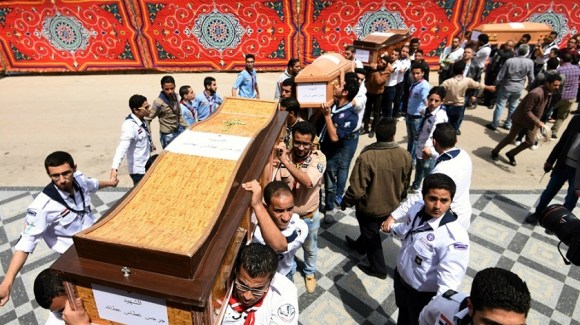
Image: MOHAMED EL-SHAHED / AFP Coffins are carried to funeral of Egyptian Christians killed in Palm Sunday bombings.
Twelve seconds of silence is an awkward eternity on television. Amr Adeeb, perhaps the most prominent talk show host in Egypt, leaned forward as he searched for a response.
“The Copts of Egypt … are made of … steel!” he finally uttered.
Moments earlier, Adeeb was watching a colleague in a simple home in Alexandria speak with the widow of Naseem Faheem, the guard at St. Mark’s Cathedral in the seaside Mediterranean city.
On Palm Sunday, the guard had redirected a suicide bomber through the perimeter metal detector, where the terrorist detonated. Likely the first to die in the blast, Faheem saved the lives of dozens inside the church.
“I’m not angry at the one who did this,” said his wife, children by her side. “I’m telling him, ‘May God forgive you, and we also forgive you. Believe me, we forgive you.’
“‘You put my husband in a place I couldn’t have dreamed of.’”
Stunned, Adeeb stammered about Copts bearing atrocities over hundreds of years, but couldn’t escape the central scandal.
“How great is this forgiveness you have!” his voice cracked. “If it were my father, I could never say this. But this is their faith and religious conviction.”
Millions marveled with him across the airwaves of Egypt.
So also did millions of Copts, recently rediscovering their ancient heritage, according to Ramez Atallah, president of the Bible Society of Egypt which subtitled and recirculated the satellite TV clip.
“In the history and culture of the Copts, there is much taught about martyrdom,” he told CT. “But until Libya, it was only in the textbooks—though deeply ingrained.”
The Islamic State in Libya kidnapped and beheaded 21 mostly Coptic Christians in February 2015. CT previouslyreported the message of forgiveness issued by their families and the witness it provided.
“Since then, there has been a paradigm shift,” said Atallah. “Our ancestors lived and believed this message, but we never had to.”
Please click here to read the full article at Christianity Today.
This article was first published by Christianity Today on April 19, 2017.
Two weeks after killing 47 Egyptians in twin church bombings on Palm Sunday, the Islamic State claimed a fresh attack on the ancient monastery of St. Catherine on the southern Sinai peninsula.
One policeman was killed and four injured during an exchange of gunfire at a checkpoint about half a mile from the monastery entrance. Police were eventually able to gain control and force the militants to flee, according to the Ministry of Interior as reported by Ahram Online.
ISIS claimed responsibility in a terse statement via their official news agency, Amaq. However, local speculation suggested it may have been a result of skirmishes between disgruntled tribes and the government.
St. Catherine’s is named after the fourth-century martyr from Alexandria, and was built in the sixth century by the Byzantine Emperor Justinian. The monastery belongs to the Greek Orthodox Church, and was declared a UNESCO world heritage site in 2003.
In the mid-19th century, the fourth-century Codex Sinaiticus was discovered in St. Catherine’s ancient library, at the time the oldest near-complete text of the Bible. The library boasts more than 8,000 early printed books, and is considered second only to the Vatican in collection of early biblical manuscripts.
“We admire the monastery for digitizing its collection for research,” said…
Please click here to read the full article at Christianity Today.
Easter is coming. May it be safe for Egyptian Christians.
Sunday is coming, and Monday after that, and Tuesday… May it be safe for Egyptians.
Forty-five people are dead after twin suicide bombings at churches on the start of Holy Week. Among them are Muslims, though only one faith was targeted.
This time. Some attacks have targeted Muslims of particular ilk. Many have targeted police, army, and other men of state.
But the nation responded as if it was an attack on national unity, and so should the prayer follow.
Bless the Christian martyrs, God, yes. Bless the Egyptian dead.
And may this prayer be echoed in the hearts of Egyptians nationwide.
It is too little to pray hold the nation together, for it does not show signs of being torn asunder.
But national unity is a slogan that is neither empty nor full. It is a reality, yet still an aspiration.
So bring together Muslim and Christian in the aftermath, and help them to know each other. Let this be a mark that undoes terrorist intention.
Yet what is the fullness of the aspiration? Citizenship? Protection? Accommodation? God, there are differing visions among different Egyptians.
Let them come together, and let them discuss. Let them bare their hearts and find your way.
Respect. Honor. Justice. Peace. Love.
There are those who actively work against these, God. Silence them. Redeem them. But put their ideas to rest. Too much exists even on the margins, seeping ever closer to the mainstream.
Until then, defend.
Equip the government to ensure both security and rights. Alert the people to threats both tangible and notional. Uplift society to immunize with both economy and education.
And above all, through the fear of God and the bond of humanity.
On the day of the bombs your Messiah was lauded. If Egypt must follow him in suffering provide also his triumph.
Church of Saint George in Tanta, Egypt, after Islamic State’s Palm Sunday bombings. By Omar Elhady, via Twitter.
Episode one. “They are just following the teachings of their book, and the example of their prophet,” said a Coptic friend following the twin church bombings in Tanta and Alexandria on Palm Sunday, killing dozens. I refrained from rolling my eyes, as this was a moment for comfort amid tragedy. Such a refrain is not uncommon among some Egyptian Christians, that while not all Muslims are terrorists, Muslims who follow their religion tend in that direction.
But then he continued. “Just a little while ago my friend told me that those men are now in heaven, because they killed non-Muslims.”
If my eyes weren’t rolling, they were now bulging from their sockets, aghast. Your friend? He would say such a thing to you, to your face?
Episode two. “I am praying for the Copts,” said another Egyptian Christian friend. “When you know your enemy you can retaliate. But who are these terrorists? If the Copts explode we could become like Lebanon, and no one wants that.”
My eyes have never had so much activity, astounded again. Lebanon? Is that in play? I can’t recall ever hearing such sentiment from a Copt. Over the past several years, the polarized Egyptian narrative has warned of civil war, of forces internal and external wishing to divide the nation. But it always seemed exaggerated, and never sectarian. Islamist and non-Islamist forces might collide, but Egypt has no Christian pockets of population that might form a regional militia. The country is integrated and homogenous, Muslim and Christian living side-by-side.
Taken together these episodes illustrate a worrisome development within a longstanding reality. Muslims and Christians tend to be friends, neighbors, and quite similar in common culture. At the same time, there is a latent but tangible reservoir of mistrust. It activates occasionally, especially when community issues turn into matters of honor over houses of worship, land, or women. But for the most part among a 90 million plus population, religious distinction is managed relatively well.
Therefore, the most disturbing aspect of the bombings is that it has now happened twice. Last December the Islamic State ran a suicide bomber into a chapel adjacent the papal cathedral, killing 29 mostly women and children. They vowed it was just the beginning.
But to say “twice” is misleading. Palm Sunday was the second of two major bombings targeting Christian civilians, amid scores of previous attacks against security personnel. But other smaller acts less well reported have left the sadly repetitive “community” pattern and veered into clearly sectarian motivation.
Last February hundreds of Copts fled their homes in northern Sinai as the Islamic State went on a killing spree. But prior to this in various locations across Egypt, there were several unexplained murders of Coptic citizens. And in Alexandria a Coptic merchant had his throat slit on a crowded public street, by a Muslim offended at his sale of alcohol.
No evidence has yet emerged that the individual incidents were explicitly planned by the Islamic State. But research by Mokhtar Awad and others have revealed an emerging strategy within the group to spark an Iraq-style sectarian war in Egypt. As their project wanes in the self-proclaimed caliphate, the land of the Nile becomes a new field to mine.
Will it work? It is a more different bet than before, when the sectarian divide was between Shia and Sunni, who also inhabited distinctive majority areas. But Awad notes that a sectarian mentality has long been cultivated in Egypt by Islamists and overlooked if not abetted by the state. Copts have responded and nurtured religious distinction as well, though within their traditional Christian ethos of monasticism, martyrdom, and loving your enemy.
Perhaps the Islamic State is betting their resilience cannot hold out forever, that an explosion against somebody is coming. Perhaps they hope the Muslim keenness on national unity will erode over time, should Copts—even a Copt—lash out in retaliation or appear too “uppity” in the demand they be treated as equal citizens.
So far it is a bad bet. The church counsels patience and the eternal crown of glory. Each attack against Copts has prompted a firm re-insistence of togetherness from state and society. Similar militant attacks in the 1990s turned the Muslim street decidedly against the jihadis.
But the world now is a different place, and the tactics exceed anything witnessed previously in Egypt. A second incident suggests there will be a third, and fourth, and so on. Even if Egypt is unlikely to become Syria, Palm Sunday suggests more bloodshed is coming.
Any American policy response will be fraught with difficulty, mixed up in the morass of Middle Eastern politics. Support too closely and risk accusation of backing repressive governments. Step away and risk accusation of empowering illiberal Islamists. Either one will beg claims of interference and violation of sovereignty. God bless the diplomats who must navigate carefully.
But in lieu of policy, the eyes can be put to better use than described above. One, dart vigilantly. Scan surroundings, beware of trouble, and look for solutions. Two, tear liberally. Tragedy demands we weep with those who weep, in sympathy and solidarity.
Otherwise, amid ongoing violence they may glaze over. Otherwise, amid religious distinctiveness they may grow jaundiced. Jesus demanded that our eye be “single”, lest the whole body be full of darkness.
It may be an apt metaphor for Egypt, a nation with many troubles and contradictions. The Islamic State is trying to exploit them. Be keen not to fuel the polarization, for the eyes of the Lord are everywhere, keeping watch on the wicked and the good.
This article was first published at Christianity Today on April 9, 2017.
Attacks at two Coptic Orthodox churches in Egypt’s Nile Delta killed more than 40 people and injured more than 100 others during Palm Sunday services—including the one where Pope Tawadros II was worshiping.
ISIS claimed responsibility. In February, the Egypt chapter of the Islamist extremists had released a threatening video calling Coptic Christians “our priority and our preferred prey.” Soon after, about 100 Christian families fled their homes in the Sinai Peninsula amid a string of murders.
Reuters reports more details on the bombing in Tanta at Mar Girgis (St. George) Church, which killed at least 27 and injured more than 70. CNN reports more details on the Alexandria bombing at St. Mark’s Cathedral, which killed at least 16 and injured more than 40. [Before ending its live updates, state media outlet Ahram Online put the final toll from Egypt’s health ministry at 29 dead in Tanta and 18 dead in Alexandria.]
Nader Wanis, director of the Arkan Cultural Center in Alexandria, was worshiping at the Anglican Pro-Cathedral only two streets from St. Mark’s when the bomb went off. “It was only a few minutes before serving communion and it shook our whole church,” he told CT. “We were scared, but insisted to continue.”
Please click here to continue reading at Christianity Today.


 Jayson Casper