Categories
Personal

Experiments with Twitter

Twitter logo initial

Over the past few weeks I have been playing around with Twitter, and I can’t say I have it figured out yet, or that I spend too much time trying. I have discovered a somewhat useful practice, though, that entertains me if no one else. Every day I read the news and take notes about subjects and personalities I am following, and when thoughts are coherent enough I enjoy turning this into a blog post. Un-coherent thoughts, though, as well as first impressions, work well with Twitter. These micro-musings can be found on the right hand column of this blog, as well as with anyone who might deign to ‘follow’ me. It seems like a narcissistic world, but that can be said of blogging as well, I suppose. The legitimate hope is that those interested in the topics I read might be able to read along with me if I highlight an article.

If you do, please enjoy. And if you like, here is our handle: jnjcasper. Ironically, and with a degree of coy self-satisfaction, I can’t even offer instructions on what to do with that to follow me, but those of you interested probably already know.

Update: Well, that wasn’t too hard to figure out. To the right is a simple button to press. I guess I have to lose the coyness now. Oh well.

Categories
Personal

‘Smelling the Breeze’ – In, and of, Tahrir

Yesterday was the ancient Egyptian holiday of Shem al-Naseem, translated ‘smelling the breeze’, which is a national observance the day after Orthodox Easter. It is the custom for all Egyptians, Muslim and Christian, to eat raw, salty fish, and go out and about, enjoying the pleasant spring weather. We decided to join the festivities, choosing Tahrir Square as our location of picnic.

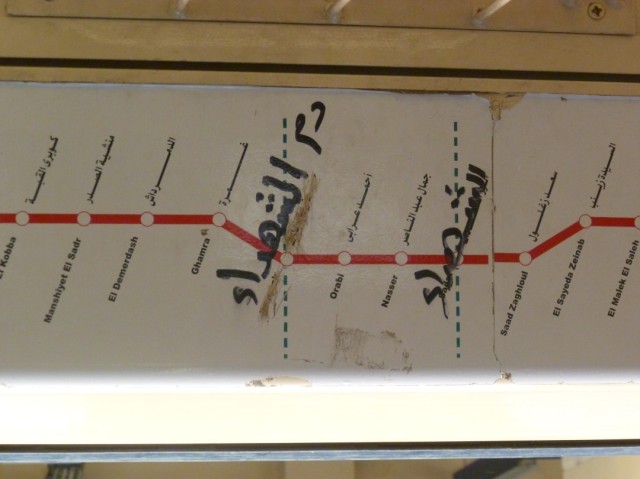
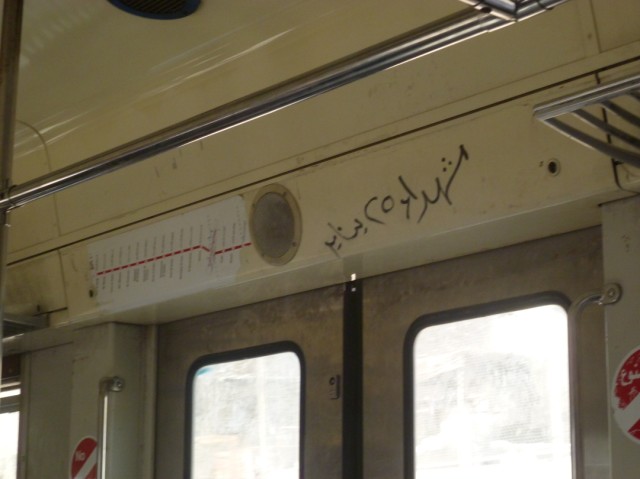
We headed out early by Egyptian standards, hoping to avoid anticipated throngs of breeze-smellers, mostly sure they were not scheduled to be joined by demonstrators. On our way down in the metro we saw evidence of the popular campaign to remove the mark of Mubarak from public display, extended in this example also to his predecessor:

Tahrir Square is located at the metro station named ‘Sadat’, which in this graffiti artist’s conception is to be renamed ‘Martyrs’. Mubarak station, meanwhile, is poignantly rechristened ‘Blood of the Martyrs’. Nasser station escaped his erasure.

Our arrival at the square coincided with the end of a military band performance, followed by the dispersal of gifts. By the time we arrived the scene was somewhat chaotic, and a later report stated the effort fell flat, and that people tried to abscond with extra gifts. Still, there were several military personnel lingering around the central grassy circle, shaking hands and taking pictures with passers-by. In the background of the photo below is also seen the Egyptian Museum to the right, site of the fierce Battle of the Camel, and to the right is the burned out remains of the headquarters of the now disbanded National Democratic Party:

We were correct that the holiday would pass without demonstrations. The biggest crowd seemed to be a gathered remnant from the military musical performance, gathered around two banners. The first extols the current military and interim government leadership, while the second, to the right, provides a long list of former government figures ‘for sale’, in reference to ongoing corruption investigations against them:

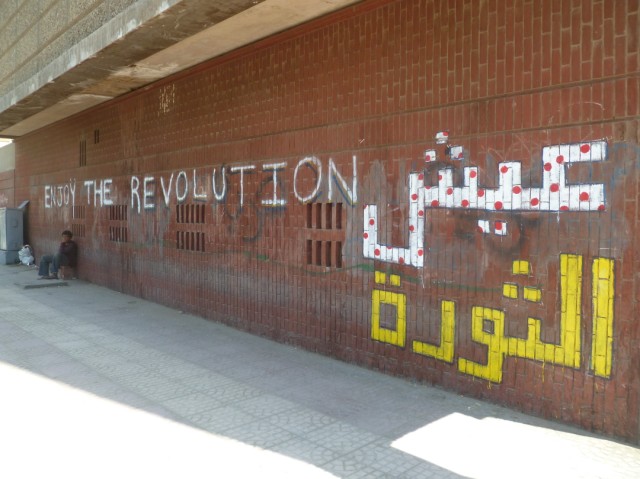
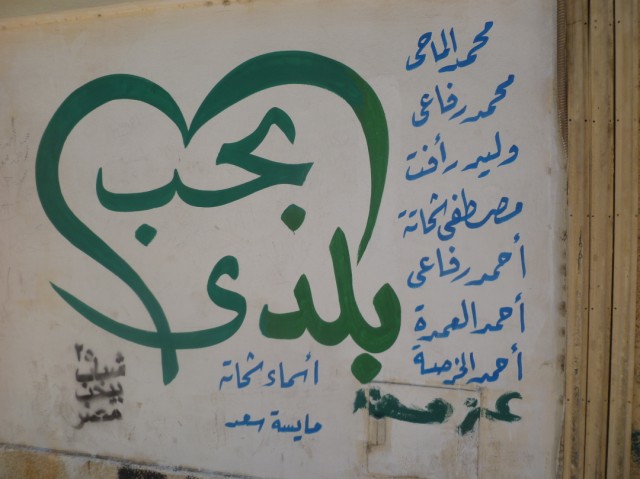
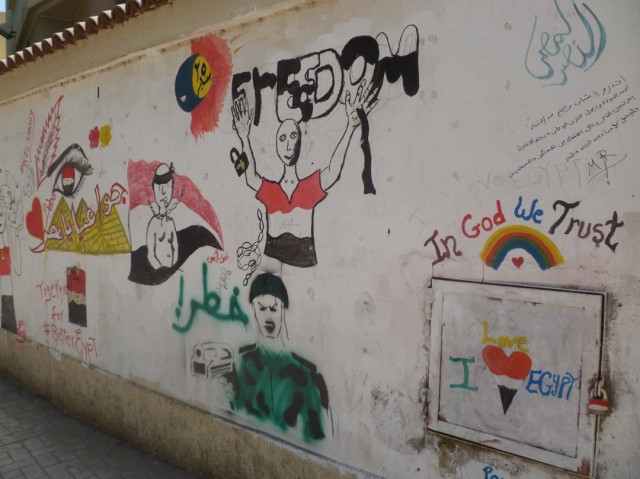
As we noted in a previous post, there were many examples of revolutionary graffiti. Here is a sampling:

(translation: Live the Revolution)

(translation: I love my country. The blue writing seems to list the names of those who died in the uprising.)

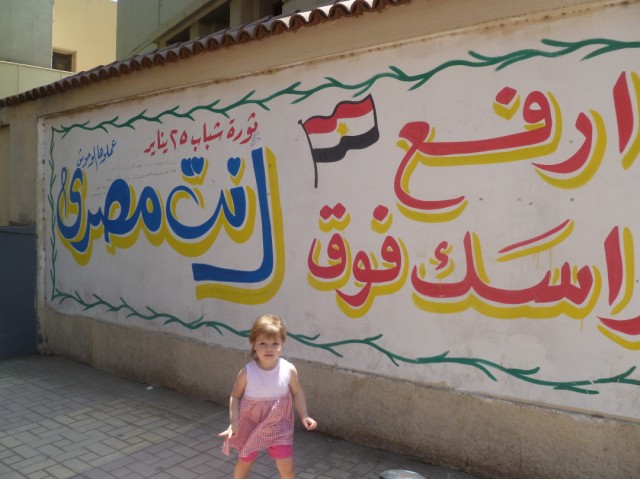
(translation: Lift your head high, you are an Egyptian!)

(translation: Oh God, protector of he who reforms. Smaller print in blue: God, make this country safe.)

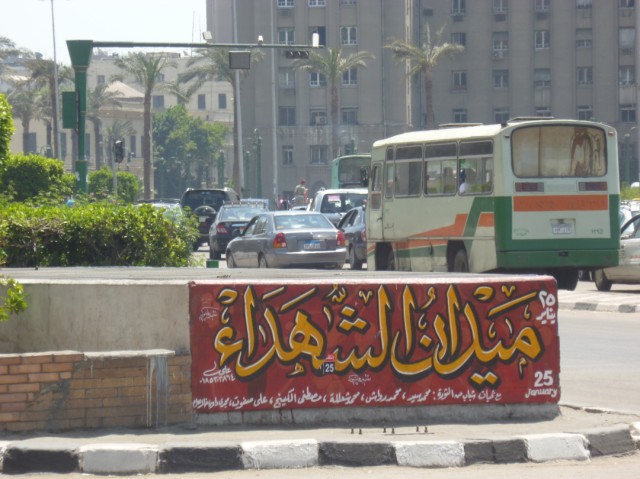
(translation: Martyrs Square)

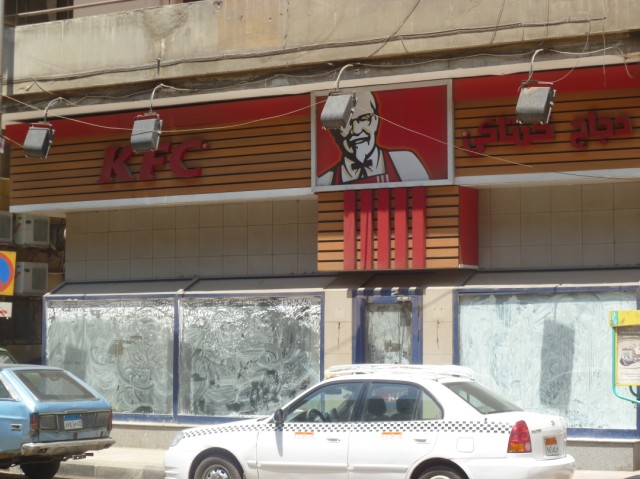
Walking around the square it was clear there was a new normalcy, rather than a return to normalcy. While some iconic restaurants had been restored and reopened following the looting of the revolution:

Others remained boarded up:

Meanwhile there were new business ventures of all varieties:

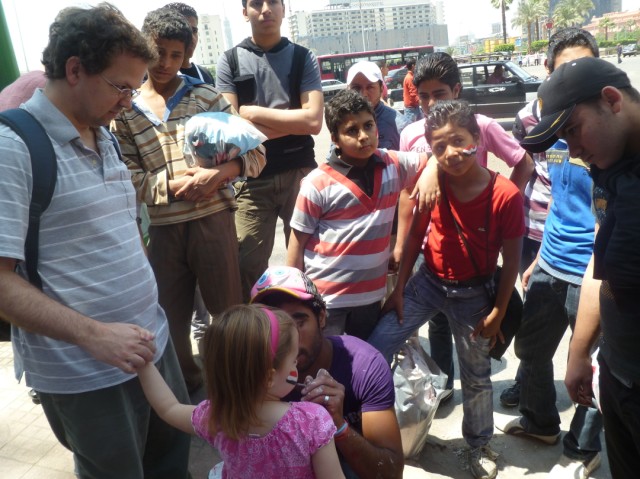
Including a mobile face painter:

After our tour of the square we settled down for our picnic, but Emma was still troubled by the attention her Egyptian-ness received:

Hannah, meanwhile, was less affected, and simply enjoyed her Oreos:

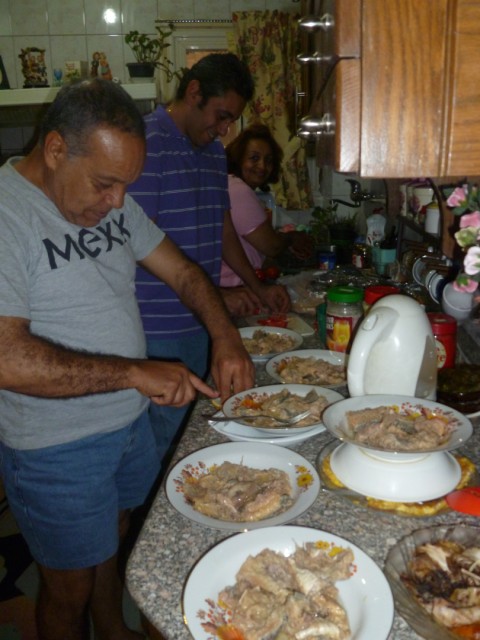
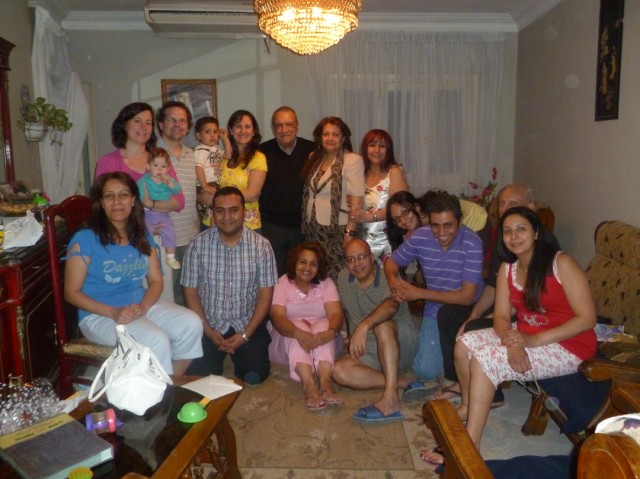
Our Shem al-Naseem celebration continued that afternoon, as we were invited to join with a family we know from the Coptic Church. Though details would be good to verify, I learned that eating fish served as a reminder of Jesus’ post-Easter meal with his disciples, mentioned in Luke 24:42, verifying the reality of his physical resurrection. That the fish is raw and salty is in continuance with the Pharaohnic practice, before modern refrigeration. The fish is actually from a catch three months old, for if they heavily salted the more recent supply, they would all get sick.

Fortunately, for foreigners, those with high blood pressure, and others of broader taste, the spread also included selections leftover from the Easter meal the day before. Many, however, chose to eat nothing but the fish. Go figure.

As I spoke with those there, one person in particular showed me photos he had taken from the revolution, many of which were of phenomenal quality depicting both the violence and the celebration. He did so not as a paid photographer, but as an involved citizen, wishing to know the reality of what was happening in his country. What he saw, at least in his interpretation, contradicted the standard narrative.

During the aforementioned Battle of the Camel, news outlets depicted the demonstrators as recipients of violence against a sizeable, but clearly outnumbered group of pro-Mubarak ‘thugs’. His pictures, however, showed thousands of Mubarak supporters, consisting of what appeared to be ordinary people, without weapons. Across the way, aside the Egyptian Museum, stood a small crowd of demonstrators, many with rocks or cement chunks in their hands. He stated that the violence was initiated by the demonstrators, some of whom then went up to the roofs and threw stones down on the pro-Mubarak crowd. Official implications had pro-government forces on the roofs, hurling stones on the demonstrators. Indeed, some of his pictures were of individual protestors, wearing makeshift helmets of plastic, towels, and even bread.

In another photo he captured a tank, with graffiti etched upon, reading, ‘Down with Mubarak’. The image was from the first days in which the army occupied the square, and was welcomed exuberantly by the crowds. This gentleman enters the slogan as evidence that the army was not neutral, but was with the protestors from the beginning. Early worries were that the army, while not killing protestors, was still biased toward the government, as they stood idly by when the ‘thugs’ attacked. Yet as this individual alters the narrative of violence, he also believes that had the army been neutral, they would not have allowed government equipment to be turned into the canvas of the revolution.

This person states that he is neither with one side or the other, seeing both as suspect, even though there were good people involved in the demonstrations. He finds that their early successes were subsequently hijacked by the Muslim Brotherhood and others, who have conducted secret deals with the military. Further evidence of this alliance is found in the number of sectarian incidents which have taken place since the revolution, in which the military has not prosecuted Muslim offenders, but continues the Mubarak era practice of ‘reconciliation sessions’.

Aspects of this testimony were disputed by others there, especially the point about the rooftop attacks. Most, however, did not contradict the concern about the intentions of the military. As I proffered other explanations, stating that a confluence of interests does not necessarily imply an alliance, and furthermore, the co-religious sentiment from the Alexandria bombing onward still carries over and offers hope of a better future, I was gently rebuked. I have been here less than two years; we Christians, however, have been here during fourteen centuries of Islam. My hope is not echoed.

Testimony has been gathered from the confessions of pro-Mubarak thugs, which I have written about before. Yet it is true that a number of the initial pro-Mubarak demonstrations did consist of ordinary people. It is also true that members of the Muslim Brotherhood were credited with the primary defense of Tahrir Square. Their ‘expertise’ had been forged in numbers of confrontations with the government, while the majority of common protestors had never seen violence. As for the military, they have stated they will not allow sectarian tensions to divide the people. Their role, as is obvious, is vital in determining the coming political realities. Their makeup is generally stated as secular, and equally obvious is their reliance on and training by the United States military. Will they then lean Islamist? Democratic Islamic transformation in Turkey has not jeopardized their US-NATO alliance, and the Muslim Brotherhood has pointed to Turkey as a model for the coming Egyptian state. Claims and counterclaims abound. Where does reality lie?

It is good to be back in Egypt. While news can be followed from anywhere, contact with people is essential for comprehension. The tea leaves multiply with alternate testimonies; smelling them correctly, amidst the breezes of Egypt, is the task at hand.

Categories
Personal

Principled Foreign Policy

… defining it, of course, is difficult.

Most Arabs I have met have been quick to distinguish between the American people and the American government. That is, while much criticism exists toward American foreign policy, this does not prevent most Arab people from having positive relationships with the American individuals they meet. We, of course, can be the beneficiaries, even in the times we seek to make understandable the policies in question.

Arabs will ask, however, why do the American people allow US foreign policy to go unchecked? There is not a lot of anger behind this question, since they live under governments which take little regard for the will of the people. America, though, is different, and most wish they enjoyed the freedom Americans have to influence national political choices. The solution they propose is that the average American must not know, or be concerned about, what goes on outside US borders, beyond the impact it might have on the American economy.

Fair enough; it may or may not be true. I, however, counter with the idea that while the average American may or may not know the details of the impact of US foreign policy in the nations affected, most are concerned to believe that the US is a force for good in this world. That is, we care about democracy, human rights, and the economic improvement of impoverished areas. As long as US policy can be explained in this light, it can enjoy popular support.

There is now statistical evidence to support my assertion.

The University of Maryland administered a poll surveying American attitudes toward the recent uprisings in the Arab world. 65% believed that increasing democratization in the region would be mostly positive for the United States, and 76% believed it would be so in the long run. Perhaps most telling is the fact that 57% ‘would want to see a country become more democratic, even if this resulted in the country being more likely to oppose U.S. policies.’

It is worthy to note that these opinions focus on the principle – democracy – rather than on the events themselves. Only 51% believed the recent uprisings were likely to lead to increased democracy. Americans can be appreciated for their realism; the outcome in the Arab world is far from clear. Yet the results of this poll demonstrate that we are, at heart, a people that care for the good of the world, even if interpreted through the lens of our own values. Policy makers must determine first and foremost the national interest, but if they fail to convince the people their decision is also beneficial for the foreign nation in question, they are unlikely to win popular support. As the poll suggests, we desire the prioritization of our principles over our interest. Undoubtedly there were many reasons to enter World War I, but the rallying cry was ‘to make the world safe for democracy.’ This sentiment is still pervasive today.

Our reality may not always match our rhetoric, but the fact of our believed benevolence should be noted, both in Washington, and on the Arab street.

Categories
Personal

Observations and Photos, post-Revolution

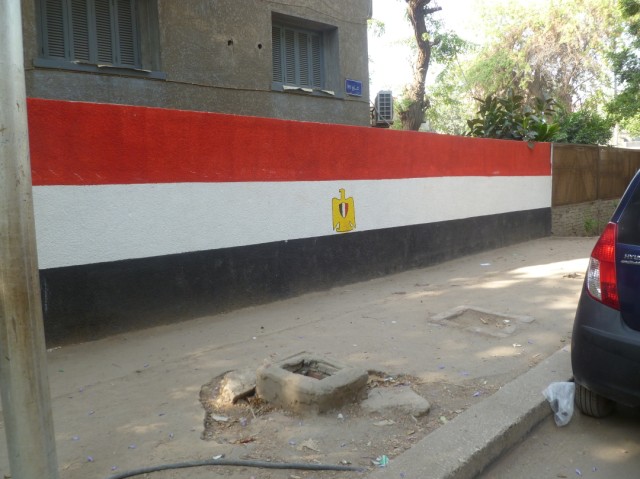
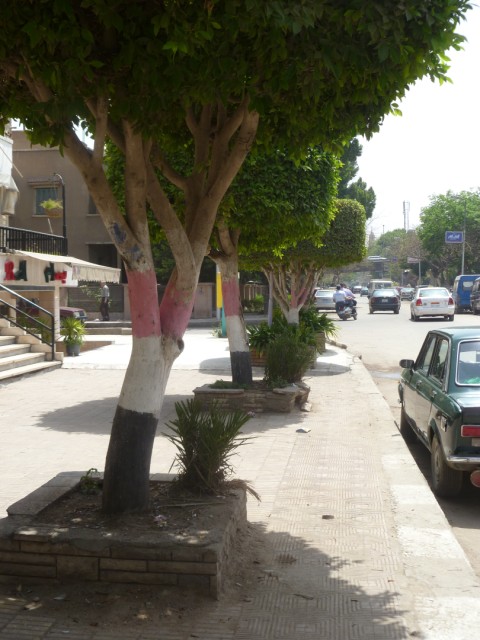
Julie and I walked around town today, for the first time since our return to Egypt. We were eager to see the changes in our area after the revolution, and took our camera along to share our observations. Much, of course, was the same, but there were many reminders that things have changed. First, the graffiti:

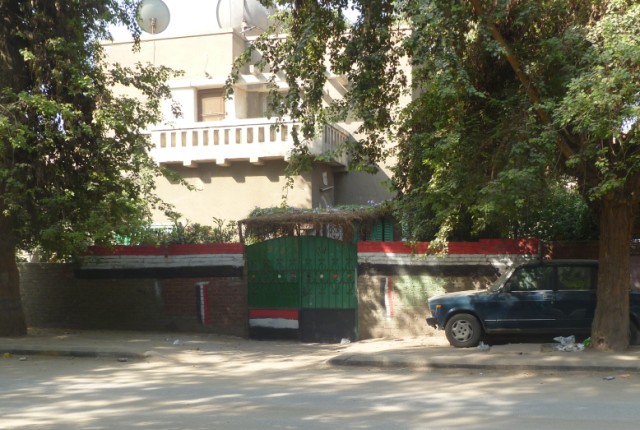
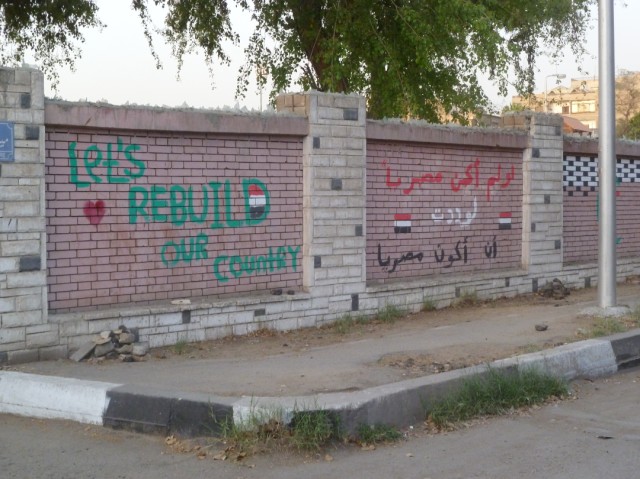
This is the wall to our neighboring apartment building. Before, it had always been as blank and dull as every other wall in the city. Now, evidence of national pride is brimming over everywhere, even if slightly less artistically on a house a few doors down:

The graffiti continues on public walls:

(translation: Egypt)

… trees:

… inside the subway:

 (translation: Martyrs of 25 January [the date of the first demonstration, which has come to label the revolution])

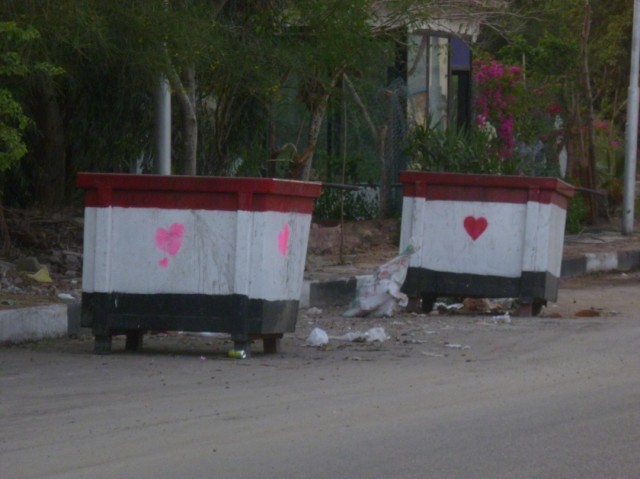
… and even on the garbage dumpsters:

It has been said that this is the first revolution in history that has cleaned up after itself.

The trend continues in advertising:

(translation: May God preserve you, Egypt [advertising Etisalat, a mobile phone service provider])

(translation: Egypt Needs You: Donate your Blood [advertising Risala, a local NGO])

… and while some new shops have opened in town:

… others have since closed down:

(to the lower left had been a Playmobile store)

Some signs extol the virtue of national unity:

(translation: If I was not an Egyptian, I would wish to be)

… while others promote a particular political/religious vision:

(translation: This country is ours; from this day onward I will honor our Lord in my work; the Muslim Brotherhood [note: ‘ours’ means ‘the people of Egypt’ as opposed to the group itself])

Before the revolution, the Muslim Brotherhood had been a banned, but tolerated, organization. Never would their slogans have been allowed public display for very long. They, like others, are now enjoying a greater freedom of operation. Meanwhile, and not necessarily conversely, others place the Islamic crescent and Christian cross side by side, alongside a heart to validate and honor the two religions of one people.

Finally, there is a reminder of violence and instability:

… as our neighbor to the other side has extended his wall six feet higher.

We are glad to be back, hearing the reactions of friends and strangers to the events of the past two months. Mostly all is positive, yet the visual complements the written word of their testimony, which we hope to convey as events continue to unfold. Accomplishments become permanent the more they are translated into memorials. After a scant eight weeks, the popular effort has already begun.


Categories
Arab West Report Middle East Published Articles

Rafik Habib: On Sharia, State, and Christianity

For an introductory essay to this text, please click here.

On August 19, 2010 AWR interviewed Dr. Rafik Habib, an Egyptian Christian scholar who has devoted his research to the realm of Christianity and Islam contemplating on Muslim-Christian relations, Islamic civilization, and the role of the state in the Egyptian society.

Dr. Rafik Habib was born in 1959 in Minya, Upper Egypt, into the family of Samuel Habib, an evangelical pastor who later became the President of the Evangelical Denomination in Egypt (1980-1997). Dr. Habib refers to himself as an ordinary Christian who came to Cairo to attend ‘Ain Shams University after finishing his secondary education in his hometown. He obtained a masters degree in psychology (1985) and later a PhD in the same field (1988). During his studies Dr. Habib researched significant issues in the Christian community, and later published Psychology of Religiosity for Copts in Egypt. He has since published over twenty other titles. Despite this, though he sought work in a university or academic research center such as al-Ahram, he was never accepted. Many suggested that it was due to the fact that he is a Christian. But, Dr. Habib is of a contrary opinion:

I found it to be a matter of social relationships. To have someone support you in this kind of issue is more important, in many cases, than if I am a Christian or a Muslim.

Dr. Rafiq Habib has been influenced by his family, as he himself acknowledges, and his father was a leading evangelical personality in Egypt at that time. Nonetheless, he is well-known for his ideological affiliation with the Muslim Brotherhood, an entirely Muslim organization.

Dr. Habib has never attempted to join the organization, nor would he be able to, but his adherence to its ideas led him to join the Wasat Party, a political organization based on the moderate ideas of the Muslim Brotherhood. As he points out, religious movements (be they Islamic or Christian) are exclusive to their denomination, but organizations working at the political or social level should be open for anyone.

Yet being a Christian and a scholar, he has sought out dialogue with the political Islamists. Dr. Habib has been interacting with the Muslim Brotherhood, al-Jama’a al-Islamyyia, and other Muslim groups since 1989. His has primarily involved himself with the peaceful groups, but has also received criticism for engaging with violent entities. He is quick to distinguish nuances:

At that time, it is important to notice that this organization (Islamic Jihad) was violent, when they murdered Anwar Sadat. But after that, they continued to be a preaching organization with a militant wing, a very weak one. (…) You could meet a member in al-Jama’a al-Islamyyia, who is not a militant. (…) In my opinion al-Jihad was a revolutionary organization from its basis, but al-Jama’a al-Islamyyia is in its basis a preaching group in its organization.

Nevertheless, Dr. Habib maintains that for a researcher is important to learn about the different groups, even those that are militant. Dialogue, however, is not possible with militant personalities, only with those who are peaceful within a militant organization. According to Dr. Habib, extremists reject dialogue altogether, making them inaccessible.

Who are the extremists? What is extremism for Dr. Habib?

Dr. Habib finds this difficult to answer as the term is drawn from western definition. Nevertheless, he asserts that extremism is not a permanent condition but a temporary phenomenon. In his opinion, most of the Islamic movements are becoming more moderate. But,

(Extremism is a) part of the Islamic project, where some make the most clear-cut points; all issues are white and black, even the values and variables. (…) Similarly some take a clear-cut position towards Christians, thinking the Islamic society is for Muslims only. For these, Christians can be present in an Islamic state, but only within their Christian community subsumed by Islamic society, not as a part of Islamic society.

How do Christians have a place in Islamic society? Dr. Habib offers his perspective based on his doctoral study of the national character of the Egyptian society. He maintains that Egypt is a part of Islamic culture and civilization, which is in fact a continuation of Pharaonic culture and civilization. Religion (first Christianity, later Islam) did not destroy the ancient culture, but rather reshaped it. Therefore, he argues that:

I think that the national character, culture, and values of the Christians in Egypt are similar to that of the Muslims, and I found that Christians themselves belong to the Islamic character and culture of Egypt. Muslims and Christians have the same national character and identity.

Based on the argument that Muslims and Christians in Egypt share the same national identity Dr. Habib believes that:

We can have a chance in the future for Christians and Muslims to discover their shared values and rebuild the Islamic culture together.

Nowadays, their mutual relations are negatively affected by developments of the 1970s. Dr. Habib argues that at the time of Anwar Sadat Egyptian society began to dissolve. Both communities began to develop separate religious identities leading to the enclosure of Christian community within the Church and to the establishment of numerous Islamic movements. These communities preferred their particular religious identity (Muslim or Christian) over the prior Islamic-Egyptian cultural identity. According to Dr. Habib, the separation of the communities happened because the state was unable to represent both Christians and Muslims in the same value system. Instead the state pushed a secular agenda foreign to both religious groups.

In order to restore the previous order – to bridge both communities again – Dr. Habib suggests a controversial idea:

The Egyptian society will continue to be an Islamic society and the Christians must return to their conservative identity and join it in one identity as happened before. If we go back 50 years, the whole society looked conservative and very Islamic, though the Christians were a little cautious of the Islamic identity. But if we go more than 100 years back, we find that Christians were unified with the Islamic society under Islamic Sharia and under the Islamic state and there was no problem.

Dr. Habib identifies the main obstacles to such a return as the secular nature of the state, the pressure from Western countries to secularize further, and the Christian community that wants to protect itself under secularization.

The core idea of Dr. Habib theory is that the revival of Islamic state would bridge the communities again. Originally, the Muslim Brotherhood aimed to restore the Islamic state following the end of Ottoman caliphate and the establishment of an imposed secular nation-state model. Dr. Habib argues that the secular state model did not reflect the religiosity of the society which rebelled against it. The Brotherhood rallied such opposition, but was double crossed:

The Nasserists came to the power with the support of the Muslim Brotherhood. It turned out to be a historical mistake, when they supported Gamal Abdel Nasser. Because after he took power with their support, he said I am not building an Islamic state.

Nasser introduced instead his own nationalistic vision of Arabism that was, to some extent, related to Islamism, in that Arabic identity can shelter both Christian and Muslim identity. The development of Arabism was, however, stopped by the 1967 defeat to Israel. The Six Day War significantly challenged the existing societal and political order in Egypt, initiating deep consequences:

When you’re defeated you return back to your deep, deep identity, and try to protect yourself inside the protection-point: your identity and social consciousness. And, the strong protection-point in our society is the religion. Then both Christians and Muslims returned back to their religions.

Dr. Habib provides an example of the daily routine at the universities in the 1970s:

If you entered a classroom, there was a special place for Christians guarded by members of the “Coptic Family” and for Muslims guarded by the “Religious Group”. But there was no conflict or violence between them; it came spontaneously. The different societies wanted to feel secure, and they turned to religion.

Therefore, Dr. Habib maintains that in order to bridge the communities again, it is necessary to return to the Islamic culture, value system, and civilization as the identity of the society, as both Christian and Muslim values in Egypt have been shaped by the same surroundings. Dr. Habib argues that these conservative religious values are embodied in the Egyptian society and therefore the existing project of the secular nation-state is failing. To succeed, the state must reflect the value system of the society which it is not the case in Egypt:

I think that this model (the secular nation-state) will not work in Egypt or in other Arabic countries, because it depends on the power of law, whereas society depends on the power of religion, which means the power of morals. If you want to organize society by the power of law, the society will not obey it. (…) All society thinks of the state as an enemy, because the state will not accept the societal identity; the state is meaning of law. (…) There is no reason for Egyptian Arab Muslims to obey the secular state, because the reason which is to be found in Western countries is not here. Western societies obey the state instead of the church. They obey the state, because it is the way of progression, and they think that if they obey the church, they will not progress.

Dr. Habib’s argument is based on the significant role religion plays in the societal order. He assumes that:

If the state obeys religion, then the people will obey the state. Because people will always obey the religion in their life, they will not obey anything other than religion, and if you want them to obey the state the state must obey the religion.

Conversely, if the state does not obey religion, the people do not find the justification to obey the laws imposed by the state. In Islam, people are to obey the ruler, even a corrupt one, as long as he applies Islamic Sharia. According to Dr. Habib, the Egyptian state fails to apply Islamic Sharia, even though it is embodied in Article 2 of the constitution.

If the present state applied Article 2 it would not be an issue, because Sharia as a basis can reshape the nation-state to Islamic state in 2 or 3 years if applied.

The proper application of Article 2 would enable the establishment of the Islamic state – an ideal type – restoring the harmony between society and the state. Dr. Habib goes further arguing that the society would be more free and powerful. The church, al-Azhar, and NGO’s would all be independent, as well as the fields of health care and education policy. There would be no interference of the state in civic society. The ideal form of the Islamic state would be a completely decentralized parliamentary system. In sum, it would mean less government in all sectors of society.

When society becomes powerful, it builds its frame of reference and it chooses its ultimate values, and then the state is obliged to behave according to these values.

Nonetheless, Dr. Habib notifies that there are several models of the Islamic state, e.g. the Iranian or Saudi models that are not desirable. He prefers the concept of the civil Islamic state where the authority is political, maintaining only the Islamic value frame of reference. Religious authority would be non-existent as there is no religious authority in Sunni Islam.  The state would be governed by the rules of religion, but no one would have religious authority. Islamic scholars would have the right to say their opinion, but the people would have the right to choose which opinion to follow. Once both scholars and society agree upon something, it would become enforced.

Understandably, the question what the position of religious minorities would be like in the Islamic state arises. Dr. Habib offers two rationales that would secure the position of Christians in the Islamic state scenario. First, the freedom of confession would be guaranteed:

Nowadays Christianity exists inside the church but is limited to the Christian community. Thus, secularism surrounds Christianity and the church and weakens its role in society. Under the Islamic state it can be completely different because the main function of the Islamic state is to protect religion, not to restrict it.

Second, the majority of those significantly influencing the character of the state are moderate Muslims with moderate thoughts representing the underlying idea of the Islamic culture. Therefore, Dr. Habib maintains that it is essential for Christians to interact with the moderate mainstream (implicitly meaning the Muslim Brotherhood):

I call on Christians to interact or just even dialogue with the mainstream, because if you are against the mainstream, you make the extremists more powerful. I have a problem here, because the state and the secular elite are always against the mainstream. By weakening the mainstream and having a powerful nation-state, the extremists will take the state.

Dr. Habib defeats the plea that dialogue between Christians and Islamists is difficult to achieve, utilizing a love-your-enemy argument:

Because of Christian values you must love all of Egyptian society, not only your neighbor or the persons you know. Within Christianity there is the fundamental idea that the Christian is to love his enemy. If we apply Christian values in that way with our traditions, which are very social, we can make bridges with the Muslim community, Islamic movements, and other trends. But, the political issue here is ruining the whole situation, especially when the church became in coalition with the state, as the role of the church should be societal.

Accordingly, the current linkage of the church and the secular state harms the reestablishment of harmony between the two religious communities. Dr. Habib claims that once the church accepted the coalition with the state, it became a part of a secular political agenda which completely contradicts the Islamist movements. Dr. Habib asserts that:

The state knows that if the Christian community agreed upon a project with the Islamic movement the secular state will end. This is because the secular discourse here in Egypt uses the existence of Christians as a reason why the Islamic state cannot be established, and the government uses Christianity to say that they are protecting it and therefore the West must support it.

By maintaining a relationship with the government the church adopts the position of a supporter of the secular nationalistic model of state. As such, the Christian community is now in a unique situation: It is separated from society, preaching and practicing Christian love inside its own community, implicitly or explicitly supporting western interference in its homeland. Finding a way out of this situation, according to Dr. Habib, is very difficult.

Dr. Rafik Habib is a unique Egyptian Christian scholar who has not been afraid to stand out and address sensitive issues in Muslim-Christian relations in Egypt. He has devoted his academic career to enhance the mutual understanding of both groups. Though his findings might be controversial, it should not be forgotten that all has been done in his best belief to contribute to a better and healthier atmosphere between Christians and Muslims in Egypt.


Related Posts:

Categories
Personal

A Christian Supporter of the Muslim Brotherhood

What are the consequences of loving your enemy?

The thought of loving your enemy with any practicality at all is nearly unfathomable for most people. Though Christians may be among the few to state the effort is even commendable, it is safe to gather that many hold the virtue as proof their faith is more sublime than others, rather than as a lived habit or lifestyle choice. But who can blame them? How does one even begin to consider what might be done otherwise? Perhaps one can curb retaliation, but to actively do good? Anticipated consequences immediately shut down all efforts. These are obvious enough – evil advancing as the victim enables – but there are unanticipated consequences as well, as shall be seen with one man who tried.

In Egypt there is no public, or even private, talk of enemies. Christians are in a minority position, and though they encounter various difficulties as a community, they also know that using a pejorative term like ‘enemy’ would only make matters worse. Yet there is an undertone of sentiment that throws its frustration in various directions – Muslims, Islam as a system, government – in a manner not far from common understandings of ‘enemy’. This is not true of all, of course, and may not even be justified. But it exists.

Many Christians strive to secure their rights by promoting a secular state and open civil society. As such, the political enemy, or at least boogeyman, is the Muslim Brotherhood. In Egyptian politics the Brotherhood is known as a somewhat moderate Islamist movement, forswearing violence in their effort to shape an Islamic society and state. There are other movements less so, though the government has stamped most of them out. Yet Christians and Muslim secularists consistently hold the Brotherhood as the foil against their democratic reform efforts. For Christians the reason is clear, even if the reality is not necessarily so: A Brotherhood triumph will make Christians second class citizens.

Christians are not without cause in fearing the Brotherhood, but like many political movements, it is difficult to sort out the rhetoric from the reality. Muslim Brothers today do not speak out against Christians, and claim they desire an open civil society as well. Is this a temporary ploy to curry favor and secure power, after which their true colors will be seen? This is the fear. Certainly there is valid enough fear to understand why Christians engage the group as if they are the enemy. Again, though, the term is never invoked.

One man, however, refuses this wholesale rejection. Rafik Habib is the son of a now-deceased prominent evangelical Christian leader. Samuel Habib directed CEOSS, the Coptic Evangelical Organization for Social Services. This group enjoys a good reputation in Egypt, both for its work among the evangelical poor, but also for their cross-service to other Christians and the Muslim community.

Rafik, however, directed his efforts toward academia. Specifically, he wished to uncover the core culture of Egypt, made up of different strands from Pharaohnic, Mediterranean, and Arab influences. Additionally, he made purposeful effort to dialogue with the Islamist elements of Egypt, entertaining the question of the place of Christians in an Islamic state.

His findings will be summarized in the post to follow. I had the chance to interview Rafik Habib, and an intern from Arab West Report wrote the summary of our conversation. As a preview, however, suffice it to say that nearly no Christian in Egypt sympathizes with him, nor shares his perspective on interreligious matters of governance. It has been wondered if he is, in fact, a Muslim himself.

In his confession, he is not, he is a Christian. Yet his effort to engage ‘the enemy’ of many of his co-religionists has marginalized him among his own community. When I met him I had the feeling I was speaking with a man alone. Alone with his convictions, to be sure; a source of strength that was also apparent.

What was not apparent was if he was alone in his love. Rafik Habib did not explain himself in this terminology, preferring to stay in the technical language of academia. Therefore, while I might read this motivation into his conduct, it would be unfair to attribute it to him.

If it was not love, however, it was conduct not far removed, unless deeper and more cynical explanations become unearthed. Regardless, two consequences are revealed in his life.

One, he has suffered rejection from his own kind. There are certainly different types of love, one of which focuses on the self-preservation of the group. This love is real, and will protect the group, even sacrificially, when its interests are threatened. The love that reaches out to the other, however, can be seen to jeopardize the group, removing barriers of distinction. The bridge of love, extending to an enemy, can be burned from either direction.

Two, though this will be seen more clearly in the interview to follow, Rafik has been changed through his interactions. Love is often said to be blind; perhaps, but it also has eyes to see what others cannot. This consequence can help justify one’s group in their rejection, but can also weigh heavily on the individual seeking to love. Bearing the burden of a new version of reality can be a troubling task. It can be hard to serve two masters, especially when they are at odds with one other.

Christians, and lovers of God from different confessions, have only one master. Yet that master wishes them to have many objects of their service. The decision to love may result in rejection, but will almost certainly result in the transformation of self. The promise, however, is that it may also result in the transformation of the other. Be it the enemy or the group, the one who loves must be prepared to suffer. It may well be, as Jesus demonstrates for Christians, that the suffering is essential. Egyptian Christians and Islamists alike, as humanity everywhere, stand in need of transformation. May many more, like Rafik Habib, stand accordingly.


Note: This article is based on an interview conducted with Habib before the revolution. I would very much like to follow up with him upon our return to Egypt, to see how he interprets the current situation.

Categories
Personal

The Islamic Political Landscape

In the aftermath of the Egyptian revolution, many have wondered about the strength of the Islamist movement, and whether or not it would come to power in free elections. A more vital question concerns whether or not it would cede power in subsequent elections, should the population so desire. Yet the diversity within the Islamist movement is often not appreciated. In recent days various groups with Islamic identities illustrate this reality.

The Muslim Brotherhood

The most recognizable organization, at least to Western political awareness, is the Muslim Brotherhood. Founded in the 1920s, this grandfather of the Islamic movement has had a distinct evolution. Both a social organization to call Muslims to God and provide for the needs of the poor, as well as a political institution dedicated to creating a state based on God’s law, the Brotherhood early on violently confronted the state and assassinated public figures. Yet for decades now it has renounced violence, yet still found itself at odds with an autocratic state, resulting in an official ban. As such, Brotherhood activity tended toward a policy of preservation, which caused the once dynamic organization to gentrify and become reactionary in contemporary politics. This helps explain their reticence to join the revolution, as well as their decision to negotiate with the Mubarak regime during its final days in power.

These decisions, however, caused great internal division within the Muslim Brotherhood. Younger members enrolled in the revolutionary struggle, and are credited with a lead role in the defense of Tahrir during the Battle of the Camel, when pro-Mubarak thugs sought to displace the protesters from the square. These younger members have now organized a reformation conference, which has been denounced by senior leadership. The youth claim they are not trying to break rank, but to revitalize the Brotherhood. They argue for greater leadership inclusion of Muslim Sisters, and express divergent views on whether or not the Brotherhood should found a formal political party. Senior leadership has established the Freedom and Justice Party, which is widely viewed as a simple political extension of the Brotherhood. Yet some youths argued that politics must be kept separate so the Brotherhood can focus on its social mission. If a party emerges, it must represent Islamist thought, to be sure, but must include a minimum quota for Christian members as well. One liberal Islamist, Abdel Munim Abdel Futuh, has already violated senior leadership’s dictate that all Brotherhood members must support the Freedom and Justice Party, by announcing the launch of an independent party, Nahdat Masr (Egypt’s Renaissance). Yet perhaps the dominant theme of the youth conference was a call for greater internal democratization. They accuse the group of mirroring the autocracy of the state, even as they rallied against it.

Al-Jama’a al-Islamiyya

Internal democracy, however, is exactly the proclamation of a long suppressed Islamic movement, al-Jama’a al-Islamiyya. During the 1970s when the Muslim Brotherhood renounced violence, al-Jama’a vowed to continue the jihad against the state, and suffered accordingly. They and other extremist groups were pursued ruthlessly by the state security apparatus, and effectively disarmed by the 1990s. Though made marginal, its leadership, led by Akram Zuhdi, also maneuvered into a non-violent posture.

Following the revolution, however, al-Jama’a reentered the political scene, seeking to be part of the emerging system. A key preliminary step is the revitalization of its internal organization. General assembly elections have begun, starting at the local level and proceeding until full governorate positions are chosen by members across the country. Leadership has announced these elections will be fully supervised by Egyptian civil society organizations, which has not been true of the Brotherhood, nor of the Egyptian state. Yet leadership will not consist of Akram Zuhdi, who has resigned from his role following cantankerous internal debates about the direction of the group. He states that he wishes to return to the function of calling people to God; does this signal a reversal of al-Jama’a’s orientation? Perhaps the democratic trend is assuaging, but what of the departure of a dovish leading figure?

The Salafis

If a democratic spirit is emerging in the two Islamic groups mentioned above, it is actively opposed by a third association, the Salafi movement. Similar to and influenced by Wahhabism in Saudi Arabia, the Salafi call is to imitation of Muhammad and his contemporaries in their cultural and political outlook. Politically, this means submission to the ruling powers, and unlike the Brotherhood, Salafis cooperated with the Mubarak regime, even if they would recognize aspects of his governance as un-Islamic. In turn, their preachers were allowed to operate certain mosques, and freedom was given to demonstrate against certain policies of the Coptic Church.

During the recent referendum on constitutional amendments, Salafi preachers urged a ‘yes’ vote, corresponding to the perceived will of the military. Yet they argued their position not on reasoned political grounds, but on the fact that it was God’s will, which should not be opposed. Recently, they have been distributing flyers stating that democracy itself is a perversion of God’s law, taken instead from non-Muslim sources. It is the Islamic scriptural sources, they say, which constitute political authority, and not the will of the people. As such, they oppose a civil state, whereas many Muslim Brotherhood members support it, variously defined. Yet perhaps paradoxically, certain Salafi leading figures have announced their intention to form a political party and advocate for their position. If some fear a reversal of democracy, their apprehensions may have legitimacy here.

The Sufis

In contrast to the above groups, the Sufi movement has historically maintained an inclusive focus. Generally seen to prefer a spiritual over a literal interpretation of religion, Sufis rarely reject other Muslims as apostate, and often have welcoming perspectives on the legitimacy of Christian faith as well. Fittingly, Sufi leader Mohamed Alaa Abul Azayem has called for an initiative to unite these various and divergent streams of the Islamic movement. Though Sufis tend to reject the mixing of religion and politics, Azayem believes they share the commitment of the Brotherhood and the Salafis to call believers to God. He also believes politics has a role in society, and as such has founded his own party, called Tahrir (Liberation).

The Church

Though The Coptic Orthodox Church represents Christian interests, there is interplay with the Islamic movements, though initiative sometimes comes from the outside. The Muslim Brotherhood, especially, is aware of the fear that should they gain power, they will return Copts to a dhimmi-like second class status. As such, sincerely or not (most Coptic Christians believe their assertions to be insincere), many proclaim their desire for a civil state in which Copts would be equal citizens. A major debate within Brotherhood circles currently is whether or not a Copt should be allowed to be president, not whether or not he or she should be allowed a vote.

Within their effort to assuage these fears, the Brotherhood has stated it will conduct official dialogue with the youth of the Orthodox Church. Though Pope Shenouda has denied negotiations have taken place, Brotherhood members state this only represents a misunderstanding, and that discussions will indeed take place. Meanwhile, Pope Shenouda has officially welcomed dialogue with the Azhar, the chief institution of Sunni Islam, but also with the Salafis. The church argues forcibly for a civil state, yet it finds itself intertwined in the politics of Islamist groups as well.


Egypt has now entered the difficult period of post-revolutionary politics. The future is not yet clear, though outlines are emerging in preparation for legislative elections, likely held in September. Islamic groups do not represent all Muslims, nor are they monolithic. Their share in a democratic future is certain, their victory is not. The cooperation, or lack of, which emerges between Islamist, secular, and to a lesser but influential degree, Christian orientations may play a deciding role in the outcome. May God guide all to mutual respect, understanding, and love, even as each legitimately, and hopefully genuinely, pursues its vision of God’s will.

Categories
Personal

Bahrain, Conspiracies, and US-Iranian Cooperation

The pace of popular protest and change in the Middle East has been bewildering. In such cases limited information, new realities, and subtle biases make the resort to conspiracy theory understandable. Tunisia caught everyone by surprise. When the demonstrations erupted in Egypt suddenly a connection was seen, and widely feared. Who was running the show? What forces were at work?

We had the privilege of being eyewitnesses to much of what took place in Egypt, and we can state that if there were greater forces at work, we did not see them. But, this is the nature of conspiracy theory; it is below the surface, unseen.

Conspiracy theories work off of truths, and therefore have merit. But they also tend to look for unified solutions, and I would argue this often betrays them. Life is complex; multiple forces are at work, a grand narrative is near impossible.

Yet while due to our experiences I believe we have a decent handle on the complexity of Egypt, the situation in Bahrain is beyond me. The Egyptian English website of the popular independent newspaper al-Masry al-Youm carries two articles on the situation there. The first is an analysis of the return of ‘stability’ as the protests have largely come to a halt. It seems that security forces have succeeded in driving back the momentum of the demonstrators, and may be undertaking a quiet crackdown against key leaders.

The second is an interview with Dr. Abdullatif al-Mahmood, the spokesman for the National Unity Gathering proposed by the government to lead dialogue between oppositional forces. The situation has certainly moved past dialogue as a solution, but some of his words may betray his status as a neutral, trusted interlocutor.

The problem with the Shias is that most of them have no loyalty to the homeland. Their loyalty to the sect and its plots comes first. How can we trust them when they put up pictures of Khomeini everywhere they go when he was the military leader of Iran, as well as the religious and secular political leader? How can the state trust them?

A quick primer on the issues at stake: Bahrain has been ruled by a Sunni monarchy for the past two hundred years, supported by Saudi Arabia and other Gulf states. It rules, however, over a majority Shia population. I am unable to say if its rule has been just, or if it has been successful in developing a sense of national unity. Nor am I able to say if the Shia population is loyal to Iran, or if there has been Iranian interference in Bahraini sovereignty. In his interview Dr. al-Mahmood raises interesting points, which are worthy for consideration.

Yet now we run into the problem of lack of familiarity and information. Can his words be trusted? Within the article he makes this startling accusation:

This is all within the framework of a US plan to create a vast Shia state loyal to Iran in the Gulf and in Iraq.

Al-Masry: How is the US aiming for the region to become governed by Shias loyal to Iran, despite the hostility between the two countries?

Al-Mahmood: This is not true. The truth is that there is no hostility between Iran and the US. There are mutual interests and roles between the two. International relations are governed by interests and not by good or bad relations.

And the conspiracy theory deepens. But it deepens in an unexpected way. Not only is this particular uprising (at least) directed by Iran, it is orchestrated in conjunction with the United States.

Before outright dismissal, where might the truth in such an assertion lie? The United States’ interest lies firmly, if uneasily, with Saudi Arabia as the dominant regional power, if only for the open pipeline of oil supplies. Moreover, media coverage of Bahraini protests, from both al-Jazeera and CNN, has been significantly less than what was given to Egypt. Furthermore, US administration comments took President Mubarak harshly to task, whereas pressure on Bahrain’s monarchy has not moved significantly beyond the call to respect human rights. When Gulf Cooperation Council forces landed in Bahrain to help pacify the situation, the US hardly blinked. This conveys the conventional wisdom in Bahrain. Saudi interests dominate, especially since it has a minority population of Shia, and the first domino must not fall. The US will back Saudi Arabia, especially in curbing an Iranian urge to increase its regional influence.

Where then is the deeper, conspiratorial narrative? If it exists, it could go like this. In this part of the world I have heard just enough US-Iran rumors as well as assumed Western anti-Islamic biases to see a logic:

If united, the Arab world, or, variously constructed, the Islamic world could be a powerful competition to Western hegemony. Following World War I and the abolition of the Ottoman Caliphate, the Western powers, namely Britain and France, divided the region into little nation-states. These were reared on the principles of nationalism, in order to give them separate identities and keep them squabbling among themselves. The British, it is said, also nurtured radical Islamic ideologies (Muslim Brotherhood in Egypt and Wahabbism in Saudi Arabia) to further divide internal populations along religious lines. Extending the thought, the state of Israel was also planted to be a thorn in the side of the Arab world.

The biggest fault line in the Middle East, however, is the Sunni-Shia divide. (I have even heard one voice saying that modern Shiism itself is a British invention.) 90% of the world’s Muslims are Sunni, and the remaining 10% is concentrated in Iran and Iraq, with pockets elsewhere such as Lebanon, Syria, and the Arabian Peninsula. Shia Islam believes that Islamic leadership should remain within the family of Muhammad, whereas Sunni Islam developed a political theology that was more egalitarian, or, interpreted differently, justified obedience to whoever usurped leadership in the Muslim community. At one point in history a minority Shia power emerged from Tunisia and ruled much of the Arab Sunni population from Egypt. Today, it is minority Sunni governments which rule over Shia populations in Bahrain, and formerly, in Saddam-era Iraq and previously.

Returning to the conspiracy theory, then, in terms of good relations with the Islamic world and unhampered flow of oil, the US would do well to favor Sunni nations such as Saudi Arabia. Yet, if the US inherits what was (if indeed it was) British policy of divide-and-conquer, under-the-table arrangements to strengthen the minority Shia and promote Iranian interests can make sense too. After all, Iran has abundant petrol resources also, as does Bahrain.

Crazy, you might say? Isn’t Iran ruled by a maniacal despot bent on the destruction of Israel and the Great Satan of America? It certainly seems so. Does anyone believe Iran is not seeking nuclear weapons, despite their statements to the contrary? But, in the Middle East, there has often been a vast difference between public posturing and private sentiment. Could it not be so in the US as well?

Egypt is seen as a bulwark in defense of the Israeli state, being a signatory to the Camp David Accords. With the fall of Mubarak many worry that an anti-Israeli popular sentiment may undue this historic peace. Yet what is often not realized is that all the while Mubarak reaped the benefits of US support upon which preservation of peace hinged, his administration allowed if not promoted the popular sentiment against normalization of the Egyptian-Israeli relationship. The same can possibly also be seen in Syria, where President Assad’s popularity is supported by a strong anti-Israel rhetoric. Yet some analysis sees Israel currently worried if the ongoing demonstrations there unseat this ‘enemy’.

Could the official and popular sentiment in the United States against Iran also be manufactured? If so, it would provide the administration cover to maintain good ties with Saudi Arabia while it fans the flames of Shia-Sunni conflict, laying the groundwork in case a formal shift in ties to Iran ever becomes necessary. Such a scenario is easy to imagine: Saudi Arabians have links to al-Qaeda, and the nation has little semblance of democracy or respect for human rights. Iran, meanwhile, is also undergoing popular demonstrations. Should these topple Ahmedinijad, or at the least lead to a coup d’etat, might we find among the Persians a better civilizational friend? Would not the virtues of their people compare favorably to the (now labeled) backward Bedouin terrorists and debauched sheikhs of Saudi Arabia?

I am not arguing for the conspiracy theory by any means. But all conspiracy theories, at some level, make sense. What I am putting forward, especially as it concerns Bahrain, is that I don’t know much of anything. This ignorance, plus a little knowledge, is fertile ground for conspiracy. But just because you’re paranoid, doesn’t mean they’re not after you, either.

Unfortunately, this is where our world is these days. In time the confusion will dissipate and we will get used to the new realities, becoming comfortable in our illusion of understanding. Yet paradoxically, it is understanding that is vitally necessary. What I have written above is a narrative current in the Middle East. I hope I have carried it forward in a manner respecting its plausibility. Why? Not so that we might lend it credence, but so that we understand and better respect those who hold to it. They are struggling to make sense of the rapid pace of change as much as we are.

Or, they may be manipulators. If so, better understanding will help us to navigate a tricky world of power and self-interest. Those committed to good must be able to see clearly through deceit and ill motivation. Yet they themselves must not yield to the power of an overarching conspiracy theory, neglecting the complexity of each situation. Where demonstrated manipulation exists, it must be rejected. Yet they themselves must know their own heart, that in their commitment to good they are often tempted similarly to smaller manipulations. At least, they are believed smaller. Are others any different?

Among the demonstrators in Bahrain are human rights activists who appear to be committed to democracy and liberal principles of government. Perhaps they are not, or perhaps these are being manipulated by others with more sinister motivations. It is hard to know the right from the wrong. May we have humility in all we profess, conviction to profess what is good, and hope that the profession of good may be mirrored even by those of whom we doubt. Above all, perhaps faith is necessary, that God will sort out our human mess, and redeem every impulse of good, so that all intertwine in a mosaic of his good, just, and eternal principles. May we aid, and not stand in the way.

Categories
Personal

The Sole of Belonging

There is nothing, or more properly rendered, no one in this photo that suggests Egyptian-ness. Perhaps we are not blue-eyed and blond, and thus may not stand out immediately as foreigners in a crowd. But any casual glance from a local resident would eye us as ‘khawaga’ – a dialectical word stating that one is not from around here, yet lives here all the same.

The only suggestion of Egyptian-ness comes from our assertion: We are foreigners, but we wish to live with a sense of belonging to the people here. We do not belong, nor can we, ultimately. Yet we hope that our lives will intertwine with theirs that we might contribute to the greater good of all.

This idea is one we have written about before, but this post generated from the need to update the ‘About the Caspers’ section of this blog, especially the photo. Our third daughter, Layla, was born in Egypt eleven months ago, yet we still pictured ourselves as a family of four. Laziness and procrastination, really – but who clicks on the sidebar links anyway?

The above picture was selected as the best representation of our family, even though Layla has grown considerably since then. Yet the careful reader will notice something which illustrates our efforts to belong will forever run into unintended faux pas. Layla’s foot is extended, sole-showing.

The reader may remember the confusion in the Western world when then-President Bush visited Iraq only to be greeted by a shoe-throwing assailant. Or, he or she may remember the images from Tahrir Square where the protesters removed their shoes and held them high in defiance of President Mubarak. Even in Mauritania, where adults routinely sit on cushions six inches or less from the ground, one of the first lessons I learned was never to extend your legs in the direction of someone sitting opposite you in the room. Showing the sole of your foot or shoe is among the biggest insults in the Arab world.

Layla does not know this, but we do. Should we then discard this photo lest we offend any Arab readership? Perhaps. But it seemed better to use it specifically, in humble demonstration of our sense of, and not true or essential, belonging. We stand in a long line of khawaga; some have been honorable, some have not. We hope our heart and conduct might make this designation as limited as possible, increasing our ‘sense of’ all the more. To the degree we achieve, Layla can enjoy. Even if her parents keep stepping on her feet.