Categories
Arab West Report Middle East Published Articles

An Azhar Sheikh on Nag Hamadi

Continuing a viewing of material which we prepared for our peacemaking project reporting which has not yet been posted here on the blog, I here list below an interview I had with a fairly prominent and controversial sheikh from the Azhar University. During our conversation we spoke about two subjects primarily: First, his very modern and reformist views of Islam; second, his opinion on the events which took place in Nag Hamadi. For the first comments I encourage you simply to read on; for the second I can preview that he provides an insightful view of how many Muslims of Egypt view this tragedy. For a balancing perspective on how most Christians view the event, please click here for an interview I had with a Cairo bishop in the Orthodox Church. If you would like to read my reflection on these divided perspectives, you may click here. Now follows the report from the Azhar sheikh, for your reading pleasure:

Dr. Ahmad al-Sayih is a controversial figure in Egypt, though I was not aware of this before seeking an interview with him. Instead, I had met him informally for the first time at a meeting of the Moral Rearmament Association, an Egyptian NGO with which he is friendly, but not a member, during which he made very open comments about Islam and Christianity being one religion and of the necessity cooperation between them. This put the idea in my head of speaking with him about potential assistance with the Center for Arab West Understanding in our efforts to promote social peace and reconciliation in Egyptian areas which have experienced conflict. Though I filed this information away for later use, a more pressing reason to interview him came after the incidents of Nag Hamadi, in which six Christians were killed upon exiting Christmas Eve mass, along with a Muslim policeman assigned to guard the church. Shortly thereafter I learned Sheikh Ahmad was from the governorate of Qena in which Nag Hamadi is located; might he be an acceptable spokesperson to travel and speak of peace?

As it turns out, Sheikh Ahmad is from a small village which bears his family name, situated only 30 kilometers from Nag Hamadi. Izbet al-Sayih, where he is from, has only five to six Christian families—which live in peace with their more numerous Muslim neighbors who guarantee their safety—but is part of the larger community of al-Qara, which is one-third Christian. Sheikh Ahmad testified that local Christians speak of him as ‘their’ sheikh. Continuing up the administrative ladder, al-Qara is connected to Abu Tisht, which is equal in level and population to Farshut, where it is reported that a Christian young man raped a Muslim girl, leading in the belief of many to the violence experienced both there and in Nag Hamadi. Abu Tisht, meanwhile, is connected to the regional capital of Qena.

Sheikh Ahmad received me in his home in Madinat Nasr, a suburb of Cairo, and immediately gave me insight into his prodigious volume of authorship as well as his favored subjects of controversy. He has written 157 books and hundreds of articles in Arabic newspapers and journals around the world. Many of these books are concerned with commentary on the Qur’an or on commentators of the Qur’an, resurrecting ancient manuscripts and updating their language and relevance to the Islamic community. The other prominent subject of his attention is combating the un-Islamic nature of Islamist movements, most notably the Wahhabis of Saudi Arabia and many strains of the Muslim Brotherhood. This critique would be controversial enough, as their ideas have wide if not full acceptance by many in Egypt. He proceeded, however, to carve deeper into general Muslim understanding.

Sheikh Ahmad produced for me two recent newspaper articles which conveyed this thoughts—and the strong reactions against them—declaring both polygamy and the ‘torture of the grave’ to be heretical. Common Islamic belief holds that a man may marry up to four wives at one time, provided he can care for them equally, and that upon death all people, including Muslims, undergo a ‘squeezing’ as the angels interrogate them about their faith, measuring them against true doctrine. These ideas, especially the latter, have been debated among Muslims for centuries but are widely held today as correct belief. Sheikh Ahmad challenges these prevailing ideas, and furthermore declares that 60% of what Muslims believe today to be accumulated superstition (khurafa).

These superstitions were attributed to falsified words and stories attributed to the Prophet Muhammad by his early followers. He specifically blamed the Gnostic sect (al-Ghunusia) for many of these forgeries, which have worked their way into the holy sources of Islam through authenticated collections of these hadith. I asked if the great researchers of these collections, including Bukhari and Muslim, were part of this ‘conspiracy’. He nodded in great enthusiasm that I had understood him properly.

These were not always the beliefs of Sheikh Ahmad, though the story of his ‘conversion’ was not discussed during this interview. After leaving Qena he studied directly at al-Azhar University, and was in time enrolled among its professors. After many years he was seconded for five years to a university in Qatar, where he drew the attention of Um al-Qura University in Mecca. Al-Azhar was unwilling to allow him to transfer under a similar arrangement asking him instead to teach five years in Egypt before taking the post. With this understanding he completed his doctoral studies in Islamic doctrine and philosophy and attained the position of dean in the faculty of dawa (the call to Islam). Thereafter he resigned to take the more lucrative paying post in Saudi Arabia, where he taught for nine years. He spoke of his deep exposure to Islamist ideas during his time abroad, with which he grew increasingly frustrated. He also commented that he had attended over fifty international Sufi conferences, professing a great preference for this line of though, though he himself was not a Sufi as he was not attached to a teacher (murid) in an established school (tariqa). He described how in a visit to Makarius Monastery in Wadi Natrun, Egypt, he recited the opening sura of the Qur’an over the relics of John the Baptist and Elisha, praying in their churches, and esteemed the Christian monks there and elsewhere as the truest of Sufis, who are the best of all Muslims.

Following our discussion of Islamic doctrine I asked Sheikh Ahmad specifically about Nag Hamadi. He mentioned three main tribes, but concentrated on two of them, one of which he divided into three smaller tribal units. He spoke first of the Arab, which he divided into the Qulaiyat, of which he is a member, Washishat, and Samaana groupings. He stated that there were over three million Qulaiyat spread throughout Upper Egypt, but that 60% of the governorate of Qena was from the Ashraf tribe, which claims descent from the Prophet Muhammad. Historically the Ashraf were at odds with all tribes in the region, but are no longer characterized as such. The other tribe he described was the Hawara, who had originally migrated from the Maghreb many generations ago, and with whom the Arabs still have tension. Christians, he described, are not related to these tribes by blood, as they predate the tribes, but come under association with the dominant tribes of their village. This gives them status of near-members, and the Christians associate themselves proudly with the village they occupy as well as with its prominent tribe. Christians will participate in defending the honor of the village and the Muslim tribes provide protection for the Christian inhabitants. Sheikh Ahmad described this as the normal set of relations.

In this context I offered the question that there was no sectarian struggle in Nag Hamadi, and Sheikh Ahmad immediately agreed, stating that the whole affair was first the fault of a Christian, and secondarily of the government. Once the promiscuous relationship between the Muslim girl and the Christian young man, who was an employee of her family, was discovered in her village of al-Shaqifi, traditional customs called for the death of both. This would be regardless of their relationship being consensual or not, or if the girl was underage or not. As to these matters Sheikh Ahmad professed no knowledge. The honor of the family was violated, however, so the young man should be killed, after which the girl would be killed by her own father, as all marriage prospects would hereafter be forfeit.

The young man is from a village called Qum al-Ahmar, which has only one or two Christian families. If he had been killed straightaway none of the subsequent troubles would have happened. He, however, fled to his relatives in Farshut to seek protection. Tribal revenge was then exacted on Christian businesses in the city. The sheikh himself volunteered the information that the Christian businessmen of Farshut are very wealthy and control area finances, but when I asked him if there was financial motive in the attack or else a deliberate play against Christian influence, he denied this, stating that the only establishments attacked belonged to the young man’s relatives. This would be an important indication of the validity of his analysis, which needs to be verified through other sources.

During this time the young man was arrested, coming under police protection, making the customary right of the family to take revenge impossible. Sheikh Ahmad placed much blame on the local security forces for miscalculations and lack of consideration of the consequences of their arrest. Had they allowed tribal custom to run its course, meaning he would have been killed, all would have been fine. I asked him about the relationship of Islam to these customs, and he strongly asserted that there was none. Why then, I questioned, could he state this? Granted that it is the reality of the situation, with which all people must adapt, but as a man of religion how could he believe this was the best situation? Sheikh Ahmad agreed that while Islam would call for the punishment of a sex offender, the religion called for this to carried out by legitimate authorities, not by vendetta.

The situation became further complicated when the families of the Christian young man fled from Qum al-Ahmar to the seat of the bishopric in Nag Hamadi. Here they received welcome and protection, but according to the sheikh also made the bishopric a viable target for revenge, as it had interfered in a blood feud. This, he believed, is why the church was subsequently attacked.

This explanation prompted two serious questions. First, why did the families flee the village if they were under the protection of the dominant Arab tribe? Sheikh Ahmad had previously explained that Qulayiat would prevent the entrance of any foreign tribal element that sought to harm local inhabitants. Regardless of the guilt or innocence of the young man, the village would protect its own, and avenge any act perpetrated against its sons or daughters, Christian or Muslim.

Sheikh Ahmad did not have a satisfactory answer for this question. He imagined that perhaps someone in the bishopric convinced the families they would be better off under its protection, as life in the city of Nag Hamadi was less governed by the dominance of tribal altercations. Still, though an understandable sentiment it made me wonder about the realities of protection offered to the Christians of the area. A previous testimony from Nag Hamadi, from the Coptic community, described the Christians in good relations with the Hawara tribe, which was at odds with the Arabs, who among the tribes were the most antagonistic toward the Christians. Without putting too much confidence in his description, might the Arab Qulaiyat of Qum al-Ahmar been divided in their tribal loyalties? The Muslim girl also belonged to the tribe of Qulaiyat. Aware of any hint of vacillation perhaps the Christian families felt their safety strongest in the church? Of course, the testimony of the sheikh about the refuge of these families in the bishopric demands confirmation, as it is the first we have heard of this connection to the attacks of Christmas Eve.

The second question was answered more confidently. Many commentators, both Coptic and Muslim, have questioned the attack on the church as a violation of tribal custom. They state that revenge must be enacted upon the extended family of the accused; never would shots be fired recklessly into a crowd of innocents. Even if the families were stationed inside, the gunmen opened fire randomly. Many have alleged this is not traditional tribal practice.

Sheikh Ahmad related a story which may refute this line of argument. A few years ago a policeman in the region assaulted a villager, kicking him repeatedly in the groin and stomach, inflicting injuries from which he later died. The police officer was from outside the area but his origin was known; the villager was a member of the Washishat tribe of the Arabs. Shortly thereafter the Washishat organized an attack on the local police headquarters where this officer was stationed. No effort was made to travel to seek out his family. It was sufficient to attack the symbol of his authority and exact revenge on the group, even though his fellow officers were not relatives and had nothing to do with the excesses of the guilty policeman. Perhaps being frustrated in their inability to kill the young man the sense of revenge was then turned against the symbol of his community.

I asked Sheikh Ahmad about another item of information learned earlier, that the ‘Baltaga’, the violent underclass which was responsible for most civil unrest, and from whom, it is said, the gunman of Nag Hamadi originated, had great representation among the Arab tribe.  He agreed that this was correct, but added that all the tribes had their ‘Baltaga’. Asked about their self-identity he related that these would view themselves as heroes (abtal). They are the ones who carry out the dirty work of tribal revenge, which this element takes very seriously. They could alternatively be described as guns-for-hire. Sheikh Ahmad stated that it would not be fitting for a respectable member of the tribe to take a gun himself and exact revenge if the honor of his family demanded it. Instead, he would commission the ‘Baltaga’ to do the job, and it would get done. There are known families famous for their participation in this ‘trade’, and when I suggested the word ‘mafia’ he signaled that I had understood.

Earlier in our conversation Sheikh Ahmad stated his desire to travel to Nag Hamadi with members of the Moral Rearmament Association as soon as the security situation would allow. He mentioned that he wished to speak about the message of humanity which binds all men together, and not simply of Islam, no matter its true relation to the principles of humanity. He wished to emphasize that Muslims and Christians were brothers and that such a crime was an assault against all. Despite his understanding of tribal customs in no manner did he wish to communicate his support; after all, the Prophet declared that the life of a person was more inviolable than the sanctity of the Ka’aba.

I esteemed this message, but emphasized that a general message of religious tolerance did not seem to be necessary based on his assessment of interreligious relations in the area. Instead the situation appeared to call for a religious assault on the culture of revenge killings, emphasizing patience and forgiveness over the desire to retaliate. Might it be possible, for example, to go to the ‘Baltaga’ and instruct them about their violation of Islam in fulfilling their tribal customs? This, he conjectured, would be useless. These patterns have been ingrained in the population since Pharaonic times, and could not be changed through personal communication. His solution was gradual and broad, of which he was optimistic in its success. It would take fifty years, he declared, but the greater culture of openness and tolerance is already spreading in Upper Egypt. There was a time, as previously mentioned, that the Ashraf tribe was at war with everyone; now, they live in peace with the others. His own tribe until recently forbid intermarriage with other groupings, and even maintained a practice of slavery. Today these remnants of traditional culture have passed away. This transformation is slowly penetrating even smaller villages, and it will not be long until a better moral consciousness has settled into the majority. Though this infiltration is happening primarily through television and media, he is hopeful that his general message soon to be delivered may play a role, however small.

With this comment we exchanged good wishes for success and cooperation as we jointly wish to promote this general culture of peace. Sheikh Ahmad referenced the similar work being done through Dr. Rifaat Ahmad of the Jaffa Center, with whom we have had previous acquaintance. He also agreed to provide a review for the peacemaking paper summarizing our findings in preventing and assuaging incidents of conflict, provided we translate the document into Arabic. In all of these matters it is hoped that we may have found another friend in contributing to a network of social peace and reconciliation, one who has been involved far longer than we have. No matter how controversial some of his views may be, we desire to work with all, and Sheikh Ahmad appears to be a powerful contributor.

Categories
Arab West Report Middle East Published Articles

A Survey of Priests

One of the most interesting projects and papers which have been produced over the past few months was a survey of diocesan priests we conducted under the authority of the bishop of Beni Suef. This was done following the incident at Izbet Bushra, described in the last post, in an effort to determine how this was experienced by other priests in the area. More importantly, it asked a number of questions concerning their community interactions with Muslims. From this we made an elementary statistical analysis which produced insightful finding for good practices which lead toward peace. I have printed the abstract below, under which is a link to the full report, which is quite a bit shorter than previous ones to which I have linked. I hope you enjoy.

The clashes between Muslims and Christians in Izbet Bushra on June 21, 2009 resulted from a dispute in the village over using a private residence for community prayer services. Though details from the event are hard to confirm, it appears that Christians anticipated many difficulties in gaining permission to build a traditional church structure, and therefore used deception to build a residence for the priest with a prayer hall under the guise of being a factory. Though much critique has been leveled at the government of Egypt concerning the right of Christians to build churches, from the example of Izbet Bushra and elsewhere, this paper seeks to look at the issue from another perspective. What are the community patterns necessary to avoid the occurrence of religious tension? Though the practical question is not addressed it is a worthy introduction: Had there been good relations between the Muslims and Christians of Izbet Bushra to begin with, might the Christian desire to build a church have engendered any controversy at all?

In the aftermath of the conflict we obtained permission from Bishop Stephanos of Beba and el-Fashn to conduct a survey of the priests in his diocese. In it we asked a number of questions designed to discover the patterns of relationship between the Christian and Muslim communities within each priest’s jurisdiction. We also asked a number of questions concerning their knowledge and opinion of the incident which took place in Izbet Bushra.

From the survey results we were able to make basic observations establishing several patterns to the key question asked each priest: How are would you describe relations between Muslims and Christians in your area of service? The three options given were: Improving, About the Same or Stable, and Deteriorating. There are definite correlations which emerge when studying the data. Among the questions asked are:

  • Does your area employ private residences for worship?
  • What is your relationship like with the area imam?
  • Are there joint projects between Muslims and Christians in your area?
  • Do Christians in your area serve in the police or security forces?
  • Do Muslims and Christians frequent the same area shops?
  • What is your method for dealing with clashes?
  • Who is the first person you would inform in the case of a clash?
  • What is the demographic data from your area, population of Muslims and Christians, number of mosques and churches, registration status of each, etc.

These questions and others produce observations which make strong suggestions about ideal community practices which lead toward improving religious relations or away from a condition of deterioration. As such, they are offered as suggestions to the Christian community in general, in hope of producing interreligious harmony which may prevent the incident of violent conflict over the normal and natural disputes which occur whenever people exist together in community. One may easily surmise that community involvement and personal interaction lead toward improving relations between residents of an area; this paper presents statistical information which demonstrates the correlation.

Click here for the full report.

Categories
Arab West Report Middle East Published Articles

Izbet Bushra

Following upon the text from yesterday which introduced our summary report, I post here the abstract for the paper which described our findings from the case study which informed it. Should you wish to read the full paper, it will provide a window into the vagaries and contradictions of Egyptian media reporting on incidents of violent conflict. The paper is an effort to sort through these reports to determine what really took place, but to go further and suggest paths for reconciliation. This was more or less the first case I received in Egypt with Arab West Report; until recently almost all subsequent activity was related to it.

On June 21, 2009 violent conflict broke out between Muslims, Christians, and security forces of Izbet Bushra, a small village located in the governorate of Beni Suef, approximately 120 kilometers south of Cairo. The issue at hand was Coptic prayer services being conducted in a private home, which caused offense to Muslim neighbors, who constitute approximately 60% of village population. Damage was done to the building as well as to other Christian homes, and people from both sides were injured in the altercation. Security arrested many and imposed curfew, after which Christians conducted a sit-in protest at the cathedral in el-Fashn, the location of the bishopric to which Izbet Bushra belongs. This was followed shortly thereafter by reconciliation session between all sides, which freed all perpetrators from custody and produced an oral agreement to compensate afflicted parties and authorize an official church in a different location in the village. Until today that promise has not been kept; security relates that sufficient tension has not yet been removed from the village.

These lines may represent a summarized timeline of the events following June 21, but they hardly represent the entire story. This paper explores the issue of Izbet Bushra in depth, seeking to discover the larger context behind the incident as provide integration of as many facts and testimonies as could be collected. This has been done through access to the many media reports published about village, as well as through investigative research undertaken by the Arab West Report team or by others commissioned on our behalf. The result is a thorough collection of data that rounds out the story, providing depth and color.

Unfortunately, a wealth of data also produces confusion. Testimony from the two sides is contradictory, as are the news reports which depended on these oppositional sources. Yet background can be provided in stating that the house used for public prayer services was not an innocent effort to conduct Christian worship. While it is true that no formal church building exists in Izbet Bushra, and that the procedures for obtaining permission to construct a church are burdensome and lack transparency, the Christians of the village purposely deceived both government administration and Muslim neighbors in declaring the building in question to be built as a factory. Upon its completion it was then first made into a residence for the priest and then employed in its lower hall for church services. While this fact makes more understandable the Muslim reactions, details even here and in the attack which followed remain unclear.

This paper first arranges all testimony, no matter how contradictory, into a narrative flow in order to give a timeline of events. It then records a best attempt at synthesis in order to distinguish from fact and speculation, offering a faithful and unbiased effort to understand exactly what took place. This recording is not done for its own sake, however, as our interest in Izbet Bushra lies ultimately in social reconciliation between the two parties. In this hope the paper concludes with suggestions for each religious community in order to seek for a solution to restore village harmony. These proposals are offered humbly, and we await the right opportunity in which we might engage village leaders to encourage them toward dialogue and reconciliation.

Click here to read the full paper.

Categories
Arab West Report Middle East Published Articles Reconciliation

Social Reconciliation

The end of February was a very hectic time for us. The peacemaking project I have written about here from time to time was coming to and end and all reports were to be submitted by the 28th. (If only it was a Leap Year!) While many reports were done, several still required editing, and everything had to be put online. In the end we made it, and you can see the results at www.enawu.com, if you click on the ZIVIC-Conflict Resolution tag on the left hand column.

In the meanwhile, I thought it would be interesting to share the lessons we learned with everyone. Not only will this give a good picture about what we have done in Egypt since arrival, it will also give a thorough introduction into conflict in Egypt, of which a fair proportion is religiously based. In this spirit we will try over the next few weeks to provide the most interesting reports, and where applicable, give you the link to the full paper which was written. For faithful followers of Julie’s posts, don’t worry, we will intersperse these as well.

Today will begin this effort, and the text which follows is the abstract of the comprehensive paper summarizing our experiences over the last six months. The full paper length is about forty pages, so take care to download it when you have a moment to spare, or else save it for future reading, say, your summer vacation at the beach. For those interested, it will be a one way mind meld between me and you, as I tried to include almost everything I have learned since arrival in Egypt. I hope you enjoy; your comments are welcome.

In all nations of the world, conflict is normal, and Egypt is no exception. Violent conflict in Egypt, however, is not. Though the Egyptian population has always been a peaceful people, many are noticing the increasing violence exhibited throughout society, much of which is along religious lines. There is a growing religiosity that imbues both Muslims and Christians with a powerful sense of identity to their community of faith. While only in the rarest of cases does this push either group towards violence, it does contribute to an unfortunate culture of sectarian analysis, which interprets these events along religious lines. This tends often to deepen the sense of religious division, cultivating further cyclical patterns of aggression, sometime passive, against the other, be it physical in outright attack, or psychological, in accusations of disloyalty or persecution. Reporting styles of the media, with all its variety, generally tends to fuel this established pattern by either labeling an incident a sectarian event or else denying the religious dimension completely. Balanced and objective journalism disappears in the process.

This paper recognizes that these are the witnessed features of conflict in Egypt, but many other factors lie beneath the surface. Underreported are the population pressures and economic difficulties which push normal disputes over resource allocation past the threshold of traditional resolution mechanisms into the pursuit of violence. One of these traditional mechanisms is the ‘reconciliation session’, which in principle restores community harmony but in practice often complicates the situation. Whether in land registration, church building policy, or an overwhelmed judiciary the law of government is applied weakly in many parts of Egypt. This tends to an overreliance upon ‘reconciliation sessions’, which are often conducted with a lack of transparency mirroring other aspects of the state. Security practices, though naturally present following an outbreak of violence, are but another example. Any mistakes made or weaknesses perceived are denied, and these therefore un-admitted factors combine with underreported demographic changes to produce the painfully visible instances of violence which torment the Egyptian consciousness.

This paper explores these issues in more depth, but also seeks a way out. Using Johan Galtung’s methodology of conflict resolution following medical practice of diagnosis, prognosis, and therapy, this peacemaking project suggests better practices. The diagnosis is explained above. Prognosis involves proscribing corrective changes to the major sections of Egyptian society: Government, Church, Local Leadership, the Media, and Non-Governmental Organizations. Therapy then posits a procedure to lead into social reconciliation following conflict. First, root causes and contextual studies must be determined and addressed. Second, community leaders from all sectors must be identified and supplied with information. Third, these are then encouraged into dialogue through a mediator who both knows the area and is accepted therein. Fourth, pending these discussions to be focused on just negotiation and relational unity, supportive projects can be considered to assist in community reintegration. It is hoped that this will be a predominantly Egyptian initiative, for local problems demand local solutions. Yet the eyes of outsiders, Cairene or otherwise, may be helpful.

This paper is submitted for review by all, but a selected number of advisors have written their critique and added their observations. These are also presented for further evaluation, and the reader is welcomed to offer both constructive criticism and proposals. For such an endeavor a network is necessary; to the degree you are willing we invite you to join.

Click here for the full paper.

Categories
Personal

Rain, Rain, Go Away

The other day it rained in Cairo.  While this might not seem strange to you, rain in Cairo is not a common occurrence.  I would estimate that we have had some rain about five times in the six months that we’ve been here.  And that has mostly been light showers once or twice throughout a particular day.  So, when I go out in the morning, I sometimes will go on our balcony to check the temperature and see if we need jackets or not, but the idea of it raining never crosses my mind.

The day it rained, I didn’t even check the temperature, so I took the girls downstairs in the double stroller, on the way to Emma’s preschool, and was surprised to see the wet ground and smell the rain.  It wasn’t raining too hard, and because of the stroller canopies, I was the only one who would really get wet, so I didn’t want to change plans for the morning and take a taxi.  I figured that’s it is Cairo anyway, and we certainly wouldn’t have too much rain.  I was surprised that I did get wet on the way to preschool, but it had mostly slowed down by the time we got there. 

Hannah and I dropped Emma off, and then went to run some errands.  First we were going to drop some things off at an American friend’s house where we visited for about an hour as Hannah played with their little boy.  I noticed at one point as I looked out the window that it was raining quite hard, and I hoped it would stop because I had some errands I really wanted to run that morning.

By the time we left our friend’s house, it had slowed quite a bit, so we went to the grocery store and then to the post office and finally to a local restaurant to pick up a container of hummus.  I put Hannah’s shade back at the restaurant so I could keep my eye on her while I picked up the hummus, but then went and put it back down when I noticed she was getting rained on.  Fortunately this was our last stop and we got back home before getting too wet.

When we went out later to pick Emma up, I decided to take a taxi since this time I knew the rain was a problem.  We taxied there and back, but did notice the sun was shining and the clouds were clearing by this time.  It seemed simply to be another typical, though infrequent, rainy day for Cairo.  Jayson came home for lunch a short while later and said it was very nice out.  This encouraged me to put out some of the laundry I had kept inside earlier because of the rain. 

Later that afternoon, after the girls woke from their naps and I was doing something in the kitchen, I heard a strange noise.  It took me a few minutes to realize that the sound was that of pouring rain!  I quickly remembered the laundry and ran to the balcony to bring it in, but not until after it had caught quite a bit of dirt from the rain.  It also caught a few little hail balls.  Wow, how cool!  When I opened the balcony door and Emma and Hannah heard the sounds, they were quite scared.  It also was thundering and lightning which is something they haven’t heard now for six months.  I know it can be scary for many kids, and ours were no exception.  I was pretty excited since a storm was so rare here, but I also realized that Jayson would be walking home soon and was wondering how he was going to make it home dry!  He returned about half an hour later with a shirt that was wet and dirty from a strong Cairo rain.  Fortunately the thunder and lightning didn’t continue long enough to disturb the girls from going to bed, but the storm did seem to make an internet connection difficult which messed up plans to Skype grandparents.  It probably didn’t help that they were getting a strong snowstorm at the same time we were having our rainstorm.  I wondered what all the rain was going to do to the roads we usually walk around town.  The next day was Friday, first day of our weekend, and the day we usually attend church.  We’d have to see if the way would be walkable.

The next morning I looked out on the balcony and it had stopped raining, but it was chilly, and everything around was wet, including a small lake at the schoolyard across the street.  I knew that trying to walk to church with the stroller would be quite messy and perhaps impossible at some points, and our normal Friday schedule of sitting at their outdoor coffee area while Emma attended Sunday School would not work too well either due to the cold and the wet.  So, we opted to stay in all day.  It made me realize that it’s kind of hard here to find things to go out and do, if the weather is bad.  It’s a good thing the weather isn’t bad too often!  

I did actually get to venture out later that day on my own, as the girls were napping.  I needed to do some shopping in another part of town, and Jayson being home allowed me to get this done without the girls in tow.  I first of all walked a few blocks to board one of the local minibuses to travel to another part of town. I noticed the main street where I like to walk for shopping was basically a lake.  It confirmed that taking a stroller out would have been a bad idea.  We drove through a lot of large puddles on our way to the store and I noticed lots of people out and about.  I remembered that today was the celebration of the ‘Mawlid’ (the Prophet Muhammad’s birthday.)  This isn’t a big holiday among Muslims, and isn’t one they are commanded to observe, but there have been special traditions and foods associated with this day in each of the countries we’ve lived in.  I felt bad that the weather may have hindered some of the visiting or celebrations for some on this day, but did notice that some of the amusement rides that people put up for these holidays were still in use.  We passed one section of town where there was a temporary carousel and two large swings for the kids to enjoy for the day.  I am guessing that each child would have had to pay one or two guinea (18-36 cents) for a few minutes on the ride.  The rain didn’t stop them from this fun.

I went out again the next day, and the big puddles had evaporated a bit.  It was still very messy to walk from our house to the main street as the water combined with the dirt and grime of the street to make for a very messy path.  But brave it we did and all in all, we didn’t get too wet.  It looked like things would be close to normal by Sunday, in time for us to begin another work week and return to Emma’s preschool.  It was weird to have so much rain in one day, and it affected our whole weekend.  Hopefully it at least cleaned the air a bit and watered the land.

Categories
Books Personal

Life as Politics

Not too long ago Prof. Asef Bayat, presented a lecture at the American University of Cairo on the topic “Life as Politics: How Ordinary People Change the Middle East”, taken from his recently published book of the same name. Prof. Bayat is a professor of sociology and Middle Eastern studies and holds the Chair of Society and Culture of the Modern Middle East at Leiden University, the Netherlands. The summary below presents a very interesting look at how Middle Eastern society is evolving, without direction or organization from the powers-that-be, either from inside or outside the region.

Many theorists around the world wonder when change will finally come to the Middle East. They see the monumental political and economic developments in Eastern Europe and Southeast Asia, and look with resignation at the Arab world which seems stagnated in autocracy and conservatism. Likewise, Arab activists themselves find the pace of change too slow, working to implement democracy and civil society but are increasingly frustrated by governments more intent on holding on to power. What spells the correct answer?

A closer consideration would note that much change has already transformed the Middle East. Over the past several decades the phenomena of globalization, Islamization, and urbanization have impacted the region, and historically Arabs have been involved in nationalist movements against colonizing influences. Even so, both regional and international scholars have identified three general positions concerning change.

The first is not widely held to popularly in the Middle East, but there are those who state that if change is to come it must originate from outside the region. Since people are not seen as effectual actors, influences must begin abroad; President Bush’s doctrine of regime change is witnessed here. The second position is that one must wait for change to happen. They hope for, think about, and educate for change, but are limited in what they can actually do to bring it about. After all, revolutions cannot be planned, but what should one do while waiting, especially if some potential outcomes of revolution might be worse than the status quo?

The third position is that of the activists who strive to make change. While social and governmental restrictions exist, there has been much progress on the part of some movements like those of women’s rights and labor unions. Still, progress has been slow overall, which has led many social scientists, though not activists, to look elsewhere in the region for examples of change. Prof. Bayat identifies these in what he calls a ‘non-movement’.

While traditional movements tend to be the activities of leisure, however passionate, of those with at least some social standing, and is a result of a planned activity coordinated with others, a non-movement is fragmented, disperse, and chaotic. Instead, it is the collective representation of individual actions on a massive scale. Specifically, Prof. Bayat highlights three: the urban migration into the cities, the activity of women, and youth identity.

The capital cities of the Middle East are a magnet attracting the rural poor in search of some economic benefit. Their arrival, however, causes disruption of property rights and legitimate commerce as shanty towns are erected and sidewalk shops sell knock-off brands and ignore copyright protection. Yet the numbers are so large that governments are impotent to do anything about it other than small scale intervention, and thus these new émigrés settle into the landscape of the city, prompting the question, who really owns it? They are a threat, to be sure, but they also represent a profound change in the makeup of society, but as a non-movement are traditionally overlooked as agents of change.

Women are more commonly seen as agents of change, but they better qualify as a non-movement alongside more traditional avenues of women’s activism. Yet the pattern of their individual actions dictates that diverse outcomes result from their participation in life. On the one hand the increasing use of a hijab or niqab signals a religious protest against a perceived un-Islamic, authoritarian regime. Yet on the other hand women are increasingly participating in life, even in the mundane activities of going to the bank, mechanic, or university. Over time the increased opportunity for reflection on life outside of domestic isolation causes women to ask the questions of necessity and curiosity – why is my inheritance limited, why are child custody laws in favor of men? Be it seen in increasing religiosity or liberation, these actions are planned by no one, yet have dramatically affected the social relations of Middle Eastern society.

Youth activity is similar. Increasing population rates have created a burgeoning youth demographic which is corralled and controlled through education. Wary of the power of unencumbered youth the government has attempted to co-opt their participation in its favor by celebrating their role in the formation of the state, at the same time using all available resources and pressures to keep them in check. Yet the public space provided in the schools and the universities allows for the congregation and self-consciousness of youth, who in different ways express their identity through dress, hairstyle, and hobby. While kept from a politics of protest, they nonetheless express a politics of presence and practice that has left a distinctive mark on the region, yet because it is not a traditional movement in the manner of engagement often seen in youth, it is generally unobserved.

The distinguishing characteristic of these non-movements is that they reflect the ordinary activity of ordinary people leading an ordinary life. There is no leader, no collaboration, and no grand strategy. As such, an authoritarian government has nothing to fight. The vast co-incidence of common activity overwhelms its ability to respond, and positive change develops from the bottom up. Though an activist would be left unsatisfied with the scope of change, social advancement occurs for the poor, liberation for the woman, and identity for the youth. In a region marked by oppressive and restrictive social controls, these developments are not insignificant.

These observations demonstrate the platitude that there is always a way to express a will for change. The subtitle of the book, however, is a bit misleading. The impression is given that the text will describe activity and thought—how is it possible for ordinary people to change their society? Instead the book is written as sociology—how is change occurring as ordinary people live, without acting or thinking? The study is noteworthy, but not proscriptive. There is much to analyze as one views the region from a bird’s-eye view, but little to communicate to the people of the Middle East. In fact when questioned about how an activist might utilize or mobilize a non-movement on behalf of a cause, Prof. Bayat warned this could undo all progress. Activism would bring the non-movement to the attention of the government, and provide a target for repression. By becoming self-conscious the strength is lost.

Unfortunately, this seems to leave the local actor in the dilemma posed above. Should change be initiated from outside, be waited upon inside, or be created by joint action? Each of these positions comes fraught with danger and difficulty, but the study of non-movements offers no solution. If anything it proposes that the option to wait is the only recourse. While surely Prof. Bayat would not endorse this conclusion, it seems the result for the Middle East is that change happens, but it cannot be made to happen. So while a theoretician may be thankful for more data to study in the process of change in the region, the activist is left unsatisfied. Is this not the natural state for an activist, however, facing the question of how to create change from nothing? Life as politics leaves no room for politics, only sociology. Change occurs for the ordinary person, but the ordinary activist longs for a movement, not a non-movement. He or she must look elsewhere for the answers.

To purchase this book from Amazon, click here: Life as Politics: How Ordinary People Change the Middle East

Categories
Personal

Remembering the Christmas ‘Martyrs’ of Nag Hamadi

“Don’t cry for me, mother; to a martyr you’ve given birth. Murderers killed your son, on a night of Christmas mirth.”

These lines of poetry were crafted for the fortieth day memorial service held for the six young Egyptian Christians randomly gunned down while exiting a Coptic Christmas Eve mass, January 6, 2010, in Nag Hamadi, three hundred miles south of Cairo. They reflect the worries of the Christian community of Egypt that their situation as citizens, even in terms of safety, is steadily declining.

The particular use of the word ‘martyr’, however, carries a strong implicit message. It is common in Egypt for both Christians and Muslims to use this word for anyone in their community who dies unnaturally, regardless of cause. Beneath this general usage, though, is a Coptic remembrance of the hundreds of martyrs celebrated daily in the liturgy, who suffered death for their Christian faith. The message is given that these young men were killed for their faith in Christ, and this at the hand of a killer alleged to have cried while firing, “I avenge my Muslim sister!”

The vengeance in question refers to an event two months earlier in a nearby village, where a Christian man is alleged to have raped a 12 year old Muslim girl. This is the opinion of Sheikh Ahmad al-Sayih, retired professor of Islamic doctrine and philosophy at Azhar University, who grew up in a village fifteen miles from Nag Hamadi. While he condemns the murder on Islamic grounds, he sees it as part of the culture of revenge killings for which the area is known. In this understanding, shared by many Muslims, the attack was simply an expression of tribal justice, having nothing to do with sectarian strife.

Amin Makram Ebeid, a retired doctor and Coptic intellectual, disagrees. He sees the incident as part of an unorganized but increasing pattern of sectarian violence against the Christians of Egypt. He doubts the account of rape, as well as the status of the girl as a minor. He states that tribal revenge would be executed only against family members, not random worshippers exiting a church on the holiest of Christian holidays. These considerations indicate the sectarian nature of the crime, and in these matters he echoes the opinions of many Copts.

Governor Magdi Ayoub of Qena, in which Nag Hamadi is located, is the only Copt among the twenty-nine governors of Egypt. Instead of being acclaimed by his religious community, however, he is reviled as being subservient to Muslim interests so as to maintain his post. Though he states that he is an Egyptian governor first and a Copt second, many Copts reject him for failing to address Christian concerns in deference to his position in what is seen as an increasingly Islamic state. Viewing religious discrimination as part and parcel of true Islamic religion, more than a few Copts anticipate further violence as a coming inevitability.

A different explanation is offered by Osama al-Ghazoly, a prominent Egyptian journalist. He agrees that violence in Egypt is increasing, but this is true of society in general, independent of sectarian tension, though it is certainly an aspect of it. He criticizes both Muslims who deny that sectarian violence exists at all, as well as Christians who view it only through this lens. Regardless of the origin, it is only the government which can extend protection to any citizen, Christians included. Copts may do well to criticize the governor’s performance, but not his position.

The Egyptian government is treating the attack as a non-sectarian isolated incident and increased its promotion of national unity. Egyptian society, however, remains divided about the causes and necessary responses to the attacks in Nag Hamadi, though all have categorically denounced the violence. Yet as the interpretations of the killing vary so dramatically between the two communities, the religious divide threatens to grow deeper. As the forty day commemoration service is a shared practice of both Muslims and Christians, and given the mingled blood of the young Christians with the Muslim policeman also killed in the attacks, perhaps this occasion may serve as a reminder that peace and the future of Egypt is built upon both religious communities.

Categories
Arab West Report Middle East Published Articles

A Departing Third Opens an Unclear Future

Yesterday, March 10, 2010, the Grand Sheikh of al-Azhar died of a heart attack while visiting Saudi Arabia. Sheikh Muhammad Tantawi led the inimitable institution, considered by many if not most Sunni Muslims to be the leading Islamic university in the world, since his appointment by President Mubarak in 1995. Together with President Mubarak and Pope Shenouda of the Coptic Orthodox Church, Sheikh Tantawi presided over a period of considerable change during his tenure, and their lives, each one in their eighties, spanned epochal changes in Egyptian society. As the first of these three elder statesmen has passed on, Egyptians may wonder about the next generation of leadership, and the directions it may take.

During his career Sheikh Tantawi was a lightning rod of criticism from all corners of Egypt, making rulings considered too liberal or too conservative, depending on the source. Among the chief condemnations made of his tenure was that he was compliant more to the will of the state than to the principles of Islamic jurisprudence. Though a religious figure, he was also a political appointee; such remarks had ample target. For Muslims frustrated with an apparent secular regime he was its worst symbol, as he was attached to the heart of Islamic learning in the Arab world, the chief figure expected to uphold the purity of Islam.

A brief litany of his most controversial rulings includes issues straddling the religious/secular/political divisions which characterize Muslim debates today. In terms of women’s issues he fought against the burka, the full body covering opening only with slits for the eyes. He denied the Islamic foundation of the cultural practice of female genital circumcision. He ruled also that Islamic sharia did not forbid a woman president. In terms of the Western debate on terrorism and jihad he ruled that Islamic jihad must only be a defensive measure. He condemned the attacks of September 11, but wavered on suicide bombings against Israeli targets. Yet he also worked tirelessly as a mediator for peace, both in Israel/Palestine and Iraq. He was also a firm defender of equality between Copts and Muslims in Egypt, and enjoyed a warm relationship with Pope Shenouda. In all of these matters he pleased some but not others, but many were left frustrated that he either went too far, or not far enough, in his rulings. His lasting reputation as a political stooge or a man of principle will be debated long after his death, which marks the end of an era in Egyptian history, and the initiation of an unclear future.

Sheikh Muhammad Tantawi was 81 years old. Currently his Christian religious counterpart Pope Shenouda is 86. President Mubarak, meanwhile, is also 81. Pope Shenouda was selected by lot to fill the patriarchal chair of St. Mark upon the passing of Pope Kyrillos in 1971. Sheikh Tantawi was appointed to fill the post of al-Azhar, being promoted from the position of Grand Mufti, upon the passing of Gad al-Haq, who was known as a conservative Islamic figure, and with whom he had clashed several times. President Mubarak, meanwhile, became president upon the assassination of President Sadat in 1981. None of the three obtained their post by the will of the people, yet all have defined the political, Islamic, and Christian positions for the majority of Egyptian citizens. Their influence has been incalculable.

Now, Sheikh Tantawi has passed on. In some respects he is probably the least significant of the three. Regardless of the prestige of al-Azhar in Islamic history in the modern state it has become an extension of government bureaucracy. This does not imply Sheikh Tantawi was not sincere in his rulings. It is simply a statement that Muslim religion in Egypt is tied to political rule, and in the multiplicity of religious interpretations al-Azhar is no longer inviolable for the Muslim faithful.

This is much less so when it comes to the power of the church. Orthodox Christians in Egypt represent 90-95% of Christianity, and the majority of these look to Pope Shenouda, though without infallibility, as the undisputed leader and example of Christian thought and practice. There is no connection to the state; though President Sadat once banished Pope Shenouda to a monastery he could have no role in selecting a replacement. President Mubarak, interestingly, reestablished him to his papal chair. The pope is a towering figure in Egypt; in recognition of his advanced age the church is wary of decisive policy. Pope Shenouda has set the course; it will be continued until he also passes away, and then God will select by lot another leader. The church, quietly, does have divergent voices; only God knows which one will emerge.

Since the wick of Sheikh Tantawi was consumed before that of President Mubarak there is less apprehension concerning the next appointment of Grand Sheikh of al-Azhar. It is anticipated that the president will appoint someone similar, certain not to stray too far from the political perspectives of government. Yet the status of sheikh is not similar to that of pope, though by tradition he maintains the post until his death. As a political appointee it is possible, though unlikely, that the next president may depose the current figure and select his own man. Still, choosing the interpretive head of the Islamic world is not as simple as choosing a minister of agriculture; there will be substantial pressures on the next president to satisfy the demands of every religious interest. The identity of this next president, however, is an open question, perhaps for the first time since the revolution of 1952 introduced military rule to Egypt.

Some observers believe simply that following President Mubarak’s anticipated decision to end his political career—the next elections are in 2011—another general from the military/security sector will be internally selected to continue governance. His presidency will be popularly validated through elections, and the course of Egyptian politics will continue as it has for the past sixty years: Secular in orientation, focused on development, cautious with human rights and freedoms, wary of the power of religion.

This prediction bears a substantial wildcard, however, which has not yet featured in the modern Egyptian state. President Mubarak has a son who is acclaimed by some as a potential successor. Gamal Mubarak, however, is not a military man. While he may (this is debated) enjoy the backing of his father, he is less likely to garnish the behind the scenes support of the military elite. Furthermore, while many Egyptians appreciate the stability of the Mubarak presidency, they are reluctant to witness the instillation of his son, reducing the status of the republic to that of the nepotistic Pharaohs.

One final possibility is that true democracy does emerge, but with what result? While political Islamist interests do not represent a majority of the population they are adept at the political game of campaigning and elections. If allowed to participate they may ride the religious slogan of ‘Islam is the Solution’ into the presidential palace on the backs of a populace frustrated by lack of the secular regime’s advancement of freedom and economy. Or, there are other candidates outside the traditional government sector which command wide respect, but are criticized as candidates for lack of political acumen. The former head of the United Nations nuclear watchdog agency and winner of the Nobel Peace Prize, Muhammad al-Baradi, is one such gentleman. Though he is understandably reluctant to throw his hat into the ring, he represents the hope of many Egyptians longing for civilian, democratic governance.

Though it be said that only God chooses the pope, space can be granted for the behind the scenes maneuvering of Orthodox bishops. Pope Shenouda has created a church bureaucracy similar to that enjoyed by the state by dividing growing bishoprics and appointing bishops loyal to his philosophy of Christianity. The Holy Synod comprises these bishops in their entirety, and with the General Lay Council of the Church is tasked with election of three candidates according to church tradition, which can be variable. Among these three, then, God makes the selection, through a blindfolded child who draws the lot.

Sheikh Muhammad Tantawi’s life spanned the rule of three kings, three presidents, and both war and peace with Israel. He witnessed the transformation of the country from a British colony with Turkish vestiges into a modern bureaucratic state. His passing signals the beginning of an era of change for Egypt, though the direction is yet uncertain. Not until Pope Shenouda and President Mubarak – may God preserve their lives – join him in the world beyond will this direction fully come to light. May their successors receive God’s wisdom for the substantial challenges each will face in filling the shoes of such monumental personalities.

Categories
Personal

The Problem of Dialect – Part Two

The strange thing about different language dialects is that the most basic words you use everyday differ from country to country.  I remember Jayson telling me this after his experience in Mauritania.  He would say, “The words for bread, water, and house are different in the Mauritanian dialect than in other dialects, but the deeper you go in the language, the more similarities you find.”

Here is a case in point.  In Jordan, we studied Arabic in a language school.  This was great in so many ways, one of them being that the teachers taught us all the basic greetings we needed to know.  So we probably learned within the first week how to say, “How are you,” which in that dialect was “Keef hallak?”

Fast forward to Tunisia, where we didn’t study in a language school, but tried to pick up their dialect on the street and in our everyday interactions.  It took quite awhile, and one of the most basic things troubled me for some time.  After someone greeted me, they would often ask me, “Faynik?” which literally means, “Where are you?”  At first I would answer them, probably with a confused look on my face, “I am here.”

Or if we were talking on the phone, I would say in my confused tone, “I’m at home,” or, “I’m out shopping,” or whatever.  It wasn’t always an inappropriate question.  I mean, if I was supposed to meet them, and they were calling me, they could ask me where I was so they knew when to expect me.  But when I went to visit my friend in her store and her first question was, “Where are you?” it was really weird.  It took a little while to realize that this was their way of saying, “How are you?”

Don’t ask me why they chose those words, people usually don’t choose the words of their greeting, they are simply taught from generation to generation, but somewhere it must make sense.  I wonder how many of my friends were confused, however, when I supplied them with my location.  Even after I realized what this really meant, it still took some forethought to not answer their question, but rather say, “Good, thank you.”

The experience changed again in Egypt.  Again, they don’t use the typical, “How are you?” that we learned in Jordan, and most of the time, they don’t even use the word we expected to hear here which is “Zayyik?”  Instead, they say, “Aamila aye?” which means “What are you doing?”  It took me right back to Tunisia.

Before I realized that this was their way of saying, “How are you?” I would answer them with what I was doing, which again, was usually an odd, confused answer, “Well, I am coming to visit you.”  Or, “I am coming here, to church.”  Of course, my thought was, “What do you mean, what am I doing?  Isn’t it obvious?”  Probably thanks to my experience in Tunisia, I caught on more quickly, and realized this was their way of greeting, and that it could probably be equated to our equally incongruous “What’s up?” in English.  Oh, the joys of learning the language on the street!

Another word that has been tripping me up some is the word for “Today.”  A most basic word, to be sure, and one that I should know well if I say I can speak the language.  Probably half the time, however, I use the word I learned in Jordan, “il-yawm.”  I was thinking through this word the other day and realized that in the three countries we’ve been in, Jordan is the only one that makes sense.  Here’s what I mean.

In Jordan, the word “il-yawm” is used for “Today.”  Following this the days of the week each have a name along with the word “yawm” in it.  One of the neat things about the days of the week in Arabic is that they are kind of forms of the numbers 1-7, so it is fairly easy to pick up, or at least logical.  So, for instance Sunday would be “yawm il-ahad,” which is kind of like “the first day”.

Well, moving onto Tunisia, they use the same word for today, which is probably one of the reasons I am having a hard time switching it now.  However, when they speak of the days of the week, they use a different word in place of “yawm,” and that is “nahhar,” which also means daytime or morning.  So, Sunday would be “nahhar il-ahad” or “the first morning”.  It was tricky to learn that at first, but we got used to it after awhile.

Now in Egypt, I realized that they do the opposite of Tunisia.  For the days of the week, we are back to the Jordanian word, “yawm il-ahad,” but the word “Today” is now “innahhar da” which literally means “this, the morning.”  Now my logical brain looks at Tunisia and Egypt and says that they should kind of switch things up a bit so at least their word for “Today” matches with the word they use in the days of the week, but who am I to criticize the language.  I’ll just keep using the wrong word for awhile until it finally sinks in and becomes habit.  Until then, I think people usually know what I’m saying, but I do think I’ve confused some of the kids at Emma’s preschool.

Since we’re on the topic of time, the last word that I will point out is the word for “Now.”  Again, it is a word I use all the time.  In Jordan it was “halla.”  In Tunisia it was “towwa.”  Now in Egypt it is “dillwaqti.”  Do you see any relationship between those three words?  Me neither, but at least I can see a familiar word in the Egyptian choice which makes it mean literally, “this, the time.”  Oh, the sweet sounds of Arabic … if only it wasn’t so confusing!


Related Posts:

Categories
Books

Launching “Books” with Libyan Poetry

If you look to the column on the right hand side of this page you will notice a new link – “Books” – which looks to chronicle what we read. A few times in this blog we have been able to write a book review of recent reading which has aided in understanding Egyptian society. Other times we have referenced a book which we have not read, but perhaps have interviewed the author or just remembered its general usefulness. The “Books” link is an effort to congregate all this information in one place, so that you can read along with us, if you care to.

The lead item in “Books” is not of this nature, however, but rather focuses on books we have had a hand in producing. Before moving to Egypt we lived in Tunisia, where among other activities I worked with a local author and publisher to translate books from Arabic into English. The first of these has come to print, which, oddly enough, is a selection of poetry from a Libyan author, entitled “The Journey of the Blind”.

I enjoyed making the translation, and though it might seem counterintuitive, translating poetry was actually a little easier than translating prose. This might not be true with classical poetry, but this author uses a modern style, which left me free to arrange meanings keeping with his style, but without the burden of having to worry about meter or rhyme.

Below is a selection from his works, selected because it is my favorite, dealing with issues of travel, home, and belonging.

MY GRANDFATHER’S TESTAMENT

[1]

I saw in the road

My old horse

Which my grandfather gave to me

Before he died,

And after he informed me

Of the dangers of travel,

Of night, of beautiful women, and of sailing,

And after he informed me

Of the dangers of the road, and thieves.

Do not let the beautiful women

Steal your little heart in the morning.

The road is before you, my dear little boy,

The road is before you,

He informed me and then closed his eyes.

[2]

In the early morning

I saw him praying,

In the paths of my homesickness,

In the forest of names and languages,

In the very cells of my body.

And I heard him say:

The best of all homelands is my home,

And the most beautiful of seas.

You see it in the sand,

In the high palm tree,

And in the mirage.

My grandfather told me

In the language of the elderly:

Do not go away,

For the people on the other side of our sea

Walk towards a distant gloom.

Do not go away, do not go away.

Beware!

Beware of the distance of the road.

Of this he informed me

               Before he fell asleep,

                           Before he fell

                                           Asleep.

Benghazi 1968

You can see an image of the book by clicking here: Cover – Journey of the Blind

The collection is available for purchase; my parents have been kind enough to agree to mail a copy to anyone interested. Full information is found under the “Books: Translations” link. Other titles referenced there can be purchased through Amazon, which if bought through this site provides us with a small percentage of the price. Not enough to persuade you not to borrow the book from the library, but on the off chance a summary catches your fancy and you would like to see the binding on your bookshelf, if you are kind enough to consider us, we appreciate it. Thanks.

Categories
Personal

Coloring Theology

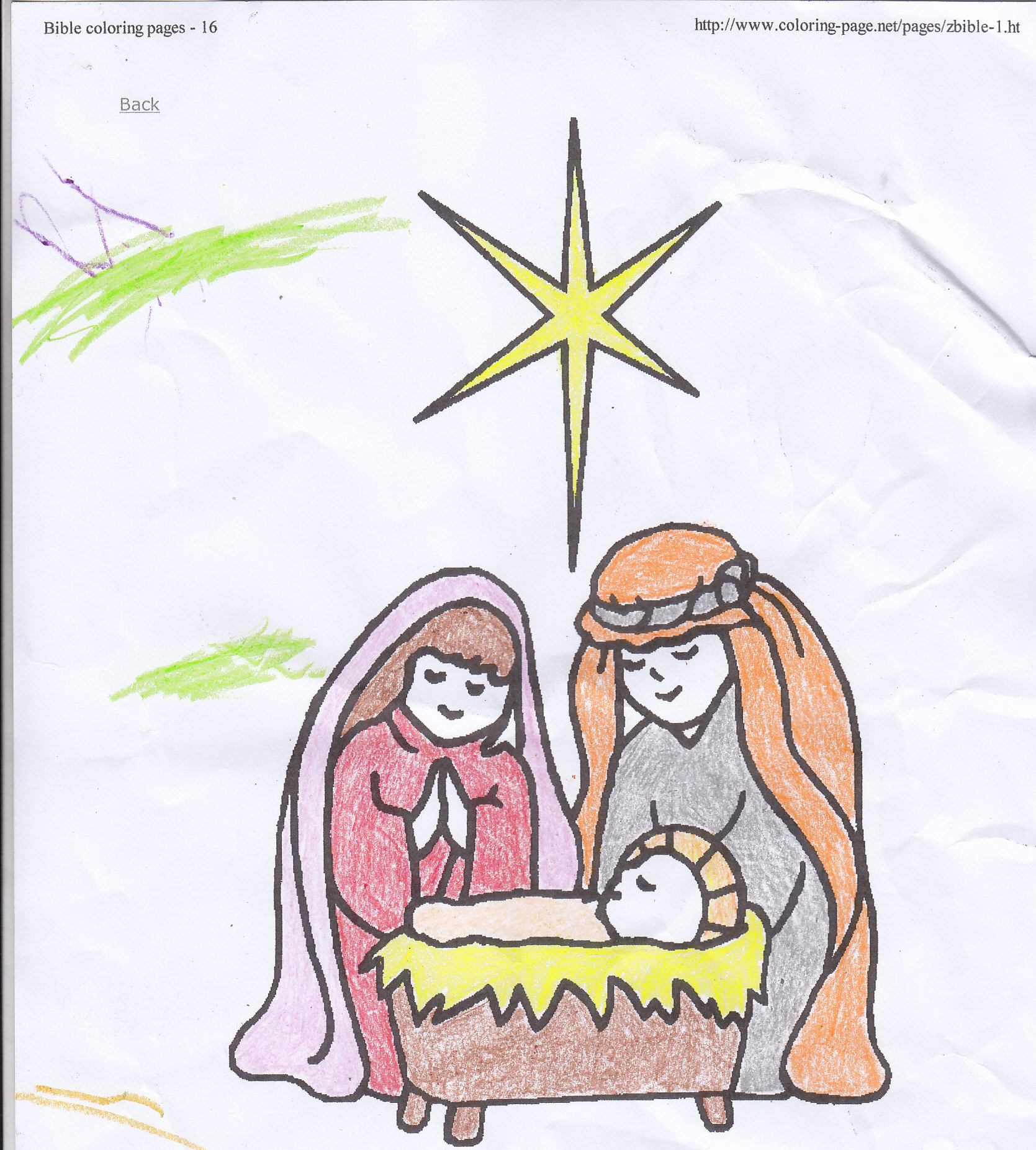
What do you notice in this picture? Try to identify subtle messages before you read on.

This picture was a product of craft time in our home. Julie distributed several coloring sheets printed from the internet, and Emma and I were taking daughter-daddy time sitting at the dinner table applying color to white spaces. Emma’s work, seen on the margins of the picture, was added during a previous session, while daddy can limit the usefulness of this togetherness by getting caught up in the artwork. In any case, I hope you like it.

While Emma and Hannah’s artwork gets hung on the wall, my occasional contributions usually just linger around. There is no need to add it to their gallery, but there is something that says you just can’t toss creativity into the garbage. Since our table has more space than the four of us need for meals, the picture sat quietly at the other end, always within my eyeshot.

One day I noticed something interesting that may never have dawned on me if not for time in the Orthodox Church. Icons hang from all corners of the sanctuary; pictures are painted in almost all available spaces, even the ceiling. One dominant image is of the theotokos, Mary, the mother of God.

She is a majestic, towering figure, holding the baby Jesus in her bosom. Like Mary, Jesus is upright; though an infant he is ruling the world from his mother’s lap. Despite her prominence, the theotokos is still a secondary image. The central icon behind the altar is of a risen Jesus, the pantocrator, the ruler of all.

Mary maintains her high place, however, in the esteem of the Orthodox Church. One of the central prayers during mass has the congregation in chant with the priest:

Through the intercession of the Mother of God, Saint Mary,

O Lord grant us the forgiveness of our sins.

We worship You, O Christ,

With Your good Father and the Holy Spirit,

For You have come and saved us.

The mercy of peace, the sacrifice of praise.  

Such devotion of Mary is of common knowledge to Western audiences through the Catholic Church as well. Protestant reaction is also familiar to most. Believing that an individual has direct access to God through Jesus, the Protestant wonders why such intercession is necessary. As such, the role and prominence of Mary is significantly decreased. Consider, therefore, the message of the picture.

Imagining, though not knowing, this internet coloring picture was designed by Protestants, notice first the folded hands of Mary. This was the image which first captured my attention. Her hands are folded in prayer to the baby Jesus. In stark contrast to the proud figure of Mary carrying the divine child, this humble figure emphasizes her subjection. In addition, she is drawn in equal proportion to Joseph, again marginalizing her importance. Furthermore, though both are kneeling, Joseph’s hands are not folded. It is the prayers of Mary that are emphasized. The message is subtle, but pictures communicate. The artist is directly imbuing the coloring child with Protestant theology.

I have sought to write this post so far without a coloring theology of my own. Of Protestant heritage, I maintain the question for Orthodox audiences: Why are these intercessions necessary? I understand and appreciate the overarching idea of the communion of the saints. The Orthodox challenge their Protestant brothers with irrefutable logic: If you ask your living sister to pray to God for whatever issue you are facing, why would you refrain from asking your ever-living sister, Mary, in heaven?

The theology of prayer is difficult in any case, intercessions or not. Why does God sometimes answer prayer, and sometimes seemingly ignore the pure petitions of his faithful? Answers are numerous, and I will not go into them here. Yet whatever answer is given to address one part of the equation always seems to violate a different scriptural precept. Prayer, if analyzed, can be very frustrating.

This, though, is where the Protestant undoes the Orthodox rebuttal. Perhaps this is a mark of American Protestantism, but most people I know who ask others to join them in prayer are not requesting intercession as much as they are asking for them to share in their suffering. The thought is not that if you also pray for me then perhaps God will now grant my request, as if it were a matter of addition. It is the natural human inclination to seek out support in time of need. Of course, since we do not know the mind of God, the prayers offered could not hurt. Depending on how great the need, perhaps the supplicant is indeed keeping count. God, answer me.

Prayer is one of the deepest expressions of human existence. The disciplined, regular prayers that we conduct with our children before meals and bedtime are pale comparisons. So also are our efforts to teach them to pray to God in their time of need, most recently expressed during occasional nightmares.

When Emma truly wakes with a nightmare it is obvious. She cries out and needs immediate consolation. Whoever put her to bed that night will go in and comfort, and then pray with her. Emma has learned this lesson, though, and will sometimes call out just fifteen minutes after going to bed, that she “had a bad dream about a rabbit.” Or, a bear, or cat, or sharks, etc. Our patience wears thin, and we will call from the door, “Did you pray to God about it?”

Clearly, our concern is more for our quiet than her relationship with God. Though the concept is good, we make a mockery of prayer, using it as a tool to wean her dependence off us, not for her spiritual development, but for our few moments of quiet at the end of the day.

What is most interesting is her usual response. “Daddy, I want you to pray to God for me.” Granted, she has heard far more prayers than she has been encouraged to utter, but the question is there: Is the desire for intercession wired into the human soul? If it is, is this positive or negative, a quality to encourage or one from which to mature? The answer may depend partially on the denomination.

Yet even in the Protestant understanding, why should one not seek to share one’s suffering with Mary, or with any other saint? Of course the Protestant cannot conjure this, any more than can be done with a stranger on the street, or perhaps more fittingly, a character from a story. The Biblical figures and the spiritual giants from bygone eras have past from living conscious into the tales of history and the register of heaven. In neither do they impact the Protestant’s daily life, nor enter the circle of relationships. Such a one should not be pressed to do so, for every relationship takes time. Does the lack of feeling toward this cloud of witnesses, however, betray a missing hue of Protestant theology?

On the other hand, if the Protestant has a warm relationship with Jesus, of whom the Bible states specifically intercedes for people before the Father, for what cause is appealing to Mary necessary? Once an Arab Catholic friend remarked, “If you can’t get what you want from someone, who better to go to than his mother!” This is interesting cultural insight as to the strong and continuous relationship an Arab man has with his mother, but contained therein is a point worthy to ask the Catholic/Orthodox: Your theology agrees with the superiority of Jesus and the access of every believer to him; do you indeed have such a relationship, or are you afraid of approaching the throne of grace? If the answer is yes there is no shame; every Protestant trembles as well that a supplication will be rejected. To ask is to risk; it is better to stay silent than to face the possibility of disappointment.

Of course, few of our prayers carry risk. Offers of thanksgiving and requests for well-being are well within our own power to accomplish; asking God’s help is good form, and cements the importance of humility, however feigned in actuality. A true supplication, however, empties the soul. Or, rather, it emerges from a soul which has been emptied. If God is the only answer left, how terrifying it is if he also fails.

This is no different than in any relationship; approaching anyone in weakness strikes at the core of our independence and self-satisfaction. Yet while we loathe our abasement, suffering is stronger in calling out for consolation. Be it for help, or for company, this is the truest of prayers. Jesus promised, “Blessed are the poor in spirit, for they shall inherit the kingdom of heaven,” and the Hebrew prophet before him, “I live in a high and holy place, but also with him who is contrite and lowly in spirit.” The prayer, it seems, is given a promise.

Ah, but what if it proves untrue? Is this an explanation of the practical side of Catholic/Orthodox appeal to saintly intercession? Is God held innocent if I only ask of Mary? I cannot answer this question, having no inherited reality of this world. If true, however unconscious, it is only parallel to the Protestant gymnastics which explain God’s inaction toward our cries for help. More likely, we fail to answer this question since we have never truly cried; our soul is not yet empty. The gymnastics are a tool to avoid the contrite and lowly spirit necessary to know God’s comfort.

I ask the Catholic/Orthodox for patience, since I am yet unable to enter this world. We both ask patience from the skeptic and secular, who scoffs at this whole conversation. It is hard to understand that which you do not know, and it is hard to know without entering in. Yet the hands of Mary, folded in the picture, illustrate both the dilemma and its solution. Hands clasped together can hold on to nothing else. This is prayer in its truest form. Though each person kneels alone before God, how much more comforting if we are joined by others. May we each so offer ourselves to those around us; may it be we also profit from those who have gone before?