If not for the wisdom of two men, the world would be aware of the village of Sheikh Masoud in Upper Egypt for all the wrong reasons.
This hamlet deep in the rural backwater south of Cairo would have been added to the well-publicized list of Egyptian locations torn apart by sectarianism.
As it is, you do not know about it – unlike Dahshur, Giza, which was the most recent casualty of religious division, and the first village to suffer under the new Islamist regime of Mohamed Morsy.
Located 40 kilometers south of Cairo and home to the famous Red and Bent Pyramids, on 28 July Muslims and Christians in Dahshur confronted each other with shouts and exchanges of Molotov cocktails. It ended with a death and a devastated population.
The incident started when a local Christian laundryman burned the shirt of a Muslim client while ironing.
A stray Molotov cocktail accidently hit a Muslim passer-by. When he died from his burns a few days later, Muslims surrounded Coptic homes and businesses, setting fire to them. By 3 August, security forces had evacuated 120 Christian families from the village until calm could be restored.
Wisdom
The events in Dahshur however are part of a more complex pattern of sectarian relations that is often missed by the media. Sensationalist headlines and attention-grabbing pictures often start out as ordinary social problems that escalate, feeding on religious difference.
Far more common is local community wisdom snuffing out the tension, as happened in the village of Sheikh Masoud, 160 kilometers south of Cairo.
It could have gone either way in this sleepy countryside hamlet whose population recently surged to 25,000, 80 per cent of it Muslim.
The village also hosts an area church. Here it was that on 5 August a wedding ceremony took place for Christians of a neighboring village that had no church. All proceeded well and the wedding guests got into cars to drive back home. But trouble developed when the bridal party rearranged the seating in their vehicles to allow the bride and groom to drive to Cairo on their own to begin their honeymoon.
To do so they stopped in the middle of the main street in the village, halting traffic. Only half an hour shy of sunset when hungry Muslims could break their Ramadan fast, an argument ensued.
According to Fr Musa Ghobrial, priest of the St George Coptic Orthodox Church in Sheikh Masoud, the street in question lies thirty meters from the church and is a public gathering area for local Muslim youth.
Muslim drivers tossed insults at the bridal party, shouting especially at the sister of the bride getting out of the car, unaware that she was blind.
Flustered, her uncle, unable to shout back as he happened to be mute, spat upon one of the youths. Within moments the argument spilled over into the church compound, with more than a hundred Muslims gathered inside.
Sheikh Masoud Church Grounds
‘I was absent at the moment of the event,’ said Mohamed Ali, a 43-year old power station manager and father of the youth who was spat upon.
‘I heard that Christians were attacking us, and came after five or ten minutes with my relatives and neighbours to stop the insults,’ he told Lapido.
Fr Musa states there was no violence in the church, but that the atmosphere was charged.
‘Muslims in our area look for opportunities to stir up trouble, especially the younger generation. We keep good relations with them, but other Muslims consider this village to be weak because it has a church,’ he said.
It was these good relations which averted the crisis.
‘What happened was a reaction from the Muslims,’ Ali said. ‘I told them to go home because this is a place of worship and there should be no problems here.
‘Then I saw Fr Musa and the other priests leaving the church and told the crowd, “I know these priests. They will take care of this.”’
As the scene quieted and the church courtyard emptied, Fr Musa sped off after the bride and groom, persuading them to return. He spent the next day sitting with Christian villagers convincing them of their need to apologize over the spitting.
The third day Fr Musa gathered the Christians in Ali’s home, and all drank tea together.
‘Nothing happened,’ Ali told his guests, ‘We are all one.’
According to Fr Musa, neither side issued a public apology, but the gesture in Upper Egyptian culture signified both sides owned their wrong and extended forgiveness.
If Mohamed Ali had been an extremist, or if Fr Musa had angrily shouted at the Muslims in his church, the situation in Sheikh Masoud could have escalated like Dahshur.
Instead, the village remains as unknown as thousands of others throughout Egypt. In each, Muslims and Christians negotiate the status quo, despite the increasing trend of religious polarity nationally.
At times the mixture leads to combustion, but more often than not, contrary to assumptions carried in the press, wisdom prevails.
Fr Musa and Mohamed Ali are courageous – but mercifully not unique – peacemakers.
This article was first published at Lapido Media on August 29, 2012. Please click here to access it.
Throughout Egypt the justice system is known to be very slow. Though it has a long and respectable history, as the population exploded and litigation increased, many turn to non-traditional methods to avoid spending a year or more in court.
Sometimes, a non-traditional method can be thuggery. A landlord, for example, might expel by force a legal tenant and deal with the consequences later – whenever the court gets around to hearing the case.
Sometimes, a non-traditional method can be arbitration. Egypt, mindful of the slowness of its judiciary, has established a limited number of licensed arbiters, especially for commercial and business disputes.
Yet for many, especially in Upper Egypt, the non-traditional method of choice is the reconciliation session. Completely outside the law, two aggrieved parties turn to a respected man of the community, and set their dispute before him.
Reconciliation sessions have a deserved bad reputation, especially as pertains to sectarian conflicts. Rather than ruling by law, the police enforce calm in an enflamed village, and then Muslim sheikhs and Christian priests sit together to ‘reconcile’ their people. Perhaps a local dispute – where a Christian may very well be at fault – escalates and a Muslim mob distributes group punishment by burning shops and homes.
If the judiciary in Egypt is slow, the law is weak. The efficient solution is to engage the sheikhs and priests to determine monetary compensation for the Christians and then make a public display of reconciliation. Valuable as this may be, too often it covers over smoldering resentment and rarely punishes wrongdoers.
Yet far more frequent in occurrence are the ordinary instances of two parties settling their grievance amicably. This does not always mean a happy ending, nor is it free of questionable rulings. But where a flawed legal system is the norm, it works.
I encountered two examples recently which help give perspective. These examples hear from only one side, and both involve Christians exclusively. At the very least, they indicate how Christians are not simply the victims of reconciliation sessions, as often portrayed in the media. On the contrary, they are willing participants mirroring exactly their Muslim neighbors.
In the first example, a Christian family consisting of three adult brothers suffered tragedy when the third brother died young. That he also died unmarried added conflict to the tragedy.
What to do with his share of the family inheritance? To whom should he leave it? If the simple answer is to divide it equally, the equation is complicated by the fact he lived with one of the brothers as a semi-dependent.
Yet the other brother stated he paid ‘rent’ to the first brother to help offset costs. In the end, they took their problem to the church. The two priests of the village convened, heard the stories, and pronounced a simple 50-50 division between the surviving brothers. All were satisfied, and life carried on.
In the second example the dispute involved the church – that is, the priests themselves. The family of the priest in question inherited a large tract of land, complete with ownership papers establishing their right. Further distant relatives, however, received no share but believed they were entitled. Yet as the church was complicated in the conflict, the petitioning family decided to go to a Muslim village sheikh.
This particular Muslim sheikh is very well respected as a non-traditional ‘reconciler’ in the village, by both Muslims and Christians. He is said to deal according to the right, and not by religion or benefit. Yet he also draws a fee for his services; it is not simply a service provided. His authority comes only from village reputation. He has no license from the government.
This fee can reach up to several hundred dollars, and is traditionally paid by the disputant who first appeals to arbitration, win or lose. Trusting the judgment of the sheikh, who has been known by both parties since childhood, the landowning family agreed.
In the end, the sheikh ruled for the landowners – their names were on the legal documentation; it was a simple case. But in doing so the sheikh put himself in a quandary. The landless family was poor; they had no means to pay his fee unless they won the judgment.
In saying so, care here must be taken since the sheikh’s perspective is not known. Yet it is said of him he was on watch for any impropriety on the part of the landowners, so as to extract from them a fee for ‘contempt’.
Apparently, the landowner believed the sheikh was listening too favorably to the complainant’s cause, and not letting him speak. At one point he interrupted angrily, ‘Shut up, sheikh!’
With this highly culturally insensitive remark, the sheikh fined the landowner the several hundred dollars which should have been his fee from the original litigant. Whether or not this swayed his understanding of the case, he then ruled according to what appears to be justice.
Of course, the winning Christian family finds this an example of injustice, but once the non-traditional reconciliation session is begun, its judgments are final.
It is reported the sheikh has spoken privately to other members of the family, saying he will return the fee if the insulting party simply apologizes, or even has his landowning relative do so for him. Both refuse.
These examples are not complete pictures of non-traditional justice in Upper Egypt. They do not include the issues of vendetta, honor killings, or the messy intersection of these with sectarian conflict.
What they provide instead is a picture of the normalcy and unremarkable nature of Christian participation in reconciliation sessions. It is not simply the headline-making instances of miscarriage of justice that characterize the practice.
Swift justice and rule of law would be better. In their absence, however, non-traditional methods work reasonably well.
Ever since the revolution Egypt has suffered / benefited from waves of popular protest. The expressions in Tahrir Square were largely political, yet included a significant expression of social and economic discontent. The original chant which rang through the streets demanded, ‘Bread, Freedom, and Social Justice.’
Most focus since the revolution has been on political matters, and these have yet only partially been achieved. The achievement is significant, as Egypt now has a parliament freely elected by its people. Yet the primary lesson learned by the population is that if you have a grievance, fill the streets.
‘One Hand’ on the Railroad
A few weeks ago I was assisting American documentary filmmakers obtain an interview with a Coptic priest and a Salafi sheikh, the latter of which was running for parliament with the former’s support. The couple is producing a film entitled ‘One Hand’, which focuses on youthful and unique expressions of national unity. They had other business in Asyut, and I was to meet them with the priest in Maghagha.
My train arrived as usual from Cairo, but coming from Asyut was another story. With the priest I waited at the station, and waited, and waited. Finally we learned that nearby villagers decided to escalate their protest against the local government for failing to deliver the normal supply of gas bottles needed for cooking. The shortage prompted a huge increase in price on the black market, so they decided to block the railroad tracks.
At this news we knew it could be hours, though probably not days, until the track was opened again. The priest and I drove an hour south to collect them on the side of the tracks. For whatever reason, the task was complicated by the fact there was very poor cell phone coverage, but we managed to speak with their neighbor who assisted them in their disembarkation. The filmmakers spoke very little Arabic.
Eventually they made it over to us, surrounded by a group of young men who were offering to ‘help’. They may or may not have been, but once we got them in the car one of them asked where we were from. Oddly, I felt a bit unnerved out of concern for the (young) couple, answered ‘America’ with a smile, and received a reply suggesting his ‘help’ may have been variable. ‘F*** America,’ he said, ‘We hate America.’
‘I know,’ I replied smiling still. We got in the car quickly and drove away, with both exhaustion and a sigh of relief. The long delay made little impact on their work, as the sheikh was not free until near midnight to begin a very friendly and welcoming interview.
Lock the Lock
The next two examples come from a Nile cruise on the occasion of Julie’s parents visit to Egypt. We boarded the sleeper car from Cairo and unloaded in Luxor, very pleased there was no railway protest to extend the journey.
Yet after the first few local sightseeing locations we noticed something strange. We got on a bus and drove over an hour away to board our cruise and spend the night. The next day we repeated the same ritual, only delayed an additional two hours. There are many ancient Pharaonic sites to see in Luxor, and both the delay and the absurd driving distance played havoc with our scheduled itinerary.
Mother and Daughter Exhausted from Extra Travel
The normal agenda is to get off the train, see the sites, and then board the boat right there in Luxor, stopping at all the tombs and temples along the way.
Unfortunately, we learned the workers at the canal lock in Isna were on protest, refusing to let any boats past. They began their sit-in on the 25th of January, to commemorate the revolution.
This left the boats in Luxor stranded, but fortunately our boat was trapped on the other side. This explains the hour plus bus ride after we finished sightseeing. We had to drive south to Isna in order to spend the night in our cabin, and then return the next day for Luxor sites, day two.
Only the next morning we encountered another post-revolutionary difficulty. The nation as a whole, but Upper Egypt especially, has suffered periodic gasoline shortages. The bus, we learned, was desperately searching for an open tap.
After several hours delay, a different bus met us at the dock and filled up from the boat’s supply of gasoline. I’m not sure there weren’t other shenanigans we weren’t being told, but we did see long lines of vehicles at the gas stations we passed on our way back to Luxor. I’m also not sure who’s bottom line must accommodate the extra costs of bus and gasoline – travel agent, cruise, tour guide – but the blow to tourism is substantial.
Other tours which knew of the lock strike at Isna cancelled their trips altogether.
A Free Pass at Edfu
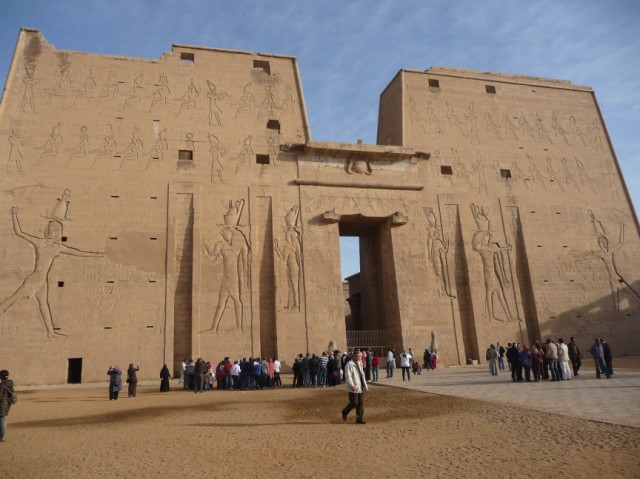
The Massive Temple at Edfu
Later on in our tour we had a pleasant outcome from local instability. Our boat docked in Edfu, but the captain told everyone the tourism workers at the temple were all on strike. The rumor circulated but before it had time to settle in the guide rounded everyone up and we went ashore. From there, we rode horse drawn carriages to the site of the temple.
What we didn’t realize until later is that our carriages stopped at the back side of the temple. We passed along an open area along the wall of the massive complex, circled to the temple gate, and moved through en masse.
At the entrance of nearly every tourist location there is a small area to mill about where the grandeur is open to all onlookers. Then there is a welcome center where a ticket is purchased and then a souvenir section where tourists – foreigners especially – are all but assaulted by desperate sellers.
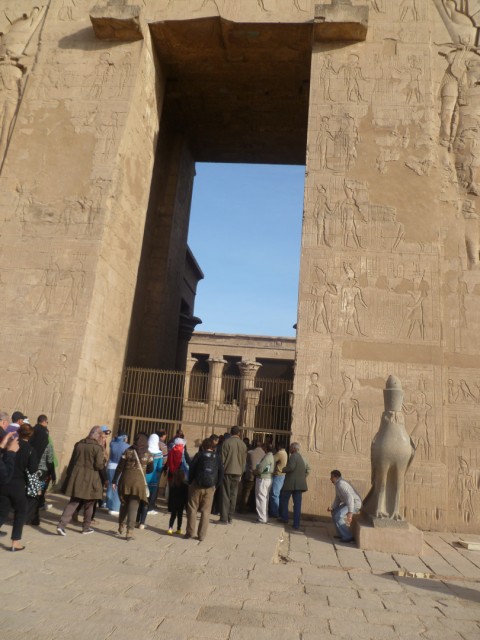
We skipped all this. By coming in the back we avoided whatever protest prevented entry from the front. At the temple gate some semblance of guard took money from every tour guide, but then allowed the group in without tickets, no questions asked. Ticket prices for Egyptians range from 1-5 LE ($0.18-0.80 US), but foreigners must fork over between 35-80 LE ($6-13 US) depending on location. It is still minimal, but it was a nice surprise – pleasant also, as we avoided the souvenir gauntlet.
Groups Moving Past the Entrance as Tour Guides Give a Little Baksheesh (Tips)
The Big Picture
It is difficult to know what to make of these protests. On the one hand, they are at the least annoying and disruptive, and perhaps even damaging to the local economy. Several people, especially in Cairo, criticize such strikes. They say people should be patient: ‘We waited thirty years to get rid of Mubarak, we should not expect things to get better immediately. In fact, such continuing ‘special interest’ protests are only making things worse.’
Fair enough, but how can this point be enforced when there is a window of opportunity now? Forty percent of Egyptians live on under two dollars a day, wages are low even in the middle class, and few people have benefits of any kind. The revolution has changed political leadership, but not so much at the regional level. Protests have proved effective for many in getting what they want – which could be as basic as a living wage. Who knows but if they wait longer the system will reset itself and local leaders will pay as little concern to their needs as before?
In many ways, the problem is one of trust. President Mubarak allowed the failure of the social contract which ensures domestic stability. Open political participation was minimal, but so was food on the table. As Egyptian institutions eroded from the inside, it will take a long time to rebuild following the revolutionary collapse. Unless such a contract is widely renegotiated, small and localized strikes will – and perhaps reasonably – continue.
Who pays the bill? Is it reasonable for the average working Egyptian to wait until the Muslim Brotherhood, elite liberals, and the armed forces get around to a new economic policy? If so few cared for their needs then, should they trust anyone will care now?
Perhaps they will. The only one of the three to demonstrate practical concern for the poor were the Islamists, who have now been widely elected to parliament. It is fair to ask if Islamist concern is opportunistic or transformative, but many have worked sincerely. Will they follow through? Will they be allowed to? Will the people wait? If so, for how long?
Revolutions are not easy, and the pain can linger even after resolution. Egyptians are among the most patient people on earth; they are now being put further to the test.
Postscript
On the sleeper train ride home I woke at about 2am from a lack of movement. It is difficult to catch shut-eye while the car lurches back and forth, but I was able. After about 45 minutes of standstill, however, I inquired. A baggage handler told me there was a train driver strike over assignments on the newer cars, which also came with a higher compensation.
Our car was newer, and despite my complaints above was much smoother than the older model we semi-suffered on the way south.
The handler assured me things would be settled soon, so I used the calm to get back to sleep. It worked, as I was unaware of another long delay that woke my wife around 4am.
In the morning I asked the porter about the delays. He replied there was just a normal backup of several trains at a particular station. Asking more specifically about a strike, he denied anything of the sort. I think I ran directly into the noble Egyptian quality of saving face.
In the end our scheduled twelve hour trip took sixteen. I don’t know if the drivers got what they wanted, or how it came about we did not spend an additional evening or two in the sleeper car. I just hope Egyptians remain patient as their lives accommodate such disturbances at an increasing frequency.
I suppose if everyone is doing it, it is easier to forgive.
Fortunately, They Slept Through the Night
Final Postscript
Today the media carried the news that a Luxor-Cairo train the day after our travels was attacked by thugs who tried to steal luggage from car number five. The passengers successfully beat them off.
Issues of sectarian tension in Upper Egypt create a double problem in establishing fact. First, many news agencies do not commit resources to the area, so journalism often relies on hearsay rather than first-hand reporting. Second, religious biases often serve to either cover over or amplify aspects of the story that play into an established narrative. This is true both among those involved and in the reporters themselves, as rumors are easily conflated into facts.
In the last week the governorate of Minya in Upper Egypt witnessed two examples of Muslim-Christian tension. Unfortunately, these incidents often go unreported in major media outlets, and within Egypt often receive scant coverage as well. This is seen in the brevity of tworeports in al-Masry al Youm, English edition, which also serve to establish the basic facts.
In the first report, clashes are reported between Copts and the police, when the former attempted to block a road in protest of two local girls who were rumored to have been kidnapped and forced to convert to Islam.
In the second report, the police this time disperse hundreds of Muslims surrounding a church in Beni Ahmad village in the governorate of Minya. They were protesting the reinstatement of a priest who had been previously removed by agreement of the church and authorities, allegedly for inciting sectarian tension.
With the dearth of first-hand, in-depth reporting, however, comes coverage that often relies on one-sided sources, promoting a cause with lack of objectivity. Whereas the lack of coverage can be interpreted as complicit silence against Coptic grievances, this latter reporting is wholesale adoption of their perspective. Indicative are these twoarticles from the Assyrian International News Agency (AINA), which tells these stories, and others as well.
These articles rely on statements taken from the area, and do a good job of increasing the level of detail.
In the first report, the two Coptic girls are identified as Christine Azat (age 16) and Nancy Magdi (age 14). These were reportedly abducted on June 12 while on their way to church. The article quotes Christine’s father, and describes how the Christians of the area have scrambled to assemble the 200,000 LE ($33,333 US) ransom demanded for their release. Once done, however, they were rebuffed saying the girls were already sold to another group, which was now demanding twelve million LE (two million USD) to hand them over. The article mentions the rumor that they ran away and willingly embraced Islam, but dismisses this as the Azhar rejects underage conversions.
In the second report, the village of Beni Ahmad West is located seven kilometers south of Minya. The conflict relates to an incident from March 23rd, 2011, in which Muslims surrounded St. George Church and threatened to destroy it when licensed renovation appeared to be expanding the building. Eyewitnesses are quoted saying the Muslims chanted they would kill the priest, Fr. George Thabit, for his role in events if he and his family did not leave the village. In a previous article AINA states there are 23,000 Muslims and 8,000 Christians resident in the village.
The report states that Fr. George did leave the village. Muslims, however, heard rumors he would be returning, and began to camp out at the church in small numbers. When he did come back, on June 24 there was another major demonstration against him. Five hours later he was escorted away in a police vehicle. The Muslims remained until security later dispersed them. The archbishopric is quoted as condemning this interference in ecclesiastic affairs, asking for the rule of law and maintenance of security.
The information above is fair enough, but it is couched in language that betrays bias. For example, the report about the two girls ends with the speculation that, “as females, their lot is to be raped, enslaved, and sold off to some rich, sexually-depraved man who believes it his divine right to own infidel sex-slaves.” The second report does not have such blatant speculation, but ends with communication of a non-identified threat from the Muslim ‘mob’, that unless they hear that, “the priest is banned from returning to the village, they will hold their Friday prayers tomorrow, June 24, inside St. George’s church.”
If indeed this is the story, it is important to relate it as such. Given the sensitive reality of sectarian tension, however, it is vital to either consult contrary sources or else convey the story with appropriate doubt. The English language Ahram Online web newspaper provides alternate coverage of the kidnapped girls.
This article places both girls’ ages at 14, and states they ran away from home months ago, with their families searching for them frantically. A policeman discovered them walking on the streets, conspicuous with their face veil but with the tattoo of a cross on their wrists. The article states the girls have produced a YouTube video stating their voluntary conversion to Islam, and that they were not kidnapped. It states they are being held in a safe house until an Azhar scholar can determine if the story of their conversion is true. Meanwhile, the families of the girls have asked that they be returned home.
It should be noted that Ahram Online is a government owned newspaper. Though it has appeared to have more freedom to criticize the government than its printed counterpart, al-Ahram, the story must still be understood in light of its ownership reality.
Arab West Report was able to contact Nermine Rida, a Coptic Orthodox journalist for Akhbar al-Minya. She stated the girls were involved in a teenage crush with two Muslims, Ali Gomaa Rashid and his relative Ezzat Gomaa Rashid. These along with another relative, Saudi Gomaa Rashid, were currently being held in custody, along with five Copts still detained for their role in the demonstrations. Rida stated that Copts transgressed the acceptable levels of peaceful demonstration by blocking the road, and that the police were justified in breaking up their protest.
Rida also stated that the Azhar rejected the girls’ conversion to Islam since the law does not allow for the conversion of anyone under eighteen years of age. She did watch the YouTube video, however, and was convinced the girls were not kidnapped and made the video without compulsion. She understood that they were being held currently by authorities, but were soon due to return to their homes.
Rida was unable to confirm the ransom demand, except to say a call to raise 200,000 LE was issued by a Christian satellite channel, al-Tariq.
Concerning the incident in Beni Ahmad village, Rida confirmed the outlines of the story centering around Muslim demonstrations and Fr. George Thabit. There was a disagreement about the dimensions of the church and the role played by Fr. George, resulting in an agreement with Bishop Arsanius of Minya to send him away. During his absence from the village the church was repaired satisfactorily along the lines agreed upon by all village members.
After completion, the bishop returned Fr. George to the village, and Muslims were angered and resumed their demonstration. Yet Rida makes clear Muslims were not the only party in disagreement with his decision. Around thirty Copts joined the Muslims in demonstrating against the return of Fr. George, headed by one named Rifaat al-Qummus.
Arab West Report is unable to independently verify the account of Nermine Rida.
What should be made of these situations, then? Without traveling to the area and investigating directly, one should be cautious about claiming certainty about events. Even then, one would be likely to discover contradictory testimony.
Kidnappings regardless of religion have taken place in Egypt within the security vacuum since the revolution. Many Copts, however, believe their community is especially targeted by extremist Muslims. Yet it is also clear that at times Copts respond with accusations of kidnapping when facing the shame of a female relative running away from home, either due to a bad family situation or in a love affair with a Muslim.
One of the issues lies in the definition of kidnapping. Generally understood, kidnapping involves the use of physical force in an abduction. Some Copts, however, expand the meaning to include the luring away of adolescent women from their family, helping (or deceiving) her to escape from difficult domestic situations. Cornelis Hulsman of Arab West Report has written extensively on this issue.[1]
Camilia Shehata represents the most recent example of an imagined kidnapping, which captured the attention of the nation. Frustrated by her marital situation, she ran away and disappeared for four days. Local Copts immediately began demonstrating demanding her return from her assumed Muslim captors.
Muslims, meanwhile, circulated pictures in which she was wearing a hijab, and claimed Copts had kidnapped her – a willing convert to Islam – holding her in a church or monastery. Salafi Muslims held rallies in her defense, and some threatened to storm the monasteries in search of their ‘sister’. Immediately on the heels of this story followed the case of Abeer Talaat, which culminated in the horrors of Imbaba when Muslims tried to enter the church upon a rumor she was captive there, held apart from her Muslim husband. The ensuing clash resulted in multiple deaths and the burning of a nearby church with no connection to the rumor.
One day before the Imbaba incident, Camilia Shehata appeared on al-Hayat Christian satellite channel and told the truth of her story. She sat with her husband and child, and confessed to running away from home, due to marital issues. She never converted to Islam, however, and she was sorry for the trouble caused.
In terms of church building issues, it is well known that Christians have had difficulty securing permits. During the Mubarak era, decision-making power was held by the security apparatus, which often decided upon granting or withholding permits due to the perceived reception of Muslims in the area. There is currently a new, draft, unified law for building houses of worship, to govern both churches and mosques on an administrative basis. The first draft has been rejected by the churches of Egypt, in part due to the perception the locus of decision will not move from security.
This issue is similar to a church building conflict in Ezbet Bushra from June 2009, in the governorate of Beni Suef. In this location Fr. Ishaq Kastour was involved in a controversy in which Copts built a factory which was actually purposed to become a church, which included a place for his personal residence. The process was done without approval, and Muslims vandalized the building at various stages. Fr. Ishaq was also removed from the village by the bishop (presumably at the urging of the security apparatus), returned, but was eventually permanently assigned elsewhere. A government sponsored Muslim-Christian reconciliation meeting led to the decision to grant Copts a church building, but on the outskirts of the village, as a hastily constructed mosque was given preference at the original location. As of the completion of an AWR report on the subject, authorization of the church had not yet been granted.
It also is not uncommon for parishioners to disagree about their church leadership. The Coptic Orthodox Church is a hierarchical organization which appoints priests to their diocese. While local sentiment can be and often is taken into consideration, it is not unheard of for a small but active contingent of a congregation to reject their given priest. According to Rida’s report, only thirty Copts participated in the protest against Fr. George. Was this a contingent of malcontents, or indicative of widespread frustration with his leadership? In any event, it would be improper to label the demonstration strictly as Muslim transgression in church affairs.
None of this explanation should be used to justify the parameters of the two stories, but will hopefully make actions more understandable. The girls may have been kidnapped or not, but if not, surely most demonstrators did not know the truth of the situation. It is the case in Egypt, and certainly since the revolution, that the best way to achieve results is to gather masses of people and pressure authorities to grant your demands. In the face of perceived official neglect of Coptic issues, including other cases of alleged kidnapped girls, the demonstration on the part of most was in imitation of other groups’ success.
Should this be necessary? No. Should underage girls have been immediately returned to their family? Yes. Should Copts have blocked roads and resisted dismissal? No. Have there been real cases of kidnapping Coptic adolescents? Perhaps. Is there blame, when in occurrence, on those who quickly circulate false or unsubstantiated claims of kidnapping? Absolutely.
What is the reality of this case? It is not altogether clear.
Similarly, Muslims have used the power of demonstration to great success in pressuring government to yield to their will. This was seen most recently in the case of the appointed Coptic governor of Qena. Initial demonstrations against him were joined by Copts, in protest of the previous Coptic governor’s poor record and the newly appointed governor’s alleged role in killing protestors during the revolution. Yet the demonstrations against him quickly took on a religious dimension, as area Salafis, and some Muslim Brothers, rejected the idea of having a non-Muslim governor altogether. They blocked roads and threatened to cut off supply lines to popular tourist areas to the east on the Red Sea coast. The government was unable to dislodge them, and a solution was crafted in which the governor was ‘suspended’ for three months. When he left the area, the demonstrations subsided.
Were the Muslims of Beni Ahmad looking to similarly assert their will against a rejected priest? Perhaps. Was the conduct of this priest deserving of their rejection? It is not known. Is it the reality of Upper Egypt that decisions are taken communally rather than through the rule of law? Yes. Is this an acceptable way to govern a nation? No. Is it right for the priest to be removed in this way? No.
What is the reality of this case? It is not altogether clear.
What is clear is the poor, partisan, and inflammatory reporting of these incidents by the Assyrian International News Agency. Whereas AINA did an admirable job of presenting a perspective of these events, when much mainstream reporting is either in ignorance or dismissive of its importance, they failed to present other sides of the issue. Furthermore, amidst this negligence, they assumed the total credibility of the reported Coptic position, in doing so warping the perspective of their readership.
Sectarian issues do not plague Egypt, but they are a significant social problem. Underlying them is an unspoken frustration with the ‘other’, as competing storylines place explanation of these incidents into a greater narrative. Depending on perspective, they are either aberrations in a centuries-long culture of tolerance, or else a disturbing confirmation of pervasive discrimination.
Greater narratives, however, smooth over details. Each individual sectarian incident has its own details, many of which are disputed or unknown. Reporting of these events must take utmost care to prevent their automatic assumption into a narrative. At the same time, reporting must call a spade a spade, when this is clear.
Such clarity is difficult to achieve. With sectarian conflict, both metaphorically and literally, the devil is in the details.
[1] Cornelis Hulsman, “Forced Conversions or not?”, report presented to the New York Council of Churches, June 28, 1999 [RNSAW, 1999, week 26A, art. 37], http://www.arabwestreport.info/node/2126




 Jayson Casper