Categories
Christianity Today Europe Published Articles

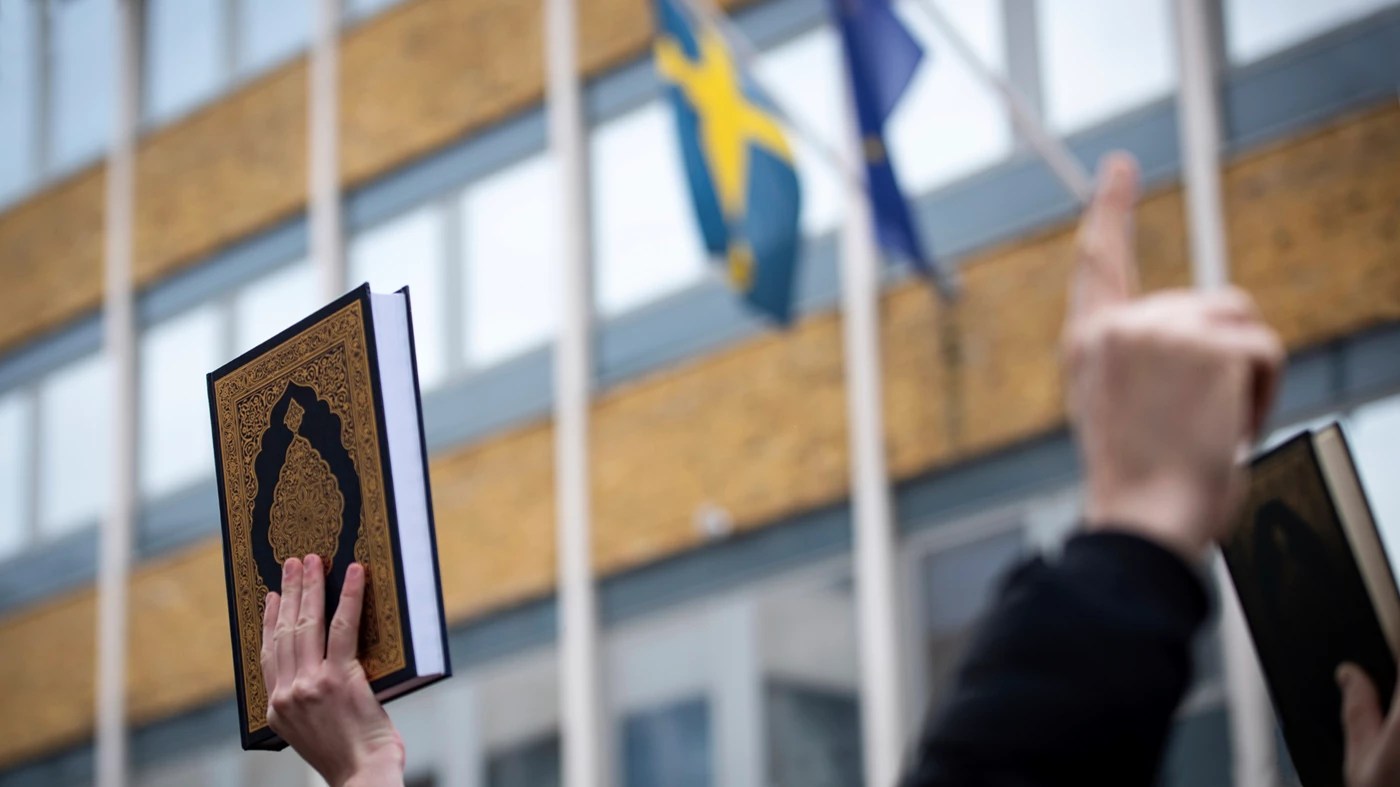
Amid Quran Burning Outcry, Should All Blasphemy Be Banned?

Image: Loredana Sangiuliano / SOPA Images / AP Images / Edits by CT

Swedish evangelicals fear a human rights retreat, as the fallout continues from last month’s Quran burning.

Earlier this month, Iraq expelled the Swedish ambassador after Swedish police authorized the burning of the Torah and the Bible in front of the Israeli embassy in Stockholm—though the Muslim applicant did not go through with it.

“If I burn the Torah, another the Bible, another the Quran, there will be war here,” stated Ahmad A. “What I wanted to show is that it’s not right to do it.”

Though unintentional, he succeeded in showing the neutrality of Swedish law. There was scant outcry from Christians to protect their Scripture, but overall many Swedes are sympathetic to his plea. More than half favor prohibition of the burning of any religious books, up from 42 percent in February.

To do so may require reviving blasphemy laws that were scrapped in the 1970s. Following a similar incident last year, the former prime minister of Sweden stated such acts should be prosecuted as hate speech, lamenting the waste of budget to protect rogue actors. And after this round of international outcry, the government announced that it is currently exploring if such a law can be passed.

But across the European continent, Christian leaders are expressing alarm.

“If you can’t burn the Quran, can you put it in the toilet?” asked Olof Edsinger, general secretary of the Swedish Evangelical Alliance. “There are many ways of desecration, and you can’t stop them all.”

Fully condemning the offense itself, he clarifies that any law—however broadly worded—would be tailored only for the religious community that is offended. The issue is with Muslim reaction, he says, and every limitation shrinks the space for freedom of expression.

It is a hard-won right for Sweden’s evangelicals. Prior to the 1952 Religious Freedom Act, many free church believers joined atheists and other religious nonconformists to seek refuge in the United States. Conversion to Catholicism, for example, was subject to exile until 1858.

“If our culture—and the West in general—bows to outside pressure,” Edsinger said, “it will be a clear step backwards.” So far, the West is resisting, though the world…

This article was originally published at Christianity Today on September 27, 2023. Please click here to read the full text.

Categories
Asia Christianity Today Europe Middle East Published Articles

Quran Burning in Sweden Singes Muslim-World Christians

Image: Hadi Mizban / AP Images

Following the burning of the Quran in Sweden last month, Christians in the Muslim world have been vocal in their condemnation.

But some expressions of disapproval may have been forced upon them.

“Christian religious figures … [must] state their positions regarding this explicit crime,” stated the Association of Muslim Scholars in Iraq. “Their silence puts them in a position of refraining from criminalizing and condemning it.”

The Sunni-based group had plenty of reasons to be offended. The stunt occurred in front of the Grand Mosque of Stockholm on the first day of Eid al-Adha, one of two primary Muslim holidays. And prior to being lit on fire, the Quran was kicked about and stuffed with bacon—provocation against Islam’s prohibition of pork.

But the greatest Iraqi ire may have been that the culprit was one of their own—and a Christian. Salwan Momika, a 37-year-old father of two, sought refuge in Sweden sometime after 2017. But his checkered history had many Middle East Christians criticizing him as well.

In fact, he is an atheist.

His Instagram post announcing his act declared his lack of faith in anything save secular liberalism. Citing the protest as an act of democracy in defense of freedom of speech, he also asked for financial support. And it is reported that upon arrival in Sweden, he volunteered for a far-right party known for its opposition to Muslim migrants.

But earlier, he worked for Shiites.

Momika professed admiration for Abu Mahdi al-Muhandis, the deputy commander of Iraq’s Popular Mobilization Forces (PMF), who was killed with Iran’s Qasem Soleimani in a US drone strike in 2020. Under the PMF’s command he enrolled with Christian compatriots in “The Spirit of Jesus Brigades” in the common fight against ISIS.

He also tried founding his own political party in Iraq, the Syriac Democratic Union. The established, similarly named Christian party in Syria denied any connection to him.

“He is a showoff who wants the spotlight,” said Habib Ephrem, president of the Lebanon-based Syriac League. “He has no specific ideology and stirred up controversy in the Muslim world—for nothing.”

Some observers speculated that Momika’s aim was to create conditions in which it would be impossible to deny his citizenship request and send him back to Iraq.

At least it has given Christians an opportunity for witness.

“What happened in Sweden was an unwholesome use of the concept of personal freedom,” said Ara Badalian, senior pastor of Baptist Church in Baghdad. “True Christianity is characterized by love, tolerance, and rejection of violence and hatred.”

The patriarch of the Assyrian Church of the East spoke similarly. “We call upon the governments of all countries, particularly the Swedish government, not to allow these actions perpetrated in the name of ‘personal freedom,’” stated Mar Awa Royel, who quoted Ephesians 4:32. “This is what the Bible teaches us…

This article was originally published at Christianity Today, on July 11, 2023. Please click here to read the full text.