Categories
Africa Christianity Today Published Articles

‘We Are Not in Heaven’: Niger Analyst Explains Christians’ Concern After Coup

Image: Anadolu Agency / Contributor / Getty

The military coup in Niger has now entered its third week. Four days after the July 26 putsch, the 15-member Economic Community of West African States (ECOWAS) threatened military action if democratic rule was not restored within seven days.

That deadline has passed, and leaders are still mulling their options while imposing sanctions against the junta, the group of military officials that seized power. But worried by the seventh coup in the Sahel region since 2020, the remaining democratic nations in West Africa believe they must draw a line in the sand.

Neighboring countries Mali and Burkina Faso, both with military governments after their own recent coups, have warned that any foreign intervention in Niger will be considered an act of war against them as well.

Niger suffered its last coup attempt in 2021, right before the elected president—now deposed—was sworn in. The former French colony had been the last bastion of Western military cooperation against jihadist militants in the Sahel, amid the expanded regional influence of Russia through its Wagner mercenary unit.

Niger, meanwhile, is the world’s seventh-largest producer of uranium.

CT interviewed Illia Djadi, Open Doors’ senior analyst for freedom of religion and belief in sub-Saharan Africa. Though he resides in London, he is a citizen of Niger, a nation which ranks No. 28 on the World Watch List of the top 50 nations where it is most difficult to be a Christian.

Djadi provided the regional context, described the difficult but improving situation of Christians, and issued a strong appeal against military intervention:

How serious is the situation in Niger right now?

I am very sad. As a Nigerien, I find the situation difficult to watch.

But as an analyst, I can say confidently that what happened two weeks ago plunged Niger into a new era of uncertainty. The country is facing a terrorist Islamist insurgency coming from Nigeria, Mali, and Burkina Faso. And Niger is also one of the poorest nations in the world, with unemployment making it easy to radicalize our youth.

We are not in heaven. But compared to our neighbors, we had been in a much better situation. For the first time…

This article was first published at Christianity Today, on August 11, 2023. Please click here to read the full text.

Categories
Christianity Today Middle East Published Articles

Coup Reversal Divides Sudan’s Christians

Courtesy: Susanna al-Nour

As a young mother in Sudan, Susanna al-Nour struggled like many others with rising prices and shortages of goods. International support pledged after the 2019 revolution was slow to materialize. The government struggled to disburse promised aid. And tribal groups protesting in the east were blocking access to essential imports coming through the Red Sea city of Port Sudan.

And then this October things got worse.

Citing divisions among politicians, Abdel Fattah al-Burhan, the general heading Sudan’s mixed military-civilian Sovereign Council, launched a coup against the popularly selected prime minister, Abdalla Hamdok.

Phone and internet connections were cut, Hamdok was detained, and security forces raided neighborhoods to arrest supporters of his government, roughing up others. Thousands poured into the streets, including Nour’s husband, an evangelist and pastor’s assistant at Faith Baptist Church in the Soba area of the capital, Khartoum.

“With a small child, I couldn’t go because of the tear gas,” she said. “But it was necessary to demonstrate against the regime.”

Sudan’s Christians were then solidly in support of Hamdok, sources told CT. Two months later, sources no longer speak in consensus.

At the time, enraged and without communication, the nation went into a standstill. Nour’s online studies through a seminary in Lebanon became impossible. So did her husband’s student ministry—as most young people were marching to reverse the coup.

Back in 2019, Hamdok quickly became the symbol of the revolution. Chosen by consensus among the political and revolutionary groups that deposed the 30-year Islamist dictatorship of Omar al-Bashir, his leadership was one of the few unifying factors in a rapidly fraying partnership between civilians and the military.

And then he wasn’t…

This article was originally published at Christianity Today, on December 10, 2021. Please click here to read the full text.

Categories
Christianity Today Middle East Published Articles

Reaching Youth for Christ During Sudan’s Coup

Image: John Sagherian
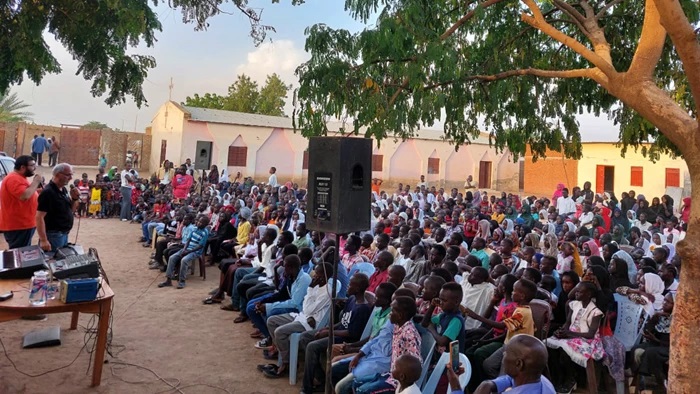
An outdoor YFC youth meeting in al-Thawra near Wad Madani, Sudan

At 6:30 a.m. last Monday, John Sagherian and Elie Heneine went down to the lobby of their three-star hotel in eastern Sudan and found a crowd gathered around a TV. Filtering in, they heard the news.

The military had staged a coup in the capital, Khartoum, 90 miles to the northwest.

“Instantly, everything we planned for that day was up in the air,” said Heneine, a 27-year-old staff worker with Youth for Christ (YFC) Lebanon. “Oh well, youth work is very organic.”

Sagherian, the 74-year-old YFC regional director, had long been “dying to visit” Sudan. Two years earlier, he had identified a promising country director named Sabet, who since then had recruited seven other volunteer staff members. Sabet even ignored the capital, concentrating instead on the poorer hinterland.

The Lebanese team of two were finally scheduled to meet their new Sudanese colleagues later that day. As malaria had been among their concerns, they had taken 100 mg of medication every day for two weeks prior. The visa had also been a complication, requiring multiple layers of bureaucracy. But it was the BBC app that now troubled Joy, Heneine’s American wife of five months, as Sudan increasingly filled her news feed.

Heneine himself was at peace. Not only was he used to instability as a Lebanese Christian, but Sabet and others assured them everything was fine—despite the political tumult between the once-cooperating military and civilian leaders.

In 2019, the Sudanese army backed massive protests to overthrow 30-year dictator Omar al-Bashir. A spate of religious freedom reforms replaced his Islamist governance, normalization agreements were signed with the nation’s former enemy Israel, and the US removed Sudan from its list of state sponsors of terrorism.

The economy was struggling, but the World Bank was poised to help. Sudan was almost ready to rejoin the community of nations. But politicians were bickering, and a military coup had been suppressed only one month earlier.

In the background was disagreement over sending Bashir to the International Criminal Court to be tried for war crimes in Darfur. Deeper still were issues of army control of large sectors of the economy. And at an unspecified but fast-approaching date, the transitional Sovereign Council was supposed to switch to civilian leadership. Two days before the coup, the YFC team had traveled three hours over bumpy roads with multiple checkpoints to reach…

This article was originally published at Christianity Today, on November 3, 2021. Please click here to read the full text.