Categories
Lapido Media Middle East Published Articles

Palestinian Children Languish under Israeli Occupation

Baghdad Declaration

Moves by the Arab League in concert with British activists, are putting pressure on Israeli authorities to observe international legal commitments on children detained, imprisoned and tortured in Israeli jails.

The Baghdad Declaration on the Palestinian and Arab Prisoners in the Israeli Occupation Prisons, issued on 12 December, 2012, includes a devastating critique of Israeli treatment of prisoners including children, and calls for legal sanctions against Israelis involved in their detention.

The 11-point Declaration issued on the second day of the 70-nation conference in the Iraqi capital includes the setting up of an Arab fund to support Palestinian and Arab prisoners and their families.

Hosted by the Arab League under the auspices of the Iraqi Government, it was addressed by both Iraqi President Galal Eltalibany, and Iraqi Prime Minister Nori Al Maliky as well as Palestinian Prime Minister Sallam Fayyad and Secretary General of the League of Arab States, Dr Nabil Elaraby.  British jurists, parliamentarians, and representatives of civil society organizations also attended.

The Declaration calls on the United Nations and the international community to hold Israel accountable for its treatment of Palestinian prisoners, especially children, using all available legal mechanisms.

Between 500 and 700 Palestinian children are arrested by Israeli soldiers every year, according to NGOs.

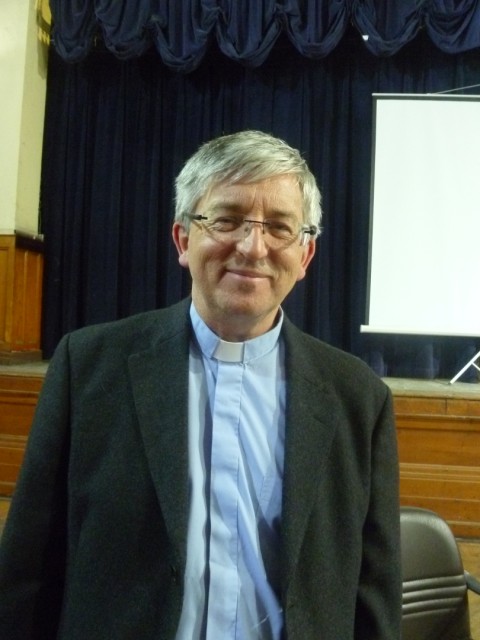
Rev. Stephen Sizer
Rev. Stephen Sizer

‘I chose to speak on child prisoners because it is there that I believe we see most blatantly human rights abuses,’ said the Revd. Stephen Sizer, vicar of Virginia Water in Surrey, England, a presenter at the conference, who helped assemble the sizeable British contingent.

A widely-published critic of ‘Christian Zionism’, he is currently under church investigation following a complaint – which he opposes – of anti-Semitism issued by the Board of Deputies of British Jews.

‘Israel breaches international law by transferring minors from Palestine to Israeli jails,’ said Mr Sizer to Lapido Media, referring to the Fourth Geneva Convention. ‘They should be returned to Palestine if they have committed offences.’

Stone throwing

Sizer’s report to the conference sponsored by the United Nations and Arab League says that most of the offences committed by children are throwing stones at soldiers or settlers in illegal Jewish settlements in the Occupied Territories.

‘Armed resistance of an illegal military occupation is legitimate in international law,’ said Mr Sizer.

Gerard Horton of Defense for Children International (DCI) who also attended the conference, does not deny children offend, but says that they have legal rights like anyone else.

‘Regardless of what they’re accused of, they shouldn’t be arrested in the middle of the night in terrifying raids, they should not be painfully tied up and blindfolded sometimes for hours on end, they should be informed of the right to silence and they should be entitled to have a parent present during questioning.’

A DCI-Palestine report found that among 311 sworn affidavits taken from children between January 2008 and January 2012, 90 percent were blindfolded and 75 percent suffered physical violence. A further 33 percent reported being strip searched, while 12 percent endured solitary confinement.

Mark Negev, spokesman for Israeli Prime Minister Benjamin Netanyahu has said in the past hat rock-throwing, throwing Molotov cocktails, and other forms of violence are ‘unacceptable’ – but stopping it should not be achieved illegally.

Israeli security agency Shin Bet denies the use of unlawful methods:  ‘No one questioned, including minors, is kept alone in a cell as a punitive measure or in order to obtain a confession,’ it says.

But one 16-year old Mohamed Shabrawi (16) of Tulkarem in the West Bank, cited by DCI, tells of soldiers seizing him in his home at 2:30am. He claimed he spent the first seventeen days of his detention in solitary confinement, and was told his family would be arrested if he did not cooperate.

After twenty days he first saw a lawyer. After twenty-five days he was formally charged. Finally, he confessed to being a member in a banned organization and was sentenced to forty-five days in prison.

Horton believes the abuse of children is meant as a deterrent, as many interviewed minors state they never wish to see another soldier or go near a checkpoint.

‘Human rights abuses occur on all sides,’ said Mr Sizer. ‘We are most concerned about the use of detention by the Israelis for political purposes.’

This article was first published on Lapido Media on January 2, 2012.

Related Posts:

Categories
Prayers

Friday Prayers for Egypt: Egyptian Jews and Salafi Splits

Flag Cross Quran

God,

Division does not please you. You have created us differently and esteem these differences. We have different opinions and go our different ways. But when we break relationship – forgive us.

As many in the liberal and leftist and revolutionary camps have come together to oppose the Islamists, honor them, even if their unity is temporary and superficial. Help them, God, that it may be otherwise. If they part may they part as friends, having accomplished good for Egypt.

At the same time, many in the Islamist camps are coming apart. The reasons are unclear, but appear to be personal, political, and administrative – not ideological. You know the heart of these leaders, God, but heal the divisions that they have. If ambition or strife stands in the way of worthy ideals, keep their house in order. If they part, may it be as friends, having accomplished good for Egypt.

Judge, God, if the division between these camps is honorable or displeasing. Heal the wounds that exist; correct the assumptions which poison. May each esteem the good in the other, and expose all wrong. Unite them in discernment, that together they may accomplish good for Egypt.

And bless those, God, who are healing historical division. Certain Muslim Brothers have invited Jews of Egyptian origin to leave Israel and reclaim their property and heritage. You know, God, the purpose and sincerity of such remarks, which the presidency has distanced itself from and other Islamists have rejected. But honor at least the symbolism – if not more – that Egypt may be a place of welcome for all people.

Be with Egypt, God. Grant the people a common vision to rebuild their nation. May you be pleased with what they create.

Amen.

Categories
Atlantic Council Middle East Published Articles

Israel’s Gaza Escalation Puts the Question to Brotherhood Rhetoric

Egypt Prime Minster Visits Hospital in Gaza

From my recent article on EgyptSource:

Yet from my perspective in Egypt, I wonder if the Israeli motivation is to test Cairo more than Hamas. Of course, domestic factors always outweigh international ones. But at the least Tel Aviv may wish to discover what sort of president it faces in Mohamed Morsy, if not seek to discredit him altogether.

Muslim Brotherhood rhetoric during the Mubarak administration was always to harshly condemn the state’s refusal to take decisive action against Israel vis-à-vis Palestine. Yet Mubarak was not shy to issue strong verbal condemnations against Israel, nor did he refrain from withdrawing his ambassador to Tel Aviv. Morsy’s government, to prove consistent, must do more.

Morsy is not the Muslim Brotherhood, officially, which allows for an undefined relation of influence and agency:

Interestingly, the Muslim Brotherhood called for massive protests on Friday, as did every other political force rallying behind Gaza. Opposition to Israel has always been a hallmark of every Egyptian political movement, but it is ironic to see liberal parties now in condemnation of an Islamist presidency’s failure to stand up to Israel. But the Brotherhood is not falling behind: It has called for cutting all ties.

Do they mean it? How much effort will they pour into protest mobilization? Are they forcing the hand of the president? Or are they simply covering themselves should Morsi’s obliged inaction have to be explained away later?

But maybe Israel is seeking more definition:

Perhaps Israel is nudging at one of these contradictions. Morsi and the Brotherhood built their power base on anti-Israeli rhetoric. Yet seeking the approval of the international community and commercial interests also pledged to respect all treaties. There is little wiggle room. If they imitate Mubarak’s outrage they risk losing the people. If they take decisive steps against Tel Aviv they risk losing credibility. Such are the demands of leadership; can they step up to the plate?

The full text notes also the domestic considerations of Israel’s actions, and notes as well certain conspiratorial factors involved. Please click here to read the article at EgyptSource.

Related Posts:

Categories
Prayers

Friday Prayers for Egypt: Gaza

God,

Above all, bring peace to Israel and Palestine. Stop rockets, stop killing, stop assassinations, and stop injustice. Allow all sides to argue over who most deserves these accusations, but draw them to a halt.

As for Egypt, where these arguments are few, give wisdom to the president and political leadership on how to intervene for peace. May he stand with victims and against oppression. Help him to mediate between his allies in Hamas and his oft-political targets in Tel Aviv. Help him to encourage the Americans to play a positive role. But guide him to the transcendence of politics to the resolution of conflict. May he do what is right, whatever that is.

Egypt needs unity and solidarity, God, but caution the people about rallying against an enemy. Bless all those who express concern for innocent Palestinians, and who seek to condemn the asymmetry of the strife. But for those who are angling for political gain, cause their efforts to come to naught. Grant Egyptians legitimate outrage over what has befallen their neighbors, and discernment to weigh injustice against propaganda.

And as Israel and Palestine confront their internal issues, limit the repercussions from spilling over into Egypt. Guard the border, God, and keep militancy from spreading to Sinai and beyond. For would-be militants already here, honor their sense of resistance and sacrifice. But direct their devotion to the cause of peace and justice, not to arms and invectives. May they harm no lives, be they Egyptian, Israeli, or their own.

Beat swords into plowshares, God. May those who love you lead the way.

Amen.

Categories
Personal

Building a Nation: America, Israel, and the Sins of History

Modern Israel suffers from the fact it started too late.

Israel, the Zionist project, was created as homeland for the Jewish people. Otherwise known as Israeli nationalism, it reflects the primary concept upon which modern international relations are built. Mostly homogenous populations in a given territory live within agreed upon borders.

There are messy points on the world map, but for the most part, the nation-state system has worked very well.

The messiest point, unfortunately, is Israel.

The problem with the nation-state system is that it was designed and enforced by the established powers of the world. These nations moved through a long evolution of subduing native populations, often by force. They forged borders through wars against the ‘other’, and instilled a master narrative of identity grounded in the togetherness of ‘us’.

Africa was outside this system, as its borders were drawn by colonial powers who exploited tribal identities. Once independent, these new nations rushed headlong into the effort to create a broader sense of nationalism. In some cases it worked, in others, it still does not even today.

More important with Israel, however, is the case of the Ottoman Empire.

The Ottomans were an Islamic empire ruled by Turkish blood. They presided over a vast swath of land; to preserve their dominance they allowed local communities a great degree of self-rule. These were not on the whole territorially-defined communities, however, they were ethnic groups living here and there, often inter-mixed with the local population of whatever area they dwelled in. It was, especially in the cities, a diverse and cosmopolitan system. It was an empire, and it attracted businessmen and craftsmen from around the world.

The defeat of the Ottoman Empire ushered in the already developing but not yet codified nation-state system. Following World War I the various ethnic communities lost their system of sponsorship, as newly freed lands adopted the ways of nationalism, stressing homogenous population.

The modern state of Turkey was attacked by Greece; having failed, Greeks in Turkey repatriated, and Turks in Greece did the same. This is also the era of the Armenian massacres; minority populations around the region suddenly found themselves without a home.

The unsettledness continued in the interwar period, and began afresh when regional states acquired greater degrees of independence following World War II. Nasser’s nationalism – well suited for displacing the last vestiges of British imperialism – also resulted in the exodus of Egypt’s Greeks and Jews. Egypt became for the Egyptians (Copts included) just as France was for the French and Germany for the Germans.

Egypt became like the nations of the world.

Israel, however, only began its national project at this time.

With the collapse of the Ottoman Empire emigration of Jews to Palestine increased steadily, as Zionism became a political concept. Aided by the horrors of the Holocaust, the world acceded to the concept of a Jewish homeland. Between the two world wars the tension of Jewish immigration was mitigated somewhat by colonial control. After WWII, however, the British wiped their hands of the problem and gave it to the United Nations.

The UN sought a partition plan, but amid Arab objections sanctioned Israel as a nation in 1948. It was only then that Israel could begin the process of entering the world system – crafting a mostly homogenous state in a given territory with agreed upon borders.

Only the territory was not homogenous – Arabs outnumbered Jews in the land as a whole. And today, post-1967, the territory has no agreed upon borders.

Though the nation-state system has been largely successful, this is why Israel is one of its messiest challenges.

The United States of America, meanwhile, is one of its top successes. Borders are well defined. There is little colonial baggage. Not only is the population mostly homogenous, but minorities within have adopted the overarching national narrative and identity. All are Americans, equal in rights and duties.

Except it is not true; the narrative blinds many to the historical reality of how America became a nation-state.

It is not true because Indians, Native Americans, can live within special jurisdictions scattered throughout the fifty states. This provision is part of assuaging the national guilt which systematically appropriated their lands for a rapidly growing native and immigrant population. Many Americans realize this, of course, but it is too late to change anything, and it is best not talked about much. Why bring up the sins of the past?

But with Israel, these are the sins of the present.

Americans might be able to ask themselves what they would have done differently if they lived in the days of Manifest Destiny and ‘Westward Ho!’ The moral compass presently lauded might have made a difference in securing justice for Native American peoples, if history could be revisited.

Israel is not America, of course. Americans have no right to lecture, let alone interfere, in Israeli-Palestinian issues.

Yet given the great groundswell of American support for Israel, especially among those who consider themselves moral, it is fair to ask if a review is in order.

Again, Israel suffers only from timing.

The United States and other great countries in the nation-state system were not hampered by thorny issues of human rights and UN resolutions. These countries formed their states far from the eye of a critical press and universal declarations. Today, reformed, they issue their moral pronouncements on the conduct of others.

Hypocrisy aside, Israel’s conduct is worthy of question. Israel proper, largely, can lay claim to having built its nation. Arabs will cry foul over the historical process of native displacement, but today Israel is a mostly homogenous population in a given territory. As such, it is a member in good standing of the international community.

Except for its borders.

In contravention to the rules of the international community, Israel maintains its firm control of the occupied territories of the West Bank, Gaza, and the Golan Heights. In contravention to the rules of the international community, Israel maintains its policy of transferring settlers into these territories and appropriating land.

Both Jews and Palestinians, as people, should have the right to a secure life and self-governance.

At issue is that the system of the nation-state has now outlawed the means of creating a nation. Israel is only imitating those who have gone before; perhaps Palestinians would do similarly if given the chance. Certainly some Arabs wish for the Jews to all go back to where they came from.

But for those watching of moral compass, these are the days of Manifest Destiny and ‘Westward Ho!’ If we can imagine what we would have done differently then, we must consider what we will do differently now.

Otherwise, history will repeat itself. Native Americans and Palestinians will weep together.

Note: This essay was written following the viewing of the documentary ‘With God on our Side’. Click here to watch a three minute clip from the film exposing the Separation Barrier. It was built ostensibly to prevent terrorism, and perhaps it did. Yet it was built not on the border, but on occupied territory, nudging the still-undefined boundaries of Israel further to the east. Produced mostly for Christians, the film is highly recommended.

Related Posts:

Categories
Prayers

Friday Prayers for Egypt: IMF, Sinai, China, Iran

God,

Much of Egypt’s attention turned outside its borders this week, and though Sinai is not foreign, it is almost a separate land. Military operations against Islamic extremists have been underway for some time, but lately there have been religious delegations sent, even from the president. These have involved former jihadists who wish to turn those in Sinai from the error of their ways. Or, at least, to halt operations.

Meanwhile the president has been in personal deliberations with the IMF over a nearly five billion dollar loan to support the economy. Beyond the financial implications lie religious controversies, if Islam permits such interest based credit. Now in power, Islamist seem to be finding it more difficult to forbid, while others – supporters and opponents – accuse them of hypocrisy.

A useful escape and popularity boosting effort was provided by the president’s travels to China and Iran. In the former he reinforced and increased economic ties, while in the latter he stood on the world stage of the Non-Aligned Movement and condemned Syria without wholly offending Tehran. Egypt and Iran have been without ties since 1979. In both nations he demonstrated a desire to move beyond uni-polar dependence on the United States.

These are the matters of governance, God, and bless Egypt in them. Give peace to the Sinai, and convict criminals who use violence in the name of religion. If there is any duplicity involved, as some liken to the political use of the US War on Terror, then expose manipulations, God. And anticipating evolution of the region to touch the Camp David Accords with Israel, may these two nations speak to each other and find ways toward mutually agreeable and just peace. Amid it all, bless the people of Sinai; may they find full citizenship and freedom of opportunity in the new Egypt.

As for the IMF, God, give the president good and honest advisors. May those who know economics well sort through the competing propaganda on the liberating / enslaving nature of IMF monies. Whatever the outcome, may the economy stabilize with sovereignty secured for the Egyptian people. As for the relationship between Islam and interest, preserve the integrity of the religious scholar. May he not bend to political pressure, nor pander for political influence. May he fear you alone as he guides the people.

As for foreign policy, give wisdom among competing interests. May the president serve only that which serves his people. May Chinese investment create jobs and aid infrastructure. May Syrian criticism lead to the cessation of violence and bloodshed and a just solution to popular grievances. May Iranian contact promote dialogue between former enemies and possibly current adversaries.

May the region avoid more war.

God, rebuild Egypt and help her to turn to all the practical matters of governance. Yet while these international issues are of deep importance, provide solutions soon to the domestic problems which plague Egypt. Restore security; lift the economy; help the poor. Build an open, free, and democratic structure to include all. Resist any attempts to close ranks, settle scores, or marginalize.

Give respect among Egypt’s political forces, one to the other. Give respect between poor and rich, and narrow the gap between. Heal wounds; issue justice; promote reconciliation.

God, the solutions to these conundrums are in your hands. Enlighten Egyptians that they may find them as well.

Amen.

Categories
Prayers

Friday Prayers for Egypt: Rafah


God,

Once again Egypt is bloody. When manipulations are political it can be understood as the nature of politics in times of transition. Yet this manipulation is evil. Sixteen soldiers were killed on the border with Gaza, by as yet unknown assailants.

Early reports blamed terrorist Islamist groups based in the Sinai. Then links with Hamas or other Palestinians were proposed. Some turned the other direction, including the Muslim Brotherhood, and alleged Israeli involvement.

The political fallout has similarly been all over the map. Some try to link the inefficient Morsy government to lax security and Islamist emboldening. Others nudge at the military council as proof they should leave transitional oversight and get back to protecting the borders. In the background is a budding new and anti-MB revolution planned for August 24, as well as moves to replace editors-in-chief of state newspapers and reorganize spy and security leadership.

The nation is abuzz, all while mourning.

In it all, God, who represents evil? Who would kill to advance their political goals?

How much longer must Egypt suffer, God? Encourage those who believe what has happened in the revolution is good, even if there is much wrong to overcome; even if there is much wrong in store.

May good men prevail. May those who have committed this atrocity be brought to justice. May those behind them be exposed.

May good men shoulder responsibility, God. May they find the truth and tell it. Cause all secrets to come to light; cause all rumors to dissipate. May Egypt be built again, but on a firmer foundation that what was.

Give strength, God. Give Egyptians faith to seize their nation and participate in shaping it. May that which was beautiful not be lost, as they discover now the road is hard and long.

Make it shorter, God, but more importantly, make Egyptians into the kind of people who can endure it. On the other side, may they be whole.

Spare the people any more violence.

Amen.

Categories
Lapido Media Middle East Published Articles

As President Morsy Preaches Peace, Muslim Brotherhood Sanctions Jihad

Morsy hailed at Tahrir Square

In both his presidential campaign and inaugural addresses, President Mohamed Morsy has assured the world of Egypt’s commitment to peace. Yet in the run-up to the final election on June 14, the Muslim Brotherhood published an Arabic article calling this commitment into question.

‘How happy would Muslims be if the leaders of the Muslims … would make recovery of al-Aqsa Mosque [in Jerusalem] their central issue – to cleanse it from the filth of the Zionists and impose Islamic sovereignty over all quarters of Palestine,’ wrote General Guide Mohamed Badie, the group’s top leader.

Furthermore, he referenced a fatwa given by ‘Muslim scholars’ without further designation, ‘Jihad with life and money for the recovery of al-Aqsa Mosque is an individual duty incumbent on every Muslim.’ The article was published on IkhwanOnline, the official website of the Muslim Brotherhood.

This message is very different from the public statements of Morsy, who emerged from the Brotherhood to win Egypt’s first free democratic presidential election.

‘We will preserve all international treaties and charters,’ said Morsy. ‘We come in peace.’

Though Israel was never mentioned by name, the inference was obvious.

The international community is watching closely as importance lies in what Morsy does, not in what he says. Still, his assurance is understood as one of the necessary guarantees to the Egyptian military as well as the United States to not stand in the way of a Brotherhood presidency.

Yet the principle of action over rhetoric is necessary also concerning domestic Brotherhood politics. As US-MB delegations were in continual contact, Badie’s article sanctioning jihad betrays little intention to honor a peace treaty. On the other hand, at this point, they are just words, not actions.

Which words should be believed?

According to Sheikh Osama al-Qusi, an Egyptian Salafi scholar with no love for the Brotherhood, the word jihad does not necessarily imply fighting. ‘The term with life designates that one must be ready to give his life for the cause of Islam. It may include engaging in battle, but this is not demanded.’

Even so, al-Qusi links ‘jihad with life and money’ to its Qur’anic source, where God instructs the Muslims, ‘Allah has purchased from the believers their lives and their properties [in exchange] for that they will have Paradise. They fight in the cause of Allah, so they kill and are killed.’

Speaking with Lapido Media, Muslim Brotherhood spokesman Mahmoud Ghozlan makes a different distinction. ‘As a citizen I am different from the state or the presidency,’ he says.

‘Just because we have gained the presidency should we give up on our principles concerning Palestine, including that Jerusalem is for us?’

Ghozlan then reiterated Morsy’s assurances that Egypt would respect all international treaties. Indeed, the rest of Badie’s article references non-violent methods to expose Israeli occupation of Palestine, such as the ‘Miles of Smiles’ aid convoys from March 2012 to break the blockade of Gaza.

Dr. Nadia Mostafa, professor of international relations at Cairo University, agrees with this non-violent interpretation. ‘We can make jihad,’ she told Lapido Media, ‘in a different way.

‘It does not mean to make a suicide bomb. Jihad with life means we must offer everything in our life for the just cause, even to the last extent in which I die.’

Badie’s article, indeed, does not call specifically for jihad. It urges patience on the Palestinian people and a focus on reconciliation between Fatah and Hamas.

Yet it also urges persistence, that they should make their ‘motto and starting point the confrontation of the Zionists’. That is, perhaps, it is a Palestinian struggle, even if they should be encouraged that ‘every sincere Muslim mujahid in every nation of the world stands with you’.

For Mostafa, Palestine is the issue which will decide the presidency of Morsy. But it must not be allowed to distract from critical domestic issues, including overcoming the secular-Islamist divide. She expects, however, a firm rejection of the Gaza blockade.

‘The Brotherhood will say what they have to say, but we must separate between them and the presidency, and I believe Morsy understands this well.’

Mohamed Morsy formally ended his membership in the Muslim Brotherhood following his official declaration as president.

As president, however, he is not expected to have much love for Israel, no matter his international obligations. Political analyst Sameh Fawzy expects a zero-tolerance strategy towards Israel.

‘Egyptians have had a very limited margin of normalization with Israel over the last decades,’ Fawzy told Lapido Media. ‘This margin is expected to be even narrower than before.’

Therefore, while the Muslim Brotherhood may well continue its strident rhetoric, Fawzy believes the Israel file will remain in the hands of the foreign ministry and security apparatus.

While these cabinet positions are still being negotiated, many analysts believe these ministries will remain firmly under military supervision, if not direct control.

This combination is not predisposed to result in war, but the consequence may well be a continuation of the status quo. For Fawzy, the bilateral outlook is bleak.

‘Cold peace is the expected option.’


Published first at Lapido Media.


Related Posts:

Categories
Aslan Media Middle East Published Articles

US Congressman Advocates ‘Limited Voting Power’

Does the phrase used in the title of this post suggest images of dictatorships restricting the rights of its people? Perhaps instead the decline of representative democracy in the face of big business and multinational corporations?

On the contrary, it is the positive suggestion issued by a US congressman, though fortunately, concerning no one in his own constituency.

Joe Walsh is a Republican congressman from the 8th district of Illinois. On May 3 he penned an op-ed for the Washington Times, reprinted in the Jerusalem Post, advocating a one-state solution in Israel.

The one-state solution is not a bad idea; I have cautiously advocated for it here. The basic premise is that Israel, the West Bank, and Gaza would be incorporated into one state. This would drop the contentious negotiating and intractable issues of the two-state solution, and the difficulties of creating an independent Palestine.

The issue with Walsh is that he argues for an Israel for Israelis. It would go too far to say ‘only’, but his preference is obvious. He writes,

Those Palestinians who wish to may leave their Fatah- and Hamas-created slums and move to the original Palestinian state: Jordan.

Unfortunately, the will of sovereign Jordan does not enter into his analysis.

But the rub of his Israeli preference bears ill fruit just a few words later, when he discusses those Palestinians who do not leave.

Those Palestinians who remain behind in Israel will maintain limited voting power but will be awarded all the economic and civil rights of Israeli citizens.

Let us admit that these economic and civil rights are substantial. Yet how is it possible that a proud inheritor of ‘all men are created equal’ and ‘out of many, one’ might limit the fundamental political rights of a whole class of people?

As long as Israel maintains the Palestinians in their occupied territories, they have no claim to political rights in the Israeli system. Yet Walsh advocates the annexation of these territories, making Palestinians, at the very least, residents of Israel.

For Walsh, this does not make them citizens.

Rev. Stephen Sizer has described the dilemma of the Israeli situation. There are three choices:

1)      Allow an independent Palestinian state and maintain a Jewish and democratic Israel.

2)      Create one democratic state of all the territories, giving up a mandated Jewish nature.

3)      Maintain the occupied territories and forfeit the democratic nature of a still Jewish state.

Walsh has amended the third choice: Create one nation but limit democratic rights.

Within the op-ed Walsh does not elaborate on his proposal. What sort of ‘limited voting power’ does he intend? Readers are invited to share if they have heard Walsh out and can demonstrate consistency with cherished American values.

On current reading, however, Walsh appears to hold to the values of Manifest Destiny and the 3/5th Compromise. At one time, these were American indeed.

May the people of the 8th district in Illinois judge if they remain so.


Related Posts:

Categories
Personal

Christian Zionism: A Lecture in Cairo

Rev. Stephen Sizer

Rev. Stephen Sizer, a renowned expert on Christian Zionism delivered a series of lectures in Egypt at Cairo University, the Anglican Cathedral, and other venues. This article is a summary of his presentation delivered on February 15, 2012.

According to Sizer, Christian Zionism is the view that the modern state of Israel is the fulfillment of Biblical prophecy and thus deserving of our moral and political support.

Sizer opened with a brief history of Zionism, tracing its first political sponsor to Napoleon, who wished to wrest Jewish banking favor away from the British Empire in their struggle for supremacy. Britain eventually emerged triumphant, and then engaged Germany in the lead up to World War I, as both sides solicited Jewish favor in exchange for their support for a return of Jews to Palestine. The Belfour Declaration in 1917 was the pinnacle of Britain’s promise, set in the context of many geopolitical maneuvers with both Jews and Arabs.

The Christian element of Zionism received a great boost with the election of President Jimmy Carter in 1976, who believed the state of Israel represented the fulfillment of prophecy. During this time Rev. Jerry Falwell emerged as the leading advocate of Christian Zionism, and promised 70 million evangelical Christian votes for supporters of the cause.

After his death in 2007, Rev. John Hagee received his mantle, promising 50 million evangelical Christians would stand side-by-side with the 5 million Jews of Israel. Today, Sizer estimates 25% of US Christians identify with Christian Zionism, though this contrasts with only 5% of Christians worldwide.

Sizer identified five primary theological underpinnings of Christian Zionism, including:

  • Jews are to be restored to Greater Israel
  • Jerusalem is the eternal Jewish capital
  • The Jewish Temple is to be rebuilt
  • Antipathy towards Arabs and Islam
  • There will be a war of Armageddon

Theology, he noted, drives behavior. Sizer then illustrated how Zionist Christians:

  • Contribute money to support settlements and help Jews emigrate to Israel from Russia and elsewhere
  • Lobby the US government to move the embassy from Tel Aviv to Jerusalem
  • Support the Orthodox in their effort to rebuild the Temple
  • Oppose the peace process as it compromises ownership of the land
  • View politics through the lens of a coming war between Russia, China, Arabs, and Europe against Israel

The consequence of Christian Zionism, Sizer noted, was the destruction of the church in the Middle East. Historic Arab Christian communities are being squeezed by the competing powers of Zionism and Islamism, finding no place for themselves. Many are immigrating.

Former Archbishop of Canterbury George Carey warned that the holy sites of the Middle East could be transformed into a Christian theme park, in which the only Christian witness is carried by tourists and pilgrims.

Sizer closed his remarks by quoting from the 2006 Jerusalem Declaration on Christian Zionism, signed by the heads of the Latin, Syrian Orthodox, Anglican, and Evangelical Lutheran churches in Jerusalem. Highlights include:

We categorically reject Christian Zionist doctrines as false teaching that corrupts the biblical message of love, justice and reconciliation.

We reject the teachings of Christian Zionism that facilitate and support these policies as they advance racial exclusivity and perpetual war rather than the gospel of universal love, redemption, and reconciliation taught by Jesus Christ. Rather than condemn the world to the doom of Armageddon we call upon everyone to liberate themselves from the ideologies of militarism and occupation. Instead, let them pursue the healing of the nations!

We call upon Christians in churches on every continent to pray for the Palestinian and Israeli people, both of whom are suffering as victims of occupation and militarism.

We affirm that Israelis and Palestinians are capable of living together within peace, justice and security.

We are committed to non-violent resistance as the most effective means to end the illegal occupation in order to attain a just and lasting peace.

With urgency we warn that Christian Zionism and its alliances are justifying colonization, apartheid and empire-building.

During a question and answer session afterwards, Sizer explained how Israel would like to have three separate achievements, but can only have two. These include:

  • Democracy
  • A Jewish State
  • The Occupied Territories

Israel can succeed in being a democratic Jewish state if it gives up the territories to an independent Palestine.

Greater Israel can succeed in being a democracy should it incorporate the inhabitants of Palestine as full citizens with equal rights, if it gives up its Jewish nature.

Or, Israel can succeed (?) in being a Jewish colonial state, but only at the expense of giving up its democratic nature.

Sizer’s presentation was warmly received by the majority of attendees, many of whom were less than familiar with this largely American religious phenomenon. The only issue taken with Sizer was his acceptance of the term, Christian Zionism. Some angrily rejected the coupling as an oxymoron – Zionism is not Christian at all.

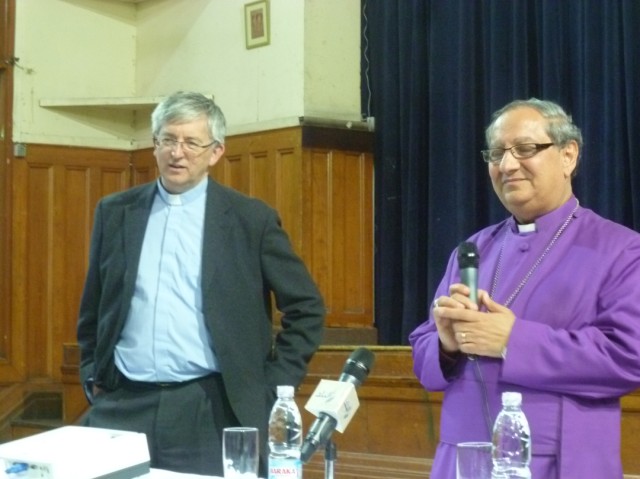
Rev. Sizer and Bishop Mouneer, who provided translation into Arabic.

Personal Reflection

I wince when issues of the world are reduced to banking and Jewish conspiracies. Sizer does not take this bait and run with it, but much of anti-Zionist discourse does. Still, ‘follow the money’ is a truth worth reflecting upon, but surely historic world capital has been available via other than the Jewish ‘cabal’, no matter how disproportionate Jewish influence might be relative to their population.

Yet from my superficial studies of world Judaism, I believe that for most of modern history the majority of Jews have been anti-Zionist themselves. Before the creation of Israel they waited for the advent of the Messiah to restore their fortunes to Jerusalem. Furthermore, many deemed Zionist efforts to be counter-productive to the social necessity of proving themselves loyal citizens to the nations in which they lived. Why then would Jewish bankers wish to swing worldwide sentiment to creation of a Jewish state? Far more research than I have done is necessary to determine the validity of the question, but however it is sliced, Zionism is a peculiar entity.

As per Christian Zionism, I wish to recognize first that few evangelicals I am familiar with would use this phrase as a self-appellation. It is not a movement, however much it is a sizeable theological-political sentiment. Moreover, its sympathizers are good Christians, contra the disbelief of some who commented at the close of the lecture. Money given to support poor Jews in Russia may be manipulated politically, but it comes from a generous heart to help ‘the least of these’, as Jesus commanded.

One omission from this particular lecture of Sizer was an evaluation of the Biblical sources. Why is Christian Zionism faulty interpretation? Its proponents certainly name chapter and verse to demonstrate the grand plan of God.

Sizer’s website contains resources to address this question, as do the writings of Colin Chapman. I do not wish to enter into this discussion here, but it will suffice to say I recognize many of the principles of Christian Zionism, or of dispensationalism, its theological underpinning, as worthy Biblical options for interpretation. Christians disagree over interpretation all the time – what is important is that a common reference point judge between disputants. Both sides appeal to scripture, and therefore must not be excluded as the enemy, even if in error.

For me, the definition of Christian Zionism as given by Sizer contains the key to its essential error. Modern political Israel may or may not be the fulfillment of Biblical prophecy. Yet even if it is, this should not translate into the necessity of moral and political support.

Rather, it is the principles outlined in the Jerusalem Declaration that must guide Christian evaluation of Israel, as of all nations, including their own. Do the policies of a state nurture or hinder the flowering of love, justice, and reconciliation? Careful reading of the news is necessary, but in many cases the government of Israel violates these values. When it does, Christians must object.

The Bible maintains that it was God’s anointed hand and the fulfillment of prophesy which smashed the Jewish state via the scepter of wicked Babylon in 586 BC, and then again by the Roman Empire in 70 AD. That this was God’s design did not call on the people to approve, only not to stand in the way. On the contrary, in the case of Babylon God promises he will judge its rulers for their injustice and oppression.

Is God moving history toward a final confrontation between the world and Israel during which Jesus will return and inaugurate his kingdom? Perhaps. Those who scoff would do well to view events through this particular interpretive lens and gauge the odd correspondence. Why else would such an unimportant piece of land command attention of the whole world?

Yet even if this vision is true, God will hold Israel’s leaders to account for their conduct – not based on political exigency, but on divine righteousness.

He will hold Christian Zionists to account all the same. He will, in fact, judge the world.

As Coptic Orthodox repeat incessantly in prayer, ‘According to your mercy, oh God, and not according to our sins.’

note: Please click here for a five minute video of Stephen Sizer giving an interview to a member of the Arab media after his presentation. Due to sound quality the questions were edited out, but should be clear enough from his answers given, which are presented in full.


Related Posts:

Categories
Personal

Muslim Brotherhood Ties Israel Peace to US Aid amidst NGO Crisis

Essam el-Erian, a senior leader in the Egyptian Muslim Brotherhood, called into question the Brotherhood’s commitment to the peace treaty with Israel.

Essam el-Erian

He commented on the ongoing NGO crisis embroiling the United States and Egypt. American and local NGO personnel in Egypt stand accused of fermenting chaos under the guise of democracy promotion.

The US has warned $1.3 billion in annual aid is in jeopardy if the charges, denied as frivolous, are not dismissed.

Erian told Lapido Media, ‘If the US withdraws its aid it gives us the right to review our side of the agreement as well. Aid is a part of the Camp David Accords, or why else would the US be giving this money to Egypt?’

There is only one problem. Former US president Jimmy Carter, who orchestrated the accords in 1978, stated, ‘There was no commitment of any finances going to Egypt as the result of the Camp David Accords.’

Is Erian ignorant of the text of these accords, or is something else in play? According to Raymond Ibrahim of Jihad Watch, Erian’s words fit into a larger context of Islamic behavior based on ‘circumstance’.

‘All Islamists understand that the treaty with Israel is a matter of necessity (i.e., Egypt cannot at the moment defeat Israel, therefore it is in its own interest to agree to peace). Might as well get money out of it.’

Ibrahim recently highlighted a video of Yasser al-Burhami, a prominent sheikh with the Salafi Call, an ultraconservative Muslim association. Burhami comments on how Mohamed at times made peace with the Jews, and at other times, subdued them through force and imposed jizia, a payment by non-Muslims in return for protection within the Muslim community.

Burhami then generalizes, ‘The prophet’s methods of dealing with infidels are available for Muslims to replicate depending on their situation and their capabilities.’

Speaking to Lapido Media, Ibrahim gave application. ‘Islamist politics and worldview are quite clear that once capability allows, Islam must go on the offensive.’

Gamal Nassar, a leader in the Muslim Brotherhood from Giza, Cairo, reinforces the notion of circumstance while commenting on Erian’s statement. ‘Things have changed since the revolution, and the US must realize it is not the same as before.’

Sheikh Osama al-Qusi is an independent Salafi scholar often criticized in his community for distinguishing between the affairs of religion and the affairs of the world.

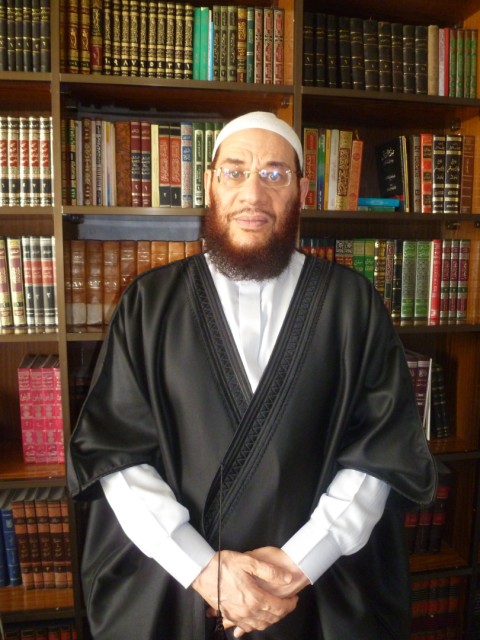
Osama al-Qusi

Qusi notes that Burhami is correct in terms of Mohamed adapting to his circumstances, but notes many Islamists take this as license to be Machiavellian. Even so, ‘Just because Mohamed did something politically does not mean it applies to us. No, we must leave politics to the politicians.’

Furthermore, circumstance does not change the Islamic attitude toward other communities. ‘We are peaceful with those who are peaceful with us, and we fight against those who fight against us.’

Yet for many Islamists, ‘us’ applies to all Muslims. Essam al-Sharif is a leader for the Salafi-based Authenticity Party in Warraq, a district of Cairo. ‘According to sharia law, I have the obligation to defend Muslims.

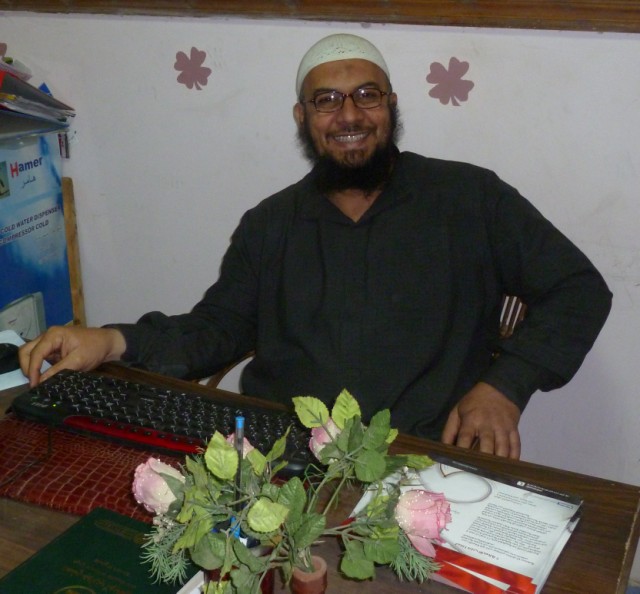
Essam al-Sharif

‘If the Camp David Accords do not allow us to help the Palestinians in Gaza it is invalid and we must fight Israel. In sharia we respect the borders of this world administratively to honor our agreements, but they do not override our duty to support Muslims.’

Sharif believes Muslims must treat non-Muslims well whether they are strong or weak regardless of their circumstances. Yet this does not preclude jizia, and Muslims must be honest about it.

‘If we say we will not collect jizia, this is hypocrisy. No, non-Muslims must pay it, even if we are too weak to collect it now.’

Sheikh Abdel Muti Bayyoumi is a member of the Azhar’s Islamic Research Academy, a pillar of the Islamic establishment in Egypt. He dismisses Burhami completely, saying he is not specialized in jurisprudence, and is not fit to issue religious rulings.

Bayyoumi agrees the Quran allows Muslims only to fight those who fight against them. Where there is a pact of peace, however, Muslims must work with non-Muslims for justice.

As this concerns Israel and the opinion of Erian, ‘There is no relation between US aid and the Camp David accords. Thus, we are still bound to the treaty so long as Israel also keeps to it and does not review it first.’

Interestingly, Carter suggests issues of justice have been neglected in the treaty.

‘There is one element of the Camp David accords that has been abandoned in the past, even in Egypt, and that is the protection of the Palestinian rights.’

Interpretations of Islam are part and parcel of post-revolutionary Egyptian attitudes toward peace with Israel. Some reflect Burhami’s attitude about ‘circumstance’, and others Bayyoumi’s attitude about justice.

With whom does Erian’s interpretation lie?


Related Posts

Categories
Personal

Rethinking Iran

English: President of Iran @ Columbia University.

Three reports related to Iran came across my attention this past week. All three cast doubts upon the common American narrative of Iran as an evil Islamic nation bent on destroying Israel through a developing nuclear weapons capability. There may be ample reason for the United States to oppose Iran as a geopolitical opponent; care must be taken, however, that American public opinion not submit to manipulative propaganda or self-deceit over assumed righteousness.

An example of this last sentence may be viewed here on YouTube, in which a TV commentator argued the US has the ‘moral authority’ to launch a pre-emptive strike on Iran, which ‘deserves to be annihilated’ because they are ‘evil’.

This rhetoric is parallel to the statement of Iranian President Ahmadinejad to ‘wipe Israel off the face of the earth’. Lest the tit-for-tat be accepted and dismissed as the voice of two extremists, however, the first report suggests Ahmadinejad’s statement was never made at all.

Shortly after his election in 2005, the New York Times quoted Ahmadinejad in a conference entitled ‘A World without Zionism’, ‘As the imam said, Israel must be wiped off the map.’

In a full translation, the NYT issued a slightly different version: ‘Our dear Imam said that the occupying regime must be wiped off the map.’

Perhaps this translation, however, also took liberties.

In analyzing the speech and providing a word for word translation, Arash Norouzi states Ahmadinejad said: ‘The Imam said this regime occupying Jerusalem must vanish from the page of time.’ Click here for his further analysis, including a survey of how this quote transformed itself in the media into ‘from the face of the earth’, as well as the context in which the quote from the Ayatollah Khomeni – not Ahmadinejad – is utilized.

The brief story, interestingly, does not simply blame Western powers with outright invention. Rather, it was the Iranian IRNA news agency which (mis?)translated his statement as ‘wiped off the face of the map.’ From here the story has become well known, and Ahmadinejad has been compared to a new Hitler desiring a new Holocaust.

Only God knows what is in his heart. Yet from his words he is not arguing for a nuclear strike to demolish Israel as a nation. He is wishing the removal of the Israeli government which according to international law illegally occupies Palestinian land. As Arab revolutions have called for the fall of the regime – Mubarak, etc – he was not specifically calling for the destruction of the state, let alone the Jews as a people.

There is a more than fair possibility Ahmadinejad views Israel, like many Muslims, as an illegitimate creation of Western dominance, and would wish to see its disappearance as a political entity. Repetition of ‘wiped off the map’ or ‘from the face of the earth’, however, must not be utilized in a campaign to demonize him or the Iranian regime.

He did not say it.

Could he do it? Well, this is the focus of the continual focus on Iran’s purported efforts to develop a nuclear weapon. This second news item was widely reported, so it is likely to have already entered American consciousness. While the UN’s atomic energy watchdog has reported that Iran is taking credible steps to enrich uranium, the New York Times released a report doubting Iranian efforts to make a bomb.

The NYT report relies on what it terms ‘the consensus of American intelligence agencies’. That is, our people tasked with determining what is happening on the ground do not believe Iran is undertaking steps to develop a nuclear weapon. Read the whole article for what uranium enrichment might entail, as well as the Israeli intelligence opinions which doubt the American consensus.

As above, the truth of the matter may be difficult to obtain. The point is to take note of all evidence which runs counter to a rush at demonization, and worse, a call to war. The call has not been issued yet, but some are certainly arguing for a pre-emptive strike, at the least.

The third news item is not as geopolitically important as the first two, but serves similarly to call into question established conventional wisdom. There is palpable fear, much of it reasonable, that the Arab revolutions opened the door to the rule of a backwards and inflexible sharia law. Of the Muslim nations in the world, Iran is one of the few to actually seek its full implementation.

This is why it is noteworthy to recognize the Iranian parliament amended all laws to forbid the penalty of stoning, whether for adultery or other offenses.

That this is a debate at all will lend evidence to common Western opinions about the backwardness of Iran and the nature of Islamic sharia. The more nuanced point to take away is that Iran – far removed from any need to polish its reputation to the West – decided to reinterpret sharia. The linked article details the internal controversy this has sparked, but gives evidence that a legal reference to sharia, demanded by many Islamist parties, does not necessarily entail draconian provisions cemented during the Middle Ages.

None of the above argues in favor of sharia, only that in all cases, what is accepted as the law of God can only be implemented by the hands of men. Men can be just or unjust with any legal code, not all of which are equal.

A fourth news item, however, serves to reinforce the common narrative. Christian pastor and Muslim convert Youcef Nadarkhani still faces the sentence of hanging for his apostasy.

Does Iran hate Israel and desire its destruction? Is it seeking to produce a nuclear weapon? Does it enslave its people through medieval codes of justice?

The answer to each of these questions is maybe. It is the task of diplomats, intelligence agents, and human rights activists to answer this question more definitively, and it is the task of media to convey their answers to the public.

What I fear is that some media has also taken upon itself the task of simplification at the least, obscuration perhaps, and manipulation at the worst. Many paint Iran as the chief obstacle to world stability, yet this map – however disputable in detail – paints a different picture as to which nation is under threat:

American Military Bases Surrounding Iran

It is a given that every nation must pursue its interests, and these are often at odds with one another. Yet the United States suffers from the inconvenient reality that the majority of its population holds to a sense of morality vis-à-vis interests. In order to take decisive steps in the international arena, the government must assure the public it is an issue including right versus wrong.

In the case of Iran, the United States may well be ‘right’. America has strong and legally enshrined traditions of freedom, human rights, and respect for national sovereignty. Yet we must be aware not only of the above counter-interpretations concerning Iran, but moreover the reality of this American truism. We are not free to simply impose our will, we must remain a defender of freedom and justice for all.

Were this not so we could simply be an empire.

Therefore, when the truism is summoned, it can also be doubted. Is our Iranian policy determined by freedom and justice, or are these principles manipulated to support a more interests-based global agenda? I don’t know, and the problem is the vast majority of the public does not know either. But at the very least, we must ask the question, and not allow misrepresentation when it is discovered.


Note: One posited explanation can be found here, defining the issue in terms of global energy and currency. Common tropes, to be sure, which also deserve to be questioned.


Related Posts:

Categories
Personal

Christians in the Sinai

The Sinai Region

Bishop Cosman is the presiding bishop of the Coptic Orthodox Church in the diocese of North Sinai, consisting of an area 200km long and 127km deep. This roughly stretches from Port Said to Suez along the west (though these cities do not belong his bishopric).

Bishop Cosman states that the population of his bishopric is roughly 400,000-500,000 people, of whom about 3,000 are Christians, represented by 740 families. By contrast, over 2,000 Christian families live in the urban Cairo district of Hadayak al-Maadi. The bishop relates that the low population density makes for a quiet life, and that Christians have good relations, by and large, with their neighbors.

There are two principle cities in North Sinai, Rafah and Arish, each of which has been in the news recently with regularity. Rafah is the site of the crossing into Gaza, which was reopened following the reconciliation of rival Palestinian factions Fatah and Hamas. As the reconciliation has sputtered, however, so has the crossing of goods through the border, as many restrictions remain. Illegal tunnels in the area compensate in black market trade, and near here Gaza Palestinians stand accused of crossing the border to infiltrate through Sinai to Eliat, where several Israelis were murdered in a terrorist attack.

Arish, meanwhile, has been the site of internal Egyptian unrest. On Jan. 29 following a massive, peaceful Muslim Brotherhood and Salafi demonstration in Tahrir Square and elsewhere, including Arish, masked gunmen attacked the city police station in a shootout lasting several hours. Flyers were distributed calling for an Islamic emirate in the Sinai, linked to a supposed local al-Qaeda branch. This event that prompted the entry of the Egyptian military, though special agreement had to be secured first with Israel, as much of the area is demilitarized as mandated by the Camp David Accords.

Each of these two cities hosts a Coptic Orthodox Church. Arish is the seat of the bishopric, which was built in 1939 in the neighborhood of Dahya. Rafah, however, hosts the only licensed church, which was built in 1996. This church, however, was destroyed during the lawless initial days of the Egyptian revolution, and has not yet been rebuilt despite promises by the state, according to Bishop Cosman. He states the Christians are waiting patiently to take their rights to pray in Rafah Church. He does not know who committed this crime, as the sixty-plus attackers covered their faces while wielding automatic weapons.

In addition to the two churches the diocese owns three additional ‘service buildings’ that resemble ordinary structures but host regular masses and provide social outlets for the Christian community. Two of these buildings are in Arish itself, with the other in Masa’id, a smaller town roughly 12km to the east. A community of five priests, in addition to Bishop Cosman, serves the Christians of the area.

Only two of these priests, however, stem originally from the diocese of North Sinai. Neither does Bishop Cosman, who hails from Beheira in the Delta region, and was appointed ten years ago from the St. Mina Monastery to the west of Alexandria. That even two priests are local is quite an accomplishment, however, as nearly all of the area Christians originally emigrated from other quarters.

The original inhabitants of the territory of the diocese are native Arishis, some Palestinians, and large Bedouin families which historically roamed the desert. To this number came significant Nile Valley transplants seeking work, beginning in the 19th Century. The Christians of North Sinai belong to this last group, and live mainly in the cities of Arish and Rafah, though some are in the smaller, inland villages of Hassana and Nikhl, and some in temporary worker outposts connected to projects. Like the inhabitants of the area, Christians tend to be poor. They are employed primarily as teachers, employees of government ministries, or in construction.

As stated earlier, Bishop Cosman emphasized the Christians of North Sinai enjoy good relations with all their neighbors, as well as the Bedouins, which is one reason he does not suspect them of involvement in the Rafah church attack. These relations are cemented through mutual visits during holidays and funerals, though the small number of Christians stipulates their reach in the community is not that far.

Yet the real danger in the area comes neither from the Salafis nor the Bedouin, but the lawless and criminal elements hiding in the desert. Even so, the bishop seemed mostly unconcerned. “We trust in God,” was his simple reply.

The region of Sinai is mysterious, beyond the experience of either urban or rural Egyptians. It exists in the nexus of struggle between Egypt and Israel, state and Bedouin, and civilization and tribe. Within this flashpoint is a small community of Christians, mostly imperceptible in each of these conflicts. Yet their faith maintains they are salt and light nonetheless. Further research, including hopeful visits to the area, is necessary to determine if it is true.

Categories
Aslan Media Middle East Published Articles

Published on Aslan Media: An American Perspective on the Culture of Conspiracy through the Lens of Sinai

The Sinai peninsula and the present day Israel...
The Sinai Peninsula

In the last day or two I had my first text published by a source outside of Arab West Report. Aslan Media is a new media project from Reza Aslan, an author of several books on Islam such as ‘No God but God’ (read and enjoyed) and ‘How to Win a Cosmic War’ (hope to read soon). The following text was featured on the front page, but has now moved to the sidebar. Click here for the direct link.


As an American, I am used to politics being partisan and even at times vitriolic, but all agree on the rules of the game and the validity of the constitutional system. Moreover, though political opponents criticize their adversaries as being servants of particular agendas, these cries generally do not descend into the realm of conspiracy. Yes, some on the Left believe there is a theocratic effort to take over government, and some on the Right find liberal secular humanism on the prowl to destroy traditional values. Yet on the whole the mantra proves true: Politics is the art of compromise. Following their vitriol, most American politicians do just that, and Americans appreciate it.

In contrast, the American resident in Egypt – if he or she pays attention to local politics – finds the culture awash in conspiracies. Worse, many of them are directed at his or her home shores. The tendency is to be dismissive; it is the response of a paralyzed people seeking to blame others for their problems, and a government actively encouraging the paranoia. Yet as a respected Egyptian journalist friend has said, with experience on both sides of the Mediterranean, foreign hands have been playing in Egypt for centuries. A palpable paranoia is fueled by reality.

The odd thing as an American is that the longer you live here with an open heart to the people, the more the culture of conspiracy can take hold. There are a thousand applications to choose from, but of particular recent concern is the development of threats in the Sinai. Here is found a regional Holy Grail of conspiracy, at the intersection of Israel, Camp David, the ruling Egyptian military council, and Islamic terrorism.

The story in brief is that Palestinian terrorists crossed into southern Israel from Gaza through the demilitarized Sinai, and killed a number of Israeli citizens during an attack on the port city of Eliat. Israel quickly targeted those it accused of responsibility with military retribution, for which Hamas unleashed heretofore largely suspended rocket fire into Israel, until a ceasefire was brokered. Meanwhile Israel also pursued fleeing Palestinians into Sinai, and several Egyptian officers were killed in the process.

Prior to this tragedy Islamist forces in Egypt conducted a massive rally in Tahrir Square and elsewhere to demand an Islamic government. In the Sinai city of Arish that evening armed bandits purporting to be Islamists attacked the local police stations, engaging in a several hour long firefight with authorities. They allegedly identified themselves as al-Qaeda in the Sinai Peninsula, seeking the establishment of an Islamic emirate in the territory. The presence of al-Qaeda in Egypt had been long denied by the government, and was rejected once more. Yet the armed forces in the days to come cooperated with Israel to allow the movement of military personnel into the peninsula – as required by the Camp David Accords – in an effort to clamp down on armed groups. This mission was pursued more urgently following the terrorist attack on Eliat.

During the Egyptian revolution it is said that several prisons were opened, and jailbreaks took place in others. A large number of these escapees remain at large, and it is reasonable to assume many have sought refuge in Sinai. With Camp David regulations limiting military presence, as well as a restive Bedouin population long frustrated with government neglect and resistant to government authority, Sinai has a reputation as a lawless frontier. Furthermore, when police stations were attacked during the revolution the weapons cache was opened. Unrest in Libya has also reportedly contributed to a dramatic increase in arms availability in Egypt. Many neighborhoods have witnessed violence in family feuds, gang activity, or attacks on police. While still small in scale, these incidents forebode what may be an emerging crisis in the Sinai, especially as the doctor of Osama bin Laden, also an explosives expert, has been allegedly identified in the territory.

Or, it is a crisis at all? This is where the power of conspiracy threatens to take over. From the Israeli side the benefits of a crisis are many. Israel has suffered widespread social protests over housing costs this summer. Israel faces a dramatic challenge to its Palestinian policy as the issue of statehood is prepared for submission to the United Nations. One can wonder also if Israel was not averse to testing the nascent Egyptian military authority, to see which way its domestic winds might influence commitment to its international agreements. More wildly, might preparations be underway to retake the Sinai to establish security, or dump responsibility for Gaza onto Egypt, or expand Gaza at Sinai’s expense, or else craft Sinai anew as an independent buffer state?

Conspiracy can take aim at the ruling military council as well. While still overwhelmingly popular with average Egyptians, it has come under severe criticism by revolutionary forces for its handling of the transition to democracy. Reuniting the people against the common enemy of Israel could diffuse attention to these complaints. Moreover, could the specter of terrorism in the Sinai lead to restoration of full Egyptian sovereignty over the territory, through amending the Camp David Accords with Israel? More wildly, might greater Egyptian control of the Sinai pave the way for the threatened million man marches from Cairo to Jerusalem, in support of Palestinian independence, or even eventual Islamist government hostility against Israel?

This is the nature of conspiracy, to delve further and further into the extreme. Conspiracy is built on explanation without information, striving to make sense of confusing events in an absence of transparency. Yet who can deny that the United States, Israel, Saudi Arabia, and others exercise influence over Egypt’s affairs? Do recent events represent an attempt to escape from this influence, or a confirmation thereof?

Whether or not Israel intended this as a test for the military council, it has quickly become one. Popular protests quickly surrounded the Israeli Embassy, and were allowed to continue several days. Mixed messages have been sent about recalling the Egyptian ambassador to Tel Aviv. Calls for a joint investigation into the incident have been issued, may have been rebuffed, but are still open. Meanwhile the government is erecting a wall around the building housing the Israeli Embassy, to provide further protection in case of need. Many Egyptian parties and politicians are calling for a harsher response, especially following the example of Turkey. Is the military council treading nimbly between the niceties of diplomatic language and the fury of popular demands? It is too early to tell. After all, it was a full year between the Israeli attack on the Mavi Marmara flotilla to Gaza, and the now enacted diplomatic rift between Israel and Turkey. The test is still underway, and its results may be long in coming.

For the American living here such conspiracy musings may be entertaining, but they can summon great passion from involved Egyptians. To make clear, the label of ‘conspiracy’ is dismissive and degrading, reflecting a subtle superiority of ethnocentric origin. Of greater concern, to both Americans resident and Egyptians permanent, is the direction of the story toward greater instability. Al-Qaeda or not, weapons are proliferating, and extremist movements are (likely) in the Sinai. Increased tension between Israel and Egypt can as easily lead to war as to greater mutual respect and sovereignty. Conspiracies of invention and play acting for the benefit of domestic distraction are possible, but could also become self-fulfilling prophecies. Egypt is a peaceful nation; it is likely to remain so. These trends, however, are worrisome.

As to the culture of conspiracy, orientalist bias or not, the world is not the same as it was at America’s independence. George Washington warned of foreign entanglements, and succeeding presidencies set the nation on a path of isolation from European politics keeping the colonial powers from interfering in the Americas. It is questionable if this is even a possibility for Egypt today. To hint back at conspiracy, is it even possible in America?

If hope can be found, it is in the establishment of transparent institutions of democratic governance. People must rule, and be able to hold their elected representation accountable. The military council has promised to hand over authority to a civilian government, and this process is still underway. Though a million conspiracies posit why this will not happen, it is yet within the power of Egyptians to see the process through. As one American who still believes in the reality of our independence, I wish the same for Egypt. May she win for her people such an honorable right.

Categories
Personal

Misnomers and Idealism in the Palestinian Question

As the Palestinian Authority prepares to request statehood from the United Nations, this essay will highlight a few terms which serve to obscure the public debate, as well as idealize the best way forward. It will not propose an answer to the ‘yes –no’ question faced by the United States at the UN, as either answer falls short of what will be offered as ideal.

The Right to Exist

This expression is often put forward to explain Israeli difficulties in securing peace with the Palestinians. To be sure, the official proclamation of Hamas to seek elimination of the Israeli state is an overwhelming obstacle to relations. Yet by seeking ‘the right to exist’ Israel overreaches.

Part of the difficulty this expression causes Palestinians and Hamas in particular is that the phrase not only establishes the Israeli state, it provides it positive moral approval. Before the prevalence of Zionism as a world Jewish movement there were limited numbers of Jews in the current geographical territories in dispute. There were also limited numbers of Palestinians, but this should not overshadow the fact the vast majority of current Jews in Israel came from elsewhere. Some of their land was purchased, some was taken through violence, terrorism, and displacement, and some was conquered through war.

Palestinians assert, rightly, that the majority of this land used to belong to them. That it does no longer is a political fact, but Israel does not simply demand recognition of their state, but also the right of its existence. Such moralistic language is a slap in the face to the thousands of Palestinian refugees forced from their homes.

Furthermore, the ‘right to exist’ expression is not the language of diplomacy and international relations. Do the Kurds have a right to exist? Do the South Sudanese? Do the French? Awkwardly, in light of American ‘Manifest Destiny’ history, does the United States? Countries come into existence through political norms of various means, and sometimes disappear. Israel is constituted among the number of legitimate states by the only organization with jurisdiction to declare in the nation-state system – the United Nations. Palestinians should admit to this reality and recognize Israel. They should not be forced to admit the morality of its existence.

Negotiated Settlement

It is right and proper that the outcome of the Israeli-Palestinian conflict be decided through negotiation. The basis for peace rests upon mutually agreed decisions taken to bring parties closer together. Ultimately, there is no substitute for this inevitability.

Yet the popular discourse in discrediting the Palestinian effort to achieve UN recognition in favor of a ‘negotiated settlement’ overlooks certain realities in the equation. First and foremost is Israel’s own status as a sovereign nation. This was not accomplished through a negotiated settlement, but by Jewish immigration, their armed militias, and ratification by the United Nations. Arab nations stood opposed to the decision, which was forced upon them by the international community. Improperly, they responded in war, which only hurt their cause further. Israel achieved its recognized status through the international means available. It is now seeking to deny Palestinians access to the same means.

Yet a further aspect of ‘negotiated settlement’ obscures the issues at hand. Israel has treated its settlements in the West Bank and Jerusalem as a topic for negotiation. It similarly treats the issue of the right of return for Palestinian refugees. In doing so, however, it seeks to negotiate two items which stand patently against international law. Yet during recent ‘negotiations’ not only has Israel sought to balance its expropriated settlement territories with traded land elsewhere, it has continued expanding its settlement claims. It is fair enough for Palestinians to consider land swaps if they so choose, but they should not be forced to. The settlements are illegal, however much they may be facts-on-the-ground. Yes, human Jewish lives reside there, and after all this time their displacement would be problematic. Yet Israeli culpability in establishing the settlements should not be a subject of negotiation, but of condemnation. How can Palestinians negotiate over that which is illegal to begin with?

If Palestinians gain access to UN membership, they will have access to file suit against Israel in the International Court of Justice. Israel has successfully resisted UN resolutions to withdraw from the occupied territories. It has successfully resisted negotiations with the Palestinians to cede full control over the territories. Israel does face the thorny issue of Hamas-led resistance to mutual recognition, but it should also be noted that only sovereign nations can recognize each other. Recognition of Israel is a proper negotiating carrot for the Palestinians, one they cannot even offer until they receive a state of their own. Member status at the United Nations, even on observer basis, may achieve this through the international court.

De-legitimize Israel

This phrase has also been utilized in the rhetoric to discredit the Palestinian effort at the United Nations. Closer examination, however, reveals the exact opposite to be true. This explains the reticence of Hamas to support the UN process initiated by the Palestinian Authority.

If anything, the creation of a Palestinian state immediately legitimizes Israel. No longer will Palestinians be able to refuse recognizing Israel without threatening their credibility in the international community. Hamas and others still maintain international justice should discredit the very establishment of the Israeli state. With a UN recognized Palestine, this claim goes by the wayside. In all likelihood, with it will go the right of return for Palestinian refugees as well. They will now have their own state to return to, even if their original home was on the other side of the 1967 border.

What the Palestinian bid at the UN does do, however, is de-legitimize Israeli policies in the occupied territories. This, though explained above, includes also disproportionate Israeli access to West Bank resources and criss-crossing the territory with settler-only lines of transportation. By moving these issues to an international forum, Palestinians do bring into question issues of legitimacy. Their overall message, however, legitimizes the Israeli state, as is proper and good.

The Arguments for No

If the above reasoning is correct, it is difficult to imagine why Israel is opposing the measure, unless it wishes to annex the territories of Judea and Samaria entirely. By granting Palestinians their state, it wins the international community as a partner to resisting any terrorism which issues from it, which would now be state-sponsored unless rigorously opposed. Perhaps more importantly to many, it also safeguards the status of Israel as a Jewish state, as the overwhelming Jewish majority would not be threatened demographically by the inclusion of additional Palestinians, either refugees seeking return or original residents in the occupied territories.

Should then the United States, with enthusiastic Israeli support, vote yes? There are a few problems lingering to suggest no. The ideal solution offered as well aims beyond it, however much it might threaten the advantages of yes.

In addition to the intransigence of Hamas, the Palestinian people suffer from a lack of true representation on the part of all their leaders. While a recent poll does suggest that 83% of Palestinians favor the move for statehood, neither Fatah nor Hamas has received a mandate through elections in quite some time. The only protests in Palestine during the Arab Spring have been against their nominal leadership, refusing their stridency in maintaining a political division. If Palestine receives statehood would the people be able to transcend this division? Would Fatah and Hamas allow them to? It remains to be seen.

Secondly and more seriously, immediate statehood would likely cement the animosity between Israel and Palestine, establishing a cold war even if there is official peace. Such a war could quickly get hot as the new Palestinian government would face the question of what to do with the Jewish settlements within its borders. Would it consider them Palestinian citizens? Would it violently uproot them? Would the settlers institute violence to seek maintenance of their now bygone privileged societal position? It is a thorny issue.

Thirdly and problematically, how do the West Bank and Gaza represent a functioning state given the lack of geographical congruity with Israel in between? As a tiny, landlocked entity save for the Gaza strip, Palestine would be barely a political district in the makeup of many countries. How could it function as an independent nation?

To vote no in the UN would throw these questions back to the negotiating table, and it is not certain a solution would be found there, either. Yet which outcome is more dangerous, yes or no?

An Ideal Solution?

It is admitted that the move away from negotiations is a move away from the ideal. A unilateral action towards statehood threatens to put the Palestinian question into the hands of the international court. While this step may greatly improve the Palestinian negotiating position, it hardens hearts and relationships, as true peace can only come from mutual embrace.

Calling for an ideal mutual embrace, however, moves the discussion from the realm of geopolitics into the realm of morality. Does the current situation in Israel/Palestine represent morality? Certainly not, on all sides. Would an imposed two-state solution represent morality? Sadly, no. Could a negotiated settlement represent a moral position? Perhaps, but these efforts have been underway for decades, and the political will seems to be lacking on both sides.

A mutual embrace, for now, purposely sidelines the fact that two peoples are largely in hostility. A solution of mutual embrace will assume the very difficult work of reconciliation. Yet the core of this idea is the undoing of two mutually contradicting narratives: A state for the Jews, and a state for the Palestinians. Roughly speaking, it calls for a one state solution.

Label this state what you want, though in fact its name will be one of the contentious issues to solve. ‘Israel’ – ‘Israelistine’ – ‘Paliel’ – ‘Israel-Palestine’ – ‘Palestine-Israel’. The very exercise of naming demonstrates the deep ethno-centrality of both sides. It is good for a people to have their own state. Is it better – more ideal – for an intermixed people to live together in one state, peacefully?

Admitting to this notion would require Zionist-inclined Jews to give up the idea of a Jewish state. Though deeply challenging, not all Jews are Zionists, and for most of history many Jews believed it a sin to seek reestablishment of a state before the appearance of the Messiah. That there is a current Jewish state is a political fact, may be the will of God, and is not immoral. But is there something better?

Admitting to this notion would require anti-Semitic Palestinians (and other Arabs) to give up the idea of a Jew-free Middle East. Though deeply challenging, not all Palestinians are anti-Semites, and for most of history many Arabs have lived peacefully side-by-side with Jews. That there are Palestinians who question Zionism-as-racism is a political fact, may be the will of God, and is not immoral. But is there something better?

What is better is the ideal of a civil democratic state with equal rights for all its citizens. Jew, Christian, and Muslim would each contribute to the success of the nation. Significant biases and economic disparities would need to be overcome. This was challenging with the reunification of Germany; it would be doubly so in this case. Yet as an ideal – that men might live together and form a representative government accountable by law – this is a more sublime goal for which to strive. In contrast to the current clamor at the United Nations, it is nearly heavenly.

Alas, ideals fall easy prey to politics and reality. Yet men of ideals can change both their politics and their reality. What is necessary is vision and commitment. Few so far have adopted the vision of one-state reconciliation; perhaps in the outcome of the UN process, if the United States does indeed vote no, more will find it.

I myself lack the full vision and courage to advocate the ideal. Even the attempt to define an ideal is subjective and often naïve. Problems in application are myriad and obvious.

Yet resistance to an ideal is often a refuge in the baser instincts of human nature. No ideal can come to be in willful ignorance of human depravity, yet the human struggle calls for virtue and sacrifice in pursuit of worthy ideals. Peace between Jews and Palestinians should certainly qualify. This is but one solution, perhaps more hopeful, in the path to its reality.


Related Post: 1967 and the Right of Return
Categories
Middle East

Erdogan in Egypt: Teenage Turkey Tests Her Limits

Erdogan with his image of prominence, popularity

I had the opportunity to witness the keynote address of Turkish Prime Minister Recep Tayyip Erdogan on September 13. Beginning a tour of Arab Spring nations, he met with military, political, and business leaders in Cairo, and then spoke generally to the nation from the historic Opera House, in a session hosted by Cairo University. The following are a few highlights from his speech, concluding with some personal observations:

  • For a lecture scheduled to begin at 4pm, Erdogan began speaking at 6:45pm. Attendees had been asked to arrive no later than 3pm for security.
  • The audience chanted continually during the speech, lauding Erdogan for his regional politics.
  • Erdogan praised Egypt and her revolution, as well as historic Egyptian-Turkish ‘sisterhood’.
  • A devout Muslim, Erdogan laced his speech with Quranic references, though in a different setting he praised the virtues of a ‘secular’ state which values religion.
  • He believed the spirit of liberation in the Arab world was spreading to America and Europe to sensitize the whole world against injustice.
  • Turkey and the Arab world will dismiss orientalist myths that the region cannot support democracy or strong economies.
  • In a nod to protestor concerns and as a prod to military leadership, Erdogan stated the coming elections should be held according to a set schedule.
  • Erdogan highlighted the dramatic increase in trade between Turkey and Egypt, and pledged it would only increase further in the future.
  • He declared that Egypt is Turkey’s key to Africa, just as Turkey is Egypt’s key to Europe.
  • Erdogan spoke of his efforts to get Syrian President Assad to reform, but stated he can no longer trust him in his pledges.
  • Alarmingly and surprisingly, Erdogan predicted that Syria will now face sectarian problems, which are played upon by foreign forces.
  • He stated that the illegitimate policies of Israel are the biggest obstacle to peace in the region, especially in her disregard for international law.
  • Erdogan prompted the greatest applause when he reiterated Turkey’s diplomatic efforts against Israel will continue until an apology is received for Turkish deaths aboard last year’s flotilla.
  • He also condemned as illegitimate the deaths of Egyptian officers in an Israeli raid across the Sinai border; he also offered his condolences to their families.
  • He expressed hope the Israeli people would realize their settlements are illegitimate, and that they are leading the nation into difficulties.
  • Erdogan pledged to hold Israeli leaders accountable while expressing he bore no ill will against the Israeli citizen, who like all must be respected on account of their creator.
  • He promised to always stand side by side with Palestine, hoping for an independent state in the framework of the United Nations.
  • Erdogan counseled the United States to reconsider its stance toward Palestinian statehood, to better accord with traditional concerns of justice in American foreign policy.
  • He believed Fatah and Hamas needed to keep from being divided and to love each other.
  • Erdogan predicted the Egyptian economy would rebound after elections, and promised that Turkey would stand by Egypt’s side forever.
  • Erdogan closed by announcing he cannot forget, and will never forget, what was accomplished in Tahrir Square.
Erdogan addressing the crowd

I have few strong opinions on Turkey. The nation has done well to craft for itself a strong economy and independent foreign policy. All is not perfect, of course: Turkey has major problems with her Kurdish minority, and human rights organizations complain about a lack of journalistic freedom and other issues. The Armenian massacre and the division of Cyprus are long unresolved issues still staining Turkish public image. Yet there is little denying the accomplishments of her democracy as well as her emergence from supervisory military rule.

I wonder, however, if Turkey in recent weeks has become like a teenager in an adult body seeking to assert his newfound power. Sometimes bravado is found right, as in Turkey’s early calls for Mubarak to heed the will of protestors. Sometimes bravado is found empty, as in Turkish impotence to stand up to Syria. Sometimes bravado takes on unwise enemies, as in Turkey’s threat to freeze EU relations if the presidency – assigned by rotation – is awarded to Cyprus. And sometimes bravado can be for its own sake, as in Turkey’s increased tension with Israel.

To be sure, Turkey’s diplomatic row with Israel is a matter of principle. Turkey opposes the Gaza blockade and the illegal settlements in the West Bank. Turkish citizens were killed by Israeli commandos in international waters, no matter how much provocation may have been directed at the soldiers. Yet the feeling is that Turkey’s response to Israel is measured and calculated. Is Turkey using her Israel policy to enhance her regional power?

Certainly Turkey is placing Israel in a no win situation. An apology conveys guilt, and admission of guilt can precede liability. Israel’s soldiers, though the initiators of overt hostility (as opposed to the symbolic hostility of breaking the blockade), were severely attacked. No nation will sell out its military to appease a demanding neighbor, unless her soldiers were clearly at fault (which remains disputed, of course).

Yet Turkey’s announcement of downgrading diplomatic relations came immediately on the heels of Egyptian outrage at her military leadership for failing to take a hard line with Israel following the death of her officers in a cross-border Israeli military raid. Turkey had already been lauded by many liberals and Islamists alike as a possible model for democratic transition. Shortly thereafter the Arab Spring diplomatic tour begins.

Beyond rhetoric, the main substantial element of this tour is the promotion of business. This seems shrewd. While the West and the IMF offer loans and the Gulf States offer cash influx, Turkey seeks job creation. It remains to be seen how much capital remains in Turkish hands, but this is the appropriate action of a growing economy, and may well serve to buttress Egypt’s economic needs as well. Is there more behind the courtship, however?

Though Egyptian populism celebrated Erdogan’s arrival, political leaders – both liberal and Islamist – were more cautious. Despite claims to historic ‘sisterhood’, Arab-Turk relations have not always been rosy. Is Turkey carpet-bagging on Arab Spring gains?

It remains to be seen if the Turkish teenager is ready for adulthood. Turkey has been an ally to the West, while maintaining relationships with Syrian and Iran. She has been an Islamic model, while maintaining relationships with Israel. Turkey’s efforts to craft a ‘Zero Problems’ foreign policy are coming apart at the seams, but this could simply be the teenager outgrowing his clothes (after significant muscle flexing).

Can Turkey stand as an independent actor on the world’s stage? Can she continue to risk offenses against entrenched Western positions? Is Turkey too big for her britches, or has she reached geopolitical maturity? Perhaps like a teenager, the only way to know is to test her limits.


Categories
Personal

Egyptian Religious Groups Denounce Attack on Israeli Embassy

On September 9 three thousand Egyptians gathered at the Israeli Embassy in Cairo, cheering the destruction of a recently erected wall around the complex, after which nearly one hundred protestors stormed the embassy and threw official paperwork to the crowd below. The incident was a continuation of rising tensions between Egypt and Israel, following the accidental killing of six Egyptian officers during an Israeli cross-border raid pursuing Palestinian militants in Sinai.

Minister of Information Osama al-Heikal issued strong condemnation. “The incident was an insult to Egypt – it is not fair to link it to the January revolution (which) had been a genuine, peaceful revolt that sought to bring down and replace the old regime.”

Religious spokesmen echoed his sentiment, including Christian voices from the protest itself. Earlier in the day tens of thousands of mostly youthful and liberal protestors gathered in Tahrir Square, pressuring the government on several demands, including an immediate end to the use of military trials for civilians. Among the groups represented was the Maspero Youth Union, a mostly Coptic Christian organization supporting religious and political equality.

General Coordinator Rami Kamel stated, “The incident breaks all diplomatic protocols and will result in trouble for Egypt. It is our role to pressure the government in both domestic and foreign policy, but we reject the breaking of the wall and the storming of the embassy.”

Official Muslim representation also denounced the attack. Abdel Muti al-Bayoumi is a member of the Islamic Research Academy of al-Azhar University, widely respected throughout the Islamic world as its most venerable institution. Speaking from sharia law he defended the sanctity of all foreign delegates. “The Israel ambassador resides legally in Egypt on the basis of a diplomatic visa, which was granted by the Egyptian government. In sharia law this represents ‘aqd al-aman, or a compact of security, which guarantees safety to the beneficiary.”

Even the conservative Salafi Muslim groups derided the attack as “not thought out”, and implicitly accepted the peace treaty with Israel, though with a wholly different perspective. The Salafi Call Organization stated the attack “will work in favor of Israel and will transform them from perpetrators to victims. The focus will shift from our demands to amend the Camp David agreement to Israel’s calls for help to protect their embassy in Egypt. Egyptians are united in their hate for Israel, thank God. We must fight cultural normalization [with Israel] and we should push for the international isolation of Israel.”

Bishop Marcos, chairman of the Coptic Orthodox Church Public Relations Committee, concurred that the Egyptian government should take a suitable response to Israeli violations on the Egyptian border, though he declined recommending specific steps as it was not the place of the church. Nevertheless, he condemned the attack on the embassy and stated all the wise men of Egypt do likewise.

“This event is not good for our relations with other countries; we must respect all nations and even our enemies.” Though he did not know who the perpetrators were, he refused to see the incident as evidence of sectarian problems or increasing Islamic identity.

Categories
Arab West Report Middle East Published Articles

Storming the Israeli Embassy in Cairo: The Greater Context

Breaking down the barrier outside the embassy

Seven months since the beginning of the Egyptian revolution, the nation is still in the process of democratic transition, and the focus of the world has greatly receded. Yesterday, September 9, could threaten to draw back the world’s eye, and possibly serve to confirm many misgivings held about the readiness of Egypt for democracy. It would be a mistake to judge so simply; hopefully this context will fill in the gaps over recent events.

On a superficial level the actions of Egyptian protestors to storm the Israeli Embassy has parallels to the Iranian Revolution of 1979. One narrative current is that just as the Iranian protests began as a liberal movement only to be overwhelmed by extremist religious forces, the Egyptian revolution may bear a similar fate. While this is still an open possibility, feared by many both within Egypt and abroad, yesterday’s events do not reinforce this narrative.

The Israeli Embassy is located at the top of an Egyptian highrise apartment surrounding by like buildings in the Cairo neighborhood of Giza, along a major thoroughfare. Protests at the embassy have been frequent since the departure of Mubarak, but have always remained peaceful, though vitriolic. On an earlier occasion several months ago protests were dismissed forcefully by security personnel.

The most recent surge in anger against Israel, however, began three weeks ago following the death of five Egyptian border guards in Sinai, at the hands of the Israeli military. That day Israel suffered a horrible terrorist attack, believed conducted by militants from Gaza who crossed into Israel through the demilitarized Sinai border. In pursuit of these criminals Israel crossed the Egyptian border in violation of the Camp David Accords, and killed the Egyptian officers accidentally in the process. Israel issued a statement of ‘great regret’ at their deaths, but stopped short of issuing an official apology. They have also resisted Egyptian calls to conduct a joint investigation.

For several days afterwards protestors gathered at the Embassy, chanting for the expulsion of the ambassador. One protestor even scaled the building to its roof and replaced the Israeli flag with an Egyptian one. This breach of diplomatic protocol was celebrated widely, with ‘Flagman’ (punning off Spiderman) receiving the gift of an apartment from the Giza governor. It was clear that on this occasion the people were allowed to vent their anger. On the diplomatic front, however, the government issued equivocal statements, drawing the frustration of the people. After a few days the protests subsided, and security forces cleared the area of the few remaining protestors.

A few days later the Egyptian government contracted to build a wall in front of the Israeli Embassy, stating it was meant to protect residents of the area from any future demonstrations. ‘Egypt above all’ was written prominently across its face, but it is difficult to imagine the wall being received as anything other than a provocation – resembling the security fence/apartheid wall in Israel/the West Bank, depending on perspective. Yet a scheduled protest at the wall a few days ago fell flat, drawing only tens of demonstrators.

In the final days of Ramadan, the Muslim holy month of fasting in which protests largely subsided, a call was issued for a major demonstration on September 9, labeled ‘The Friday of Correcting the Path’. Its main demand was to put an end to the military trial of civilians, but also included a call for a clear timetable to transfer power to civilian rule, judicial independence, and further purging state institutions of former regime figures. Though Islamist political forces had earlier spoken out forcefully against the military trial of civilians, their largest representatives boycotted this protest, opting instead to not put additional pressure on the ruling military council. The day of the protest between 10-35,000 demonstrators descended on Tahrir Square. These were mostly liberal groups and youthful revolutionaries, whose numbers, though impressive, did not measure up to the numerical strength of earlier protests. Instead of concentrating solely at Tahrir Square, however, bands dispersed for separate protests at the Interior Ministry, the People’s Assembly, the Radio and Television Building – and the Israeli Embassy.

Ever since forcibly dismissing a sit-in protest at Tahrir Square on August 1, which had lasted three weeks and prevented all traffic from accessing this major hub, the security forces had occupied the central garden area of Tahrir and prevented all protests from accessing the area. The government relented, however, to allow the September 9 protest, but warned they would be responsible for their own security, and the police withdrew from the area, as well as from other major government institutions. At the Interior Ministry, for example, protestors were able to draw graffiti on the walls and remove the official insignia, while security restrained itself behind the walls.

In addition to the liberal and youth demonstrators, however, there was a surprise participant in the protests – soccer hooligans. The three largest teams in the Egyptian division each have their own groups of rowdy followers, who often clash with each other as well as the police. These groups had contributed greatly to the Egyptian revolution, providing discipline and organization – along with the Muslim Brotherhood – when their demonstrations came under attack. Since then, however, they have returned to soccer.

A few days before September 9 there was a relatively minor soccer match involving one of these squads, at the end of which the hooligans began chanting slogans against the police and the now incarcerated former minister of the interior. It is not clear if the provocation was also physical, but the police thereafter rushed into the crowd and began beating the hooligans. Nearly a hundred people on both sides suffered injuries, and the hooligans vowed revenge after several of their group were arrested.

This event rallied the three different groups of hooligans together, who descended united to Tahrir Square. This swelled the numbers and vibrancy of the protest, but also de-dignified it, as they spent the day chanting curses against the police. Yet for the most part, however, they and the other protestors exercised restraint, with one group even issuing a public declaration it withdrew from the protest at the end of the day, to shield itself should violence occur later from unknown ‘thugs’. This hooligan group had split off from the main demonstration in Tahrir to protest directly at the Ministry of Interior.

A second group, however, went to the Israeli Embassy. They and many others carried hammers, seeking to destroy the recently erected wall. Numbers swelled as Egyptians, frustrated by the response of the government to the border killings, compared the sharp rise in condemnation issued to Israel by Turkey, in response to the death of its citizens on board last year’s Freedom Flotilla. It took several hours to demolish the wall, as protestors cheered and encouraged joyously. Some even repeated the action of Flagman, and lowered the Israeli flag once again.

Around this time a group of unknown protestors, numbering about 100, rushed into the building housing the embassy and ascended the floors, breaking into at least part of the upper complex. They then proceeded to hurl documents to the crowd below, seemingly seeking a Wikileaks-type moment. About an hour later, security arrived en masse and bombarded the area with tear gas. Street fighting erupted thereafter throughout the night, injuring around 1000 and killing three.

Israel’s response was swift. The recently returned ambassador – not at the embassy – evacuated Cairo with his family and staff. Israel issued a statement asking for the United States to help secure the embassy – clearly a slap in the face to the Egyptian government. It denied that protestors had entered the embassy and had only apprehended pamphlets. Israeli sources also state the Egyptian government conducted an emergency raid to free six people inside the embassy. I have not seen confirmation of this from the Egyptian side, but neighboring residents interviewed stated the embassy was empty, and had been for the last three weeks. A friend connected with the US Embassy in Cairo stated, however, that it was fully conceivable personnel could be in the embassy at such an odd time over the weekend.

In the days to come more facts will emerge. For now it is hoped this greater context will demonstrate the dissimilarity to the American hostage crisis in Iran in 1979. First and foremost, this was the action of either liberal activists, soccer hooligans, or, as many revolutionaries have accused in like incidents over the past several months, ‘thugs’ working on behalf of the former regime to stir up trouble and ruin the reputation of the Egyptian revolution. It was not done by Islamic extremists, who were wholly absent from the day’s protest. Most Egyptians find the politics of the Israeli government reprehensible in their treatment of the Palestinian issue. Large numbers oppose the peace treaty, and not a few would apply their approbation on the Jews as a whole. The storming of the embassy, however, had more to do with the work of a small minority, and the aftermath was a battle with security, reminding many of its severity under the Mubarak regime.

At the same time, it should be recognized that many Egyptians hold no ill will toward Jews, and have no desire to enter into war with Israel. Almost none would defend the policies of Israel, and most would have the treaty adjusted. The masses were enthused following the revolution that Egyptian foreign policy might more closely follow the popular will. Yet harboring conviction that ‘peace with Israel’ was largely imposed on Egypt from abroad through the grip of Mubarak, six months since his departure Egyptians find they still have no voice on this issue. It is not that Egyptians wish a rush to war; they desire instead a reflection of sovereignty.

Yet some do call for a semblance of war in terms of a peaceful march on Jerusalem, ready to die as martyrs by the millions. While this tends toward being an extreme Islamic position, ratcheting up rhetoric against Israel is an easy populist political play. The storming of the embassy was a shameful act. While most Egyptians condemned the action, many were eager to compare its lack of real damage with the blockade of Gaza, expanding settlements, and other breaches of international law issuing real suffering on Palestinians, for which there is less world outrage.

By all accounts Egyptians should act from respect for diplomatic laws and agreements. There is far too much dismissive anti-Israeli sentiment on the street, reflective of abject rejection of this enemy. September 9, however, was not the first step toward the anti-Western takeover of the revolution. It was either a reaction driven by frustration of impotence on the Israeli issue, or a counterrevolutionary measure to contrast with the ‘stability’ of the previous regime. More than likely both factors are in play, besides others.

It is a worrisome sign, by all accounts. If the Israeli Embassy can be violated, then what about other embassies, institutions, or places of worship? Many people note that the term ‘revolution’ is a misnomer for the experience of Egypt. Revolutions are violent, conducted by people with insatiable ambition, frustration, or hunger. Such ambition may exist among Islamists, but their conduct has been generally wise and prudent. Such frustration exists among liberals and the youth, and their frustration has amplified in the transitional period. Such hunger exists among much of the lower and working classes.

Too much should not be made of these possibilities. Storming the Israeli Embassy, though incredibly foolish and illegal, was not particularly violent. Egyptians are not a violent people by nature, as has been confirmed a hundred times over during the last half year. The outcome of the ‘revolution’ is still an open matter, and progress is needed toward the promised democracy. What is needed now on the part of the West is not a knee-jerk reaction to events, but continued support for a democratic transition. This may well produce anti-Western or anti-Israeli policies. Yet it will also produce sovereignty; that its government might be of, by, and for the people. This is what the Egyptian people desire. They do not desire Iran.

For a sample prayer about these matters, click here. Please note it was written before the embassy was actually stormed.

Categories
Prayers

Friday Prayers for Egypt

God,

An odd participant rejoined the revolution today – Egypt’s version of football hooligans. Feeling oppressed by the police, with colleagues in custody after an altercation, they chose today to rally with other revolutionary forces. After a quiet Ramadan, many were longing for reengagement.

Thank you, God, for their restraint. Before descending to Tahrir they vowed revenge against security, but despite protests in many locations, there were few altercations.

Yet bless their tongues, God. There was no restraint on their cursing, with vile words hurled at police and their families. Many others cheered them on, celebrating their passion and anger. You can redeem anger, God, but there is a better way. Help those protesting to find it. Help them to bless, and not curse. Help them to display the worth of their cause, and shame their opponents with kindness. This may not be in the nature of a hooligan, but you can change their hearts, God. Help them to win the police, not deepen the divide.

Elsewhere the demonstrators demolished a wall, recently constructed to block off the Israeli Embassy. Repeating the hailed bravery of two weeks earlier, some climbed the walls and lowered their flag. Once is clever, twice is amateurish – both are wrong.

God, there are reasons for hostility between Egypt and Israel; work to correct these and bring justice and reconciliation. Yet so many Egyptians made a revolution for dignity, and now some undo these gains willingly, and eagerly. Teach these ones – frustrated by an inability to politically respond to Israel as they wish – that dignity is built on respect. Yes, they believe their nation to be disrespected, but they are responsible for themselves. Restore honor to Egypt, God, and help her as a nation to treat others as she would be treated. Help her to resist oppression and aid the weak, but from a position of moral strength, not theatrics. Grant these few the eyes to see themselves, and to repent.

Yet before today began, God, protests were not driven by revolutionaries but by laborers. Pressure is building on the government as it must respond throughout the country to those long aggrieved, who now seek redress. They have been asked to postpone their causes until stability returns; they have also been threatened for the same. Yet they continue: Is it courage or selfishness, commitment or desperation?

God, grant them wisdom, as well as to those who must weigh their concerns against national interest. May negotiations be fair, God. May parties seek the collective interest of all. May Egypt see its economy lifted, that all might benefit, and none might exploit. Balance the scales, God; bring justice and peace.

For so long Egypt was run with an iron grip, haphazardly. So much now seems to run only on inertia, chugging along, tinkering with the system. Give wisdom to ruling authorities, God; give grace to the people. Preserve this great country through difficult times, that she might be strong once again in due time. Yet as she grows strong, may she also grow good. May Egypt reflect your righteousness, God; may she be a land of peace and prosperity.

Amen.


Categories
Personal

Refuting a Rogue Call to Kill the Israeli Ambassador to Egypt

Dr. Sallah Sultan

The Middle East Media Research Institute highlighted on August 29 a video clip originally aired on August 26, in which Dr. Sallah Sultan, founder of the American Center for Islamic Research in Ohio, called for the death of the Israeli ambassador to Egypt. His call came in response to wide-scale Egyptian protests following an Israeli raid on militants in the Sinai Peninsula, in which five Egyptian officers were killed. While the protests demanded the ruling Egyptian military council to expel the ambassador, Dr. Sultan went further:

As someone who has studied Islamic law, specializing in Islamic jurisprudence, I am calling to kill the [Israeli] ambassador, not just expel him. Our sons were killed in our country, on our land, and our sons are being killed in Gaza by an occupying enemy. Brothers and sisters, the genuine rulings of Islamic law can no longer be silenced. I am prepared to confront any Islamic scholar who says otherwise.

The link to the MEMRI report can be accessed here.

I spoke with Dr. Abd al-Mu‘ti Bayyumi, member of the Islamic Research Academy at the Azhar. While Dr. Bayyumi did not recognize the name of Dr. Sultan, he expressed shock at the statement, which he declared demonstrated Dr. Sultan was not a proper Islamic scholar.

Bayyumi stated that the Israel ambassador resides legally in Egypt on the basis of a diplomatic visa, which was granted by the Egyptian government. In sharia law this represents ‘aqd al-aman, or a compact of security, which guarantees safety to the beneficiary. By calling for the violation of this compact through killing the ambassador, Dr. Bayyumi stated Sultan’s words were not a legal ruling, but backwardness.

Bayyumi believed the Egyptian government must study the issue of what took place on the Israeli border, and then take appropriate steps based on its findings. To begin, there should be a joint investigation between the two nations. If it is found that the Israeli soldiers killed the Egyptian officers accidentally, Bayyumi stated sharia law proscribes each victim be compensated the equivalent of 4 ¼ kilogram of pure gold. If it is found the officers were killed deliberately, then Egypt must take steps commensurate with the assault on its dignity.

Inasmuch as an official investigation has not yet been conducted, Bayyumi stated that any number of political outcomes are possible. Perhaps the ambassador could be expelled, or the Egyptian ambassador to Tel Aviv could be withdrawn. It would also do well for the two nations to take another look at the Camp David treaty to amend it so as to provide better security for both Egypt and Israel. He stressed, however, that this was his opinion, and that this was a political matter and not one of Islamic jurisprudence.