Categories
Arab West Report Middle East Published Articles

Remembering Alexandria

Translation: Martyrs of the Two Saints' Church; New Year's Eve, 2010

One year ago this evening Egypt was rocked by an explosion in Alexandria, killing twenty-one and injuring over 170, at the Two Saints’ Church in the Sidi Bishr region. One year before that, at Coptic Christmas on January 7, six Christians were killing along with a Muslim security guard at a church in Nag Hamadi, in the governorate of Qena, when a Muslim opened fire as they exited following mass.

It has been a difficult spell for Egypt as a whole, and for its Christians in particular. This year opened with a revolution holding great promise of Muslim-Christian unity, but has been largely displaced with liberal-Islamist political competition and attacks on Copts in Atfih, Imbaba, Maspero, and elsewhere. The nation is trembling, but some hopeful Copts see connections, in which God intervenes to avenge his children.

In Egyptian culture a death is commemorated on the 40th day, as loved ones gather to remember the deceased. Back in September of 1981 then-President Sadat arrested over 1500 political opponents, and within this sweep he banished Pope Shenouda to a monastery withdrawing official recognition of his leadership. Before the 40th day fell, Sadat was assassinated by the hand of a Muslim extremist.

Fast forward to Alexandria, and a similar pattern emerges. The Two Saints’ Church was bombed on January 1. Though the government blamed Islamic extremists from Gaza, it is widely believed to have been the work of Habib al-Adly, President Mubarak’s Minister of the Interior. Roughly forty days later, on February 11, President Mubarak resigned his position following a revolution which appeared out of nowhere.

Incidentally, it was also roughly forty days after the massacre of mostly Coptic protestors at Maspero on October 9, that the government of Essam Sharaf fell during the clashes of Mohamed Mahmoud Street.

Has God been at work in Egypt, redeeming the blood of Christians through political events? While largely open to interpretation, it is noteworthy this has not been the desire of the Two Saints’ Church.

Cross at the Entrance to the Memorial; See Translation Below

The Coptic Orthodox Church maintains its identity as a church of martyrs. The church calendar begins Year One counting from the time of the Roman Diocletian persecution in the 4th Century; saints are commemorated in icons, relics, and hymns of praise. Following this spirit, the Two Saints’ Church dedicated space to the memory of these modern day martyrs.

The cross in the picture above houses a bloody cloth salvaged from the bombing, but the selected verse is telling. Quoting Steven, the first Christian martyr, it calls out: Oh Lord, do not hold this sin against them (Acts 7:60).

It is very powerful, considering further the commemoration to the right of the cross.

Jesus, Surrounded by his Slain Children

The mural of Jesus was originally outside the church at street level, when it was damaged by the blast. Damaged also was the façade of the church, splattered with blood. Damaged completely were those whose pictures now ring the mural of Jesus, having received the crown of martyrdom. They now have their own hymn of praise to the left (translated below), and the maroon box overflowing with paper represents prayer requests for which their intercession is asked.

When the explosion happened I had never been to Alexandria. Inquiries about the area gathered that the Sidi Bishr area in which the church was located was a poorer district, and I imagined the church to be along these lines as well. Original video from inside the church at the time of the explosion does not suggest a place of great wealth either. It appears to be just a simple place of worship.

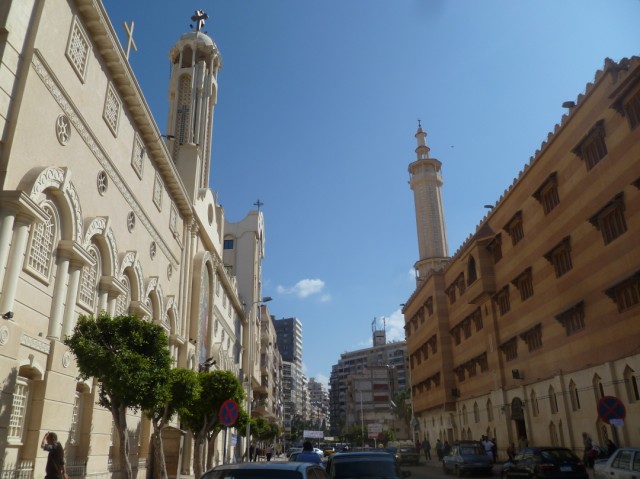
A recent visit to Alexandria revealed it to be quite the opposite.
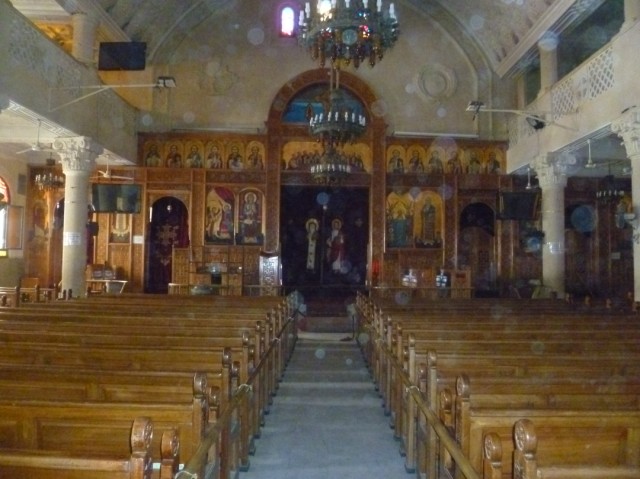
Sanctuary of the Two Saints' Church
Jesus, with the Four Evangelists in a Mural above the Sanctuary
Facing the Street are St. Mark and Pope Peter, Patrons of the Church
The Church is Directly Opposite an Equally Massive Mosque

Upon reflection, it is fair to wonder about the oft-repeated Coptic practice of building elaborate churches amidst areas of poverty. It is also fair to wonder about the dueling massive places of worship on opposite sides of the street, and what this conveys of Egypt. Yet the primary impression I received from my visit was the audacity of the attack in its chosen location.

Alexandria as a city is the birthplace of Christianity in Egypt and the original seat of the Coptic papacy. I cannot say why the Two Saints’ Church was chosen out of the many places of Christian worship in Alexandria. Clearly, however, a message was delivered – striking at a place of Coptic ecclesiastic pride. This was no small and easily targeted church. It was a slap in the face targeting Coptic comeuppance.

What was the message exactly cannot be known, at least until the perpetrators are properly convicted. Until now the revolutionary government has not reopened investigations, despite repeated legal requests from Alexandria’s local church leadership. Yet given the uncertainty, and given the carnage, the response is all the more Christ-like:

Oh Lord, do not hold this sin against them.

As the Egyptian revolution sputters along, at times bloodily, this is a message in dire need of remembrance. One year following Alexandria the blood of these pre-revolutionary martyrs calls out from the ground, saying, ‘Where is your brother?’ Muslims and Christians must rediscover such unity, if the gains from the revolution are to be preserved.

Song of Praise for the Martyrs of the Two Saints’ Church

Note: After each line is a repeated refrain: The martyrs of the Two Saints’ Church

  • In the Church of the Two Saints – There are victorious martyrs – We praise them every moment
  • Our Coptic Church – Is worthless in Alexandria – Martyrs of Christianity
  • At the beginning of the year – Their spirits rose peacefully – With the Lord of humanity
  • The time of St. Mark has returned – With the beginning of celebrations – With our new martyrs
  • Your blood dripped like liquid – Like of St. Mark the Apostle – In the surrounding streets
  • Oh children of the seal of martyrs – Heaven has called you – And you answered the call
  • The oppressors killed you – And we ask of God – Always lifting up prayer
  • Give all consolation – To the families of the martyrs – And give us faith and hope
  • With shouts and wailing – Rachel has cried once more – Over all martyrs in this generation
  • We all announced our mourning – Throughout the whole country – After the explosions
  • Their limbs flew off – As their intestines also exited – From the bodies of the children
  • You have consecrated our lands – We in the midst of your blood – For the sake of our Redeemer
  • We make a record of – Our patience over the departure – of the martyrs of Iraq,
  • Nag Hamadi, Umraniyya – Kushh and Alexandria – Rejoice Oh Orthodoxy
  • Hearts have been broken – Over every beloved martyr – Blessed are you, children of Job
  • Your path is sweet and beautiful – We sing it in our hymns – A bouquet of long remembrance
  • In your remembrance we welcome you – As you arrive to your Redeemer – And we call to you in our prayers
  • Light us to be a candle – As our eyes are full of tears – Mention us before Jesus
  • Today St. Mark is joyous – As well as Pope Peter – That you have joined them now
  • You have become our intercessors – In the monastery of St. Mina – With Pope Cyril and St. Mina
  • Pray at all times – For Pope Shenouda the faithful – That the Lord the Helper will support him
  • Oh children – You have become our treasure – Mention every soul

The final refrain: The mention of your name in the mouths of all believers – Everyone says: Oh God of the martyrs of the Two Saints’ Church, take care of us all

Related Articles:

Reflections on the New Year’s Eve Massacre in Alexandria

Christian Responses to Alexandria: Irony, Violence, and Love

The Happiest Christmas of my Life

Contemplating a Terrorist Strike

Categories
Arab West Report Middle East Published Articles

Christian Responses to Alexandria: Irony, Violence, and Love

Irony can emerge from the midst of tragedy. While the world awaits the emergence of good – from somewhere, somehow – irony is often first to make its appearance on the scene.

On Monday, January 3, two days after the horrific bombing at the Church of Two Saints, St. Mark and Pope Peter in Alexandria, the government sent a construction crew to repair damage caused to the church by the blast. Christian demonstrators, however, prevented them from entering the premises, stating that damage and blood must remain until the perpetrators are brought to justice. While their response is understandable in light of the circumstances, other observers may notice another angle: Christians often criticize the government for complicating or preventing church construction, repair, or renovation. In this instance, it is the Christians who prevent the government from restoring the church to its original state.

Since the bombing there have been angry Christian demonstrations throughout Egypt, many of them violent. A representative video, with English subtitles, can be found on the al-Masry al-Youm website. The following is a sampling of recent events. All statements are as reported in various Egyptian newspapers; sources can be tracked by following the links.

Immediately after the bombing area Christians swarmed to the scene and clashed with security forces. It is also reported that they stoned a nearby mosque.

On Monday the demonstrations began in earnest. During the funeral of the deceased, Christians chanted anti-government slogans. Demonstrations broke out at the papal cathedral in Cairo, in which 43 policemen were injured. Three of the most prominent Islamic leaders in the country had come to pay their condolences to the cathedral to Pope Shenouda, but their cars were assaulted while there. 90 people were injured during demonstrations in Shubra, a section of Cairo with a large Christian population. Thousands of Christians joined with activists in a protest in downtown Cairo, during which time 47 were arrested and 20 cars smashed in. One headline read: “Angry Coptic demonstrations sweep Cairo and governorates.” A popular protest chant was: “With our souls and our blood, we will defend the cross.”

On Tuesday the violence continued. In Giza protestors blocked the ring road around the city. In one location in Cairo demonstrations led to the injury of 20 Christians and 37 policemen. Throughout the country 125 policemen were injured.

Immediate context can be traced not only to anger stemming from the bombing, but to Christian anger that has been swelling for some time. The action in Giza to block the ring road is the very same strategy employed a month earlier in late November, to protest what was understood as government interference in a church building project. This, and other more violent Christian protest, eventually led to government security forces using live ammunition which resulted in the death of two protestors and the hospitalization of dozens.

Other events could be summoned in which Christians have been largely passive recipients of violence, at times accusing security forces of lending a hand. Other times still they have been left wondering why justice was never served to perpetrators. In many of these cases the violence was due, at least partially, to normal community tensions, during which religious differences caused the spark that exploded the conflict. All the same, many Christians view security as their problem, rather than their protection.

There is substantial irony in the Christian community, self-understood to be beleaguered by security violence, now violently confronting the security apparatus. Elsewhere, there are emerging signs of good. The sources above also describe significant outpourings of interreligious protest against the bombing. Thousands of Muslims and Christians demonstrated together, in both Cairo and Alexandria. They carried signs uniting the cross and the crescent, lifting high their Bibles and Qur’ans.

Certain Muslim groups have even responded creatively. Eight thousand Muslims have signed up for an initiative to ‘go to the churches and die with them’, proposing to create human shields around church locations. In the aforementioned neighborhood of Shubra, Muslims went to the churches and distributed sweets and flowers to entering churchgoers.

It must be understood that the majority of violent Christian protestors come from poorer and underdeveloped sections of urban Egypt. These tend to be young, and their poverty and lack of education, shared by all Egyptians in their areas, contributes to their easy radicalization. In one particularly disconcerting scene, depicted on the video at about the 3:50 mark, Muslim counter-protestors chanted at Christians, “With our blood and our souls, we defend you Prophet Muhammad.” Though not captured on the video, clashes erupted between Muslims and Christians in circumstances like these. Religion plays a role, but social, political, and economic factors lay the groundwork.

Christian leadership has done its best to counsel patience and calm. Bishop Bisanti of Helwan, a large area on the southern outskirts of Cairo, states that this agitation of Coptic youth is due to shock, and is a temporary phenomenon. Pope Shenouda urges the Christians to have self-control, and priests in general have been urging their congregants to resist anything which leads to further sectarian tensions. This is necessary advice, absolutely required given the circumstances.

It would be difficult to expect more, but the thousands of Christians who have joined Muslims in denouncing the action are beginning to act upon the advice of Bishop Musa, bishop of youth. Imagining the bomber to be an Egyptian, he declared him to be a traitor to the nation, not just a criminal against Christians. Furthermore, he urged the people: Love is the answer.

It is an act of love to join with fellow citizens to set aside religious differences, even religious tensions, and project one voice to renounce violence and assert national unity. But it is also true that this author has not yet seen reports of Christian creative love, such as that evidenced by the Muslims mentioned above. There is little fault, for who can think of blessings when the natural human instinct is to curse?

Yet it is hoped that Christians might be able to find expressions of creative love to offer to those beyond their natural Muslim allies who rallied together with them. Here is one idea:

Currently, collective Christian anger and frustration is aimed at security. Rightly or wrongly, many Christians view the security apparatus as negligent, if not complicit, in their sufferings over the last few decades. Following this attack, one week before Coptic Christmas, the government is sure to place the maximum security presence around each and every church, to prevent a subsequent attack.

Though intensified, this is not a new procedure. Each week as my family goes to church, we pass by two or three security guards at the entrance. These have been assigned their post in precaution; there have been attacks, though far less severe in scale, on churches before. Most all worshippers enter church without giving the slightest pause to their presence. Most often these guards sit idly and stare out into space. They have become part of the established church architecture.

This coming Thursday evening, January 6, Coptic Christmas Eve, everyone will be on full alert, and no Christian will enter church unmindful of the security presence. What will their visceral emotions be?

One year ago to the day, six Christians were shot dead exiting Christmas Eve mass in an attack on a church in Nag Hamadi in Upper Egypt. In this attack a Muslim security guard was also killed. One week ago to the day, a bomb exploded and killed 22 worshippers at a church in Alexandria.

For Christians, will your church be next? For security, will your church be next?

Christians have legitimate space to be frustrated with security as a system, but on January 6, they and the individual security guards at their churches will all be in the same boat. These guards are not volunteers; they are on assignment. All the same, their life is on the line.

Imagine the goodwill that might develop if each Christian worshipper shook the hand of a security guard on his way into the service. Imagine if he stopped, looked the guard in the eye, and thanked him for his service. What if they took a moment, realized the gravity of the situation, and cried together? What if this occurred in every church throughout Egypt?

I am not under the presumption that many Egyptian Christians will read this text. But if you do, and you believe this idea has merit, please sow this seed among your fellow believers. In times like these, hope must be found in creative expressions of love. Egyptian Muslims have taken the lead in certain places; it is fully understandable that Egyptian Christians are lagging behind. More than anything else, they need now to be the recipients of love.

Their faith, though, calls them to more. They believe they have been loved undeservedly by God. Having received, they must now give. In many of their eyes, security is among the least deserving of all Egyptians. May they embrace them unconditionally. May they find greater and deeper expressions that ring far more powerfully than this simple idea. May they transform evil into good.

Otherwise, it is only irony and sadness which will continue to emerge from this tragedy.