Categories
Christianity Today Middle East Published Articles

As Erdoğan Goads on Gaza, Turkish Christians Prefer Peace

Image: Burak Kara / Stringer / Getty / Edits by CT

Defending Hamas, Turkish president Recep Erdoğan upstaged his own nation.

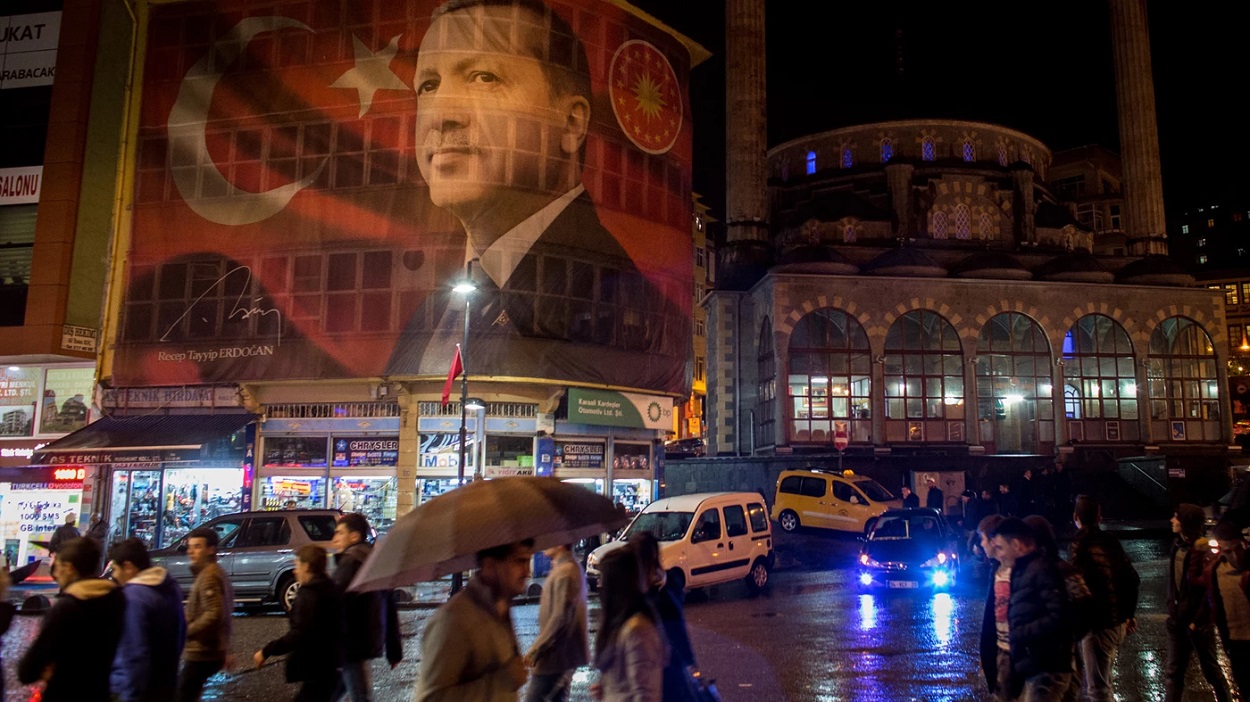
One day prior to last month’s 100th anniversary of the modern state of Turkey (now formally called Türkiye), an estimated 1.5 million people gathered for a pro-Palestinian rally October 28 and heard their Islamist-leaning leader denounce Israel as a “war criminal.”

“Hamas is not a terror organization,” Erdoğan had previously stated October 25. “It is an organization of liberation, of mujahedeen, who fight to protect their land and citizens.”

Observers noted that immediately after the October 7 terrorist attacks by Hamas that killed 1,200 mostly civilian Israelis and took 240 hostage, Erdoğan had struck a cautious tone. Reports circulateddenied by Ankara—that Turkish officials quietly asked Hamas leaders to depart the EU candidate country. And in advance of the rally, the president reiterated that he could never excuse acts that target civilians.

Then something changed.

Despite efforts over the past year to heal a diplomatic rift with Israel, Erdoğan now questioned its existence.

“What was Gaza and Palestine in 1947, what is it today?” he asked rhetorically, in reference to the establishment of Israeli statehood in 1948. “Israel, how did you get here? How did you get in? You are an invader.”

And widening his scope, the head of the NATO-member nation impinged his allies in religious terms, calling the Gaza attack “revenge” for the 15th century fall of Constantinople.

“Oh, West, I cry out to you, do you want to start your crusade against the Crescent again?” Erdoğan asked. “If you are making such efforts, know that this nation is not dead.”

The next day, in a muted celebration, he laid a customary wreath at the grave of Mustafa Kemal Atatürk, who abolished the Ottoman caliphate and established a secular republic in 1923. In attendance was the ecumenical patriarch of the Eastern Orthodox Church, Bartholomew I.

Two weeks prior, Erdoğan attended the inauguration of Mor Ephrem Syriac Orthodox Church, honoring the estimated 25,000 Assyrian Christian citizens of Turkey. It was the first church to be built with state funding since Atatürk’s founding.

And since Erdoğan’s party took power in 2002, 20 churches have been restored.

“The church we have built is a symbol of freedom of religion and belief in our country,” Erdoğan stated. “At a time when divisions, conflicts, and hate crimes based on religious and ethnic origin are increasing in our region and the world, this embracing attitude of Turkey is very important.”

His October 15 remarks were poignant, with the Israel-Hamas war raging. In between the church ceremony and the Palestinian rally, Erdoğan sent Sweden’s NATO application to the Turkish parliament for ratification. And this month, the Incirlik air base in southeast Turkey received the deployment of a pair of United States B-1 Lancer long-range bombers.

Last week, Turkish protestors tried to storm it.

Turkish Christians have had a complicated relationship with Erdoğan, and generally do not speak out on political matters. But one believer voiced his strong displeasure with the president’s comments.

“It is not acceptable. Hamas is a terrorist organization,” said Gokhan Talas, founder of Miras Publishing Ministry. “Calling its attack anything else could cause another painful trauma for victims and their families.”

The small evangelical community in Turkey, he said, has diverse views about Israel—stemming from both political and eschatological differences. Some speak in terms of unconditional support for the prophetically reconstituted Jewish state. Others, rejecting such theology, find justification for the Palestinian militant response.

But Ali Kalkandelen, president of Turkey’s Association of Protestant Churches, made clear their unified position.

“As Christians, we believe that God is the judge over everything,” he said. “We are against any war, killing, and the death of innocent people.”

They are praying for both sides, he added. And also Erdoğan.

Talas believes that Israel’s first reactions were…

This article was originally published at Christianity Today, on November 14, 2023. Please click here to read the full text.

Categories
Christianity Today Middle East Published Articles

Turkish Christians Turn to Tabitha for Earthquake Relief—and Resurrection

Image: Illustration by Christianity Today / Source Images: AP Images / WikiMedia Commons

Exhausted and emotionally spent at the end of a full week surveying the damage from Turkey’s massive earthquake last February, Ali Kalkandelen needed hope. As chairman of his nation’s Association of Protestant Churches (TeK), he felt the weight of responsibility to help his colleagues in 27 affected congregations.

Eventually, he found a template for moving forward in the biblical figure of Tabitha.

Scattered over 11 cities in a geographic area the size of England, local Turkish Christian leaders had already launched into service, supported by the larger body of 186 affiliated churches with aid, funds, and volunteers.

Kalkandelen set out from Istanbul, encouraging colleagues in Antakya, Adiyaman, and three other cities. He traversed ruined highways, lamented collapsed buildings, and tried to take stock of the task of relief.

Last on his list was Kahramanmaraş, for a personal visit. His father’s home had been destroyed, and he went to check in on his many relatives there.

And there in the rubble flitted a small piece of paper.

Upon inspection it was a page from a Turkish Bible, from 2 Corinthians 1. He read verse 3–4: Praise be to … the God of all comfort, who comforts us in all our troubles, so that we can comfort those in any trouble.

The slip of paper was all the more moving because, among the population of half a million people, the city had no church and no known Christians.

“I read it with my wife, and we started weeping,” said Kalkandelen. “God was talking to his church in Turkey.”

Six months later, alongside trauma counseling and spiritual care, TeK provided 7,500 tents, 27,000 outfits of clothing, and over one million meals to those displaced by the earthquake. And to compensate for the destroyed infrastructure, TeK made available three tons of drinking water, 7,000 diapers, and 146 tons of coal for winter heating.

To do so required organization.

With previous natural disasters in Turkey, the church had always played a role in relief. But with experts warning that another earthquake was likely to hit Istanbul within a few years, Kalkandelen wanted a standing response. By April he had gathered leaders from the affected areas, linking them with TeK elders from across the country.

Searching for an appropriate name, the six-person committee took note of Tabitha in Acts 9. Also known as Dorcas, she hailed from Joppa—modern-day Jaffa outside Tel Aviv—and was known for her good works and charity, especially in sewing clothes for area widows. When she died, the believers called for Peter, and he raised her from the dead.

Kalkandelen recalled his scrap of paper and the shell-shocked faces of the earthquake survivors. He has delivered us from such a deadly peril, and he will deliver us again, says verse 10. On him we have set our hope. The Tabitha committee has…

This article was originally published at Christianity Today, on August 4, 2023. Please click here to read the full text.
Categories
Christianity Today Middle East Published Articles

Turkish Christians Plead: Don’t Distribute Bibles After Earthquake

Image: Chris McGrath / Getty Images

An unnamed Turkish man dug through the rubble. The stench from rotting corpses filled his nostrils; the cries from trapped survivors pierced his ears. Finally, he located a little girl he could help, removed the surrounding debris, and gently pulled her from the clutches of death.

And social media cursed him.

The man filmed the whole episode on Facebook Live. And contrary to his expectations, comments of derision poured in from across the country. While his religion is unstated, Turkish Christians warned of similar earthquake exploitation from their brothers and sisters in faith.

When Bibles were distributed in Kahramanmaras, between the epicenters of the 7.8- and 7.5-magnitude quakes that killed 47,000 people along the Turkey-Syria border, local authorities responded by saying they did not want help from the church.

“This is not the way of Jesus; it is opportunistic, and doesn’t work,” said Ilyas Uyar, an elder in the Protestant Church Foundation of Diyarbakir. “We say we are Christians all the time, but it is disgusting to connect this to aid.”

The Protestant Association of Turkey (TeK) has been hard at work to establish guidelines. Last week, after expressing a “debt of gratitude” to all who have prayed and given to support relief efforts, it issued six directives.

Alongside the prohibition of Bibles and evangelistic materials was a basic request to work with the local church to navigate Turkish sensitivities. These included basic requests to coordinate aid, as well as the avoidance of political commentary and unauthorized photos.

But permission is not the only issue. A Christian group from Italy came to Diyarbakir to offer help, Uyar said. They filmed and took pictures and then asked for church assistance to move onward to Kahramanmaras.

Perhaps they will return home and help raise funds. But to spare overburdened local volunteers from playing tour guide, TeK suggested three hubs for communication and collection of donations.

The first is an organization.

First Hope Association (FHA), a disaster relief agency founded by Turkish Protestants, has long cooperated closely with the official authorities. Over 10 tractor trailers have been dispatched to deliver 55 generators, 150 beds, 200 heaters, 3,000 blankets, and 12,000 cans of food.

Over 4,000 people benefit daily from FHA hygiene trucks.

But echoing TeK concerns about Bibles, FHA board chairman Demokan Kileci described his anger at how many Christian organizations are fundraising off the disaster.

Others, he lamented, are well-intentioned humanitarian tourists.

“They fly over a group of 20 people, stay in hotels, and rent cars and to come to the area,” he said. “Meanwhile, our people can’t even find places to sleep.”

Turkey is not backwards, he continued, as it works according to European standards with professionally trained experts. And the church has started to supply psychological support for its many volunteers.

Trauma care workers and programs for children can wait for a month.

Even so, the job is too large for Turkey alone. FHA was designated by the government to facilitate the assistance of Samaritan’s Purse, which has set up a virtual mini-city with 22 tents, a 52-bed field hospital, and a rotating crew of about 100 international disaster relief specialists.

“We offered our help, and they immediately took it,” said Franklin Graham, president and CEO of the evangelical aid association. “We are open about our Christian faith, but did not come to distribute shoe boxes.”

Operation Christmas Child, the popular holiday outreach which has sent 209 million gift boxes around the world, has direct evangelistic and discipleship purposes. But in Turkey, Samaritan’s Purse is focused on the immediate need to save life, Graham said. Working through the US embassy, he praised the Turkish military for helicopter delivery to the parking lot of a collapsed hospital facility outside Antakya.

The local medical profession is devastated, he added.

A week after the quake, Samaritan’s Purse chartered a 747-sized airplane to deliver 600 oversized tents that can shelter up to 1,000 families. More than 900 have received medical care, including 25 surgeries. Graham expects Samaritan’s Purse to be present for up to four months, replenishing supplies every 10 days, and will leave everything behind when Turkey is able to assume local care.

Until then, its staff lament the fires lit in the streets to help people stay warm.

“You look at great suffering, but don’t get paralyzed,” stated Aaron Ashoff, deputy director of international projects, who takes strength from the psalms. “You need to walk into that pain, and then walk out, and say, ‘We’re Samaritan’s Purse, we are going to act.’”

So have the other two TeK hubs. Many churches and organizations are helping in relief, TeK board member Soner Turfan said. But the sister churches in Diyarbakir and Antakya were identified due to…

This article was originally published at Christianity Today on February 22, 2023. Please click here to read the full text.

Categories
Middle East

Despite Drop in Deportations, Turkey Still Troubles Christians

Image: Chris McGrath / Staff / Getty

Last year, Protestant Christians in Turkey suffered no physical attacks.

There were no reported violations of their freedom to share their faith.

And there was a sharp reduction in foreign missionaries denied residency.

But not all is well, according to the 2021 Human Rights Violation Report, issued March 18 by the nationally registered Association of Protestant Churches (APC).

Hate speech against Christians is increasing, fueled by social media.

Legal recognition as a church is limited to historic places of worship.

And missionaries are still needed, because it remains exceedingly difficult to formalize the training of Turkish pastors.

“Generally there is freedom of religion in our country,” stated the report. “But despite legal protections, there were still some basic problems.”

Efforts to unite Turkey’s evangelicals started in the mid-1990s, and the APC began publishing its yearly human rights reports in 2007. Today the association, officially registered in 2009, represents about 85 percent of Christians within Turkey’s 186 Protestant churches, according to general secretary Soner Tufan.

Only 119 are legal entities.

And of these, only 11 meet in historic church buildings. The great majority rent facilities following their establishment as a religious foundation or a church association. While generally left alone, they are not recognized by the state as formal places of worship and thus are denied free utilities and tax exemption.

And if they present themselves to the government in pursuit of such benefits, officials often warn they are not a church and threaten closure. Sometimes the authorities even try to recruit informants. And some Christians who have refused have lost their jobs.

Other Turkish Protestants are simply harassed. “Dead priest walking,” said residents of Arhavi to a local pastor as…

This article was originally published at Christianity Today on April 6, 2022. Please click here to read the full text.