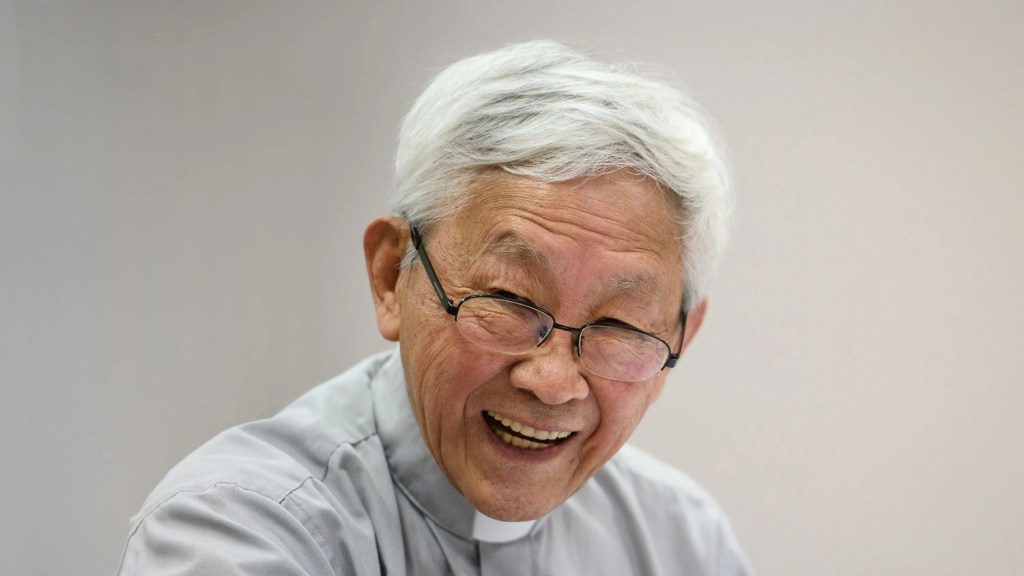
Three years ago in a Hong Kong courtroom, 90-year-old cardinal Joseph Zen Ze-kiun leaned heavily on his cane. Wearing his black clerical robe and white collar, the white-haired bishop emeritus faced charges of failing to register a legal support fund to help arrested activists during the 2019 pro-democracy protest movement.
Despite his advanced age, Zen shows no sign of slowing down. Last June in a Hong Kong parish he leaned heavily on a different kind of cane—a golden ecclesial monstrance bearing the Eucharist inside. He had just finished celebrating the controversial Latin Mass, reinforcing his position on the conservative wing of the Catholic church.
Savvy in public messaging, Zen—who turns 94 today—in both images portrays himself as a quiet rebel, clashing with governmental and religious institutions. Such commitment marked his ministry especially after his appointment as bishop of Hong Kong in 2002. Mindful of the needs of the poor and the oppressed in the underground Chinese church, the Hong Kong faithful welcomed his own elevation as the Vatican’s recognition of his stance on social justice.
“The purpose of life,” Zen said in an interview after his court appearance, is to be a person of integrity, justice, and kindness.
Yet this does not temper his clear words of rebuke. He called the 2018 provisional agreement between the Vatican and Chinese government to jointly appoint bishops as “blatantly evil [and] immoral because it legitimizes a schismatic Church.”
Open Doors ranks China No. 15 on its World Watch List of countries where it is hardest to be a Christian. Because of Chinese Catholics’ international ties to the Vatican, faced even greater persecution than Protestants. In 1951, the Communist government cut diplomatic relations with the Vatican and six year later organized the Chinese Catholic Patriotic Association (CCPA) to oversee the national church.
Zen was born in mainland China in 1932, one year after the Japanese invasion in Manchuria that eventually contributed to the beginning of World War II in Asia. He moved from Shanghai to Hong Kong in 1948, two years after the then-British colony was promoted to a Catholic diocese. His Catholic family left behind endured persecution from Mao Zedong’s regime, which considered the church a counterrevolutionary entity.
In Hong Kong, Zen attended a Catholic school associated with the Salesian order of Don Bosco. The order was founded in 1859 to help poor boys and young men with no education.
Zen became a priest in 1961 and earned a doctorate three years later from the Salesian Pontifical University in Rome. In 1978, he headed the local order as he concentrated on parish ministry. But when Chinese soldiers opened fire on students peacefully protesting at Tiananmen Square in 1989, Zen felt motivated to serve also the mainland church.
Shortly thereafter he secured China’s permission to spend six months every year as a professor in government-run Catholic seminaries. Though he watched the Tiananmen Square massacre with horror, for the next seven years he remained quiet about his opinions to nurture ties with Chinese officials and the underground church.
Zen described his sojourns in China as…
This article was originally published at Christianity Today on January 13, 2026. Please click here to read the full text.
 Jayson Casper