Almost six months have passed since Issa Saliba boarded a bus in Gaza with 15 other Christians to seek safety in Egypt. But he still relishes how they sang, clapped, and danced as they escaped devastation.
The air conditioning cooled his nerves, frayed from the harrowing journey to the border. Later that day, the wayside stop provided his first full meal.
Top of Form
As 1.9 million Palestinians—90 percent of Gaza’s population—remain internally displaced, less known is that 100,000 have managed to take refuge in Egypt. Saliba, allowed to depart because he is enrolled at the American University of Madaba in Jordan, left behind his father, two younger brothers, and the hundreds of other Christians remaining in the war-torn Mediterranean strip.
Saliba’s trip in April took him south along the damaged, dusty coastal road through Israeli checkpoints to the Rafah crossing. Then came a six-hour ride to Cairo. Saliba got out just in time: In May, Israel took control of Rafah’s Philadelphi Corridor and closed the border. The 8-mile-long strip of land remains a key sticking point in current negotiations over a ceasefire.
But from the first days of the Israel-Hamas war, the Egyptian government has resisted overtures to resettle displaced Palestinians in the adjacent Sinai Peninsula. Wary of terrorist infiltration but also fearful Israel will permanently refuse refugee reentry to Gaza, Egypt limited entry to people with medical emergencies, the financial means to pay up to thousands of dollars in fees, and international educational connections, like Saliba.
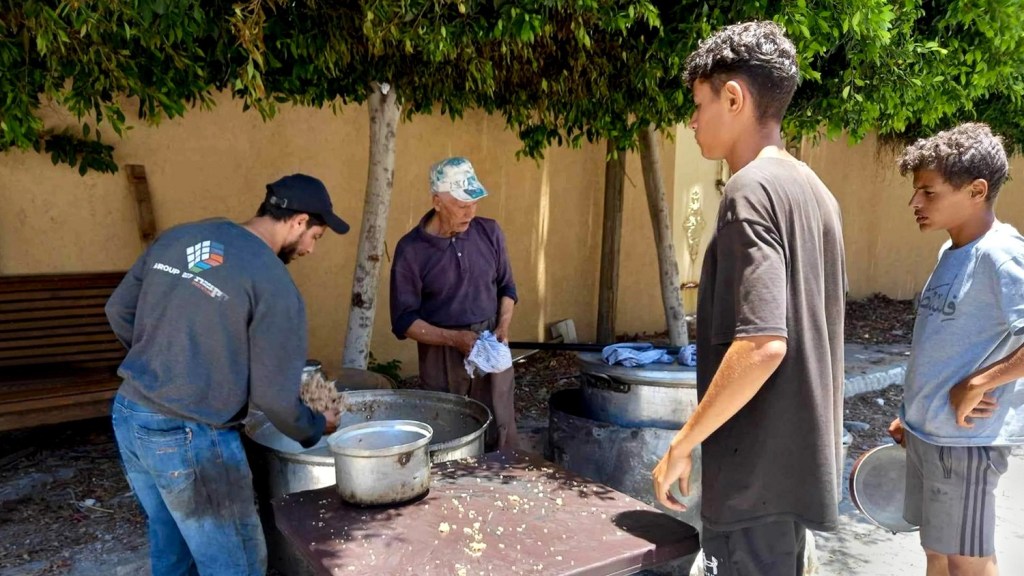
Evangelicals, though, are becoming known for giving food and supplies to refugees, whether Christian or Muslim. The Egyptian church, partnering with like-minded Palestinians, has even sent aid into Gaza for the believers huddled for safety in churches, as well as thousands of others displaced from their homes in makeshift camp communities.
“We show the love of God to everyone,” said Samuel Adel, chairman of the pastoral, outreach, and missions council of the Evangelical Presbyterian Church of Egypt, also called Synod of the Nile. “When people ask why, we tell them it comes from our love of Jesus.”
Soon after the Israel-Hamas war began on October 7, aid to refugees began…
The article was originally published at Christianity Today on September 16, 2024. Please click here to read the full text.
During Tuesday night’s presidential debate, Kamala Harris accused Donald Trump of a fondness for dictators, alleging that he supported a negotiated settlement with Vladimir Putin following Russia’s invasion of Ukraine. Trump, declining to affirm that a Ukrainian victory would serve US interests, replied that if he were still in the Oval Office, the war would never have happened, and he claimed that he could bring it to an end even as president-elect.
Both candidates failed to address the most salient current issue on Ukraine for evangelicals: religious freedom.
Last month, the Ukrainian parliament overwhelmingly approved a proposal to ban the activities of the Russian Orthodox Church (ROC) and compel the Ukrainian Orthodox Church (UOC) to break all ties with the patriarchate in Moscow. President Volodymyr Zelensky signed the bill into law, hailing his nation’s “spiritual independence.”
Some Republicans, including vice-presidential candidate J.D. Vance, have accused Ukraine of “assault[ing] traditional Christian communities.” Vance linked these alleged violations to the continuation of US military support, stating that military aid should be used as leverage to ensure religious freedom.
The charge is nonsense, said a leading Ukrainian expert in an interview with CT.
The law, said Maksym Vasin, director for international advocacy and research at the Institute for Religious Freedom in Kyiv, is meant to protect Orthodox believers in Ukraine from Russian propaganda. The State Service for Ethnic Policy and Freedom of Conscience (DESS) studied ROC and UOC documents to demonstrate the continuing link between the two churches, despite the UOC’s postwar assertion of independence. Each of the UOC’s 10,000 parishes has now been given nine months to demonstrate that it is not connected to the ROC, subject to court judgment.
However, the GOP is not alone in its concern.
Pope Francis stated last month that no church should be abolished “directly or indirectly” based on how its people pray. The World Council of Churches urged “caution.” And according to variousreports, Ecumenical Patriarch Bartholomew I, considered first among equals in the Orthodox world, sent a delegation to Ukraine to inquire about canonical structure and whether individual UOC parishes are being forcibly transferred to the rival Orthodox Church of Ukraine (OCU).
The state said 1,500 parishes have voluntarily aligned with the OCU since 2018.
In 2019, Bartholomew granted autocephaly (canonical independence) to the OCU, a then-schismatic body that had earlier broken off ties with Moscow. The move, supported by the United States, shifted OCU allegiance to the ecumenical patriarch’s church in historic Constantinople.
Orthodoxy first spread among the Slavic people from Kyiv, which was joined to the ROC in 1686. Following passage of last month’s law, the OCU reached out to the UOC for dialogue, emphasizing the need for unity and reconciliation.
CT spoke with Vasin, who contributed a chapter analyzing an earlier draft of the law in last year’s Security, Religion, and the Rule of Law, about the response of Ukrainian evangelicals, the limits of individual criminal prosecution, and whether the law should be considered a “ban.”
Please explain the aim of the new law.
The law aims to terminate Russian influence on Ukrainian society through Russian religious centers and to limit the propaganda of the chauvinistic ideology of Russkiy Mir (Russian World) in Ukraine. Ever since Soviet times, Russia has systematically used religion and religious centers of various denominations, primarily the ROC, as a tool of propaganda to achieve its military and geopolitical goals.
Churches are then manipulated to exert totalitarian control over their citizens or are closed down if they refuse to cooperate. This repressive policy is clearly visible in the eastern and southern regions of Ukraine, annexed following the Russian invasion. There, the Russian authorities are carrying out brutal repression against Ukrainian Christian churches and religious communities of various denominations, including Muslims and Jews who do not support Russian aggression.
Putin and the Kremlin want to maintain a key instrument of influence in Ukraine, namely the ROC and its affiliated local Orthodox eparchies and parishes. For this reason, Russia is most vocal critic of the Ukrainian government’s initiatives aimed at protecting religious freedom from abuse.
Is the new law a “ban” of the UOC?
It is a ban of the ROC in Ukraine, because of its open support for Russia’s war.
It is not an immediate ban on the activities of the UOC, which is not even directly mentioned. The government will issue directives to break administrative and canonical subordination to the ROC or other Russian religious centers. If a religious community refuses to sever these ties, the government will have the right to apply to the court to terminate the activities of this legal entity, given the danger to national and public security. But if the defendant parish complies during these hearings, the court case will be dismissed.
Thus, it is wrong to say that this law bans the UOC. Instead, the law allows this church and any other religious associations in Ukraine to liberate themselves from the influence of Russian intelligence services and stop being mouthpieces for Russian propaganda.
It is up to the UOC priests and parishioners to decide whether they will continue to agree to be used by the Kremlin or whether they will end their dependence on the ROC and Russian authorities.
Your analysis of an earlier version of the law advised the government to concentrate on individual criminal proceedings against clerics who collaborated with Russia. Why is this not a sufficient safeguard against Russian interference?
Religious communities should not be responsible for the activities of their clerics, and a ban must be the last resort if other measures have been ineffective. But in recent years, it has become increasingly clear that…
This article was originally published at Christianity Today, on September 13, 2014. Please click here to read the full text.

 Jayson Casper