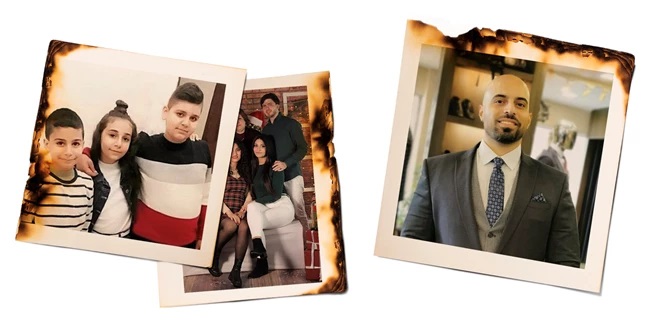
Trapped in Gaza, Janet Maher has not had a shower for two weeks. She feeds her three children one meal a day, often no more than bread and cheese.
Her cousin perished from damage caused by an Israeli missile, shielding his seven- and five-year-old boys from the collapsing wall at St. Porphyrius Orthodox Church. The two families had been sheltering together, and the younger boy was friends with her son in kindergarten.
But amid the horrors of life under siege, perhaps the worst is this: Janet’s husband is trapped in Egypt.
“I feel like Moses’ mother and sister after they put him in the bulrushes,” said Hanna Maher, former pastor of Gaza Baptist Church. “All I can do is watch from afar.”
Born in Sohag in Upper Egypt, Maher pastored the evangelical congregation from 2012–2020. Single upon arrival, he married Janet, daughter of an Orthodox father and Baptist mother, during his first year of service in Gaza. Though he was called to “the hard places,” ministry was taxing—as was navigating the permissions for complicated entry and exit procedures under Israeli occupation.
Since 2007, Israel and Egypt have imposed a blockade on the 140-square-mile coastal strip.
Every family vacation to Egypt began with the feeling that he should never return to Gaza. But until 2020, each trip ended with Maher’s renewed sense of commitment to mission. That year, he accepted the pastorate at the Presbyterian church in Beni Suef, 90 miles south of Cairo, and Janet—who had always desired to stay close to her extended family—felt at peace.
Maher did not. Three years later, with Janet’s blessing to renew his calling, he resigned from his position, and last May the family returned to Gaza. Since he is no longer a funded missionary, he used the extended vision trip to explore service opportunities apart from the pulpit. Contemplating an educational or small business development center, on September 28 he returned alone to Egypt to seek denominational partnerships.
Less than two weeks later the war began, with no one allowed in or out.
“I can’t concentrate, I have no energy, and I couldn’t sleep after the attack on the church,” said Maher. “I just watch the news and pray for my family.”
Much of his day is devoted to trying to call them. From morning until night he rings Janet’s cell phone, but with communication networks damaged in the bombing, it takes hours to get a connection. At best, they have a five-minute conversation—but are usually cut off after about 60 seconds.
Once, his son forced a reluctant chuckle: It’s fantastic, daddy, there is no school.
Maher’s smile passed quickly amid the morbid statistics. Over 8,000 people have been reportedly killed in Gaza, including at least 3,324 children, with another 6,000 children injured. The ministry of public works reported that 43 percent of all housing units have been destroyed or damaged, with more than 1.4 million out of a population of 2.2 million displaced from their homes.
And prior to Israel restoring flow to the second of three main water pipelines, water for drinking, cooking, and washing was estimated at 3 liters per day per person, far below the World Heath Organization recommendation of 100 liters.
Maher’s Tel al-Hawa neighborhood in Gaza City came under extensive Israeli bombing. Living near the al-Quds Hospital—accused of being a Hamas hideout—where about 10,000 displaced Gazans have taken refuge, Janet was unable to find food on the local grocery shelves.
Israel has accused Hamas of hoarding essential water, food, and fuel. Janet left to take refuge at the Greek Orthodox church five days after the war began, when…
This article was originally published at Christianity Today, on November 3, 2023. Please click here to read the full text.
 Jayson Casper