Categories
Lapido Media Middle East Published Articles

Christian Partnership with UAE Royals Guarantees Safer Childbirth

Peddle Thorp UAE
UAE Deputy Prime Minister Sheikh Saif bin Zayed and his sons at the inauguration of Oasis Hospital’s new maternity centre. Photo: Peddle Thorp

The ruling family in the United Arab Emirates have transformed the country’s maternity facilities, thanks to a multi-million pound investment in Christian medical care.

Oasis Hospital in al-Ain, once just a mud-brick affair built at a date-palmed caravan crossing point before oil wealth modernized the area, will become the top childbirth facility in this former Trucial State.

Four members of the royal family inaugurated the new facility on 15 November this year, with hospital staff old and new.

‘This hospital may be better equipped and integrated than ninety per cent of the hospitals in the United States,’ said Dr Daryl Erickson, a missionary surgeon who served at Oasis from 1976-1985.

The expanded complex now includes 98 rooms over three floors and a state-of-the-art neo-natal intensive care unit. There are twelve delivery rooms – doubled from six – and more specialist staff.

Still present throughout the hospital are Arabic translations of the Gospel of Luke, the physician.

American missionary doctors Pat and Marian Kennedy founded the hospital in 1961, coming at the invitation of the nation’s founder, Sheikh Zayed bin Sultan Al Nahyan.

They scaled sand dunes by Land Rover in a rugged two-day trek to arrive at the desert oasis, tasked with developing modern medical care.

‘Before the hospital, thirty per cent of women died in childbirth and sixty per cent of children died before they were six years old,’ said Erickson, after whom the new surgical wing is named.

‘Immediately after delivery women had their vaginas packed with rock salt. As a result the post-partum period was incredibly painful and any subsequent labour could last up to four days because of severe scarring,’ he explained.

 Honour

Among the Kennedys’ first births was Crown Prince Sheikh Mohamed bin Zayed, younger brother of Sheikh Khalid, President of the UAE.

Gertrude Dyke, author of the definitive history of Oasis Hospital, delivered babies for twenty-six years. She related to the National that Sheikh Mohamed told her, ‘If you had not come, we would not be here.’

From the beginning, Erickson said, the Kennedys were up front about their desire to share their Christian faith. The tolerance – even honour – afforded to them and the hospital by the royal family continues to this day.

Dr Trey Hulsey: ‘Free care for migrant workers.’ Photo: Oasis Hospital
Hulsey: Free care for poor migrant workers. Photo: Oasis Hospital

‘The founding doctors came as missionaries, which was allowed and accepted by the rulers of that time,’ Oasis President Dr Trey Hulsey told Lapido.

‘Because we have kept to the spirit of treating everyone and turning no one away, we are allowed to keep Bibles out for people to take if they choose.’

Oasis is part of CURE, a network of Christian hospitals in thirty countries that has assisted more than 2.5 million patients, performed more than 180,000 surgeries, and trained over 7,200 medical professionals.

The hospital provides free care worth almost £1.8 million per year, mostly to migrant workers from Pakistan and Afghanistan.

 Dignity

Equal dignity to the poor, said Hulsey, is integral to the CURE slogan: Healing the sick and proclaiming the kingdom of God.

But so too is top-notch professional service to wealthy Emiratis. The hospital has twenty VIP suites fitted out with floor cushions and carpet: Emiratis prefer to sit on the floor.

‘We want people to understand they are cared for, both by us and by God,’ said Hulsey, ‘because God has cared for us first through Christ.’

Oasis hospital employs sixty doctors, about half of whom are Muslim. One-quarter are Christians of traditional missionary spirit.

They deliver three thousand babies a year, but are in need of more staff. The hospital is operating at only two-thirds capacity following the expansion.

Oasis Hospital: better equipped than most US hospitals. Photo: CURE International
Oasis Hospital: Better equipped than most US hospitals. Photo: CURE International

At the grand opening UAE Deputy Prime Minister and Minister of Interior Sheikh Saif bin Zayed especially honoured the Kennedys’ two daughters, Kathleen and Nancy, thanking them publicly for their parents’ service, the nature of which he said he highlighted to all his international visitors.

Saif also acknowledged their faith, saying whether Muslim, Christian, or Jew, everyone must follow God in their own way.

 Freedom

Christians represent 13 per cent of the UAE’s population, according to the Pew Research Center, drawn entirely from the migrant worker community.

The UAE constitution forbids discrimination on the basis of religion, and guarantees freedom of worship if consistent with public morals.

But according to the US Commission on International Religious Freedom, the UAE is among a number of Muslim-majority countries that make insufficient provision for individual religious freedom.

Open Doors ranks the UAE at number 49 on its list of countries showing degrees of Christian persecution. Though persecution is ‘scarce’, and there is wide freedom for non-Muslims to worship, evangelism is prohibited and the law does not recognize conversion from Islam to Christianity.

Dr Daryl Erickson: UAE’s pioneer missionary surgeon. Photo: Jayson Casper
Erickson: UAE’s pioneer missionary surgeon. Photo: Jayson Casper

Preaching at the hospital had to cease in 1978, and the Christian bookstore was forced to close. In the 1980s, Bibles were banned from patient rooms.

But today they are available again, while the church adjacent to the hospital hosts a Bible Society of the Gulf kiosk.

Oasis Hospital recently delivered its one-hundred-thousandth baby, and certainly enjoys the favour of both citizens and government.

Coordination is now underway with a national charitable foundation to provide medical and surgical aid in Syria and Yemen.

Erickson muses:  ‘I wonder if the UAE is as peaceful as it is today as a result of God’s blessing on the local people—citizens and leaders alike—because of their long-term interest in and tolerance of the Gospel.

‘I don’t know how you prove this, but just look at what the rest of the Middle East is like.’

This article was first published by Lapido Media.
Categories
Prayers

Friday Prayers for Egypt: Coalition

Flag Cross Quran

God,

After campaigning comes positioning. Perhaps after that will come legislating and querying. But help Egypt’s newly elected representatives to get this interim period right.

An effort is underway to draft members into a grand coalition to support the presidency of Abdel Fattah al-Sisi. This would be consistent, as many campaigned on this very point. They want the Egyptian state to succeed, and believe unity between the executive and legislative branches is essential.

Others suspect an agenda to recreate the non-ideological party that surrounded former President Mubarak. Some even accuse the effort of imitating the Muslim Brotherhood tendency to exclude other voices.

But to a degree, coalitions are necessary. The constitution gives the parliament the right to approve the president’s cabinet. If not, the leading party or coalition has the right to form the government. There is currently no party with a majority.

Therefore, God, be present in all negotiations.

Weigh the motivations of leading and lesser players. Give them discernment against personal interests. Guard them against partisan manipulation. May they politic truly, but politic well.

Support the state, God. Empower just institutions, promote humble individuals.

Help Egypt’s coalitions to move, in time, from people to policies. But may the policies always be conscious of the people.

And soon, regardless of how coalitions emerge, inspire parliament to accomplish its constitutional mandate. Give wisdom in the reviewing of law. Give courage in the accounting of government.

God, with greater stability comes greater responsibility. Fulfill Egypt’s promise, and the many promises she has made. Position her – and her representatives – to do good to many.

Amen.

Categories
Prayers

Friday Prayers for Egypt: Exceptions

Flag Cross Quran

God,

No matter the policy or pattern of behavior, life is unique. Each person is responsible for his or her own actions, no matter the repercussions on all.

But all actions have consequences, determine policies, and establish patterns. Help Egypt navigate through the exception and the general…

… as the Coptic pope visits Jerusalem in violation of a decades old decision.

… as the president promises to discipline policemen who have tortured and killed citizens.

… as a local bar fight explodes and kills sixteen.

… as a local woman somewhere gives birth to the 98 millionth Egyptian.

Each incident, God, is of exceptional importance. Yet each one begs meaning larger than itself. Help Egypt assign it correctly.

The pope went to attend a funeral and says the visit carries no change in commitment to Palestine.

The president assures of the importance of good conduct and insists violations are isolated.

For all their bravado, Egyptians rarely fight and this tragedy bears no marks of terrorism.

For all their uniqueness, that is a lot of Egyptians along an overpopulated stretch of river.

Each meaning, God, is fiercely contested. Yet each one begs a further prayer. Help Egypt look to you and not to punditry.

Give Egypt peace with an Israel that conforms to your righteousness. May Copts and Muslims together take pilgrimage hand in hand.

Give Egypt confidence in a police force that acts with complete professionalism. May old patterns be overturned and your justice enforced.

Give Egypt respite from more tales of woe. May all personal conduct be governed by your mercy and all terrorism cease.

Give Egypt sufficient prosperity to receive and accommodate her many millions. May each one experience your particular grace.

God, for all Egypt has experienced in history many believe she is an exceptional recipient of your protection and favor. May this be true, but not particular. Similarly guard each nation of the region, with many now so deeply in need.

Settle the issues of societal reach, but not at the expense of the individual. Honor the uniqueness of every Egyptian, but not at the expense of society. Keep Egypt in balance, reestablish her harmony.

May policy and personhood meet, and may it not be exceptional. Bless Egypt, God, and make her whole.

Amen.

Categories
Christianity Today Middle East Published Articles

The Inside Story: Christianity in the Gulf

List of Churches within the Evangelical Church of Abu Dhabi

Christianity Today recently interviewed me about my September article on the churches of the Persian/Arabian Gulf.

There are about 2.3 million Christians in the Arabian Peninsula—more than nearly 100 countries can claim. What does that look like on the ground? Christianity Today‘s Middle East correspondent Jayson Casper recently spoke with assistant editor Morgan Lee on his fascinating story on why Christianity is surging in the heart of Islam. In the interview, Casper explains why Gulf States want churches, how globalization affects religious freedom in the region, and what most surprises him about the region’s Christianity.

As judged by the Facebook shares (over 6,000), this story surprised many of our readers. To what extent did you “stumble” on this story?

The story was suggested by CT’s News Editor Jeremy Weber, but I was eager to take it on. I was aware that there were churches in the region for a long time, but always curious about what local Christianity looked like.

Would the number of churches come as a surprise to those who live in the Gulf?

As far as the Gulf is concerned, the presence of churches is well known. If one is nonreligious, they would not necessarily be spotted, but anyone looking can find them easily. Many churches have an active web presence.

Christian leaders in the United Arab Emirates, as well as a high ranking member of the royal family, told me the government wants to do all it can to facilitate the worship of Christian foreign workers. They value the wholeness the church can provide.

Otherwise they deal with the normal vices found in Western society but out of place in the Gulf, and on top of it suffer from loss of productivity when workers suffer loneliness and depression.

What was hard about doing the reporting for this piece?

Balancing the good news—foreign Christians have been largely welcome to the country—with the reality that this freedom does not extend to Gulf citizens. Overwhelmingly, Christian leaders wanted to accentuate their appreciation to the authorities.

But there was also a tenor among some — off the record — that a glowing portrayal would not be right. The focus of the story is to help correct the wide assumption among many Western Christians that the Islam of the Arabian Peninsula is intolerant to Christianity in general. But getting the right tone of ‘yes-but’ was not easy.

What did you find most surprising in your own reporting?

The physical size of the church buildings, how they are part of the landscape of the community and not hidden away as eyesores. There is money in the Gulf, so everything is big. But while I knew that Christianity existed within a level of tolerance, I had no idea about the level of normalcy these buildings imply. (See pictures here.)

What’s something you wish you could have included in the final draft that didn’t make its way in?

There were several charming stories of interactions normal Christians had with their neighbors. A Sunday School teacher. A military instructor. An IT manager. Each one came for a job, but was living their Christian life—and often speaking of it—in winsome ways.

I also heard about churches organizing service trips into the migrant labor camps, and some of the difficulties experienced by the majority Asian population. Not all of these stories made it into the article, but they served to confirm what leading sources conveyed.

In the article you write, “Thanks also to global capitalism, that freedom is not going away.” To what extent do you think this freedom will expand?

It is difficult to say. Because the nations of the Gulf are so young and their economies are expanding so rapidly, many sources told me that the authorities sort of make it up as they go along.

Concerning the churches, this means there is often no set of regulations that can be followed in a clear cut manner. So much depends upon decisions of higher-ups that come through relationship more than bureaucracy. They prefer to deal with a head of denomination and let them regulate affairs internally. So one measure of expanding freedom can be seen if this freedom simply gets written down into law.

Another measure of freedom, perhaps, exists in comparison between the Gulf States and Europe, both of which have received many migrants over the past decades. Europe has extended citizen rights to many, while the Gulf does not. Will the Gulf ever offer a similar opportunity? If so, can they accept Christians as citizens as opposed to guest workers?

Globalization and multicultural realities often produce a liberalizing effect, even as they can spark backlash. Over time will these realities fundamentally change Gulf attitudes? It is a fascinating possibility to observe.

[Note: Both Bahrain and Kuwait have a tiny number of Christian citizens originally from other Arab countries.]

In the article you write “that Gulf churches exist at all stems from relationships, not economics or law.” Who are those relationships open to? In other words, is it only between Arab men and Western white men? Or are these accessible regardless of ethnic background or gender?

In the article, that sentence meant the origin and continuance of the churches is due to the very specific relationship between Christian leaders and the ruling authorities. In terms of relations between guest workers and Gulf citizens, I think the general culture does not facilitate mixing.

In many settings the migrant workers are the majority, and many citizens do not work except in management at the level of “boss.” This would include the vast sector of domestic labor, which I did not sufficiently encounter. Non-Western migrants also complained about a level of hierarchy, with increasing discrimination felt by the darker of skin and the lower of economic level.

In your observation, how has the Western Protestant church been affected by Gulf State culture?

Most leaders celebrated a far greater level of diversity than would be experienced by most Christians in America. They would say that our congregation is a ‘taste of heaven’ as they listed the number of nationalities and languages worshiping together. This is certainly part of Gulf culture stemming from economic realities—not necessarily the Arab Muslim culture they maintain among themselves, though in some settings it is also seen here.

Morgan Lee is assistant editor of Christianity Today.

Categories
Excerpts

The American University in Cairo: Ranking and Pictures

AUC LogoCongratulations to the American University in Cairo for their placement in this year’s QS World University Rankings. Measuring only the top 700 universities in the world, AUC came in at number 345. This is tops in Egypt, with the only other measured institution being the acclaimed Cairo University in the 500-550 range.

It is also the fourth highest ranked African university, behind three from South Africa. MIT, Harvard, and the UK’s Cambridge occupy the top spots worldwide.

But according to the AUC press release, the school scored higher than several prestigious US institutions:

In the 2015 – 2016 QS World University Rankings, AUC ranks ahead of several U.S. universities that are also private, mid-size, four-year liberal arts institutions delivering a curriculum comparable to AUC, including Brandeis University, Wake Forest University, Lehigh University, College of William & Mary and Southern Methodist University.

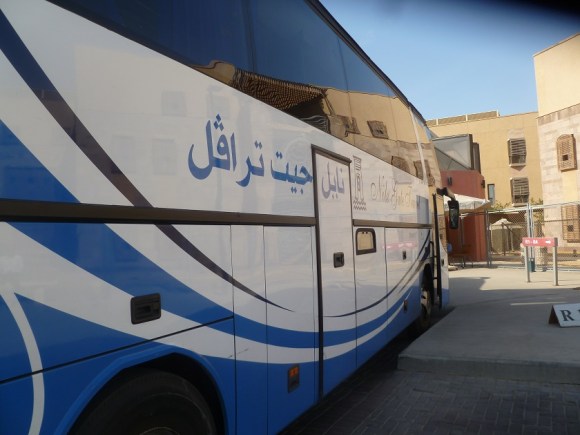
A while ago I visited the new AUC campus, which is quite a distance from its historic Tahrir Square location, where it still maintains administrative offices, operates a bookstore, and hosts educational and cultural events. Tahrir is easily accessible by metro, whereas students must now commute over an hour to get to class. But a high-quality bus runs on set schedule, mirroring the high-quality campus, all funded by high tuition far outpacing any fees charged by Egyptian private universities.

(Click here for a recent post on fees charged by private high schools operating in Egypt.)

Please enjoy the pictures below:

Upon arriving by bus at the university gates
Showing the extent of campus grounds
A view from the grounds
Though some female students wear hijab, a great number did not, far more than the normal percentage in Egypt
The university provides plenty of open space to sit, relax, and mix -- also somewhat unusual between genders in Egypt
The university provides plenty of open space to sit, relax, and mix — also somewhat unusual between genders in Egypt
There is also a sizable foreign population at AUC
Besides modern buildings, AUC has also created a modern oasis
But here the grass is much more patchy -- imagine the water necessary to create green open space on the outskirts of a desert
But here the grass is much more patchy — imagine the water necessary to create green open space on the outskirts of a desert
A typical and well equipped classroom
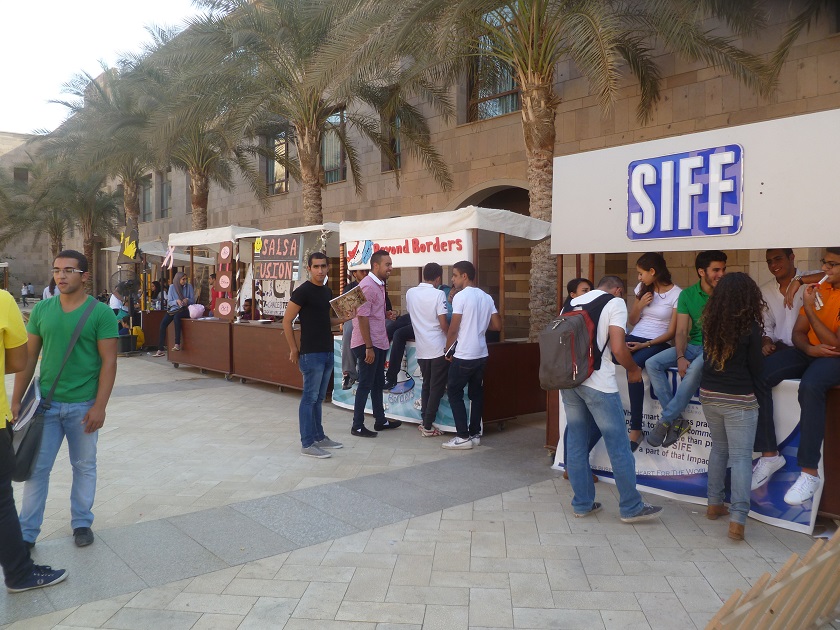
But before classes begin, students linger in the main square signing up for different student groups
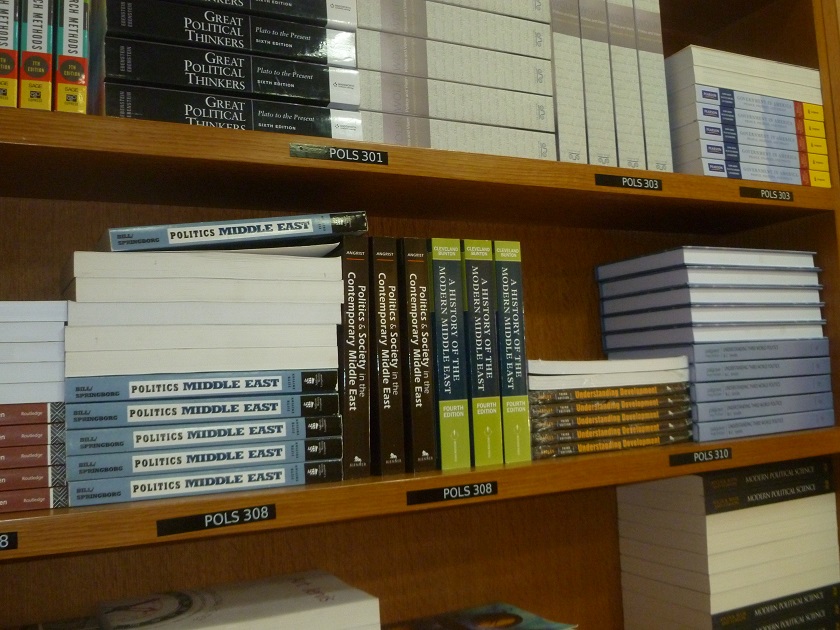
Afterwards, they will visit this very familiar university site
Finally, no campus is complete with insignia available to purchase and wear
Finally, no campus is complete without insignia available to purchase and wear

Again, congratulations to AUC on their ranking. Click here for the university website and explore on your own. Perhaps some might even come and enroll. Welcome.